
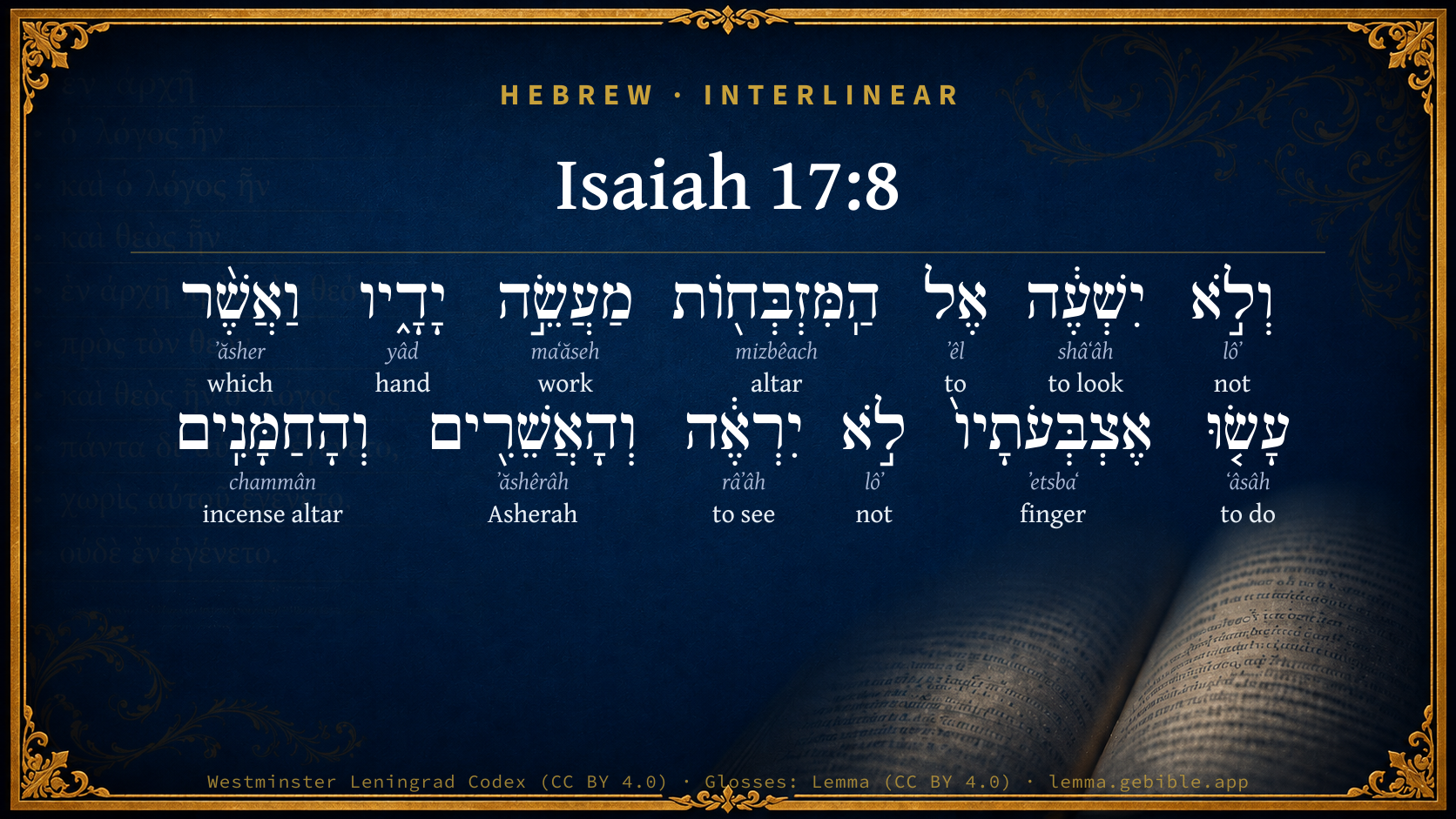
Isaiah 17:8

Hebrew (Westminster Leningrad Codex) Isaiah 17:8 appears in the Hebrew Old Testament. The text above is from the Westminster Leningrad Codex. Each word links to its Strong’s number, a concise gloss, and parsing drawn from the Open Scriptures Hebrew Bible morphology. Click any word for its full Brown-Driver-Briggs (BDB) entry.
Download image
Cite this verse

Isaiah 17:8 (World English Bible). Public Domain. Lemma interlinear Bible study tool, https://lemma.gebible.app/v/isaiah/17/8.

Show BibTeX & RIS
BibTeX
RIS
English Translation
They shall not look to the altars, the work of their hands; neither shall they have respect to that which their fingers have made, either the Asherim, or the sun-images.
World English Bible · Public Domain
Download a study sheet

One document with this verse’s original text, its word-by-word gloss line, the meaning frame, cross-references with their text, attributed commentary, and full source and license credits — printable, and it pastes into notes with its structure intact.

This verse Autodidact and up

Study sheet (.html) Plain text (.txt)

A passage Seminary Student

Up to 50 verses in one chapter. A passage sheet keeps up to 6 commentary sources and 12 cross-references per verse, in the order this page ranks them, and says so on the sheet whenever that leaves anything out. Ask for a single verse and you get the Autodidact verse sheet above.

Everything on this page stays free to read, with no account — the sheet is a download of what is already on screen, not access to it.

Want to remove ads? Support Godless Engineer
Compare translations 3

The same verse in 3 English versions, stacked beneath the original-language interlinear above. Click any original word for its lexicon entry.

Each is an independent rendering of the whole verse — the interlinear is not word-aligned to these translations.

Highlighted words mark where these versions differ — a whole-verse word diff, not a word-by-word alignment.

  • World English Bible Public Domain
    They shall not look to the altars, the work of their hands; neither shall they have respect to that which their fingers have made, either the Asherim, or the sun-images.
  • King James Version Public Domain
    And he shall not look to the altars, the work of his hands, neither shall respect that which his fingers have made, either the groves, or the images.
  • unfoldingWord Literal Text CC BY-SA 4.0
    And he will not gaze at altars, the work of his hands. And he will not look what his fingers have made, either Asherahs or sun images.

unfoldingWord Literal Text — © unfoldingWord, licensed CC BY-SA 4.0. Word-aligned USFM3 via Door43 (git.door43.org/unfoldingWord/en_ult).

Versions to compare (up to 4)

3 of 4 selected

Show all 18 translations

Every available English version of this verse, each an independent rendering of the whole verse.

  • World English Bible Public Domain
    They shall not look to the altars, the work of their hands; neither shall they have respect to that which their fingers have made, either the Asherim, or the sun-images.
  • Berean Standard Bible Public Domain
    They will not look to the altars they have fashioned with their hands or to the Asherahs and incense altars they have made with their fingers.
  • Majority Standard Bible Public Domain
    They will not look to the altars they have fashioned with their hands or to the Asherahs and incense altars they have made with their fingers.
  • King James Version Public Domain
    And he shall not look to the altars, the work of his hands, neither shall respect that which his fingers have made, either the groves, or the images.
  • American Standard Version (1901) Public Domain
    And they shall not look to the altars, the work of their hands; neither shall they have respect to that which their fingers have made, either the Asherim, or the sun-images.
  • Revised Version (1885) Public Domain
    And he shall not look to the altars, the work of his hands, neither shall he have respect to that which his fingers have made, either the Asherim, or the sun-images.
  • Geneva Bible (1599) Public Domain
    And hee shall not looke to the altars, the workes of his owne hands, neither shall he looke to those thinges, which his owne fingers haue made, as groues and images.
  • Douay-Rheims (1899) Public Domain
    And he shall not look to the altars which his hands made: and he shall not have respect to the things that his fingers wrought, such as groves and temples.
  • Young's Literal Translation Public Domain
    And he looketh not unto the altars. The work of his own hands, And that which his own fingers made He seeth not -- the shrines and the images.
  • Literal Standard Version CC BY-SA 4.0
    And he does not look to the altars. The work of his own hands, || And that which his own fingers made, He does not see—the Asherim and the images.
  • Unlocked Literal Bible CC BY-SA 4.0
    They will not look to the altars, the work of their hands, nor will they look to what their fingers have made, the Asherah poles or the sun images.
  • unfoldingWord Literal Text CC BY-SA 4.0
    And he will not gaze at altars, the work of his hands. And he will not look what his fingers have made, either Asherahs or sun images.
  • Darby Bible Public Domain
    And he will not look to the altars, the work of his hands, nor have regard to what his fingers have made, neither the Asherahs nor the sun-images.
  • World Messianic Bible Public Domain
    They will not look to the altars, the work of their hands; neither shall they respect that which their fingers have made, either the Asherah poles or the incense altars.
  • Webster's Bible Public Domain
    And he shall not look to the altars, the work of his hands, neither shall respect that which his fingers have made, either the groves, or the images.
  • Free Bible Version CC BY-SA 4.0
    They won't believe in the altars they built and the idols they made; they will not look to the Asherah poles or the altars of incense.
  • Bible in Basic English Public Domain
    He will not be looking to the altars, the work of his hands, or to the wood pillars or to the sun-images which his fingers have made.
  • JPS Tanakh (1917) Public Domain
    And he shall not regard the altars, the work of his hands, neither shall he look to that which his fingers have made, either the Asherim, or the sun-images.

Literal Standard Version (2020), Covenant Press — licensed CC BY-SA 4.0. Text via the HelloAO Bible API (eBible.org). Unlocked Literal Bible (unfoldingWord) — licensed CC BY-SA 4.0. Text via the HelloAO Bible API (eBible.org). unfoldingWord Literal Text — © unfoldingWord, licensed CC BY-SA 4.0. Word-aligned USFM3 via Door43 (git.door43.org/unfoldingWord/en_ult). Free Bible Version, Dr. Jonathan Gallagher — licensed CC BY-SA 4.0. Text via the HelloAO Bible API (eBible.org).

Word by word

More ways to search: Search by grammar → Find every occurrence → Compare this word →

Practice this passage: Drill this verse → Learn its vocabulary →

וְהָחַמָּנִֽים
chammân
H2553
“and · the · incense altars”
Conjunction + Particle, Definite Article + Noun, Common, Masculine, Plural, Absolute
Part of Speech
Conjunction + Particle + Noun
Type
Common
Gender
Masculine
Number
Plural
State
Absolute
Full BDB Definition

Origin: from H2535

TWOT: TWOT- 677d

incense altar, sun-pillar, idol, image - used in idolatrous worship
  1. וְלֹ֣א lôʼ H3808 “and · not” Conjunction + Particle, Negative
  2. יִשְׁעֶ֔ה shâʻâh H8159 “to look” Verb, Qal, Imperfect, 3rd Person, Masculine, Singular
  3. אֶל ʼêl H413 “to” Preposition
  4. הַֽמִּזְבְּח֖וֹת mizbêach H4196 “the · altars” Particle, Definite Article + Noun, Common, Masculine, Plural, Absolute
  5. מַעֲשֵׂ֣ה maʻăseh H4639 “work of” Noun, Common, Masculine, Singular, Construct
  6. יָדָ֑יו yâd H3027 “hands · his” Noun, Common, Both, Dual, Construct + Suffix, Personal, 3rd Person, Masculine, Singular
  7. וַאֲשֶׁ֨ר ʼăsher H834 “and · which” Conjunction + Particle, Relative
  8. עָשׂ֤וּ ʻâsâh H6213 “to do” Verb, Qal, Perfect, 3rd Person, Common, Plural
  9. אֶצְבְּעֹתָיו֙ ʼetsbaʻ H676 “fingers · his” Noun, Common, Feminine, Plural, Construct + Suffix, Personal, 3rd Person, Masculine, Singular
  10. לֹ֣א lôʼ H3808 “not” Particle, Negative
  11. יִרְאֶ֔ה râʼâh H7200 “to see” Verb, Qal, Imperfect, 3rd Person, Masculine, Singular
  12. וְהָאֲשֵׁרִ֖ים ʼăshêrâh H842 “and · the · Asherah” Conjunction + Particle, Definite Article + Noun, Proper

About this verse

These counts appear in no published source. They are computed here, from the morphology-tagged text and Lemma’s own curated glosses. What Lemma adds →

13
words
12
distinct lemmas
Prophets
section

Notable vocabulary

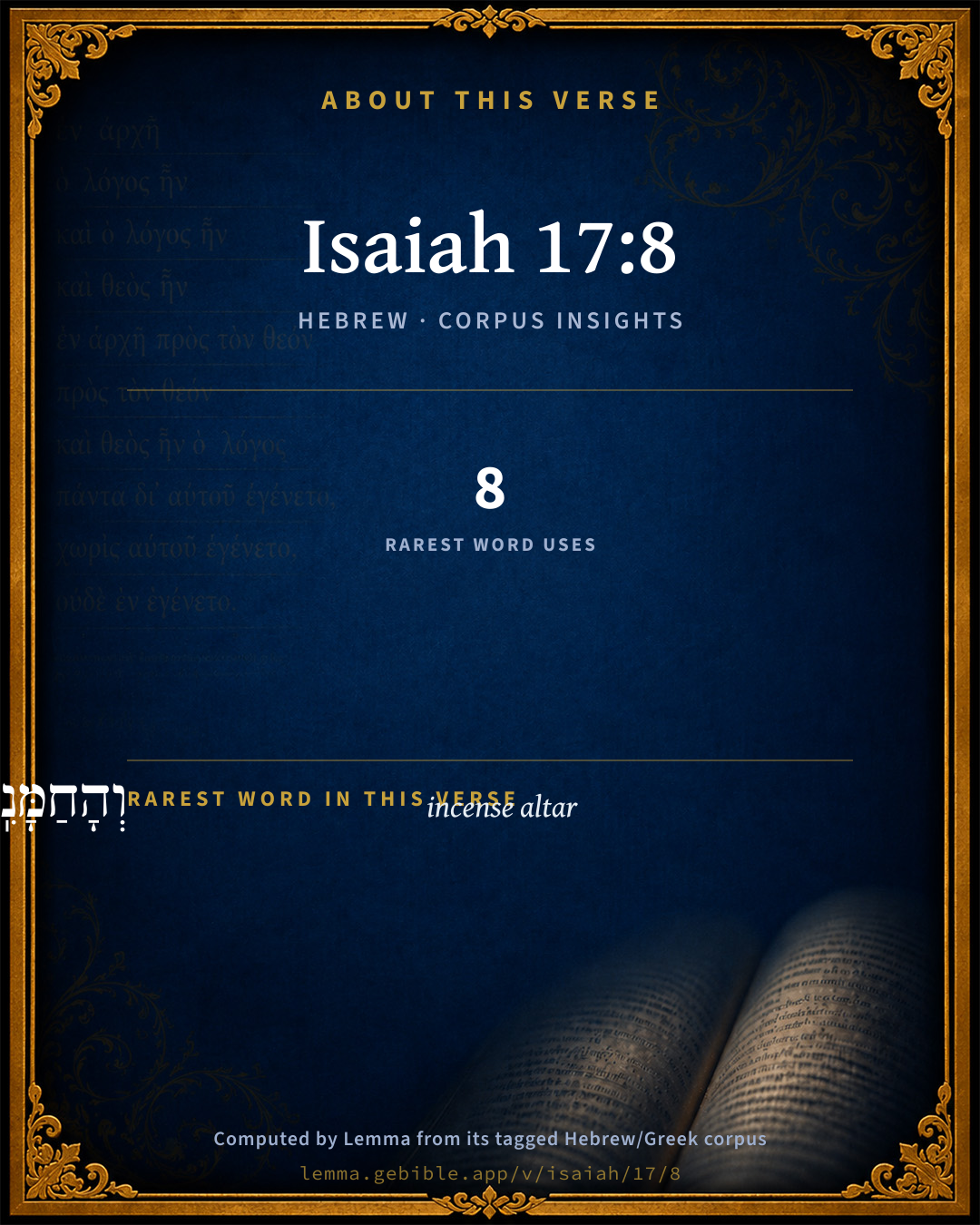
The rarest word here is וְהָחַמָּנִֽים incense altar H2553 — appearing just 8 times in the whole Hebrew Bible.

Shared distinctive vocabulary

וְהָחַמָּנִֽים incense altar H2553 occurs in 8 verses of the Hebrew Bible. Also found in:

Grammatical profile

  • 3 verbs
  • 6 nouns
  • 1 preposition
  • 3 particles

Verb forms

  • יִשְׁעֶ֔ה Qal · Imperfect
  • עָשׂ֤וּ Qal · Perfect
  • יִרְאֶ֔ה Qal · Imperfect

Repetition

A word recurs within this verse — often emphatic in Hebrew:

  • וְלֹ֣א not H3808 ×2

Hebrew & Septuagint length

In English translation the verse runs 30 words from the Hebrew and 33 from the Septuagint (LXX English) — closely comparable.

A rough comparison of the two English renderings, which tokenize alike — not a word-level alignment.

Word counts can differ between the Hebrew and the Greek without any difference in meaning — e.g. the Hebrew direct-object marker אֵת has no separate Greek word, and Greek often adds the article ὁ.

Cross-references

20

Topical passages linked to Isaiah 17:8 in the Treasury of Scripture Knowledge — connected by theme and wording, ordered by reader-vote popularity; previews shown in the World English Bible.

  • Isaiah 30:22 You shall defile the overlaying of your engraved images of silver, and the plating of your molten images of gold: you shall cast them away as an unclean thing; you shall tell it, Get you hence.
  • Isaiah 27:9 Therefore by this shall the iniquity of Jacob be forgiven, and this is all the fruit of taking away his sin: that he makes all the stones of the altar as chalk stones that are beaten in sunder, [so that] the Asherim and the sun-images shall rise no more.
  • Isaiah 2:8 Their land also is full of idols. They worship the work of their own hands, That which their own fingers have made.
  • Micah 5:13–14 I will cut off your engraved images and your pillars out of your midst; And you shall no more worship the work of your hands.
  • Exodus 34:13 but you shall break down their altars, and dash in pieces their pillars, and you shall cut down their Asherim;
  • 2 Chronicles 14:5 Also he took away out of all the cities of Judah the high places and the sun-images: and the kingdom was quiet before him.
  • 2 Chronicles 34:4 They broke down the altars of the Baals in his presence; and the sun-images that were on high above them he hewed down; and the Asherim, and the engraved images, and the molten images, he broke in pieces, and made dust of them, and strewed it on the graves [of those] who had sacrificed to them.
  • 2 Chronicles 34:6–7 [So did he] in the cities of Manasseh and Ephraim and Simeon, even to Naphtali, in their ruins round about.
  • Isaiah 1:29 For they shall be ashamed of the oaks which you have desired, And you shall be confounded for the gardens that you have chosen.
  • Isaiah 2:18–21 The idols shall utterly pass away.
  • Isaiah 31:6–7 Turn you to him from whom you have deeply revolted, children of Israel.
  • Isaiah 44:15 Then shall it be for a man to burn; and he takes of it, and warms himself; yes, he kindles it, and bakes bread: yes, he makes a god, and worships it; he makes it an engraved image, and falls down to it.
  • Isaiah 44:19–20 None calls to mind, neither is there knowledge nor understanding to say, I have burned part of it in the fire; yes, also I have baked bread on the coals of it; I have roasted flesh and eaten it: and shall I make the residue of it an abomination? shall I fall down to the stock of a tree?
  • Ezekiel 36:25 I will sprinkle clean water on you, and you shall be clean: from all your filthiness, and from all your idols, will I cleanse you.
  • Hosea 8:4–6 They have set up kings, but not by me. They have made princes, and I didn't approve. Of their silver and their gold they have made themselves idols, That they may be cut off.
  • Hosea 10:1–2 Israel is a luxuriant vine that puts forth his fruit. According to the abundance of his fruit he has multiplied his altars. As their land has prospered, they have adorned their sacred stones.
  • Hosea 13:1–2 When Ephraim spoke, there was trembling. He exalted himself in Israel, But when he became guilty in Baal, he died.
  • Hosea 14:8 Ephraim, what have I to do any more with idols? I answer, and will take care of him. I am like a green fir tree; From me your fruit is found."
  • Zephaniah 1:3 I will sweep away man and animal. I will sweep away the birds of the sky, the fish of the sea, and the heaps of rubble with the wicked. I will cut off man from the surface of the earth, says Yahweh.
  • Zechariah 13:2 It will come to pass in that day, says Yahweh of Hosts, that I will cut off the names of the idols out of the land, and they will no more be remembered; and also I will cause the prophets and the spirit of impurity to pass out of the land.

Cross-references courtesy of OpenBible.info (CC BY 4.0).

Hebrew and Greek witnesses Masoretic Hebrew ↔ Greek Septuagint

The same verse in the two great witnesses to the Old Testament, shown verse-for-verse.

These are two independent witnesses, not word-aligned to each other, and the Septuagint is shown in lemma (dictionary) form.

Hebrew Isaiah 17:8 Masoretic · Westminster Leningrad Codex

וְלֹ֣א יִשְׁעֶ֔ה אֶל הַֽמִּזְבְּח֖וֹת מַעֲשֵׂ֣ה יָדָ֑יו וַאֲשֶׁ֨ר עָשׂ֤וּ אֶצְבְּעֹתָיו֙ לֹ֣א יִרְאֶ֔ה וְהָאֲשֵׁרִ֖ים וְהָחַמָּנִֽים

They shall not look to the altars, the work of their hands; neither shall they have respect to that which their fingers have made, either the Asherim, or the sun-images.

World English Bible · Public Domain

Greek LXX Isaiah 17:8 Septuagint · lemma form

καί οὐ μή πείθω οὖς ἐπί ὁ βωμός οὐδέ ἐπί ὁ ἔργον ὁ χείρ αὐτός ὅς ποιέω ὁ δάκτυλος αὐτός καί οὐ ὁράω ὁ δένδρον αὐτός οὐδέ ὁ βδέλυγμα αὐτός

And they shall not at all trust in their altars, nor in the works of their hands, which their fingers made; and they shall not look to the trees, nor to their abominations.

LXX2012 (modern English Septuagint) · Public Domain

Hebrew: Westminster Leningrad Codex (CC BY 4.0). Greek: Septuagint (public domain); English from LXX2012 (modern English Septuagint) (Public Domain). How the Septuagint differs from the Hebrew →

Targum (Aramaic paraphrase)

1

The Targum is the ancient Jewish Aramaic paraphrase of the Hebrew Scriptures — an interpretive translation, not the Hebrew text itself. Onkelos (literal) and Pseudo-Jonathan (expansive) render the Torah, and Jonathan the Prophets. Coverage is partial: where no permissively-licensed English translation exists for a verse, only the Aramaic is shown. This is verse-level text, not a word-by-word alignment to the Hebrew.

  1. Targum Jonathan Prophets (Joshua–Malachi)
    וְלָא יִסְתְּמֵיךְ עַל אֱגוֹרַיָא עוֹבַד יְדוֹהִי וּדְאַתְקְנָא אֶצְבְּעְתֵיהּ לָא יִתְקַיֵים וַאֲשֵׁרַיָא וַחֲנִיסְנְסַיָא:

    He shall not rest upon the altars, the work of his hands, or stay himself upon that which his fingers have prepared, neither upon the groves nor upon the sun-images.

    Targum Jonathan — Aramaic: “Mikraot Gedolot” (public domain). English: “Sefaria Community Translation” (CC0 1.0 (public-domain dedication)); “London "Chaldee Paraphrase," 1871” (public domain). Text via Sefaria.

Commentary

Notes on Isaiah 17:8 from classic Christian and Jewish commentators (each source and its license shown beneath its notes). The classic Christian expositions comment on the surrounding passage and are grouped to its opening verse, so a note may address several verses; the Jewish commentaries on the Tanakh (Rashi and others) are per-verse, so they appear only where the commentator wrote on this verse.

Lemma curates 59 commentaries, every one of them public domain or Creative Commons licensed, each selected and text-cleaned for this edition rather than reprinted as found. About our sources →

Trapp's Complete Commentary

John Trapp

Isa 17:8 And he shall not look to the altars, the work of his hands, neither shall respect [that] which his fingers have made, either the groves, or the images.

Ver. 8. And he shall not look to the altars.] As, having looked before to his Maker with a single eye, with an eye of adamant, that will turn only to one point. See on Hos 14:8.

John Trapp, A Commentary or Exposition upon All the Books of the Old and New Testament (1647–1656) — public domain. Text from a community e-Sword module.

Tyndale Open Study Notes

Tyndale Open Resources

17:8 Canaanites and then Israelites worshiped the fertility goddess Asherah in wooded areas or, in the absence of wooded areas, using Asherah poles (see 27:9; 65:3; Mic 5:14).

Tyndale Open Study Notes — © Tyndale Open Resources, licensed CC BY-SA 4.0. Text via the HelloAO Bible API.

Jamieson, Fausset & Brown

Robert Jamieson, A. R. Fausset & David Brown

groves--A symbolical tree is often found in Assyrian inscriptions, representing the hosts of heaven ("Saba"), answering to Ashteroth or Astarte, the queen of heaven, as Baal or Bel is the king. Hence the expression, "image of the grove," is explained (Kg2 21:7).

images--literally, "images to the sun," that is, to Baal, who answers to the sun, as Astarte to the hosts of heaven (Kg2 23:5; Job 31:26).

Jamieson, Fausset & Brown — Commentary Critical and Explanatory on the Whole Bible (1871) — public domain (CC PDM 1.0). Text via the HelloAO Bible API.

Adam Clarke's Commentary

Verse 8. The altars, the work of his hands - "The altars dedicated to the work of his hands"] The construction of the words, and the meaning of the sentence, in this place are not obvious; all the ancient Versions, and most of the modern, have mistaken it. The word מעשה maaseh, "the work," stands in regimine with מזבחות mizbechoth, "altars," not in opposition to it; it means the, altars of the work of their hand; that is of the idols, which are the work of their hands. Thus Kimchi has explained it, and Le Clerc has followed him.

Adam Clarke's Commentary on the Bible (1810–1826) — public domain. Text from a community e-Sword/MySword module.

Ellicott's Commentary for English Readers

(8) The groves or the images.—Literally, the Asherah or the sun-images. The former were conical, tree-like pillars which symbolised the worship of a Canaanite goddess, the giver of good fortune. (See Notes on 2Ki_21:7; 2Ch_34:3-7.)

A Bible Commentary for English Readers, edited by Charles John Ellicott (1878–1897) — public domain. Text from a community e-Sword module.

The Cambridge Bible for Schools and Colleges

gen. ed. J. J. S. Perowne

8. the work of his hands … that which his fingers have made] phrases used of idols in ch. Isa_2:8; Isa_2:20, Isa_31:7.

the altars … either the groves or the images] These words overburden the rhythm of the verse and are probably explanatory glosses. An allusion to the brazen-altar of Ahaz (2Ki_16:10-13) is far-fetched, even if not absolutely excluded by the date. The two last-mentioned objects are never referred to elsewhere by Isaiah.

the groves] R.V., rightly, the Asherim. The Ashçrah or Sacred Pole was an emblem of divinity which seems to have stood regularly by the side of the altar in a Canaanitish sanctuary (Jdg_6:13; Jdg_6:25; Deu_16:21; 2Ki_18:4, &c.). It is regarded by some as an artificial survival of the sacred tree, under which the altar stood; by others as the symbol (or image) of a goddess of the same name. Whether a goddess Ashçrah was actually worshipped is a much controverted point; if so, she was probably nothing more than an impersonation of the material symbol here referred to. (See Robertson Smith, Relig. of the Semites, Revd. Ed. pp. 187 ff.)

images] probably sun-pillars: R.V. “sun-images.” The word (ḥammânîm, pl.) only occurs in ch. Isa_27:9; 2Ch_14:5; 2Ch_34:4; 2Ch_34:7; Eze_6:4; Eze_6:6; Lev_26:30. It seems to be connected with Baal-Ḥammân, a Phœnician deity (best known from the Carthaginian inscriptions) whose name appears to designate him as “Lord of the sun’s heat,” (cf. the Hebrew ḥammâh used in poetry of the sun: Psa_19:6; Job_30:28; Son_6:10; Isa_24:23; Isa_30:26). The “sun-pillars” were probably emblems of this deity.

The Cambridge Bible for Schools and Colleges (gen. ed. J. J. S. Perowne; Cambridge University Press, 1878–1918) — public domain. Text from a community e-Sword module.

John Gill's Exposition

And he shall not took to the altars, the work of his hands,.... That is, to altars erected to the worship of idols, which are both the works of men's hands, so as to serve at them, and sacrifice upon them. Kimchi observes, that the latter clause is not to be understood as belonging to the former, but as distinct from it, and signifies idols which men have made; otherwise all altars, even the altars of God, were the works of men, which yet it was right to look unto, and offer sacrifice upon; but idol altars, and idols themselves, are here meant: and a good man will not look unto his good works as altars to atone for sin; he knows that nothing that a creature can do can expiate sin; that his best works are such as are due to God, and therefore can never atone for past crimes; that Jesus Christ is only the altar, sacrifice, and priest, to whom he looks for, and from whom he receives the atonement:

neither shall respect that which his fingers have made, either the groves or the images; both might be said to be made by the fingers of men, the former being planted, and, the latter carved and fashioned by them; whether by groves are meant clusters of trees, where idols and altars were placed, or medals struck with such a representation on them, and also whatever images are here designed: the word signifies sun images, images made to represent the sun, or for the honour and worship of it. Aben Ezra says they were images made according to the likeness of chariots for the sun. The Targum renders it "temples", such as were dedicated to the sun; though some understand by it sunny places, where their idols were set and sunburnt, as distinct from shady groves. Good men will not took to their own works, what their fingers have wrought, as groves to shelter them from divine wrath and vengeance, or as idols to bow down to, trust in, and depend upon for salvation; but reject them, and look to Christ only.

John Gill's Exposition of the Whole Bible (1746–1763) — public domain (CC PDM 1.0). Text via the HelloAO Bible API.

Albert Barnes' Notes on the Bible

And he shall not look to the altars - That is, the altars of the gods which the Syrians worshipped, and the altars of the false gods which had been erected in the land of Israel or Samaria by its wicked kings, and particularly by Ahaz. Ahaz fancied an altar which he saw at Damascus when on a visit to Tiglath-pileser, and ordered Urijah the priest to construct one like it in Samaria, on which he subsequently offered sacrifice 2Ki 16:10-13. It is well known, also, that the kings of Israel and Judah often reared altars to false gods in the high places and the groves of the land (see 2Ki 21:3-5). The Ephraimites were particularly guilty in this respect Hos 8:11 : ‘Because Ephraim hath made many altars to sin, altars shall be unto him to sin.’

Which his fingers have made - Perhaps indicating that the idols which they worshipped had been constructed with special art and skill (see Isa 2:8).

Either the groves - The altars of idols were usually erected in groves, and idols were worshipped there before temples were raised (see Exo 34:13; Deu 7:5; Deu 12:3; Jdg 3:7; 1Ki 14:23; 1Ki 18:19; 2Ch 33:3; compare the notes at Isa 1:29).

Or the images - Margin, ‘Sun images’ (חמנים chamānı̂ym). This word is used to denote idols in general in Lev 26:30; 2Ch 24:4. But it is supposed to denote properly images erected to the sun, and to be derived from חמה chamāh, “the sun.” Thus the word is used in Job 30:28; Isa 24:23; Isa 30:26; Son 6:10. The word, according to Gesenius, is of Persian origin (Commentary in loc.) The sun was undoubtedly worshipped by the ancient idolaters, and altars or images would be erected to it (see the notes at Job 31:26).

Albert Barnes' Notes on the Bible (1834–1885) — public domain. Text from a community e-Sword/MySword module.

Matthew Poole's English Annotations

Not look to the altars; not resort or trust to them, or to the worship offered to idols upon them.

The work of his hands; their own inventions; for otherwise the altars made by God’s command were the work of men’s hands. The groves, which were devised and planted by men, as fit places for the worship of their gods; and therefore were forbidden, Deu 16:21; 1Ki 14:15. The images, worshipped in their groves. The word properly signifies images of the sun, either having the form and shape of the sun, or at least erected to his honour and worship; of which see Deu 4:19; 17:3; 2Ki 23:5,11; Jer 8:2; 7:18; 44:17,18.

Matthew Poole's English Annotations on the Holy Bible (1683–1685) — public domain. Text from a community e-Sword/MySword module.

The Pulpit Commentary

And he shall not look to the altars. The altars at Dan and Bethel (1Ki_12:28-33) may be intended, or the Israelites may have had other idolatrous altars besides these. (2Ki_17:11 Hos_8:11) Josiah, about B.C. 631, broke down altars throughout all the land of Israel, in the cities of Manasseh and Ephraim and Simeon(?), even unto Naphtali. (2Ch_34:5-7) Apparently he had the consent of the inhabitants to this demolition. Either the groves, or the images, Asherah, the word here and elsewhere commonly translated "grove" in the Authorized Version, is now generally admitted to have designated an artificial construction of wood or metal, which was used in the idolatrous worship of the Phoenicians and the Israelites, probably as the emblem of some deity. The Assyrian "sacred tree" was most likely an emblem of the same kind, and may give an idea of the sort of object worshipped under the name of Asherah (comp. "Ancient Monarchies," vol. 2. pp. 235-237). The Israelites, in the time of their prosperity, had set up "groves" of this character "on every high hill, and under every green tree". (2Ki_17:10) Many of them were still standing when Josiah made his iconoclastic raid into the Israelite country, (2Ch_34:5-7) and were broken down by him at the same time as the altars. The "images" of this place are the same as those coupled with the Israelite "groves" in 2Ch_34:7, namely "sun-images," emblems of Baal, probably pillars or conical stones, such as are known to have held a place in the religious worship of Phoenicia.

The prophet on heathen worship.

Having described in brief the true religion as a "looking up to God" as Maker and Redeemer of Israel, the prophet with equal expressiveness characterizes the heathen worship around.

I IT IS REVERENCE FOR THE OBJECT OF HUMAN ART. Contemptuous is the reference to "the work of his hands," and "that which his fingers have made altars and images. When the spiritual nerve of religion is weakened, the affections fix upon the symbols, forms, and accessories of religion. The soul that has lost its God must have some visible substitute, as a pet, a plaything, an idol. When the meaning of sacrifice is deeply realized and felt, any bare table will suffice for altar. But as the idea and feeling become extinct, all the more will men seek to supply the void by some beauty in the object. The shrine becomes more splendid as devotion becomes more cold. Perhaps the prophet is thinking of the case of King Ahaz. He went to Damascus to meet Tiglath-Pileser of Assyria, and there saw an altar" which so pleased him, that he sent the pattern of it to Urijah the priest, who built one to correspond. And this was a king who sacrificed and burned incense in the high places, and on the hills, and under every green tree". (2Ki 16) And Manasseh, rejecting the good example of Hezekiah his father, set up altars to Baal, and made a grove, and plunged deeply into all manner of superstition. (2Ki 21) The Prophet Hosea pointedly speaks of the tendency in the people generally: "Because Ephraim has made many altars to sin, altars shall be unto him to sin". (Hos_8:2) The connection of this with luxury is pointed out by our prophet Isa_2:7, Isa_2:8. But what strikes him especially with astonishment is the addiction to "art for art"s sake." This has been a cant and, to some extent, a creed in our time. When carried out, it must mean the valuation of human genius and talent regardlessly of the subjects on which, and the ends for which, it is employed. No matter how seusualizing or otherwise debasing to feeling the painter"s or the sculptor"s theme, the cleverness with which he treats form and color, light and shade, is only worth attending to. These doctrines may be carried into the church, which may become a place for mere imaginative and sensuous enjoyment; and people may find they cannot "look up to God" in a building whose lines are incorrectly drawn, or where the latest fashion of ecclesiastical foppery is not kept up. By-and-by it will be discovered that the house of God has been turned into a theatre, containing, it is true, an altar, but, like the altar in the great theatre at Athens, serving for little more than a station of performers. Spiritual worship is extinct with us if we cannot lift up eye, and heart, and hand, and voice to the Eternal with equal joy, if need demand, in the barn as in the cathedral. But how wide-reaching the principle of idolatry! The delight in genius, the admiration for it, may enter into religious feeling as one of its richest elements; it may, on the other hand, be separated from religious feeling altogether, and be the principle of an idolatry.

II IT IS IMPURE AND CRUEL. There is an allusion to the worship of Baal and Ashtoreth, and what we know of these deities indicates beings conceived by those worshippers as dark, wrathful, malignant, and lustful. Baal, often named in the plural Baalim, is closely related to, if not identical with, Moloch, (see Jer_7:31 Jer_19:5 Jer_32:35) whose terrible wrath was supposed to be manifested in the torrid heat of summer, and who exacted human sacrifices. In great dangers kings sacrificed to this Bel-Moloch their only sons; (2Ki_3:27) and this is sternly denounced in Lev_20:3. It would seem that Israelites in their declension confounded the nature of this heathen god with that of Jehovah. (Num_25:4) Read the eloquent protest of Mic_6:7, and see how clearly in that animated passage the contrast is made between the merciful and holy religion of Jehovah and the cursed ritual of Baal or of Moloch. "To do justly, to love mercy, to walk humbly with God, these are the requirements of true religion. By the side of Baal was Ashtoreth in Canaan (Jud_1:10:6) and in Syria. The Greeks called her Astarte. At Babylon she was known as Mylitta or Beltis, consort of Bel; and Herodotus describes the darkly superstitious and impure character of her worship, which involved the profanation of women (1. 199). The religion of Israel knows no goddess; the people itself, when true to their faith, felt themselves to be as a people, the bride of Jehovah, and unfaithfulness to him is a crime analogous to unfaithfulness to the nuptial tie. "Israel my people, I their God," is the symbolic word of the covenant between spirit and Spirit, which religion ever is, in its truth and purity. There are lessons for us in all this. There are ever tendencies at work to degrade and defile the holy ideas of our religion. Sometimes it is wealth, sometimes it is ignorance, sometimes greed and other passions. Men would subdue the spirit of Christianity to their own liking, and bow down, if not to the work of their fingers, to the impure idols of an unchastened fancy. The preacher, the true prophet, must, on the other hand, be ever upholding the purity of doctrine, and exhibit those grand requirements to which the conscience must, however reluctantly, respond. And he must lay it to heart that the purer religion can never be the most fashionable. If the people turn aside to groves and altars more suited to their taste, at least let him make it his one concern to "save himself and them that hear him. J.

The Pulpit Commentary (1880–1919), ed. H.D.M. Spence-Jones & Joseph S. Exell — public domain. Text from a community e-Sword module.

John Wesley's Explanatory Notes

Not look - Not trust to them, or to worship offered to idols upon them. The work - Their own inventions. Groves - Which were devised by men, as fit places for the worship of their gods. Images - Worshipped in their groves.

John Wesley, Explanatory Notes Upon the Whole Bible (1754–1765) — public domain. Text via the GEBible commentary corpus.

J. A. Alexander on Isaiah

Joseph Addison Alexander

“And he shall not turn (or look) to the altars, the work of his own hands, and that which his own fingers have made shall he not regard, and the groves (or images of Ashtoreth) and the pillars (or images) of the sun.” The positive declaration of the preceding verse is negatively expressed in this, with a particular mention of the objects which had usurped the place of God. Idol-altars are described as the work of men’s hands, because erected by their sole authority, whereas the altar at Jerusalem was, in the highest sense, the work of God Himself. The old translation ‘groves’, (i.e., such as were used for idol-worship), has been shown to be in some places inadmissible; as when the grove is said to have stood upon an altar, or under a tree, or to have been brought out of a temple (1Ki 14:23; 2Ch 34:4). The modern writers, therefore, understand it as denoting the goddess of fortune or happiness, otherwise called Ashtoreth, the Phoenician Venus, extensively worshipped in conjunction with Baal.

Joseph Addison Alexander, The Prophecies of Isaiah (1846–1847; New York: Scribner, 1870–1878) — public domain. Text from a community e-Sword module.

unfoldingWord translationNotes

Door43 World Missions Community

They will not look to the altars

Looking to the altars represents worshiping idols with the hope that the idols will help them. AT: "They will not worship idols at their altars" or "The people of Israel will not go to their altars and ask their idols to help them" (See: Metonymy)

the work of their hands

Here the people are represented by their "hands" to emphasize that they made the altars or idols. AT: "that they made with their hands" or "which they themselves built" (See: Synecdoche)

what their fingers have made ... the Asherah poles or the sun images

The second phrase identifies the things that the people made. Speaking of the fingers here emphasizes that the people made them, so these things are not real gods. AT: "the Asherah poles or the sun images, which they themselves made" (See: Metonymy)

that were forsaken because of the people of Israel

It can be made explicit who left these lands. This can be stated in active form. AT: "that the Hivites and Amorites left after the people of Israel came" (See: Assumed Knowledge and Implicit Information and Active or Passive)

translationWords

altar

hand

Asherah

forsake

people group

Israel

desolate

unfoldingWord translationNotes — © Distant Shores Media and the Door43 World Missions Community, licensed CC BY-SA 4.0. Source: git.door43.org/Door43/en_tn.

Rashi

Rabbi Shlomo Yitzchaki (Rashi)

he shall not regard [lit. he shall not see.] They shall not be important in his eyes.

Rashi on the Tanakh — English translations: “The Judaica Press complete Tanach with Rashi, translated by A. J. Rosenberg” (CC BY 4.0); “Pentateuch with Rashi's commentary by M. Rosenbaum and A.M. Silbermann, 1929-1934” (public domain); “The Metsudah Tanach series, Lakewood, N.J” (CC BY 4.0); and “The Book of Joshua, Metsudah Publications, 1997” (CC BY 4.0). Text via Sefaria.

Ibn Ezra

Rabbi Abraham ibn Ezra

והחמנים Nor the images of the sun. The נ is not radical; comp. רחמניות merciful (Lam. 4:10). חמנים are images made like chariots in honour of the sun (חַמָּה) as stated in the history of King Manasseh (2 Kings 21:3)

Ibn Ezra on the Tanakh — English translations: “Sefaria Community Translation” (CC0 1.0 (public-domain dedication)); “Yalkut, Sifsei Chachomim Chumash, Metsudah Publications, 2009” (CC BY 4.0); and “Commentary of Ibn Ezra on Isaiah - trans. by M. Friedlander, 1873” (public domain). Text via Sefaria.

Lesson kit

Teaching starters — assembled from the data on this page, not authored interpretation. Every prompt links to the verse data it draws on. Edit before teaching.

Isaiah, in the Prophets, opens this verse with 13 words (12 distinct Hebrew lemmas). Its most distinctive word is chammân (“incense altar”). A historical commentator’s framing appears above. Read the whole chapter for the surrounding context.

Discussion questions

  1. What does “incense altar” (chammân) contribute to the verse as a whole?
  2. How does Leviticus 26:30, which shares the word «incense altar», read alongside this verse?
  3. What does the repetition of “not” (2× in this one verse) do in this verse?
  4. These translations render this verse differently; the difference is in the English rendering, not the original. What questions does that raise?
  5. «יִשְׁעֶ֔ה» is a Qal Imperfect verb. How does that grammatical form shape the action described?
  6. Compare how Trapp's Complete Commentary and Tyndale Open Study Notes read this verse. Where do they agree or differ?

Things to notice

Reading settings

Reading text

Shown beneath each verse's original-language words.

Old Testament
Old Testament edition

Read the OT as the Masoretic Hebrew (MT) or the Greek Septuagint (LXX).

English shown for the Greek Septuagint (in the Hebrew ↔ Greek comparison).

Comparing translations? Open the Compare panel on any verse page to stack up to four side by side.