Exodus 38:4

Hebrew (Westminster Leningrad Codex) Exodus 38:4 appears in the Hebrew Old Testament. The text above is from the Westminster Leningrad Codex. Each word links to its Strong’s number, a concise gloss, and parsing drawn from the Open Scriptures Hebrew Bible morphology. Click any word for its full Brown-Driver-Briggs (BDB) entry.
Download image
Cite this verse

Exodus 38:4 (World English Bible). Public Domain. Lemma interlinear Bible study tool, https://lemma.gebible.app/v/exodus/38/4.

Show BibTeX & RIS
BibTeX
RIS
English Translation
He made for the altar a grating of a network of brass, under the ledge around it beneath, reaching halfway up.
World English Bible · Public Domain
Download a study sheet

One document with this verse’s original text, its word-by-word gloss line, the meaning frame, cross-references with their text, attributed commentary, and full source and license credits — printable, and it pastes into notes with its structure intact.

This verse Autodidact and up

Study sheet (.html) Plain text (.txt)

A passage Seminary Student

Up to 50 verses in one chapter. A passage sheet keeps up to 6 commentary sources and 12 cross-references per verse, in the order this page ranks them, and says so on the sheet whenever that leaves anything out. Ask for a single verse and you get the Autodidact verse sheet above.

Everything on this page stays free to read, with no account — the sheet is a download of what is already on screen, not access to it.

Want to remove ads? Support Godless Engineer
Compare translations 3

The same verse in 3 English versions, stacked beneath the original-language interlinear above. Click any original word for its lexicon entry.

Each is an independent rendering of the whole verse — the interlinear is not word-aligned to these translations.

Highlighted words mark where these versions differ — a whole-verse word diff, not a word-by-word alignment.

  • World English Bible Public Domain
    He made for the altar a grating of a network of brass, under the ledge around it beneath, reaching halfway up.
  • King James Version Public Domain
    And he made for the altar a brazen grate of network under the compass thereof beneath unto the midst of it.
  • unfoldingWord Literal Text CC BY-SA 4.0
    And he made a grate for the altar, a work of a network of bronze under its ledge, from below to its middle.

unfoldingWord Literal Text — © unfoldingWord, licensed CC BY-SA 4.0. Word-aligned USFM3 via Door43 (git.door43.org/unfoldingWord/en_ult).

Versions to compare (up to 4)

3 of 4 selected

Show all 18 translations

Every available English version of this verse, each an independent rendering of the whole verse.

  • World English Bible Public Domain
    He made for the altar a grating of a network of brass, under the ledge around it beneath, reaching halfway up.
  • Berean Standard Bible Public Domain
    He made a grate of bronze mesh for the altar under its ledge, halfway up from the bottom.
  • Majority Standard Bible Public Domain
    He made a grate of bronze mesh for the altar under its ledge, halfway up from the bottom.
  • King James Version Public Domain
    And he made for the altar a brazen grate of network under the compass thereof beneath unto the midst of it.
  • American Standard Version (1901) Public Domain
    And he made for the altar a grating of network of brass, under the ledge round it beneath, reaching halfway up.
  • Revised Version (1885) Public Domain
    And he made for the altar a grating of network of brass, under the ledge round it beneath, reaching halfway up.
  • Geneva Bible (1599) Public Domain
    Moreouer he made a brasen grate wrought like a net to the Altar, vnder the compasse of it beneath in the middes of it,
  • Douay-Rheims (1899) Public Domain
    And he made the grate thereof of brass, in manner of a net, and under it in the midst of the altar a hearth,
  • Young's Literal Translation Public Domain
    And he maketh for the altar a brazen grate of net-work, under its border beneath, unto its midst;
  • Literal Standard Version CC BY-SA 4.0
    And he makes a bronze grate of network for the altar, under its rim beneath, to its midst;
  • Unlocked Literal Bible CC BY-SA 4.0
    He made a grate for the altar, a network of bronze to be placed under the ledge, halfway down to the bottom.
  • unfoldingWord Literal Text CC BY-SA 4.0
    And he made a grate for the altar, a work of a network of bronze under its ledge, from below to its middle.
  • Darby Bible Public Domain
    And he made for the altar a grating of network of copper under its ledge from beneath, to the very middle of it.
  • World Messianic Bible Public Domain
    He made for the altar a grating of a network of bronze, under the ledge around it beneath, reaching halfway up.
  • Webster's Bible Public Domain
    And he made for the altar a brazen grate of net-work under the compass of it beneath to the midst of it.
  • Free Bible Version CC BY-SA 4.0
    He made a bronze mesh grate for the altar and placed it under the ledge of the altar, so that the mesh came halfway down the altar.
  • Bible in Basic English Public Domain
    And he made a network of brass for the altar, under the frame round it, stretching half-way up;
  • JPS Tanakh (1917) Public Domain
    And he made for the altar a grating of network of brass, under the ledge round it beneath, reaching halfway up.

Literal Standard Version (2020), Covenant Press — licensed CC BY-SA 4.0. Text via the HelloAO Bible API (eBible.org). Unlocked Literal Bible (unfoldingWord) — licensed CC BY-SA 4.0. Text via the HelloAO Bible API (eBible.org). unfoldingWord Literal Text — © unfoldingWord, licensed CC BY-SA 4.0. Word-aligned USFM3 via Door43 (git.door43.org/unfoldingWord/en_ult). Free Bible Version, Dr. Jonathan Gallagher — licensed CC BY-SA 4.0. Text via the HelloAO Bible API (eBible.org).

Word by word

More ways to search: Search by grammar → Find every occurrence → Compare this word →

Practice this passage: Drill this verse → Learn its vocabulary →

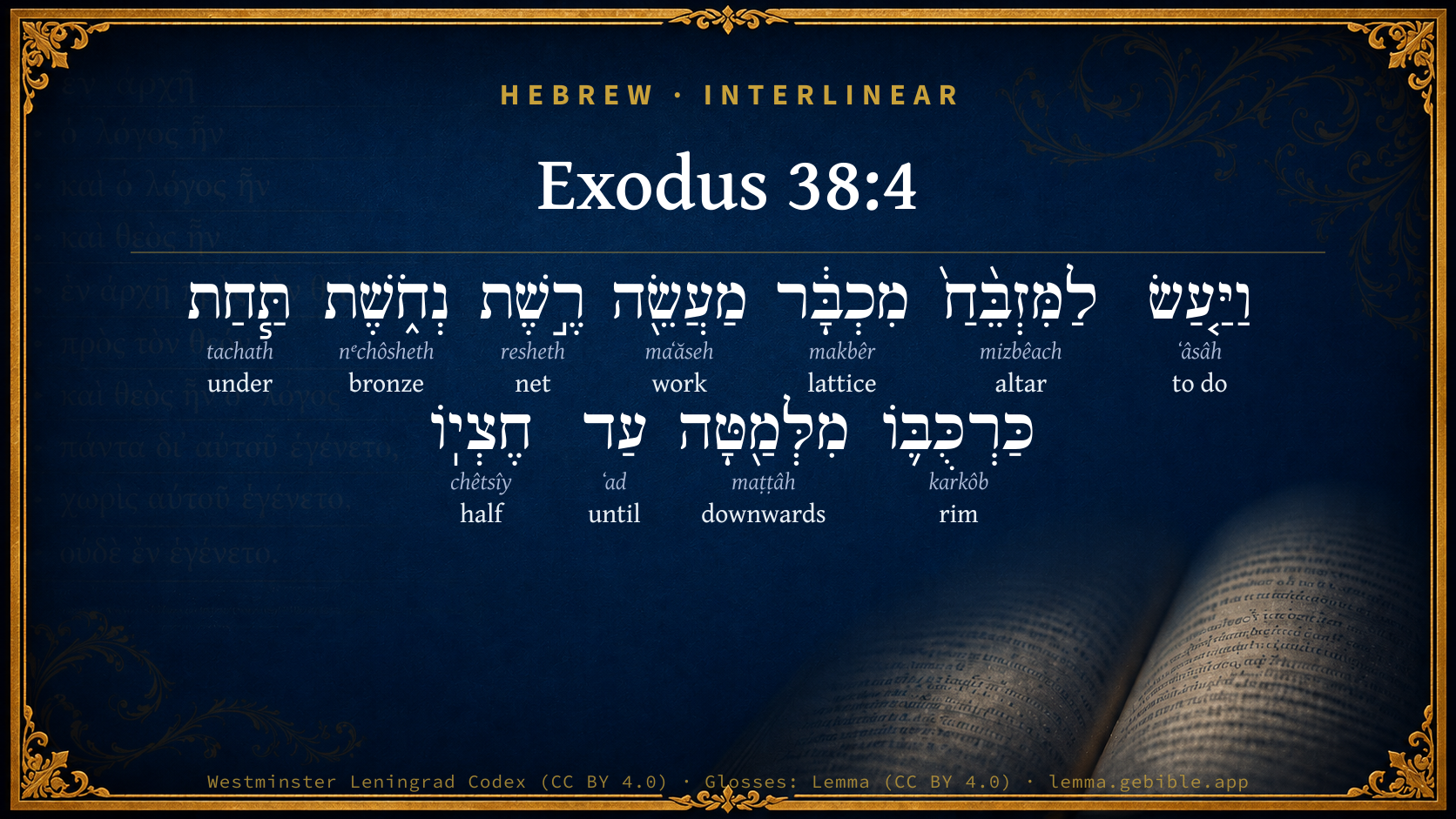
כַּרְכֻּבּ֛וֹ
karkôb
H3749
“rim · his”
Noun, Common, Masculine, Singular, Construct + Suffix, Personal, 3rd Person, Masculine, Singular
Part of Speech
Noun
Type
Common
Gender
Masculine
Number
Singular
State
Construct
Full BDB Definition

Origin: expanded from the same as H3522

TWOT: 1038a

edge, rim
  1. וַיַּ֤עַשׂ ʻâsâh H6213 “and · to do” Conjunction + Verb, Qal, Sequential Imperfect, 3rd Person, Masculine, Singular
  2. לַמִּזְבֵּ֨חַ֙ mizbêach H4196 “to/for the · altar” Preposition, Determined + Noun, Common, Masculine, Singular, Absolute
  3. מִכְבָּ֔ר makbêr H4345 “lattice” Noun, Common, Masculine, Singular, Absolute
  4. מַעֲשֵׂ֖ה maʻăseh H4639 “work of” Noun, Common, Masculine, Singular, Construct
  5. רֶ֣שֶׁת resheth H7568 “net of” Noun, Common, Feminine, Singular, Construct
  6. נְחֹ֑שֶׁת nᵉchôsheth H5178 “bronze” Noun, Common, Feminine, Singular, Absolute
  7. תַּ֧חַת tachath H8478 “under” Preposition
  8. מִלְּמַ֖טָּה maṭṭâh H4295 “from · to/for · downwards” Preposition + Preposition + Adverb
  9. עַד ʻad H5704 “until” Preposition
  10. חֶצְיֽוֹ chêtsîy H2677 “half · his” Noun, Common, Masculine, Singular, Construct + Suffix, Personal, 3rd Person, Masculine, Singular

About this verse

These counts appear in no published source. They are computed here, from the morphology-tagged text and Lemma’s own curated glosses. What Lemma adds →

11
words
11
distinct lemmas
Pentateuch
section

Notable vocabulary

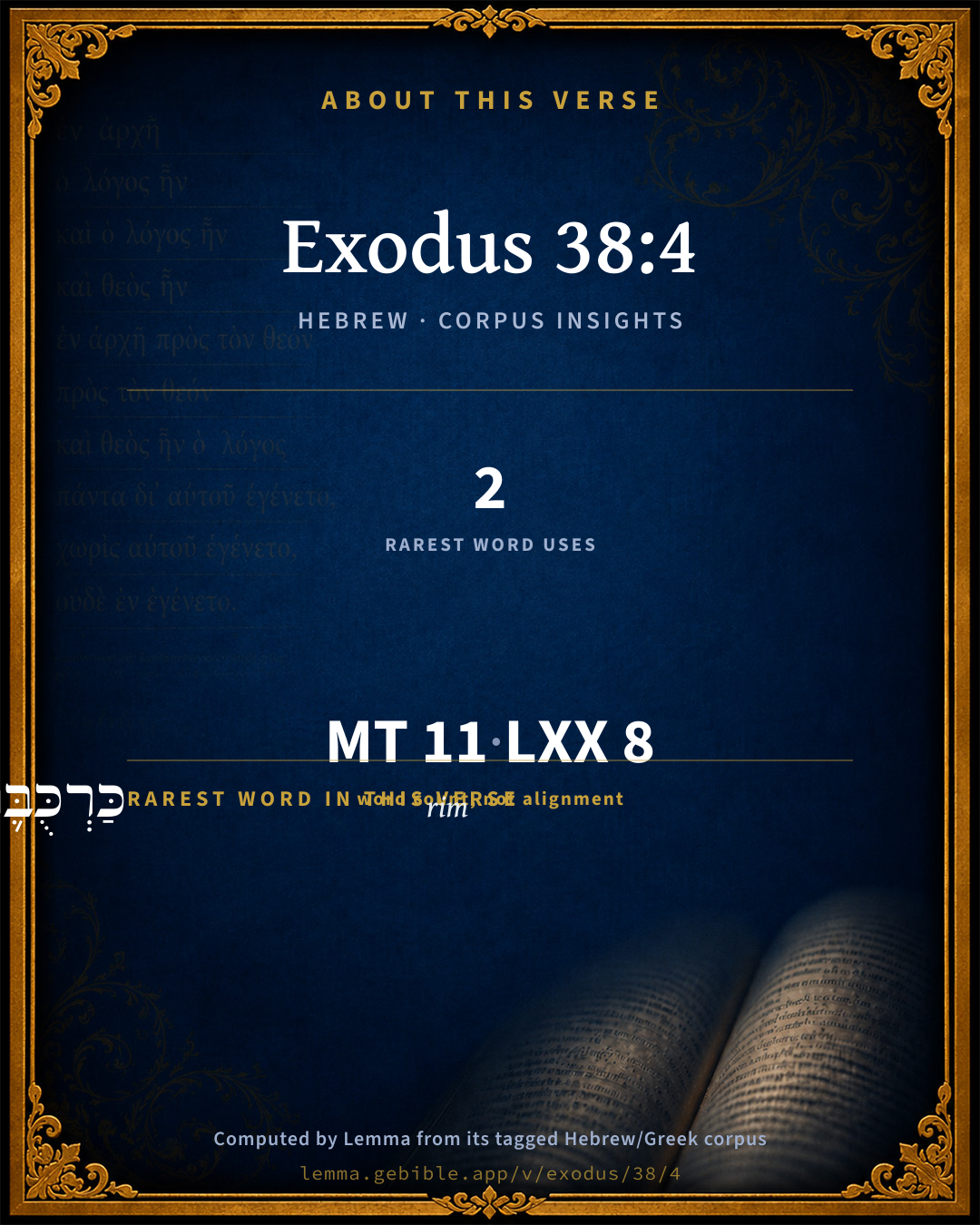
The rarest word here is כַּרְכֻּבּ֛וֹ rim H3749 — appearing just 2 times in the whole Hebrew Bible.

Shared distinctive vocabulary

כַּרְכֻּבּ֛וֹ rim H3749 occurs in 2 verses of the Hebrew Bible. Also found in:

Grammatical profile

  • 1 verb
  • 7 nouns
  • 2 prepositions
  • 1 adverb

Verb forms

  • וַיַּ֤עַשׂ Qal · Sequential Imperfect

Hebrew & Septuagint length

In English translation the verse runs 21 words from the Hebrew and 14 from the Septuagint (LXX English) — the Septuagint runs noticeably shorter here. See the side-by-side →

A rough comparison of the two English renderings, which tokenize alike — not a word-level alignment.

Word counts can differ between the Hebrew and the Greek without any difference in meaning — e.g. the Hebrew direct-object marker אֵת has no separate Greek word, and Greek often adds the article ὁ.

In the original languages it is 11 Hebrew tokens and 8 Greek tokens — but the two are counted differently (Hebrew bundles its prefixes and suffixes into one token; the Greek is in lemma form), so that isn’t a like-for-like length.

Hebrew and Greek witnesses Masoretic Hebrew ↔ Greek Septuagint

The same verse in the two great witnesses to the Old Testament, shown verse-for-verse.

Here the Septuagint runs noticeably shorter than the Hebrew — LXX2012 (modern English Septuagint) 14 words vs World English Bible 21. A rough length comparison of the two English translations, not a word-level alignment — read both below.

These are two independent witnesses, not word-aligned to each other, and the Septuagint is shown in lemma (dictionary) form.

Hebrew Exodus 38:4 Masoretic · Westminster Leningrad Codex

וַיַּ֤עַשׂ לַמִּזְבֵּ֨חַ֙ מִכְבָּ֔ר מַעֲשֵׂ֖ה רֶ֣שֶׁת נְחֹ֑שֶׁת תַּ֧חַת כַּרְכֻּבּ֛וֹ מִלְּמַ֖טָּה עַד חֶצְיֽוֹ

He made for the altar a grating of a network of brass, under the ledge around it beneath, reaching halfway up.

World English Bible · Public Domain

Greek LXX Exodus 38:4 Septuagint · lemma form

εὐρύς ὁ διωστήρ ὥστε αἴρω αὐτός ἐν αὐτός

wide enough for the staves, so that men should bear the ark with them.

LXX2012 (modern English Septuagint) · Public Domain

Hebrew: Westminster Leningrad Codex (CC BY 4.0). Greek: Septuagint (public domain); English from LXX2012 (modern English Septuagint) (Public Domain). How the Septuagint differs from the Hebrew →

Targum (Aramaic paraphrase)

2

The Targum is the ancient Jewish Aramaic paraphrase of the Hebrew Scriptures — an interpretive translation, not the Hebrew text itself. Onkelos (literal) and Pseudo-Jonathan (expansive) render the Torah, and Jonathan the Prophets. Coverage is partial: where no permissively-licensed English translation exists for a verse, only the Aramaic is shown. This is verse-level text, not a word-by-word alignment to the Hebrew.

  1. Targum Onkelos Torah (Genesis–Deuteronomy)
    וַעֲבַד לְּמַדְבְּחָא סְרָדָא עוֹבַד מְצַדְתָּא דִנְחָשָׁא תְּחוֹת סוֹבָבֵהּ מִלְרַע עַד פַּלְגֵהּ:

    (no public-domain English translation for this verse)

    Targum Onkelos — Aramaic: “Onkelos Genesis” (public domain); “Onkelos Exodus” (public domain); “Onkelos Leviticus” (public domain); “Onkelos Numbers” (public domain); “Onkelos Deuteronomy” (public domain). English: “Sefaria Community Translation” (CC0 1.0 (public-domain dedication)); “J.W. Etheridge. The Targums of Onkelos and Jonathan Ben Uzziel on the Pentateuch. London: Longmans, Green, 1862” (public domain). Text via Sefaria.

  2. Targum Pseudo-Jonathan Torah (Genesis–Deuteronomy)
    וַעֲבַד לְמַדְבְּחָא קַנְקַל עוֹבַד מְצַרְתָּא דִנְחָשָׁא תְּחוֹת סוֹבְבֵיהּ מִלְרַע עַד פַּלְגֵיהּ מְטוֹל לְקַבָּלָא גוּמְרַיָא וְגַרְמַיָא דְנָפְלִין מִן מַדְבְּחָא

    And he made the grate of the altar, of brasen network under the border beneath, reaching to the middle of it, to receive the cinders and bones that fell from the altar.

    Targum Pseudo-Jonathan — Aramaic: “Targum Jonathan on Genesis” (public domain); “Targum Jonathan on Exodus” (public domain); “Targum Jonathan on Leviticus” (public domain); “Targum Jonathan on Numbers” (public domain); “Targum Jonathan on Deuteronomy” (public domain). English: “The Targum of Jonathan ben Uzziel, trans. J. W. Etheridge, London, 1862” (public domain). Text via Sefaria.

Commentary

Notes on Exodus 38:4 from classic Christian and Jewish commentators (each source and its license shown beneath its notes). The classic Christian expositions comment on the surrounding passage and are grouped to its opening verse, so a note may address several verses; the Jewish commentaries on the Tanakh (Rashi and others) are per-verse, so they appear only where the commentator wrote on this verse.

Lemma curates 59 commentaries, every one of them public domain or Creative Commons licensed, each selected and text-cleaned for this edition rather than reprinted as found. About our sources →

unfoldingWord translationNotes

Door43 World Missions Community

General Information:

Bezalel's work crew continues to build the tabernacle and furniture.

He made ... for the poles

For Exo 38:4-5 see how you translated many of these words in Exodus 27:4 and Exodus 27:5.

to be placed under the ledge

This can be stated in active form. AT: "which they placed under the ledge" (See: Active or Passive)

translationWords

altar

bronze

unfoldingWord translationNotes — © Distant Shores Media and the Door43 World Missions Community, licensed CC BY-SA 4.0. Source: git.door43.org/Door43/en_tn.

Geneva Bible (1599)

Geneva Bible translators

So that the gridiron or grate was half so high as the altar, and stood within it.

Geneva Bible (1599) marginal notes — public domain. Text via Bolls.life.

Lesson kit

Teaching starters — assembled from the data on this page, not authored interpretation. Every prompt links to the verse data it draws on. Edit before teaching.

Exodus, in the Pentateuch, opens this verse with 11 words (11 distinct Hebrew lemmas). Its most distinctive word is karkôb (“rim”). The Greek Septuagint runs shorter here. A historical commentator’s framing appears above. Read the whole chapter for the surrounding context.

Discussion questions

  1. What does “rim” (karkôb) contribute to the verse as a whole?
  2. How does Exodus 27:5, which shares the word «rim», read alongside this verse?
  3. The Septuagint runs shorter here than the Hebrew. What might account for the difference?
  4. These translations render this verse differently. What is at stake in choosing one wording over another?
  5. «וַיַּ֤עַשׂ» is a Qal Sequential Imperfect verb. How does that grammatical form shape the action described?
  6. Compare how unfoldingWord translationNotes and Geneva Bible (1599) read this verse. Where do they agree or differ?

Things to notice

Reading settings

Reading text

Shown beneath each verse's original-language words.

Old Testament
Old Testament edition

Read the OT as the Masoretic Hebrew (MT) or the Greek Septuagint (LXX).

English shown for the Greek Septuagint (in the Hebrew ↔ Greek comparison).

Comparing translations? Open the Compare panel on any verse page to stack up to four side by side.