
Amos 9:1

Hebrew (Westminster Leningrad Codex) Amos 9:1 appears in the Hebrew Old Testament. The text above is from the Westminster Leningrad Codex. Each word links to its Strong’s number, a concise gloss, and parsing drawn from the Open Scriptures Hebrew Bible morphology. Click any word for its full Brown-Driver-Briggs (BDB) entry.
Download image
Cite this verse

Amos 9:1 (World English Bible). Public Domain. Lemma interlinear Bible study tool, https://lemma.gebible.app/v/amos/9/1.

Show BibTeX & RIS
BibTeX
RIS
English Translation
I saw the Lord standing beside the altar, and he said, "Strike the tops of the pillars, that the thresholds may shake; and break them in pieces on the head of all of them; and I will kill the last of them with the sword: there shall not one of them flee away, and there shall not one of them escape.
World English Bible · Public Domain
Download a study sheet

One document with this verse’s original text, its word-by-word gloss line, the meaning frame, cross-references with their text, attributed commentary, and full source and license credits — printable, and it pastes into notes with its structure intact.

This verse Autodidact and up

Study sheet (.html) Plain text (.txt)

A passage Seminary Student

Up to 50 verses in one chapter. A passage sheet keeps up to 6 commentary sources and 12 cross-references per verse, in the order this page ranks them, and says so on the sheet whenever that leaves anything out. Ask for a single verse and you get the Autodidact verse sheet above.

Everything on this page stays free to read, with no account — the sheet is a download of what is already on screen, not access to it.

Want to remove ads? Support Godless Engineer
Compare translations 3

The same verse in 3 English versions, stacked beneath the original-language interlinear above. Click any original word for its lexicon entry.

Each is an independent rendering of the whole verse — the interlinear is not word-aligned to these translations.

Highlighted words mark where these versions differ — a whole-verse word diff, not a word-by-word alignment.

  • World English Bible Public Domain
    I saw the Lord standing beside the altar, and he said, "Strike the tops of the pillars, that the thresholds may shake; and break them in pieces on the head of all of them; and I will kill the last of them with the sword: there shall not one of them flee away, and there shall not one of them escape.
  • King James Version Public Domain
    I saw the LORD standing upon the altar: and he said, Smite the lintel of the door, that the posts may shake: and cut them in the head, all of them; and I will slay the last of them with the sword: he that fleeth of them shall not flee away, and he that escapeth of them shall not be delivered.
  • unfoldingWord Literal Text CC BY-SA 4.0
    I saw the Lord standing beside the altar, and he said, “Strike the tops of the pillars so that the foundations will shake. Break them in pieces on all of their heads, and I will kill the last of them with the sword. Not one of them will get away, not one of them will escape.

unfoldingWord Literal Text — © unfoldingWord, licensed CC BY-SA 4.0. Word-aligned USFM3 via Door43 (git.door43.org/unfoldingWord/en_ult).

Versions to compare (up to 4)

3 of 4 selected

Show all 18 translations

Every available English version of this verse, each an independent rendering of the whole verse.

  • World English Bible Public Domain
    I saw the Lord standing beside the altar, and he said, "Strike the tops of the pillars, that the thresholds may shake; and break them in pieces on the head of all of them; and I will kill the last of them with the sword: there shall not one of them flee away, and there shall not one of them escape.
  • Berean Standard Bible Public Domain
    I saw the Lord standing beside the altar, and He said: “Strike the tops of the pillars so that the thresholds shake. Topple them on the heads of all the people, and I will kill the rest with the sword. None of those who flee will get away; none of the fugitives will escape.
  • Majority Standard Bible Public Domain
    I saw the Lord standing beside the altar, and He said: “Strike the tops of the pillars so that the thresholds shake. Topple them on the heads of all the people, and I will kill the rest with the sword. None of those who flee will get away; none of the fugitives will escape.
  • King James Version Public Domain
    I saw the LORD standing upon the altar: and he said, Smite the lintel of the door, that the posts may shake: and cut them in the head, all of them; and I will slay the last of them with the sword: he that fleeth of them shall not flee away, and he that escapeth of them shall not be delivered.
  • American Standard Version (1901) Public Domain
    I saw the Lord standing beside the altar: and he said, Smite the capitals, that the thresholds may shake; and break them in pieces on the head of all of them; and I will slay the last of them with the sword: there shall not one of them flee away, and there shall not one of them escape.
  • Revised Version (1885) Public Domain
    I SAW the Lord standing beside the altar: and he said, Smite the chapiters, that the thresholds may shake: and break them in pieces on the head of all of them; and I will slay the last of them with the sword: there shall not one of them flee away, and there shall not one of them escape.
  • Geneva Bible (1599) Public Domain
    I sawe the Lord standing vpon the altar, and he sayde, Smite the lintel of the doore, that the postes may shake: and cut them in pieces, euen the heads of them all, and I will slay the last of them with the sword: he that fleeth of them, shall not flee away: and he that escapeth of them, shall not be deliuered.
  • Douay-Rheims (1899) Public Domain
    I saw the Lord standing upon the altar, and he said: Strike the hinges, and let the lintels be shook: for there is covetousness in the head of them all, and I will slay the last of them with the sword: there shall be no flight for them: they shall flee, and he that shall flee of them shall not be delivered.
  • Young's Literal Translation Public Domain
    I have seen the Lord standing by the altar, and He saith: `Smite the knob, and the thresholds shake, And cut them off by the head -- all of them, And their posterity with a sword I do slay, Not flee to them doth the fleer, Nor escape to them doth a fugitive.
  • Literal Standard Version CC BY-SA 4.0
    I have seen the Lord standing by the altar, and He says, || “Strike the knob, and the thresholds shake, || And cut them off by the head—all of them, || And I slay their posterity with a sword, || None that flee of them flee away, || Nor a fugitive of them escape.
  • Unlocked Literal Bible CC BY-SA 4.0
    I saw the Lord standing beside the altar, and he said, “Strike the tops of the pillars so that the foundations will shake. Break them in pieces on all of their heads, and I will kill the last of them with the sword. Not one of them will get away, not one of them will escape.
  • unfoldingWord Literal Text CC BY-SA 4.0
    I saw the Lord standing beside the altar, and he said, “Strike the tops of the pillars so that the foundations will shake. Break them in pieces on all of their heads, and I will kill the last of them with the sword. Not one of them will get away, not one of them will escape.
  • Darby Bible Public Domain
    I saw the Lord standing upon the altar; and he said, Smite the chapiter that the thresholds may shake; and break all of them in pieces, in the head; and I will slay the last of them with the sword: he that fleeth of them shall not get away by flight, and he that escapeth of them shall not be delivered.
  • World Messianic Bible Public Domain
    I saw the Lord standing beside the altar, and he said, “Strike the tops of the pillars, that the thresholds may shake. Break them in pieces on the head of all of them. I will kill the last of them with the sword. Not one of them will flee away. Not one of them will escape.
  • Webster's Bible Public Domain
    I saw the Lord standing upon the altar: and he said, Smite the lintel of the door, that the posts may shake: and cut them in the head, all of them; and I will slay the last of them with the sword: he that fleeth of them shall not flee away, and he that escapeth of them shall not be delivered.
  • Free Bible Version CC BY-SA 4.0
    Then I saw the Lord standing beside the altar, and he said: Strike the tops of the Temple pillars so that the foundations shake, and shatter them on the heads of all the people below. Those who survive I will kill by the sword. None of them will escape, not a single one.
  • Bible in Basic English Public Domain
    I saw the Lord stationed by the side of the altar, giving blows to the tops of the pillars so that the doorsteps were shaking: and he said, I will let all of them be broken with earth-shocks; I will put the last of them to the sword: if any one of them goes in flight he will not get away, not one of them will be safe.
  • JPS Tanakh (1917) Public Domain
    I saw the Lord standing beside the altar; and He said: Smite the capitals, that the posts may shake; and break them in pieces on the head of all of them; and I will slay the residue of them with the sword; there shall not one of them flee away, and there shall not one of them escape.

Literal Standard Version (2020), Covenant Press — licensed CC BY-SA 4.0. Text via the HelloAO Bible API (eBible.org). Unlocked Literal Bible (unfoldingWord) — licensed CC BY-SA 4.0. Text via the HelloAO Bible API (eBible.org). unfoldingWord Literal Text — © unfoldingWord, licensed CC BY-SA 4.0. Word-aligned USFM3 via Door43 (git.door43.org/unfoldingWord/en_ult). Free Bible Version, Dr. Jonathan Gallagher — licensed CC BY-SA 4.0. Text via the HelloAO Bible API (eBible.org).

Word by word

More ways to search: Search by grammar → Find every occurrence → Compare this word →

Practice this passage: Drill this verse → Learn its vocabulary →

וּבְצַ֨עַם֙
bâtsaʻ
H1214
“and · cut off · them”
Conjunction + Verb, Qal, Imperative, 2nd Person, Masculine, Singular + Suffix, Personal, 3rd Person, Masculine, Plural
Part of Speech
Conjunction + Verb
Stem
Qal
Form
Imperative
Person
2nd Person
Gender
Masculine
Number
Singular
Full BDB Definition

Origin: a primitive root

TWOT: 267

to cut off, break off, gain by unrighteous violence, get, finish, be covetous, be greedy - (Qal) - to cut off - to stop - to gain wrongfully or by violence - (Piel) - to cut off, sever - to finish, complete, accomplish - to violently make gain of
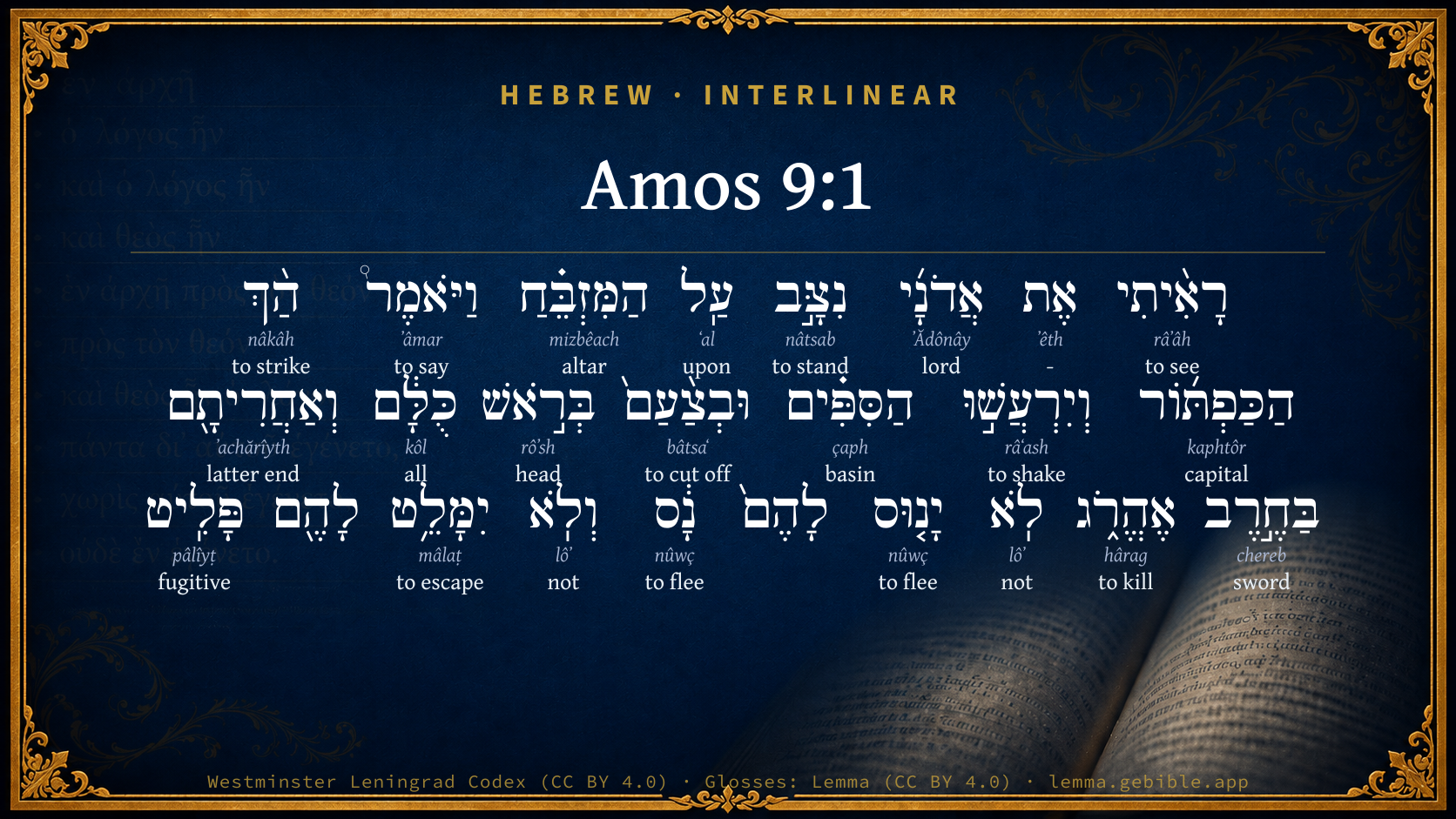
  1. רָאִ֨יתִי râʼâh H7200 “to see” Verb, Qal, Perfect, 1st Person, Common, Singular
  2. אֶת ʼêth H853 “-” Particle, Direct Object
  3. אֲדֹנָ֜י ʼĂdônây H136 “Lord · my” Noun, Common, Masculine, Plural, Construct + Suffix, Personal, 1st Person, Common, Singular
  4. נִצָּ֣ב nâtsab H5324 “standing” Verb, Niphal, Participle Active, Masculine, Singular, Absolute
  5. עַֽל ʻal H5921 “upon” Preposition
  6. הַמִּזְבֵּ֗חַ mizbêach H4196 “the · altar” Particle, Definite Article + Noun, Common, Masculine, Singular, Absolute
  7. וַיֹּאמֶר֩ ʼâmar H559 “and · to say” Conjunction + Verb, Qal, Sequential Imperfect, 3rd Person, Masculine, Singular
  8. הַ֨ךְ nâkâh H5221 “strike” Verb, Hiphil, Imperative, 2nd Person, Masculine, Singular
  9. הַכַּפְתּ֜וֹר kaphtôr H3730 “the · capital” Particle, Definite Article + Noun, Common, Masculine, Singular, Absolute
  10. וְיִרְעֲשׁ֣וּ râʻash H7493 “and · to shake” Conjunction + Verb, Qal, Imperfect, 3rd Person, Masculine, Plural
  11. הַסִּפִּ֗ים çaph H5592 “the · basins” Particle, Definite Article + Noun, Common, Masculine, Plural, Absolute
  12. בְּרֹ֣אשׁ rôʼsh H7218 “in/at · head of” Preposition + Noun, Common, Masculine, Singular, Construct
  13. כֻּלָּ֔ם kôl H3605 “all · their” Noun, Common, Masculine, Singular, Construct + Suffix, Personal, 3rd Person, Masculine, Plural
  14. וְאַחֲרִיתָ֖ם ʼachărîyth H319 “and · latter end · their” Conjunction + Noun, Common, Feminine, Singular, Construct + Suffix, Personal, 3rd Person, Masculine, Plural
  15. בַּחֶ֣רֶב chereb H2719 “in/at the · sword” Preposition, Determined + Noun, Common, Feminine, Singular, Absolute
  16. אֶהֱרֹ֑ג hârag H2026 “to kill” Verb, Qal, Imperfect, 1st Person, Common, Singular
  17. לֹֽא lôʼ H3808 “not” Particle, Negative
  18. יָנ֤וּס nûwç H5127 “to flee” Verb, Qal, Imperfect, 3rd Person, Masculine, Singular
  19. נָ֔ס nûwç H5127 “fleeing” Verb, Qal, Participle Active, Masculine, Singular, Absolute
  20. וְלֹֽא lôʼ H3808 “and · not” Conjunction + Particle, Negative
  21. יִמָּלֵ֥ט mâlaṭ H4422 “to escape” Verb, Niphal, Imperfect, 3rd Person, Masculine, Singular
  22. פָּלִֽיט pâlîyṭ H6412 “fugitive” Noun, Common, Masculine, Singular, Absolute

About this verse

These counts appear in no published source. They are computed here, from the morphology-tagged text and Lemma’s own curated glosses. What Lemma adds →

25
words
21
distinct lemmas
Prophets
section

Notable vocabulary

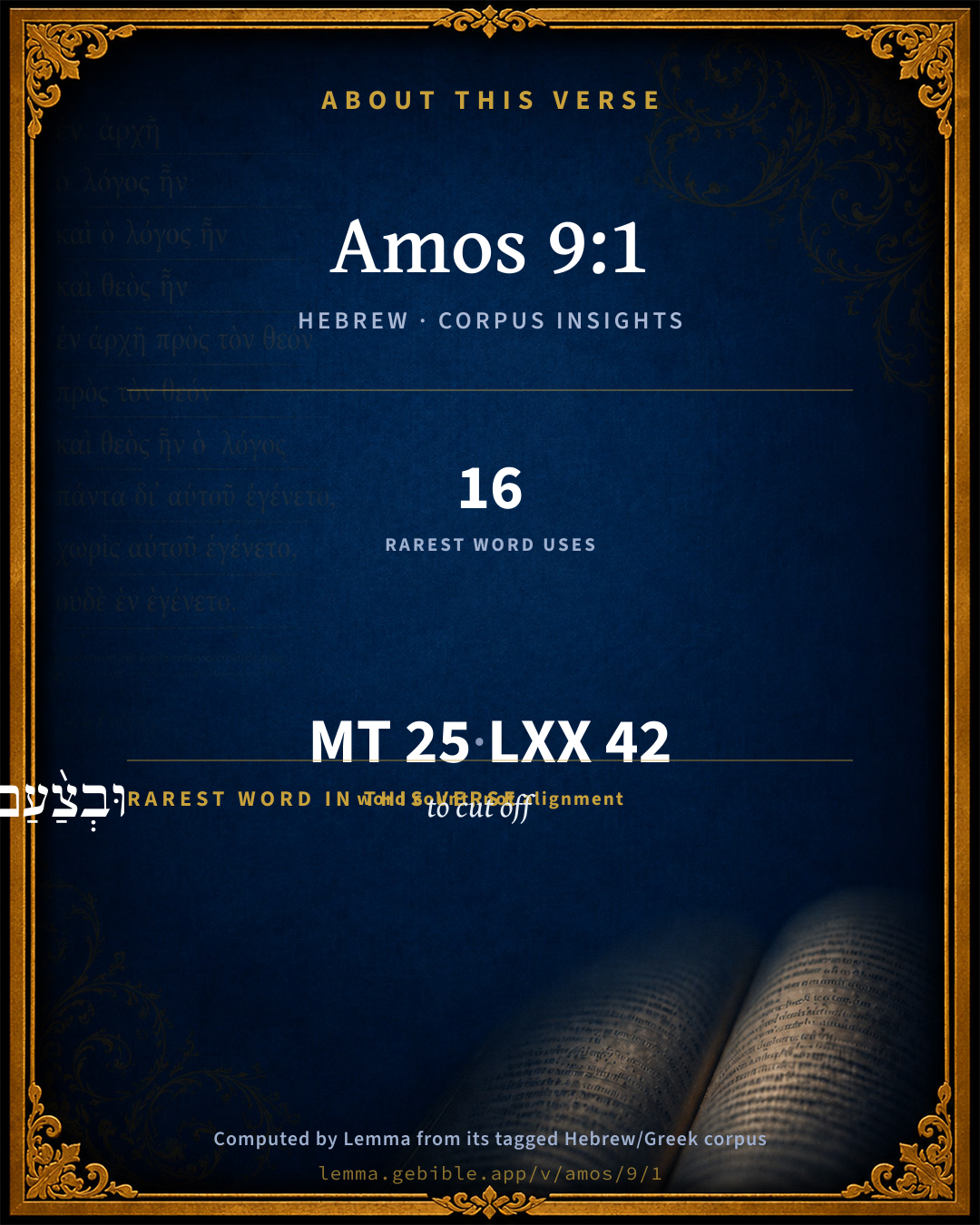
The rarest word here is וּבְצַ֨עַם֙ to cut off H1214 — appearing just 16 times in the whole Hebrew Bible.

Shared distinctive vocabulary

וּבְצַ֨עַם֙ to cut off H1214 occurs in 16 verses of the Hebrew Bible. Also found in:

Grammatical profile

  • 10 verbs
  • 9 nouns
  • 3 prepositions
  • 3 particles

Verb forms

  • רָאִ֨יתִי Qal · Perfect
  • נִצָּ֣ב Niphal · Participle Active
  • וַיֹּאמֶר֩ Qal · Sequential Imperfect
  • הַ֨ךְ Hiphil · Imperative
  • וְיִרְעֲשׁ֣וּ Qal · Imperfect
  • וּבְצַ֨עַם֙ Qal · Imperative
  • אֶהֱרֹ֑ג Qal · Imperfect
  • יָנ֤וּס Qal · Imperfect
  • נָ֔ס Qal · Participle Active
  • יִמָּלֵ֥ט Niphal · Imperfect

Repetition

Words recur within this verse — often emphatic in Hebrew:

  • יָנ֤וּס to flee H5127 ×2
  • לֹֽא not H3808 ×2

Hebrew & Septuagint length

In English translation the verse runs 61 words from the Hebrew and 58 from the Septuagint (LXX English) — closely comparable.

A rough comparison of the two English renderings, which tokenize alike — not a word-level alignment.

Word counts can differ between the Hebrew and the Greek without any difference in meaning — e.g. the Hebrew direct-object marker אֵת has no separate Greek word, and Greek often adds the article ὁ.

In the original languages it is 25 Hebrew tokens and 42 Greek tokens — but the two are counted differently (Hebrew bundles its prefixes and suffixes into one token; the Greek is in lemma form), so that isn’t a like-for-like length.

Cross-references

19

Topical passages linked to Amos 9:1 in the Treasury of Scripture Knowledge — connected by theme and wording, ordered by reader-vote popularity; previews shown in the World English Bible.

  • Psalms 68:21 But God will strike through the head of his enemies, The hairy scalp of such a one as still continues in his guiltiness.
  • Isaiah 6:1 In the year that king Uzziah died, I saw the Lord sitting on a throne, high and lifted up; and his train filled the temple.
  • Isaiah 6:3–4 One called to another, and said, "Holy, holy, holy, is Yahweh of Hosts! The whole earth is full of his glory!"
  • Amos 3:14 "For in the day that I visit the transgressions of Israel on him, I will also visit the altars of Bethel; And the horns of the altar will be cut off, And fall to the ground.
  • Habakkuk 3:13 You went forth for the salvation of your people, For the salvation of your anointed. You crushed the head of the land of wickedness. You stripped them head to foot. Selah.
  • John 1:18 No one has seen God at any time. The one and only Son, who is in the bosom of the Father, he has declared him.
  • Revelation 1:17 When I saw him, I fell at his feet like a dead man. He laid his right hand on me, saying, "Don't be afraid. I am the first and the last,
  • 2 Chronicles 18:18 [Micaiah] said, Therefore hear you the word of Yahweh: I saw Yahweh sitting on his throne, and all the host of heaven standing on his right hand and on his left.
  • Isaiah 30:16 but you said, No, for we will flee on horses; therefore shall you flee: and, We will ride on the swift; therefore shall those who pursue you be swift.
  • Jeremiah 48:44 He who flees from the fear shall fall into the pit; and he who gets up out of the pit shall be taken in the snare: for I will bring on him, even on Moab, the year of their visitation, says Yahweh.
  • Ezekiel 1:28 As the appearance of the bow that is in the cloud in the day of rain, so was the appearance of the brightness round about. This was the appearance of the likeness of the glory of Yahweh. When I saw it, I fell on my face, and I heard a voice of one that spoke.
  • Ezekiel 9:2 Behold, six men came from the way of the upper gate, which lies toward the north, every man with his slaughter weapon in his hand; and one man in the midst of them clothed in linen, with a writer's inkhorn by his side. They went in, and stood beside the brazen altar.
  • Ezekiel 10:4 The glory of Yahweh mounted up from the cherub, [and stood] over the threshold of the house; and the house was filled with the cloud, and the court was full of the brightness of Yahweh's glory.
  • Amos 2:14–15 Flight will perish from the swift; And the strong won't strengthen his force; Neither shall the mighty deliver himself;
  • Zephaniah 2:14 Herds will lie down in the midst of her, all the animals of the nations. Both the pelican and the porcupine will lodge in its capitals. Their calls will echo through the windows. Desolation will be in the thresholds, for he has laid bare the cedar beams.
  • Zechariah 11:1–2 Open your doors, Lebanon, That the fire may devour your cedars.
  • John 1:32 John testified, saying, "I have seen the Spirit descending like a dove out of heaven, and it remained on him.
  • Acts 26:13 at noon, O King, I saw on the way a light from the sky, brighter than the sun, shining around me and those who traveled with me.
  • Isaiah 24:17–18 Fear, and the pit, and the snare, are on you, O inhabitant of the earth.

Cross-references courtesy of OpenBible.info (CC BY 4.0).

Hebrew and Greek witnesses Masoretic Hebrew ↔ Greek Septuagint

The same verse in the two great witnesses to the Old Testament, shown verse-for-verse.

These are two independent witnesses, not word-aligned to each other, and the Septuagint is shown in lemma (dictionary) form.

Hebrew Amos 9:1 Masoretic · Westminster Leningrad Codex

רָאִ֨יתִי אֶת אֲדֹנָ֜י נִצָּ֣ב עַֽל הַמִּזְבֵּ֗חַ וַיֹּאמֶר֩ הַ֨ךְ הַכַּפְתּ֜וֹר וְיִרְעֲשׁ֣וּ הַסִּפִּ֗ים וּבְצַ֨עַם֙ בְּרֹ֣אשׁ כֻּלָּ֔ם וְאַחֲרִיתָ֖ם בַּחֶ֣רֶב אֶהֱרֹ֑ג לֹֽא יָנ֤וּס לָהֶם֙ נָ֔ס וְלֹֽא יִמָּלֵ֥ט לָהֶ֖ם פָּלִֽיט

I saw the Lord standing beside the altar, and he said, "Strike the tops of the pillars, that the thresholds may shake; and break them in pieces on the head of all of them; and I will kill the last of them with the sword: there shall not one of them flee away, and there shall not one of them escape.

World English Bible · Public Domain

Greek LXX Amos 9:1 Septuagint · lemma form

ὁράω ὁ κύριος ἐπιἵστημι ἐπί ὁ θυσιαστήριον καί εἶπον πατάσσω ἐπί ὁ ἱλαστήριον καί σείω ὁ πρόπυλον καί διακόπτω εἰς κεφαλή πᾶς καί ὁ κατάλοιπος αὐτός ἐν ῥομφαία ἀποκτείνω οὐ μή διαφεύγω ἐκ αὐτός φεύγω καί οὐ μή διασώζω ἐκ αὐτός ἀνασώζω

I saw the Lord standing on the altar: and he said, Strike the mercy-seat, and the porch shall be shaken: and cut through into the heads of all; and I will kill the remnant of them with the sword: no one of them fleeing shall escape, and no one of them, striving to save himself shall be delivered.

LXX2012 (modern English Septuagint) · Public Domain

On this verse, Ellicott's Commentary for English Readers discusses the Septuagint’s reading. Read the note in Commentary ↓

Hebrew: Westminster Leningrad Codex (CC BY 4.0). Greek: Septuagint (public domain); English from LXX2012 (modern English Septuagint) (Public Domain). How the Septuagint differs from the Hebrew →

Targum (Aramaic paraphrase)

1

The Targum is the ancient Jewish Aramaic paraphrase of the Hebrew Scriptures — an interpretive translation, not the Hebrew text itself. Onkelos (literal) and Pseudo-Jonathan (expansive) render the Torah, and Jonathan the Prophets. Coverage is partial: where no permissively-licensed English translation exists for a verse, only the Aramaic is shown. This is verse-level text, not a word-by-word alignment to the Hebrew.

  1. Targum Jonathan Prophets (Joshua–Malachi)
    אֲמַר עָמוֹס נְבִיָא חֲזֵיתִי יַת יְקָרָא דַייָ אִסְתַּלֵק מִכְּרוּבָא וּשְׁרָא עַל מַדְבְּחָא וַאֲמַר אִם לֵית עַמָא בֵית יִשְׂרָאֵל תָּיְבִין לְאוֹרַיְתָא טְפֵי מְנַרְתָּא אִתְקְטֵיל מַלְכָּא יֹאשִׁיָה וְיֶחְרַב בֵּיתָא וְיִתְפַּגְרָן עֲזָרָתָא וּמָנֵי בֵית מַקְדְשָׁא בְּשִׁבְיָא יַהֲכוּן וּשְׁאָרֵיהוֹן בְּחַרְבָּא אֶקְטוֹל לָא יַעֲרוֹק לְהוֹן דַעֲרִיק וְלָא יִשְׁתֵּזֵיב לְהוֹן דְמִשְׁתֵּיזִיב:

    (no public-domain English translation for this verse)

    Targum Jonathan — Aramaic: “Mikraot Gedolot” (public domain). English: “Sefaria Community Translation” (CC0 1.0 (public-domain dedication)); “London "Chaldee Paraphrase," 1871” (public domain). Text via Sefaria.

Commentary

Notes on Amos 9:1 from classic Christian and Jewish commentators (each source and its license shown beneath its notes). The classic Christian expositions comment on the surrounding passage and are grouped to its opening verse, so a note may address several verses; the Jewish commentaries on the Tanakh (Rashi and others) are per-verse, so they appear only where the commentator wrote on this verse.

Lemma curates 59 commentaries, every one of them public domain or Creative Commons licensed, each selected and text-cleaned for this edition rather than reprinted as found. About our sources →

Matthew Henry's Commentary

We have here the justice of God passing sentence upon a provoking people; and observe,

I. With what solemnity the sentence is passed. The prophet saw in vision the Lord standing upon the altar (Amo 9:1), the altar of burnt-offerings; for the Lord has a sacrifice, and multitudes must fall as victims to his justice. He is removed from the mercy-seat between the cherubim, and stands upon the altar, the judgment-seat, on which the fire of God used to fall, to devour the sacrifices. He stands upon the altar, to show that the ground of his controversy with this people was their profanation of his holy things; here he stands to avenge the quarrel of his altar, as also to signify that the sin of the house of Israel, like that of the house of Eli, shall not be purged with sacrifice nor offering for ever, Sa1 3:14. He stands on the altar, to prohibit sacrifice. Now the order given is, Smite the lintel of the door of the temple, the chapiter, smite it with such a blow that the posts may shake, and cut them, wound them in the head, all of them; break down the doors of God's house, or of the courts of his house, in token of this, that he is going out from it, and forsaking it, and then all judgments are breaking in upon it. Or it signifies the destruction of those in the first place that should be as the door-posts to the nation for its defence, so that, they being broken down, it becomes as a city without gates and bars. "Smite the king, who is as the lintel of the door, that the princes, who are as the posts, may shake; cut them in the head, cleave them down, all of them, as wood for the fire; and I will slay the last of them, the posterity of them, them and their families, or the least of them, them and all that are employed under them; or, I will slay them all, them and all that remain of them, till it comes to the last man; the slaughter shall be general." There is no living for those on whom God has said, I will slay them, no standing before his sword.

II. What effectual care is taken that none shall escape the execution of this sentence. This is enlarged upon here, and is intended for warning to all that provoke the Lord to jealousy. Let sinners read it, and tremble; as there is no fighting it out with God, so there is no fleeing from him. His judgments, when they come with commission, as they will overpower the strongest that think to outface them, so they will overtake the swiftest that think to out-run them, Amo 9:2. Those of them that flee, and take to their heels, shall soon be out of breath, and shall not flee away out of the reach of danger; for, as sometimes the wicked flee when none pursues, so he cannot flee away when God pursues, though he would fain flee out of his hand. Nay, he that escapes of them, that thinks he has gained his point, shall not be delivered. Evil pursues sinners, and will arrest them. This is here enlarged upon by showing that wherever sinners flee for shelter from God's justice, it will overtake them, and the shelter will prove but a refuge of lies. What David says of the ubiquity of God's presence (Psa 139:7-10) is here said of the extent of God's power and justice. (1.) Hell itself, though it has its name in English from its being hilled, or covered over, or hidden, cannot hide them (Amo 9:2): "Though they dig into hell, into the centre of the earth, or the darkest recesses of it, yet thence shall my hand take them, and bring them forth to be made public monuments of divine justice." The grave is a hiding-place to the righteous from the malice of the world (Job 3:17), but it shall be no hiding-place to the righteous from the justice of God; thence God's hands shall take them, when they shall rise in the great day to everlasting shame and contempt. (2.) Heaven, though it has its name from being heaved, or lifted up, shall not put them out of reach of God's judgments; as hell cannot hide them, so heaven will not. Though they climb up to heaven in their conceit, yet thence will I bring them down. Those whom God brings to heaven by his grace shall never be brought down; but those who climb thither themselves, by their own presumption, and confidence in themselves, will be brought down and filled with shame. (3.) The top of Carmel, one of the highest parts of the dust of the world in that country, shall not protect them: "Though they hide themselves there, where they imagine nobody will look for them, I will search, and take them out thence; neither the thickest bushes, nor the darkest caves, in the top of Carmel, will serve to hide them." (4.) The bottom of the sea shall not serve to conceal them; though they think to hide themselves there, even there the judgments of God shall find them out, and lay hold on them: Thence will I command the serpent, and he shall bite them, the crooked serpent, even the dragon that is in the sea, Isa 27:1. They shall find their plague and death where they hope to find shelter and protection; diving will stand them in no more stead than climbing. (5.) Remote countries will not befriend them, nor shall less judgments excuse them from greater (Amo 9:4): Thought they go into captivity before their enemies, who carry them to places at a great distance, and mingle them with their own people, among whom they seem to be lost, yet that shall not serve their turn: Thence will I command the sword, and it shall slay them, the sword of the enemy, or one another's sword. When God judges he will overcome. That which binds on all this, makes their escape impossible and their ruin inevitable, is that God will set his eyes upon them for evil, and not for good. His eyes are in every place, are upon all men and upon all the ways of men, upon some for good, to show himself strong on their behalf, but upon others for evil, to take notice of their sins (Job 13:27) and take all opportunities of punishing them for their sins. Their case is truly miserable who have the providence of God: and all the dispensations of it, against them, working for their hurt.

3. What a great and mighty God he is that passes this sentence upon them, and will take the executing of it into his own hands. Threatenings are more or less formidable according to the power of him that threatens. We laugh at impotent wrath; but the wrath of God is not so; it is omnipotent wrath. Who knows the power of it? What he had before said he would do (Amo 8:8) is here repeated, that he would make the land melt and tremble, and all that dwell therein mourn, that the judgment should rise up wholly like a flood, and the country should be drowned, and laid under water, as by the flood of Egypt, Amo 9:5. But is he able to make his words good? Yes, certainly he is; he does but touch the land and it melts, touch the mountains and they smoke; he can do it with the greatest ease, for, (1.) He is the Lord God of hosts, who undertakes to do it, the God who has all the power in his hand, and all creatures at his beck and call, who having made them all, and given them their several capacities, makes what use he pleases of them and all their powers. Very miserable is the case of those who have the Lord of hosts against them, for they have hosts against them, the whole creation at war with them. (2.) He is the Creator and governor of the upper world: It is he that builds his stories in the heavens, the celestial orbs, or spheres, one over another, as so many stories in a high and stately palace. They are his, for he built them at first, when he said, Let there be a firmament, and he made the firmament; and he builds them still, is continually building them, not that they need repair, but by his providence he still upholds them; his power is the pillars of heaven, by which it is borne up. Now he that has the command of those stories is certainly to be feared, for thence, as from a castle, he can fire upon his enemies, or cast upon them great hailstones, as on the Canaanites, or make the stars in their courses, the furniture of those stories, to fight against them, as against Sisera. (3.) He has the management and command of this lower world too, in which we dwell, the terraqueous globe, both earth and sea, so that, which way soever his enemies think to make their escape, he will meet them, or to make opposition, he will match them. Do they think to make a land-fight of it? He has founded his troop in the earth, his troop of guards, which he has at command, and makes use of for the protection of his subjects and the punishment of his enemies. All the creatures on earth make one bundle (as the margin reads it), one bundle of arrows, out of which he takes what he pleases to discharge against the persecutors, Psa 7:13. They are all one army, one body, so closely are they connected, and so harmoniously and so much in concert do they act for the accomplishing of their Creator's purposes. Do they think to make a sea-fight of it? He will be too hard for them there, for he has the waters of the sea at command; even its waves, the most tumultuous rebellious waters, do obey him. He calls for the waters of the sea in the course of his common providence, causes vapours to ascend out of it, and pours them out in showers, the small rain and the great rain of his strength, upon the face of the earth; this was mentioned before as a reason why we should seek the Lord (Amo 5:8) and make him our friend, as it is here made a reason why we should fear him and dread having him for our enemy.

4. How justly God passes this sentence upon the people of Israel. He does not destroy them by an act of sovereignty, but by an act of righteousness; for (Amo 9:8), it is a sinful kingdom, and the eyes of the Lord are upon it, discovering it to be so; he sees the great sinfulness of it, and therefore he will destroy it from off the face of the earth. Note, When those kingdoms that in name and profession were holy kingdoms, and kingdoms of priests, as Israel was, become sinful kingdoms, no other can be expected than that they should be cut off and abandoned. Let sinful kingdoms, and sinful families, and sinful persons too, see the eyes of the Lord upon them, observing all their wickedness, and reserving the notice of it for the day of reckoning and recompence. This being a sinful kingdom, see how light God makes of it, Amo 9:7.

(1.) Of the relation wherein he stood to it: Are you not as children of Ethiopians unto me, O children of Israel? A sad change! Children of Israel become as children of the Ethiopians! [1.] They were so in themselves; that was their sin. It is a thing to be greatly lamented that the children of Israel often become as children of the Ethiopians; this children of godly parents degenerate, and become the reverse of those that went before them. Those that were well-educated, and trained up in the knowledge and fear of God, and set out well, and promised fair, throw off their profession and become as bad as the worst. How has the gold become dim! [2.] The were so in God's account, and that was their punishment. He valued them no more, though they were children of Israel, than if they had been children of the Ethiopians. We read of one in the title of Ps. 7 that was Cush (an Ethiopian, as some understand it) and yet a Benjamite. Those that by birth and profession are children of Israel, if they degenerate, and become wicked and vile, are to God no more than children of the Ethiopians. This is an intimation of the rejection of the unbelieving Jews in the days of the Messiah; because they embraced not the doctrine of Christ, the kingdom of God was taken from them, they were unchurched, and cast out of covenant, became as children of the Ethiopians, and are so to this day. And it is true of those that are called Christians, but do no live up to their name and profession, that rest in the form of piety, but live under the power of reigning iniquity, that they are to God as children of the Ethiopians; he rejects them, and their services.

(2.) See how light he makes of the favours he had conferred upon them; they thought he would not, he could not, cast them off, and put them upon a level with other nations, because he had done that for them which he had not done for other nations, whereby they thought he was bound to them, so as never to leave them. "No," says he, "The favours shown to you are not so distinguishing as you think they are: Have I not brought up Israel out of the land of Egypt?" It is true I have; but I have also brought the Philistines from Caphtor, or Cappadocia, where they were natives, or captives, or both; they are called the remnant of the country of Caphtor (Jer 47:4), and the Philistim are joined with the Caphtorim, Gen 10:14. In like manner the Syrians were brought up from Kir when they had been carried away thither, Kg2 16:9. Note, If God's Israel lose the peculiarity of their holiness, they lose the peculiarity of their privileges; and what was designed as a favour of special grace shall be set in another light, shall have its property altered, and shall become an act of common providence; if professors liken themselves to the world, God will level them with the world. And, if we live not up to the obligation of God's mercies, we forfeit the honour and comfort of them.

5. How graciously God will separate between the precious and the vile in the day of retribution. Though the wicked Israelites shall be as the wicked Ethiopians, and their being called Israelites shall stand them in no stead, yet the pious Israelites shall not be as the wicked ones; no, the Judge of all the earth will do right, more right than to slay the righteous with the wicked, Gen 18:25. His eyes are upon the sinful kingdom, to spy out those in it who preserve their integrity and swim against the stream, who sigh and cry for the abominations of their land, and they shall be marked for preservation, so that the destruction shall not be total: I will not utterly destroy the house of Jacob, not ruin them by wholesale and in the gross, good and bad together, but I will distinguish, as becomes a righteous judge. The house of Israel shall be sifted as corn is sifted; they shall be greatly hurried, and shaken, and tossed, but still in the hands of God, in both his hands, as the sieve in the hands of him that sifts (Amo 9:9): I will sift the house of Israel among all nations. Wherever they are shaken and scattered, God will have his eye upon them, and will take care to separate between the corn and chaff, which was the thing he designed in sifting them. (1.) The righteous ones among them, that are as the solid wheat, shall none of them perish; they shall be delivered either from or through the common calamities of the kingdom; not the least grain shall fall on the earth, so as to be lost and forgotten - not the least stone (so the word is), for the good corn is weighty as a stone in comparison with that which we call light corn. Note, Whatever shakings there may be in the world, God does and will effectually provide that none who are truly his shall be truly miserable. (2.) The wicked ones among them who are hardened in their sins shall all of them perish, Amo 9:10. See what a height of impiety they have come to: They say, The evil shall not overtake nor prevent us. They think they are innocent, and do not deserve punishment, or that the profession they make of relation to God will be their exemption and security from punishment, or that they shall be able to make their part good against the judgments of God, that they shall flee so swiftly from them that they shall not overtake them, or guard so carefully against them that they shall not prevent or surprise them. Note, Hope of impunity is the deceitful refuge of the impenitent. But see what it will come to at last: All the sinners that thus flatter themselves, and affront God, shall die by the sword, the sword of war, which to them shall be the sword of divine vengeance; yea, though they be the sinners of my people, for their profession shall not be their protection. Note, Evil is often nearest those that put it at the greatest distance from them.

Matthew Henry's Commentary on the Whole Bible (1708–1710) — public domain (CC PDM 1.0). Text via the HelloAO Bible API.

The Cambridge Bible for Schools and Colleges

gen. ed. J. J. S. Perowne

1. standing] stationed (Amo_7:7).

by the altar] lit. over, i.e. leaning over, an idiomatic use of the preposition, found elsewhere, as Num_23:3; Num_23:6; 1Ki_13:1 &c.: cf. ch. Amo_7:7. The altar meant is the altar at Beth-el, the chief Israelitish sanctuary and national religious centre (Amo_7:13).

Smite the chapiters that the thresholds may shake, and cut them off on to the head of all of them] A violent blow is to be dealt out to the chapiters, or capitals at the top of the columns supporting the roof of the temple: the temple will quiver to its very foundations; the broken fragments of the capitals—and no doubt, though this is not expressly mentioned, of the roof as well—will fall down upon the heads of the worshippers assembled below, burying them beneath the ruins. It has been questioned who is addressed in the words smite and cut. The same question has to be asked sometimes elsewhere in the prophets (Isa_13:2; Jer_5:10; Jer_6:4; Isa_57:14; Isa_62:10 &c.); and the reply is always the same, viz. the agent (or agents) whom in each case the prophet pictures as naturally fitted to carry out the commission: here, probably, an angel. The chapiter, properly a knop,—the word is used in Exo_25:31 and elsewhere of a spherical ornament on the stem and branches of the golden candlestick,—will have been the globular ornament at the top of a column (so Zep_2:14). Comp. in Solomon’s temple, 1Ki_7:16-20 (where the word, however, is not the same).

and I will slay the last of them] the residue of them (Amo_4:2): those who escaped at the time that the temple fell, should perish subsequently by the sword. The two last clauses of the verse, as well as the three following verses, emphasize further the same thought.

Amo_9:1-6. The fifth vision, the smitten sanctuary. The people are all assembled for worship in their sanctuary: Jehovah is seen standing by the altar, and commanding the building to be so smitten that it may fall and destroy the worshippers: none, it is emphatically added, shall escape the irrevocable doom. The worshippers are manifestly intended to symbolize the entire nation.

The Cambridge Bible for Schools and Colleges (gen. ed. J. J. S. Perowne; Cambridge University Press, 1878–1918) — public domain. Text from a community e-Sword module.

Trapp's Complete Commentary

John Trapp

Amo 9:1 I saw the Lord standing upon the altar: and he said, Smite the lintel of the door, that the posts may shake: and cut them in the head, all of them; and I will slay the last of them with the sword: he that fleeth of them shall not flee away, and he that escapeth of them shall not be delivered.

Ver. 1. I saw the Lord] This seer, Amo 7:12, saw the Lord in a vision; for otherwise God is too subtile for sinew or sight to seize upon him. We cannot look upon the body of the sun, neither can we see at all without the beams of it; so here.

Standing upon the altar] Or, firmly set, sc. to do execution upon that altar, sc. that idolatrous altar at Bethel mentioned before, and formerly threatened by another prophet, 1Ki 13:1-2. The Rabbis say, God was seen standing upon that altar, as ready to sacrifice and slay the men of that age, whose idolatries and other impieties he could no longer bear with. And hence it is haply, that he is brought in standing; like as Act 7:55, Jesus, at Stephen’s death, was seen standing at the right hand of God, where he is usually said to sit. Stat ut vindex, sedet ut iudex. He stood as his defender and sat as his judge.

And he said] sc. to the angel that stood by, Zec 3:7, or to the enemy commissioned by him, or to some other creature, for they are all his servants, Psa 119:91, neither can he want a weapon to tame his rebels with.

Smite the lintel of the door, that the posts may shake] Smite with a courage, as Eze 9:5. Angels give no light blows. "Behold, the Lord, the Lord of hosts, shall lop the bough with terror: and the high ones of stature shall be hewn down, and the haughty shall be humbled. And he shall cut down the thickets of the forests with iron, and Lebanon shall fall by a mighty one," Isa 10:33-34; that is, by an angel shall he smite to the ground that mighty army which was like a thick wood. See Isa 37:36 Psa 78:25; Psa 89:6. So at our Saviour’s resurrection, an angel, in despite of the soldiers set to watch, rolled away the grave stone, and sat upon it. And as a mighty man, when he sitteth down, shaketh the bench under him, so did he shake the earth; "and for fear of him the keepers did shake, and became as dead men," Mat 28:2; Mat 28:4. Down with this idol temple, down with it, saith God here, even to the ground.

And cut them in the head, all of them] Cleave them down the middle, so that every post may be sure to fall, being divided from the top to the bottom; and let this act be a sign to them all of what I intend to do to their persons, as many of them as by this gate have entered into this idol temple and altar. A deep cut in the head is dangerous and deadly, Gen 3:15 Psa 68:21.

And I will slay the last of them] I, by mine agents and instruments, as before: for it is but one hand and many executioners that God slays men with. Job could discern God’s arrows in Satan’s hand, and God’s hand on the arms of the Sabean robbers. The sword is bathed in heaven before it is imbrued in men’s blood, Isa 34:5. "The Lord killeth and maketh alive," saith holy Hannah, 1Sa 2:6.

He that fleeth of them shall not flee away] See Amo 2:14. {See Trapp on "Amo 2:14"} and say, Behold the severity of God, Rom 11:12.

John Trapp, A Commentary or Exposition upon All the Books of the Old and New Testament (1647–1656) — public domain. Text from a community e-Sword module.

The Biblical Illustrator

Joseph S. Exell

Amo_9:1

I saw the Lord standing upon the altar.

The Lord arising to judgment in His Church

God will no longer tolerate sin, nor allow sinners to trifle with His majesty.

I. Dwelling-place of The Most High--His Church.

1. No Church is His without Him (Rev_3:2-3; Rev_3:9).

2. High privilege to have Him so nigh (Deu_4:7).

3. Continuous realisation of His presence by Israel (Exo_40:38).

4. Peculiar abiding-place in Holy of Holies (Exo_25:20-22).

5. And afterwards incarnate in the Holy One (Joh_1:14).

6. Future tabernacling (Rev_21:3).

But in text God is still in temple.

II. His presence in the church realised.

1. Always by a spiritual discernment (1Co_2:14).

2. Some times by outward signs (1Ki_8:10-11; 1Ki_19:12). His Word, ordinances, blessings, visitations, etc.

3. But in text, I saw the Lord., Thus Moses (Exo_33:18), Isaiah (Isa_6:1) (Act_7:56; Act_9:3, etc.).

III. The Lord come out of his abiding-place. No longer dwelling between the cherubim (Psa_80:1), but standing upon the altar (unusual place), near the worshippers, ready to depart.

1. Because of spirit of infatuation. Israel often acted as if God were bound to remain while semblances only of religion existed (Num_16:3; Mat_3:9; Mat_5:20).

2. Gods judgments often begin at house of God (1Pe_4:17). Hence, early official act of Jesus Christ (Joh_2:15), repeated before His death (Mar_11:15).

3. Our expectancy and duty (Mar_13:33, etc.; Rev_22:20).

IV. The Lord uttering his judgments against sin.

1. Spared not His own Son, made sin (Zec_13:7).

2. Spared not the heathen (Amo_1:2.), nor religious professors (Amo_6:1), not any, great or small (Amo_9:1; Hebrews, capitals, and other parts).

3. Note remarkable parallelisms.

4. Observe the many I wills of judgment and power.

5. Yet remembering His mercy. A remnant to be saved.

Application.

1. Ministerial duty.

2. If the Lord be among us, is His presence honoured?

3. Our acknowledgments. (W. W. Tyler.)

Great sins, great calamities, great efforts

This chapter commences with an account of the fifth and last vision of the prophet, in which the final ruin of the kingdom of Israel is represented. This ruin was to be complete and irreparable; and no quarter to which the inhabitants might flee for refuge would afford them any shelter from the wrath of the Omnipresent and Almighty Jehovah. The prophet in vision sees the Almighty standing upon the altar, and hears Him give the command to smite the lintel of the temple door, that the posts may shake; in other words, to destroy the temple.

I. That under the righteous government of God great sin exposes to great calamity. How terrible the calamities here referred to! The Israelites, when threatened by the Assyrians, would flock in crowds to Bethel and implore protection from the golden calf. But the very place where they sought protection would prove their ruin. Jehovah says, Smite the lintel of the door, that the posts may shake: and cut them in the head, all of them; and I will slay the last of them with the sword, etc. The sin of these Israelites in their idolatrous worship was great. They were the descendants of Abraham the friend of God. Yet they gave themselves up to idolatry. Hence these terrible calamities. The greater the sin the greater the punishment Unto whom much is given, much will be required.

II. The consciousness of approaching calamities will stimulate to great efforts for escape. Though they dig into hell, thence shall Mine hand take them; though they climb up to heaven, thence will I bring them down. There are here supposed attempts at escape. There is the supposed attempt to get into hell--Sheol, the dark realm of shadows, where they could conceal themselves. There is an attempt to climb Mount Carmel, 1200 feet in height, there to conceal themselves under the shadows, intricacies, and the crowded forests of oaks, pines, laurels, etc., and also in the deep caves running down to the sea. Men in view of great dangers always seek refuge. On the great day of retribution sinners are represented as crying to the rocks and mountains to fall on them.

III. The greatest efforts to escape must prove utterly futile when God has given the sinner up. Though they dig into hell, thence shall Mine hand take them. Whatever the efforts of the sinner in the prospect of approaching danger, there is no escape for him. God is everywhere, and everywhere all-seeing, all just, and almighty. Conclusion. The only way to escape utter ruin is to renounce your sin and commit yourself unto the safe keeping of Him who is the Redeemer of mankind. (Homilist.)

The Biblical Illustrator, edited by Joseph S. Exell (c. 1880s–1900s) — public domain. Text from a community e-Sword module.

Joseph Benson's Commentary

Amo 9:1. I saw — Namely, in a vision or ecstasy; the Lord — That is, the glory and majesty of the Lord, as Isaiah did, Isa 6:1, or a bright glorious light, indicating the presence of God; standing upon the altar — Resting upon, or over the altar. The altar of burnt-offering seems to be meant here, and the glory of God resting upon it to have denoted that his justice demanded the lives of the sinners here spoken of to be cut off. “He stands upon the altar,” says Henry, “to show that the ground of his controversy with this people was their profanation of his holy things: here he stands to avenge the quarrel of his altar; as also to signify, that the sin of the house of Israel, like that of the house of Eli, should not be purged with sacrifice nor offering for ever.” And he said — To an angel, as Jerome explains it; or rather God here speaks to his people’s enemies, and gives them a commission to destroy them and their temple. Smite the lintel of the door — This signified that the temple, which was then represented to the prophet, should be destroyed. Whether this was the temple at Beth-el, or that of Jerusalem, is not quite certain. The Chaldee understands the vision of the kingdom of Judah; if so, the temple at Jerusalem is undoubtedly intended. And even if the vision relates, as most suppose, to the kingdom of Israel, yet still the temple of Jerusalem may be here spoken of, and the scene be laid there, because Israel had forsaken this altar and temple and set up others in opposition to them; and here God, in his jealousy, appears prepared to take vengeance. Possibly, the vision might also be designed to intimate his future departure from Judah too. There Eze 9:2, saw the slaughter-men stand. By the lintel of the door, the chapiter, knop, or ornament that was upon the lintel, is intended, namely, of the door of the gate of the temple, or possibly of the gate that led into the priests’ court. That the posts may shake — The posts were the strength and beauty of the gate, and by these the princes, the door-posts as it were of the nation, are supposed to be represented, as the king is by the lintel of the door. And cut them, wound them deep in the head — That is, the people who were represented in the vision as standing in the court of the temple. He says in the head, more fully to signify the destroying of the chief or heads of this sinful people. All of them — Spare not one of them; let the destruction be general. And I will slay the last of them — That is, their posterity and their families — them, and all that remain of them, till it come to the last man. Observe, reader, there is no living for those of whom God hath said, I will slay them; no standing before his sword. He that fleeth of them shall not flee away — That is, shall not escape. He that escapeth of them shall not be delivered — That is, he that escapeth in battle, or escapes one or two, or even several judgments, shall, nevertheless, not escape finally; but shall fall in some other way, or be made captive. The greatest precaution, and the highest station in life, will not avail a man any thing when God is resolved to punish. This is intended for a warning to all that provoke the Lord to jealousy: let sinners read it and tremble. As there is no fighting it out with God, so there is no fleeing from him. His judgments, when they come with commission, as they will overpower the strongest, who think to withstand them, so they will overtake the swiftest, who think to outrun them.

Joseph Benson's Commentary on the Old and New Testaments (1811–1818) — public domain. Text from a community e-Sword module.

Whedon's Commentary on the Bible

Daniel D. Whedon

THE SMITTEN SANCTUARY, vv. 1-6.

These verses contain an account of the fifth vision, followed by an exposition setting forth the inevitableness and completeness of the judgment. The prophet beholds the sanctuary crowded with worshipers, and Jehovah standing beside the altar; he hears the divine command to smite the sanctuary, so that it will fall upon the worshipers and crush them.

If some should escape by accident they will meet their doom in other ways. Wherever they may seek a hiding place Jehovah will find them and blot them out. The threat is enforced, as in Amo_4:13; Amo_5:8-9, by a solemn description of the majesty and power of Jehovah. If the words were spoken under the shadow of the sanctuary at Beth-el (Amo_7:13), this vision would be especially appropriate and impressive.

1. I saw — The other visions are introduced with “Jehovah showed unto me.”

The Lord — He is the central figure in this vision, not a symbolic object or act.

Standing — As in Amo_7:7. A more accurate rendering would be stationed, since the word denotes a more formal attitude than is indicated by the simple standing.

Beside — Literally, upon (Num_23:3; Num_23:6; 1Ki_21:1).

Altar — It is most natural to suppose that the prophet has in mind the altar at Beth-el, the chief sanctuary of the north, where he was delivering his message.

He said — To whom? See on “publish ye” (Amo_3:9; compare Amo_3:13).

Lintel — The Hebrew has the singular, which is used in a collective sense, therefore R.V. reads the plural, “capitals”; the ornaments on top of the columns which support the roof (Zep_2:14; compare Exo_25:31). A blow upon these capitals would cause the roof to fall, especially if the blow was severe enough to cause the foundations to tremble.

Posts — Better, thresholds, since the word is used almost exclusively in the latter sense. Threshold is equivalent to foundation, and the clause indicates the force of the blow.

Cut [“break”] them — The Hebrew underlying this translation is peculiar (G.-K., 61g). The pronoun (plural in Hebrew) is interpreted most naturally as referring back to “capitals” (singular in Hebrew). Such construction is unusual; it may be a construction according to the sense (G.-K., 1350), or the prophet may be thinking of the pieces made by the blow. Most commentators suspect a corruption of the text.

All of them — The worshipers gathered within the sanctuary.

The last of them — Or, the residue of them, that is, any who may escape from the sanctuary; they shall fall subsequently by the sword.

For the rest of Amo_9:1 R.V. reads, perhaps less literally than A.V., “there shall not one of them flee away, and there shall not one of them escape.” Not from the smitten sanctuary, for both the preceding clause and Amo_9:2 imply that some will escape from it, but from Jehovah (Amo_5:19). If any succeed in escaping from the ruins Jehovah will follow them, until he overtakes them and somehow causes their destruction.

This thought is expanded in 2-4, with which may be compared Psalms 139. The prophet enumerates the places which might be expected to provide safe hiding places, but Jehovah will penetrate all.

Hell — Better, R.V., “Sheol”; the place of the departed (Hos_13:14; Hab_2:5; see article “Sheol” in Hastings’s Dictionary of the Bible). Sheol was thought to be located in the center of the earth (Eph_4:9).

Heaven — The dwelling place of God on high. The two represent the lowest depth and the highest height (Isa_7:11; Job_11:8); both are inaccessible to living men. If somehow the survivors should succeed in reaching the places Jehovah’s wrath will pursue them.

Amo_9:3 mentions two other ordinarily inaccessible places, which in this instance will offer no safety.

Top of Carmel — See on Amo_1:2. Mount Carmel would be a promising hiding place, because (1) it was rich in natural caves — there are said to be about two thousand “close together and so serpentine as to make the discovery of a fugitive entirely impossible”; (2) its top was thickly wooded. Strabo relates (xvi, 2, 28) that in the first century A.D. the forests of Carmel were favorite hiding places of robbers. If hunted from Mount Carmel they might seek refuge in the neighboring Mediterranean, but even the deep sea bottom will offer no shelter.

Serpent — This is not an ordinary marine serpent, such as are found in tropical climates in the sea — not in the Mediterranean — but a mythological sea monster (Gen_1:21; compare Isa_27:1), called also Leviathan (Job_41:1); it is probably to be connected with the Babylonian Tiamat. With no other agent near, this serpent will be called upon to execute judgment.

Go into captivity — The enemy may be willing to spare their lives; not so Jehovah. He has decreed their utter destruction.

Set mine eyes upon — An expression used frequently in a good sense, equivalent to keep watch over (Gen_44:21; Jer_24:6); here in a bad sense, to look upon in anger.

For evil — In order to destroy (compare Jer_21:10; Eze_15:7).

Daniel D. Whedon (gen. ed.), Commentary on the Old and New Testaments (1874–1909) — public domain. Text from a community e-Sword module.

The Preacher's Complete Homiletical Commentary

Joseph S. Exell (gen. ed.)

CRITICAL NOTES.] Amos sees God standing, fixed in purpose, by the altar. Posts] Thresholds (Isa_6:4). Cut] Human victims demanded; wounded with fragments of broken columns (cf. Psa_68:21; Hab_3:13). Last] Those left cannot escape.

Amo_9:2.] The Lord everywhere will pursue and destroy them (ch. Amo_2:14). Hell] Though they hide themselves in the deepest holes and caverns of earth. Climb] the greatest heights (Job_20:6-7; Jer_51:53).

Amo_9:3. Carmel] One of the highest mountains, full of caves and forests (Jdg_6:2; 1Sa_13:6). Serpent] A great sea-monster (Isa_27:1).

Amo_9:4. Go] willingly into captivity; the sword shall slay them. Set] “God has fixed His eye upon them, i.e. has taken them under His special superintendence (cf. Jer_39:12); not to shelter, protect, and bless, but for evil, i.e. to punish them” [Keil]

HOMILETICS

THE FINAL CALAMITY.—Amo_9:1-4

In previous visions we see the ripeness of the people and the nearness of judgment. In this God himself is engaged to execute it. The temple at Bethel is a fitting emblem of the nation, which gathers round it. The command is given to smite. It shakes, falls, and buries the multitude under its ruins. The sanctuary was overthrown by the judgment of God, and the kingdom of Israel totally destroyed.

I. The nature of the calamity.

1. It is moral. God stands upon the altar and smites the idolatrous temple. He is ready to depart from them and punish them for apostasy. He was forsaking his people because they had forsaken him. God warns men, before he departs from them. But idolatry provokes him, and turns the place of sacrifice into a throne of vengeance. The posts and pillars of the temple are smitten. “Begin at my sanctuary” (Eze_9:6). The nearer to God, the greater the provocations; the higher the privileges, the nearer to judgment (Dan_9:12; 1Pe_4:17).

2. It is complete. It involves the utter destruction of the kingdom, the overthrow of the nation in its corporate existence.

(1) The heads of the people. “Cut them in the head, all of them.” Civil and religious leaders had neglected their duty, forgotten their dignity, and disregarded the good of the nation. God is no respecter of persons. Head or heel they cannot escape. “He is terrible to the kings of the earth.”

(2) The posterity of the people. “I will slay the last of them with the sword.” God will slay all the remainder, their families and their posterity, all that are left, unto the very last. Justice is unsparing. Great and small, kings and common people, must suffer. Universality in sin brings universality in punishment. Neither pre-eminence nor poverty can protect from guilt. When the head is smitten, the body faints, and every member suffers with it.

II. The certainty of the calamity. None can escape, for God is Omniscient (Amo_9:2-4), and God is Omnipotent.

1. God has determined to punish. He appears in an attitude of judgment; fixed in purpose, to prohibit sacrifices and avenge his honour. Israel’s iniquity was like that of the house of Eli, which “could not be purged with sacrifice nor offering for ever” (1Sa_3:14).

2. It is impossible to escape punishment.

(1) The loftiest heights cannot protect them, (a) Carmel, with its caves and its forests, a hiding-place for robbers and runaways, could afford no refuge. “I will search and take them out thence.” (b) Heaven itself could not hide them. If they fixed their throne in the stars, and climbed the highest regions of space, they would fall into the hands of God. From thence would he humble, judge, and condemn them. “Thence will I bring them down.”

(2) The greatest depths cannot hide them, (a) If they were to “dig in Hell,” in the deepest and most secret places of the earth, God would find them. “Thence shall my hand take them.” (b) “Though they be hid in the bottom of the sea,” the deadly serpent would bite them (Isa_27:1). Diving would avail no more than climbing. Height and depth, light and darkness are alike open to the Omnipresent God. Men would gladly hide themselves from God’s presence, but they cannot.

(3) The longest distance cannot shelter them. Captivity might seem safe, for men do not often slay those whom they carry away. But God would discover them among their enemies, and remotest countries could not befriend them. Sinners would gladly dig into hell or climb up to heaven to escape from God’s presence; but God is everywhere. “If I ascend up into heaven, thou art there: if I make my bed in hell, behold, thou art there. If I take the wings of the morning, and dwell in the uttermost parts of the sea; even there shall thy hand lead me” (Psa_139:7-11).

HOMILETIC HINTS AND OUTLINES

Amo_9:1. Standing upon the altar. The place of mercy turned into judgment. The Bible, the means of grace, and every altar of idolatry, literal or spiritual, will be smitten by God. Abused altars will be turned into seats of justice, and cry for vengeance, not sacrifice. “They were in counterfeit of the sacrifices which God had appointed, they offered would-be-atoning sacrifices, and sinned in them; God appeared standing, to behold, to judge, to condemn” [Pusey].

Amo_9:2 to Amo_4:1. The power of Divine judgments.

2. The subservience of God’s attributes in their execution.

3. The impossibility of escaping them. “Every syllable is important, even though at first it may seem otherwise. The Holy Spirit designs to shake off our self-flatteries and rouse our innate torpor, that we may not think of God as of ourselves, but know that his power extends to all hiding-places” [Calvin].

I. Desperate efforts of sinners to escape. They dig, they climb, and “they go into captivity,” willingly, in presumption and fear. In presence of danger men are roused to most strenuous efforts. They multiply endless means, and think they can get out of every trouble by turning away from God, II. Fruitless efforts of sinners to escape. What the Psalmist says of God’s omnipresence (Psalms 139) the Prophet declares concerning his justice. All refuge is hopeless and ruin is inevitable. No depth of delusion nor human devices can secure the sinner from the serpent-bite of conscience here, and no mountains nor hills can hide from the presence of God hereafter. Only in Christ can refuge be found. Escape for thy life.

He contrasts Mount Carmel, which rises abruptly out of the sea, with depths of that ocean which it overhangs. Carmel was in two ways a hiding-place.

1. Through its caves (some say 1000, some 2000) with which it is perforated, whose entrance sometimes scarcely admits a single man; so close to each other that a pursuer would not discern into which the fugitive had vanished; so serpentine within, that 10 steps apart, says a traveller, we could hear each others’ voices, but could not see each other.

2. Its summit, about 1800 feet above the sea, is covered with pines and oaks, and lower down with olive and laurel trees. These forests furnished hiding-places to robber-hordes at the time of our Lord. In those caves Elijah probably at times was hidden from the persecution of Ahab and Jezebel. Carmel, as the western extremity of the land, projecting into the sea, was the last place which a fugitive would reach. If he found no safety there, there was none in his whole land. Nor was there by sea [Pusey].

HOMILETICS

GOD’S EYE FIXED ON SINNERS.—Amo_9:4

This is a figurative expression setting forth a solemn thought. As we indicate pleasure or anger by the look of the eye, or the form of our countenance, so God in providence fixes his “eyes over the righteous,” but his “face is against them that do evil” (Psa_34:15).

1. In displeasure at his guilt. God is not indifferent to human conduct. He sets his eye upon all wicked deeds, and will give them no countenance nor support. If men obstinately rebel against him, he will show his displeasure against them. “I will set my face against that man” (Eze_14:8 : Lev_20:3; Lev_26:17).

2. In tracking his steps. “I will search and take them out thence.” God discovers the hypocrisy and finds out the hiding-place of men. They are watched as by spies, guarded as by sentinels; hemmed in and forbidden to escape. In repose and occupation, by night and by day, alone and with others, God narrowly looks into all their paths (Job_13:27).

3. In determination to punish his sin. “For evil and not for good.” The evil man is checkmated in life, followed by Nemesis, the prediction and in part the experience of justice. He flees from himself, from conscience, from God, and meets them all! His punishment is everywhere below, how then can he escape hereafter? If the eyes of Tamerlane had such power that men could hardly endure to behold them, what must the eyes of God be? If the frown of Augustus Cæsar or Queen Elizabeth was death, who can endure the anger of God? “For his eyes are upon the ways of man, and he seeth all his goings” (Job_34:21-22).

“So writhes the mind remorse hath riven,

Unfit for earth, undoomed for heaven,

Darkness above, despair beneath,

Around it flame, within it death” [Byron].

ILLUSTRATIONS TO CHAPTER 9

Amo_9:1-4. Hide themselves. God is everywhere, not as the air is everywhere. The air is part in one place and part in another; God is all in every place. God is wholly in the height of heaven, and wholly in the depth of hell; wholly in the length of the earth, and wholly in the breadth of the sea. All God is in all things, and all God is without all things; He is without all things, and not shut out of anything. He is in all things, and not included in anything. So the ancients speak of this wonderful mystery of God’s omnipresence [Caryl].

God’s Eye—Sentences—

“Heaven hath its countless eyes to view men’s acts.

Can we outrun the heavens?

However wickedness outstrips men, it has no wings to fly from God” [Shakespeare].

The Preacher's Complete Homiletical Commentary (gen. ed. Joseph S. Exell; Funk & Wagnalls, c. 1892) — public domain (pre-1929). A full-Bible homiletical/sermon-outline anthology covering 65 of 66 books (2 John is absent from the source module). Text from a community e-Sword module.

Keil & Delitzsch

C. F. Keil & F. Delitzsch

"I saw the Lord standing by the altar; and He said, Smite the top, that the thresholds may tremble, and smash them upon the head of all of them; and I will slay their remnant with the sword: a fugitive of them shall not flee; and an escaped one of them shall not escape." The correct and full interpretation not only of this verse, but of the whole chapter, depends upon the answer to be given to the question, what altar we are to understand by hammizbēăch. Ewald, Hitzig, Hofmann, and Baur follow Cyril in thinking of the temple at Bethel, because, as Hitzig says, this vision attaches itself in an explanatory manner to the close of Amo 8:14, and because, according to Hofmann, "if the word of the prophet in general was directed against the kingdom, the royal house and the sanctuary of the ten tribes, the article before hammizbēăch points to the altar of the sanctuary in the kingdom of Israel, to the altar at Bethel, against which he has already prophesied in a perfectly similar manner in Amo 3:14." But there is no ground whatever for the assertion that our vision contains simply an explanation of Amo 8:14. The connection with Amo 8:1-14 is altogether not so close, that the object of the prophecy in the one chapter must of necessity cover that of the other. And it is quite incorrect to say that the word of the prophet throughout is directed simply against the kingdom of the ten tribes, or that, although Amos does indeed reprove the sins of Judah as well as those of Israel, he proclaims destruction to the kingdom of Jeroboam alone. As early as Amo 2:5 he announces desolation to Judah by fire, and the burning of the palaces of Jerusalem; and in Amo 6:1, again, he gives utterance to a woe upon the self-secure in Zion, as well as upon the careless ones in Samaria. And lastly, it is evident from Amo 9:8-10 of the present chapter, that the sinful kingdom which is to be destroyed from the face of the earth is not merely the kingdom of the ten tribes, but the kingdoms of Judah and Israel, which are embraced in one. For although it is stated immediately afterwards that the Lord will not utterly destroy the house of Jacob, but will shake the house of Israel among all nations, the house of Jacob cannot mean the kingdom of Judah, and the house of Israel the kingdom of the ten tribes, because such a contrast between Judah and Israel makes the thought too lame, and the antithesis between the destruction of the sinful kingdom and the utter destruction of the nation is quite obliterated. Amos does not generally draw such a distinction between the house of Jacob and the house of Israel, as that the first represents Judah, and the second the ten tribes; but he uses the two epithets as synonymous, as we may see from a comparison of Amo 6:8 with Amo 6:14, where the rejection of the pride of Israel and the hating of its palaces (Amo 9:8) are practically interpreted by the raising up of a nation which oppresses the house of Israel in all its borders (Amo 9:14). And so also in the chapter before us, the "house of Israel" (Amo 9:9) is identical with "Israel" and the "children of Israel" (Amo 9:7), whom God brought up out of Egypt. But God brought up out of Egypt not the ten tribes, but the twelve. And consequently it is decidedly incorrect to restrict the contents of Amo 9:1-10 to the kingdom of the ten tribes. And if this be the case, we cannot possibly understand by hammizbēăch in Amo 9:1 the altar of Bethel, especially seeing that not only does Amos foretel the visitation or destruction of the altars of Bethel in Amo 3:14, and therefore recognises not one altar only in Bethel, but a plurality of altars, but that he also speaks in Amo 7:9 of the desolation of the high places and sanctuaries in Israel, and in Amo 8:14 places the sanctuary at Daniel on a par with that at Bethel; so that there was not any one altar in the kingdom of the ten tribes, which could be called hammizbēăch, the altar par excellence, inasmuch as it possessed from the very beginning two sanctuaries of equal dignity (viz., at Bethel and Dan). Hammizbēăch, therefore, both here and at Eze 9:2, is the altar of burnt-offering in the temple, at Jerusalem, the sanctuary of the whole of the covenant nation, to which even the ten bribes still belonged, in spite of their having fallen away from the house of David. So long as the Lord still continued to send prophets to the ten tribes, so long did they pass as still forming part of the people of God, and so long also was the temple at Jerusalem the divinely appointed sanctuary and the throne of Jehovah, from which both blessings and punishment issued from the. The Lord roars from Zion, and from Zion He utters His voice (Amo 1:2), not only upon the nations who have shown hostility to Judah or Israel, but also upon Judah and Israel, on account of their departure from His law (Amo 2:4 and Amo 2:6.).

The vision in this verse is founded upon the idea that the whole nation is assembled before the Lord at the threshold of the temple, so that it is buried under the ruins of the falling building, in consequence of the blow upon the top, which shatters the temple to its very foundations. The Lord appears at the altar, because here at the sacrificial place of the nation the sins of Israel are heaped up, that He may execute judgment upon the nation there. נצּב על, standing at (not upon) the altar, as in Kg1 13:1. He gives commandment to smite the top. The person who is to do this is not mentioned; but it was no doubt an angel, probably the המּלאך המּשׁחית, who brought the pestilence as a punishment at the numbering of the people in the time of David (Sa2 24:15-16), who smote the army of the Assyrian king Sennacherib before Jerusalem (Kg2 19:35), and who also slew the first-born of Egypt (Exo 12:13, Exo 12:23); whereas in Eze 9:2, Eze 9:7, He is represented as accomplishing the judgment of destruction by means of six angels. Hakkaphtōr, the knob or top; in Exo 25:31, Exo 25:33, ff., an ornament upon the shaft and branches of the golden candlestick. Here it is an ornament at the top of the columns, and not "the lintel of the door," or "the pinnacle of the temple with its ornaments." For the latter explanation of kaphtōr, which cannot be philologically sustained, by no means follows from the fact that the antithesis to the kaphtōr is formed by the sippı̄m, or thresholds of the door. The knob and threshold simply express the contrast between the loftiest summit and the lowest base, without at all warranting the conclusion that the saph denotes the base of the pillar which culminated in a knob, or kaphtōr, the top of the door which rested upon a threshold. The description is not architectural, but rhetorical, the separate portions of the whole being individualized, for the purpose of expressing the thought that the building was to be shattered to pieces in summo usque ad imum, a capite ad calcem. Would we bring out more clearly the idea which lies at the foundation of the rhetorical mode of expression, we have only to think of the capital of the pillars Jachin and Boaz, and that with special reference to their significance, as symbolizing the stability of the temple. The smiting of these pillars, so that they fall to the ground, individualizes the destruction of the temple, without there being any necessity in consequence to think of these pillars as supporting the roof of the temple hall. The rhetorical character of the expression comes out clearly again in what follows, "and smash them to pieces, i.e., lay them in ruins upon the head of all,"

(Note: Luther's rendering, "for their avarice shall come upon the head of all of them," in which he follows the Vulgate, arose from בּצעם being confounded with בּצעם.)

where the plural suffix attached to בּצעם (with the toneless suffix for בּצעם; see Ewald, 253, a) cannot possibly be taken as referring to the singular hakkaphtōr, nor even to hassippı̄m alone, but must refer to the two nouns hakkaphtōr and hassippı̄m. the reference to hassippı̄m could no doubt be grammatically sustained; but so far as the sense is concerned, it is inadmissible, inasmuch as when a building falls to the ground in consequence of its having been laid in ruins by a blow from above, the thresholds of the entrance could not possibly fall upon the heads of the men who were standing in front of it. The command has throughout a symbolical meaning, ad has no literal reference to the destruction of the temple. The temple symbolizes the kingdom of God, which the Lord had founded in Israel; and as being the centre of that kingdom, it stands here for the kingdom itself. In the temple, as the dwelling-place of the name of Jehovah, i.e., of the gracious presence of God, the idolatrous nation beheld an indestructible pledge of the lasting continuance of the kingdom. But this support to their false trust is taken away from it by the announcement that the Lord will lay the temple in ruins. The destruction of the temple represents the destruction of the kingdom of God embodied in the temple, with which indeed the earthly temple would of necessity fall to the ground. No one will escape this judgment. This is affirmed in the words which follow: And their last, their remnant ('achărı̄th, as in Amo 4:2), I will slay with the sword; as to the meaning of which Cocceius has correctly observed, that the magnitude of the slaughter is increased exclusione fugientium et eorum, qui videbantur effugisse. The apparent discrepancy in the statement, that they will all be crushed to pieces by the ruins, and yet there will be fugitives and persons who have escaped, is removed at once if we bear in mind that the intention of the prophet is to cut off every loophole for carnal security, and that the meaning of the words is simply this: "And even if any should succeed in fleeing and escaping, God will pursue them with the sword, and slay them" (see Hengstenberg, Christology, on this passage).

Keil & Delitzsch — Biblical Commentary on the Old Testament (1861–1891) — public domain (CC PDM 1.0). Text via the HelloAO Bible API. (Old Testament only.)

Lange's Commentary on the Holy Scriptures

Amos 9

Fifth Vision. The Downfall. Not even a little Grain perishes. After the Overthrow of all careless Sinners God will raise the fallen Tent of David to new Glory.

1I saw the Lord standing at1 the altar,

And He said, Smite the top2 that the thresholds may tremble,

And dash them3 upon the head of all,

And their remnant I will kill with the sword;

He that fleeth of them shall not flee away,

And he that escapeth of them shall not be delivered.

2 If they break through4 into hell,

From thence will my hand take them;

And if they climb up to heaven,

Thence will I bring them down.

3 And if they hide themselves on the top of Carmel,

From thence will I search and take them out.

And if they conceal themselves from my sight in the bottom of the sea,

From thence will I command the serpent5 and he bites them.

4 And if they go into captivity before their enemies,

From thence will I command the sword, and it slays them,

And I set mine eye upon them for evil and not for good.

5 And the Lord, Jehovah of hosts,

Who toucheth the earth and it melteth,6

And all that dwell therein mourn;

And the whole of it riseth up like the Nile,

And sinketh down like the Nile of Egypt,

6 Who buildeth his upper chambers7 in the heaven,

And his vault,8—over the earth He founded it,

Who calleth to the waters of the sea,

And poureth them out upon the face of the earth;

Jehovah is his Name.

7 Are ye not as the sons of the Cushites unto me,

Ye sons of Israel? saith Jehovah.

Have not I brought up Israel from the land of Egypt,

And the Philistines from Caphtor,

And the Syrians from Kir?

8 Behold, the eyes of the Lord, Jehovah, are upon the sinful kingdom,9

And I will destroy it

From off the face of the earth,

Saving that10 I will not utterly destroy the house of Jacob, saith the Lord.

9 For behold, I, I will command

And will shake the house of Israel among all nations,

As one shaketh in a sieve,

And not even a little grain11 shall fall to the ground.

10 By the sword shall all the sinners of my people die,

Who say, The evil will not overtake nor reach12 us.

11 In that day will I raise up

The fallen hut13 of David,

And wall14 up its breaches,

And raise up its ruins,15

And build it16 as in the days of old;

12 That they may possess17 the remnant of Edom and all the nations

Upon whom my name is called,

Saith Jehovah who doeth this.

13 Behold, the days are coming, saith Jehovah,

When the ploughman reaches to the reaper,

And the treader of grapes to the sower of seed;

And the mountains drop new wine,

And all the hills melt:

14 And I bring back the captives18 of my people, Israel,

And they build the waste cities, and inhabit them,

And plant vineyards and drink their wine,

And make gardens and eat their fruit.

15 And I plant them upon their land,

And they shall no more be torn up out of their land which I gave to them,

Saith Jehovah, thy God.

EXEGETICAL AND CRITICAL

A Fifth Vision. In the four previous visions, the Lord showed the prophet only what He was about to do; in this one the prophet sees the Lord actually engaged in executing his judgment.

1. Amo_9:1-4, describe an annihilating judgment which none can escape. Amo_9:1. The altar here cannot possibly denote the one at Jerusalem, in spite of all that Keil urges to the contrary. In that case the object of the vision would be one essentially different from that which is mentioned in the threatening, namely, all Israel, and would be Judah in particular, and this, without any indication of the change. There is the less reason for assuming such a change, since the chapter does not give any statement of sins as the ground of the judgment the execution of which it records. The reason of the omission is that the necessity for this judgment has been already shown in the setting forth of the sins of the ten tribes. Hence our chapter treats of a judgment upon this kingdom. That judgment has already been threatened and the grounds of it assigned, whereas one of another kind would require the reasons for it to be stated. But there is an entire lack of such reasons; for the prophet, in spite of what he says in chap. 2 Amo_9:4, does not consider Judah as deserving such a complete destruction of its political existence as this chapter describes. Such a judgment corresponds to the condition of things in Israel, but not at all to that in Judah so far as known to the prophet. And it by no means follows that because an annihilating stroke afterwards fell upon this kingdom, the prophet announced it here. That would be to take a very unhistorical view of prophecy. We should rather say that if he announced such a fate, he would also have described Judah as meriting it. But he does no such thing. Therefore he knows of no such corruption in Judah, regards its measure of iniquity as not yet full, and hence knows nothing of the judgment which was one day to destroy it. But in fact, had Judah’s sin become so gross, and had the prophet known of it, still it would not have been noticed in this connection, because Amos is not a prophet for Judah, but only touches that kingdom lightly, for the most part passing it over wholly. And it cannot be assumed that he threatens such a destructive visitation upon Judah equally with Israel, whose desert of punishment he has set forth not only immediately before, but in a continuous series of chapters. A fundamental law of prophecy is to balance, so to speak, the sinfulness and the judgment against each other. But no such statement concerning Judah is found in our-chapter. In fine, it is only by violence that the phrase, the sinful kingdom, can be understood to mean “Israel and Judah embraced in one.” No, if the kingdom of Israel is so expressly and amply described as sinful and then expressly named “the sinful kingdom,” then, according to all the rules of a sound hermeneutics, certainly this kingdom of Israel must be intended in the first place, and not at the same time another kingdom the sinfulness of which was not specially noticed.

Smite, according to the simplest view, is addressed to the prophet. For of angels (Keil) there is no mention here. The prophet is not to be merely a spectator, but takes part in the action. That he was not in a situation to do what is here enjoined is no objection, for the whole transaction takes place in vision. A blow which strikes the pillar-capitals so that the foundation-beams shake, is manifestly = a crash that brings the whole building to the ground. We are then to think of a temple. The shaking to the ground is only the first step; the stroke aims farther, namely, to break to pieces. Upon the head of all; the whole people is considered as assembled around the national sanctuary. What is meant, then, is a destruction, and that total. That no one can escape is expressly said afterwards, but with a change from the language of vision to that of reality. Their remnant refers to the all, and shows that it is to be understood in its full force,—should any succeed in escaping the crash of the building, even these God would slay with the sword. The universality of the destruction is also negatively set forth in the remaining clauses of Amo_9:1, and is still farther expanded with poetical minuteness in the three following verses. Cf. Psa_139:7-8.

Amo_9:3. On the top of Carmel. Named partly as a mountain which is of considerable height as compared with the sea over which it rises, and partly as a point on the extreme western boundary of the kingdom. “Whoever hides himself there, must know of no other secure refuge in all the land beside. And if there be no security there, nothing is left but the sea.”

Amo_9:4. Even going into captivity shall not save them.

2. Amo_9:5-6. To confirm the threatening, God is described as almighty, such illustrations being cited as show his omnipotence in destroying=He who thus speaks is the Lord, who touches the earth, etc. The first two members of Amo_9:5 stand in close relation to what follows, and are its foundation. Inasmuch as the Lord is enthroned in heaven, he is in a condition to call in the waters of the sea, etc. (and while such devastations are wrought in the earth, He himself is untouched by them). We are not, with Keil, to think here of “a mountain of clouds,” or of rain, for the inundation is plainly stated to proceed from the sea, not from rain. Nor is it natural to admit a reference to the physical fact that the waters of the sea ascend on high in vapor in order to come down again as rain. Amo_9:6, therefore is not to be regarded as an allusion to the Deluge, but rather as a marine inundation, such as often occurs in consequence of an earthquake; e.g., the tidal wave in Chili in 1868.

3. Amo_9:7-10. Are ye not, etc. Degenerate Israel should not rely upon their election; they are to be carried away. Still God in his grace will not destroy them wholly, but only sift them, and even the carrying away is to serve as a means to this end.

Amo_9:7. This is the sharpest thing that can be said of Israel, namely, to liken them to the heathen. The “sons” of the Cushites, Ham’s posterity, are as highly esteemed as the “sons” of Israel. And the bringing of Israel out of Egypt avails no more than the bringing of the Syrians and Philistines out of their former dwelling-places. Caphtor, probably,=Crete, from which, according to this statement, at least a portion of the Philistines emigrated. (Others say=Kasluhim.) In chap. 1 Amo_9:5, it was said that the Syrians should be carried away to Kir. According to the present passage, a portion of them must have emigrated from that place.

After thus rejecting Israel’s claim for impunity, Amos proceeds in Amo_9:8 to announce the punishment once more. It is expressly said upon whom it shall fall, namely, the sinful kingdom, which can be none other than the ten tribes, who are thus sufficiently indicated. But in the second member the threatening is mitigated; there still remains grace. The distinction between Israel and the heathen which has just been denied—denied so far as Israel made it a matter of boasting,—is again set up. The preference, however, is a matter not of merit but of grace, and exists only because God will not wholly abandon his own people. House of Jacob is not=kingdom of Judah, denoting that this should be spared; for then it would not he a limitation of the preceding threatening which was aimed at Israel. Literally the phrase is=stock of Israel; but here, according to the prophet’s aim, it means simply the ten tribes, just as these have been styled in the previous chapters, “Israel,” “House of Israel.” The prophet does not acknowledge two nations, but throughout designedly holds in view the one people, Israel, of which the kingdom of the ten tribes is only the particularly corrupt portion; this house of Jacob, whose punishment is here in question, shall go forth from their own land, but shall not be entirely destroyed. This latter statement does not conflict with the carrying out of what is stated in Amo_9:1-4. For that only denies that any one can of himself escape the threatened destruction.

How we are to understand Amo_9:8 is set forth in Amo_9:9 by a significant figure. By its dispersion Israel comes, as it were, into a sieve, in which the good corn and the dust and dirt are tossed up together. Yet this is only in order to make a more speedy separation. The solid good grains remain, only the trash falls to the ground. So with Israel.

By the sword (Amo_9:10), shall all the sinners of my people die,—but only these. The sinners are still marked as self-secure, by the addition, who say, the evil will not overtake, etc. To the thought expressed in Amo_9:10 we must assign a more general scope, standing as it does at the close of the book, as including in the wide sweep of the judgment a reference to Judah. For it must be supposed that the prophet sees in the same judgment which destroys Israel the execution of the threatening against Judah in chap. 2 Amo_9:5, only that Judah is not visited in the same degree, i.e., one which destroys its national existence. The stroke penetrates deeply and destroys the sinners, but at the same time purifies, and thus paves the way immediately for Judah, and so for Israel in general, so far as it still exists, to a new prosperity by which it rises again into a kingdom as powerful and happy as ever before.

4. Amo_9:11-15. In that day will I, etc. In the fact that the destruction is not to be absolutely total, the grace of God shines through the furious wrath of the judgment. But the grace is not limited to this negation; it advances to the positive declaration that God will magnify Israel by establishing a new condition of prosperity. This exercise of grace—so the connection of the thought proves—is not something adventitious, but is directly mediated through the action of the judgment. This judgment, just because it is so radical in its extirpation of all sinners among God’s people, operates, as before remarked, in a purifying direction, and its limitation contains the condition of a new position, a new salvation, the possibility of a rich bestowment of grace. For with the removal of sinners, every reason for the divine wrath ceases, and room is afforded for such an exhibition of grace as will restore Israel to a new prosperity. Very naturally, therefore, the question is no longer about the restoration of “the kingdom of Israel,” in the narrow sense of that term, for this in its separation from Judah represented apostasy from Jehovah, and a constitution exactly opposed to the true idea of a people of God. No, the divine grace shows itself in this, that after the destruction of the ungodly elements, first and chiefly in the ten tribes, but also in Judah, there arises a single but prosperous and powerful kingdom of Israel under the legitimate monarchy, which attracts to itself all the elements spared and refined by the judgment, including those which belonged to the existing ten tribes. The discourse certainly turns in Amo_9:11 to Judah, yet not as a separate kingdom, but only in so far as it furnishes the divinely appointed basis and point of departure for the restoration of the entire people. More than that Judah cannot be, since it is not only outwardly enfeebled and proportionately suffering, but also, in the prophet’s view, contains many sinful elements and must expect the divine chastisement, through which it will become still weaker outwardly, so that its future exaltation is due only to the grace of God, who cannot let his covenant with Israel fall, cannot give up his people. This enfeebled, prostrate condition of Israel—i.e., at first Judah, but also Israel because Judah alone was the true representative of Israel—is expressed in Amo_9:11 by the fallen hut of David = the Davidic monarchy, and this, in a condition of real prostration. This is set forth by calling it not a palace but a “hut,” and this hut a “fallen” one; and the picture is made still more vivid by the mention of breaches and of ruins. Many expositors (among them Keil) think that the phrase, the fallen hut of David, presupposes the actual downfall of the kingdom of Judah,—in connection with the execution of the threatening in the whole chapter against Israel and Judah. But apart from what was said on this view in the comments on Amo_9:1, the phrase itself contradicts it. For in the downfall, not only a hut, but the house in general was prostrated. The term “hut” has its appropriate meaning only when we think of something not wholly fallen but still existing, for the manner of this existence is then pointed out by the word “hut,” and is still further characterized by the epithet “fallen,” as also by the following expressions, “breaches,” “ruins.” The restoration of captives spoken of here, can therefore be no proof of the assumption that the downfall of Judah and the Babylonish exile is presupposed in Amo_9:11. For while a carrying away is certainly mentioned, it is from the kingdom of Israel, and the return is included in this promise, although in the first instance it refers to Judah; since the thought is that along with the renovation of Judah, as the one genuine kingdom of Israel, there is bound up the return of all the Israelites held captive in heathen lands, as a constituent of that future prosperity. But, besides, there were, independent of the exile in Babylon, captives out of the kingdom of Judah, who had been dragged away by the heathen, as we have already seen in Joel; and the prophet might therefore well suppose that there would be more, before the new period of salvation. It is not to the purpose that in the later prophets the promise of future salvation for Israel, including Judah, presupposes the foreseen destruction of the kingdom of Judah. For it is preposterous from this to infer that all had the same general view, without regard to the differences of time. Surely we cannot without ceremony transfer to the earlier prophets what belongs well enough to the later.—This fallen hut is to be raised up again, and that in such a way that the breaches shall be walled up and the prostrate ruins restored. This then is a building of the hut, and the result is that it becomes what it was in ancient times=in the days of David himself. This restoration of the former power and greatness is then expanded in Amo_9:13, where the term possess is an allusion to Balaam’s prophecy, “And Edom shall be a possession, Seir also shall be a possession.” The acquisition shall be easily made, being Jehovah’s gift to his people. The remnant of Edom = what has not already been subjugated again. Edom is particularly mentioned, because while they were related to the Israelites, they were of all nations the most hostile to them. To receive possession of them is therefore a peculiar token of Israel’s glory. But Israel is to gain more, even all the nations upon whom my name is called. This phrase manifestly refers in the first instance to the nations who by David were brought under the sway of God’s people and therefore were called by Jehovah’s name. Still the question recurs why the dependence on Israel was expressed in just this peculiar manner. It was to indicate a peculiar relation of these nations to Jehovah which was the reason of their subjugation. This indeed existed under David, but was not then fully realized. What, then lay in intention and was contemplated in their conquest, actually occurs in the new and better time here brought into view. The nations shall so come under Israel’s rule that they will bear the name of Israel’s God, and be called his people, so that a conversion of the heathen—not of all, for the prophecy does not touch that point—but of heathen nations, is placed in prospect or at least intimated. (Upon the quotation in Act_15:16, and also the meaning of the promise in Amo_9:11-12, see Doctrinal and Moral.) But to the future prosperity of Israel belongs not only national power and greatness, but also a rich blessing upon the land and thus upon the people (Amo_9:13),in fulfillment of the promise in Lev_26:5. What is there said of the action—the threshing shall reach unto the vintage,—is here transferred to the person who performs it. The ploughman reaches to the reaper, i. e., the ploughing will still continue in one place, although the reaping has begun in another, which however does not mean that the crop will grow and mature so quickly, but that so much is there to plough that it lasts to the harvest. This, at all events, is the meaning of the next clause,—The treader of grapes (will reach) to the sower of seed = the vintage will last to the sowing time, so abundant is it. The mountains drop new wine, etc. Cf. Joe_3:18. There the hills are said to flow with milk, here the expression is stronger,—the hills melt, as it were, dissolve themselves in pure streams of milk, new wine, honey.

Amo_9:14. I bring back the captives, etc. This is another essential feature in the picture of Israel’s future. For when the period of judgment has once elapsed, and God in his grace brings his people to a new prosperity, its members cannot longer continue under the power of the heathen, for that would be an evidence that the state of punishment still continued. As to “the captives” thus restored, see above on Amo_9:11. The phrase, they build the waste cities, etc., clearly depicts the reviving activity of those who have been restored from exile to their desolated land, and the words in Amo_9:15, they shall no more be torn up, etc., distinctly express the final abolition of an exile. As God’s direct judgments, drought, and barrenness, are to cease, so also shall the indirect, namely, desolation by a foe. Therefore they shall not merely build cities but inhabit them; not only plant vineyards, but also drink the wine (the direct reverse of chap. 5 Amo_9:11); not only lay out gardens, but eat their fruit! And (Amo_9:15) especially shall the restored exiles never again be carried away by enemies. This, in immediate connection with what has just been said of the plantings which Israel is to make, is represented under the figure of a planting which shall never be torn up; at the same time with a reference to the firm “planting” formerly made by means of David, in 2Sa_7:10. The higher fulfillment of this will occur only when David’s fallen hut is again raised up.

DOCTRINAL AND MORAL

1. The prophet paints in a frightful manner the vast power of the divine judgments and man’s helplessness before them. God’s omnipresence and omnipotence subserve his wrath; hence its energy. Nowhere can man escape Him; by no means can he protect himself; all places are accessible to God; all powers stand subject to his will. The judgment here primarily intended is one that is executed by a conquering foe. Now whence comes the crushing weight of so many conquerors, whom nothing can resist, before whom all means prove impotent? We do not understand how it is possible. Here we have the answer, here where we, as it were, glance behind the scenes. The conqueror is only the instrument of God’s wrath; but this is so mighty, so irresistible, that it is no wonder that nothing can withstand the victorious foe, that every resource fails, even though it may have a hundred times in other cases brought relief and defense. If the Lord will not, all is of no avail.

2. But when the judgment is one thus executed by a foreign conqueror, it is not to be denied that the description, as indeed often in the former chapters, so especially here, transcends what usually occurs in case of a hostile invasion and conquest. It has, so to speak, an eschatological coloring. The threatened punishment is a total, final, decisive destruction of sinners. The prophet knows of none that goes beyond it. The only counterpart to it is a glorious act of grace. As surely as the latter is something definite and conclusive, so is the former. If we inquire as to the fulfillment of this threatening, confessedly one such took place for Israel in the overthrow of the kingdom. But a complete and exact fulfillment is not to be found in that event; an unprejudiced comparison shows that the prophecy transcends the experience. This fact does not show that the threatening is unfounded, but that it has an eschatological character. The prophet, indeed, sees the last decisive judgment arise, the day of the Lord (although there is no express reference to that here), but still the judgment which came historically upon the ten tribes was not this last decisive one. What he threatens against Israel was, we venture to say, farther fulfilled in the last judgment upon Israel, when Jerusalem was destroyed by the Romans; but this still awaits its complete fulfillment in the last judgment at the Parousia upon the entire body at the apostate members of God’s people, of whom Israel was a type. In this judgment the punitive righteousness of God will be fully revealed in its frightful universality. The threatenings, as well as the promises of prophecy, find their complete fulfillment first in the New Testament, yet not in the literal Israel, but in the people of God represented by Israel in so far as it is apostate. It is not unimportant to make this clear, in order to show the incorrectness of the popular argument, that because all the threatenings have been fulfilled in the literal Israel, therefore the promises must be so likewise; that the latter are to be taken just as strictly as the former, and hence the fulfillment of such of them as have not yet come to pass, is to be expected in Israel after the flesh.

3. But the divine judgment is not a work of absolute annihilation but of sifting, to separate the wheat from the chaff. Herein is revealed the eschatological character of these judgments, in that they are so strictly just; but since the separation of the wheat and the chaff is only relative, the sparing of those who are spared must be deemed an act of grace, and so much the more, since the sparing does not stand alone and simple, but the judgment upon the ungodly is itself a purifying work for “the righteous,” and cannot remain without a wholesome influence upon them; while on the other hand it is for them a deliverance, the dawn of a new prosperity which is possible only after the consummated excision of the destructive elements which provoke the wrath of God. What Amos calls “the little grain” in the sieve is substantially that which afterwards appears as the “remnant of Jacob.” But still the question with Amos was not about a still surviving remnant of the people in general when he now sees the kingdom of Israel fall, nor was it whether the whole people of God should or could go down or not. Hence the term “remnant” would ill apply to those whom he sees to be spared.

4. Israel’s provocation of the divine wrath in general lay in the ungodly course it took at the founding of the kingdom of the ten tribes and ever afterwards persevered in. After the destruction of this kingdom, and after the judgment which is to fall upon Judah, although this kingdom is not to be destroyed, there no longer remains any hindrance to the blooming of a new prosperity for Israel as a whole. Therefore the prophet, since it was his commission to announce the judgment of God upon all the ungodly, but especially upon the ungodly kingdom of the ten tribes, concludes, after this commission has been fulfilled, with a promise for Israel as the people of God. Under the only legitimate monarchy, the house of David, it is by God’s blessing raised out of its humiliation; its power and greatness are restored as they were in David’s time; the kingdom spreads out over the heathen; the land rejoices in the richest blessings; all captive exiles return,—never again to be carried away; and the kingdom has the prospect of being established forever. It is very perverse to ask if an internal renovation is not also expressed in this exaltation. What is said in Amo_9:11, etc., concerning deliverance and restoration, refers only to the outward prosperity of Israel, not to its internal character; but certainly an inward renewing is presupposed, for the destruction of all sinners is, as Amo_9:10 shows, the only way to the promised outward restitution, its conditio sine qua non. Subjectively it is its ground and root, while objectively all results from the grace of God, who has intended prosperity and salvation for Israel as his people, and who therefore in all his judgments upon Israel aims at last at a new and so much the higher blessing, and the establishment of a complete state of prosperity. The flourishing Israel therefore is naturally to be considered as a people serving God and converted to Him, even though nothing has been expressly said on the point. Or they are considered as his members, consisting partly of those who remained faithful, partly of such as have been, converted. The emphasis with Which an annihilating judgment is beforehand pronounced upon ungodliness, leaves room for no other view. Such a divine blessing as is here promised, and especially its permanence, presupposes a godly life. Although Amos says nothing of a personal Messiah, yet in the wide sense we must call this prophecy Messianic, in substance if not in form, in so far as the Messiah of the later prophets is He who introduces the consummation of the people of God, and the great time of its happiness, and it is just this final completeness and glory which is here promised.

5. As to the fulfillment of the prophecy, it must be said, just as in the case of Joel, that this has not taken place exactly according to the letter, for that represents the new greatness and never-ending prosperity of the kingdom of Judah and Israel as coincident with the judgment upon the ten tribes. But although this latter event was followed by happier times for Judah, still this was not what is promised here, but in place of a flourishing exaltation of the Davidic line there followed its complete prostration along with the overthrow of the kingdom. But this, as we said above, the prophet does not take into the account. For this reason, the fair prospect of Israel’s future glory has maintained and still maintains its truth and validity, as it is not a product of human wish and hope, but flows from a revelation of the Holy Spirit and rests upon a view furnished by that Spirit. Nor do we deceive ourselves when we assume that the later prophets, who also foresaw and announced the downfall of Judah, found a basis for their promises in the promise of Joel and also in that of Amos which is so closely connected with it. For if such a noble future was predicted, the downfall of the kingdom could not be final, rather, not only would a remnant be saved, but there would be a lifting up out of this deep fall, a restitution after the overthrow. Israel, as the people of God by virtue of God’s covenant with them, may and indeed must suffer his judgments in case of apostasy, but so far from perishing by these, rather attains a condition of greatness and power, an enduring prosperity; this is the truth forever established and fortified by our promise. A certain fulfillment was no doubt experienced in the restoration accomplished by the Jews who returned from exile. But this was by no means “the Messianic salvation,” the consummation of God’s kingdom in Israel. Nor can a literal fulfillment of Amos’s prophesy be sought herein, because our prophet does not take into account the facts which gave occasion for that return, namely, the overthrow of the kingdom and the exile. The Messiah came in the person of Jesus Christ. Did then the promised great salvation come? Did He fulfill our promise? Not according to the letter, since by no means did a time of new grandeur break in upon Israel after the flesh; but in place of expecting any such thing in the future and seeking there the fulfillment of the promise, we rather affirm that it has already begun with Christ’s coming. For as, according to a principle before laid down, we have the true complement of the Old Testament in the New, so we see in Christ’s salvation the fulfillment of the promise of a time of glory for Israel, since Israel (with Canaan) was only a type of the true people of God. What therefore was promised to Israel passes over by virtue of the new covenant to all who belong to Israel through faith in Christ and form the people of God. And we are not at all to expect a literal fulfillment of these engagements to a national Israel, and in the shape of temporal blessings on the stand-point of the Old Testament. For, if we did, it would follow that there must be a literal possession of the “remnant of Edom.” But the boldest realist will hardly conclude that in the future Edom will again exist alongside of Israel. We may here appropriate in substance the observations of Keil, who says that “the raising up of David’s fallen hut commenced with the coming of Christ and the founding of the Christian Church by the Apostles—(as to which we refer, e.g., only to Luk_1:32-33, where Jesus is represented as the restorer of David’s throne, and one whose kingdom shall have no end),—and the possession of Edom and of all the other nations upon whom the Lord reveals his name, took its rise in the reception of the Gentiles into the kingdom of heaven set up by Christ… The land which will flow with streams of divine blessing is not Palestine, but the domain of the Christian Church, or the earth, so far as it has received the blessings of Christianity. The people which cultivate this land is the Christian Church, so far as it stands in living faith and produces the fruits of the Holy Spirit.” And—we may add—so far as the Jews are converted to Christ and incorporated into the Christian community, there is “a bringing back of the captives.” Still this “bringing back” is not limited to Israel after the flesh. Its fulfillment is to be sought more generally in the freedom which Christ has brought, in consequence of which believers in Him are no longer prisoners under the control of an alien power. They possess “the glorious liberty of the children of God,” through their enjoyment of communion with God,—incomplete, indeed, in the first instance, just as the return from exile is not complete. But it will be through Christ. He will one day conduct all the (genuine) members of God’s people out of exile and bondage into the heavenly Canaan, and no one shall ever again drive them out. But certainly this promise for the people of God first began to be fulfilled at the appearing of the Messiah and in the domain of the Christian Church. Its complete fulfillment is to be expected at the parousia of Christ; and then the spiritual blessing, the spiritual power and greatness, the spiritual freedom which the people of God now enjoy, will obtain a corresponding outward sensible manifestation. Inward prosperity will not lack that which is outward, yet in a higher sense than the Old Covenant understood it, since the distinction between the outward and the inward will in the main be done away. The hope of this final glory of the people of God has a right to nourish itself constantly from the prophecies which give such bright pictures of the future glory of Israel. So far these prophecies preserve constantly their significance for the religious life. By their confident and assured tone they greatly oppose and undermine the doubts awakened by the day of small things in which we live.

6. The opinion that our promise is fulfilled in Christ is confirmed in the New Testament (Act_12:15) by the Apostle James. He sees a fulfillment of the words of Amos (Amo_9:12) concerning the relation of the nations=the heathen, to the restored Israel, in Peter’s statement of the effects of faith in Christ among the heathen, since these without being circumcised had received the Holy Spirit. He thus probably understands the phrase, “upon whom my name is called,” in a pregnant sense=upon whom God has testified Himself as God, therefore as a promise of an inward relation of God to the heathen, but at bottom a promise of the bestowment of the Holy Ghost upon them. Therefore he regards the advices of Peter as a fulfillment of the prophetic utterance. This explanation does not conform to the original sense of the prophet’s words (see above in Critical and Exegetical), just as the words immediately preceding are given by James in a form quite different from the Hebrew. For us the only important point is that James considers the fulfillment of this promise as beginning with Christ. But we may draw a farther conclusion. If James sees this statement of Amos concerning the heathen and their relation to Israel fulfilled in the appearance of Christ, in so far as that caused the reception of the Spirit by believers in Him, then certainly he regards the promise of the restoration of David’s fallen hut as fulfilled in Christ. Although the promise, literally understood, treats of an outward restoration, a return of outward greatness to Israel as a kingdom, yet the tenor of the discourse is wholly different; James therefore, since he saw its fulfillment then occurring, could not possibly have cherished any dreams of an outward glorification of the kingdom of Israel to be expected in the future on the ground of the prophetic utterances. The only correct view is, that to him the people of God appeared in the closest union with the national Israel, and he; saw Christ and his salvation as obtained in the first instance for the latter. The national Israel to him always stood in the foreground. But he saw the promises to the nation fulfilled in the spiritual blessings which proceeded from Christ. But it was inconsistent to take the prophet’s promises literally in respect to “Israel,” i.e., to claim them for the national Israel, and yet not to take them literally in respect to their meaning, not to understand them as holding out an earthly greatness, a national blessing; and hence both Peter and Paul went far beyond this view. But it is remarkable that James, who was so pronounced a representative of the Judaistic tendency, should regard such a promise as we have in Amos, as fulfilled, so far as regards its meaning, in the appearance of Christ and the spiritual blessings thence resulting, without even once referring it to the second coming of the Saviour. Even he therefore is a patron of the so-called spiritual interpretation of the prophecies; and if the theological explanation here finds itself in agreement with a disciple of the Lord, and him a man of strong Jewish-Christian feeling, that is a proof that it is on the right track, and has so much the more reason for disowning the doctrine of a future glorification of the national Israel as guaranteed by the prophets.

7. In relation to the promises of prophecy, we may make the same remark as before in relation to prophetical threatenings in chap, 7, sec. 6, of Doctrinal and Moral. As the prophet is not the mere instrument of revelation without will of his own, we must, while fully acknowledging the objective ground of these promises, at the same time regard them as evidences of the prophet’s own strength of faith. While he at first on account of the prevailing sinfulness sees only punishment and downfall, a speedy outbreak of divine wrath, yet at the same time he holds firm as a rock the hope that the grace of God will return and a new salvation begin for the people of God. The divine promises made to Israel as the people of God are an anchor of his faith and a light to illumine the gloomy future before him, so that the final aim of the procedure remains to him immovably noble. If it is the old promises upon which his faith rests, these are reanimated and freshly confirmed by the new revelations he receives. But this occurs only when they are firmly believed, and therefore the utterance of them is an evidence of strength of faith.

HOMILETICAL AND PRACTICAL

Amo_9:1. Smite the top, etc. The judgments of God when they begin are like might blows, which make everything tremble, if they do not altogether dash to pieces. Apostasy from God (idolatry) is that which decides the case, and at last makes the divine judgments break forth.

Amo_9:2-3. That which is our greatest confidence when God is on our side, namely, that He is everywhere present, is our terror when He is against us. [The prophet has not employed a superfluous heap of words. Every suitable is important, even though at first it may seem otherwise. The Holy Spirit designs to shake off our self-flatteries and rouse our innate torpor, that we may not think of God as of ourselves, but know that his power extends to all hiding-places.—Calvin.

Amo_9:4. And I set mine eye, etc. The eye of God upon us is our whole hope and stay and life. It is on the confessor in prison, the martyr on the rack, the poor in their sufferings, the mourner in the chamber of death, for good. What if that eye, the source of all good, rests on his creature only for evil?—Pusey.]

Amo_9:5-6. God’s omniscience and omnipresence gain their whole significance from his omnipotence. But He is as certainly almighty as He is allwise and everywhere present. He commands the earth when and as He will, and it must obey Him. If He only touch it, it trembles. But no wonder that the earth obeys Him, for it is He who rules also the heaven. [This is the hope of his servants, the hopelessness of his enemies.—Pusey.]

Amo_9:7. Are ye not as the sons of the Cushites, etc. Woe to him who considers what God through grace has made of him, as his own merit, and therefore boasts! God will be ashamed of him, and humble him under those over whom he exalts himself.

Amo_9:8. The eyes of the Lord, etc. Nothing escapes the eyes of God; even though the contrary may often seem to be the case, yet in the end it is proven that He has seen all, and in his own time administers chastisement. Whole kingdoms as well as individuals are objects of God’s attention for joy or for sorrow. Why does many a kingdom meet a frightful end? The eyes of the Lord were upon it and upon its sins, and though men were not conscious of it, finally the fact became manifest.

Amo_9:8-9. I will not utterly destroy, etc. That we do not utterly perish is due only to the goodness of God, which has no end. Who has reason to fear the divine judgments? Not those who are like wheat, but those who resemble chaff. Hence the grave question to each one; whom do you resemble? Although it often seems as if even the wheat fell to the ground, yet in the end it is shown to be otherwise. Much seems to be wheat, and is not. In the sifting power of God’s judgments lies their chief significance.

Amo_9:10. Who say, The evil shall not, etc. [In both destructions of Jerusalem, the people perished the more miserably being buoyed up by the false confidence that they should not perish. So too now, none are so likely to perish forever as they who say, The evil shall not overtake us. “I will repent hereafter.” “There is time enough yet.” “God will forgive the errors of youth, the heat of passion.” “God is merciful.” Thus Satan deludes thousands upon thousands to their destruction.—Pusey.

Amo_9:11. As the prophet here declares that a redeemer would come and renew the whole state of the kingdom, we see that the faith of the fathers was ever fixed on Christ; for in the whole world it is He alone who has reconciled us to God. Nor could the fallen Church have been restored otherwise than under one head. If then at this day we desire to raise up our minds to God, Christ must immediately become a mediator between us; for when He is taken away, despair will overwhelm us. Our confidence will come to nothing unless it be founded on Christ alone.—Calvin. The fallen hut. Strange comment on human greatness, that the royal line was not to be employed in the salvation of the world until it was fallen ! The royal palace had to become the hut of Nazareth, ere the Redeemer of the world could be born, whose glory and kingdom were not of this world, who came to take from us nothing but our nature that He might sanctify it, our misery that He might bear it for us. Yet flesh and blood could not foresee it ere it came, as flesh and blood could not believe it when He came.—Pusey.

Amo_9:12. That they may possess, etc. No gifts of God end in the immediate object of his bounty and love. Israel was restored in order that they, the first objects of God’s mercies, might win others to God, not Edom only, but all nations upon whom his name is called.—Pusey.

Amo_9:13. The mountains and hills of Judæa, with their terraced sides clad with the vine, were a natural symbol of fruitfulness to the Jews; but they themselves could not think that natural fruitfulness was meant under this imagery. It would have been a hyperbole as to things of nature, but what in natural things is a hyperbole, is but a faint shadow of the joys and delights and glad fruitfulness of grace.—Id.

Amo_9:14. And they build cities, etc. This needs no exposition, since throughout the world, amid the desert of Heathendom, which was before deserted by God, churches of Christ have arisen which for firmness of faith may be called cities, and for gladness of hope, vineyards, and for sweetness of charity, gardens; wherein they dwell who have builded “them through the Word, whence they drink the wine of gladness who formed them by precepts, whence they eat fruits who advanced them by counsels.—Rupertus.

Amo_9:15. It is a promise of perpetuity like that of our Lord, Lo, I am with you alway, etc. As Jerome says, the Church may be shaken by persecutions, she cannot be uprooted; she may be tempted, she cannot be overcome. For the Lord God Almighty hath promised that He will do it, I whose promise is the law to nature.—Pusey.]

Often in oar time the Church of Christ seems like to David’s fallen hut, but only when we look at its outward condition and the many who shun it; so far as regards the power which goes out from Christ and the blessing which He procures, it is not a fallen but a restored hut. For his blessings are not small. Happy are all who believe in Him. But a day is coming when the Church shall triumph in the face of the world, and stand forth great and noble outwardly as well as inwardly.

“Amen, Lord, all thy Word is true!

Amen, Lord, come, complete it all!”

Footnotes:

[1][I Amo_9:1.—עַל, used with נצב=at or by. Cf. Gen_18:2; 1Sa_4:20.]

[2]Amo_9:1.—כַפְתוֹר=knob, h. pillar-top or capital, כף=threshold, usually that over which one enters a building, but also=the foundation-beams in which the posts are inserted. So here.

[3]Amo_9:1.—בְצַּעַם for בְצָעֵם (Green, Heb. Gr., 125, 1). The suffix ם—has no exact antecedent. It cannot be referred naturally to סִפִים, nor in order to admit of such reference should the latter word be altered to mean “projecting roof of the temple supported by pillars.” It belongs to כַפְתּוֹר, and either denotes that the capital on various pillars was struck, or the thought is that one capital was dashed into many pieces. [Keil and Hengstenberg refer it to both the capitals and the thresholds or the entire building, which is greatly preferable.]

[4]Amo_9:2.—חָתַּר with בְ=to break through into.

[5]Amo_9:3.—נָחָשׁ = water-serpent, not to be more closely defined—elsewhere called לִוְיָהָן or תַּנִּין, Isa_27:1.

[6]Amo_9:5.—מוּג, lit. to melt; here denotes the dissolution of the earth. Others [Fürst]=to fail through fear, to quake. The latter half of the verse is repeated with insignificant alterations from chap. 8 Amo_9:8.

[7]Amo_9:6.—מַעֲלֹות = עְליּוֹת, Psa_104:3, lit., places to which one has to ascend, upper chambers, lofts.

[8]Amo_9:6.—אַגֻדָּה, vault=רָקיע.

[9]Amo_9:8.—בַּמַּמ׳, lit., they rest upon the sinful kingdom, in order to destroy it. [Verbs and nouns expressive of anger are connected by בְ with the object on which the anger rests. Cf. Psa_34:17 [Hengst.].

[10]Amo_9:8.—אֶפֶס כִי introduces a limitation.

[11]Amo_9:9.—צְרוֹר, lit., a thing tightly bound together; hence anything solid, as a pebble or little stone (2Sa_17:13); here, a kernel or grain of corn, as opposed to the loose, dusty chaff.

[12]Amo_9:10.—חִקְדּים בצד, lit., to come between=so as to block up the way of escape. [Usage requires us to render, “to come to meet one round about,” i.e., from every side.]

[13]Amo_9:11.—סֻכַּת, lit., a booth, here a hut.

[14]Amo_9:11.—גָדַרְתִּי, the “close” of E. V., is better replaced by “wall” from the margin. The plural suffix in *פִרְ probably refers to “walls” understood. [Keil and Hengstenberg say that it indicates that both kingdoms are intended.

[15]Amo_9:11.—The suffix in חֲרִס׳ refers to Israel understood [but others refer it to David].

[16]Amo_9:11.—The suffix בְנִי׳ all agree, refers to the fallen hut.

[17]Amo_9:12.—יִירְשׁוּ, take possession of, in reference to Num_24:18.

[18]Amo_9:14.—שׁוּב שְׁבוּת. Keil vainly contends against explaining this formula as meaning “to restore the captives,” and insists that it=to turn a state of misery into one of prosperity. [Hengstenberg strongly maintains the latter view, which indeed in such cases Job_42:10 must be admitted.]

Lange's Commentary on the Holy Scriptures (Critical, Doctrinal, and Homiletical), ed. John Peter Lange, English translation edited by Philip Schaff (1864–1880) — public domain. Text from a community e-Sword module.

The Annotated Bible

Arno C. Gaebelein

CHAPTER 9

The Passing of a Kingdom and the Coming of the Kingdom

1. The fifth vision: The passing of a kingdom (Amo 9:1-10)

2. The coming of the kingdom (Amo 9:11-15)

Amo 9:1-10. In his fifth vision the prophet saw the Lord standing by the altar. He utters His word. The description of what is to take place is very vivid. He stands by the altar and the people are assembled before Him. He smites the lintel of the door, so that everything trembles and the building falls upon them, cutting all of them in the head and none can escape. Even if they break into sheol (not hell, but the world of spirits in the unknown regions), from thence His hand will take them; if they climb into heaven, He would bring them down. If they hide themselves on the top of Carmel He would search for them and take them out. If they conceal themselves from His sight in the bottom of the sea, He would command the serpent to bite them. It is to be an all consuming judgment with no possibility of escape.

Even as they went into captivity the sword of judgment would follow them. “Thence will I command the sword, and it shall slay them; and I will set Mine eyes upon them for evil, and not for good.” He is the Lord who has all power to do this (Amo 9:5-6). They had degraded themselves down to the level of the heathen nations, hence they were unto Him like the Ethiopians. Then He calls them “the sinful kingdom.” This kingdom is to pass away from the face of the earth, there is no hope for its restoration. But the Lord in mercy promises that the house of Jacob is not utterly to be destroyed. In His own time He will assemble the outcasts of Israel with dispersed Judah and lead them back to their land. In the meantime they will be sifted among all nations, as wheat is sifted in a sieve, but not the least grain shall fall on the ground. The sinners of His people will die by the sword.

Amo 9:11-15. While the sinful kingdom, the ten-tribe kingdom of Israel, is passed away and will never come into existence again, there is another kingdom which will come, into which Judah and Israel will be gathered with the nations of the earth. This kingdom of heaven, promised to David, is now announced by the prophet. “In that day will I raise up the tabernacle of David that is fallen, and close up the breaches thereof; and I will raise up its ruins, and I will build it as in the days of old.” This prophecy is quoted by James in Act 15:15-16 at the first great church council held in Jerusalem. On that occasion the Holy Spirit used the prophecy of Amos to unfold the program of God concerning the future. Yet there is no church council, no general conference, general assembly or general association which reckons in any way with that which the Spirit of God has laid down as the program of the future. We learn from the passage in Acts that during this age the Gentiles are visited to gather out from among them a people for His Name (the Church). When this is accomplished the Lord returns, and, as a result of His return, the restoration of the tabernacle of David takes place: that is, the kingdom will be restored to His people, the kingdom of heaven comes and the Lord Jesus Christ will be enthroned as its king upon the throne of David. Then the conversion of the world will take place.

This is seen here in the passage before us. Amo 9:12 tells us that when the tabernacle of David is raised up, when “that day” has come, His people restored and saved will possess the remnant of Edom and all the nations. The last three verses of the prophecy of Amos describe the millennium in its earthly blessings. It also shows the permanent blessing and glory into which redeemed and restored Israel has entered, “They shall no more be pulled up out of their land which I have given them, saith the LORD thy God.”

Arno C. Gaebelein, The Annotated Bible (1913–1922) — public domain. Text from a community e-Sword module.

The Expositor's Bible

2. NEMESIS

Amo_9:1-6

There follows a Vision in Bethel, the opening of which, "I saw the Lord," immediately recalls the great inauguration of Isaiah. He also "saw the Lord"; but how different the Attitude, how other the Word! To the statesman-prophet the Lord is enthroned, surrounded by the court of heaven; and though the temple rocks to the intolerable thunder of their praise, they bring to the contrite man beneath the consciousness of a lifelong mission. But to Amos the Lord is standing and alone-to this lonely prophet God is always alone-and His message may be summed up in its initial word, "Smite." There-Government: hierarchies of service, embassies, clemencies, healings, and though at first devastation, thereafter the indestructible hope of a future. Here-Judgment: that Figure of Fate which terrors fascinated eye ever sees alone; one final blow and irreparable ruin. And so, as with Isaiah we saw how constructive, prophecy may be, with Amos we behold only the preparatory havoc, the leveling and clearing of the ground of the future.

"I have seen the Lord standing over the Altar, and He said, Smite the capital"-of the pillar" that the" very "thresholds quake, and break them on the head of all of them!" It is a shock that makes the temple reel from roof-tree to basement. The vision seems subsequent to the prophets visit to Bethel; and it gathers his whole attack on the national worship into one decisive and irreparable blow. "The last of them will I slay with the sword: there shall not flee away of them one fugitive: there shall not escape of them a" single "survivor!" Neither hell nor heaven, mountain-top nor sea-bottom, shall harbor one of them. "If they break through to Sheol, thence shall My hand take them; and if they climb to heaven, thence shall I bring them down. If they hide in Carmels top, thence will I find them out and fetch them; and if they conceal themselves from before Mine eyes in the bottom of the sea, thence shall I charge the Serpent and he shall bite them; and if they go into captivity before their foes"-to Israel as terrible a distance from Gods face as Sheol itself! "thence will I charge the sword and it shall slay them; and I will set Mine eye upon them for evil and not for good."

It is a ruder draft of the Hundred and Thirty-Ninth Psalm; but the Divine Pursuer is Nemesis, and not Conscience.

"And the Lord, Jehovah of the Hosts; Who toucheth the earth and it melteth, and all its inhabitants mourn, and it rises like the Nile, all of it" together, "and sinks like the Nile of Egypt; Who buildeth His stories in the heavens, and His vault on the earth He foundeth; Who calleth to the waters of the sea and poureth them forth on the face of the earth-Jehovah" of Hosts "is His Name."

William Robertson Nicoll, ed., The Expositor's Bible (London: Hodder & Stoughton, 1887–1910) — public domain. 65 of 66 books (1 Corinthians is not separately keyed, as that volume carries no machine-parseable verse references); section-level commentary keyed to the opening verse. Introductory and overview sections not keyed to a specific passage are excluded.

Tyndale Open Study Notes

Tyndale Open Resources

9:1 I saw . . . the Lord (see 7:1): God ceased to reveal how or why he would punish Israel; he was now poised to act. • beside the altar: Judgment must begin with the center of worship (cp. 1 Pet 4:17). This altar probably refers to the Bethel shrine, although it could refer to the Temple in Jerusalem.

Tyndale Open Study Notes — © Tyndale Open Resources, licensed CC BY-SA 4.0. Text via the HelloAO Bible API.

Geneva Bible (1599)

Geneva Bible translators

Which was at Jerusalem: for he appeared not in the idolatrous places of Israel.

Both the chief of them and also the common people.

Geneva Bible (1599) marginal notes — public domain. Text via Bolls.life.

Adam Clarke's Commentary

CHAPTER IX

The first part of this chapter contains another vision, in

which God is represented as declaring the final ruin of the

kingdom of Israel, and the general dispersion of the people,

1-10.

The prophet then passes to the great blessedness of the people

of God under the Gospel dispensation, 11-15.

See Ac 15:15-16.

NOTES ON CHAP. IX

Verse 1. I saw the Lord standing upon the altar] As this is a continuation of the preceding prophecy, the altar here may be one of those either at Dan or Beer-sheba.

Smite the lintel] Either the piece of timber that binds the wall above the door, or the upper part of the door frame, in which the cheeks, or side posts, are inserted, and which corresponds to the threshold, or lower part of the door frame.

And cut them in the head] Let all the lintels of all the doors of all those temples be thus cut, as a sign that the whole shall be thrown down and totally demolished. Or this may refer to their heads-chief men, who were principals in these transgressions. Mark their temples, their priests, their prophets, and their princes, for destruction.

He that fleeth - shall not flee away] He shall be caught before he can get out of the reach of danger.

And he that escapeth (that makes good his flight) shall not be delivered.] Captivity, famine, or sword, shall reach him even there.

Adam Clarke's Commentary on the Bible (1810–1826) — public domain. Text from a community e-Sword/MySword module.

John Calvin's Commentaries

The Prophet confirms the threatening which we have already explained; for he says that the people would be soon removed, as there was now no hope of repentance. But it must first be observed, that he speaks not here of the profane temples which Jeroboam the first had built in Dan and in Bethel, but of the true and lawful temple; for it would not have been befitting that this vision should have been made to the Prophet in one of those profane temples, from which, we know, God was far away. Had God appeared in Dan or Bethel, it would have been an indirect approbation of superstition. They are then mistaken who think that the vision was given to the Prophet in any other place than on mount Zion, as we have shown in other places. For the Prophets say not, that God had spoken either in Dan or in Bethel, nor had there been any oracle announced from these places; for God designed in every way to show that he had nothing to do with those profane rites and abominations. It is then certain that God appeared to his Prophet on mount Zion, and on the lawful altar.

Let us now see the design of the vision. The greater part of interpreters think that the destruction of the kingdom and of the priesthood is predicted here, at the time when Zedekiah was taken and led ignominiously into exile, and when his children were killed, and when afterwards the temple was erased and the city demolished. But this prediction, I doubt not, ought to be extended much farther, even to the many calamities which immediately followed, by which at length the whole people were destroyed. I therefore do not confine what is here said to the demolition of the city and of the temple. But the meaning of the Prophet is the same as though he had said, that the Israelites as well as the Jews in vain boasted of their descent and of other privileges with which they had been honored: for the Lord had resolved to destroy them, and also the temple, which they employed as a cloak to cover their iniquities. We now then understand the intention of the Prophet. But this also must be noticed, — that if the Lord spared not his own temple, which he had commanded to be built, and in which he had chosen a habitation for himself, those profane temples, which he had ever despised, could not possibly escape destruction. We now see the design of this prophecy, which is the last, with the exception of the promise that is given, of which we shall speak in its proper place.

He says then that he saw God standing on the altar. The Prophet might have heard what follows without a vision; but God then, we know, was wont to sanction his predictions by visions, as we find in the twelfth chapter of Numbers. God then not only intended to commit to his Prophet what he was to proclaim, but also to add authority to his doctrine; and the vision was as it were the seal, which the Israelites as well as the Jews knew to be a proof, that what the Prophet declared by his mouth proceeded from heaven.

It now follows, Smite the lintel כפתור, caphtur, is, I think, called the cover which is on the top of the posts of the temple; for the Hebrews call כפתורים, caphturim, apples. As then they painted there pomegranates and flowers, the Hebrew doctors think that the part which is above the two posts of the temple is called כפתור, caphtur. But that part of the entrance might have taken its name from its round form. However this may be, they called the highest part of the porch of the temple כפתוד, caphtur. Now the posts sustained that which they commonly called the lintel. God then says, Strike the lintel, and let the posts be moved, or let them shake, let the whole gate of the temple shake. Then he adds, And strike and break all on the head, or on the head of all. This verb is differently read by interpreters. Correctly, according to the rule of grammar, it ought to be read in the third person, and it will dash to the ground But some however, render it thus, “and dash to the ground”, or break, because he had said before, Smite. As to the meaning, it matters not much for an explanation immediately follows. Now as to what he says, “on the head”, and as to the word אחריתם, achritam, which follows, some by the head understand the priests and the rulers of the people, which view I am inclined to embrace; but when they explain אחרית, achrit, to mean posterity or children, it does not seem to suit this place; for it ought rather as I think, to he referred to the common people. As then the Prophet had spoken of the head, he now adds the people in general. The Hebrews call whatever follows or comes after by אחרית, achrit. They indeed understand posterity by it, but it is a word that has variety of meaning: for it is taken for end, for a footstep, in short, for anything that comes after.

It is easy now to gather the meaning of the Prophet: A vision was exhibited to him which showed that it was decreed by God himself to smite both the chiefs and the common people: and since God begins with his temple, how can profane men hope for pardon, who had deserted the true and pure worship of God? They were all apostates: how then could they have hoped that God would be placable to them, inasmuch as he had broken down his own temple?

He now adds, I will slay with the sword, etc. We see then that this vision is to be referred to the stroke which was shortly after to be inflicted. I will slay then with the sword whatever follows, that is, the common people.

He afterwards says, Flee away from them shall not he who fleeth, nor shall he escape from them who escapeth; that is though they may think that flight is possible, their expectation will deceive them, for I shall catch them. Had the Prophet said that there would be to them no means of fleeing away, he would not have spoken with so much severity; but when he says, that when they fled, he would catch them, that when they thought that they had escaped, there would be no safety to them, he says what is much more grievous. In short, he cuts off all hope from the Israelites, that they might understand that they were certain to perish, because God had hitherto tried in vain to restore them to the right way. Inasmuch then as they had been wholly incurable, they now hear that no hope remained for them.

And since the Prophet denounces such and so dreadful a destruction of an elect people, and since the vision was exhibited to him in the temples there is no reason for us to trust in our outward profession, and to wait till God’s judgments come, as we see many are doing in our day, who are wholly careless, because they think that no evil can happen to them, inasmuch as they bear the name of God. But the Prophet here shows, that God sits in his temple, not only to protect those whom he has adopted as his people and peculiar possession, but also to vindicate his own honor, because the Israelites had corrupted his worship; and the Jews also had departed from true religion. Since then impiety everywhere prevailed, he now shows that God sits there as the punisher of sins, that his people may know that they are not to tolerate those evils, which for a time he does not punish, as though he had forgotten his office, or that he designs his favor to be the cover of their iniquity; but because he designs by degrees to draw to repentance those, who are healable, and at the same time to take away every excuse frown the reprobate. Let us proceed —

John Calvin's Commentaries (1540-1563) — public domain. Text from the Calvin Translation Society English edition (1840s-50s) via the Christian Classics Ethereal Library (ccel.org). Calvin's coverage is partial (roughly two-thirds of the Bible); uncommented books and verses are honest gaps, never fabricated. The 19th-century editor's footnotes and remarks are omitted so the notes are faithfully Calvin's own voice.

Ellicott's Commentary for English Readers

IX.

(1) The last vision is transferred to the shrine at Bethel, the seat of the calf-worship. The prophet sees Jehovah Himself standing in pomp by the altar of burnt offering, and by His side the angel of His presence, to whom now, as on many other occasions, the mission of destruction has been entrusted. To him the words of Jehovah are addressed (so Aben Ezra, Kimchi). It is doubtful what is meant by the Hebrew Caphtôr (mistranslated “lintel of the door”). It may mean the wreathed capital of the columns, as in Zep_2:14. So Hitzig and Keil. The word sippîm (mistranslated “posts”) properly signifies “thresholds,” but is here understood by the first-mentioned commentator to mean the cornice supported by the columns. This is confirmed by the LXX. on Isa_6:4 (see Delitzsch ad loc). But as there is no mention of the temple building, but only of the altar of burnt offering, it is much safer to adhere to the ordinary and well-established significations of these terms. We should accordingly follow Ewald in taking Caphtôr as referring to the ornamented horns of the altar. Similarly, in Exo_25:31; Exo_37:17, it signifies the richly decorated extremities of the golden candelabra. The scene is wonderfully vivid. Round the colossal altar of burnt offering a crowd of eager devotees is gathered. Jehovah gives the word of command to His angel, and with a blow that shakes the very threshold the ornamented altar horns are shivered to fragments, which are hurled down upon the panic-stricken multitude below.

And cut . . .—Rather, and dash them in pieces upon the head of all of them.

A Bible Commentary for English Readers, edited by Charles John Ellicott (1878–1897) — public domain. Text from a community e-Sword module.

John Gill's Exposition

And I saw the Lord standing upon the altar,.... Either upon the altar of burnt offerings in the temple of Jerusalem, whither he had removed from the cherubim; signifying his being about to depart, and that he was displeased, and would not be appeased by sacrifice: so the Targum,

"said Amos the prophet, I saw the glory of the Lord removing from the cherub, and it dwelt upon the altar;''

and the vision may refer to the destruction of the Jews, their city and temple, either by the Chaldeans, or by the Romans: or rather, since the prophecy in general, and this vision in particular, seems to respect the ten tribes only, it was upon the altar at Bethel the Lord was seen standing, as offended at the sacrifices there offered, and to hinder them from sacrificing them, as well as to take vengeance on those that offered them, Kg1 13:1;

and he said; the Lord said, either to the prophet in vision, or to one of the angels, as Aben Ezra and Kimchi; or to the executioners of his vengeance, the enemies of the people of Israel:

smite the lintel of the door, that the posts may shake; the upper lintel, on which pomegranates and flowers were carved, and therefore called "caphtor", as Kimchi thinks; this was the lintel of the door, either of the temple at Jerusalem, as the Jewish writers generally suppose; or rather of the temple at Bethel, see Kg1 12:31; which was to be smitten with such three, that the posts thereof should shake; signifying the destruction of the whole building in a short time, and that none should be able to go in and out thereat:

and cut them in the head, all of them; and I will slay the last of them with the sword; which shows that the lintel and doorposts are not to be taken literally, but figuratively; and that the smiting and cutting of them intend the destruction of men; by the "head", the king, and the princes, and nobles, or the priests; and, by "the last of them", the common people, the meanest sort, or those that were left of them, as Aben Ezra and Kimchi:

he that fleeth of them shall not flee away; he that attempts to make his escape, and shall flee for his life, shall not get clear, but either be stopped, or pursued and taken:

and he that escapeth of them shall not be delivered; he that does get out of the hands of those that destroy with the sword shall not be delivered from death, but shall die by famine or pestilence. The Targum is,

"and he said, unless the people of the house of Israel return to the law, the candlestick shall be extinguished, King Josiah shall be killed, and the house destroyed, and the courts dissipated, and the vessels of the house of the sanctuary shall go into captivity; and the rest of them I will slay with the sword, &c.''

referring the whole to the Jews, and to the destruction of the temple at Jerusalem.

John Gill's Exposition of the Whole Bible (1746–1763) — public domain (CC PDM 1.0). Text via the HelloAO Bible API.

Albert Barnes' Notes on the Bible

I saw the Lord - He saw God in vision; yet God no more, as before, asked him what he saw. God no longer shows him emblems of the destruction, but the destruction itself. Since Amos had just been speaking of the idolatry of Samaria, as the ground of its utter destruction, doubtless this vision of such utter destruction of the place of worship, with and upon the worshipers, relates to those same idolaters and idoltries . True, the condenmation of Israel would become the condemnation of Judah, when Judah’s sins, like Israel’s, should become complete. But directly, it can hardly relate to any other than those spoken of before and after, Israel. “The altar,” then, “over” which Amos sees God “stand,” is doubtless the altar on which Jeroboam sacrificed, “the altar” which he set up over-against the altar at Jerusalem, the center of the calf-worship, whose destruction the man of God foretold on the day of its dedication.

There where, in counterfeit of the sacrifices which God had appointed, they offered would-be-atoning sacrifices and sinned in them, God appeared, standing, to behold, to judge, to condemn. “And He said, smite the lintel,” literally, “the chapter,” or “capital,” probably so called from “crowning” the pillar with a globular form, like a pomegranate. This, the spurious outward imitation of the true sanctuary, God commands to be stricken, “that the posts,” or probably “the thresholds, may shake.” The building was struck from above, and reeled to its base. It does not matter, whether any blow on the capital of a pillar would make the whole fabric to shake. For the blow was no blow of man. God gives the command probably to the Angel of the Lord, as, in Ezekiel’s vision of the destruction of Jerusalem, the charge to destroy was given to six men Eze 9:2. So the first-born of Egypt, the army of Sennacherib, were destroyed by an Angel Exo 12:23; 2Ki 19:34-35. An Angel stood with his sword over Jerusalem 2Sa 24:1, 2Sa 24:15-16, when God punished David’s presumption in numbering the people. At one blow of the heavenly Agent the whole building shook, staggered, fell.

And cut them in the head, all of them - o This may be either by the direct agency of the Angel, or the temple itself may be represented as falling on the heads of the worshipers. As God, through Jehu, destroyed all the worshipers of Baal in the house of Baal, so here He foretells, under a like image, the destruction of all the idolaters of Israel. He had said, “they that swear by the sin of Samaria - shall fall and never rise up again.” Here he represents the place of that worship the idolaters, as it seems, crowded there, and the command given to destroy them all. All Israel was not to be destroyed. “Not the least grain” was to “fall upon the earth Amo 9:9. Those then here represented as destroyed to the last man, must be a distinct class. Those destroyed in the temple must be the worshipers in the temple. In the Temple of God at Jerusalem, none entered except the priests. Even the space “between the porch and the altar” was set apart for the priests. But heresy is necessarily irreverent, because, not worshiping the One God, it had no Object of reverence. Hence, the temple of Baal was full “from end to end 2Ki 10:21, and the worshipers of the sun at Jerusalem turned “their backs toward the Temple,” and “worshiped the sun toward the east, at the door of the Temple, between the porch and the altar” Eze 8:16; Eze 11:1. The worshipers of the calves were commanded to “kiss” Hos 13:2 them, and so must have filled the temple, where they were.

And I will slay the last of them - The Angel is bidden to destroy those gatered in open idolatry in one place. God, by His Omniscience, reserved the rest for His own judgment. All creatures, animate or inanimate, rational or irrational, stand at His command to fulfill His will. The mass of idolaters having perished in their idolatry, the rest, not crushed in the fall of the temple, would fain flee away, but “he that fleeth shall not flee,” God says, to any good “to themselves;” yea, although they should do what for man is impossible, they should not escape God.

Albert Barnes' Notes on the Bible (1834–1885) — public domain. Text from a community e-Sword/MySword module.

Haydock's Catholic Bible Commentary

Altar, in Jerusalem, chap. viii. 3., and i. 2. God is going to punish Israel, (Calmet) or the two tribes. (Chaldean) (St. Jerome) --- The ruin of the altar and temple, imply the abolishing of sacrifices during the captivity, at Babylon. (Worthington) --- But Amos speaks rather of Israel. (Calmet) --- Sword. The princes and people are all guilty. Septuagint, "strike or cut on the heads of all." (Haydock)

George Leo Haydock (1774–1849), Haydock's Catholic Family Bible and Commentary, 1859 edition — public domain. Excludes Psalms (Douay-Rheims chapter numbering differs from Protestant) and Deuterocanonical books (Catholic canon only).

Matthew Poole's English Annotations

I saw: as before, Amo 7:1,4,7; 8:1; so here the prophet hath a fifth vision.

The Lord; the great, glorious, just, and holy God, in some visible tokens of his majesty.

Standing; either ready to execute sentence, or ready to depart, Eze 9:3; 10:1,4; indeed here he will do both, execute his own sentence, and depart from this people.

Upon the altar of burnt-offering before the temple at Jerusalem: here the scene is laid, this altar and temple Israel had forsaken, and set up others against it; and here God in his jealousy appears prepared to take vengeance: possibly it may intimate his future departure from Judah too. There Ezekiel, Eze 9:2, saw the slaughtermen stand.

He said, commanded,

Smite the lintel of the door, or the chapiter, knop, ornament that was upon the lintel of the door, which is supposed to be of the gate of the temple, or possibly the door of the gate that led into the priests’ courts; and though the party that smites be not named, it is likely it was an angel; or possibly the prophet seemed to do it, for this is to do in vision.

That the posts may shake; which were the strength and beauty of the gate.

And cut, wound deep,

them, the people which were visionally represented as standing in the court of the temple,

in the head, that it may more fully signify the destroying of the chief of the heads of this sinful people.

All; spare not one of these.

I will slay the last; God will slay by the enemies’ sword the meanest of them, or the last, i.e. the posterity of them.

He that fleeth of them shall not flee away, or get out of danger.

He that escapeth, for the present, out of battle or besieged city,

shall not be delivered; shall yet at last fall into the enemies’ hand, or by his sword.

Matthew Poole's English Annotations on the Holy Bible (1683–1685) — public domain. Text from a community e-Sword/MySword module.

Dummelow's Commentary on the Holy Bible

J. R. Dummelow

The Concluding Vision and a Discourse. Comfortable Words

1. The vision.

2-10. The discourse, declaring that none shall evade God's judgments (Amo_9:2-6); that Israel stands in no peculiar relationship to Jehovah (Amo_9:7); that all the sinners amongst them shall perish (Amo_9:8-10).

11-15. Comfortable words, predicting the restoration of the Davidic kingdom in all its former extent (Amo_9:11-12); the exuberant fertility of the land (Amo_9:13); the complete and final establishment of the nation on it (Amo_9:15).

1. Read, 'I saw Jehovah standing beside the altar; and he said, “Smite the capitals of the pillars, so that the thresholds may shake, and break them in pieces on the head of all of them.. there shall not one of them flee away, and there shall not one of them escape.”' The altar is that at Bethel, the chief sanctuary of the kingdom (1Ki_12:33; Amo_7:13); assembled there for worship, the great mass of the people meet with destruction, like the Philistines in the house of their god (Jdg_16:29-30). The blow from heaven shakes the building throughout, and its loftier parts come crashing down on the worshippers.

2. Hell] Heb. Sheol, the abode of the departed.

3. Carmel's lofty, rough, wooded summit would be an ideal place to hide in. Fugitives had the right of asylum on this sacred mountain. The reference to the serpent reminds us of the Babylonian myth in which the dragon of chaos is vanquished by Merodach: cp. also Isa_51:9; Psa_74:13.

5, 6. This may have been a note written on the margin, suggested by Psa_5:8; Psa_8:8.

6. RV 'It is He that buildeth His chambers in the heaven, and hath founded His vault upon the earth.' The vault of the sky appears to rest on the ground.

7. At Amo_3:2; Amos admits that there is a special bond between Israel and the Lord; here, with splendid boldness, he repudiates it. Their conduct has dissolved the connexion. Not only so: Providence has guided other races as well as the Hebrews: cp. Mat_3:9; Joh_8:33; Act_17:26). The Ethiopians inhabited that part of the Nile Valley which stretches from Assouan southwards. Caphtor] probably the island of Crete (cp. Eze_25:16); but some authorities identify it with the coast of the Egyptian Delta.

8-10. The qualifications at the end of Amo_9:8-9 rob the threat of much of its force, and are not quite in the manner of Amos. At all events, we have three stern messages here: the kingdom is to be utterly destroyed, the people are to be wanderers amongst all nations, the sword is to slay all the sinners.

11. The dominion exercised by David's descendants is spoken of as the tabernacle of David, and is figured as a small, dilapidated house, part of which has fallen in, the rest being full of gaps: cp. 1Ki_12:16; Eze_34:23-24; Eze_37:24.

12. The remnant of Edom is an expression which implies that this people has been much weakened; the victories of Amaziah greatly reduced its power (2Ki_14:7-22). Over other nations, also, Jehovah's name had been proclaimed as victor and owner: cp. Deu_28:10; 2Sa_12:28; Isa_63:19; 2Ch_6:33.

13. Vintage comes in the dry months of autumn, and is soon over. In the happy future the grapes will be so plentiful that this work will last till the rainy season, when the grain is sown. Sweet wine] the newly expressed juice of the grape.

14. To bring again the captivity is an expression which does not necessarily imply exile. It often means a favourable change in one's fortunes. But the mention of the waste cities, and the land gone out of cultivation, agrees with the idea of a real captivity, and the promise in the closing v. suggests that Israel had been 'plucked up out of their land.'

J. R. Dummelow, A Commentary on the Holy Bible (Macmillan, 1909) — public domain. Text from a community e-Sword module.

The Pulpit Commentary

Vers. 1-10. . The fifth vision displays the Lord standing by the altar and commanding the destruction of the temple (ver. 1). No one shall escape this judgment, flee whither he will (vers. 2-4); for God is Almighty (vers. 5, 6). Their election shall not save the guilty Israelites; still they shall not be utterly destroyed (vers. 7-10).

I saw the Lord. It is now no longer a mere emblem that the prophet sees, but actual destruction. He beholds the majesty of God, as Isa_6:1; Eze_10:1. Upon (or, by) the altar; i.e. the altar of burnt offering at Jerusalem, Where, it is supposed, the whole nation, Israelites and Judaeans, are assembled for worship. It is natural, at first sight, to suppose that the sanctuary of the northern kingdom is the scene of this vision, as the destruction of idolatry is here emblemized; but more probably Bethel is not meant, for there were more altars than one there, (Amo_3:14) and one cannot imagine the Lord standing by the symbol of the calf worship. Smite. The command is mysteriously addressed to the destroying angel (comp. Exo_12:13; 2Sa_24:15, etc.; 2Ki_19:35) The lintel of the door; rion (Septuagint); cardinem (Vulgate); better, the chapiter; (Zep_2:14) i.e. the capital of the columns. The word kaphtor is used in Exo_25:31, etc., for the knop or ornament on the golden candlesticks; here the idea is that the temple receives a blow on the top of the pillars which support it sufficient to cause its overthrow. The LXX rendering arises from a confusion of two Hebrew words somewhat similar. The posts; the thresholds; i.e. the base. The knop and the threshold imply the total destruction from summit to base. Cut them in the head, all of them; rather, break them the capital and the thresholds to pieces upon the head of all. Let the falling building cover them with its ruins. The Vulgate renders, avaritia enim in capite omnium, confounding two words. Jerome had the same Hebrew reading, as he translates, quaetus eorum, avaritia, as if giving the reason for the punishment. The overthrown temple presents a forcible picture of the destruction of the theocracy. The last of them; (Psa_139:8-12) is so also to the inevitable destruction of the ungodly. One climbs the heaven of proud defiance, to be brought ignominiously down (Jer_49:16; Oba_1:4) Another "breaks through into the hell" of abject fear and self-abasement, to be dragged forth into the intolerable light. The Carmel of philosophic nescience presents no cave or grove impenetrable by the hounds of righteous judgment. Even the sea of deeper sinful indulgence has a serpent of avenging providence in its depths, from whose bite there is no escape.

IV THIS JUDGMENT REACHING THEM THROUGH THE INSTRUMENTALITY OF ALL NATURAL CAUSES. The "sword," as representing human agency, and the "serpent," as representing the agency of natural causes, are both set in motion by God"s command. The causes of nature are to God as the bodily organs to the brain, viz. servants to do his bidding. He "acts himself into them." Human wills are accessible to the will of the Supreme, and move with it as the tides with the circling moon. The Assyrian warring against Israel for his own reasons is, nevertheless, the rod of his anger in the band of Israel"s God. This fact gives moral significance to many events that seem purely natural. The drunkard"s bloated body, the sensualist"s shattered health, the spendthrift"s ruined fortunes, are results of natural laws, it is true, but of these directed and combined by supernatural power, and accomplishing Divine moral ends. The evil that comes through nature comes from its God.

HOMILIES BY J.R. THOMSON

Vers. 1-4.

Inevitable judgment.

The thought of the Divine omniscience is a welcome thought to the friend, the child of God. But to the impenitent transgressor no thought is so distasteful, so distressing. If he cannot persuade himself that there is no God, he at all events hopes that the Divine eye does not rest upon him, that he is overlooked and forgotten. This vain refuge of sinners is discovered and destroyed by the revelation of this prophecy. The idolatrous temple shall be dismantled, the idolatrous altar shall be overthrown, when the Lord enters into controversy with unfaithful Israel. And in that day the sinful and deluded worshippers and priests shall be scattered. Whether slain or carried into captivity, none shall escape the eye or elude the chastening hand of the God who has been defied or forgotten. Every individual shall be dealt with upon the principles of eternal justice.

I THE FOOLISH AND VAIN ENDEAVOURS OF SINNERS TO AVOID THE RECOMPENSE OF THEIR INIQUITY. The language of the prophet is vigorous and poetical. He pictures the smitten and scattered Israelites as delving into the abyss, as soaring to the heights of heaven, as hiding in the caves of Carmel, as crouching beneath the waters of the ocean; and all in vain. This figurative language represents the sophistry and the self-deception and the useless wiles and artifices by which the discovered sinner seeks to persuade himself that his crimes shall be unpunished.

II THE OMNIPRESENCE OF THE RIGHTEOUS JUDGE. We are reminded of that ancient acknowledgment, "Thou God seest me!" as we read this declaration, "I will set mine eyes upon them." The psalmist, in the hundred and thirty-ninth psalm, has given us the most wonderfully impressive description which is to be found even in sacred literature of the omnipresence and the omniscience of God. Next to that description, for vigour and effectiveness, comes perhaps this passage of the prophecies of Amos. At every point and at every moment the universal and all-comprehending Spirit is in closest contact with every created intelligence; and that presence which may be discerned in operation wherever any work of God in the realm of nature is studied, is equally recognizable in the intellectual, the spiritual kingdom. Every conscience is a witness to the ever-present, all-observing Deity.

III THE CONSEQUENT CERTAINTY OF THE CARRYING OUT OF ALL THE REGAL AND JUDICIAL DECISIONS OF THE DIVINE RULER. The circumstances of Israel led to the application of this great principle to the case of the sinful and rebellious. It was a painful duty which the prophet had to perform, but as a servant of God he felt that there was no choice left him. It was his office, and it is the office of every preacher of righteousness, to say unto the wicked, "Thou shall surely die. T.

HOMILIES BY D. THOMAS Vers. 1-4

Great sins, great calamities, great efforts.

saw the Lord standing upon the altar," etc. "This chapter commences with an account of the fifth and last vision of the prophet, in which the final ruin of the kingdom of Israel is represented. This ruin was to be complete and irreparable; and no quarter to which the inhabitants might flee for refuge would afford them any shelter from the wrath of the omnipresent and almighty Jehovah." The prophet in vision sees the Almighty standing upon the altar, and hears him give the command to smite the lintel of the temple door that the posts may shake; in other words, to destroy the temple. The temple here is not, I think (though the allusion is uncertain), the temple at Jerusalem, the temple of true worship, but the temple of idolatrous worship. The passage suggests three remarks.

I THAT UNDER THE RIGHTEOUS GOVERNMENT OF GOD GREAT SIN EXPOSES TO GREAT CALAMITY. How terrible the calamities here referred to! The Israelites, when threatened by the Assyrians, would flock in crowds to Bethel and implore protection from the golden calf. But the very place where they sought protection would prove their ruin. Jehovah says, "Smite the lintel of the door, that the posts may shake: and cut them in the head, all of them; and I will slay the last of them with the sword," etc. The sin of these Israelites in their idolatrous worship was great. They were the descendants of Abraham, the friend of God. As a people, they were chosen of God and blessed with a thousand opportunities of knowing what was right and true in doctrine and in practice. Yet they gave themselves up to idolatry. Hence these terrible calamities. The greater the sin, the greater the punishment. "Unto whom much is given of him shall be much required; He that knoweth his Lord"s will and doeth it not, shall be beaten with many stripes;" "It will be more tolerable for Sodom and Gomorrah," etc.

II THE CONSCIOUSNESS OF APPROACHING CALAMITIES WILL STIMULATE TO GREAT EFFORTS FOR ESCAPE. "Though they dig into hell, thence shall mine hand take them; though they climb up to heaven, thence will I bring them down." There are here supposed attempts at escape. There is the supposed attempt to get into hell Sheol, the dark realm of shadows, where they could conceal themselves. There is an attempt to climb Mount Carmel, twelve hundred feet in height, there to conceal themselves under the shadows, intricacies, and the crowded forests of oak, pines, laurels, etc., and also in the deep caves running down to the sea. Men in view of great dangers always seek refuge. The sinner here, when he finds death approaching, what strenuous efforts does he employ in order to escape the monster"s touch! On the great day of retribution sinners are represented as crying to the rocks and mountains to fall on them.

III THE GREATEST EFFORTS TO ESCAPE MUST PROVE UTTERLY FUTILE WHEN GOD HAS GIVEN THE SINNER UP. "Though they dig into hell, thence shall mine hand take them," etc. There are many similar passages to these in the Bible, such as the following: "If I ascend up into heaven, thou art there: if I make my bed in hell, behold, thou art there"; (Psa_139:8) "Though his excellency mount up to the heavens, and his head reach unto the clouds; yet he shall perish forever like his own dung: they which have seen him shall say, Where is he?" (Job_20:6, Job_20:7) "Though Babylon should mount up to heaven, and though she should fortify the height of her strength, yet from me shall spoilers come unto her, saith the Lord"; (Jer_51:53) "Though thou exalt thyself as the eagle, and though thou set thy nest among the stars, thence will I bring thee down, saith the Lord". (Jer_49:16) Whatever the efforts of the sinner in the prospect of approaching danger, there is no escape for him. God is everywhere, and everywhere all-seeing, all-just, and almighty.

CONCLUSION. The only way to escape utter ruin is to renounce your sin, and commit yourself unto the safe keeping of him who is the Redeemer of mankind. D.T.

The Pulpit Commentary (1880–1919), ed. H.D.M. Spence-Jones & Joseph S. Exell — public domain. Text from a community e-Sword module.

John Wesley's Explanatory Notes

Judgments are threatened upon all, but the remnant, ver. 1-10. Mercy is promised, ver. 11-14.

The altar - Of burnt-offering before the temple at Jerusalem, this altar and temple Israel had forsaken, and set up others against it; and here God in his jealousy appears prepared to take vengeance. Possibly it may intimate his future departure from Judah too. There Ezekiel, Ezek. ix, 2, saw the slaughter-men stand. The door - The door of the gate that led into the priests court. And cut them - Wound deep, the people who were visionally represented as standing in the court of the temple.

John Wesley, Explanatory Notes Upon the Whole Bible (1754–1765) — public domain. Text via the GEBible commentary corpus.

Scofield Reference Notes

C. I. Scofield

standing

The position of the Lord (Adonai) is significant. The altar speaks properly of mercy because of judgement executed upon an interposed sacrifice, but when altar and sacrifice are despised the altar becomes a place of judgment. Cf. Joh 12:31.

The Scofield Reference Bible (1917 edition), notes by C. I. Scofield — public domain. Text from a community e-Sword module.

Kretzmann's Popular Commentary

Paul E. Kretzmann

The Wicked Kingdom Overthrown

v. 1. I saw, in a fifth vision, the Lord standing upon the altar, most likely that of the idolatrous sanctuary at Bethel, to which reference has just been made; and He said, Smite the lintel of the door, the prophet himself striking the blow against the supporting pillars, that the posts may shake, and cut them in the head, all of them, dashing down the pieces, as the building collapses, upon the heads of the whole people assembled about the national sanctuary; and I will slay the last of them with the sword, namely, the remnant which would succeed in escaping the downfall of the building. He that fleeth of them shall not flee away, though he may fancy himself safe, and he that escapeth of them shall not be delivered, not succeed in saving his life.

v. 2. Though they dig into hell, in the uttermost depths of the universe, thence shall Mine hand take them; though they climb up to heaven, thence will I bring them down, Cf Psa 139:7-8;

v. 3. and though they hide themselves in the top of Carmel, whose wooded heights were at the extreme western boundary of their kingdom, I will search and take them out thence; and though they be hid from My sight in the bottom of the sea, in the nethermost caves of the ocean, thence will I command the serpent, and he shall bite them;

v. 4. and though they go into captivity before their enemies, hoping to save their lives by surrendering to the foe, thence will I command the sword, wielded by those who hated them, and it shall slay them; and I will set Mine eyes upon them for evil and not for good, keeping them under observation without ceasing, so that escape would be an utter impossibility. The omnipresence and the almighty power of the Lord is further brought out.

v. 5. And the Lord God of hosts is He that toucheth the land, and it shall melt, Cf Psa 46:7; Psa 75:4, and all that dwell therein shall mourn, for the melting is done by the judgments of the Lord, who makes the invaders and conquerors of the land His instruments; and it shall rise up wholly like a flood, rather, "the whole of it riseth like the Nile,". and shall be drowned as by the flood of Egypt, the annual overflow of the Nile being once more made a picture of the overwhelming judgments of the Lord.

v. 6. It is He that buildeth His stories in the heaven, literally, "His upper chambers," to which one would have to ascend by steps, and hath founded His troop in the earth, firmly fixing the vault of His sky above; He that calleth for the waters of the sea and poureth them. out upon the face of the earth, either in tidal waves or in another deluge:. The Lord is His name. After this emphatic declaration of His almighty power and sovereignty the Lord shows the children of Israel that they may not rely upon the fact of their being His chosen people.

v. 7. Are ye not as children of the Ethiopians unto Me, O children of Israel? saith the Lord. Since they had broken the covenant, they stood no nearer to Him than the heathen. Have not I brought up Israel out of the land of Egypt, this being a deed for which He alone should receive credit, and the Philistines from Caphtor, from the island of Crete, and the Syrians from Kir? very likely a province of Assyria.

v. 8. Behold, the eyes of the Lord God are upon the sinful kingdom, directed against it to work His punishment, and I will destroy it from off the face of the earth, namely, the sinful people as such, saving that I will not utterly destroy the house of Jacob, saith the Lord, namely, the spiritual Israel, the true descendants of the patriarchs,

v. 9. For, lo, I will command, and I will sift the house of Israel, shaking them as in a colander, or sieve, among all nations, like as corn is sifted in a sieve, yet shall not the least grain fall upon the earth. The nations of the world are the sieve by which Israel is cleaned of the chaff found in its midst of the godless people that claimed membership in the congregation of the Lord.

v. 10. All the sinners of My people, namely, those who persist in their godlessness and false security, shall die by the sword, which say. The evil shall not overtake nor prevent us, that is, precede or reach us. When God is once determined to punish the wicked, there is no power which may stop Him, and all the efforts of the godless to escape His wrath are futile.

Paul E. Kretzmann, Popular Commentary of the Bible (1921–1924) — public domain. Text from a community e-Sword module.

The Sermon Bible

William Robertson Nicoll (ed.)

Amo 9:2-4

What a variety, what a reduplication of expression in order to represent as utterly impossible that the parties who are here threatened could escape the vengeance of their God! It matters not where they might be, or whither they might betake themselves, the agency of vengeance is always close at hand. These words assert to us the greatness, the certainty, the ubiquity of Divine vengeance.

I. Consider the text as illustrated in the case of the Jews. If it were specially in the destruction of Jerusalem that these threatenings were accomplished, it is easy to show that at the same time, as well before as after, vengeance, as though by a kind of natural instinct, seized on the Jews wheresoever they were found. The history of the Jews, since their exile from Jerusalem, has been a history of fierce wrongs, disgraceful to the nations of the earth, of extortion, contempt, hatred, cruelty; the history of a people which every other seemed anxious to exterminate, or to preserve only that they might oppress. The serpent and the sword seemed to start forth wheresoever the exiles were found.

II. The text has reference to all men as well as to the Jews. In the kind of instinct with which vengeance has appeared to follow the exiles of Judea; in the mysterious but indissoluble association between themselves and suffering; we have but the picture of what has been universally appointed to the exiles from paradise. They may cross the ocean and ascend the mountain and dive into the cavern, but can never hide themselves from conscience, which, armed with fearful powers, is always ready to put on them the stamp of offenders, and to exact from them some of the penalties of offence. The commission of sin seems to produce the ministry of vengeance; its cry is heard as soon as the guilty pleasure has been enjoyed.

III. The words of the text may be applied to the second coming of Christ. The scenery of the last dread assize is brought into every district, yea, into every household of the world; and it does not sweep the earth of its inhabitants and gather them confusedly into one court of judicature, but it spreads that court of judicature over the whole earth; so that wheresoever a man is found, there is the white throne reared, there are the books opened, and there is the trumpet sounded.

H. Melvill, Penny Pulpit, No. 2,541.

References: Amo 9:7-10.—Homiletic Magazine, vol. vii., p. 330. Amo 9:9.—Spurgeon, Sermons, vol. xiv., No. 825; Ibid., Morning by Morning, p. 172. Amo 9:11-15.—Homiletic Magazine, vol. vii., p. 331. Amo 9:13.—Spurgeon, Sermons, vol. vi., No. 296. Amo 9:13.—Ibid., vol. viii., No. 466; F. Hastings, Christian World Pulpit, vol. xxix., p. 261. Amos.—R. Smith, Preacher’s Lantern, vol. iv., pp. 535, 599, 673, 727.

The Sermon Bible, ed. William Robertson Nicoll (1888–1900) — public domain. Text from a community e-Sword module.

unfoldingWord translationNotes

Door43 World Missions Community

General Information:

Yahweh shows Amos another vision.

Strike the tops ... Break them

It is uncertain to whom Yahweh is speaking these commands.

Strike the tops of the pillars so that the foundations will shake

It is implied that Yahweh is speaking about the pillars and foundations of a temple. (See: Assumed Knowledge and Implicit Information)

so that the foundations will shake

Here "foundations" represents the whole temple. AT: "so that the whole temple will shake" (See: Synecdoche)

Break them in pieces on all of their heads

Here "heads" represents the whole person. AT: "Break the pillars so that the temple falls on all of the people and kills them" (See: Synecdoche)

I will kill the last of them with the sword

Here "sword" represents an army attacking with their weapons. AT: "I will send an enemy army to kill the rest of them" (See: Metonymy)

Though they dig into Sheol, there my hand will take them. Though they climb up to heaven, there I will bring them down

Yahweh uses an exaggerated image of people fleeing to Sheol or heaven to try to escape being killed. Here "Sheol" and "heaven" are a merism that represents all places. AT: "Even if they were to flee to Sheol or to heaven, they would not be able to escape me" (See: Hyperbole and Generalization and Merism)

there my hand will take them

Here "hand" represents Yahweh's power. AT: "I will pull them up from there" (See: Metonymy)

translationWords

lord

altar

column

found

head

sword

Hades

hand

heaven

unfoldingWord translationNotes — © Distant Shores Media and the Door43 World Missions Community, licensed CC BY-SA 4.0. Source: git.door43.org/Door43/en_tn.

Rashi

Rabbi Shlomo Yitzchaki (Rashi)

standing beside the altar—Going away from the cherub to the altar on its way out, on the golden altar which is in the Temple, and this is one of the ten travels made by the Shechinah. [from Jonathan]

Strike the lintel—which is on top of the roof.

and the sideposts shall quake—The lower doorposts of the Temple; so will the king be slain and the princes quake.

and break to pieces those who are at the head of all of them Heb. וּבְצַעַם, like וּפְצַעַם [wound them or break them] And Jonathan renders כַּפְתּוֹר as the Menorah: [If the people of the house of Israel do not repent,] extinguish the Menorah; King Josiah shall be slain. And the sideposts shall quake, meaning that the Temple will be destroyed, and the Courtyards will be demolished.

וּבְצַעַם בְּרֹאשׁ כֻּלָם, meaning that the vessels of the Temple will go into captivity. וּבְצַעַם means ‘their money’ shall go into exile at the head of all of them.

Rashi on the Tanakh — English translations: “The Judaica Press complete Tanach with Rashi, translated by A. J. Rosenberg” (CC BY 4.0); “Pentateuch with Rashi's commentary by M. Rosenbaum and A.M. Silbermann, 1929-1934” (public domain); “The Metsudah Tanach series, Lakewood, N.J” (CC BY 4.0); and “The Book of Joshua, Metsudah Publications, 1997” (CC BY 4.0). Text via Sefaria.

Lesson kit

Teaching starters — assembled from the data on this page, not authored interpretation. Every prompt links to the verse data it draws on. Edit before teaching.

Amos, in the Prophets, opens this verse with 25 words (21 distinct Hebrew lemmas). Its most distinctive word is bâtsaʻ (“to cut off”). A historical commentator’s framing appears above. Read the whole chapter for the surrounding context.

Discussion questions

  1. What does “to cut off” (bâtsaʻ) contribute to the verse as a whole?
  2. Job 6:9 shares the word «to cut off» with this verse. How do the two illuminate each other?
  3. “to flee” occurs 2× in this one verse. What is the effect of the repetition?
  4. These translations render this verse differently; the difference is in the English rendering, not the original. What questions does that raise?
  5. The verb «רָאִ֨יתִי» is Qal Perfect. How does its form color the action?
  6. Reading how Matthew Henry's Commentary and The Cambridge Bible for Schools and Colleges read this verse, where do the two commentators agree and where do they part?

Things to notice

Reading settings

Reading text

Shown beneath each verse's original-language words.

Old Testament
Old Testament edition

Read the OT as the Masoretic Hebrew (MT) or the Greek Septuagint (LXX).

English shown for the Greek Septuagint (in the Hebrew ↔ Greek comparison).

Comparing translations? Open the Compare panel on any verse page to stack up to four side by side.