
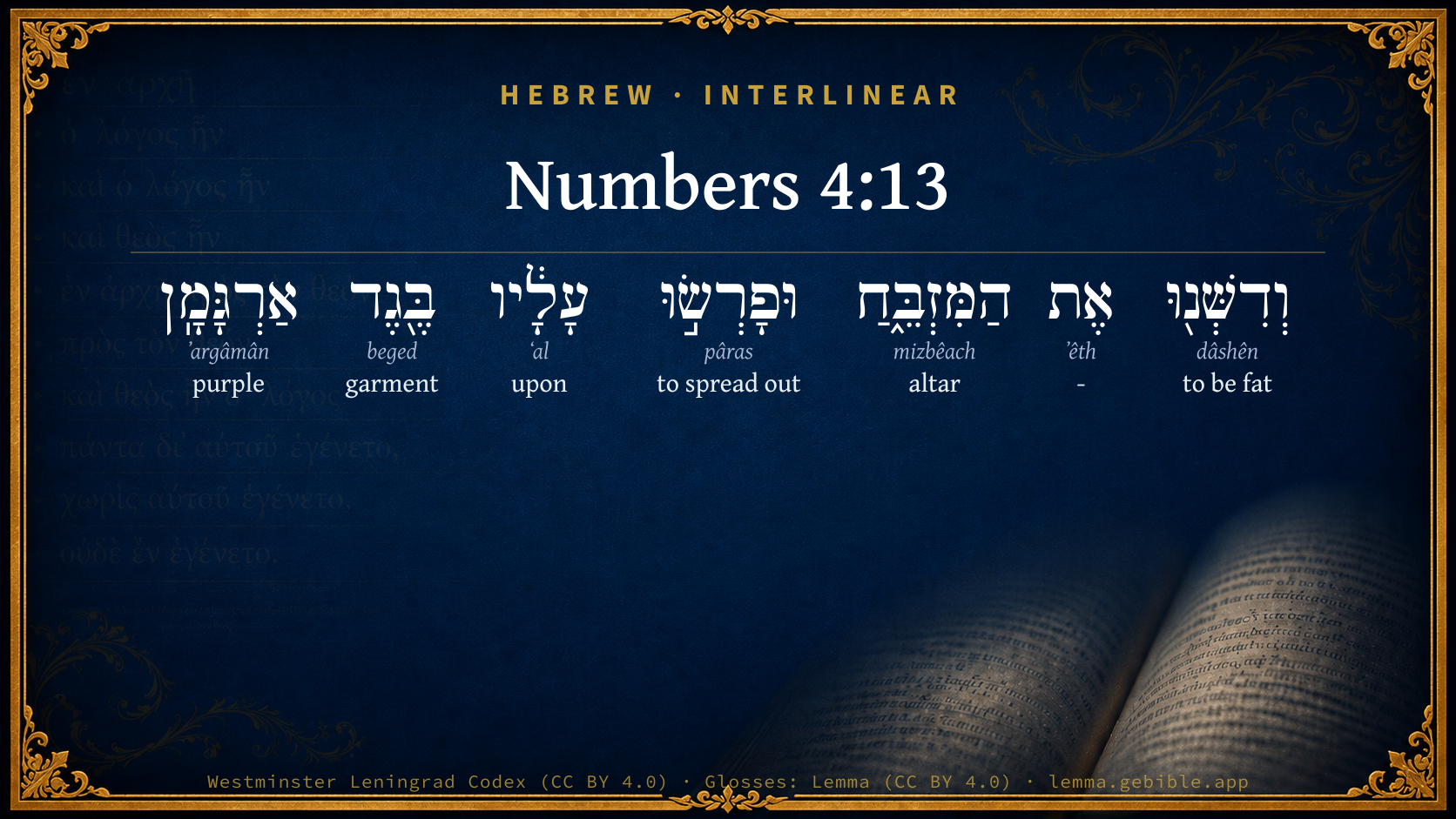
Numbers 4:13

Hebrew (Westminster Leningrad Codex) Numbers 4:13 appears in the Hebrew Old Testament. The text above is from the Westminster Leningrad Codex. Each word links to its Strong’s number, a concise gloss, and parsing drawn from the Open Scriptures Hebrew Bible morphology. Click any word for its full Brown-Driver-Briggs (BDB) entry.
Download image
Cite this verse

Numbers 4:13 (World English Bible). Public Domain. Lemma interlinear Bible study tool, https://lemma.gebible.app/v/numbers/4/13.

Show BibTeX & RIS
BibTeX
RIS
English Translation
They shall take away the ashes from the altar, and spread a purple cloth on it.
World English Bible · Public Domain
Download a study sheet

One document with this verse’s original text, its word-by-word gloss line, the meaning frame, cross-references with their text, attributed commentary, and full source and license credits — printable, and it pastes into notes with its structure intact.

This verse Autodidact and up

Study sheet (.html) Plain text (.txt)

A passage Seminary Student

Up to 50 verses in one chapter. A passage sheet keeps up to 6 commentary sources and 12 cross-references per verse, in the order this page ranks them, and says so on the sheet whenever that leaves anything out. Ask for a single verse and you get the Autodidact verse sheet above.

Everything on this page stays free to read, with no account — the sheet is a download of what is already on screen, not access to it.

Want to remove ads? Support Godless Engineer
Compare translations 3

The same verse in 3 English versions, stacked beneath the original-language interlinear above. Click any original word for its lexicon entry.

Each is an independent rendering of the whole verse — the interlinear is not word-aligned to these translations.

Highlighted words mark where these versions differ — a whole-verse word diff, not a word-by-word alignment.

  • World English Bible Public Domain
    They shall take away the ashes from the altar, and spread a purple cloth on it.
  • King James Version Public Domain
    And they shall take away the ashes from the altar, and spread a purple cloth thereon:
  • unfoldingWord Literal Text CC BY-SA 4.0
    And they shall remove the ashes from the altar, and they shall spread over it a cloth of purple.

unfoldingWord Literal Text — © unfoldingWord, licensed CC BY-SA 4.0. Word-aligned USFM3 via Door43 (git.door43.org/unfoldingWord/en_ult).

Versions to compare (up to 4)

3 of 4 selected

Show all 18 translations

Every available English version of this verse, each an independent rendering of the whole verse.

  • World English Bible Public Domain
    They shall take away the ashes from the altar, and spread a purple cloth on it.
  • Berean Standard Bible Public Domain
    Then they shall remove the ashes from the bronze altar, spread a purple cloth over it,
  • Majority Standard Bible Public Domain
    Then they shall remove the ashes from the bronze altar, spread a purple cloth over it,
  • King James Version Public Domain
    And they shall take away the ashes from the altar, and spread a purple cloth thereon:
  • American Standard Version (1901) Public Domain
    And they shall take away the ashes from the altar, and spread a purple cloth thereon:
  • Revised Version (1885) Public Domain
    And they shall take away the ashes from the altar, and spread a purple cloth thereon:
  • Geneva Bible (1599) Public Domain
    Also they shall take away the ashes from the altar, and spread a purple cloth vpon it,
  • Douay-Rheims (1899) Public Domain
    They shall cleanse the altar also from the ashes, and shall wrap it up in a purple cloth,
  • Young's Literal Translation Public Domain
    and have removed the ashes of the altar, and have spread over it a garment of purple;
  • Literal Standard Version CC BY-SA 4.0
    and have removed the ashes of the altar, and have spread a garment of purple over it,
  • Unlocked Literal Bible CC BY-SA 4.0
    They must remove the ashes from the altar and spread a purple cloth on the altar.
  • unfoldingWord Literal Text CC BY-SA 4.0
    And they shall remove the ashes from the altar, and they shall spread over it a cloth of purple.
  • Darby Bible Public Domain
    And they shall cleanse the altar of the ashes, and spread a purple cloth thereon;
  • World Messianic Bible Public Domain
    “They shall take away the ashes from the altar, and spread a purple cloth on it.
  • Webster's Bible Public Domain
    And they shall take away the ashes from the altar, and spread a purple cloth upon it:
  • Free Bible Version CC BY-SA 4.0
    Have them clean the ashes from the bronze altar and spread a purple cloth over it,
  • Bible in Basic English Public Domain
    And they are to take away the burned waste from the altar, and put a purple cloth on it;
  • JPS Tanakh (1917) Public Domain
    And they shall take away the ashes from the altar, and spread a purple cloth thereon.

Literal Standard Version (2020), Covenant Press — licensed CC BY-SA 4.0. Text via the HelloAO Bible API (eBible.org). Unlocked Literal Bible (unfoldingWord) — licensed CC BY-SA 4.0. Text via the HelloAO Bible API (eBible.org). unfoldingWord Literal Text — © unfoldingWord, licensed CC BY-SA 4.0. Word-aligned USFM3 via Door43 (git.door43.org/unfoldingWord/en_ult). Free Bible Version, Dr. Jonathan Gallagher — licensed CC BY-SA 4.0. Text via the HelloAO Bible API (eBible.org).

Word by word

More ways to search: Search by grammar → Find every occurrence → Compare this word →

Practice this passage: Drill this verse → Learn its vocabulary →

וְדִשְּׁנ֖וּ
dâshên
H1878
“and · to be fat”
Conjunction + Verb, Piel, Sequential Perfect, 3rd Person, Common, Plural
Part of Speech
Conjunction + Verb
Stem
Piel
Form
Sequential Perfect
Person
3rd Person
Gender
Common
Number
Plural
Full BDB Definition

Origin: a primitive root

TWOT: 457

to be fat, grow fat, become fat, become prosperous, anoint - (Qal) of prosperity (figuratively) - (Piel) - to make fat, anoint - to find fat (of offering - acceptable) - to take away ashes (from altar) - (Pual) to be made fat - (Hothpael) to fatten oneself (of Jehovah's sword)
  1. אֶת ʼêth H853 “-” Particle, Direct Object
  2. הַמִּזְבֵּ֑חַ mizbêach H4196 “the · altar” Particle, Definite Article + Noun, Common, Masculine, Singular, Absolute
  3. וּפָרְשׂ֣וּ pâras H6566 “and · to spread out” Conjunction + Verb, Qal, Sequential Perfect, 3rd Person, Common, Plural
  4. עָלָ֔יו ʻal H5921 “upon · him” Preposition + Suffix, Personal, 3rd Person, Masculine, Singular
  5. בֶּ֖גֶד beged H899 “garment of” Noun, Common, Masculine, Singular, Construct
  6. אַרְגָּמָֽן ʼargâmân H713 “purple” Noun, Common, Masculine, Singular, Absolute

About this verse

These counts appear in no published source. They are computed here, from the morphology-tagged text and Lemma’s own curated glosses. What Lemma adds →

7
words
7
distinct lemmas
Pentateuch
section

Notable vocabulary

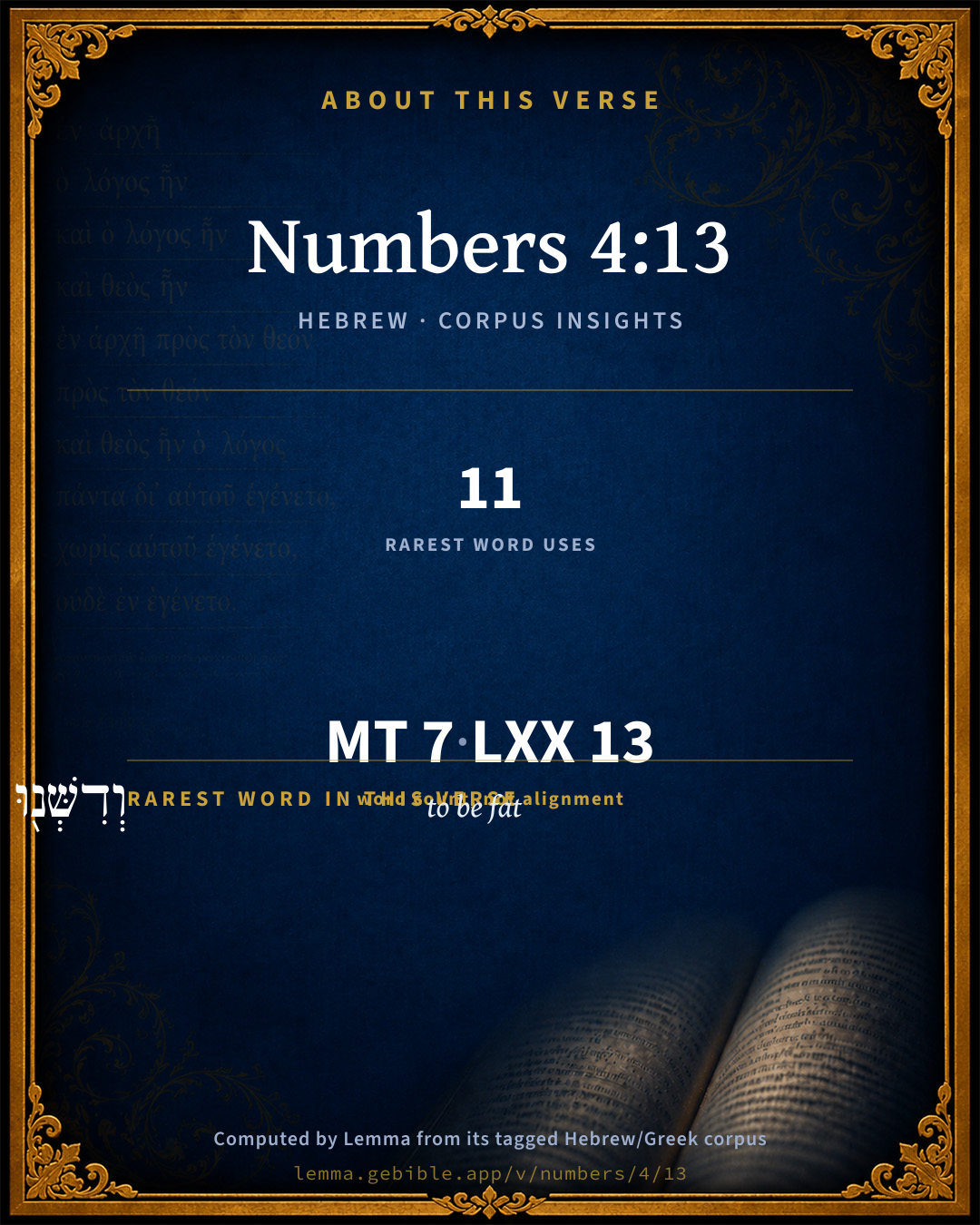
The rarest word here is וְדִשְּׁנ֖וּ to be fat H1878 — appearing just 11 times in the whole Hebrew Bible.

Shared distinctive vocabulary

וְדִשְּׁנ֖וּ to be fat H1878 occurs in 11 verses of the Hebrew Bible. Also found in:

Grammatical profile

  • 2 verbs
  • 3 nouns
  • 1 preposition
  • 1 particle

Verb forms

  • וְדִשְּׁנ֖וּ Piel · Sequential Perfect
  • וּפָרְשׂ֣וּ Qal · Sequential Perfect

Hebrew & Septuagint length

In English translation the verse runs 16 words from the Hebrew and 20 from the Septuagint (LXX English) — closely comparable.

A rough comparison of the two English renderings, which tokenize alike — not a word-level alignment.

Word counts can differ between the Hebrew and the Greek without any difference in meaning — e.g. the Hebrew direct-object marker אֵת has no separate Greek word, and Greek often adds the article ὁ.

In the original languages it is 7 Hebrew tokens and 13 Greek tokens — but the two are counted differently (Hebrew bundles its prefixes and suffixes into one token; the Greek is in lemma form), so that isn’t a like-for-like length.

Cross-references

6

Topical passages linked to Numbers 4:13 in the Treasury of Scripture Knowledge — connected by theme and wording, ordered by reader-vote popularity; previews shown in the World English Bible.

  • Leviticus 6:12–13 The fire on the altar shall be kept burning on it, it shall not go out; and the priest shall burn wood on it every morning: and he shall lay the burnt offering in order upon it, and shall burn on it the fat of the peace offerings.
  • Exodus 27:1–8 "You shall make the altar of acacia wood, five cubits long, and five cubits broad; the altar shall be foursquare: and its height shall be three cubits.
  • Exodus 39:1 Of the blue, purple, and scarlet, they made finely worked garments, for ministering in the holy place, and made the holy garments for Aaron; as Yahweh commanded Moses.
  • Exodus 39:41 the finely worked garments for ministering in the holy place, the holy garments for Aaron the priest, and the garments of his sons, to minister in the priest's office.
  • Numbers 4:6–9 and shall put a covering of sealskin on it, and shall spread over it a cloth all of blue, and shall put in its poles.
  • Numbers 4:11–12 On the golden altar they shall spread a blue cloth, and cover it with a covering of sealskin, and shall put in its poles.

Cross-references courtesy of OpenBible.info (CC BY 4.0).

Hebrew and Greek witnesses Masoretic Hebrew ↔ Greek Septuagint

The same verse in the two great witnesses to the Old Testament, shown verse-for-verse.

These are two independent witnesses, not word-aligned to each other, and the Septuagint is shown in lemma (dictionary) form.

Hebrew Numbers 4:13 Masoretic · Westminster Leningrad Codex

וְדִשְּׁנ֖וּ אֶת הַמִּזְבֵּ֑חַ וּפָרְשׂ֣וּ עָלָ֔יו בֶּ֖גֶד אַרְגָּמָֽן

They shall take away the ashes from the altar, and spread a purple cloth on it.

World English Bible · Public Domain

Greek LXX Numbers 4:13 Septuagint · lemma form

καί ὁ καλυπτήρ ἐπιτίθημι ἐπί ὁ θυσιαστήριον καί ἐπικαλύπτω ἐπί αὐτός ἱμάτιον ὁλοπόρφυρος

And he shall put the covering on the altar, and they shall cover it with a cloth all of purple.

LXX2012 (modern English Septuagint) · Public Domain

On this verse, John Gill's Exposition discusses the Septuagint’s reading. Read the note in Commentary ↓

Hebrew: Westminster Leningrad Codex (CC BY 4.0). Greek: Septuagint (public domain); English from LXX2012 (modern English Septuagint) (Public Domain). How the Septuagint differs from the Hebrew →

Targum (Aramaic paraphrase)

2

The Targum is the ancient Jewish Aramaic paraphrase of the Hebrew Scriptures — an interpretive translation, not the Hebrew text itself. Onkelos (literal) and Pseudo-Jonathan (expansive) render the Torah, and Jonathan the Prophets. Coverage is partial: where no permissively-licensed English translation exists for a verse, only the Aramaic is shown. This is verse-level text, not a word-by-word alignment to the Hebrew.

  1. Targum Onkelos Torah (Genesis–Deuteronomy)
    וְיִסְפוּן יָת קִטְמָא דְמַדְבְּחָא וְיִפְרְסוּן עֲלוֹהִי לְבוּשׁ אַרְגְוָן

    (no public-domain English translation for this verse)

    Targum Onkelos — Aramaic: “Onkelos Genesis” (public domain); “Onkelos Exodus” (public domain); “Onkelos Leviticus” (public domain); “Onkelos Numbers” (public domain); “Onkelos Deuteronomy” (public domain). English: “Sefaria Community Translation” (CC0 1.0 (public-domain dedication)); “J.W. Etheridge. The Targums of Onkelos and Jonathan Ben Uzziel on the Pentateuch. London: Longmans, Green, 1862” (public domain). Text via Sefaria.

  2. Targum Pseudo-Jonathan Torah (Genesis–Deuteronomy)
    וִידַרְדוּן יַת מַדְבְּחָא וְיִפְרְסוּן עֲלוֹי לְבוּשׁ אַרְגְוָון

    And they shall remove the cinders from the altar, and overspread it with a covering of crimson.

    Targum Pseudo-Jonathan — Aramaic: “Targum Jonathan on Genesis” (public domain); “Targum Jonathan on Exodus” (public domain); “Targum Jonathan on Leviticus” (public domain); “Targum Jonathan on Numbers” (public domain); “Targum Jonathan on Deuteronomy” (public domain). English: “The Targum of Jonathan ben Uzziel, trans. J. W. Etheridge, London, 1862” (public domain). Text via Sefaria.

Commentary

Notes on Numbers 4:13 from classic Christian and Jewish commentators (each source and its license shown beneath its notes). The classic Christian expositions comment on the surrounding passage and are grouped to its opening verse, so a note may address several verses; the Jewish commentaries on the Tanakh (Rashi and others) are per-verse, so they appear only where the commentator wrote on this verse.

Lemma curates 59 commentaries, every one of them public domain or Creative Commons licensed, each selected and text-cleaned for this edition rather than reprinted as found. About our sources →

Trapp's Complete Commentary

John Trapp

Num 4:13 And they shall take away the ashes from the altar, and spread a purple cloth thereon:

Ver. 13. The ashes from the altar.] The fire from heaven was also carefully kept alive, {Lev 6:12} though nothing be here said of it.

John Trapp, A Commentary or Exposition upon All the Books of the Old and New Testament (1647–1656) — public domain. Text from a community e-Sword module.

Joseph Benson's Commentary

Num 4:13. Shall take away the ashes from the altar — Hence we may conclude, that they did offer sacrifices at other times, though not so constantly and diligently as they did in Canaan. Moreover the taking away of the ashes only doth sufficiently imply that the fire was preserved, which, as it came down from heaven, (Leviticus 9.,) so it was by God’s command to be continually fed and kept burning, and therefore doubtless was put into some vessel, which might be either fastened to the altar, and put within this covering, or carried by some person appointed thereunto.

Joseph Benson's Commentary on the Old and New Testaments (1811–1818) — public domain. Text from a community e-Sword module.

Geneva Bible (1599)

Geneva Bible translators

Of the burnt offering.

Geneva Bible (1599) marginal notes — public domain. Text via Bolls.life.

Jamieson, Fausset & Brown

Robert Jamieson, A. R. Fausset & David Brown

shall take away the ashes from the altar, &c.--The necessity of removing ashes from the altar plainly implies that sacrifices were offered in the wilderness (compare Exo 18:12; Exo 24:4), though that rebellious race seems frequently to have neglected the duty (Amo 5:25). No mention is made of the sacred fire; but as, by divine command, it was to be kept constantly burning, it must have been transferred to some pan or brazier under the covering, and borne by the appointed carriers.

Jamieson, Fausset & Brown — Commentary Critical and Explanatory on the Whole Bible (1871) — public domain (CC PDM 1.0). Text via the HelloAO Bible API.

Ellicott's Commentary for English Readers

(13) And they shall take away the ashes from the altar.—In Exo_27:3 we find a direction to make pans for removing the ashes from the brazen altar, and also to make all the brazen vessels mentioned in the next verse.

A Bible Commentary for English Readers, edited by Charles John Ellicott (1878–1897) — public domain. Text from a community e-Sword module.

John Gill's Exposition

And they shall take away the ashes from the altar, and spread a purple cloth thereon. Having cleared the holy of holies, and the holy place, they were to come forth from thence into the court of the tabernacle, where stood the altar of burnt offering, which is here meant, and on which sacrifices being daily burnt, there were always ashes to be removed; and which at this time was highly necessary to be done, when the tabernacle was taken down, and all belonging to it to be carried away; and though no mention is made of the fire, which was always burning on it, it was doubtless preserved, and care was taken for the carrying it along with the altar, or in a separate vessel from it. Bishop Patrick supposes it might be carried upon the grate.

And they shall take away the ashes from the altar, and spread a purple cloth thereon. Having cleared the holy of holies, and the holy place, they were to come forth from thence into the court of the tabernacle, where stood the altar of burnt offering, which is here meant, and on which sacrifices being daily burnt, there were always ashes to be removed; and which at this time was highly necessary to be done, when the tabernacle was taken down, and all belonging to it to be carried away; and though no mention is made of the fire, which was always burning on it, it was doubtless preserved, and care was taken for the carrying it along with the altar, or in a separate vessel from it. Bishop Patrick supposes it might be carried upon the grate.

Numbers 4:14

num 4:14

num 4:14

num 4:14And they shall put upon it all the vessels thereof,.... Upon the altar covered with a blue cloth; on that were to be put everything belonging to the altar:

wherewith they minister about it; the priests, when they offered sacrifice on it:

even the censers, the fleshhooks, and the shovels, and the basins,

all the vessels of the altar; of which see Exo 27:3,

and they shall spread upon it a covering of badgers' skins: to prevent the rains falling upon them, which being all of brass, would be apt to tarnish:

and put to the staves of it; which were made to bear and carry it on such an occasion as this, Exo 27:6. No mention is made of the laver, though there is both in the Septuagint and Samaritan versions, which add,"and they shall take a purple cloth and cover the layer, and its base, and shall put it into a covering of skin of a blue colour, and put it upon bearers:''but perhaps the reason why this is not mentioned is, because it was carried uncovered; the mystery of which, Ainsworth conjectures, was this, that it might be a lively representation of the grace of God in Christ, continuing and opened as an ever springing fountain, where always God's elect, having faith in him, may wash and purge themselves in the blood of Christ unto forgiveness of sin sanctification of the Spirit, and salvation; see Zac 13:1.

John Gill's Exposition of the Whole Bible (1746–1763) — public domain (CC PDM 1.0). Text via the HelloAO Bible API.

Haydock's Catholic Bible Commentary

Ashes, which might be upon the grate of the altar, where the sacred fire had been burning. This shews that the precept was already observed. The Septuagint do not mention the ashes. But some copies, with Origen, (hom. iv.) and the Samaritan Pentateuch, insert some words at the end of ver. 14, which Grotius believes have been omitted by the Massorets, in the present Hebrew Bibles. "They shall take a purple veil, and fold up the laver and its foot, and put them in a covering of violet skins, and place them upon the bars." (Calmet) --- The children of Caath were the most honoured among the Levites, as Moses and Aaron sprung from the same family, Eleazar, the future pontiff, presided over them in a particular manner, while his younger brother Ithamar, directed the rest. (Haydock)

George Leo Haydock (1774–1849), Haydock's Catholic Family Bible and Commentary, 1859 edition — public domain. Excludes Psalms (Douay-Rheims chapter numbering differs from Protestant) and Deuterocanonical books (Catholic canon only).

Matthew Poole's English Annotations

From the altar of burnt-offerings; whereby it may seem probable, though it be denied by most, that they did offer some sacrifices in the wilderness, though it may not be so frequently nor orderly as afterwards they did. Whence else were these ashes? And there are some undeniable instances of their sacrificing there, as Exo 18:12 24:4; Num 7, &c.; from which it seems rational to conclude that they did offer sacrifices at other times, though not so constantly and diligently as they did in Canaan. And for the argument against it from Amo 5:25, that may be easily dissolved, as we shall there see, if the Lord please. Moreover the taking away of the ashes only doth sufficiently imply that the fire was preserved, which as it came down from heaven, Le 9, so it was by God’s command to be continually fed and kept burning, and therefore doubtless was put into some vessel, which might be either fastened to the altar and put within this covering, or carried by some person appointed thereunto.

Matthew Poole's English Annotations on the Holy Bible (1683–1685) — public domain. Text from a community e-Sword/MySword module.

The Pulpit Commentary

Take away the ashes. This is omitted by the Septuagint. The Hebrew word for "ashes is of somewhat doubtful meaning, being only used here and in Exo_27:3 Psa_20:3 (see margin). Being connected with the word "fat," it may perhaps mean the grease or dripping from the burnt offerings. The Targum of Palestine renders it "cinders." As the altar was hollow, and was filled with earth or stones when used, there would be no need to cleanse it from ashes; if this be the meaning of the word, the command would rather have been to collect the living embers before the altar was removed, in order to keep alive the sacred fire. That this fire was never allowed to go out may be looked upon as certain.

The Pulpit Commentary (1880–1919), ed. H.D.M. Spence-Jones & Joseph S. Exell — public domain. Text from a community e-Sword module.

John Wesley's Explanatory Notes

The altar - Hence we may conclude, that they did offer sacrifices at other times, though not so constantly and diligently, as they did in Canaan. Moreover the taking away of the ashes only doth sufficiently imply that the fire was preserved, which as it came down from heaven, Lev. ix, 24. So it was by God's command to be continually fed, and kept burning, and therefore doubtless was put into some vessel, which might be either fastened to the altar and put within this covering, or carried by some person appointed thereunto.

John Wesley, Explanatory Notes Upon the Whole Bible (1754–1765) — public domain. Text via the GEBible commentary corpus.

Keil & Delitzsch

C. F. Keil & F. Delitzsch

The altar of burnt-offering was first of all to be cleansed from the ashes; a crimson cloth was then to be covered over it, and the whole of the furniture belonging to it to be placed upon the top; and lastly, the whole was to be covered with a sea-cow skin. The only thing not mentioned is the copper laver (Exo 30:18), probably because it was carried without any cover at all. The statement in the Septuagint and the Samaritan text, which follows Num 4:14. respecting its covering and conveyance upon a frame, is no doubt a spurious interpolation.

Keil & Delitzsch — Biblical Commentary on the Old Testament (1861–1891) — public domain (CC PDM 1.0). Text via the HelloAO Bible API. (Old Testament only.)

Rashi

Rabbi Shlomo Yitzchaki (Rashi)

ודשנו את המזבח AND THEY SHALL TAKE AWAY THE ASHES FROM THE ALTAR — from the brazen altar.

ודשנו means, they shall remove the ashes from off it (cf. Rashi on Exodus 27:3).

ופרשו עליו בגד ארגמן AND THEY SHALL SPREAD A GARMENT OF RED PURPLE THEREON — But the fire that descended from heaven on the altar (cf. Rashi on Leviticus 1:7) lay beneath the garment in the form of a lion during the journeyings; it did not, however, burn it because they inverted a large vessel of copper over it (cf. Yoma 21b).

Rashi on the Tanakh — English translations: “The Judaica Press complete Tanach with Rashi, translated by A. J. Rosenberg” (CC BY 4.0); “Pentateuch with Rashi's commentary by M. Rosenbaum and A.M. Silbermann, 1929-1934” (public domain); “The Metsudah Tanach series, Lakewood, N.J” (CC BY 4.0); and “The Book of Joshua, Metsudah Publications, 1997” (CC BY 4.0). Text via Sefaria.

Lesson kit

Teaching starters — assembled from the data on this page, not authored interpretation. Every prompt links to the verse data it draws on. Edit before teaching.

Numbers, in the Pentateuch, opens this verse with 7 words (7 distinct Hebrew lemmas). Its most distinctive word is dâshên (“to be fat”). A historical commentator’s framing appears above. Read the whole chapter for the surrounding context.

Discussion questions

  1. What does “to be fat” (dâshên) contribute to the verse as a whole?
  2. Exodus 27:3 shares the word «to be fat» with this verse. How do the two illuminate each other?
  3. The translations on this page render this verse differently — a whole-verse word diff, not a word-by-word alignment. What might account for the different wordings?
  4. The verb «וְדִשְּׁנ֖וּ» is Piel Sequential Perfect. How does its form color the action?
  5. Reading how Trapp's Complete Commentary and Joseph Benson's Commentary read this verse, where do the two commentators agree and where do they part?

Things to notice

Reading settings

Reading text

Shown beneath each verse's original-language words.

Old Testament
Old Testament edition

Read the OT as the Masoretic Hebrew (MT) or the Greek Septuagint (LXX).

English shown for the Greek Septuagint (in the Hebrew ↔ Greek comparison).

Comparing translations? Open the Compare panel on any verse page to stack up to four side by side.