
Numbers 4:14

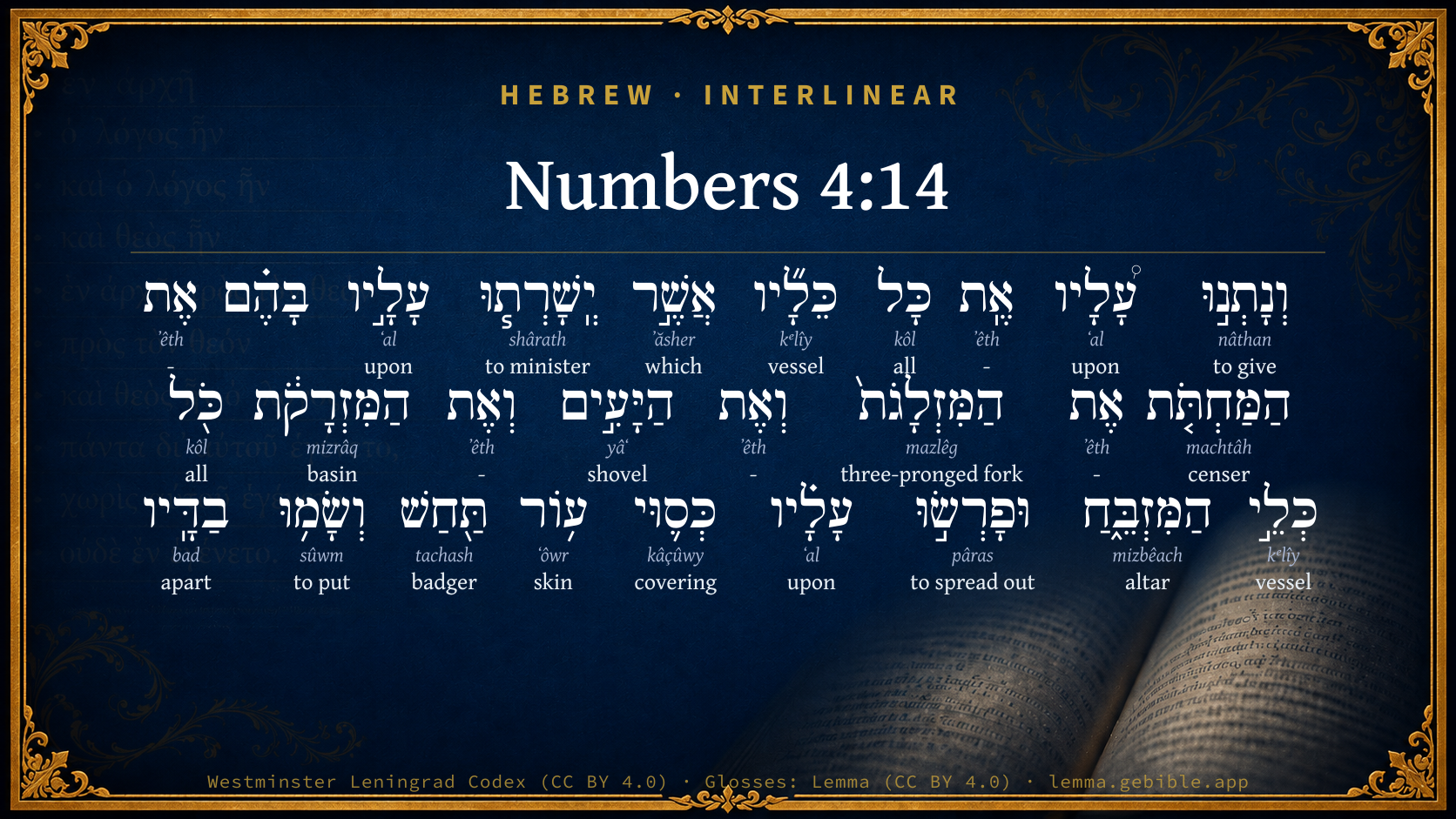
Hebrew (Westminster Leningrad Codex) Numbers 4:14 appears in the Hebrew Old Testament. The text above is from the Westminster Leningrad Codex. Each word links to its Strong’s number, a concise gloss, and parsing drawn from the Open Scriptures Hebrew Bible morphology. Click any word for its full Brown-Driver-Briggs (BDB) entry.
Download image
Cite this verse

Numbers 4:14 (World English Bible). Public Domain. Lemma interlinear Bible study tool, https://lemma.gebible.app/v/numbers/4/14.

Show BibTeX & RIS
BibTeX
RIS
English Translation
They shall put on it all its vessels, with which they minister about it, the fire pans, the flesh hooks, the shovels, and the basins; all the vessels of the altar; and they shall spread on it a covering of sealskin, and put in its poles.
World English Bible · Public Domain
Download a study sheet

One document with this verse’s original text, its word-by-word gloss line, the meaning frame, cross-references with their text, attributed commentary, and full source and license credits — printable, and it pastes into notes with its structure intact.

This verse Autodidact and up

Study sheet (.html) Plain text (.txt)

A passage Seminary Student

Up to 50 verses in one chapter. A passage sheet keeps up to 6 commentary sources and 12 cross-references per verse, in the order this page ranks them, and says so on the sheet whenever that leaves anything out. Ask for a single verse and you get the Autodidact verse sheet above.

Everything on this page stays free to read, with no account — the sheet is a download of what is already on screen, not access to it.

Want to remove ads? Support Godless Engineer
Compare translations 3

The same verse in 3 English versions, stacked beneath the original-language interlinear above. Click any original word for its lexicon entry.

Each is an independent rendering of the whole verse — the interlinear is not word-aligned to these translations.

Highlighted words mark where these versions differ — a whole-verse word diff, not a word-by-word alignment.

  • World English Bible Public Domain
    They shall put on it all its vessels, with which they minister about it, the fire pans, the flesh hooks, the shovels, and the basins; all the vessels of the altar; and they shall spread on it a covering of sealskin, and put in its poles.
  • King James Version Public Domain
    And they shall put upon it all the vessels thereof, wherewith they minister about it, even the censers, the fleshhooks, and the shovels, and the basins, all the vessels of the altar; and they shall spread upon it a covering of badgers' skins, and put to the staves of it.
  • unfoldingWord Literal Text CC BY-SA 4.0
    And they shall put on it all its vessels with which they minister on it: the trays, the meat forks and the shovels and the basins—all the vessels of the altar. And they shall spread over it a covering of skin of a porpoise, and they shall set its poles.

unfoldingWord Literal Text — © unfoldingWord, licensed CC BY-SA 4.0. Word-aligned USFM3 via Door43 (git.door43.org/unfoldingWord/en_ult).

Versions to compare (up to 4)

3 of 4 selected

Show all 18 translations

Every available English version of this verse, each an independent rendering of the whole verse.

  • World English Bible Public Domain
    They shall put on it all its vessels, with which they minister about it, the fire pans, the flesh hooks, the shovels, and the basins; all the vessels of the altar; and they shall spread on it a covering of sealskin, and put in its poles.
  • Berean Standard Bible Public Domain
    and place on it all the vessels used to serve there: the firepans, meat forks, shovels, and sprinkling bowls—all the equipment of the altar. They are to spread over it a covering of fine leather and insert the poles.
  • Majority Standard Bible Public Domain
    and place on it all the vessels used to serve there: the firepans, meat forks, shovels, and sprinkling bowls—all the equipment of the altar. They are to spread over it a covering of fine leather and insert the poles.
  • King James Version Public Domain
    And they shall put upon it all the vessels thereof, wherewith they minister about it, even the censers, the fleshhooks, and the shovels, and the basins, all the vessels of the altar; and they shall spread upon it a covering of badgers' skins, and put to the staves of it.
  • American Standard Version (1901) Public Domain
    and they shall put upon it all the vessels thereof, wherewith they minister about it, the firepans, the flesh-hooks, and the shovels, and the basins, all the vessels of the altar; and they shall spread upon it a covering of sealskin, and put in the staves thereof.
  • Revised Version (1885) Public Domain
    and they shall put upon it all the vessels thereof, wherewith they minister about it, the firepans, the fleshhooks, and the shovels, and the basons, all the vessels of the altar; and they shall spread upon it a covering of sealskin, and put in the staves thereof.
  • Geneva Bible (1599) Public Domain
    And shall put vpon it all the instruments thereof, which they occupie about it: the censers, the fleshhookes and the besomes, and the basens, euen al the instruments of the altar and they shall spread vpon it a couering of badgers skinnes, and put to the barres of it.
  • Douay-Rheims (1899) Public Domain
    And shall put it with all the vessels that they use in the ministry thereof, that is to say, firepans, fleshhooks and forks, pothooks and shovels. They shall cover all the vessels of the altar together with a covering of violet skins, and shall put in the bars.
  • Young's Literal Translation Public Domain
    and have put on it all its vessels wherewith they minister about it, the censers, the hooks, and the shovels, and the bowls, all the vessels of the altar, and have spread on it a covering of badger skin, and have placed its staves:
  • Literal Standard Version CC BY-SA 4.0
    and have put on it all its vessels with which they minister on it—the censers, the hooks, and the shovels, and the bowls, all the vessels of the altar—and have spread a covering of tachash skin on it, and have placed its poles.
  • Unlocked Literal Bible CC BY-SA 4.0
    They must put on the carrying frame all the equipment that they use in the work of the altar. These objects are the firepans, forks, shovels, bowls, and all the other equipment for the altar. They must cover the altar with sea cow skins and then insert the carrying poles.
  • unfoldingWord Literal Text CC BY-SA 4.0
    And they shall put on it all its vessels with which they minister on it: the trays, the meat forks and the shovels and the basins—all the vessels of the altar. And they shall spread over it a covering of skin of a porpoise, and they shall set its poles.
  • Darby Bible Public Domain
    and they shall put upon it all the utensils thereof, wherewith they perform service about it: the firepans, the forks, and the shovels, and the bowls, -- all the utensils of the altar; and they shall spread upon it a covering of badgers' skin, and put its staves [to it].
  • World Messianic Bible Public Domain
    They shall put on it all its vessels with which they minister about it, the fire pans, the meat hooks, the shovels, and the basins—all the vessels of the altar; and they shall spread on it a covering of sealskin, and put in its poles.
  • Webster's Bible Public Domain
    And they shall put upon it all its vessels, with which they minister about it, even the censers, the flesh-hooks, and the shovels, and the basins, all the vessels of the altar; and they shall spread upon it a covering of badgers' skins, and put to it its staffs.
  • Free Bible Version CC BY-SA 4.0
    and put on it all the equipment used in the services on the altar: the firepans, meat forks, shovels, and sprinkling bowls. Spread over it a fine leather covering and then insert its carrying poles.
  • Bible in Basic English Public Domain
    Placing on the cloth all its vessels, the fire-baskets, the meat-hooks, the spades, and the basins; all the vessels of the altar; they are to put a leather cover over all these, and put its rods in their places.
  • JPS Tanakh (1917) Public Domain
    And they shall put upon it all the vessels thereof, wherewith they minister about it, the fire-pans, the flesh-hooks, and the shovels, and the basins, all the vessels of the altar; and they shall spread upon it a covering of sealskin, and set the staves thereof.

Literal Standard Version (2020), Covenant Press — licensed CC BY-SA 4.0. Text via the HelloAO Bible API (eBible.org). Unlocked Literal Bible (unfoldingWord) — licensed CC BY-SA 4.0. Text via the HelloAO Bible API (eBible.org). unfoldingWord Literal Text — © unfoldingWord, licensed CC BY-SA 4.0. Word-aligned USFM3 via Door43 (git.door43.org/unfoldingWord/en_ult). Free Bible Version, Dr. Jonathan Gallagher — licensed CC BY-SA 4.0. Text via the HelloAO Bible API (eBible.org).

Word by word

More ways to search: Search by grammar → Find every occurrence → Compare this word →

Practice this passage: Drill this verse → Learn its vocabulary →

כְּס֛וּי
kâçûwy
H3681
“covering of”
Noun, Common, Masculine, Singular, Construct
Part of Speech
Noun
Type
Common
Gender
Masculine
Number
Singular
State
Construct
Full BDB Definition

Origin: passive participle of H3680

TWOT: 1008a

covering, outer covering
  1. וְנָתְנ֣וּ nâthan H5414 “and · to give” Conjunction + Verb, Qal, Sequential Perfect, 3rd Person, Common, Plural
  2. עָ֠לָיו ʻal H5921 “upon · him” Preposition + Suffix, Personal, 3rd Person, Masculine, Singular
  3. אֶֽת ʼêth H853 “-” Particle, Direct Object
  4. כָּל kôl H3605 “all of” Noun, Common, Masculine, Singular, Construct
  5. כֵּלָ֞יו kᵉlîy H3627 “vessels · his” Noun, Common, Masculine, Plural, Construct + Suffix, Personal, 3rd Person, Masculine, Singular
  6. אֲשֶׁ֣ר ʼăsher H834 “which” Particle, Relative
  7. יְֽשָׁרְת֧וּ shârath H8334 “to minister” Verb, Piel, Imperfect, 3rd Person, Masculine, Plural
  8. עָלָ֣יו ʻal H5921 “upon · him” Preposition + Suffix, Personal, 3rd Person, Masculine, Singular
  9. אֶת ʼêth H853 “-” Particle, Direct Object
  10. הַמַּחְתֹּ֤ת machtâh H4289 “the · censers” Particle, Definite Article + Noun, Common, Feminine, Plural, Absolute
  11. אֶת ʼêth H853 “-” Particle, Direct Object
  12. הַמִּזְלָגֹת֙ mazlêg H4207 “the · three-pronged forks” Particle, Definite Article + Noun, Common, Feminine, Plural, Absolute
  13. וְאֶת ʼêth H853 “and · -” Conjunction + Particle, Direct Object
  14. הַיָּעִ֣ים yâʻ H3257 “the · shovels” Particle, Definite Article + Noun, Common, Masculine, Plural, Absolute
  15. וְאֶת ʼêth H853 “and · -” Conjunction + Particle, Direct Object
  16. הַמִּזְרָקֹ֔ת mizrâq H4219 “the · basins” Particle, Definite Article + Noun, Common, Masculine, Plural, Absolute
  17. כֹּ֖ל kôl H3605 “all of” Noun, Common, Masculine, Singular, Construct
  18. כְּלֵ֣י kᵉlîy H3627 “vessels of” Noun, Common, Masculine, Plural, Construct
  19. הַמִּזְבֵּ֑חַ mizbêach H4196 “the · altar” Particle, Definite Article + Noun, Common, Masculine, Singular, Absolute
  20. וּפָרְשׂ֣וּ pâras H6566 “and · to spread out” Conjunction + Verb, Qal, Sequential Perfect, 3rd Person, Common, Plural
  21. עָלָ֗יו ʻal H5921 “upon · him” Preposition + Suffix, Personal, 3rd Person, Masculine, Singular
  22. ע֥וֹר ʻôwr H5785 “skin of” Noun, Common, Masculine, Singular, Construct
  23. תַּ֖חַשׁ tachash H8476 “badger” Noun, Common, Masculine, Singular, Absolute
  24. וְשָׂמ֥וּ sûwm H7760 “and · to put” Conjunction + Verb, Qal, Sequential Perfect, 3rd Person, Common, Plural
  25. בַדָּֽיו bad H905 “poles · his” Noun, Common, Masculine, Plural, Construct + Suffix, Personal, 3rd Person, Masculine, Singular

About this verse

These counts appear in no published source. They are computed here, from the morphology-tagged text and Lemma’s own curated glosses. What Lemma adds →

27
words
18
distinct lemmas
Pentateuch
section

Notable vocabulary

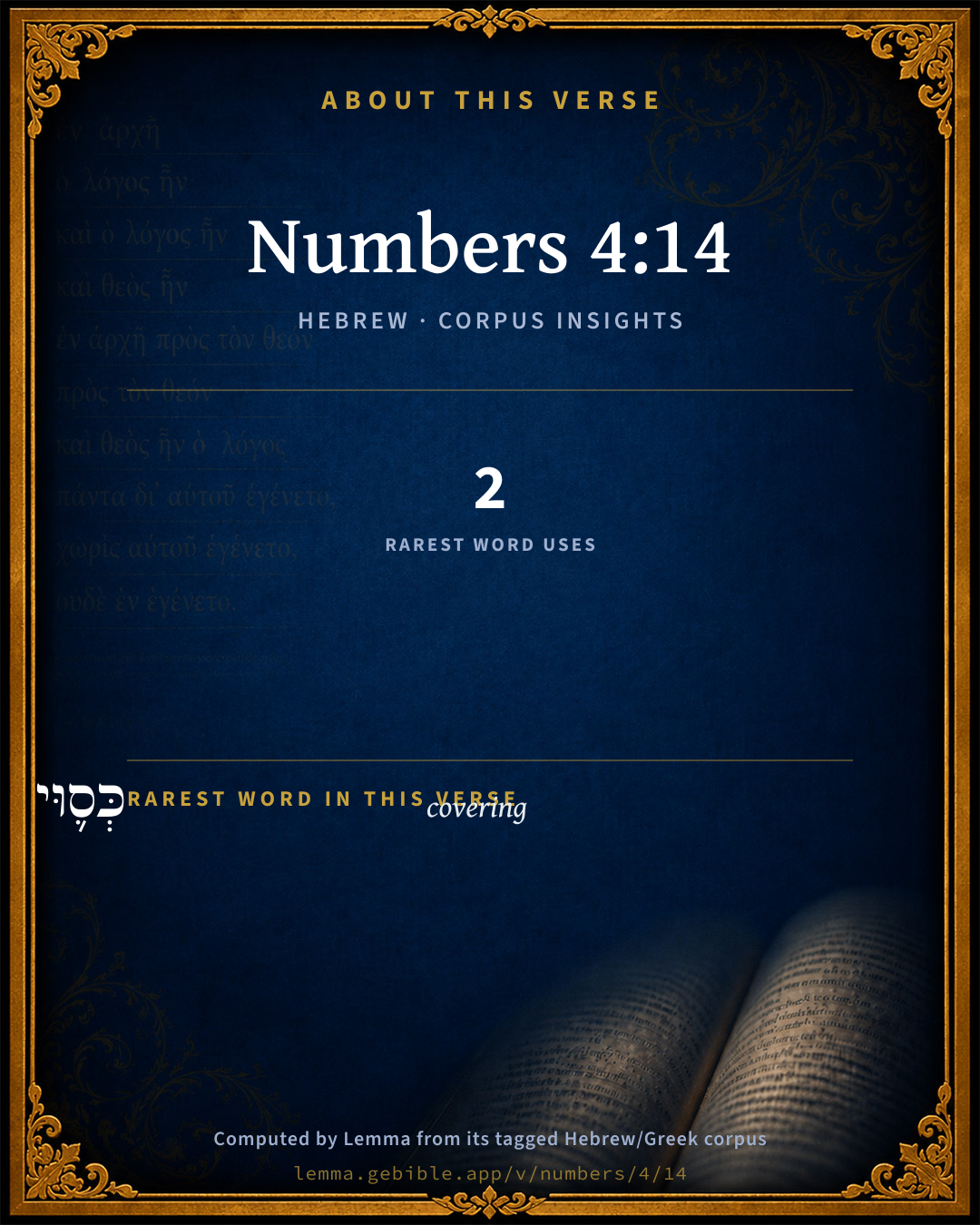
The rarest word here is כְּס֛וּי covering H3681 — appearing just 2 times in the whole Hebrew Bible.

Shared distinctive vocabulary

כְּס֛וּי covering H3681 occurs in 2 verses of the Hebrew Bible. Also found in:

Grammatical profile

  • 4 verbs
  • 13 nouns
  • 4 prepositions
  • 6 particles

Verb forms

  • וְנָתְנ֣וּ Qal · Sequential Perfect
  • יְֽשָׁרְת֧וּ Piel · Imperfect
  • וּפָרְשׂ֣וּ Qal · Sequential Perfect
  • וְשָׂמ֥וּ Qal · Sequential Perfect

Repetition

Words recur within this verse — often emphatic in Hebrew:

  • עָ֠לָיו upon H5921 ×3
  • כָּל all H3605 ×2
  • כֵּלָ֞יו vessel H3627 ×2

Hebrew & Septuagint length

In English translation the verse runs 46 words from the Hebrew and 82 from the Septuagint (LXX English) — the Septuagint runs noticeably longer here. See the side-by-side →

A rough comparison of the two English renderings, which tokenize alike — not a word-level alignment.

Word counts can differ between the Hebrew and the Greek without any difference in meaning — e.g. the Hebrew direct-object marker אֵת has no separate Greek word, and Greek often adds the article ὁ.

Cross-references

2

Topical passages linked to Numbers 4:14 in the Treasury of Scripture Knowledge — connected by theme and wording, ordered by reader-vote popularity; previews shown in the World English Bible.

  • Exodus 38:1–7 He made the altar of burnt offering of acacia wood. It was square. Its length was five cubits, its breadth was five cubits, and its height was three cubits.
  • 2 Chronicles 4:19 Solomon made all the vessels that were in the house of God, the golden altar also, and the tables whereon was the show bread;

Cross-references courtesy of OpenBible.info (CC BY 4.0).

Hebrew and Greek witnesses Masoretic Hebrew ↔ Greek Septuagint

The same verse in the two great witnesses to the Old Testament, shown verse-for-verse.

Here the Septuagint runs noticeably longer than the Hebrew — LXX2012 (modern English Septuagint) 82 words vs World English Bible 46. A rough length comparison of the two English translations, not a word-level alignment — read both below.

These are two independent witnesses, not word-aligned to each other, and the Septuagint is shown in lemma (dictionary) form.

Hebrew Numbers 4:14 Masoretic · Westminster Leningrad Codex

וְנָתְנ֣וּ עָ֠לָיו אֶֽת כָּל כֵּלָ֞יו אֲשֶׁ֣ר יְֽשָׁרְת֧וּ עָלָ֣יו בָּהֶ֗ם אֶת הַמַּחְתֹּ֤ת אֶת הַמִּזְלָגֹת֙ וְאֶת הַיָּעִ֣ים וְאֶת הַמִּזְרָקֹ֔ת כֹּ֖ל כְּלֵ֣י הַמִּזְבֵּ֑חַ וּפָרְשׂ֣וּ עָלָ֗יו כְּס֛וּי ע֥וֹר תַּ֖חַשׁ וְשָׂמ֥וּ בַדָּֽיו

They shall put on it all its vessels, with which they minister about it, the fire pans, the flesh hooks, the shovels, and the basins; all the vessels of the altar; and they shall spread on it a covering of sealskin, and put in its poles.

World English Bible · Public Domain

Greek LXX Numbers 4:14 Septuagint · lemma form

καί ἐπιτίθημι ἐπί αὐτός πᾶς ὁ σκεῦος ὅσος λειτουργέω ἐπί αὐτός ἐν αὐτός καί ὁ πυρεῖον καί ὁ κρεάγρα καί ὁ φιάλη καί ὁ καλυπτήρ καί πᾶς ὁ σκεῦος ὁ θυσιαστήριον καί ἐπιβάλλω ἐπί αὐτός κάλυμμα δερμάτινος ὑακίνθινος καί δια ἐνβάλλω ὁ ἀναφορεύς αὐτός καί λαμβάνω ἱμάτιον πορφύρεος καί συνκαλύπτω ὁ λουτήρ καί ὁ βάσις αὐτός καί ἐνβάλλω αὐτός εἰς κάλυμμα δερμάτινος ὑακίνθινος καί ἐπιτίθημι ἐπί ἀναφορεύς

And they shall put upon it all the vessels with which they minister upon it, and the fire-pans, and the flesh hooks, and the cups, and the cover, and all the vessels of the altar; and they shall put on it a blue cover of skins, and shall put in its staves; and they shall take a purple cloth, and cover the laver and its foot, and they shall put it into a blue cover of skin, and put it on bars.

LXX2012 (modern English Septuagint) · Public Domain

On this verse, John Gill's Exposition discusses the Septuagint’s reading. Read the note in Commentary ↓

Hebrew: Westminster Leningrad Codex (CC BY 4.0). Greek: Septuagint (public domain); English from LXX2012 (modern English Septuagint) (Public Domain). How the Septuagint differs from the Hebrew →

Targum (Aramaic paraphrase)

2

The Targum is the ancient Jewish Aramaic paraphrase of the Hebrew Scriptures — an interpretive translation, not the Hebrew text itself. Onkelos (literal) and Pseudo-Jonathan (expansive) render the Torah, and Jonathan the Prophets. Coverage is partial: where no permissively-licensed English translation exists for a verse, only the Aramaic is shown. This is verse-level text, not a word-by-word alignment to the Hebrew.

  1. Targum Onkelos Torah (Genesis–Deuteronomy)
    וְיִתְּנוּן עֲלוֹהִי יָת כָּל מָנוֹהִי דִי יְשַׁמְשׁוּן עֲלוֹהִי בְהוֹן יָת מַחְתְּיָתָא וְיָת צִנוֹרְיָתָא וְיָת מַגְרוֹפְיָתָא וְיָת מִזְרְקַיָא כֹּל מָנֵי מַדְבְּחָא וְיִפְרְסוּן עֲלוֹהִי חוֹפָאָה דִמְשַׁךְ סַסְגוֹנָא וִישַׁווּן אֲרִיחוֹהִי

    (no public-domain English translation for this verse)

    Targum Onkelos — Aramaic: “Onkelos Genesis” (public domain); “Onkelos Exodus” (public domain); “Onkelos Leviticus” (public domain); “Onkelos Numbers” (public domain); “Onkelos Deuteronomy” (public domain). English: “Sefaria Community Translation” (CC0 1.0 (public-domain dedication)); “J.W. Etheridge. The Targums of Onkelos and Jonathan Ben Uzziel on the Pentateuch. London: Longmans, Green, 1862” (public domain). Text via Sefaria.

  2. Targum Pseudo-Jonathan Torah (Genesis–Deuteronomy)
    וְיִתְּנוּן עֲלוֹי יַת כָּל מָנוֹי דִישַׁמְשׁוּן עֲלוֹי בְּהוֹן יַת מַחְתְּיָיתָא וְיַת מַשִׁלְיָיתָא וְיַת מַגְרוֹפְיָיתָא וְיַת מִזְרְקַיָא כָּל מָאנֵי מַדְבְּחָא וְיִפְרְסוּן עֲלוֹי חוֹפָאָה דִמְשַׁךְ סַסְגוֹנָא וִישַׁווּן אֲרִיחוֹי

    and put upon it all its vessels with which it is served, the cinder-holders, flesh-hooks, prongs, and basins, even all the vessels of the altar, and spread upon it a covering of hyacinthine skin, and inset its staves.

    Targum Pseudo-Jonathan — Aramaic: “Targum Jonathan on Genesis” (public domain); “Targum Jonathan on Exodus” (public domain); “Targum Jonathan on Leviticus” (public domain); “Targum Jonathan on Numbers” (public domain); “Targum Jonathan on Deuteronomy” (public domain). English: “The Targum of Jonathan ben Uzziel, trans. J. W. Etheridge, London, 1862” (public domain). Text via Sefaria.

Commentary

Notes on Numbers 4:14 from classic Christian and Jewish commentators (each source and its license shown beneath its notes). The classic Christian expositions comment on the surrounding passage and are grouped to its opening verse, so a note may address several verses; the Jewish commentaries on the Tanakh (Rashi and others) are per-verse, so they appear only where the commentator wrote on this verse.

Lemma curates 59 commentaries, every one of them public domain or Creative Commons licensed, each selected and text-cleaned for this edition rather than reprinted as found. About our sources →

Ellicott's Commentary for English Readers

(14) The censers.—Better, the fire-pans, as in Exo_27:3.

A Bible Commentary for English Readers, edited by Charles John Ellicott (1878–1897) — public domain. Text from a community e-Sword module.

John Gill's Exposition

And when Aaron and his sons had made an end of covering the sanctuary,.... Not the holy place, nor the most holy place, for these were not covered by them; but "the holy things" in them, as the Septuagint version, the ark, shewbread table, &c. and all "the vessels of the sanctuary"; all appertaining to those holy things, which are before mentioned. Jarchi interprets the "sanctuary", or the "holiness", of the ark and altar:

and all the vessels of the sanctuary; of the candlestick and the instruments of ministry:

as the camp is to set forward; which made the covering of them necessary, in order to their being carried as that moved:

after that the sons of Kohath shall come to bear it; or rather them, all the holy things, and their vessels, and that upon their shoulders:

but they shall not touch any holy thing; even in bearing them, neither the ark nor any other, only the staves and bar, on which they were carried: lest they die; by the immediate hand of God:

these things are the burden of the sons of Kohath, in the tabernacle of the congregation; the above things, the ark, &c. which they were to bear on their shoulders, and not make use of wagons to carry them.

John Gill's Exposition of the Whole Bible (1746–1763) — public domain (CC PDM 1.0). Text via the HelloAO Bible API.

Matthew Poole's English Annotations

Amongst all these vessels here and above named there is no mention of the brazen laver though that be elsewhere. reckoned among the holy things, as Exo 35:16; 38:8; 39:39; 40:30, whereof possibly the reason may be because it was not covered, as not being capable of much hurt by the weather; though some ancient translations of the Bible do here add these words, They shall take a purple covering, and cover the laver, &c.

Matthew Poole's English Annotations on the Holy Bible (1683–1685) — public domain. Text from a community e-Sword/MySword module.

Rashi

Rabbi Shlomo Yitzchaki (Rashi)

מחתת THE CENSERS into which the coals were raked for the purpose of the ceremony of תרומת הדשן, removing a pan of ashes from the copper altar (cf. Rashi on Leviticus 6:4), and which were formed like a pan which has only three walls (none in front) and with the front of it draws in the coals.

מזלגת — copper hooks (cf. Rashi on Exodus 27:3) which they stuck forcibly into the limbs that were on the altar in order to turn them over so that they might become thoroughly and quickly consumed.

יעים are shovels; in O. F. vedil. They were of copper and with them they cleared the ashes from off the altar.

Rashi on the Tanakh — English translations: “The Judaica Press complete Tanach with Rashi, translated by A. J. Rosenberg” (CC BY 4.0); “Pentateuch with Rashi's commentary by M. Rosenbaum and A.M. Silbermann, 1929-1934” (public domain); “The Metsudah Tanach series, Lakewood, N.J” (CC BY 4.0); and “The Book of Joshua, Metsudah Publications, 1997” (CC BY 4.0). Text via Sefaria.

Lesson kit

Teaching starters — assembled from the data on this page, not authored interpretation. Every prompt links to the verse data it draws on. Edit before teaching.

Numbers, in the Pentateuch, opens this verse with 27 words (18 distinct Hebrew lemmas). Its most distinctive word is kâçûwy (“covering”). The Greek Septuagint runs longer here. A historical commentator’s framing appears above. Read the whole chapter for the surrounding context.

Discussion questions

  1. The word kâçûwy carries the sense “covering.” How does it shape the verse?
  2. How does Numbers 4:6, which shares the word «covering», read alongside this verse?
  3. What does the repetition of “upon” (3× in this one verse) do in this verse?
  4. The Septuagint runs longer here than the Hebrew. What might account for the difference?
  5. These translations render this verse differently; the difference is in the English rendering, not the original. What questions does that raise?
  6. «וְנָתְנ֣וּ» is a Qal Sequential Perfect verb. How does that grammatical form shape the action described?
  7. Compare how Ellicott's Commentary for English Readers and John Gill's Exposition read this verse. Where do they agree or differ?

Things to notice

Reading settings

Reading text

Shown beneath each verse's original-language words.

Old Testament
Old Testament edition

Read the OT as the Masoretic Hebrew (MT) or the Greek Septuagint (LXX).

English shown for the Greek Septuagint (in the Hebrew ↔ Greek comparison).

Comparing translations? Open the Compare panel on any verse page to stack up to four side by side.