
Joshua 22:16

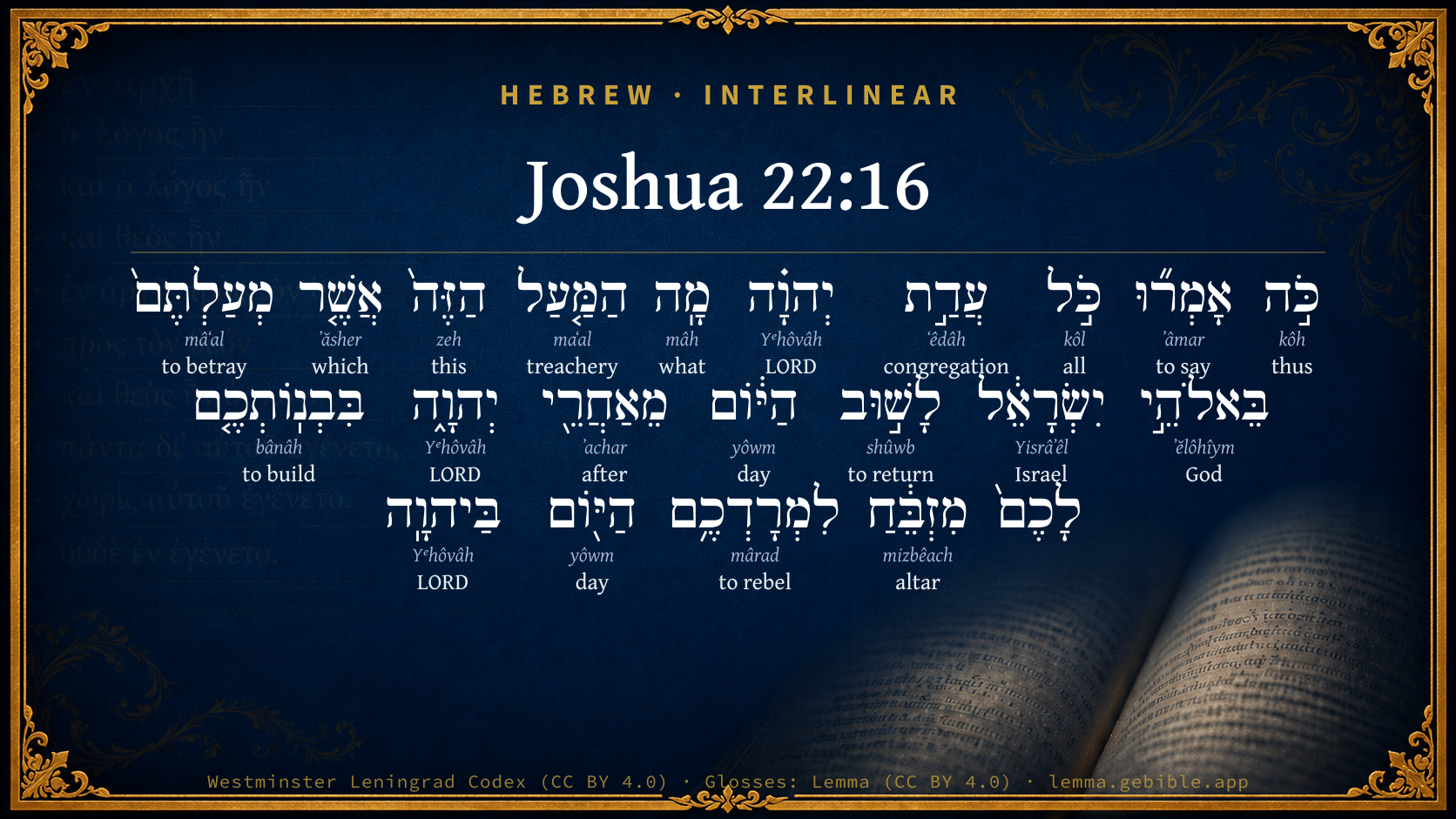
Hebrew (Westminster Leningrad Codex) Joshua 22:16 appears in the Hebrew Old Testament. The text above is from the Westminster Leningrad Codex. Each word links to its Strong’s number, a concise gloss, and parsing drawn from the Open Scriptures Hebrew Bible morphology. Click any word for its full Brown-Driver-Briggs (BDB) entry.
Download image
Cite this verse

Joshua 22:16 (World English Bible). Public Domain. Lemma interlinear Bible study tool, https://lemma.gebible.app/v/joshua/22/16.

Show BibTeX & RIS
BibTeX
RIS
English Translation
Thus says the whole congregation of Yahweh, What trespass is this that you have committed against the God of Israel, to turn away this day from following Yahweh, in that you have built you an altar, to rebel this day against Yahweh?
World English Bible · Public Domain
Download a study sheet

One document with this verse’s original text, its word-by-word gloss line, the meaning frame, cross-references with their text, attributed commentary, and full source and license credits — printable, and it pastes into notes with its structure intact.

This verse Autodidact and up

Study sheet (.html) Plain text (.txt)

A passage Seminary Student

Up to 50 verses in one chapter. A passage sheet keeps up to 6 commentary sources and 12 cross-references per verse, in the order this page ranks them, and says so on the sheet whenever that leaves anything out. Ask for a single verse and you get the Autodidact verse sheet above.

Everything on this page stays free to read, with no account — the sheet is a download of what is already on screen, not access to it.

Want to remove ads? Support Godless Engineer
Compare translations 3

The same verse in 3 English versions, stacked beneath the original-language interlinear above. Click any original word for its lexicon entry.

Each is an independent rendering of the whole verse — the interlinear is not word-aligned to these translations.

Highlighted words mark where these versions differ — a whole-verse word diff, not a word-by-word alignment.

  • World English Bible Public Domain
    Thus says the whole congregation of Yahweh, What trespass is this that you have committed against the God of Israel, to turn away this day from following Yahweh, in that you have built you an altar, to rebel this day against Yahweh?
  • King James Version Public Domain
    Thus saith the whole congregation of the LORD, What trespass is this that ye have committed against the God of Israel, to turn away this day from following the LORD, in that ye have builded you an altar, that ye might rebel this day against the LORD?
  • unfoldingWord Literal Text CC BY-SA 4.0
    “Thus says all of the congregation of Yahweh: ‘What is this unfaithfulness that you have done unfaithfully against the God of Israel, to turn today from after Yahweh in your building for yourselves an altar today for your rebelling against Yahweh?

unfoldingWord Literal Text — © unfoldingWord, licensed CC BY-SA 4.0. Word-aligned USFM3 via Door43 (git.door43.org/unfoldingWord/en_ult).

Versions to compare (up to 4)

3 of 4 selected

Show all 18 translations

Every available English version of this verse, each an independent rendering of the whole verse.

  • World English Bible Public Domain
    Thus says the whole congregation of Yahweh, What trespass is this that you have committed against the God of Israel, to turn away this day from following Yahweh, in that you have built you an altar, to rebel this day against Yahweh?
  • Berean Standard Bible Public Domain
    “This is what the whole congregation of the LORD says: ‘What is this breach of faith you have committed today against the God of Israel by turning away from the LORD and building for yourselves an altar, that you might rebel against the LORD this day?
  • Majority Standard Bible Public Domain
    “This is what the whole congregation of the LORD says: ‘What is this breach of faith you have committed today against the God of Israel by turning away from the LORD and building for yourselves an altar, that you might rebel against the LORD this day?
  • King James Version Public Domain
    Thus saith the whole congregation of the LORD, What trespass is this that ye have committed against the God of Israel, to turn away this day from following the LORD, in that ye have builded you an altar, that ye might rebel this day against the LORD?
  • American Standard Version (1901) Public Domain
    Thus saith the whole congregation of Jehovah, What trespass is this that ye have committed against the God of Israel, to turn away this day from following Jehovah, in that ye have builded you an altar, to rebel this day against Jehovah?
  • Revised Version (1885) Public Domain
    Thus saith the whole congregation of the LORD, What trespass is this that ye have committed against the God of Israel, to turn away this day from following the LORD, in that ye have builded you an altar, to rebel this day against the LORD?
  • Geneva Bible (1599) Public Domain
    Thus saith the whole congregation of the Lord, What transgression is this that ye haue transgressed against the God of Israel, to turne away this day from the Lord, in that ye haue built you an altar for to rebell this day against the Lord?
  • Douay-Rheims (1899) Public Domain
    Thus saith all the people of the Lord: What meaneth this transgression? Why have you forsaken the Lord the God of Israel, building a sacrilegious altar, and revolting from the worship of him?
  • Young's Literal Translation Public Domain
    `Thus said all the company of Jehovah, What `is' this trespass which ye have trespassed against the God of Israel, to turn back to-day from after Jehovah, by your building for you an altar, for your rebelling to-day against Jehovah?
  • Literal Standard Version CC BY-SA 4.0
    “Thus said all the congregation of YHWH: What [is] this trespass which you have trespassed against the God of Israel, to turn back today from after YHWH, by your building an altar for yourselves, for your rebelling today against YHWH?
  • Unlocked Literal Bible CC BY-SA 4.0
    “The whole assembly of Yahweh says this, 'What is this unfaithfulness that you have committed against the God of Israel, by turning this day from following Yahweh by building yourself an altar this day in rebellion against Yahweh?
  • unfoldingWord Literal Text CC BY-SA 4.0
    “Thus says all of the congregation of Yahweh: ‘What is this unfaithfulness that you have done unfaithfully against the God of Israel, to turn today from after Yahweh in your building for yourselves an altar today for your rebelling against Yahweh?
  • Darby Bible Public Domain
    Thus saith the whole assembly of Jehovah: What wickedness is this which ye have committed against the God of Israel, to turn away this day from following Jehovah, in that ye have built yourselves an altar, rebelling this day against Jehovah?
  • World Messianic Bible Public Domain
    “The whole congregation of the LORD says, ‘What trespass is this that you have committed against the God of Israel, to turn away today from following the LORD, in that you have built yourselves an altar, to rebel today against the LORD?
  • Webster's Bible Public Domain
    Thus saith the whole congregation of the LORD, What trespass is this that ye have committed against the God of Israel, to turn away this day from following the LORD, in that ye have built you an altar, that ye might rebel this day against the LORD?
  • Free Bible Version CC BY-SA 4.0
    “This is what all of the Lord's people say, ‘What is this disloyal act you have committed against the God of Israel by building an altar for yourselves? How could you turn away from him now in such rebellion?
  • Bible in Basic English Public Domain
    This is what all the meeting of the people of the Lord has said, What is this wrong which you have done against the God of Israel, turning back this day from the Lord and building an altar for yourselves, and being false to the Lord?
  • JPS Tanakh (1917) Public Domain
    'Thus saith the whole congregation of the LORD: What treachery is this that ye have committed against the God of Israel, to turn away this day from following the LORD, in that ye have builded you an altar, to rebel this day against the LORD?

Literal Standard Version (2020), Covenant Press — licensed CC BY-SA 4.0. Text via the HelloAO Bible API (eBible.org). Unlocked Literal Bible (unfoldingWord) — licensed CC BY-SA 4.0. Text via the HelloAO Bible API (eBible.org). unfoldingWord Literal Text — © unfoldingWord, licensed CC BY-SA 4.0. Word-aligned USFM3 via Door43 (git.door43.org/unfoldingWord/en_ult). Free Bible Version, Dr. Jonathan Gallagher — licensed CC BY-SA 4.0. Text via the HelloAO Bible API (eBible.org).

Word by word

More ways to search: Search by grammar → Find every occurrence → Compare this word →

Practice this passage: Drill this verse → Learn its vocabulary →

לִמְרָדְכֶ֥ם
mârad
H4775
“to rebel · you”
Preposition + Verb, Qal, Infinitive Construct + Suffix, Personal, 2nd Person, Masculine, Plural
Part of Speech
Preposition + Verb
Stem
Qal
Form
Infinitive Construct
Full BDB Definition

Origin: a primitive root

TWOT: 1240

to rebel, revolt, be rebellious - (Qal) to rebel, revolt - against human king - against God - against light (poetic)
  1. כֹּ֣ה kôh H3541 “thus” Adverb
  2. אָמְר֞וּ ʼâmar H559 “to say” Verb, Qal, Perfect, 3rd Person, Common, Plural
  3. כֹּ֣ל kôl H3605 “all of” Noun, Common, Masculine, Singular, Construct
  4. עֲדַ֣ת ʻêdâh H5712 “congregation of” Noun, Common, Feminine, Singular, Construct
  5. יְהוָ֗ה Yᵉhôvâh H3068 “LORD” Noun, Proper
  6. מָֽה mâh H4100 “what” Particle, Interrogative
  7. הַמַּ֤עַל maʻal H4604 “the · treachery” Particle, Definite Article + Noun, Common, Masculine, Singular, Absolute
  8. הַזֶּה֙ zeh H2088 “the · this” Particle, Definite Article + Pronoun, Demonstrative, Masculine, Singular
  9. אֲשֶׁ֤ר ʼăsher H834 “which” Particle, Relative
  10. מְעַלְתֶּם֙ mâʻal H4603 “to betray” Verb, Qal, Perfect, 2nd Person, Masculine, Plural
  11. בֵּאלֹהֵ֣י ʼĕlôhîym H430 “in/at · God(s) of” Preposition + Noun, Common, Masculine, Plural, Construct
  12. יִשְׂרָאֵ֔ל Yisrâʼêl H3478 “Israel” Noun, Proper
  13. לָשׁ֣וּב shûwb H7725 “to return” Preposition + Verb, Qal, Infinitive Construct
  14. הַיּ֔וֹם yôwm H3117 “the · day” Particle, Definite Article + Noun, Common, Masculine, Singular, Absolute
  15. מֵאַחֲרֵ֖י ʼachar H310 “from · after” Preposition + Preposition
  16. יְהוָ֑ה Yᵉhôvâh H3068 “LORD” Noun, Proper
  17. בִּבְנֽוֹתְכֶ֤ם bânâh H1129 “in/at · to build · you” Preposition + Verb, Qal, Infinitive Construct + Suffix, Personal, 2nd Person, Masculine, Plural
  18. מִזְבֵּ֔חַ mizbêach H4196 “altar” Noun, Common, Masculine, Singular, Absolute
  19. הַיּ֖וֹם yôwm H3117 “the · day” Particle, Definite Article + Noun, Common, Masculine, Singular, Absolute
  20. בַּיהוָֽה Yᵉhôvâh H3068 “in/at · LORD” Preposition + Noun, Proper

About this verse

These counts appear in no published source. They are computed here, from the morphology-tagged text and Lemma’s own curated glosses. What Lemma adds →

22
words
18
distinct lemmas
Historical
section

Notable vocabulary

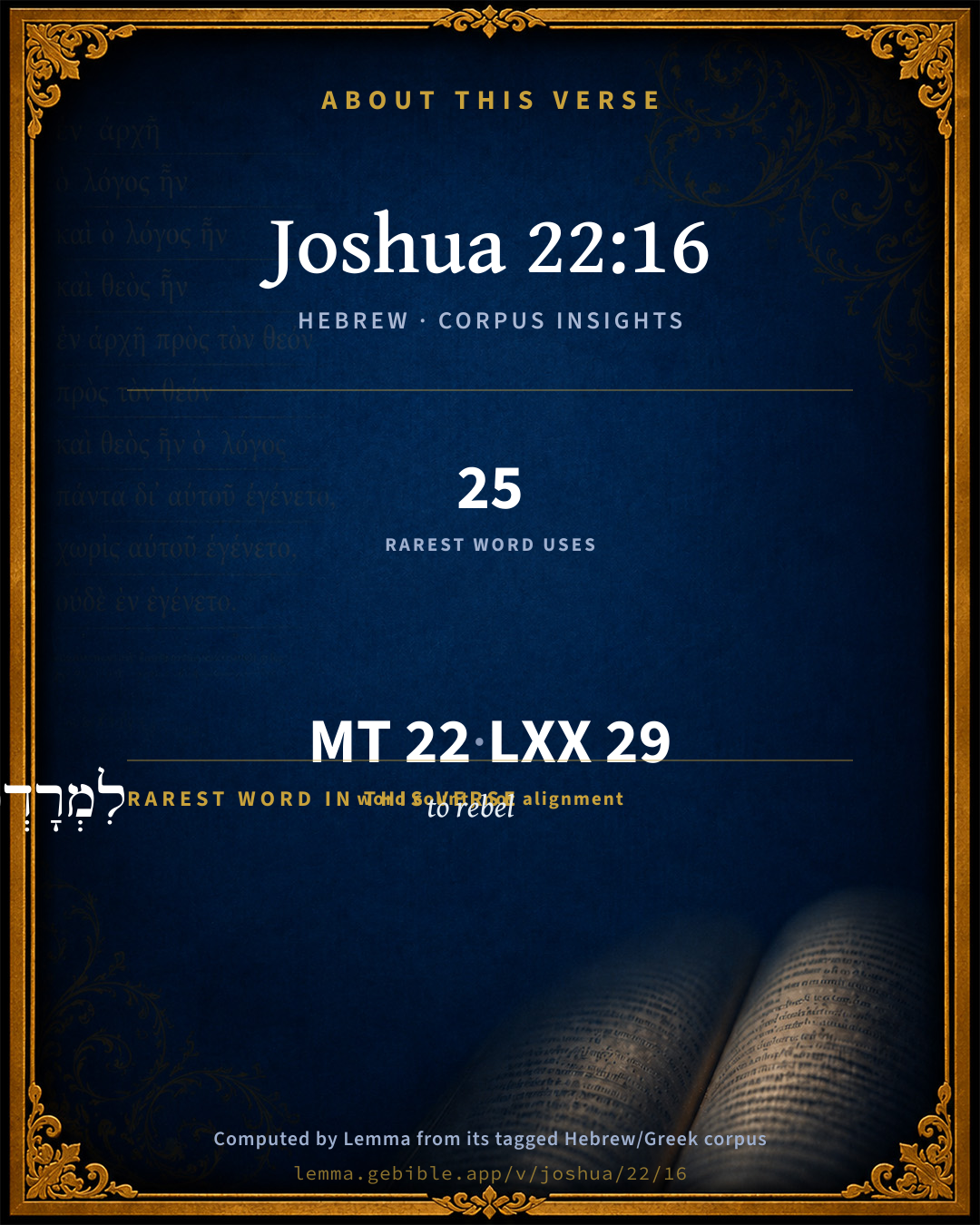
The rarest word here is לִמְרָדְכֶ֥ם to rebel H4775 — appearing just 25 times in the whole Hebrew Bible.

Shared distinctive vocabulary

לִמְרָדְכֶ֥ם to rebel H4775 occurs in 23 verses of the Hebrew Bible. Also found in:

Grammatical profile

  • 5 verbs
  • 11 nouns
  • 1 pronoun
  • 2 prepositions
  • 1 adverb
  • 2 particles

Verb forms

  • אָמְר֞וּ Qal · Perfect
  • מְעַלְתֶּם֙ Qal · Perfect
  • לָשׁ֣וּב Qal · Infinitive Construct
  • בִּבְנֽוֹתְכֶ֤ם Qal · Infinitive Construct
  • לִמְרָדְכֶ֥ם Qal · Infinitive Construct

Repetition

Words recur within this verse — often emphatic in Hebrew:

  • יְהוָ֗ה LORD H3068 ×3
  • הַיּ֔וֹם day H3117 ×2

Hebrew & Septuagint length

In English translation the verse runs 42 words from the Hebrew and 46 from the Septuagint (LXX English) — closely comparable.

A rough comparison of the two English renderings, which tokenize alike — not a word-level alignment.

Word counts can differ between the Hebrew and the Greek without any difference in meaning — e.g. the Hebrew direct-object marker אֵת has no separate Greek word, and Greek often adds the article ὁ.

In the original languages it is 22 Hebrew tokens and 29 Greek tokens — but the two are counted differently (Hebrew bundles its prefixes and suffixes into one token; the Greek is in lemma form), so that isn’t a like-for-like length.

Cross-references

1

Topical passages linked to Joshua 22:16 in the Treasury of Scripture Knowledge — connected by theme and wording, ordered by reader-vote popularity; previews shown in the World English Bible.

  • Deuteronomy 12:13–14 Take heed to yourself that you don't offer your burnt offerings in every place that you see;

Cross-references courtesy of OpenBible.info (CC BY 4.0).

Hebrew and Greek witnesses Masoretic Hebrew ↔ Greek Septuagint

The same verse in the two great witnesses to the Old Testament, shown verse-for-verse.

These are two independent witnesses, not word-aligned to each other, and the Septuagint is shown in lemma (dictionary) form.

Hebrew Joshua 22:16 Masoretic · Westminster Leningrad Codex

כֹּ֣ה אָמְר֞וּ כֹּ֣ל עֲדַ֣ת יְהוָ֗ה מָֽה הַמַּ֤עַל הַזֶּה֙ אֲשֶׁ֤ר מְעַלְתֶּם֙ בֵּאלֹהֵ֣י יִשְׂרָאֵ֔ל לָשׁ֣וּב הַיּ֔וֹם מֵאַחֲרֵ֖י יְהוָ֑ה בִּבְנֽוֹתְכֶ֤ם לָכֶם֙ מִזְבֵּ֔חַ לִמְרָדְכֶ֥ם הַיּ֖וֹם בַּיהוָֽה

Thus says the whole congregation of Yahweh, What trespass is this that you have committed against the God of Israel, to turn away this day from following Yahweh, in that you have built you an altar, to rebel this day against Yahweh?

World English Bible · Public Domain

Greek LXX Joshua 22:16 Septuagint · lemma form

ὅδε λέγω πᾶς ὁ συναγωγή κύριος τίς ὁ πλημμέλεια οὗτος ὅς πλημμελέω ἐναντίον ὁ θεός ἰσραήλ ἀποστρέφω σήμερον ἀπό κύριος οἰκοδομέω σύ ἑαυτοῦ βωμός ἀποστάτης σύ γίγνομαι ἀπό κύριος

Thus says the whole congregation of the Lord, What is this transgression that you⌃ have transgressed before the God of Israel, to turn away today from the Lord, in that you⌃ have built for yourselves an altar, so that you⌃ should be apostates from the Lord?

LXX2012 (modern English Septuagint) · Public Domain

Hebrew: Westminster Leningrad Codex (CC BY 4.0). Greek: Septuagint (public domain); English from LXX2012 (modern English Septuagint) (Public Domain). How the Septuagint differs from the Hebrew →

Targum (Aramaic paraphrase)

1

The Targum is the ancient Jewish Aramaic paraphrase of the Hebrew Scriptures — an interpretive translation, not the Hebrew text itself. Onkelos (literal) and Pseudo-Jonathan (expansive) render the Torah, and Jonathan the Prophets. Coverage is partial: where no permissively-licensed English translation exists for a verse, only the Aramaic is shown. This is verse-level text, not a word-by-word alignment to the Hebrew.

  1. Targum Jonathan Prophets (Joshua–Malachi)
    כְּדֵין אֲמַרוּ כָּל כְּנִשְׁתָּא דַייָ מָא שִׁקְרָא הָדֵין דִי שְׁקַרְתּוּן בְּמֵימְרָא דֶאֱלָהָא יִשְׂרָאֵל לְמִיתַב יוֹמָא דֵין מִבָּתַר פּוּלְחָנָא דַייָ בְּמִבְנְכֹן לְכוֹן מַדְבְּחָא לְמִמְרַדְכוֹן יוֹמָא דֵין בְּמֵימְרָא דַיָי:

    (no public-domain English translation for this verse)

    Targum Jonathan — Aramaic: “Mikraot Gedolot” (public domain). English: “Sefaria Community Translation” (CC0 1.0 (public-domain dedication)); “London "Chaldee Paraphrase," 1871” (public domain). Text via Sefaria.

Commentary

Notes on Joshua 22:16 from classic Christian and Jewish commentators (each source and its license shown beneath its notes). The classic Christian expositions comment on the surrounding passage and are grouped to its opening verse, so a note may address several verses; the Jewish commentaries on the Tanakh (Rashi and others) are per-verse, so they appear only where the commentator wrote on this verse.

Lemma curates 59 commentaries, every one of them public domain or Creative Commons licensed, each selected and text-cleaned for this edition rather than reprinted as found. About our sources →

Trapp's Complete Commentary

John Trapp

Jos 22:16 Thus saith the whole congregation of the LORD, What trespass [is] this that ye have committed against the God of Israel, to turn away this day from following the LORD, in that ye have builded you an altar, that ye might rebel this day against the LORD?

Ver. 16. What trespass is this?] Idolatry is a wickedness with a witness; and they that withdraw from God, do it to the perdition of their souls. {Heb 10:39}

In that ye have builded you an altar.] Another besides that in the tabernacle: whereas God will have but one altar, for a figure of Christ’s cross, which was the only true altar.

That ye might rebel.] Wilful disobedience is open rebellion, yea, it is blasphemy. {Eze 20:27} But why were these good men, that found the fault, so faulty themselves in passing this rash and harsh censure upon a sinister suspicion, upon a mere mistake? Ea quemque ansa prehendamus quae commode teneri potest, saith Epictetus. If one action had a hundred faces, saith another, we should always cast our sight upon the fairest: "Charity hopeth all things, thinketh no evil"; {1Co 13:5; 1Co 13:7} holdeth that things are reverenter glossanda, as one said of the pontifician law, to have a reverent gloss put upon them. Quarrels grow many times upon mistakes. Cyril, and John, bishop of Antioch, excommunicated one another for heresy on each side objected: so did Cyril and Theodoret; yet afterwards they found that they held the same things, when once they grew to a right understanding of one another’s meaning. {a}

{a} Act. Conc. Ephesin.

John Trapp, A Commentary or Exposition upon All the Books of the Old and New Testament (1647–1656) — public domain. Text from a community e-Sword module.

Joseph Benson's Commentary

Jos 22:16. Thus saith the whole congregation — Who do, and are resolved to cleave unto that God from whom you have revolted. What trespass is this that you have committed? — How heinous a crime! To turn away this day — That is, so soon after God hath obliged you by such wonderful favours, and when he is now conducting you home to reap the fruits of all your pains and hazards. In that you have builded you an altar — For sacrifice, as they supposed. That ye might rebel — With a design to rebel against God, and against his express command enjoining you to worship him at one only altar.

Joseph Benson's Commentary on the Old and New Testaments (1811–1818) — public domain. Text from a community e-Sword module.

Tyndale Open Study Notes

Tyndale Open Resources

22:16 The delegation brought the message the ten tribes had agreed upon when they met at Shiloh. • The whole community of the Lord demands to know (literally Thus says the whole congregation of the Lord): The formula using “thus says” was a typical introduction to a messenger’s report (e.g., Ezra 1:2; Isa 28:16).

Tyndale Open Study Notes — © Tyndale Open Resources, licensed CC BY-SA 4.0. Text via the HelloAO Bible API.

Geneva Bible (1599)

Geneva Bible translators

Not only of the princes, but also of the common people.

Geneva Bible (1599) marginal notes — public domain. Text via Bolls.life.

John Calvin's Commentaries

16. Thus says the whole congregation, etc Just as if it had been known that this second altar was opposed to the one only altar of God, they begin with upbraiding them, and that in a very harsh and severe manner. They thus assume it as confessed, that the two tribes had built the altar with a view of offering sacrifices upon it. In this they are mistaken, as it was destined for a different use and purpose. Moreover, had the idea which they had conceived been correct, all the expostulation which they employ would have been just; for it was a clear case of criminal revolt to make any change in the Law of God, who values obedience more than all sacrifices, (1 Samuel 15:22) and there would have been perfect ground for condemning them as apostates, in withdrawing from the one only altar.

John Calvin's Commentaries (1540-1563) — public domain. Text from the Calvin Translation Society English edition (1840s-50s) via the Christian Classics Ethereal Library (ccel.org). Calvin's coverage is partial (roughly two-thirds of the Bible); uncommented books and verses are honest gaps, never fabricated. The 19th-century editor's footnotes and remarks are omitted so the notes are faithfully Calvin's own voice.

The Cambridge Bible for Schools and Colleges

gen. ed. J. J. S. Perowne

16. that ye might rebel] See Num_14:9; Lev_17:8-9; Deu_12:13-14.

The Cambridge Bible for Schools and Colleges (gen. ed. J. J. S. Perowne; Cambridge University Press, 1878–1918) — public domain. Text from a community e-Sword module.

John Gill's Exposition

Is the iniquity of Peor too little for us,.... The worshipping of that idol, when in the plains of Moab; the history of which, see in Num 25:2, was that so small a sin, that another must be added to it, or a greater committed? since building an altar seemed designed not for a single action of idolatrous worship, but for the continuance of it, whereas the sin of Peor was only committed at one time, and not continued in:

from which we are not cleansed until this day; not cleared from the shame and disgrace of it, or the guilt of it expiated or removed; but it might be expected, as in the case of the golden calf, that God would still at times punish for it, when provoked by new crimes; or the sense is, that there were those among them that were infected with the same contagion, and whose inclinations were to commit the same, or like sin of idolatry:

although there was a plague in congregation of the Lord; of which twenty four thousand died, Num 25:9.

John Gill's Exposition of the Whole Bible (1746–1763) — public domain (CC PDM 1.0). Text via the HelloAO Bible API.

Haydock's Catholic Bible Commentary

Lord. Thus Phinees shews that he speaks in the name of those who still continued faithful to the Lord. He imputes the crime of apostacy to Ruben, &c., that they may declare more openly for what reason they had built this altar. (Menochius)

George Leo Haydock (1774–1849), Haydock's Catholic Family Bible and Commentary, 1859 edition — public domain. Excludes Psalms (Douay-Rheims chapter numbering differs from Protestant) and Deuterocanonical books (Catholic canon only).

Matthew Poole's English Annotations

The whole congregation of the Lord, who do and are resolved to cleave unto that God from whom you have revolted, and who speak this to you in the name of the Lord.

What trespass is this? how heinous a crime is this! To turn away this day, i.e. so soon after God hath obliged you by such wonderful favours, and when God is now conducting you home to reap the fruits of all your pains and hazards.

That ye might rebel; with a design to revolt from and rebel against God, and against his express command of worshipping him at one only altar, Exo 20:24; Lev 17:8,9; Deu 12:5,11,13.

Matthew Poole's English Annotations on the Holy Bible (1683–1685) — public domain. Text from a community e-Sword/MySword module.

Whedon's Commentary on the Bible

Daniel D. Whedon

16. What trespass is this — The erection of the altar is justly regarded as prima facie proof of violating the unity of divine worship, inasmuch as sacrifices offered in any other place than at the door of the tabernacle were strictly forbidden. Lev_17:7-8.

Daniel D. Whedon (gen. ed.), Commentary on the Old and New Testaments (1874–1909) — public domain. Text from a community e-Sword module.

The Pulpit Commentary

Trespass. The Hebrew word signifies to act deceitfully or faithlessly. It was an act of ingratitude towards the God who had established them in the good land in which they now found themselves. Such ingratitude and desertion of God was equivalent to rebellion, the term used immediately afterwards. The embassy clearly assumed that the fault had been committed, and that it would be necessary to proceed to extremities. Yet, deeply moved as they were, they did not refuse to listen to reason, and rejoiced that it was not necessary to inflict the fearful vengeance which otherwise would have been their duty. How great a contrast is this to the readiness, nay, even the eagerness, which many owning the Christian name have displayed to destroy the body, and the soul also, if that were possible, of their brethren in Christ, who have been overtaken, or have been supposed to be overtaken, in a similar fault!

The Pulpit Commentary (1880–1919), ed. H.D.M. Spence-Jones & Joseph S. Exell — public domain. Text from a community e-Sword module.

John Wesley's Explanatory Notes

The congregation - Who do and are resolved to cleave unto that God from whom you have revolted. What trespass - How heinous a crime is this! This day - That is, so soon after God hath obliged you by such wonderful favours, and when God is now conducting you home to reap the fruits of all your pains and hazards. Rebel - With a design to rebel against God, and against his express command of worshipping him at one only altar.

John Wesley, Explanatory Notes Upon the Whole Bible (1754–1765) — public domain. Text via the GEBible commentary corpus.

Keil & Delitzsch

C. F. Keil & F. Delitzsch

Assuming at the outset that the altar was intended for a second place of sacrifice in opposition to the command of God, the delegates, with Phinehas no doubt as their speaker, began by reproaching them for falling away from the Lord. "What faithlessness is this (מעל: see at Lev 5:15) that ye have committed against the God of Israel, to turn away this day from Jehovah, in that ye have builded you an altar, that ye might rebel this day against Jehovah?" מרד (to rebel) is stronger than מעל.

Keil & Delitzsch — Biblical Commentary on the Old Testament (1861–1891) — public domain (CC PDM 1.0). Text via the HelloAO Bible API. (Old Testament only.)

Lesson kit

Teaching starters — assembled from the data on this page, not authored interpretation. Every prompt links to the verse data it draws on. Edit before teaching.

Joshua, in the Historical, opens this verse with 22 words (18 distinct Hebrew lemmas). Its most distinctive word is mârad (“to rebel”). A historical commentator’s framing appears above. Read the whole chapter for the surrounding context.

Discussion questions

  1. How does “to rebel” (mârad) shape what this verse is saying?
  2. How does Genesis 14:4, which shares the word «to rebel», read alongside this verse?
  3. What does the repetition of “LORD” (3× in this one verse) do in this verse?
  4. The translations on this page render this verse differently — a whole-verse word diff, not a word-by-word alignment. What might account for the different wordings?
  5. «אָמְר֞וּ» is a Qal Perfect verb. How does that grammatical form shape the action described?
  6. Compare how Trapp's Complete Commentary and Joseph Benson's Commentary read this verse. Where do they agree or differ?

Things to notice

Reading settings

Reading text

Shown beneath each verse's original-language words.

Old Testament
Old Testament edition

Read the OT as the Masoretic Hebrew (MT) or the Greek Septuagint (LXX).

English shown for the Greek Septuagint (in the Hebrew ↔ Greek comparison).

Comparing translations? Open the Compare panel on any verse page to stack up to four side by side.