
Leviticus 4:26

Hebrew (Westminster Leningrad Codex) Leviticus 4:26 appears in the Hebrew Old Testament. The text above is from the Westminster Leningrad Codex. Each word links to its Strong’s number, a concise gloss, and parsing drawn from the Open Scriptures Hebrew Bible morphology. Click any word for its full Brown-Driver-Briggs (BDB) entry.
Download image
Cite this verse

Leviticus 4:26 (World English Bible). Public Domain. Lemma interlinear Bible study tool, https://lemma.gebible.app/v/leviticus/4/26.

Show BibTeX & RIS
BibTeX
RIS
English Translation
All its fat he shall burn on the altar, like the fat of the sacrifice of peace offerings; and the priest shall make atonement for him concerning his sin, and he will be forgiven.
World English Bible · Public Domain
Download a study sheet

One document with this verse’s original text, its word-by-word gloss line, the meaning frame, cross-references with their text, attributed commentary, and full source and license credits — printable, and it pastes into notes with its structure intact.

This verse Autodidact and up

Study sheet (.html) Plain text (.txt)

A passage Seminary Student

Up to 50 verses in one chapter. A passage sheet keeps up to 6 commentary sources and 12 cross-references per verse, in the order this page ranks them, and says so on the sheet whenever that leaves anything out. Ask for a single verse and you get the Autodidact verse sheet above.

Everything on this page stays free to read, with no account — the sheet is a download of what is already on screen, not access to it.

Want to remove ads? Support Godless Engineer
Compare translations 3

The same verse in 3 English versions, stacked beneath the original-language interlinear above. Click any original word for its lexicon entry.

Each is an independent rendering of the whole verse — the interlinear is not word-aligned to these translations.

Highlighted words mark where these versions differ — a whole-verse word diff, not a word-by-word alignment.

  • World English Bible Public Domain
    All its fat he shall burn on the altar, like the fat of the sacrifice of peace offerings; and the priest shall make atonement for him concerning his sin, and he will be forgiven.
  • King James Version Public Domain
    And he shall burn all his fat upon the altar, as the fat of the sacrifice of peace offerings: and the priest shall make an atonement for him as concerning his sin, and it shall be forgiven him.
  • unfoldingWord Literal Text CC BY-SA 4.0
    And all of its fat he shall cause to become smoke on the altar, like the fat of the sacrifice of the peace offerings. And the priest shall make atonement for him from his sin, and it will be forgiven to him.

unfoldingWord Literal Text — © unfoldingWord, licensed CC BY-SA 4.0. Word-aligned USFM3 via Door43 (git.door43.org/unfoldingWord/en_ult).

Versions to compare (up to 4)

3 of 4 selected

Show all 18 translations

Every available English version of this verse, each an independent rendering of the whole verse.

  • World English Bible Public Domain
    All its fat he shall burn on the altar, like the fat of the sacrifice of peace offerings; and the priest shall make atonement for him concerning his sin, and he will be forgiven.
  • Berean Standard Bible Public Domain
    He must burn all its fat on the altar, like the fat of the peace offerings; thus the priest will make atonement for that man’s sin, and he will be forgiven.
  • Majority Standard Bible Public Domain
    He must burn all its fat on the altar, like the fat of the peace offerings; thus the priest will make atonement for that man’s sin, and he will be forgiven.
  • King James Version Public Domain
    And he shall burn all his fat upon the altar, as the fat of the sacrifice of peace offerings: and the priest shall make an atonement for him as concerning his sin, and it shall be forgiven him.
  • American Standard Version (1901) Public Domain
    And all the fat thereof shall he burn upon the altar, as the fat of the sacrifice of peace-offerings; and the priest shall make atonement for him as concerning his sin, and he shall be forgiven.
  • Revised Version (1885) Public Domain
    And all the fat thereof shall he burn upon the altar, as the fat of the sacrifice of peace offerings: and the priest shall make atonement for him as concerning his sin, and he shall be forgiven.
  • Geneva Bible (1599) Public Domain
    And shall burne all his fat vpon the altar, as the fat of the peace offring: so the Priest shall make an atonement for him, concerning his sinne, and it shalbe forgiuen him.
  • Douay-Rheims (1899) Public Domain
    But the fat he shall burn upon it, as is wont to be done with the victims of peace offerings: and the priest shall pray for him, and for his sin, and it shall be forgiven him.
  • Young's Literal Translation Public Domain
    and with all its fat he doth make perfume on the altar, as the fat of the sacrifice of the peace-offerings; and the priest hath made atonement for him because of his sin, and it hath been forgiven him.
  • Literal Standard Version CC BY-SA 4.0
    and he makes incense on the altar with all its fat, as the fat of the sacrifice of the peace-offerings; and the priest has made atonement for him because of his sin, and it has been forgiven him.
  • Unlocked Literal Bible CC BY-SA 4.0
    He will burn all the fat on the altar, just like the fat of the sacrifice of peace offerings. The priest will make atonement for the ruler concerning his sin, and the ruler will be forgiven.
  • unfoldingWord Literal Text CC BY-SA 4.0
    And all of its fat he shall cause to become smoke on the altar, like the fat of the sacrifice of the peace offerings. And the priest shall make atonement for him from his sin, and it will be forgiven to him.
  • Darby Bible Public Domain
    And he shall burn all its fat on the altar, as the fat of the sacrifice of peace-offering; and the priest shall make atonement for him [to cleanse him] from his sin, and it shall be forgiven him.
  • World Messianic Bible Public Domain
    All its fat he shall burn on the altar, like the fat of the sacrifice of peace offerings; and the priest shall make atonement for him concerning his sin, and he will be forgiven.
  • Webster's Bible Public Domain
    And he shall burn all his fat upon the altar, as the fat of the sacrifice of peace-offerings: and the priest shall make an atonement for him as concerning his sin, and it shall be forgiven him.
  • Free Bible Version CC BY-SA 4.0
    He shall burn all its fat on the altar like the fat of the peace offerings. In this way the priest will make the man's sin right, and he will be forgiven.
  • Bible in Basic English Public Domain
    And all the fat of it is to be burned on the altar like the fat of the peace-offering; and the priest will take away his sin and he will have forgiveness.
  • JPS Tanakh (1917) Public Domain
    And all the fat thereof shall he make smoke upon the altar, as the fat of the sacrifice of peace-offerings; and the priest shall make atonement for him as concerning his sin, and he shall be forgiven.

Literal Standard Version (2020), Covenant Press — licensed CC BY-SA 4.0. Text via the HelloAO Bible API (eBible.org). Unlocked Literal Bible (unfoldingWord) — licensed CC BY-SA 4.0. Text via the HelloAO Bible API (eBible.org). unfoldingWord Literal Text — © unfoldingWord, licensed CC BY-SA 4.0. Word-aligned USFM3 via Door43 (git.door43.org/unfoldingWord/en_ult). Free Bible Version, Dr. Jonathan Gallagher — licensed CC BY-SA 4.0. Text via the HelloAO Bible API (eBible.org).

Word by word

More ways to search: Search by grammar → Find every occurrence → Compare this word →

Practice this passage: Drill this verse → Learn its vocabulary →

וְנִסְלַ֥ח
çâlach
H5545
“and · to forgive”
Conjunction + Verb, Niphal, Sequential Perfect, 3rd Person, Masculine, Singular
Part of Speech
Conjunction + Verb
Stem
Niphal
Form
Sequential Perfect
Person
3rd Person
Gender
Masculine
Number
Singular
Full BDB Definition

Origin: a primitive root

TWOT: 1505

to forgive, pardon - (Qal) to forgive, pardon - (Niphal) to be forgiven
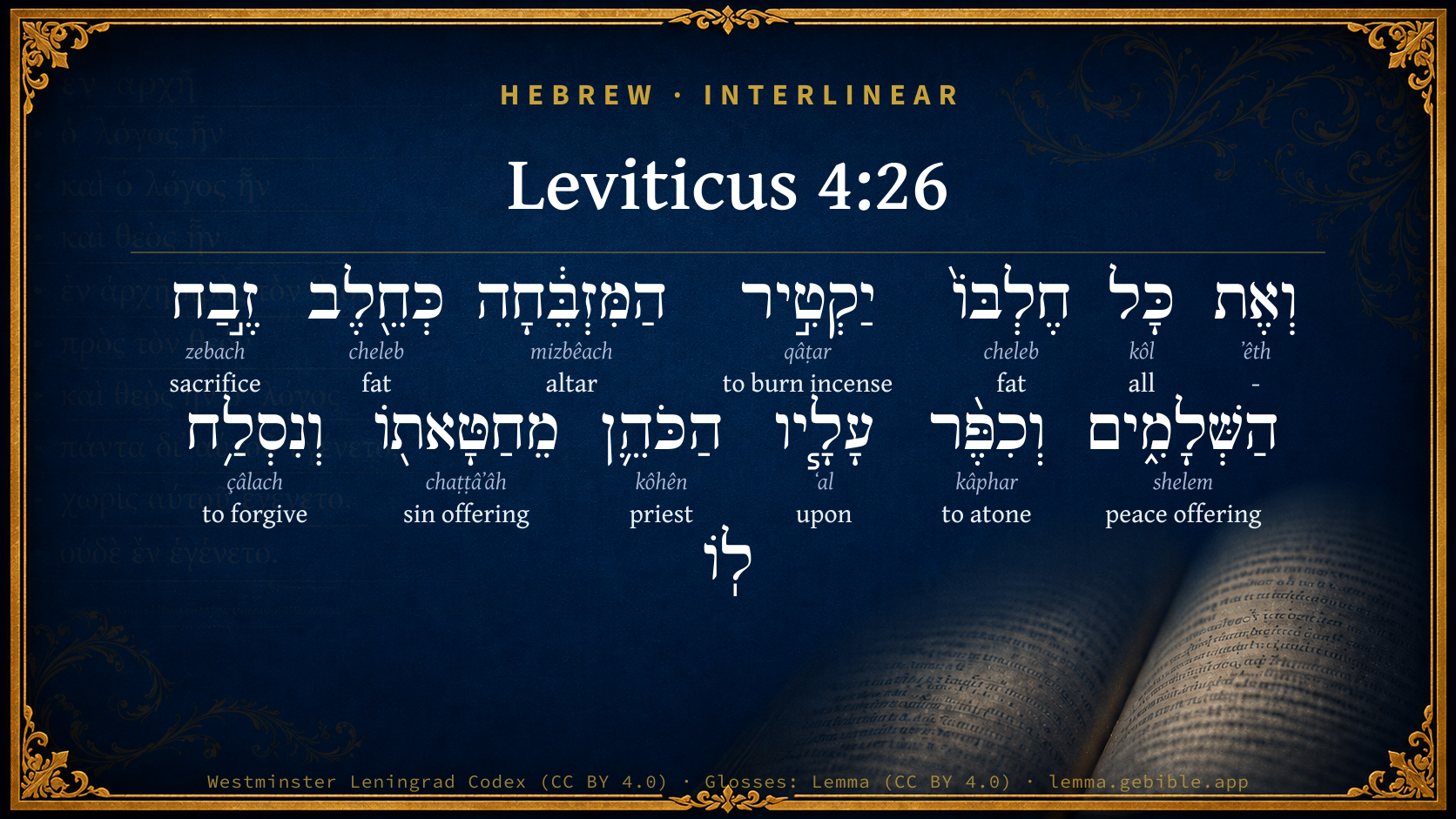
  1. וְאֶת ʼêth H853 “and · -” Conjunction + Particle, Direct Object
  2. כָּל kôl H3605 “all of” Noun, Common, Masculine, Singular, Construct
  3. חֶלְבּוֹ֙ cheleb H2459 “fat · his” Noun, Common, Masculine, Singular, Construct + Suffix, Personal, 3rd Person, Masculine, Singular
  4. יַקְטִ֣יר qâṭar H6999 “to burn incense” Verb, Hiphil, Imperfect, 3rd Person, Masculine, Singular
  5. הַמִּזְבֵּ֔חָה mizbêach H4196 “the · altar · toward” Particle, Definite Article + Noun, Common, Masculine, Singular, Absolute + Suffix, Demonstrative
  6. כְּחֵ֖לֶב cheleb H2459 “like/as · fat of” Preposition + Noun, Common, Masculine, Singular, Construct
  7. זֶ֣בַח zebach H2077 “sacrifice of” Noun, Common, Masculine, Singular, Construct
  8. הַשְּׁלָמִ֑ים shelem H8002 “the · peace offerings” Particle, Definite Article + Noun, Common, Masculine, Plural, Absolute
  9. וְכִפֶּ֨ר kâphar H3722 “and · to atone” Conjunction + Verb, Piel, Sequential Perfect, 3rd Person, Masculine, Singular
  10. עָלָ֧יו ʻal H5921 “upon · him” Preposition + Suffix, Personal, 3rd Person, Masculine, Singular
  11. הַכֹּהֵ֛ן kôhên H3548 “the · priest” Particle, Definite Article + Noun, Common, Masculine, Singular, Absolute
  12. מֵחַטָּאת֖וֹ chaṭṭâʼâh H2403 “from · sin offering · his” Preposition + Noun, Common, Feminine, Singular, Construct + Suffix, Personal, 3rd Person, Masculine, Singular

About this verse

These counts appear in no published source. They are computed here, from the morphology-tagged text and Lemma’s own curated glosses. What Lemma adds →

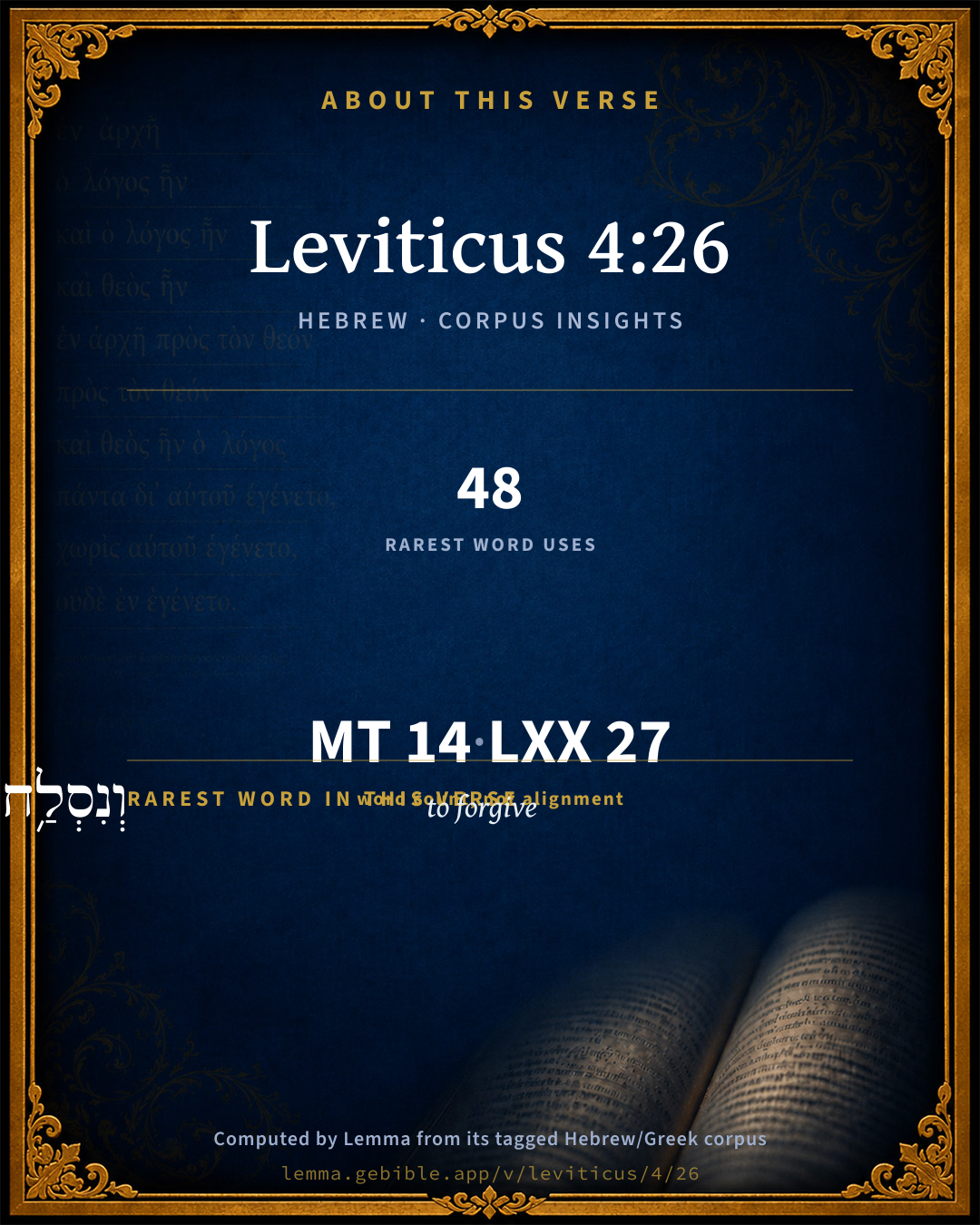
14
words
12
distinct lemmas
Pentateuch
section

Shared distinctive vocabulary

וְנִסְלַ֥ח to forgive H5545 occurs in 45 verses of the Hebrew Bible. Also found in:

Grammatical profile

  • 3 verbs
  • 8 nouns
  • 2 prepositions
  • 1 particle

Verb forms

  • יַקְטִ֣יר Hiphil · Imperfect
  • וְכִפֶּ֨ר Piel · Sequential Perfect
  • וְנִסְלַ֥ח Niphal · Sequential Perfect

Repetition

A word recurs within this verse — often emphatic in Hebrew:

  • חֶלְבּוֹ֙ fat H2459 ×2

Hebrew & Septuagint length

In English translation the verse runs 34 words from the Hebrew and 36 from the Septuagint (LXX English) — closely comparable.

A rough comparison of the two English renderings, which tokenize alike — not a word-level alignment.

Word counts can differ between the Hebrew and the Greek without any difference in meaning — e.g. the Hebrew direct-object marker אֵת has no separate Greek word, and Greek often adds the article ὁ.

In the original languages it is 14 Hebrew tokens and 27 Greek tokens — but the two are counted differently (Hebrew bundles its prefixes and suffixes into one token; the Greek is in lemma form), so that isn’t a like-for-like length.

Cross-references

12

Topical passages linked to Leviticus 4:26 in the Treasury of Scripture Knowledge — connected by theme and wording, ordered by reader-vote popularity; previews shown in the World English Bible.

  • Leviticus 4:20 Thus shall he do with the bull; as he did with the bull of the sin offering, so shall he do with this; and the priest shall make atonement for them, and they shall be forgiven.
  • Leviticus 3:5 Aaron's sons shall burn it on the altar on the burnt offering, which is on the wood that is on the fire: it is an offering made by fire, of a sweet savor to Yahweh.
  • Leviticus 4:31 All its fat he shall take away, like the fat is taken away from off of the sacrifice of peace offerings; and the priest shall burn it on the altar for a sweet savor to Yahweh; and the priest shall make atonement for him, and he will be forgiven.
  • Leviticus 4:35 All its fat he shall take away, like the fat of the lamb is taken away from the sacrifice of peace offerings; and the priest shall burn them on the altar, on the offerings of Yahweh made by fire; and the priest shall make atonement for him concerning his sin that he has sinned, and he will be forgiven.
  • Leviticus 5:10 He shall offer the second for a burnt offering, according to the ordinance; and the priest shall make atonement for him concerning his sin which he has sinned, and he shall be forgiven.
  • Numbers 15:28 The priest shall make atonement for the soul who errs, when he sins unwittingly, before Yahweh, to make atonement for him; and he shall be forgiven.
  • Leviticus 4:8–10 He shall take all the fat of the bull of the sin offering off of it; the fat that covers the innards, and all the fat that is on the innards,
  • Leviticus 5:13 The priest shall make atonement for him concerning his sin that he has sinned in any of these things, and he will be forgiven; and the rest shall be the priest's, as the meal offering.'"
  • Leviticus 5:16 He shall make restitution for that which he has done wrong in the holy thing, and shall add a fifth part to it, and give it to the priest; and the priest shall make atonement for him with the ram of the trespass offering, and he will be forgiven.
  • Leviticus 5:18 He shall bring a ram without blemish from of the flock, according to your estimation, for a trespass offering, to the priest; and the priest shall make atonement for him concerning the thing in which he sinned and didn't know it, and he will be forgiven.
  • Leviticus 6:7 The priest shall make atonement for him before Yahweh, and he will be forgiven concerning whatever he does to become guilty."
  • Leviticus 6:20–30 "This is the offering of Aaron and of his sons, which they shall offer to Yahweh in the day when he is anointed: the tenth part of an ephah of fine flour for a meal offering perpetually, half of it in the morning, and half of it in the evening.

Cross-references courtesy of OpenBible.info (CC BY 4.0).

Hebrew and Greek witnesses Masoretic Hebrew ↔ Greek Septuagint

The same verse in the two great witnesses to the Old Testament, shown verse-for-verse.

These are two independent witnesses, not word-aligned to each other, and the Septuagint is shown in lemma (dictionary) form.

Hebrew Leviticus 4:26 Masoretic · Westminster Leningrad Codex

וְאֶת כָּל חֶלְבּוֹ֙ יַקְטִ֣יר הַמִּזְבֵּ֔חָה כְּחֵ֖לֶב זֶ֣בַח הַשְּׁלָמִ֑ים וְכִפֶּ֨ר עָלָ֧יו הַכֹּהֵ֛ן מֵחַטָּאת֖וֹ וְנִסְלַ֥ח לֽוֹ

All its fat he shall burn on the altar, like the fat of the sacrifice of peace offerings; and the priest shall make atonement for him concerning his sin, and he will be forgiven.

World English Bible · Public Domain

Greek LXX Leviticus 4:26 Septuagint · lemma form

καί ὁ πᾶς στέαρ αὐτός ἀναφέρω ἐπί ὁ θυσιαστήριον ὥσπερ ὁ στέαρ θυσία σωτήριον καί ἐκἱλάσκομαι περί αὐτός ὁ ἱερεύς ἀπό ὁ ἁμαρτία αὐτός καί ἀποἵημι αὐτός

And he shall offer up all his fat on the altar, as the fat of the sacrifice of peace-offering; and the priest shall make atonement for him concerning his sin, and it shall be forgiven him.

LXX2012 (modern English Septuagint) · Public Domain

Hebrew: Westminster Leningrad Codex (CC BY 4.0). Greek: Septuagint (public domain); English from LXX2012 (modern English Septuagint) (Public Domain). How the Septuagint differs from the Hebrew →

Targum (Aramaic paraphrase)

2

The Targum is the ancient Jewish Aramaic paraphrase of the Hebrew Scriptures — an interpretive translation, not the Hebrew text itself. Onkelos (literal) and Pseudo-Jonathan (expansive) render the Torah, and Jonathan the Prophets. Coverage is partial: where no permissively-licensed English translation exists for a verse, only the Aramaic is shown. This is verse-level text, not a word-by-word alignment to the Hebrew.

  1. Targum Onkelos Torah (Genesis–Deuteronomy)
    וְיָת כָּל תַּרְבֵּה יַסֵק לְמַדְבְּחָא כִּתְרַב נִכְסַת קוּדְשַׁיָּא וִיכַפֵּר עֲלוֹהִי כַּהֲנָא מֵחוֹבְתֵהּ וְיִשְׁתְּבֵק לֵהּ

    (no public-domain English translation for this verse)

    Targum Onkelos — Aramaic: “Onkelos Genesis” (public domain); “Onkelos Exodus” (public domain); “Onkelos Leviticus” (public domain); “Onkelos Numbers” (public domain); “Onkelos Deuteronomy” (public domain). English: “Sefaria Community Translation” (CC0 1.0 (public-domain dedication)); “J.W. Etheridge. The Targums of Onkelos and Jonathan Ben Uzziel on the Pentateuch. London: Longmans, Green, 1862” (public domain). Text via Sefaria.

  2. Targum Pseudo-Jonathan Torah (Genesis–Deuteronomy)
    וְיַת כָּל תַּרְבֵּיהּ יַסֵיק לְמַדְבְּחָא הֵי כִתְרֵיב נִיכְסַת קוּדְשַׁיָא וִיכַפֵּר עֲלוֹי כַּהֲנָא מֵחוֹבְתֵיהּ וְיִשְׁתְּבֵיק לֵיהּ

    And all the fat he shall burn at the altar, as was the fat of the sanctified oblations; and the priest shall atone for him on account of his sin, and it shall be forgiven him.

    Targum Pseudo-Jonathan — Aramaic: “Targum Jonathan on Genesis” (public domain); “Targum Jonathan on Exodus” (public domain); “Targum Jonathan on Leviticus” (public domain); “Targum Jonathan on Numbers” (public domain); “Targum Jonathan on Deuteronomy” (public domain). English: “The Targum of Jonathan ben Uzziel, trans. J. W. Etheridge, London, 1862” (public domain). Text via Sefaria.

Commentary

Notes on Leviticus 4:26 from classic Christian and Jewish commentators (each source and its license shown beneath its notes). The classic Christian expositions comment on the surrounding passage and are grouped to its opening verse, so a note may address several verses; the Jewish commentaries on the Tanakh (Rashi and others) are per-verse, so they appear only where the commentator wrote on this verse.

Lemma curates 59 commentaries, every one of them public domain or Creative Commons licensed, each selected and text-cleaned for this edition rather than reprinted as found. About our sources →

Trapp's Complete Commentary

John Trapp

Lev 4:26 And he shall burn all his fat upon the altar, as the fat of the sacrifice of peace offerings: and the priest shall make an atonement for him as concerning his sin, and it shall be forgiven him.

Ver. 26. All his fat.] See Lev 4:19. The fat was burnt, saith one, because, among other things, it signified duricordium, hard heartedness. {Psa 119:70}

John Trapp, A Commentary or Exposition upon All the Books of the Old and New Testament (1647–1656) — public domain. Text from a community e-Sword module.

Joseph Benson's Commentary

Lev 4:26. It shall be forgiven — Both judicially, as to all ecclesiastical censures or civil punishment; and really, upon condition of repentance and faith in the Messiah to come.

Joseph Benson's Commentary on the Old and New Testaments (1811–1818) — public domain. Text from a community e-Sword module.

Geneva Bible (1599)

Geneva Bible translators

Wherein he represented Jesus Christ.

Geneva Bible (1599) marginal notes — public domain. Text via Bolls.life.

John Gill's Exposition

And if anyone of the common people sin through ignorance,.... Or, "if one soul of the people of the earth": that is, a single person, and so is distinguished from the congregation, one of the common sort of people; however is neither an high priest, nor a prince, or king, but either a common priest, or Levite, or Israelite; no man is free from sin; all sorts of persons, of all ranks and degrees, high and low, rich and poor, men in office, civil or ecclesiastical, or in whatsoever state of life, are liable to sin, and do sin continually, either ignorantly or willingly; and Christ is a sacrifice for all sins and for all sorts of sinners:

whilst he doeth somewhat; &c. See Gill on Lev 4:2, Lev 4:13, Lev 4:22.

John Gill's Exposition of the Whole Bible (1746–1763) — public domain (CC PDM 1.0). Text via the HelloAO Bible API.

Haydock's Catholic Bible Commentary

Him. Moses does not here specify what was to be done with the flesh. But (chap. vi. 26,) he commands it to be given to the priests. (Calmet) --- In the sacrifices for the sins of the multitude, or of the priest, all was consumed; to express a greater detestation of such offences, (Tirinus) and that the priests might derive no benefit from them. (Theodoret, q. 3.; St. Thomas Aquinas, [Summa Theologiae] i. 2, q. 102, a. 3.) (Worthington) --- Those who offered these victims received no part of them again, nor were oil or incense used; as all delicacies must be rejected by penitents. (Tirinus)

George Leo Haydock (1774–1849), Haydock's Catholic Family Bible and Commentary, 1859 edition — public domain. Excludes Psalms (Douay-Rheims chapter numbering differs from Protestant) and Deuterocanonical books (Catholic canon only).

Matthew Poole's English Annotations

Both ceremonially and judicially, as to all ecclesiastical censures or civil punishments; and really, upon condition of their repentance and faith in the Messias to come.

Matthew Poole's English Annotations on the Holy Bible (1683–1685) — public domain. Text from a community e-Sword/MySword module.

John Wesley's Explanatory Notes

It shall be forgiven - Both judicially, as to all ecclesiastical censures or civil punishment; and really, upon condition of repentance and faith in the Messiah to come.

John Wesley, Explanatory Notes Upon the Whole Bible (1754–1765) — public domain. Text via the GEBible commentary corpus.

Scofield Reference Notes

C. I. Scofield

atonement

(See Scofield "Exo 29:33")

The Scofield Reference Bible (1917 edition), notes by C. I. Scofield — public domain. Text from a community e-Sword module.

unfoldingWord translationNotes

Door43 World Missions Community

He will burn

"The priest will burn"

The priest will make atonement for the ruler

The abstract noun "atonement" can be stated as a verb. AT: "The priest will atone for the ruler" (See: Abstract Nouns)

the ruler will be forgiven

This can be stated in active form. AT: "Yahweh will forgive the ruler's sins" (See: Active or Passive)

translationWords

altar

peace offering

priest

atonement

rule

sin

forgive

unfoldingWord translationNotes — © Distant Shores Media and the Door43 World Missions Community, licensed CC BY-SA 4.0. Source: git.door43.org/Door43/en_tn.

Rashi

Rabbi Shlomo Yitzchaki (Rashi)

כחלב זבח השלמים [AND HE SHALL CAUSE ALL ITS FAT TO ASCEND IN FUMES], AS THE FAT OF THE SACRIFICE OF PEACE OFFERINGS — i. e. as those fat portions which are specified in the case of the goat that is mentioned among the peace-offerings (Leviticus 3:14, 15).

Rashi on the Tanakh — English translations: “The Judaica Press complete Tanach with Rashi, translated by A. J. Rosenberg” (CC BY 4.0); “Pentateuch with Rashi's commentary by M. Rosenbaum and A.M. Silbermann, 1929-1934” (public domain); “The Metsudah Tanach series, Lakewood, N.J” (CC BY 4.0); and “The Book of Joshua, Metsudah Publications, 1997” (CC BY 4.0). Text via Sefaria.

Lesson kit

Teaching starters — assembled from the data on this page, not authored interpretation. Every prompt links to the verse data it draws on. Edit before teaching.

Leviticus, in the Pentateuch, opens this verse with 14 words (12 distinct Hebrew lemmas). Its most distinctive word is çâlach (“to forgive”). A historical commentator’s framing appears above. Read the whole chapter for the surrounding context.

Discussion questions

  1. What does “to forgive” (çâlach) contribute to the verse as a whole?
  2. Exodus 34:9 shares the word «to forgive» with this verse. How do the two illuminate each other?
  3. “fat” occurs 2× in this one verse. What is the effect of the repetition?
  4. These translations render this verse differently; the difference is in the English rendering, not the original. What questions does that raise?
  5. The verb «יַקְטִ֣יר» is Hiphil Imperfect. How does its form color the action?
  6. Reading how Trapp's Complete Commentary and Joseph Benson's Commentary read this verse, where do the two commentators agree and where do they part?

Things to notice

Reading settings

Reading text

Shown beneath each verse's original-language words.

Old Testament
Old Testament edition

Read the OT as the Masoretic Hebrew (MT) or the Greek Septuagint (LXX).

English shown for the Greek Septuagint (in the Hebrew ↔ Greek comparison).

Comparing translations? Open the Compare panel on any verse page to stack up to four side by side.