
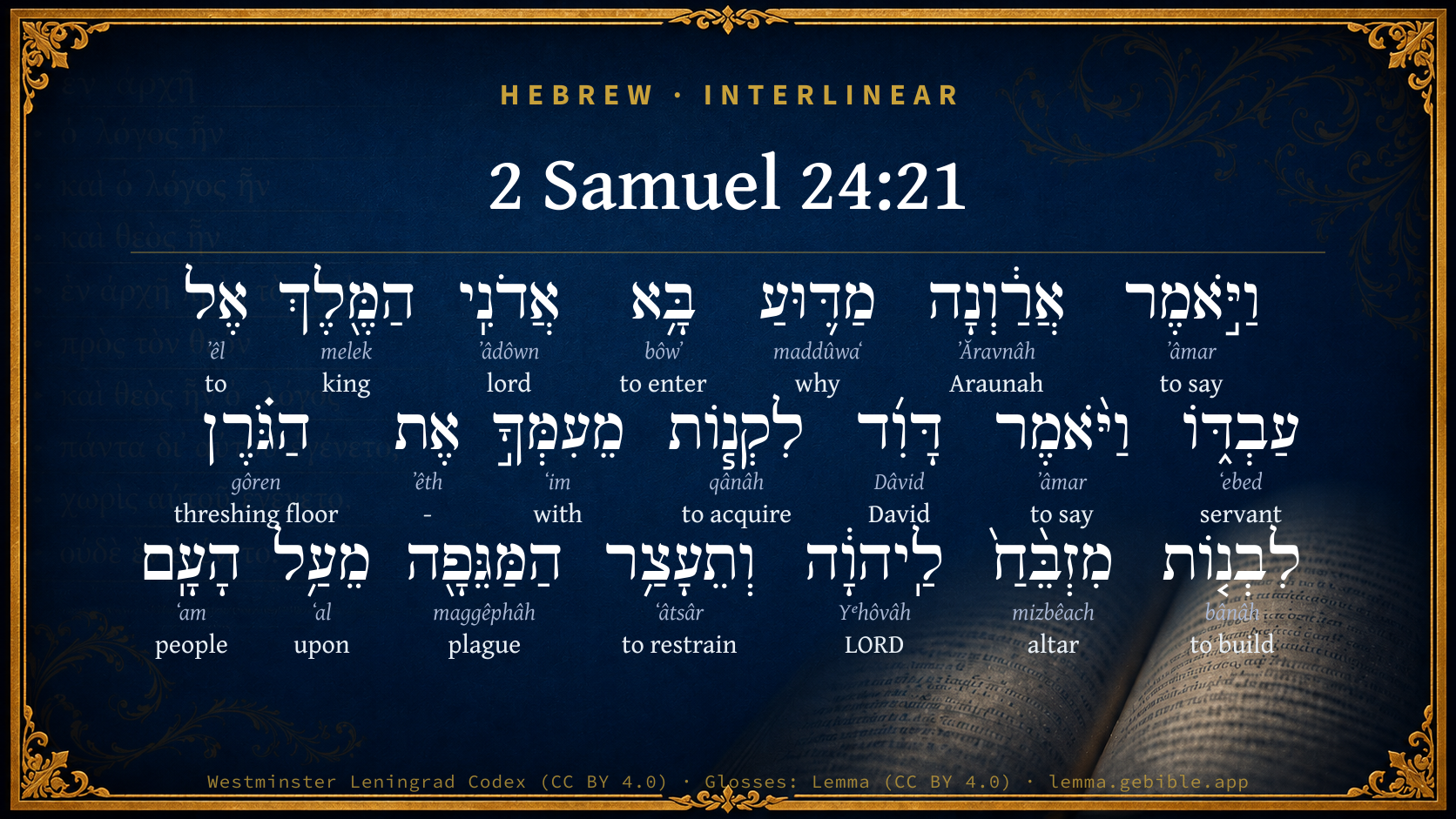
2 Samuel 24:21

Hebrew (Westminster Leningrad Codex) 2 Samuel 24:21 appears in the Hebrew Old Testament. The text above is from the Westminster Leningrad Codex. Each word links to its Strong’s number, a concise gloss, and parsing drawn from the Open Scriptures Hebrew Bible morphology. Click any word for its full Brown-Driver-Briggs (BDB) entry.
Download image
Cite this verse

2 Samuel 24:21 (World English Bible). Public Domain. Lemma interlinear Bible study tool, https://lemma.gebible.app/v/2-samuel/24/21.

Show BibTeX & RIS
BibTeX
RIS
English Translation
Araunah said, Why is my lord the king come to his servant? David said, To buy the threshing floor of you, to build an altar to Yahweh, that the plague may be stayed from the people.
World English Bible · Public Domain
Download a study sheet

One document with this verse’s original text, its word-by-word gloss line, the meaning frame, cross-references with their text, attributed commentary, and full source and license credits — printable, and it pastes into notes with its structure intact.

This verse Autodidact and up

Study sheet (.html) Plain text (.txt)

A passage Seminary Student

Up to 50 verses in one chapter. A passage sheet keeps up to 6 commentary sources and 12 cross-references per verse, in the order this page ranks them, and says so on the sheet whenever that leaves anything out. Ask for a single verse and you get the Autodidact verse sheet above.

Everything on this page stays free to read, with no account — the sheet is a download of what is already on screen, not access to it.

Want to remove ads? Support Godless Engineer
Compare translations 3

The same verse in 3 English versions, stacked beneath the original-language interlinear above. Click any original word for its lexicon entry.

Each is an independent rendering of the whole verse — the interlinear is not word-aligned to these translations.

Highlighted words mark where these versions differ — a whole-verse word diff, not a word-by-word alignment.

  • World English Bible Public Domain
    Araunah said, Why is my lord the king come to his servant? David said, To buy the threshing floor of you, to build an altar to Yahweh, that the plague may be stayed from the people.
  • King James Version Public Domain
    And Araunah said, Wherefore is my lord the king come to his servant? And David said, To buy the threshingfloor of thee, to build an altar unto the LORD, that the plague may be stayed from the people.
  • unfoldingWord Literal Text CC BY-SA 4.0
    And Araunah said, “Why has my lord the king come to his servant?” And David said, “To buy from you the threshing floor to build an altar for Yahweh, that the plague may be restrained from against the people.”

unfoldingWord Literal Text — © unfoldingWord, licensed CC BY-SA 4.0. Word-aligned USFM3 via Door43 (git.door43.org/unfoldingWord/en_ult).

Versions to compare (up to 4)

3 of 4 selected

Show all 18 translations

Every available English version of this verse, each an independent rendering of the whole verse.

  • World English Bible Public Domain
    Araunah said, Why is my lord the king come to his servant? David said, To buy the threshing floor of you, to build an altar to Yahweh, that the plague may be stayed from the people.
  • Berean Standard Bible Public Domain
    “Why has my lord the king come to his servant?” Araunah said. “To buy your threshing floor,” David replied, “that I may build an altar to the LORD, so that the plague upon the people may be halted.”
  • Majority Standard Bible Public Domain
    “Why has my lord the king come to his servant?” Araunah said. “To buy your threshing floor,” David replied, “that I may build an altar to the LORD, so that the plague upon the people may be halted.”
  • King James Version Public Domain
    And Araunah said, Wherefore is my lord the king come to his servant? And David said, To buy the threshingfloor of thee, to build an altar unto the LORD, that the plague may be stayed from the people.
  • American Standard Version (1901) Public Domain
    And Araunah said, Wherefore is my lord the king come to his servant? And David said, To buy the threshing-floor of thee, to build an altar unto Jehovah, that the plague may be stayed from the people.
  • Revised Version (1885) Public Domain
    And Araunah said, Wherefore is my lord the king come to his servant? And David said, To buy the threshing-floor of thee, to build an altar unto the LORD, that the plague may be stayed from the people.
  • Geneva Bible (1599) Public Domain
    And Araunah said, Wherefore is my lord the King come to his seruant? Then Dauid answered, To bye the threshing floore of thee for to builde an altar vnto the Lord, that the plague may cease from the people.
  • Douay-Rheims (1899) Public Domain
    An going out he worshipped the king, bowing with his face to the earth, and said: Wherefore is my lord the king come to his servant? Arid David said to him: To buy the thrashingfloor of thee, and build an altar to the Lord, that the plague, which rageth among the people, may cease.
  • Young's Literal Translation Public Domain
    And Araunah saith, `Wherefore hath my lord the king come unto his servant?' and David saith, `To buy from thee the threshing-floor, to build an altar to Jehovah, and the plague is restrained from the people.'
  • Literal Standard Version CC BY-SA 4.0
    And Araunah says, “Why has my lord the king come to his servant?” And David says, “To buy the threshing-floor from you, to build an altar to YHWH, and the plague is restrained from the people.”
  • Unlocked Literal Bible CC BY-SA 4.0
    Then Araunah said, “Why has my master the king come to me, his servant?” David replied, “To buy your threshing floor, so I can build an altar for Yahweh, so that the plague may be removed from the people.”
  • unfoldingWord Literal Text CC BY-SA 4.0
    And Araunah said, “Why has my lord the king come to his servant?” And David said, “To buy from you the threshing floor to build an altar for Yahweh, that the plague may be restrained from against the people.”
  • Darby Bible Public Domain
    And Araunah said, Why is my lord the king come to his servant? And David said, To buy the threshing-floor of thee, to build an altar to Jehovah, that the plague may be stayed from the people.
  • World Messianic Bible Public Domain
    Araunah said, “Why has my lord the king come to his servant?” David said, “To buy your threshing floor, to build an altar to the LORD, that the plague may be stopped from afflicting the people.”
  • Webster's Bible Public Domain
    And Araunah said, Why is my lord the king come to his servant? And David said, To buy the threshing-floor of thee, to build an altar to the LORD, that the plague may be stayed from the people.
  • Free Bible Version CC BY-SA 4.0
    “Why has Your Majesty come to see me, your servant?” Araunah asked. “To buy your threshing floor so I can build an altar to the Lord in order that the plague on the people may be stopped.” David replied.
  • Bible in Basic English Public Domain
    And Araunah said, Why has my lord the king come to his servant? And David said, To give you a price for your grain-floor, so that I may put up an altar to the Lord, and the disease may be stopped among the people.
  • JPS Tanakh (1917) Public Domain
    And Araunah said: 'Wherefore is my lord the king come to his servant?' And David said: 'To buy the threshing-floor of thee, to build an altar unto the LORD, that the plague may be stayed from the people.'

Literal Standard Version (2020), Covenant Press — licensed CC BY-SA 4.0. Text via the HelloAO Bible API (eBible.org). Unlocked Literal Bible (unfoldingWord) — licensed CC BY-SA 4.0. Text via the HelloAO Bible API (eBible.org). unfoldingWord Literal Text — © unfoldingWord, licensed CC BY-SA 4.0. Word-aligned USFM3 via Door43 (git.door43.org/unfoldingWord/en_ult). Free Bible Version, Dr. Jonathan Gallagher — licensed CC BY-SA 4.0. Text via the HelloAO Bible API (eBible.org).

Word by word

More ways to search: Search by grammar → Find every occurrence → Compare this word →

Practice this passage: Drill this verse → Learn its vocabulary →

אֲרַ֔וְנָה
ʼĂravnâh
H728
“Araunah”
Noun, Proper
Part of Speech
Noun
Type
Proper
Full BDB Definition

Origin: all by orthographical variation for H771

TWOT: None

= "joyful shouting of Jah ( 2Sa 24:18 )" = "make ye to shine ( 2Sa 24:16 )" = "joyful shouting of Jah ( 2Sa 24:18 )" - a Jebusite who sold David the site for an altar
  1. וַיֹּ֣אמֶר ʼâmar H559 “and · to say” Conjunction + Verb, Qal, Sequential Imperfect, 3rd Person, Masculine, Singular
  2. מַדּ֛וּעַ maddûwaʻ H4069 “why” Particle, Interrogative
  3. בָּ֥א bôwʼ H935 “to enter” Verb, Qal, Perfect, 3rd Person, Masculine, Singular
  4. אֲדֹנִֽי ʼâdôwn H113 “lord · my” Noun, Common, Masculine, Singular, Construct + Suffix, Personal, 1st Person, Common, Singular
  5. הַמֶּ֖לֶךְ melek H4428 “the · king” Particle, Definite Article + Noun, Common, Masculine, Singular, Absolute
  6. אֶל ʼêl H413 “to” Preposition
  7. עַבְדּ֑וֹ ʻebed H5650 “servant · his” Noun, Common, Masculine, Singular, Construct + Suffix, Personal, 3rd Person, Masculine, Singular
  8. וַיֹּ֨אמֶר ʼâmar H559 “and · to say” Conjunction + Verb, Qal, Sequential Imperfect, 3rd Person, Masculine, Singular
  9. דָּוִ֜ד Dâvid H1732 “David” Noun, Proper
  10. לִקְנ֧וֹת qânâh H7069 “to acquire” Preposition + Verb, Qal, Infinitive Construct
  11. מֵעִמְּךָ֣ ʻim H5973 “from · with · you” Preposition + Preposition + Suffix, Personal, 2nd Person, Masculine, Singular
  12. אֶת ʼêth H853 “-” Particle, Direct Object
  13. הַגֹּ֗רֶן gôren H1637 “the · threshing floor” Particle, Definite Article + Noun, Common, Both, Singular, Absolute
  14. לִבְנ֤וֹת bânâh H1129 “to build” Preposition + Verb, Qal, Infinitive Construct
  15. מִזְבֵּ֨חַ֙ mizbêach H4196 “altar” Noun, Common, Masculine, Singular, Absolute
  16. לַֽיהוָ֔ה Yᵉhôvâh H3068 “to/for · LORD” Preposition + Noun, Proper
  17. וְתֵעָצַ֥ר ʻâtsâr H6113 “and · to restrain” Conjunction + Verb, Niphal, Imperfect, 3rd Person, Feminine, Singular
  18. הַמַּגֵּפָ֖ה maggêphâh H4046 “the · plague” Particle, Definite Article + Noun, Common, Feminine, Singular, Absolute
  19. מֵעַ֥ל ʻal H5921 “from · upon” Preposition + Preposition
  20. הָעָֽם ʻam H5971 “the · people” Particle, Definite Article + Noun, Common, Masculine, Singular, Absolute

About this verse

These counts appear in no published source. They are computed here, from the morphology-tagged text and Lemma’s own curated glosses. What Lemma adds →

21
words
20
distinct lemmas
Historical
section

Notable vocabulary

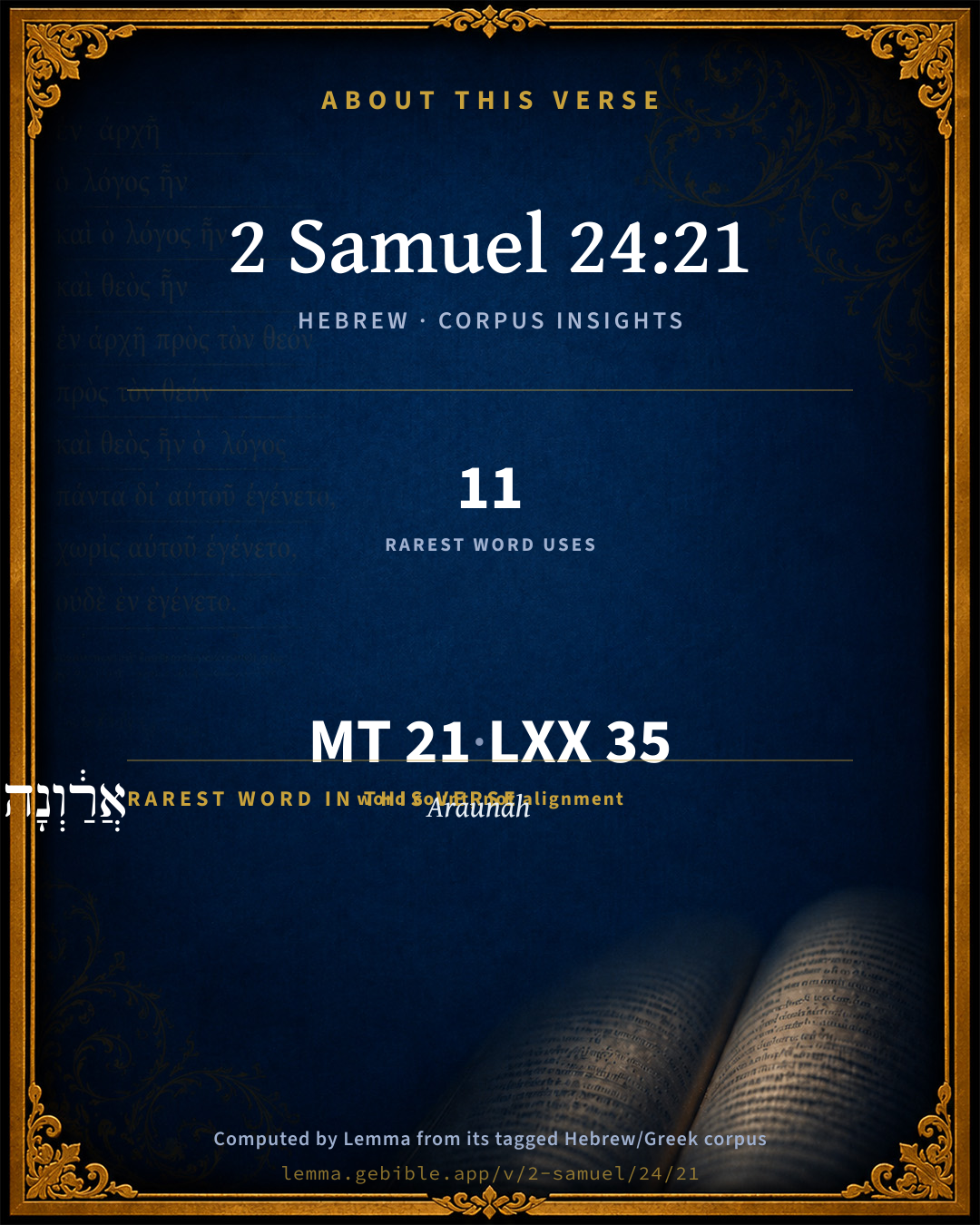
The rarest word here is אֲרַ֔וְנָה Araunah H728 — appearing just 11 times in the whole Hebrew Bible.

Shared distinctive vocabulary

אֲרַ֔וְנָה Araunah H728 occurs in 7 verses of the Hebrew Bible. Also found in:

Grammatical profile

  • 6 verbs
  • 10 nouns
  • 3 prepositions
  • 2 particles

Verb forms

  • וַיֹּ֣אמֶר Qal · Sequential Imperfect
  • בָּ֥א Qal · Perfect
  • וַיֹּ֨אמֶר Qal · Sequential Imperfect
  • לִקְנ֧וֹת Qal · Infinitive Construct
  • לִבְנ֤וֹת Qal · Infinitive Construct
  • וְתֵעָצַ֥ר Niphal · Imperfect

Repetition

A word recurs within this verse — often emphatic in Hebrew:

  • וַיֹּ֣אמֶר to say H559 ×2

Hebrew & Septuagint length

In English translation the verse runs 36 words from the Hebrew and 42 from the Septuagint (LXX English) — closely comparable.

A rough comparison of the two English renderings, which tokenize alike — not a word-level alignment.

Word counts can differ between the Hebrew and the Greek without any difference in meaning — e.g. the Hebrew direct-object marker אֵת has no separate Greek word, and Greek often adds the article ὁ.

In the original languages it is 21 Hebrew tokens and 35 Greek tokens — but the two are counted differently (Hebrew bundles its prefixes and suffixes into one token; the Greek is in lemma form), so that isn’t a like-for-like length.

Cross-references

9

Topical passages linked to 2 Samuel 24:21 in the Treasury of Scripture Knowledge — connected by theme and wording, ordered by reader-vote popularity; previews shown in the World English Bible.

  • Genesis 23:8–16 He talked with them, saying, "If it be your mind that I should bury my dead out of my sight, hear me, and entreat for me to Ephron the son of Zohar,
  • Numbers 16:44–50 Yahweh spoke to Moses, saying,
  • Numbers 25:8 and he went after the man of Israel into the pavilion, and thrust both of them through, the man of Israel, and the woman through her body. So the plague was stayed from the children of Israel.
  • 2 Samuel 21:3–14 and David said to the Gibeonites, What shall I do for you? And with what shall I make atonement, that you may bless the inheritance of Yahweh?
  • 2 Samuel 24:3 Joab said to the king, Now Yahweh your God add to the people, however many they may be, one hundred times; and may the eyes of my lord the king see it: but why does my lord the king delight in this thing?
  • 2 Samuel 24:18 Gad came that day to David, and said to him, Go up, rear an altar to Yahweh in the threshing floor of Araunah the Jebusite.
  • 1 Chronicles 21:22 Then David said to Ornan, Give me the place of this threshing floor, that I may build thereon an altar to Yahweh: for the full price shall you give it me, that the plague may be stayed from the people.
  • Psalms 106:30 Then Phinehas stood up, and executed judgment, So the plague was stopped.

Cross-references courtesy of OpenBible.info (CC BY 4.0).

Hebrew and Greek witnesses Masoretic Hebrew ↔ Greek Septuagint

The same verse in the two great witnesses to the Old Testament, shown verse-for-verse.

These are two independent witnesses, not word-aligned to each other, and the Septuagint is shown in lemma (dictionary) form.

Hebrew 2 Samuel 24:21 Masoretic · Westminster Leningrad Codex

וַיֹּ֣אמֶר אֲרַ֔וְנָה מַדּ֛וּעַ בָּ֥א אֲדֹנִֽי הַמֶּ֖לֶךְ אֶל עַבְדּ֑וֹ וַיֹּ֨אמֶר דָּוִ֜ד לִקְנ֧וֹת מֵעִמְּךָ֣ אֶת הַגֹּ֗רֶן לִבְנ֤וֹת מִזְבֵּ֨חַ֙ לַֽיהוָ֔ה וְתֵעָצַ֥ר הַמַּגֵּפָ֖ה מֵעַ֥ל הָעָֽם

Araunah said, Why is my lord the king come to his servant? David said, To buy the threshing floor of you, to build an altar to Yahweh, that the plague may be stayed from the people.

World English Bible · Public Domain

Greek LXX 2 Samuel 24:21 Septuagint · lemma form

καί εἶπον ορνα τίς ὅτι ἔρχομαι ὁ κύριος ἐγώ ὁ βασιλεύς πρός ὁ δοῦλος αὐτός καί εἶπον δαυίδ κτάομαι παρά σύ ὁ ἅλων ὁ οἰκοδομέω θυσιαστήριον ὁ κύριος καί συνἔχω ὁ θραῦσις ἐπάνω ὁ λαός

And Orna said, Why has my lord the king come to his servant? and David said, To buy of you the threshing floor, in order to build an altar to the Lord that the plague may be restrained from off the people.

LXX2012 (modern English Septuagint) · Public Domain

Hebrew: Westminster Leningrad Codex (CC BY 4.0). Greek: Septuagint (public domain); English from LXX2012 (modern English Septuagint) (Public Domain). How the Septuagint differs from the Hebrew →

Targum (Aramaic paraphrase)

1

The Targum is the ancient Jewish Aramaic paraphrase of the Hebrew Scriptures — an interpretive translation, not the Hebrew text itself. Onkelos (literal) and Pseudo-Jonathan (expansive) render the Torah, and Jonathan the Prophets. Coverage is partial: where no permissively-licensed English translation exists for a verse, only the Aramaic is shown. This is verse-level text, not a word-by-word alignment to the Hebrew.

  1. Targum Jonathan Prophets (Joshua–Malachi)
    וַאֲמַר אֲרַוָן מָא דֵין אֲתָא רִבּוֹנִי מַלְכָּא לְוַת עַבְדֵיהּ וַאֲמַר דָוִד לְמִזְבַן מִנָךְ יַת בֵּית אִידְרֵי לְמִבְנָא מַדְבְּחָא קֲדָם יְיָ וְיִתְכְּלִי מוֹתָנָא מֵעַל עַמָא:

    (no public-domain English translation for this verse)

    Targum Jonathan — Aramaic: “Mikraot Gedolot” (public domain). English: “Sefaria Community Translation” (CC0 1.0 (public-domain dedication)); “London "Chaldee Paraphrase," 1871” (public domain). Text via Sefaria.

Commentary

Notes on 2 Samuel 24:21 from classic Christian and Jewish commentators (each source and its license shown beneath its notes). The classic Christian expositions comment on the surrounding passage and are grouped to its opening verse, so a note may address several verses; the Jewish commentaries on the Tanakh (Rashi and others) are per-verse, so they appear only where the commentator wrote on this verse.

Lemma curates 59 commentaries, every one of them public domain or Creative Commons licensed, each selected and text-cleaned for this edition rather than reprinted as found. About our sources →

Trapp's Complete Commentary

John Trapp

2Sa 24:21 And Araunah said, Wherefore is my lord the king come to his servant? And David said, To buy the threshingfloor of thee, to build an altar unto the LORD, that the plague may be stayed from the people.

Ver. 21 Wherefore is my lord the king come to his servant?] This, he thought, was stupenda dignatio, a wonderful condescension. What is it, then, that the great God should come unto us? {Psa 101:2} should dwell in us, and walk in us {2Co 6:16} and sup with us? {Rev 3:20} should manifest himself to us, and not to the world? {Joh 14:22}

John Trapp, A Commentary or Exposition upon All the Books of the Old and New Testament (1647–1656) — public domain. Text from a community e-Sword module.

Joseph Benson's Commentary

2Sa 24:21-22. Wherefore is my lord the king come? — Wherefore doth the king do me this honour, and give himself the trouble of coming to me? Behold, here be the oxen — Which were employed by him in his present work of thrashing. And instruments of the oxen — Their yokes, and the instruments which they drew after them, to beat and press out the corn.

Joseph Benson's Commentary on the Old and New Testaments (1811–1818) — public domain. Text from a community e-Sword module.

Tyndale Open Study Notes

Tyndale Open Resources

24:21 so that he will stop the plague: David did not know that God had already announced the end of the plague to the angel (24:16).

Tyndale Open Study Notes — © Tyndale Open Resources, licensed CC BY-SA 4.0. Text via the HelloAO Bible API.

Geneva Bible (1599)

Geneva Bible translators

Called also Ornan, 1 Chron. 21:20.

Geneva Bible (1599) marginal notes — public domain. Text via Bolls.life.

Jamieson, Fausset & Brown

Robert Jamieson, A. R. Fausset & David Brown

to build an altar unto the Lord, that the plague may be stayed--It is evident that the plague was not stayed till after the altar was built, and the sacrifice offered, so that what is related (Sa2 24:16) was by anticipation. Previous to the offering of this sacrifice, he had seen the destroying angel as well as offered the intercessory prayer (Sa2 24:17). This was a sacrifice of expiation; and the reason why he was allowed to offer it on Mount Moriah was partly in gracious consideration to his fear of repairing to Gibeon (Ch1 21:29-30), and partly in anticipation of the removal of the tabernacle and the erection of the temple there (Ch2 3:1).

Jamieson, Fausset & Brown — Commentary Critical and Explanatory on the Whole Bible (1871) — public domain (CC PDM 1.0). Text via the HelloAO Bible API.

John Gill's Exposition

And Araunah said unto David, let my lord the king take and offer up what seemeth good unto him,.... Build an altar, offer sacrifices of whatsoever he found upon the premises fit for the same, and make use of whatever came to hand proper to perform such service with, as follows:

behold, here be oxen for burnt sacrifice: which were employed in treading the corn, hence the law in Deu 25:4,

and threshing instruments; not flails, such as are used by us, but wooden sledges, drays or carts drawn on wheels, which were filled with stones, and the bottom of them stuck with iron teeth, and were drawn by oxen to and fro over the sheaves of corn; see Isa 28:27,

and other instruments of the oxen for wood; as their yokes; these Araunah gave leave to take to burn the sacrifice with; and in Ch1 21:23, it is added, "and the wheat for the meat offering", which was upon the threshingfloor; and there always went a meat offering with a burnt offering.

John Gill's Exposition of the Whole Bible (1746–1763) — public domain (CC PDM 1.0). Text via the HelloAO Bible API.

Matthew Poole's English Annotations

Wherefore is my lord the king come to his servant? wherefore doth the king do me this honour, and give himself the trouble of coming to me?

Matthew Poole's English Annotations on the Holy Bible (1683–1685) — public domain. Text from a community e-Sword/MySword module.

unfoldingWord translationNotes

Door43 World Missions Community

so that the plague may be removed from the people

This can be stated in active form. AT: "so that Yahweh will remove this plague from the people" (See: Active or Passive)

what is good in your sight

Here sight represents judgment or evaluation. AT: "what you think is good" or "what is good in your judgement" (See: Metaphor)

threshing sledges

heavy boards used to separate grain from the rest of the wheat plant

translationWords

lord

plague

cow

burnt offering

yoke

God

unfoldingWord translationNotes — © Distant Shores Media and the Door43 World Missions Community, licensed CC BY-SA 4.0. Source: git.door43.org/Door43/en_tn.

Lesson kit

Teaching starters — assembled from the data on this page, not authored interpretation. Every prompt links to the verse data it draws on. Edit before teaching.

2 Samuel, in the Historical, opens this verse with 21 words (20 distinct Hebrew lemmas). Its most distinctive word is ʼĂravnâh (“Araunah”). A historical commentator’s framing appears above. Read the whole chapter for the surrounding context.

Discussion questions

  1. What does “Araunah” (ʼĂravnâh) contribute to the verse as a whole?
  2. 2 Samuel 24:16 shares the word «Araunah» with this verse. How do the two illuminate each other?
  3. “to say” occurs 2× in this one verse. What is the effect of the repetition?
  4. These translations render this verse differently; the difference is in the English rendering, not the original. What questions does that raise?
  5. The verb «וַיֹּ֣אמֶר» is Qal Sequential Imperfect. How does its form color the action?
  6. Reading how Trapp's Complete Commentary and Joseph Benson's Commentary read this verse, where do the two commentators agree and where do they part?

Things to notice

Reading settings

Reading text

Shown beneath each verse's original-language words.

Old Testament
Old Testament edition

Read the OT as the Masoretic Hebrew (MT) or the Greek Septuagint (LXX).

English shown for the Greek Septuagint (in the Hebrew ↔ Greek comparison).

Comparing translations? Open the Compare panel on any verse page to stack up to four side by side.