
1 Kings 12:33

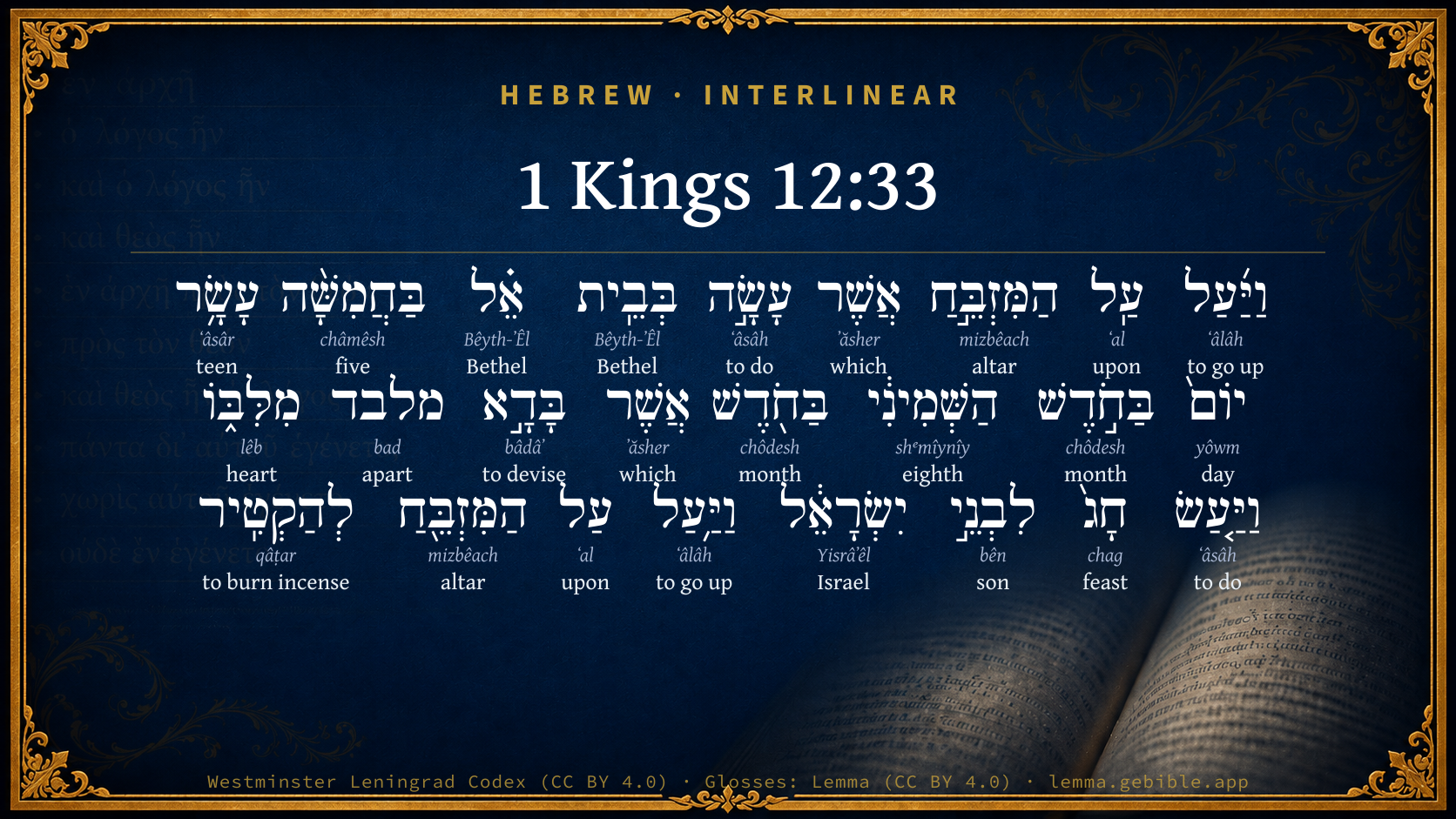
Hebrew (Westminster Leningrad Codex) 1 Kings 12:33 appears in the Hebrew Old Testament. The text above is from the Westminster Leningrad Codex. Each word links to its Strong’s number, a concise gloss, and parsing drawn from the Open Scriptures Hebrew Bible morphology. Click any word for its full Brown-Driver-Briggs (BDB) entry.
Download image
Cite this verse

1 Kings 12:33 (World English Bible). Public Domain. Lemma interlinear Bible study tool, https://lemma.gebible.app/v/1-kings/12/33.

Show BibTeX & RIS
BibTeX
RIS
English Translation
He went up to the altar which he had made in Bethel on the fifteenth day in the eighth month, even in the month which he had devised of his own heart: and he ordained a feast for the children of Israel, and went up to the altar, to burn incense.
World English Bible · Public Domain
Highlights Full analysis ↓
Download a study sheet

One document with this verse’s original text, its word-by-word gloss line, the meaning frame, cross-references with their text, attributed commentary, and full source and license credits — printable, and it pastes into notes with its structure intact.

This verse Autodidact and up

Study sheet (.html) Plain text (.txt)

A passage Seminary Student

Up to 50 verses in one chapter. A passage sheet keeps up to 6 commentary sources and 12 cross-references per verse, in the order this page ranks them, and says so on the sheet whenever that leaves anything out. Ask for a single verse and you get the Autodidact verse sheet above.

Everything on this page stays free to read, with no account — the sheet is a download of what is already on screen, not access to it.

Want to remove ads? Support Godless Engineer
Compare translations 3

The same verse in 3 English versions, stacked beneath the original-language interlinear above. Click any original word for its lexicon entry.

Each is an independent rendering of the whole verse — the interlinear is not word-aligned to these translations.

Highlighted words mark where these versions differ — a whole-verse word diff, not a word-by-word alignment.

  • World English Bible Public Domain
    He went up to the altar which he had made in Bethel on the fifteenth day in the eighth month, even in the month which he had devised of his own heart: and he ordained a feast for the children of Israel, and went up to the altar, to burn incense.
  • King James Version Public Domain
    So he offered upon the altar which he had made in Bethel the fifteenth day of the eighth month, even in the month which he had devised of his own heart; and ordained a feast unto the children of Israel: and he offered upon the altar, and burnt incense.
  • unfoldingWord Literal Text CC BY-SA 4.0
    And he offered on the altar that he had made at Bethel on the fifteenth day in the eighth month, in the month that he had devised by himself. And he made a festival for the sons of Israel, and he offered on the altar to burn incense.

unfoldingWord Literal Text — © unfoldingWord, licensed CC BY-SA 4.0. Word-aligned USFM3 via Door43 (git.door43.org/unfoldingWord/en_ult).

Versions to compare (up to 4)

3 of 4 selected

Show all 18 translations

Every available English version of this verse, each an independent rendering of the whole verse.

  • World English Bible Public Domain
    He went up to the altar which he had made in Bethel on the fifteenth day in the eighth month, even in the month which he had devised of his own heart: and he ordained a feast for the children of Israel, and went up to the altar, to burn incense.
  • Berean Standard Bible Public Domain
    On the fifteenth day of the eighth month, a month of his own choosing, Jeroboam offered sacrifices on the altar he had set up in Bethel. So he ordained a feast for the Israelites, offered sacrifices on the altar, and burned incense.
  • Majority Standard Bible Public Domain
    On the fifteenth day of the eighth month, a month of his own choosing, Jeroboam offered sacrifices on the altar he had set up in Bethel. So he ordained a feast for the Israelites, offered sacrifices on the altar, and burned incense.
  • King James Version Public Domain
    So he offered upon the altar which he had made in Bethel the fifteenth day of the eighth month, even in the month which he had devised of his own heart; and ordained a feast unto the children of Israel: and he offered upon the altar, and burnt incense.
  • American Standard Version (1901) Public Domain
    And he went up unto the altar which he had made in Beth-el on the fifteenth day in the eighth month, even in the month which he had devised of his own heart: and he ordained a feast for the children of Israel, and went up unto the altar, to burn incense.
  • Revised Version (1885) Public Domain
    And he went up unto the altar which he had made in Beth-el on the fifteenth day in the eighth month, even in the month which he had devised of his own heart: and he ordained a feast for the children of Israel, and went up unto the altar, to burn incense.
  • Geneva Bible (1599) Public Domain
    And he offered vpon the altar, which he had made in Beth-el, the fifteenth day of the eight moneth, (euen in the moneth which he had forged of his owne heart) and made a solemne feast vnto the children of Israel: and he went vp to the altar, to burne incense.
  • Douay-Rheims (1899) Public Domain
    And he went up to the altar, which he had built in Bethel, on the fifteenth day of the eighth month, which he had devised of his own heart: and he ordained a feast to the children of Israel, and went upon the altar to burn incense.
  • Young's Literal Translation Public Domain
    And he offereth up on the altar that he made in Beth-El, on the fifteenth day of the eighth month, in the month that he devised of his own heart, and he maketh a festival to the sons of Israel, and offereth on the altar -- to make perfume.
  • Literal Standard Version CC BY-SA 4.0
    And he offers up on the altar that he made in Beth-El, on the fifteenth day of the eighth month, in the month that he devised from his own heart, and he makes a festival for the sons of Israel, and offers on the altar—to make incense.
  • Unlocked Literal Bible CC BY-SA 4.0
    Jeroboam went up to the altar that he had made in Bethel on the fifteenth day in the eighth month, in the month he had planned in his own mind; he ordained a feast for the people of Israel and went up to the altar to burn incense.
  • unfoldingWord Literal Text CC BY-SA 4.0
    And he offered on the altar that he had made at Bethel on the fifteenth day in the eighth month, in the month that he had devised by himself. And he made a festival for the sons of Israel, and he offered on the altar to burn incense.
  • Darby Bible Public Domain
    And he offered upon the altar that he had made in Bethel, on the fifteenth day of the eighth month, in the month which he had devised of his own heart; and he made a feast for the children of Israel, and he offered upon the altar, burning incense.
  • World Messianic Bible Public Domain
    He went up to the altar which he had made in Bethel on the fifteenth day in the eighth month, even in the month which he had devised of his own heart; and he ordained a feast for the children of Israel, and went up to the altar to burn incense.
  • Webster's Bible Public Domain
    So he offered upon the altar which he had made in Beth-el the fifteenth day of the eighth month, even in the month which he had devised of his own heart; and ordained a feast to the children of Israel: and he offered upon the altar, and burnt incense.
  • Free Bible Version CC BY-SA 4.0
    So on the fifteenth day of the eighth month, a month he had chosen himself, Jeroboam offered sacrifices on the altar he had set up in Bethel. In this way he instituted a festival for the Israelites, offering sacrifices on the altar and burning incense.
  • Bible in Basic English Public Domain
    He went up to the altar he had made in Beth-el on the fifteenth day of the eighth month, the month fixed by him at his pleasure; and he gave orders for a feast for the people of Israel, and went up to the altar, and there he made the smoke of his offerings go up.
  • JPS Tanakh (1917) Public Domain
    And he went up unto the altar which he had made in Beth-el on the fifteenth day in the eighth month, even in the month which he had devised of his own heart; and he ordained a feast for the children of Israel, and went up unto the altar, to offer.

Literal Standard Version (2020), Covenant Press — licensed CC BY-SA 4.0. Text via the HelloAO Bible API (eBible.org). Unlocked Literal Bible (unfoldingWord) — licensed CC BY-SA 4.0. Text via the HelloAO Bible API (eBible.org). unfoldingWord Literal Text — © unfoldingWord, licensed CC BY-SA 4.0. Word-aligned USFM3 via Door43 (git.door43.org/unfoldingWord/en_ult). Free Bible Version, Dr. Jonathan Gallagher — licensed CC BY-SA 4.0. Text via the HelloAO Bible API (eBible.org).

Word by word

More ways to search: Search by grammar → Find every occurrence → Compare this word →

Practice this passage: Drill this verse → Learn its vocabulary →

בָּדָ֣א
bâdâʼ
H908
“to devise”
Verb, Qal, Perfect, 3rd Person, Masculine, Singular
Part of Speech
Verb
Stem
Qal
Form
Perfect
Person
3rd Person
Gender
Masculine
Number
Singular
Full BDB Definition

Origin: a primitive root

TWOT: 200

to devise, contrive, invent (bad sense) - (Qal) - to devise - to contrive
  1. וַיַּ֜עַל ʻâlâh H5927 “and · to go up” Conjunction + Verb, Hiphil, Sequential Imperfect, 3rd Person, Masculine, Singular
  2. עַֽל ʻal H5921 “upon” Preposition
  3. הַמִּזְבֵּ֣חַ mizbêach H4196 “the · altar” Particle, Definite Article + Noun, Common, Masculine, Singular, Absolute
  4. אֲשֶׁר ʼăsher H834 “which” Particle, Relative
  5. עָשָׂ֣ה ʻâsâh H6213 “to do” Verb, Qal, Perfect, 3rd Person, Masculine, Singular
  6. בְּבֵֽית Bêyth-ʼÊl H1008 “in/at · Bethel” Preposition + Noun, Proper
  7. אֵ֗ל Bêyth-ʼÊl H1008 “Bethel” Noun, Proper
  8. בַּחֲמִשָּׁ֨ה châmêsh H2568 “in/at the · five” Preposition, Determined + Adjective, Cardinal number, Masculine, Singular, Absolute
  9. עָשָׂ֥ר ʻâsâr H6240 “teen” Adjective, Cardinal number, Masculine, Singular, Absolute
  10. יוֹם֙ yôwm H3117 “day” Noun, Common, Masculine, Singular, Absolute
  11. בַּחֹ֣דֶשׁ chôdesh H2320 “in/at the · month” Preposition, Determined + Noun, Common, Masculine, Singular, Absolute
  12. הַשְּׁמִינִ֔י shᵉmîynîy H8066 “the · eighth” Particle, Definite Article + Adjective, Ordinal number, Masculine, Singular, Absolute
  13. בַּחֹ֖דֶשׁ chôdesh H2320 “in/at the · month” Preposition, Determined + Noun, Common, Masculine, Singular, Absolute
  14. אֲשֶׁר ʼăsher H834 “which” Particle, Relative
  15. מלבד bad H905 “from · to/for · apart” Preposition + Preposition + Noun, Common, Masculine, Singular, Absolute
  16. מִלִּבּ֑וֹ lêb H3820 “from · heart · his” Preposition + Noun, Common, Masculine, Singular, Construct + Suffix, Personal, 3rd Person, Masculine, Singular
  17. וַיַּ֤עַשׂ ʻâsâh H6213 “and · to do” Conjunction + Verb, Qal, Sequential Imperfect, 3rd Person, Masculine, Singular
  18. חָג֙ chag H2282 “feast” Noun, Common, Masculine, Singular, Absolute
  19. לִבְנֵ֣י bên H1121 “to/for · sons of” Preposition + Noun, Common, Masculine, Plural, Construct
  20. יִשְׂרָאֵ֔ל Yisrâʼêl H3478 “Israel” Noun, Proper
  21. וַיַּ֥עַל ʻâlâh H5927 “and · to go up” Conjunction + Verb, Hiphil, Sequential Imperfect, 3rd Person, Masculine, Singular
  22. עַל ʻal H5921 “upon” Preposition
  23. הַמִּזְבֵּ֖חַ mizbêach H4196 “the · altar” Particle, Definite Article + Noun, Common, Masculine, Singular, Absolute
  24. לְהַקְטִֽיר qâṭar H6999 “to burn incense” Preposition + Verb, Hiphil, Infinitive Construct

About this verse

These counts appear in no published source. They are computed here, from the morphology-tagged text and Lemma’s own curated glosses. What Lemma adds →

25
words
18
distinct lemmas
Historical
section

Notable vocabulary

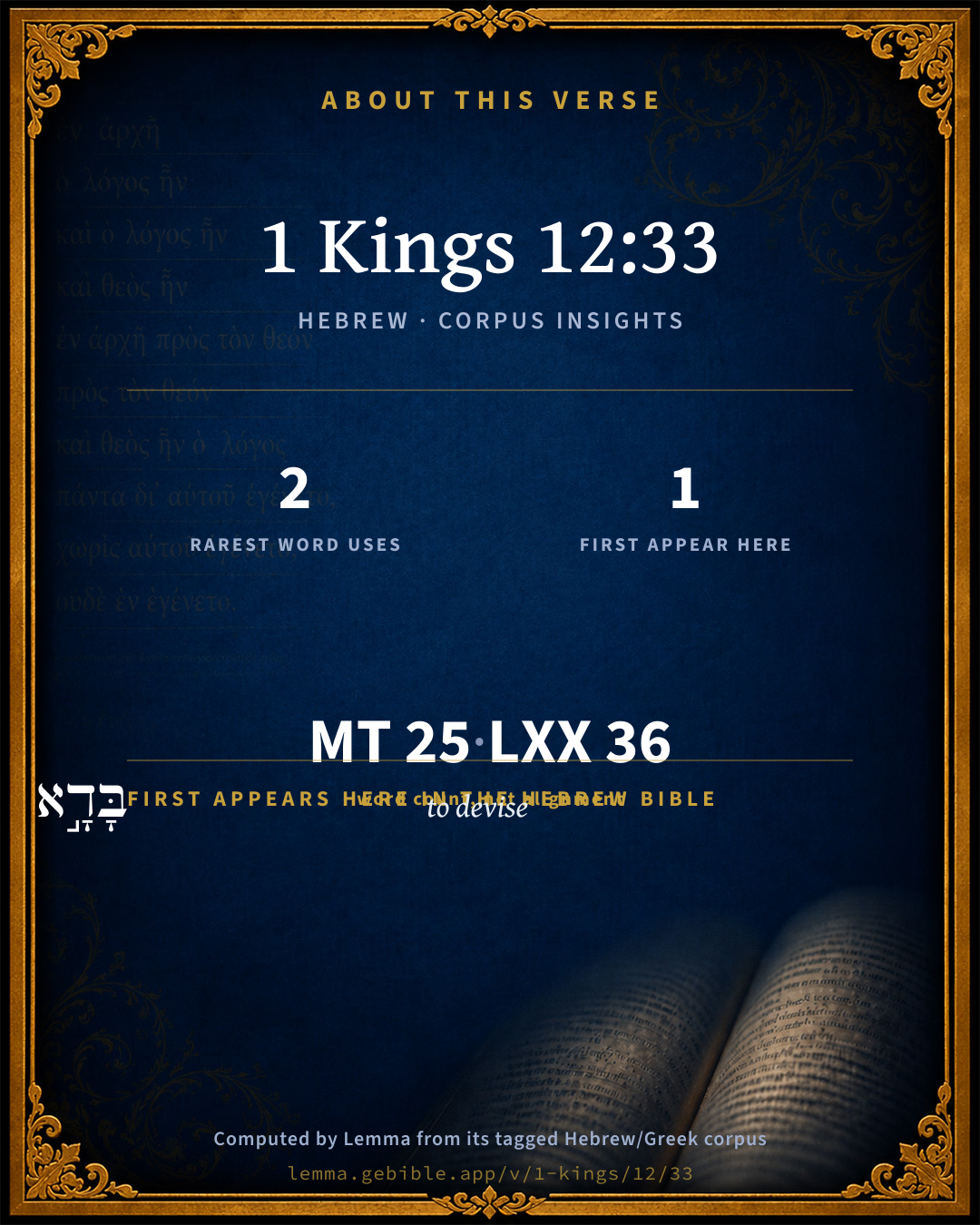
The rarest word here is בָּדָ֣א to devise H908 — appearing just 2 times in the whole Hebrew Bible.

First appearance in Scripture

This word makes its first canonical appearance in the Hebrew Bible here:

  • בָּדָ֣א to devise H908

Shared distinctive vocabulary

בָּדָ֣א to devise H908 occurs in 2 verses of the Hebrew Bible. Also found in:

Grammatical profile

  • 6 verbs
  • 12 nouns
  • 3 adjectives
  • 2 prepositions
  • 2 particles

Verb forms

  • וַיַּ֜עַל Hiphil · Sequential Imperfect
  • עָשָׂ֣ה Qal · Perfect
  • בָּדָ֣א Qal · Perfect
  • וַיַּ֤עַשׂ Qal · Sequential Imperfect
  • וַיַּ֥עַל Hiphil · Sequential Imperfect
  • לְהַקְטִֽיר Hiphil · Infinitive Construct

Repetition

Words recur within this verse — often emphatic in Hebrew:

  • וַיַּ֜עַל to go up H5927 ×2
  • עַֽל upon H5921 ×2
  • הַמִּזְבֵּ֣חַ altar H4196 ×2
  • עָשָׂ֣ה to do H6213 ×2
  • בְּבֵֽית Bethel H1008 ×2
  • בַּחֹ֣דֶשׁ month H2320 ×2
  • אֲשֶׁר which H834 ×2

Hebrew & Septuagint length

In English translation the verse runs 51 words from the Hebrew and 82 from the Septuagint (LXX English) — the Septuagint runs noticeably longer here. See the side-by-side →

A rough comparison of the two English renderings, which tokenize alike — not a word-level alignment.

Word counts can differ between the Hebrew and the Greek without any difference in meaning — e.g. the Hebrew direct-object marker אֵת has no separate Greek word, and Greek often adds the article ὁ.

In the original languages it is 25 Hebrew tokens and 36 Greek tokens — but the two are counted differently (Hebrew bundles its prefixes and suffixes into one token; the Greek is in lemma form), so that isn’t a like-for-like length.

Cross-references

8

Topical passages linked to 1 Kings 12:33 in the Treasury of Scripture Knowledge — connected by theme and wording, ordered by reader-vote popularity; previews shown in the World English Bible.

  • 1 Kings 13:1 Behold, there came a man of God out of Judah by the word of Yahweh to Beth El: and Jeroboam was standing by the altar to burn incense.
  • Numbers 15:39 and it shall be to you for a fringe, that you may look on it, and remember all the commandments of Yahweh, and do them; and that you not follow after your own heart and your own eyes, after which you use to play the prostitute;
  • 1 Samuel 13:12 therefore said I, Now will the Philistines come down on me to Gilgal, and I haven't entreated the favor of Yahweh: I forced myself therefore, and offered the burnt offering.
  • 2 Chronicles 26:6 He went forth and warred against the Philistines, and broke down the wall of Gath, and the wall of Jabneh, and the wall of Ashdod; and he built cities in [the country of] Ashdod, and among the Philistines.
  • Psalms 106:39 Thus were they defiled with their works, And prostituted themselves in their deeds.
  • Isaiah 29:13 The Lord said, Because this people draw near [to me], and with their mouth and with their lips to honor me, but have removed their heart far from me, and their fear of me is a commandment of men which has been taught [them];
  • Matthew 15:6 he shall not honor his father or mother.' You have made the commandment of God void because of your tradition.
  • Mark 7:13 making void the word of God by your tradition, which you have handed down. You do many things like this."

Cross-references courtesy of OpenBible.info (CC BY 4.0).

Hebrew and Greek witnesses Masoretic Hebrew ↔ Greek Septuagint

The same verse in the two great witnesses to the Old Testament, shown verse-for-verse.

Here the Septuagint runs noticeably longer than the Hebrew — LXX2012 (modern English Septuagint) 82 words vs World English Bible 51. A rough length comparison of the two English translations, not a word-level alignment — read both below.

These are two independent witnesses, not word-aligned to each other, and the Septuagint is shown in lemma (dictionary) form.

Hebrew 1 Kings 12:33 Masoretic · Westminster Leningrad Codex

וַיַּ֜עַל עַֽל הַמִּזְבֵּ֣חַ אֲשֶׁר עָשָׂ֣ה בְּבֵֽית אֵ֗ל בַּחֲמִשָּׁ֨ה עָשָׂ֥ר יוֹם֙ בַּחֹ֣דֶשׁ הַשְּׁמִינִ֔י בַּחֹ֖דֶשׁ אֲשֶׁר בָּדָ֣א מלבד מִלִּבּ֑וֹ וַיַּ֤עַשׂ חָג֙ לִבְנֵ֣י יִשְׂרָאֵ֔ל וַיַּ֥עַל עַל הַמִּזְבֵּ֖חַ לְהַקְטִֽיר

He went up to the altar which he had made in Bethel on the fifteenth day in the eighth month, even in the month which he had devised of his own heart: and he ordained a feast for the children of Israel, and went up to the altar, to burn incense.

World English Bible · Public Domain

Greek LXX 1 Kings 12:33 Septuagint · lemma form

καί ἀναβαίνω ἐπί ὁ θυσιαστήριον ὅς ποιέω ὁ πεντεκαιδέκατος ἡμέρα ἐν ὁ μήν ὁ ὄγδοος ἐν ὁ ἑορτή ὅς πλάσσω ἀπό καρδία αὐτός καί ποιέω ἑορτή ὁ υἱός ἰσραήλ καί ἀναβαίνω ἐπί ὁ θυσιαστήριον ὁ ἐπιθύω

and went up to the altar which he made in Baethel to sacrifice to the heifers which he made, and he placed in Baethel the priests of the high places which he had made. And he went up to the altar which he had made, on the fifteenth day in the eighth month, at the feast which he devised out of his own heart; and he made a feast to the children of Israel, and went up to the altar to sacrifice.

LXX2012 (modern English Septuagint) · Public Domain

On this verse, Haydock's Catholic Bible Commentary discusses the Septuagint’s reading. Read the note in Commentary ↓

Hebrew: Westminster Leningrad Codex (CC BY 4.0). Greek: Septuagint (public domain); English from LXX2012 (modern English Septuagint) (Public Domain). How the Septuagint differs from the Hebrew →

Targum (Aramaic paraphrase)

1

The Targum is the ancient Jewish Aramaic paraphrase of the Hebrew Scriptures — an interpretive translation, not the Hebrew text itself. Onkelos (literal) and Pseudo-Jonathan (expansive) render the Torah, and Jonathan the Prophets. Coverage is partial: where no permissively-licensed English translation exists for a verse, only the Aramaic is shown. This is verse-level text, not a word-by-word alignment to the Hebrew.

  1. Targum Jonathan Prophets (Joshua–Malachi)
    וְאַסֵיק עַל אֱגוֹרָא דַעֲבַד בְּבֵית אֵל בְּחַמְשָׁא עַסְרָא יוֹמָא לְיַרְחָא תְמִינָאָה בְּיַרְחָא דַעֲדָא מֵרְעוּתֵיהּ וַעֲבַד חַגָא לִבְנֵי יִשְׂרָאֵל וּסְלִיק עַל אֱגוֹרָא לְאַקְטָרָא:

    (no public-domain English translation for this verse)

    Targum Jonathan — Aramaic: “Mikraot Gedolot” (public domain). English: “Sefaria Community Translation” (CC0 1.0 (public-domain dedication)); “London "Chaldee Paraphrase," 1871” (public domain). Text via Sefaria.

Commentary

Notes on 1 Kings 12:33 from classic Christian and Jewish commentators (each source and its license shown beneath its notes). The classic Christian expositions comment on the surrounding passage and are grouped to its opening verse, so a note may address several verses; the Jewish commentaries on the Tanakh (Rashi and others) are per-verse, so they appear only where the commentator wrote on this verse.

Lemma curates 59 commentaries, every one of them public domain or Creative Commons licensed, each selected and text-cleaned for this edition rather than reprinted as found. About our sources →

Trapp's Complete Commentary

John Trapp

1Ki 12:33 So he offered upon the altar which he had made in Bethel the fifteenth day of the eighth month, [even] in the month which he had devised of his own heart; and ordained a feast unto the children of Israel: and he offered upon the altar, and burnt incense.

Ver. 33. So he offered upon the altar.] As he usurped the kingdom, so now he invadeth the high priesthood: {a} as did likewise Uzziah. {2Ch 26:16} Julius Caesar wrote to his mother, Hodie videbis me aut Pontificem aut exulem. Today you will see me as Pontiff or exileed. {b} Charles V also sought once to make himself Pope, that he might get both the swords into his own hand. Ambition rideth without reins.

Which he had devised of his own heart.] Hence this new day is called the day of the king, by the prophet Hosea, who doth often thunder against this idolatry. Sed surdo fabulam.

{a} Josephus.

{b} Sueton.

John Trapp, A Commentary or Exposition upon All the Books of the Old and New Testament (1647–1656) — public domain. Text from a community e-Sword module.

Joseph Benson's Commentary

1Ki 12:33. Which he had devised of his own heart — Out of his own will and pleasure, against the express ordinance of God. And ordained a feast — To be observed, it is likely, every year in Beth-el, as well as in Dan, as the feast of tabernacles was at Jerusalem, like which it also lasted many days. And he offered upon the altar, and burned incense — Thus performing the highest part of the priest’s office.

Joseph Benson's Commentary on the Old and New Testaments (1811–1818) — public domain. Text from a community e-Sword module.

Adam Clarke's Commentary

Verse 33. He offered upon the altar] Jeroboam probably performed the functions of high priest himself, that he might in his own person condense the civil and ecclesiastical power.

Adam Clarke's Commentary on the Bible (1810–1826) — public domain. Text from a community e-Sword/MySword module.

Ellicott's Commentary for English Readers

(33) So he offered upon the altar.—The repetition of this verse is accounted for by its belonging properly in sense to the next chapter, opening the story of the mission of the “man of God from Judah.” The idea of the verse would be best conveyed by rendering the verbs of this verse in the imperfect tense: “So Jeroboam was offering,” &c.

A Bible Commentary for English Readers, edited by Charles John Ellicott (1878–1897) — public domain. Text from a community e-Sword module.

The Cambridge Bible for Schools and Colleges

gen. ed. J. J. S. Perowne

33. which he had devised of his own heart] This is a translation of the Keri, i.e. the marginal reading of the Hebrew. The Kethib (i.e. the written text) would be rendered ‘apart,’ and if it be correct must be understood, as intimating that the king consulted nobody, which comes much to the same as what we now translate. The difference to the eye between מלבד = ‘apart,’ and מלבו = ‘from his heart’ is very slight.

and he offered upon the altar, and burnt incense] The marginal note of the A. V. points out that the last verb is in the infinitive. By translating with R.V. this is made apparent in the text and went up unto the altar to burn incense.

The Cambridge Bible for Schools and Colleges (gen. ed. J. J. S. Perowne; Cambridge University Press, 1878–1918) — public domain. Text from a community e-Sword module.

Albert Barnes' Notes on the Bible

This verse belongs to 1 Kings 13 rather than to 1 Kings 12, being intended as an introduction to what follows.

Which he had devised of his own heart - The entire system of Jeroboam receives its condemnation in these words. His main fault was that he left a ritual and a worship where all was divinely authorized, for ceremonies and services which were wholly of his own devising. Not being a prophet, he had no authority to introduce religious innovations. Not having received any commission to establish new forms, he had no right to expect that any religious benefit would accrue from them. (See 1Ki 12:26 note.)

Albert Barnes' Notes on the Bible (1834–1885) — public domain. Text from a community e-Sword/MySword module.

Haydock's Catholic Bible Commentary

To: literally, "up on," (super) as at the end of the verse. (Haydock) --- The altars were very high and large. (Calmet) --- Month. Septuagint add, "on the festival which," &c. (Menochius) --- Heart. Hebrew reads millibod, (præter) instead of molbu, (ex corde suo.) Some manuscripts retain the latter word, as it is printed also in the marginal keri. Leusden tells us, we are by no means to say it is the truer reading, because then the text must be allowed to be corrupted; but it only explains what is meant by præter, "besides." A marvellous explanation! and perhaps it is only to be paralleled by ei explained by non. (Kennicott) --- Jeroboam has a mind to do honour to his new worship, and unites in his own person the sacerdotal and regal dignity, as the Roman emperors did. (Calmet) --- Incense. Septuagint, "to sacrifice." (Haydock) --- From this period, many learned men date the 390 years of the iniquity of Israel, Ezechiel iv. 5. (Du Hamel)

George Leo Haydock (1774–1849), Haydock's Catholic Family Bible and Commentary, 1859 edition — public domain. Excludes Psalms (Douay-Rheims chapter numbering differs from Protestant) and Deuterocanonical books (Catholic canon only).

Matthew Poole's English Annotations

Which he had devised of his own heart; which he appointed without any warrant from God, which was superstition. Compare Jer 7:31.

Matthew Poole's English Annotations on the Holy Bible (1683–1685) — public domain. Text from a community e-Sword/MySword module.

The Pulpit Commentary

So he offered Heb. went up, as before. This verse is really the introduction to the history of the next chapter upon the altar which he had made in Bethel the fifteenth day of the eighth month, even in the month which he had devised Josephus (Ant. 7:8. 5) seems unaware that this new feast was kept at a different date from the true Feast of Tabernacles. But these words are decisive of his own heart The Cethib has dBoLmi by which Maurer and Keil understand dbLmi (seoreum." But qu.) But the Keri wOBLmi is every way to be preferred, So LXX, ajpoav auJtou. Similarly,; (Neh_6:8) and ordered rather, kept, celebrated a feast unto Heb. for the children of Israel: and he offered went up upon the altar, and burnt incense Heb. to burn, etc. The context seems to imply that it was not incense, or not incense only, but the sacrifice, or sacrificial parts of the victim, that the king burned. See on. 1Ki_13:3 (vD) And this meaning is justified by Lev_1:9, 1Sa_2:16; Amo_4:5, where the same word is used. It cannot be denied, however, that the word is generally used of incense, and it is very probable that both this and sacrifices were offered by Jeroboam on the same altar. (cf. 1Ki_11:8) We may perhaps see in Jeroboam"s ministering in person, not only the design to invest the new ordinance with exceptional interest and splendour, but also the idea of encouraging his new priests to enter on their unauthorized functions with. out fear. The history, or even the traditions, of Nadab and Abihu (Le 10) and of Korah and his company, (Num_16:40) and the threatenings of the law (Num_18:7, Num_18:22, cf., 2Ch_26:20) may well have made them hesitate. To allay their fears the king undertakes to offer the first of the sacrifices. And that their fears of a Divine interposition were not groundless the sequel shows.

The Pulpit Commentary (1880–1919), ed. H.D.M. Spence-Jones & Joseph S. Exell — public domain. Text from a community e-Sword module.

John Wesley's Explanatory Notes

Devised - Which he appointed without any warrant from God.

John Wesley, Explanatory Notes Upon the Whole Bible (1754–1765) — public domain. Text via the GEBible commentary corpus.

unfoldingWord translationNotes

Door43 World Missions Community

went up to the altar

"Went up" here is an idiom for going to a sacred place to worship since these altars were located on high places. AT: "offered sacrifices on the altar" (See: Idiom)

in the month he had planned in his own mind

"in the month that he had determined"

translationWords

Jeroboam

mind

Israel

incense

unfoldingWord translationNotes — © Distant Shores Media and the Door43 World Missions Community, licensed CC BY-SA 4.0. Source: git.door43.org/Door43/en_tn.

Rashi

Rabbi Shlomo Yitzchaki (Rashi)

Of the eighth month. He expounded to them that this was the month of the harvest, and was, therefore, the proper time for the festival to be.

He thought up out of his own heart. An expression of falsehood, controver, in O.F.

Rashi on the Tanakh — English translations: “The Judaica Press complete Tanach with Rashi, translated by A. J. Rosenberg” (CC BY 4.0); “Pentateuch with Rashi's commentary by M. Rosenbaum and A.M. Silbermann, 1929-1934” (public domain); “The Metsudah Tanach series, Lakewood, N.J” (CC BY 4.0); and “The Book of Joshua, Metsudah Publications, 1997” (CC BY 4.0). Text via Sefaria.

Lesson kit

Teaching starters — assembled from the data on this page, not authored interpretation. Every prompt links to the verse data it draws on. Edit before teaching.

1 Kings, in the Historical, opens this verse with 25 words (18 distinct Hebrew lemmas). Its most distinctive word is bâdâʼ (“to devise”). The Greek Septuagint runs longer here. A historical commentator’s framing appears above. Read the whole chapter for the surrounding context.

Discussion questions

  1. How does “to devise” (bâdâʼ) shape what this verse is saying?
  2. The word “to devise” first appears here in Scripture. What is being introduced at this debut?
  3. Nehemiah 6:8 shares the word «to devise» with this verse. How do the two illuminate each other?
  4. “to go up” occurs 2× in this one verse. What is the effect of the repetition?
  5. Compared with the Hebrew, the Septuagint runs longer here. What questions does that raise?
  6. The translations on this page render this verse differently — a whole-verse word diff, not a word-by-word alignment. What might account for the different wordings?
  7. The verb «וַיַּ֜עַל» is Hiphil Sequential Imperfect. How does its form color the action?
  8. Reading how Trapp's Complete Commentary and Joseph Benson's Commentary read this verse, where do the two commentators agree and where do they part?

Things to notice

Reading settings

Reading text

Shown beneath each verse's original-language words.

Old Testament
Old Testament edition

Read the OT as the Masoretic Hebrew (MT) or the Greek Septuagint (LXX).

English shown for the Greek Septuagint (in the Hebrew ↔ Greek comparison).

Comparing translations? Open the Compare panel on any verse page to stack up to four side by side.