
Joshua 22:23

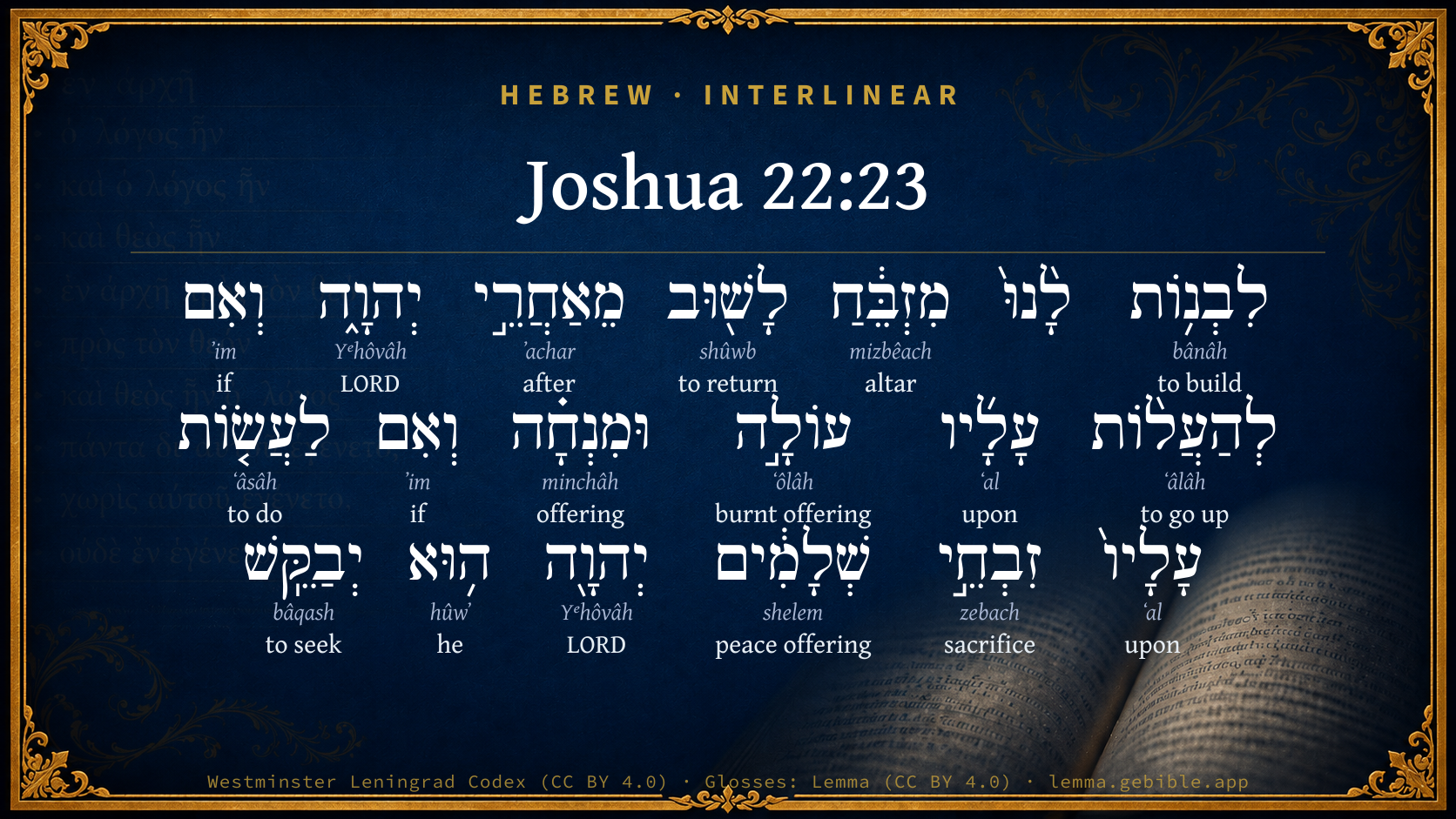
Hebrew (Westminster Leningrad Codex) Joshua 22:23 appears in the Hebrew Old Testament. The text above is from the Westminster Leningrad Codex. Each word links to its Strong’s number, a concise gloss, and parsing drawn from the Open Scriptures Hebrew Bible morphology. Click any word for its full Brown-Driver-Briggs (BDB) entry.
Download image
Cite this verse

Joshua 22:23 (World English Bible). Public Domain. Lemma interlinear Bible study tool, https://lemma.gebible.app/v/joshua/22/23.

Show BibTeX & RIS
BibTeX
RIS
English Translation
that we have built us an altar to turn away from following Yahweh; or if to offer thereon burnt offering or meal-offering, or if to offer sacrifices of peace-offerings thereon, let Yahweh himself require it;
World English Bible · Public Domain
Download a study sheet

One document with this verse’s original text, its word-by-word gloss line, the meaning frame, cross-references with their text, attributed commentary, and full source and license credits — printable, and it pastes into notes with its structure intact.

This verse Autodidact and up

Study sheet (.html) Plain text (.txt)

A passage Seminary Student

Up to 50 verses in one chapter. A passage sheet keeps up to 6 commentary sources and 12 cross-references per verse, in the order this page ranks them, and says so on the sheet whenever that leaves anything out. Ask for a single verse and you get the Autodidact verse sheet above.

Everything on this page stays free to read, with no account — the sheet is a download of what is already on screen, not access to it.

Want to remove ads? Support Godless Engineer
Compare translations 3

The same verse in 3 English versions, stacked beneath the original-language interlinear above. Click any original word for its lexicon entry.

Each is an independent rendering of the whole verse — the interlinear is not word-aligned to these translations.

Highlighted words mark where these versions differ — a whole-verse word diff, not a word-by-word alignment.

  • World English Bible Public Domain
    that we have built us an altar to turn away from following Yahweh; or if to offer thereon burnt offering or meal-offering, or if to offer sacrifices of peace-offerings thereon, let Yahweh himself require it;
  • King James Version Public Domain
    That we have built us an altar to turn from following the LORD, or if to offer thereon burnt offering or meat offering, or if to offer peace offerings thereon, let the LORD himself require it;
  • unfoldingWord Literal Text CC BY-SA 4.0
    To build an altar for ourselves to turn from after Yahweh, or if to offer on it burnt offerings or grain offerings, or if to make on it sacrifices of peace offerings, Yahweh himself will seek.

unfoldingWord Literal Text — © unfoldingWord, licensed CC BY-SA 4.0. Word-aligned USFM3 via Door43 (git.door43.org/unfoldingWord/en_ult).

Versions to compare (up to 4)

3 of 4 selected

Show all 18 translations

Every available English version of this verse, each an independent rendering of the whole verse.

  • World English Bible Public Domain
    that we have built us an altar to turn away from following Yahweh; or if to offer thereon burnt offering or meal-offering, or if to offer sacrifices of peace-offerings thereon, let Yahweh himself require it;
  • Berean Standard Bible Public Domain
    If we have built for ourselves an altar to turn away from Him and to offer burnt offerings and grain offerings on it, or to sacrifice fellowship offerings on it, may the LORD Himself hold us accountable.
  • Majority Standard Bible Public Domain
    If we have built for ourselves an altar to turn away from Him and to offer burnt offerings and grain offerings on it, or to sacrifice peace offerings on it, may the LORD Himself hold us accountable.
  • King James Version Public Domain
    That we have built us an altar to turn from following the LORD, or if to offer thereon burnt offering or meat offering, or if to offer peace offerings thereon, let the LORD himself require it;
  • American Standard Version (1901) Public Domain
    that we have built us an altar to turn away from following Jehovah; or if to offer thereon burnt-offering or meal-offering, or if to offer sacrifices of peace-offerings thereon, let Jehovah himself require it;
  • Revised Version (1885) Public Domain
    that we have built us an altar to turn away from following the LORD; or if to offer thereon burnt offering or meal offering, or if to offer sacrifices of peace offerings thereon, let the LORD himself require it;
  • Geneva Bible (1599) Public Domain
    If we haue built vs an altar to returne away from the Lord, either to offer thereon burnt offering, or meate offering, or to offer peace offerings thereon, let the Lord himselfe require it:
  • Douay-Rheims (1899) Public Domain
    And if we did it with that mind, that we might lay upon it holocausts, and sacrifice, and victims of peace offerings, let him require and judge:
  • Young's Literal Translation Public Domain
    `we are' building for ourselves an altar to turn back from after Jehovah, and if to cause to go up on it burnt-offering and present, and if to make on it peace-offerings -- Jehovah Himself doth require `it'.
  • Literal Standard Version CC BY-SA 4.0
    [If we] are building an altar for ourselves to turn back from after YHWH, and if to cause burnt-offering and present to go up on it, and if to make peace-offerings on it—YHWH Himself requires [it].
  • Unlocked Literal Bible CC BY-SA 4.0
    for having built an altar to turn ourselves away from following Yahweh. If we built that altar in order to offer on it burnt offerings, grain offerings, or peace offerings, then let Yahweh make us pay for it.
  • unfoldingWord Literal Text CC BY-SA 4.0
    To build an altar for ourselves to turn from after Yahweh, or if to offer on it burnt offerings or grain offerings, or if to make on it sacrifices of peace offerings, Yahweh himself will seek.
  • Darby Bible Public Domain
    -- that we have built for ourselves an altar to turn from following Jehovah, and if it is to offer up burnt-offering and oblation on it, and if to offer peace-offerings thereon, let Jehovah himself require it [from us];
  • World Messianic Bible Public Domain
    that we have built us an altar to turn away from following the LORD; or if to offer burnt offering or meal offering, or if to offer sacrifices of peace offerings, let the LORD himself require it.
  • Webster's Bible Public Domain
    That we have built us an altar to turn from following the LORD, or if to offer on it burnt-offering, or meat-offering, or if to offer peace-offerings on it, let the LORD himself require it;
  • Free Bible Version CC BY-SA 4.0
    If our action of building an altar was to turn away from the Lord, or to use the altar to make burnt offerings or grain offerings or friendship offerings, then may the Lord punish us.
  • Bible in Basic English Public Domain
    That we have made ourselves an altar, being false to the Lord, keep us not safe from death this day; and if for the purpose of offering burned offerings on it and meal offerings, or peace-offerings, let the Lord himself send punishment for it;
  • JPS Tanakh (1917) Public Domain
    that we have built us an altar to turn away from following the LORD; or if to offer thereon burnt-offering or meal-offering, or if to offer sacrifices of peace-offerings thereon, let the LORD Himself require it;

Literal Standard Version (2020), Covenant Press — licensed CC BY-SA 4.0. Text via the HelloAO Bible API (eBible.org). Unlocked Literal Bible (unfoldingWord) — licensed CC BY-SA 4.0. Text via the HelloAO Bible API (eBible.org). unfoldingWord Literal Text — © unfoldingWord, licensed CC BY-SA 4.0. Word-aligned USFM3 via Door43 (git.door43.org/unfoldingWord/en_ult). Free Bible Version, Dr. Jonathan Gallagher — licensed CC BY-SA 4.0. Text via the HelloAO Bible API (eBible.org).

Word by word

More ways to search: Search by grammar → Find every occurrence → Compare this word →

Practice this passage: Drill this verse → Learn its vocabulary →

שְׁלָמִ֔ים
shelem
H8002
“peace offerings”
Noun, Common, Masculine, Plural, Absolute
Part of Speech
Noun
Type
Common
Gender
Masculine
Number
Plural
State
Absolute
Full BDB Definition

Origin: from H7999

TWOT: 2401b

peace offering, requital, sacrifice for alliance or friendship - voluntary sacrifice of thanks
  1. לִבְנ֥וֹת bânâh H1129 “to build” Preposition + Verb, Qal, Infinitive Construct
  2. מִזְבֵּ֔חַ mizbêach H4196 “altar” Noun, Common, Masculine, Singular, Absolute
  3. לָשׁ֖וּב shûwb H7725 “to return” Preposition + Verb, Qal, Infinitive Construct
  4. מֵאַחֲרֵ֣י ʼachar H310 “from · after” Preposition + Preposition
  5. יְהוָ֑ה Yᵉhôvâh H3068 “LORD” Noun, Proper
  6. וְאִם ʼim H518 “and · if” Conjunction + Conjunction
  7. לְהַעֲל֨וֹת ʻâlâh H5927 “to go up” Preposition + Verb, Hiphil, Infinitive Construct
  8. עָלָ֜יו ʻal H5921 “upon · him” Preposition + Suffix, Personal, 3rd Person, Masculine, Singular
  9. עוֹלָ֣ה ʻôlâh H5930 “burnt offering” Noun, Common, Feminine, Singular, Absolute
  10. וּמִנְחָ֗ה minchâh H4503 “and · offering” Conjunction + Noun, Common, Feminine, Singular, Absolute
  11. וְאִם ʼim H518 “and · if” Conjunction + Conjunction
  12. לַעֲשׂ֤וֹת ʻâsâh H6213 “to do” Preposition + Verb, Qal, Infinitive Construct
  13. עָלָיו֙ ʻal H5921 “upon · him” Preposition + Suffix, Personal, 3rd Person, Masculine, Singular
  14. זִבְחֵ֣י zebach H2077 “sacrifices of” Noun, Common, Masculine, Plural, Construct
  15. יְהוָ֖ה Yᵉhôvâh H3068 “LORD” Noun, Proper
  16. ה֥וּא hûwʼ H1931 “he” Pronoun, Personal, 3rd Person, Masculine, Singular
  17. יְבַקֵּֽשׁ bâqash H1245 “to seek” Verb, Piel, Imperfect, 3rd Person, Masculine, Singular

About this verse

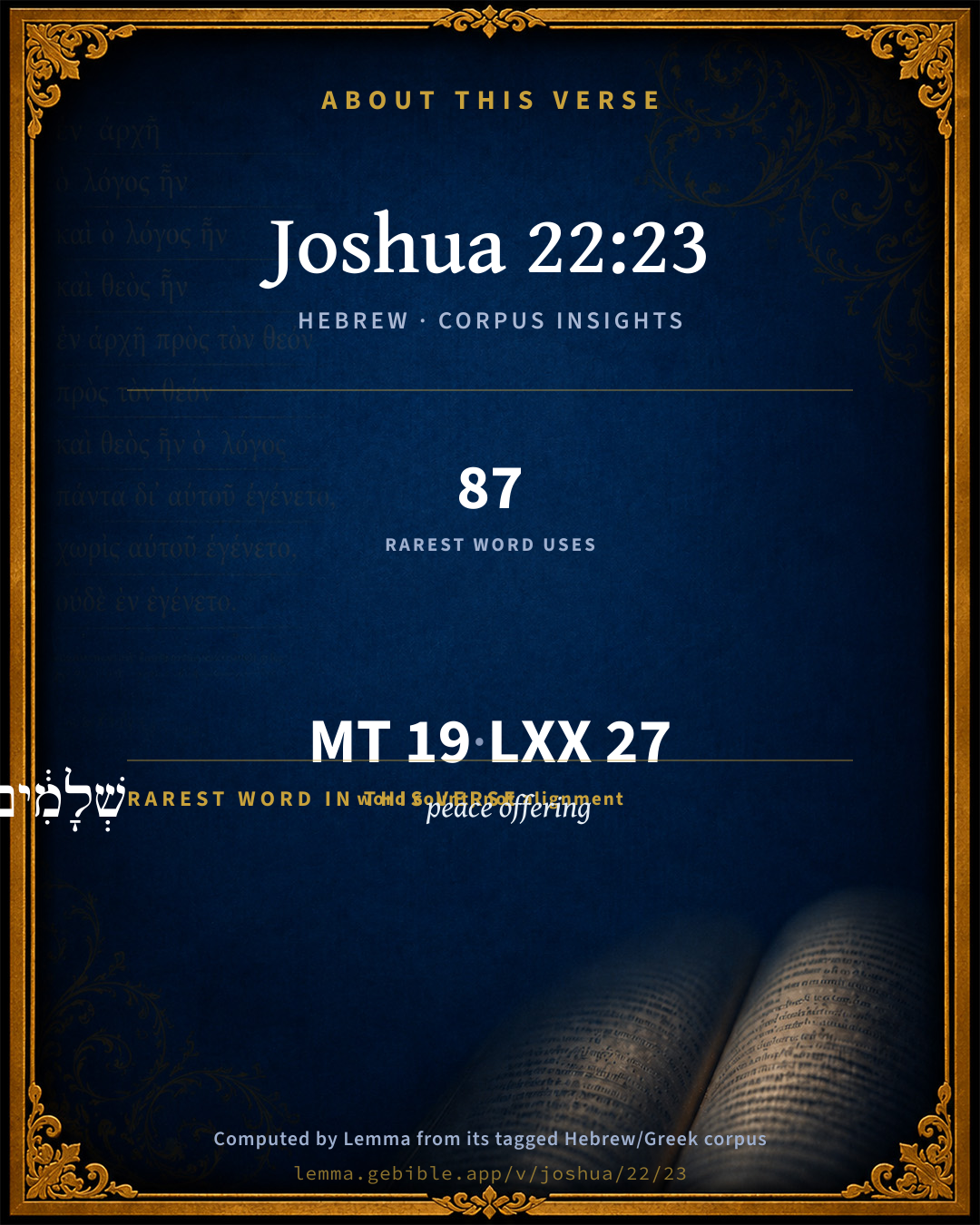
These counts appear in no published source. They are computed here, from the morphology-tagged text and Lemma’s own curated glosses. What Lemma adds →

19
words
15
distinct lemmas
Historical
section

Grammatical profile

  • 5 verbs
  • 7 nouns
  • 1 pronoun
  • 4 prepositions
  • 2 conjunctions

Verb forms

  • לִבְנ֥וֹת Qal · Infinitive Construct
  • לָשׁ֖וּב Qal · Infinitive Construct
  • לְהַעֲל֨וֹת Hiphil · Infinitive Construct
  • לַעֲשׂ֤וֹת Qal · Infinitive Construct
  • יְבַקֵּֽשׁ Piel · Imperfect

Repetition

Words recur within this verse — often emphatic in Hebrew:

  • יְהוָ֑ה LORD H3068 ×2
  • עָלָ֜יו upon H5921 ×2
  • וְאִם if H518 ×2

Hebrew & Septuagint length

In English translation the verse runs 35 words from the Hebrew and 45 from the Septuagint (LXX English) — closely comparable.

A rough comparison of the two English renderings, which tokenize alike — not a word-level alignment.

Word counts can differ between the Hebrew and the Greek without any difference in meaning — e.g. the Hebrew direct-object marker אֵת has no separate Greek word, and Greek often adds the article ὁ.

In the original languages it is 19 Hebrew tokens and 27 Greek tokens — but the two are counted differently (Hebrew bundles its prefixes and suffixes into one token; the Greek is in lemma form), so that isn’t a like-for-like length.

Cross-references

9

Topical passages linked to Joshua 22:23 in the Treasury of Scripture Knowledge — connected by theme and wording, ordered by reader-vote popularity; previews shown in the World English Bible.

  • Deuteronomy 18:19 It shall happen, that whoever will not listen to my words which he shall speak in my name, I will require it of him.
  • 1 Samuel 20:16 So Jonathan made a covenant with the house of David, [saying], Yahweh will require it at the hand of David's enemies.
  • Genesis 9:4 But flesh with the life of it, the blood of it, you shall not eat.
  • Deuteronomy 12:11 then it shall happen that to the place which Yahweh your God shall choose, to cause his name to dwell there, there shall you bring all that I command you: your burnt offerings, and your sacrifices, your tithes, and the heave-offering of your hand, and all your choice vows which you vow to Yahweh.
  • 2 Chronicles 24:22 Thus Joash the king didn't remember the kindness which Jehoiada his father had done to him, but killed his son. When he died, he said, Yahweh look on it, and require it.
  • Psalms 10:13–14 Why does the wicked person condemn God, And say in his heart, "God won't call me into account?"
  • Ezekiel 3:18 When I tell the wicked, You shall surely die; and you give him no warning, nor speak to warn the wicked from his wicked way, to save his life; the same wicked man shall die in his iniquity; but his blood will I require at your hand.
  • Ezekiel 33:6 But if the watchman sees the sword come, and doesn't blow the trumpet, and the people aren't warned, and the sword comes, and take any person from among them; he is taken away in his iniquity, but his blood will I require at the watchman's hand.
  • Ezekiel 33:8 When I tell the wicked, O wicked man, you shall surely die, and you don't speak to warn the wicked from his way; that wicked man shall die in his iniquity, but his blood will I require at your hand.

Cross-references courtesy of OpenBible.info (CC BY 4.0).

Hebrew and Greek witnesses Masoretic Hebrew ↔ Greek Septuagint

The same verse in the two great witnesses to the Old Testament, shown verse-for-verse.

These are two independent witnesses, not word-aligned to each other, and the Septuagint is shown in lemma (dictionary) form.

Hebrew Joshua 22:23 Masoretic · Westminster Leningrad Codex

לִבְנ֥וֹת לָ֨נוּ֙ מִזְבֵּ֔חַ לָשׁ֖וּב מֵאַחֲרֵ֣י יְהוָ֑ה וְאִם לְהַעֲל֨וֹת עָלָ֜יו עוֹלָ֣ה וּמִנְחָ֗ה וְאִם לַעֲשׂ֤וֹת עָלָיו֙ זִבְחֵ֣י שְׁלָמִ֔ים יְהוָ֖ה ה֥וּא יְבַקֵּֽשׁ

that we have built us an altar to turn away from following Yahweh; or if to offer thereon burnt offering or meal-offering, or if to offer sacrifices of peace-offerings thereon, let Yahweh himself require it;

World English Bible · Public Domain

Greek LXX Joshua 22:23 Septuagint · lemma form

καί εἰ οἰκοδομέω ἑαυτοῦ βωμός ὥστε ἀποἵστημι ἀπό κύριος ὁ θεός ἐγώ ὥστε ἀναβιβάζω ἐπί αὐτός θυσία ὁλοκαύτωμα ἤ ὥστε ποιέω ἐπί αὐτός θυσία σωτήριον κύριος ἐκζητέω

And if we have built to ourselves an altar, so as to apostatize from the Lord our God, so as to offer upon it a sacrifice of whole burnt offerings, so as to offer upon it a sacrifice of peace-offering, —the Lord shall require it.

LXX2012 (modern English Septuagint) · Public Domain

Hebrew: Westminster Leningrad Codex (CC BY 4.0). Greek: Septuagint (public domain); English from LXX2012 (modern English Septuagint) (Public Domain). How the Septuagint differs from the Hebrew →

Targum (Aramaic paraphrase)

1

The Targum is the ancient Jewish Aramaic paraphrase of the Hebrew Scriptures — an interpretive translation, not the Hebrew text itself. Onkelos (literal) and Pseudo-Jonathan (expansive) render the Torah, and Jonathan the Prophets. Coverage is partial: where no permissively-licensed English translation exists for a verse, only the Aramaic is shown. This is verse-level text, not a word-by-word alignment to the Hebrew.

  1. Targum Jonathan Prophets (Joshua–Malachi)
    לְמִבְנָא לָנָא מַדְבְּחָא לְמֵיתַב מִבָּתַר פּוּלְחָנָא דַייָ וְאִם לְאַסָקָא עֲלוֹהִי עֲלָתָא וּמִנְחָתָא וְאִם לְמֶעְבַּד עֲלוֹהִי נִכְסַת קוּדְשִׁין יְיָ הוּא יִתְבַּע:

    (no public-domain English translation for this verse)

    Targum Jonathan — Aramaic: “Mikraot Gedolot” (public domain). English: “Sefaria Community Translation” (CC0 1.0 (public-domain dedication)); “London "Chaldee Paraphrase," 1871” (public domain). Text via Sefaria.

Commentary

Notes on Joshua 22:23 from classic Christian and Jewish commentators (each source and its license shown beneath its notes). The classic Christian expositions comment on the surrounding passage and are grouped to its opening verse, so a note may address several verses; the Jewish commentaries on the Tanakh (Rashi and others) are per-verse, so they appear only where the commentator wrote on this verse.

Lemma curates 59 commentaries, every one of them public domain or Creative Commons licensed, each selected and text-cleaned for this edition rather than reprinted as found. About our sources →

Trapp's Complete Commentary

John Trapp

Jos 22:23 That we have built us an altar to turn from following the LORD, or if to offer thereon burnt offering or meat offering, or if to offer peace offerings thereon, let the LORD himself require [it];

Ver. 23. Let the Lord himself require it.] So great is the confidence of a clear conscience. {Gen 20:5} As for sedition, for aught that I know, methinks I should not need Christ, if I may so say, saith Latimer in a sermon of his before King Edward VI.

John Trapp, A Commentary or Exposition upon All the Books of the Old and New Testament (1647–1656) — public domain. Text from a community e-Sword module.

Joseph Benson's Commentary

Jos 22:23-25. Let the Lord himself require it — That is, call us to an account and punish us for it. What have you to do with the Lord — You have no relation to him, nor interest in him, or his worship. The Lord hath made Jordan a border — To shut you out of the land of promise, and consequently from the covenant made between God and our fathers. Ye have no part in the Lord — Nothing to do with him; no right to serve him or expect favour from him. Cease from fearing the Lord — For they that are cut off from public ordinances, usually by degrees lose all religion. It is true the form and profession of godliness may be kept without the life and power of it. But the life and power will not long be kept without the form and profession of it.

Joseph Benson's Commentary on the Old and New Testaments (1811–1818) — public domain. Text from a community e-Sword module.

Tyndale Open Study Notes

Tyndale Open Resources

22:23 The eastern tribes swore by the name of the Lord that they were not guilty. • The instructions for sacrifices prescribed burnt offerings or grain offerings or peace offerings (Lev 1–3). At this time, Israel’s worship was centered at the Tabernacle in Shiloh. To offer sacrifices anywhere but the central sanctuary was a violation of God’s covenant.

Tyndale Open Study Notes — © Tyndale Open Resources, licensed CC BY-SA 4.0. Text via the HelloAO Bible API.

Geneva Bible (1599)

Geneva Bible translators

Let him punish us.

Geneva Bible (1599) marginal notes — public domain. Text via Bolls.life.

The Cambridge Bible for Schools and Colleges

gen. ed. J. J. S. Perowne

23. require it] Comp. Deu_18:19, “And it shall come to pass, that whosoever will not hearken unto my words which he shall speak in my name, I will require it of him;” 1Sa_20:16, “So Jonathan made a covenant with the house of David, saying, Let the Lord even require it at the hand of David’s enemies.”

The Cambridge Bible for Schools and Colleges (gen. ed. J. J. S. Perowne; Cambridge University Press, 1878–1918) — public domain. Text from a community e-Sword module.

John Gill's Exposition

And if we have not rather done it for fear of this thing,.... So far they suggest were they from doing this, in order to turn from the pure worship of God, and introduce idolatrous worship, that it was to guard against everything of that kind for the future; and through fear of it, and anxiety and distress of mind, lest some time or another there should be any temptation to it in their posterity, had they built this altar:

saying, in time to come your children might speak unto our children; or "tomorrow" (m), in a short time after your heads, and ours, are laid in the grave, your posterity will accost us:

saying, what have you to do with the Lord God of Israel? you are aliens and strangers from the commonwealth of Israel, live in a foreign land, and not in the land, of Canaan; are separated from us by the river Jordan, are a different people from us, and have nothing to do with the tabernacle of the Lord, and the service of it, or with the altar of the Lord, to offer sacrifice on it. Now as they returned to their own country, or when got there, such anxious thoughts and fears rose up in their minds, which they communicated to one another, and thought of this expedient to prevent what would be so fatal to their posterity. The Targum is,"you have no part in the Word of the Lord God of Israel;''see Joh 13:8.

(m) "cras", Pagninus, Montanus, &c.

John Gill's Exposition of the Whole Bible (1746–1763) — public domain (CC PDM 1.0). Text via the HelloAO Bible API.

Haydock's Catholic Bible Commentary

Sacrifice. Hebrew intimates particularly "of flour or libations." (Calmet)

George Leo Haydock (1774–1849), Haydock's Catholic Family Bible and Commentary, 1859 edition — public domain. Excludes Psalms (Douay-Rheims chapter numbering differs from Protestant) and Deuterocanonical books (Catholic canon only).

Matthew Poole's English Annotations

i.e. Call us to an account, and punish us for it; as that phrase is oft used, as Deu 18:19; 1Sa 20:16; Job 10:6; Psa 10:13.

Matthew Poole's English Annotations on the Holy Bible (1683–1685) — public domain. Text from a community e-Sword/MySword module.

The Pulpit Commentary

Let the Lord himself require it. Or, the Lord, He shall exact, i.e. , the penalty.

The Pulpit Commentary (1880–1919), ed. H.D.M. Spence-Jones & Joseph S. Exell — public domain. Text from a community e-Sword module.

John Wesley's Explanatory Notes

Require it - That is, call us to an account and punish us for it.

John Wesley, Explanatory Notes Upon the Whole Bible (1754–1765) — public domain. Text via the GEBible commentary corpus.

Rashi

Rabbi Shlomo Yitzchaki (Rashi)

Let Him prosecute—Let him punish us.

Rashi on the Tanakh — English translations: “The Judaica Press complete Tanach with Rashi, translated by A. J. Rosenberg” (CC BY 4.0); “Pentateuch with Rashi's commentary by M. Rosenbaum and A.M. Silbermann, 1929-1934” (public domain); “The Metsudah Tanach series, Lakewood, N.J” (CC BY 4.0); and “The Book of Joshua, Metsudah Publications, 1997” (CC BY 4.0). Text via Sefaria.

Lesson kit

Teaching starters — assembled from the data on this page, not authored interpretation. Every prompt links to the verse data it draws on. Edit before teaching.

Joshua, in the Historical, opens this verse with 19 words (15 distinct Hebrew lemmas). Its most distinctive word is shelem (“peace offering”). A historical commentator’s framing appears above. Read the whole chapter for the surrounding context.

Discussion questions

  1. How does “peace offering” (shelem) shape what this verse is saying?
  2. How does Deuteronomy 18:19, which shares this passage’s theme, read alongside this verse?
  3. What does the repetition of “LORD” (2× in this one verse) do in this verse?
  4. These translations render this verse differently; the difference is in the English rendering, not the original. What questions does that raise?
  5. «לִבְנ֥וֹת» is a Qal Infinitive Construct verb. How does that grammatical form shape the action described?
  6. Compare how Trapp's Complete Commentary and Joseph Benson's Commentary read this verse. Where do they agree or differ?

Things to notice

Reading settings

Reading text

Shown beneath each verse's original-language words.

Old Testament
Old Testament edition

Read the OT as the Masoretic Hebrew (MT) or the Greek Septuagint (LXX).

English shown for the Greek Septuagint (in the Hebrew ↔ Greek comparison).

Comparing translations? Open the Compare panel on any verse page to stack up to four side by side.