
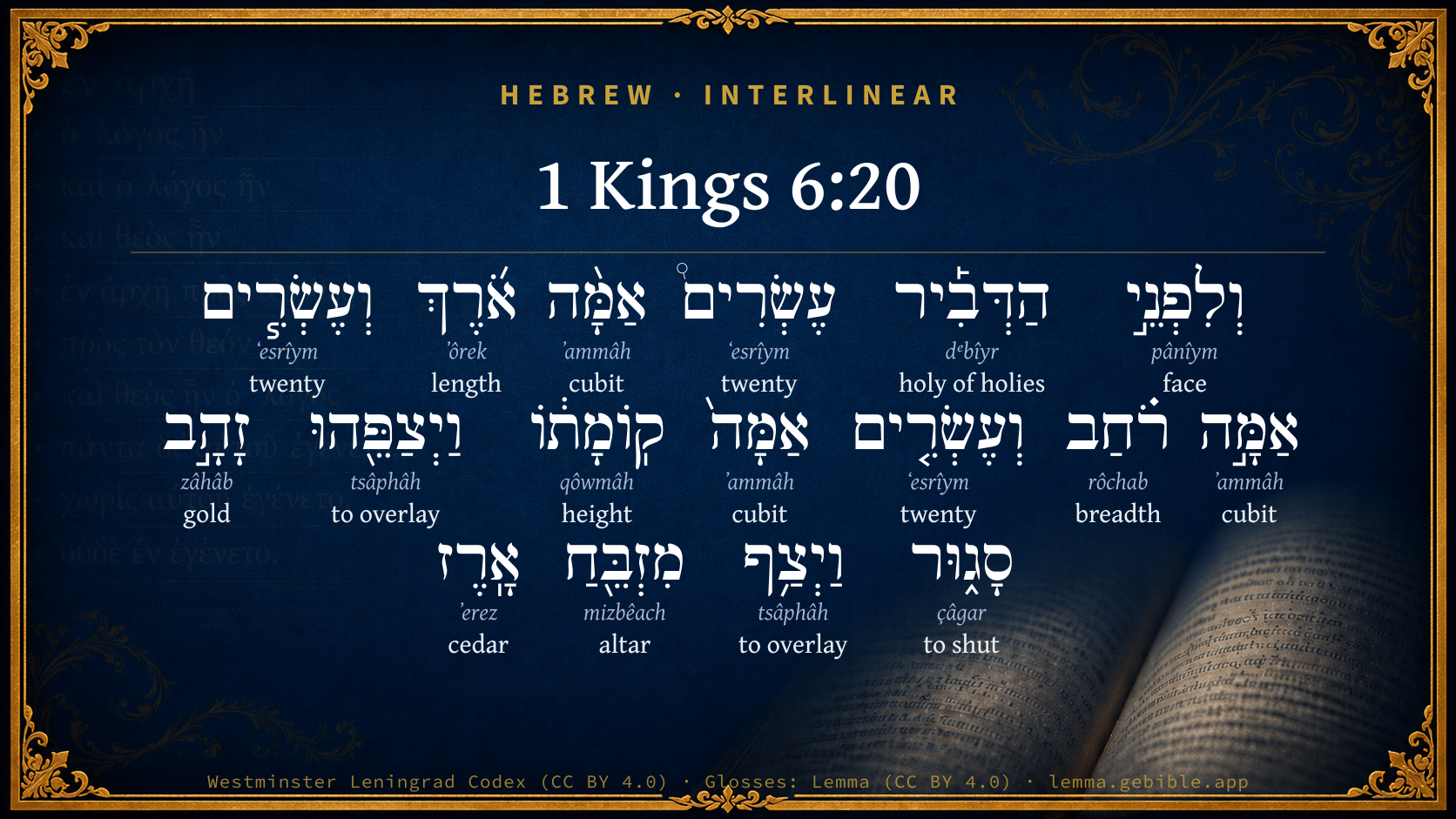
1 Kings 6:20

Hebrew (Westminster Leningrad Codex) 1 Kings 6:20 appears in the Hebrew Old Testament. The text above is from the Westminster Leningrad Codex. Each word links to its Strong’s number, a concise gloss, and parsing drawn from the Open Scriptures Hebrew Bible morphology. Click any word for its full Brown-Driver-Briggs (BDB) entry.
Download image
Cite this verse

1 Kings 6:20 (World English Bible). Public Domain. Lemma interlinear Bible study tool, https://lemma.gebible.app/v/1-kings/6/20.

Show BibTeX & RIS
BibTeX
RIS
English Translation
Within the oracle was [a space of] twenty cubits in length, and twenty cubits in breadth, and twenty cubits in the height of it; and he overlaid it with pure gold: and he covered the altar with cedar.
World English Bible · Public Domain
Download a study sheet

One document with this verse’s original text, its word-by-word gloss line, the meaning frame, cross-references with their text, attributed commentary, and full source and license credits — printable, and it pastes into notes with its structure intact.

This verse Autodidact and up

Study sheet (.html) Plain text (.txt)

A passage Seminary Student

Up to 50 verses in one chapter. A passage sheet keeps up to 6 commentary sources and 12 cross-references per verse, in the order this page ranks them, and says so on the sheet whenever that leaves anything out. Ask for a single verse and you get the Autodidact verse sheet above.

Everything on this page stays free to read, with no account — the sheet is a download of what is already on screen, not access to it.

Want to remove ads? Support Godless Engineer
Compare translations 3

The same verse in 3 English versions, stacked beneath the original-language interlinear above. Click any original word for its lexicon entry.

Each is an independent rendering of the whole verse — the interlinear is not word-aligned to these translations.

Highlighted words mark where these versions differ — a whole-verse word diff, not a word-by-word alignment.

  • World English Bible Public Domain
    Within the oracle was [a space of] twenty cubits in length, and twenty cubits in breadth, and twenty cubits in the height of it; and he overlaid it with pure gold: and he covered the altar with cedar.
  • King James Version Public Domain
    And the oracle in the forepart was twenty cubits in length, and twenty cubits in breadth, and twenty cubits in the height thereof: and he overlaid it with pure gold; and so covered the altar which was of cedar.
  • unfoldingWord Literal Text CC BY-SA 4.0
    And the interior of the inner sanctuary, 20 cubits length and 20 cubits width, and 20 cubits its height. And he overlaid it pure gold, and he overlaid an altar cedar.

unfoldingWord Literal Text — © unfoldingWord, licensed CC BY-SA 4.0. Word-aligned USFM3 via Door43 (git.door43.org/unfoldingWord/en_ult).

Versions to compare (up to 4)

3 of 4 selected

Show all 18 translations

Every available English version of this verse, each an independent rendering of the whole verse.

  • World English Bible Public Domain
    Within the oracle was [a space of] twenty cubits in length, and twenty cubits in breadth, and twenty cubits in the height of it; and he overlaid it with pure gold: and he covered the altar with cedar.
  • Berean Standard Bible Public Domain
    The inner sanctuary was twenty cubits long, twenty cubits wide, and twenty cubits high. He overlaid the inside with pure gold, and he also overlaid the altar of cedar.
  • Majority Standard Bible Public Domain
    The inner sanctuary was twenty cubits long, twenty cubits wide, and twenty cubits high. He overlaid the inside with pure gold, and he also overlaid the altar of cedar.
  • King James Version Public Domain
    And the oracle in the forepart was twenty cubits in length, and twenty cubits in breadth, and twenty cubits in the height thereof: and he overlaid it with pure gold; and so covered the altar which was of cedar.
  • American Standard Version (1901) Public Domain
    And within the oracle was `a space of' twenty cubits in length, and twenty cubits in breadth, and twenty cubits in the height thereof; and he overlaid it with pure gold: and he covered the altar with cedar.
  • Revised Version (1885) Public Domain
    And within the oracle was a space of twenty cubits in length, and twenty cubits in breadth, and twenty cubits in the height thereof; and he overlaid it with pure gold: and he covered the altar with cedar.
  • Geneva Bible (1599) Public Domain
    And the place of the oracle within was twentie cubites long, and twentie cubites broad, and twentie cubites hie, and hee couered it with pure golde, and couered the altar with cedar.
  • Douay-Rheims (1899) Public Domain
    Now the oracle was twenty cubits in length, and twenty cubits in breadth, and twenty cubits in height. And he covered and overlaid it with most pure gold. And the altar also he covered with cedar.
  • Young's Literal Translation Public Domain
    And before the oracle `is' twenty cubits in length, and twenty cubits in breadth, and twenty cubits `is' its height; and he overlayeth it with gold refined, and overlayeth the altar with cedar.
  • Literal Standard Version CC BY-SA 4.0
    And before the oracle [is] twenty cubits in length, and twenty cubits in breadth, and its height [is] twenty cubits; and he overlays it with gold refined, and overlays the altar with cedar.
  • Unlocked Literal Bible CC BY-SA 4.0
    The inner room was twenty cubits in length, twenty cubits in width, and twenty cubits in height. Solomon overlaid the walls with pure gold and covered the altar with cedar wood.
  • unfoldingWord Literal Text CC BY-SA 4.0
    And the interior of the inner sanctuary, 20 cubits length and 20 cubits width, and 20 cubits its height. And he overlaid it pure gold, and he overlaid an altar cedar.
  • Darby Bible Public Domain
    And the oracle within was twenty cubits in length, and twenty cubits in breadth, and twenty cubits in the height thereof; and he overlaid it with pure gold; and he overlaid the cedar-wood altar --
  • World Messianic Bible Public Domain
    Within the inner sanctuary was twenty cubits in length, and twenty cubits in width, and twenty cubits in its height. He overlaid it with pure gold. He covered the altar with cedar.
  • Webster's Bible Public Domain
    And the oracle in the forepart was twenty cubits in length, and twenty cubits in breadth, and twenty cubits in the hight of it, and he overlaid it with pure gold; and so covered the altar which was of cedar.
  • Free Bible Version CC BY-SA 4.0
    The inner sanctuary measured twenty cubits long, twenty cubits wide, and twenty cubits high. He had the interior covered with a coating with pure gold, as well as the altar of cedar.
  • Bible in Basic English Public Domain
    And the inmost room was twenty cubits square and twenty cubits high, plated over with clear gold, and he made an altar of cedar-wood, plating it with gold.
  • JPS Tanakh (1917) Public Domain
    And before the Sanctuary which was twenty cubits in length, and twenty cubits in breadth, and twenty cubits in the height thereof, overlaid with pure gold, he set an altar, which he covered with cedar.

Literal Standard Version (2020), Covenant Press — licensed CC BY-SA 4.0. Text via the HelloAO Bible API (eBible.org). Unlocked Literal Bible (unfoldingWord) — licensed CC BY-SA 4.0. Text via the HelloAO Bible API (eBible.org). unfoldingWord Literal Text — © unfoldingWord, licensed CC BY-SA 4.0. Word-aligned USFM3 via Door43 (git.door43.org/unfoldingWord/en_ult). Free Bible Version, Dr. Jonathan Gallagher — licensed CC BY-SA 4.0. Text via the HelloAO Bible API (eBible.org).

Word by word

More ways to search: Search by grammar → Find every occurrence → Compare this word →

Practice this passage: Drill this verse → Learn its vocabulary →

הַדְּבִ֡יר
dᵉbîyr
H1687
“the · holy of holies”
Particle, Definite Article + Noun, Common, Masculine, Singular, Absolute
Part of Speech
Particle + Noun
Type
Common
Gender
Masculine
Number
Singular
State
Absolute
Full BDB Definition

Origin: from H1696 (apparently in the sense of oracle)

TWOT: 399g

the holy of holies, the innermost room of the temple or tabernacle - hindmost chamber, innermost room of the temple of Solomon, most holy place, holy of holies - (TWOT) oracle
  1. וְלִפְנֵ֣י pânîym H6440 “and · to/for · face(s) of” Conjunction + Preposition + Noun, Common, Both, Plural, Construct
  2. עֶשְׂרִים֩ ʻesrîym H6242 “twenty” Adjective, Cardinal number, Both, Plural, Absolute
  3. אַמָּ֨ה ʼammâh H520 “cubit” Noun, Common, Feminine, Singular, Absolute
  4. אֹ֜רֶךְ ʼôrek H753 “length” Noun, Common, Masculine, Singular, Absolute
  5. וְעֶשְׂרִ֧ים ʻesrîym H6242 “and · twenty” Conjunction + Adjective, Cardinal number, Both, Plural, Absolute
  6. אַמָּ֣ה ʼammâh H520 “cubit” Noun, Common, Feminine, Singular, Absolute
  7. רֹ֗חַב rôchab H7341 “breadth” Noun, Common, Masculine, Singular, Absolute
  8. וְעֶשְׂרִ֤ים ʻesrîym H6242 “and · twenty” Conjunction + Adjective, Cardinal number, Both, Plural, Absolute
  9. אַמָּה֙ ʼammâh H520 “cubit” Noun, Common, Feminine, Singular, Absolute
  10. קֽוֹמָת֔וֹ qôwmâh H6967 “height · his” Noun, Common, Feminine, Singular, Construct + Suffix, Personal, 3rd Person, Masculine, Singular
  11. וַיְצַפֵּ֖הוּ tsâphâh H6823 “and · to overlay · him” Conjunction + Verb, Piel, Sequential Imperfect, 3rd Person, Masculine, Singular + Suffix, Personal, 3rd Person, Masculine, Singular
  12. זָהָ֣ב zâhâb H2091 “gold” Noun, Common, Masculine, Singular, Absolute
  13. סָג֑וּר çâgar H5462 “pure” Noun, Common, Masculine, Singular, Absolute
  14. וַיְצַ֥ף tsâphâh H6823 “and · to overlay” Conjunction + Verb, Piel, Sequential Imperfect, 3rd Person, Masculine, Singular
  15. מִזְבֵּ֖חַ mizbêach H4196 “altar” Noun, Common, Masculine, Singular, Absolute
  16. אָֽרֶז ʼerez H730 “cedar” Noun, Common, Masculine, Singular, Absolute

About this verse

These counts appear in no published source. They are computed here, from the morphology-tagged text and Lemma’s own curated glosses. What Lemma adds →

17
words
12
distinct lemmas
Historical
section

Notable vocabulary

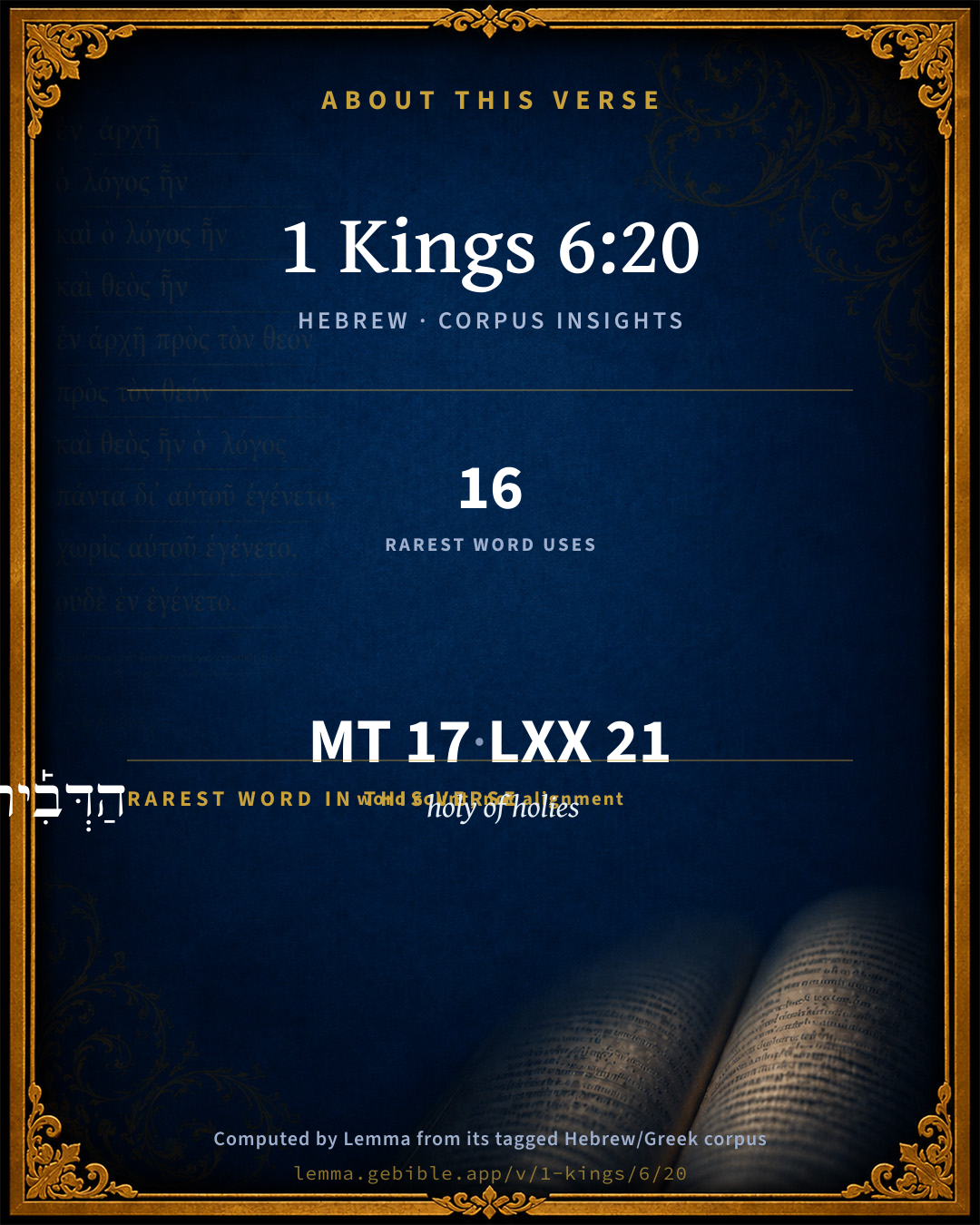
The rarest word here is הַדְּבִ֡יר holy of holies H1687 — appearing just 16 times in the whole Hebrew Bible.

Shared distinctive vocabulary

הַדְּבִ֡יר holy of holies H1687 occurs in 16 verses of the Hebrew Bible. Also found in:

Grammatical profile

  • 2 verbs
  • 12 nouns
  • 3 adjectives

Verb forms

  • וַיְצַפֵּ֖הוּ Piel · Sequential Imperfect
  • וַיְצַ֥ף Piel · Sequential Imperfect

Repetition

Words recur within this verse — often emphatic in Hebrew:

  • עֶשְׂרִים֩ twenty H6242 ×3
  • אַמָּ֨ה cubit H520 ×3
  • וַיְצַפֵּ֖הוּ to overlay H6823 ×2

Hebrew & Septuagint length

In English translation the verse runs 38 words from the Hebrew and 41 from the Septuagint (LXX English) — closely comparable.

A rough comparison of the two English renderings, which tokenize alike — not a word-level alignment.

Word counts can differ between the Hebrew and the Greek without any difference in meaning — e.g. the Hebrew direct-object marker אֵת has no separate Greek word, and Greek often adds the article ὁ.

In the original languages it is 17 Hebrew tokens and 21 Greek tokens — but the two are counted differently (Hebrew bundles its prefixes and suffixes into one token; the Greek is in lemma form), so that isn’t a like-for-like length.

Cross-references

4

Topical passages linked to 1 Kings 6:20 in the Treasury of Scripture Knowledge — connected by theme and wording, ordered by reader-vote popularity; previews shown in the World English Bible.

  • Exodus 30:1–3 "You shall make an altar to burn incense on. You shall make it of acacia wood.
  • 1 Kings 6:2–3 The house which king Solomon built for Yahweh, the length of it was sixty cubits, and the breadth of it twenty [cubits], and the height of it thirty cubits.
  • 1 Kings 6:22 The whole house he overlaid with gold, until all the house was finished: also the whole altar that belonged to the oracle he overlaid with gold.
  • 1 Kings 7:48 Solomon made all the vessels that were in the house of Yahweh: the golden altar, and the table whereupon the show bread was, of gold;

Cross-references courtesy of OpenBible.info (CC BY 4.0).

Hebrew and Greek witnesses Masoretic Hebrew ↔ Greek Septuagint

The same verse in the two great witnesses to the Old Testament, shown verse-for-verse.

These are two independent witnesses, not word-aligned to each other, and the Septuagint is shown in lemma (dictionary) form.

Hebrew 1 Kings 6:20 Masoretic · Westminster Leningrad Codex

וְלִפְנֵ֣י הַדְּבִ֡יר עֶשְׂרִים֩ אַמָּ֨ה אֹ֜רֶךְ וְעֶשְׂרִ֧ים אַמָּ֣ה רֹ֗חַב וְעֶשְׂרִ֤ים אַמָּה֙ קֽוֹמָת֔וֹ וַיְצַפֵּ֖הוּ זָהָ֣ב סָג֑וּר וַיְצַ֥ף מִזְבֵּ֖חַ אָֽרֶז

Within the oracle was [a space of] twenty cubits in length, and twenty cubits in breadth, and twenty cubits in the height of it; and he overlaid it with pure gold: and he covered the altar with cedar.

World English Bible · Public Domain

Greek LXX 1 Kings 6:20 Septuagint · lemma form

εἴκοσι πῆχυς μῆκος καί εἴκοσι πῆχυς πλάτος καί εἴκοσι πῆχυς ὁ ὕψος αὐτός καί περιἔχω αὐτός χρυσίον συνκλείω καί ποιέω θυσιαστήριον

The length was twenty cubits, and the breadth was twenty cubits, and the height of it was twenty cubits. And he covered it with perfect gold, and he made an altar in front of the oracle, and covered it with gold.

LXX2012 (modern English Septuagint) · Public Domain

On this verse, The Cambridge Bible for Schools and Colleges discusses the Septuagint’s reading. Read the note in Commentary ↓

Hebrew: Westminster Leningrad Codex (CC BY 4.0). Greek: Septuagint (public domain); English from LXX2012 (modern English Septuagint) (Public Domain). How the Septuagint differs from the Hebrew →

Targum (Aramaic paraphrase)

1

The Targum is the ancient Jewish Aramaic paraphrase of the Hebrew Scriptures — an interpretive translation, not the Hebrew text itself. Onkelos (literal) and Pseudo-Jonathan (expansive) render the Torah, and Jonathan the Prophets. Coverage is partial: where no permissively-licensed English translation exists for a verse, only the Aramaic is shown. This is verse-level text, not a word-by-word alignment to the Hebrew.

  1. Targum Jonathan Prophets (Joshua–Malachi)
    וְקָדָם בֵּית כַּפּוֹרֵי עַסְרִין אַמִין אוֹרְכָּא וְעַסְרִין אַמִין פּוּתְיָא וְעַסְרִין אַמִין רוּמֵיהּ וַחֲפָהִי דַהֲבָא טָבָא וַחֲפָא מַדְבְּחָא נִסְרִין דְאַרְזָא:

    (no public-domain English translation for this verse)

    Targum Jonathan — Aramaic: “Mikraot Gedolot” (public domain). English: “Sefaria Community Translation” (CC0 1.0 (public-domain dedication)); “London "Chaldee Paraphrase," 1871” (public domain). Text via Sefaria.

Commentary

Notes on 1 Kings 6:20 from classic Christian and Jewish commentators (each source and its license shown beneath its notes). The classic Christian expositions comment on the surrounding passage and are grouped to its opening verse, so a note may address several verses; the Jewish commentaries on the Tanakh (Rashi and others) are per-verse, so they appear only where the commentator wrote on this verse.

Lemma curates 59 commentaries, every one of them public domain or Creative Commons licensed, each selected and text-cleaned for this edition rather than reprinted as found. About our sources →

Trapp's Complete Commentary

John Trapp

1Ki 6:20 And the oracle in the forepart [was] twenty cubits in length, and twenty cubits in breadth, and twenty cubits in the height thereof: and he overlaid it with pure gold; and [so] covered the altar [which was of] cedar.

Ver. 20. Twenty cubits in length.] So that it was every way square.

Overlaid it with pure gold.] Heb., With gold shut up; so called, haply, because men used to hoard up the best gold, and keep it close prisoner, as it were.

And so covered the altar.] Which being wood within, and gold without, shadowed out Christ - the true altar {Heb 13:10} - in his twofold nature, human and divine.

John Trapp, A Commentary or Exposition upon All the Books of the Old and New Testament (1647–1656) — public domain. Text from a community e-Sword module.

Ellicott's Commentary for English Readers

(20) In the forepart.—Although this is a literal translation of the original, the sense is clearly (as the Vulgate renders the phrase) “in the inner part.” Gesenius supposes the meaning to be properly, “the wall facing the entrance;” thence the opposite, or “inner,” wall or region.

Covered the altar . . .—Our translators have been misled by the context to anticipate what is said below (1Ki_6:22). The meaning is “he covered the altar” (presumably of stone) “with cedar.”

(20-22) These verses describe the overlaying with pure gold of the panelling of the house and of the Oracle, the partition dividing them, and the altar of incense. Even the floor was similarly covered. (See 1Ki_6:30.)

A Bible Commentary for English Readers, edited by Charles John Ellicott (1878–1897) — public domain. Text from a community e-Sword module.

The Cambridge Bible for Schools and Colleges

gen. ed. J. J. S. Perowne

20. the oracle in the fore-part] The two words thus rendered would, if they stood alone, be rendered ‘before the oracle.’ In this verse, however, this cannot be the meaning. But in standing before such a room as is here described, it is in front of you, and you see the interior. In this way ‘before the oracle’ may be taken to indicate what is seen when you stand there. Hence we may arrive at the sense in the R.V. ‘within the oracle was a space &c.’ It is difficult to assign any meaning to the A.V., and it may be that some error has crept into the text.

Some have preferred to render literally thus, ‘And before the oracle—twenty cubits was it in length, and twenty cubits in breadth, and twenty cubits in the height thereof, and he overlaid it with pure gold—he overlaid also the altar with cedar.’ But the accents of the Hebrew do not favour such a parenthetic clause, and the last sentence is very awkward.

The LXX. (Vat.) omits at the beginning of the verse ‘before the oracle,’ then takes the next sentences as a specification of the size of the oracle, and makes an addition to the last clause thus, ‘and he made an altar before the oracle and overlaid it with gold,’ making no mention of the cedar at all. Most probably this represents the correct text.

and so covered the altar which was of cedar] We cannot, in the face of the preceding clause, translate otherwise than and he covered an altar with cedar. The construction in the two cases is identical. But then arises a difficulty. The altar in question was the altar of incense in the holy place. This stood in front of the vail which separated the most holy place (see Exo_40:5; Exo_40:26), and in Eze_41:22 it is called ‘the altar of wood’ (cf. Exo_30:1-6). From the description in the verse before us there must have been some substance underneath the wood. The LXX. (Alex.) solves the difficulty by reading ‘and he made’ for ‘and he covered,’ i.e. ויעשׂ for ויצף, καὶ ἐποίησε θυσιαστήριον κέδρου.

The Cambridge Bible for Schools and Colleges (gen. ed. J. J. S. Perowne; Cambridge University Press, 1878–1918) — public domain. Text from a community e-Sword module.

John Gill's Exposition

So Solomon overlaid the house within with pure gold,.... The inside of the holy of holies with fine gold, which gold amounted to six hundred talents, Ch2 3:8; and these to 7,332,000 ducats of gold, or 3,045,000 pounds sterling:

and he made a partition by the chains of gold before the oracle; between the holy and the most holy, and were instead of a vail in the tabernacle of Moses between them; here was also a vail beside the partition made by chains of gold across the oracle; for the partition was a wall of the thickness of a cubit, as Maimonides (b) says; and in Ch2 3:14 express mention is made of a vail of blue, &c. and in imitation of this had the Heathens their deities within vails (c):

and he overlaid it with gold; the partition wall.

(b) Hilchot Beth Habechirah, c. 4. sect. 2. (c) Apulei Metamorph. l. xi. p. 176.

John Gill's Exposition of the Whole Bible (1746–1763) — public domain (CC PDM 1.0). Text via the HelloAO Bible API.

Albert Barnes' Notes on the Bible

The fore part - Perhaps “the interior.”

And so covered ... - Rather, “and he covered the altar (of incense) with cedar.” The altar was doubtless of stone, and was covered with cedar in preparation for the overlaying with gold. This overlaying was not gilding, but the attachment of thin plates of gold, which had to be fastened on with small nails. Such a mode of ornamentation was common in Babylonia, in Assyria, and in Media.

Albert Barnes' Notes on the Bible (1834–1885) — public domain. Text from a community e-Sword/MySword module.

Haydock's Catholic Bible Commentary

Pure gold. Hebrew, "reserved" by David, or "gold locked up," as most precious. Thin plates were laid on, so as to fit all the various mouldings, flowers, &c. --- Cedar. The altar was probably of stone, and upon the cedar boards gold was laid, that the ark might rest upon it. The altar of perfumes was not in the most holy place. (Calmet)

George Leo Haydock (1774–1849), Haydock's Catholic Family Bible and Commentary, 1859 edition — public domain. Excludes Psalms (Douay-Rheims chapter numbering differs from Protestant) and Deuterocanonical books (Catholic canon only).

Matthew Poole's English Annotations

In the forepart, or rather, which was in the inner part, to wit, of the house; called here in Hebrew, the forepart, not because a man first enters there, but because when a man is entering, or newly entered, into the house, it is still before him. Thus the same, or the like word proceeding from the same root, is oft used, as Lev 10:18; 1Ki 6:19,29,30,36; 1Ch 28:11.

Twenty cubits in the height thereof.

Object. The great house was thirty cubits high, above, 1Ki 6:2.

Answ. It is probably affirmed by divers, that the most holy place was not so high as the holy place by ten cubits; which was no way inconvenient, nor against the rules of proportion observed in buildings. And as the second part of the building was far lower than the first, which was the porch; so the third part might be considerably lower than the second. And it might be lower either,

1. Outwardly, or in respect of the walls of it, which might be only twenty cubits high, and at that height covered with a flat roof; it being but decent that that eminently holy place should be distinguished from the less holy, even by its outward and visible shape. Or,

2. Inwardly, or within the walls of that part. For although this part might be vaulted at the top, as the holy place was, which vaulted roof some think was ten cubits high; yet here might be the difference, that the vaulted roof of the holy place lay open to view, whereas that of the most holy was covered with a flat roof from wall to wall, at the height of twenty cubits. So covered, i.e. with gold, 1Ki 7:48; 1Ch 28:18. The altar, to wit, the altar of incense, which was put next to the most high place, 1Ki 6:22.

Which was of cedar.

Object. This altar was made of shittim wood, Exo 30:1.

Answ. Either that was covered with cedar, that it might be agreeable to the rest; all being cedar, as was said, 1Ki 6:18. Or this was a new altar which Solomon made by Divine command and direction, delivered to him, either immediately, or by his father; of which see 1Ch 28:12, &c. But this place may seem to be better translated thus, and he covered the altar with cedar; either to make it like the rest; or because this was a new altar made of stone, and therefore fit to be covered with cedar, that it might better receive and retain the gold wherewith this cedar was overlaid, 1Ki 6:22.

Matthew Poole's English Annotations on the Holy Bible (1683–1685) — public domain. Text from a community e-Sword/MySword module.

Whedon's Commentary on the Bible

Daniel D. Whedon

20. The oracle in the forepart — That is, the holy of holies on the inside measured twenty cubits each way. לפני, here rendered in the forepart, may be taken as the construct state of פנימ, surface, faces; and rendered, As to the faces (that is, the inside surface) of the oracle, twenty cubits was the length, etc. The construction of the most holy place in the form of a perfect cube had doubtless its typical significance. It was an appropriate symbol of perfection. The solid cube, in whatever way it is set, is always upright, a perfect square on every side, and all sides and angles corresponding perfectly to each other. So this form of the inner sanctuary indicated that the Holy One of Israel dwelleth in perfection.

And so covered — Better to leave out so, and the other words here supplied in the English version, and translate literally, covered the altar with cedar. The altar of incense for the tabernacle (see Exo_30:1-10) was made of shittim wood, and overlaid with gold. This altar of Solomon was built, as is here stated, with cedar, and the cedar overlaid with plates of gold. 1Ki_6:22. We must not understand that this altar was in the oracle, but, as appears in 1Ki_6:22, by or at the oracle; that is, on the outside and just in front of it. So Moses was commanded to “put it before the vail that is by the ark of the testimony.” Exo_30:6. “The altar of incense is mentioned in connexion with the holy of holies,” says Wordsworth, “because the incense which was burnt upon it was offered before the vail, and with a view to the Divine Presence enshrined in the holy of holies, and had a special relation to the ark in the oracle. On this altar incense was offered morning and evening, the type of continual prayer.”

Daniel D. Whedon (gen. ed.), Commentary on the Old and New Testaments (1874–1909) — public domain. Text from a community e-Sword module.

The Pulpit Commentary

And the oracle in the forepart or, the interior of the oracle. Keil, after Kimchi, maintains that ynepli is the construct of the noun See ver. 29, where it clearly means interior, as its opposition to "without" shows. The A.V yields no sense was twenty cubits in length, and twenty cubits in breadth, and twenty cubits in the height thereof that is to say, it was a perfect cube. When we consider that the oracle of the tabernacle was a cube of ten cubits and the Holy City (Rev_21:16; cf. Eze_48:8-35, especially ver. 20) is a cube of 12, 000 furlongs, we cannot but regard these measurements as significant. To the ancients the square seemed the most appropriate shape to express the idea of moral perfection. The idea of the cube consequently was that of entire completeness, of absolute perfection. A little light is thrown on this subject by the use of tetragwnov among the Greeks. See the quotation from Simonides in Plat. Protag. 334 A; Arist. Rhet. 3:11; Eth. Nic. 1:10, 11, and compare the familiar totus teres atque rotundus. The height of the oracle (internally) being only twenty cubits, while that of the house was thirty (ver. 2), several questions of some interest suggest themselves for consideration. It is perhaps impossible in the present state of our knowledge to arrive at any very positive conclusions, but it may be well, nevertheless, if only to show in how much uncertainty the architecture of the temple is involved, to state them. First among them is this: Was the roof of the temple flat or ridged? (See above on ver. 9).

(2) In either case, was the height of thirty cubits, or any uniform height, maintained throughout, or was the roof of the oracle some ten cubits lower than that of the house? The analogy of the tabernacle, of which the temple was a copy, would lead us to suppose that the ridge if there was a ridge of the entire building was level and unbroken, though the analogy of the Gothic church, which, we have already seen, is almost a reproduction of the temple, suggests that the oracle (like the chancel, and, it may be added, like the adytum of Egyptian temples) may possibly have had a lower roof. But

(3) supposing the same height was maintained from end to end, to what use, if any, was the vacant space of ten cubits (15 feet) between cieling and roof of oracle applied? It has been held by some that there was a chamber here, but that it was empty, being formed, in fact, not for use, but in order to procure the cubical shape of the oracle. Others contend that this upper room, or one which ran the entire length of the building, was designed to serve as a receptacle for the reliques of the tabernacle, and they would identify it with the twyli (LXX, to uJperwon) of 2Ch_3:9.

And untrustworthy as Josephus is when not supported by independent evidence, it is worth mentioning here that beth he and the Talmud "persistently assert that there was a superstructure on the temple equal in height to the lower part" (Fergusson, who, consequently, is of opinion that there undoubtedly was some such superstructure, as in the tomb of Darius, near Persepolis (see Dict. Bib. 3. pp. 1456, 1-457), and that it was used for worship, (2Ki_23:12) where see note). Bahr, however, argues forcibly against this idea. He says, inter alia, that there was no approach provided to these chambers; but our account is so manifestly imperfect that this argument is at the best a precarious one. He sees in the "upper chambers" (the Hebrew word is plural) the upper stories of the side structure. He agrees, however, with Ewald that there was a chamber over the oracle, but thinks it was unoccupied. Keil identifies this space with the "upper chambers" of 2Ch_3:9, and upon the whole this appears to be the most feasible view.

(4) How was the cieling, whether with or without this upper chamber, and whether at the height of twenty or thirty cubits how was it supported?

For "no cedar beam could be laid across a space of twenty cubits without sinking in the centre by its own weight." Fergusson hence argues that the roof must have been carried on pillars four in the sanctuary and ten in the hall. He remarks that they were used in the house of the Forest of Lebanon, where they were less suitable than here: and he overlaid it lit. made it shine with pure gold marg. shut up (from rgs clausit). Cf. Job_28:15 (Heb.) The same gold is described as rwOhf (Exo_25:11) and bwOf. (2Ch_3:8) It is called "shut up gold," not because it was concealed (keimelion), but because of the exclusion of impure ingredients (Vulg. aurum purissimum). The lavish use of gold in the interior of the temple its weight 600 talents (75, 000 lbs.), its value almost incalculable was not for mere display (for most of it was never seen except by the priests), but was symbolical of light and purity (Job_37:22, Job_37:23; Rev_21:18) and stamped the place as the abode of Him who dwelleth in light. (1Ti_6:16) See Bahr in loc. The palace of the Lord must be "exceeding magnifical." The overlaying was not gilding, but laminae of gold were attached to the woodwork with nails. This art was probably derived from Egypt. (Exo_25:11, Exo_25:13) Egyptian figures ornamented with gold plates are found both in the Louvre and British Museum. See Wilkinson, "Ancient Egyptians," 2. p. 233 sqq.) Rawlinson remarks that "such ornamentation was common in Babylon, in Assyria, and in Media." See Isa_46:6; Heb 1:98; Layard, 2:264. In addition to the gold, the house was garnished with precious stones. (2Ch_3:6 Cf.; 1Ch_29:2, 1Ch_29:8) and so covered the Heb. an altar which was of cedar. The italics in the A.V lead us to suspect a mistranslation, and such it proves to be. What the writer means, supposing the present text to be retained, is, not that Solomon covered the cedar altar with gold, but that he overlaid the (stone?) altar with cedar. It is true the article is wanting, but this may perhaps be accounted for by the fact that the altar is now mentioned for the first time (Keil). It is much more probable, however, that the text has been slightly corrupted. The LXX reads, kaihse qusiasthrion (Cod. Alex. adds kedrou,), which proves that the Seventy had cYw instead of pxYw in their text. If so, the absence of the article is at once explained, and an unmeaning repetition in ver. 22 avoided. The mention of the altar of course it is the altar of incense that is meant: the altar of burnt sacrifice was outside the building in connexion with the oracle is significant. In ver. 22 it is called the "altar that (belonged) to the oracle," because it stood just outside it. In the tabernacle it was placed "before the vail" (Exo_30:6 Exo_40:5, Exo_40:26; Lev_16:12-18) and it occupied this position because the incense burned upon it was offered before the Invisible Presence within. It is an argument in favour of the textual emendation suggested above that the altar in the tabernacle was of wood, (Exo_30:1) and that Ezekiel speaks of the "altar of wood", (Eze_41:22) the altar of sacrifice being of earth stones, (Exo_20:24, Exo_20:25) or brass (2Ch_4:1) If we retain the Received Text we are almost compelled to believe that this altar was also of stone, as they would hardly cover a wooden altar with wood.

The Pulpit Commentary (1880–1919), ed. H.D.M. Spence-Jones & Joseph S. Exell — public domain. Text from a community e-Sword module.

John Wesley's Explanatory Notes

Forepart - Which was in the inner part of the house, called in Hebrew, the forepart; not because a man first enters there, but because when a man is entering, or newly entered into the house, it is still before him. Covered - With gold, chap. vii, 48; 1 Chron. xxviii, 18. The altar - The altar of incense.

John Wesley, Explanatory Notes Upon the Whole Bible (1754–1765) — public domain. Text via the GEBible commentary corpus.

Rashi

Rabbi Shlomo Yitzchaki (Rashi)

The inside of the Holy of Holies. Within that partition was an area of twenty [amohs] long and twenty [amohs] wide.

And twenty amohs high. I.e., the height of the Holy of Holies was lower than that of the Temple., and the height of the Temple was stated as thirty amohs in v. 2 above.

He covered it. The Sanctuary, [i.e.,] the partition.

Refined gold. Our Rabbis explained this [סגור], that at the time [this type of gold] was offered for sale, all other stores were closed [=נסגרות]. But [Targum] Yonoson rendered this as “good gold,” i.e., he who possesses this gold “locks” it [סוגרו] for himself.

[He] covered the altar with cedar wood. That is the [golden] altar of incense, but I am perplexed, why was Moshe’s [golden altar] hidden?

Rashi on the Tanakh — English translations: “The Judaica Press complete Tanach with Rashi, translated by A. J. Rosenberg” (CC BY 4.0); “Pentateuch with Rashi's commentary by M. Rosenbaum and A.M. Silbermann, 1929-1934” (public domain); “The Metsudah Tanach series, Lakewood, N.J” (CC BY 4.0); and “The Book of Joshua, Metsudah Publications, 1997” (CC BY 4.0). Text via Sefaria.

Lesson kit

Teaching starters — assembled from the data on this page, not authored interpretation. Every prompt links to the verse data it draws on. Edit before teaching.

1 Kings, in the Historical, opens this verse with 17 words (12 distinct Hebrew lemmas). Its most distinctive word is dᵉbîyr (“holy of holies”). A historical commentator’s framing appears above. Read the whole chapter for the surrounding context.

Discussion questions

  1. What does “holy of holies” (dᵉbîyr) contribute to the verse as a whole?
  2. How does 1 Kings 6:5, which shares the word «holy of holies», read alongside this verse?
  3. What does the repetition of “twenty” (3× in this one verse) do in this verse?
  4. These translations render this verse differently. What is at stake in choosing one wording over another?
  5. «וַיְצַפֵּ֖הוּ» is a Piel Sequential Imperfect verb. How does that grammatical form shape the action described?
  6. Compare how Trapp's Complete Commentary and Ellicott's Commentary for English Readers read this verse. Where do they agree or differ?

Things to notice

Reading settings

Reading text

Shown beneath each verse's original-language words.

Old Testament
Old Testament edition

Read the OT as the Masoretic Hebrew (MT) or the Greek Septuagint (LXX).

English shown for the Greek Septuagint (in the Hebrew ↔ Greek comparison).

Comparing translations? Open the Compare panel on any verse page to stack up to four side by side.