
Ezra 3:2

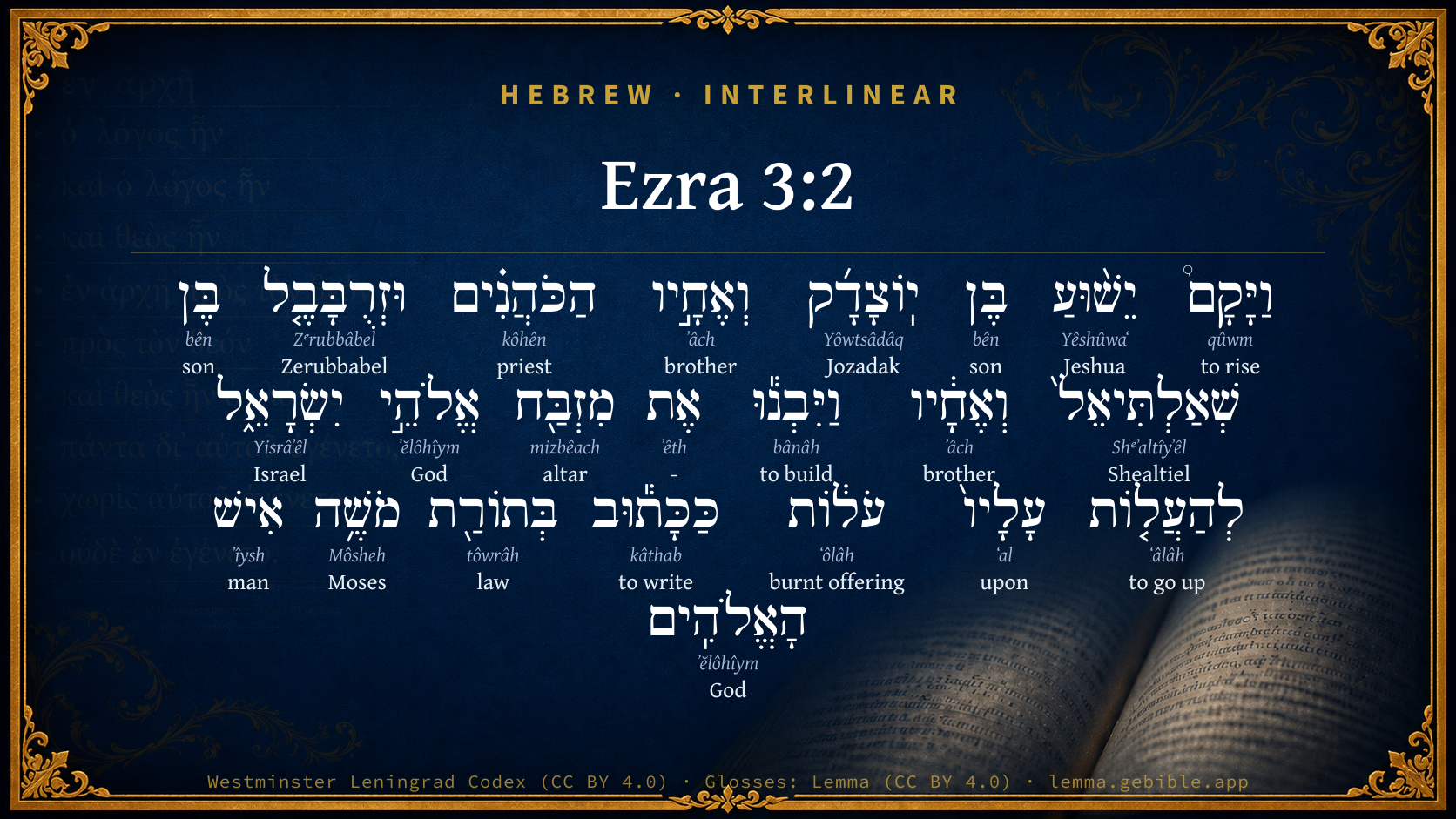
Hebrew (Westminster Leningrad Codex) Ezra 3:2 appears in the Hebrew Old Testament. The text above is from the Westminster Leningrad Codex. Each word links to its Strong’s number, a concise gloss, and parsing drawn from the Open Scriptures Hebrew Bible morphology. Click any word for its full Brown-Driver-Briggs (BDB) entry.
Download image
Cite this verse

Ezra 3:2 (World English Bible). Public Domain. Lemma interlinear Bible study tool, https://lemma.gebible.app/v/ezra/3/2.

Show BibTeX & RIS
BibTeX
RIS
English Translation
Then stood up Jeshua the son of Jozadak, and his brothers the priests, and Zerubbabel the son of Shealtiel, and his brothers, and built the altar of the God of Israel, to offer burnt offerings thereon, as it is written in the law of Moses the man of God.
World English Bible · Public Domain
Highlights
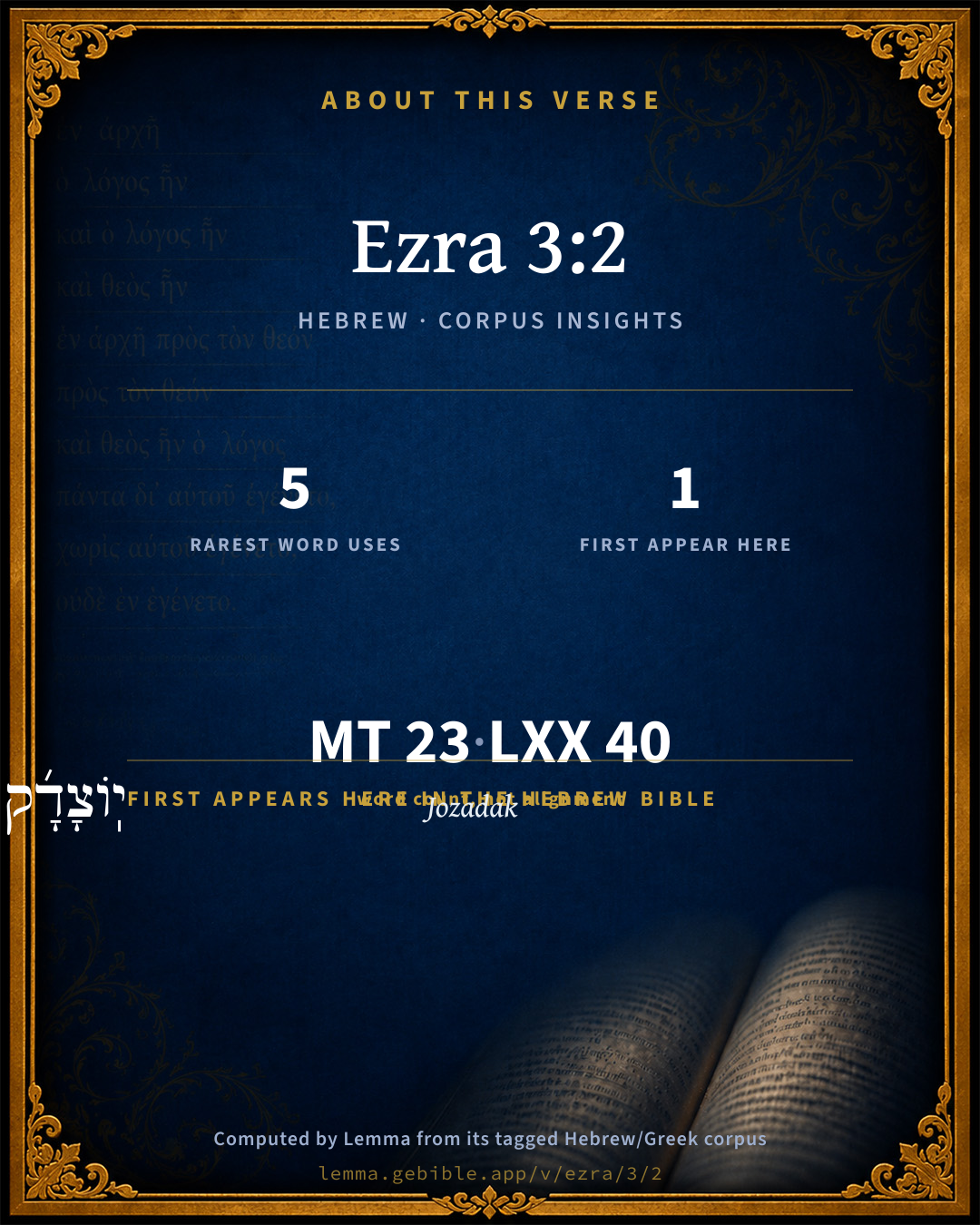
  • 1 first appearance in the Hebrew Bible
Full analysis ↓
Download a study sheet

One document with this verse’s original text, its word-by-word gloss line, the meaning frame, cross-references with their text, attributed commentary, and full source and license credits — printable, and it pastes into notes with its structure intact.

This verse Autodidact and up

Study sheet (.html) Plain text (.txt)

A passage Seminary Student

Up to 50 verses in one chapter. A passage sheet keeps up to 6 commentary sources and 12 cross-references per verse, in the order this page ranks them, and says so on the sheet whenever that leaves anything out. Ask for a single verse and you get the Autodidact verse sheet above.

Everything on this page stays free to read, with no account — the sheet is a download of what is already on screen, not access to it.

Want to remove ads? Support Godless Engineer
Compare translations 3

The same verse in 3 English versions, stacked beneath the original-language interlinear above. Click any original word for its lexicon entry.

Each is an independent rendering of the whole verse — the interlinear is not word-aligned to these translations.

Highlighted words mark where these versions differ — a whole-verse word diff, not a word-by-word alignment.

  • World English Bible Public Domain
    Then stood up Jeshua the son of Jozadak, and his brothers the priests, and Zerubbabel the son of Shealtiel, and his brothers, and built the altar of the God of Israel, to offer burnt offerings thereon, as it is written in the law of Moses the man of God.
  • King James Version Public Domain
    Then stood up Jeshua the son of Jozadak, and his brethren the priests, and Zerubbabel the son of Shealtiel, and his brethren, and builded the altar of the God of Israel, to offer burnt offerings thereon, as it is written in the law of Moses the man of God.
  • unfoldingWord Literal Text CC BY-SA 4.0
    Then arose Jeshua the son of Jozadak, and his brothers the priests, and Zerubbabel the son of Shealtiel, and his brothers, and they built the altar of the God of Israel to offer up burnt up offerings on it as is written in the law of Moses, the man of God.

unfoldingWord Literal Text — © unfoldingWord, licensed CC BY-SA 4.0. Word-aligned USFM3 via Door43 (git.door43.org/unfoldingWord/en_ult).

Versions to compare (up to 4)

3 of 4 selected

Show all 18 translations

Every available English version of this verse, each an independent rendering of the whole verse.

  • World English Bible Public Domain
    Then stood up Jeshua the son of Jozadak, and his brothers the priests, and Zerubbabel the son of Shealtiel, and his brothers, and built the altar of the God of Israel, to offer burnt offerings thereon, as it is written in the law of Moses the man of God.
  • Berean Standard Bible Public Domain
    Then Jeshua son of Jozadak and his fellow priests, along with Zerubbabel son of Shealtiel and his associates, began to build the altar of the God of Israel to sacrifice burnt offerings on it, as it is written in the Law of Moses the man of God.
  • Majority Standard Bible Public Domain
    Then Jeshua son of Jozadak and his fellow priests, along with Zerubbabel son of Shealtiel and his associates, began to build the altar of the God of Israel to sacrifice burnt offerings on it, as it is written in the Law of Moses the man of God.
  • King James Version Public Domain
    Then stood up Jeshua the son of Jozadak, and his brethren the priests, and Zerubbabel the son of Shealtiel, and his brethren, and builded the altar of the God of Israel, to offer burnt offerings thereon, as it is written in the law of Moses the man of God.
  • American Standard Version (1901) Public Domain
    Then stood up Jeshua the son of Jozadak, and his brethren the priests, and Zerubbabel the son of Shealtiel, and his brethren, and builded the altar of the God of Israel, to offer burnt-offerings thereon, as it is written in the law of Moses the man of God.
  • Revised Version (1885) Public Domain
    Then stood up Jeshua the son of Jozadak, and his brethren the priests, and Zerubbabel the son of Shealtiel, and his brethren, and builded the altar of the God of Israel, to offer burnt offerings thereon, as it is written in the law of Moses the man of God.
  • Geneva Bible (1599) Public Domain
    Then stoode vp Ieshua rhe sonne of Iozadak, and his brethren the Priests, and Zerubbabel the sonne of Shealtiel, and his brethren, and builded the altar of the God of Israel, to offer burnt offerings thereon, as it is written in ye Lawe of Moses the man of God,
  • Douay-Rheims (1899) Public Domain
    And Josue the son of Josedec rose up, and his brethren the priests, and Zorobabel the son of Salathiel, and his brethren, and they built the altar of the God of Israel that they might offer holocausts upon it, as it is written in the law of Moses the mall of God.
  • Young's Literal Translation Public Domain
    And rise doth Jeshua son of Jozadak, and his brethren the priests, and Zerubbabel son of Shealtiel, and his brethren, and they build the altar of the God of Israel, to cause to ascend upon it burnt-offerings, as it is written in the law of Moses, the man of God.
  • Literal Standard Version CC BY-SA 4.0
    And Jeshua son of Jozadak rises, and his brothers the priests, and Zerubbabel son of Shealtiel, and his brothers, and they build the altar of the God of Israel, to cause to ascend on it burnt-offerings, as it is written in the Law of Moses, the man of God.
  • Unlocked Literal Bible CC BY-SA 4.0
    Jeshua son of Jozadak and his brothers the priests, and Zerubbabel son of Shealtiel, and his brothers rose up and built the altar of the God of Israel to offer burnt offerings as it is written in the law of Moses the man of God.
  • unfoldingWord Literal Text CC BY-SA 4.0
    Then arose Jeshua the son of Jozadak, and his brothers the priests, and Zerubbabel the son of Shealtiel, and his brothers, and they built the altar of the God of Israel to offer up burnt up offerings on it as is written in the law of Moses, the man of God.
  • Darby Bible Public Domain
    Then stood up Jeshua the son of Jozadak, and his brethren the priests, and Zerubbabel the son of Shealtiel, and his brethren, and built the altar of the God of Israel, to offer up burnt-offerings on it, as it is written in the law of Moses the man of God.
  • World Messianic Bible Public Domain
    Then Yeshua the son of Jozadak stood up with his brothers the priests and Zerubbabel the son of Shealtiel and his relatives, and built the altar of the God of Israel, to offer burnt offerings on it, as it is written in the Torah of Moses the man of God.
  • Webster's Bible Public Domain
    Then stood up Jeshua the son of Jozadak, and his brethren the priests, and Zerubbabel the son of Shealtiel, and his brethren, and built the altar of the God of Israel, to offer burnt-offerings on it as it is written in the law of Moses the man of God.
  • Free Bible Version CC BY-SA 4.0
    Then Jeshua, son of Jozadak, and the priests with him, together with Zerubbabel, son of Shealtiel, and his relatives, started to build the altar of the God of Israel in order to sacrifice burnt offerings on it, as instructed by the Law of Moses, the man of God.
  • Bible in Basic English Public Domain
    Then Jeshua, the son of Jozadak, and his brothers the priests, and Zerubbabel, the son of Shealtiel, with his brothers, got up and made the altar of the God of Israel for burned offerings as is recorded in the law of Moses, the man of God.
  • JPS Tanakh (1917) Public Domain
    Then stood up Jeshua the son of Jozadak, and his brethren the priests, and Zerubbabel the son of Shealtiel, and his brethren, and builded the altar of the God of Israel, to offer burnt-offerings thereon, as it is written in the Law of Moses the man of God.

Literal Standard Version (2020), Covenant Press — licensed CC BY-SA 4.0. Text via the HelloAO Bible API (eBible.org). Unlocked Literal Bible (unfoldingWord) — licensed CC BY-SA 4.0. Text via the HelloAO Bible API (eBible.org). unfoldingWord Literal Text — © unfoldingWord, licensed CC BY-SA 4.0. Word-aligned USFM3 via Door43 (git.door43.org/unfoldingWord/en_ult). Free Bible Version, Dr. Jonathan Gallagher — licensed CC BY-SA 4.0. Text via the HelloAO Bible API (eBible.org).

Word by word

More ways to search: Search by grammar → Find every occurrence → Compare this word →

Practice this passage: Drill this verse → Learn its vocabulary →

יֽוֹצָדָ֜ק
Yôwtsâdâq
H3136
“Jozadak”
Noun, Proper
Part of Speech
Noun
Type
Proper
Full BDB Definition

Origin: a form of H3087

TWOT: None

Jozadak = "Jehovah is righteous" - grandson of the high priest Hilkiah; son of the high priest Seraiah; and father of the high priest Joshua; he never attained the office of high priest himself because he was carried captive to Babylon by Nebuchadnezzar
  1. וַיָּקָם֩ qûwm H6965 “and · to rise” Conjunction + Verb, Qal, Sequential Imperfect, 3rd Person, Masculine, Singular
  2. יֵשׁ֨וּעַ Yêshûwaʻ H3442 “Jeshua” Noun, Proper
  3. בֶּן bên H1121 “son of” Noun, Common, Masculine, Singular, Construct
  4. וְאֶחָ֣יו ʼâch H251 “and · brothers · his” Conjunction + Noun, Common, Masculine, Plural, Construct + Suffix, Personal, 3rd Person, Masculine, Singular
  5. הַכֹּהֲנִ֗ים kôhên H3548 “the · priests” Particle, Definite Article + Noun, Common, Masculine, Plural, Absolute
  6. וּזְרֻבָּבֶ֤ל Zᵉrubbâbel H2216 “and · Zerubbabel” Conjunction + Noun, Proper
  7. בֶּן bên H1121 “son of” Noun, Common, Masculine, Singular, Construct
  8. שְׁאַלְתִּיאֵל֙ Shᵉʼaltîyʼêl H7597 “Shealtiel” Noun, Proper
  9. וְאֶחָ֔יו ʼâch H251 “and · brothers · his” Conjunction + Noun, Common, Masculine, Plural, Construct + Suffix, Personal, 3rd Person, Masculine, Singular
  10. וַיִּבְנ֕וּ bânâh H1129 “and · to build” Conjunction + Verb, Qal, Sequential Imperfect, 3rd Person, Masculine, Plural
  11. אֶת ʼêth H853 “-” Particle, Direct Object
  12. מִזְבַּ֖ח mizbêach H4196 “altar of” Noun, Common, Masculine, Singular, Construct
  13. אֱלֹהֵ֣י ʼĕlôhîym H430 “God(s) of” Noun, Common, Masculine, Plural, Construct
  14. יִשְׂרָאֵ֑ל Yisrâʼêl H3478 “Israel” Noun, Proper
  15. לְהַעֲל֤וֹת ʻâlâh H5927 “to go up” Preposition + Verb, Hiphil, Infinitive Construct
  16. עָלָיו֙ ʻal H5921 “upon · him” Preposition + Suffix, Personal, 3rd Person, Masculine, Singular
  17. עֹל֔וֹת ʻôlâh H5930 “burnt offerings” Noun, Common, Feminine, Plural, Absolute
  18. כַּכָּת֕וּב kâthab H3789 “like/as the · written” Preposition, Determined + Verb, Qal, Participle Passive, Masculine, Singular, Absolute
  19. בְּתוֹרַ֖ת tôwrâh H8451 “in/at · law of” Preposition + Noun, Common, Feminine, Singular, Construct
  20. מֹשֶׁ֥ה Môsheh H4872 “Moses” Noun, Proper
  21. אִישׁ ʼîysh H376 “man of” Noun, Common, Masculine, Singular, Construct
  22. הָאֱלֹהִֽים ʼĕlôhîym H430 “the · God(s)” Particle, Definite Article + Noun, Common, Masculine, Plural, Absolute

About this verse

These counts appear in no published source. They are computed here, from the morphology-tagged text and Lemma’s own curated glosses. What Lemma adds →

23
words
20
distinct lemmas
Historical
section

Notable vocabulary

The rarest word here is יֽוֹצָדָ֜ק Jozadak H3136 — appearing just 5 times in the whole Hebrew Bible.

First appearance in Scripture

This word makes its first canonical appearance in the Hebrew Bible here:

  • יֽוֹצָדָ֜ק Jozadak H3136

Shared distinctive vocabulary

יֽוֹצָדָ֜ק Jozadak H3136 occurs in 5 verses of the Hebrew Bible. Also found in:

Grammatical profile

  • 4 verbs
  • 17 nouns
  • 1 preposition
  • 1 particle

Verb forms

  • וַיָּקָם֩ Qal · Sequential Imperfect
  • וַיִּבְנ֕וּ Qal · Sequential Imperfect
  • לְהַעֲל֤וֹת Hiphil · Infinitive Construct
  • כַּכָּת֕וּב Qal · Participle Passive

Repetition

Words recur within this verse — often emphatic in Hebrew:

  • בֶּן son H1121 ×2
  • וְאֶחָ֣יו brother H251 ×2
  • אֱלֹהֵ֣י God H430 ×2

Hebrew & Septuagint length

In English translation the verse runs 49 words from the Hebrew and 55 from the Septuagint (LXX English) — closely comparable.

A rough comparison of the two English renderings, which tokenize alike — not a word-level alignment.

Word counts can differ between the Hebrew and the Greek without any difference in meaning — e.g. the Hebrew direct-object marker אֵת has no separate Greek word, and Greek often adds the article ὁ.

In the original languages it is 23 Hebrew tokens and 40 Greek tokens — but the two are counted differently (Hebrew bundles its prefixes and suffixes into one token; the Greek is in lemma form), so that isn’t a like-for-like length.

Cross-references

22

Topical passages linked to Ezra 3:2 in the Treasury of Scripture Knowledge — connected by theme and wording, ordered by reader-vote popularity; previews shown in the World English Bible.

  • Haggai 1:1 In the second year of Darius the king, in the sixth month, in the first day of the month, the Word of Yahweh came by Haggai, the prophet, to Zerubbabel, the son of Shealtiel, governor of Judah, and to Joshua, the son of Jehozadak, the high priest, saying,
  • Luke 3:27 the son of Joanan, the son of Rhesa, the son of Zerubbabel, the son of Shealtiel, the son of Neri,
  • 1 Chronicles 3:17 The sons of Jeconiah, the captive: Shealtiel his son,
  • Ezra 2:2 who came with Zerubbabel, Jeshua, Nehemiah, Seraiah, Reelaiah, Mordecai, Bilshan, Mispar, Bigvai, Rehum, Baanah. The number of the men of the people of Israel:
  • Exodus 20:24–25 You shall make an altar of earth for me, and shall sacrifice on it your burnt offerings and your peace-offerings, your sheep and your oxen. In every place where I record my name I will come to you and I will bless you.
  • Matthew 1:12–13 After the exile to Babylon, Jechoniah became the father of Shealtiel. Shealtiel became the father of Zerubbabel.
  • Numbers 28:3–31 You shall tell them, This is the offering made by fire which you shall offer to Yahweh: he-lambs a year old without blemish, two day by day, for a continual burnt offering.
  • Deuteronomy 12:5–7 But to the place which Yahweh your God shall choose out of all your tribes, to put his name there, even to his habitation shall you seek, and there you shall come;
  • 1 Chronicles 3:19 The sons of Pedaiah: Zerubbabel, and Shimei. The sons of Zerubbabel: Meshullam, and Hananiah; and Shelomith was their sister;
  • 2 Chronicles 6:6 but I have chosen Jerusalem, that my name might be there; and have chosen David to be over my people Israel.
  • Nehemiah 12:1 Now these are the priests and the Levites who went up with Zerubbabel the son of Shealtiel, and Jeshua: Seraiah, Jeremiah, Ezra,
  • Nehemiah 12:8 Moreover the Levites: Jeshua, Binnui, Kadmiel, Sherebiah, Judah, [and] Mattaniah, who was over the thanksgiving, he and his brothers.
  • Psalms 78:68 But chose the tribe of Judah, Mount Zion which he loved.
  • Haggai 1:12 Then Zerubbabel, the son of Shealtiel, and Joshua, the son of Jehozadak, the high priest, with all the remnant of the people, obeyed the voice of Yahweh, their God, and the words of Haggai, the prophet, as Yahweh, their God, had sent him; and the people feared Yahweh.
  • Haggai 1:14 Yahweh stirred up the spirit of Zerubbabel, the son of Shealtiel, governor of Judah, and the spirit of Joshua, the son of Jehozadak, the high priest, and the spirit of all the remnant of the people; and they came and worked on the house of Yahweh of Hosts, their God,
  • Haggai 2:2–4 "Speak now to Zerubbabel, the son of Shealtiel, governor of Judah, and to Joshua, the son of Jehozadak, the high priest, and to the remnant of the people, saying,
  • Haggai 2:21 "Speak to Zerubbabel, governor of Judah, saying, 'I will shake the heavens and the earth.
  • Haggai 2:23 In that day, says Yahweh of Hosts, will I take you, Zerubbabel, my servant, the son of Shealtiel,' says Yahweh, 'and will make you as a signet, for I have chosen you,' says Yahweh of Hosts."
  • Zechariah 3:1 He showed me Joshua the high priest standing before the angel of Yahweh, and Satan standing at his right hand to be his adversary.
  • Zechariah 3:8 Hear now, Joshua the high priest, you and your fellows who sit before you; for they are men who are a sign: for, behold, I will bring forth my servant, the Branch.
  • Zechariah 4:6–10 Then he answered and spoke to me, saying, "This is the word of Yahweh to Zerubbabel, saying, 'Not by might, nor by power, but by my Spirit,' says Yahweh of Hosts.
  • Zechariah 6:11 Yes, take silver and gold, and make crowns, and set them on the head of Joshua the son of Jehozadak, the high priest;

Cross-references courtesy of OpenBible.info (CC BY 4.0).

Hebrew and Greek witnesses Masoretic Hebrew ↔ Greek Septuagint

The same verse in the two great witnesses to the Old Testament, shown verse-for-verse.

These are two independent witnesses, not word-aligned to each other, and the Septuagint is shown in lemma (dictionary) form.

Hebrew Ezra 3:2 Masoretic · Westminster Leningrad Codex

וַיָּקָם֩ יֵשׁ֨וּעַ בֶּן יֽוֹצָדָ֜ק וְאֶחָ֣יו הַכֹּהֲנִ֗ים וּזְרֻבָּבֶ֤ל בֶּן שְׁאַלְתִּיאֵל֙ וְאֶחָ֔יו וַיִּבְנ֕וּ אֶת מִזְבַּ֖ח אֱלֹהֵ֣י יִשְׂרָאֵ֑ל לְהַעֲל֤וֹת עָלָיו֙ עֹל֔וֹת כַּכָּת֕וּב בְּתוֹרַ֖ת מֹשֶׁ֥ה אִישׁ הָאֱלֹהִֽים

Then stood up Jeshua the son of Jozadak, and his brothers the priests, and Zerubbabel the son of Shealtiel, and his brothers, and built the altar of the God of Israel, to offer burnt offerings thereon, as it is written in the law of Moses the man of God.

World English Bible · Public Domain

Greek LXX Ezra 3:2 Septuagint · lemma form

καί ἀναἵστημι ἰησοῦς ὁ ὁ ιωσεδεκ καί ὁ ἀδελφός αὐτός ἱερεύς καί ζοροβαβελ ὁ ὁ σαλαθιηλ καί ὁ ἀδελφός αὐτός καί οἰκοδομέω ὁ θυσιαστήριον θεός ἰσραήλ ὁ ἀναφέρω ἐπί αὐτός ὁλοκαύτωσις κατά ὁ γράφω ἐν νόμος μωυσῆς ἄνθρωπος ὁ θεός

Then stood up Jesus the son of Josedec, and his brethren the priests, and Zorobabel the son of Salathiel, and his brethren, and they built the altar of the God of Israel, to offer upon it whole burnt offerings, according to the things that were written in the law of Moses the man of God.

LXX2012 (modern English Septuagint) · Public Domain

In the Septuagint this is one book — Esdras B (2 Esdras): Ezra is chapters 1–10, Nehemiah 11–23.

Hebrew: Westminster Leningrad Codex (CC BY 4.0). Greek: Septuagint (public domain); English from LXX2012 (modern English Septuagint) (Public Domain). How the Septuagint differs from the Hebrew →

Commentary

Notes on Ezra 3:2 from classic Christian and Jewish commentators (each source and its license shown beneath its notes). The classic Christian expositions comment on the surrounding passage and are grouped to its opening verse, so a note may address several verses; the Jewish commentaries on the Tanakh (Rashi and others) are per-verse, so they appear only where the commentator wrote on this verse.

Lemma curates 59 commentaries, every one of them public domain or Creative Commons licensed, each selected and text-cleaned for this edition rather than reprinted as found. About our sources →

Trapp's Complete Commentary

John Trapp

Ezr 3:2 Then stood up Jeshua the son of Jozadak, and his brethren the priests, and Zerubbabel the son of Shealtiel, and his brethren, and builded the altar of the God of Israel, to offer burnt offerings thereon, as [it is] written in the law of Moses the man of God.

Ver. 2. Then stood up Jeshua] Ministers, of all others, should be most forward and forth putting, ready prest and prepared to every good work, as patterns to the people, who are led more by their eyes than by their ears, &c.

And Zerubbabel the son of Shealtiel] These two ever went hand in hand; and hence the work so prospered in their hand. It must needs be so (said Queen Elizabeth once to the Suffolk gentlemen who came to meet her with their ministers by their sides) where the word and the sword go together.

And builded the altar of the God of Israel] Which therefore, in their father Jacob’s sense, Gen 33:20, they might safely have called El, Elohe-Israel, that is, God, the God of Israel, putting the sign for the thing signified. Thus also the ark is called God’s face, Psa 105:4; yea, even God himself, Psa 132:5.

As it is written in the law of Moses] This was the rule they wrought by. God requireth to have a reasonable service, Rom 12:1, such as whereof we can render a reason out of his word; he hateth a Samaritan service, Joh 4:22, and will not endure Popish will-worship. Who requireth these things at their hands, their altars, crucifixes, penances, pilgrimages, &c.? The whole number of the beast is but the number of a man, Rev 13:18. Men will have it so, and this is the sum of all Popish religion. All their superstructions are human inventions.

Moses, the man of God] The prophet, the lawgiver, a man of much communion with God above any other, Num 12:8. One calleth him heaven’s chancellor.

John Trapp, A Commentary or Exposition upon All the Books of the Old and New Testament (1647–1656) — public domain. Text from a community e-Sword module.

Joseph Benson's Commentary

Ezr 3:2. Then stood up Jeshua the son of Jozadak — He was the high- priest, called Joshua, Hag 1:1. And Zerubbabel the son of Shealtiel — That is, his grandson; for, properly speaking, he was the son of Pedaiah. And builded the altar of the God of Israel — Which was of more present necessity than the temple, both to make atonement to God for all their sins, and to obtain God’s assistance for the building of the temple, and to strengthen their own hearts and hands in that great work.

Joseph Benson's Commentary on the Old and New Testaments (1811–1818) — public domain. Text from a community e-Sword module.

Tyndale Open Study Notes

Tyndale Open Resources

3:2 Jeshua (Hag 1:1; Zech 3:1) was the high priest (Neh 12:1). However, Ezra never used this title (Ezra 2:2; 3:2; 4:3; 5:2), which suggests that the title was given after the Temple was completed (6:15). • Zerubbabel served as the Persian-appointed governor of Judah (Hag 1:1), most likely after the death of Sheshbazzar (see study note on Ezra 1:8). He was the grandson of King Jehoiachin of Judah (1 Chr 3:17).

Tyndale Open Study Notes — © Tyndale Open Resources, licensed CC BY-SA 4.0. Text via the HelloAO Bible API.

Geneva Bible (1599)

Geneva Bible translators

Meaning, nephew: for he was the son of Pedaiah, read 1 Chron. 3:19.

Geneva Bible (1599) marginal notes — public domain. Text via Bolls.life.

Jamieson, Fausset & Brown

Robert Jamieson, A. R. Fausset & David Brown

Jeshua--the grandson of Seraiah, the high priest, put to death by Nebuchadnezzar at Riblah (Kg2 25:18-21). His father, Josedech, had been carried captive to Babylon, and died there, some time before this.

Zerubbabel--was, according to the order of nature, son of Pedaiah (Ch1 3:17-19); but having been brought up by Salathiel, he was called his son.

builded the altar of the God of Israel, to offer burnt offerings thereon--This was of urgent and immediate necessity, in order, first, to make atonement for their sins; secondly, to obtain the divine blessing on their preparations for the temple, as well as animate their feelings of piety and patriotism for the prosecution of that national work.

Jamieson, Fausset & Brown — Commentary Critical and Explanatory on the Whole Bible (1871) — public domain (CC PDM 1.0). Text via the HelloAO Bible API.

Adam Clarke's Commentary

Verse 2. Jeshua the son of Jozadak] He was grandson of Seraiah the high priest, who was put to death by Nebuchadnezzar, 2Kg 25:18; 2Kg 25:21. This Jeshua or Joshua was the first high priest after the captivity.

Adam Clarke's Commentary on the Bible (1810–1826) — public domain. Text from a community e-Sword/MySword module.

Ellicott's Commentary for English Readers

(2) Builded the altar.—Only as the beginning of their work. The Temple was, as it were, built around the altar, as the centre of all.

Moses the man of God.—Like David, Neh_12:24; Neh_12:36.

A Bible Commentary for English Readers, edited by Charles John Ellicott (1878–1897) — public domain. Text from a community e-Sword module.

The Cambridge Bible for Schools and Colleges

gen. ed. J. J. S. Perowne

2. Then stood up … to offer]

Jeshua the High-priest (cf. Ezr_2:2) mentioned here in connexion with sacrifice, before Zerubbabel; in Ezr_3:8 after Zerubbabel in connexion with the work of rebuilding the Temple.

Jeshua’s brethren are the priests: Zerubbabel’s brethren ‘the heads of fathers’ houses’ (cf. Ezr_2:2; Ezr_2:68).

Zerubbabel called here for the first time ‘son of Shealtiel’. See note on Ezr_2:2.

and builded] a ceremonious act performed by the heads of the people.

the altar of the God of Israel] cf. Ezr_1:3. We are reminded by this term of the unity of the divided and scattered people. The altar, the place of sacrifice, symbolized the approach of the whole people.

as it is written in the law of Moses] cf. Ezr_6:18; 2Ch_23:18; 2Ch_35:12; 2Ch_35:26. The offerings for the 1st day of Tisri, the Feast of Trumpets, are described in Num_29:1-6.

the man of God] For the phrase used of Moses, cf. 1Ch_23:14; 2Ch_30:16.

The Cambridge Bible for Schools and Colleges (gen. ed. J. J. S. Perowne; Cambridge University Press, 1878–1918) — public domain. Text from a community e-Sword module.

John Gill's Exposition

Then stood up Jeshua the son of Jozadak,.... Who was the high priest, and the proper person to give the lead in the following work:

and his brethren the priests; the common priests, very fit to join him, and assist him in it:

and Zerubbabel, the son of Shealtiel; the prince and governor of Judah, whose presence was necessary to give countenance to the work, and animate to it:

and his brethren; the princes and heads of the people, particularly those mentioned Ezr 2:2

and builded the altar of the God of Israel; the altar of burnt offering, gave orders for the building of it, and directions about it:

to offer burnt offerings thereon, as it is written in the law of Moses the man of God; or prophet of God, as the Syriac version; see Lev 1:1.

John Gill's Exposition of the Whole Bible (1746–1763) — public domain (CC PDM 1.0). Text via the HelloAO Bible API.

Albert Barnes' Notes on the Bible

Jeshua, the high priest, was the son of Jozadak, who was carried into captivity by Nebuchadnezzar 1Ch 6:15.

Zerubbabel was really the son of Pedaiah, Shealtiel’s (or Salathiel’s) younger brother. But Shealtiel having no sons, and the royal line being continued in the person of his nephew, Zerubbabel, the latter was accounted Shealtiel’s son.

Albert Barnes' Notes on the Bible (1834–1885) — public domain. Text from a community e-Sword/MySword module.

Haydock's Catholic Bible Commentary

Josue, or Jesus, (Jeshua) the son of Josedec: he was the high priest at that time; (Challoner) the first after the captivity. --- Salathiel, by whom he was brought up, though he was born of Phadaia, 1 Paralipomenon iii. 19. (Calmet) --- Protestants read Shealtiel.

George Leo Haydock (1774–1849), Haydock's Catholic Family Bible and Commentary, 1859 edition — public domain. Excludes Psalms (Douay-Rheims chapter numbering differs from Protestant) and Deuterocanonical books (Catholic canon only).

Matthew Poole's English Annotations

Jeshua the son of Jozadak, the high priest.

The son of Shealtiel, i.e. the grandson; for he was the son of Pedaiah, 1Ch 3:17-19.

Built the altar; which was of more present and urgent necessity than the temple, both to make atonement to God for all their sins, and to obtain God’s assistance for the building of the temple, and to strengthen their own hearts and hands in that great work, wherein they saw they should have many enemies.

Matthew Poole's English Annotations on the Holy Bible (1683–1685) — public domain. Text from a community e-Sword/MySword module.

Whedon's Commentary on the Bible

Daniel D. Whedon

2. Then stood up — To lead and direct the people in the work and worship for which they had come together.

Jeshua… Zerubbabel — See note on Ezr_2:2. Here priestly work is the main subject of the context, and Jeshua, the priest, is named first; in other passages where the government of the people, or building matters, form the chief topic, Zerubbabel is named first. Compare Ezr_3:8, Ezr_2:2; Ezr_4:3, etc.

Builded the altar — This was their first care. Before the temple is commenced they provided for the proper offering of the daily and special sacrifices.

The law of Moses — This had been sacredly preserved, and existed in book form; but during the exile the masses of the people had so far lost the use of their ancient language that they needed to have the law not only read, but expounded in their hearing. Neh_8:1-8.

Daniel D. Whedon (gen. ed.), Commentary on the Old and New Testaments (1874–1909) — public domain. Text from a community e-Sword module.

The Pulpit Commentary

Jeshua the son of Jozadak. The position of Jeshua, both here and in vers. 8, 9, sufficiently marks him as the high priest, though Ezra does not give him the title. Haggai, however, (Ezr_1:1 Ezr_2:2) and Zechariah (Ezr_3:1, 8 6:11) distinctly assign him the office. His father, Jozadak, or Josedech, was the son of Seraiah, high priest at the destruction of Jerusalem. (1Ch_6:14) The name Jeshua is a mere variant of Joshua, and so corresponds to Jesus, of whom Jeshua may be regarded as a type. His brethren the priests. As being all of them equally descended from Aaron, the priests were "brethren." Zerubbabel the son of Shealtiel. See note on Ezr_2:2, where Zerubbabel"s actual descent is given. And his brethren. Such other members of the royal house as had returned with him. As it is written in the law. See Lev_17:2-6; Deu_12:5-11. It was an express command of God to the Israelites that sacrifice should be offered only at Jerusalem in the place which he should appoint. Moses the man of God. That is, "the Prophet;" but the phrase is emphatic, and characteristic of Ezra. (comp. 1Ch_23:14 and 2Ch_30:16)

The Pulpit Commentary (1880–1919), ed. H.D.M. Spence-Jones & Joseph S. Exell — public domain. Text from a community e-Sword module.

John Wesley's Explanatory Notes

Altar - Which was of more present necessity than the temple, both to make atonement to God for all their sins, and to obtain God's assistance for the building of the temple, and to strengthen their own hearts and hands in that great work.

John Wesley, Explanatory Notes Upon the Whole Bible (1754–1765) — public domain. Text via the GEBible commentary corpus.

Lesson kit

Teaching starters — assembled from the data on this page, not authored interpretation. Every prompt links to the verse data it draws on. Edit before teaching.

Ezra, in the Historical, opens this verse with 23 words (20 distinct Hebrew lemmas). Its most distinctive word is Yôwtsâdâq (“Jozadak”). A historical commentator’s framing appears above. Read the whole chapter for the surrounding context.

Discussion questions

  1. The word Yôwtsâdâq carries the sense “Jozadak.” How does it shape the verse?
  2. This is the first place “Jozadak” appears in Scripture (first appears here). What does its debut here establish?
  3. How does Ezra 3:8, which shares the word «Jozadak», read alongside this verse?
  4. What does the repetition of “son” (2× in this one verse) do in this verse?
  5. These translations render this verse differently; the difference is in the English rendering, not the original. What questions does that raise?
  6. «וַיָּקָם֩» is a Qal Sequential Imperfect verb. How does that grammatical form shape the action described?
  7. Compare how Trapp's Complete Commentary and Joseph Benson's Commentary read this verse. Where do they agree or differ?

Things to notice

Reading settings

Reading text

Shown beneath each verse's original-language words.

Old Testament
Old Testament edition

Read the OT as the Masoretic Hebrew (MT) or the Greek Septuagint (LXX).

English shown for the Greek Septuagint (in the Hebrew ↔ Greek comparison).

Comparing translations? Open the Compare panel on any verse page to stack up to four side by side.