
Joshua 22:29

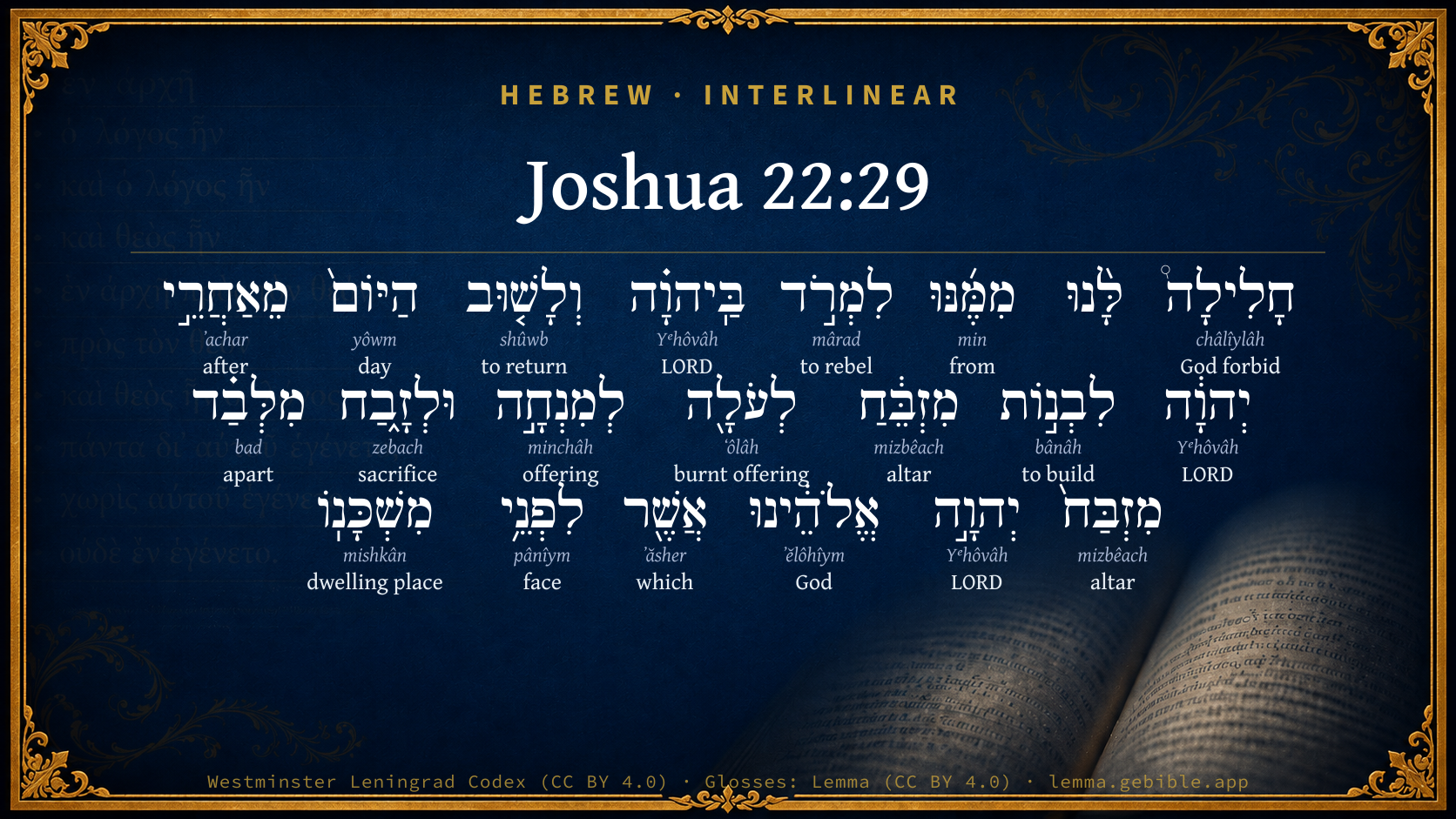
Hebrew (Westminster Leningrad Codex) Joshua 22:29 appears in the Hebrew Old Testament. The text above is from the Westminster Leningrad Codex. Each word links to its Strong’s number, a concise gloss, and parsing drawn from the Open Scriptures Hebrew Bible morphology. Click any word for its full Brown-Driver-Briggs (BDB) entry.
Download image
Cite this verse

Joshua 22:29 (World English Bible). Public Domain. Lemma interlinear Bible study tool, https://lemma.gebible.app/v/joshua/22/29.

Show BibTeX & RIS
BibTeX
RIS
English Translation
Far be it from us that we should rebel against Yahweh, and turn away this day from following Yahweh, to build an altar for burnt-offering, for meal-offering, or for sacrifice, besides the altar of Yahweh our God that is before his tent.
World English Bible · Public Domain
Download a study sheet

One document with this verse’s original text, its word-by-word gloss line, the meaning frame, cross-references with their text, attributed commentary, and full source and license credits — printable, and it pastes into notes with its structure intact.

This verse Autodidact and up

Study sheet (.html) Plain text (.txt)

A passage Seminary Student

Up to 50 verses in one chapter. A passage sheet keeps up to 6 commentary sources and 12 cross-references per verse, in the order this page ranks them, and says so on the sheet whenever that leaves anything out. Ask for a single verse and you get the Autodidact verse sheet above.

Everything on this page stays free to read, with no account — the sheet is a download of what is already on screen, not access to it.

Want to remove ads? Support Godless Engineer
Compare translations 3

The same verse in 3 English versions, stacked beneath the original-language interlinear above. Click any original word for its lexicon entry.

Each is an independent rendering of the whole verse — the interlinear is not word-aligned to these translations.

Highlighted words mark where these versions differ — a whole-verse word diff, not a word-by-word alignment.

  • World English Bible Public Domain
    Far be it from us that we should rebel against Yahweh, and turn away this day from following Yahweh, to build an altar for burnt-offering, for meal-offering, or for sacrifice, besides the altar of Yahweh our God that is before his tent.
  • King James Version Public Domain
    God forbid that we should rebel against the LORD, and turn this day from following the LORD, to build an altar for burnt offerings, for meat offerings, or for sacrifices, beside the altar of the LORD our God that is before his tabernacle.
  • unfoldingWord Literal Text CC BY-SA 4.0
    Profane to us from him, to rebel against Yahweh and turn today from after Yahweh to build an altar for a burnt offering, for a grain offering, or for a sacrifice, apart from the altar of Yahweh our God that is to the face of his dwelling!’”

unfoldingWord Literal Text — © unfoldingWord, licensed CC BY-SA 4.0. Word-aligned USFM3 via Door43 (git.door43.org/unfoldingWord/en_ult).

Versions to compare (up to 4)

3 of 4 selected

Show all 18 translations

Every available English version of this verse, each an independent rendering of the whole verse.

  • World English Bible Public Domain
    Far be it from us that we should rebel against Yahweh, and turn away this day from following Yahweh, to build an altar for burnt-offering, for meal-offering, or for sacrifice, besides the altar of Yahweh our God that is before his tent.
  • Berean Standard Bible Public Domain
    Far be it from us to rebel against the LORD and turn away from Him today by building an altar for burnt offerings, grain offerings, or sacrifices, other than the altar of the LORD our God, which stands before His tabernacle.”
  • Majority Standard Bible Public Domain
    Far be it from us to rebel against the LORD and turn away from Him today by building an altar for burnt offerings, grain offerings, or sacrifices, other than the altar of the LORD our God, which stands before His tabernacle.”
  • King James Version Public Domain
    God forbid that we should rebel against the LORD, and turn this day from following the LORD, to build an altar for burnt offerings, for meat offerings, or for sacrifices, beside the altar of the LORD our God that is before his tabernacle.
  • American Standard Version (1901) Public Domain
    Far be it from us that we should rebel against Jehovah, and turn away this day from following Jehovah, to build an altar for burnt-offering, for meal-offering, or for sacrifice, besides the altar of Jehovah our God that is before his tabernacle.
  • Revised Version (1885) Public Domain
    God forbid that we should rebel against the LORD, and turn away this day from following the LORD, to build an altar for burnt offering, for meal offering, or for sacrifice, besides the altar of the LORD our God that is before his tabernacle.
  • Geneva Bible (1599) Public Domain
    God forbid, that we should rebell against the Lord, and turne this day away from the Lord to builde an altar for burnt offering, or for meate offering, or for sacrifice, saue the altar of the Lord our God, that is before his Tabernacle.
  • Douay-Rheims (1899) Public Domain
    God keep us from any such wickedness that we should revolt from the Lord, and leave off following his steps, by building an altar to offer holocausts, and sacrifices, and victims, beside the altar of the Lord our God, which is erected before his tabernacle.
  • Young's Literal Translation Public Domain
    `Far be it from us to rebel against Jehovah, and to turn back to-day from after Jehovah, to build an altar for burnt-offering, for present, and for sacrifice, apart from the altar of Jehovah our God, which `is' before His tabernacle.'
  • Literal Standard Version CC BY-SA 4.0
    Far be it from us to rebel against YHWH, and to turn back from after YHWH today, to build an altar for burnt-offering, for present, and for sacrifice, apart from the altar of our God YHWH, which [is] before His Dwelling Place.”
  • Unlocked Literal Bible CC BY-SA 4.0
    May it be far from us that we should rebel against Yahweh, and today turn away from following him by building an altar for burnt offering, for grain offering, or for sacrifice, other than the altar of Yahweh our God that is before his tabernacle.'”
  • unfoldingWord Literal Text CC BY-SA 4.0
    Profane to us from him, to rebel against Yahweh and turn today from after Yahweh to build an altar for a burnt offering, for a grain offering, or for a sacrifice, apart from the altar of Yahweh our God that is to the face of his dwelling!’”
  • Darby Bible Public Domain
    Far be it from us that we should rebel against Jehovah, and turn this day from following Jehovah, in building an altar for burnt-offering, for oblation, and for sacrifice, besides the altar of Jehovah our God that is before his tabernacle.
  • World Messianic Bible Public Domain
    “Far be it from us that we should rebel against the LORD, and turn away today from following the LORD, to build an altar for burnt offering, for meal offering, or for sacrifice, besides the LORD our God’s altar that is before his tabernacle!”
  • Webster's Bible Public Domain
    Far be it from us that we should rebel against the LORD, and turn this day from following the LORD, to build an altar for burnt-offerings, for meat-offerings, or for sacrifices, besides the altar of the LORD our God that is before his tabernacle.
  • Free Bible Version CC BY-SA 4.0
    We would never think to rebel against the Lord or to turn away from him now by building an altar to make burnt offerings or grain offerings or sacrifices. The only altar of the Lord our God is the one that stands in front of his Tabernacle.”
  • Bible in Basic English Public Domain
    Never let it be said that we were false to the Lord, turning back this day from him and building an altar for burned offerings and meal offerings and offerings of beasts, in addition to the altar of the Lord our God which is before his House.
  • JPS Tanakh (1917) Public Domain
    Far be it from us that we should rebel against the LORD, and turn away this day from following the LORD, to build an altar for burnt-offering, for meal-offering, or for sacrifice, besides the altar of the LORD our God that is before His tabernacle.'

Literal Standard Version (2020), Covenant Press — licensed CC BY-SA 4.0. Text via the HelloAO Bible API (eBible.org). Unlocked Literal Bible (unfoldingWord) — licensed CC BY-SA 4.0. Text via the HelloAO Bible API (eBible.org). unfoldingWord Literal Text — © unfoldingWord, licensed CC BY-SA 4.0. Word-aligned USFM3 via Door43 (git.door43.org/unfoldingWord/en_ult). Free Bible Version, Dr. Jonathan Gallagher — licensed CC BY-SA 4.0. Text via the HelloAO Bible API (eBible.org).

Word by word

More ways to search: Search by grammar → Find every occurrence → Compare this word →

Practice this passage: Drill this verse → Learn its vocabulary →

חָלִילָה֩
châlîylâh
H2486
“God forbid · toward”
Particle, Interjection + Suffix, Demonstrative
Part of Speech
Particle
Type
Interjection
Full BDB Definition

Origin: a directive from H2490

TWOT: 661c

far be it (from me), God forbid that, let it not be
  1. מִמֶּ֜נּוּ min H4480 “from · us” Preposition + Suffix, Personal, 1st Person, Common, Plural
  2. לִמְרֹ֣ד mârad H4775 “to rebel” Preposition + Verb, Qal, Infinitive Construct
  3. בַּֽיהוָ֗ה Yᵉhôvâh H3068 “in/at · LORD” Preposition + Noun, Proper
  4. וְלָשׁ֤וּב shûwb H7725 “and · to return” Conjunction + Preposition + Verb, Qal, Infinitive Construct
  5. הַיּוֹם֙ yôwm H3117 “the · day” Particle, Definite Article + Noun, Common, Masculine, Singular, Absolute
  6. מֵאַחֲרֵ֣י ʼachar H310 “from · after” Preposition + Preposition
  7. יְהוָ֔ה Yᵉhôvâh H3068 “LORD” Noun, Proper
  8. לִבְנ֣וֹת bânâh H1129 “to build” Preposition + Verb, Qal, Infinitive Construct
  9. מִזְבֵּ֔חַ mizbêach H4196 “altar” Noun, Common, Masculine, Singular, Absolute
  10. לְעֹלָ֖ה ʻôlâh H5930 “to/for · burnt offering” Preposition + Noun, Common, Feminine, Singular, Absolute
  11. לְמִנְחָ֣ה minchâh H4503 “to/for · offering” Preposition + Noun, Common, Feminine, Singular, Absolute
  12. וּלְזָ֑בַח zebach H2077 “and · to/for · sacrifice” Conjunction + Preposition + Noun, Common, Masculine, Singular, Absolute
  13. מִלְּבַ֗ד bad H905 “from · to/for · apart of” Preposition + Preposition + Noun, Common, Masculine, Singular, Construct
  14. מִזְבַּח֙ mizbêach H4196 “altar of” Noun, Common, Masculine, Singular, Construct
  15. יְהוָ֣ה Yᵉhôvâh H3068 “LORD” Noun, Proper
  16. אֱלֹהֵ֔ינוּ ʼĕlôhîym H430 “God(s) · our” Noun, Common, Masculine, Plural, Construct + Suffix, Personal, 1st Person, Common, Plural
  17. אֲשֶׁ֖ר ʼăsher H834 “which” Particle, Relative
  18. לִפְנֵ֥י pânîym H6440 “to/for · face(s) of” Preposition + Noun, Common, Both, Plural, Construct
  19. מִשְׁכָּנֽוֹ mishkân H4908 “dwelling place · his” Noun, Common, Masculine, Singular, Construct + Suffix, Personal, 3rd Person, Masculine, Singular

About this verse

These counts appear in no published source. They are computed here, from the morphology-tagged text and Lemma’s own curated glosses. What Lemma adds →

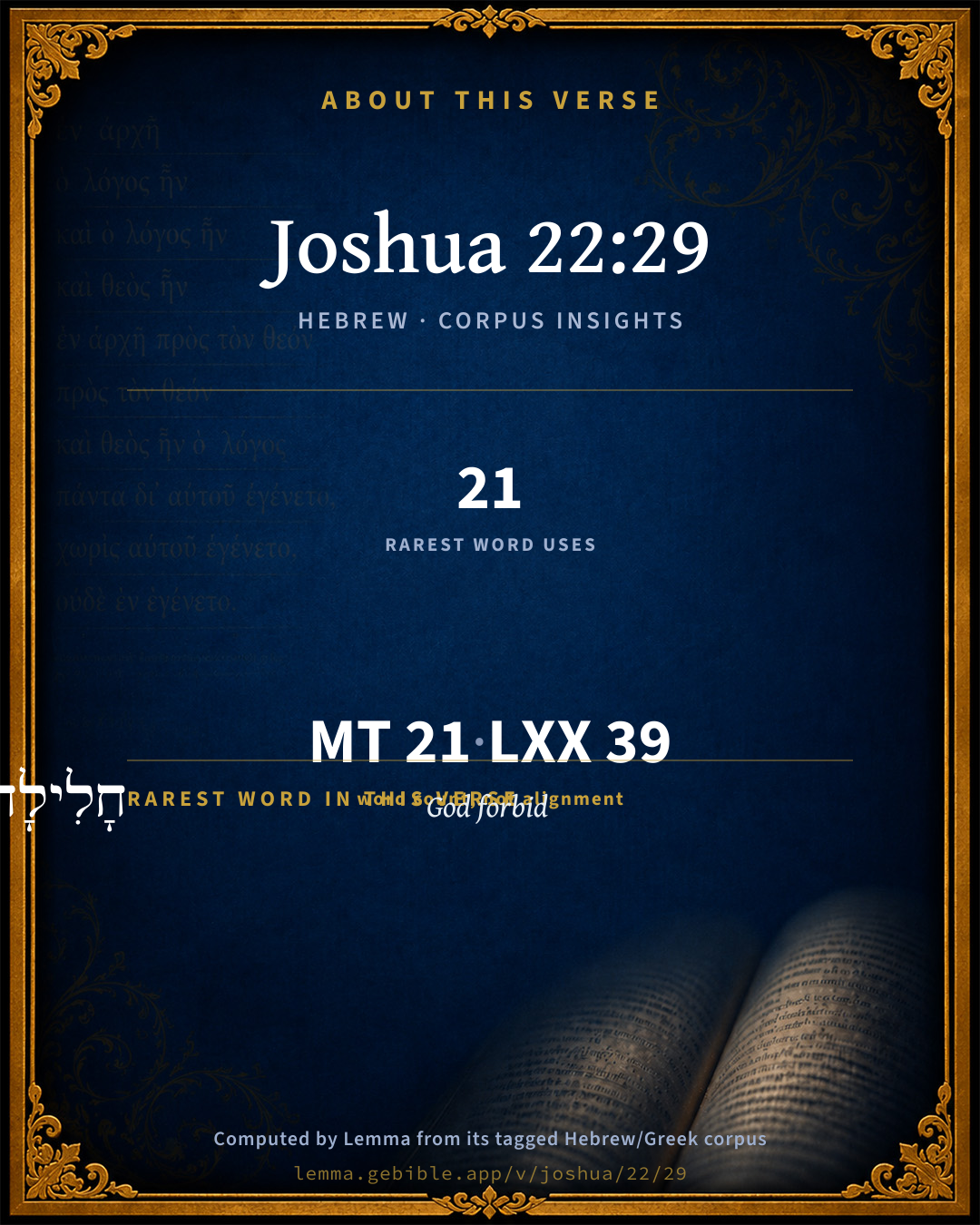
21
words
17
distinct lemmas
Historical
section

Notable vocabulary

The rarest word here is חָלִילָה֩ God forbid H2486 — appearing just 21 times in the whole Hebrew Bible.

Shared distinctive vocabulary

חָלִילָה֩ God forbid H2486 occurs in 19 verses of the Hebrew Bible. Also found in:

Grammatical profile

  • 3 verbs
  • 13 nouns
  • 3 prepositions
  • 2 particles

Verb forms

  • לִמְרֹ֣ד Qal · Infinitive Construct
  • וְלָשׁ֤וּב Qal · Infinitive Construct
  • לִבְנ֣וֹת Qal · Infinitive Construct

Repetition

Words recur within this verse — often emphatic in Hebrew:

  • בַּֽיהוָ֗ה LORD H3068 ×3
  • מִזְבֵּ֔חַ altar H4196 ×2

Hebrew & Septuagint length

In English translation the verse runs 42 words from the Hebrew and 48 from the Septuagint (LXX English) — closely comparable.

A rough comparison of the two English renderings, which tokenize alike — not a word-level alignment.

Word counts can differ between the Hebrew and the Greek without any difference in meaning — e.g. the Hebrew direct-object marker אֵת has no separate Greek word, and Greek often adds the article ὁ.

In the original languages it is 21 Hebrew tokens and 39 Greek tokens — but the two are counted differently (Hebrew bundles its prefixes and suffixes into one token; the Greek is in lemma form), so that isn’t a like-for-like length.

Cross-references

13

Topical passages linked to Joshua 22:29 in the Treasury of Scripture Knowledge — connected by theme and wording, ordered by reader-vote popularity; previews shown in the World English Bible.

  • Deuteronomy 12:13–14 Take heed to yourself that you don't offer your burnt offerings in every place that you see;
  • Joshua 24:16 The people answered, Far be it from us that we should forsake Yahweh, to serve other gods;
  • Genesis 44:7 They said to him, "Why does my lord speak such words as these? Far be it from your servants that they should do such a thing!
  • Genesis 44:17 He said, "Far be it from me that I should do so. The man in whose hand the cup is found, he will be my bondservant; but as for you, go up in peace to your father."
  • Joshua 22:23 that we have built us an altar to turn away from following Yahweh; or if to offer thereon burnt offering or meal-offering, or if to offer sacrifices of peace-offerings thereon, let Yahweh himself require it;
  • Joshua 22:26 Therefore we said, Let us now prepare to build us an altar, not for burnt offering, nor for sacrifice:
  • 1 Samuel 12:23 Moreover as for me, far be it from me that I should sin against Yahweh in ceasing to pray for you: but I will instruct you in the good and the right way.
  • 1 Kings 21:3 Naboth said to Ahab, Yahweh forbid it me, that I should give the inheritance of my fathers to you.
  • 2 Kings 18:22 But if you tell me, We trust in Yahweh our God; isn't that he whose high places and whose altars Hezekiah has taken away, and has said to Judah and to Jerusalem, You shall worship before this altar in Jerusalem?
  • 2 Chronicles 32:12 Has not the same Hezekiah taken away his high places and his altars, and commanded Judah and Jerusalem, saying, You shall worship before one altar, and on it shall you burn incense?
  • Romans 3:6 May it never be! For then how will God judge the world?
  • Romans 6:2 May it never be! We who died to sin, how could we live in it any longer?
  • Romans 9:14 What shall we say then? Is there unrighteousness with God? May it never be!

Cross-references courtesy of OpenBible.info (CC BY 4.0).

Hebrew and Greek witnesses Masoretic Hebrew ↔ Greek Septuagint

The same verse in the two great witnesses to the Old Testament, shown verse-for-verse.

These are two independent witnesses, not word-aligned to each other, and the Septuagint is shown in lemma (dictionary) form.

Hebrew Joshua 22:29 Masoretic · Westminster Leningrad Codex

חָלִילָה֩ לָּ֨נוּ מִמֶּ֜נּוּ לִמְרֹ֣ד בַּֽיהוָ֗ה וְלָשׁ֤וּב הַיּוֹם֙ מֵאַחֲרֵ֣י יְהוָ֔ה לִבְנ֣וֹת מִזְבֵּ֔חַ לְעֹלָ֖ה לְמִנְחָ֣ה וּלְזָ֑בַח מִלְּבַ֗ד מִזְבַּח֙ יְהוָ֣ה אֱלֹהֵ֔ינוּ אֲשֶׁ֖ר לִפְנֵ֥י מִשְׁכָּנֽוֹ

Far be it from us that we should rebel against Yahweh, and turn away this day from following Yahweh, to build an altar for burnt-offering, for meal-offering, or for sacrifice, besides the altar of Yahweh our God that is before his tent.

World English Bible · Public Domain

Greek LXX Joshua 22:29 Septuagint · lemma form

μή γίγνομαι οὖν ἐγώ ἀποστρέφω ἀπό κύριος ἐν ὁ σήμερον ἡμέρα ἀποἵστημι ἀπό κύριος ὥστε οἰκοδομέω ἐγώ θυσιαστήριον ὁ κάρπωμα καί ὁ θυσία σαλαμιν καί ὁ θυσία ὁ σωτήριον πλήν ὁ θυσιαστήριον κύριος ὅς εἰμί ἐναντίον ὁ σκηνή αὐτός

Far be it from us therefore that we should turn away from the Lord this day so as to apostatize from the Lord, so as that we should build an altar for burnt offerings, and for peace-offerings, besides the altar of the Lord which is before his tabernacle.

LXX2012 (modern English Septuagint) · Public Domain

On this verse, The Cambridge Bible for Schools and Colleges discusses the Septuagint’s reading. Read the note in Commentary ↓

Hebrew: Westminster Leningrad Codex (CC BY 4.0). Greek: Septuagint (public domain); English from LXX2012 (modern English Septuagint) (Public Domain). How the Septuagint differs from the Hebrew →

Targum (Aramaic paraphrase)

1

The Targum is the ancient Jewish Aramaic paraphrase of the Hebrew Scriptures — an interpretive translation, not the Hebrew text itself. Onkelos (literal) and Pseudo-Jonathan (expansive) render the Torah, and Jonathan the Prophets. Coverage is partial: where no permissively-licensed English translation exists for a verse, only the Aramaic is shown. This is verse-level text, not a word-by-word alignment to the Hebrew.

  1. Targum Jonathan Prophets (Joshua–Malachi)
    חַס לָנָא מִנָנָא מִלְמֶחְטֵי קֳדָמוֹהִי מִלְמֵרַד בְּמֵימְרָא דַייָ וּלְמִיתַב יוֹמָא דֵין מִבָּתַר פּוּלְחָנָא דַייָ לְמִבְנֵי מַדְבְּחָא לַעֲלָתָא לְמִנְחָתָא וּלְנִכְסַת קוּדְשַׁיָא בַּר מִמַדְבְּחָא דַייָ אֱלָהָנָא דִי קֳדָם מַשְׁכְּנֵיהּ:

    (no public-domain English translation for this verse)

    Targum Jonathan — Aramaic: “Mikraot Gedolot” (public domain). English: “Sefaria Community Translation” (CC0 1.0 (public-domain dedication)); “London "Chaldee Paraphrase," 1871” (public domain). Text via Sefaria.

Commentary

Notes on Joshua 22:29 from classic Christian and Jewish commentators (each source and its license shown beneath its notes). The classic Christian expositions comment on the surrounding passage and are grouped to its opening verse, so a note may address several verses; the Jewish commentaries on the Tanakh (Rashi and others) are per-verse, so they appear only where the commentator wrote on this verse.

Lemma curates 59 commentaries, every one of them public domain or Creative Commons licensed, each selected and text-cleaned for this edition rather than reprinted as found. About our sources →

Trapp's Complete Commentary

John Trapp

Jos 22:29 God forbid that we should rebel against the LORD, and turn this day from following the LORD, to build an altar for burnt offerings, for meat offerings, or for sacrifices, beside the altar of the LORD our God that [is] before his tabernacle.

Ver. 29. God forbid that we.] As it is a folly to be hot in a cold matter, so it is a great fault to be cold in a hot. See Act 17:16-17, &c., "his spirit was stirred," he was in a holy fit, and he bestirred him accordingly.

John Trapp, A Commentary or Exposition upon All the Books of the Old and New Testament (1647–1656) — public domain. Text from a community e-Sword module.

Adam Clarke's Commentary

Verse 29. God forbid that we should rebel] These words not only express their strong abhorrence of this crime, but also show that without God they could do no good thing, and that they depended upon him for that strength by which alone they could abstain from evil.

Adam Clarke's Commentary on the Bible (1810–1826) — public domain. Text from a community e-Sword/MySword module.

The Cambridge Bible for Schools and Colleges

gen. ed. J. J. S. Perowne

29. God forbid] Literally, Far be it from us. LXX. μὴ γένοιτο. Wyclif translates it, “God shilde fro vs this hidous gilt.” The speakers express in the strongest manner their abhorrence of the idea of forsaking Jehovah.

The Cambridge Bible for Schools and Colleges (gen. ed. J. J. S. Perowne; Cambridge University Press, 1878–1918) — public domain. Text from a community e-Sword module.

John Gill's Exposition

And when Phinehas the priest,.... For he was, being the son of Eleazar the high priest, so the word "priest", Jos 22:13; is to be joined, not to Eleazar but to Phinehas:

and the princes of the congregation; the ten princes, who were sent by the congregation of Israel, one out of each tribe:

and heads out of the thousands of Israel; these are the same with the princes, and this belongs to their title, who were heads of the Chiliarchs, or those who were rulers of thousands in Israel:

which were with him; with Phinehas, who were joined with him in the embassy, and now present with him:

heard the words that the children of Reuben, and the children of Gad,

and the children of Manasseh; spake; in defence of themselves, explaining the meaning and design of the altar they had built:

it pleased them; they were not only satisfied with their answer, but highly delighted with what they had done, as tending to preserve the common faith and fellowship of Israel.

John Gill's Exposition of the Whole Bible (1746–1763) — public domain (CC PDM 1.0). Text via the HelloAO Bible API.

The Pulpit Commentary

God forbid. Literally, profane or accursed to us be it from Him. So Keil, Gesenius, and Knobel. That we should rebel against the Lord. The embassy had the effect not only of eliciting an explanation, but of showing how earnest, at that time at least, the tribes of Israel were in the service of God. And we may learn here, as Robertson remarks of St. Paul"s frank and explicit vindications of himself, the value of explanations. Many a misunderstanding would be averted, many a feeling of rankling displeasure, culminating in an inexcusable explosion of anger, might be avoided, nay, many an unjust suspicion against a fellow Christian"s honesty and sincerity of purpose might be dispelled, if men would but follow the example of the ten tribes on this occasion, or lay to heart the words of our Lord in St. Mat_18:15, "If thy brother shall trespass against thee, go and tell him his fault between thee and him alone; if he shall hear thee, thou hast gained thy brother."

The Pulpit Commentary (1880–1919), ed. H.D.M. Spence-Jones & Joseph S. Exell — public domain. Text from a community e-Sword module.

Keil & Delitzsch

C. F. Keil & F. Delitzsch

The speakers conclude with an expression of horror at the thought of rebelling against Jehovah. ממּנּוּ לנוּ חלילה, "far be it from us away from Him (ממּנּוּ = מיהוה, Sa1 24:7; Sa1 26:11; Kg1 21:3), to rebel against Jehovah," etc.

Keil & Delitzsch — Biblical Commentary on the Old Testament (1861–1891) — public domain (CC PDM 1.0). Text via the HelloAO Bible API. (Old Testament only.)

Lesson kit

Teaching starters — assembled from the data on this page, not authored interpretation. Every prompt links to the verse data it draws on. Edit before teaching.

Joshua, in the Historical, opens this verse with 21 words (17 distinct Hebrew lemmas). Its most distinctive word is châlîylâh (“God forbid”). A historical commentator’s framing appears above. Read the whole chapter for the surrounding context.

Discussion questions

  1. What does “God forbid” (châlîylâh) contribute to the verse as a whole?
  2. How does Genesis 18:25, which shares the word «God forbid», read alongside this verse?
  3. What does the repetition of “LORD” (3× in this one verse) do in this verse?
  4. These translations render this verse differently; the difference is in the English rendering, not the original. What questions does that raise?
  5. «לִמְרֹ֣ד» is a Qal Infinitive Construct verb. How does that grammatical form shape the action described?
  6. Compare how Trapp's Complete Commentary and Adam Clarke's Commentary read this verse. Where do they agree or differ?

Things to notice

Reading settings

Reading text

Shown beneath each verse's original-language words.

Old Testament
Old Testament edition

Read the OT as the Masoretic Hebrew (MT) or the Greek Septuagint (LXX).

English shown for the Greek Septuagint (in the Hebrew ↔ Greek comparison).

Comparing translations? Open the Compare panel on any verse page to stack up to four side by side.