
Genesis 33:20

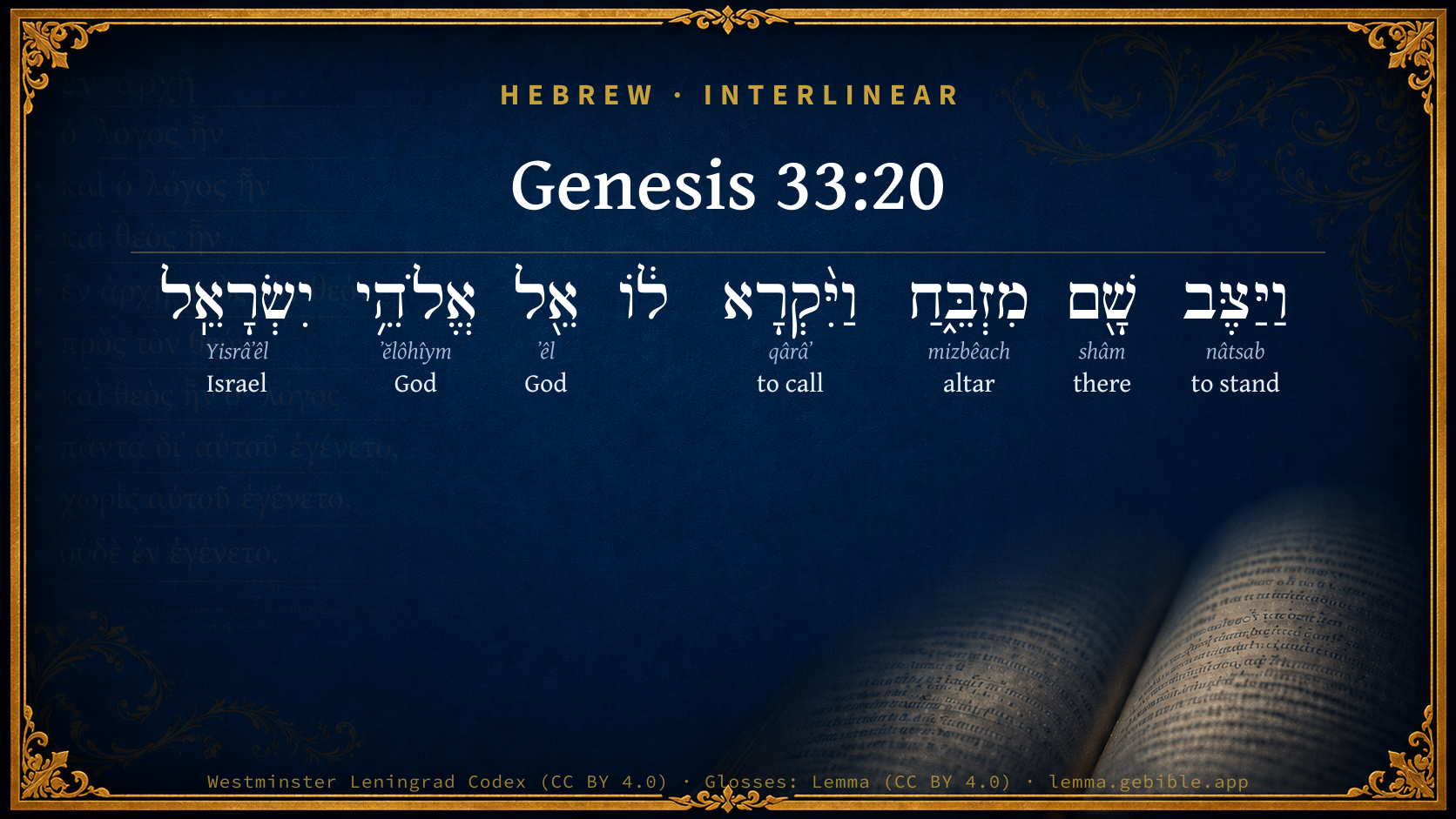
Hebrew (Westminster Leningrad Codex) Genesis 33:20 appears in the Hebrew Old Testament. The text above is from the Westminster Leningrad Codex. Each word links to its Strong’s number, a concise gloss, and parsing drawn from the Open Scriptures Hebrew Bible morphology. Click any word for its full Brown-Driver-Briggs (BDB) entry.
Download image
Cite this verse

Genesis 33:20 (World English Bible). Public Domain. Lemma interlinear Bible study tool, https://lemma.gebible.app/v/genesis/33/20.

Show BibTeX & RIS
BibTeX
RIS
English Translation
He erected an altar there, and called it El Elohe Israel.
World English Bible · Public Domain
Download a study sheet

One document with this verse’s original text, its word-by-word gloss line, the meaning frame, cross-references with their text, attributed commentary, and full source and license credits — printable, and it pastes into notes with its structure intact.

This verse Autodidact and up

Study sheet (.html) Plain text (.txt)

A passage Seminary Student

Up to 50 verses in one chapter. A passage sheet keeps up to 6 commentary sources and 12 cross-references per verse, in the order this page ranks them, and says so on the sheet whenever that leaves anything out. Ask for a single verse and you get the Autodidact verse sheet above.

Everything on this page stays free to read, with no account — the sheet is a download of what is already on screen, not access to it.

Want to remove ads? Support Godless Engineer
Compare translations 3

The same verse in 3 English versions, stacked beneath the original-language interlinear above. Click any original word for its lexicon entry.

Each is an independent rendering of the whole verse — the interlinear is not word-aligned to these translations.

Highlighted words mark where these versions differ — a whole-verse word diff, not a word-by-word alignment.

  • World English Bible Public Domain
    He erected an altar there, and called it El Elohe Israel.
  • King James Version Public Domain
    And he erected there an altar, and called it EleloheIsrael.
  • unfoldingWord Literal Text CC BY-SA 4.0
    And there he set up an altar, and he called it El Elohe Israel.

unfoldingWord Literal Text — © unfoldingWord, licensed CC BY-SA 4.0. Word-aligned USFM3 via Door43 (git.door43.org/unfoldingWord/en_ult).

Versions to compare (up to 4)

3 of 4 selected

Show all 18 translations

Every available English version of this verse, each an independent rendering of the whole verse.

  • World English Bible Public Domain
    He erected an altar there, and called it El Elohe Israel.
  • Berean Standard Bible Public Domain
    There he set up an altar and called it El-Elohe-Israel.
  • Majority Standard Bible Public Domain
    There he set up an altar and called it El-Elohe-Israel.
  • King James Version Public Domain
    And he erected there an altar, and called it EleloheIsrael.
  • American Standard Version (1901) Public Domain
    And he erected there an altar, and called it El-elohe-israel.
  • Revised Version (1885) Public Domain
    And he erected there an altar, and called it El-elohe-Israel.
  • Geneva Bible (1599) Public Domain
    And he set vp there an altar, and called it, The mightie God of Israel.
  • Douay-Rheims (1899) Public Domain
    And raising an altar there, he invoked upon it the most mighty God of Israel.
  • Young's Literal Translation Public Domain
    and he setteth up there an altar, and proclaimeth at it God -- the God of Israel.
  • Literal Standard Version CC BY-SA 4.0
    and he sets up there an altar, and proclaims at it God—the God of Israel.
  • Unlocked Literal Bible CC BY-SA 4.0
    There he set up an altar and called it El Elohe Israel.
  • unfoldingWord Literal Text CC BY-SA 4.0
    And there he set up an altar, and he called it El Elohe Israel.
  • Darby Bible Public Domain
    And there he set up an altar, and called it El-Elohe-Israel.
  • World Messianic Bible Public Domain
    He erected an altar there, and called it El Elohe Israel.
  • Webster's Bible Public Domain
    And he erected there an altar, and called it El-elohe-Israel.
  • Free Bible Version CC BY-SA 4.0
    He built an altar there and called it El-Elohe-Israel.
  • Bible in Basic English Public Domain
    And there he put up an altar, naming it El, the God of Israel.
  • JPS Tanakh (1917) Public Domain
    And he erected there an altar, and called it El-elohe-Israel.

Literal Standard Version (2020), Covenant Press — licensed CC BY-SA 4.0. Text via the HelloAO Bible API (eBible.org). Unlocked Literal Bible (unfoldingWord) — licensed CC BY-SA 4.0. Text via the HelloAO Bible API (eBible.org). unfoldingWord Literal Text — © unfoldingWord, licensed CC BY-SA 4.0. Word-aligned USFM3 via Door43 (git.door43.org/unfoldingWord/en_ult). Free Bible Version, Dr. Jonathan Gallagher — licensed CC BY-SA 4.0. Text via the HelloAO Bible API (eBible.org).

Word by word

More ways to search: Search by grammar → Find every occurrence → Compare this word →

Practice this passage: Drill this verse → Learn its vocabulary →

וַיַּצֶּב
nâtsab
H5324
“and · to stand”
Conjunction + Verb, Hiphil, Sequential Imperfect, 3rd Person, Masculine, Singular
Part of Speech
Conjunction + Verb
Stem
Hiphil
Form
Sequential Imperfect
Person
3rd Person
Gender
Masculine
Number
Singular
Full BDB Definition

Origin: a primitive root

TWOT: 1398

to stand, take one's stand, stand upright, be set (over), establish - (Niphal) - to station oneself, take one's stand - to stand, be stationed - to stand, take an upright position - to be stationed, be appointed - deputy, prefect, appointed, deputed (substantive) - to stand firm - (Hiphil) - to station, set - to set up, erect - to cause to stand erect - to fix, establish - (Hophal) to be fixed, be determined, be stationary
  1. שָׁ֖ם shâm H8033 “there” Adverb
  2. מִזְבֵּ֑חַ mizbêach H4196 “altar” Noun, Common, Masculine, Singular, Absolute
  3. וַיִּ֨קְרָא qârâʼ H7121 “and · to call” Conjunction + Verb, Qal, Sequential Imperfect, 3rd Person, Masculine, Singular
  4. אֵ֖ל ʼêl H410 “God” Noun, Common, Masculine, Singular, Absolute
  5. אֱלֹהֵ֥י ʼĕlôhîym H430 “God(s) of” Noun, Common, Masculine, Plural, Construct
  6. יִשְׂרָאֵֽל Yisrâʼêl H3478 “Israel” Noun, Proper

About this verse

These counts appear in no published source. They are computed here, from the morphology-tagged text and Lemma’s own curated glosses. What Lemma adds →

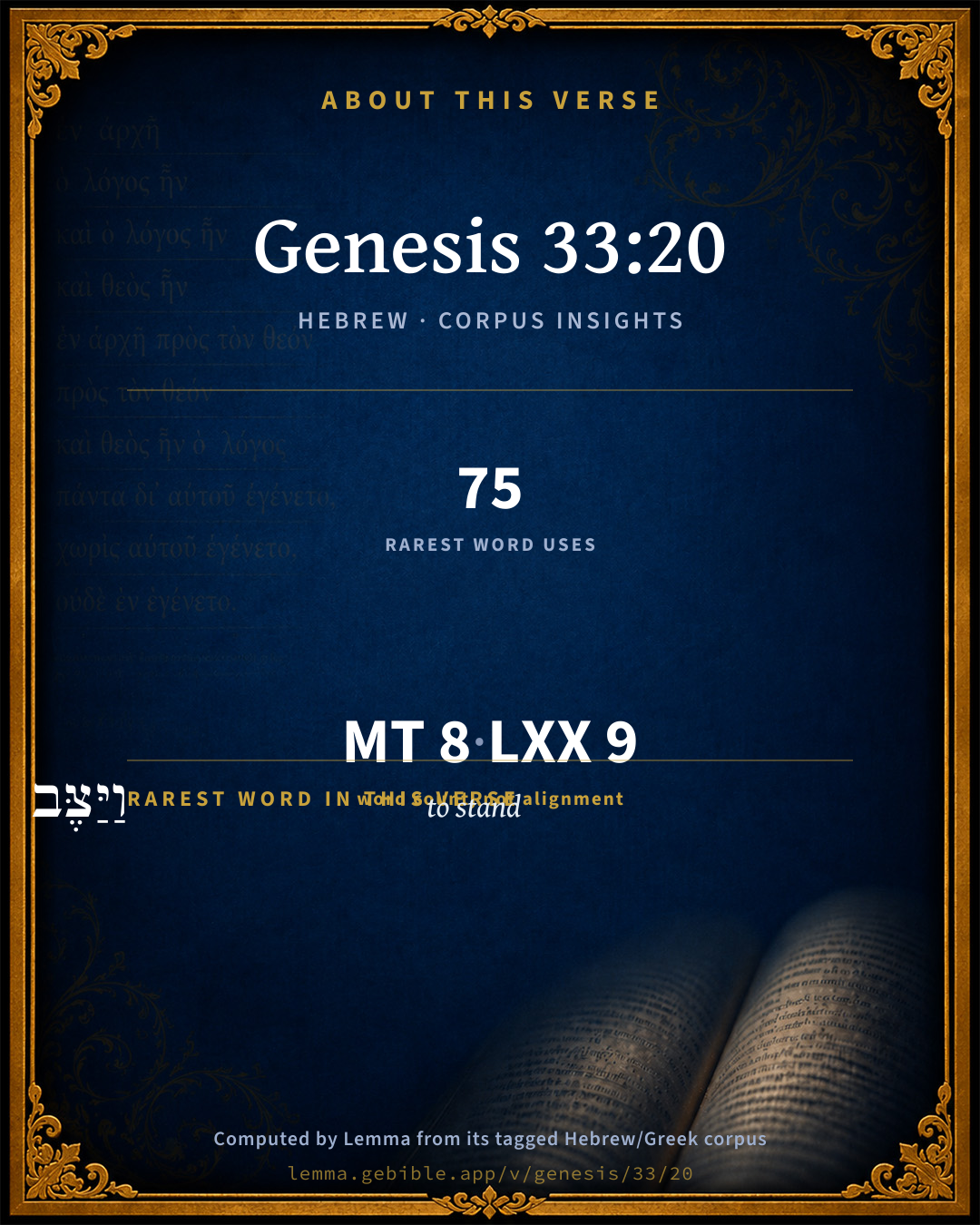
8
words
7
distinct lemmas
Pentateuch
section

Grammatical profile

  • 2 verbs
  • 4 nouns
  • 1 preposition
  • 1 adverb

Verb forms

  • וַיַּצֶּב Hiphil · Sequential Imperfect
  • וַיִּ֨קְרָא Qal · Sequential Imperfect

Hebrew & Septuagint length

In English translation the verse runs 11 words from the Hebrew and 14 from the Septuagint (LXX English) — closely comparable.

A rough comparison of the two English renderings, which tokenize alike — not a word-level alignment.

Word counts can differ between the Hebrew and the Greek without any difference in meaning — e.g. the Hebrew direct-object marker אֵת has no separate Greek word, and Greek often adds the article ὁ.

In the original languages it is 8 Hebrew tokens and 9 Greek tokens — but the two are counted differently (Hebrew bundles its prefixes and suffixes into one token; the Greek is in lemma form), so that isn’t a like-for-like length.

Cross-references

6

Topical passages linked to Genesis 33:20 in the Treasury of Scripture Knowledge — connected by theme and wording, ordered by reader-vote popularity; previews shown in the World English Bible.

  • Genesis 21:33 Abraham planted a tamarisk tree in Beersheba, and called there on the name of Yahweh, the Everlasting God.
  • Genesis 35:7 He built an altar there, and called the place El Beth El; because there God was revealed to him, when he fled from the face of his brother.
  • Genesis 32:28 He said, "Your name will no longer be called 'Jacob,' but, 'Israel,' for you have fought with God and with men, and have prevailed."
  • Genesis 8:20 Noah built an altar to Yahweh, and took of every clean animal, and of every clean bird, and offered burnt offerings on the altar.
  • Genesis 12:7–8 Yahweh appeared to Abram, and said, "I will give this land to your seed." He built an altar there to Yahweh, who appeared to him.
  • Genesis 13:18 Abram moved his tent, and came and lived by the oaks of Mamre, which are in Hebron, and built an altar there to Yahweh.

Cross-references courtesy of OpenBible.info (CC BY 4.0).

Hebrew and Greek witnesses Masoretic Hebrew ↔ Greek Septuagint

The same verse in the two great witnesses to the Old Testament, shown verse-for-verse.

These are two independent witnesses, not word-aligned to each other, and the Septuagint is shown in lemma (dictionary) form.

Hebrew Genesis 33:20 Masoretic · Westminster Leningrad Codex

וַיַּצֶּב שָׁ֖ם מִזְבֵּ֑חַ וַיִּ֨קְרָא ל֔וֹ אֵ֖ל אֱלֹהֵ֥י יִשְׂרָאֵֽל

He erected an altar there, and called it El Elohe Israel.

World English Bible · Public Domain

Greek LXX Genesis 33:20 Septuagint · lemma form

καί ἵστημι ἐκεῖ θυσιαστήριον καί ἐπικαλέω ὁ θεός ἰσραήλ

And he set up there an altar, and called on the God of Israel.

LXX2012 (modern English Septuagint) · Public Domain

On this verse, The Pulpit Commentary discusses the Septuagint’s reading. Read the note in Commentary ↓

Hebrew: Westminster Leningrad Codex (CC BY 4.0). Greek: Septuagint (public domain); English from LXX2012 (modern English Septuagint) (Public Domain). How the Septuagint differs from the Hebrew →

Targum (Aramaic paraphrase)

2

The Targum is the ancient Jewish Aramaic paraphrase of the Hebrew Scriptures — an interpretive translation, not the Hebrew text itself. Onkelos (literal) and Pseudo-Jonathan (expansive) render the Torah, and Jonathan the Prophets. Coverage is partial: where no permissively-licensed English translation exists for a verse, only the Aramaic is shown. This is verse-level text, not a word-by-word alignment to the Hebrew.

  1. Targum Onkelos Torah (Genesis–Deuteronomy)
    וַאֲקֵם תַּמָּן מַדְבְּחָא וּפְלַח עֲלוֹהִי קֳדָם אֵל אֱלָהָא דְיִשְׂרָאֵל

    (no public-domain English translation for this verse)

    Targum Onkelos — Aramaic: “Onkelos Genesis” (public domain); “Onkelos Exodus” (public domain); “Onkelos Leviticus” (public domain); “Onkelos Numbers” (public domain); “Onkelos Deuteronomy” (public domain). English: “Sefaria Community Translation” (CC0 1.0 (public-domain dedication)); “J.W. Etheridge. The Targums of Onkelos and Jonathan Ben Uzziel on the Pentateuch. London: Longmans, Green, 1862” (public domain). Text via Sefaria.

  2. Targum Pseudo-Jonathan Torah (Genesis–Deuteronomy)
    וְאָקִים תַּמָן מַדְבְּחָא וְתַמָן יְהַב מַעְשְרַיָא דְאַפְרֵישׁ מִן כָּל דִילֵיהּ קֳדָם אֵל אֱלָהָא דְיִשְרָאֵל

    And he raised there an altar, and there he gave the tithes which he had set apart of all that he had before God, the God of Israel.

    Targum Pseudo-Jonathan — Aramaic: “Targum Jonathan on Genesis” (public domain); “Targum Jonathan on Exodus” (public domain); “Targum Jonathan on Leviticus” (public domain); “Targum Jonathan on Numbers” (public domain); “Targum Jonathan on Deuteronomy” (public domain). English: “The Targum of Jonathan ben Uzziel, trans. J. W. Etheridge, London, 1862” (public domain). Text via Sefaria.

Commentary

Notes on Genesis 33:20 from classic Christian and Jewish commentators (each source and its license shown beneath its notes). The classic Christian expositions comment on the surrounding passage and are grouped to its opening verse, so a note may address several verses; the Jewish commentaries on the Tanakh (Rashi and others) are per-verse, so they appear only where the commentator wrote on this verse.

Lemma curates 59 commentaries, every one of them public domain or Creative Commons licensed, each selected and text-cleaned for this edition rather than reprinted as found. About our sources →

Trapp's Complete Commentary

John Trapp

Gen 33:20 And he erected there an altar, and called it Elelohe-Israel.

Ver. 20. And he erected there an altar.] (1.) As a memorial of the promises, and a symbol of God’s presence; (2.) As an external profession of his piety; (3.) That he might set up God in his family, and season all his worldly affairs with a relish of religion.

John Trapp, A Commentary or Exposition upon All the Books of the Old and New Testament (1647–1656) — public domain. Text from a community e-Sword module.

Joseph Benson's Commentary

Gen 33:20. He erected there an altar — 1st, In thankfulness to God, for the good hand of his providence over him. 2d, That he might keep up religion and the worship of God in his family. He dedicated this altar to the honour of El-elohe-Israel, God the God of Israel: to the honour of God in general, the only living and true God, the best of Beings, the first of causes: and to the honour of the God of Israel, as a God in covenant with him. God had lately called him by the name of Israel; and now he calls God the God of Israel. Though he be styled a prince with God, God shall still be a prince with him, his Lord and his God.

Joseph Benson's Commentary on the Old and New Testaments (1811–1818) — public domain. Text from a community e-Sword module.

Tyndale Open Study Notes

Tyndale Open Resources

33:20 El-Elohe-Israel: The name of the altar (“God, the God of Israel”) commemorated Jacob’s relationship with God. Jacob publicly proclaimed that God was his God, and that God had led him back to the land he would inherit.

Tyndale Open Study Notes — © Tyndale Open Resources, licensed CC BY-SA 4.0. Text via the HelloAO Bible API.

Geneva Bible (1599)

Geneva Bible translators

He calleth the sign, the thing which it signifieth, in token that God had mightily delivered him.

Geneva Bible (1599) marginal notes — public domain. Text via Bolls.life.

Jamieson, Fausset & Brown

Robert Jamieson, A. R. Fausset & David Brown

and he erected . . . an altar--A beautiful proof of his personal piety, a most suitable conclusion to his journey, and a lasting memorial of a distinguished favor in the name "God, the God of Israel." Wherever we pitch a tent, God shall have an altar.

Next: Genesis Chapter 34

Jamieson, Fausset & Brown — Commentary Critical and Explanatory on the Whole Bible (1871) — public domain (CC PDM 1.0). Text via the HelloAO Bible API.

Adam Clarke's Commentary

Verse 20. And he erected there an altar] It appears that Jacob had a very correct notion of the providence and mercy of God; hence he says, Ge 33:5: The children which God hath GRACIOUSLY given thy servant; and in Ge 33:11 he attributes all his substance to the bounty of his Maker: Take, I pray thee, my blessing - because God hath dealt GRACIOUSLY with me, and because I have enough. Hence he viewed God as the God of all grace, and to him he erects an altar, dedicating it to God, the God of Israel, referring particularly to the change of his own name, and the mercies which he then received; and hence perhaps it would be best to translate the words, The strong God (is) the God of Israel; as by the power of his grace and goodness he had rescued, defended, blessed, and supported him from his youth up until now. The erecting altars with particular names appears in other places; so, Ex 17:15, Moses calls his altar Jehovah-nissi, "the Lord is my banner."

1. WHEN a man's way's please God, he maketh even his enemies to be at peace with him. When Jacob had got reconciled to God, God reconciled his brother to him. The hearts of all men are in the hands of God, and he turns them howsoever he will.

2. Since the time in which Jacob wrestled with the Angel of the covenant. We see in him much dependence on God, accompanied with a spirit of deep humility and gratitude. God's grace alone can change the heart of man, and it is by that grace only that we get a sense of our obligations; this lays us in the dust, and the more we receive the lower we shall lie.

3. "The first thing," says good Bishop Wilson, "that pious men do, is to provide for the honour and worship of God." Jacob buys a piece of ground, and erects an altar on it in the land of a heathen, that he might acknowledge God among his enemies, and turn them to the true faith; and there is every reason to believe that this expedient would have been successful, had it not been for the base conduct of his sons. How true is the saying, One sinner spoileth much good! Reader, beware, lest thy conduct should become a stumbling block to any.

Adam Clarke's Commentary on the Bible (1810–1826) — public domain. Text from a community e-Sword/MySword module.

John Calvin's Commentaries

20. And he erected there an altar. Jacob having obtained a place in which he might provide for his family, set up the solemn service of God; as Moses before testified concerning Abraham and Isaac. For although, in every place, they gave themselves up to the pure worship of God in prayers and other acts of devotion; nevertheless they did not neglect the external confession of piety, whenever the Lord granted them any fixed place in which they might remain. For (as I have elsewhere stated) whenever we read that an altar was built by them, we must consider its design and use: namely, that they might offer victims, and might invoke the name of God with a pure rite; so that, by this method, their religion and faith might be made known. I say this, lest any one should think that they rashly trifled with the worship of God; for it was their care to direct their actions according to the divinely prescribed rule which was handed down to them from Noah and Shem. Wherefore, under the word “altar,” let the reader understand, by synecdoche, the external testimony of piety. Moreover, it may hence be clearly perceived how greatly the love of divine worship prevailed in the holy man; because though broken down by various troubles, he nevertheless was not forgetful of the altar. And not only does he privately worship God in the secret feeling of his mind; but he exercises himself in ceremonies which are useful and commanded by God. For he knew that men want helps, as long as they are in the flesh, and that sacrifices were not instituted without reason. He had also another purpose; namely, that his whole family should worship God with the same sense of piety. For it behoves a pious father of a family diligently to take care that he has no profane house, but rather that God should reign there as in a sanctuary. Besides, since the inhabitants of that region had fallen into many superstitions, and had corrupted the true worship of God, Jacob wished to make a distinction between himself and them. The Shechemites and other neighboring nations had certainly altars of their own. Therefore Jacob, by establishing a different method of worship for his household, thus declares theft he has a God peculiar to himself, and has not degenerated from the holy fathers, from whom the perfect and genuine religion had proceeded. This course could not but subject him to reproach, because the Shechemites and other inhabitants would feel that they were despised: but the holy man deemed anything preferable to mixing himself with idolaters.

21. And he called it El-eloh-Israel This name appears little suitable to the altar; for it sounds as if a heap of stones or turf formed a visible statue of God. But the meaning of the holy man was different. For, because the altar was a memorial and pledge of all the visions and promises of God, he honors it with this title, to the end that, as often he beheld the altar, he should call God to rememberance. That inscription of Moses, “The Lord is my help.” Has the same signification; and also that Ezekiel inscribes on the forms of speaking thereis a want of strict propiety of metaphor; yet this is not without reason. For as superstitious men foolishly and wickedly attach God to symbols, and as it were, draw him down from his heavenly throne to render him subject to their gross inventions; so the faithful, piously and rightly, ascend from earthly signs that he worshipped no other God than him who had been manifested by certain oracles, in order that he might distinguish Him from all idols. And we must observe it as a rule of modesty, not to speak carelessly concerning the mysteries and the glory of the Lord, but from a sense of faith, so far indeed, as he is made known to us in his word. Moreover Jacob had respect to his to his prosperity; for since the Lord had appeared to him, on the express condition, that he would make with him the covenant of salvation, Jacob leaves his monument, from which, after his death, his descendants might ascertain, ttat his religion had not flowed from a dark or obscure well, or from a turbid pool, but from a clear and pure fountain; as if he had engraved the oracles and visions, by which he had been taught, upon the altar.

John Calvin's Commentaries (1540-1563) — public domain. Text from the Calvin Translation Society English edition (1840s-50s) via the Christian Classics Ethereal Library (ccel.org). Calvin's coverage is partial (roughly two-thirds of the Bible); uncommented books and verses are honest gaps, never fabricated. The 19th-century editor's footnotes and remarks are omitted so the notes are faithfully Calvin's own voice.

Ellicott's Commentary for English Readers

(20) He erected there an altar.—Abraham had already built an altar in this neighbourhood (Gen_12:7), and Jacob now followed his example—partly as a thanksoffering for his safe return, partly also as taking possession of the country; but chiefly as a profession of faith, and public recognition of the new relation in which he stood to God. This especially appears in his calling the altar “El, the Elohim of Israel.” Of course the title of Jehovah could not be used here, as the altar had a special reference to the change of Jacob’s name, and was an acknowledgment on his own part of his now being Israel, a prince with El, that is. with God.

A Bible Commentary for English Readers, edited by Charles John Ellicott (1878–1897) — public domain. Text from a community e-Sword module.

The Cambridge Bible for Schools and Colleges

gen. ed. J. J. S. Perowne

20. erected] Lit. “set up.” A verb used elsewhere, not of an altar, but of a “pillar” or upright stone. Cf. Gen_35:14; Gen_35:20 and Jos_24:26. Hence many prefer here to read “pillar” (maṣṣêbah) instead of “altar” (mizbêaḥ).

El-elohe-Israel] R.V. marg. That is, God, the God of Israel. The altar, or stone, is denoted by the name of Êl, the God of Israel. The origin of some sacred stone, well known to the Israelites, was thus accounted for. The stone and the Divine Being associated with it are identified: see Gen_28:22, Gen_35:7. “Israel’s God is El” is a profession of faith in the one true God made at the moment when Jacob comes to dwell among the heathen Canaanites.

The Cambridge Bible for Schools and Colleges (gen. ed. J. J. S. Perowne; Cambridge University Press, 1878–1918) — public domain. Text from a community e-Sword module.

Haydock's Catholic Bible Commentary

The most, &c. El Elohe Yisrael. By this name he dignified the altar, consecrating his field and all his possessions to God, and acknowledging that all was his gift. (Haydock)

George Leo Haydock (1774–1849), Haydock's Catholic Family Bible and Commentary, 1859 edition — public domain. Excludes Psalms (Douay-Rheims chapter numbering differs from Protestant) and Deuterocanonical books (Catholic canon only).

Matthew Poole's English Annotations

Or, called upon El-elohe-Israel, the particle lo being redundant, as such pronouns oft are, as Gen 12:1; Jos 20:2.

Matthew Poole's English Annotations on the Holy Bible (1683–1685) — public domain. Text from a community e-Sword/MySword module.

Whedon's Commentary on the Bible

Daniel D. Whedon

20. Erected — Rather, established. Having now obtained land of his own, he establishes his household altar, perhaps on the very spot already consecrated by the ancient altar of Abraham. Gen_12:7.

El-

Elohe-Israel — That is, God, the God of Israel. Thus he calls the new altar after his own new name, and in grateful acknowledgment of the vision and triumph at Penuel.

Daniel D. Whedon (gen. ed.), Commentary on the Old and New Testaments (1874–1909) — public domain. Text from a community e-Sword module.

The Pulpit Commentary

And he erected there an altar, as Abram his ancestor had (Gen_12:7) and called it not invoked upon it, invocavit super illud (Vulgate), ejtekalhsato (LXX), but named it (Dathe, Rosenm Keil, &c.);El-elohe-Israeli.e. God, the God of Israel; meaning, he called it the altar of God, the God of Israel (Rosenm or, reading el as a preposition, "To the God of Israel" (Quarry, p. 508).

The Pulpit Commentary (1880–1919), ed. H.D.M. Spence-Jones & Joseph S. Exell — public domain. Text from a community e-Sword module.

John Wesley's Explanatory Notes

He erected an altar -

1. In thankfulness to God for the good hand of his providence over him.

2. That he might keep up religion, and the worship of God in his family. He dedicated this altar to the honour of El-elohe-israel, God-the God of Israel: to the honour of God in general, the only living and true God, the Best of beings, the First of causes: and to the honour of the God of Israel, as a God in covenant with him. God had lately called him by the name of Israel; and now he calls God the God of Israel; though he be called a prince with God, God shall still be a prince with him, his Lord and his God.

John Wesley, Explanatory Notes Upon the Whole Bible (1754–1765) — public domain. Text via the GEBible commentary corpus.

Scofield Reference Notes

C. I. Scofield

El-elohe-Israel

i.e. God, the God of Israel. Jacob’s act of faith, appropriating his new name, but also claiming Elohim in this new sense as the God through whom alone he could walk according to his new name. See Gen 14:18-23.

See note 2 of (See Scofield "Gen 14:18") for a similar appropriation by Abraham.

The Scofield Reference Bible (1917 edition), notes by C. I. Scofield — public domain. Text from a community e-Sword module.

Rashi

Rabbi Shlomo Yitzchaki (Rashi)

ויקרא לו אל אלהי ישראל AND HE CALLED IT EL-ELOHE ISRAEL — It does not mean that the altar was named “The God of Israel” thus bearing a Divine Name, but because the Holy One blessed be He, had been with him and delivered him he called the name of the altar by a term that had an allusion to the miracle, so that the praise of God might be mentioned when people called it by its name. Thus it would mean: He who is El, God — viz, the Holy One, blessed be He — is the God of me whose name is Israel. We find something similar in the case of Moses (Exodus 17:15): “And he called its (the altar’s) name Adonai-Nissi. Not that the altar was called by the Divine Name Adonai, but he named the altar thus, to mention the praise of the Holy One, blessed be He: “The Lord — He is my banner!" Our Rabbis, of blessed memory, expounded it thus: that the Holy One, blessed be He, called Jacob by the name El. The verse therefore should be translated “and the God of Israel called him (Jacob) El” (Megillah 18a). And in reference to all these different explanations it may be said that the words of the Torah — just as a hammer splits the rock into many different pieces (Shabbat 88b) — may be given many different explanations. I however make it my aim to give the plain sense of Scripture.

Rashi on the Tanakh — English translations: “The Judaica Press complete Tanach with Rashi, translated by A. J. Rosenberg” (CC BY 4.0); “Pentateuch with Rashi's commentary by M. Rosenbaum and A.M. Silbermann, 1929-1934” (public domain); “The Metsudah Tanach series, Lakewood, N.J” (CC BY 4.0); and “The Book of Joshua, Metsudah Publications, 1997” (CC BY 4.0). Text via Sefaria.

Ramban (Nachmanides)

Rabbi Moshe ben Nachman (Ramban / Nachmanides)

AND HE CALLED ‘LO’ (IT) E-IL-ELOKEI-ISRAEL. It does not mean that the altar was called “The G-d of Israel,” but because the Holy One, blessed be He, had been with him to deliver him, he named the altar in honor of the miracle so that the praise of the Holy One, blessed be He, would be recalled when people referred to the altar. Thus it would mean, “He Who is E-il is the G-d of me whose name is Israel.” Similarly we find in the case of Moses: And he called its [the altar’s] name Adonai-nissi. It is not that the altar was called by the Divine Name Adonai but rather that he named the altar in honor of the miracle so that the praise of the Holy One, blessed be He, might be mentioned: “G-d — He is my banner.” Our Rabbis expounded that the Holy One, blessed be He, called Jacob eil (a great and mighty man). [According to this, the verse should be interpreted as follows: “And the G-d of Israel called Jacob eil].” The words of the Torah are thus as a hammer splitting the rock into many different pieces, admitting many different explanations. I, however, make it my aim to render the plain sense of Scripture. All of this is the language of Rashi.Now the words of the Rabbi [Rashi] are correct as regards the plain sense of Scripture. And the meaning of the word lo will then be [not “it,” which would refer to the altar, but “him,” which refers to Jacob], just as is the meaning of the same word in the verses: And his father called ‘lo’ (him) Benjamin; ‘Vekarei lecha’ (and thou shalt be called) The repairer of the breach. Know that it was the custom in Israel that names be called which are indicative of the praises of G-d, such as Zuriel (G-d is my rock), Zurishaddai, 7:36. (The Almighty is my rock), for the one who calls that name declares that G-d is his rock and the Almighty is his rock. Likewise, Immanuel (G-d is with us). And so also the name of the Messiah, who will be called, The Eternal is our righteousness, and the name of Jerusalem will be, The Eternal is there. And so did they do with the names of the angels: Gabriel (G-d is my strength), Michael, 10:13. (Who is like unto G-d?), for because of their great power they proclaim with their very name that the strength belongs to G-d and who is like unto Him!Onkelos however said: “And he worshipped on it before G-d, the G-d of Israel.” In that case the meaning of the word lo will be as bo (“in it” or “on it”), in the same manner as: That thou hast chosen ‘l’ben’ (the son) of Jesse; And he took hold ‘lo’ (of him); ‘L’mei’ (In the waters) of Meribah. It may be that Scripture is saying, “And he called Him G-d, the G-d of Israel,” and the meaning of the word lo is similar to the usage in these verses: I will get me unto the great men; Get thee out of thy country. And by way of the Truth, [that is, the mystic lore of the Cabala, the verse is to be understood] as being in accord with the Midrash which the Rabbis have expounded in Tractate Megillah: “Whence do we know that the Holy One, blessed be He, called Jacob eil? It is said, And He — the G-d of Israel — called him ‘eil.’ “ There is in this matter a great secret, which the Sages have additionally mentioned in Bereshith Rabbah in another way: “Jacob said to G-d, ‘Thou art the G-d of those on high, and I am the master of those down below.’” The Sages thereby alluded to that which they constantly say: the likeness of Jacob is engraved in the Heavenly Throne. The intent [of Jacob’s statement quoted in the Midrash — “I am the master of those down below”] — is that the Divine Glory rests in the Land of Israel. The student learned in the mystic lore of the Cabala will understand.

Ramban (Nachmanides) on the Tanakh — English translation: “Commentary on the Torah by Ramban (Nachmanides). Translated and annotated by Charles B. Chavel. New York, Shilo Pub. House, 1971-1976” (CC BY 4.0). Text via Sefaria.

Radak

Rabbi David Kimhi (Radak)

ויצב שם, considering that the Torah used the word ויצב instead of ויבן, he built, it is probable that this altar consisted of only one large lab of stone. He placed this stone in the appropriate position to serve as an altar upon which to offer his sacrifice.

ויקרא לו א-ל אלו-הי ישראל, he named the altar thus in commemoration of the fact that G’d had saved him while he was en route, and had sent an angel to accomplish that, and had also changed his name to Yisrael. It is possible that he placed the stone at the site where he had the nocturnal encounter with the angel. We find a parallel to this in Exodus 17,15 where Moses called the altar he had built ה' נסי, “G’d is my miracle,” in commemoration of the miracle G’d had performed for the Israelites enabling them to defeat the Amalekites. Another similar example of the name of G’d being linked to the salvation He brings to the Jewish people, albeit in the future, is found in Jeremiah 23,6, זה שמו אשר יקראו ה' צדקנו. A similar verse occurs in Jeremiah 33,17, whereas in Ezekiel 48,35 we found a city (the new Jerusalem) being named after an event (the redemption), the new name meaning: “the Lord is there.”

Radak on the Tanakh — English translations: “Sefaria Community Translation” (CC0 1.0 (public-domain dedication)); “Eliyahu Munk, HaChut Hameshulash” (CC BY 4.0); “Rabbi Mike Feuer, Jerusalem Anthology” (CC BY 4.0); and “R. David Kimhi on the first book of Psalms, Translated by R.G. Finch, London, 1919” (public domain). Text via Sefaria.

Lesson kit

Teaching starters — assembled from the data on this page, not authored interpretation. Every prompt links to the verse data it draws on. Edit before teaching.

Genesis, in the Pentateuch, opens this verse with 8 words (7 distinct Hebrew lemmas). Its most distinctive word is nâtsab (“to stand”). A historical commentator’s framing appears above. Read the whole chapter for the surrounding context.

Discussion questions

  1. What does “to stand” (nâtsab) contribute to the verse as a whole?
  2. Genesis 21:33 shares this passage’s theme. How do the two illuminate each other?
  3. The translations on this page render this verse differently — a whole-verse word diff, not a word-by-word alignment. What might account for the different wordings?
  4. The verb «וַיַּצֶּב» is Hiphil Sequential Imperfect. How does its form color the action?
  5. Reading how Trapp's Complete Commentary and Joseph Benson's Commentary read this verse, where do the two commentators agree and where do they part?

Things to notice

Reading settings

Reading text

Shown beneath each verse's original-language words.

Old Testament
Old Testament edition

Read the OT as the Masoretic Hebrew (MT) or the Greek Septuagint (LXX).

English shown for the Greek Septuagint (in the Hebrew ↔ Greek comparison).

Comparing translations? Open the Compare panel on any verse page to stack up to four side by side.