ος
who
Full lexicon entry — Thayer's Greek Lexicon
From Thayer's Greek Lexicon
Where this word appears
See every Accusative-case word in the Greek New Testament →
Grammar key — what these labels mean
Part of speech
- Relative pronoun
- Introduces a relative clause (“who,” “which,” “that”).
- Adverb
- A word that modifies a verb, adjective, or other adverb.
Case
- Nominative
- The case of the subject (and the predicate nominative).
- Accusative
- The case of the direct object and of extent.
- Genitive
- The case of source, possession, or “of” — answers “whose / from what.”
- Dative
- The case of the indirect object, means, or location — “to / for / with / in.”
Gender
- Masculine
- Grammatically masculine.
- Neuter
- Grammatically neuter.
- Feminine
- Grammatically feminine.
Number
- Singular
- One.
- Plural
- More than one.
Grammatical forms 25 distinct
- Relative pronoun, Nominative, Singular, Masculine 218 times (16%)
- Relative pronoun, Accusative, Singular, Neuter 175 times (12%)
- Relative pronoun, Accusative, Singular, Masculine 166 times (12%)
- Relative pronoun, Accusative, Plural, Neuter 99 times (7%)
- Relative pronoun, Accusative, Singular, Feminine 98 times (7%)
- Relative pronoun, Genitive, Singular, Masculine 94 times (7%)
- Relative pronoun, Dative, Singular, Masculine 77 times (5%)
- Relative pronoun, Nominative, Singular, Neuter 72 times (5%)
+17 more forms (407 occurrences)
Parsed forms decoded from the imported morphology (Robinson–Tischendorf, public domain), counted across 1,406 parsed occurrences — not distinct verses.
Page 3 of 7 — showing verses 401–600 of 1,225 distinct verses where G3739 appears, across 27 books. Click any verse to open its interlinear word-by-word view. Verse text shown in the World English Bible for context — . Each verse’s Greek form is shown with its reference; the English is not keyword-highlighted, since the data carries no word-level English alignment. Use “Compare translations” on any verse to read it across multiple English versions. This concordance covers the Greek New Testament; Septuagint (Greek Old Testament) occurrences of this word are not indexed here.
John 142 verses
- John 8:26 ἃ rel.pron acc pl neut I have many things to speak and to judge concerning you. However he who sent me is true; and the things which I heard from him, these I say to the world."
- John 8:38 ἃ ἃ rel.pron acc pl neut rel.pron acc pl neut I say the things which I have seen with my Father; and you also do the things which you have seen with your father."
- John 8:40 ὃς ἣν rel.pron nom sg masc rel.pron acc sg fem But now you seek to kill me, a man who has told you the truth, which I heard from God. Abraham didn't do this.
- John 8:54 ὃν rel.pron acc sg masc Jesus answered, "If I glorify myself, my glory is nothing. It is my Father who glorifies me, of whom you say that he is our God.
- John 9:7 ὃ rel.pron nom sg neut and said to him, "Go, wash in the pool of Siloam" (which means "Sent"). So he went away, washed, and came back seeing.
- John 9:14 ᾗ rel.pron dat sg fem It was a Sabbath when Jesus made the mud and opened his eyes.
- John 9:19 ὃν rel.pron acc sg masc and asked them, "Is this your son, who you say was born blind? How then does he now see?"
- John 9:24 ὃς rel.pron nom sg masc So they called the man who was blind a second time, and said to him, "Give glory to God. We know that this man is a sinner."
- John 10:6 ἃ rel.pron acc pl neut Jesus spoke this parable to them, but they didn't understand what he was telling them.
- John 10:12 οὗ rel.pron gen sg masc He who is a hired hand, and not a shepherd, who doesn't own the sheep, sees the wolf coming, leaves the sheep, and flees. The wolf snatches the sheep, and scatters them.
- John 10:16 ἃ rel.pron nom pl neut I have other sheep, which are not of this fold. I must bring them also, and they will hear my voice. They will become one flock with one shepherd.
- John 10:25 ἃ rel.pron acc pl neut Jesus answered them, "I told you, and you don't believe. The works that I do in my Father's name, these testify about me.
- John 10:29 ὃ rel.pron acc sg neut My Father, who has given them to me, is greater than all. No one is able to snatch them out of my Father's hand.
- John 10:35 οὓς rel.pron acc pl masc If he called them gods, to whom the word of God came (and the Scripture can't be broken),
- John 10:36 ὃν rel.pron acc sg masc Do you say of him whom the Father sanctified and sent into the world, 'You blaspheme,' because I said, 'I am the Son of God?'
- John 11:2 ἧς rel.pron gen sg fem It was that Mary who had anointed the Lord with ointment, and wiped his feet with her hair, whose brother, Lazarus, was sick.
- John 11:3 ὃν rel.pron acc sg masc The sisters therefore sent to him, saying, "Lord, behold, he for whom you have great affection is sick."
- John 11:6 ᾧ rel.pron dat sg masc When therefore he heard that he was sick, he stayed two days in the place where he was.
- John 11:45 ἃ rel.pron acc pl neut Therefore many of the Jews, who came to Mary and saw what Jesus did, believed in him.
- John 11:46 ἃ rel.pron acc pl neut But some of them went away to the Pharisees, and told them the things which Jesus had done.
- John 12:1 ὃν rel.pron acc sg masc Then six days before the Passover, Jesus came to Bethany, where Lazarus was, who had been dead, whom he raised from the dead.
- John 12:9 ὃν rel.pron acc sg masc A large crowd therefore of the Jews learned that he was there, and they came, not for Jesus' sake only, but that they might see Lazarus also, whom he had raised from the dead.
- John 12:38 ὃν rel.pron acc sg masc that the word of Isaiah the prophet might be fulfilled, which he spoke, "Lord, who has believed our report? To whom has the arm of the Lord been revealed?"
- John 12:48 ὃν rel.pron acc sg masc He who rejects me, and doesn't receive my sayings, has one who judges him. The word that I spoke, the same will judge him in the last day.
- John 12:50 ἃ rel.pron acc pl neut I know that his commandment is eternal life. The things therefore which I speak, even as the Father has said to me, so I speak."
- John 13:5 ᾧ rel.pron dat sg neut Then he poured water into the basin, and began to wash the disciples' feet, and to wipe them with the towel that was wrapped around him.
- John 13:7 ὃ rel.pron acc sg neut Jesus answered him, "You don't know what I am doing now, but you will understand later."
- John 13:23 ὃν rel.pron acc sg masc One of his disciples, whom Jesus loved, was at the table, leaning against Jesus' breast.
- John 13:24 οὗ rel.pron gen sg masc Simon Peter therefore beckoned to him, and said to him, "Tell us who it is of whom he speaks."
- John 13:26 ᾧ rel.pron dat sg masc Jesus therefore answered, "It is he to whom I will give this piece of bread when I have dipped it." So when he had dipped the piece of bread, he gave it to Judas, the son of Simon Iscariot.
- John 13:27 ὃ rel.pron acc sg neut After the piece of bread, then Satan entered into him. Then Jesus said to him, "What you do, do quickly."
- John 13:29 ὧν rel.pron gen pl neut For some thought, because Judas had the money box, that Jesus said to him, "Buy what things we need for the feast," or that he should give something to the poor.
- John 13:38 οὗ rel.pron gen sg masc Jesus answered him, "Will you lay down your life for me? Most assuredly I tell you, the rooster won't crow until you have denied me three times.
- John 14:10 ἃ rel.pron acc pl neut Don't you believe that I am in the Father, and the Father in me? The words that I tell you, I speak not from myself; but the Father who lives in me does his works.
- John 14:12 ἃ rel.pron acc pl neut Most assuredly I tell you, he who believes in me, the works that I do, he will do also; and greater works than these will he do; because I am going to my Father.
- John 14:13 ὅ rel.pron acc sg neut Whatever you will ask in my name, that will I do, that the Father may be glorified in the Son.
- John 14:17 ὃ rel.pron acc sg neut the Spirit of truth, whom the world can't receive; for it doesn't see him, neither knows him. You know him, for he lives with you, and will be in you.
- John 14:24 ὃν rel.pron acc sg masc He who doesn't love me doesn't keep my words. The word which you hear isn't mine, but the Father's who sent me.
- John 14:26 ὃ ἃ rel.pron acc sg neut rel.pron acc pl neut But the Counselor, the Holy Spirit, whom the Father will send in my name, he will teach you all things, and will remind you of all that I said to you.
- John 15:3 ὃν rel.pron acc sg masc You are already pruned clean because of the word which I have spoken to you.
- John 15:7 ὃ rel.pron acc sg neut If you remain in me, and my words remain in you, you will ask whatever you desire, and it will be done for you.
- John 15:14 ἃ rel.pron acc pl neut You are my friends, if you do whatever I command you.
- John 15:15 ἃ rel.pron acc pl neut No longer do I call you servants, for the servant doesn't know what his lord does. But I have called you friends, for everything that I heard from my Father, I have made known to you.
- John 15:16 ὅ rel.pron acc sg neut You didn't choose me, but I chose you, and appointed you, that you should go and bear fruit, and that your fruit should remain; that whatever you will ask of the Father in my name, he may give it to you.
- John 15:20 οὗ rel.pron gen sg masc Remember the word that I said to you: 'A servant is not greater than his lord.' If they persecuted me, they will also persecute you. If they kept my word, they will keep yours also.
- John 15:24 ἃ rel.pron acc pl neut If I hadn't done among them the works which no one else did, they wouldn't have had sin. But now have they seen and also hated both me and my Father.
- John 15:26 ὃν ὃ rel.pron acc sg masc rel.pron nom sg neut "When the Counselor has come, whom I will send to you from the Father, the Spirit of truth, who proceeds from the Father, he will testify about me.
- John 16:17 ὃ rel.pron acc sg neut Some of his disciples therefore said to one another, "What is this that he says to us, 'A little while, and you won't see me, and again a little while, and you will see me;' and, 'Because I go to the Father?'"
- John 16:18 ὃ rel.pron acc sg neut They said therefore, "What is this that he says, 'A little while?' We don't know what he is saying."
- John 17:2 ὃ rel.pron acc sg neut even as you gave him authority over all flesh, he will give eternal life to all whom you have given him.
- John 17:3 ὃν rel.pron acc sg masc This is eternal life, that they should know you, the only true God, and him whom you sent, Jesus Christ.
- John 17:4 ὃ rel.pron acc sg neut I glorified you on the earth. I have accomplished the work which you have given me to do.
- John 17:5 ᾗ rel.pron dat sg fem Now, Father, glorify me with your own self with the glory which I had with you before the world existed.
- John 17:6 οὓς rel.pron acc pl masc I revealed your name to the people whom you have given me out of the world. They were yours, and you have given them to me. They have kept your word.
- John 17:8 ἃ rel.pron acc pl neut for the words which you have given me I have given to them, and they received them, and knew for sure that I came forth from you, and they have believed that you sent me.
- John 17:9 ὧν rel.pron gen pl masc I pray for them. I don't pray for the world, but for those whom you have given me, for they are yours.
- John 17:11 ᾧ rel.pron dat sg neut I am no more in the world, but these are in the world, and I am coming to you. Holy Father, keep them through your name which you have given me, that they may be one, even as we are.
- John 17:12 ᾧ rel.pron dat sg neut While I was with them in the world, I kept them in your name. Those whom you have given me I have kept. None of them is lost, except the son of destruction, that the Scripture might be fulfilled.
- John 17:22 ἣν rel.pron acc sg fem The glory which you have given me, I have given to them; that they may be one, even as we are one;
- John 17:24 ὃ ἣν rel.pron acc sg neut rel.pron acc sg fem Father, I desire that they also whom you have given me be with me where I am, that they may see my glory, which you have given me, for you loved me before the foundation of the world.
- John 17:26 ἣν rel.pron acc sg fem I made known to them your name, and will make it known; that the love with which you loved me may be in them, and I in them."
- John 18:1 ὃν rel.pron acc sg masc When Jesus had spoken these words, he went out with his disciples over the brook Kidron, where was a garden, into which he and his disciples entered.
- John 18:9 ὃν οὓς rel.pron acc sg masc rel.pron acc pl masc that the word might be fulfilled which he spoke, "Of those whom you have given me, I have lost none."
- John 18:11 ὃ rel.pron acc sg neut Jesus therefore said to Peter, "Put the sword into its sheath. The cup which the Father has given me, shall I not surely drink it?"
- John 18:13 ὃς rel.pron nom sg masc and led him to Annas first, for he was father-in-law to Caiaphas, who was high priest that year.
- John 18:21 ἃ rel.pron acc pl neut Why do you ask me? Ask those who have heard me what I said to them. Behold, these know the things which I said."
- John 18:26 οὗ rel.pron gen sg masc One of the servants of the high priest, being a relative of him whose ear Peter had cut off, said, "Didn't I see you in the garden with him?"
- John 18:32 ὃν rel.pron acc sg masc that the word of Jesus might be fulfilled, which he spoke, signifying by what kind of death he should die.
- John 19:17 ὃ rel.pron nom sg neut He went out, bearing his cross, to the place called "The Place of a Skull," which is called in Hebrew, "Golgotha,"
- John 19:22 ὃ rel.pron acc sg neut Pilate answered, "What I have written, I have written."
- John 19:26 ὃν rel.pron acc sg masc Therefore when Jesus saw his mother, and the disciple whom he loved standing there, he said to his mother, "Woman, behold your son!"
- John 19:37 ὃν rel.pron acc sg masc Again another Scripture says, "They will look on him whom they pierced."
- John 19:41 ᾧ rel.pron dat sg neut Now in the place where he was crucified there was a garden. In the garden a new tomb in which no man had ever yet been laid.
- John 20:2 ὃν rel.pron acc sg masc Therefore she ran and came to Simon Peter, and to the other disciple whom Jesus loved, and said to them, "They have taken away the Lord out of the tomb, and we don't know where they have laid him!"
- John 20:7 ὃ rel.pron nom sg neut and the cloth that had been on his head, not lying with the linen cloths, but rolled up in a place by itself.
- John 20:16 ὃ rel.pron nom sg neut Jesus said to her, "Mary." She turned and said to him, "Rhabbouni!" which is to say, "Teacher!"
- John 20:30 ἃ rel.pron nom pl neut Therefore Jesus did many other signs in the presence of his disciples, which are not written in this book;
- John 21:7 ὃν rel.pron acc sg masc That disciple therefore whom Jesus loved said to Peter, "It's the Lord!" So when Simon Peter heard that it was the Lord, he wrapped his coat around him (for he was naked), and threw himself into the sea.
- John 21:10 ὧν rel.pron gen pl neut Jesus said to them, "Bring some of the fish which you have just caught."
- John 21:20 ὃν ὃς rel.pron acc sg masc rel.pron nom sg masc Then Peter, turning around, saw a disciple following. This was the disciple whom Jesus sincerely loved, the one who had also leaned on Jesus' breast at the supper and asked, "Lord, who is going to betray You?"
Acts 200 verses
- Acts 1:1 ὧν rel.pron gen pl neut The first book I wrote, Theophilus, concerned all that Jesus began both to do and to teach,
- Acts 1:2 ἧς οὓς rel.pron gen sg fem rel.pron acc pl masc until the day in which he was received up, after he had given commandment through the Holy Spirit to the apostles whom he had chosen.
- Acts 1:3 οἷς rel.pron dat pl masc To these he also showed himself alive after he suffered, by many proofs, appearing to them over a period of forty days, and speaking about God's Kingdom.
- Acts 1:4 ἣν rel.pron acc sg fem Being assembled together with them, he charged them, "Don't depart from Jerusalem, but wait for the promise of the Father, which you heard from me.
- Acts 1:7 οὓς rel.pron acc pl masc He said to them, "It isn't for you to know times or seasons which the Father has set within His own authority.
- Acts 1:11 οἳ ὃν rel.pron nom pl masc rel.pron acc sg masc who also said, "You men of Galilee, why do you stand looking into the sky? This Jesus, who was received up from you into the sky will come back in the same way as you saw him going into the sky."
- Acts 1:12 ὅ rel.pron nom sg neut Then they returned to Jerusalem from the mountain called Olivet, which is near Jerusalem, a Sabbath day's journey away.
- Acts 1:16 ἣν rel.pron acc sg fem "Brothers, it was necessary that this Scripture should be fulfilled, which the Holy Spirit spoke before by the mouth of David concerning Judas, who was guide to those who took Jesus.
- Acts 1:19 ὃ rel.pron nom sg neut It became known to everyone who lived in Jerusalem that in their language that field was called 'Akeldama,' that is, 'The field of blood.'
- Acts 1:21 ᾧ rel.pron dat sg masc Of the men therefore who have accompanied us all the time that the Lord Jesus went in and out among us,
- Acts 1:22 ἧς rel.pron gen sg fem beginning from the baptism of John, to the day that he was received up from us, of these one must become a witness with us of his resurrection."
- Acts 1:23 ὃς rel.pron nom sg masc They put forward two, Joseph called Barsabbas, who was surnamed Justus, and Matthias.
- Acts 1:24 ὃν rel.pron acc sg masc They prayed, and said, "You, Lord, who know the hearts of all men, show which one of these two you have chosen
- Acts 1:25 ἧς rel.pron gen sg fem to take part in this ministry and apostleship from which Judas fell away, that he might go to his own place."
- Acts 2:8 ᾗ rel.pron dat sg fem How do we hear, everyone in our own native language?
- Acts 2:21 ὃς rel.pron nom sg masc It will be, that whoever will call on the name of the Lord will be saved.'
- Acts 2:22 οἷς rel.pron dat pl neut "Men of Israel, hear these words! Jesus of Nazareth, a man approved by God to you by mighty works and wonders and signs which God did by him in the midst of you, even as you yourselves know,
- Acts 2:24 ὃν rel.pron acc sg masc whom God raised up, having freed him from the agony of death, because it was not possible that he should be held by it.
- Acts 2:32 οὗ rel.pron gen sg masc This Jesus God raised up, to which we all are witnesses.
- Acts 2:33 ὃ rel.pron acc sg neut Being therefore exalted by the right hand of God, and having received from the Father the promise of the Holy Spirit, he has poured out this, which you now see and hear.
- Acts 2:36 ὃν rel.pron acc sg masc "Let all the house of Israel therefore know assuredly that God has made him both Lord and Christ, this Jesus whom you crucified."
- Acts 3:2 ὃν rel.pron acc sg masc A certain man who was lame from his mother's womb was being carried, whom they laid daily at the door of the temple which is called Beautiful, to ask gifts for the needy of those who entered into the temple.
- Acts 3:3 ὃς rel.pron nom sg masc Seeing Peter and John about to go into the temple, he asked to receive gifts for the needy.
- Acts 3:6 ὃ rel.pron acc sg neut But Peter said, "Silver and gold have I none, but what I have, that I give you. In the name of Jesus Christ of Nazareth, get up and walk!"
- Acts 3:13 ὃν rel.pron acc sg masc The God of Abraham, Isaac, and Jacob, the God of our fathers, has glorified his Servant Jesus, whom you delivered up, and denied in the presence of Pilate, when he had determined to release him.
- Acts 3:15 ὃν οὗ rel.pron acc sg masc rel.pron gen sg masc and killed the Prince of life, whom God raised from the dead, to which we are witnesses.
- Acts 3:16 ὃν rel.pron acc sg masc By faith in his name has his name made this man strong, whom you see and know. Yes, the faith which is through him has given him this perfect soundness in the presence of you all.
- Acts 3:18 ἃ rel.pron acc pl neut But the things which God announced by the mouth of all his prophets, that Christ should suffer, he thus fulfilled.
- Acts 3:21 ὃν ὧν rel.pron acc sg masc rel.pron gen pl neut whom heaven must receive until the times of restoration of all things, which God spoke long ago by the mouth of his holy prophets.
- Acts 3:25 ἧς rel.pron gen sg fem You are the children of the prophets, and of the covenant which God made with our fathers, saying to Abraham, 'In your seed will all the families of the earth be blessed.'
- Acts 4:10 ὃν ὃν rel.pron acc sg masc rel.pron acc sg masc be it known to you all, and to all the people of Israel, that in the name of Jesus Christ of Nazareth, whom you crucified, whom God raised from the dead, in him does this man stand here before you whole.
- Acts 4:12 ᾧ rel.pron dat sg neut There is salvation in none other, for neither is there any other name under heaven, that is given among men, by which we must be saved!"
- Acts 4:20 ἃ rel.pron acc pl neut for we can't help telling the things which we saw and heard."
- Acts 4:22 ὃν rel.pron acc sg masc For the man on whom this miracle of healing was performed was more than forty years old.
- Acts 4:27 ὃν rel.pron acc sg masc For truly, in this city against your holy servant, Jesus, whom you anointed, both Herod and Pontius Pilate, with the Gentiles and the people of Israel, were gathered together
- Acts 4:31 ᾧ rel.pron dat sg masc When they had prayed, the place was shaken where they were gathered together. They were all filled with the Holy Spirit, and they spoke the word of God with boldness.
- Acts 4:36 ὅ rel.pron nom sg neut Joses, who by the apostles was surnamed Barnabas (which is, being interpreted, Son of Encouragement), a Levite, a man of Cyprus by race,
- Acts 5:25 οὓς rel.pron acc pl masc One came and told them, "Behold, the men whom you put in prison are in the temple, standing and teaching the people."
- Acts 5:30 ὃν rel.pron acc sg masc The God of our fathers raised up Jesus, whom you killed, hanging him on a tree.
- Acts 5:32 ὃ rel.pron acc sg neut We are His witnesses of these things; and so also is the Holy Spirit, whom God has given to those who obey him."
- Acts 5:36 ᾧ ὃς rel.pron dat sg masc rel.pron nom sg masc For before these days Theudas rose up, making himself out to be somebody; to whom a number of men, about four hundred, joined themselves: who was slain; and all, as many as obeyed him, were dispersed, and came to nothing.
- Acts 6:3 οὓς rel.pron acc pl masc Therefore select from among you, brothers, seven men of good report, full of the Holy Spirit and of wisdom, whom we may appoint over this business.
- Acts 6:6 οὓς rel.pron acc pl masc whom they set before the apostles. When they had prayed, they laid their hands on them.
- Acts 6:10 ᾧ rel.pron dat sg neut They weren't able to withstand the wisdom and the Spirit by which he spoke.
- Acts 6:14 ἃ rel.pron acc pl neut For we have heard him say that this Jesus of Nazareth will destroy this place, and will change the customs which Moses delivered to us."
- Acts 7:3 ἣν rel.pron acc sg fem and said to him, 'Get out of your land, and from your relatives, and come into a land which I will show you.'
- Acts 7:4 ἣν rel.pron acc sg fem Then he came out of the land of the Chaldaeans, and lived in Haran. From there, when his father was dead, God moved him into this land, where you are now living.
- Acts 7:7 ᾧ rel.pron dat sg masc 'I will judge the nation to which they will be in bondage,' said God, 'and after that will they come out, and serve me in this place.'
- Acts 7:16 ᾧ rel.pron dat sg neut and they were brought back to Shechem, and laid in the tomb that Abraham bought for a price in silver from the children of Hamor of Shechem.
- Acts 7:17 ἧς rel.pron gen sg fem "But as the time of the promise came close which God had sworn to Abraham, the people grew and multiplied in Egypt,
- Acts 7:18 οὗ ὃς rel.pron gen sg masc rel.pron nom sg masc until there arose a different king, who didn't know Joseph.
- Acts 7:20 ᾧ ὃς rel.pron dat sg masc rel.pron nom sg masc At that time Moses was born, and was exceedingly handsome. He was nourished three months in his father's house.
- Acts 7:28 ὃν rel.pron acc sg masc Do you want to kill me, as you killed the Egyptian yesterday?'
- Acts 7:33 ᾧ rel.pron dat sg masc The Lord said to him, 'Take your sandals off of your feet, for the place where you stand is holy ground.
- Acts 7:35 ὃν rel.pron acc sg masc "This Moses, whom they refused, saying, 'Who made you a ruler and a judge?'--God has sent him as both a ruler and a deliverer by the hand of the angel who appeared to him in the bush.
- Acts 7:38 ὃς rel.pron nom sg masc This is he who was in the assembly in the wilderness with the angel that spoke to him on Mount Sinai, and with our fathers, who received living oracles to give to us,
- Acts 7:39 ᾧ rel.pron dat sg masc to whom our fathers wouldn't be obedient, but rejected him, and turned back in their hearts to Egypt,
- Acts 7:40 οἳ ὃς rel.pron nom pl masc rel.pron nom sg masc saying to Aaron, 'Make us gods that will go before us, for as for this Moses, who led us out of the land of Egypt, we don't know what has become of him.'
- Acts 7:43 οὓς rel.pron acc pl masc You took up the tent of Moloch, The star of your god Rephan, The figures which you made to worship. I will carry you away beyond Babylon.'
- Acts 7:44 ὃν rel.pron acc sg masc "Our fathers had the tent of the testimony in the wilderness, even as he who spoke to Moses commanded him to make it according to the pattern that he had seen;
- Acts 7:45 ἣν ὧν rel.pron acc sg fem rel.pron gen pl neut which also our fathers, in their turn, brought in with Joshua when they entered into the possession of the nations, whom God drove out before the face of our fathers, to the days of David,
- Acts 7:46 ὃς rel.pron nom sg masc who found favor in the sight of God, and asked to find a habitation for the God of Jacob.
- Acts 7:52 οὗ rel.pron gen sg masc Which of the prophets didn't your fathers persecute? They killed those who foretold the coming of the Righteous One, of whom you have now become betrayers and murderers.
- Acts 8:6 ἃ rel.pron acc pl neut The multitudes listened with one accord to the things that were spoken by Philip, when they heard and saw the signs which he did.
- Acts 8:10 ᾧ rel.pron dat sg masc to whom they all listened, from the least to the greatest, saying, "This man is that great power of God."
- Acts 8:19 ᾧ rel.pron dat sg masc saying, "Give me also this power, that whoever I lay my hands on may receive the Holy Spirit."
- Acts 8:24 ὧν rel.pron gen pl neut Simon answered, "Pray for me to the Lord, that none of the things which you have spoken happen to me."
- Acts 8:27 ὃς rel.pron nom sg masc He arose and went; and behold, there was a man of Ethiopia, a eunuch of great authority under Candace, queen of the Ethiopians, who was over all her treasure, who had come to Jerusalem to worship.
- Acts 8:30 ἃ rel.pron acc pl neut Philip ran to him, and heard him reading Isaiah the prophet, and said, "Do you understand what you are reading?"
- Acts 8:32 ἣν rel.pron acc sg fem Now the passage of the Scripture which he was reading was this, "He was led as a sheep to the slaughter. As a lamb before his shearer is silent, So he doesn't open his mouth.
- Acts 9:5 ὃν rel.pron acc sg masc He said, "Who are you, Lord?" The Lord said, "I am Jesus, whom you are persecuting.
- Acts 9:6 ὅ rel.pron acc sg neut But rise up, and enter into the city, and you will be told what you must do."
- Acts 9:17 ᾗ rel.pron dat sg fem Ananias departed, and entered into the house. Laying his hands on him, he said, "Brother Saul, the Lord, who appeared to you on the road by which you came, has sent me, that you may receive your sight, and be filled with the Holy Spirit."
- Acts 9:33 ὃς rel.pron nom sg masc There he found a certain man named Aeneas, who had been bedridden for eight years, because he was paralyzed.
- Acts 9:36 ἣ ὧν rel.pron nom sg fem rel.pron gen pl fem Now there was at Joppa a certain disciple named Tabitha, which when translated, means Dorcas. This woman was full of good works and acts of mercy which she did.
- Acts 9:39 ὃν rel.pron acc sg masc Peter got up and went with them. When he had come, they brought him into the upper chamber. All the widows stood by him weeping, and showing the coats and garments which Dorcas had made while she was with them.
- Acts 10:5 ὃς rel.pron nom sg masc Now send men to Joppa, and get Simon, who is surnamed Peter.
- Acts 10:6 ᾧ rel.pron dat sg masc He lodges with one Simon, a tanner, whose house is by the seaside."
- Acts 10:12 ᾧ rel.pron dat sg neut in which were all kinds of four-footed animals of the earth, wild animals, reptiles, and birds of the sky.
- Acts 10:15 ἃ rel.pron acc pl neut A voice came to him again the second time, "What God has cleansed, you must not call unclean."
- Acts 10:17 ὃ rel.pron acc sg neut Now while Peter was very perplexed in himself what the vision which he had seen might mean, behold, the men who were sent by Cornelius, having made inquiry for Simon's house, stood before the gate,
- Acts 10:21 ὃν ἣν rel.pron acc sg masc rel.pron acc sg fem Peter went down to the men, and said, "Behold, I am he whom you seek. Why have you come?"
- Acts 10:32 ὃς rel.pron nom sg masc Send therefore to Joppa, and summon Simon, who is surnamed Peter. He lodges in the house of Simon a tanner, by the seaside. When he comes, he will speak to you.'
- Acts 10:36 ὃν rel.pron acc sg masc The word which he sent to the children of Israel, preaching good news of peace by Jesus Christ--he is Lord of all--
- Acts 10:37 ὃ rel.pron acc sg neut that spoken word you yourselves know, which was proclaimed throughout all Judea, beginning from Galilee, after the baptism which John preached;
- Acts 10:38 ὃς rel.pron nom sg masc even Jesus of Nazareth, how God anointed him with the Holy Spirit and with power, who went about doing good and healing all who were oppressed by the devil, for God was with him.
- Acts 10:39 ὧν ὃν rel.pron gen pl neut rel.pron acc sg masc We are witnesses of everything he did both in the country of the Jews, and in Jerusalem; whom they also killed, hanging him on a tree.
- Acts 11:6 ἣν rel.pron acc sg fem When I had looked intently at it, I considered, and saw the four-footed animals of the earth, wild animals, creeping things, and birds of the sky.
- Acts 11:9 ἃ rel.pron acc pl neut But a voice answered me the second time out of heaven, 'What God has cleansed, don't you call unclean.'
- Acts 11:11 ᾗ rel.pron dat sg fem Behold, immediately three men stood before the house where I was, having been sent from Caesarea to me.
- Acts 11:14 ὃς οἷς rel.pron nom sg masc rel.pron dat pl neut who will speak to you words by which you will be saved, you and all your house.'
- Acts 11:23 ὃς rel.pron nom sg masc who, when he had come, and had seen the grace of God, was glad. He exhorted them all, that with purpose of heart they should remain near to the Lord.
- Acts 11:30 ὃ rel.pron acc sg neut which they also did, sending it to the elders by the hands of Barnabas and Saul.
- Acts 12:4 ὃν rel.pron acc sg masc When he had arrested him, he put him in prison, and delivered him to four squads of four soldiers each to guard him, intending to bring him out to the people after the Passover.
- Acts 12:23 ὧν rel.pron gen pl neut Immediately an angel of the Lord struck him, because he didn't give God the glory, and he was eaten by worms and died.
- Acts 13:2 ὃ rel.pron acc sg neut As they served the Lord and fasted, the Holy Spirit said, "Separate Barnabas and Saul for me, for the work to which I have called them."
- Acts 13:6 ᾧ rel.pron dat sg masc When they had gone through the island to Paphos, they found a certain sorcerer, a false prophet, a Jew, whose name was Bar Jesus,
- Acts 13:7 ὃς rel.pron nom sg masc who was with the proconsul, Sergius Paulus, a man of understanding. This man summoned Barnabas and Saul, and sought to hear the word of God.
- Acts 13:22 ᾧ ὃς rel.pron dat sg masc rel.pron nom sg masc When he had removed him, he raised up David to be their king, to whom he also testified, 'I have found David the son of Jesse, a man after my heart, who will do all my will.'
- Acts 13:25 οὗ rel.pron gen sg masc As John was fulfilling his course, he said, 'What do you suppose that I am? I am not he. But behold, one comes after me the sandals of whose feet I am not worthy to untie.'
- Acts 13:31 ὃς rel.pron nom sg masc and he was seen for many days by those who came up with him from Galilee to Jerusalem, who are his witnesses to the people.
- Acts 13:37 ὃν rel.pron acc sg masc But he whom God raised up saw no decay.
- Acts 13:39 ὧν rel.pron gen pl neut and by him everyone who believes is justified from all things, from which you could not be justified by the law of Moses.
- Acts 13:41 ὃ rel.pron acc sg neut 'Behold, you scoffers, and wonder, and perish; For I work a work in your days, A work which you will in no way believe, if one declares it to you.'"
- Acts 14:8 ὃς rel.pron nom sg masc At Lystra a certain man sat, impotent in his feet, a cripple from his mother's womb, who never had walked.
- Acts 14:9 ὃς rel.pron nom sg masc He was listening to Paul speaking, who, fastening eyes on him, and seeing that he had faith to be made whole,
- Acts 14:11 ὃ rel.pron acc sg neut When the multitude saw what Paul had done, they lifted up their voice, saying in the language of Lycaonia, "The gods have come down to us in the likeness of men!"
- Acts 14:15 ὃς rel.pron nom sg masc "Men, why are you doing these things? We also are men of like passions with you, and bring you good news, that you should turn from these vain things to the living God, who made the sky and the earth and the sea, and all that is in them;
- Acts 14:16 ὃς rel.pron nom sg masc who in the generations gone by allowed all the nations to walk in their own ways.
- Acts 14:23 ὃν rel.pron acc sg masc When they had appointed elders for them in every assembly, and had prayed with fasting, they commended them to the Lord, on whom they had believed.
- Acts 14:26 ὃ rel.pron acc sg neut From there they sailed to Antioch, from where they had been committed to the grace of God for the work which they had fulfilled.
- Acts 15:10 ὃν rel.pron acc sg masc Now therefore why do you tempt God, that you should put a yoke on the neck of the disciples which neither our fathers nor we were able to bear?
- Acts 15:11 ὃν rel.pron acc sg masc But we believe that we are saved through the grace of the Lord Jesus, just as they are."
- Acts 15:17 οὓς rel.pron acc pl masc That the rest of men may seek after the Lord; All the Gentiles who are called by my name, Says the Lord, who does all these things.
- Acts 15:24 οἷς rel.pron dat pl masc Because we have heard that some who went out from us have troubled you with words, unsettling your souls, saying, 'You must be circumcised and keep the law,' to whom we gave no commandment;
- Acts 15:29 ὧν rel.pron gen pl neut that you abstain from things sacrificed to idols, from blood, from things strangled, and from sexual immorality, from which if you keep yourselves, it will be well with you. Farewell."
- Acts 15:36 αἷς rel.pron dat pl fem After some days Paul said to Barnabas, "Let's return now and visit our brothers in every city in which we proclaimed the word of the Lord, to see how they are doing."
- Acts 16:2 ὃς rel.pron nom sg masc The brothers who were at Lystra and Iconium gave a good testimony about him.
- Acts 16:14 ἧς rel.pron gen sg fem A certain woman named Lydia, a seller of purple, of the city of Thyatira, one who worshiped God, heard us; whose heart the Lord opened to listen to the things which were spoken by Paul.
- Acts 16:21 ἃ rel.pron acc pl neut and set forth customs which it is not lawful for us to accept or to observe, being Romans."
About this entry
At a glance — auto-summarized from this page’s data, not written by a person. Every figure links to its source below. This summary describes the numbers; it doesn’t interpret them.
At its core, ος (hós) means “who.” Scripture first uses it in Matthew 1:16. It appears 1,225 verses across 27 books of the Greek New Testament, among its most common vocabulary. It clusters with ο, τανυν and οδε under a shared root. Dig into 1,225-verse concordance and the renderings breakdown below.
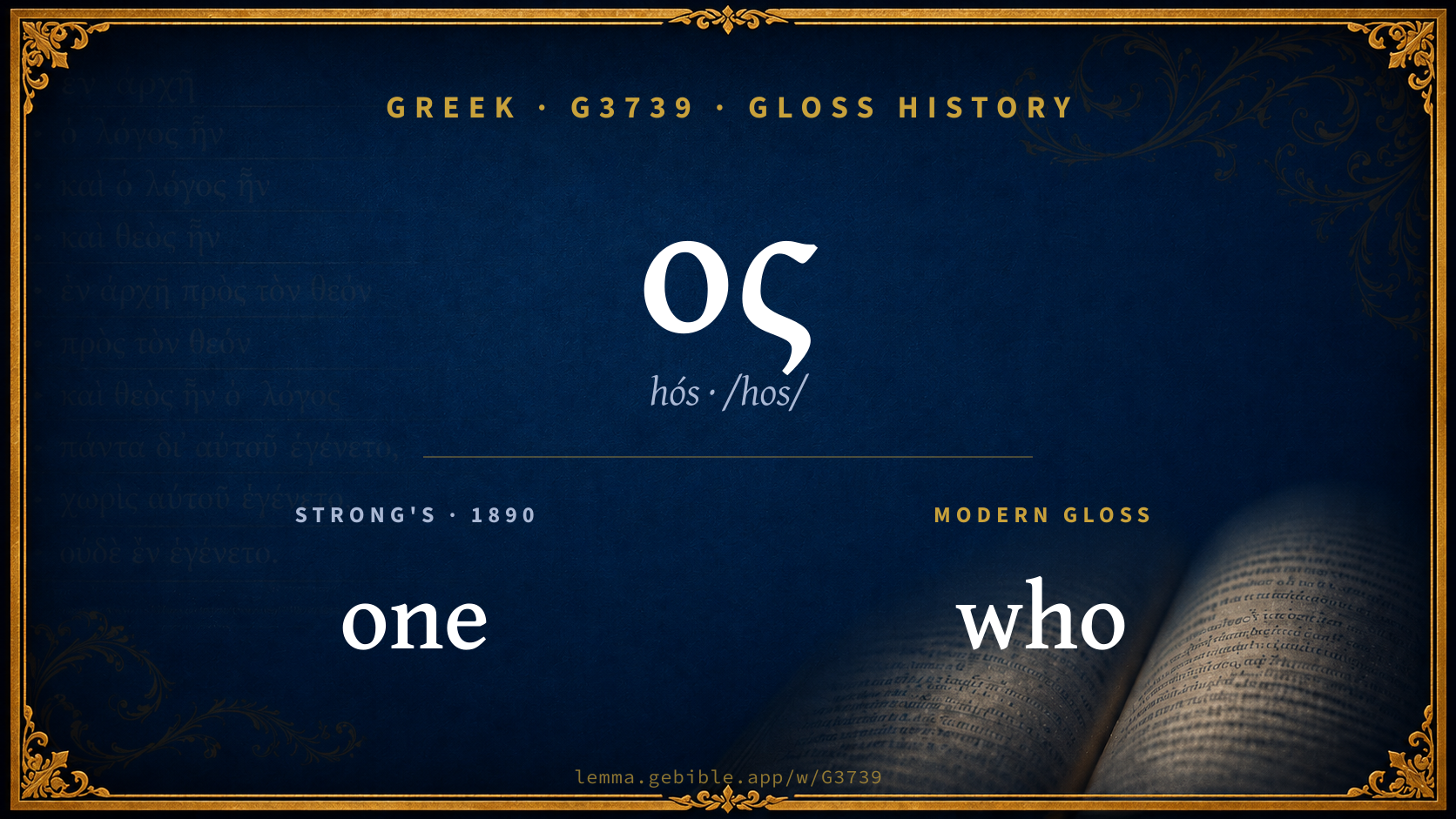
Gloss history
Strong's 1890 vs modern scholarship
About this word
Strong's G3739 catalogs a Greek word from the Greek New Testament.
These counts are not copied from any lexicon or concordance. They are computed here, from the morphology-tagged Greek New Testament. What Lemma adds →
- 1,225
- distinct verses
- The word appears in 1,225 distinct verses.
- 27 / 27
- NT books
- The word appears in 27 of 27 New Testament books.
- #12
- by frequency
- Top 25 most frequent Greek words (rank 12 of 5,347 Greek words by occurrence).
View all 1,225 occurrences in the concordance →
By section of the New Testament
By traditional corpus
Conventional, traditional groupings — biblical authorship is debated, so this is a traditional corpus grouping, not an authorship claim. Some books belong to more than one corpus (Luke is in both the Gospels and the Lukan corpus, and so on), so these shares overlap and need not total 100%. Each figure is a share of the word’s 1,225 distinct verses.
- Gospels 480 verses · 39%
- Lukan (Luke–Acts) 362 verses · 30%
- Pauline corpus 331 verses · 27%
- Johannine 235 verses · 19%
- General (Catholic) Epistles 81 verses · 7%
- Hebrews 69 verses · 6%
- Revelation 64 verses · 5%
How translations render this word
Counts come from each version’s own published word-to-Strong’s tagging or interlinear alignment — an approximate guide to how each version renders this word, not a word-level alignment the data otherwise carries. Because each total is that version’s own tagged count, the per-version totals vary from one another and need not match the appearance or distinct-verse counts above. These counts may also differ from a printed concordance because Lemma counts each distinctly tagged rendering and does not collapse phrase taggings into a single head-word total. This is a fixed set of word-tagged versions (KJV, ASV, BSB, ULT) and does not change with the reading translation you choose elsewhere. Each version’s license is shown beside its name below (and on Sources).
- King James Version: Which 394×, Whom 256×, That 126×
- American Standard Version: Which 325×, Whom 247×, That 139×
- Berean Standard Bible: Whom 124×, Which 116×, What 114×
- unfoldingWord Literal Text: Which 272×, Whom 262×, That 227×
King James Version Public Domain
Renders G3739 across 1,256 tagged occurrences — most commonly:
Plus other, less common renderings. Plus 47 renderings that appear only once — usually multi-word phrases or single function words the recovered tagging swept in, not distinct renderings. Not rendered by a distinct English word in 147 further occurrences.
American Standard Version Public Domain
Renders G3739 across 1,259 tagged occurrences — most commonly:
Plus other, less common renderings. Plus 91 renderings that appear only once — usually multi-word phrases or single function words the recovered tagging swept in, not distinct renderings. Not rendered by a distinct English word in 3 further occurrences.
Berean Standard Bible Public Domain
Renders G3739 across 866 tagged occurrences — most commonly:
Plus other, less common renderings. Plus 50 renderings that appear only once — usually multi-word phrases or single function words the recovered tagging swept in, not distinct renderings. Not rendered by a distinct English word in 496 further occurrences.
unfoldingWord Literal Text CC BY-SA 4.0
Renders G3739 across 1,431 tagged occurrences — most commonly:
Plus other, less common renderings. Plus 25 renderings that appear only once — usually multi-word phrases or single function words the recovered tagging swept in, not distinct renderings.
Senses in Thayer's
The 1 sense Thayer's distinguishes for this word, in lexicon order (not ranked by frequency or importance). The full entry — with sub-senses — is in the Lexicon Entry tab.
- who, which, what, that Wigram's count is 1309 not 1393.
Word origin
Derived from ο (ho) (G3588).
Forms in the corpus
The 25 distinct written forms G3739 takes in the Greek New Testament, most frequent first — each parse links to that case’s occurrences in the concordance.
Same root — word family
Other Thayer's entries built from the same root as G3739, grouped by Strong’s listed origin. These share a root / origin per the lexicon — not necessarily a shared meaning. Each links to that word’s own entry.
Derives from
Shares the same root
- τανυν tanŷn G3569 present
- οδε hóde G3592 this
- οιος hoîos G3634 what sort of
- ουτος hoûtos G3778 this
- σημερον sḗmeron G4594 this day
- ταυτα tautá G5024 thus
- τηλικουτος tēlikoûtos G5082 of such size
- τοι toí G5104 truly
- τοσουτος tosoûtos G5118 so great
- τοτε tóte G5119 then
- του toû G5120 his
- τουναντιον tounantíon G5121 on the contrary
- τουνομα toúnoma G5122 by name
Derived from this word
- ο εστι hó esti G3603 which is
- οθεν hóthen G3606 from which
- οποιος hopoîos G3697 what sort
- οποτε hopóte G3698 when
- οπου hópou G3699 where
- οπως hópōs G3704 how
- οσακις hosákis G3740 as often as
- οσος hósos G3745 how much
- οσπερ hósper G3746 whomever
- οστις hóstis G3748 whoever
- οτε hóte G3753 when
- ου hoû G3757 where
- ποσος pósos G4214 how much
- ως hōs G5613 as
Proper names from this root
People and places named from this root — a name, not an additional meaning of the word.
- θεος theós G2316 God
- ο ων και ο ην και ο ερχομενος ho ṑn kaí ho ēn kaí ho erchómenos G3801 He who is
Compare all same-root words → Showing 4 of 31 — not the complete family. 2 of the same-root words are proper names (people or places). They share a root, not necessarily a meaning.
Septuagint usage
The same Greek word ος appears 3,959 times in the Greek Old Testament (Septuagint), across 3,406 verses in 38 books.
- 3,959
- LXX occurrences
- Tagged occurrences of this Greek word in the Septuagint.
- 3,406
- verses
- Distinct Septuagint verses containing this word.
- 38 / 39
- OT books
- The word appears in 38 of the 39 Old Testament books.
Sample Septuagint occurrences
- Genesis 1:7 ὅς
- Exodus 1:8 ὅς
- Leviticus 2:8 ὅς
- Numbers 1:19 ὅς
- Deuteronomy 1:1 ὅς
- Joshua 1:2 ὅς
- Judges 1:12 ὅς
- Ruth 1:13 ὅς
- 1 Samuel 1:15 ὅς
- 2 Samuel 2:10 ὅς
- 1 Kings 1:9 ὅς
- 2 Kings 1:4 ὅς
Septuagint occurrences (same lexeme)
Every verse where the same Strong’s number (G3739) appears in the Greek Septuagint — showing the first 50 of 3,406. Verse text shown in the World English Bible for context; the Greek form is the matched word — the English is not keyword-highlighted.
- Genesis 1:7 ὅς God made the expanse, and divided the waters which were under the expanse from the waters which were above the expanse, and it was so.
- Genesis 1:11 ὅς God said, "Let the earth put forth grass, herbs yielding seed, and fruit trees bearing fruit after their kind, with its seed in it, on the earth," and it was so.
- Genesis 1:12 ὅς The earth brought forth grass, herbs yielding seed after their kind, and trees bearing fruit, with its seed in it, after their kind: and God saw that it was good.
- Genesis 1:21 ὅς God created the large sea creatures, and every living creature that moves, with which the waters swarmed, after their kind, and every winged bird after its kind. God saw that it was good.
- Genesis 1:29 ὅς God said, "Behold, I have given you every herb yielding seed, which is on the surface of all the earth, and every tree, which bears fruit yielding seed. It will be your food.
- Genesis 1:30 ὅς To every animal of the earth, and to every bird of the sky, and to everything that creeps on the earth, in which there is life, I have given every green herb for food." And it was so.
- Genesis 2:2 ὅς On the seventh day God finished his work which he had made; and he rested on the seventh day from all his work which he had made.
- Genesis 2:3 ὅς God blessed the seventh day, and made it holy, because he rested in it from all his work which he had created and made.
- Genesis 2:4 ὅς This is the history of the generations of the heavens and of the earth when they were created, in the day that Yahweh God made earth and the heavens.
- Genesis 2:8 ὅς Yahweh God planted a garden eastward, in Eden, and there he put the man whom he had formed.
- Genesis 2:11 ὅς The name of the first is Pishon: this is the one which flows through the whole land of Havilah, where there is gold;
- Genesis 2:15 ὅς Yahweh God took the man, and put him into the garden of Eden to dress it and to keep it.
- Genesis 2:17 ὅς but of the tree of the knowledge of good and evil, you shall not eat of it: for in the day that you eat of it you will surely die."
- Genesis 2:19 ὅς Out of the ground Yahweh God formed every animal of the field, and every bird of the sky, and brought them to the man to see what he would call them. Whatever the man called every living creature, that was its name.
- Genesis 2:22 ὅς He made the rib, which Yahweh God had taken from the man, into a woman, and brought her to the man.
- Genesis 2:25 ὅς They were both naked, the man and his wife, and were not ashamed.
- Genesis 3:1 ὅς Now the serpent was more subtle than any animal of the field which Yahweh God had made. He said to the woman, "Yes, has God said, 'You shall not eat of any tree of the garden?'"
- Genesis 3:3 ὅς but of the fruit of the tree which is in the midst of the garden, God has said, 'You shall not eat of it, neither shall you touch it, lest you die.'"
- Genesis 3:5 ὅς for God knows that in the day you eat it, your eyes will be opened, and you will be like God, knowing good and evil."
- Genesis 3:8 ὅς They heard the voice of Yahweh God walking in the garden in the cool of the day, and the man and his wife hid themselves from the presence of Yahweh God among the trees of the garden.
- Genesis 3:11 ὅς God said, "Who told you that you were naked? Have you eaten from the tree that I commanded you not to eat from?"
- Genesis 3:12 ὅς The man said, "The woman whom you gave to be with me, she gave me of the tree, and I ate."
- Genesis 3:17 ὅς To Adam he said, "Because you have listened to your wife's voice, and have eaten of the tree, of which I commanded you, saying, 'You shall not eat of it,' cursed is the ground for your sake. In toil you will eat of it all the days of your life.
- Genesis 3:19 ὅς By the sweat of your face will you eat bread until you return to the ground, for out of it you were taken. For you are dust, and to dust you shall return."
- Genesis 3:23 ὅς Therefore Yahweh God sent him forth from the garden of Eden, to till the ground from whence he was taken.
- Genesis 4:11 ὅς Now you are cursed because of the ground, which has opened its mouth to receive your brother's blood from your hand.
- Genesis 4:25 ὅς Adam knew his wife again. She gave birth to a son, and named him Seth. For, she said, "God has appointed me another child instead of Abel, for Cain killed him."
- Genesis 5:1 ὅς This is the book of the generations of Adam. In the day that God created man, he made him in God's likeness.
- Genesis 5:2 ὅς He created them male and female, and blessed them, and called their name Adam, in the day when they were created.
- Genesis 5:5 ὅς All the days that Adam lived were nine hundred thirty years, then he died.
- Genesis 5:27 ὅς All the days of Methuselah were nine hundred sixty-nine years, then he died.
- Genesis 5:29 ὅς and he named him Noah, saying, "This same will comfort us in our work and in the toil of our hands, because of the ground which Yahweh has cursed."
- Genesis 6:2 ὅς that God's sons saw that men's daughters were beautiful, and they took for themselves wives of all that they chose.
- Genesis 6:7 ὅς Yahweh said, "I will destroy man whom I have created from the surface of the ground; man, along with animals, creeping things, and birds of the sky; for I am sorry that I have made them."
- Genesis 6:17 ὅς I, even, I do bring the flood of waters on this earth, to destroy all flesh having the breath of life from under the sky. Everything that is in the earth will die.
- Genesis 6:21 ὅς Take with you of all food that is eaten, and gather it to you; and it will be for food for you, and for them."
- Genesis 7:4 ὅς In seven days, I will cause it to rain on the earth for forty days and forty nights. Every living thing that I have made, I will destroy from the surface of the ground."
- Genesis 7:15 ὅς They went to Noah into the ark, by pairs of all flesh with the breath of life in them.
- Genesis 7:19 ὅς The waters prevailed exceedingly on the earth. All the high mountains that were under the whole sky were covered.
- Genesis 7:22 ὅς All in whose nostrils was the breath of the spirit of life, of all that was on the dry land, died.
- Genesis 7:23 ὅς Every living thing was destroyed that was on the surface of the ground, including man, cattle, creeping things, and birds of the sky. They were destroyed from the earth. Only Noah was left, and those who were with him in the ark.
- Genesis 8:6 ὅς It happened at the end of forty days, that Noah opened the window of the ark which he had made,
- Genesis 8:13 ὅς It happened in the six hundred first year, in the first month, the first day of the month, the waters were dried up from off the earth. Noah removed the covering of the ark, and looked. He saw that the surface of the ground was dried.
- Genesis 9:3 ὅς Every moving thing that lives will be food for you. As the green herb, I have given everything to you.
- Genesis 9:12 ὅς God said, "This is the token of the covenant which I make between me and you and every living creature that is with you, for perpetual generations:
- Genesis 9:15 ὅς and I will remember my covenant, which is between me and you and every living creature of all flesh, and the waters will no more become a flood to destroy all flesh.
- Genesis 9:16 ὅς The rainbow will be in the cloud. I will look at it, that I may remember the everlasting covenant between God and every living creature of all flesh that is on the earth."
- Genesis 9:17 ὅς God said to Noah, "This is the token of the covenant which I have established between me and all flesh that is on the earth."
- Genesis 11:4 ὅς They said, "Come, let's build us a city, and a tower, whose top reaches to the sky, and let's make us a name; lest we be scattered abroad on the surface of the whole earth."
- Genesis 11:5 ὅς Yahweh came down to see the city and the tower, which the children of men built.
These are occurrences of the same Greek lexeme (G3739) in the Septuagint — not a translation of any one Hebrew word. The store carries no word-level Hebrew↔Greek alignment, so no Hebrew original is asserted here. Counts come from the recovered LXX Strong's tagging — high-frequency vocabulary is well covered, while rare or late forms may be untagged — so they reflect tagged occurrences and may slightly undercount.