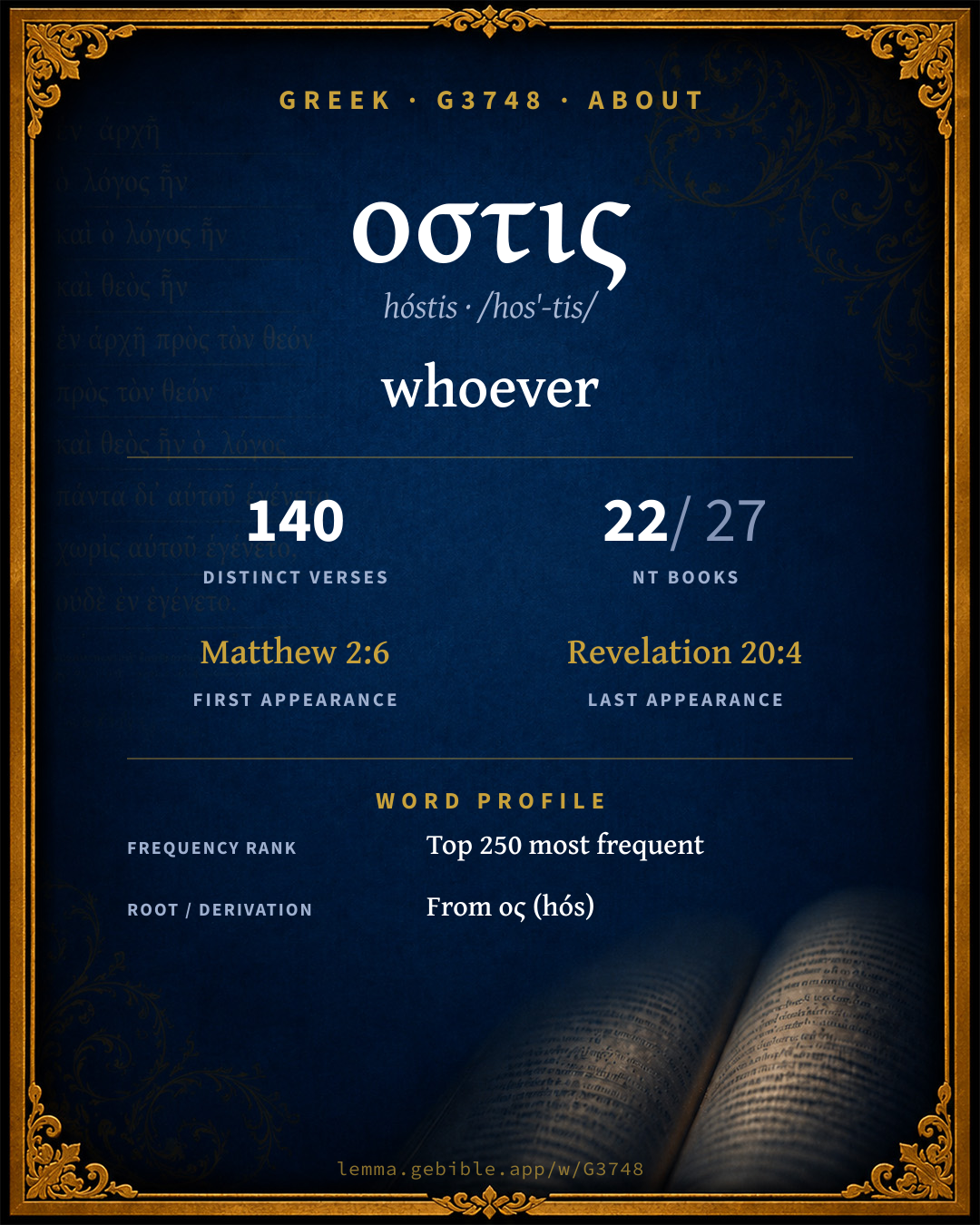
οστις
whoever
Full lexicon entry — Thayer's Greek Lexicon
From Thayer's Greek Lexicon
Where this word appears
See every Nominative-case word in the Greek New Testament →
Grammar key — what these labels mean
Part of speech
- Relative pronoun
- Introduces a relative clause (“who,” “which,” “that”).
Case
- Nominative
- The case of the subject (and the predicate nominative).
- Genitive
- The case of source, possession, or “of” — answers “whose / from what.”
Gender
- Masculine
- Grammatically masculine.
- Feminine
- Grammatically feminine.
- Neuter
- Grammatically neuter.
Number
- Plural
- More than one.
- Singular
- One.
Grammatical forms
- Relative pronoun, Nominative, Plural, Masculine 60 times (41%)
- Relative pronoun, Nominative, Singular, Feminine 38 times (26%)
- Relative pronoun, Nominative, Singular, Masculine 27 times (18%)
- Relative pronoun, Nominative, Plural, Feminine 10 times (7%)
- Relative pronoun, Genitive, Singular, Neuter, Attic form 7 times (5%)
- Relative pronoun, Nominative, Plural, Neuter 4 times (3%)
Parsed forms decoded from the imported morphology (Robinson–Tischendorf, public domain), counted across 146 parsed occurrences — not distinct verses.
Every verse where G3748 appears — 140 distinct verses across 22 books. Click any verse to open its interlinear word-by-word view. Verse text shown in the World English Bible for context — . Each verse’s Greek form is shown with its reference; the English is not keyword-highlighted, since the data carries no word-level English alignment. Use “Compare translations” on any verse to read it across multiple English versions. This concordance covers the Greek New Testament; Septuagint (Greek Old Testament) occurrences of this word are not indexed here.
Matthew 25 verses
- Matthew 2:6 ὅστις rel.pron nom sg masc 'You Bethlehem, land of Judah, Are in no way least among the princes of Judah: For out of you shall come forth a governor, Who shall shepherd my people, Israel.'"
- Matthew 5:25 ὅτου rel.pron gen sg neut attic Agree with your adversary quickly, while you are with him in the way; lest perhaps the prosecutor deliver you to the judge, and the judge deliver you to the officer, and you be cast into prison.
- Matthew 5:39 ὅστις rel.pron nom sg masc But I tell you, don't resist him who is evil; but whoever strikes you on your right cheek, turn to him the other also.
- Matthew 5:41 ὅστις rel.pron nom sg masc Whoever compels you to go one mile, go with him two.
- Matthew 7:15 οἵτινες rel.pron nom pl masc "Beware of false prophets, who come to you in sheep's clothing, but inwardly are ravening wolves.
- Matthew 7:24 ὅστις ὅστις rel.pron nom sg masc rel.pron nom sg masc "Everyone therefore who hears these words of mine, and does them, I will liken him to a wise man, who built his house on a rock.
- Matthew 7:26 ὅστις rel.pron nom sg masc Everyone who hears these words of mine, and doesn't do them will be like a foolish man, who built his house on the sand.
- Matthew 10:32 ὅστις rel.pron nom sg masc Everyone therefore who confesses me before men, him I will also confess before my Father who is in heaven.
- Matthew 10:33 ὅστις rel.pron nom sg masc But whoever denies me before men, him I will also deny before my Father who is in heaven.
- Matthew 12:50 ὅστις rel.pron nom sg masc For whoever does the will of my Father who is in heaven, he is my brother, and sister, and mother."
- Matthew 13:12 ὅστις ὅστις rel.pron nom sg masc rel.pron nom sg masc For whoever has, to him will be given, and he will have abundance, but whoever doesn't have, from him will be taken away even that which he has.
- Matthew 13:52 ὅστις rel.pron nom sg masc He said to them, "Therefore, every scribe who has been made a disciple in the Kingdom of Heaven is like a man who is a householder, who brings out of his treasure new and old things."
- Matthew 16:28 οἵτινες rel.pron nom pl masc Most assuredly I tell you, there are some standing here who will in no way taste of death, until they see the Son of Man coming in his Kingdom."
- Matthew 18:4 ὅστις rel.pron nom sg masc Whoever therefore humbles himself as this little child, the same is the greatest in the Kingdom of Heaven.
- Matthew 19:12 οἵτινες οἵτινες οἵτινες rel.pron nom pl masc rel.pron nom pl masc rel.pron nom pl masc For there are eunuchs who were born that way from their mother's womb, and there are eunuchs who were made eunuchs by men; and there are eunuchs who made themselves eunuchs for the Kingdom of Heaven's sake. He who is able to receive it, let him receive it."
- Matthew 19:29 ὅστις rel.pron nom sg masc Everyone who has left houses, or brothers, or sisters, or father, or mother, or wife, or children, or lands, for my name's sake, will receive one hundred times, and will inherit eternal life.
- Matthew 20:1 ὅστις rel.pron nom sg masc "For the Kingdom of Heaven is like a man who was the master of a household, who went out early in the morning to hire laborers for his vineyard.
- Matthew 21:33 ὅστις rel.pron nom sg masc "Hear another parable. There was a man who was a master of a household, who planted a vineyard, set a hedge about it, dug a winepress in it, built a tower, leased it out to farmers, and went into another country.
- Matthew 21:41 οἵτινες rel.pron nom pl masc They told him, "He will miserably destroy those miserable men, and will lease out the vineyard to other farmers, who will give him the fruit in its season."
- Matthew 22:2 ὅστις rel.pron nom sg masc "The Kingdom of Heaven is like a certain king, who made a marriage feast for his son,
- Matthew 23:12 ὅστις ὅστις rel.pron nom sg masc rel.pron nom sg masc Whoever exalts himself will be humbled, and whoever humbles himself will be exalted.
- Matthew 23:27 οἵτινες rel.pron nom pl masc "Woe to you, scribes and Pharisees, hypocrites! For you are like whitened tombs, which outwardly appear beautiful, but inwardly are full of dead men's bones, and of all uncleanness.
- Matthew 25:1 αἵτινες rel.pron nom pl fem "Then the Kingdom of Heaven will be like ten virgins, who took their lamps, and went out to meet the bridegroom.
- Matthew 27:55 αἵτινες rel.pron nom pl fem Many women were there watching from afar, who had followed Jesus from Galilee, serving him.
- Matthew 27:62 ἥτις rel.pron nom sg fem Now on the next day, which was the day after the Preparation Day, the chief priests and the Pharisees were gathered together to Pilate,
Mark 5 verses
- Mark 4:20 οἵτινες rel.pron nom pl masc These are those which were sown on the good ground: such as hear the word, and accept it, and bear fruit, some thirty times, some sixty times, and some one hundred times."
- Mark 8:34 ὅστις rel.pron nom sg masc He called the multitude to himself with his disciples, and said to them, "Whoever wants to come after me, let him deny himself, and take up his cross, and follow me.
- Mark 9:1 οἵτινες rel.pron nom pl masc He said to them, "Most assuredly I tell you, there are some standing here who will in no way taste death until they see the Kingdom of God come with power."
- Mark 12:18 οἵτινες rel.pron nom pl masc There came to him Sadducees, who say that there is no resurrection. They asked him, saying,
- Mark 15:7 οἵτινες rel.pron nom pl masc There was one called Barabbas, bound with those who had made insurrection, men who in the insurrection had committed murder.
Luke 22 verses
- Luke 1:20 οἵτινες rel.pron nom pl masc Behold, you will be silent and not able to speak, until the day that these things will happen, because you didn't believe my words, which will be fulfilled in their proper time."
- Luke 2:4 ἥτις rel.pron nom sg fem Joseph also went up from Galilee, out of the city of Nazareth, into Judea, to the city of David, which is called Bethlehem, because he was of the house and family of David;
- Luke 2:10 ἥτις rel.pron nom sg fem The angel said to them, "Don't be afraid, for behold, I bring you good news of great joy which will be to all the people.
- Luke 7:37 ἥτις rel.pron nom sg fem Behold, a woman in the city who was a sinner, when she knew that he was reclining in the Pharisee's house, she brought an alabaster jar of ointment.
- Luke 7:39 ἥτις rel.pron nom sg fem Now when the Pharisee who had invited him saw it, he said to himself, "This man, if he were a prophet, would have perceived who and what kind of woman this is who touches him, that she is a sinner."
- Luke 8:3 αἵτινες rel.pron nom pl fem and Joanna, the wife of Chuzas, Herod's steward; Susanna; and many others; who ministered to them from their possessions.
- Luke 8:15 οἵτινες rel.pron nom pl masc That in the good ground, these are such as in an honest and good heart, having heard the word, hold it tightly, and bring forth fruit with patience.
- Luke 8:26 ἥτις rel.pron nom sg fem They arrived at the country of the Gadarenes, which is opposite Galilee.
- Luke 8:43 ἥτις rel.pron nom sg fem A woman who had a flow of blood for twelve years, who had spent all her living on physicians, and could not be healed by any,
- Luke 9:30 οἵτινες rel.pron nom pl masc Behold, two men were talking with him, who were Moses and Elijah,
- Luke 10:42 ἥτις rel.pron nom sg fem but one thing is needed. Mary has chosen the good part, which will not be taken away from her."
- Luke 12:1 ἥτις rel.pron nom sg fem Meanwhile, when a multitude of many thousands had gathered together, so much so that they trampled on each other, he began to tell his disciples first of all, "Beware of the yeast of the Pharisees, which is hypocrisy.
- Luke 12:50 ὅτου rel.pron gen sg neut attic But I have a baptism to be baptized with, and how distressed I am until it is accomplished!
- Luke 13:8 ὅτου rel.pron gen sg neut attic He answered, 'Lord, leave it alone this year also, until I dig around it, and fertilize it.
- Luke 14:15 ὅστις rel.pron nom sg masc When one of those who sat at the table with him heard these things, he said to him, "Blessed is he who will feast in the Kingdom of God!"
- Luke 14:27 ὅστις rel.pron nom sg masc Whoever doesn't bear his own cross, and come after me, can't be my disciple.
- Luke 15:7 οἵτινες rel.pron nom pl masc I tell you that even so there will be more joy in heaven over one sinner who repents, than over ninety-nine righteous people who need no repentance.
- Luke 15:8 ὅτου rel.pron gen sg neut attic Or what woman, if she had ten drachma coins, if she lost one drachma coin, wouldn't light a lamp, sweep the house, and seek diligently until she found it?
- Luke 22:16 ὅτου rel.pron gen sg neut attic for I tell you, I will no longer by any means eat of it until it is fulfilled in the Kingdom of God."
- Luke 22:18 ὅτου rel.pron gen sg neut attic for I tell you, I will not drink at all again from the fruit of the vine, until the Kingdom of God comes."
- Luke 23:19 ὅστις rel.pron nom sg masc one who was thrown into prison for a certain revolt in the city, and for murder.
- Luke 23:55 αἵτινες rel.pron nom pl fem The women, who had come with him out of Galilee, followed after, and saw the tomb, and how his body was laid.
John 2 verses
- John 8:53 ὅστις rel.pron nom sg masc Are you greater than our father, Abraham, who died? The prophets died. Who do you make yourself out to be?"
- John 9:18 ὅτου rel.pron gen sg neut attic The Jews therefore did not believe concerning him, that he had been blind, and had received his sight, until they called the parents of him who had received his sight,
Acts 23 verses
- Acts 3:23 ἥτις rel.pron nom sg fem It will be, that every soul that will not listen to that prophet will be utterly destroyed from among the people.'
- Acts 5:16 οἵτινες rel.pron nom pl masc Multitudes also came together from the cities around Jerusalem, bringing sick people, and those who were tormented by unclean spirits: and they were all healed.
- Acts 7:53 οἵτινες rel.pron nom pl masc You received the law as it was ordained by angels, and didn't keep it!"
- Acts 8:15 οἵτινες rel.pron nom pl masc who, when they had come down, prayed for them, that they might receive the Holy Spirit;
- Acts 9:35 οἵτινες rel.pron nom pl masc All who lived at Lydda and in Sharon saw him, and they turned to the Lord.
- Acts 10:41 οἵτινες rel.pron nom pl masc not to all the people, but to witnesses who were chosen before by God, to us, who ate and drank with him after he rose from the dead.
- Acts 10:47 οἵτινες rel.pron nom pl masc "Can any man forbid the water, that these who have received the Holy Spirit as well as we should not be baptized?"
- Acts 11:20 οἵτινες rel.pron nom pl masc But there were some of them, men of Cyprus and Cyrene, who, when they had come to Antioch, spoke to the Greeks, preaching the Lord Jesus.
- Acts 11:28 ἥτις rel.pron nom sg fem One of them named Agabus stood up, and indicated by the Spirit that there should be a great famine all over the world, which also happened in the days of Claudius.
- Acts 12:10 ἥτις rel.pron nom sg fem When they were past the first and the second guard, they came to the iron gate that leads into the city, which opened to them by itself. They went out, and went down one street, and immediately the angel departed from him.
- Acts 13:31 οἵτινες rel.pron nom pl masc and he was seen for many days by those who came up with him from Galilee to Jerusalem, who are his witnesses to the people.
- Acts 13:43 οἵτινες rel.pron nom pl masc Now when the synagogue broke up, many of the Jews and of the devout proselytes followed Paul and Barnabas; who, speaking to them, urged them to continue in the grace of God.
- Acts 16:12 ἥτις rel.pron nom sg fem and from there to Philippi, which is a city of Macedonia, the foremost of the district, a Roman colony. We were staying some days in this city.
- Acts 16:16 ἥτις rel.pron nom sg fem It happened, as we were going to prayer, that a certain girl having a spirit of divination met us, who brought her masters much gain by fortune telling.
- Acts 16:17 οἵτινες rel.pron nom pl masc Following Paul and us, she cried out, "These men are servants of the Most High God, who proclaim to us the way of salvation!"
- Acts 17:10 οἵτινες rel.pron nom pl masc The brothers immediately sent Paul and Silas away by night to Beroea. When they arrived, they went into the Jewish synagogue.
- Acts 17:11 οἵτινες rel.pron nom pl masc Now these were more noble than those in Thessalonica, in that they received the word with all readiness of the mind, examining the Scriptures daily to see whether these things were so.
- Acts 21:4 οἵτινες rel.pron nom pl masc Having found disciples, we stayed there seven days. These said to Paul through the Spirit, that he should not go up to Jerusalem.
- Acts 23:14 οἵτινες rel.pron nom pl masc They came to the chief priests and the elders, and said, "We have bound ourselves under a great curse, to taste nothing until we have killed Paul.
- Acts 23:21 οἵτινες rel.pron nom pl masc Therefore don't yield to them, for more than forty men lie in wait for him, who have bound themselves under a curse neither to eat nor to drink until they have killed him. Now they are ready, looking for the promise from you."
- Acts 23:33 οἵτινες rel.pron nom pl masc When they came to Caesarea and delivered the letter to the governor, they also presented Paul to him.
- Acts 24:1 οἵτινες rel.pron nom pl masc After five days, the high priest, Ananias, came down with certain elders and an orator, one Tertullus. They informed the governor against Paul.
- Acts 28:18 οἵτινες rel.pron nom pl masc who, when they had examined me, desired to set me free, because there was no cause of death in me.
Romans 10 verses
- Romans 1:25 οἵτινες rel.pron nom pl masc who exchanged the truth of God for a lie, and worshiped and served the creature rather than the Creator, who is blessed forever. Amen.
- Romans 1:32 οἵτινες rel.pron nom pl masc who, knowing the ordinance of God, that those who practice such things are worthy of death, not only do the same, but also approve of those who practice them.
- Romans 2:15 οἵτινες rel.pron nom pl masc in that they show the work of the law written in their hearts, their conscience testifying with them, and their thoughts among themselves accusing or else excusing them)
- Romans 6:2 οἵτινες rel.pron nom pl masc May it never be! We who died to sin, how could we live in it any longer?
- Romans 9:4 οἵτινές rel.pron nom pl masc who are Israelites; whose is the adoption, the glory, the covenants, the giving of the law, the service, and the promises;
- Romans 11:4 οἵτινες rel.pron nom pl masc But how does God answer him? "I have reserved for myself seven thousand men, who have not bowed the knee to Baal."
- Romans 16:4 οἵτινες rel.pron nom pl masc who for my life, laid down their own necks; to whom not only I give thanks, but also all the assemblies of the Gentiles.
- Romans 16:6 ἥτις rel.pron nom sg fem Greet Mary, who labored much for us.
- Romans 16:7 οἵτινές rel.pron nom pl masc Greet Andronicus and Junias, my relatives and my fellow prisoners, who are notable among the apostles, who also were in Christ before me.
- Romans 16:12 ἥτις rel.pron nom sg fem Greet Tryphaena and Tryphosa, who labor in the Lord. Greet Persis, the beloved, who labored much in the Lord.
1 Corinthians 2 verses
- 1 Corinthians 3:17 οἵτινές rel.pron nom pl masc If anyone destroys the temple of God, God will destroy him; for God's temple is holy, which you are.
- 1 Corinthians 5:1 ἥτις rel.pron nom sg fem It is actually reported that there is sexual immorality among you, and such sexual immorality as is not even named among the Gentiles, that one has his father's wife.
2 Corinthians 2 verses
- 2 Corinthians 8:10 οἵτινες rel.pron nom pl masc I give a judgment in this: for this is expedient for you, who were the first to start a year ago, not only to do, but also to be willing.
- 2 Corinthians 9:11 ἥτις rel.pron nom sg fem you being enriched in everything to all liberality, which works through us thanksgiving to God.
Galatians 6 verses
- Galatians 2:4 οἵτινες rel.pron nom pl masc This was because of the false brothers secretly brought in, who stole in to spy out our liberty which we have in Christ Jesus, that they might bring us into bondage;
- Galatians 4:24 ἅτινά ἥτις rel.pron nom pl neut rel.pron nom sg fem These things contain an allegory, for these are two covenants. One is from Mount Sinai, bearing children to bondage, which is Hagar.
- Galatians 4:26 ἥτις rel.pron nom sg fem But the Jerusalem that is above is free, which is the mother of us all.
- Galatians 5:4 οἵτινες rel.pron nom pl masc You are alienated from Christ, you who desire to be justified by the law. You have fallen away from grace.
- Galatians 5:10 ὅστις rel.pron nom sg masc I have confidence toward you in the Lord that you will think no other way. But he who troubles you will bear his judgment, whoever he is.
- Galatians 5:19 ἅτινά rel.pron nom pl neut Now the works of the flesh are obvious, which are: adultery, sexual immorality, uncleanness, lustfulness,
Ephesians 4 verses
- Ephesians 1:23 ἥτις rel.pron nom sg fem which is his body, the fullness of him who fills all in all.
- Ephesians 3:13 ἥτις rel.pron nom sg fem Therefore I ask that you may not lose heart at my troubles for you, which are your glory.
- Ephesians 4:19 οἵτινες rel.pron nom pl masc who having become callous gave themselves up to lust, to work all uncleanness with greediness.
- Ephesians 6:2 ἥτις rel.pron nom sg fem "Honor your father and mother," which is the first commandment with a promise:
Philippians 4 verses
- Philippians 1:28 ἥτις rel.pron nom sg fem and in nothing frightened by the adversaries, which is for them a proof of destruction, but to you of salvation, and that from God.
- Philippians 2:20 ὅστις rel.pron nom sg masc For I have no one else like-minded, who will truly care about you.
- Philippians 3:7 ἅτινα rel.pron nom pl neut However, what things were gain to me, these have I counted loss for Christ.
- Philippians 4:3 αἵτινες rel.pron nom pl fem Yes, I beg you also, true yoke-fellow, help these women, for they labored with me in the Gospel, with Clement also, and the rest of my fellow workers, whose names are in the book of life.
Colossians 3 verses
- Colossians 2:23 ἅτινά rel.pron nom pl neut Which things indeed appear like wisdom in self-imposed worship, and humility, and severity to the body; but aren't of any value against the indulgence of the flesh.
- Colossians 3:5 ἥτις rel.pron nom sg fem Put to death therefore your members which are on the earth: sexual immorality, uncleanness, depraved passion, evil desire, and covetousness, which is idolatry;
- Colossians 4:11 οἵτινες rel.pron nom pl masc and Jesus who is called Justus, who are of the circumcision. These are my only fellow workers for the Kingdom of God, men who have been a comfort to me.
2 Thessalonians 1 verse
1 Timothy 3 verses
- 1 Timothy 1:4 αἵτινες rel.pron nom pl fem neither to pay attention to myths and endless genealogies, which cause disputes, rather than God's stewardship, which is in faith--
- 1 Timothy 3:15 ἥτις rel.pron nom sg fem but if I wait long, that you may know how men ought to behave themselves in the house of God, which is the assembly of the living God, the pillar and ground of the truth.
- 1 Timothy 6:9 αἵτινες rel.pron nom pl fem But those who are determined to be rich fall into a temptation and a snare and many foolish and harmful lusts, such as drown men in ruin and destruction.
2 Timothy 3 verses
- 2 Timothy 1:5 ἥτις rel.pron nom sg fem having been reminded of the unfeigned faith that is in you; which lived first in your grandmother Lois, and your mother Eunice, and, I am persuaded, in you also.
- 2 Timothy 2:2 οἵτινες rel.pron nom pl masc The things which you have heard from me among many witnesses, commit the same to faithful men, who will be able to teach others also.
- 2 Timothy 2:18 οἵτινες rel.pron nom pl masc men who have erred concerning the truth, saying that the resurrection is already past, and overthrowing the faith of some.
Titus 1 verse
Hebrews 10 verses
- Hebrews 2:3 ἥτις rel.pron nom sg fem how will we escape if we neglect so great a salvation-- which at the first having been spoken through the Lord, was confirmed to us by those who heard;
- Hebrews 8:5 οἵτινες rel.pron nom pl masc who serve a copy and shadow of the heavenly things, even as Moses was warned by God when he was about to make the tabernacle, for he said, "See, you shall make everything according to the pattern that was shown to you on the mountain."
- Hebrews 8:6 ἥτις rel.pron nom sg fem But now he has obtained a more excellent ministry, by so much as he is also the mediator of a better covenant, which has been enacted on better promises.
- Hebrews 9:2 ἥτις rel.pron nom sg fem For there was a tabernacle prepared. In the first part were the lampstand, the table, and the show bread; which is called the Holy Place.
- Hebrews 9:9 ἥτις rel.pron nom sg fem which is a symbol of the present age, where gifts and sacrifices are offered that are incapable, concerning the conscience, of making the worshipper perfect;
- Hebrews 10:8 αἵτινες rel.pron nom pl fem Previously saying, "Sacrifices and offerings and whole burnt offerings and sacrifices for sin you didn't desire, neither had pleasure in them" (those which are offered according to the law),
- Hebrews 10:11 αἵτινες rel.pron nom pl fem Every priest indeed stands day by day ministering and often offering the same sacrifices, which can never take away sins,
- Hebrews 10:35 ἥτις rel.pron nom sg fem Therefore don't throw away your boldness, which has a great reward.
- Hebrews 12:5 ἥτις rel.pron nom sg fem and you have forgotten the exhortation which reasons with you as with children, "My son, don't take lightly the chastening of the Lord, Nor faint when you are reproved by him;
- Hebrews 13:7 οἵτινες rel.pron nom pl masc Remember your leaders, men who spoke to you the word of God, and considering the results of their conduct, imitate their faith.
James 2 verses
- James 2:10 ὅστις rel.pron nom sg masc For whoever shall keep the whole law, and yet stumble in one point, he has become guilty of all.
- James 4:14 οἵτινες rel.pron nom pl masc Whereas you don't know what your life will be like tomorrow. For what is your life? For you are a vapor, that appears for a little time, and then vanishes away.
1 Peter 1 verse
2 Peter 1 verse
1 John 1 verse
Revelation 9 verses
- Revelation 1:7 οἵτινες rel.pron nom pl masc Behold, he is coming with the clouds, and every eye will see him, including those who pierced him. All the tribes of the earth will mourn over him. Even so, Amen.
- Revelation 1:12 ἥτις rel.pron nom sg fem I turned to see the voice that spoke with me. Having turned, I saw seven golden lampstands.
- Revelation 2:24 οἵτινες rel.pron nom pl masc But to you I say, to the rest who are in Thyatira, as many as don't have this teaching, who don't know what some call 'the deep things of Satan,' to you I say, I am not putting any other burden on you.
- Revelation 9:4 οἵτινες rel.pron nom pl masc They were told that they should not hurt the grass of the earth, neither any green thing, neither any tree, but only those people who don't have God's seal on their foreheads.
- Revelation 11:8 ἥτις rel.pron nom sg fem Their dead bodies will be in the street of the great city, which spiritually is called Sodom and Egypt, where also their Lord was crucified.
- Revelation 12:13 ἥτις rel.pron nom sg fem When the dragon saw that he was thrown down to the earth, he persecuted the woman who gave birth to the male child.
- Revelation 17:12 οἵτινες rel.pron nom pl masc The ten horns that you saw are ten kings who have received no kingdom as yet, but they receive authority as kings, with the beast, for one hour.
- Revelation 19:2 ἥτις rel.pron nom sg fem for true and righteous are his judgments. For he has judged the great prostitute, who corrupted the earth with her sexual immorality, and he has avenged the blood of his servants at her hand."
- Revelation 20:4 οἵτινες rel.pron nom pl masc I saw thrones, and they sat on them, and judgment was given to them. I saw the souls of those who had been beheaded for the testimony of Jesus, and for the word of God, and such as didn't worship the beast nor his image, and didn't receive the mark on their forehead and on their hand. They lived, and reigned with Christ for the thousand years.
About this entry
At a glance — auto-summarized from this page’s data, not written by a person. Every figure links to its source below. This summary describes the numbers; it doesn’t interpret them.
The Greek word οστις centers on the idea of “whoever.” Debuting at Matthew 2:6, it then recurs through the corpus. Spanning 140 verses in 22 books, it ranks among the common words of the Greek New Testament. Sharing its root, it stands alongside ος, ο εστι and οθεν. Dig into 140-verse concordance and the renderings breakdown below.
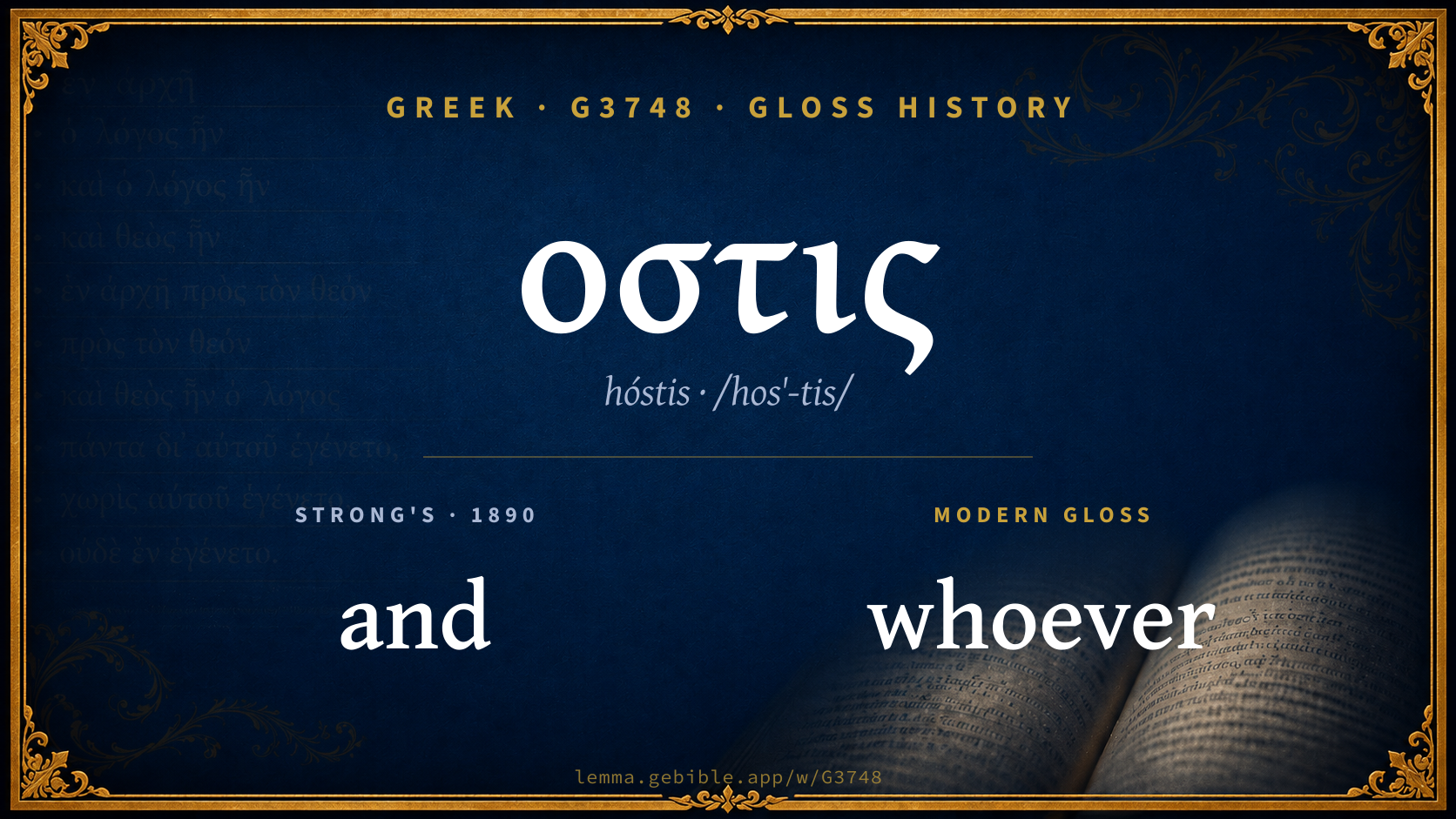
Gloss history
Strong's 1890 vs modern scholarship
About this word
Strong's G3748 catalogs a Greek word from the Greek New Testament.
These counts are not copied from any lexicon or concordance. They are computed here, from the morphology-tagged Greek New Testament. What Lemma adds →
- 140
- distinct verses
- The word appears in 140 distinct verses.
- 22 / 27
- NT books
- The word appears in 22 of 27 New Testament books.
- #111
- by frequency
- Top 250 most frequent Greek words (rank 111 of 5,347 Greek words by occurrence).
View all 140 occurrences in the concordance →
By section of the New Testament
By traditional corpus
Conventional, traditional groupings — biblical authorship is debated, so this is a traditional corpus grouping, not an authorship claim. Some books belong to more than one corpus (Luke is in both the Gospels and the Lukan corpus, and so on), so these shares overlap and need not total 100%. Each figure is a share of the word’s 140 distinct verses.
- Gospels 54 verses · 39%
- Lukan (Luke–Acts) 45 verses · 32%
- Pauline corpus 39 verses · 28%
- Johannine 12 verses · 9%
- Hebrews 10 verses · 7%
- Revelation 9 verses · 6%
- General (Catholic) Epistles 5 verses · 4%
How translations render this word
Counts come from each version’s own published word-to-Strong’s tagging or interlinear alignment — an approximate guide to how each version renders this word, not a word-level alignment the data otherwise carries. Because each total is that version’s own tagged count, the per-version totals vary from one another and need not match the appearance or distinct-verse counts above. These counts may also differ from a printed concordance because Lemma counts each distinctly tagged rendering and does not collapse phrase taggings into a single head-word total. This is a fixed set of word-tagged versions (KJV, ASV, BSB, ULT) and does not change with the reading translation you choose elsewhere. Each version’s license is shown beside its name below (and on Sources).
- King James Version: Which 79×, Who 30×, Whosoever 12×
- American Standard Version: Who 46×, Which 34×, That 10×
- Berean Standard Bible: Who 42×, Which 13×, Whoever 10×
- unfoldingWord Literal Text: Who 76×, Which 31×, Whoever 15×
King James Version Public Domain
Renders G3748 across 149 tagged occurrences — most commonly:
Plus 10 renderings that appear only once — usually multi-word phrases or single function words the recovered tagging swept in, not distinct renderings. Not rendered by a distinct English word in 4 further occurrences.
American Standard Version Public Domain
Renders G3748 across 135 tagged occurrences — most commonly:
Plus 17 renderings that appear only once — usually multi-word phrases or single function words the recovered tagging swept in, not distinct renderings.
Berean Standard Bible Public Domain
Renders G3748 across 84 tagged occurrences — most commonly:
Plus 7 renderings that appear only once — usually multi-word phrases or single function words the recovered tagging swept in, not distinct renderings. Not rendered by a distinct English word in 52 further occurrences.
unfoldingWord Literal Text CC BY-SA 4.0
Renders G3748 across 147 tagged occurrences — most commonly:
Plus 7 renderings that appear only once — usually multi-word phrases or single function words the recovered tagging swept in, not distinct renderings.
Senses in Thayer's
The 1 sense Thayer's distinguishes for this word, in lexicon order (not ranked by frequency or importance). The full entry — with sub-senses — is in the Lexicon Entry tab.
- whoever, whatever, who
Word origin
Derived from ος (hós) (G3739) — who.
Forms in the corpus
The 8 distinct written forms G3748 takes in the Greek New Testament, most frequent first — each parse links to that case’s occurrences in the concordance.
| Form | Parsing | Example | Uses |
|---|---|---|---|
| οἵτινες hoítines | Relative pronoun, Nominative, Plural, Masculine | Matthew 7:15 | 57 |
| ἥτις hḗtis | Relative pronoun, Nominative, Singular, Feminine | Matthew 27:62 | 38 |
| ὅστις hóstis | Relative pronoun, Nominative, Singular, Masculine | Matthew 2:6 | 27 |
| αἵτινες haítines | Relative pronoun, Nominative, Plural, Feminine | Matthew 25:1 | 10 |
| ὅτου hótou | Relative pronoun, Genitive, Singular, Neuter, Attic form | Matthew 5:25 | 7 |
| οἵτινές hoítinés | Relative pronoun, Nominative, Plural, Masculine | Romans 9:4 | 3 |
| ἅτινά hátiná | Relative pronoun, Nominative, Plural, Neuter | Galatians 4:24 | 3 |
| ἅτινα hátina | Relative pronoun, Nominative, Plural, Neuter | Philippians 3:7 | 1 |
Same root — word family
Other Thayer's entries built from the same root as G3748, grouped by Strong’s listed origin. These share a root / origin per the lexicon — not necessarily a shared meaning. Each links to that word’s own entry.
Derives from
Shares the same root
- ο εστι hó esti G3603 which is
- οθεν hóthen G3606 from which
- οποιος hopoîos G3697 what sort
- οποτε hopóte G3698 when
- οπου hópou G3699 where
- οπως hópōs G3704 how
- οσακις hosákis G3740 as often as
- οσος hósos G3745 how much
- οσπερ hósper G3746 whomever
- οτε hóte G3753 when
- ου hoû G3757 where
- ποσος pósos G4214 how much
- ως hōs G5613 as
Derived from this word
Compare all same-root words → Showing 4 of 17 — not the complete family. They share a root, not necessarily a meaning.
Septuagint usage
The same Greek word οστις appears 100 times in the Greek Old Testament (Septuagint), across 94 verses in 20 books.
- 100
- LXX occurrences
- Tagged occurrences of this Greek word in the Septuagint.
- 94
- verses
- Distinct Septuagint verses containing this word.
- 20 / 39
- OT books
- The word appears in 20 of the 39 Old Testament books.
Sample Septuagint occurrences
- Exodus 9:18 ὅστις
- Leviticus 5:2 ὅστις
- Numbers 1:5 ὅστις
- Deuteronomy 1:39 ὅστις
- Joshua 1:18 ὅστις
- Judges 10:18 ὅστις
- 1 Samuel 22:3 ὅστις
- 1 Kings 10:7 ὅστις
- 2 Kings 2:17 ὅστις
- Ezra 14:5 ὅστις
- Esther 7:5 ὅστις
- Job 6:16 ὅστις
Septuagint occurrences (same lexeme)
Every verse where the same Strong’s number (G3748) appears in the Greek Septuagint — showing the first 50 of 94. Verse text shown in the World English Bible for context; the Greek form is the matched word — the English is not keyword-highlighted.
- Exodus 9:18 ὅστις Behold, tomorrow about this time I will cause it to rain a very grievous hail, such as has not been in Egypt since the day it was founded even until now.
- Exodus 9:24 ὅστις So there was very severe hail, and lightning mixed with the hail, such as had not been in all the land of Egypt since it became a nation.
- Exodus 11:6 ὅστις There shall be a great cry throughout all the land of Egypt, such as there has not been, nor shall be any more.
- Exodus 20:2 ὅστις "I am Yahweh your God, who brought you out of the land of Egypt, out of the house of bondage.
- Exodus 32:4 ὅστις He received what they handed him, and fashioned it with an engraving tool, and made it a molten calf; and they said, "These are your gods, Israel, which brought you up out of the land of Egypt."
- Exodus 32:8 ὅστις They have turned aside quickly out of the way which I commanded them. They have made themselves a molten calf, and have worshiped it, and have sacrificed to it, and said, 'These are your gods, Israel, which brought you up out of the land of Egypt.'"
- Leviticus 5:2 ὅστις "'Or if anyone touches any unclean thing, whether it is the carcass of an unclean animal, or the carcass of unclean cattle, or the carcass of unclean creeping things, and it is hidden from him, and he is unclean, then he shall be guilty.
- Leviticus 5:23 ὅστις
- Leviticus 7:7 ὅστις "'As is the sin offering, so is the trespass offering; there is one law for them. The priest who makes atonement with them shall have it.
- Leviticus 7:9 ὅστις Every meal offering that is baked in the oven, and all that is dressed in the frying pan, and on the baking pan, shall be the priest's who offers it.
- Leviticus 7:18 ὅστις If any of the flesh of the sacrifice of his peace offerings is eaten on the third day, it will not be accepted, neither shall it be imputed to him who offers it. It will be an abomination, and the soul who eats any of it will bear his iniquity.
- Leviticus 7:20 ὅστις but the soul who eats of the flesh of the sacrifice of peace offerings, that belongs to Yahweh, having his uncleanness on him, that soul shall be cut off from his people.
- Leviticus 12:2 ὅστις "Speak to the children of Israel, saying, 'If a woman conceives, and bears a male child, then she shall be unclean seven days; as in the days of her monthly period she shall be unclean.
- Leviticus 15:19 ὅστις "'If a woman has a discharge, and her discharge in her flesh is blood, she shall be in her impurity seven days: and whoever touches her shall be unclean until the evening.
- Leviticus 17:15 ὅστις "'Every person that eats what dies of itself, or that which is torn by animals, whether he is native-born or a foreigner, he shall wash his clothes, and bathe himself in water, and be unclean until the evening: then he shall be clean.
- Leviticus 20:16 ὅστις "'If a woman approaches any animal, and lies down with it, you shall kill the woman, and the animal: they shall surely be put to death; their blood shall be upon them.
- Leviticus 22:5 ὅστις or whoever touches any creeping thing, whereby he may be made unclean, or a man of whom he may take uncleanness, whatever uncleanness he has;
- Leviticus 22:6 ὅστις the person that touches any such shall be unclean until the evening, and shall not eat of the holy things, unless he bathe his body in water.
- Leviticus 23:29 ὅστις For whoever it is who shall not deny himself in that same day; shall be cut off from his people.
- Leviticus 23:30 ὅστις Whoever it is who does any manner of work in that same day, that person I will destroy from among his people.
- Numbers 1:5 ὅστις These are the names of the men who shall stand with you: Of Reuben: Elizur the son of Shedeur.
- Numbers 5:6 ὅστις "Speak to the children of Israel: When a man or woman commits any sin that men commit, so as to trespass against Yahweh, and that soul is guilty;
- Numbers 14:8 ὅστις If Yahweh delight in us, then he will bring us into this land, and give it to us; a land which flows with milk and honey.
- Numbers 14:14 ὅστις and they will tell it to the inhabitants of this land. They have heard that you Yahweh are in the midst of this people; for you Yahweh are seen face to face, and your cloud stands over them, and you go before them, in a pillar of cloud by day, and in a pillar of fire by night.
- Numbers 15:30 ὅστις But the soul who does anything with a high hand, whether he is home-born or a foreigner, the same blasphemes Yahweh; and that soul shall be cut off from among his people.
- Numbers 19:2 ὅστις This is the statute of the law which Yahweh has commanded, saying, Speak to the children of Israel, that they bring you a red heifer without spot, in which is no blemish, [and] on which never came yoke.
- Numbers 24:4 ὅστις He says, who hears the words of God, Who sees the vision of the Almighty, Falling down, and having his eyes open:
- Numbers 27:17 ὅστις who may go out before them, and who may come in before them, and who may lead them out, and who may bring them in; that the congregation of Yahweh not be as sheep which have no shepherd.
- Numbers 31:17 ὅστις Now therefore kill every male among the little ones, and kill every woman who has known man by lying with him.
- Numbers 31:18 ὅστις But all the girls, who have not known man by lying with him, keep alive for yourselves.
- Deuteronomy 1:39 ὅστις Moreover your little ones, whom you said should be a prey, and your children, who this day have no knowledge of good or evil, they shall go in there, and to them will I give it, and they shall possess it.
- Deuteronomy 2:25 ὅστις This day will I begin to put the dread of you and the fear of you on the peoples who are under the whole sky, who shall hear the report of you, and shall tremble, and be in anguish because of you.
- Deuteronomy 2:36 ὅστις From Aroer, which is on the edge of the valley of the Arnon, and [from] the city that is in the valley, even to Gilead, there was not a city too high for us; Yahweh our God delivered up all before us:
- Deuteronomy 3:24 ὅστις Lord Yahweh, you have begun to show your servant your greatness, and your strong hand: for what god is there in heaven or in earth, that can do according to your works, and according to your mighty acts?
- Deuteronomy 4:3 ὅστις Your eyes have seen what Yahweh did because of Baal Peor; for all the men who followed Baal Peor, Yahweh your God has destroyed them from the midst of you.
- Deuteronomy 5:26 ὅστις For who is there of all flesh, that has heard the voice of the living God speaking out of the midst of the fire, as we have, and lived?
- Deuteronomy 10:17 ὅστις For Yahweh your God, he is God of gods, and Lord of lords, the great God, the mighty, and the awesome, who doesn't regard persons, nor takes reward.
- Deuteronomy 10:21 ὅστις He is your praise, and he is your God, who has done for you these great and awesome things, which your eyes have seen.
- Deuteronomy 17:2 ὅστις If there be found in the midst of you, within any of your gates which Yahweh your God gives you, man or woman, who does that which is evil in the sight of Yahweh your God, in transgressing his covenant,
- Deuteronomy 20:6 ὅστις What man is there who has planted a vineyard, and has not used the fruit of it? let him go and return to his house, lest he die in the battle, and another man use the fruit of it.
- Deuteronomy 20:7 ὅστις What man is there who has pledged to be married a wife, and has not taken her? let him go and return to his house, lest he die in the battle, and another man take her.
- Deuteronomy 20:20 ὅστις Only the trees of which you know that they are not trees for food, you shall destroy and cut them down; and you shall build bulwarks against the city that makes war with you, until it fall.
- Deuteronomy 21:3 ὅστις and it shall be, that the city which is nearest to the slain man, even the elders of that city shall take a heifer of the herd, which hasn't been worked with, and which has not drawn in the yoke;
- Deuteronomy 21:4 ὅστις and the elders of that city shall bring down the heifer to a valley with running water, which is neither plowed nor sown, and shall break the heifer's neck there in the valley.
- Deuteronomy 22:28 ὅστις If a man find a lady who is a virgin, who is not pledged to be married, and lay hold on her, and lie with her, and they be found;
- Deuteronomy 27:15 ὅστις Cursed be the man who makes an engraved or molten image, an abomination to Yahweh, the work of the hands of the craftsman, and sets it up in secret. All the people shall answer and say, Amen.
- Deuteronomy 28:50 ὅστις a nation of fierce facial expressions, that shall not regard the person of the old, nor show favor to the young,
- Joshua 1:18 ὅστις Whoever he be who shall rebel against your commandment, and shall not listen to your words in all that you command him, he shall be put to death: only be strong and of good courage.
- Judges 10:18 ὅστις The people, the princes of Gilead, said one to another, What man is he who will begin to fight against the children of Ammon? he shall be head over all the inhabitants of Gilead.
- Judges 21:12 ὅστις They found among the inhabitants of Jabesh Gilead four hundred young virgins, who had not known man by lying with him; and they brought them to the camp to Shiloh, which is in the land of Canaan.
These are occurrences of the same Greek lexeme (G3748) in the Septuagint — not a translation of any one Hebrew word. The store carries no word-level Hebrew↔Greek alignment, so no Hebrew original is asserted here. Counts come from the recovered LXX Strong's tagging — high-frequency vocabulary is well covered, while rare or late forms may be untagged — so they reflect tagged occurrences and may slightly undercount.