

Acts 11:14
Greek (Tischendorf 8th ed.) Acts 11:14 appears in the Greek New Testament. The text above is from the Tischendorf 8th edition. Each word links to its Strong’s number and a concise gloss. Click any word for its full Thayer’s Greek Lexicon entry.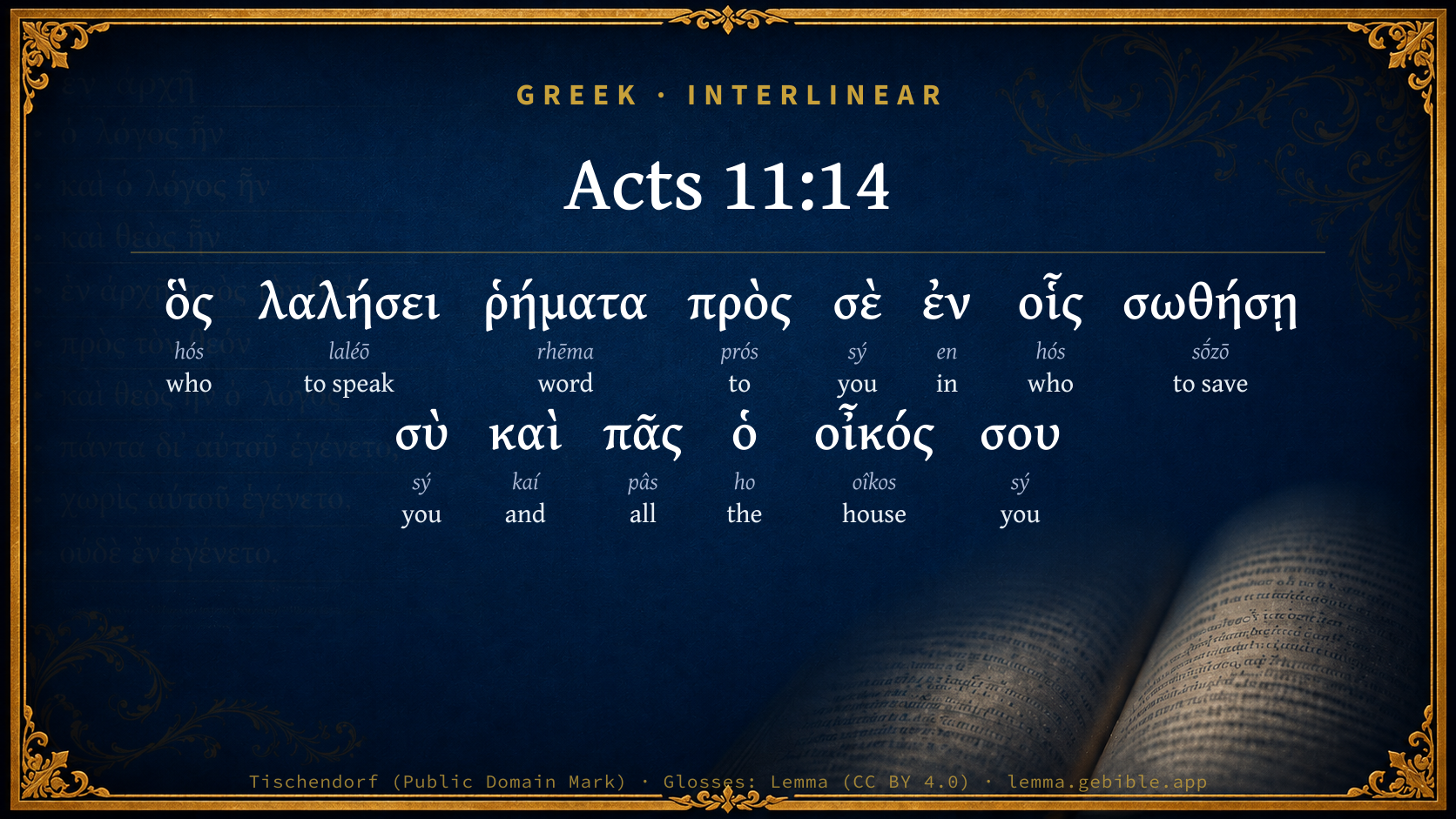
who will speak to you words by which you will be saved, you and all your house.'
Download a study sheet
One document with this verse’s original text, its word-by-word gloss line, the meaning frame, cross-references with their text, attributed commentary, and full source and license credits — printable, and it pastes into notes with its structure intact.
This verse Autodidact and up
A passage Seminary Student
Up to 50 verses in one chapter. A passage sheet keeps up to 6 commentary sources and 12 cross-references per verse, in the order this page ranks them, and says so on the sheet whenever that leaves anything out. Ask for a single verse and you get the Autodidact verse sheet above.
Everything on this page stays free to read, with no account — the sheet is a download of what is already on screen, not access to it.
Compare translations 3
The same verse in 3 English versions, stacked beneath the original-language interlinear above. Click any original word for its lexicon entry.
Each is an independent rendering of the whole verse — the interlinear is not word-aligned to these translations.
Highlighted words mark where these versions differ — a whole-verse word diff, not a word-by-word alignment.
-
World English Bible Public Domain
who will speak to you words by which you will be saved, you and all your house.'
-
King James Version Public Domain
Who shall tell thee words, whereby thou and all thy house shall be saved.
-
unfoldingWord Literal Text CC BY-SA 4.0
He will speak words to you by which you will be saved—you and all your house.’
unfoldingWord Literal Text — © unfoldingWord, licensed CC BY-SA 4.0. Word-aligned USFM3 via Door43 (git.door43.org/unfoldingWord/en_ult).
Show all 19 translations
Every available English version of this verse, each an independent rendering of the whole verse.
-
World English Bible Public Domain
who will speak to you words by which you will be saved, you and all your house.'
-
Berean Standard Bible Public Domain
He will convey to you a message by which you and all your household will be saved.’
-
Majority Standard Bible Public Domain
He will convey to you a message by which you and all your household will be saved.’
-
King James Version Public Domain
Who shall tell thee words, whereby thou and all thy house shall be saved.
-
American Standard Version (1901) Public Domain
who shall speak unto thee words, whereby thou shalt be saved, thou and all thy house.
-
Revised Version (1885) Public Domain
who shall speak unto thee words, whereby thou shalt be saved, thou and all thy house.
-
Geneva Bible (1599) Public Domain
He shall speake wordes vnto thee, whereby both thou and all thine house shalbe saued.
-
Douay-Rheims (1899) Public Domain
Who shall speak to thee words, whereby thou shalt be saved, and all thy house.
-
Young's Literal Translation Public Domain
who shall speak sayings by which thou shalt be saved, thou and all thy house.
-
Literal Standard Version CC BY-SA 4.0
who will speak sayings by which you will be saved, you and all your house.
-
Unlocked Literal Bible CC BY-SA 4.0
He will speak to you a message by which you will be saved—you and all your household.”
-
unfoldingWord Literal Text CC BY-SA 4.0
He will speak words to you by which you will be saved—you and all your house.’
-
Darby Bible Public Domain
who shall speak words to thee whereby *thou* shalt be saved, thou and all thy house.
-
World Messianic Bible Public Domain
who will speak to you words by which you will be saved, you and all your house.’
-
Webster's Bible Public Domain
Who shall tell thee words, by which thou and all thy house shall be saved.
-
Free Bible Version CC BY-SA 4.0
who will tell you what you need to hear so you can be saved—you and your whole household.’
-
Bible in Basic English Public Domain
Who will say words to you through which you and all your family may get salvation.
-
Text-Critical English NT CC BY 4.0
he will speak a message to yoʋ by which yoʋ will be saved, yoʋ and yoʋr entire household.’
-
Tyndale New Testament (1534) Public Domain
he shall tell the wordes wherby both thou and all thyne housse shalbe saved.
Literal Standard Version (2020), Covenant Press — licensed CC BY-SA 4.0. Text via the HelloAO Bible API (eBible.org). Unlocked Literal Bible (unfoldingWord) — licensed CC BY-SA 4.0. Text via the HelloAO Bible API (eBible.org). unfoldingWord Literal Text — © unfoldingWord, licensed CC BY-SA 4.0. Word-aligned USFM3 via Door43 (git.door43.org/unfoldingWord/en_ult). Free Bible Version, Dr. Jonathan Gallagher — licensed CC BY-SA 4.0. Text via the HelloAO Bible API (eBible.org).
Word by word
More ways to search: Search by grammar → Find every occurrence → Compare this word →
Practice this passage: Drill this verse → Learn its vocabulary →
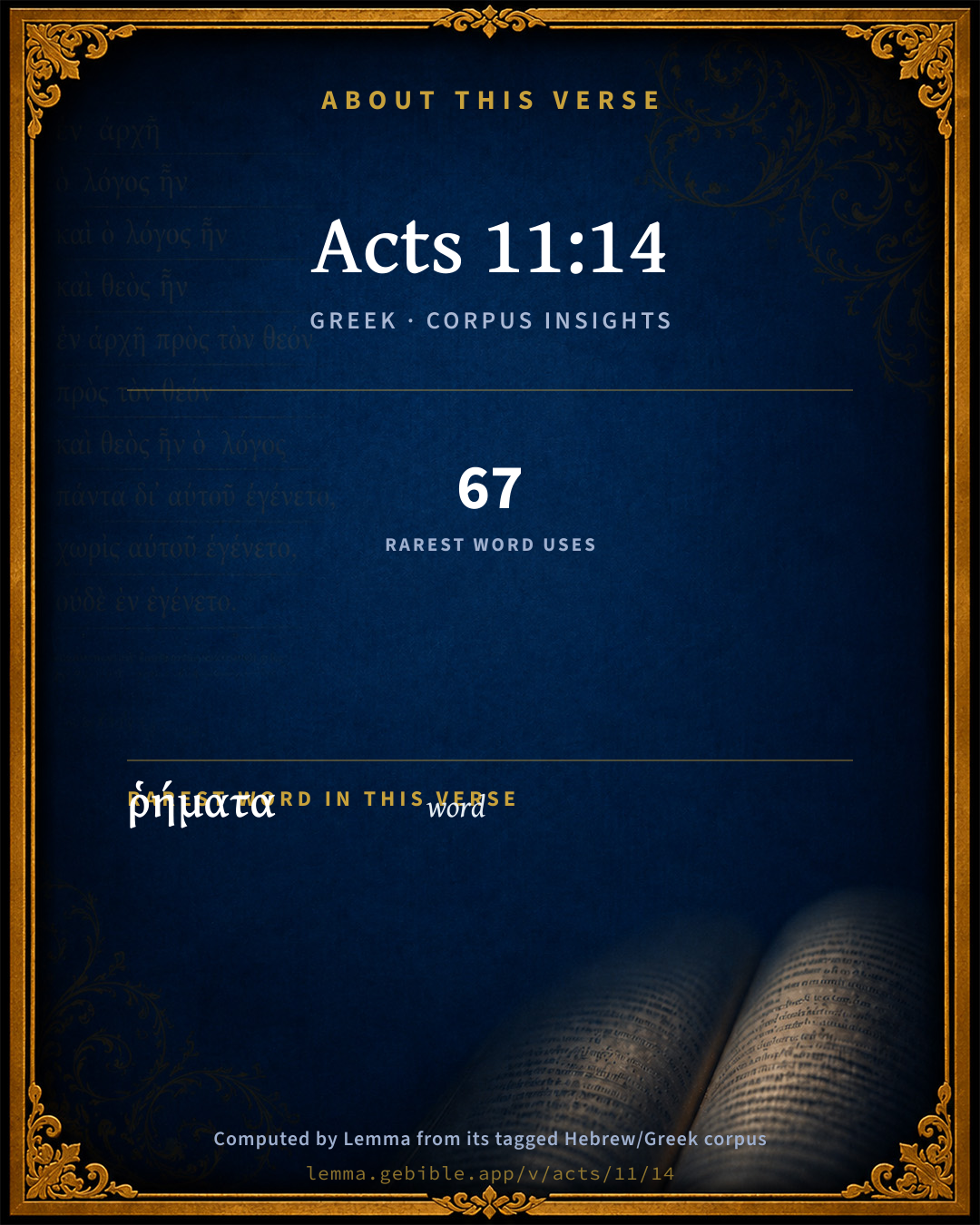
- Appears 67× in the Greek New Testament
- First appears at Matthew 4:4
- Part of Speech
- Noun
- Case
- Accusative
- Number
- Plural
- Gender
- Neuter
Full Thayer's Definition
- ὃς hós G3739 “who” Relative pronoun, Nominative, Singular, Masculine
- λαλήσει laléō G2980 “to speak” Verb, Future, Active, Indicative, 3rd person, Singular
- ῥήματα rhēma G4487 “word” Noun, Accusative, Plural, Neuter
- πρὸς prós G4314 “to” Preposition
- σὲ sý G4771 “you” Personal pronoun, 2nd person, Accusative, Singular
- ἐν en G1722 “in” Preposition
- οἷς hós G3739 “who” Relative pronoun, Dative, Plural, Neuter
- σωθήσῃ sṓzō G4982 “to save” Verb, Future, Passive, Indicative, 2nd person, Singular
- σὺ sý G4771 “you” Personal pronoun, 2nd person, Nominative, Singular
- καὶ kaí G2532 “and” Conjunction
- πᾶς pâs G3956 “all” Adjective, Nominative, Singular, Masculine
- ὁ ho G3588 “the” Article, Nominative, Singular, Masculine
- οἶκός oîkos G3624 “house” Noun, Nominative, Singular, Masculine
- σου sý G4771 “you” Personal pronoun, 2nd person, Genitive, Singular
About this verse
These counts appear in no published source. They are computed here, from the morphology-tagged text and Lemma’s own curated glosses. What Lemma adds →
- 14
- words
- 11
- distinct lemmas
- Acts
- section
Cross-references
29Topical passages linked to Acts 11:14 in the Treasury of Scripture Knowledge — connected by theme and wording, ordered by reader-vote popularity; previews shown in the World English Bible.
- Acts 10:22 They said, "Cornelius, a centurion, a righteous man and one who fears God, and well spoken of by all the nation of the Jews, was directed by a holy angel to invite you to his house, and to listen to what you say."
- Acts 16:15 When she and her household were baptized, she begged us, saying, "If you have judged me to be faithful to the Lord, come into my house, and stay." So she persuaded us.
- Acts 16:31–34 They said, "Believe in the Lord Jesus Christ, and you will be saved, you and your household."
- Genesis 17:7 I will establish my covenant between me and you and your seed after you throughout their generations for an everlasting covenant, to be a God to you and to your seed after you.
- John 12:50 I know that his commandment is eternal life. The things therefore which I speak, even as the Father has said to me, so I speak."
- John 20:31 but these are written, that you may believe that Jesus is the Christ, the Son of God, and that believing you may have life in his name.
- Acts 2:39 For to you is the promise, and to your children, and to all who are far off, even as many as the Lord our God will call to himself."
- Acts 10:2 a devout man, and one who feared God with all his house, who gave gifts for the needy generously to the people, and always prayed to God.
- Acts 10:6 He lodges with one Simon, a tanner, whose house is by the seaside."
- Acts 10:32–33 Send therefore to Joppa, and summon Simon, who is surnamed Peter. He lodges in the house of Simon a tanner, by the seaside. When he comes, he will speak to you.'
- 1 John 5:9–13 If we receive the witness of men, the witness of God is greater; for this is God's testimony which he has testified concerning his Son.
- Genesis 18:19 For I have known him, to the end that he may command his children and his household after him, that they may keep the way of Yahweh, to do righteousness and justice; to the end that Yahweh may bring on Abraham that which he has spoken of him."
- Psalms 19:7–11 Yahweh's law is perfect, restoring the soul. Yahweh's testimony is sure, making wise the simple.
- Psalms 103:17 But Yahweh's loving kindness is from everlasting to everlasting with those who fear him, His righteousness to children's children;
- Psalms 112:2 His seed will be mighty in the land. The generation of the upright will be blessed.
- Psalms 115:13–14 He will bless those who fear Yahweh, Both small and great.
- Proverbs 20:7 A righteous man walks in integrity. Blessed are his children after him.
- Isaiah 61:8–9 For I, Yahweh, love justice, I hate robbery with iniquity; and I will give them their recompense in truth, and I will make an everlasting covenant with them.
- Jeremiah 32:39 and I will give them one heart and one way, that they may fear me forever, for the good of them, and of their children after them:
- Mark 16:16 He who believes and is baptized will be saved; but he who disbelieves will be condemned.
- Luke 19:10 For the Son of Man came to seek and to save that which was lost."
- John 4:53 So the father knew that it was at that hour in which Jesus said to him, "Your son lives." He believed, as did his whole house.
- John 6:63 It is the spirit who gives life. The flesh profits nothing. The words that I speak to you are spirit, and are life.
- John 6:68 Simon Peter answered him, "Lord, to whom would we go? You have the words of eternal life.
- Acts 10:43 All the prophets testify about him, that through his name everyone who believes in him will receive remission of sins."
- Acts 18:8 Crispus, the ruler of the synagogue, believed in the Lord with all his house. Many of the Corinthians, when they heard, believed and were baptized.
- Romans 1:16–17 For I am not ashamed of the Gospel of Christ, for it is the power of God for salvation for everyone who believes; for the Jew first, and also for the Greek.
- Romans 10:9–10 that if you will confess with your mouth the Lord Jesus, and believe in your heart that God raised him from the dead, you will be saved.
- 1 Corinthians 1:16 (I also baptized the household of Stephanas; besides them, I don't know whether I baptized any other.)
Cross-references courtesy of OpenBible.info (CC BY 4.0).
Lesson kit
Teaching starters — assembled from the data on this page, not authored interpretation. Every prompt links to the verse data it draws on. Edit before teaching.
Acts, in the Acts, opens this verse with 14 words (11 distinct Greek lemmas). Its most distinctive word is rhēma (“word”). A historical commentator’s framing appears above. Read the whole chapter for the surrounding context.
Discussion questions
- What does “word” (rhēma) contribute to the verse as a whole?
- Acts 10:22 shares this passage’s theme. How do the two illuminate each other?
- “you” occurs 3× in this one verse. What is the effect of the repetition?
- These translations render this verse differently; the difference is in the English rendering, not the original. What questions does that raise?
- Reading how The Biblical Illustrator and Expositor's Greek Testament read this verse, where do the two commentators agree and where do they part?
Things to notice
- These translations choose different wording for 10 words in this verse.
- “you” occurs 3× in this single verse.
- 11 distinct Greek lemmas span 14 words in this verse.
Commentary
Notes on Acts 11:14 from classic Christian and Jewish commentators (each source and its license shown beneath its notes). The classic Christian expositions comment on the surrounding passage and are grouped to its opening verse, so a note may address several verses; the Jewish commentaries on the Tanakh (Rashi and others) are per-verse, so they appear only where the commentator wrote on this verse.
Lemma curates 59 commentaries, every one of them public domain or Creative Commons licensed, each selected and text-cleaned for this edition rather than reprinted as found. About our sources →
The Biblical Illustrator
Joseph S. Exell
The Biblical Illustrator, edited by Joseph S. Exell (c. 1880s–1900s) — public domain. Text from a community e-Sword module.
Expositor's Greek Testament
ed. W. Robertson Nicoll
The Expositor's Greek Testament, edited by W. Robertson Nicoll (1897–1910) — public domain. Text from a community e-Sword module.
Jamieson, Fausset & Brown
Robert Jamieson, A. R. Fausset & David Brown
Jamieson, Fausset & Brown — Commentary Critical and Explanatory on the Whole Bible (1871) — public domain (CC PDM 1.0). Text via the HelloAO Bible API.
Adam Clarke's Commentary
Adam Clarke's Commentary on the Bible (1810–1826) — public domain. Text from a community e-Sword/MySword module.
Ellicott's Commentary for English Readers
A Bible Commentary for English Readers, edited by Charles John Ellicott (1878–1897) — public domain. Text from a community e-Sword module.
John Gill's Exposition
John Gill's Exposition of the Whole Bible (1746–1763) — public domain (CC PDM 1.0). Text via the HelloAO Bible API.
Albert Barnes' Notes on the Bible
Albert Barnes' Notes on the Bible (1834–1885) — public domain. Text from a community e-Sword/MySword module.
Matthew Poole's English Annotations
Matthew Poole's English Annotations on the Holy Bible (1683–1685) — public domain. Text from a community e-Sword/MySword module.
Whedon's Commentary on the Bible
Daniel D. Whedon
Daniel D. Whedon (gen. ed.), Commentary on the Old and New Testaments (1874–1909) — public domain. Text from a community e-Sword module.
The Pulpit Commentary
The Pulpit Commentary (1880–1919), ed. H.D.M. Spence-Jones & Joseph S. Exell — public domain. Text from a community e-Sword module.
John Wesley's Explanatory Notes
John Wesley, Explanatory Notes Upon the Whole Bible (1754–1765) — public domain. Text via the GEBible commentary corpus.
Scofield Reference Notes
C. I. Scofield
The Scofield Reference Bible (1917 edition), notes by C. I. Scofield — public domain. Text from a community e-Sword module.
Godbey's Commentary on the New Testament
William B. Godbey
William B. Godbey, Commentary on the New Testament (1896–1900) — public domain. Text from a community e-Sword module.
McGarvey & Pendleton's Commentaries
J. W. McGarvey
J. W. McGarvey (with Philip Y. Pendleton), Commentaries on the New Testament (The Fourfold Gospel, 1914; Acts; and the epistles) — public domain. Text from a community e-Sword/MySword module.
Alford’s Greek Testament
Henry Alford
Henry Alford, The Greek Testament (1849–1861) — public domain. Text from a community e-Sword module.