Acts 16:21

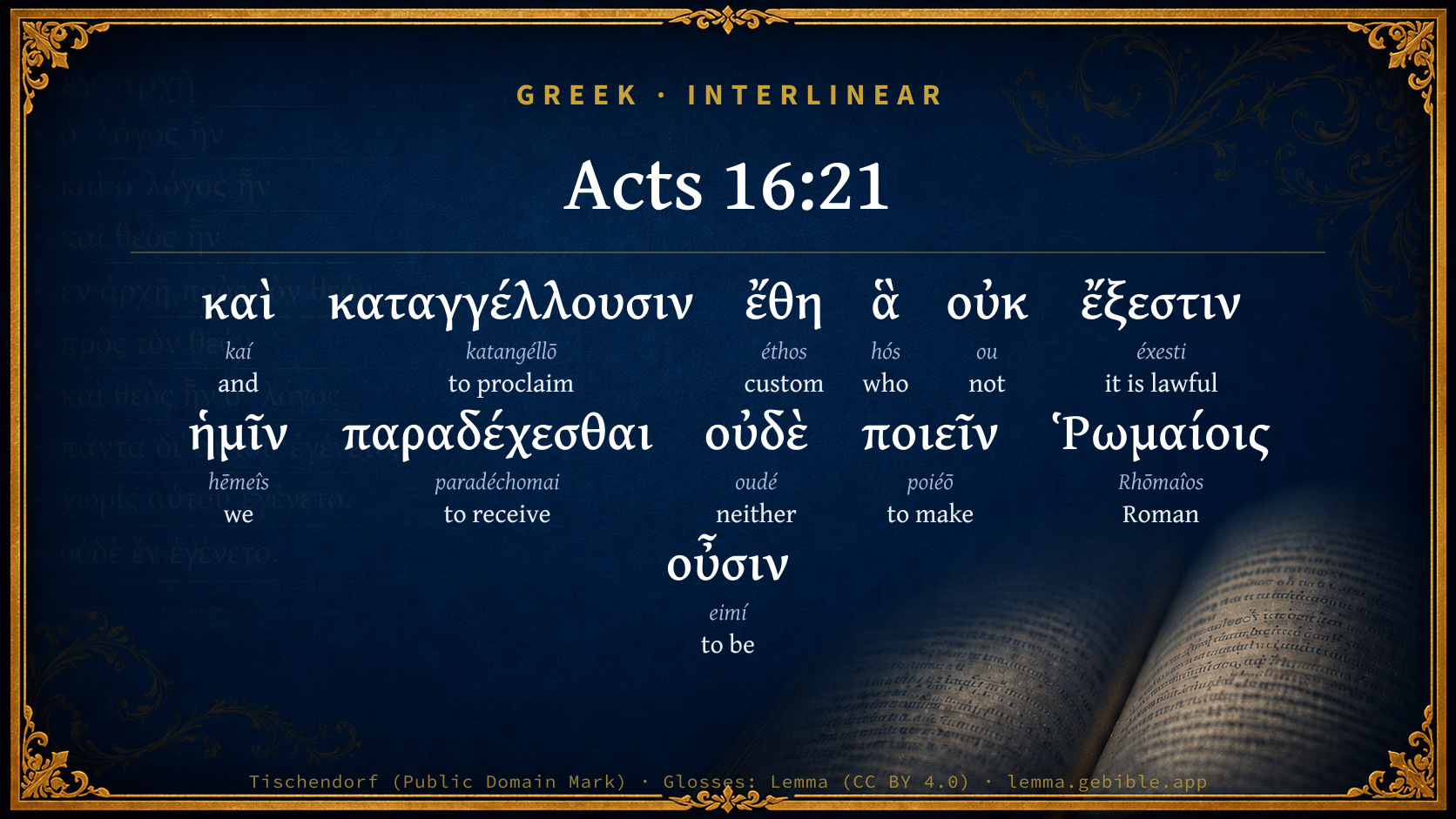
Greek (Tischendorf 8th ed.) Acts 16:21 appears in the Greek New Testament. The text above is from the Tischendorf 8th edition. Each word links to its Strong’s number and a concise gloss. Click any word for its full Thayer’s Greek Lexicon entry.
Download image
Cite this verse

Acts 16:21 (World English Bible). Public Domain. Lemma interlinear Bible study tool, https://lemma.gebible.app/v/acts/16/21.

Show BibTeX & RIS
BibTeX
RIS
English Translation
and set forth customs which it is not lawful for us to accept or to observe, being Romans."
World English Bible · Public Domain
Download a study sheet

One document with this verse’s original text, its word-by-word gloss line, the meaning frame, cross-references with their text, attributed commentary, and full source and license credits — printable, and it pastes into notes with its structure intact.

This verse Autodidact and up

Study sheet (.html) Plain text (.txt)

A passage Seminary Student

Up to 50 verses in one chapter. A passage sheet keeps up to 6 commentary sources and 12 cross-references per verse, in the order this page ranks them, and says so on the sheet whenever that leaves anything out. Ask for a single verse and you get the Autodidact verse sheet above.

Everything on this page stays free to read, with no account — the sheet is a download of what is already on screen, not access to it.

Want to remove ads? Support Godless Engineer
Compare translations 3

The same verse in 3 English versions, stacked beneath the original-language interlinear above. Click any original word for its lexicon entry.

Each is an independent rendering of the whole verse — the interlinear is not word-aligned to these translations.

Highlighted words mark where these versions differ — a whole-verse word diff, not a word-by-word alignment.

  • World English Bible Public Domain
    and set forth customs which it is not lawful for us to accept or to observe, being Romans."
  • King James Version Public Domain
    And teach customs, which are not lawful for us to receive, neither to observe, being Romans.
  • unfoldingWord Literal Text CC BY-SA 4.0
    and they are proclaiming customs that are lawful for us neither to accept nor to practice, being Romans.”

unfoldingWord Literal Text — © unfoldingWord, licensed CC BY-SA 4.0. Word-aligned USFM3 via Door43 (git.door43.org/unfoldingWord/en_ult).

Versions to compare (up to 4)

3 of 4 selected

Show all 19 translations

Every available English version of this verse, each an independent rendering of the whole verse.

  • World English Bible Public Domain
    and set forth customs which it is not lawful for us to accept or to observe, being Romans."
  • Berean Standard Bible Public Domain
    by promoting customs that are unlawful for us Romans to adopt or practice.”
  • Majority Standard Bible Public Domain
    by promoting customs that are unlawful for us Romans to adopt or practice.”
  • King James Version Public Domain
    And teach customs, which are not lawful for us to receive, neither to observe, being Romans.
  • American Standard Version (1901) Public Domain
    and set forth customs which it is not lawful for us to receive, or to observe, being Romans.
  • Revised Version (1885) Public Domain
    and set forth customs which it is not lawful for us to receive, or to observe, being Romans.
  • Geneva Bible (1599) Public Domain
    And preache ordinances, which are not lawfull for vs to receiue, neither to obserue, seeing we are Romanes.
  • Douay-Rheims (1899) Public Domain
    And preach a fashion which it is not lawful for us to receive nor observe, being Romans.
  • Young's Literal Translation Public Domain
    and they proclaim customs that are not lawful for us to receive nor to do, being Romans.'
  • Literal Standard Version CC BY-SA 4.0
    and they proclaim customs that are not lawful for us to receive nor to do, being Romans.”
  • Unlocked Literal Bible CC BY-SA 4.0
    They proclaim customs that are not lawful for Romans to accept or practice.”
  • unfoldingWord Literal Text CC BY-SA 4.0
    and they are proclaiming customs that are lawful for us neither to accept nor to practice, being Romans.”
  • Darby Bible Public Domain
    and announce customs which it is not lawful for us to receive nor practise, being Romans.
  • World Messianic Bible Public Domain
    and advocate customs which it is not lawful for us to accept or to observe, being Romans.”
  • Webster's Bible Public Domain
    And teach customs which are not lawful for us to receive, neither to observe, being Romans.
  • Free Bible Version CC BY-SA 4.0
    “They're advocating things that are illegal for us as Romans to accept or to practice.”
  • Bible in Basic English Public Domain
    Teaching rules of living which it is not right for us to have or to keep, being Romans.
  • Text-Critical English NT CC BY 4.0
    and they are proclaiming customs that are not lawful for us as Romans to accept or practice.”
  • Tyndale New Testament (1534) Public Domain
    and preache ordinaunces which are not laufull for vs to receave nether to observe seinge we are Romayns.

Literal Standard Version (2020), Covenant Press — licensed CC BY-SA 4.0. Text via the HelloAO Bible API (eBible.org). Unlocked Literal Bible (unfoldingWord) — licensed CC BY-SA 4.0. Text via the HelloAO Bible API (eBible.org). unfoldingWord Literal Text — © unfoldingWord, licensed CC BY-SA 4.0. Word-aligned USFM3 via Door43 (git.door43.org/unfoldingWord/en_ult). Free Bible Version, Dr. Jonathan Gallagher — licensed CC BY-SA 4.0. Text via the HelloAO Bible API (eBible.org).

Word by word

More ways to search: Search by grammar → Find every occurrence → Compare this word →

Practice this passage: Drill this verse → Learn its vocabulary →

παραδέχεσθαι
paradéchomai
G3858
“to receive”
Verb, Present, Middle or Passive deponent, Infinitive
Part of Speech
Verb
Tense
Present
Voice
Middle or Passive deponent
Mood
Infinitive
Full Thayer's Definition

Origin: from G3844 and G1209

TDNT: None

1. to receive, take up, take upon one's self 2. to admit i.e. not to reject, to accept, receive a. of a son: to acknowledge as one's own
  1. καὶ kaí G2532 “and” Conjunction
  2. καταγγέλλουσιν katangéllō G2605 “to proclaim” Verb, Present, Active, Indicative, 3rd person, Plural
  3. ἔθη éthos G1485 “custom” Noun, Accusative, Plural, Neuter
  4. ἃ hós G3739 “who” Relative pronoun, Accusative, Plural, Neuter
  5. οὐκ ou G3756 “not” Particle, Negative
  6. ἔξεστιν éxesti G1832 “it is lawful” Verb, Present, Active, Indicative, 3rd person, Singular
  7. ἡμῖν hēmeîs G2249 “we” Personal pronoun, 1st person, Dative, Plural
  8. οὐδὲ oudé G3761 “neither” Conjunction, Negative
  9. ποιεῖν poiéō G4160 “to make” Verb, Present, Active, Infinitive
  10. Ῥωμαίοις Rhōmaîos G4514 “Roman” Adjective, Dative, Plural, Masculine
  11. οὖσιν eimí G1510 “to be” Verb, Present, Active, Participle, Dative, Plural, Masculine

About this verse

These counts appear in no published source. They are computed here, from the morphology-tagged text and Lemma’s own curated glosses. What Lemma adds →

12
words
12
distinct lemmas
Acts
section

Notable vocabulary

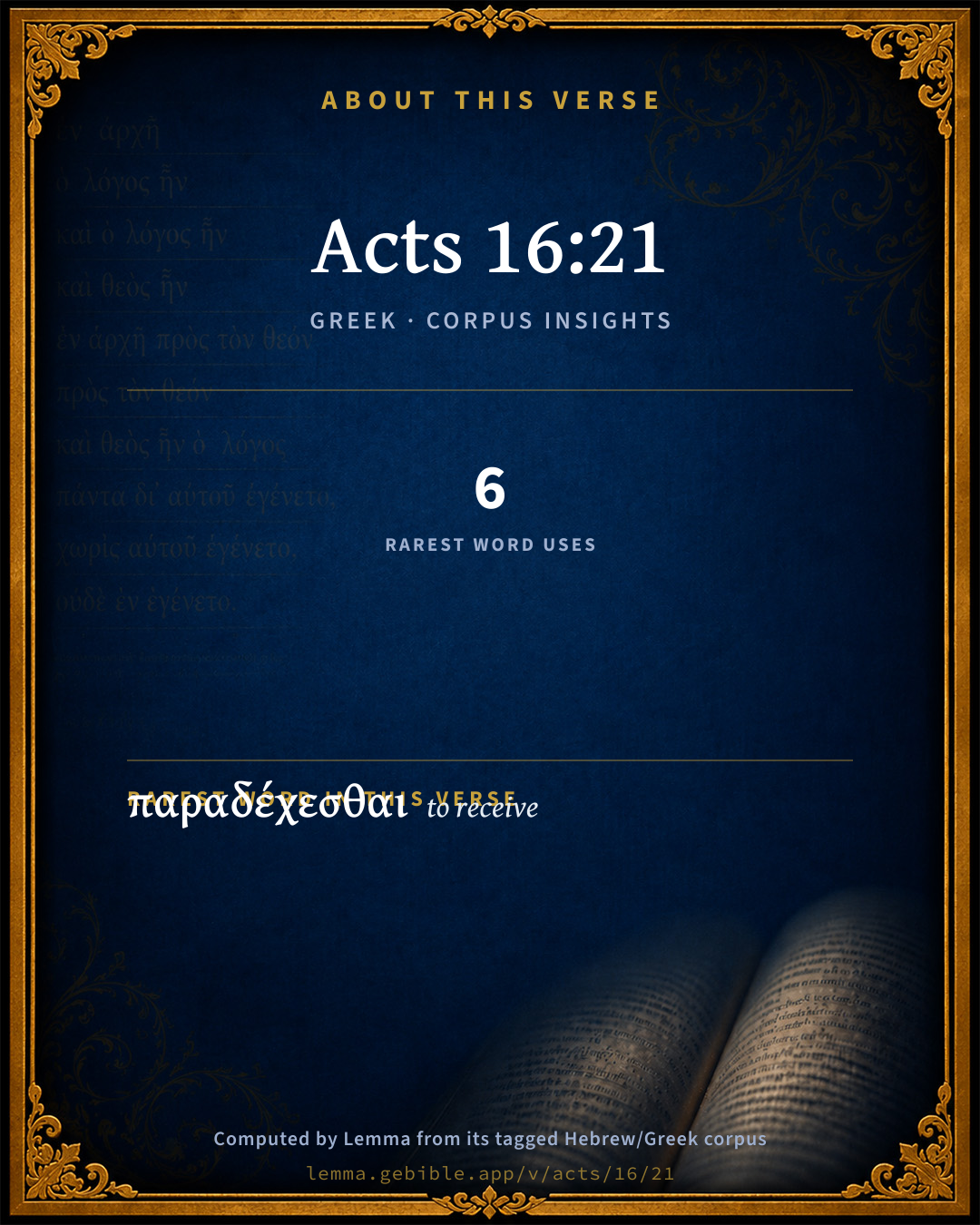
The rarest word here is παραδέχεσθαι to receive G3858 — appearing just 6 times in the whole Greek New Testament.

Shared distinctive vocabulary

παραδέχεσθαι to receive G3858 occurs in 6 verses of the Greek New Testament. Also found in:

Cross-references

4

Topical passages linked to Acts 16:21 in the Treasury of Scripture Knowledge — connected by theme and wording, ordered by reader-vote popularity; previews shown in the World English Bible.

  • Esther 3:8 Haman said to king Ahasuerus, There is a certain people scattered abroad and dispersed among the peoples in all the provinces of your kingdom; and their laws are diverse from [those of] every people; neither keep they the king's laws: therefore it is not for the king's profit to allow them.
  • Jeremiah 10:3 For the customs of the peoples are vanity; for one cuts a tree out of the forest, the work of the hands of the workman with the axe.
  • Acts 16:12 and from there to Philippi, which is a city of Macedonia, the foremost of the district, a Roman colony. We were staying some days in this city.
  • Acts 26:3 especially because you are expert in all customs and questions which are among the Jews. Therefore I beg you to hear me patiently.

Cross-references courtesy of OpenBible.info (CC BY 4.0).

Commentary

Notes on Acts 16:21 from classic Christian and Jewish commentators (each source and its license shown beneath its notes). The classic Christian expositions comment on the surrounding passage and are grouped to its opening verse, so a note may address several verses; the Jewish commentaries on the Tanakh (Rashi and others) are per-verse, so they appear only where the commentator wrote on this verse.

Lemma curates 59 commentaries, every one of them public domain or Creative Commons licensed, each selected and text-cleaned for this edition rather than reprinted as found. About our sources →

Bengel's Gnomon

Johann Albrecht Bengel

Act 16:21. Ἔθη, customs) The world has either admitted, or adopted, all the dogmas of all the philosophers; but this is the characteristic of the truth of the Gospel, that it has in it something singularly both hostile to and hated by human corruption.—ἃ οὐκ, which not) But is it lawful to hold fast ungodly customs?—Ῥωμαίοις, being Romans) A frequent objection of the community of the world against the kingdom of GOD. Even in our days Romanism is repugnant to (opposes) Paul.

Bengel's Gnomon of the New Testament — English translation (T&T Clark, Edinburgh, 1860) — public domain. Text from a community e-Sword module.

Expositor's Greek Testament

ed. W. Robertson Nicoll

Act 16:21 . ἔθη : religious customs here; the charge ostensibly put forward was really that of introducing a religio illicita, licita as it was for the Jews themselves. No doubt the fact that they were Jews presented in itself no ground of accusation, but their Jewish nationality would suggest the kind of customs with the introduction of which it would be easy to charge them, e.g. , circumcision. The introduction of Jewish habits and mode of life included under ἔθη , cf. Act 6:14 , Act 21:21 , would upset the whole social system, so that here, as on other occasions, the missionaries suffered from being identified with their Jewish countrymen. οὑκ ἔξ . παραδέχεσθαι : Wetstein, in loco; Marquardt, Röm. Staatsrecht , iii., 70, and see preceding verse, cf. Act 15:5 , Act 21:21 . In LXX, cf. Exo 23 . Ῥωμαίοις οὑσι : in natural contrast (at the end of the sentence) to the despised Jews: as inhabitants of a Roman colonia they could lay claim to the proud title. On the force of ὑπάρχοντες and οὗσι see Alford’s note in loco.

The Expositor's Greek Testament, edited by W. Robertson Nicoll (1897–1910) — public domain. Text from a community e-Sword module.

Geneva Bible (1599)

Geneva Bible translators

It is an argument of the devil, to urge the authority of ancestors without any distinction.

Geneva Bible (1599) marginal notes — public domain. Text via Bolls.life.

Jamieson, Fausset & Brown

Robert Jamieson, A. R. Fausset & David Brown

And teach customs, which are not lawful for us to receive, neither to observe, being Romans--Here also there was a measure of truth; as the introduction of new gods was forbidden by the laws, and this might be thought to apply to any change of religion. But the whole charge was pure hypocrisy; for as these men would have let the missionaries preach what religion they pleased if they had not dried up the source of their gains, so they conceal the real cause of their rage under color of a zeal for religion, and law, and good order: so Act 17:6-7; Act 19:25, Act 19:27.

Jamieson, Fausset & Brown — Commentary Critical and Explanatory on the Whole Bible (1871) — public domain (CC PDM 1.0). Text via the HelloAO Bible API.

Adam Clarke's Commentary

Verse 21. And teach customs] εθη, Religious opinions, and religious rites.

Which are not lawful for us to receive] The Romans were very jealous of their national worship. Servius, on the following lines of Virgil, has given us correct information on this point; and has confirmed what several other writers have advanced:-

Rex Evandrus ait: Non haec solemnia nobis

______ ______ ______ ______

Vana superstitio, veterumque ignara deorum,

Imposuit. AEn. viii. v. 185, c. King Evander said:-It is not vain superstition, ignorant of the ancient worship of the gods, which has imposed these rites on us.

Duo dicit, says Servius: non ideo Herculem colimus aut quia omnem religionem veram putamus; aut quia deos ignoramus antiquos. Cautum enim fuerat, et apud Athenienses, et apud Romanos; ne quis NOVAS introduceret RELIGIONES: unde et Socrates damnatus est: et Chaldaei et Judaei unt urbe depulsi.

"He says two things: we do not worship Hercules because we believe every religion to be true; nor are we ignorant of the ancient gods. Great care was taken, both among the Athenians and Romans, that no one should introduce any new religion. It was on this account that Socrates was condemned, and on this account the Chaldeans and the Jews were banished from Rome."

CICERO, De Legibus, lib. ii. c. 8, says: Separatim nemo habessit deos; neve NOVOS; sed nec ADVENAS, nisi publice ADSCITOS, PRIVATIM colunto. "No person shall have any separate gods, nor new ones; nor shall he privately worship any strange gods, unless they be publicly allowed." The whole chapter is curious. It was on such laws as these that the people of Philippi pleaded against the apostles. These men bring new gods, new worship, new rites; we are Romans, and the laws forbid us to worship any new or strange god, unless publicly allowed.

Adam Clarke's Commentary on the Bible (1810–1826) — public domain. Text from a community e-Sword/MySword module.

John Calvin's Commentaries

21. Ordinances which. They lean to a prejudice, lest the cause should come to be disputed; as the Papists deal with us at this day, this was decreed in a General Council; it is a more ancient and common opinion, than that is may be called in question; custom hath long time approved this; this hath been established by consent more than a thousand years ago. But to what end tend all these things, save only that they may rob the Word of God of all authority? They make boast of man’s decrees, but in the mean season they leave no place at all for the laws of God. We may see only this place what force these prejudices ought to have. The laws of the Romans were excellent, but religion doth depend upon the Word of God alone. Therefore in this matter we must take great heed, that men being brough under, the authority of God alone do prevail, and that he make all things which in the world are excellent subject to him.

John Calvin's Commentaries (1540-1563) — public domain. Text from the Calvin Translation Society English edition (1840s-50s) via the Christian Classics Ethereal Library (ccel.org). Calvin's coverage is partial (roughly two-thirds of the Bible); uncommented books and verses are honest gaps, never fabricated. The 19th-century editor's footnotes and remarks are omitted so the notes are faithfully Calvin's own voice.

Ellicott's Commentary for English Readers

(21) And teach customs.—The word is used as including ritual as well as social habits, and seems to have been specially used of the whole system of Jewish life. (See Notes on Act_6:14; Act_15:1; Act_21:21.)

Being Romans.—The people of Philippi, as a colonia, had a right to claim the title of Roman citizens, which could not have been claimed by those who were merely inhabitants of a Greek city, such as Thessalonica or Corinth. (See Note on Act_16:12.)

A Bible Commentary for English Readers, edited by Charles John Ellicott (1878–1897) — public domain. Text from a community e-Sword module.

The Cambridge Bible for Schools and Colleges

gen. ed. J. J. S. Perowne

21. and teach customs] Better, set forth (So R. V.), make proclamation of; the word refers to the preaching of the Apostles.

The Cambridge Bible for Schools and Colleges (gen. ed. J. J. S. Perowne; Cambridge University Press, 1878–1918) — public domain. Text from a community e-Sword module.

John Gill's Exposition

And teach customs,.... The Vulgate Latin and Ethiopic versions read in the singular number, "custom or law"; referring to the doctrine of salvation by Christ, in whose name the spirit of divination was cast out of the maid, and whom they took for a new deity; and so concluded that the apostle and his company were introducing a new religious law or custom, the worship of another God:

which are not lawful for us to receive, neither to observe, being Romans; for the city of Philippi was a Roman colony, and so the inhabitants of it called themselves Romans; or these men might be strictly such, who were transplanted hither; and with the Romans, it was not lawful to receive, observe, and worship, a new or strange deity, without the decree of the senate (l).

(l) Tertull. Apolog. c. 5. Euseb. Eccl. Hist. l. 2. c. 2.

John Gill's Exposition of the Whole Bible (1746–1763) — public domain (CC PDM 1.0). Text via the HelloAO Bible API.

Trapp's Complete Commentary

John Trapp

21 And teach customs, which are not lawful for us to receive, neither to observe, being Romans.

Ver. 21. Neither to observe, &c.] An ordinary thing to oppose the placits and devices of men to the truth of God.

John Trapp, A Commentary or Exposition upon All the Books of the Old and New Testament (1647–1656) — public domain. Text from a community e-Sword module.

Albert Barnes' Notes on the Bible

And teach customs - The word “customs” here ἔθη ethē refers to “religious rites or forms of worship.” See the notes on Act 6:14. They meant to charge the apostles with introducing a new religion which was unauthorized by the Roman laws. This was a cunning and artful accusation. It is perfectly evident that they cared nothing either for the religion of the Romans or of the Jews. Nor were they really concerned about any change of religion. Paul had destroyed their hopes of gain; and as they Could not prevent that except by securing his punishment or expulsion, and as they had no way of revenge except by endeavoring to excite indignation against him and Silas for violating the laws, they endeavored to convict thorn of such violation. This is one among many instances, Where wicked and unprincipled people will endeavor to make religion the means of promoting their own interest. If they can make money by it, they will become its professed friends or if they can annoy Christians, they will at once have remarkable zeal for the laws and for the purity of religion. Many a man opposes revivals of religion, and the real progress of evangelical piety from professed zeal for truth and order.

Which are not lawful for us to receive - There were laws of the Roman empire under which they might shield themselves in this charge, though it is evident that their zeal was; not because they loved the laws more, but because they loved Christianity less. Thus, Servius on Virgil, Aeneid, viii. 187, says, “care was taken among the Athenians and the Romans that no one should introduce new religions. It was on this account that Socrates was condemned, and the Chaldeans or Jews were banished from the city.” Cicero (“DeLegibus,” ii. 8) says, “No person shall have any separate gods, or new ones; nor shall he privately worship any strange gods, unless they be publicly allowed.” Wetstein (in loco) says, “The Romans would indeed allow foreigners to worship their own god, but not unless it were done secretly, so that the Worship of foreign gods would not interfere with the allowed worship of the Romans, and so that occasion for dissension and controversy might be avoided. Neither was it lawful among the Romans to recommend a new religion to the citizens, contrary to what was confirmed and established by the public authority, and to call off the people from that. It was on this account that there was such a hatred of the Romans against the Jews” (Kuinoel). Tertullian says that “there was a decree that no god should be consecrated unless approved by the senate” (Grotius). See many other authorities quoted in Dr. Watson’s “Apology (Defense) for Christianity.”

To observe - To do.

Being Romans - Having the privileges of Roman citizens. See the notes on Act 16:12.

Albert Barnes' Notes on the Bible (1834–1885) — public domain. Text from a community e-Sword/MySword module.

Haydock's Catholic Bible Commentary

There was a standing decree of the senate, which forbade the introduction of any new divinity, without the formal consent of the senate. (Bible de Vence)

George Leo Haydock (1774–1849), Haydock's Catholic Family Bible and Commentary, 1859 edition — public domain. Excludes Psalms (Douay-Rheims chapter numbering differs from Protestant) and Deuterocanonical books (Catholic canon only).

Matthew Poole's English Annotations

There was at Philippi, as appears Act 16:12, a colony of the Romans, and they were governed by their laws, by which they might make no innovation in religion without the consent of the senate, and afterwards of their emperors; which here these persecutors allege.

Matthew Poole's English Annotations on the Holy Bible (1683–1685) — public domain. Text from a community e-Sword/MySword module.

Whedon's Commentary on the Bible

Daniel D. Whedon

21. Customs… not lawful—Roman law did by most solemn sanctions decree that to the magistrates it should pertain to forbid all foreign rites, and banish all priestlings, (sacrificulos,) and prophets or preachers, from the forum, circus, or city; and should abolish every sacrificial institute not established by ancient Roman custom. All who imported new or unrecognised religions, whether in doctrine or ceremony, by which men’s minds were disturbed, should be punished, the nobler by banishment, the humbler by death. Such was the law our apostles were bound to face.

Daniel D. Whedon (gen. ed.), Commentary on the Old and New Testaments (1874–1909) — public domain. Text from a community e-Sword module.

The Pulpit Commentary

Set forth for teach, A.V.; it is for are, A.V.; or for neither, A.V. Romans; in a special sense, as members of a colony.

The Pulpit Commentary (1880–1919), ed. H.D.M. Spence-Jones & Joseph S. Exell — public domain. Text from a community e-Sword module.

John Wesley's Explanatory Notes

And teach customs which it is not lawful for us to receive - The world has received all the rules and doctrines of all the philosophers that ever were. But this is a property of Gospel truth: it has something in it peculiarly intolerable to the world.

John Wesley, Explanatory Notes Upon the Whole Bible (1754–1765) — public domain. Text via the GEBible commentary corpus.

McGarvey & Pendleton's Commentaries

J. W. McGarvey

See notes on verse 19

J. W. McGarvey (with Philip Y. Pendleton), Commentaries on the New Testament (The Fourfold Gospel, 1914; Acts; and the epistles) — public domain. Text from a community e-Sword/MySword module.

Cambridge Greek Testament for Schools and Colleges

21. καὶ καταγγέλλουσιν ἔθη, and set forth customs. The verb refers to the proclamation or preaching of the Apostles.

Cambridge Greek Testament for Schools and Colleges (Cambridge University Press, 1896; 21 vols, various authors incl. Carr, Maclear, Plummer, Farrar, Lumby, Moule, M. R. James, Simcox) — public domain. Text from a community e-Sword module.

Alford’s Greek Testament

Henry Alford

21. ἔθη …] “Dio Cassius tells us that Mæcenas gave the following advice to Augustus:—τὸ μὲν θεῖον πάντη πάντως αὐτός τε σέβου κατὰ τὰ πάτρια, καὶ τοὺς ἄλλους τιμᾷν ἀνάγκαζε· τοὺς δὲ ξενίζοντάς τι περὶ αὐτὸ καὶ μίσει καὶ κόλαζε· and the reason is alleged, viz. that such innovations lead to secret associations, conspiracies, and cabals, ἅπερ ἥκιστα μοναρχίᾳ συμφέρει.” (C. and H. i. p. 356.) So Julius Paulus, Sentent. v. 21. 2, cited by Wetst., ‘Qui novas et usu vel ratione incognitas religiones inducunt, ex quibus animi hominum moveantur, honestiores deportantur, humiliores capite premuntur.’

Henry Alford, The Greek Testament (1849–1861) — public domain. Text from a community e-Sword module.

Vincent's Word Studies in the New Testament

Marvin R. Vincent

Being Romans. The Romans granted absolute toleration to conquered nations to follow their own religious customs, and took the gods of these countries under their protection. Otho, Domitian, Commodus, and Caracalla were zealous partisans of the worship of Isis; Serapis and Cybele were patronized at Rome; and in the reign of Nero the religious dilettante at Rome affected Judaism, and professed to honor the name of Moses and the sacred books. Poppaea, Nero's consort, was their patroness, and Seneca said, "the Jewish faith is now received on every hand. The conquered have given laws to the conquerors." On the other hand, there were laws which forbade the introduction of strange deities among the Romans themselves. In 186 B. C., when stringent measures were taken by the government for the repression of Bacchanalian orgies in Rome, one of the consuls, addressing an assembly of the people, said : "How often in the ages of our fathers was it given in charge to the magistrates to prohibit the performance of any foreign religious rites; to banish strolling sacrificers and soothsayers from the forum, the circus, and the city; to search for and burn books of divination; and to abolish every mode of sacrificing that was not conformable to the Roman practice" (Livy, 39, 16) It was contrary to strict Roman law for the Jews to propagate their opinions among the Romans, though they might make proselytes of other nations.

Marvin R. Vincent, Word Studies in the New Testament (1887–1900) — public domain. Text from a community e-Sword/MySword module.

Lesson kit

Teaching starters — assembled from the data on this page, not authored interpretation. Every prompt links to the verse data it draws on. Edit before teaching.

Acts, in the Acts, opens this verse with 12 words (12 distinct Greek lemmas). Its most distinctive word is paradéchomai (“to receive”). A historical commentator’s framing appears above. Read the whole chapter for the surrounding context.

Discussion questions

  1. The word paradéchomai carries the sense “to receive.” How does it shape the verse?
  2. How does Mark 4:20, which shares the word «to receive», read alongside this verse?
  3. These translations render this verse differently; the difference is in the English rendering, not the original. What questions does that raise?
  4. Compare how Bengel's Gnomon and Expositor's Greek Testament read this verse. Where do they agree or differ?

Things to notice

Reading settings

Reading text

Shown beneath each verse's original-language words.

Old Testament
Old Testament edition

Read the OT as the Masoretic Hebrew (MT) or the Greek Septuagint (LXX).

English shown for the Greek Septuagint (in the Hebrew ↔ Greek comparison).

Comparing translations? Open the Compare panel on any verse page to stack up to four side by side.