
John 17:5

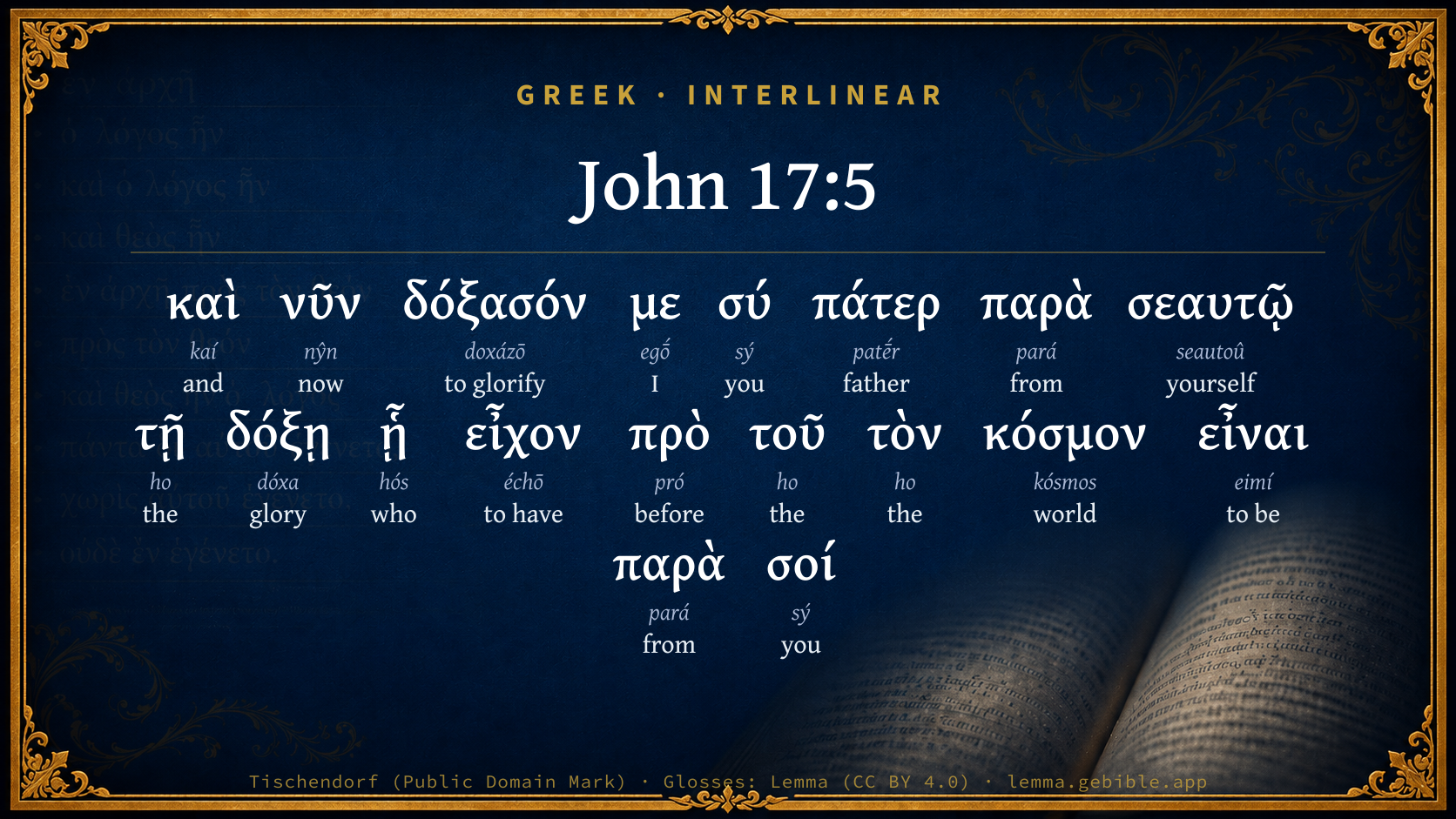
Greek (Tischendorf 8th ed.) John 17:5 appears in the Greek New Testament. The text above is from the Tischendorf 8th edition. Each word links to its Strong’s number and a concise gloss. Click any word for its full Thayer’s Greek Lexicon entry.
Download image
Cite this verse

John 17:5 (World English Bible). Public Domain. Lemma interlinear Bible study tool, https://lemma.gebible.app/v/john/17/5.

Show BibTeX & RIS
BibTeX
RIS
English Translation
Now, Father, glorify me with your own self with the glory which I had with you before the world existed.
World English Bible · Public Domain
Download a study sheet

One document with this verse’s original text, its word-by-word gloss line, the meaning frame, cross-references with their text, attributed commentary, and full source and license credits — printable, and it pastes into notes with its structure intact.

This verse Autodidact and up

Study sheet (.html) Plain text (.txt)

A passage Seminary Student

Up to 50 verses in one chapter. A passage sheet keeps up to 6 commentary sources and 12 cross-references per verse, in the order this page ranks them, and says so on the sheet whenever that leaves anything out. Ask for a single verse and you get the Autodidact verse sheet above.

Everything on this page stays free to read, with no account — the sheet is a download of what is already on screen, not access to it.

Want to remove ads? Support Godless Engineer
Compare translations 3

The same verse in 3 English versions, stacked beneath the original-language interlinear above. Click any original word for its lexicon entry.

Each is an independent rendering of the whole verse — the interlinear is not word-aligned to these translations.

Highlighted words mark where these versions differ — a whole-verse word diff, not a word-by-word alignment.

  • World English Bible Public Domain
    Now, Father, glorify me with your own self with the glory which I had with you before the world existed.
  • King James Version Public Domain
    And now, O Father, glorify thou me with thine own self with the glory which I had with thee before the world was.
  • unfoldingWord Literal Text CC BY-SA 4.0
    And now, Father, glorify me along with yourself with the glory that I had with you before the world was made.

unfoldingWord Literal Text — © unfoldingWord, licensed CC BY-SA 4.0. Word-aligned USFM3 via Door43 (git.door43.org/unfoldingWord/en_ult).

Versions to compare (up to 4)

3 of 4 selected

Show all 19 translations

Every available English version of this verse, each an independent rendering of the whole verse.

  • World English Bible Public Domain
    Now, Father, glorify me with your own self with the glory which I had with you before the world existed.
  • Berean Standard Bible Public Domain
    And now, Father, glorify Me in Your presence with the glory I had with You before the world existed.
  • Majority Standard Bible Public Domain
    And now, Father, glorify Me in Your presence with the glory I had with You before the world existed.
  • King James Version Public Domain
    And now, O Father, glorify thou me with thine own self with the glory which I had with thee before the world was.
  • American Standard Version (1901) Public Domain
    And now, Father, glorify thou me with thine own self with the glory which I had with thee before the world was.
  • Revised Version (1885) Public Domain
    And now, O Father, glorify thou me with thine own self with the glory which I had with thee before the world was.
  • Geneva Bible (1599) Public Domain
    And nowe glorifie me, thou Father, with thine owne selfe, with the glorie which I had with thee before the world was.
  • Douay-Rheims (1899) Public Domain
    And now glorify thou me, O Father, with thyself, with the glory which I had, before the world was, with thee.
  • Young's Literal Translation Public Domain
    `And now, glorify me, Thou Father, with Thyself, with the glory that I had before the world was, with Thee;
  • Literal Standard Version CC BY-SA 4.0
    And now, glorify Me, You Father, with Yourself, with the glory that I had with You before the world was;
  • Unlocked Literal Bible CC BY-SA 4.0
    Now, Father, glorify me along with yourself with the glory that I had with you before the world was made.
  • unfoldingWord Literal Text CC BY-SA 4.0
    And now, Father, glorify me along with yourself with the glory that I had with you before the world was made.
  • Darby Bible Public Domain
    and now glorify *me*, *thou* Father, along with thyself, with the glory which I had along with thee before the world was.
  • World Messianic Bible Public Domain
    Now, Father, glorify me with your own self with the glory which I had with you before the world existed.
  • Webster's Bible Public Domain
    And now, O Father, glorify thou me with thy ownself, with the glory which I had with thee before the world was.
  • Free Bible Version CC BY-SA 4.0
    Now Father, glorify me in your presence with the glory I had with you before the beginning of the world.
  • Bible in Basic English Public Domain
    And now, Father, let me have glory with you, even that glory which I had with you before the world was.
  • Text-Critical English NT CC BY 4.0
    And now, Father, glorify me in yoʋr presence with the glory I had with yoʋ before the world existed.
  • Tyndale New Testament (1534) Public Domain
    And now glorify me thou father with thyn awne selfe with the glory which I had with ye yerre the worlde was.

Literal Standard Version (2020), Covenant Press — licensed CC BY-SA 4.0. Text via the HelloAO Bible API (eBible.org). Unlocked Literal Bible (unfoldingWord) — licensed CC BY-SA 4.0. Text via the HelloAO Bible API (eBible.org). unfoldingWord Literal Text — © unfoldingWord, licensed CC BY-SA 4.0. Word-aligned USFM3 via Door43 (git.door43.org/unfoldingWord/en_ult). Free Bible Version, Dr. Jonathan Gallagher — licensed CC BY-SA 4.0. Text via the HelloAO Bible API (eBible.org).

Word by word

More ways to search: Search by grammar → Find every occurrence → Compare this word →

Practice this passage: Drill this verse → Learn its vocabulary →

σεαυτῷ
seautoû
G4572
“yourself”
Reflexive pronoun, 2nd person, Dative, Singular, Masculine
Part of Speech
Reflexive pronoun
Person
2nd person
Case
Dative
Number
Singular
Gender
Masculine
Full Thayer's Definition

Origin: genitive case from G4571 and G846

TDNT: None

1. thyself, thee
  1. καὶ kaí G2532 “and” Conjunction
  2. νῦν nŷn G3568 “now” Adverb
  3. δόξασόν doxázō G1392 “to glorify” Verb, Aorist, Active, Imperative, 2nd person, Singular
  4. με egṓ G1473 “I” Personal pronoun, 1st person, Accusative, Singular
  5. σύ sý G4771 “you” Personal pronoun, 2nd person, Nominative, Singular
  6. πάτερ patḗr G3962 “father” Noun, Vocative, Singular, Masculine
  7. παρὰ pará G3844 “from” Preposition
  8. τῇ ho G3588 “the” Article, Dative, Singular, Feminine
  9. δόξῃ dóxa G1391 “glory” Noun, Dative, Singular, Feminine
  10. ᾗ hós G3739 “who” Relative pronoun, Dative, Singular, Feminine
  11. εἶχον échō G2192 “to have” Verb, Imperfect, Active, Indicative, 1st person, Singular
  12. πρὸ pró G4253 “before” Preposition
  13. τοῦ ho G3588 “the” Article, Genitive, Singular, Neuter
  14. τὸν ho G3588 “the” Article, Accusative, Singular, Masculine
  15. κόσμον kósmos G2889 “world” Noun, Accusative, Singular, Masculine
  16. εἶναι eimí G1510 “to be” Verb, Present, Active, Infinitive
  17. παρὰ pará G3844 “from” Preposition
  18. σοί sý G4771 “you” Personal pronoun, 2nd person, Dative, Singular

About this verse

These counts appear in no published source. They are computed here, from the morphology-tagged text and Lemma’s own curated glosses. What Lemma adds →

19
words
15
distinct lemmas
Gospels
section

Shared distinctive vocabulary

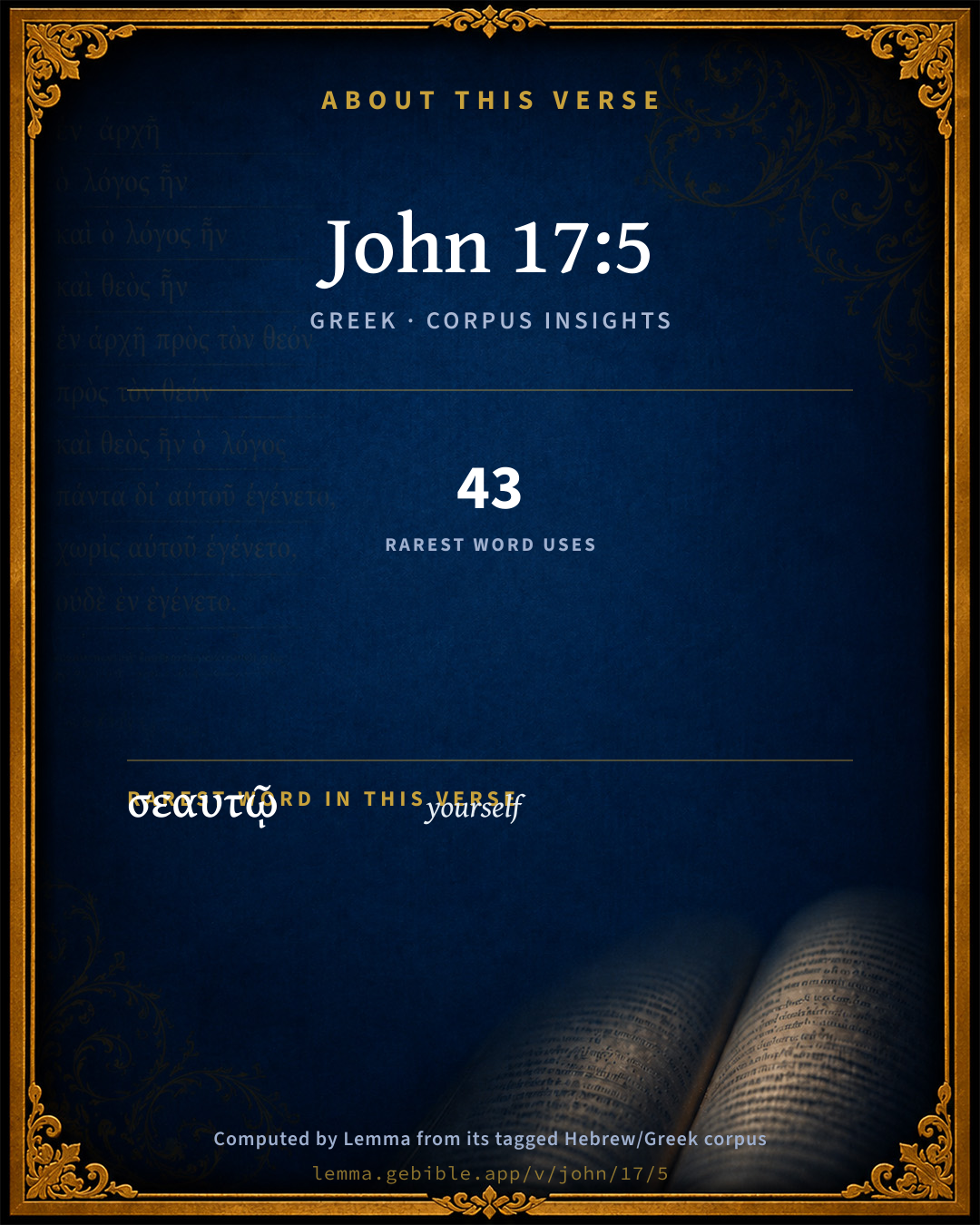
σεαυτῷ yourself G4572 occurs in 42 verses of the Greek New Testament. Also found in:
Repetition

Words recur within this verse:

Cross-references

18

Topical passages linked to John 17:5 in the Treasury of Scripture Knowledge — connected by theme and wording, ordered by reader-vote popularity; previews shown in the World English Bible.

  • John 1:1–3 In the beginning was the Word, and the Word was with God, and the Word was God.
  • Colossians 1:15–17 who is the image of the invisible God, the firstborn of all creation.
  • John 10:30 I and the Father are one."
  • 1 Peter 1:20 who was foreknown indeed before the foundation of the world, but was revealed at the end of times for your sake,
  • Philippians 2:6 who, existing in the form of God, didn't consider it robbery to be equal with God,
  • Hebrews 1:3 His Son is the radiance of his glory, the very image of his substance, and upholding all things by the word of his power, when he had by himself made purification for our sins, sat down on the right hand of the Majesty on high;
  • Revelation 5:9–14 They sang a new song, saying, "You are worthy to take the book, And to open its seals: For you were killed, And bought us for God with your blood, Out of every tribe, language, people, and nation,
  • John 17:24 Father, I desire that they also whom you have given me be with me where I am, that they may see my glory, which you have given me, for you loved me before the foundation of the world.
  • Hebrews 1:10 And, "You, Lord, in the beginning, laid the foundation of the earth. The heavens are the works of your hands.
  • Proverbs 8:22–31 "Yahweh possessed me in the beginning of his work, Before his deeds of old.
  • John 1:18 No one has seen God at any time. The one and only Son, who is in the bosom of the Father, he has declared him.
  • Matthew 25:34 Then the King will tell those on his right hand, 'Come, blessed of my Father, inherit the Kingdom prepared for you from the foundation of the world;
  • John 8:58 Jesus said to them, "Most assuredly, I tell you, before Abraham came into existence, I AM."
  • John 3:13 No one has ascended into heaven, but he who descended out of heaven, the Son of Man, who is in heaven.
  • John 14:9 Jesus said to him, "Have I been with you such a long time, and do you not know me, Philip? He who has seen me has seen the Father. How do you say, 'Show us the Father?'
  • 1 John 1:2 (and the life was revealed, and we have seen, and testify, and declare to you the life, the eternal life, which was with the Father, and was revealed to us);
  • Revelation 3:21 He who overcomes, I will give to him to sit down with me on my throne, as I also overcame, and sat down with my Father on his throne.
  • Revelation 13:8 All who dwell on the earth will worship him, everyone whose name has not been written from the foundation of the world in the book of life of the Lamb who has been killed.

Cross-references courtesy of OpenBible.info (CC BY 4.0).

Commentary

Notes on John 17:5 from classic Christian and Jewish commentators (each source and its license shown beneath its notes). The classic Christian expositions comment on the surrounding passage and are grouped to its opening verse, so a note may address several verses; the Jewish commentaries on the Tanakh (Rashi and others) are per-verse, so they appear only where the commentator wrote on this verse.

Lemma curates 59 commentaries, every one of them public domain or Creative Commons licensed, each selected and text-cleaned for this edition rather than reprinted as found. About our sources →

Tyndale Open Study Notes

Tyndale Open Resources

17:5 Jesus prayed to return to the position he had with God before the world began (1:1).

Tyndale Open Study Notes — © Tyndale Open Resources, licensed CC BY-SA 4.0. Text via the HelloAO Bible API.

Bengel's Gnomon

Johann Albrecht Bengel

Joh 17:5. Εἶχον, I had) Here He does not say, I received. He always was having it, was in possession of it; He never began to have it.—πρὸ τοῦ τὸν κόσμον εἶναι, before that the world was) In the appellation, “the world,” in this place angels also are included. Even before that the world was made, the Son was having that glory; Joh 17:24, “Thou lovedst Me before the foundation of the world;” but when the world was made, that glory began to put itself forth. Herein is implied the eternity of the Son of God. The beginning of the world and of time were coincident. Whatever is before the world is before time. Whatever is before time is eternal.—παρὰ σόι, with Thee) because there was then nothing external to God. Construe the words with εἶχον, “I was having with Thee.”

Bengel's Gnomon of the New Testament — English translation (T&T Clark, Edinburgh, 1860) — public domain. Text from a community e-Sword module.

Expositor's Greek Testament

ed. W. Robertson Nicoll

Joh 17:5 . καὶ νῦν δόξασον … σοί . The precise character of the glorification He looks for is here presented. It is παρὰ σεαυτῷ , and it is a restoration to the glory He had enjoyed πρὸ τοῦ τὸν κόσμον εἶναι . By παρὰ σεαυτῷ it is rendered impossible to understand παρὰ σοί of an “ideal” pre-existence; because these two expressions are here equivalents, and Christ cannot be supposed to have prayed for an “ideal” glory when He asked that God would glorify Him παρὰ σεαυτῷ . “There is, consequently, here, as in Joh 6:62 , Joh 8:58 , a continuity of the consciousness of the historical Christ with the Logos.” Tholuck. On this verse Beyschlag remarks (i. 254): “The possibility of such a position was first won by Jesus through His life and death on earth, so that, in point of fact, it forms the divine reward of that life and death; how then could He have possessed it realiter before the world was?” But the representation given by Paul in Phi 2 is open to the same objection. Christ is represented as leaving a glory He originally enjoyed and returning to it when His work on earth was done and as the result of that work. The humanity was now to share in and to be in some way the organ of that divine glory; and this it could not be until it had been perfected by the experience of a human life. Wendt ( Teaching of Jesus , ii. 169) says: “According to the mode of speech and conception prevalent in the N.T., a heavenly good, and so also a heavenly glory, can be conceived and spoken of as existing with God, and belonging to a person, not because this person already exists, and is invested with glory, but because the glory of God is in some way deposited and preserved for this person in heaven”. The passages, however, on which he depends for this principle do not sustain it. Such expressions as Joh 1:14 , Joh 2:11 , which indicate that already while on earth a divine glory was manifest in Christ, in no degree contradict but rather confirm such statements as the present.

The Expositor's Greek Testament, edited by W. Robertson Nicoll (1897–1910) — public domain. Text from a community e-Sword module.

Jamieson, Fausset & Brown

Robert Jamieson, A. R. Fausset & David Brown

And now--in return.

glorify thou me--The "I Thee" and "Thou Me" are so placed in the original, each beside its fellow, as to show that A PERFECT RECIPROCITY OF SERVICES of the Son to the Father first, and then of the Father to the Son in return, is what our Lord means here to express.

with the glory which I had with thee before the world was--when "in the beginning the Word was with God" (Joh 1:1), "the only-begotten Son in the bosom of the Father" (Joh 1:18). With this pre-existent glory, which He veiled on earth, He asks to be reinvested, the design of the veiling being accomplished--not, however, simply as before, but now in our nature.

Jamieson, Fausset & Brown — Commentary Critical and Explanatory on the Whole Bible (1871) — public domain (CC PDM 1.0). Text via the HelloAO Bible API.

Adam Clarke's Commentary

Verse 5. Before the world was.] That is, from eternity, before there was any creation-so the phrase, and others similar to it, are taken in the sacred writings; see Joh 17:24; Ps 90:2; Eph 1:4. See Joh 1:1. Let the glory of my eternal divinity surround and penetrate my humanity, in its resurrection, ascension, and in the place which it is to occupy at thy right hand, far above all creatures, Phi 2:6; Phi 2:9.

Adam Clarke's Commentary on the Bible (1810–1826) — public domain. Text from a community e-Sword/MySword module.

John Calvin's Commentaries

5. The glory which I had with thee. He desires to be glorified with the Father, not that the Father may glorify him secretly, without any witnesses, but that, having been received into heaven, he may give a magnificent display of his greatness and power, that every knee may bow to him, (Philippians 2:10.) Consequently, that phrase in the former clause, with the Father, is contrasted with earthly and fading glory, as Paul describes the blessed immortality of Christ, by saying that

he died to sin once, but now he liveth to God, (Romans 6:10.)

The glory which I had with thee before the world was. He now declares that he desires nothing that does not strictly belong to him, but only that he may appear in the flesh, such as he was before the creation of the world; or, to speak more plainly, that the Divine majesty, which he had always possessed, may now be illustriously displayed in the person of the Mediator, and in the human flesh with which he was clothed. This is a remarkable passage, which teaches us that Christ is not a God who has been newly contrived, or who has existed only for a time; for if his glory was eternal, himself also has always been. Besides, a manifest distinction between the person of Christ and the person of the rather is here expressed; from which we infer, that he is not only the eternal God, but also that he is the eternal Word of God, begotten by the rather before all ages.

John Calvin's Commentaries (1540-1563) — public domain. Text from the Calvin Translation Society English edition (1840s-50s) via the Christian Classics Ethereal Library (ccel.org). Calvin's coverage is partial (roughly two-thirds of the Bible); uncommented books and verses are honest gaps, never fabricated. The 19th-century editor's footnotes and remarks are omitted so the notes are faithfully Calvin's own voice.

Ellicott's Commentary for English Readers

(5) And now, O Father, glorify thou me with thine own self.—These words are exactly parallel with the commencement of the previous verse. “I,” “Thou,” “Thee—Me,” “on earth,” “with Thine own self.” (Comp. Joh_13:31-32.)

With the glory which I had with thee before the world was.—This clause admits of but one meaning—viz., that Jesus claimed for Himself the possession of the divine glory in His pre-existent state before the world was; and that He claimed this in personality distinct from, but in essence one with God. (Comp. Joh_1:1; Joh_1:18, and on the whole passage, Notes on Php_2:4-9.) The special importance of the thought here is that it is uttered in the words of Christ Himself, and that these words are a prayer to the Father. There can be no explanation of Joh_17:1-5 of this chapter, which denies that our Lord Jesus Christ claimed for Himself that He was divine, and co-eternal with the Father.

A Bible Commentary for English Readers, edited by Charles John Ellicott (1878–1897) — public domain. Text from a community e-Sword module.

The Cambridge Bible for Schools and Colleges

gen. ed. J. J. S. Perowne

5. And now] When the ministry is completed.

glorify thou me] The pronouns are placed side by side for emphasis, as in Joh_17:4, where the Greek runs, ‘I Thee glorified.’ The two verses are parallels; ‘I Thee glorified on earth; glorify Me Thou in heaven.’

with thine own self] In fellowship with Thee. The following great truths are contained in these two verses; (1) that the Son is in Person distinct from the Father; (2) that the Son, existing in glory with the Father from all eternity, working in obedience to the Father on earth, existing in glory with the Father now, is in Person one and the same.

I had] Imperfect tense, implying continual possession.

The Cambridge Bible for Schools and Colleges (gen. ed. J. J. S. Perowne; Cambridge University Press, 1878–1918) — public domain. Text from a community e-Sword module.

John Gill's Exposition

And now, O Father, glorify thou me with thine own self,.... Not with his perfections, these he had, they dwelt bodily in him; or with his nature, in which he was one with him; but as Mediator, with his glorious presence in heaven, by setting him at his right hand, and crowning him with glory and honour. The Jews have a notion that God will give to the King Messiah, , "of the supreme glory" (g): the glory Christ prays for is, as he says,

the glory which I had with thee before the world was; the same phrase with or , used by the Jews (h). This is not to be understood of the glory of the human nature of Christ, abstractly considered; for that is no person of itself, but what is taken up into personal union with the Son of God; and therefore cannot be intended by this personal character I; nor did it exist from eternity; it was indeed written in God's book of predestination, even all its members, when as yet there were none of them in actual being; it was set up in God's thoughts and counsel, as the pattern and exemplar of human nature; it had a federal union with the Son of God, or a covenant subsistence with him; and in the Old Testament Christ was often spoken of as man, because of his frequent appearances in an human form, and because of the certainty of his incarnation; but he did not really and actually exist as man, until he took flesh of the virgin; for Christ, as man, is the seed of the woman, the son of David, Abraham, and Adam; he is called the last and second Adam, and was not as man before the first: the Old Testament speaks of his incarnation as future, nor is it possible that a creature can exist before time; for as soon as a creature exists, time begins, which is nothing else than the measure of a creature's duration; nor was the human nature of Christ with the Father from eternity; nor had it a glory before the world began, neither in whole, nor in part: nor is the glory of the divine nature abstractly considered here meant; this glory indeed Christ had from everlasting; he had it with his Father, in common with him, being in union to him; and it is true that it was in some measure veiled and covered in his state of humiliation; for though there were some breakings forth of it in that state, these were seen but by a few; wherefore he is thought by some, to pray here for the manifestation of this glory; but this glory was essential to him, was his natural right, and not to be prayed for, and which he then had as much as ever, and of which there could be no suspension: but this designs the glory of him as Godman, and Mediator; he was not only predestinated to be a Mediator, but was really set up as such from everlasting, and had a mediatorial fulness of grace put into his hands, and had the honour and glory of that office given unto him by the other two persons; and now that he might appear to be what he was, to be made, that is, made manifest that he was both Lord and Christ, he here prays; which was to be done, upon his ascension to heaven, and session at the right hand of God, by the pouring down of the Holy Ghost.

(g) Midrash Tillim in Psal. 20 apud Galatin. de Arcan. Cathol. Ver. l. 3. c. 9. (h) Gloss in T. Bab Pesachim, fol. 54. 1.

John Gill's Exposition of the Whole Bible (1746–1763) — public domain (CC PDM 1.0). Text via the HelloAO Bible API.

Trapp's Complete Commentary

John Trapp

5 And now, O Father, glorify thou me with thine own self with the glory which I had with thee before the world was.

Ver. 5. With the glory which I had, &c.] Our Saviour then is no upstart God, and of a later standing, as the Arians and Mahometans would make of him. Mahomet speaks very honourably of Christ, except only in two things. First, he denied that he was crucified, but that some other was crucified for him. Secondly, he took up the opinion of the Arians, to deny his Divinity. Arius at Constantinople, sitting upon the close stool, purged out his guts. Mahometism is now there in that place, as it were the excrements of Arius.

John Trapp, A Commentary or Exposition upon All the Books of the Old and New Testament (1647–1656) — public domain. Text from a community e-Sword module.

Albert Barnes' Notes on the Bible

With thine own self - In heaven, granting me a participation of the same honor which the Father has. He had just said that he had glorified God on the earth, he now prays that God would glorify him in heaven.

With the glory - With the honor. This word also includes the notion of happiness, or everything which could render the condition blessed.

Before the world was - There could not be a more distinct and clear declaration of the pre-existence of Christ than this. It means before the creation of the world; before there was any world. Of course, the speaker here must have existed then, and this is equivalent to saying that he existed from eternity. See Joh 1:1-2; Joh 6:62; Joh 3:13; Joh 16:28. The glory which he had then was that which was proper to the Son of God, represented by the expression “being in the bosom of the Father” Joh 1:18, denoting intimacy, friendship, united felicity. The Son of God, by becoming incarnate, is represented as “humbling himself” (Greek: he “emptied himself”), Phi 2:8. He laid aside for a time the external aspect of honor, and consented to become despised, and to assume the form of a servant. He now prays that God would raise him up to the dignity and honor which he had before his incarnation. This is the state to which he is now exalted, with the additional honor of having made atonement for sin, and having opened the way to save a race of rebels from eternal death. The lowest condition on earth is frequently connected with the highest honors of heaven. Man looks on the outward appearance. God looks to him that is humble and of a contrite spirit.

Albert Barnes' Notes on the Bible (1834–1885) — public domain. Text from a community e-Sword/MySword module.

Haydock's Catholic Bible Commentary

And now, glorify thou me, O Father, with thyself, with the glory which I had with thee, before the world was. Glorify me, is the same as make me known to men; so that the sense may be, make men know, that I had the same glory with thee, before the world was created, and from all eternity. Others understand, that Christ as man, here prays that his eternal Father would make known to men, that glory, which it was decreed from eternity should be given him: that is, that all creatures should be made subject to him, even as he was man, and appointed to be judge of the living and the dead. See 1 Corinthians xv. 26; Ephesians i. 22. (Witham)

George Leo Haydock (1774–1849), Haydock's Catholic Family Bible and Commentary, 1859 edition — public domain. Excludes Psalms (Douay-Rheims chapter numbering differs from Protestant) and Deuterocanonical books (Catholic canon only).

Matthew Poole's English Annotations

Let the glory which, as to my Divine nature, I had with thee before the foundation of the world, be communicated also to my human nature, that my whole person may be made glorious. From hence is easily concluded, against those who deny the Godhead of Christ, that Christ was glorified with his Father before the world was, which he could not have been if he had not been eternal God. He here begs of his Father, that that glory might shine upon his person as Mediator.

Matthew Poole's English Annotations on the Holy Bible (1683–1685) — public domain. Text from a community e-Sword/MySword module.

Whedon's Commentary on the Bible

Daniel D. Whedon

5. With thine own self—In blessed and eternal society with thy own nature.

Glory which I had… before the world—That is, the glory which I, as eternal Logos, had with the eternal God. See note on Joh_1:1. Into that glory admit me, the incarnate Logos, so that the God-man shall be eternally recognized as eternally divine. The eternal Logos and the incarnate Logos are the same person in different eras of existence. So that the incarnate Logos could claim on earth that as Logos he possessed an eternal glory in heaven, to which he might ascend and therewith be invested.

Before the world was—The term world here includes the entire universe of worlds. Some have affirmed that God has eternally been creating worlds after worlds. In that case the priority of the glory of the Logos would be rather priority in the order of nature than of time, as regards the absolute universe.

Daniel D. Whedon (gen. ed.), Commentary on the Old and New Testaments (1874–1909) — public domain. Text from a community e-Sword module.

The Pulpit Commentary

And now (nun) the very point of time has comeglorify thou me, O Father, explaining the opening of the prayer, "Glorify thy Son." He identifies his own Personality with that of "the Son," and "thy Son." With thy own self (para seautw); in closest connection and fellowship with thy-self a relation which has been arrested or suspended since have been "Jesus Christ," and glorifying thee amid the toil and sorrow of this earthly pilgrimage. This immediate glorification of the Son embraces the glory of vicarious death, the triumphant resurrection, the mystery of ascension in the strength of his human memories to the right hand of God. (Joh_13:31, Joh_13:32) He still further defines this wondrous prospect, as with the glory which I had with thee before the world was before the being of the kosmov para seautw ... para soi Para in John represents local relationships (see Joh_1:40 Joh_4:40 Joh_14:25 Rev_2:13) or intimate spiritual associations. (Joh_14:23) So our Lord remembers and anticipates a "glory with the Father." That which he refers to as before the existence of the world has been softened down by Grotius, Wettstein, Schleiermacher, and some moderns to mean the glory of the Divine thought and destination concerning him; but the expression para soi is far from being exhausted by such a rendering. He who wrote the prologue (Joh_1:2, Joh_1:18) meant that, as the Logos had been proon and eiv tolpon tou Patrov , and at a special epoch "became flesh," the beamings forth of his glory on earth were those which belonged to human life, to the form of a servant, and were profoundly different from that morfh Yeou in which his innermost self-consciousness, the center of his Personality, originally dwelt. And now he seeks to carry this new appanage of his Sonship, this God-glorifying humanity, up into the glory of the pre-existent majesty. (cf. Php_2:9 Heb_1:8, Heb_1:13) The doxa which was visible to the disciples on (Joh_1:14) was glory limited, colored, conditioned, by human life and death; but so complete was the Lord"s union with the Loges, that it did not quench his memory of the glory of his omnipresent, eternal Being, nor his remembrance of absolute coexistence with the Father before all worlds. He would lift humanity to the very throne of God by its union with his Person. This stupendous claim both as to the past and future would be utterly bewildering if it stood alone; but the Old Testament has prepared the mind of the disciples for this great mystery. (Pr 8 Isa 6) The theophanies generally, and Joh_8:25 and Hebrews 1, with numerous other passages, sustain and corroborate the conception that the Loges of God was throughout all human history on the verge of manifestation in the flesh. The record of the extraordinary God-consciousness of Jesus does transcend all human experience, and baffles us at every turn; but the human consciousness of Jesus appears gradually to have come into such communion with the Loges who had become flesh in him, that he thought the veritable thoughts and felt the emotions of the eternal God as though they were absolutely his own. In addition to this idea of his resumption of his own eternal state, Lange and Moulton, in opposition to Meyer, lay emphasis on the answer to this prayer, consisting in such a manifestation of the premundane glory in his flesh, that it should perfectly establish the relation between the glory of the Father before all worlds, -rod the glory of utter and complete self-sacrifice for the redemption of the world. The glory of omnipotence and omnipresence is lost in the greater glory of infinite love. Thus the glory which he had with the Father would be best seen in the completion of his agony, the tetelestai of the cross.

The transcendent glory of the Divine Word.

Still the Savior"s mind runs upon glory. How unlike the thoughts of a man, however great and good, are these thoughts expressed in this recorded prayer of Christ! It was not vanity, it was not egotism, it was not assumption; it was the consciousness of Divinity which accounted for this language.

I CHRIST HAD GLORY WITH THE FATHER BEFORE THE WORLD WAS. Of this we only know what our Lord himself has revealed to us. But we are assured that this world is not the only scene of the manifestation of the glory of the eternal Word. In what manner, through what circumstances, to what order of intelligences, this ante-natal glory was displayed, we have no means of knowing.

II CHRIST GATHERED TO HIMSELF FRESH GLORY DURING HIS EARTHLY MANIFESTATION AND MINISTRY. This was emphatically a moral and spiritual glory the glory of truth, righteousness, purity, and love. It was emphatically the glory of sacrifice glory which could only be realized through incarnation and humiliation. This glory is discerned anti appreciated only by the spiritual; to the view of such it excels all the tinseled splendor of worldly greatness.

III CHRIST TOOK WITH HIM TO THE PRESENCE OF THE FATHER A GLORY WHICH HARMONIZED WITH THAT WHICH WAS NATIVE AND ORIGINAL, AND WHICH EVEN ENHANCED IT. This prayer opens up before the mind three stages of Divine glory as belonging to Christ. The Incarnation did not create his glory, for he brought it with him from the heavens. But his earthly sojourn was the occasion of accession of glory. And when he ascended on high to receive the reward of toil, to reap the harvest of sacrifice, he appeared, and he ever does and will appear, irradiated with a splendor which, as mediatorial, is at once sacrificial and triumphant. T.

The Pulpit Commentary (1880–1919), ed. H.D.M. Spence-Jones & Joseph S. Exell — public domain. Text from a community e-Sword module.

John Wesley's Explanatory Notes

The glory which I had - He does not say received - He always had it, till he emptied himself of it in the days of his flesh.

John Wesley, Explanatory Notes Upon the Whole Bible (1754–1765) — public domain. Text via the GEBible commentary corpus.

Burkitt's Expository Notes on the New Testament

William Burkitt

From the connection of this with the former verse learn, 1. That whoever expects to be glorified of God in heaven, must glorify him first here upon earth.

2. That, after we have glorified him, we may expect to be glorified with him and by him. I have glorified thee, and now, O Father, glorify thou me; it follows, with the glory which I had with thee before the world was.

Here note, 1. That Christ as God, had an essential glory with God the Father before the world was: he had this glory not in the purpose and decree of God only, as the Socinians would have it; for he doth not say, "Glorify me with the glory which thou didst purpose and prepare for me before the world was:" but "which I had and enjoyed with thee before the world was:" by which words our Lord plainly asserts his own existence and being from eternity, and prays for a re-exaltation to that glory which he enjoyed with his Father before his incarnation.

Note, 2. That Christ, as Mediator, did so far humble himself, that he needed to pray for his Father to bestow upon him the glory which he wanted; namely, the glory of his ascension and exaltation: Now, O Father, Glorify me with thine own self.

As if Christ had said, "Father, glorify me, embrace and honour me as thy Son, who have been, in the eyes of the world, handled disgracefully as a servant." It is an actual glory that Christ speaks of, not in decree and purpose only, for that believers had as well as he; but this was a glory when no creature was in being.

William Burkitt's Expository Notes on the New Testament (1700–1703) — public domain. Text from a community e-Sword module.

Cambridge Greek Testament for Schools and Colleges

5. This and Joh 17:4 are parallels: ‘I Thee glorified on earth; glorify Me Thou in heaven;’ the pronouns being placed side by side for emphasis. Καὶ νῦν means ‘now that all is completed;’ and παρὰ σεαντῷ ‘side by side with Thee, in fellowship with Thee.’ The imperfect, εἷχον, implies continual possession. The following great truths are contained in these two verses; (1) that the Son is in Person distinct from the Father; (2) that the Son, existing in glory with the Father from all eternity, working in obedience to the Father on earth, existing in glory with the Father now, is in Person one and the same.

Cambridge Greek Testament for Schools and Colleges (Cambridge University Press, 1896; 21 vols, various authors incl. Carr, Maclear, Plummer, Farrar, Lumby, Moule, M. R. James, Simcox) — public domain. Text from a community e-Sword module.

Alford’s Greek Testament

Henry Alford

5. δόξασόν με] Notice the correlation, which Meyer has pointed out, between ἐγώ σε before and με σύ now. The same Person (ἐγώ) who had with the Father glory before the world, also glorified the Father in the world, and prays to be again received into that glory. A decisive proof of the unity of the Person of Christ, in His three estates of eternal præ-existence in glory, humiliation in the flesh, and glorification in the Resurrection Body.

This direct testimony to the eternal præ-existence of the Son of God has been evaded by the Socinian and also the Arminian interpreters, by rendering εἶχον,—“habebam destinatione tua,” Grot., . On the identity of the δόξα in ver. 22 with this δόξα, see note there.

εἶχον] “Hic non dicit accepi. Semper habebat: nunquam cœpit habere.” Bengel.

πρὸ τοῦ τ. κ. εἶν., before the καταβολὴ κόσμου, ver. 24;—‘before all creation.’ “Antequam fieret mundus, gloriam illam habebat Filius; sed cum fieret mundus, gloria illa se cœpit (?) exserere.” Bengel.

παρὰ σοί = πρὸς τὸν θεόν, ch. 1:1; εἰς τὸν κόλπον τοῦ πατρός, ch. 1:18.

Henry Alford, The Greek Testament (1849–1861) — public domain. Text from a community e-Sword module.

International Critical Commentary

5. καὶ νῦν, “and now,” that this earthly ministry is ended (cf. 14:29 for καὶ νῦν).

δόξασόν με. There is emphasis on νῦν. The glorification prayed for here transcends the glorification in the Passion prayed for in v. 1. Here the thought is of a heavenly glorification already predicted, 13:32, ὁ θεὸς δοξάσει αὐτὸν ἐν αὐτῷ. For Jesus asks now, with lofty assurance (σύ, πάτερ), that the eternal glory which was His before the Incarnation (cf. 1:1) may be resumed in fellowship with the Father (παρὰ σεαυτῷ … παρὰ σοί). Cf. Pro 8:30, Joh 6:62, and Rev 3:21. The glory of the Eternal Word is distinguishable from the glory of the Incarnate Word (see on 1:14); the spheres of life are different, ἐπὶ τῆς γῆς (v. 4) implying the Incarnate Life, but παρὰ σεαυτῷ implying life in the bosom of the Godhead.

As He had said, “Before Abraham was, I am” (8:58), so here He expresses His sure conviction that He was in eternal relation with God. τῇ δόξῃ ᾗ εἶχον … παρὰ σοί indicates a real, and not only an ideal, pre-existence.

πρὸ τοῦ τὸν κόσμον εἶναι. See 1:1, v. 24, and cf. Pro 8:23. For κόσμος, see on 1:9.

International Critical Commentary — older volumes (1896–1929), various authors — public domain. Text from a community e-Sword module.

Vincent's Word Studies in the New Testament

Marvin R. Vincent

With Thyself [παρα σεαυτω] . In fellowship with Thyself. So with Thee [παρα σοι] .

I had. Actually possessed.

Marvin R. Vincent, Word Studies in the New Testament (1887–1900) — public domain. Text from a community e-Sword/MySword module.

Godet's Commentaries

Frédéric Louis Godet

Ver. 5. The most potent means of action of which He has need in order to continue this task, He can only obtain by recovering His state anterior to the incarnation. And this is the purpose for which He asks it again. There cannot be any temerity on His part in doing this, since this state of divine glory appertains to His nature, and He has voluntarily renounced it in order to serve God here on earth.

By the words: with thyself, Jesus opposes the divine sphere to that in which He is at present living (on the earth, Joh 17:4.), Joh 13:32.— The expression: the glory which I had, is opposed to His present humiliation. No doubt, in His human state He has also a glory, even a glory “as that of the only begotten Son having come from the Father” (Joh 1:14). But it differs from His heavenly glory as the dependent form of the human existence differs from the autonomous form of the divine existence. This filial position in relation to God, which He has as man, is only a reflection of the filial position which He has had as God. Reuss thinks that this verse does not imply absolute pre- existence, eternity, but only a certain priority with relation to the world. But from the biblical point of view, the world embraces all that appertains to the sphere of becoming, and beyond this sphere there is only being, eternity. Comp. the opposition between γίνεσθαι and εἶναι, Joh 1:1; Joh 1:3, Joh 8:58, and Psa 90:2.— Παρὰ σοί, with thee, cannot have the purely ideal sense which the Socinians give to it, and which now again Beyschlagand Sabatier endeavor to maintain in somewhat different forms. This theory does violence to John’s terms no less than to those of Paul (Php 2:6-11). He who says, I had...with thee, emphasizes His own personality previous to the incarnation, no less than that of God (Joh 17:24). The I who asks for the glory is the one who has had it. It is equally impossible to find here the least trace of the idea which Sabatier finds in the passage of Paul (Phil.),—that of a progress from the glory of Christ before His earthly life to His glory afterwards. The only difference between these two conditions is that this latter glory is possessed by Him even in His humanity, elevated to the sphere of the divine existence (Act 7:55, Mat 26:64, where the term Son of man is still applied to the glorified Christ). See on Joh 8:58.

From the fact that Jesus says: before the world was, and not “before I came into the world,” Schelling concluded that the humiliation of the Logos began from the time of the creation, and not only with the incarnation. This conclusion is not well founded exegetically. For Jesus only means here to oppose this glory to a glory which may have had some sort of beginning in time.

Frédéric Louis Godet — Commentaries on Luke, John, Romans, and 1 Corinthians — English translation (T&T Clark, Edinburgh, 1870s–1890s) — public domain. Text from a community e-Sword module.

Lesson kit

Teaching starters — assembled from the data on this page, not authored interpretation. Every prompt links to the verse data it draws on. Edit before teaching.

John, in the Gospels, opens this verse with 19 words (15 distinct Greek lemmas). Its most distinctive word is seautoû (“yourself”). A historical commentator’s framing appears above. Read the whole chapter for the surrounding context.

Discussion questions

  1. What does “yourself” (seautoû) contribute to the verse as a whole?
  2. Matthew 4:6 shares the word «yourself» with this verse. How do the two illuminate each other?
  3. “the” occurs 3× in this one verse. What is the effect of the repetition?
  4. These translations render this verse differently; the difference is in the English rendering, not the original. What questions does that raise?
  5. Reading how Tyndale Open Study Notes and Bengel's Gnomon read this verse, where do the two commentators agree and where do they part?

Things to notice

Reading settings

Reading text

Shown beneath each verse's original-language words.

Old Testament
Old Testament edition

Read the OT as the Masoretic Hebrew (MT) or the Greek Septuagint (LXX).

English shown for the Greek Septuagint (in the Hebrew ↔ Greek comparison).

Comparing translations? Open the Compare panel on any verse page to stack up to four side by side.