

Acts 10:32
Greek (Tischendorf 8th ed.) Acts 10:32 appears in the Greek New Testament. The text above is from the Tischendorf 8th edition. Each word links to its Strong’s number and a concise gloss. Click any word for its full Thayer’s Greek Lexicon entry.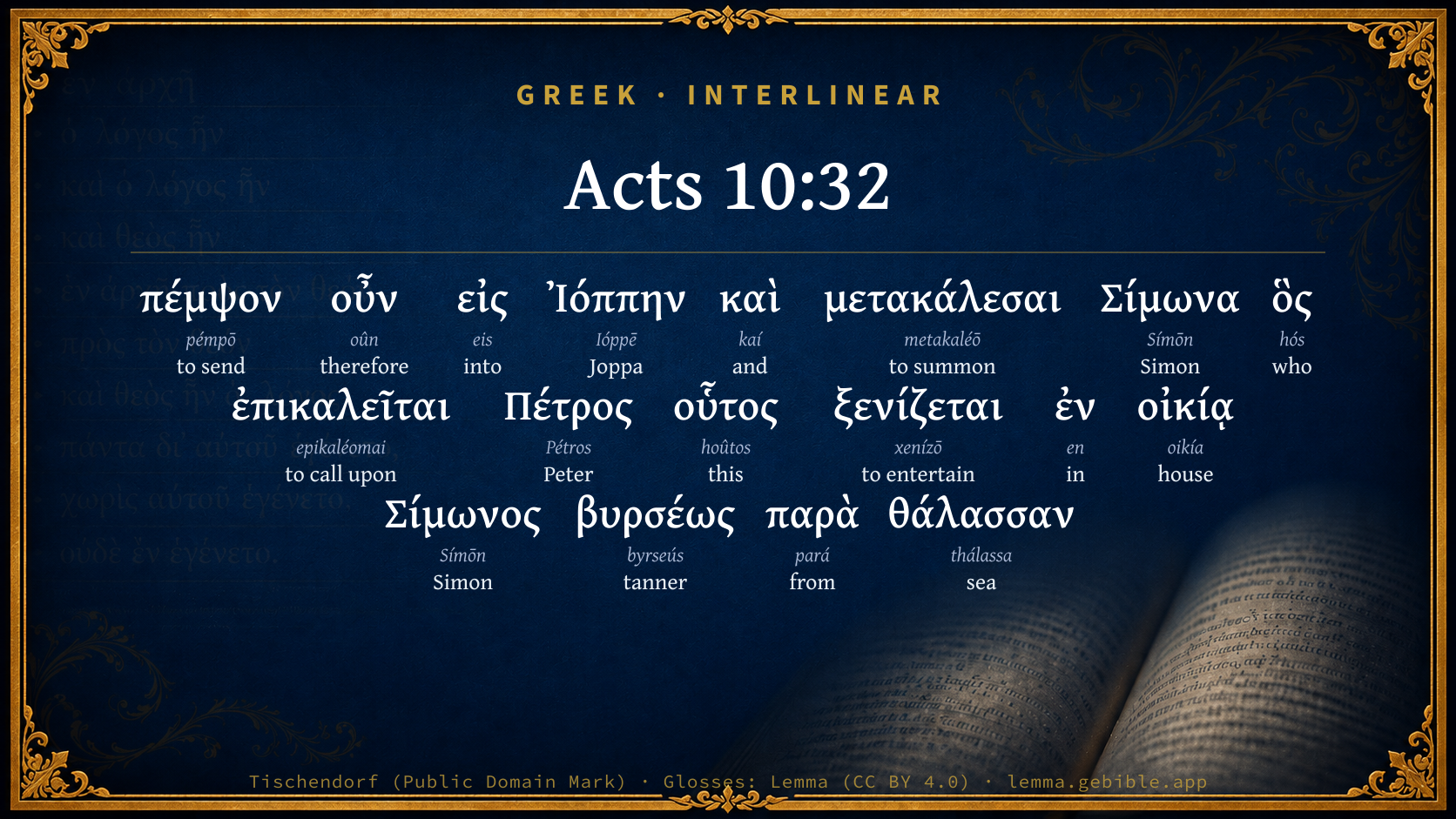
Send therefore to Joppa, and summon Simon, who is surnamed Peter. He lodges in the house of Simon a tanner, by the seaside. When he comes, he will speak to you.'
Download a study sheet
One document with this verse’s original text, its word-by-word gloss line, the meaning frame, cross-references with their text, attributed commentary, and full source and license credits — printable, and it pastes into notes with its structure intact.
This verse Autodidact and up
A passage Seminary Student
Up to 50 verses in one chapter. A passage sheet keeps up to 6 commentary sources and 12 cross-references per verse, in the order this page ranks them, and says so on the sheet whenever that leaves anything out. Ask for a single verse and you get the Autodidact verse sheet above.
Everything on this page stays free to read, with no account — the sheet is a download of what is already on screen, not access to it.
Compare translations 3
The same verse in 3 English versions, stacked beneath the original-language interlinear above. Click any original word for its lexicon entry.
Each is an independent rendering of the whole verse — the interlinear is not word-aligned to these translations.
Highlighted words mark where these versions differ — a whole-verse word diff, not a word-by-word alignment.
-
World English Bible Public Domain
Send therefore to Joppa, and summon Simon, who is surnamed Peter. He lodges in the house of Simon a tanner, by the seaside. When he comes, he will speak to you.'
-
King James Version Public Domain
Send therefore to Joppa, and call hither Simon, whose surname is Peter; he is lodged in the house of one Simon a tanner by the sea side: who, when he cometh, shall speak unto thee.
-
unfoldingWord Literal Text CC BY-SA 4.0
Therefore, send to Joppa and summon Simon who is called Peter. He is being hosted in the house of Simon, a tanner, by the sea.’
unfoldingWord Literal Text — © unfoldingWord, licensed CC BY-SA 4.0. Word-aligned USFM3 via Door43 (git.door43.org/unfoldingWord/en_ult).
Show all 19 translations
Every available English version of this verse, each an independent rendering of the whole verse.
-
World English Bible Public Domain
Send therefore to Joppa, and summon Simon, who is surnamed Peter. He lodges in the house of Simon a tanner, by the seaside. When he comes, he will speak to you.'
-
Berean Standard Bible Public Domain
Therefore send to Joppa for Simon, who is called Peter. He is a guest in the home of Simon the tanner, by the sea.’
-
Majority Standard Bible Public Domain
Therefore send to Joppa for Simon, who is called Peter. He is a guest in the home of Simon the tanner, by the sea. He will speak to you when he arrives.’
-
King James Version Public Domain
Send therefore to Joppa, and call hither Simon, whose surname is Peter; he is lodged in the house of one Simon a tanner by the sea side: who, when he cometh, shall speak unto thee.
-
American Standard Version (1901) Public Domain
Send therefore to Joppa, and call unto thee Simon, who is surnamed Peter; he lodgeth in the house of Simon a tanner, by the sea side.
-
Revised Version (1885) Public Domain
Send therefore to Joppa, and call unto thee Simon, who is surnamed Peter; he lodgeth in the house of Simon a tanner, by the sea side.
-
Geneva Bible (1599) Public Domain
Send therefore to Ioppa, and call for Simon, whose surname is Peter (he is lodged in the house of Simon a Tanner by the sea side) who when he commeth, shall speake vnto thee.
-
Douay-Rheims (1899) Public Domain
Send therefore to Joppe, and call hither Simon, who is surnamed Peter: he lodgeth in the house of Simon a tanner, by the sea side.
-
Young's Literal Translation Public Domain
send, therefore, to Joppa, and call for Simon, who is surnamed Peter; this one doth lodge in the house of Simon a tanner, by the sea, who having come, shall speak to thee;
-
Literal Standard Version CC BY-SA 4.0
send, therefore, to Joppa, and call for Simon, who is surnamed Peter; this one lodges in the house of Simon a tanner, by the sea, who having come, will speak to you;
-
Unlocked Literal Bible CC BY-SA 4.0
So send someone to Joppa, and call to you a man named Simon who is called Peter. He is staying in the house of a tanner named Simon, by the seaside.'
-
unfoldingWord Literal Text CC BY-SA 4.0
Therefore, send to Joppa and summon Simon who is called Peter. He is being hosted in the house of Simon, a tanner, by the sea.’
-
Darby Bible Public Domain
Send therefore to Joppa and fetch Simon, who is surnamed Peter; he lodges in the house of Simon, a tanner, by the sea [who when he is come will speak to thee].
-
World Messianic Bible Public Domain
Send therefore to Joppa and summon Simon, who is also called Peter. He is staying in the house of a tanner named Simon, by the seaside. When he comes, he will speak to you.’
-
Webster's Bible Public Domain
Send therefore to Joppa, and call hither Simon, whose surname is Peter; he lodgeth in the house of one Simon a tanner, by the sea-side: who, when he cometh, will speak to thee.
-
Free Bible Version CC BY-SA 4.0
Send someone to Joppa for Simon Peter. He's staying at Simon the tanner's house, down by the sea shore.’
-
Bible in Basic English Public Domain
Send, then, to Joppa, and get Simon, named Peter, to come to you; he is living in the house of Simon, a leather-worker, by the sea.
-
Text-Critical English NT CC BY 4.0
Therefore send to Joppa and ask for Simon, who is called Peter. He is staying by the sea in the house of a tanner named Simon. When he arrives, he will speak to yoʋ.’
-
Tyndale New Testament (1534) Public Domain
Sende therfore to Ioppa and call for Simon which is also called Peter. He is lodged in the housse of one Simon a tanner by the see syde the wich assone as he is come shall speake vnto the.
Literal Standard Version (2020), Covenant Press — licensed CC BY-SA 4.0. Text via the HelloAO Bible API (eBible.org). Unlocked Literal Bible (unfoldingWord) — licensed CC BY-SA 4.0. Text via the HelloAO Bible API (eBible.org). unfoldingWord Literal Text — © unfoldingWord, licensed CC BY-SA 4.0. Word-aligned USFM3 via Door43 (git.door43.org/unfoldingWord/en_ult). Free Bible Version, Dr. Jonathan Gallagher — licensed CC BY-SA 4.0. Text via the HelloAO Bible API (eBible.org).
Word by word
More ways to search: Search by grammar → Find every occurrence → Compare this word →
Practice this passage: Drill this verse → Learn its vocabulary →
- Appears 3× in the Greek New Testament
- First appears at Acts 9:43
- Part of Speech
- Noun
- Case
- Genitive
- Number
- Singular
- Gender
- Masculine
Full Thayer's Definition
- πέμψον pémpō G3992 “to send” Verb, Aorist, Active, Imperative, 2nd person, Singular
- οὖν oûn G3767 “therefore” Conjunction
- εἰς eis G1519 “into” Preposition
- Ἰόππην Ióppē G2445 “Joppa” Noun, Accusative, Singular, Feminine
- καὶ kaí G2532 “and” Conjunction
- μετακάλεσαι metakaléō G3333 “to summon” Verb, Aorist, Middle, Imperative, 2nd person, Singular
- Σίμωνα Símōn G4613 “Simon” Noun, Accusative, Singular, Masculine
- ὃς hós G3739 “who” Relative pronoun, Nominative, Singular, Masculine
- ἐπικαλεῖται epikaléomai G1941 “to call upon” Verb, Present, Passive, Indicative, 3rd person, Singular
- Πέτρος Pétros G4074 “Peter” Noun, Nominative, Singular, Masculine
- οὗτος hoûtos G3778 “this” Demonstrative pronoun, Nominative, Singular, Masculine
- ξενίζεται xenízō G3579 “to entertain” Verb, Present, Passive, Indicative, 3rd person, Singular
- ἐν en G1722 “in” Preposition
- οἰκίᾳ oikía G3614 “house” Noun, Dative, Singular, Feminine
- Σίμωνος Símōn G4613 “Simon” Noun, Genitive, Singular, Masculine
- βυρσέως byrseús G1038 “tanner” Noun, Genitive, Singular, Masculine
- παρὰ pará G3844 “from” Preposition
- θάλασσαν thálassa G2281 “sea” Noun, Accusative, Singular, Feminine
About this verse
These counts appear in no published source. They are computed here, from the morphology-tagged text and Lemma’s own curated glosses. What Lemma adds →
- 18
- words
- 17
- distinct lemmas
- Acts
- section
Notable vocabulary
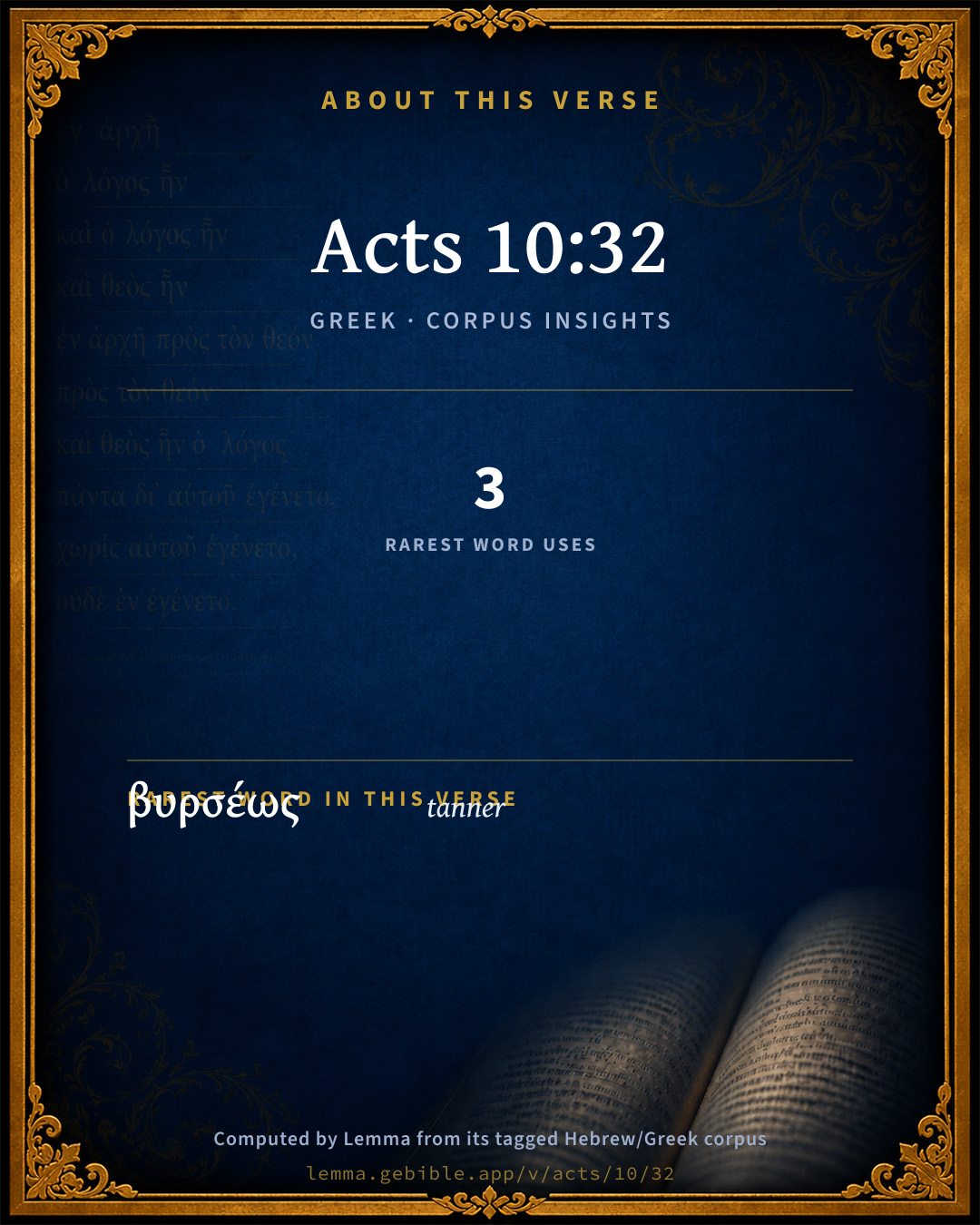
The rarest word here is βυρσέως tanner G1038 — appearing just 3 times in the whole Greek New Testament.
Shared distinctive vocabulary
βυρσέως tanner G1038 occurs in 3 verses of the Greek New Testament. Also found in:
Repetition
A word recurs within this verse:
- Σίμωνα Simon G4613 ×2
Where the printed editions differ
1 variantPlaces in this verse where the major printed Greek editions disagree on the wording in a way that affects the translation — a comparison of editions, not a manuscript-by-manuscript collation. The editions are the modern critical texts (Nestlé-Aland 28/27, SBL, Westcott-Hort, Tregelles, Tyndale House) and the traditional texts behind the KJV (the Textus Receptus and the Byzantine/Majority text). It is not a claim about which reading is original.
-
Extra text
ὃς παραγενόμενος λαλήσει σοι.
“who having come he will speak to you.”
In TRByz Not in NA28NA27TynSBLWHTregὃς παραγενόμενος λαλήσει σοι. (hos paragenomenos lalēsei soi) 'who having come he will speak to you.' is only in traditional manuscripts (TR+Byz)
Textual data: Translators Amalgamated Greek New Testament (STEPBible TAGNT) · CC BY 4.0.
Lesson kit
Teaching starters — assembled from the data on this page, not authored interpretation. Every prompt links to the verse data it draws on. Edit before teaching.
Acts, in the Acts, opens this verse with 18 words (17 distinct Greek lemmas). Its most distinctive word is byrseús (“tanner”). A historical commentator’s framing appears above. Read the whole chapter for the surrounding context.
Discussion questions
- What does “tanner” (byrseús) contribute to the verse as a whole?
- How does Acts 9:43, which shares the word «tanner», read alongside this verse?
- What does the repetition of “Simon” (2× in this one verse) do in this verse?
- The translations on this page render this verse differently — a whole-verse word diff, not a word-by-word alignment. What might account for the different wordings?
- Compare how Geneva Bible (1599) and The Cambridge Bible for Schools and Colleges read this verse. Where do they agree or differ?
Things to notice
- These translations choose different wording for 22 words in this verse.
- “Simon” occurs 2× in this single verse.
- 17 distinct Greek lemmas span 18 words in this verse.
Commentary
Notes on Acts 10:32 from classic Christian and Jewish commentators (each source and its license shown beneath its notes). The classic Christian expositions comment on the surrounding passage and are grouped to its opening verse, so a note may address several verses; the Jewish commentaries on the Tanakh (Rashi and others) are per-verse, so they appear only where the commentator wrote on this verse.
Lemma curates 59 commentaries, every one of them public domain or Creative Commons licensed, each selected and text-cleaned for this edition rather than reprinted as found. About our sources →
Geneva Bible (1599)
Geneva Bible translators
Geneva Bible (1599) marginal notes — public domain. Text via Bolls.life.
The Cambridge Bible for Schools and Colleges
gen. ed. J. J. S. Perowne
The Cambridge Bible for Schools and Colleges (gen. ed. J. J. S. Perowne; Cambridge University Press, 1878–1918) — public domain. Text from a community e-Sword module.
John Gill's Exposition
John Gill's Exposition of the Whole Bible (1746–1763) — public domain (CC PDM 1.0). Text via the HelloAO Bible API.
Trapp's Complete Commentary
John Trapp
John Trapp, A Commentary or Exposition upon All the Books of the Old and New Testament (1647–1656) — public domain. Text from a community e-Sword module.
Matthew Poole's English Annotations
Matthew Poole's English Annotations on the Holy Bible (1683–1685) — public domain. Text from a community e-Sword/MySword module.
The Pulpit Commentary
The Pulpit Commentary (1880–1919), ed. H.D.M. Spence-Jones & Joseph S. Exell — public domain. Text from a community e-Sword module.
McGarvey & Pendleton's Commentaries
J. W. McGarvey
J. W. McGarvey (with Philip Y. Pendleton), Commentaries on the New Testament (The Fourfold Gospel, 1914; Acts; and the epistles) — public domain. Text from a community e-Sword/MySword module.
Cambridge Greek Testament for Schools and Colleges
Cambridge Greek Testament for Schools and Colleges (Cambridge University Press, 1896; 21 vols, various authors incl. Carr, Maclear, Plummer, Farrar, Lumby, Moule, M. R. James, Simcox) — public domain. Text from a community e-Sword module.