Acts 14:9

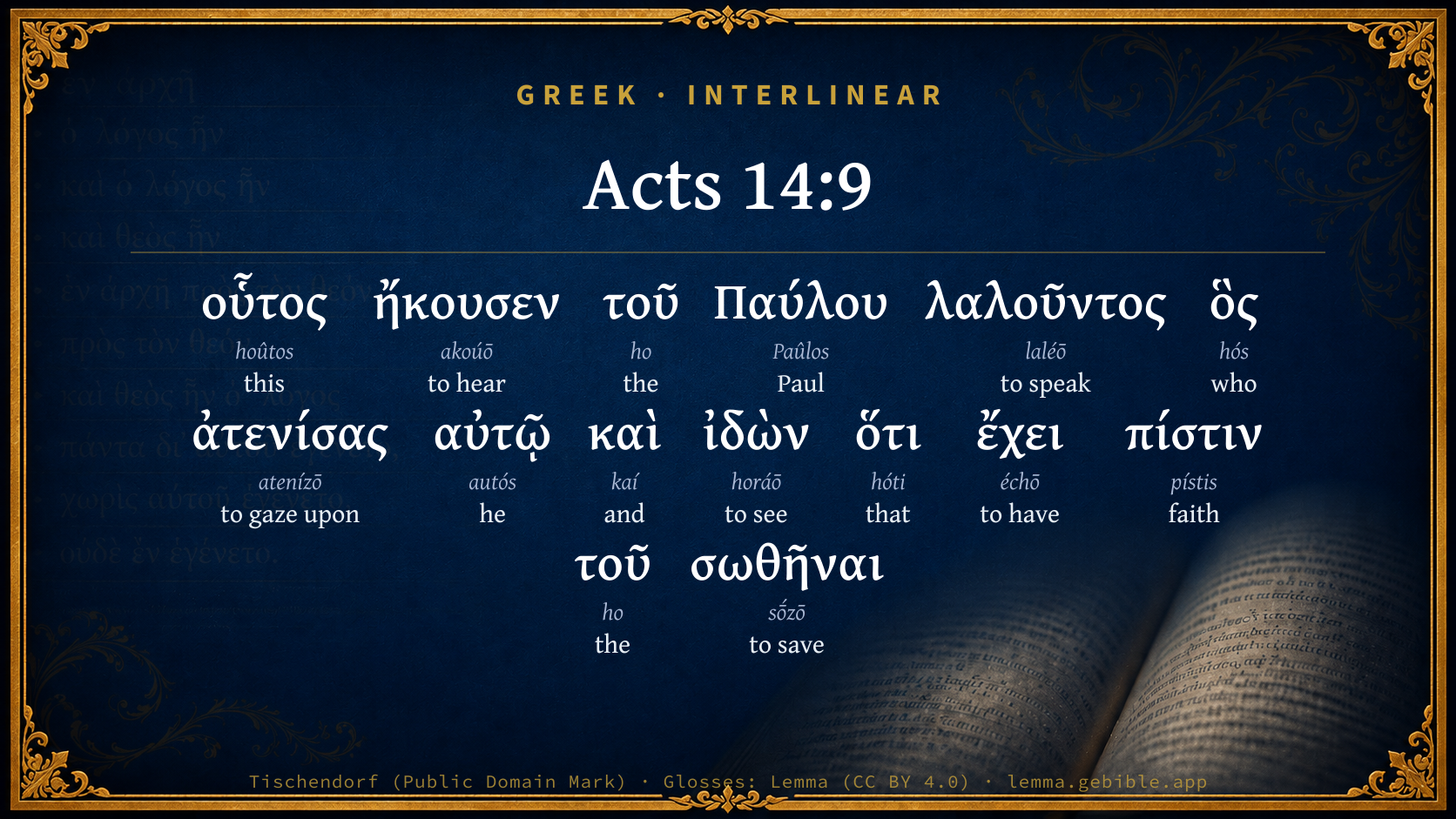
Greek (Tischendorf 8th ed.) Acts 14:9 appears in the Greek New Testament. The text above is from the Tischendorf 8th edition. Each word links to its Strong’s number and a concise gloss. Click any word for its full Thayer’s Greek Lexicon entry.
Download image
Cite this verse

Acts 14:9 (World English Bible). Public Domain. Lemma interlinear Bible study tool, https://lemma.gebible.app/v/acts/14/9.

Show BibTeX & RIS
BibTeX
RIS
English Translation
He was listening to Paul speaking, who, fastening eyes on him, and seeing that he had faith to be made whole,
World English Bible · Public Domain
Download a study sheet

One document with this verse’s original text, its word-by-word gloss line, the meaning frame, cross-references with their text, attributed commentary, and full source and license credits — printable, and it pastes into notes with its structure intact.

This verse Autodidact and up

Study sheet (.html) Plain text (.txt)

A passage Seminary Student

Up to 50 verses in one chapter. A passage sheet keeps up to 6 commentary sources and 12 cross-references per verse, in the order this page ranks them, and says so on the sheet whenever that leaves anything out. Ask for a single verse and you get the Autodidact verse sheet above.

Everything on this page stays free to read, with no account — the sheet is a download of what is already on screen, not access to it.

Want to remove ads? Support Godless Engineer
Compare translations 3

The same verse in 3 English versions, stacked beneath the original-language interlinear above. Click any original word for its lexicon entry.

Each is an independent rendering of the whole verse — the interlinear is not word-aligned to these translations.

Highlighted words mark where these versions differ — a whole-verse word diff, not a word-by-word alignment.

  • World English Bible Public Domain
    He was listening to Paul speaking, who, fastening eyes on him, and seeing that he had faith to be made whole,
  • King James Version Public Domain
    The same heard Paul speak: who stedfastly beholding him, and perceiving that he had faith to be healed,
  • unfoldingWord Literal Text CC BY-SA 4.0
    He heard Paul speaking, who looked intently at him and saw that he had faith to be healed.

unfoldingWord Literal Text — © unfoldingWord, licensed CC BY-SA 4.0. Word-aligned USFM3 via Door43 (git.door43.org/unfoldingWord/en_ult).

Versions to compare (up to 4)

3 of 4 selected

Show all 19 translations

Every available English version of this verse, each an independent rendering of the whole verse.

  • World English Bible Public Domain
    He was listening to Paul speaking, who, fastening eyes on him, and seeing that he had faith to be made whole,
  • Berean Standard Bible Public Domain
    This man was listening to the words of Paul, who looked intently at him and saw that he had faith to be healed.
  • Majority Standard Bible Public Domain
    This man was listening to the words of Paul, who looked intently at him and saw that he had faith to be healed.
  • King James Version Public Domain
    The same heard Paul speak: who stedfastly beholding him, and perceiving that he had faith to be healed,
  • American Standard Version (1901) Public Domain
    The same heard Paul speaking, who, fastening eyes upon him, and seeing that he had faith to be made whole,
  • Revised Version (1885) Public Domain
    The same heard Paul speaking: who, fastening his eyes upon him, and seeing that he had faith to be made whole,
  • Geneva Bible (1599) Public Domain
    He heard Paul speake: who beholding him, and perceiuing that he had faith to be healed,
  • Douay-Rheims (1899) Public Domain
    Said with a loud voice: Stand upright on thy feet. And he leaped up, and walked.
  • Young's Literal Translation Public Domain
    this one was hearing Paul speaking, who, having stedfastly beheld him, and having seen that he hath faith to be saved,
  • Literal Standard Version CC BY-SA 4.0
    this one was hearing Paul speaking, who, having steadfastly beheld him, and having seen that he has faith to be saved,
  • Unlocked Literal Bible CC BY-SA 4.0
    This man heard Paul speaking. Paul fixed his eyes on him and saw that he had faith to be made well.
  • unfoldingWord Literal Text CC BY-SA 4.0
    He heard Paul speaking, who looked intently at him and saw that he had faith to be healed.
  • Darby Bible Public Domain
    This [man] heard Paul speaking, who, fixing his eyes on him, and seeing that he had faith to be healed,
  • World Messianic Bible Public Domain
    He was listening to Paul speaking, who, fastening eyes on him and seeing that he had faith to be made whole,
  • Webster's Bible Public Domain
    The same heard Paul speak: who steadfastly beholding him, and perceiving that he had faith to be healed,
  • Free Bible Version CC BY-SA 4.0
    He sat there listening to Paul speaking. When Paul looked directly at him, and realized that the man was trusting in God to heal him,
  • Bible in Basic English Public Domain
    This man was giving ear to the preaching of Paul, who, looking at him, and seeing that he had faith to be made well,
  • Text-Critical English NT CC BY 4.0
    This man listened to Paul as he was speaking. Paul looked at him intently, and when he saw that he had faith to be healed,
  • Tyndale New Testament (1534) Public Domain
    The same hearde Paul preache. Which behelde him and perceaved that he had fayth to be whole

Literal Standard Version (2020), Covenant Press — licensed CC BY-SA 4.0. Text via the HelloAO Bible API (eBible.org). Unlocked Literal Bible (unfoldingWord) — licensed CC BY-SA 4.0. Text via the HelloAO Bible API (eBible.org). unfoldingWord Literal Text — © unfoldingWord, licensed CC BY-SA 4.0. Word-aligned USFM3 via Door43 (git.door43.org/unfoldingWord/en_ult). Free Bible Version, Dr. Jonathan Gallagher — licensed CC BY-SA 4.0. Text via the HelloAO Bible API (eBible.org).

Word by word

More ways to search: Search by grammar → Find every occurrence → Compare this word →

Practice this passage: Drill this verse → Learn its vocabulary →

ἀτενίσας
atenízō
G816
“to gaze upon”
Verb, Aorist, Active, Participle, Nominative, Singular, Masculine
Part of Speech
Verb
Tense
Aorist
Voice
Active
Mood
Participle
Case
Nominative
Number
Singular
Gender
Masculine
Full Thayer's Definition

Origin: from a compound of G1 (as a particle of union) and teino (to stretch)

TDNT: None

1. to fix the eyes on, gaze upon 2. to look into anything 3. metaph. to fix one's mind on one as an example
  1. οὗτος hoûtos G3778 “this” Demonstrative pronoun, Nominative, Singular, Masculine
  2. ἤκουσεν akoúō G191 “to hear” Verb, Aorist, Active, Indicative, 3rd person, Singular
  3. τοῦ ho G3588 “the” Article, Genitive, Singular, Masculine
  4. Παύλου Paûlos G3972 “Paul” Noun, Genitive, Singular, Masculine
  5. λαλοῦντος laléō G2980 “to speak” Verb, Present, Active, Participle, Genitive, Singular, Masculine
  6. ὃς hós G3739 “who” Relative pronoun, Nominative, Singular, Masculine
  7. αὐτῷ autós G846 “he” Personal pronoun, Dative, Singular, Masculine
  8. καὶ kaí G2532 “and” Conjunction
  9. ἰδὼν horáō G3708 “to see” Verb, Aorist, Active, Participle, Nominative, Singular, Masculine
  10. ὅτι hóti G3754 “that” Conjunction
  11. ἔχει échō G2192 “to have” Verb, Present, Active, Indicative, 3rd person, Singular
  12. πίστιν pístis G4102 “faith” Noun, Accusative, Singular, Feminine
  13. τοῦ ho G3588 “the” Article, Genitive, Singular, Neuter
  14. σωθῆναι sṓzō G4982 “to save” Verb, Aorist, Passive, Infinitive

About this verse

These counts appear in no published source. They are computed here, from the morphology-tagged text and Lemma’s own curated glosses. What Lemma adds →

15
words
14
distinct lemmas
Acts
section

Notable vocabulary

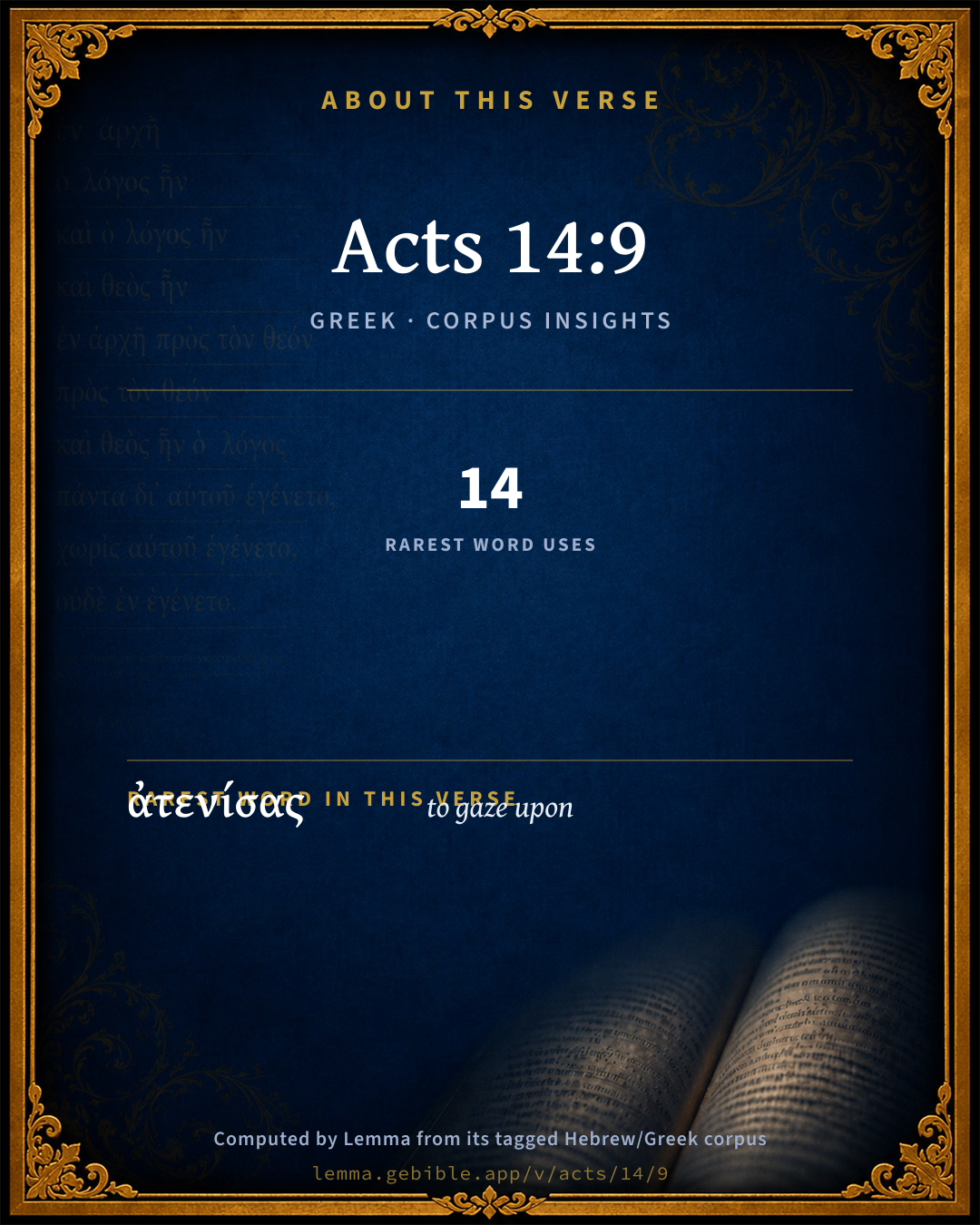
The rarest word here is ἀτενίσας to gaze upon G816 — appearing just 14 times in the whole Greek New Testament.

Shared distinctive vocabulary

ἀτενίσας to gaze upon G816 occurs in 14 verses of the Greek New Testament. Also found in:

Repetition

A word recurs within this verse:

Cross-references

11

Topical passages linked to Acts 14:9 in the Treasury of Scripture Knowledge — connected by theme and wording, ordered by reader-vote popularity; previews shown in the World English Bible.

  • Matthew 15:28 Then Jesus answered her, "Woman, great is your faith! Be it done to you even as you desire." And her daughter was healed from that hour.
  • Acts 3:4 Peter, fastening his eyes on him, with John, said, "Look at us."
  • Matthew 9:28–29 When he had come into the house, the blind men came to him. Jesus said to them, "Do you believe that I am able to do this?" They told him, "Yes, Lord."
  • Matthew 8:10 When Jesus heard it, he marveled, and said to those who followed, "Most assuredly I tell you, I haven't found so great a faith, not even in Israel.
  • Matthew 9:22 But Jesus, turning around and seeing her, said, "Daughter, cheer up! Your faith has made you well." And the woman was made well from that hour.
  • Matthew 13:58 He didn't do many mighty works there because of their unbelief.
  • Mark 1:40–41 There came to him a leper, begging him, kneeling down to him, and saying to him, "If you want to, you can make me clean."
  • Mark 2:5 Jesus, seeing their faith, said to the paralytic, "Son, your sins are forgiven you."
  • Mark 2:11–12 "I tell you, arise, take up your mat, and go to your house."
  • Mark 9:23–24 Jesus said to him, "If you can believe, all things are possible to him who believes."
  • Mark 10:52 Jesus said to him, "Go your way. Your faith has made you well." Immediately he received his sight, and followed Jesus in the way.

Cross-references courtesy of OpenBible.info (CC BY 4.0).

Commentary

Notes on Acts 14:9 from classic Christian and Jewish commentators (each source and its license shown beneath its notes). The classic Christian expositions comment on the surrounding passage and are grouped to its opening verse, so a note may address several verses; the Jewish commentaries on the Tanakh (Rashi and others) are per-verse, so they appear only where the commentator wrote on this verse.

Lemma curates 59 commentaries, every one of them public domain or Creative Commons licensed, each selected and text-cleaned for this edition rather than reprinted as found. About our sources →

The Biblical Illustrator

Joseph S. Exell

Act_14:9-10

The same heard Paul speak: who … perceiving that he had faith to be healed, said … Stand upright.

Faith to be healed

I. What preceded his faith? Faith cometh by hearing; but the bearing of what? The gospel (Act_14:7). Yes, he declared to these ignorant, superstitious fanatics the very same truths which he spoke to his enlightened Jewish brethren. He makes no difference between the education of his hearers in different places. To Ephesian sorcerers, to philosophic Athenians, to Corinthian merchants, to rustic Leptrians, his only message is the gospel. What, then, was this gospel which Paul preached everywhere?

1. It was a gospel of facts. Every time Paul preached he told the following unvarnished tale: God beheld men lost and ruined. Out of love to them He sent His only-begotten Son, who lived a life of innocence and perfect obedience. He was crucified, rose again, and ascended up to heaven, where He sitteth at the right hand of God, from whence He shall come to judge the quick and the dead.

2. There were certain doctrines flowing out of the facts. To wit, that Jesus Christ had offered a full atonement for the sin of His people, so that whosoever would believe on Him should be saved. Then would come the doctrine of pardon, how God could be just, and yet the Justifier of him who believeth.

3. And out of these there sprung certain commands: Believe in the Lord Jesus Christ and thou shelf be saved. He that believeth and is baptized shall be saved. Well, says one, do you think the world will be turned upside down by this? It has been and will be again. In vain do men attempt to find a nobler instrument. This is the great battering ram which shall yet shake the bastions of error. This is the true Excalibur, which, if any man knoweth how to wield it, shall cut through joints and marrow, and make him more than a conqueror. Do ye ask, then, where this mans faith came from? It came from Pauls preaching of the gospel.

II. Wherein lay this mans faith?

1. Paul perceived that he had faith to be healed. As he listened to Paul he thought, perhaps, That seems to be the truth; it is the truth; I am sure it is true; and, if so, perhaps I may be healed; I--I--I think I may; I hope I may; I believe I may; from what Paul says of Christs character, I think He must be willing to do it. Then Paul said to him, Stand upright on thy feet, and he did so in a moment, for he had faith to be healed.

2. You say, It does not appear that Paul had any previous communication with the cripple. Now I know from my own experience that it is no uncommon thing for someone to arrest the preachers attention. The group of countenances before him might to the first glance of a stranger look confused and inexplicable, as a Chinese grammar to those who know not the language. But a practised eye can learn to read the one as well as the other. The languor and indifference of some; the curious inquiring look of others; the cold, critical attention of more, form a picture which often reacts upon us, and kindles a desire to reach those who, for a brief hour, hang upon our lips. But there will sometimes be one who has faith dazzling in his very eyes, seeming to drink in every syllable, till the preacher becomes as absorbed in that man as the man had been in the preacher. And while he pursues the discourse, he perceives that at last this man has heard the very truth which meets his case. Preacher and hearer, unknown to all the rest of the audience, have secretly saluted each other, and met on the common ground of a vital faith.

3. Shall I describe this faith to be saved? You have faith, but you have not fully exercised it. Now, you believe that Jesus Christ is Gods Son? Yes. That He has made a full atonement? Yes. That He is worthy to be trusted? You depend on nothing else? No. Then you only need that gracious command--Stand upright on thy feet.

III. The spiritual teaching of the miracle and of the blessing conferred. Are there not many, who though they have faith to be saved, are still limping? The reasons may be different in different cases.

1. Some have been so stunned by grief on account of sin, that while they do believe that Christ is able and willing to save, they cannot get a hold of the fact that they are saved. Stand upright on thy feet, thou trembling sinner. If thou believest in Jesus, whatever thy fears may be, there is no cause for them.

2. Some are still lame, though they have faith, through ignorance. They are waiting for something, they hardly know what, to embellish their faith, or to fortify it with signs and wonders. All that you have to do with is this--Do I believe in Jesus? If you do you are saved, Stand upright on your feet.

3. How many, too, are kept lame because of a fear of self-deception. Away with that affectation of modesty, saying, I hope; I trust; but I feel such doubts, such fears, and such gloomy misgivings, that is a vain unseemly questioning of God.

4. Others, again, cannot stand upright because they are afraid that if they did begin they would go back again, and so bring dishonour to Christ. This would be a very proper fear if you had anything to do with keeping yourselves, but Christ gives you His promise to preserve you even to the end.

5. Then possibly there is one here who cannot stand upright because of his many sins. Sinner, stand upright on thy feet, for all manner of sin and blasphemy shall be forgiven unto men. (C. H. Spurgeon.)

Faith to be healed

1. Faith is the one condition indispensable whenever one would receive blessings from God.

2. We must be willing to look for and recognise even feeble faith (Isa_42:3). It requires alertness and charity,

3. Christians must instantly honour true faith when they find it, not stop to question, and to search, and to disturb it.

4. He who has greatest faith of his own will detect faith in others most quickly.

5. Our Lord is wont to see faith sometimes when we declare we cannot. (C. S. Robinson, D. D.)

The efficacy of faith

Take a piece of wax and a piece of gold of the same magnitude; the wax is not valuable with the gold; but as this wax is placed at the end of some will, by virtue of which some great estate is confirmed and conveyed, so it may be worth many hundred pounds. So faith, considered purely in itself, doth challenge nothing more than any other graces: nay, in some sense it is inferior, it being an empty hand; but as this hand receives the precious alms of Christs merits, and is an instrument or channel through which the blessed streams of life flow to us from Him, so it doth challenge a superiority over, and is more excellent than, all other graces whatsoever. (J. Spencer.)

Essential faith

Why is faith so essential? It is because of its receptive power. A purse will not make a man rich, and yet, without some place for his money, how could a man acquire wealth? Faith itself could not contribute a penny to salvation, but it is the purse which holds a precious Christ within itself, yea, it holds all the treasure of Divine love. If a man is thirsty, a rope and a bucket are not in themselves of much use to him, but yet if there is a well near at hand, the very thing that is wanted is a bucket and a rope by which the water can be lifted. Faith is the bucket by which a man may draw water out of the wells of salvation, and drink to his hearts content. You may sometimes have stopped a moment at a street fountain, and have desired to drink, but you found you could not, for the drinking cup was gone. The water flowed, but you could not get at it. It was tantalising to be at the fountainhead, and yet to be thirsty still in want of a little cup. Now faith is that little cup, which we hold up to the flowing stream of Christs grace; we fill it, and then we drink and are refreshed. Hence the importance of faith. It would have seemed to our forefathers an idle thing to lay down a cable under the sea from England to America, and it would be idle now were it not that science has taught us how to speak by lightening; yet the cable itself is now of the utmost importance, for the best invention of telegraphy would be of no use for purposes of transatlantic communication if there were not the connecting wire between the two continents. Faith is just that; it is the connecting link between our souls and God, and the living message flashes along it to our souls. (C. H. Spurgeon.)

The Biblical Illustrator, edited by Joseph S. Exell (c. 1880s–1900s) — public domain. Text from a community e-Sword module.

Tyndale Open Study Notes

Tyndale Open Resources

14:9 Paul realized he had faith to be healed: Paul, full of the Holy Spirit (9:17), sensed the man’s spiritual openness and expectancy for divine help and intervention.

Tyndale Open Study Notes — © Tyndale Open Resources, licensed CC BY-SA 4.0. Text via the HelloAO Bible API.

Bengel's Gnomon

Johann Albrecht Bengel

Act 14:9. Ἀτενίσας, having stedfastly looked upon) It is the part of spiritual prudence, to observe the motions of the hearers, especially such as are afflicted.—πίστιν, faith) passive faith with regard to the miracle. Whilst the cripple hears the word, he feels its power in his soul: whence he is moved inwardly, so as to draw the conclusion with respect to his body (being cured).

Bengel's Gnomon of the New Testament — English translation (T&T Clark, Edinburgh, 1860) — public domain. Text from a community e-Sword module.

Expositor's Greek Testament

ed. W. Robertson Nicoll

Act 14:9 . οὗτος ; a genuine Lucan mark of connection, Friedrich, p. 10. ἤκουε ; “used to hear,” or “was listening to,” i.e. , was an habitual hearer of Paul’s preaching, see critical notes on D. Ramsay, St, Paul , pp. 114, 116, regards the man as a proselyte, cf. additions in Bezan text, but for another view of the additions here and in Act 14:10 , Page, Classical Review , July, 1899. ἀτεν ., see above, Act 1:10 . τοῦ σ ., Burton, Moods and Tenses , p. 158.

The Expositor's Greek Testament, edited by W. Robertson Nicoll (1897–1910) — public domain. Text from a community e-Sword module.

Jamieson, Fausset & Brown

Robert Jamieson, A. R. Fausset & David Brown

who steadfastly beholding him--as he did Elymas the sorcerer when about to work a miracle on him.

and perceiving that he had faith to be healed--Paul may have been led by the sight of this cripple to dwell on the Saviour's miracles of healing, and His present power; and perceiving from the eagerness with which the patient drank in his words, that he was prepared to put his own case into the Redeemer's hands, the Spirit of the glorified Physician came all upon Paul, and "with a loud voice" he bade him "stand upright upon his feet." The effect was instantaneous--he sprang to his feet "and walked."

Jamieson, Fausset & Brown — Commentary Critical and Explanatory on the Whole Bible (1871) — public domain (CC PDM 1.0). Text via the HelloAO Bible API.

Adam Clarke's Commentary

Verse 9. That he had faith to be healed] How did this faith come to this poor heathen? Why, by hearing the word of God preached: for it is said, the same heard Paul speak. And it appears that he credited the doctrine he heard, and believed that Jesus could, if he would, make him whole. Besides, he must have heard of the miracles which the apostles had wrought, see Ac 14:3; and this would raise his expectation of receiving a cure.

Adam Clarke's Commentary on the Bible (1810–1826) — public domain. Text from a community e-Sword/MySword module.

John Calvin's Commentaries

9. He heard Paul speak. Hearing is set down first, that we may know that the faith which Luke will commend by and by was conceived of Paul’s doctrine. Therefore, when he heard Paul, he hoped to be healed. But the question is, whether this was promised to him specially; for God doth not command us to hope for everything by and by, when he offereth unto us eternal salvation in the gospel. I answer, that this was a singular and extraordinary motion of the Spirit of God in the cripple, as it was on the other side in Paul, when he knew his faith by beholding him only. It may be that many may receive the gospel, and yet they shall not be cured of those diseases wherewith they are vexed. But forasmuch as God was determined to show a token of his grace in the cripple, he prepared his mind before, and made him capable of this that should come upon him. Wherefore we must not make this a common rule, because the cripple believed that he should be healed, but it was a peculiar preparation to receive the gift of healing. And this kind of faith is likewise particular which giveth place to miracles, which many of God’s children do want, who are, notwithstanding, indued with the Spirit of adoption.

Whom when Paul beheld steadfastly. We know how doubtful and how deceitful a thing the countenance of man is, therefore there could no sure judgment be given thereby of faith, which hath God alone to be witness thereof; but, as I have already said, the cripple’s faith was revealed to Paul by the secret inspiration of the Spirit, as he was to the apostles their only guide and master to work miracles.

John Calvin's Commentaries (1540-1563) — public domain. Text from the Calvin Translation Society English edition (1840s-50s) via the Christian Classics Ethereal Library (ccel.org). Calvin's coverage is partial (roughly two-thirds of the Bible); uncommented books and verses are honest gaps, never fabricated. The 19th-century editor's footnotes and remarks are omitted so the notes are faithfully Calvin's own voice.

Ellicott's Commentary for English Readers

(9) Who stedfastly beholding him.—We note once more the recurrence of the characteristic word and look. (See Note on Act_13:9.)

Perceiving that he had faith to be healed.—Here, as so often, as if it were the general, though not the universal, law of miraculous working (see Notes on Mar_10:23), faith is pre-supposed as the condition. It follows from this, no less than from the tense of the verb, “used to listen to Paul as he spoke,” that he had for some days been among St. Paul’s hearers, had heard the gospel of the death and resurrection of Jesus, and had found that such a Saviour met his every need. All this the Apostle read, with that earnest gaze of his, in the man’s upward look.

A Bible Commentary for English Readers, edited by Charles John Ellicott (1878–1897) — public domain. Text from a community e-Sword module.

The Cambridge Bible for Schools and Colleges

gen. ed. J. J. S. Perowne

9. the same heard Paul speak] The verb in the Text. recept. is here the imperfect, but some MSS. have the aorist The former seems to be the more suitable. What happened was that the Apostles preached on several occasions, and that the lame man was at his station and heard repeatedly the teaching of the Gospel, and by his earnest attention and manner indicated that what was spoken had been accepted by him with faith. This attracted the attention of St Paul.

who stedfastly beholding him (fastening his eyes upon him)] The verb is common with St Luke, and is used several times of St Paul, as in Act_13:9, where he fixes his gaze on Elymas, and Act_23:1, where he attentively beholds the council. From the context of the latter passage, in which we learn that the Apostle did not recognize the high-priest, some have thought that this straining earnest gaze, so frequently ascribed to St Paul, was due to some weakness of sight remaining ever since his blindness at the time of his conversion.

and perceiving (seeing) that he had faith to be healed] The man’s heart shone out in his face, and the Spirit within the Apostle recognized that here was a fit object to be made, by his cure, a sign unto the men of Lystra.

The Cambridge Bible for Schools and Colleges (gen. ed. J. J. S. Perowne; Cambridge University Press, 1878–1918) — public domain. Text from a community e-Sword module.

John Gill's Exposition

The same heard Paul speak,.... That is, preach the Gospel; he was one of his hearers, and faith came to hint by hearing; the Arabic version adds, "he cried unto him"; that is, to Paul, whom he heard:

who steadfastly beholding him; not the lame man beholding Paul, but Paul beholding the lame man, as the Syriac and Ethiopic versions both express it, as also Beza's ancient copy and others; so Peter looked on the man he cured, Act 3:4.

And perceiving that he had faith to be healed; as he might by his looks, his gestures, his attention in hearing, and it may be by somewhat that he said, as well as by revelation, or a spirit of discerning, which he had.

John Gill's Exposition of the Whole Bible (1746–1763) — public domain (CC PDM 1.0). Text via the HelloAO Bible API.

Trapp's Complete Commentary

John Trapp

9 The same heard Paul speak: who stedfastly beholding him, and perceiving that he had faith to be healed,

Ver. 9. Perceiving that he had faith] Not by any skill he had in physiognomy, {a} but by special revelation; without the which, strong confidence one may have of another man’s true grace, but no certainty either of sense or of science.

{a} The foretelling of destiny or future fortune from the features and lines of the face, ŒD

John Trapp, A Commentary or Exposition upon All the Books of the Old and New Testament (1647–1656) — public domain. Text from a community e-Sword module.

Albert Barnes' Notes on the Bible

Who stedfastly beholding him - Fixing his eyes intently on him. See the notes on Act 1:10.

And perceiving - How he perceived this is not said. Perhaps it was indicated by the ardor, humility, and strong desire depicted in his countenance. He had heard Paul, and perhaps the apostle had dwelt particularly on the miracles with which the gospel had been attested. The miracles performed also in Icontium had doubtless also been heard of in Lystra.

Had faith to be healed - Compare Mat 9:21-22, Mat 9:28-29; Luk 7:50; Luk 17:19; Luk 18:42.

Albert Barnes' Notes on the Bible (1834–1885) — public domain. Text from a community e-Sword/MySword module.

Matthew Poole's English Annotations

This Paul might know by a prophetical Spirit; and that extraordinary gift of discerning of spirits might be in this case bestowed upon him. But withal, it is not unlikely but this lame man’s attention to the word, eyes, gesture, and countenance, might speak as much.

Matthew Poole's English Annotations on the Holy Bible (1683–1685) — public domain. Text from a community e-Sword/MySword module.

Whedon's Commentary on the Bible

Daniel D. Whedon

9. Heard Paul speak—In the discourse, doubtless, he learned how the blessed Jesus performed many a miracle, which cured at once both soul and body, administering forgiveness of sin and restoring health and soundness. He may have been told that that same Jesus still reigned on high, willing and able to save, and empowering even his apostles often to work miracles of mercy upon the diseased of soul and body. He may have learned that the very first miracle performed by the Lord’s apostles was the healing of a cripple like himself at the Beautiful gate of the wonderful temple in ancient Jerusalem.

Steadfastly beholding him—See note on Act_3:4.

Faith to be healed—The Greek word here signifies not to be healed, but to be saved, including the whole salvation both of body and soul, the earnest and type of the complete salvation of body and soul in the glorious resurrection.

Daniel D. Whedon (gen. ed.), Commentary on the Old and New Testaments (1874–1909) — public domain. Text from a community e-Sword module.

The Pulpit Commentary

Speaking for speak, A.V.; fastening his eyes upon for stedfastly beholding, A.V.; (see above, Act_1:10 Act_3:4, etc.) seeing for perceiving, A.V.; made whole for healed, A.V. Heard. The force of the imperfect hkoue would, perhaps, be better given by "listened" to Paul speaking. There is great resemblance between this miracle of healing, and that of the lame man laid at the gate of the temple, who was healed by, (Act_3:2-10) and, not unnaturally, considerable identity of expression in the narratives. Both men were lame from their birth; the apostles fastened their eyes upon both; both, when healed, leaped and walked; and in both cases the miracle "had a great effect upon the multitudes who beheld it. Zeller (vol. it. p. 6), with characteristic recklessness, infers that "this narrative was, merely in imitation of the early miraculous story of Peter;" and so relegates both it and the subsequent narrative to the regions of fable.

The Pulpit Commentary (1880–1919), ed. H.D.M. Spence-Jones & Joseph S. Exell — public domain. Text from a community e-Sword module.

John Wesley's Explanatory Notes

He had faith to be healed - He felt the power of God in his soul; and thence knew it was sufficient to heal his body also.

John Wesley, Explanatory Notes Upon the Whole Bible (1754–1765) — public domain. Text via the GEBible commentary corpus.

McGarvey & Pendleton's Commentaries

J. W. McGarvey

See notes one verse 8

J. W. McGarvey (with Philip Y. Pendleton), Commentaries on the New Testament (The Fourfold Gospel, 1914; Acts; and the epistles) — public domain. Text from a community e-Sword/MySword module.

Cambridge Greek Testament for Schools and Colleges

9. οὗτος ἤκουσεν κ.τ.λ., this man heard Paul speaking. The aorist leaves it quite indefinite whether the man heard on this one occasion only, or had listened to frequent teachings, and so become filled with faith in what was taught.

ὃς ἀτενίσας αὐτῷ, who fastening his eyes upon him. This verb is common with St Luke, and seems to indicate that the person using it was an eye-witness of what he relates. It occurs several times of St Paul, as in Act 13:9, where he fixes his gaze on Elymas, and Act 23:1, where he attentively beholds the council. From the context of the latter passage, in which we learn that the Apostle did not recognize the high-priest, some have thought that this straining earnest gaze, so frequently ascribed to St Paul, was due to some weakness of sight remaining ever since his blindness at the time of his conversion.

καὶ ἰδὼν ὅτι ἔχει πίστιν τοῦ σωθῆναι, and seeing that he had faith to be healed. The man’s heart shone out in his face, and the Spirit within the Apostle recognized that here was a fit object to be made, by his cure, a sign unto the men of Lystra. Cf. Mar 10:23.

The genitival infinitive τοῦ σωθῆναι may here be regarded as a noun regularly governed by πίστιν.

Cambridge Greek Testament for Schools and Colleges (Cambridge University Press, 1896; 21 vols, various authors incl. Carr, Maclear, Plummer, Farrar, Lumby, Moule, M. R. James, Simcox) — public domain. Text from a community e-Sword module.

Alford’s Greek Testament

Henry Alford

9.] The imperfect ἤκουεν is important. He was listening to Paul’s preaching, and, while listening, his countenance, read by the Apostle’s gift of spiritual discernment, gave token of faith to be healed

ἀτεν. αὐτ.] See note on ch. 13:9.

Henry Alford, The Greek Testament (1849–1861) — public domain. Text from a community e-Sword module.

Vincent's Word Studies in the New Testament

Marvin R. Vincent

Heard [ηκουε] . The force of the imperfect should be given here. He was hearing while Paul preached.

Marvin R. Vincent, Word Studies in the New Testament (1887–1900) — public domain. Text from a community e-Sword/MySword module.

Lesson kit

Teaching starters — assembled from the data on this page, not authored interpretation. Every prompt links to the verse data it draws on. Edit before teaching.

Acts, in the Acts, opens this verse with 15 words (14 distinct Greek lemmas). Its most distinctive word is atenízō (“to gaze upon”). A historical commentator’s framing appears above. Read the whole chapter for the surrounding context.

Discussion questions

  1. The word atenízō carries the sense “to gaze upon.” How does it shape the verse?
  2. How does Luke 4:20, which shares the word «to gaze upon», read alongside this verse?
  3. What does the repetition of “the” (2× in this one verse) do in this verse?
  4. These translations render this verse differently; the difference is in the English rendering, not the original. What questions does that raise?
  5. Compare how The Biblical Illustrator and Tyndale Open Study Notes read this verse. Where do they agree or differ?

Things to notice

Reading settings

Reading text

Shown beneath each verse's original-language words.

Old Testament
Old Testament edition

Read the OT as the Masoretic Hebrew (MT) or the Greek Septuagint (LXX).

English shown for the Greek Septuagint (in the Hebrew ↔ Greek comparison).

Comparing translations? Open the Compare panel on any verse page to stack up to four side by side.