

Acts 6:14
Greek (Tischendorf 8th ed.) Acts 6:14 appears in the Greek New Testament. The text above is from the Tischendorf 8th edition. Each word links to its Strong’s number and a concise gloss. Click any word for its full Thayer’s Greek Lexicon entry.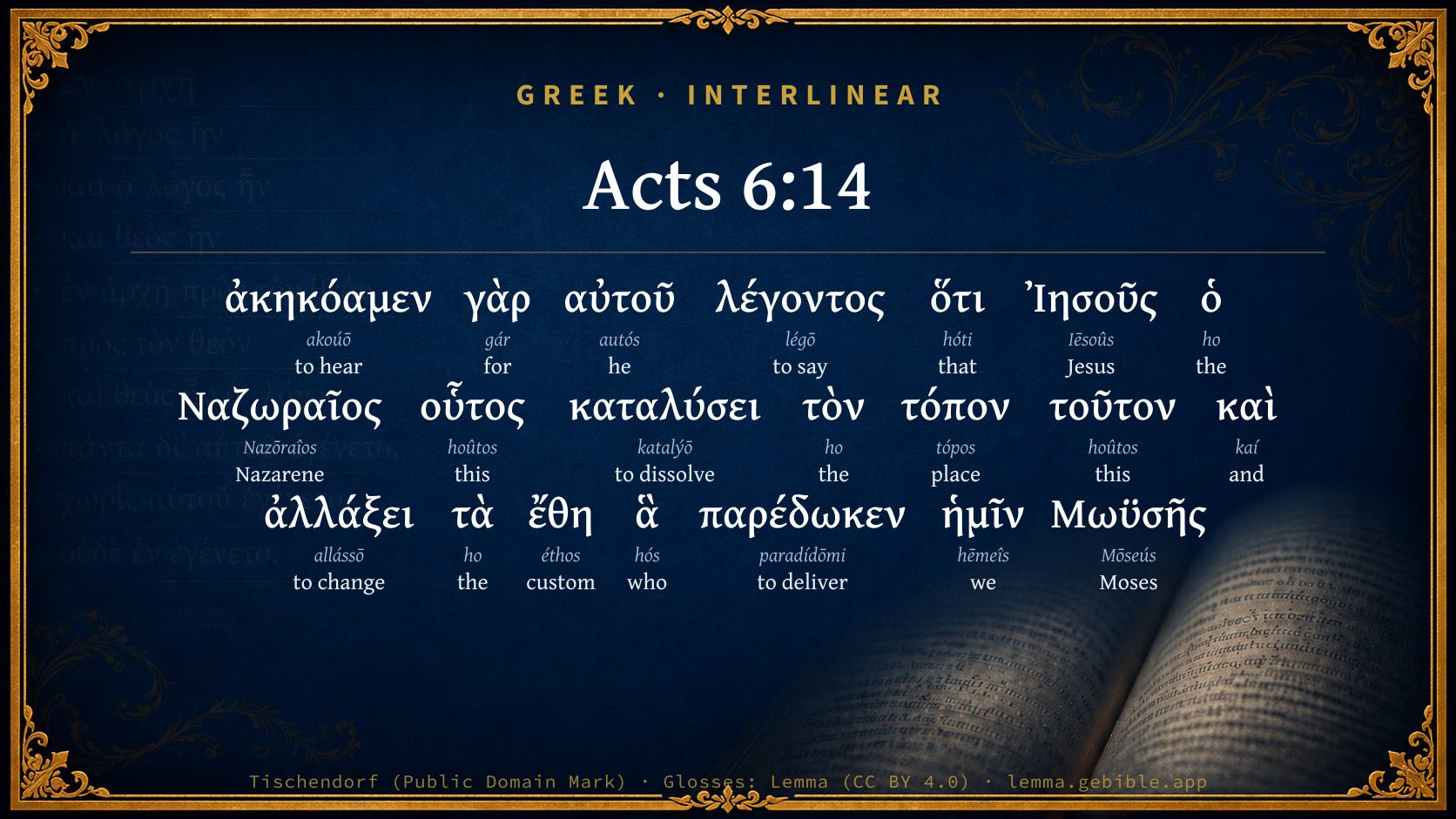
For we have heard him say that this Jesus of Nazareth will destroy this place, and will change the customs which Moses delivered to us."
Download a study sheet
One document with this verse’s original text, its word-by-word gloss line, the meaning frame, cross-references with their text, attributed commentary, and full source and license credits — printable, and it pastes into notes with its structure intact.
This verse Autodidact and up
A passage Seminary Student
Up to 50 verses in one chapter. A passage sheet keeps up to 6 commentary sources and 12 cross-references per verse, in the order this page ranks them, and says so on the sheet whenever that leaves anything out. Ask for a single verse and you get the Autodidact verse sheet above.
Everything on this page stays free to read, with no account — the sheet is a download of what is already on screen, not access to it.
Compare translations 3
The same verse in 3 English versions, stacked beneath the original-language interlinear above. Click any original word for its lexicon entry.
Each is an independent rendering of the whole verse — the interlinear is not word-aligned to these translations.
Highlighted words mark where these versions differ — a whole-verse word diff, not a word-by-word alignment.
-
World English Bible Public Domain
For we have heard him say that this Jesus of Nazareth will destroy this place, and will change the customs which Moses delivered to us."
-
King James Version Public Domain
For we have heard him say, that this Jesus of Nazareth shall destroy this place, and shall change the customs which Moses delivered us.
-
unfoldingWord Literal Text CC BY-SA 4.0
For we have heard him say that this Jesus the Nazarene will destroy this place and change the customs that Moses handed down to us.”
unfoldingWord Literal Text — © unfoldingWord, licensed CC BY-SA 4.0. Word-aligned USFM3 via Door43 (git.door43.org/unfoldingWord/en_ult).
Show all 19 translations
Every available English version of this verse, each an independent rendering of the whole verse.
-
World English Bible Public Domain
For we have heard him say that this Jesus of Nazareth will destroy this place, and will change the customs which Moses delivered to us."
-
Berean Standard Bible Public Domain
For we have heard him say that Jesus of Nazareth will destroy this place and change the customs that Moses handed down to us.”
-
Majority Standard Bible Public Domain
For we have heard him say that Jesus of Nazareth will destroy this place and change the customs that Moses handed down to us.”
-
King James Version Public Domain
For we have heard him say, that this Jesus of Nazareth shall destroy this place, and shall change the customs which Moses delivered us.
-
American Standard Version (1901) Public Domain
for we have heard him say, that this Jesus of Nazareth shall destroy this place, and shall change the customs which Moses delivered unto us.
-
Revised Version (1885) Public Domain
for we have heard him say, that this Jesus of Nazareth shall destroy this place, and shall change the customs which Moses delivered unto us.
-
Geneva Bible (1599) Public Domain
For we haue heard him say, that this Iesus of Nazareth shall destroy this place, and shall change the ordinances, which Moses gaue vs.
-
Douay-Rheims (1899) Public Domain
For we have heard him say, that this Jesus of Nazareth shall destroy this place, and shall change the traditions which Moses delivered unto us.
-
Young's Literal Translation Public Domain
for we have heard him saying, That this Jesus the Nazarean shall overthrow this place, and shall change the customs that Moses delivered to us;'
-
Literal Standard Version CC BY-SA 4.0
for we have heard him saying that this Jesus the Nazarean will overthrow this place, and will change the customs that Moses delivered to us”;
-
Unlocked Literal Bible CC BY-SA 4.0
For we have heard him say that this Jesus of Nazareth will destroy this place and change the customs that Moses handed down to us.”
-
unfoldingWord Literal Text CC BY-SA 4.0
For we have heard him say that this Jesus the Nazarene will destroy this place and change the customs that Moses handed down to us.”
-
Darby Bible Public Domain
for we have heard him saying, This Jesus the Nazaraean shall destroy this place, and change the customs which Moses taught us.
-
World Messianic Bible Public Domain
For we have heard him say that this Yeshua of Nazareth will destroy this place, and will change the customs which Moses delivered to us.”
-
Webster's Bible Public Domain
For we have heard him say, that this Jesus of Nazareth will destroy this place, and will change the customs which Moses delivered to us.
-
Free Bible Version CC BY-SA 4.0
“We've heard him say that this Jesus of Nazareth will destroy the Temple, and will change the laws we received from Moses.”
-
Bible in Basic English Public Domain
For he has said in our hearing that this Jesus of Nazareth will put this place to destruction and make changes in the rules which were handed down to us by Moses.
-
Text-Critical English NT CC BY 4.0
For we heard him saying that this Jesus of Nazareth will destroy this place and change the customs that Moses handed down to us.”
-
Tyndale New Testament (1534) Public Domain
for we hearde him saye: this Iesus of Nazareth shall destroye this place and shall chaunge the ordinaunces which Moses gave vs.
Literal Standard Version (2020), Covenant Press — licensed CC BY-SA 4.0. Text via the HelloAO Bible API (eBible.org). Unlocked Literal Bible (unfoldingWord) — licensed CC BY-SA 4.0. Text via the HelloAO Bible API (eBible.org). unfoldingWord Literal Text — © unfoldingWord, licensed CC BY-SA 4.0. Word-aligned USFM3 via Door43 (git.door43.org/unfoldingWord/en_ult). Free Bible Version, Dr. Jonathan Gallagher — licensed CC BY-SA 4.0. Text via the HelloAO Bible API (eBible.org).
Word by word
More ways to search: Search by grammar → Find every occurrence → Compare this word →
Practice this passage: Drill this verse → Learn its vocabulary →
- Appears 7× in the Greek New Testament
- First appears here
- Part of Speech
- Verb
- Tense
- Future
- Voice
- Active
- Mood
- Indicative
- Person
- 3rd person
- Number
- Singular
Full Thayer's Definition
- ἀκηκόαμεν akoúō G191 “to hear” Verb, Perfect, Active, Indicative, 1st person, Plural, Attic form
- γὰρ gár G1063 “for” Conjunction
- αὐτοῦ autós G846 “he” Personal pronoun, Genitive, Singular, Masculine
- λέγοντος légō G3004 “to say” Verb, Present, Active, Participle, Genitive, Singular, Masculine
- ὅτι hóti G3754 “that” Conjunction
- Ἰησοῦς Iēsoûs G2424 “Jesus” Noun, Nominative, Singular, Masculine
- ὁ ho G3588 “the” Article, Nominative, Singular, Masculine
- Ναζωραῖος Nazōraîos G3480 “Nazarene” Noun, Nominative, Singular, Masculine
- οὗτος hoûtos G3778 “this” Demonstrative pronoun, Nominative, Singular, Masculine
- καταλύσει katalýō G2647 “to dissolve” Verb, Future, Active, Indicative, 3rd person, Singular
- τὸν ho G3588 “the” Article, Accusative, Singular, Masculine
- τόπον tópos G5117 “place” Noun, Accusative, Singular, Masculine
- τοῦτον hoûtos G3778 “this” Demonstrative pronoun, Accusative, Singular, Masculine
- καὶ kaí G2532 “and” Conjunction
- ἀλλάξει allássō G236 “to change” Verb, Future, Active, Indicative, 3rd person, Singular
- τὰ ho G3588 “the” Article, Accusative, Plural, Neuter
- ἔθη éthos G1485 “custom” Noun, Accusative, Plural, Neuter
- ἃ hós G3739 “who” Relative pronoun, Accusative, Plural, Neuter
- παρέδωκεν paradídōmi G3860 “to deliver” Verb, Aorist, Active, Indicative, 3rd person, Singular
- ἡμῖν hēmeîs G2249 “we” Personal pronoun, 1st person, Dative, Plural
- Μωϋσῆς Mōseús G3475 “Moses” Noun, Nominative, Singular, Masculine
About this verse
These counts appear in no published source. They are computed here, from the morphology-tagged text and Lemma’s own curated glosses. What Lemma adds →
- 21
- words
- 18
- distinct lemmas
- Acts
- section
Notable vocabulary
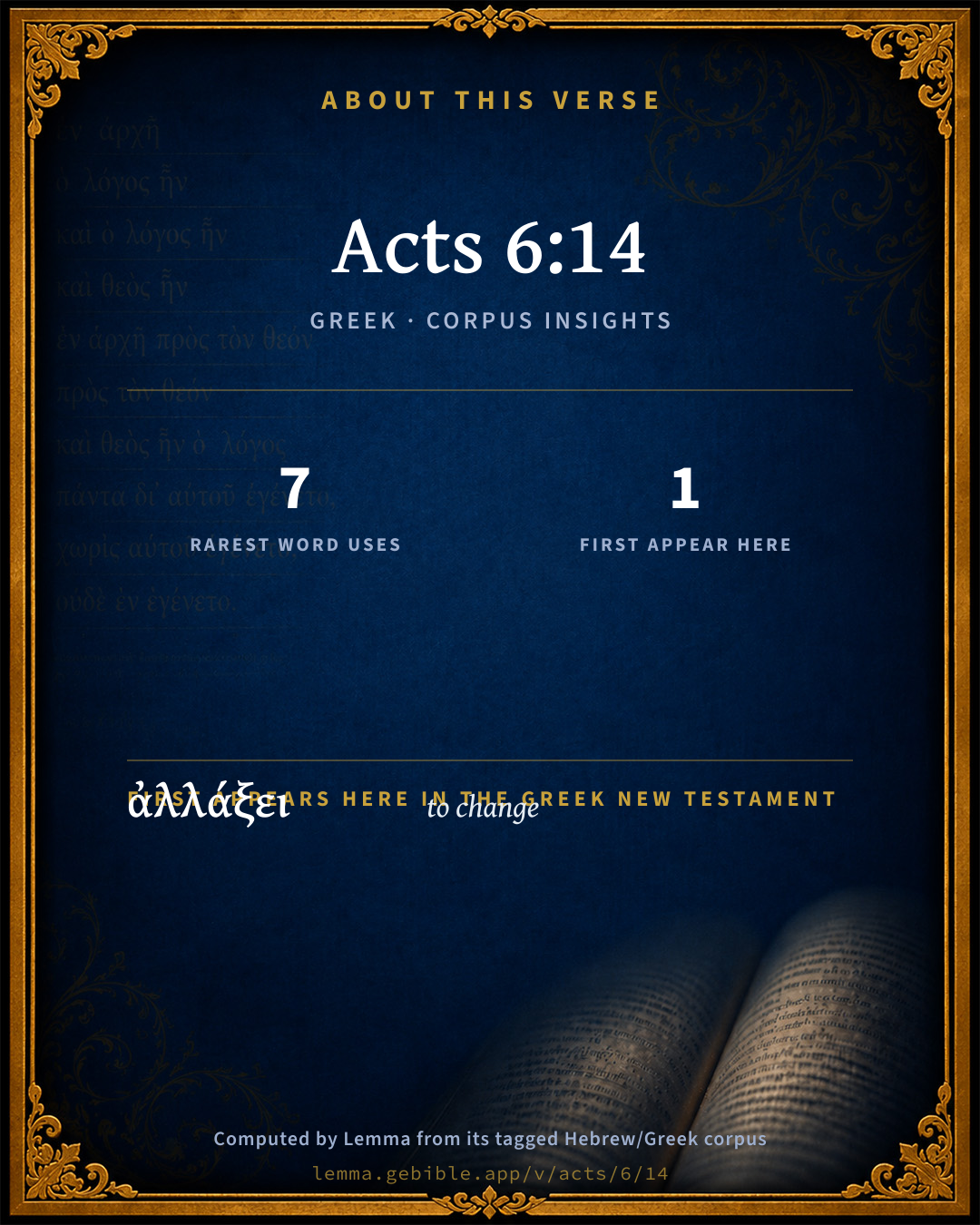
The rarest word here is ἀλλάξει to change G236 — appearing just 7 times in the whole Greek New Testament.
First appearance in Scripture
This word makes its first canonical appearance in the Greek New Testament here:
- ἀλλάξει to change G236
Shared distinctive vocabulary
ἀλλάξει to change G236 occurs in 6 verses of the Greek New Testament. Also found in:
Cross-references
32Topical passages linked to Acts 6:14 in the Treasury of Scripture Knowledge — connected by theme and wording, ordered by reader-vote popularity; previews shown in the World English Bible.
- Daniel 9:26 After the sixty-two weeks the Anointed One shall be cut off, and shall have nothing: and the people of the prince who shall come shall destroy the city and the sanctuary; and the end of it shall be with a flood, and even to the end shall be war; desolations are determined.
- Acts 21:21 They have been informed about you, that you teach all the Jews who are among the Gentiles to forsake Moses, telling them not to circumcise their children neither to walk after the customs.
- Hebrews 12:26–28 whose voice shook the earth, then, but now he has promised, saying, "Yet once more I will shake not only the earth, but also the heavens."
- Acts 15:1 Some men came down from Judea and taught the brothers, "Unless you are circumcised after the custom of Moses, you can't be saved."
- Luke 21:6 "As for these things which you see, the days will come, in which there will not be left here one stone on another that will not be thrown down."
- John 4:21 Jesus said to her, "Woman, believe me, the hour comes, when neither in this mountain, nor in Jerusalem, will you worship the Father.
- Acts 28:17 It happened that after three days Paul called together those who were the leaders of the Jews. When they had come together, he said to them, "I, brothers, though I had done nothing against the people, or the customs of our fathers, still was delivered prisoner from Jerusalem into the hands of the Romans,
- Galatians 3:19 What then is the law? It was added because of transgressions, until the seed should come to whom the promise has been made. It was ordained through angels by the hand of a mediator.
- Galatians 3:23 But before faith came, we were kept in custody under the law, shut up to the faith which should afterwards be revealed.
- Galatians 4:3–5 So we also, when we were children, were held in bondage under the elements of the world.
- Hebrews 8:6–13 But now he has obtained a more excellent ministry, by so much as he is also the mediator of a better covenant, which has been enacted on better promises.
- Hebrews 9:9–11 which is a symbol of the present age, where gifts and sacrifices are offered that are incapable, concerning the conscience, of making the worshipper perfect;
- Hebrews 10:1–18 For the law, having a shadow of the good to come, not the very image of the things, can never with the same sacrifices year by year, which they offer continually, make perfect those who draw near.
- Isaiah 66:1–6 Thus says Yahweh, heaven is my throne, and the earth is my footstool: what manner of house will you build to me? and what place shall be my rest?
- Jeremiah 7:4–14 Don't you trust in lying words, saying, The temple of Yahweh, the temple of Yahweh, the temple of Yahweh, are these.
- Zechariah 14:2 For I will gather all nations against Jerusalem to battle; and the city will be taken, the houses rifled, and the women ravished. half of the city will go out into captivity, and the rest of the people will not be cut off from the city.
- Luke 13:34–35 "Jerusalem, Jerusalem, that kills the prophets, and stones those who are sent to her! How often I wanted to gather your children together, like a hen gathers her own brood under her wings, and you refused!
- Luke 21:24 They will fall by the edge of the sword, and will be led captive into all the nations. Jerusalem will be trampled down by the Gentiles, until the times of the Gentiles are fulfilled.
- Acts 25:8 while he said in his defense, "Neither against the law of the Jews, nor against the temple, nor against Caesar, have I sinned at all."
- Acts 26:3 especially because you are expert in all customs and questions which are among the Jews. Therefore I beg you to hear me patiently.
- Hebrews 7:11–19 Now if there was perfection through the Levitical priesthood (for under it the people have received the law), what further need was there for another priest to arise after the order of Melchizedek, and not be called after the order of Aaron?
- Isaiah 65:15 You shall leave your name for a curse to my chosen; and the Lord Yahweh will kill you; and he will call his servants by another name:
- Isaiah 66:19–21 I will set a sign among them, and I will send such as escape of them to the nations, to Tarshish, Pul, and Lud, who draw the bow, to Tubal and Javan, to the isles afar off, who have not heard my fame, neither have seen my glory; and they shall declare my glory among the nations.
- Jeremiah 26:6–9 then will I make this house like Shiloh, and will make this city a curse to all the nations of the earth.
- Jeremiah 26:12 Then spoke Jeremiah to all the princes and to all the people, saying, Yahweh sent me to prophesy against this house and against this city all the words that you have heard.
- Jeremiah 26:18 Micah the Morashtite prophesied in the days of Hezekiah king of Judah; and he spoke to all the people of Judah, saying, Thus says Yahweh of Hosts: Zion shall be plowed as a field, and Jerusalem shall become heaps, and the mountain of the house as the high places of a forest.
- Hosea 3:4 For the children of Israel shall abide many days without king, and without prince, and without sacrifice, and without sacred stone, and without ephod or idols.
- Micah 3:12 Therefore Zion for your sake will be plowed like a field, And Jerusalem will become heaps of rubble, And the mountain of the temple like the high places of a forest.
- Zechariah 11:1 Open your doors, Lebanon, That the fire may devour your cedars.
- Matthew 24:1–2 Jesus went out from the temple, and was going on his way. His disciples came to him to show him the buildings of the temple.
- Matthew 26:61 and said, "This man said, 'I am able to destroy the temple of God, and to build it in three days.'"
- Mark 14:58 "We heard him say, 'I will destroy this temple that is made with hands, and in three days I will build another made without hands.'"
Cross-references courtesy of OpenBible.info (CC BY 4.0).
Lesson kit
Teaching starters — assembled from the data on this page, not authored interpretation. Every prompt links to the verse data it draws on. Edit before teaching.
Acts, in the Acts, opens this verse with 21 words (18 distinct Greek lemmas). Its most distinctive word is allássō (“to change”). A historical commentator’s framing appears above. Read the whole chapter for the surrounding context.
Discussion questions
- What does “to change” (allássō) contribute to the verse as a whole?
- The word “to change” first appears here in Scripture. What is being introduced at this debut?
- Romans 1:23 shares the word «to change» with this verse. How do the two illuminate each other?
- “the” occurs 3× in this one verse. What is the effect of the repetition?
- These translations render this verse differently; the difference is in the English rendering, not the original. What questions does that raise?
- Reading how Bengel's Gnomon and Expositor's Greek Testament read this verse, where do the two commentators agree and where do they part?
Things to notice
- 1 word makes its first canonical appearance in Scripture here.
- These translations choose different wording for 8 words in this verse.
- “the” occurs 3× in this single verse.
- 18 distinct Greek lemmas span 21 words in this verse.
Commentary
Notes on Acts 6:14 from classic Christian and Jewish commentators (each source and its license shown beneath its notes). The classic Christian expositions comment on the surrounding passage and are grouped to its opening verse, so a note may address several verses; the Jewish commentaries on the Tanakh (Rashi and others) are per-verse, so they appear only where the commentator wrote on this verse.
Lemma curates 59 commentaries, every one of them public domain or Creative Commons licensed, each selected and text-cleaned for this edition rather than reprinted as found. About our sources →
Bengel's Gnomon
Johann Albrecht Bengel
Bengel's Gnomon of the New Testament — English translation (T&T Clark, Edinburgh, 1860) — public domain. Text from a community e-Sword module.
Expositor's Greek Testament
ed. W. Robertson Nicoll
The Expositor's Greek Testament, edited by W. Robertson Nicoll (1897–1910) — public domain. Text from a community e-Sword module.
John Calvin's Commentaries
John Calvin's Commentaries (1540-1563) — public domain. Text from the Calvin Translation Society English edition (1840s-50s) via the Christian Classics Ethereal Library (ccel.org). Calvin's coverage is partial (roughly two-thirds of the Bible); uncommented books and verses are honest gaps, never fabricated. The 19th-century editor's footnotes and remarks are omitted so the notes are faithfully Calvin's own voice.
Ellicott's Commentary for English Readers
A Bible Commentary for English Readers, edited by Charles John Ellicott (1878–1897) — public domain. Text from a community e-Sword module.
The Cambridge Bible for Schools and Colleges
gen. ed. J. J. S. Perowne
The Cambridge Bible for Schools and Colleges (gen. ed. J. J. S. Perowne; Cambridge University Press, 1878–1918) — public domain. Text from a community e-Sword module.
John Gill's Exposition
John Gill's Exposition of the Whole Bible (1746–1763) — public domain (CC PDM 1.0). Text via the HelloAO Bible API.
Trapp's Complete Commentary
John Trapp
John Trapp, A Commentary or Exposition upon All the Books of the Old and New Testament (1647–1656) — public domain. Text from a community e-Sword module.
Albert Barnes' Notes on the Bible
Albert Barnes' Notes on the Bible (1834–1885) — public domain. Text from a community e-Sword/MySword module.
Matthew Poole's English Annotations
Matthew Poole's English Annotations on the Holy Bible (1683–1685) — public domain. Text from a community e-Sword/MySword module.
The Pulpit Commentary
The Pulpit Commentary (1880–1919), ed. H.D.M. Spence-Jones & Joseph S. Exell — public domain. Text from a community e-Sword module.
John Wesley's Explanatory Notes
John Wesley, Explanatory Notes Upon the Whole Bible (1754–1765) — public domain. Text via the GEBible commentary corpus.
McGarvey & Pendleton's Commentaries
J. W. McGarvey
J. W. McGarvey (with Philip Y. Pendleton), Commentaries on the New Testament (The Fourfold Gospel, 1914; Acts; and the epistles) — public domain. Text from a community e-Sword/MySword module.
Cambridge Greek Testament for Schools and Colleges
Cambridge Greek Testament for Schools and Colleges (Cambridge University Press, 1896; 21 vols, various authors incl. Carr, Maclear, Plummer, Farrar, Lumby, Moule, M. R. James, Simcox) — public domain. Text from a community e-Sword module.
Alford’s Greek Testament
Henry Alford
Henry Alford, The Greek Testament (1849–1861) — public domain. Text from a community e-Sword module.
Vincent's Word Studies in the New Testament
Marvin R. Vincent
Marvin R. Vincent, Word Studies in the New Testament (1887–1900) — public domain. Text from a community e-Sword/MySword module.