
Acts 7:4

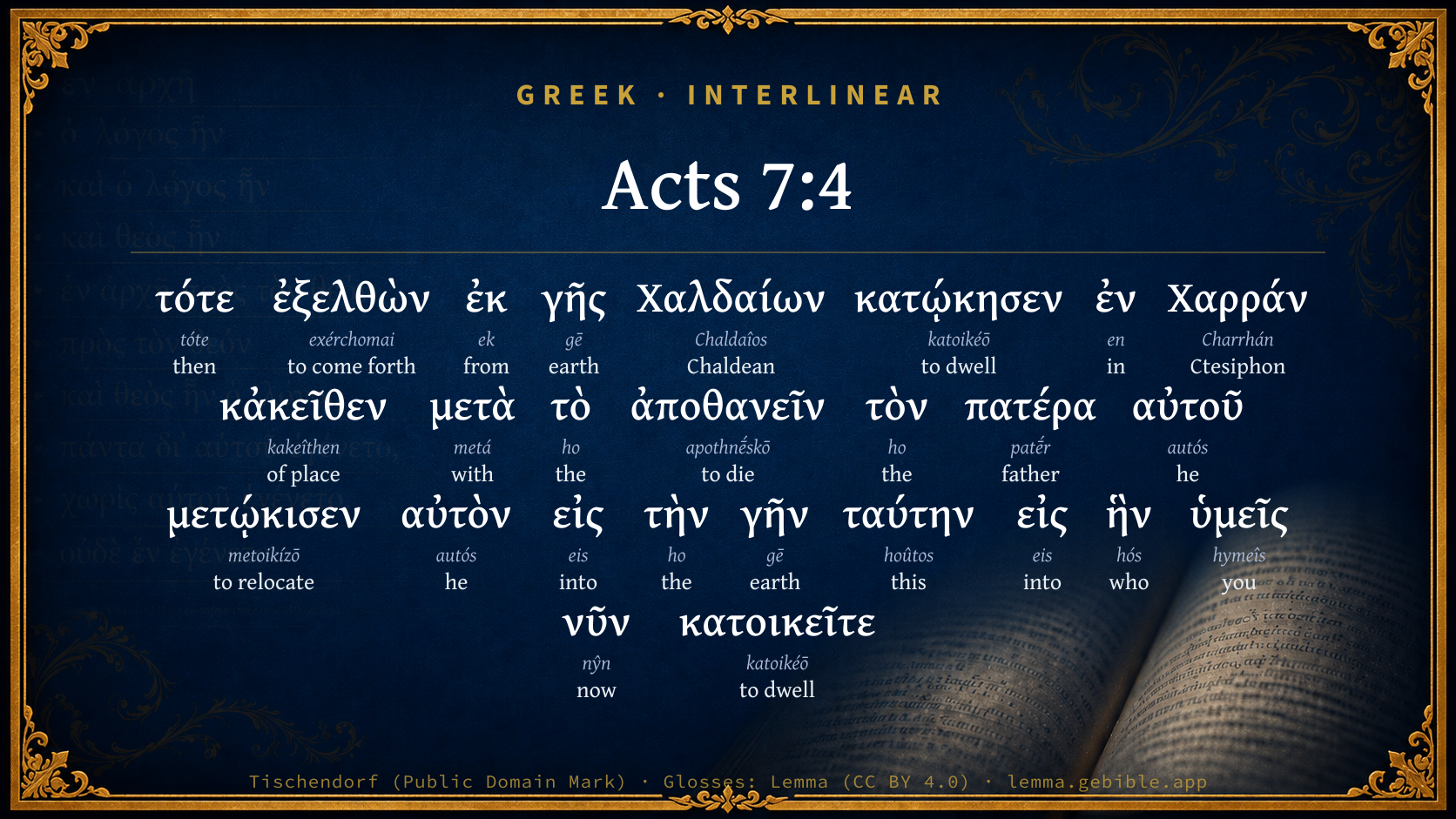
Greek (Tischendorf 8th ed.) Acts 7:4 appears in the Greek New Testament. The text above is from the Tischendorf 8th edition. Each word links to its Strong’s number and a concise gloss. Click any word for its full Thayer’s Greek Lexicon entry.
Download image
Cite this verse

Acts 7:4 (World English Bible). Public Domain. Lemma interlinear Bible study tool, https://lemma.gebible.app/v/acts/7/4.

Show BibTeX & RIS
BibTeX
RIS
English Translation
Then he came out of the land of the Chaldaeans, and lived in Haran. From there, when his father was dead, God moved him into this land, where you are now living.
World English Bible · Public Domain
Highlights
  • 1 hapax legomenon — only here in the Greek New Testament
  • 2 first appearances in the Greek New Testament
Full analysis ↓
Download a study sheet

One document with this verse’s original text, its word-by-word gloss line, the meaning frame, cross-references with their text, attributed commentary, and full source and license credits — printable, and it pastes into notes with its structure intact.

This verse Autodidact and up

Study sheet (.html) Plain text (.txt)

A passage Seminary Student

Up to 50 verses in one chapter. A passage sheet keeps up to 6 commentary sources and 12 cross-references per verse, in the order this page ranks them, and says so on the sheet whenever that leaves anything out. Ask for a single verse and you get the Autodidact verse sheet above.

Everything on this page stays free to read, with no account — the sheet is a download of what is already on screen, not access to it.

Want to remove ads? Support Godless Engineer
Compare translations 3

The same verse in 3 English versions, stacked beneath the original-language interlinear above. Click any original word for its lexicon entry.

Each is an independent rendering of the whole verse — the interlinear is not word-aligned to these translations.

Highlighted words mark where these versions differ — a whole-verse word diff, not a word-by-word alignment.

  • World English Bible Public Domain
    Then he came out of the land of the Chaldaeans, and lived in Haran. From there, when his father was dead, God moved him into this land, where you are now living.
  • King James Version Public Domain
    Then came he out of the land of the Chaldaeans, and dwelt in Charran: and from thence, when his father was dead, he removed him into this land, wherein ye now dwell.
  • unfoldingWord Literal Text CC BY-SA 4.0
    Then going out from the land of the Chaldeans, he lived in Haran. And from there, after the death of his father, he brought him into this land, in which you live now.

unfoldingWord Literal Text — © unfoldingWord, licensed CC BY-SA 4.0. Word-aligned USFM3 via Door43 (git.door43.org/unfoldingWord/en_ult).

Versions to compare (up to 4)

3 of 4 selected

Show all 19 translations

Every available English version of this verse, each an independent rendering of the whole verse.

  • World English Bible Public Domain
    Then he came out of the land of the Chaldaeans, and lived in Haran. From there, when his father was dead, God moved him into this land, where you are now living.
  • Berean Standard Bible Public Domain
    So Abraham left the land of the Chaldeans and settled in Haran. After his father died, God brought him out of that place and into this land where you are now living.
  • Majority Standard Bible Public Domain
    So Abraham left the land of the Chaldeans and settled in Haran. After his father died, God brought him out of that place and into this land where you are now living.
  • King James Version Public Domain
    Then came he out of the land of the Chaldaeans, and dwelt in Charran: and from thence, when his father was dead, he removed him into this land, wherein ye now dwell.
  • American Standard Version (1901) Public Domain
    Then came he out of the land of the Chaldaeans, and dwelt in Haran: and from thence, when his father was dead, `God' removed him into this land, wherein ye now dwell:
  • Revised Version (1885) Public Domain
    Then came he out of the land of the Chaldaeans, and dwelt in Haran: and from thence, when his father was dead, God removed him into this land, wherein ye now dwell:
  • Geneva Bible (1599) Public Domain
    Then came he out of the land of the Chaldeans, and dwelt in Charran. And after that his father was dead, God brought him from thence into this land, wherein ye now dwell,
  • Douay-Rheims (1899) Public Domain
    Then he went out of the land of the Chaldeans, and dwelt in Charan. And from thence, after his father was dead, he removed him into this land, wherein you now dwell.
  • Young's Literal Translation Public Domain
    `Then having come forth out of the land of the Chaldeans, he dwelt in Haran, and from thence, after the death of his father, He did remove him to this land wherein ye now dwell,
  • Literal Standard Version CC BY-SA 4.0
    Then having come forth out of the land of the Chaldeans, he dwelt in Haran, and from there, after the death of his father, He removed him to this land wherein you now dwell,
  • Unlocked Literal Bible CC BY-SA 4.0
    Then he left the land of the Chaldeans and lived in Haran; from there, after his father died, God brought him into this land, where you live now.
  • unfoldingWord Literal Text CC BY-SA 4.0
    Then going out from the land of the Chaldeans, he lived in Haran. And from there, after the death of his father, he brought him into this land, in which you live now.
  • Darby Bible Public Domain
    Then going out of the land of the Chaldeans he dwelt in Charran, and thence, after his father died, he removed him into this land in which *ye* now dwell.
  • World Messianic Bible Public Domain
    Then he came out of the land of the Kasdim and lived in Haran. From there, when his father was dead, God moved him into this land where you are now living.
  • Webster's Bible Public Domain
    Then he came from the land of the Chaldeans, and dwelt in Charran. And from thence, when his father was dead, he removed him into this land in which ye now dwell.
  • Free Bible Version CC BY-SA 4.0
    So he left the country of the Chaldeans and lived in Haran. After his father's death, God sent him here to this country where you now live.
  • Bible in Basic English Public Domain
    Then he came out of the land of the Chaldaeans, and went into Haran; and from there, when his father was dead, he was guided by God into this land, where you are living now:
  • Text-Critical English NT CC BY 4.0
    Then he left the land of the Chaldeans and dwelt in Haran. After his father died, God relocated him to this land in which you now dwell.
  • Tyndale New Testament (1534) Public Domain
    Then came he out of the londe of Chaldey and dwelt in Charran. And after that assone as his father was deed he brought him into this lande in which ye now dwell

Literal Standard Version (2020), Covenant Press — licensed CC BY-SA 4.0. Text via the HelloAO Bible API (eBible.org). Unlocked Literal Bible (unfoldingWord) — licensed CC BY-SA 4.0. Text via the HelloAO Bible API (eBible.org). unfoldingWord Literal Text — © unfoldingWord, licensed CC BY-SA 4.0. Word-aligned USFM3 via Door43 (git.door43.org/unfoldingWord/en_ult). Free Bible Version, Dr. Jonathan Gallagher — licensed CC BY-SA 4.0. Text via the HelloAO Bible API (eBible.org).

Word by word

More ways to search: Search by grammar → Find every occurrence → Compare this word →

Practice this passage: Drill this verse → Learn its vocabulary →

Χαλδαίων
Chaldaîos
G5466
“Chaldean”
Noun, Genitive, Plural, Masculine
Part of Speech
Noun
Case
Genitive
Number
Plural
Gender
Masculine
Full Thayer's Definition

Origin: probably of hebrew or G3778

TDNT: None

Chaldean = "as clod breakers" 1. a Chaldean
  1. τότε tóte G5119 “then” Adverb
  2. ἐξελθὼν exérchomai G1831 “to come forth” Verb, Aorist, Active, Participle, Nominative, Singular, Masculine
  3. ἐκ ek G1537 “from” Preposition
  4. γῆς gē G1093 “earth” Noun, Genitive, Singular, Feminine
  5. κατῴκησεν katoikéō G2730 “to dwell” Verb, Aorist, Active, Indicative, 3rd person, Singular
  6. ἐν en G1722 “in” Preposition
  7. Χαρράν Charrhán G5488 “Ctesiphon” Noun, Proper, indeclinable
  8. κἀκεῖθεν kakeîthen G2547 “of place” Adverb, Aramaic form
  9. μετὰ metá G3326 “with” Preposition
  10. τὸ ho G3588 “the” Article, Accusative, Singular, Neuter
  11. ἀποθανεῖν apothnḗskō G599 “to die” Verb, Aorist, Active, Infinitive
  12. τὸν ho G3588 “the” Article, Accusative, Singular, Masculine
  13. πατέρα patḗr G3962 “father” Noun, Accusative, Singular, Masculine
  14. αὐτοῦ autós G846 “he” Personal pronoun, Genitive, Singular, Masculine
  15. μετῴκισεν metoikízō G3351 “to relocate” Verb, Aorist, Active, Indicative, 3rd person, Singular
  16. αὐτὸν autós G846 “he” Personal pronoun, Accusative, Singular, Masculine
  17. εἰς eis G1519 “into” Preposition
  18. τὴν ho G3588 “the” Article, Accusative, Singular, Feminine
  19. γῆν gē G1093 “earth” Noun, Accusative, Singular, Feminine
  20. ταύτην hoûtos G3778 “this” Demonstrative pronoun, Accusative, Singular, Feminine
  21. εἰς eis G1519 “into” Preposition
  22. ἣν hós G3739 “who” Relative pronoun, Accusative, Singular, Feminine
  23. ὑμεῖς hymeîs G5210 “you” Personal pronoun, 2nd person, Nominative, Plural
  24. νῦν nŷn G3568 “now” Adverb
  25. κατοικεῖτε katoikéō G2730 “to dwell” Verb, Present, Active, Indicative, 2nd person, Plural

About this verse

These counts appear in no published source. They are computed here, from the morphology-tagged text and Lemma’s own curated glosses. What Lemma adds →

26
words
20
distinct lemmas
Acts
section

Notable vocabulary

1 hapax legomenon — a word that appears only here in the entire Greek New Testament:

  • Χαλδαίων Chaldean G5466

First appearance in Scripture

These words make their first canonical appearance in the Greek New Testament here:

  • Χαλδαίων Chaldean G5466
  • μετῴκισεν to relocate G3351

Shared distinctive vocabulary

Χαρράν Ctesiphon G5488 occurs in 2 verses of the Greek New Testament. Also found in:
Repetition

Words recur within this verse:

  • γῆς earth G1093 ×2
  • κατῴκησεν to dwell G2730 ×2
  • εἰς into G1519 ×2
  • τὸ the G3588 ×3
  • αὐτοῦ he G846 ×2

Cross-references

4

Topical passages linked to Acts 7:4 in the Treasury of Scripture Knowledge — connected by theme and wording, ordered by reader-vote popularity; previews shown in the World English Bible.

  • Genesis 12:4–5 So Abram went, as Yahweh had spoken to him. Lot went with him. Abram was seventy-five years old when he departed out of Haran.
  • Genesis 11:31–32 Terah took Abram his son, Lot the son of Haran, his son's son, and Sarai his daughter-in-law, his son Abram's wife. They went forth from Ur of the Chaldees, to go into the land of Canaan. They came to Haran, and lived there.
  • Isaiah 41:2 Who has raised up one from the east, whom he calls in righteousness to his foot? he gives nations before him, and makes him rule over kings; he gives them as the dust to his sword, as the driven stubble to his bow.
  • Isaiah 41:9 you whom I have taken hold of from the ends of the earth, and called from the corners of it, and said to you, You are my servant, I have chosen you and not cast you away;

Cross-references courtesy of OpenBible.info (CC BY 4.0).

Commentary

Notes on Acts 7:4 from classic Christian and Jewish commentators (each source and its license shown beneath its notes). The classic Christian expositions comment on the surrounding passage and are grouped to its opening verse, so a note may address several verses; the Jewish commentaries on the Tanakh (Rashi and others) are per-verse, so they appear only where the commentator wrote on this verse.

Lemma curates 59 commentaries, every one of them public domain or Creative Commons licensed, each selected and text-cleaned for this edition rather than reprinted as found. About our sources →

The Biblical Illustrator

Joseph S. Exell

Act_7:4-8

When his father was dead He removed him into this land.

The difficulty as to the date of Abrahams migration

Terah died at Haran at the age of two hundred and five (Gen_11:32.). From Gen_11:26 it has been inferred that Terah was not more than seventy at the birth of Abraham; and as Abraham left Haran at seventy-five (Gen_12:4) it would follow that Terah outlived his departure sixty years. But it is nowhere stated that Abraham was Terahs eldest son, and the Rabbins reckoned him the youngest. Abrahams prominence in history as the father of the faithful and the friend of God accounts for his name being placed before that of Haran in Gen_11:26. In like manner the name of Shem, the youngest, stands first among the sons of Noah (Gen_9:18; Gen_10:21); Isaacs name takes precedence of Ishmaels (1Ch_1:28); Judah is placed at the head of the list of the sons of Jacob (1Ch_4:1; 1Ch_5:1-2), and Moses is mentioned before his elder brother Aaron. (Bp. Jacobsen.)

And He gave him none inheritance in it … yet He promised, that He would give it to him for a possession.--

The faithfulness of God

Of this we have three illustrations in the verses before us, which are all the more impressive because of their unlikelihood. We have Gods fidelity--

I. To His promises (verse 5). Abraham, without a foot of land, and, being childless and nomadic, not likely to trouble himself about any, was promised that his seed should possess the entire country. We know that this came to pass, and through what a wonderful series of unlikely events it came to pass. This, therefore, is a good sample of all Gods promises--e.g.,

1. Of temporal good. Who that has trusted Gods word in this particular ever knew it to fail? There is no promise of affluence, but there are abundant promises of sufficiency. Some of the richest pages in Christian biography are records of the extraordinary way in which God works the deliverance of His people in poverty, affliction, danger, etc.

2. Of salvation Believe on the Lord Jesus Christ and thou shalt be saved. Who ever knew that to fail? It has been proved over and over again in the most hopeless cases. The infidel, men and women to whom abnormal vice has become a second nature, criminals on the verge of execution, have found it true, and in a manner in which the most sanguine could never have expected.

3. Of grace. The Christian is sometimes placed in circumstances of extraordinary trial. Extreme adversity and extreme prosperity, circumstances which have been gradually accumulating until they reach a climax, and circumstances which seem to gather like a thunderous cloud in a moment, expose the Christian to extreme peril. Satan seems to occupy an unshakeable vantage ground, and the good man seems to be helplessly entangled in his toils. Not so. Strangely is there opened a way of escape, which would all along have been seen to be open but for temporary blindness of faith.

4. Of glory--the best illustration perhaps of the promise before us. Then there will be given to us what we most seem to want here, but which we have least ground to expect. The poor will have riches, the weary rest, the afflicted blessedness, and, most wonderful of all, the humble Christian worker the glad well done and the crown of life.

II. To His prophecies (verse 6). That this prophecy would be fulfilled was most improbable, a general characteristic of most of the Divine predictions. Men make shrewd guesses based upon wide experience and a careful induction of facts, and men marvel when what, to the clear sighted, seemed almost inevitable takes place. Much more should they marvel when Gods Word--based upon what to the most sagacious human reason would pronounce to be no ground at all--comes true; only the wonder should be mixed with adoration. Here, e.g., is the prediction that a childless old man without a foot of territory should have a seed large enough to occupy the land; that a race that did not exist should pass through vicissitudes which are Sufficiently specified for a given number of years. Of alike character are the prophecies concerning Christ and His Church. This being the case with regard to fulfilled prophecies, surely there is good room for faith in those which have not yet come to pass. Having regard to the past who can cease to have hope for the Church or for the world. The Church has not yet come fully into its inheritance--but it is better off than Abraham, who had not a foot of his.

III. To His threatenings (verse 7). The power here threatened was now, and at the time of the fulfilment of the threatening, the mightiest in the world. Yet Egypt was judged. The great world powers afterwards threatened--Babylon, Persia, Greece, Rome, were in their turn colossal in their strength, yet where are they to-day? And why? Let modern potentates heed the lesson--because they opposed the cause of God; a course as likely to succeed as the effort to keep back the sea with a broom. Conclusion:

1. A sacramental guarantee was given for all this. God entered into solemn covenant with Abraham that promise, prediction, threatening--for all hung together--should be fulfilled, and sealed the covenant by the ordinance of circumcision. And what is a Christians baptism but a seal of a covenant of promise involving everything else for this life and the life to come; and what is the Lords supper but a memorial to all generations of the present support and ultimate triumph of the Church of Christ?

2. Lessons:

(1) God takes time for the evolution of His purposes. Four hundred years was not too long for the working out of His purposes concerning Israel; four thousand years are not too long for Him to whom one thousand years is as one day.

(2) Man must therefore wait. Patience is the grace supremely needed in this relation. Let us not, like faithless Israel, forget or despair. (J. W. Burn.)

And God spoke in this wise, that his seed should sojourn in a strange land.--

Sojourners in a strange land

I. The sojourners--Abrahams seed the spiritual progenitors of believers. They that are of faith are the seed of Abraham. The Jews were--

1. A chosen people; so Christians are a chosen generation.

2. A separated people. In whatever circumstances we find them they will not mix. They would not in Egypt; they will not to-day. So a distinguishing mark of Christians is separation from the world--What concord hath Christ with Belial.

3. A people owned of God--I will be their God; they shall be My people. His own inheritance, portion, special treasure. Observe also, that this people owned their God. In their feasts, sacrifices, offerings, first-born. God was to be owned as their God in all. They were not to take a journey nor engage in battle without first asking God. Another and a double mark of Christian character.

4. A blessed people. Blessed art thou in Israel, etc., and all who are of the faith are recipients of the blessing of Abraham. The covenant treasures laid up in Christ Jesus, the righteousness which is by faith.

II. The sojourning. We should never consider the world through which we are passing as any other than a strange land. Do not think of building your nests as if you were to be always at home here. Leave the worldling to his toys, and let us contemplate the fact that we are only strangers and sojourners as all our fathers were.

1. Abrahams seed are considered strange beings in this world--so strange, that they are held an abomination, and positively offensive (Gen_43:32). The case is not altered in the present day. The world knoweth us not, because it knows Him not. The natural man receiveth not the things of the Spirit of God, etc. He who is born after the flesh is still as bent upon persecuting him who is born after the Spirit as in Pauls days. Nor can the servants of Satan, the soldiers of Sihon and Og, allow the Israel of God to pass through their territories unmolested. And yet I am anxious that all the seed of Abraham should be able so to live, that their very enemies may come to the same conclusion that the enemies of Daniel did (Dan_6:5).

2. They are annoyed with strange things as they pass through this strange land with its--

(1) Principles.

(2) Practices.

(3) Persons.

3. Though grievously annoyed, yet they advance continually in the face of every obstacle and foe. Nothing stops them; on they must go. But how was it that no powers could arrest, no floods or plains intimidate, or armies vanquish Abrahams seed? Just because God went before them as their guide, a pillar of cloud by day, and a pillar of fire by night. And is it not the same now? The Lord is a wall of fire round about them that fear Him. The real advancement of the seed of Abraham will always include these two things; an advancement in the knowledge of ourselves that shall lay us low; and in the knowledge of Jesus that shall elevate and cheer us.

III. The kingdom beyond. It was Jehovahs good pleasure to give His people Canaan, and they got it not with sword or bow. They did not deserve it, for they were a stiff-necked and perverse generation, but it was Jehovahs good pleasure to give it to them, just as it is our Fathers good pleasure to give us the kingdom. Many things might be said about this kingdom; but note these: We shall then be so situated as to be above all annoyances, in a kingdom where there is not an unwholesome law; where there is not a dissenting voice from the will of the Monarch; where there is no infirmity, and nothing but joy, and peace, and righteousness. (J. Irons.)

And that they should bring them into bondage, and entreat them evil four hundred years.--

The duration of the sojourning

Verses 6 and 7 are quoted, not with verbal exactness, from Gen_15:13-14 according to the LXX. A parenthesis marked after land and evil would make it clear that the four hundred years are the length of the entire time during which Abraham and his descendants were to be sojourners, i.e., to have no country of their own. The Egyptian servitude did not begin till after the death of Joseph, and did not exceed two hundred and fifteen years. If the calculation is made from the weaning of Isaac, the interval is exactly four hundred years. In speaking, the round number was used instead of the precise total of four hundred and thirty years; which is given in the historical statement (Exo_12:40), quoted Gal_3:17, which the received chronology makes to be the interval between Abrahams going down into Egypt and the Exodus. The same variation is found in Josephus, who states in his history that the Israelites quitted Egypt in the four hundred and thirtieth year; but in a report of a speech of his own in the Wars he gives the duration four hundred years. (Bp. Jacobson.)

The Biblical Illustrator, edited by Joseph S. Exell (c. 1880s–1900s) — public domain. Text from a community e-Sword module.

Joseph Benson's Commentary

Act 7:4-5. Then came he out of the land of the Chaldeans — Strange as the command which was given him might seem, he, with all submission, readily obeyed it; and dwelt in Charran — Namely, for several years, having been led thither by the divine conduct, and not immediately receiving a signal to proceed any further. And from thence — After his father died, by another call; he (God) removed him into this land — The land of Canaan. And yet, upon his coming into it, he gave him none inheritance — But he was a stranger and sojourner in it; no, not so much as to set his foot on — Or a piece of land which he might cover with the sole of his foot: for the field mentioned, Act 7:16, he did not receive by a divine donation, but bought it; yet he promised — At sundry times; that he would give it to him for a possession — Which promise Abraham firmly believed that God would fulfil; and to his seed after him, when as yet he had no child — And, humanly speaking, it was not likely he ever should have one: but his faith triumphed over all these seeming difficulties, and he confidently trusted in the power, and love, and faithfulness of God to make his word good.

Joseph Benson's Commentary on the Old and New Testaments (1811–1818) — public domain. Text from a community e-Sword module.

Bengel's Gnomon

Johann Albrecht Bengel

Act 7:4. Χαλδαίων, of the Chaldees) whose land belonged to Mesopotamia.—μετὰ, after that) Abraham, whilst Terah lived in Haran, had in some measure his paternal home in Haran, only acting the part of a stranger or foreign sojourner in the land of Canaan: but when his father was dead, he began altogether to have his home solely in the land of Canaan. It is not without mystery (symbolical meaning), that the father of Abraham did not enter the land of Canaan: for so it was evident, that it was not by the right of worldly inheritance that this land fell to himself and his posterity.—νῦν, now) at this present day.

Bengel's Gnomon of the New Testament — English translation (T&T Clark, Edinburgh, 1860) — public domain. Text from a community e-Sword module.

Meyer's Critical & Exegetical Commentary

Heinrich August Wilhelm Meyer

Act_7:4. Τότε] after he had received this command.

μετὰ τὸ ἀποθανεῖν τὸν πατέρα αὐτοῦ] Abraham was born to his father Terah when he was 70 years of age (Gen_11:26); and the whole life of Terah amounted to 205 years (Gen_11:32). Now, as Abraham was 75 years old when he went from Haran (Gen_12:4; Joseph. Antt. i. 7. 1), it follows that Terah, after this departure of his son, lived 60 years. Once more, therefore, we encounter a deviation from the biblical narrative, which is found also in Philo, de migr. Abr. p. 415, and hence probably rests on a tradition, which arose for the credit of the filial piety of Abraham, who had not migrated before his fathers death. The circumstance that the death of Terah is narrated at Gen_11:32 (proleptically, comp. Act_12:4) before the migration, does not alter the state of matters historically, and cannot, with an inviolable belief in inspiration, at all justify the expedient of Baumgarten, p. 134.[197] The various attempts at reconciliation are to be rejected as arbitrarily forced: e.g. the proposal (Knatchbull, Cappellus, Bochart, Whiston) to insert at Gen_11:32, instead of 205, according to the Samaritan text 145 (but even the latter is corrupted, as Gen_11:32 was not understood proleptically, and therefore it was thought necessary to correct it);[198] or the ingenious refinement which, after Augustine, particularly Chladenius (de conciliat. Mosis et Steph. circa annos Abr., Viteb. 1710), Loescher, Wolf, Bengel, and several older interpreters have defended, that μετῴκισεν is to be understood, not of the transferring generally, but of the giving quiet and abiding possession, to which Abraham only attained after the death of his father. More recently (Michaelis, Krause, Kuinoel, Luger, Olshausen) it has been assumed that Stephen here follows the tradition (Lightf. in loc.; Michael. de chronol. Mos. post diluv. sec. 15) that Abraham left Canaan after the spiritual death of his father, i.e. after his falling away into idolatry (this, at least, was intended to protect the patriarch from the suspicion of having violated his filial duty!); which opinion Michaelis incorrectly ascribes also to Philo. According to this view, ἀποθανεῖν would have to be understood spiritually, which the context does not in the least degree warrant, and which no one would hit upon, if it were not considered a necessity that no deviation from Genesis l.c. should be admitted.

μετῴκισεν] namely, God. Rapid change of the subject; comp. on Act_6:6.

εἰς ἣν ὑμεῖς νῦν κατοικ.] i.e. into which ye having moved now dwell in it. A well-known brachylogy by combining the conception of motion with that of rest, Winer, p. 386 f. [E. T. 516 f.]; Dissen, ad Pind. Ol. xi. 38, p. 132. The εἰς ἥν calls to mind the immigration of the nation (which is represented by ὑμεῖς) from Egypt.

[197] That the narrative of the death of Terah, Gen. l.c., would indicate that for the commencement of the new relation of God to men Abraham alone, and not in connection with his father, comes into account. Thus certainly all tallies.

[198] Naively enough, Knatchbull, p. 47, was of opinion that, if this alteration of the Hebrew text could not be admitted, it was better cum Scaligero nodum hunc solvendum relinquere, dum Elias venerit. According to Beelen in loc., Abraham need not have been the first-born of Terah, in spite of Gen_11:26-27.

Meyer — Critical and Exegetical Commentary on the New Testament — English translation by Peter Christie, edited by Frederick Crombie (T&T Clark, 1880) — public domain. Text from a community e-Sword module.

Expositor's Greek Testament

ed. W. Robertson Nicoll

Act 7:4 . μετὰ τὸ ἀποθανεῖν : St. Stephen apparently falls into the same chronological mistake as is made in the Pentateuch and by Philo ( De Migr. Abrah. , i., 463, Mang.). According to Gen 11:26 Terah lived seventy years and begat Abraham, Nahor, Haran; in Gen 11:32 it is said that Terah’s age was 205 years when he died in Haran; in Gen 12:4 it is said that Abraham was seventy-five years old when he left Haran. But since 70 + 75 = 145, it would seem that Terah must have lived some sixty years after Abraham’s departure. Perhaps the circumstance that Terah’s death was mentioned , in Gen 11:32 , before the command to Abraham to leave Haran, Act 12:1 , may be the cause of the mistake, as it was not observed that the mention of Terah’s death was anticipatory (so Alford). Blass seems to adopt a somewhat similar view, as he commends the reading in Gigas: “priusquam mortuus est pater ejus,” for the obedience of the patriarch, who did not hesitate to leave even his father, is opposed to the obstinacy of the Jewish people (see Blass, in loco ). Other attempts at explanation are that reference is made to spiritual death of Terah, who is supposed to have relapsed into idolatry at Haran, a view which appears to have originated with the Rabbis, probably to get rid of the chronological difficulty (Lightfoot, Hor. Heb. ; Meyer-Wendt, in loco ), but for which there is absolutely no justification in the context; or that Abraham need not have been the eldest son of Terah, but that he was mentioned first because he was the most famous, a view adopted with more or less variation by Wordsworth, Hackett, and recently by Felten (see too B.D. 2 , p. 16, note), but apparently in opposition to the authority of Hamburger, who states that Terah was seventy years old when Abraham was born, that he was alive when Abraham departed at the age of seventy-five, being released from the duty of caring for his father by the more imperative command to obey the call of God. Lumby quotes from Midrash Rabbah , on Genesis, cap. 39, that God absolved Abraham from the care of his father, and yet, lest Abraham’s departure from Terah should lead others to claim the same relaxation of a commandment for themselves, Terah’s death is mentioned in holy Holy Scripture before Abraham’s departure, cf. Gen 11:32 ; Gen 12:1 . One other solution has been attempted by maintaining that μετῴκισεν does not refer to the removal, but only to the quiet and abiding settlement which Abraham gained after his father’s death, but this view, although supported by Augustine and Bengel, amongst others, is justly condemned by Alford and Wendt. The Samaritan Pentateuch reads in Gen 11:32 , 145 instead of 205, probably an alteration to meet the apparent contradiction. But it is quite possible that here, as elsewhere in the speech, Stephen followed some special tradition (so Zöckler). μετά with infinitive as a temporal proposition frequent in Luke (analogous construction in Hebrew), cf. Luk 12:5 ; Luk 22:20 , etc., cf. LXX, Bar 1:9 ; Viteau, Le Grec du N. T. , p. 165 (1893). μετῴκισεν , subject ὁ Θεός : cf. for a similar quick change of subject Act 6:6 . Weiss sees in this the hand of a reviser, but the fact that Stephen was speaking under such circumstances would easily account for a rapid change of subject, which would easily be supplied by his hearers; verb only in Act 7:43 elsewhere, in a quotation found several times in LXX, and also in use in classical Greek.

The Expositor's Greek Testament, edited by W. Robertson Nicoll (1897–1910) — public domain. Text from a community e-Sword module.

Jamieson, Fausset & Brown

Robert Jamieson, A. R. Fausset & David Brown

when his father was dead, he removed into this land--Though Abraham was in Canaan before Terah's death, his settlement in it as the land of promise is here said to be after it, as being in no way dependent on the family movement, but a transaction purely between Jehovah and Abraham himself.

Jamieson, Fausset & Brown — Commentary Critical and Explanatory on the Whole Bible (1871) — public domain (CC PDM 1.0). Text via the HelloAO Bible API.

Adam Clarke's Commentary

Verse 4. When his father was dead] See Clarke on Ge 11:26.

Adam Clarke's Commentary on the Bible (1810–1826) — public domain. Text from a community e-Sword/MySword module.

John Calvin's Commentaries

4. Then going out. The readiness and willingness of faith is commended in these words. For when he is called he maketh no delay, but maketh haste and subdueth all his affections, that they may obey the holy commandment of God. It is uncertain for what cause he stayed at Charran; yet it may be that the weakness of his father caused him to tarry there, who, as we read, died there shortly after; or else, because he durst go no further, until such time as the Lord had told him whither he should go. It is more like to be true in mine opinion, that he was stayed there a while with the wearisomeness and sickness of his father, because Stephen saith plainly that he was brought thence after the death of his father.

John Calvin's Commentaries (1540-1563) — public domain. Text from the Calvin Translation Society English edition (1840s-50s) via the Christian Classics Ethereal Library (ccel.org). Calvin's coverage is partial (roughly two-thirds of the Bible); uncommented books and verses are honest gaps, never fabricated. The 19th-century editor's footnotes and remarks are omitted so the notes are faithfully Calvin's own voice.

Ellicott's Commentary for English Readers

(4) From thence, when his father was dead.—In Gen_11:26; Gen_11:32, Terah, the father of Abraham, is said to have died at the age of 205 years, and after he had reached the age of seventy to have begotten Abram, Nahor, and Haran; while Abraham in Gen_12:4 is said to have been seventy-five years old when he departed out of Haran. This, primâ facie, suggests the conclusion that he lived for sixty years after his son’s departure. The explanations sometimes given—(1) that Abraham may have been the youngest, not the eldest son of Terah, placed first in order of honour, not of time, as Shem is among the sons of Noah (Gen_5:32; Gen_6:10), though Japheth was the elder (Gen_10:21); and (2) that the marriage of Abraham’s son with the granddaughter of Nahor by the youngest of his eight sons, Bethuel (Gen_22:22), suggests some such difference of age, and that he may therefore have been born when Terah was 130, and so have remained in Haran till his father’s death—though probable as an hypothesis, would hardly appear so natural an explanation as that the memory of St. Stephen or of his reporter dwelt upon the broad outlines of the history, and was indifferent to chronological details. It is remarkable that like difficulties present themselves in St. Paul’s own survey of the history of Israel. (See Notes on Act_13:20; Gal_3:17.) A man speaking for his life, and pleading for the truth with a passionate eagerness, does not commonly carry with him a memoria technica of chronological minutiœ. This seems, on the whole, a more satisfactory explanation than the assumption that the Apostle, having a clear recollection of the facts as we find them, brought them before his hearers in a form which presented at least the appearance of inaccuracy.

He removed him.—The change of subject may be noted as more natural in a speaker than a writer, and as so far confirming the inference that we have probably a verbatim report.

A Bible Commentary for English Readers, edited by Charles John Ellicott (1878–1897) — public domain. Text from a community e-Sword module.

The Cambridge Bible for Schools and Colleges

gen. ed. J. J. S. Perowne

4. Then came he out of the land of the Chaldeans, and dwelt in Charran] The Chaldæans were the people of that country which had Babylon for its capital. The extent of the country signified by “the land of the Chaldæans” must have varied at different periods.

when his father was dead] According to the order of the narrative in Genesis, this seems to be so, but when the ages of Terah and Abraham are noticed, it appears that Abraham left Haran before his father’s death. For Terah was 70 years old when Abraham was born (Gen_11:26), and Abraham was 75 years old when he departed out of Haran (Gen_12:4), so that of Terah’s 205 years there were yet (205–145) = 60 years unexpired when his son went away. On this Jewish literature has the explanation (Midrash Rabbah on Genesis, cap. 39) that God absolved Abraham from the care of his father, and yet, that Abraham’s departure from Terah should not lead others to claim the same relaxation of a commandment for themselves, Terah’s death is noticed in Holy Writ before Abraham’s departure, and it is also added, to explain the mention of death, that “the wicked (and among them Terah is reckoned, see Jos_24:2) are called dead while they are alive.”

he removed him] i.e. God caused him to migrate. There is a slight vagueness in the English, but none in the Greek.

The Cambridge Bible for Schools and Colleges (gen. ed. J. J. S. Perowne; Cambridge University Press, 1878–1918) — public domain. Text from a community e-Sword module.

John Gill's Exposition

Then came he out of the land of the Chaldeans,.... The same with Mesopotamia; so Pliny says (b), that

"because of Babylon the head of the Chaldean nation---the other part of Mesopotamia and Assyria is called Babylonia.''

And he places Babylon in Mesopotamia; it was out of Ur, in the land of the Chaldeans particularly, that Abraham came, upon his first call:

and dwelt in Charan: according to the Jewish writers (c), he dwelt here five years:

and from thence, when his father was dead; who died in Haran, as is said in Gen 11:32 and that it was after the death of Terah his father, that Abraham went from thence, is manifest from Gen 11:31 and yet a Jew (d) has the impudence to charge Stephen with a mistake, and to affirm, that Abraham went from Haran, whilst his father was yet living; proceeding upon a false hypothesis, that Terah begat Abraham when he was seventy years of age: but Philo the Jew is expressly with Stephen in this circumstance; he says (e),

"I think no man versed in the laws can be ignorant, that Abraham, when he first went out of the land of Chaldea, dwelt in Charan; "but his father dying there", he removed from thence:''

and so says Stephen:

he removed him into this land, wherein ye now dwell; the land of Canaan; see Gen 12:5 or "he removed himself", as the Ethiopic version renders it; or rather "God removed him", as the Syriac version reads, and so one copy in the Bodleian library; for it was by the order and assistance, and under the direction and protection of God, that he came into that land: after the words

wherein ye now dwell, Beza's ancient copy adds, "and our fathers that were before us".

(b) De Urbibus, l. 6. c. 26. (c) Seder Olam Rabba, c. 1. p. 2. Ganz Tzemach David, par. 1. fol. 5. 2. (d) R. Isaac Chizzuk Emuna, par. 2. c. 61. p. 448. (e) De Migratione Abrahami, p. 415.

John Gill's Exposition of the Whole Bible (1746–1763) — public domain (CC PDM 1.0). Text via the HelloAO Bible API.

Albert Barnes' Notes on the Bible

Land of the Chaldeans - From Ur of the Chaldees, Gen 11:31.

When his father was dead - This passage has given rise to no small difficulty in the interpretation. The difficulty is this: From Gen 11:26, it would seem that Abraham was born when Terah was 70 years of age. “And Terah lived seventy years, and begat Abram, Nahor, and Haran.” From Gen 12:4, it seems that Abraham was 75 years of age when he departed from Haran to Canaan. The age of Terah was therefore but 145 years. Yet in Gen 11:32, it is said that Terah was 205 old when he died, thus leaving 60 years of Terah’s life beyond the time when Abraham left Haran. Various modes have been proposed of explaining this difficulty:

(1) Errors in “numbers” are more likely to occur than any other. In the “Samaritan” copy of the Pentateuch, it is said that Terah died in Haran at the age of 105 years, which would suppose that his death occurred 40 years before Abraham left Haran. But the Hebrew, Latin, Vulgate, Septuagint, Syriac, and Arabic read it as 205 years.

(2) It is not affirmed that Abraham was born just at the time when Terah was 70 years of age. All that the passage in Gen 11:26 proves, according to the usual meaning of similar expressions, is, that Terah was 70 years old before he had any sons, and that the three were born subsequently to that. But which was born first or what intervals intervened between their birth does not appear. Assuredly, it does not mean that all were born precisely at the time when Terah was 70 years of age. Neither does it appear that Abraham was the oldest of the three. The sons of Noah are said to have been Shem, Ham, and Japheth Gen 5:32; yet Japheth, though mentioned last, was the oldest, Gen 10:21. As Abraham afterward became much the most distinguished, and as he was the father of the Jewish people, of whom Moses was writing, it was natural that he should be mentioned first if it cannot be proveD that Abraham was the oldest, as assuredly it cannot be, then there is no improbability in supposing that his birth might have occurred many years after Terah was 70 years of age.

(3) The Jews unanimously affirm that Terah relapsed into idolatry before Abraham left Haran; and this they denominate “death,” or a moral death (Kuinoel). It is certain, therefore, that, from some cause, they were accustomed to speak of Terah as “dead” before Abraham left him. Stephen only used language which was customary among the Jews, and would employ it, doubtless, correctly, though we may not be able to see precisely how it can be reconciled with the account in Genesis.

Albert Barnes' Notes on the Bible (1834–1885) — public domain. Text from a community e-Sword/MySword module.

Matthew Poole's English Annotations

Abraham had as great a love to his kindred and native country as others have; but he had a greater faith, which made him yield to God’s call and command, and follow from place to place the will of God, who is said here to have removed Abraham, and does choose the inheritance and habitation for his people, Psa 47:4.

Matthew Poole's English Annotations on the Holy Bible (1683–1685) — public domain. Text from a community e-Sword/MySword module.

Whedon's Commentary on the Bible

Daniel D. Whedon

4. Land of the Chaldeans—It has generally been supposed that Ur of the Chaldeans was northwest of Palestine, at the sources of the Tigris in Armenia. And this view is favoured because Haran or Carrhae would seem to lie in the route from that region to Palestine. But later researches seem to identify Ur of the Chaldees with the modern Mugheir, situated in the lower countries about one hundred and twenty-five miles from the emptying of the Euphrates into the Persian Gulf. Probably the direct route thence to Canaan for Abraham was impassable by reason of the predatory tribes between. Attracted by greater safety and excellent pastures, the patriarch emigrated up the rivers and tarried awhile at Haran.

Charran— Called Haran in Genesis and Carrhae by the Romans. Its situation was in the northwestern part of Mesopotamia, on a river of the same name flowing into the Euphrates; it is celebrated for the defeat of the Roman general Crassus in a great battle with the Parthians; but its chief celebrity is derived from this temporary residence of Abraham.

When his father was dead—Yet it would seem, from a comparison of passages in Genesis, that Terah, father of Abraham, was living when Abraham left Haran. Terah lived (Gen_11:32) two hundred and five years. Now, assuming that Abraham was his oldest son, as being first named, Terah was (Gen_11:26) seventy years old when Abraham was born; and Abraham (Gen_12:4) was seventy-five years old— and therefore Terah but one hundred and forty-five—when he left Haran, at which time Terah had sixty years more to live to fill out his two hundred and five. But the real fact probably is that Abraham was not the oldest son, but his name is placed first as the post of honour, like Shem’s in Gen_10:1. Isaac, Abraham’s son, married the granddaughter of Nahor, Abraham’s brother, indicating that Abraham was the younger brother. According to Jewish tradition Terah was himself tinged with idolatry, and by this fact, doubtless, it was that Abraham was detained from entering the holy land until his father’s death.

Land wherein ye now dwell—Stephen thus connects his hearers and himself with the venerable past, tying them as it were to the illustrious father of their race.

4. Scattered abroad… every where—Luke repeats the scattering, as if to assure us of the totality of the dispersion. The Pentecostal Church forever disappeared, and of it the subsequently gathered Jerusalem Church was but an indifferent successor.

Twice did it appear to the hostile Jews that the life of Christianity was closed: first, when Christ was slain and his disciples apparently overwhelmed; second, when Stephen was martyred and the Church dispersed. Both these sad events were preceded by a brilliant but transient popularity of Christianity with the masses. Before the crucifixion the raising of Lazarus seemed to give almost a triumph to Jesus over the authorities. And before this martyrdom, the bold apostles, at two successive arraignments, seemed to come off by popular favour almost victorious over the Sanhedrin. But in the case of Stephen the terrible charge of hostility to the temple seemed to be so substantiated, and the bloody vengeance inflicted upon him so appalling, that the victory of hostile Judaism seemed to be complete; and the downfall of the Pentecostal Church appeared like the extinction of Christianity. (See note on Act_4:1.)

Preaching the word—But the death of the Pentecostal Church was but its resurrection into a Missionary Church. Unconsciously missionary it probably originally was; for it was through the returning Pentecostal visitors at their various homes, by whom even the first germs of Christianity at Rome may have been planted. But this Jerusalem body was really absorbed in the home intensification of its own piety. That beautiful structure must break into countless fragments, and each fragment scattered abroad must become the nucleus of a new Church. Young Christianity must not conclude to be merely one self-luminous spot, but must radiate the world through. She must learn that the world is not now to be ended, but to be converted. The pentecostal emblems of universality must now begin to be realized.

Every where… preaching—Those dispersed Christians are, every man, an itinerant preacher! They wait for no “holy orders” forsooth; ask no bishop’s permit to hold prayer-meetings, and do not refuse to exhort or preach because they have received no license. Work is better than formal machinery. Saving souls is better even than churchly order; for no churchly order is established and is good for any thing, only for saving souls and doing good to men. A large share of the wide spread growth of Methodism historically arises not only from the fact that her itinerancy is this scattering abroad organized into system, but also from the fact that her laymen so often have such a spiritual life in themselves that when flung out of the reach of the regular ministry they forthwith, like these dispersed ones, set about the work of preaching the word themselves. Such vitality in such circumstances every earnest Christian should show forth whether he possess the parchment or not. The church order that does not rejoice in this freedom sacrifices the spirit to the form. It idolizes the machinery at the expense of all the machinery is good for. The electrical apparatus was made for the fluid, not the fluid for the apparatus.

Daniel D. Whedon (gen. ed.), Commentary on the Old and New Testaments (1874–1909) — public domain. Text from a community e-Sword module.

The Pulpit Commentary

Haran for Charran, A.V.; God removed for he removed, A.V. The land of the Chaldaeans. In Gen_11:28 Ur is called "Ur of the Chaldees." When his father was dead (see note to ver. 2). God removed. That God is the subject appears from the following verbs, "he gave," "he promised." The verb metwkisen, he removed, is the technical word for planting a colony. Wherein, etc. (eijv h) into which ye came and dwelt.

The Pulpit Commentary (1880–1919), ed. H.D.M. Spence-Jones & Joseph S. Exell — public domain. Text from a community e-Sword module.

John Wesley's Explanatory Notes

After his father was dead - While Terah lived, Abraham lived partly with him, partly in Canaan: but after he died, altogether in Canaan.

John Wesley, Explanatory Notes Upon the Whole Bible (1754–1765) — public domain. Text via the GEBible commentary corpus.

McGarvey & Pendleton's Commentaries

J. W. McGarvey

See notes on verse 2

J. W. McGarvey (with Philip Y. Pendleton), Commentaries on the New Testament (The Fourfold Gospel, 1914; Acts; and the epistles) — public domain. Text from a community e-Sword/MySword module.

unfoldingWord translationNotes

Door43 World Missions Community

General Information:

In verse 4 the words "he," "his," and "him" refer to Abraham. In verse 5 the words "He" and "he" refer to God, but the word "him" refers to Abraham.

General Information:

Here the word "you" refers to the Jewish council and audience. (See: Forms of You)

He gave none of it

"He did not give any of it"

enough to set a foot on

Possible meanings for this phrase are 1) enough ground to stand on or 2) enough ground to take a step. AT: "a very tiny piece of ground" (See: Idiom)

as a possession to him and to his descendants after him

"for Abraham to own and to give to his descendants"

translationWords

Chaldea

inherit

Abraham

descend

unfoldingWord translationNotes — © Distant Shores Media and the Door43 World Missions Community, licensed CC BY-SA 4.0. Source: git.door43.org/Door43/en_tn.

Cambridge Greek Testament for Schools and Colleges

4. Χαλδαίων, of the Chaldæans. The Chaldæans were the people of that country which had Babylon for its capital. The extent of the country signified by ‘the land of the Chaldæans’ must have varied at different periods.

μετὰ τὸ ἀποθανεῖν τὸν π. α., after his father was dead. According to the order of the narrative in Genesis, this seems to be so; but when the ages of Terah and Abraham are noticed, it appears that Abraham left Haran before his father’s death. For Terah was 70 years old when Abraham was born (Gen 11:26), and Abraham was 75 years old when he departed out of Haran (Gen 12:4), so that of Terah’s 205 years there were yet (205–145) = 60 years unexpired when his son went away. On this chronological difficulty Jewish literature has the explanation (Midrash Rabbah on Genesis, cap. 39) Abraham from the care of his father, and yet lest Abraham’s departure from Terah should lead others to claim the same relaxation of a commandment for themselves, Terah’s death is noticed in Holy Writ before Abraham’s departure, and it is also added, to explain the mention of death, that ‘the wicked (and among them Terah is reckoned, see Jos 24:2) are called dead while they are alive.’

μετῴκισεν αὐτόν, he caused him to migrate. The ‘removed him’ of the A.V. is somewhat vague.

εἰς ἣν, in which. The use of εἰς in this way after κατοικέω and similar verbs is due to the implied idea ‘ye have come into and dwell.’ Cf. Mat 2:23; Mat 4:13, where the construction is made easy by a previous ἐλθών, which in the present verse must be mentally supplied.

Cambridge Greek Testament for Schools and Colleges (Cambridge University Press, 1896; 21 vols, various authors incl. Carr, Maclear, Plummer, Farrar, Lumby, Moule, M. R. James, Simcox) — public domain. Text from a community e-Sword module.

Alford’s Greek Testament

Henry Alford

4. μετὰ τὸ ἀποθανεῖν τὸν πατ. αὐτ.] In Gen 11:26, we read that Terah lived 70 years and begot Abram, Nahor, and Haran; in 11:32, that Terah lived 205 years, and died in Haran; and in 12:4, that Abram was 75 years old when he left Haran. Since then cir. 70 + 75 = cir. 145, Terah must have lived cir. 60 years in Haran after Abram’s departure.

It seems evident, that the Jewish chronology, which Stephen follows, was at fault here, owing to the circumstance of Terah’s death being mentioned Gen 11:32, before the command of Abram to leave Haran;—it not having been observed that the mention is anticipatory. And this is confirmed by Philo having fallen into the same mistake, de Migr. Abrah. § 32, vol. i. p. 464, πρότερον μὲν ἐκ τῆς Χαλδαϊκῆς ἀναστὰς γῆς Ἀβραὰμ ᾤκησεν εἰς Χαῤῥάν· τελευτήσαντος δὲ αὐτοῦ τοῦ πατρὸς ἐκεῖθε καὶ ἐκ ταύτης μετανίσταται. It is observable that the Samaritan Pentateuch in Gen 11:32, for 205, reads 145, which has most probably been an alteration to remove the apparent inconsistency. The subterfuge of understanding the spiritual death of Terah, who is, as a further hypothesis, supposed to have relapsed into idolatry at Haran, appears to have originated with the Rabbis (see Kuinoel ad loc. and Lightf. Hor. Heb.) on discovering that their tradition was at variance with the sacred chronology. They have not been without followers in modern Christendom. It is truly lamentable to see the great Bengel, warped by the unworthy effort of squaring at all hazards, the letter of God’s word in such matters, write thus: ‘Abram, dum Thara vixit in Haran, domum quodammodo paternam habuit in Haran, in terra Canaan duntaxat peregrinum agens; mortuo autem patre, plane in terra Canaan domum unice habere cœpit.’ (This alteration of relation in the land being expressed by μετῴκισεν αὐτὸν εἰς!) The way in which the difficulty has been met by Wordsworth and others, viz. that we have no right to assume that Abram was born when Terah was 70, but may regard him as the youngest son, would leave us in this equally unsatisfactory position:—Terah, in the course of nature, begets his son Abram at 130 (205-75): yet this very son Abram regards it as incredible that he himself should beget a son at 99 (Gen 17:1, Gen 17:17); and on the fact of the birth of Isaac being out of the course of nature, most important Scriptural arguments and consequences are founded, cf. Rom 4:17-21, Heb 11:11, Heb 11:12. We may fairly leave these Commentators with their new difficulty: only remarking for our instruction, how sure those are to plunge into hopeless confusion, who, from motives however good, once begin to handle the word of God deceitfully. μετ. αὐτ. εἰς] In these words Stephen clearly recognizes the second command, to migrate from Haran to Canaan: and as clearly therefore made no mistake in ver. 2, but applied the expressed words of the second command to the first injunction, the λόγιον of Philo.

Henry Alford, The Greek Testament (1849–1861) — public domain. Text from a community e-Sword module.

Lesson kit

Teaching starters — assembled from the data on this page, not authored interpretation. Every prompt links to the verse data it draws on. Edit before teaching.

Acts, in the Acts, opens this verse with 26 words (20 distinct Greek lemmas). Its most distinctive word is Chaldaîos (“Chaldean”). A historical commentator’s framing appears above. Read the whole chapter for the surrounding context.

Discussion questions

  1. What does “Chaldean” (Chaldaîos) contribute to the verse as a whole?
  2. This verse holds 1 word here found nowhere else in the Greek New Testament. What might the rare word draw attention to?
  3. 2 words here appear for the first time in Scripture. What is being introduced at this debut?
  4. Acts 7:2 shares the word «Ctesiphon» with this verse. How do the two illuminate each other?
  5. “earth” occurs 2× in this one verse. What is the effect of the repetition?
  6. The translations on this page render this verse differently — a whole-verse word diff, not a word-by-word alignment. What might account for the different wordings?
  7. Reading how The Biblical Illustrator and Joseph Benson's Commentary read this verse, where do the two commentators agree and where do they part?

Things to notice

  • 1 word in this verse appears nowhere else in the Greek New Testament.
  • 2 words make their first canonical appearance in Scripture here.
  • These translations choose different wording for 25 words in this verse.
  • “earth” occurs 2× in this single verse.
  • 20 distinct Greek lemmas span 26 words in this verse.

Reading settings

Reading text

Shown beneath each verse's original-language words.

Old Testament
Old Testament edition

Read the OT as the Masoretic Hebrew (MT) or the Greek Septuagint (LXX).

English shown for the Greek Septuagint (in the Hebrew ↔ Greek comparison).

Comparing translations? Open the Compare panel on any verse page to stack up to four side by side.