
Acts 8:27

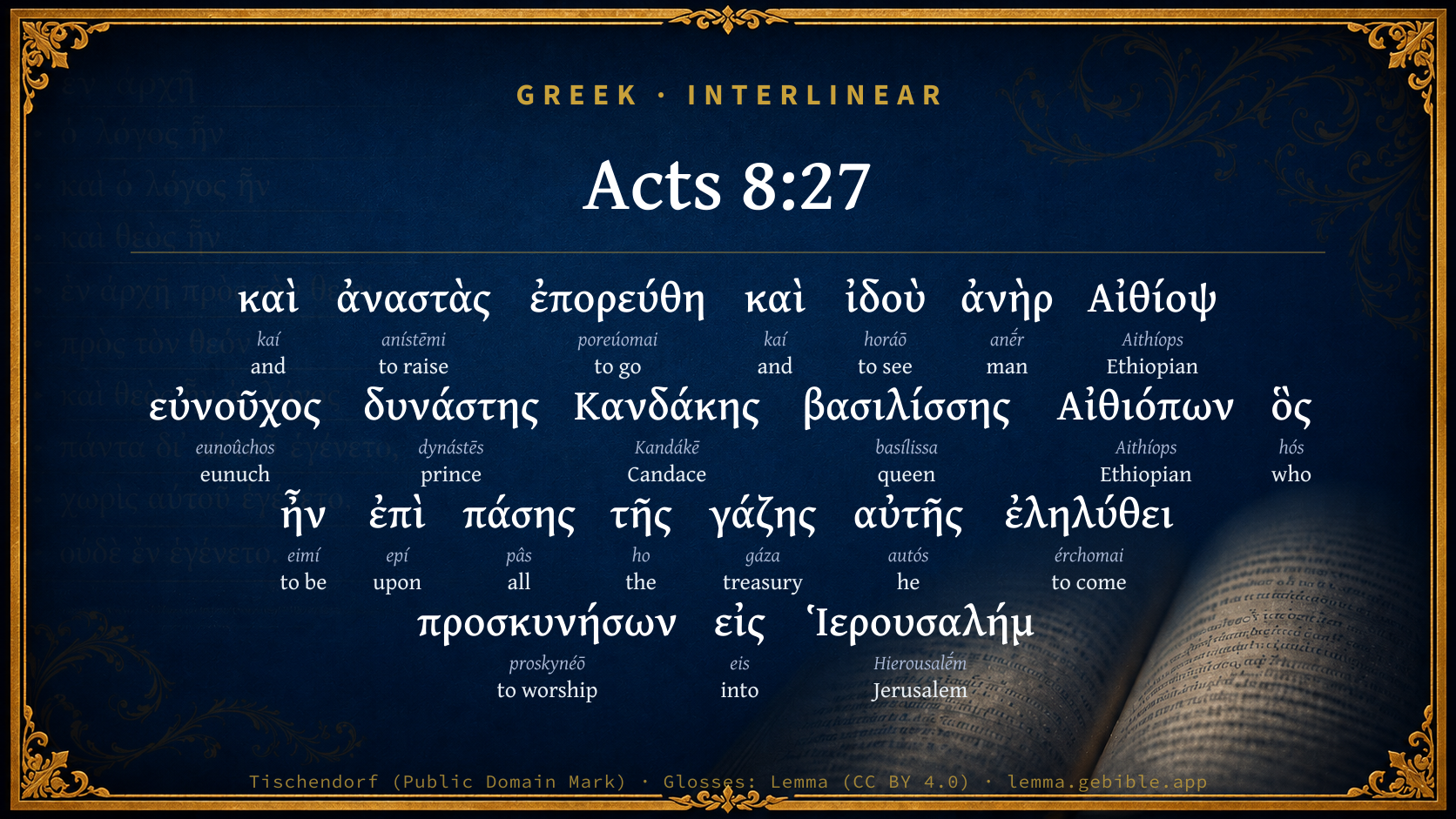
Greek (Tischendorf 8th ed.) Acts 8:27 appears in the Greek New Testament. The text above is from the Tischendorf 8th edition. Each word links to its Strong’s number and a concise gloss. Click any word for its full Thayer’s Greek Lexicon entry.
Download image
Cite this verse

Acts 8:27 (World English Bible). Public Domain. Lemma interlinear Bible study tool, https://lemma.gebible.app/v/acts/8/27.

Show BibTeX & RIS
BibTeX
RIS
English Translation
He arose and went; and behold, there was a man of Ethiopia, a eunuch of great authority under Candace, queen of the Ethiopians, who was over all her treasure, who had come to Jerusalem to worship.
World English Bible · Public Domain
Highlights
  • 2 hapax legomena — only here in the Greek New Testament
  • 3 first appearances in the Greek New Testament
Full analysis ↓
Download a study sheet

One document with this verse’s original text, its word-by-word gloss line, the meaning frame, cross-references with their text, attributed commentary, and full source and license credits — printable, and it pastes into notes with its structure intact.

This verse Autodidact and up

Study sheet (.html) Plain text (.txt)

A passage Seminary Student

Up to 50 verses in one chapter. A passage sheet keeps up to 6 commentary sources and 12 cross-references per verse, in the order this page ranks them, and says so on the sheet whenever that leaves anything out. Ask for a single verse and you get the Autodidact verse sheet above.

Everything on this page stays free to read, with no account — the sheet is a download of what is already on screen, not access to it.

Want to remove ads? Support Godless Engineer
Compare translations 3

The same verse in 3 English versions, stacked beneath the original-language interlinear above. Click any original word for its lexicon entry.

Each is an independent rendering of the whole verse — the interlinear is not word-aligned to these translations.

Highlighted words mark where these versions differ — a whole-verse word diff, not a word-by-word alignment.

  • World English Bible Public Domain
    He arose and went; and behold, there was a man of Ethiopia, a eunuch of great authority under Candace, queen of the Ethiopians, who was over all her treasure, who had come to Jerusalem to worship.
  • King James Version Public Domain
    And he arose and went: and, behold, a man of Ethiopia, an eunuch of great authority under Candace queen of the Ethiopians, who had the charge of all her treasure, and had come to Jerusalem for to worship,
  • unfoldingWord Literal Text CC BY-SA 4.0
    And arising, he went, and behold, a man, an Ethiopian, a eunuch, an official of the Kandake, the queen of the Ethiopians, who was over all her treasure, who had come to Jerusalem to worship,

unfoldingWord Literal Text — © unfoldingWord, licensed CC BY-SA 4.0. Word-aligned USFM3 via Door43 (git.door43.org/unfoldingWord/en_ult).

Versions to compare (up to 4)

3 of 4 selected

Show all 19 translations

Every available English version of this verse, each an independent rendering of the whole verse.

  • World English Bible Public Domain
    He arose and went; and behold, there was a man of Ethiopia, a eunuch of great authority under Candace, queen of the Ethiopians, who was over all her treasure, who had come to Jerusalem to worship.
  • Berean Standard Bible Public Domain
    So he started out, and on his way he met an Ethiopian eunuch, a court official in charge of the entire treasury of Candace, queen of the Ethiopians. He had gone to Jerusalem to worship,
  • Majority Standard Bible Public Domain
    So he started out, and on his way he met an Ethiopian eunuch, a court official in charge of the entire treasury of Candace, the queen of the Ethiopians. He had gone to Jerusalem to worship,
  • King James Version Public Domain
    And he arose and went: and, behold, a man of Ethiopia, an eunuch of great authority under Candace queen of the Ethiopians, who had the charge of all her treasure, and had come to Jerusalem for to worship,
  • American Standard Version (1901) Public Domain
    And he arose and went: and behold, a man of Ethiopia, a eunuch of great authority under Candace, queen of the Ethiopians, who was over all her treasure, who had come to Jerusalem to worship;
  • Revised Version (1885) Public Domain
    And he arose and went: and behold, a man of Ethiopia, a eunuch of great authority under Candace, queen of the Ethiopians, who was over all her treasure, who had come to Jerusalem for to worship;
  • Geneva Bible (1599) Public Domain
    And hee arose and went on: and beholde, a certaine Eunuche of Ethiopia, Candaces the Queene of the Ethiopians chiefe Gouernour, who had the rule of all her treasure, and came to Hierusalem to worship:
  • Douay-Rheims (1899) Public Domain
    And rising up, he went. And behold a man of Ethiopia, an eunuch, of great authority under Candace the queen of the Ethiopians, who had charge over all her treasures, had come to Jerusalem to adore.
  • Young's Literal Translation Public Domain
    And having arisen, he went on, and lo, a man of Ethiopia, a eunuch, a man of rank, of Candace the queen of the Ethiopians, who was over all her treasure, who had come to worship to Jerusalem;
  • Literal Standard Version CC BY-SA 4.0
    And having arisen, he went on, and behold, a man of Ethiopia, a eunuch, a man of rank, of Candace the queen of the Ethiopians, who was over all her treasure, who had come to Jerusalem to worship;
  • Unlocked Literal Bible CC BY-SA 4.0
    He arose and went. Behold, there was a man from Cush, a eunuch of great authority under Candace, queen of the Cushites. He was in charge of all her treasure. He had come to Jerusalem to worship.
  • unfoldingWord Literal Text CC BY-SA 4.0
    And arising, he went, and behold, a man, an Ethiopian, a eunuch, an official of the Kandake, the queen of the Ethiopians, who was over all her treasure, who had come to Jerusalem to worship,
  • Darby Bible Public Domain
    And he rose up and went. And lo, an Ethiopian, a eunuch, a man in power under Candace queen of the Ethiopians, who was over all her treasure, who had come to worship at Jerusalem,
  • World Messianic Bible Public Domain
    He arose and went; and behold, there was a man of Ethiopia, a eunuch of great authority under Candace, queen of the Ethiopians, who was over all her treasure, who had come to Jerusalem to worship.
  • Webster's Bible Public Domain
    And he arose, and went: and behold, a man of Ethiopia, a eunuch of great authority under Candace queen of the Ethiopians, who had the charge of all her treasure, and had come to Jerusalem to worship,
  • Free Bible Version CC BY-SA 4.0
    So Philip set out, and met an Ethiopian man, a eunuch who had a high position in the service of the Kandake, Queen of Ethiopia. He was her chief treasurer. He had gone to Jerusalem to worship there, and
  • Bible in Basic English Public Domain
    And he went and there was a man of Ethiopia, a servant of great authority under Candace, queen of the Ethiopians, and controller of all her property, who had come up to Jerusalem for worship;
  • Text-Critical English NT CC BY 4.0
    So he rose and went. And behold, there was an Ethiopian eunuch, a court official in charge of the entire treasury of Candace, the queen of the Ethiopians. This man had come to Jerusalem to worship
  • Tyndale New Testament (1534) Public Domain
    And he arose and wet on. And beholde a man of Ethiopia which was a chaberlayne and of grete auctorite with Candace quene of the Ethiopias and had the rule of all her treasure came to Ierusalem for to praye.

Literal Standard Version (2020), Covenant Press — licensed CC BY-SA 4.0. Text via the HelloAO Bible API (eBible.org). Unlocked Literal Bible (unfoldingWord) — licensed CC BY-SA 4.0. Text via the HelloAO Bible API (eBible.org). unfoldingWord Literal Text — © unfoldingWord, licensed CC BY-SA 4.0. Word-aligned USFM3 via Door43 (git.door43.org/unfoldingWord/en_ult). Free Bible Version, Dr. Jonathan Gallagher — licensed CC BY-SA 4.0. Text via the HelloAO Bible API (eBible.org).

Word by word

More ways to search: Search by grammar → Find every occurrence → Compare this word →

Practice this passage: Drill this verse → Learn its vocabulary →

Κανδάκης
Kandákē
G2582
“Candace”
Noun, Genitive, Singular, Feminine
Part of Speech
Noun
Case
Genitive
Number
Singular
Gender
Feminine
Full Thayer's Definition

Origin: of foreign origin

TDNT: None

Candace = "prince of servants" 1. a queen of Ethiopia mentioned in Acts 8:27 . (A.D. 2. The name was not a proper name of an individual, but that of a dynasty of Ethiopian queens.
  1. καὶ kaí G2532 “and” Conjunction
  2. ἀναστὰς anístēmi G450 “to raise” Verb, Aorist, Active, Participle, Nominative, Singular, Masculine
  3. ἐπορεύθη poreúomai G4198 “to go” Verb, Aorist, Passive deponent, Indicative, 3rd person, Singular
  4. καὶ kaí G2532 “and” Conjunction
  5. ἰδοὺ horáō G3708 “to see” Verb, Aorist, Middle, Imperative, 2nd person, Singular
  6. ἀνὴρ anḗr G435 “man” Noun, Nominative, Singular, Masculine
  7. Αἰθίοψ Aithíops G128 “Ethiopian” Noun, Nominative, Singular, Masculine
  8. εὐνοῦχος eunoûchos G2135 “eunuch” Noun, Nominative, Singular, Masculine
  9. δυνάστης dynástēs G1413 “prince” Noun, Nominative, Singular, Masculine
  10. βασιλίσσης basílissa G938 “queen” Noun, Genitive, Singular, Feminine
  11. Αἰθιόπων Aithíops G128 “Ethiopian” Noun, Genitive, Plural, Masculine
  12. ὃς hós G3739 “who” Relative pronoun, Nominative, Singular, Masculine
  13. ἦν eimí G1510 “to be” Verb, Imperfect, Active, Indicative, 3rd person, Singular
  14. ἐπὶ epí G1909 “upon” Preposition
  15. πάσης pâs G3956 “all” Adjective, Genitive, Singular, Feminine
  16. τῆς ho G3588 “the” Article, Genitive, Singular, Feminine
  17. γάζης gáza G1047 “treasury” Noun, Genitive, Singular, Feminine
  18. αὐτῆς autós G846 “he” Personal pronoun, Genitive, Singular, Feminine
  19. ἐληλύθει érchomai G2064 “to come” Verb, Pluperfect, Active, Indicative, 3rd person, Singular
  20. προσκυνήσων proskynéō G4352 “to worship” Verb, Future, Active, Participle, Nominative, Singular, Masculine
  21. εἰς eis G1519 “into” Preposition
  22. Ἱερουσαλήμ Hierousalḗm G2419 “Jerusalem” Noun, Proper, indeclinable

About this verse

These counts appear in no published source. They are computed here, from the morphology-tagged text and Lemma’s own curated glosses. What Lemma adds →

23
words
21
distinct lemmas
Acts
section

Notable vocabulary

2 hapax legomena — words that appear only here in the entire Greek New Testament:

  • Κανδάκης Candace G2582
  • γάζης treasury G1047

First appearance in Scripture

These words make their first canonical appearance in the Greek New Testament here:
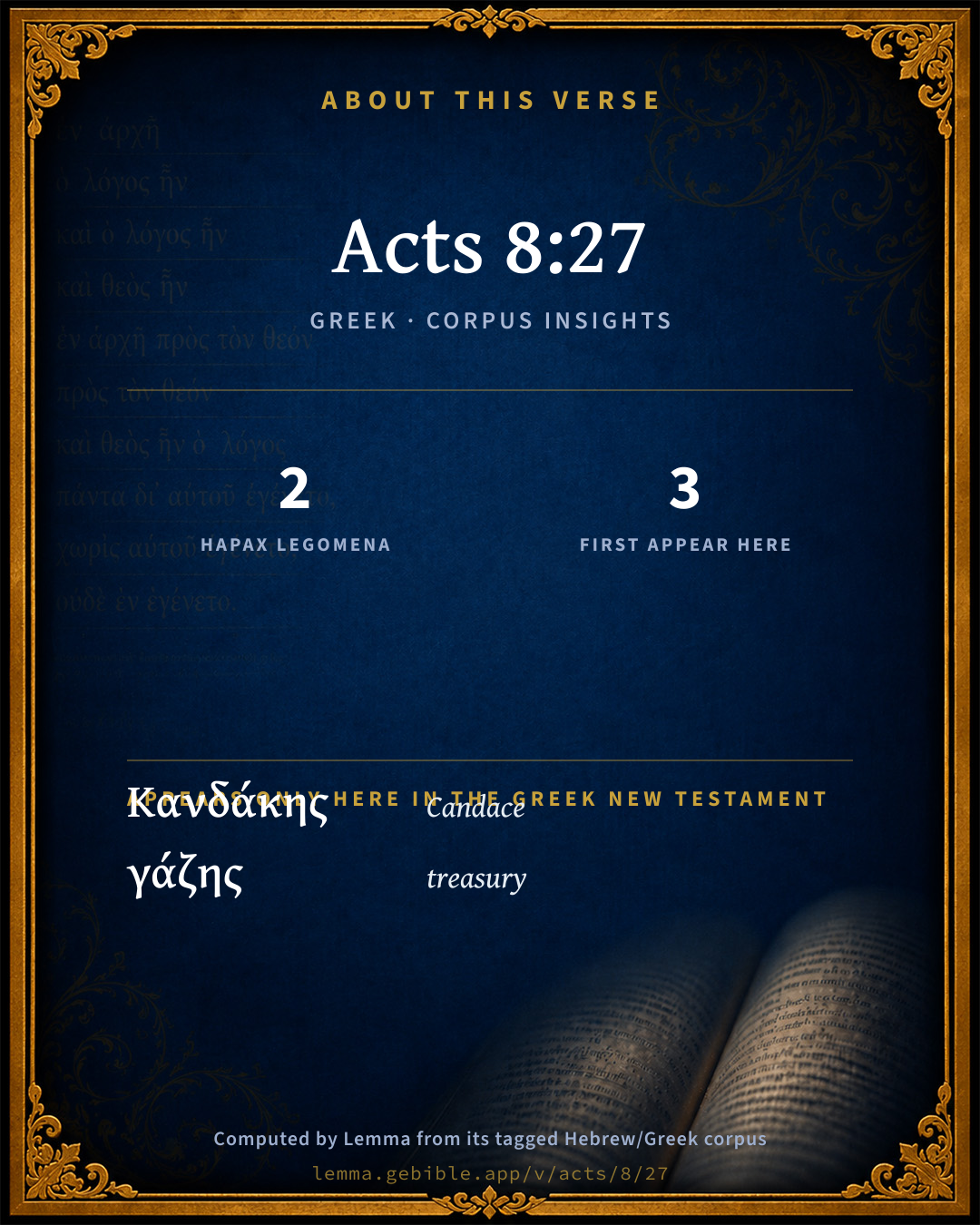
  • Αἰθίοψ Ethiopian G128
  • Κανδάκης Candace G2582
  • γάζης treasury G1047

Repetition

Words recur within this verse:

  • Αἰθίοψ Ethiopian G128 ×2
  • καὶ and G2532 ×2

Cross-references

22

Topical passages linked to Acts 8:27 in the Treasury of Scripture Knowledge — connected by theme and wording, ordered by reader-vote popularity; previews shown in the World English Bible.

  • Psalms 68:31 Princes shall come out of Egypt. Ethiopia shall hurry to stretch out her hands to God.
  • Zephaniah 3:10 From beyond the rivers of Cush, my worshipers, even the daughter of my dispersed people, will bring my offering.
  • Psalms 87:4 I will record Rahab and Babylon among those who acknowledge me. Behold, Philistia, Tyre, and also Ethiopia: "This one was born there."
  • Isaiah 56:3–8 Neither let the foreigner, who has joined himself to Yahweh, speak, saying, Yahweh will surely separate me from his people; neither let the eunuch say, Behold, I am a dry tree.
  • Jeremiah 38:7 Now when Ebedmelech the Ethiopian, a eunuch, who was in the king's house, heard that they had put Jeremiah in the dungeon (the king then sitting in the gate of Benjamin),
  • 1 Kings 8:41–43 Moreover concerning the foreigner, who is not of your people Israel, when he shall come out of a far country for your name's sake
  • Matthew 12:42 The queen of the south will rise up in the judgment with this generation, and will condemn it, for she came from the ends of the earth to hear the wisdom of Solomon; and behold, someone greater than Solomon is here.
  • John 12:20 Now there were certain Greeks among those that went up to worship at the feast.
  • 1 Kings 10:1 When the queen of Sheba heard of the fame of Solomon concerning the name of Yahweh, she came to prove him with hard questions.
  • Psalms 68:29 Because of your temple at Jerusalem, Kings shall bring presents to you.
  • Isaiah 43:6 I will tell the north, Give up; and to the south, Don't keep back; bring my sons from far, and my daughters from the end of the earth;
  • Isaiah 45:14 Thus says Yahweh: "The labor of Egypt, and the merchandise of Ethiopia, and the Sabeans, men of stature, shall come over to you, and they shall be yours. They shall go after you. In chains they shall come over; and they shall fall down to you. They shall make supplication to you: 'Surely God is in you; and there is none else, there is no other god.
  • Isaiah 60:3 Nations shall come to your light, and kings to the brightness of your rising.
  • Isaiah 60:6 The multitude of camels shall cover you, the dromedaries of Midian and Ephah; all they from Sheba shall come; they shall bring gold and frankincense, and shall proclaim the praises of Yahweh.
  • Isaiah 66:19 I will set a sign among them, and I will send such as escape of them to the nations, to Tarshish, Pul, and Lud, who draw the bow, to Tubal and Javan, to the isles afar off, who have not heard my fame, neither have seen my glory; and they shall declare my glory among the nations.
  • Jeremiah 13:23 Can the Ethiopian change his skin, or the leopard his spots? then may you also do good, who are accustomed to do evil.
  • 2 Chronicles 6:32–33 Moreover concerning the foreigner, who is not of your people Israel, when he shall come from a far country for your great name's sake, and your mighty hand, and your outstretched arm; when they shall come and pray toward this house:
  • Jeremiah 39:16 Go, and speak to Ebedmelech the Ethiopian, saying, Thus says Yahweh of Hosts, the God of Israel: Behold, I will bring my words on this city for evil, and not for good; and they shall be accomplished before you in that day.
  • Matthew 21:2–6 saying to them, "Go into the village that is opposite you, and immediately you will find a donkey tied, and a colt with her. Untie them, and bring them to me.
  • Mark 14:13–16 He sent two of his disciples, and said to them, "Go into the city, and there you will meet a man carrying a pitcher of water. Follow him,
  • John 2:5–8 His mother said to the servants, "Whatever he says to you, do it."
  • Hebrews 11:8 By faith, Abraham, when he was called, obeyed to go out to the place which he was to receive for an inheritance. He went out, not knowing where he went.

Cross-references courtesy of OpenBible.info (CC BY 4.0).

Commentary

Notes on Acts 8:27 from classic Christian and Jewish commentators (each source and its license shown beneath its notes). The classic Christian expositions comment on the surrounding passage and are grouped to its opening verse, so a note may address several verses; the Jewish commentaries on the Tanakh (Rashi and others) are per-verse, so they appear only where the commentator wrote on this verse.

Lemma curates 59 commentaries, every one of them public domain or Creative Commons licensed, each selected and text-cleaned for this edition rather than reprinted as found. About our sources →

Tyndale Open Study Notes

Tyndale Open Resources

8:27 In the ancient world, a eunuch was an official, typically castrated, who served in a royal court (see 2 Kgs 9:30-32; Esth 1:10; 2:3, 14-15, 21; 4:4-5). Eunuchs were often scorned by Jews because they could not perpetuate the covenant family, and the law of Moses excluded men who had damaged genitals from the assembly of Israel (Deut 23:1; cp. Lev 21:17-23), but Isaiah spoke of God’s acceptance of Gentiles and eunuchs (Isa 56:3-8; see also Matt 19:12). In the new covenant, all who have genuine faith have a place among the people of God. • The eunuch had traveled from Africa to Jerusalem to worship in the Temple, probably for one of the great Jewish festivals.

Tyndale Open Study Notes — © Tyndale Open Resources, licensed CC BY-SA 4.0. Text via the HelloAO Bible API.

Bengel's Gnomon

Johann Albrecht Bengel

Act 8:27. Κανδάκης, of Candace) a name which, according to Pliny, has now for many years passed to the queens (of Ethiopia).—[προσκυνήσων, for the purpose of worshipping) He seems also long ago to have received circumcision.—V. g.]

Bengel's Gnomon of the New Testament — English translation (T&T Clark, Edinburgh, 1860) — public domain. Text from a community e-Sword module.

Meyer's Critical & Exegetical Commentary

Heinrich August Wilhelm Meyer

Act_8:27. Καὶ ἰδού] And behold (there was) a man. Comp. on Mat_3:17.

εὐνοῦχος δυνάστης] is, seeing that δυνάστης is a substantive, most simply taken, not conjointly (a power-wielding eunuch, after the analogy of Herod. ii. 32: ἀνδρῶν δυναστέων παῖδες, comp. Sir_8:1), but separately: a eunuch, one wielding power, so that there is a double apposition (see Bornemann in loc). The more precise description, what kind of wielder of power he was, follows (chief treasurer, γαζοφύλαξ, Plut. Mor. p. 823 C; Athen. vi. p. 261 B). The express mention of his sexual character is perhaps connected with the universalism of Luke, in contrast to Deu_23:1. In the East, eunuchs were taken not only to be overseers of the harem, but also generally to fill the most important posts of the court and the closet (Pignor. de servis, p. 371 f.; Winer, Realw. s.v. Verschnittene); hence εὐνοῦχος is often employed generally of court officials, without regard to corporeal mutilation. See de Dieu, in loc.; Spanheim, ad Julian. Oratt. p. 174. Many therefore (Cornelius a Lapide, de Dieu, Kuinoel, Olshausen) suppose that the Ethiopian was not emasculated, for he is called ἀνήρ and he was not a complete Gentile (as Eusebius and Nicephorus would make him), but, according to Act_8:30 ff., a Jew, whereas Israelitish citizenship did not belong to emasculated persons (Deu_23:1; Michaelis, Mos. R. II. § 95, IV. § 185; Ewald, Alterth. p. 218). But if so, εὐνοῦχος, with which, moreover, the general word ἀνήρ[228] is sufficiently compatible, would be an entirely superfluous term. The very fact, however, that he was an officer of the first rank in the court of a queen, makes it most probable that he was actually a eunuch; and the objection drawn from Deut. l.c. is obviated by the very natural supposition that he was a proselyte of the gate (comp. on Joh_12:20). That this born Gentile, although a eunuch, had been actually received into the congregation of Israel (Baumgarten), and accordingly a proselyte of righteousness, as Calovius and others assumed, cannot be proved either from Isa_56:3-6, where there is a promise of the Messianic future, in the salvation of which even Gentiles and eunuchs were to share; nor from the example of Ebedmelech, Jer_38:7 ff. (considered by Baumgarten as the type of the chamberlain), of whom it is not said that he was a complete Jew; nor can it be inferred from the distant journey of the man and his quick reception of baptism (Lange, apost. Zeitalt. II. p. 109), which is a very arbitrary inference. Eusebius, ii. 1, also designates him as πρῶτος ἐξ ἐθνῶν, who had been converted. Κανδάκη was, like Pharaoh among the Egyptian kings, the proper name in common of the queens of Ethiopia, which still in the times of Eusebius was governed by queens. See Strabo, xvii. 1. 54, p. 820; Dio Cass. liv. 5; Plin. N. H. iv. 35. 7. Their capital was Napata. See particularly Laurent, neutest. Stud. p. 140 ff.

On γάζα, a word received from the Persian (pecuniam regiam, quam gazam Persae vocant, Curt. iii. 13. 5) into Greek and Latin, see Serv. ad Virgil. Aen. i. 119, vol. i. p. 30, ed. Lion. and Wetstein in loc.

ἐπί, as in vi. 3. Nepos, Datam. 5 : gazae custos regiae.

Tradition (Bzovius, Annal. ad a. 1524, p. 542), with as much uncertainty as improbability (Ludolf, Comm. ad Hist. Aeth. p. 89 f.), calls the Ethiopian Indich and Judich, and makes him,what is without historical proof, doubtless, but in itself not improbable, though so early a permanent establishment of Christianity in Ethiopia is not historically known,the first preacher of the gospel among his countrymen, whose queen the legend with fresh invention makes to be baptized by him (Niceph. ii. 6).

[228] He might even have been married. See Gen_39:1, and Knobel in loc.

Meyer — Critical and Exegetical Commentary on the New Testament — English translation by Peter Christie, edited by Frederick Crombie (T&T Clark, 1880) — public domain. Text from a community e-Sword module.

Expositor's Greek Testament

ed. W. Robertson Nicoll

Act 8:27 . καὶ ἀναστὰς ἐπορεύθη : immediate and implicit obedience. καὶ ἰδού , see on Act 1:11 ; cf. Hort, Ecclesia , p. 179, on the force of the phrase; used characteristically by St. Luke of sudden and as it were providential interpositions, Act 1:10 , Act 10:17 , Act 12:7 , and see note on Act 16:1 . εὐνοῦχος : the word can be taken literally, for there is no contradiction involved in Deu 23:1 , as he would be simply “a proselyte of the gate” (Hort, Judaistic Christianity , p. 54). The instances sometimes referred to as showing that the exclusion of eunuchs from the congregation of the Lord was relaxed in the later period of Jewish history can scarcely hold good, since Isa 56:3 refers to the Messianic future in which even the heathen and the eunuchs should share, and in Jer 38:7 ; Jer 39:15 nothing is said which could lead us to describe Ebed Melech, another Ethiopian eunuch, as a Jew in the full sense. On the position and influence of eunuchs in the East, both in ancient and modern times, see “Eunuch,” B.D. 2 , and Hastings’ B.D. St. Luke’s mention that he was a eunuch is quite in accordance with the “universalism” of the Acts; gradually the barriers of a narrow Judaism were broken down, first in the case of the Samaritans, and now in the case of the eunuch. Eusebius, H. E. , ii., i., speaks of him as πρῶτος ἐξ ἐθνῶν , who was converted to Christ, and even as a “proselyte of the gate” he might be so described, for the gulf which lay between a born Gentile and a genuine descendant of Abraham could never be bridged over (Schürer, Jewish People , div. ii., vol. ii., p. 326, E.T.). Moreover, in the case of the Ethiopian eunuch, descended from the accursed race of Ham, this separation from Israel must have been intensified to the utmost ( cf. Amo 9:7 ). No doubt St. Luke may also have desired to instance the way in which thus early the Gospel spread to a land far distant from the place of its birth (McGiffert, Apostolic Age , p. 100). δυνάστης : noun in apposition to ἀνὴρ Αἰθ ., only used by St. Luke here and in his Gospel, Luk 1:52 , and once again by St. Paul, 1Ti 6:15 . In LXX frequent (used of God, Sir 46:5 , 2Ma 15:3 ; 2Ma 15:23 , etc.; so too of Zeus by Soph.), for its meaning here cf. Gen 1:4 , Latin, aulicus . Κανδάκης : not a personal name, but said to be a name often given to queens of Ethiopia ( cf. Pharaoh, and later Ptolemy, in Egypt), Pliny, N. H. , vi., 35, 7. In the time of Eusebius, H. E. , ii., 1, Ethiopia is said to be still ruled by queens, Strabo, xvii., I., 54; Bion of Soli, Ethiopica (Müller, Fragm. Hist. Græc. , iv., p. 351). According to Brugsch the spelling would be Kanta-ki: cf. “Candace,” B.D. 2 , and “Ethiopia,” Hastings’ B.D. γάζης : a Persian word found both in Greek and Latin ( cf. Cicero, De Off. , ii., 22; Virg., Æn. , i., 119; and see Wetstein, in loco ). In LXX, Ezr 6:1 (Est 4:7 ), treasures; Act 5:17 , Act 7:20 , treasury; Act 7:21 , treasurers; cf. also Isa 39:2 , and γαζοφυλάκιον in LXX, and in N.T., Luk 21:1 , Mar 12:41 (2), 43, Joh 8:20 . “Observat Lucas, et locum, ubi præfectus Gazæ Philippo factus est obviam, Gazam fuisse vocatum” Wetstein; see also on the nomen et omen Felten and Plumptre, and compare on the word Jerome, Epist. , cviii. 11. If the second ὅς is retained (R.V.) it emphasises the fact that the eunuch was already a proselyte Weiss). προσκυνής ων : proves not that (he was a Jew, but that he was not a heathen (Hackett). The proselytes, as well as foreign Jews, came to Jerusalem to worship. We cannot say whether he had gone up to one of the feasts; St. Chrysostom places it to his credit that he had gone up at an unusual time.

The Expositor's Greek Testament, edited by W. Robertson Nicoll (1897–1910) — public domain. Text from a community e-Sword module.

Geneva Bible (1599)

Geneva Bible translators

A man of great wealth and authority with Candaces: Now this word Candaces is a common name to all the Queens of Ethiopia.

Geneva Bible (1599) marginal notes — public domain. Text via Bolls.life.

Jamieson, Fausset & Brown

Robert Jamieson, A. R. Fausset & David Brown

a man of Ethiopia--Upper Egypt, Meroe.

an eunuch of great authority--Eunuchs were generally employed for confidential offices in the East, and to some extent are still.

Candace--the family name of the queens of Upper Egypt, like Pharaoh, Cæsar, &c. (as appears from classic authors).

had come to Jerusalem to worship--that is, to keep the recent feast of Pentecost, as a Gentile proselyte to the Jewish faith. (See Isa 56:3-8, and Joh 12:20).

Jamieson, Fausset & Brown — Commentary Critical and Explanatory on the Whole Bible (1871) — public domain (CC PDM 1.0). Text via the HelloAO Bible API.

Adam Clarke's Commentary

Verse 27. A man of Ethiopia] ανηραιθιοψ should be translated an Ethiopian, for the reasons given on Ac 7:2.

An eunuch] See this word interpreted, on Mt 19:12. The term eunuch was given to persons in authority at court, to whom its literal meaning did not apply. Potiphar was probably an eunuch only as to his office; for he was a married man. See Acts 37:36; Acts 39:1. And it is likely that this Ethiopian was of the same sort.

Of great authority] δυναστης, A perfect lord chamberlain of the royal household; or, rather, her treasurer, for it is here said, he had charge of all her treasure, ην επι πασης της γαζης αυτης. The apparent Greek word γαζα, Gaza, is generally allowed to be Persian, from the authority of Servius, who, in his comment on AEn. lib. i. ver. 118:-

Apparent rari nantes in gurgite vasto,

Arma virum, tabulaeque, et Troia GAZA per undas.

"And here and there above the waves are seen

Arms, pictures, precious goods, and floating men."

DRYDEN.

The words of Servius are: "Gaza Persicus sermo est, et significat divitias; unde Gaza urbs in Palaestina dicitur, quod in ea Cambyses rex Persarum cum AEgyptiis bellum inferret divitias suas condidit." GAZA is a Persian word, and signifies RICHES: hence Gaza, a city in Palestine, was so called because Cambyses, king of Persia, laid up his treasures in it, when he waged war with the Egyptians. The nearest Persian word of this signification which I find is [Persian] gunj, or ganz, and [Persian] gunja, which signify a magazine, store, hoard, or hidden treasure. The Arabic [Arabic] kluzaneh, comes as near as the Persian, with the same meaning. Hence [Arabic] makhzen, called magazen by the Spaniards, and magazine by the English; a word which signifies a collection of stores or treasures, or the place where they are laid up. It is scarcely necessary to remark that this name is given also to certain monthly publications, which are, or profess to be, a store of treasures, or repository of precious, or valuable things.

But who was Candace? It is granted that she is not found in the common lists of Ethiopic sovereigns with which we have been favoured. But neither the Abyssinians nor the Jews admitted women in their genealogies. I shall not enter into this controversy, but shall content myself with quoting the words of Mr. Bruce. "It is known," says he, "from credible writers engaged in no controversy, that this Candace reigned upon the Nile in Atbara, near Egypt. Her capital also, was taken in the time of Augustus, a few years before the conversion of the slave by Philip; and we shall have occasion often to mention her successors and her kingdom, as existing in the reign of the Abyssinian kings, long after the Mohammedan conquest: they existed when I passed through Atbara, and do undoubtedly exist there to this day."-Bruce's Travels, vol. ii. p. 431.

It does not appear, as some have imagined, that the Abyssinians were converted to the Christian faith by this eunuch, nor by any of the apostles; as there is strong historic evidence that they continued Jews and Pagans for more than three hundred years after the Christian aera. Their conversion is with great probability attributed to Frumentius, sent to Abyssinia for that purpose by Athanasius, bishop of Alexandria, about A.D. 330. See Bruce as above.

The Ethiopians mentioned here are those who inhabited the isle or peninsula of Meroe, above and southward of Egypt. It is the district which Mr. Bruce calls Atbara, and which he proves formerly bore the name of Meroe. This place, according to Diodorus Siculus, had its name from Meroe, daughter of Cambyses, king of Persia, who died there in the expedition which her father undertook against the Ethiopians. Strabo mentions a queen in this very district named Candace: his words are remarkable. Speaking of an insurrection of the Ethiopians against the Romans he says: Τουτων δ' ησαν και οἱ βασιλισσης στρατηγοι της Κανδακης, ἡ καθ' ἡμας ηρξε των Αιθιοπων, ανδρικη τις γυνη, πεπηρωενη τον οφθαλμον, "Among these were the officers of Queen CANDACE, who in our days reigned over the Ethiopians. She was a masculine woman, and blind of one eye." Though this could not have been the Candace mentioned in the text, it being a little before the Christian aera, yet it establishes the fact that a queen of this name did reign in this place; and we learn from others that it was a common name to the queens of Ethiopia. Pliny, giving an account of the report made by Nero's messengers, who were sent to examine this country, says, AEdificia oppidi (Meroes) pauca: regnare faeminam CANDACEN; quod nomen multis jam annis ad reginas transiit. Hist. Nat. lib. vi. cap. 29, ad fin. They reported that "the edifices of the city were few: that a woman reigned there of the name of Candace; which name had passed to their queens, successively, for many years." To one of those queens the eunuch in the text belonged; and the above is sufficient authority to prove that queens of this name reigned over this part of Ethiopia.

Had come to Jerusalem for to worship] Which is a proof that he was a worshipper of the God of Israel; but how came he acquainted with the Jewish religion? Let us, for a little, examine this question. In 1Kg 10:1, c., we have the account of the visit paid to Solomon by the queen of Sheba, the person to whom our Lord refers, Mt 12:42, and Lu 11:31. It has been long credited by the Abyssinians that this queen, who by some is called Balkis, by others Maqueda, was not only instructed by Solomon in the Jewish religion, but also established it in her own empire on her return that she had a son by Solomon named Menilek, who succeeded her in the kingdom; and, from that time till the present, they have preserved the Jewish religion. Mr. Bruce throws some light upon this subject: the substance of what he says is the following: "There can be no doubt of the expedition of the queen of Sheba; as Pagan, Moor, Arab, Abyssinian, and all the countries round, vouch for it, nearly in the terms of Scripture. Our Saviour calls her queen of the south; and she is called, in 1Kg 10:1, c., 2Ch 9:1, c., queen of Sheba or Saba for Saba, Azab, and Azaba, all signify the south: and she is said to have come from the uttermost parts of the earth. In our Saviour's time the boundaries of the known land, southward, were Raptam or Prassum which were the uttermost parts of the known earth, and were with great propriety so styled by our Lord. The gold, myrrh, cassia, and frankincense, which she brought with her, are all products of that country. The annals of the Abyssinians state that she was a pagan when she left Saba or Azab, to visit Solomon; and that she was there converted and had a son by Solomon, who succeeded her in the kingdom, as stated above. All the inhabitants of this country, whether Jews or Christians, believe this; and, farther, that the 45th Psalm Ps 45:1, c. was a prophecy of her journey to Jerusalem that she was accompanied by a daughter of Hiram from Tyre; and that the latter part of the Psalm is a prophecy of her having a son by Solomon, and of his ruling over the Gentiles." Travels, vol. ii. page 395, c. All this being granted, and especially the Scripture fact of the queen of Sheba's visit, and the great probability, supported by uninterrupted tradition, that she established the Jewish religion in her dominions on her return, we may at once see that the eunuch in question was a descendant of those Jews or that he was a proselyte in his own country to the Jewish faith, and was now come up at the great feast to worship God at Jerusalem. Mr. Bruce may be right; but some think that Saba, in Arabia Felix, is meant: See Clarke on Mt 12:42.

Adam Clarke's Commentary on the Bible (1810–1826) — public domain. Text from a community e-Sword/MySword module.

John Calvin's Commentaries

27. Behold, a man, an Ethiopian. He calleth him a man, who he saith shortly after was an eunuch; but because kings and queens in the East were wont to appoint eunuchs over their weighty affairs, thereby it came to pass that lords of great power were called generally eunuchs, whereas, notwithstanding, they were men. Furthermore, Philip findeth indeed, now at length, that he did not obey God in vain. Therefore, whosoever committeth the success to God, and goeth on forward thither whither he biddeth him, he shall at length try that all that falleth out well which is taken in hand at his appointment. The name Candace was not the name of one queen only; but as all the emperors of Rome were called Caesars,, so the Ethiopians, as Pliny withesseth, called their queens Candaces. This maketh also unto the matter that the writers of histories report that that was a noble and wealthy kingdom, because it may the better be gathered by the royalty and power thereof how gorgeous the condition and dignity of the eunuch was. The head and principal place was Meroe. The profane writers agree with Luke, who report that women used to reign there.

Came [had come] to worship. Hereby we gather that the name of the true God was spread far abroad, seeing he had some worshippers in far countries. Certes, it must needs be that this man did openly profess another worship than his nation; for so great a lord could not come into Judea by stealth, and undoubtedly he brought with him a great train. And no marvel if there were some everywhere in the East parts which worshipped the true God, because that after the people were scattered abroad, there was also some smell of the knowledge of the true God spread abroad with them throughout foreign countries; yea, the banishment of the people was a spreading abroad of true godliness. Also, we see that though the Romans did condemn the Jewish religion with many cruel edicts, yet could they not bring to pass but that many, even on [in] heaps, would profess the same. These were certain beginnings of the calling of the Gentiles, until such time as Christ, having with the brightness of his coming put away the shadows of the law, might take away the difference which was between the Jews and the Gentiles; and having pulled down the wall of separation, he might gather together from all parts the children of God, (Ephesians 2:14.)

Whereas the eunuch came to Jerusalem to worship, it must not be accounted any superstition. He might, indeed, have called upon God in his own country, but this man would not omit the exercises which were prescribed to the worshippers of God; and, therefore, this was his purpose, not only to nourish faith privily in his heart, but also to make profession of the same amongst men. And yet, notwithstanding, he could not be so divorced from his nation, but that he might well know that he should be hated of many. But he made more account of the external profession of religion, which he knew God did require, than of the favor of men. And if such a small sparkle of the knowledge of the law did so shine in him, what a shame were it for us to choke the perfect light of the gospel with unfaithful silence? If any do object that the sacrifices were even then abrogated, and that now the time was come wherein God would be called upon everywhere without difference of place, we may easily answer, that those to whom the truth of the gospel was not yet revealed, were retained in the shadows of the law without any superstition. For whereas it is said that the law was abolished by Christ, as concerning the ceremonies, it is thus to be understood, that where Christ showeth himself plainly, those rites vanish away which prefigured him when he was absent. Whereas the Lord suffered the eunuch to come to Jerusalem before he sent him a teacher, it is to be thought that it was done for this cause, because it was profitable that he should yet be framed by the rudiments of the law, that he might be made more apt afterward to receive the doctrine of the gospel. And whereas God sent none of the apostles unto him at Jerusalem, the cause lieth hid in his secret counsel, unless, peradventure, it were done that he might make more account of the gospel, as of some treasure found suddenly, and offered unto him contrary to hope; or because it was better that Christ should be set before him, after that being separated and withdrawn from the external pomp of ceremonies and the beholding of the temple, he sought the way of salvation quietly at such time as he was at rest.

John Calvin's Commentaries (1540-1563) — public domain. Text from the Calvin Translation Society English edition (1840s-50s) via the Christian Classics Ethereal Library (ccel.org). Calvin's coverage is partial (roughly two-thirds of the Bible); uncommented books and verses are honest gaps, never fabricated. The 19th-century editor's footnotes and remarks are omitted so the notes are faithfully Calvin's own voice.

Ellicott's Commentary for English Readers

(27) A man of Ethiopia, an eunuch of great authority.—Literally, a eunuch, a potentate. The Ethiopia from which the traveller came was the region so named by the geographers of St. Luke’s time in the upper valley of the Nile. Its connection with the Jewish people presents many points of interest. There seems reason to believe that in the time of Manasseh, who (according to the statement in the narrative of Aristeas as to the LXX. translation) formed an alliance with Psammetichus king of Egypt, a considerable body of Jews were sent off to protect the outposts of his kingdom, and it is in reference, probably, to these that Zephaniah speaks of the suppliants of “the daughter of my dispersed beyond the rivers of Ethiopia” (Zep_3:10). Jewish influences had accordingly been at work there for some centuries. They may probably be traced in the piety of the Ethiopian eunuch, Ebed-melech, in the time of Jeremiah (Jer_38:7-13; Jer_39:16-18). Even at an earlier period the hopes of Israel had looked forward to, perhaps had actually seen, the admission of Ethiopians among the citizens of Zion (Psa_87:4), Ethiopia stretching forth her hands unto God (Psa_68:31). The fact that the traveller had come as a pilgrim or a proselyte, shows (if, as the narrative implies, the latter) that he was a circumcised “proselyte of righteousness.” His baptism was not, like that of Cornelius, the admission of a Gentile as such. The word “eunuch” has been taken by some commentators as meaning only “chamberlain,” which is, indeed, the strict etymological sense of the word. Its use in Mat_19:12, and indeed in later Greek writers generally, is, however, in favour of the literal sense of the word. The strict letter of Deu_23:1, forbidding the admission of such persons into the congregation of the Lord, had been already modified (probably on the assumption that the state was not one which they had brought about by their own act) in favour of the sons of the stranger, the eunuchs “who keep my Sabbaths,” by Isaiah (Isa_56:4); and we may well think of St. Luke, as glad to record a proof that the discipline of the Church of Christ was as liberal on this point as the teaching of the Evangelical prophet. It is interesting to note that the first act of the first (Ecumenical Council was to formulate a like rule in dealing with such cases of the kind as then presented themselves (Conc. Nic. Song of Solomon 1), admitting those who were not self-mutilated even into the ranks of the clergy.

Under Candace queen of the Ethiopians.—The quantity of the second syllable is uncertain, but the analogy of Canãce is in favour of its being short. The knowledge of the student of Strabo (Strabo, xvii. p. 820) may, perhaps, be traced in the description. He mentions a Queen of Meroè, in Ethiopia, bearing the name of Candace. The occurrence of the same name in Plin. iv. 35, Dion.-Cass. liv. 5, indicates that it was, like Pharaoh, a dynastic name or title. Eusebius (Hist. ii. 1) states that in his time (circ. A.D. 430) the region was still under the rule of a queen, according to the custom of the country.

Who had the charge of all her treasure.—The Greek word for treasure is Gaza, a word of Persian origin, which about this time had come into use both among Greek and Latin writers (Cicero, de Off. ii. 22). The LXX. translators employ it in Ezr_5:17; Ezr_6:1; Ezr_7:21; Isa_39:2. Aristotle (Hist. Plant. viii. 11) is the first Greek writer in whom we find it naturalised. It is not found elsewhere in the New Testament, but a compound form appears as denoting the treasury of the Temple in Luk_21:1. The coincidence between this Gaza and the name of the town is at least suggestive of the thought that St. Luke saw in it a nomen et omen. The man came from one Gaza, and was going to another; and he, like the man in the parable of Mat_13:44, found a treasure which he had not looked for, but which came to him as the reward of his diligently seeking.

Had come to Jerusalem for to worship.—The act itself, even prior to the eunuch’s conversion by Philip, was a fulfilment of the hope of the prophet Zephaniah cited above. Whether of Jewish origin or incorporated as a “proselyte of righteousness,” he belonged to “the daughter of the dispersed,” and so long a journey by a man in so high a position was in itself a notable event. He came seeking, we must believe, for light and wisdom, and they were given him beyond his expectations.

A Bible Commentary for English Readers, edited by Charles John Ellicott (1878–1897) — public domain. Text from a community e-Sword module.

The Cambridge Bible for Schools and Colleges

gen. ed. J. J. S. Perowne

27. behold, a man of Ethiopia] It is better to supply the substantive verb here, “behold there was, &c.” otherwise the conjunction at the commencement of the next verse is left untranslated.

Ethiopia, like Cush in the O. T., is a general name given to the country which is now called Nubia and Abyssinia. Its northern portion was the great kingdom of Meroe, which we know was ruled over by queens for a long period (Plin. H. N. vi. 29), and it is from this kingdom, most probably, that the eunuch had come. Jews were abundant in Egypt, and this man had become a proselyte to their religion.

under Candace queen of the Ethiopians] We are told by Pliny (l. c.) that this was the name of a series of queens of Meroe, just as Pharaoh at an early period and Ptolemy subsequently were general names for the kings of Egypt, and Cæsar for the Roman emperors.

and had come to Jerusalem for to worship] As proselytes did, as well as Jews. This we learn from the enumeration of those who were present at the feast of Pentecost (Act_2:10), among whom proselytes are expressly named. So (Joh_12:20) we find Greeks coming up to the feasts at Jerusalem.

The Cambridge Bible for Schools and Colleges (gen. ed. J. J. S. Perowne; Cambridge University Press, 1878–1918) — public domain. Text from a community e-Sword module.

John Gill's Exposition

Was returning,.... From Jerusalem, having finished the parts of divine worship he came to perform; and it is remarkable, that though he must doubtless have heard of Jesus of Nazareth, and what had passed in Jerusalem lately, and of his apostles, yet heard them not; or however, was not converted by them, nor believed in Jesus; his conversion being ordered to be at another time, in another place, and by another instrument:

and sitting in his chariot: as was the manner of princes and great persons:

read Esaias the Prophet; the Book of the Prophecies of Isaiah the Prophet; and in Luk 4:17 it is called the "Book of the Prophet Esaias"; and in the note there; see Gill on Luk 4:17, I have observed, that the prophets, especially the larger ones, were sometimes in separate and distinct books, and so might be the prophecy of Isaiah; and such an one was delivered to Christ, in the synagogue of Nazareth; and such an one the eunuch might have, and be reading in it: hence we read (s), that Daniel should say to the Israelites, who came to discourse with him about the prophecies of Jeremiah, bring me, says he, , the Book of Isaiah"; he began to read, and went on till he came to this verse, "the burden of the desert of the sea", &c. Isa 21:1 and both the Arabic and Ethiopic versions here read, "the Book of the Prophet Isaiah." See Gill on Luk 4:17. Some think the eunuch might be reading over some passages of Scripture in this prophet, which he had heard expounded at Jerusalem, to refresh his memory with what he had heard. This prophet is a very evangelical one, and very delightful and profitable to read: many things are prophesied by him concerning the Messiah, and particularly in the chapter in which the eunuch was reading; and this being a time when there was great expectation of the Messiah, such passages might be read and expounded in their synagogues, which concerned him: however, the eunuch improved his time, as he was travelling in a religious way, which was very commendable; and as this was the occasion and opportunity which the Holy Ghost took to bring on his conversion, it may serve greatly to recommend the reading of the Scriptures.

(s) Shirhashirim Rabba, fol. 33. 1.

John Gill's Exposition of the Whole Bible (1746–1763) — public domain (CC PDM 1.0). Text via the HelloAO Bible API.

Trapp's Complete Commentary

John Trapp

27 And he arose and went: and, behold, a man of Ethiopia, an eunuch of great authority under Candace queen of the Ethiopians, who had the charge of all her treasure, and had come to Jerusalem for to worship,

Ver. 27. Candace] This, saith Pliny, was a common name to the Ethiopian queens, as Caesar was to the Roman emperors. Her country might haply be that large region of Nubia, which had from the apostles’ time (as it is thought) professed the Christian faith; but hath again above a hundred years since forsaken it, and embraced instead of it, partly Mahometanism, and partly idolatry; and that by the most miserable occasion that might befall, namely, famine of the word of God through lack of ministers.

John Trapp, A Commentary or Exposition upon All the Books of the Old and New Testament (1647–1656) — public domain. Text from a community e-Sword module.

Albert Barnes' Notes on the Bible

A man of Ethiopia - Gaza was near the confines between Palestine and Egypt. It was in the direct road from Jerusalem to Egypt. “Ethiopia” was one of the great kingdoms of Africa, part of which is now called Abyssinia. It is frequently mentioned in Scripture under the name of “Cush.” But “Cush” comprehended a much larger region, including the southern part of Arabia, and even sometimes the countries adjacent to the Tigris and Euphrates. Ethiopia proper lay south of Egypt, on the Nile, and was bounded north by Egypt, that is, by the cataracts near Syene; east by the Red Sea, and perhaps part by the Indian Ocean; south by unknown regions in the interior of Africa; and west by Libya and the deserts. It comprehended the modern kingdoms of Nubia or Sennaar, and Abyssinia. The chief city in it was the ancient Meroe, situated on the island or tract of the same name, between the Nile and Ashtaboras, not far from the modern Shendi Robinson’s Calmet).

An eunuch ... - See the notes on Mat 19:12. Eunuchs were commonly employed in attendance on the females of the harem; but the word is often used to denote “any confidential officer, or counselor of state.” It is evidently so used here.

Of great authority - Of high rank; an officer of the court. It is clear from what follows that this man was a Jew. But it is known that Jews were often raised to posts of high honor and distinction in foreign courts, as in the case of Joseph in Egypt, and of Daniel in Babylon.

Under Candace ... - Candace is said to have been the common name of the queens of Ethiopia, as “Pharaoh” was of the sovereigns of Egypt. This is expressly stated by Pliny (Nat. History, 7:29). His words are: “The edifices of the city were few; a woman reigned there of the name of Candace, which name had been transmitted to these queens for many years.” Strabo mentions also a queen of Ethiopia of the name of Candace. Speaking of an insurrection against the Romans, he says, “Among these were the officers of queen Candace, who in our days reigned over the Ethiopians.” As this could not have been the Candace mentioned here, it is plain that the name was common to these queens - a sort of royal title. She was probably queen of Meroe, an important part of Ethiopia (Bruce’s Travels, vol. ii, p. 431; Clarke).

Who had the charge ... - The treasurer was an officer of high trust and responsibility.

And had come ... - This proves that he was a Jew, or at least a Jewish proselyte. It was customary for the Jews in foreign lands, as far as practicable, to attend the great feasts at Jerusalem. He had gone up to attend the Passover, etc. See the notes on Act 2:5.

Albert Barnes' Notes on the Bible (1834–1885) — public domain. Text from a community e-Sword/MySword module.

Haydock's Catholic Bible Commentary

An eunuch. It is likely a proselyte converted to the Jewish religion. He shews his zeal and devotion, says St. John Chrysostom, not only by coming to Jerusalem, but by reading the prophets in his chariot. (Witham)

George Leo Haydock (1774–1849), Haydock's Catholic Family Bible and Commentary, 1859 edition — public domain. Excludes Psalms (Douay-Rheims chapter numbering differs from Protestant) and Deuterocanonical books (Catholic canon only).

Matthew Poole's English Annotations

A man of Ethiopia: the Ethiopians were the most despicable unto the Jews; and Homer calls them, εσχατοι ανορων; but God would now show that there is no difference of nations with him; but in every nation, he that worketh righteousness shall be accepted, Act 10:35.

An eunuch; in great esteem in courts, especially to attend on queens, to avoid all suspicion: here that prophecy was fulfilled, Isa 56:4,5; though both in the Hebrew and (anciently) in the Greek tongue a eunuch signified more largely, viz. any attendant in the chamber.

Candace; a name common to the queens of that country; as all the kings of Egypt were called Pharaohs, and the emperors of Germany are called Caesars.

Come to Jerusalem for to worship; being a proselyte, he had been to worship God in that solemn festival of the passover.

Matthew Poole's English Annotations on the Holy Bible (1683–1685) — public domain. Text from a community e-Sword/MySword module.

The Pulpit Commentary

Was over for had the charge of, A.V.; who for and, A.V. Candace. According to Pithy, the queens of Ethiopia, who reigned at Meroc, were so named through a long course of years ("Nat. Hist.," 6:2, 5-37). Dion Cassius speaks of a warlike Queen of Ethiopia of that name, who was brought to terms by Caius Petronius in the year A.U.C. 732 (54:5, 4). Eusebius ("Eccl. Hist.," lib. it. cap. 1.) says that the custom still continued in his day of the Ethiopians being governed by a queen. Had come to Jerusalem, etc. He was doubtless a proselyte of the gate. Eusebius, in the place above cited, speaks of him as the first Gentile convert, and as the first fruits of the faithful in the whole world. He adds, as Irenaeus before him had hinted (3. 12:8), that he is reported to have preached the gospel to the Ethiopians, by which the prophecy of Psa_68:31 was fulfilled. Later traditions speak of Candace as baptized by him.

Vers. 27-39. The inquiring proselyte.

Give some account of Ethiopia, of the queen of that day, of the office the eunuch occupied, and of the probable means by which he had been made a Jewish proselyte. He was one of those men among the heathen who had been awakened to spiritual anxiety by the ever-working Spirit of God. He may have had some Jewish connections, through whom he had come to know of Jehovah. We can recognize in him:

1. An inquirer.

2. A spiritually awakened inquirer, one who had come to see that his own personal relations with God were matters of extreme importance.

3. A wise seeker, who had found the revealed Word of God, and was searching it in full confidence that therein was the "eternal life." To such a seeker help will never be long withheld. "God waiteth to be gracious." Philip was divinely guided to meet the eunuch on his return from the holy city, and to join him in the chariot just when he was hopelessly puzzled with his reading. The passage which engaged his attention was one which opened up the applications of truth to sinful souls. The great chapter of the evangelical Isaiah deals with human sins, calling them transgressions; and it discloses that wonderful scheme of Divine wisdom and love by which those transgressions were vicariously borne, and borne away. Philip preached unto him Jesus, who "was wounded for our transgressions," on whom the "Lord laid the iniquity of us all," whose "soul was made an offering for sin;" who now saves his people from their sins; from the penalty of their sins, by the virtue of his great sacrifice, from the power of their sinfulness by the cleansing energies of his Holy Spirit. With opened soul the eunuch listened, and the truth dawned upon him; Christ, the Messiah, the Savior, was revealed to him. He believed the record, and longed at once to seal in baptism his faith and love to the crucified One. He thus simply declares his faith, "I believe that Jesus Christ is the Son of God." What was this eunuch"s faith? and can we learn from him what the saving faith is? Evidently it was a simple acceptance of and confidence in the testimony rendered by Philip to Christ, based as the testimony was upon the revealed Word of God. And that is faith still receiving the record which God hath given us of his Son, and acting on the record. Faith is the great difficulty in the way of seekers, yet, when it is won, it seems strange that so simple a matter should have hindered. Some of the expressions and figures of Scripture may help us.

I To BELIEVE IN CHRIST IS TO APPREHEND OR LAY HOLD OF HIM. AS St. Peter, sinking in the waters, put out his hand and grasped the offered hand of Christ, so our souls, sinking in sin and despair, by faith lay hold of the strong, rescuing Savior.

II To BELIEVE IN CHRIST IS TO RECEIVE HIM. As the imprisoned debtor welcomes and receives the man who brings into his cell the money of his ransom, so our souls, by faith, welcome and receive him by whose precious blood we have been bought out of our prison-house of sin.

III To BELIEVE IN CHRIST IS TO ROLL OUR BURDEN UPON HIM. To shift the weight of all the trouble and anxiety from our own shoulders, and let Christ bear it all for us; as one might do who had an important trial coming on, but trusted the whole matter to his skilful lawyer-friend.

IV To BELIEVE IN CHRIST IS TO APPLY TO HIM. As the hungry and the thirsty apply for food and drink, so the hungry soul applies to Christ for the bread which, if a man eats, he lives for ever.

V To BELIEVE IN CHRIST IS TO COME TO HIM. To flee to him as the villagers flee into the strongholds before invading armies; as the doomed man fled into the sanctuary to lay hold of the horns of the altar, or as the manslayer fled before the avenger of blood to gain the shelter of the city of refuge. So the soul enters the stronghold of Christ, takes sanctuary with Christ, passes within the gates of Christ, the Refuge for the sinner.

VI To BELIEVE IN CHRIST IS TO LEAN UPON HIM, TO STAY UPON HIM, as we lean upon a staff for support. Christ is the strong Staff, on which the soul, with all its eternal interests, may safely lean; Christ is the healthy, strong Friend, on whom the sick, fainting, weary soul may wholly rely.

VII To BELIEVE IN CHRIST IS TO ADHERE TO HIM, TO CLEAVE TO HIM. As the drowning man clutches so must we grasp, cling to, cleave to, the Lord Jesus, binding the soul to him as with everlasting bands. With so many and so simple illustrations, how well you may be urged now even now to believe on the Son of God, and find the pardon he speaks, the life he gives, and the love with which he will make you his own forever. R.T.

The Pulpit Commentary (1880–1919), ed. H.D.M. Spence-Jones & Joseph S. Exell — public domain. Text from a community e-Sword module.

John Wesley's Explanatory Notes

An eunuch - Chief officers were anciently called eunuchs, though not always literally such; because such used to be chief ministers in the eastern courts. Candace, queen of the Ethiopians - So all the queens of Ethiopia were called.

John Wesley, Explanatory Notes Upon the Whole Bible (1754–1765) — public domain. Text via the GEBible commentary corpus.

McGarvey & Pendleton's Commentaries

J. W. McGarvey

27, 28. Philip promptly obeyed the command of the angel, and was soon in close proximity to the intended convert, though, as yet, he knew nothing of him. (27) " He arose and went; and behold a man of Ethiopia, an eunuch of great authority under Candace, queen of the Ethiopians, who had charge of all her treasure, and had come to Jerusalem to worship, (28) was returning, and sitting in his chariot, was reading the Prophet Isaiah. "

J. W. McGarvey (with Philip Y. Pendleton), Commentaries on the New Testament (The Fourfold Gospel, 1914; Acts; and the epistles) — public domain. Text from a community e-Sword/MySword module.

The People's New Testament

B. W. Johnson

27. A man of Ethiopia. The term is applied to that portion of Africa which lies south of Egypt. A eunuch of great authority. This mutilated class of men often rose to great power in Oriental countries. This one was the royal treasurer. Under Candace, queen of the Ethiopians. Candace had her seat of power on the island of Meroe, a large island of the Nile, about a thousand miles from the mouth of the river. The name Candace seems to have belonged to several queens of this kingdom. It is still seen inscribed on the ruined palace walls of Meroe. Come to Jerusalem for to worship. He was probably a proselyte to the Jewish faith. His long journey, his study of Scripture, and his ready hearing all indicate a believer in Jehovah, a devout man, and one seeking for the Christ.

B. W. Johnson's The People's New Testament with Notes (1889–1891) — public domain. Electronic text from the Christian Classics Ethereal Library (CCEL) ThML edition.

Cambridge Greek Testament for Schools and Colleges

27. The second ὃς omitted with אACD. It is unrepresented in the Vulg.

27. ἀνὴρ Αἰθίοψ. The deletion of the second ὂς in this verse leaves the nominative with a verb to which it may be joined, which was not the case in the Text. recept.

Ethiopia, like Cush in the O.T., is a general name given to the country which is now called Nubia and Abyssinia. Its northern portion was the great kingdom of Meroë, which we know was ruled over by queens for a long period (Plin. H. N. VI. 29), and it is from this kingdom, most probably, that the eunuch had come. Jews were abundant in Egypt, and this man had become a proselyte to their religion.

Κανδάκης, of Candace. We are told by Pliny (l. c.) that this was the name of a series of queens of Meroë, just as Pharaoh at an early period, and Ptolemy subsequently, were general names for the kings of Egypt, and Cæsar for the Roman emperors.

ἐπὶ πάσης τῆς γάζης αὐτῆς, over all her treasure, γάζα is a word of Persian origin, and is found in nearly the same form in the Hebrew text of Ezr 5:17; Ezr 6:1; Ezr 7:20, and Est 4:7, into which books it has come directly from the Persian.

ἐληλύθει προσκυνήσων, had come to worship, which proselytes did, as well as Jews. This we learn from the enumeration of those who were present at the feast of Pentecost (Act 2:10), among whom proselytes are expressly named. So (Joh 12:20) we find Greeks coming up to the feasts at Jerusalem.

Cambridge Greek Testament for Schools and Colleges (Cambridge University Press, 1896; 21 vols, various authors incl. Carr, Maclear, Plummer, Farrar, Lumby, Moule, M. R. James, Simcox) — public domain. Text from a community e-Sword module.

Alford’s Greek Testament

Henry Alford

27. εὐνοῦχος] The very general use of eunuchs in the East for filling offices of confidence, and the fact that this man was minister to a female sovereign, makes it probable that he was literally an eunuch. If not so, the word would hardly have been expressed. No difficulty arises from Deu 23:1, for no inference can be drawn from the history further than that he may have been a proselyte of the gate, in whose case the prohibition would not apply. Nay, the whole occurrence seems to have had one design, connected with this fact. The walls of partition were one after another being thrown down: the Samaritans were already in full possession of the Gospel: it was next to be shewn that none of those physical incapacities which excluded from the congregation of the Lord under the old covenant, formed any bar to Christian baptism and the inheritance among believers; and thus the way gradually paved for the great and as yet incomprehensible truth of Gal 3:28.

Κανδάκης] As Pharaoh among the Egyptians was the customary name of kings, so Candăce of the Queens among the Æthiopians in upper Egypt (Αἰθίοπες ὑπὲρ Αἰγύπτου οἰκοῦντες, Dio Cass. liv. 5),—in the island of Meroe, Plin. vi. 29, where he says, ‘Ipsum oppidum Meroen ab introitu insulæ abesse lxx m. pass.… Regnare fœminam Candacen, quod nomen multis jam annis ad reginas transiit.… Cæterum cum potirentur rerum Æthiopes, insula ea magnæ claritatis fuit.’

γάζης] A Persian term. Q. Curt. iii. 13. 5, ‘pecuniam regiam, quam gazam Persæ vocant.’ See Virg. Æn. i.119.

ὃς ἐληλύθει …] This did not only Jews and proselytes, but also those pious Gentiles who adhered to Judaism,—the proselytes of the gate, see Joh 12:20. Euseb. ii. 1, prope fin., speaking of this eunuch says, ὃν πρῶτον ἐξ ἐθνῶν πρὸς τοῦ Φιλίππου διʼ ἐπιφανείας τὰ τοῦ θείου λόγου ὄργια μετασχόντα, τῶν τε ἀνὰ τὴν οἰκουμένην πιστῶν ἀπαρχὴν γενόμενον κ.τ.λ., taking for granted that he was a Gentile. There were (see below, ch. 11:21) cases of Gentile conversion before that of Cornelius; and the stress of the narrative in ch. 10 consists in the miscellaneous admission of all the Gentile company of Cornelius, and their official reception into the church by that Apostle to whom was especially given the power. We may remark, that if even the plain revelation by which the reception of Cornelius and his company was commanded failed finally to convince Peter, so that long after this he vacillated (Gal 2:11, Gal 2:12), it is no argument for the eunuch not being a Gentile, that his conversion and baptism did not remove the prejudices of the Jewish Christians.

Henry Alford, The Greek Testament (1849–1861) — public domain. Text from a community e-Sword module.

Vincent's Word Studies in the New Testament

Marvin R. Vincent

Of Ethiopia. The name for the lands lying south of Egypt, including the modern Nubia, Cordofan, and Northern Abyssinia. Rawlinson speaks of subjects of the Ethiopian queens living in an island near Meroe, in the northern part of this district. He further remarks : "The monuments prove beyond all question that the Ethiopians borrowed from Egypt their religion and their habits of civilization. They even adopted the Egyptian as the language of religion and of the court, which it continued to be till the power of the Pharaohs had fallen, and their dominion was again confined to the frontier of Ethiopia. It was through Egypt, too, that Christianity passed into Ethiopia, even in the age of the apostles, as is shown by the eunuch of Queen Candace."

Of great authority [δυναστης] . A general term for a potentate.

Candace. The common name of the queens of Meroe : a titular distinction, like Pharaoh in Egypt, or Caesar at Rome.

Treasure [γαζης] . Only here in New Testament. A Persian word.

Marvin R. Vincent, Word Studies in the New Testament (1887–1900) — public domain. Text from a community e-Sword/MySword module.

Lesson kit

Teaching starters — assembled from the data on this page, not authored interpretation. Every prompt links to the verse data it draws on. Edit before teaching.

Acts, in the Acts, opens this verse with 23 words (21 distinct Greek lemmas). Its most distinctive word is Kandákē (“Candace”). A historical commentator’s framing appears above. Read the whole chapter for the surrounding context.

Discussion questions

  1. What does “Candace” (Kandákē) contribute to the verse as a whole?
  2. This verse holds 2 words here found nowhere else in the Greek New Testament. What might the rare words draw attention to?
  3. 3 words here appear for the first time in Scripture. What is being introduced at this debut?
  4. Psalms 68:31 shares this passage’s theme. How do the two illuminate each other?
  5. “Ethiopian” occurs 2× in this one verse. What is the effect of the repetition?
  6. The translations on this page render this verse differently — a whole-verse word diff, not a word-by-word alignment. What might account for the different wordings?
  7. Reading how Tyndale Open Study Notes and Bengel's Gnomon read this verse, where do the two commentators agree and where do they part?

Things to notice

  • 2 words in this verse appear nowhere else in the Greek New Testament.
  • 3 words make their first canonical appearance in Scripture here.
  • These translations choose different wording for 13 words in this verse.
  • “Ethiopian” occurs 2× in this single verse.
  • 21 distinct Greek lemmas span 23 words in this verse.

Reading settings

Reading text

Shown beneath each verse's original-language words.

Old Testament
Old Testament edition

Read the OT as the Masoretic Hebrew (MT) or the Greek Septuagint (LXX).

English shown for the Greek Septuagint (in the Hebrew ↔ Greek comparison).

Comparing translations? Open the Compare panel on any verse page to stack up to four side by side.