John 15:20

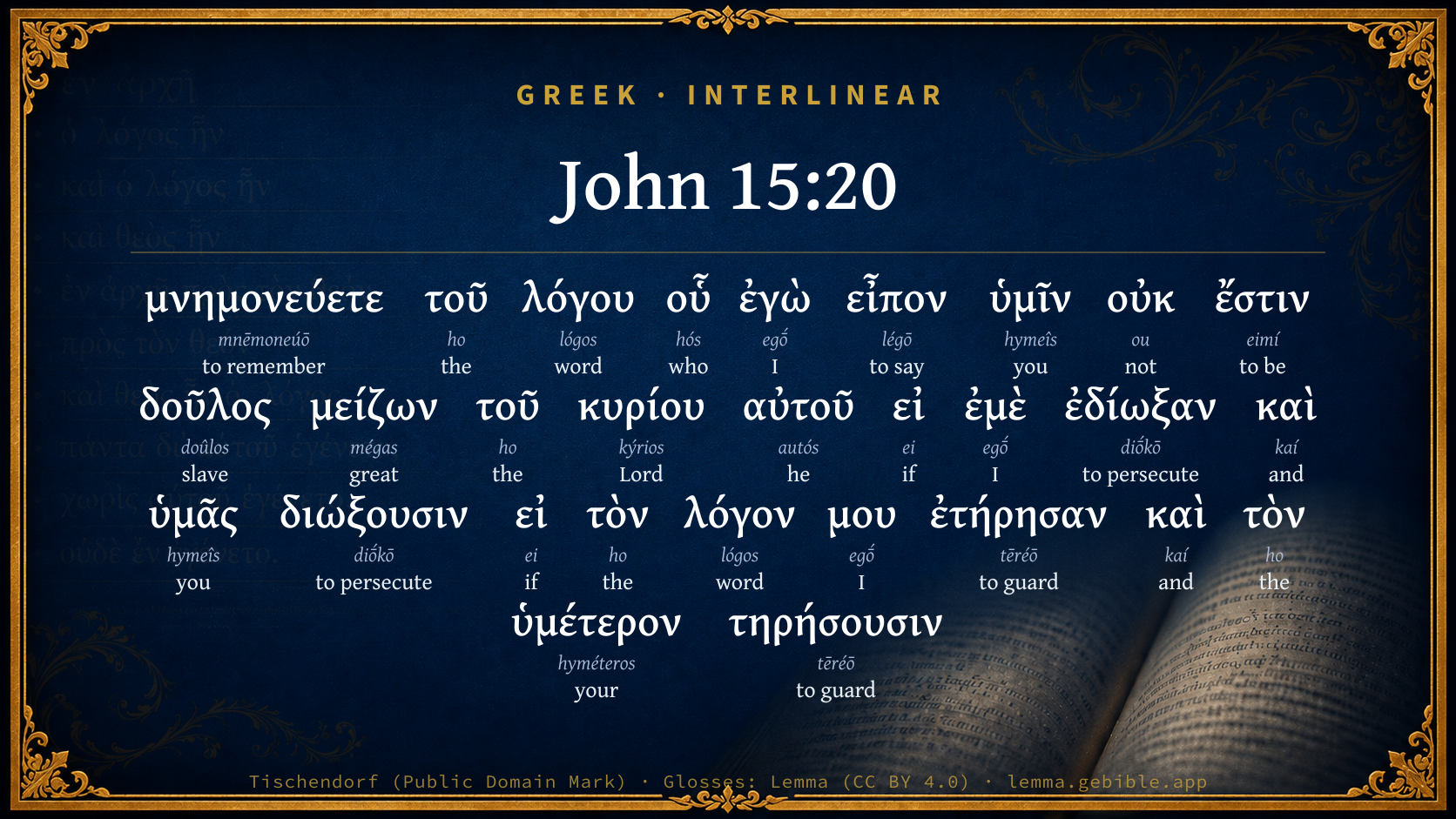
Greek (Tischendorf 8th ed.) John 15:20 appears in the Greek New Testament. The text above is from the Tischendorf 8th edition. Each word links to its Strong’s number and a concise gloss. Click any word for its full Thayer’s Greek Lexicon entry.
Download image
Cite this verse

John 15:20 (World English Bible). Public Domain. Lemma interlinear Bible study tool, https://lemma.gebible.app/v/john/15/20.

Show BibTeX & RIS
BibTeX
RIS
English Translation
Remember the word that I said to you: 'A servant is not greater than his lord.' If they persecuted me, they will also persecute you. If they kept my word, they will keep yours also.
World English Bible · Public Domain
Download a study sheet

One document with this verse’s original text, its word-by-word gloss line, the meaning frame, cross-references with their text, attributed commentary, and full source and license credits — printable, and it pastes into notes with its structure intact.

This verse Autodidact and up

Study sheet (.html) Plain text (.txt)

A passage Seminary Student

Up to 50 verses in one chapter. A passage sheet keeps up to 6 commentary sources and 12 cross-references per verse, in the order this page ranks them, and says so on the sheet whenever that leaves anything out. Ask for a single verse and you get the Autodidact verse sheet above.

Everything on this page stays free to read, with no account — the sheet is a download of what is already on screen, not access to it.

Want to remove ads? Support Godless Engineer
Compare translations 3

The same verse in 3 English versions, stacked beneath the original-language interlinear above. Click any original word for its lexicon entry.

Each is an independent rendering of the whole verse — the interlinear is not word-aligned to these translations.

Highlighted words mark where these versions differ — a whole-verse word diff, not a word-by-word alignment.

  • World English Bible Public Domain
    Remember the word that I said to you: 'A servant is not greater than his lord.' If they persecuted me, they will also persecute you. If they kept my word, they will keep yours also.
  • King James Version Public Domain
    Remember the word that I said unto you, The servant is not greater than his lord. If they have persecuted me, they will also persecute you; if they have kept my saying, they will keep yours also.
  • unfoldingWord Literal Text CC BY-SA 4.0
    Remember the word that I said to you, ‘A slave is not greater than his master.’ If they persecuted me, they will also persecute you; if they kept my word, they will also keep yours.

unfoldingWord Literal Text — © unfoldingWord, licensed CC BY-SA 4.0. Word-aligned USFM3 via Door43 (git.door43.org/unfoldingWord/en_ult).

Versions to compare (up to 4)

3 of 4 selected

Show all 19 translations

Every available English version of this verse, each an independent rendering of the whole verse.

  • World English Bible Public Domain
    Remember the word that I said to you: 'A servant is not greater than his lord.' If they persecuted me, they will also persecute you. If they kept my word, they will keep yours also.
  • Berean Standard Bible Public Domain
    Remember the word that I spoke to you: ‘No servant is greater than his master.’ If they persecuted Me, they will persecute you as well; if they kept My word, they will keep yours as well.
  • Majority Standard Bible Public Domain
    Remember the word that I spoke to you: ‘No servant is greater than his master.’ If they persecuted Me, they will persecute you as well; if they kept My word, they will keep yours as well.
  • King James Version Public Domain
    Remember the word that I said unto you, The servant is not greater than his lord. If they have persecuted me, they will also persecute you; if they have kept my saying, they will keep yours also.
  • American Standard Version (1901) Public Domain
    Remember the word that I said unto you, A servant is not greater than his lord. If they persecuted me, they will also persecute you; if they kept my word, they will keep yours also.
  • Revised Version (1885) Public Domain
    Remember the word that I said unto you, A servant is not greater than his lord. If they persecuted me, they will also persecute you; if they kept my word, they will keep yours also.
  • Geneva Bible (1599) Public Domain
    Remember the word that I said vnto you, The seruant is not greater then his master. If they haue persecuted me, they will persecute you also: if they haue kept my worde, they will also keepe yours.
  • Douay-Rheims (1899) Public Domain
    Remember my word that I said to you: The servant is not greater than his master. If they have persecuted me, they will also persecute you: if they have kept my word, they will keep yours also.
  • Young's Literal Translation Public Domain
    `Remember the word that I said to you, A servant is not greater than his lord; if me they did persecute, you also they will persecute; if my word they did keep, yours also they will keep;
  • Literal Standard Version CC BY-SA 4.0
    Remember the word that I said to you: A servant is not greater than his lord; if they persecuted Me, they will also persecute you; if they kept My word, they will also keep yours;
  • Unlocked Literal Bible CC BY-SA 4.0
    Remember the word that I said to you, 'A servant is not greater than his master.' If they persecuted me, they will also persecute you; if they kept my word, they will also keep yours.
  • unfoldingWord Literal Text CC BY-SA 4.0
    Remember the word that I said to you, ‘A slave is not greater than his master.’ If they persecuted me, they will also persecute you; if they kept my word, they will also keep yours.
  • Darby Bible Public Domain
    Remember the word which I said unto you, The bondman is not greater than his master. If they have persecuted me, they will also persecute you; if they have kept my word, they will keep also yours.
  • World Messianic Bible Public Domain
    Remember the word that I said to you: ‘A servant is not greater than his lord.’ If they persecuted me, they will also persecute you. If they kept my word, they will also keep yours.
  • Webster's Bible Public Domain
    Remember the word that I said to you, The servant is not greater than his lord. If they have persecuted me, they will also persecute you: if they have kept my saying, they will keep yours also.
  • Free Bible Version CC BY-SA 4.0
    Remember what I told you: servants aren't more important than their master. If they persecuted me, they will persecute you too. If they did what I told them, they would do what you tell them too.
  • Bible in Basic English Public Domain
    Keep in mind the words I said to you, A servant is not greater than his lord. If they were cruel to me, they will be cruel to you; if they kept my words, they will keep yours.
  • Text-Critical English NT CC BY 4.0
    Remember what I told you: ‘A servant is not greater than his master.’ If they persecuted me, they will persecute you also. If they kept my word, they will keep yours also.
  • Tyndale New Testament (1534) Public Domain
    Remember the sayinge that I sayde vnto you: the servaute is not greater then his lorde. Yf they have persecuted me so will they persecute you Yf they have kept my sayinge so will they kepe youres.

Literal Standard Version (2020), Covenant Press — licensed CC BY-SA 4.0. Text via the HelloAO Bible API (eBible.org). Unlocked Literal Bible (unfoldingWord) — licensed CC BY-SA 4.0. Text via the HelloAO Bible API (eBible.org). unfoldingWord Literal Text — © unfoldingWord, licensed CC BY-SA 4.0. Word-aligned USFM3 via Door43 (git.door43.org/unfoldingWord/en_ult). Free Bible Version, Dr. Jonathan Gallagher — licensed CC BY-SA 4.0. Text via the HelloAO Bible API (eBible.org).

Word by word

More ways to search: Search by grammar → Find every occurrence → Compare this word →

Practice this passage: Drill this verse → Learn its vocabulary →

ὑμέτερον
hyméteros
G5212
“your”
Possessive pronoun, 2nd person, Accusative, Plural, Masculine
Part of Speech
Possessive pronoun
Person
2nd person
Case
Accusative
Number
Plural
Gender
Masculine
Full Thayer's Definition

Origin: from G5210

TDNT: None

1. you, yours a. to be possessed by you b. to be allocated by you c. proceeding from you
  1. μνημονεύετε mnēmoneúō G3421 “to remember” Verb, Present, Active, Imperative, 2nd person, Plural
  2. τοῦ ho G3588 “the” Article, Genitive, Singular, Masculine
  3. λόγου lógos G3056 “word” Noun, Genitive, Singular, Masculine
  4. οὗ hós G3739 “who” Relative pronoun, Genitive, Singular, Masculine
  5. ἐγὼ egṓ G1473 “I” Personal pronoun, 1st person, Nominative, Singular
  6. εἶπον légō G3004 “to say” Verb, Aorist, Active, Indicative, 1st person, Singular
  7. ὑμῖν hymeîs G5210 “you” Personal pronoun, 2nd person, Dative, Plural
  8. οὐκ ou G3756 “not” Particle, Negative
  9. ἔστιν eimí G1510 “to be” Verb, Present, Active, Indicative, 3rd person, Singular
  10. δοῦλος doûlos G1401 “slave” Noun, Nominative, Singular, Masculine
  11. μείζων mégas G3173 “great” Adjective, Nominative, Singular, Masculine, Comparative
  12. τοῦ ho G3588 “the” Article, Genitive, Singular, Masculine
  13. κυρίου kýrios G2962 “Lord” Noun, Genitive, Singular, Masculine
  14. αὐτοῦ autós G846 “he” Personal pronoun, Genitive, Singular, Masculine
  15. εἰ ei G1487 “if” Conditional
  16. ἐμὲ egṓ G1473 “I” Personal pronoun, 1st person, Accusative, Singular
  17. ἐδίωξαν diṓkō G1377 “to persecute” Verb, Aorist, Active, Indicative, 3rd person, Plural
  18. καὶ kaí G2532 “and” Conjunction
  19. ὑμᾶς hymeîs G5210 “you” Personal pronoun, 2nd person, Accusative, Plural
  20. διώξουσιν diṓkō G1377 “to persecute” Verb, Future, Active, Indicative, 3rd person, Plural
  21. εἰ ei G1487 “if” Conditional
  22. τὸν ho G3588 “the” Article, Accusative, Singular, Masculine
  23. λόγον lógos G3056 “word” Noun, Accusative, Singular, Masculine
  24. μου egṓ G1473 “I” Personal pronoun, 1st person, Genitive, Singular
  25. ἐτήρησαν tēréō G5083 “to guard” Verb, Aorist, Active, Indicative, 3rd person, Plural
  26. καὶ kaí G2532 “and” Conjunction
  27. τὸν ho G3588 “the” Article, Accusative, Singular, Masculine
  28. τηρήσουσιν tēréō G5083 “to guard” Verb, Future, Active, Indicative, 3rd person, Plural

About this verse

These counts appear in no published source. They are computed here, from the morphology-tagged text and Lemma’s own curated glosses. What Lemma adds →

29
words
18
distinct lemmas
Gospels
section

Notable vocabulary

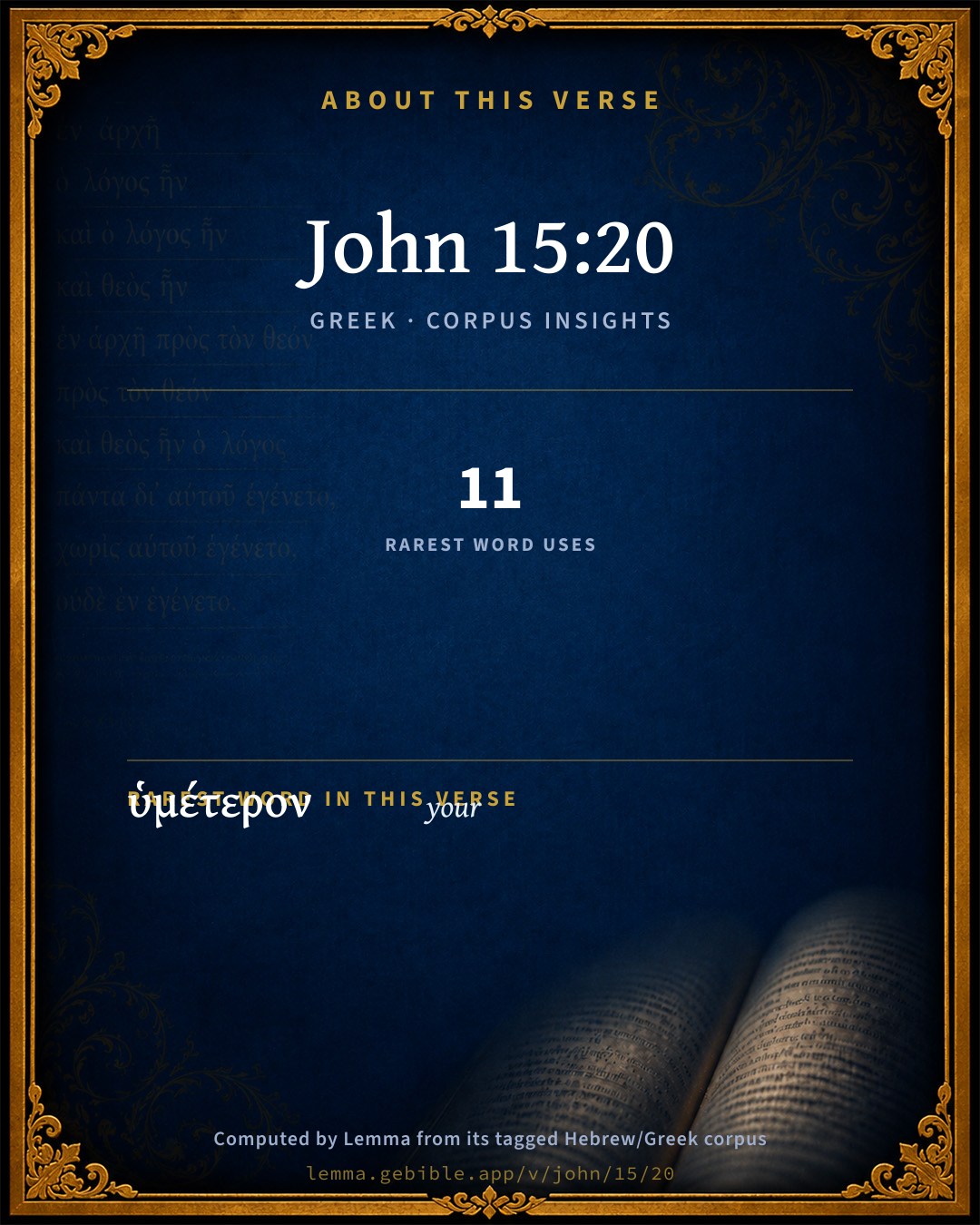
The rarest word here is ὑμέτερον your G5212 — appearing just 11 times in the whole Greek New Testament.

Shared distinctive vocabulary

ὑμέτερον your G5212 occurs in 11 verses of the Greek New Testament. Also found in:

Repetition

Words recur within this verse:

  • λόγου word G3056 ×2
  • ἐδίωξαν to persecute G1377 ×2
  • ἐτήρησαν to guard G5083 ×2
  • τοῦ the G3588 ×4
  • ἐγὼ I G1473 ×3
  • ὑμῖν you G5210 ×2
  • εἰ if G1487 ×2
  • καὶ and G2532 ×2

Cross-references

19

Topical passages linked to John 15:20 in the Treasury of Scripture Knowledge — connected by theme and wording, ordered by reader-vote popularity; previews shown in the World English Bible.

  • 2 Timothy 3:12 Yes, and all who desire to live godly in Christ Jesus will suffer persecution.
  • John 13:16 Most assuredly I tell you, a servant is not greater than his lord, neither one who is sent greater than he who sent him.
  • Matthew 10:24 "A disciple is not above his teacher, nor a servant above his lord.
  • Ezekiel 3:7 But the house of Israel will not listen to you; for they will not listen to me: for all the house of Israel are of hard forehead and of a stiff heart.
  • 1 Corinthians 4:12 We toil, working with our own hands. When people curse us, we bless. Being persecuted, we endure.
  • 2 Corinthians 4:9 pursued, yet not forsaken; struck down, yet not destroyed;
  • Luke 6:40 A disciple is not above his teacher, but everyone when he is fully trained will be like his teacher.
  • John 8:51 Most assuredly, I tell you, if a person keeps my word, he will never see death."
  • Acts 4:27–30 For truly, in this city against your holy servant, Jesus, whom you anointed, both Herod and Pontius Pilate, with the Gentiles and the people of Israel, were gathered together
  • Isaiah 53:1–3 Who has believed our message? and to whom has the arm of Yahweh been revealed?
  • John 10:31 Therefore Jews took up stones again to stone him.
  • 1 Thessalonians 2:15 who killed both the Lord Jesus and their own prophets, and drove us out, and didn't please God, and are contrary to all men;
  • 1 Samuel 8:7 Yahweh said to Samuel, Listen to the voice of the people in all that they tell you; for they have not rejected you, but they have rejected me, that I should not be king over them.
  • Luke 2:34 and Simeon blessed them, and said to Mary, his mother, "Behold, this child is set for the falling and the rising of many in Israel, and for a sign which is spoken against.
  • John 5:16 For this cause the Jews persecuted Jesus, and sought to kill him, because he did these things on the Sabbath.
  • John 7:32 The Pharisees heard the multitude murmuring these things concerning him, and the chief priests and the Pharisees sent officers to arrest him.
  • John 8:59 Therefore they took up stones to throw at him, but Jesus was hidden, and went out of the temple, having gone through the midst of them, and so passed by.
  • John 11:57 Now the chief priests and the Pharisees had commanded that if anyone knew where he was, he should report it, that they might seize him.
  • Acts 7:52–60 Which of the prophets didn't your fathers persecute? They killed those who foretold the coming of the Righteous One, of whom you have now become betrayers and murderers.

Cross-references courtesy of OpenBible.info (CC BY 4.0).

Commentary

Notes on John 15:20 from classic Christian and Jewish commentators (each source and its license shown beneath its notes). The classic Christian expositions comment on the surrounding passage and are grouped to its opening verse, so a note may address several verses; the Jewish commentaries on the Tanakh (Rashi and others) are per-verse, so they appear only where the commentator wrote on this verse.

Lemma curates 59 commentaries, every one of them public domain or Creative Commons licensed, each selected and text-cleaned for this edition rather than reprinted as found. About our sources →

Tyndale Open Study Notes

Tyndale Open Resources

15:20 A slave is not greater than the master: See study note on 13:16. Jesus’ disciples should mirror him in every way, even in his experience of persecution and martyrdom.

Tyndale Open Study Notes — © Tyndale Open Resources, licensed CC BY-SA 4.0. Text via the HelloAO Bible API.

Bengel's Gnomon

Johann Albrecht Bengel

Joh 15:20. Εἶπον, I said) ch. Joh 13:16; Mat 10:24.—εἰ—ἐδίωξαν· εἰ—ἐτήρησαν, if they have persecuted: if they have watched) The if is not a mere condition, but has the force of affirming [As surely as they have]: and τηρεῖν in tins passage is to watch in a hostile manner, as in Mat 27:36, “Sitting down, they watched Him there” (ἐτήρουν, at the crucifixion); Gen 3:15, “The seed of the woman shall watch with hostile intent thy head, and thou shalt watch His heel:” αὐτός σου τηρήσει κεφάλην, καὶ σὺ τηρήσεις αὐτοῦ πτέρναν.[361] They persecuted Him when ‘doing’ good, Joh 15:24; they watched Him whilst He was ‘speaking,’ Joh 15:22.—καὶ, also) Mat 10:25. Both are contained in the πάντα, all these things, Joh 15:21.

[361] I confess I prefer the Engl. Vers. If they have kept, i.e. as surely as they have not kept, etc. For τηρέω is used in this very ch. ver. 10 in this sense, and is never found in any other sense in connection with λόγον, ἐντολάς, etc. Παρατηρέω is the word used when a hostile intention is designed, Luk 4:7; Luk 14:1, etc.—E. and T.

Bengel's Gnomon of the New Testament — English translation (T&T Clark, Edinburgh, 1860) — public domain. Text from a community e-Sword module.

Meyer's Critical & Exegetical Commentary

Heinrich August Wilhelm Meyer

Joh_15:20. A recalling of Joh_13:16, presupposing, however, a different application than in that passagenamely, a slave has no better lot to claim than his lord (comp. Mat_10:24-25).

If they have persecuted me, they will also persecute you; if they have kept my word, they will also keep yours. Which of these two cases will in general occur, Jesus leaves to the judgment of the disciples themselves, since they in truth knew from experience how it had gone with Him. To take the second clause ironically (quasi dicat: non est, quod hoc speretis, Grotius, Lampe), is appropriate neither to the seriousness of the first, nor to the tone of the whole passage. Olshausens view is incorrect (comp. B. Crusius, Maier, Godet), if many, etc., where, in the first half, according to Godet, we should have to think of the mass of the people. But the variation of the subjects is a pure importation. Finally, when Bengel and other older expositors (in Wolf) interpret τηρεῖν as watch, this is quite opposed to the Johannean usage of τὸν λόγ. τηρεῖν (Joh_8:51, Joh_14:23-24, and frequently), comp. Joh_15:10, and it would also be too weak a conception after the first half of the verse. Irrespective of this, usage would not stand in the way of such rendering, Gen_3:15 (according to the usual reading); Dem. 317 ult., 1252. 8; Soph. O. R. 808; Arist. Vesp. 364; Thuc. iv. 108. 1, vii. 80. 1; Lys. iii. 34.

Meyer — Critical and Exegetical Commentary on the New Testament — English translation by Peter Christie, edited by Frederick Crombie (T&T Clark, 1880) — public domain. Text from a community e-Sword module.

Expositor's Greek Testament

ed. W. Robertson Nicoll

Joh 15:20 . μνημονεύετε τοῦ λόγου … αὐτοῦ . μνημονεύετε (from μνήμων , mindful), “be mindful of,” sometimes used pregnantly, as in 1Th 1:3 ; Gal 2:10 ; “the words which I said to you,” viz. , in Joh 13:16 , and Mat 10:24-25 . The outcome of the principle is seen in 2Ti 2:11 , and 1Pe 4:13 . That He should speak of them as “servants” so shortly after calling them “friends,” shows how natural and appropriate both designations are, how truly service characterises His friends, and how He must at all times be looked upon as Supreme Lord. εἰ ἐμὲ ἐδίωξαν … τηρήσουσιν . “If they persecuted me, you also will they persecute; if they kept my word, yours too will they keep.” In so far as they are identified with Him, their experience will be identical with His. The attitude of the world does not alter. Bengel takes ἐτήρησαν in a hostile sense, “infensis modis observare,” referring to Mat 27:36 , but in John τὸν λόγον τηρεῖν is regularly used of “observing” in the sense of “keeping,” practising, see Joh 8:51 , Joh 9:16 , Joh 14:23 ; 1Jn 2:3-5 , etc.; Rev 1:3 ; Rev 3:8 , etc.

The Expositor's Greek Testament, edited by W. Robertson Nicoll (1897–1910) — public domain. Text from a community e-Sword module.

Adam Clarke's Commentary

Verse 20. If they have kept my saying] Or, doctrine. Whosoever acknowledges me for the Christ will acknowledge you for my ministers.

Some translate the passage thus: If they have WATCHED my sayings, i.e. with an intent to accuse me for something which I have said, they will WATCH yours also: therefore be on your guard. παρατηρειν has this sense, as we have had occasion to observe before; and perhaps τηρειν has the same sense here, as it is much more agreeable to the context.

Adam Clarke's Commentary on the Bible (1810–1826) — public domain. Text from a community e-Sword/MySword module.

John Calvin's Commentaries

20. Remember the word. It might also be read in the indicative mood, You remember the word, and the meaning is not very different; but I think that it is more suitable to read it in the imperative mood, Remember the word. It is a confirmation of what Christ had spoken immediately before, when he said that he was hated by the world, though he was far more excellent than his disciples; for it is unreasonable that the condition of the servant should be better than that of his master Having spoken of persons, he likewise makes mention of doctrine.

If they have heard my word, they will keep yours also. Nothing gives greater uneasiness to the godly than when they see the doctrine, which is of God, haughtily despised by men; for it is truly shocking and dreadful, and the sight of it might shake the stoutest heart. But when we remember on the other hand, that not less obstinate resistance was manifested against the Son of God himself, we need not wonder that the doctrine of God is so little reverenced among men. When he calls it his doctrine and their doctrine, this refers to the ministry. Christ is the only Teacher of the Church; but he intended that his doctrine, of which he had been the first Teacher, should be afterwards preached by the apostles.

John Calvin's Commentaries (1540-1563) — public domain. Text from the Calvin Translation Society English edition (1840s-50s) via the Christian Classics Ethereal Library (ccel.org). Calvin's coverage is partial (roughly two-thirds of the Bible); uncommented books and verses are honest gaps, never fabricated. The 19th-century editor's footnotes and remarks are omitted so the notes are faithfully Calvin's own voice.

Ellicott's Commentary for English Readers

(20) Remember the word that I said unto you.—Comp. Joh_13:16, where the saying is used in a different sense; and Mat_10:24, where it is used in the same connection in which we find it here.

If they have persecuted me, they will also persecute you; if they have kept my saying . . .—The meaning is exactly that which is expressed in the rendering of the English version. The two things are necessarily united, as Christ and His disciples are united. His word is their word. The relation of the world to the one would be that which it had been to the other.

A Bible Commentary for English Readers, edited by Charles John Ellicott (1878–1897) — public domain. Text from a community e-Sword module.

The Cambridge Bible for Schools and Colleges

gen. ed. J. J. S. Perowne

20. Remember] See note on Joh_13:16 : of the passages noticed there Mat_10:24 is similar in meaning to this. Christ may here be alluding to the occasion recorded in Mat_10:24. On the blessedness of sharing the lot of Christ comp. 1Pe_4:12-13.

if they have kept my saying, they will keep] Better, If they kept (comp. Joh_13:14, Joh_18:23) My word, they will keep. ‘Keep’ must not be exchanged for ‘watch, lay wait for,’ in a hostile sense; as if both halves of the verse were alike instead of being opposed. The phrase ‘keep the word (or words)’ of any one is frequent in this Gospel (Joh_8:51-52; Joh_8:55, Joh_14:23-24, Joh_17:6); always in the sense of the parallel phrase ‘keep my commandments’ (Joh_14:15; Joh_14:21, Joh_15:10). Both phrases form a link not only between the Gospel and the First Epistle (Joh_2:3-5, Joh_3:22; Joh_3:24, Joh_5:2-3), but also between these two and the Apocalypse (Rev_3:8; Rev_3:10, Rev_12:17, Rev_14:12, Rev_22:7; Rev_22:9). Comp. Joh_9:16; Rev_1:3; Rev_2:26; Rev_3:3. (See on Joh_11:44, Joh_19:37, Joh_20:16). All these passages shew that it is impossible to take ‘keep’ in a hostile sense. The phrase ‘to keep the word’ of any one occurs in S. John’s writings only. ‘To keep the commandments (or commandment)’ occurs elsewhere only Mat_19:17 (comp. Mat_28:20) and 1Ti_6:14. The meaning of the verse as a whole is that both in failure and in success they will share His lot. For the construction comp. Joh_13:14, Joh_18:23.

The Cambridge Bible for Schools and Colleges (gen. ed. J. J. S. Perowne; Cambridge University Press, 1878–1918) — public domain. Text from a community e-Sword module.

John Gill's Exposition

If I had not come and spoken unto them,.... The ignorance of the Jews is represented as inexcusable, since Christ was come, and had preached unto them; if he had not come and told them that he was the Messiah, they might have pleaded an excuse for their ignorance of him, and his mission, and of the Father that sent him: but inasmuch as he was come in the flesh, and came to them his own; and came also a light into the world, carrying along with him evidence, conviction, and demonstration, of his being the Messiah; speaking such words as never man did; preaching with such authority as the Scribes and Pharisees did not; declaring in plain terms he was the Christ of God, and that if they did not believe him to be so, they would die in their sins; they could have no pretext to make for their ignorance and disbelief: if all this had not been done,

they had not had sin; or been guilty of the sin of unbelief, in the rejection of the Messiah; not that they would have been without sin in any sense, or without any kind of sin, but without this particular sin; at least they would have excused and wiped themselves clean, and would have looked like innocent and sinless persons, under all their ignorance and unbelief:

but now they have no cloak for their sin; they could not say, had he come to us, and told us that he was the Messiah, and given evidence of his being sent by the Father, we would have believed him, and received him as the Messiah; for he did do this, and so cut off all excuses and pretences from them.

John Gill's Exposition of the Whole Bible (1746–1763) — public domain (CC PDM 1.0). Text via the HelloAO Bible API.

Trapp's Complete Commentary

John Trapp

20 Remember the word that I said unto you, The servant is not greater than his lord. If they have persecuted me, they will also persecute you; if they have kept my saying, they will keep yours also.

Ver. 20. Remember the word, &c.] Else all is lost, 1Co 15:2. Naturally the word runs through us, as water through a riven vessel: Pleni rimarum sumus, huc atque illuc diffuimus. Our memories are as sieves, that retain the chaff, let go the good grain; or as nets, that keep the pelf, let go the clean water; or as hour glasses, that are no sooner full, but running out again. Beseech we God to put his finger upon the hole, and to make his word an engrafted word unto us, to settle it upon our souls, μηποτε παραρυωμεν, Heb 2:1.

If they have kept my saying, &c.] But they will do neither. Holy Melancthon, being himself newly converted, thought it impossible for his hearers to withstand the evidence of the gospel; but after he had been a preacher awhile, it is said he complained that old Adam was too hard for young Melancthon.

John Trapp, A Commentary or Exposition upon All the Books of the Old and New Testament (1647–1656) — public domain. Text from a community e-Sword module.

Albert Barnes' Notes on the Bible

Remember the word that I said ... - At their first appointment to the apostolic office. See Mat 10:24-25.

Albert Barnes' Notes on the Bible (1834–1885) — public domain. Text from a community e-Sword/MySword module.

Haydock's Catholic Bible Commentary

Here Christ predicts, that many will be deaf to the words of his Church, as they have neglected to attend to his precepts.

George Leo Haydock (1774–1849), Haydock's Catholic Family Bible and Commentary, 1859 edition — public domain. Excludes Psalms (Douay-Rheims chapter numbering differs from Protestant) and Deuterocanonical books (Catholic canon only).

Matthew Poole's English Annotations

The word that I said unto you, Joh 13:16, to press you to humility, and a mutual serving of one another in love; and which I spake to you, Mat 10:24, when I first sent you out; and I spake it then to you upon the very same account that I now speak it. You that are my servants cannot look to fare better with the world than I that am your Master; you know they have hated me, you must expect they should persecute you: if there be any of them whose hearts God shall incline to keep my sayings, they will also keep your words, which are but my sayings explained to them, and further pressed upon them.

Matthew Poole's English Annotations on the Holy Bible (1683–1685) — public domain. Text from a community e-Sword/MySword module.

Whedon's Commentary on the Bible

Daniel D. Whedon

20. Remember—Bear this word imprinted on your heart.

Servant… Lord— Mat_10:24; Joh_13:16. Honourable are the scorn and the hatred shared with Him who is honour itself. Nor can they complain while, in their suffering, they are preceded by his great example. And ever since he, the Lord, suffered persecution, persecution has become an honour; and persecutors have become afraid and ashamed when men cry persecution! against them. If…

persecuted me… also persecute you—This thought shall harden you into good soldiers: that all their assaults were first suffered by me. Just the same persecution, and the same acceptance, which they afforded me, they will afford you; no more no less.

Daniel D. Whedon (gen. ed.), Commentary on the Old and New Testaments (1874–1909) — public domain. Text from a community e-Sword module.

The Pulpit Commentary

Remember the word which I spake to you, (see Mat_10:24, but especially Joh_13:16, where Christ used the proverb) The servant is not greater than his lord. In Joh_13:16 the idea was used to enforce the spirit of humility and mutual service; it applies also here, but in another sense. The disciples are not to expect better treatment from the world than their Lord met with. If they (used of "the world", in its special concrete manifestations; "they" of Nazareth and Capernaum and Jerusalem correspond with the "they" of Lycaonia, Ephesus, Thessalonica, and Rome) persecuted me, they will persecute drive away from them you also. The "if" is remarkably explicit; there is no doubt about it in Christ"s case, and the supposition is one of definite and acknowledged fact, and the conditional sentence most positively assures them of antagonism and persecution. It is probable, though not certainly known, that these disciples all endured a living martyrdom, if not a cruel death in his cause. Then follows a sentence which has by some unwisely been supposed to be ironical, and by others to refer to another subject. If they others, or many, or somekept (i.e . "observed," "obeyed," not as Bengel supposed, "laid in wait," or "kept maliciously") my word, they will keep yours also Why should irony be interpolated here? Surely the whole conact with the world was not an utter failure. Christ did win persons from all classes, and they loved him, with a passionate love; and so the apostles, and all who "go forth to bear fruit," may hope for some victories, and will travail in birth with the souls of men.

The Pulpit Commentary (1880–1919), ed. H.D.M. Spence-Jones & Joseph S. Exell — public domain. Text from a community e-Sword module.

John Wesley's Explanatory Notes

John xiii, 16; Matt. x, 24; Luke vi, 40.

John Wesley, Explanatory Notes Upon the Whole Bible (1754–1765) — public domain. Text via the GEBible commentary corpus.

The People's New Testament

B. W. Johnson

20. They will also persecute you. The servants must expect similar treatment to that given the Master. The long roll of Christian martyrs shows how this has been verified.

B. W. Johnson's The People's New Testament with Notes (1889–1891) — public domain. Electronic text from the Christian Classics Ethereal Library (CCEL) ThML edition.

unfoldingWord translationNotes

Door43 World Missions Community

Remember the word that I said to you

Here "word" is a metonym for the message of Jesus. AT: "Remember the message that I spoke to you" (See: Metonymy)

because of my name

Here "because of my name" is a metonym that represents Jesus. People will make his followers suffer because they belong to him. AT: "because you belong to me" (See: Metonymy)

If I had not come and spoken to them, they would not have sin, but now they have no excuse for their sin

Jesus implies here that he has shared God's message with those who do not trust him. AT: "Because I have come and told them God's message, they have no excuse when God judges them for their sins" (See: Assumed Knowledge and Implicit Information)

translationWords

servant

lord

persecute

sin

unfoldingWord translationNotes — © Distant Shores Media and the Door43 World Missions Community, licensed CC BY-SA 4.0. Source: git.door43.org/Door43/en_tn.

Cambridge Greek Testament for Schools and Colleges

20. μνημονεύετε. See note on Joh 13:16: of the passages noticed there Mat 10:24 is similar in meaning to this. Christ may here be alluding to the occasion recorded in Mat 10:24. On the blessedness of sharing the lot of Christ comp. 1Pe 4:12-13.

εἰ ἐμὲ ἐδ. If they persecuted Me … if they kept (Joh 13:14, Joh 18:23) My word. Τηρεῖν must not be rendered ‘watch, lay wait for’ in a hostile sense: the two halves of the sentence are opposed, not parallel. Τὸν λ. or τοὺς λ. τηρεῖν is peculiar to S. John (Joh 8:51-52; Joh 8:55, Joh 14:23-24, Joh 17:6) always in the sense of the parallel phrase τὰς ἐντολὰς τ. (Joh 14:15; Joh 14:21, Joh 15:10). Both phrases link the Gospel with the First Epistle (1Jn 2:3-5, 1Jn 3:22; 1Jn 3:24, 1Jn 5:2-3), and these two with the Apocalypse (Rev 3:8; Rev 3:10, Rev 12:17, Rev 14:12, Rev 22:7; Rev 22:9). Comp. Joh 9:16; Rev 1:3; Rev 2:26; Rev 3:3, and see on Joh 7:30; Joh 7:37; Joh 11:44; Joh 19:37; Joh 20:16. These passages shew that τηρεῖν cannot be taken in a hostile sense. The meaning of the verse as a whole is that both in failure and in success they will share His lot.

Cambridge Greek Testament for Schools and Colleges (Cambridge University Press, 1896; 21 vols, various authors incl. Carr, Maclear, Plummer, Farrar, Lumby, Moule, M. R. James, Simcox) — public domain. Text from a community e-Sword module.

Alford’s Greek Testament

Henry Alford

20.] Ch. 13:16, but with a different reference: the sense here being, ‘Remember the saying, for it is true in this matter also:’ see Mat 10:24, where it is used in the same sense. The subject of ἐδίωξαν is ὁ κόσμος as a noun of number.

A difficulty has been raised on ἐτήρησαν … τηρήσουσιν, and some have wanted to give this word a hostile sense, (as παρατηρεῖν,) quoting Mat 27:36, and Gen 3:15 (which is altogether an exceptional use, the reading being undoubtedly genuine): see also Jer 20:13. But in John this cannot be. Nor is irony (Lampe, Stier) in this latter clause at all in keeping with the solemnity of the discourse. The words simply mean (as Thl.), ‘the keeping My word and the keeping yours are intimately joined, and when you find the world or any part of the world do the first, you may infer the other.’ The issue of εἰ τ. λ. μ. ἐτήρ. was to be proved by their rejection and killing of the Lord Jesus.

Beware of rendering as Kuinoel, “If they had kept my word, they would keep yours,” which is ungrammatical. The only idiomatic rendering in English is that of the E. V., If they have kept [or rather, If they kept] my word they will keep yours.

Henry Alford, The Greek Testament (1849–1861) — public domain. Text from a community e-Sword module.

International Critical Commentary

20. μνημονεύετε τοῦ λόγου οὗ ἐγὼ εἶπον ὐμῖν, “Be mindful of the saying which I said to you.” μνημονεύειν occurs again in Jn. only at 16:4, 21. א reads here τὸν λόγον ὃν ἐγὼ ἐλάλησα ὑμῖν.

We have already had the saying οὐκ ἔστιν δοῦλος μείζων τοῦ κυρίου αὐτοῦ at 13:16 (where see note), but Jesus probably repeated it more than once, the reference here perhaps being to the occasion when He gave a charge to the newly chosen apostles (Mat 10:24; cf. Luk 6:40). They had been warned then that they would not be exempt from persecution (cf. Mat 10:17-23); it was even more necessary that they should bear this in mind in the days that were coming. He had told them that He counted them as friends rather than servants (v. 15), but for all that the saying “The servant is not greater than his lord” would be applicable to their situation in a hostile world. The moral He had drawn from this saying at the Last Supper, earlier in the evening, was different (13:16).

εἰ ἐμὲ ἐδίωξαν, “If they persecuted me,” the subject being ὁ κόσμος, taken as a noun of multitude, from v. 19. Jn. has already spoken of the persecution (ἐδίωκον) of Jesus by the Jews, because of the freedom with which He treated the rules of the Sabbath (5:16).

καὶ ὑμᾶς διώξουσιν, “they will persecute you also,” a warning repeated in other language at 16:33. Lk. records a similar warning (Luk 21:12), and Mar 10:30 notes that Jesus accompanied a promise of temporal blessings to the faithful with the significant addition of μετὰ διωγμῶν. There is no reason to doubt that Jesus did thus predict that persecution would be the lot of His disciples; and it is unnecessary to accumulate proofs that the prediction came true (cf. 1Co 4:12, 2Co 4:9, Gal 4:29, 2Ti 3:12).

εἰ τὸν λόγον μου ἐτήρησαν, καὶ τὸν ὑμέτερον τηρήσουσιν, “if they kept my word, they will keep yours also.” For the phrase τὸν λόγον τηρεῖν, a favourite phrase in Jn., see on 8:51, 14:15. In Eze 3:7 Yahweh is represented as saying to the prophet, “They will not hearken unto thee, because they will not hearken unto me”; and this would apply to the apostles of Jesus. But the saying recorded here by Jn. goes farther. Those who observe the word of Jesus will also observe the word of His apostles, it being implied of course that the apostles will utter no “word” for which they have not the authority of their Master. A world which “observed” the teaching of Jesus would inevitably “observe” the teaching of those who could rightly claim His commission. The difficulty of drawing inferences from this great assurance, once Christendom was divided, is illustrated by the whole course of Christian history. Jesus, however, goes on to insist that it is the other alternative which the apostles must prepare to face; not acquiescence, but opposition, will be the portion of those who proclaim His gospel.

International Critical Commentary — older volumes (1896–1929), various authors — public domain. Text from a community e-Sword module.

Vincent's Word Studies in the New Testament

Marvin R. Vincent

Persecuted [εδιωξαν] . The verb means originally to put to flight; thence to run swiftly in order to overtake or attain, as the goal or the competitor in the race. Thus Sophocles (" Electra, "738) :" He urged his swift steeds vehemently with shouts that pierced their ears, and makes for him [διωκει] . "Compare I follow after (diwkw, Phi 3:12). Hence to pursue with hostile intent, and, generally, to molest, harass, persecute. Persecute is from the equivalent Latin persequor, to follow up, and is used earlier, in the sense of pursue, while pursue, in turn, is used in the sense of persecute. Thus Wyc, Mt 5:44, for men pursuing you. Sir Thomas More (" Utopia ")," Whiles their enemies rejoicing in the victory have persecuted (i. e., pursued) them. "

Marvin R. Vincent, Word Studies in the New Testament (1887–1900) — public domain. Text from a community e-Sword/MySword module.

Lesson kit

Teaching starters — assembled from the data on this page, not authored interpretation. Every prompt links to the verse data it draws on. Edit before teaching.

John, in the Gospels, opens this verse with 29 words (18 distinct Greek lemmas). Its most distinctive word is hyméteros (“your”). A historical commentator’s framing appears above. Read the whole chapter for the surrounding context.

Discussion questions

  1. The word hyméteros carries the sense “your.” How does it shape the verse?
  2. How does Luke 6:20, which shares the word «your», read alongside this verse?
  3. What does the repetition of “word” (2× in this one verse) do in this verse?
  4. These translations render this verse differently. What is at stake in choosing one wording over another?
  5. Compare how Tyndale Open Study Notes and Bengel's Gnomon read this verse. Where do they agree or differ?

Things to notice

  • These translations choose different wording for 6 words in this verse.
  • “word” occurs 2× in this single verse.
  • 18 distinct Greek lemmas span 29 words in this verse.

Reading settings

Reading text

Shown beneath each verse's original-language words.

Old Testament
Old Testament edition

Read the OT as the Masoretic Hebrew (MT) or the Greek Septuagint (LXX).

English shown for the Greek Septuagint (in the Hebrew ↔ Greek comparison).

Comparing translations? Open the Compare panel on any verse page to stack up to four side by side.