
Acts 1:25

Greek (Tischendorf 8th ed.) Acts 1:25 appears in the Greek New Testament. The text above is from the Tischendorf 8th edition. Each word links to its Strong’s number and a concise gloss. Click any word for its full Thayer’s Greek Lexicon entry.
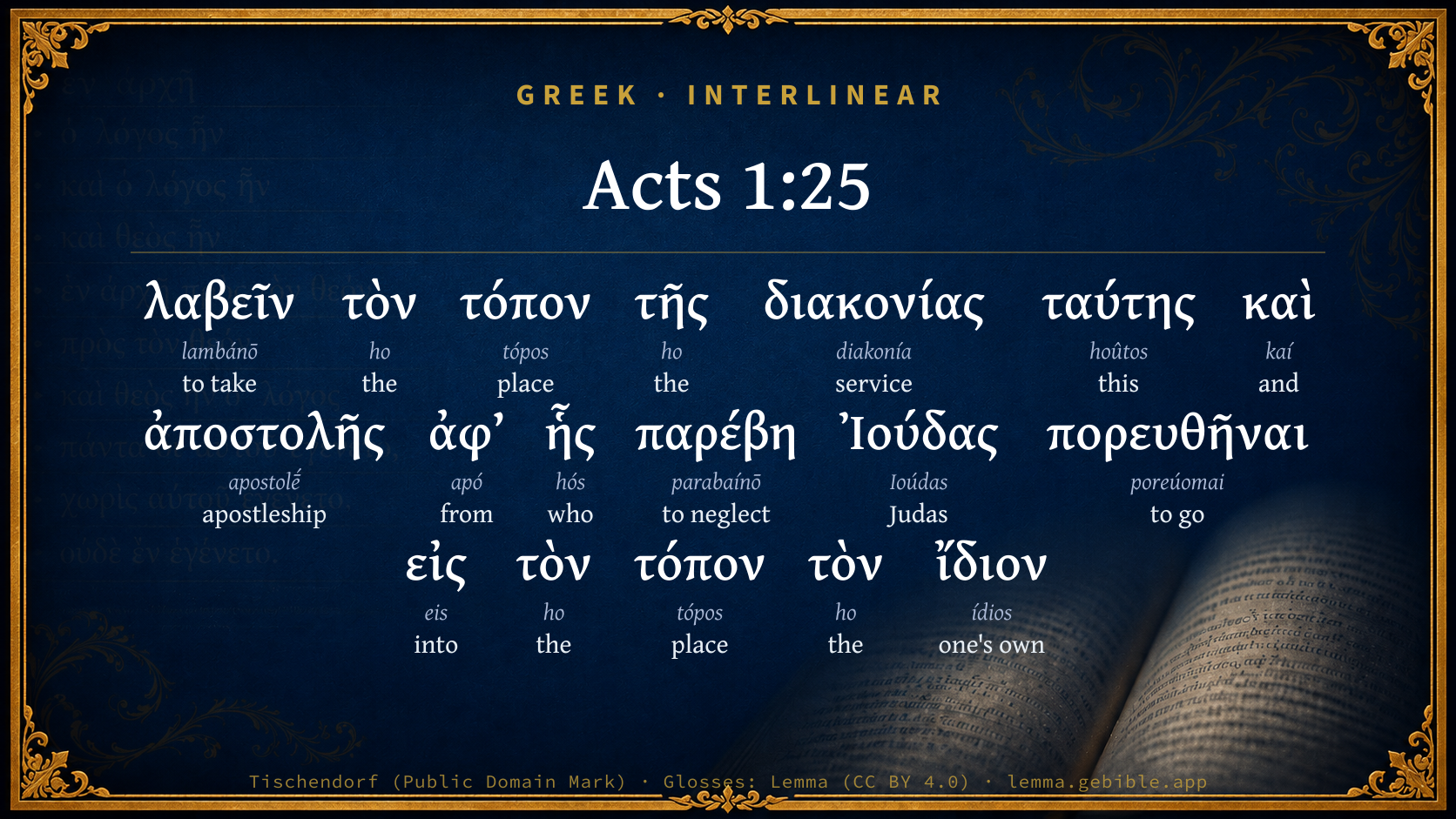
Download image
Cite this verse

Acts 1:25 (World English Bible). Public Domain. Lemma interlinear Bible study tool, https://lemma.gebible.app/v/acts/1/25.

Show BibTeX & RIS
BibTeX
RIS
English Translation
to take part in this ministry and apostleship from which Judas fell away, that he might go to his own place."
World English Bible · Public Domain
Highlights
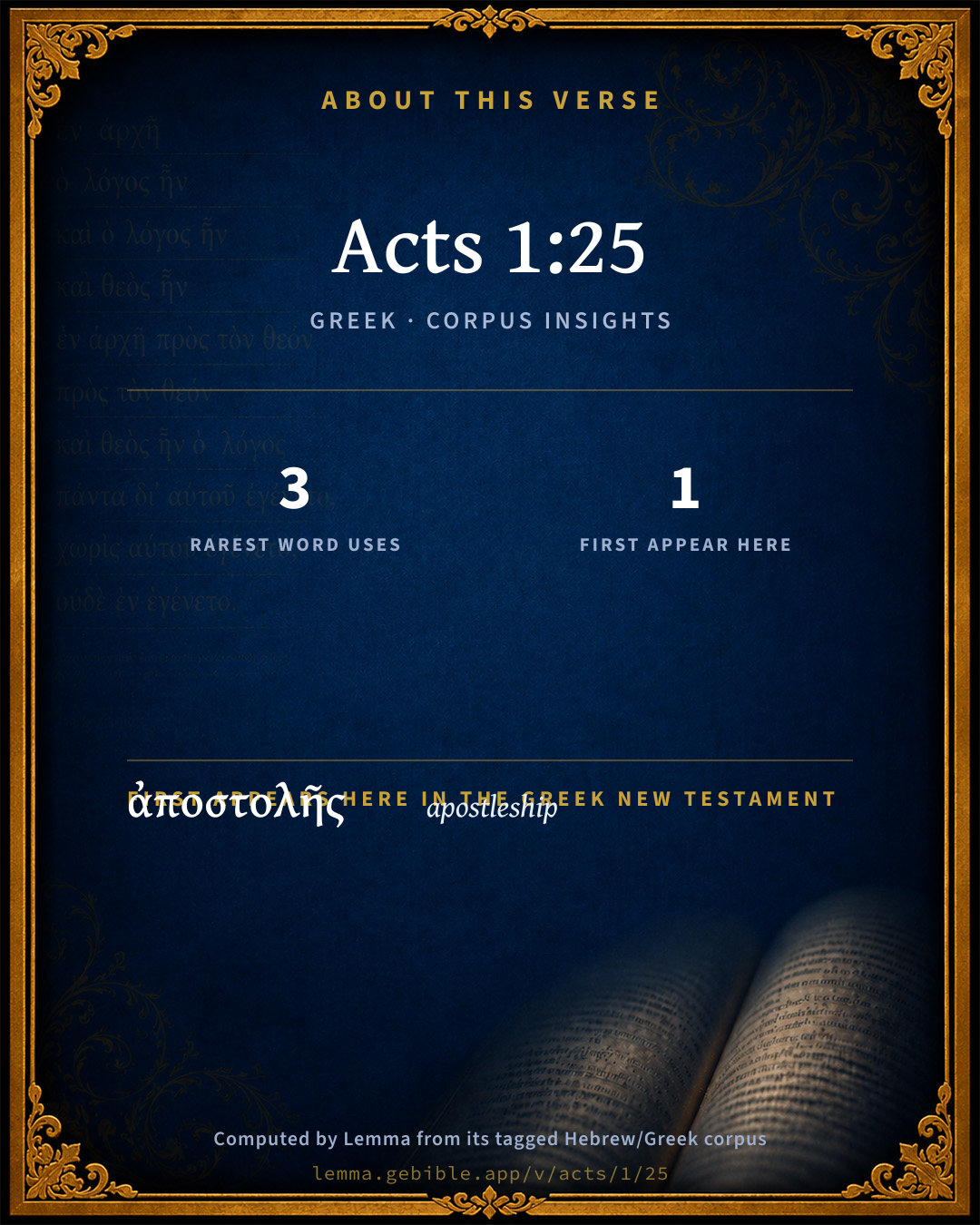
  • 1 first appearance in the Greek New Testament
Full analysis ↓
Download a study sheet

One document with this verse’s original text, its word-by-word gloss line, the meaning frame, cross-references with their text, attributed commentary, and full source and license credits — printable, and it pastes into notes with its structure intact.

This verse Autodidact and up

Study sheet (.html) Plain text (.txt)

A passage Seminary Student

Up to 50 verses in one chapter. A passage sheet keeps up to 6 commentary sources and 12 cross-references per verse, in the order this page ranks them, and says so on the sheet whenever that leaves anything out. Ask for a single verse and you get the Autodidact verse sheet above.

Everything on this page stays free to read, with no account — the sheet is a download of what is already on screen, not access to it.

Want to remove ads? Support Godless Engineer
Compare translations 3

The same verse in 3 English versions, stacked beneath the original-language interlinear above. Click any original word for its lexicon entry.

Each is an independent rendering of the whole verse — the interlinear is not word-aligned to these translations.

Highlighted words mark where these versions differ — a whole-verse word diff, not a word-by-word alignment.

  • World English Bible Public Domain
    to take part in this ministry and apostleship from which Judas fell away, that he might go to his own place."
  • King James Version Public Domain
    That he may take part of this ministry and apostleship, from which Judas by transgression fell, that he might go to his own place.
  • unfoldingWord Literal Text CC BY-SA 4.0
    to take this place of ministry and apostleship from which Judas turned aside to go to his own place.”

unfoldingWord Literal Text — © unfoldingWord, licensed CC BY-SA 4.0. Word-aligned USFM3 via Door43 (git.door43.org/unfoldingWord/en_ult).

Versions to compare (up to 4)

3 of 4 selected

Show all 19 translations

Every available English version of this verse, each an independent rendering of the whole verse.

  • World English Bible Public Domain
    to take part in this ministry and apostleship from which Judas fell away, that he might go to his own place."
  • Berean Standard Bible Public Domain
    to take up this ministry and apostleship, which Judas abandoned to go to his rightful place.”
  • Majority Standard Bible Public Domain
    to receive a portion in this ministry and apostleship that Judas abandoned to go to his rightful place.”
  • King James Version Public Domain
    That he may take part of this ministry and apostleship, from which Judas by transgression fell, that he might go to his own place.
  • American Standard Version (1901) Public Domain
    to take the place in this ministry and apostleship from which Judas fell away, that he might go to his own place.
  • Revised Version (1885) Public Domain
    to take the place in this ministry and apostleship, from which Judas fell away, that he might go to his own place.
  • Geneva Bible (1599) Public Domain
    That he may take the roume of this ministration and Apostleship, from which Iudas hath gone astray, to goe to his owne place.
  • Douay-Rheims (1899) Public Domain
    To take the place of this ministry and apostleship, from which Judas hath by transgression fallen, that he might go to his own place.
  • Young's Literal Translation Public Domain
    to receive the share of this ministration and apostleship, from which Judas, by transgression, did fall, to go on to his proper place;'
  • Literal Standard Version CC BY-SA 4.0
    to receive the share of this ministry and apostleship, from which Judas, by transgression, fell, to go on to his proper place”;
  • Unlocked Literal Bible CC BY-SA 4.0
    to take the place in this ministry and apostleship from which Judas turned away to go to his own place.”
  • unfoldingWord Literal Text CC BY-SA 4.0
    to take this place of ministry and apostleship from which Judas turned aside to go to his own place.”
  • Darby Bible Public Domain
    to receive the lot of this service and apostleship, from which Judas transgressing fell to go to his own place.
  • World Messianic Bible Public Domain
    to take part in this ministry and office of emissary from which Judah fell away, that he might go to his own place.”
  • Webster's Bible Public Domain
    That he may take part of this ministry and apostleship, from which Judas by transgression fell, that he might go to his own place.
  • Free Bible Version CC BY-SA 4.0
    to replace Judas as an apostle in this ministry that he gave up to go to where he belongs.”
  • Bible in Basic English Public Domain
    To take that position as a servant and Apostle, from which Judas by his sin was shut out, so that he might go to his place.
  • Text-Critical English NT CC BY 4.0
    to receive the share of this ministry and apostleship from which Judas turned away to go to his own place.”
  • Tyndale New Testament (1534) Public Domain
    that the one maye take the roume of this ministracion and apostleshippe from the which Iudas by transgression fell that he myght go to his awne place.

Literal Standard Version (2020), Covenant Press — licensed CC BY-SA 4.0. Text via the HelloAO Bible API (eBible.org). Unlocked Literal Bible (unfoldingWord) — licensed CC BY-SA 4.0. Text via the HelloAO Bible API (eBible.org). unfoldingWord Literal Text — © unfoldingWord, licensed CC BY-SA 4.0. Word-aligned USFM3 via Door43 (git.door43.org/unfoldingWord/en_ult). Free Bible Version, Dr. Jonathan Gallagher — licensed CC BY-SA 4.0. Text via the HelloAO Bible API (eBible.org).

Word by word

More ways to search: Search by grammar → Find every occurrence → Compare this word →

Practice this passage: Drill this verse → Learn its vocabulary →

παρέβη
parabaínō
G3845
“to neglect”
Verb, Aorist, Active, Indicative, 3rd person, Singular
Part of Speech
Verb
Tense
Aorist
Voice
Active
Mood
Indicative
Person
3rd person
Number
Singular
Full Thayer's Definition

Origin: from G3844 and the base of G939

TDNT: 17:16,8

1. to go by the side of 2. to go past or pass over without touching a thing 3. to overstep, neglect, violate, transgress 4. so to go past as to turn aside from a. to depart, leave, be turned from 5. one who abandons his trust
  1. λαβεῖν lambánō G2983 “to take” Verb, Aorist, Active, Infinitive
  2. τὸν ho G3588 “the” Article, Accusative, Singular, Masculine
  3. τόπον tópos G5117 “place” Noun, Accusative, Singular, Masculine
  4. τῆς ho G3588 “the” Article, Genitive, Singular, Feminine
  5. διακονίας diakonía G1248 “service” Noun, Genitive, Singular, Feminine
  6. ταύτης hoûtos G3778 “this” Demonstrative pronoun, Genitive, Singular, Feminine
  7. καὶ kaí G2532 “and” Conjunction
  8. ἀποστολῆς apostolḗ G651 “apostleship” Noun, Genitive, Singular, Feminine
  9. ἀφ’ apó G575 “from” Preposition
  10. ἧς hós G3739 “who” Relative pronoun, Genitive, Singular, Feminine
  11. Ἰούδας Ioúdas G2455 “Judas” Noun, Nominative, Singular, Masculine
  12. πορευθῆναι poreúomai G4198 “to go” Verb, Aorist, Passive deponent, Infinitive
  13. εἰς eis G1519 “into” Preposition
  14. τὸν ho G3588 “the” Article, Accusative, Singular, Masculine
  15. τόπον tópos G5117 “place” Noun, Accusative, Singular, Masculine
  16. τὸν ho G3588 “the” Article, Accusative, Singular, Masculine
  17. ἴδιον ídios G2398 “one's own” Adjective, Accusative, Singular, Masculine

About this verse

These counts appear in no published source. They are computed here, from the morphology-tagged text and Lemma’s own curated glosses. What Lemma adds →

18
words
14
distinct lemmas
Acts
section

Notable vocabulary

The rarest word here is παρέβη to neglect G3845 — appearing just 3 times in the whole Greek New Testament.

First appearance in Scripture

This word makes its first canonical appearance in the Greek New Testament here:

  • ἀποστολῆς apostleship G651

Shared distinctive vocabulary

παρέβη to neglect G3845 occurs in 3 verses of the Greek New Testament. Also found in:
Repetition

Words recur within this verse:

  • τόπον place G5117 ×2
  • τὸν the G3588 ×4

Cross-references

15

Topical passages linked to Acts 1:25 in the Treasury of Scripture Knowledge — connected by theme and wording, ordered by reader-vote popularity; previews shown in the World English Bible.

  • 1 Corinthians 9:2 If to others I am not an apostle, yet at least I am to you; for you are the seal of my apostleship in the Lord.
  • Romans 1:5 through whom we received grace and apostleship, for obedience of faith among all the nations, for his name's sake;
  • John 6:70–71 Jesus answered them, "Didn't I choose you, the twelve, and one of you is a devil?"
  • John 17:12 While I was with them in the world, I kept them in your name. Those whom you have given me I have kept. None of them is lost, except the son of destruction, that the Scripture might be fulfilled.
  • Acts 1:16–21 "Brothers, it was necessary that this Scripture should be fulfilled, which the Holy Spirit spoke before by the mouth of David concerning Judas, who was guide to those who took Jesus.
  • Galatians 2:8 (for he who appointed Peter to the apostleship of the circumcision appointed me also to the Gentiles);
  • 1 Chronicles 10:13–14 So Saul died for his trespass which he committed against Yahweh, because of the word of Yahweh, which he didn't keep; and also because he asked counsel of one who had a familiar spirit, to inquire [thereby],
  • Jude 1:6–7 Angels who didn't keep their first domain, but deserted their own dwelling place, he has kept in everlasting bonds under darkness for the judgment of the great day.
  • Psalms 109:7 When he is judged, let him come forth guilty. Let his prayer be turned into sin.
  • Matthew 25:41 Then he will say also to those on the left hand, 'Depart from me, you cursed, into the eternal fire which is prepared for the devil and his angels;
  • Matthew 25:46 These will go away into eternal punishment, but the righteous into eternal life."
  • Matthew 26:24 The Son of Man goes, even as it is written of him, but woe to that man through whom the Son of Man is betrayed! It would be better for that man if he had not been born."
  • Matthew 27:3–5 Then Judas, who betrayed him, when he saw that Jesus was condemned, felt remorse, and brought back the thirty pieces of silver to the chief priests and elders,
  • John 13:27 After the piece of bread, then Satan entered into him. Then Jesus said to him, "What you do, do quickly."
  • 2 Peter 2:3–6 In covetousness they will exploit you with deceptive words: whose sentence now from of old doesn't linger, and their destruction will not slumber.

Cross-references courtesy of OpenBible.info (CC BY 4.0).

Commentary

Notes on Acts 1:25 from classic Christian and Jewish commentators (each source and its license shown beneath its notes). The classic Christian expositions comment on the surrounding passage and are grouped to its opening verse, so a note may address several verses; the Jewish commentaries on the Tanakh (Rashi and others) are per-verse, so they appear only where the commentator wrote on this verse.

Lemma curates 59 commentaries, every one of them public domain or Creative Commons licensed, each selected and text-cleaned for this edition rather than reprinted as found. About our sources →

Bengel's Gnomon

Johann Albrecht Bengel

Act 1:25. Εἰς τὸν τόπον τὸν ἴδιον, to his own place) to the place altogether peculiar to him, and distinct from that of the other apostles, [or even distinct from the rest of those who perish.—V. g.] He had sought ἴδιον, a something peculiarly his own property: Act 1:18, the field: he obtained his own place, which escapes [falls not under] the eyes of survivors, viz. a place in the region of death.

Bengel's Gnomon of the New Testament — English translation (T&T Clark, Edinburgh, 1860) — public domain. Text from a community e-Sword module.

Expositor's Greek Testament

ed. W. Robertson Nicoll

Act 1:25 . τὸν κλῆρον : R.V. τόπον marking the antithesis between the place in the Apostleship and “his own place” to which Judas had gone, Vulg. locum . τῆς διακονίας ταύτης καὶ ἀποστολῆς : as above we have not only the word διακονία used but also ἐπισκοπή , Act 5:17 ; Act 5:20 , so here too we have not only διακονία but also ἀποστολή , although no doubt there is a sense in which we may truly say with Dr. Hort ( Ecclesia , p. 204) that Apostleship is the highest form of ministration. On the word ἀπόστολος see Act 13:2-3 ; the term was undoubtedly used in N.T. to include others besides the Twelve, although there is no reason to suppose that the qualification of having “seen the Lord” was in any case invalidated ( cf. Gwatkin, “Apostle,” Hastings’ B.D., p. 126). The whole narrative before us which relates the solemn appeal of the Church to her Ascended Lord, and the choice determined upon in immediate sequence to that appeal, is clearly at variance with any conception of Apostleship as other than a divine commission received directly from Christ Himself (Moberly, Ministerial Priesthood , p. 130). παρέβη , “fell away,” R.V. cf. LXX Exo 32:8 , ἐκ τῆς ὁδοῦ , so Deu 9:12 ; Deu 17:20 , ἀπὸ τῶν ἐντολῶν ( cf. Act 28:14 , A.), so the Heb. סוּר followed by מִן . A.V. following Tyndall renders “by transgression fell,” which lays too much stress upon “fell,” which is not the prominent notion of the Greek verb, elsewhere “transgressed” (Humphry on Revised Version , p. 188 εἰς τὸν τόπον τὸν ἴδιον on τόπος ). in the sense of social position, dignity, see Sir 12:12 , and also Deissmann, Neue Bibelstudien , p. 95, of succeeding to the vacant place caused by death in a religious community. Here the phrase is usually explained as the place of punishment, Gehenna, cf. Baal Turim on Num 24:25 (and Gen 31:55 ) “Balaam ivit in locum suum,” i.e. , Gehenna, Lightfoot, Hor. Heb. , while on the other hand Schöttgen sees no need to explain the expression in this way. In each of the passages in the O.T. the word ἴδιος does not occur in the LXX, although in the still more fanciful comment of the Rabbis on Job 2:11 , we have ἐκ τῆς ἰδίας χώρας . That the phrase ἴδιος τόπος may be used in a good or bad sense is plain from Ignat., Magn. , v., in a passage which is naturally referred to the verse before us, where a man’s “own place” denotes the place of reward, or that of punishment, cf., e.g. , εἰς τὸν ὀφειλόμενον τόπον , Polycarp, Phil. , ix., where the words refer to the martyrs who were with the Lord, and εἰς τὸν ὀφειλ . τόπον τῆς δόξης said of St. Peter, Clem. Rom., Cor [112] v. Nösgen argues, Apostelgeschichte , pp. 88, 89, that we are not justified in concluding from a few Rabbinical passages which contain such fanciful interpretations of simple words ( cf. the comment on Job 2:11 , quoted by Wetstein) that St. Peter must have meant “Gehenna”. In his wilful fall from the place chosen for him by God, Judas had chosen in self-will ἴδιος τόπος , and this wilful and deliberate choice St. Peter would emphasise in contrast to the τόπος ἀποστολῆς about to be bestowed, Act 1:25 (see also Rendall, Acts , p. 174). But however this may be, the words may well indicate a reserve on the part of St. Peter in speaking of the fate and destiny of Judas, characteristic of his reference to him cf. note on Act 1:16 . None of the other explanations offered can be deemed satisfactory, as, e.g. , that the word πορευθῆναι κ . τ . λ . refers to the successor of Judas; that Matthias should undertake the Apostolic circuit assigned to Judas (so Oecumenius, and amongst English commentators, Hammond); or, that the words refer to the house or home of Judas, or to his association with the Pharisees, or to his suicide and dishonoured burial, or to the χωρίον mentioned above. Spitta, amongst recent commentators, stands almost alone in referring the words back to Act 1:16 , and holds that they refer to the position of Judas as the guide to those who took Jesus. The sense of the passage is expressed in the reading of A δίκαιον instead of ἴδιον .

[112] Corinth, Corinthian or Corinthians.

The Expositor's Greek Testament, edited by W. Robertson Nicoll (1897–1910) — public domain. Text from a community e-Sword module.

Geneva Bible (1599)

Geneva Bible translators

That he may be fellow and partaker of this ministry.

Departed from, or fallen from: And it is a Metaphor taken from the way: For callings are signified by the name of ways, with the Hebrews.

Geneva Bible (1599) marginal notes — public domain. Text via Bolls.life.

Jamieson, Fausset & Brown

Robert Jamieson, A. R. Fausset & David Brown

that he might go to his own place--A euphemistic or softened expression of the awful future of the traitor, implying not only destined habitation but congenial element.

Jamieson, Fausset & Brown — Commentary Critical and Explanatory on the Whole Bible (1871) — public domain (CC PDM 1.0). Text via the HelloAO Bible API.

Adam Clarke's Commentary

Verse 25. That he may take part of this ministry, c.] Instead of τον κληρον, the lot, which we translate part, τον τοπον, the place, is the reading of ABC*, Coptic, Vulgate, and the Itala in the Codex Bezae, and from them the verse may be read thus, That he may take the place of this ministry and apostleship, (from which Judas fell) and go to his own place but instead of ιδιον, own, the Codex Alexandrinus, and one of Matthai's MSS., read δικαιον, just-that he might go to his just or proper place.

This verse has been variously expounded:

1. Some suppose that the words, that he might go to his own place, are spoken of Judas, and his punishment in hell, which they say must be the own place of such a person as Judas.

2. Others refer them to the purchase of the field, made by the thirty pieces of silver for which he had sold our Lord. So he abandoned the ministry and apostolate, that he might go to his own place, viz. that which he had purchased.

3. Others, with more seeming propriety, state that his own place means his own house, or former occupation; he left this ministry and apostleship that he might resume his former employment in conjunction with his family, c. This is primarily the meaning of it in Nu 24:25: And Balaam returned to HIS OWN PLACE, i.e. to his own country, friends, and employment.

4. Others think it simply means the state of the dead in general, independently of either rewards or punishments as is probably meant by Ec 3:20: All go unto ONE PLACE: all are of the dust, and all turn to dust again.

But, 5. Some of the best critics assert that the words (as before hinted) belong to Matthias-his own place being the office to which he was about to be elected. Should any object, this could not be called his own place, because he was not yet appointed to it, but hell might be properly called Judas's own place, because, by treason and covetousness, he was fully prepared for that place of torment, it may be answered, that the own or proper place of a man is that for which he is eligible from being qualified for it, though he may not yet possess such a place: so St. Paul, Every man shall receive HIS OWN reward, τονιδιονμισθον, called there his own, not from his having it already in possession, for that was not to take place until the resurrection of the just; but from his being qualified in this life for the state of glory in the other. See the observations at the end of the chapter. See Clarke on Ac 1:26.

Adam Clarke's Commentary on the Bible (1810–1826) — public domain. Text from a community e-Sword/MySword module.

John Calvin's Commentaries

25. Of the ministry and apostleship. Because the word ministry was base, he addeth apostleship, wherein there is greater dignity; although the sense shall be more plain if you expound it, “the ministry of the apostleship.” For the figure hypallage is common in the Scriptures. Assuredly Luke meant to join with the burden the excellency of the office, that it might have the greater reverence and authority; and yet this was his intent also, to declare that the apostles are called unto a painful function.

John Calvin's Commentaries (1540-1563) — public domain. Text from the Calvin Translation Society English edition (1840s-50s) via the Christian Classics Ethereal Library (ccel.org). Calvin's coverage is partial (roughly two-thirds of the Bible); uncommented books and verses are honest gaps, never fabricated. The 19th-century editor's footnotes and remarks are omitted so the notes are faithfully Calvin's own voice.

Ellicott's Commentary for English Readers

(25) That he may take part of this ministry.—Better, the portion, or the lot, so as to give the word (cleros, as in Act_1:17) the same prominence in English as it has in the Greek.

From which Judas by transgression fell.—The last three words are as a paraphrase of the one Greek verb. Better, fell away.

That he might go to his own place.—Literally, as the verb is in the infinitive, to go to his own place. The construction is not free from ambiguity, and some interpreters have referred the words to the disciple about to be chosen, “to go to his own place” in the company of the Twelve. If we connect them, as seems most natural, with Judas, we find in them the kind of reserve natural in one that could neither bring himself to cherish hope nor venture to pronounce the condemnation which belonged to the Searcher of hearts. All that had been revealed to him was, that “it had been good for that man if he had not been born” (Mar_14:21).

A Bible Commentary for English Readers, edited by Charles John Ellicott (1878–1897) — public domain. Text from a community e-Sword module.

The Cambridge Bible for Schools and Colleges

gen. ed. J. J. S. Perowne

25. that he may take part] The best MSS. read that he may take the place, &c. The Rec. Text has the same words here and in Act_1:17, as is represented in the A. V. A scribe remembering the former would easily assimilate the two places, and as the Greek word in Act_1:17 signifies lot, he might perceive a fitness in its use in this part of the narrative.

from which Judas by transgression fell] Better, from which Judas fell away. The Gk. has only a verb which literally = transgressed.

that he might go to his own place] He had been chosen into one place by Jesus, but had made another choice for himself, which had ended in destruction. That “his own place” when thus used was, to the Jewish mind, an equivalent for Gehenna = the place of torment, may be seen from the Baal Haturim on Num_24:25, where it is said “Balaam went to his own place, i.e. to Gehenna.” A like expression is found concerning Job’s friends, Midrash Rabbah on Ecc_7:1.

The Cambridge Bible for Schools and Colleges (gen. ed. J. J. S. Perowne; Cambridge University Press, 1878–1918) — public domain. Text from a community e-Sword module.

John Gill's Exposition

That he may take part of this ministry and apostleship,.... Of the ministry of the apostles, or of the apostolical ministration; which lay in preaching the Gospel, administering ordinances, planting churches, and working miracles; and which part, lot, or inheritance, Judas had; see Act 1:17.

And from which Judas by transgression fell; by betraying his Lord, whose apostle he was, he was turned out of his office, and had no longer part in the apostolical ministry:

that he might go to his own place; which may be understood of Judas, and of his going to hell, as the just punishment of his sin; which is commonly so called by the Jews, who often explain this phrase, "his place", by hell; as when it is said of Laban, Gen 31:55 that he "returned to his place", it intimates, say they (d), that he returned to his place, which was prepared for him in hell; and so likewise when it is said of Balaam, Num 24:25 that he "returned to his place", they observe (e), that

"he did not return from his evil way, but returned to his place; and so intimates by saying, to his place, that which was prepared for him in hell, as the Rabbins of blessed memory say (f); "they came everyone from his own place", Job 2:11 a man from his house, a man from his country it is not written, but a man from his place, which was prepared for him in hell; and because they came to show mercy to Job, they were delivered from hell, and became worthy of the world to come; and so here, and "he returned to his place", , "which was prepared for him in hell".

And another of their writers (g), on the same passage, has this remark, and he returned to his place, and he does not say,

"he went on his way, for he was driven out of his way, and went down to hell.

And agreeably to what is said of Job's friends, the Targumist on Job 2:11 paraphrases the words thus,

"and there came a man, or everyone from his place, and by this merit they were delivered from the place, prepared for them in hell.

And which place the same Targumist on Job 8:4 calls , "the place of their rebellion"; that is, procured by it: and so Judas's own place was what he had merited by his sin, and was righteously appointed for him; and though it was not peculiar to him, but common to all impenitent sinners, yet very proper for him, as a betrayer; for it is a settled point with the Jews (h), that

"he that betrays an Israelite into the hands of the Gentiles (so Judas betrayed his master), whether in his body, or in his substance, has no part in the world to come.

This clause is by some understood not of Judas, but of Matthias, or of him that was to come in the room of Judas; and by "his own place" it is thought is meant, the "part of the ministry and apostleship", in the former clause, and which the Alexandrian copy reads, "the place of this ministry", he was to take; and now Judas by his iniquity falling from it, made way for another, for Matthias to go to his own place, which God had in his counsel and purposes designed for him; or "into his place", as the Syriac and Arabic versions render it; that is, into the place of Judas, to take his place among the apostles, in his room and stead: the Alexandrian copy reads, "into that righteous place",

(d) Tzeror Hammor, fol. 43. 2. (e) Ib. fol. 127. 1. (f) Vid. Midrash Kohelet, fol. 74. 3. (g) Baal Hatturim in Numb. xxiv. 25. (h) Maimon. Hilchot Chobel, &c. c. 8. sect. 9.

John Gill's Exposition of the Whole Bible (1746–1763) — public domain (CC PDM 1.0). Text via the HelloAO Bible API.

Trapp's Complete Commentary

John Trapp

25 That he may take part of this ministry and apostleship, from which Judas by transgression fell, that he might go to his own place.

Ver. 25. Go to his own place] A place of his own providing; and that he had purchased with that wages of wickedness, Act 1:18. Bellarmine tells us of a desperate advocate in the court of Rome, who being exhorted on his death bed to make his peace with God, made this speech to him; Lord, I have a word to say to thee, not for myself, but for my wife and children, Ego enim propero ad inferos, neque est ut aliquid pro me agas; for I am hasting to hell, neither is there anything that I would beg of thee in my own behalf. And this he spake, saith Bellarmine (who was by the while), as boldly and without fear, as if he had been but to take his journey only to some near neighbouring village.

John Trapp, A Commentary or Exposition upon All the Books of the Old and New Testament (1647–1656) — public domain. Text from a community e-Sword module.

Albert Barnes' Notes on the Bible

That he may take part of this ministry - The word rendered “part” - κλῆρον klēron - is the same which in the next verse is rendered lots. It properly means a lot or portion the portion divided to a man, or assigned to him by casting lots; and also the instrument or means by which the lot is determined. The former is its meaning here; the office, or portion of apostolic work, which would fall to him by taking the place of Judas.

Ministry and apostleship - This is an instance of the figure of speech hendiadys, when two words are used to express one thing. It means the apostolic ministry. See instances in Gen 1:14, “Let them be for signs and for seasons,” that is, signs of seasons; Act 23:6, “Hope and resurrection of the dead,” that is, hope of the resurrection of the dead.

From which Judas by transgression fell - Literally, went aside - παρέβη parebē - “as opposed to the idea of adhering faithfully to the character and service which his apostleship required of him” (Prof. Hackett). The transgression referred to was his treason and suicide.

That he might go to his own place - These words by different interpreters have been referred both to Matthias and Judas. Those who refer them to Matthias say that they mean that Judas fell that Matthias might go to his own place, that is, to a place for which he was suited, or well qualified. But to this there are many objections:

1. The apostolic office could with no propriety be called, in reference to Matthias, his own place, until it was actually conferred upon him.

2. There is no instance in which the expression to go to his own place is applied to a successor in office.

3. It is not true that the design or reason why Judas fell was to make way for another. He fell by his crimes; his avarice, his voluntary and enormous wickedness.

4. The former part of the sentence contains this sentiment: “Another must be appointed to this office which the death of Judas has made vacant.” If this expression, “that he might go,” etc., refers to the successor of Judas, it expresses the same sentiment, but more obscurely.

5. The obvious and natural meaning of the phrase is to refer it to Judas. But those who suppose that it refers to Judas differ greatly about its meaning. Some suppose that it refers to his own house, and that the meaning is, that he left the apostolic office to return to his own house; and they appeal to Num 24:25. But it is not true that Judas did this; nor is there the least proof that it was his design. Others refer it to the grave, as the place of man, where all must lie; and particularly as an ignominious place where it was proper that a traitor like Judas should lie. But there is no example where the word “place” is used in this sense, nor is there an instance where a man, by being buried, is said to return to his own or proper place. Others have supposed that the manner of his death by hanging is referred to as his own or his proper place. But this interpretation is evidently an unnatural and forced one. The word “place” cannot be applied to an act of self-murder. It denotes “habitation, abode, situation in which to remain”; not an act. These are the only interpretations of the passage which can be suggested, except the common one of referring it to the abode of Judas in the world of woe. This might be said to be his own, as he had prepared himself for it, and as it was proper that he who betrayed his Lord should dwell there. This interpretation may be defended by the following considerations:

1. It is the obvious and natural meaning of the words. It commends itself by its simplicity and its evident connection with the context. It has in all ages been the common interpretation; nor has any other been adopted, except in cases where there was a theory to be defended about future punishment. Unless people had previously made up their minds not to believe in future punishment, no one would ever have thought of any other interpretation. This fact alone throws strong light on the meaning of the passage.

2. It accords with the crimes of Judas, and with all that we know of him. What the future doom of Judas would be was not unknown to the apostles. Jesus Christ had expressly declared this - “it had been good for that man if he had not been born”; a declaration which could not be true if, after any limited period of suffering, he was at last admitted to eternal happiness. See Mat 26:24, and the notes on that place. This declaration was made in the presence of the eleven apostles, at the institution of the Lord’s Supper, and at a time when their attention was absorbed with deep interest in what Christ said; and it was therefore a declaration which they would not be likely to forget. As they knew the fate of Judas beforehand, nothing was more natural for them than to speak of it familiarly as a thing which had actually occurred when he betrayed his Lord and hung himself.

3. The expression “to go to his own place” is one which is used by the ancient writers to denote “going to an eternal destiny.” Thus, the Jewish Tract, Baal Turim, on Num 24:25, says, “Balaam went to his own place, that is, to Gehenna,” to hell. Thus, the Targum, or Chaldee Paraphrase on Ecc 6:6, says,” Although the days of a man's life were two thousand years, and he did not study the Law, and do justice, in the day of his death his soul shall descend to hell, to the one place where all sinners go.” Thus, Ignatius in the Epistle to the Magnesians says, “Because all things have an end, the two things death and life shall lie down together, and each one shall go to his own place.” The phrase his own place means the place or abode which was suited for him, which was his appropriate home.

Judas was not in a place which befitted his character when he was an apostle; he was not in such a place in the church; he would not be in heaven. Hell was the only place which was suited to the man of avarice and of treason. And if this be the true interpretation of this passage, then it follows:

1. That there will be such a thing as future, eternal punishment. There is certainly one man in hell, and ever will be. If there is one there, for the same reason there may be others. All objections to the doctrine are removed by this single fact; and it cannot be true that all people will be saved.

2. Each individual in eternity will find his own proper place. The punishment of hell is not an arbitrary appointment. Every man will go to the place for which his character is suited. The hypocrite is not suited for heaven. The man of pride, and avarice, and pollution, and falsehood, is not suited for heaven. The place adapted to such people is hell; and the design of the judgment will be to assign to each individual his proper abode in the eternal world. It would not be fit that the holy and pure should dwell forever in the same place with the unholy and impure; and the Lord Jesus will come to assign to each his appropriate eternal habitation.

3. The sinner will have no cause of complaint. If he is assigned to his proper place, he cannot complain. If he is unfit for heaven, he cannot complain that he is excluded. And if his character and feelings are such as make it proper that he should find his eternal abode among the enemies of God, then he must expect that a God of justice and equity will assign him such a doom. But,

4. This will not alleviate his pain; it will deepen his woe. He will have the eternal consciousness that that, and that only, is his place - the abode for which he is suited. The prison is no less dreadful because a man is conscious that he deserves it. The gallows is not the less terrible because the man knows that he deserves to die. And the consciousness of the sinner that he is unfit for heaven; that there is not a solitary soul there with whom he could have sympathy or friendship; that he is fit for hell, and hell only, will be an ingredient of eternal bitterness in the cup of woe that awaits him. Let not the sinner then hope to escape; for God will assuredly appoint his residence in that world to which his character here is adapted.

The character and end of Judas is one of the most important and instructive things in history. It teaches us:

1. That Christ may employ wicked men for important purposes in his kingdom. See the notes on Act 1:17. He does no violence to their freedom; he permits them to act as they please, but brings important ends out of their conduct. One of the most conclusive arguments for the pure character of Jesus Christ is drawn from the silent testimony of Judas.

2. The character of Judas was eminently base and wicked. He was influenced by one of the worst human passions; and yet he concealed it from all the apostles. It was remarkable that any man should have thought of making money in such a band of men; but avarice will show itself everywhere.

3. We see the effects of covetousness in the church. It led to the betraying of Jesus Christ, and to his death; and it has often betrayed the cause of pure religion since. There is no single human passion that has done so much evil in the church of God as this. It may be consistent with external decency and order, and in accordance with the principles on which the world acts, and which it approves, and it may therefore be indulged without disgrace, while open and acknowledged vices would expose their possessors to shame and ruin. And yet it paralyses and betrays religion probably more than any single propensity of man.

4. The character of an avaricious man in the church will be developed. Opportunities will occur when it will be seen and known by what principle he is influenced. So it was with Achan Jos 7:21; so it was with Judas; and so it will be with all. Occasions will occur which will test the character, and show what manner of spirit a man is of. Every appeal to a man’s benevolence, every call upon his charity, shows what spirit influences him - whether he is actuated by the love of gold, or by the love of Christ and his cause.

Albert Barnes' Notes on the Bible (1834–1885) — public domain. Text from a community e-Sword/MySword module.

Haydock's Catholic Bible Commentary

To his own place of perdition, which he brought himself to. (Witham)

George Leo Haydock (1774–1849), Haydock's Catholic Family Bible and Commentary, 1859 edition — public domain. Excludes Psalms (Douay-Rheims chapter numbering differs from Protestant) and Deuterocanonical books (Catholic canon only).

Matthew Poole's English Annotations

Ministry and apostleship, klhron, or every one’s station in the world, is ordered by the providence of God, and their part or portion is assigned to them; and so the apostleship was unto the apostles.

His own place; hell, or destruction, not intended by Judas, but righteously by God appointed for him: whilst he was in the world (especially after his betraying of our Saviour) he was a usurper in it; and as bad as the world was, it was too good for him. That these words should be understood of Matthias’s succeeding to the apostleship of Judas as into his own place, is the less probable, because as yet he was not chosen into it.

Matthew Poole's English Annotations on the Holy Bible (1683–1685) — public domain. Text from a community e-Sword/MySword module.

Whedon's Commentary on the Bible

Daniel D. Whedon

25. Part—The best readings would substitute place for part here. And then we seem to have a sort of antithesis. The new apostle elect must take place in the apostleship that Judas may go to his own place.

His own place—Of the different interpretations of this phrase (which may be found in Clarke on the passage) but one possesses the slightest probability. Judas had fallen from what was not his place to go to the place which belongs to final apostates, hell. Kuinoel abundantly proves this by examples from Jewish classic and apostolic authors. Thus, upon Num_24:25, one Jewish writer thus comments: “Balaam went to his own place, that is, Gehenna,” [hell.] The Targum on Ecc_6:6, says, “On the day of his death his soul descended into Gehenna, into the single place, where all sinners go.” St. Ignatius, in his Epistle to the Magnesians, says, “When things have come to an end, there occur two ways, death and life, and each one will go to his own place.” Clement, Bishop of Rome, says of Peter, “Having suffered many labours, and so suffered martyrdom, he went to the due place of glory.” Thus every person in this world of probation has his own place in the world of retribution; a place made his own by his own conduct and character.

Daniel D. Whedon (gen. ed.), Commentary on the Old and New Testaments (1874–1909) — public domain. Text from a community e-Sword module.

The Pulpit Commentary

To take the place in this for that he matt take part of this, A.V. and T.R.; fell away for by transgression fell, A.V. (parebh). The use of parabainw in an intransitive sense for "to transgress, fall away from, turn aside from; and the like, is frequent in the LXX (Exo_32:8; Deu_17:20, etc.) To his own place. An awful phrase, showing that every man has the place in eternity which he has made for himself in time. If the reading place, in the beginning of the verse, is adopted instead of the part (klhron) of the A.V, then them is a contrast between the blessed place of apostleship, which Judas forfeited, and that of traitorship, which he acquired.

The Pulpit Commentary (1880–1919), ed. H.D.M. Spence-Jones & Joseph S. Exell — public domain. Text from a community e-Sword module.

John Wesley's Explanatory Notes

Fell - By his transgression - Some time before his death: to go to his own place - That which his crimes had deserved, and which he had chosen for himself, far from the other apostles, in the region of death.

John Wesley, Explanatory Notes Upon the Whole Bible (1754–1765) — public domain. Text via the GEBible commentary corpus.

Scofield Reference Notes

C. I. Scofield

transgression

Sin. (See Scofield "Rom 3:23").

The Scofield Reference Bible (1917 edition), notes by C. I. Scofield — public domain. Text from a community e-Sword module.

Godbey's Commentary on the New Testament

William B. Godbey

25. “To receive a place of this ministry and apostleship, from which Judas departed to go into his own place.” So long as Judas was true to the ministry and apostleship of our Lord, he enjoyed a place in the kingdom of God. Unfortunately, Satan pulls and pulls incessantly on the mighty Archimedian lever of money-love, till he finally maneuvers to tilt him away from the safe anchorage of our Lord’s ministry and apostleship, the divine image evanescing from his heart and the Heavenly Dove retreating away. Then Satan comes in and pollutes his spirit through and through, obliterating every trace of heavenly congeniality and fitting him only for hell. Just as Holiness gravitates all its possessors into heaven, their own place, where they meet none but congenial spirits; even so doth sin gravitate its victim hellwardly, till, like a millstone round his neck, it drags him into the bottomless pit, “his own place,” where everything and all the inmates are alike polluted with sin, and where alone in all the realms of eternal worlds, the sinner can find congeniality. The sinner has his own hell in him and carries it with him into hell. If he were to go to heaven he would carry his hell in him into the city of God. With hell in him, though in heaven, he would doubtless be, if possible, more miserable than in hell; so that even in heaven he would be irreconcilably dissatisfied and wretched so that he would long to get away, and, like the fallen apostle, go to “his own place.”

William B. Godbey, Commentary on the New Testament (1896–1900) — public domain. Text from a community e-Sword module.

McGarvey & Pendleton's Commentaries

J. W. McGarvey

See notes on verse 23

J. W. McGarvey (with Philip Y. Pendleton), Commentaries on the New Testament (The Fourfold Gospel, 1914; Acts; and the epistles) — public domain. Text from a community e-Sword/MySword module.

Cambridge Greek Testament for Schools and Colleges

25. τόπον for κλῆρον with ABCD. Text. recept. seems to have been a change made because τόπον occurs again in the verse. The Vulg. has ‘locum,’ א κλῆρον.

ἀφ’ for ἐξ with אABCD.

25. τόπον. Used in the sense of a position or office, Sir 12:12 μὴ ἀνατρέψας σε στῇ ἐπὶ τὸν τόπον σου. Cf. also 1Co 14:16. The testimony of the Vulgate is in favour of τόπον, for κλῆρον could not be rendered by ‘locum ministerii.’

διακονίας … καὶ ἀποστολῆς. The office is described by two words, the first of which is the more general, the second defining the character of the work which was to constitute the διακονία.

παρέβη, fell away. The periphrasis ‘by transgression fell’ of the A.V. gives the sense correctly, but does not shew that the whole expression is but a single verb in the original.

τὸν τόπον τὸν ἴδιον. He had been chosen for one place, but had made choice of another for himself. The writer does not define what this was, but what this phrase meant in a Jewish mouth is seen from the Baal Haturim on Num 24:25, where the place to which Balaam went is explained as Gehenna, the place of torment. So too Midrash Koheleth Rabbah, VII. 1.

Cambridge Greek Testament for Schools and Colleges (Cambridge University Press, 1896; 21 vols, various authors incl. Carr, Maclear, Plummer, Farrar, Lumby, Moule, M. R. James, Simcox) — public domain. Text from a community e-Sword module.

Alford’s Greek Testament

Henry Alford

25.] τόπον is from internal evidence, as well us manuscript authority, the preferable reading. It has been altered to κλῆρον to suit ver. 17.

διακονίας, implying the active duties; ἀποστολῆς, the official dignity of the office:—no figure of ἓν διὰ δυοῖν.

τὸν τόπον τὸν ἴδιον] With the reading τόπον before, I think these words may be interpreted two ways: 1. that Judas deserted this our τόπος, our office and ministry, to go to his own τόπος, that part which he had chosen for himself, viz. the office and character of a traitor and enemy of God; 2. regarding the former word τόπος as being selected to correspond to the more proper and dreadful use of the word here, that Judas deserted his τόπος, his appointed place, here among us, that he might go to his own appointed τόπος elsewhere, viz. among the dead in the place of torment. Of these two interpretations, I very much prefer the second, on all accounts; as being more according to the likely usage of the word, and as more befitting the solemnity of such a prayer. At the same time, no absolute sentence is pronounced on the traitor, but that dark surmise expressed by the euphemism τὸν τόπον τ. ἴδ., which none can help feeling with regard to him. To refer the words πορ. εἰς τ. τόπ. τ. ἴδ., to the successor of Judas (Knatchbull, Hammond, al.), ‘ut occupet locum ipsi a Deo destinatum,’ (1) is contrary to the form of the sentence, which would require καὶ πορευθῆναι; (2) is inconsistent with the words πορ. κ.τ.λ., which are unexampled in this sense; (3) would divest a sentence, evidently solemn and pregnant, of all point and meaning, and reduce it to a mere tautology. It appears to have been very early understood as above; for Clement of Rome says of Peter (1Co_5), οὕτω μαρτυρήσας ἐπορεύθη εἰς τὸν ὀφειλόμενον τόπον τῆς δόξης, an expression evidently borrowed from our text. Lightf., Hor. Hebr. in loc., quotes from the Rabbinical work Baal turim on Num 24:25,—‘Balaam ivit in locum suum, i.e. in Gehennam.’

Henry Alford, The Greek Testament (1849–1861) — public domain. Text from a community e-Sword module.

Vincent's Word Studies in the New Testament

Marvin R. Vincent

That he may take part [λαβειν τον κληρον] . Lit., to take the lot. But the best texts read ton topon, the place. Rev., to take the place. By transgression fell [παρεβη] . See on trespasses, Mt 6:14. The rendering of the A. V. is explanatory. Rev., better, fell away.

His own place. Compare "the place in this ministry." Ton idion, his own, is stronger than the simple possessive pronoun. It is the place which was peculiarly his, as befitting his awful sin - Gehenna.

Marvin R. Vincent, Word Studies in the New Testament (1887–1900) — public domain. Text from a community e-Sword/MySword module.

Lesson kit

Teaching starters — assembled from the data on this page, not authored interpretation. Every prompt links to the verse data it draws on. Edit before teaching.

Acts, in the Acts, opens this verse with 18 words (14 distinct Greek lemmas). Its most distinctive word is parabaínō (“to neglect”). A historical commentator’s framing appears above. Read the whole chapter for the surrounding context.

Discussion questions

  1. What does “to neglect” (parabaínō) contribute to the verse as a whole?
  2. This is the first place “apostleship” appears in Scripture (first appears here). What does its debut here establish?
  3. How does Matthew 15:2, which shares the word «to neglect», read alongside this verse?
  4. What does the repetition of “place” (2× in this one verse) do in this verse?
  5. The translations on this page render this verse differently — a whole-verse word diff, not a word-by-word alignment. What might account for the different wordings?
  6. Compare how Bengel's Gnomon and Expositor's Greek Testament read this verse. Where do they agree or differ?

Things to notice

  • 1 word makes its first canonical appearance in Scripture here.
  • These translations choose different wording for 8 words in this verse.
  • “place” occurs 2× in this single verse.
  • 14 distinct Greek lemmas span 18 words in this verse.

Reading settings

Reading text

Shown beneath each verse's original-language words.

Old Testament
Old Testament edition

Read the OT as the Masoretic Hebrew (MT) or the Greek Septuagint (LXX).

English shown for the Greek Septuagint (in the Hebrew ↔ Greek comparison).

Comparing translations? Open the Compare panel on any verse page to stack up to four side by side.