
Acts 13:6

Greek (Tischendorf 8th ed.) Acts 13:6 appears in the Greek New Testament. The text above is from the Tischendorf 8th edition. Each word links to its Strong’s number and a concise gloss. Click any word for its full Thayer’s Greek Lexicon entry.
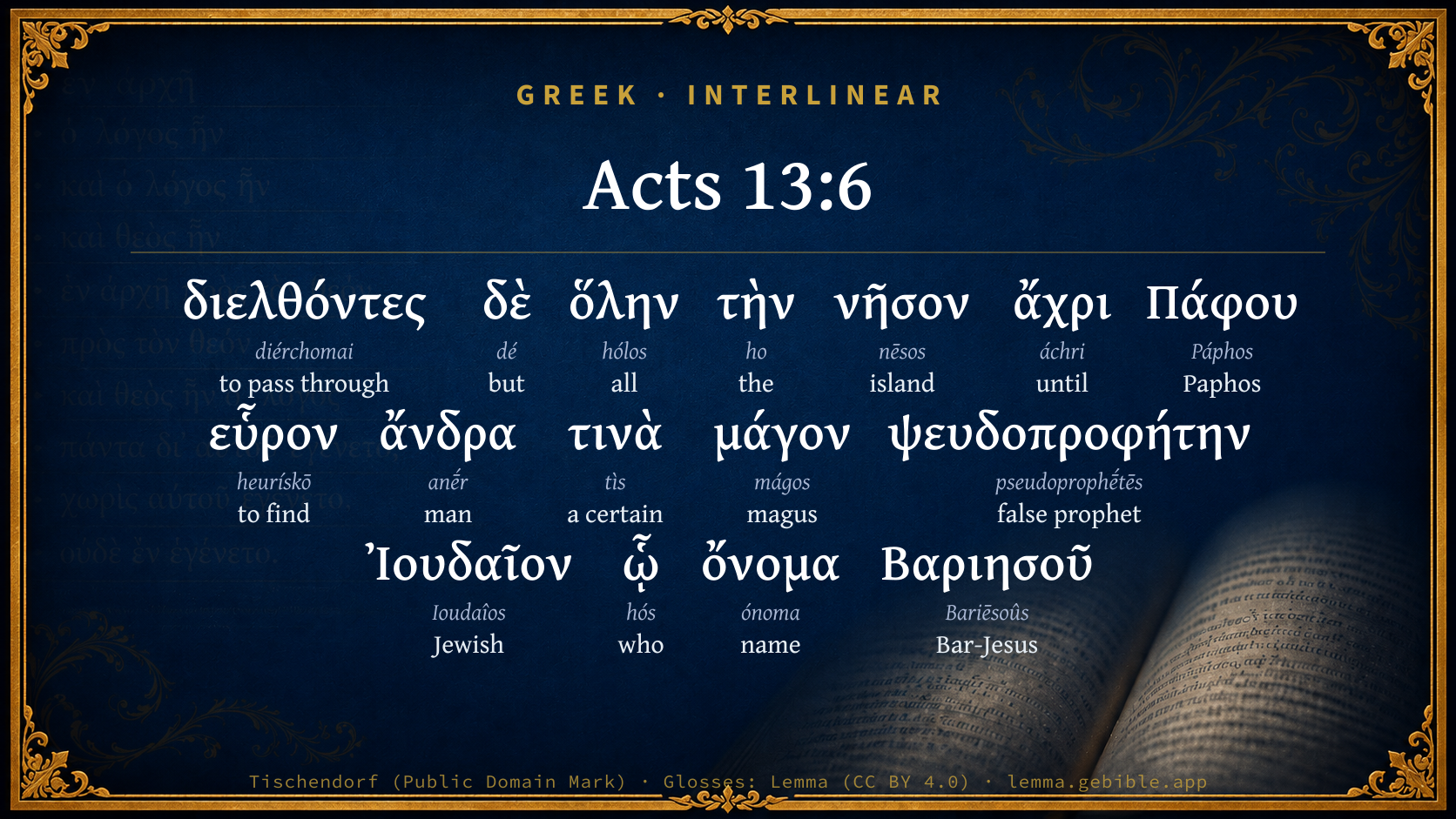
Download image
Cite this verse

Acts 13:6 (World English Bible). Public Domain. Lemma interlinear Bible study tool, https://lemma.gebible.app/v/acts/13/6.

Show BibTeX & RIS
BibTeX
RIS
English Translation
When they had gone through the island to Paphos, they found a certain sorcerer, a false prophet, a Jew, whose name was Bar Jesus,
World English Bible · Public Domain
Highlights
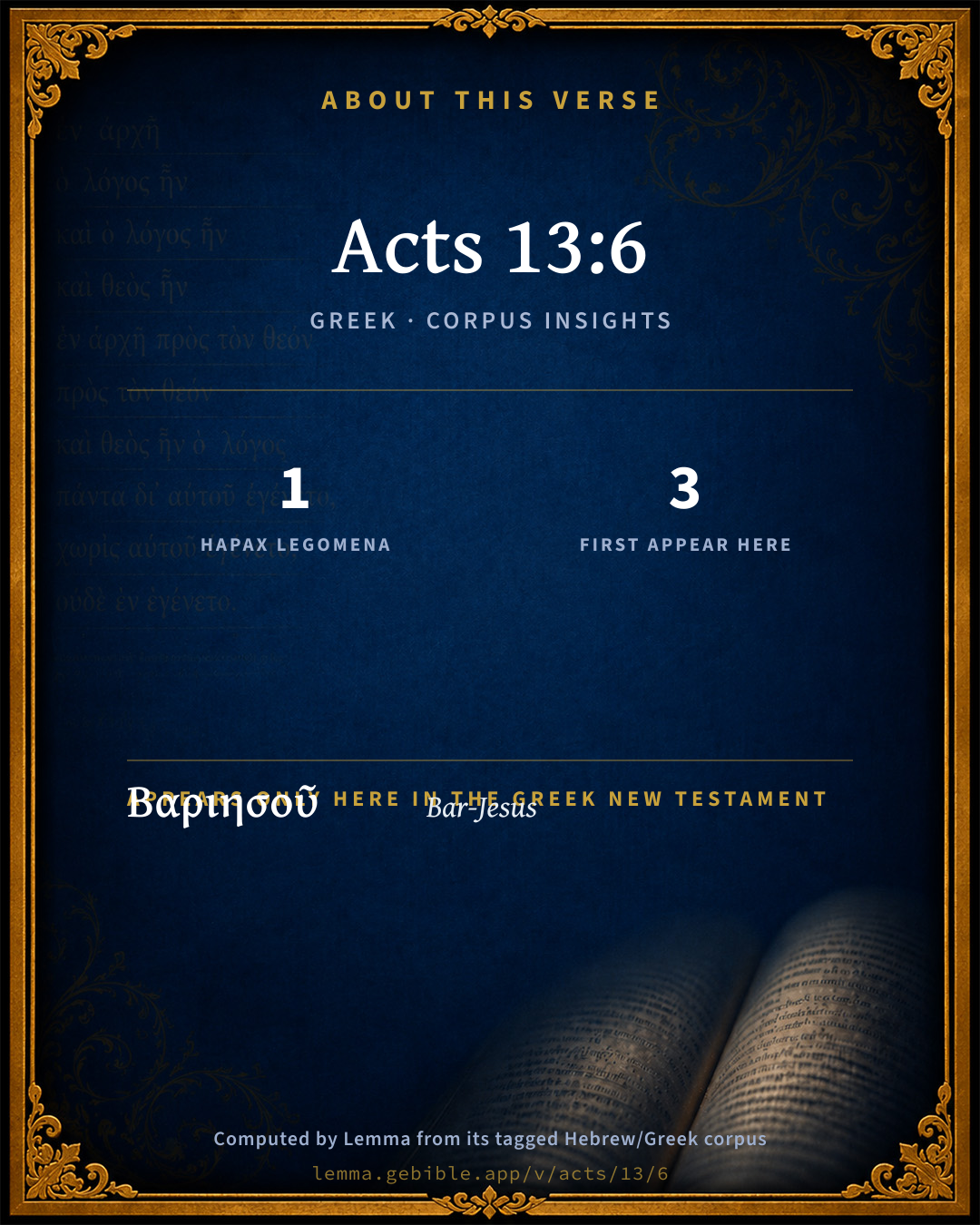
  • 1 hapax legomenon — only here in the Greek New Testament
  • 3 first appearances in the Greek New Testament
Full analysis ↓
Download a study sheet

One document with this verse’s original text, its word-by-word gloss line, the meaning frame, cross-references with their text, attributed commentary, and full source and license credits — printable, and it pastes into notes with its structure intact.

This verse Autodidact and up

Study sheet (.html) Plain text (.txt)

A passage Seminary Student

Up to 50 verses in one chapter. A passage sheet keeps up to 6 commentary sources and 12 cross-references per verse, in the order this page ranks them, and says so on the sheet whenever that leaves anything out. Ask for a single verse and you get the Autodidact verse sheet above.

Everything on this page stays free to read, with no account — the sheet is a download of what is already on screen, not access to it.

Want to remove ads? Support Godless Engineer
Compare translations 3

The same verse in 3 English versions, stacked beneath the original-language interlinear above. Click any original word for its lexicon entry.

Each is an independent rendering of the whole verse — the interlinear is not word-aligned to these translations.

Highlighted words mark where these versions differ — a whole-verse word diff, not a word-by-word alignment.

  • World English Bible Public Domain
    When they had gone through the island to Paphos, they found a certain sorcerer, a false prophet, a Jew, whose name was Bar Jesus,
  • King James Version Public Domain
    And when they had gone through the isle unto Paphos, they found a certain sorcerer, a false prophet, a Jew, whose name was Barjesus:
  • unfoldingWord Literal Text CC BY-SA 4.0
    And having passed through the whole island as far as Paphos, they found a certain man, a magician, a Jewish false prophet, whose name Bar Jesus,

unfoldingWord Literal Text — © unfoldingWord, licensed CC BY-SA 4.0. Word-aligned USFM3 via Door43 (git.door43.org/unfoldingWord/en_ult).

Versions to compare (up to 4)

3 of 4 selected

Show all 19 translations

Every available English version of this verse, each an independent rendering of the whole verse.

  • World English Bible Public Domain
    When they had gone through the island to Paphos, they found a certain sorcerer, a false prophet, a Jew, whose name was Bar Jesus,
  • Berean Standard Bible Public Domain
    They traveled through the whole island as far as Paphos, where they found a Jewish sorcerer and false prophet named Bar-Jesus,
  • Majority Standard Bible Public Domain
    They traveled through the island as far as Paphos, where they found a Jewish sorcerer and false prophet named Bar-Jesus,
  • King James Version Public Domain
    And when they had gone through the isle unto Paphos, they found a certain sorcerer, a false prophet, a Jew, whose name was Barjesus:
  • American Standard Version (1901) Public Domain
    And when they had gone through the whole island unto Paphos, they found a certain sorcerer, a false prophet, a Jew, whose name was Bar-jesus;
  • Revised Version (1885) Public Domain
    And when they had gone through the whole island unto Paphos, they found a certain sorcerer, a false prophet, a Jew, whose name was Bar-Jesus;
  • Geneva Bible (1599) Public Domain
    So when they had gone throughout the yle vnto Paphus, they found a certaine sorcerer, a false prophet, being a Iewe, named Bariesus,
  • Douay-Rheims (1899) Public Domain
    And when they had gone through the whole island, as far as Paphos, they found a certain man, a magician, a false prophet, a Jew, whose name was Bar-jesu:
  • Young's Literal Translation Public Domain
    and having gone through the island unto Paphos, they found a certain magian, a false prophet, a Jew, whose name `is' Bar-Jesus;
  • Literal Standard Version CC BY-SA 4.0
    and having gone through the island to Paphos, they found a certain magus, a false prophet, a Jew, whose name [is] Bar-Jesus;
  • Unlocked Literal Bible CC BY-SA 4.0
    When they had gone through the whole island to Paphos, they found a certain magician, a Jewish false prophet, whose name was Bar Jesus.
  • unfoldingWord Literal Text CC BY-SA 4.0
    And having passed through the whole island as far as Paphos, they found a certain man, a magician, a Jewish false prophet, whose name Bar Jesus,
  • Darby Bible Public Domain
    And having passed through the whole island as far as Paphos, they found a certain man a magician, a false prophet, a Jew, whose name was Bar-jesus,
  • World Messianic Bible Public Domain
    When they had gone through the island to Paphos, they found a certain sorcerer, a false prophet, a Jew whose name was Bar-Yeshua,
  • Webster's Bible Public Domain
    And when they had gone through the isle to Paphos, they found a certain sorcerer, a false prophet, a Jew, whose name was Barjesus:
  • Free Bible Version CC BY-SA 4.0
    They traveled throughout the island and eventually came to Paphos. There they found a Jewish magician, a false prophet by the name of Bar-jesus.
  • Bible in Basic English Public Domain
    And when they had gone through all the island to Paphos, they came across a certain wonder-worker and false prophet, a Jew whose name was Bar-Jesus;
  • Text-Critical English NT CC BY 4.0
    When they had gone across the island to Paphos, they came across a certain magician, a Jewish false prophet named Bar-Jesus.
  • Tyndale New Testament (1534) Public Domain
    When they had gone thorowout the yle vnto the cite of Paphos they foude a certayne sorserer a falce prophet

Literal Standard Version (2020), Covenant Press — licensed CC BY-SA 4.0. Text via the HelloAO Bible API (eBible.org). Unlocked Literal Bible (unfoldingWord) — licensed CC BY-SA 4.0. Text via the HelloAO Bible API (eBible.org). unfoldingWord Literal Text — © unfoldingWord, licensed CC BY-SA 4.0. Word-aligned USFM3 via Door43 (git.door43.org/unfoldingWord/en_ult). Free Bible Version, Dr. Jonathan Gallagher — licensed CC BY-SA 4.0. Text via the HelloAO Bible API (eBible.org).

Word by word

More ways to search: Search by grammar → Find every occurrence → Compare this word →

Practice this passage: Drill this verse → Learn its vocabulary →

Βαριησοῦ
Bariēsoûs
G919
“Bar-Jesus”
Noun, Genitive, Singular, Masculine
Part of Speech
Noun
Case
Genitive
Number
Singular
Gender
Masculine
Full Thayer's Definition

Origin: of Aramaic origin H1247 and G3091

TDNT: None

Barjesus = "son of Jesus" 1. a certain false prophet
  1. διελθόντες diérchomai G1330 “to pass through” Verb, Aorist, Active, Participle, Nominative, Plural, Masculine
  2. δὲ dé G1161 “but” Conjunction
  3. ὅλην hólos G3650 “all” Adjective, Accusative, Singular, Feminine
  4. τὴν ho G3588 “the” Article, Accusative, Singular, Feminine
  5. νῆσον nēsos G3520 “island” Noun, Accusative, Singular, Feminine
  6. ἄχρι áchri G891 “until” Adverb
  7. Πάφου Páphos G3974 “Paphos” Noun, Genitive, Singular, Feminine
  8. εὗρον heurískō G2147 “to find” Verb, Aorist, Active, Indicative, 3rd person, Plural
  9. ἄνδρα anḗr G435 “man” Noun, Accusative, Singular, Masculine
  10. τινὰ tìs G5100 “a certain” Indefinite pronoun, Accusative, Singular, Masculine
  11. μάγον mágos G3097 “magus” Noun, Accusative, Singular, Masculine
  12. ψευδοπροφήτην pseudoprophḗtēs G5578 “false prophet” Noun, Accusative, Singular, Masculine
  13. Ἰουδαῖον Ioudaîos G2453 “Jewish” Adjective, Accusative, Singular, Masculine
  14. ᾧ hós G3739 “who” Relative pronoun, Dative, Singular, Masculine
  15. ὄνομα ónoma G3686 “name” Noun, Nominative, Singular, Neuter

About this verse

These counts appear in no published source. They are computed here, from the morphology-tagged text and Lemma’s own curated glosses. What Lemma adds →

16
words
16
distinct lemmas
Acts
section

Notable vocabulary

1 hapax legomenon — a word that appears only here in the entire Greek New Testament:

  • Βαριησοῦ Bar-Jesus G919

First appearance in Scripture

These words make their first canonical appearance in the Greek New Testament here:

  • νῆσον island G3520
  • Πάφου Paphos G3974
  • Βαριησοῦ Bar-Jesus G919

Shared distinctive vocabulary

Πάφου Paphos G3974 occurs in 2 verses of the Greek New Testament. Also found in:
Cross-references

22

Topical passages linked to Acts 13:6 in the Treasury of Scripture Knowledge — connected by theme and wording, ordered by reader-vote popularity; previews shown in the World English Bible.

  • Matthew 7:15 "Beware of false prophets, who come to you in sheep's clothing, but inwardly are ravening wolves.
  • 1 John 4:1 Beloved, don't believe every spirit, but test the spirits, whether they are of God, because many false prophets have gone out into the world.
  • 2 Corinthians 11:13 For such men are false apostles, deceitful workers, masquerading as Christ's apostles.
  • Exodus 22:18 "You shall not allow a sorceress to live.
  • Deuteronomy 13:1–3 If there arise in the midst of you a prophet, or a dreamer of dreams, and he give you a sign or a wonder,
  • Jeremiah 23:14–15 In the prophets of Jerusalem also I have seen a horrible thing: they commit adultery, and walk in lies; and they strengthen the hands of evil-doers, so that none does return from his wickedness: they are all of them become to me as Sodom, and the inhabitants of it as Gomorrah.
  • Ezekiel 13:10–16 Because, even because they have seduced my people, saying, Peace; and there is no peace; and when one builds up a wall, behold, they daub it with whitewash:
  • Zechariah 13:3 It will happen that, when anyone still prophesies, then his father and his mother who bore him will tell him, 'You must die, because you speak lies in the name of Yahweh;' and his father and his mother who bore him will stab him when he prophesies.
  • Matthew 16:17 Jesus answered him, "Blessed are you, Simon Bar Jonah, for flesh and blood has not revealed this to you, but my Father who is in heaven.
  • Matthew 24:24 For there will arise false christs, and false prophets, and they will show great signs and wonders, so as to lead astray, if possible, even the chosen ones.
  • Mark 10:46 They came to Jericho. As he went out from Jericho, with his disciples and a great multitude, the son of Timaeus, Bartimaeus, a blind beggar, was sitting by the road.
  • Leviticus 20:6 "'The person that turns to those who are mediums, and to the wizards, to play the prostitute after them, I will even set my face against that person, and will cut him off from among his people.
  • Deuteronomy 18:10–12 There shall not be found with you anyone who makes his son or his daughter to pass through the fire, one who uses divination, one who practices sorcery, or an enchanter, or a sorcerer,
  • 1 Kings 22:22 Yahweh said to him, 'How?' He said, 'I will go forth, and will be a lying spirit in the mouth of all his prophets.' He said, 'You shall entice him, and shall prevail also: go forth, and do so.'
  • 1 Chronicles 10:13 So Saul died for his trespass which he committed against Yahweh, because of the word of Yahweh, which he didn't keep; and also because he asked counsel of one who had a familiar spirit, to inquire [thereby],
  • Isaiah 8:19–20 When they shall tell you, "Consult with those who have familiar spirits and with the wizards, who chirp and who mutter:" shouldn't a people consult with their God? on behalf of the living [should they consult] with the dead?
  • John 21:15–17 So when they had eaten their breakfast, Jesus said to Simon Peter, "Simon, son of Jonah, do you love me more than these?" He said to him, "Yes, Lord; you know that I have affection for you." He said to him, "Feed my lambs."
  • Acts 8:9–11 But there was a certain man, Simon by name, who used to practice sorcery in the city, and amazed the people of Samaria, making himself out to be some great one,
  • Acts 19:18–19 Many also of those who had believed came, confessing, and declaring their deeds.
  • 2 Timothy 3:8 Even as Jannes and Jambres opposed Moses, so do these also oppose the truth; men corrupted in mind, reprobate concerning the faith.
  • 2 Peter 2:1–3 But there also arose false prophets among the people, as among you also there will be false teachers, who will secretly bring in destructive heresies, denying even the Master who bought them, bringing on themselves swift destruction.
  • Revelation 19:20 The beast was taken, and with him the false prophet who worked the signs in his sight, with which he deceived those who had received the mark of the beast and those who worshiped his image. These two were thrown alive into the lake of fire that burns with sulfur.

Cross-references courtesy of OpenBible.info (CC BY 4.0).

Where the printed editions differ

2 variants

Places in this verse where the major printed Greek editions disagree on the wording in a way that affects the translation — a comparison of editions, not a manuscript-by-manuscript collation. The editions are the modern critical texts (Nestlé-Aland 28/27, SBL, Westcott-Hort, Tregelles, Tyndale House) and the traditional texts behind the KJV (the Textus Receptus and the Byzantine/Majority text). It is not a claim about which reading is original.

  1. Extra text
    ὅλην

    “all”

    In NA28NA27TynSBLWHTreg Not in TRByz

    ὅλην (holēn) 'all' is only in older manuscripts (NA28+NA27+Tyn+SBL+WH+Treg)

  2. Extra text
    ἄνδρα

    “a man —”

    In NA28NA27TynSBLWHTreg Not in TRByz

    ἄνδρα (andra) 'a man —' is only in older manuscripts (NA28+NA27+Tyn+SBL+WH+Treg)

Textual data: Translators Amalgamated Greek New Testament (STEPBible TAGNT) · CC BY 4.0.

Commentary

Notes on Acts 13:6 from classic Christian and Jewish commentators (each source and its license shown beneath its notes). The classic Christian expositions comment on the surrounding passage and are grouped to its opening verse, so a note may address several verses; the Jewish commentaries on the Tanakh (Rashi and others) are per-verse, so they appear only where the commentator wrote on this verse.

Lemma curates 59 commentaries, every one of them public domain or Creative Commons licensed, each selected and text-cleaned for this edition rather than reprinted as found. About our sources →

Joseph Benson's Commentary

Act 13:6-8. When they had gone through the isle unto Paphos — Which lay on its western coast; they found a certain sorcerer — Or magician; a false prophet — Who falsely pretended to foretel future events; a Jew, whose name was Bar-jesus — Or the son of one Jesus, or Joshua. “There were many instances of real or pretended sorcery among the Jews in those days, which seems to have been designed by Satan and wicked men to bring into disrepute the miracles of Christ and his apostles. But by comparing them, in several instances, the Christian cause was magnified yet more than it would otherwise have been. Nevertheless, it is to be feared they wrought on many, who were not wise and candid enough to examine, so as to introduce a general contempt of all pretences to supernatural powers as false or inconclusive.” — Doddridge. Which was with the deputy — Which Jew was with the Roman proconsul there, as ανθυπατος, the word here rendered deputy, properly signifies; Sergius Paulus, a prudent man — A man of a steady conduct and thoughtful temper; and therefore not overswayed by the sorcerer, but desirous to inquire further; who called for Barnabas and Saul — Having received some general information of their character and doctrine; and desired to hear the word of God — That he might know what was the purport of their preaching, and what regard was due to it. But Elymas the sorcerer (for so is his name by interpretation — That is, the word, Elymas, of Arabic or Hebrew derivation, signifies sorcerer, or magician) withstood them — Being sensible that he should be no more regarded if their doctrine was received, and therefore setting himself with all his might to hinder the effect of it. Seeking to turn away the deputy from the faith — To prevent his embracing it, by a variety of crafty and false insinuations.

Joseph Benson's Commentary on the Old and New Testaments (1811–1818) — public domain. Text from a community e-Sword module.

Tyndale Open Study Notes

Tyndale Open Resources

13:6-12 At Paphos there was a power struggle with a false prophet, with the result that the power of God was manifested and the Roman governor became a believer.

13:6 Paphos was located on the southwest coast of Cyprus. As the leading city of Cyprus, it was of strategic importance. • a Jewish sorcerer . . . named Bar-Jesus: Such eastern magicians often exercised a tremendous influence in the Greco-Roman world.

Tyndale Open Study Notes — © Tyndale Open Resources, licensed CC BY-SA 4.0. Text via the HelloAO Bible API.

Bengel's Gnomon

Johann Albrecht Bengel

Act 13:6. Πάφου) Paphos was a city in the west: Salamis, in the east.—μάγον ψευδοπροφήτην, a sorcerer, a false prophet) Two predicates very closely joined together.—Βαριηοὺ) Bar-Jehu was in itself a name, equally as Jehu, applicable to a man, but one very convenient to a sorcerer, a false prophet, for arrogating the claim of divinity. Jehu and Jehovah are kindred names (Collactanea); which also seems to be the reason why the Syriac version has translated Barjehu as Bar Schumo. In Barschumo and in Elymas the Syria Græca of Hermann von der Hardt, pp. 110, 114, states that there is contained the notion of blindness: but even from the fact, that Barschumo is a most frequent name among the Syrians, as is evident from the Bibliotheca, or. T. 2, c. i., of Assemann, a more pleasing notion is to be looked for in it. Ludovicus de Dieu interprets it, the son of ulcers, a physician healing ulcers; as Elymas, in his view, is חלומא, healer. Paul calls that Barjehu, Son of the devil, rebutting thus by a parody the impostor’s arrogant assumption of a name expressive of divinity.[69]

[69] Some MSS. of Vulg. read Barjehu: others, Βαριησοῦ, Barjesu: and so Memph. B (judging from the silence of the collators) CEe Theb. read Βαριησοῦς: AD corrected, Βαοιησοῦν: Lucif. 209, etc. Barjesuban.—E. and T.

Bengel's Gnomon of the New Testament — English translation (T&T Clark, Edinburgh, 1860) — public domain. Text from a community e-Sword module.

Meyer's Critical & Exegetical Commentary

Heinrich August Wilhelm Meyer

Act_13:6-7. Ὅλην τὴν νῆσον] For Paphos, i.e. New Paphos, the capital and the residence of the proconsul, sixty stadia to the north of the old city celebrated for the worship of Venus, lay quite on the opposite western side of the island. See Forbiger, Geogr. I. p. 469 f.

μάγον] see on Act_8:9. Whether he was precisely a representative of the cabalistic tendency (Baumgarten), cannot be determined. But perhaps, from the Arabic name Elymas, which he adopted, he was an Arabian Jew. μάγον, although a substantive, is to be connected with ἄνδρα (Act_3:14).

Βαριησοῦς] i.e. בַּר יֵשׁוּע, filius Jesu (Josuae). The different forms of this name in the Fathers and versions, Barjeu, Barsuma, Barjesuban, Βαριησουσάν, have their origin in the reverence and awe felt for the name of Jesus.

ἀνθυπάτῳ] Cyprus, which Augustus had restored to the senate, was, it is true, at that time a propraetorian province (Dio Cass. liv. 4); but all provincial rulers were, by the command of Augustus, called proconsules, Dio Cass. liii. 13.

συνετῷ] although the contrary might be suspected from his connection with the sorcerer. But his intelligence is attested partly by the fact that he was not satisfied with heathenism, and therefore had at that time the Jewish sorcerer with him in the effort to acquire more satisfactory views; and partly by the fact that he does not feel satisfied even with him, but asks for the publishers of the new doctrine. In general, sorcerers found at that time welcome reception with Gentiles otherwise very intelligent. Lucian. Alex. 30, Wetstein in loc.

τὸν λόγ. τοῦ Θεοῦ] Description of the new doctrine from the standpoint of Luke. See, moreover, on Act_8:25.

Meyer — Critical and Exegetical Commentary on the New Testament — English translation by Peter Christie, edited by Frederick Crombie (T&T Clark, 1880) — public domain. Text from a community e-Sword module.

Expositor's Greek Testament

ed. W. Robertson Nicoll

Act 13:6 . διελθόντες δὲ ( ὅλην ) τὴν ν .: “and they made a missionary progress through the whole island,” Ramsay, St. Paul , pp. 72 and 384, and “Words demoting Missionary Travel in Acts,” Expositor , May, 1896; on ὅλην , see critical notes. Ramsay gives nine examples in Acts of this use of διέρχεσθαι or διελθεῖν with the accusative of the region traversed, the only other instance in the N.T. being 1Co 16:5 . In each of these ten cases the verb implies the process of going over a country as a missionary, and it is remarkable that in 1 12 this construction of διέρχομαι never occurs, though there are cases in which the idea of a missionary tour requires expression. Ramsay therefore sees in the use of the word in the second part of the book a quasi technical term which the writer had caught from St. Paul himself, by whom alone it is also employed. Πάφου : Nea Paphos the chief town and the place of residence of the Roman governor some little distance from the old Paphos ( Παλαίπαφος , Strabo) celebrated for its Venus temple. The place still bears the name of Baffa , Renan, St. Paul , p. 14; O. Holtzmann, Neutest. Zeitgeschichte , p. 101; C. and H., smaller edition, p. 125. μάγον , cf. Act 8:9 ; “sorcerer,” A. and R.V. margin, cf. Mat 2:1 , but word used here as among the Greeks and Romans in a bad sense. Wycl. has “witch,” and this in its masculine form “wizard” has been suggested as an appropriate rendering here. On the absurd attempt to show that the whole narrative is merely introduced as a parallel to St. Peter’s encounter with Simon, chap. 8, see Nösgen, p. 427; Zöckler, in loco , and Salmon, Introduction , p. 310. The parallel really amounts to this, that both Peter and Paul encountered a person described under the same title, a magician an encounter surely not improbable in the social circumstances of the time (see below)! For other views see Holtzmann, who still holds that the narrative is influenced by Act 8:14 ff. The word is entirely omitted by Jüngst, p. 120, without any authority whatever. Elymas, according to the narrative, says Jüngst, was either a magician or a false prophet. But the proconsul is styled ἀνὴρ συνετός , and this could not have been consistent with his relation with a magician: Elymas was therefore a kind of Jewish confessor. But neither supposition does much to establish the wisdom of Sergius Paulus. ψευδοπροφήτην like ψευδόμαντις in classical writers, here only in Acts; and Luk 6:26 , by St. Luke. But frequently used elsewhere in N.T., and in the LXX, and several times in Didaché , xi. On the “Triple beat,” Magian, false prophet, Jew, see Ramsay, St. Paul , p. 415. Βαρϊησοῦς , on the name see critical notes.

The Expositor's Greek Testament, edited by W. Robertson Nicoll (1897–1910) — public domain. Text from a community e-Sword module.

Jamieson, Fausset & Brown

Robert Jamieson, A. R. Fausset & David Brown

when they had gone through the isle unto Paphos--on the opposite or west side of the island, about one hundred miles by land, along the south coast; the Roman capital, where the governor resided.

they found a . . . sorcerer--one of a numerous class of impostors who, at this time of general unbelief, were encouraged even by cultivated Romans.

Jamieson, Fausset & Brown — Commentary Critical and Explanatory on the Whole Bible (1871) — public domain (CC PDM 1.0). Text via the HelloAO Bible API.

Adam Clarke's Commentary

Verse 6. Gone through the isle] ολην, The WHOLE isle, is added here by ABCDE, several others, both the Syrian, Coptic, AEthiopic, Armenian, Vulgate, and Itala; and also by several of the Greek fathers; and this must be the true reading, for it is evident they ran through the whole island from east to west.

Unto Paphos] This town, next in importance to Salamis, was situated on the western part of the isle; and having gone from Salamis to this place is a proof that they had gone through the whole island from east to west, according to the reading noticed above. There was probably no town in the universe more dissolute than Papas. Here Venus had a superb temple: here she was worshipped with all her rites; and from this place she was named the Paphian Venus, the queen of Paphos, c. This temple and whole city were destroyed by an earthquake so that a vestige of either does not now remain. There are two islands which go by this name, both adjoining, and on the west side of the island of Cyprus. One is called Old Paphos, the other New Paphos; the latter is probably the island here mentioned, though they are often confounded. On this island there is a Christian Church, dedicated to St. George, in which service is performed by the Greek ministers. It is a bishop's see, suffragan to the Abp. of Nicosia.

A certain sorcerer] τινα μαγον, A magician, one who used magical arts, and pretended to have commerce with supernatural agents. A person who dealt in sleight of hand, or leger-de-main. Such as I have supposed Simon Magus to be. See Clarke on Ac 8:9.

A false prophet]. A deceiver, one who pretended to have a Divine commission, a fortune teller.

Bar-Jesus] That is, the son of Jesus or Joshua; as Bar-jona is the son of Jonah; Bar-tholomew, the son of Thalmi, &c.

Adam Clarke's Commentary on the Bible (1810–1826) — public domain. Text from a community e-Sword/MySword module.

John Calvin's Commentaries

6. When they had passed over. It is to be thought that this their passage was not altogether without fruit; and, assuredly, Luke would never have passed over with silence a general repulse; but it was sufficient for him to say that they were not idle in the office of teaching in their journey, seeing that he maketh haste unto a famous history, which he will set down immediately. And forasmuch as Salamis, situated upon the east coast, did look toward Syria, it was requisite that Paul and Barnabas should pass through the midst of the island unto the other side, that they might come to Paphos; for Paphos was a city situated upon the sea-coast toward the south. Furthermore though all the island was dedicated to Venus, yet Paphos was the principal seat of the idol. For which cause the goodness of God is more wonderful, in that he would have the light of his gospel to pierce into such a filthy and cruel [dire] den. For we may thereby gather what manner of integrity and chastity, and honesty and temperance, was in that city, in that religion did grant liberty to the inhabitants to commit all manner of shameful and heinous offenses.

They found a certain fake prophet. Seeing that religion was quite corrupt among the Jews, it is no marvel if they fell away unto many wicked superstitions. And forasmuch as they had hitherto professed that they worshipped a certain peculiar god, this was a fair color to deceive withal, seeing that they might pretend the name of the unknown God at their pleasure; but this is a wonder how it was possible for Elymas, with his juggling, to cozen a grave and wise man. For we know that the Jews were at that time hated of all the world, and especially of the Romans, and with hatred was coupled extreme contempt of them.

Now Luke doth not without cause expressly commend Sergius’s wisdom, lest any man should think that his foolishness and lightness was subject to the seducings of the sorcerer. His meaning was, indeed, to show in a clear mirror how frivolous and vain man’s wisdom is, which cannot beware of such gross subtlety of Satan.

And assuredly where the truth of God doth not appear, the more men seem to be wise, the more filthily foolish are they. We see what filthy monsters of superstition did reign amongst the most witty Gentiles, and such as were furnished with all manner of learning. Therefore, there is neither judgment nor wisdom, save only from the Spirit of God. And this is the just vengeance of God upon all idolaters, that being delivered up to a reprobate sense they can discern nothing, (Romans 1:28.) Though it may be that Sergius Paulus, being weary of superstitions, did then begin to desire a more pure worship of God, at such time as he [did] light upon that sorcerer. Which if we receive, it was surely a wonderful judgment of God, that he suffered a man godly-affected to throw himself headlong into the [deadly] snares of Satan. But God doth sometimes so exercise his elect, that he causeth them to wander many ways, before they be directed into the right way.

John Calvin's Commentaries (1540-1563) — public domain. Text from the Calvin Translation Society English edition (1840s-50s) via the Christian Classics Ethereal Library (ccel.org). Calvin's coverage is partial (roughly two-thirds of the Bible); uncommented books and verses are honest gaps, never fabricated. The 19th-century editor's footnotes and remarks are omitted so the notes are faithfully Calvin's own voice.

Ellicott's Commentary for English Readers

(6) When they had gone through the isle.—The better MSS. give, through the whole island. Paphos lay at its western extremity, and appears to have been the head-quarters of the Roman governor. A local tradition, reported by M. de Cesnola (Cyprus, pp. 29, 223), points out a marble column to which St. Paul was bound and scourged by the citizens of Paphos, who are represented as having been among the most wicked of mankind.

They found a certain sorcerer.—The word so rendered, Magos, is the same as that used for the “wise men” of Mat_2:1 (where see Note), but it is obviously used here in the bad sense which had begun to attach to it even in the days of Sophocles, who makes Œdipus revile Tiresias under this name, as practising magic arts (Œd. Rex. 387), and which we have found in the case of Simon the sorcerer. (See Note on Act_8:9.) The man bore two names, one, Bar-jesus, in its form a patronymic, the other Elymas (an Aramaic word, probably connected with the Arabic Ulema, or sage), a title describing his claims to wisdom and supernatural powers. We have already met with a character of this type in the sorcerer of Samaria. (See Note on Act_8:9.) The lower class of Jews here, as in Act_19:14, seem to have been specially addicted to such practices. They traded on the religious prestige of their race, and boasted, in addition to their sacred books, of spells and charms that had come down to them from Solomon.

A Bible Commentary for English Readers, edited by Charles John Ellicott (1878–1897) — public domain. Text from a community e-Sword module.

The Cambridge Bible for Schools and Colleges

gen. ed. J. J. S. Perowne

6. And when they had gone through the isle unto Paphos] Probably teaching at other places in the same way as they had done in Salamis. Paphos was the capital of Cyprus, and therefore the residence of the Roman governor. It was the more modern city, not the old city of Paphos, to which Paul and Barnabas came. See Dictionary of Bible.

they found a certain sorcerer [magician], a false prophet, a Jew] That there were living among the Jews persons well known as pretenders to magic powers we can see from a story told T. B. Berakhoth 59 a, of a certain Rab Katina who, in his walk, as he was passing the door of one who was known as a professor of witchcraft and magic arts, felt a slight shock of an earthquake. He thereupon called out and asked “Does this wizard diviner know what that shock is?” Upon this the man cried with a sanctimonious promptness worthy of his profession, “In the hour when the Holy One, blessed be He, remembers His children who dwell in sorrow among the nations of the world, He lets fall two tears into the great sea, and that is the cause of the tremor of the earth.” Chaldæan astrologers and impostors are mentioned by Juvenal (vi. 562; xiv. 248) and Horace (Sat. i. 2. 1) and by many other Latin writers, and these were probably Babylonian Jews. See Lucian, Necyomantia, where a wonderful story is told of a magician named Mithrobarzanes. Also Lucian, Philopseudes, where one of the wonder-workers is described as “a Syrian from Palestine.”

Bar-jesus] This was his Jewish name. The Arabic name or title Elymas = wise, was a self-assumed designation; and for that reason he is called “Magus” = the magician, a name originally applied to the Persian priests, who were deemed the wise men of the realm both in policy and religion, though their title in after times was degraded to baser arts and persons.

The Cambridge Bible for Schools and Colleges (gen. ed. J. J. S. Perowne; Cambridge University Press, 1878–1918) — public domain. Text from a community e-Sword module.

John Gill's Exposition

And when they had gone through the isle unto Paphos,.... The Alexandrian copy, and the Vulgate Latin and Syriac versions read, "the whole isle"; for through the midst of the whole island they must go, to go from Salarnis to Paphos; for Salamis was on the east, and Paphos on the west of the islands (q): it had its name from the Phoenician word, , "peathpaoth", "the corner of corners"; because both old and new Paphos were situated in the extreme part of the island; and not from Paphus, the son of Pygmalion, by any ivory statue which he had made, whom Venus, at his request, according to the fables of the Heathens, turned into a woman: some say (r), that Cinyras, a king of the Assyrians, coming into Cyprus, built Paphos; but Pausanias (s) affirms, that Agapenor, who came hither after the Trojan war, was the builder of this place, and also of the temple of Venus in it, for which it was famous (t); and in a certain area of which, Pliny (u) says it never rained; and from this place, Venus was called Paphia: according to Chrysostom, it was the metropolis of Cyprus; and it is indeed mentioned by Pliny (w), first of the fifteen cities that were in it; and seems at this time to have been the seat of the Roman deputy Paulus Sergius, afterwards spoken of: concerning this place Jerom says (x),

"Paphus, a city on the sea coast, in the island of Cyprus, formerly famous for the sacred rites of Venus, and the verses of the poets; which fell by frequent earthquakes, and now only shows, by its ruins, what it formerly was:''

so Seneca (y) says, "quotiens in se Paphus corruit?", "how often has Paphus fell within itself?" that is, by earthquakes: the ruins of many goodly churches and buildings are to be seen in it; and the walls of a strong, and almost impregnable tower, situated upon a hill in the middle of the city, supposed to be the habitation of Sergius Paulus; there is also shown, under a certain church, a prison divided into seven rooms, where they say Paul and Barnabas were imprisoned, for preaching the Gospel; what remains of it, is now called Bapho: here

they found a certain sorcerer, a false prophet, a Jew, whose name was Barjesus, or the son of Jesus; Jesus was a name frequent among the Jews, and is the same with Joshua, and was in use long before our Saviour's time; there was Jesus the son of Sirach, the author of Ecclesiasticus, and who had a grandfather of the same name, the Syriac version here calls him "Barsuma", which some render "the son of a name"; that is, a man of note, a famous person, of great renown; others, "the son of a swelling", or "the son of ulcers"; he professing to be a physician, and to cure them, with which they make the name of Barjesus to agree, deriving it from a root, which signifies to heal: Jerom (z) pronounces this name Barieu, and observes, that some corruptly read it Barjesu; and he makes it to signify an evil man, or one in evil; and Drusius says, he found the name "Barjeou", in some papers of his; and a very learned man (a) of later years says, it is the same with Bar-Jehu, the son of Jehu; and affirms, that the Greek word is "Barjeus", which others wrongly turn into "Bar-jesus"; the Magdeburgensian Centuriators call him, "Elymas Barjehu"; the reason Beda gives, why it should be so read, and not Bar-jesus, is because that a magician was unworthy to be called the son of Jesus, the Saviour, when he was a child of the devil; but the Greek copies agree in Barjesus; his name shows him to be a Jew, as he is here called: and he was one of those false prophets our Lord said should arise, and deceive many; he pretended to foretell things to come, and practised sorcery, and was given to magic arts.

(q) Ptolom. Geograph. l. 5. c. 14. (r) Apollodorus de deorum orig. l. 3. p. 193. (s) Arcadica, sive l. 8. p. 461. (t) Philostrat. Vita Apollonii, l. 3. c. 16. (u) Nat. Hist. l. 2. c. 96. (w) Ib. l. 5. c. 31. (x) De locis Hebraicis, fol. 96. F. & Vita Hilarion, fol. 86. C. (y) Ep. 91. (z) De nominibus Hebraicis, fol 105. 1. (a) Hileri Onomasticum Sacrum, p. 760.

John Gill's Exposition of the Whole Bible (1746–1763) — public domain (CC PDM 1.0). Text via the HelloAO Bible API.

Trapp's Complete Commentary

John Trapp

6 And when they had gone through the isle unto Paphos, they found a certain sorcerer, a false prophet, a Jew, whose name was Barjesus:

Ver. 6. Whose name was Barjesus] The son of Jesus; so he had called himself, as if of nearest alliance to our Saviour. The Syriac hath it Barshuma, the son of name or renown.

John Trapp, A Commentary or Exposition upon All the Books of the Old and New Testament (1647–1656) — public domain. Text from a community e-Sword module.

Albert Barnes' Notes on the Bible

And when they had gone through the isle - The length of the island, according to Strabo, was 1,400 stadia, or nearly 170 miles.

Unto Paphos - Paphos was a city at the western extremity of the island. It was the residence of the proconsul, and was distinguished for a splendid temple erected to Venus, who was worshipped throughout the island. Cyprus was fabled to be the place of the birth of this goddess. It had, besides Paphos and Salamis, several towns of note Citium, the birthplace of Zeno, Areathus, sacred to Venus, etc. Its present capital is Nicosia. Whether Paul preached at any of these places is not recorded. The island is formerly supposed to have had one million inhabitants.

A certain sorcerer - Greek: magus, or magician. See the notes on Act 8:9.

A false prophet - Pretending to be endowed with the gift of prophecy; or a man, probably, who pretended to be inspired.

Bar-jesus - The word “Bar” is Syriac, and means “son.” Jesus (Joshua) was not an uncommon name among the Jews. The name was given from his father - son of Jesus, or Joshua; as Bar-Jonas, son of Jonas.

Albert Barnes' Notes on the Bible (1834–1885) — public domain. Text from a community e-Sword/MySword module.

Haydock's Catholic Bible Commentary

A magician ... whose name was Bar-jesu, son of Jesus, or Josue. In Arabic, Elymas is the same as magician. This man did all he could to dissuade the proconsul, Sergius Paulus, from embracing the Christian faith. (Witham) --- Salamina was the capital of the island of Cyprus, and at the eastern extremity, as Paphos was at the western. A. D. 45. [the year A.D. 45.]

George Leo Haydock (1774–1849), Haydock's Catholic Family Bible and Commentary, 1859 edition — public domain. Excludes Psalms (Douay-Rheims chapter numbering differs from Protestant) and Deuterocanonical books (Catholic canon only).

Matthew Poole's English Annotations

Unto Paphos; this city was on the west end of Cyprus, so that going from Salamis they went through the island: this place was famous for the worshipping of Venus.

A certain sorcerer; there were many magicians about this time amongst the Jews, who by their false miracles endeavoured to bring the real miracles of our Saviour into contempt. As the magicians and sorcerers of Egypt, by their enchantments, for a while did seem to do such wonders as Moses had wrought by the finger of God, Exo 7:11.

Matthew Poole's English Annotations on the Holy Bible (1683–1685) — public domain. Text from a community e-Sword/MySword module.

Whedon's Commentary on the Bible

Daniel D. Whedon

6. Paphos—This city would be reached by an easy journey over a Roman road of a hundred miles. Paphos was celebrated for its temple of Venus, and for the corresponding dissoluteness of its inhabitants. Here, too, resided Sergius Paulus, the Roman governor of the island.

Sorcerer—According to the Greek, a magus or magian. (See note on Act_8:9; Mat_2:1.)

False… prophet—Who falsely professed to be a prophet of the true God; for, as a Jew, he would be a professor of the doctrine of one God, and his monotheistic discourse formed his doctrinal attraction to Sergius Paulus. The prefix Bar in Hebrew (like the prefix Mac in the Celtic) signifies son of; and Bar-jesus signifies son of Jesus or Joshua; Jesus being the Greek form of the Hebrew Joshua. It was singular that this opponent of Jesus should bear his sacred name.

Daniel D. Whedon (gen. ed.), Commentary on the Old and New Testaments (1874–1909) — public domain. Text from a community e-Sword module.

The Pulpit Commentary

The whole island for the isle, A.V. and T.R. Paphos; on the south coast at the further extremity of the island, now Baffa. It had once a convenient harbor, which is now choked up from neglect. The chief temple of the Cyprian Venus was here. A certain sorcerer. The Greek word magov, whence magic and magician, is the same as in Mat_2:1 is rendered "wise men." But here, as in Act_8:9, it has a bad sense. It is a Persian word, and in its original use designated a Persian religious caste, famous for their knowledge, wisdom, and purity of religious faith. They were attached to the court of the Babylonian monarchs, and were deemed to have great skill in astrology, in interpretation of dreams, and the like (Dan_1:20 Dan_4:7 4 in the LXX) in Jer_39:3, Jer_39:13, the name Rab-mag seems to mean "the chief of the magi." But in process of time the word "magus" came to mean a sorcerer, a magician, a practicer of dark arts, as e.g. Simon Magus (see the chapter on magic in Pliny, "Nat. Hist.,"lib. 30. cap. 1.).

The Pulpit Commentary (1880–1919), ed. H.D.M. Spence-Jones & Joseph S. Exell — public domain. Text from a community e-Sword module.

John Wesley's Explanatory Notes

Paphos was on the western, Salamis on the eastern part of the island.

John Wesley, Explanatory Notes Upon the Whole Bible (1754–1765) — public domain. Text via the GEBible commentary corpus.

Scofield Reference Notes

C. I. Scofield

sorcerer

(Greek - μάγος)." See Mat 2:1, "wise men." The same word was used for a vulgar magician, and for a true wise man of the East.

The Scofield Reference Bible (1917 edition), notes by C. I. Scofield — public domain. Text from a community e-Sword module.

Godbey's Commentary on the New Testament

William B. Godbey

SATAN’S PREACHER AND THE CONVERSION OF THE PROCONSUL

6-12. Having traveled across the island of Cyprus throughout the whole length from east to west, everywhere preaching the Word, they arrive at Paphos, on the west coast, the metropolis of the West End and the residence of Sergius Paulus, the Roman proconsul, a well-disposed, intelligent man and an earnest inquirer after truth. They are soon confronted by the resident pastor, Elymas, who forbids them the privilege of preaching in his pastoral charge. He is a Jew and a prophet, i. e., a preacher in good standing, even having the confidence of the Roman governor, and wielding so potent an influence as to have the right to keep all the heresies and strange doctrines out of his bailiwick. We have him here pronounced a false prophet, because the Holy Ghost is the Author of the history. You must remember that the false prophets in the days of Elijah were the popular pastors of the influential churches, who believed themselves to be the true ministers of God and Elijah a false prophet. So Elymas is Paul’s brother in the popular church, an able preacher of the gospel, as they understood it, having the confidence of the people and enjoying the patronage of the Roman proconsul, who was looking to him for light and salvation. He forbids Paul and Barnabas to preach at Paphos, and if modern ecclesiastical law be correct he had a right to order them out of his dominion. Good Lord, help us all to profit by the clear truth here elucidated and perfectly explanatory of a thousand parallel cases at the present day. It is only a false prophet who is unwilling to have all the help he can get against the armies of hell, which are running rough-shod all over this wicked world. Every heart in sympathy and co-operation with the Savior of sinners welcomes every helping hand and covers every soul with blessings that will join in the common crusade against the powers of hell, and make an honest effort to rescue the perishing. How the present opposition to the holiness people, who preach no creed and nothing but Jesus and His pure and unadulterated truth, is fulfilling the latter-day prophecies, “Men will not endure sound doctrine.” But you say we ought to be very polite to the false prophets who forbid us to preach the Word at some place over which they claim the right to wield the scepter of ecclesiastical tyranny. Let us see how polite and courteous Paul was to this false prophet, at the same time remembering that he was his brother in the Jewish church.

William B. Godbey, Commentary on the New Testament (1896–1900) — public domain. Text from a community e-Sword module.

McGarvey & Pendleton's Commentaries

J. W. McGarvey

6, 7. Luke is entirely silent in reference to the effect of the apostolic preaching in Salamis, leaving us to suppose that it was not great. After stating that they preached in the synagogues of the Jews, he follows them in their further progress through the island. (6) " And having passed through the whole island as far as Paphos, they found a certain magician, a false prophet, a Jew whose name was Bar-Jesus, (7) who was with Sergius Paulus the proconsul, a prudent man, who called for Barnabas and Saul, and desired to hear the word of God. " Every reader of ancient history has observed that statesmen and generals were in the habit of consulting oracles and auguries, and that they generally kept about them some one supposed to have the power of interpreting the signs of approaching good or evil. In this particular period, the educated Romans had become skeptical in reference to their heathen oracles, but Jewish pretenders still had access to their confidence on the credit of the ancient Jewish prophets. With a knowledge of the true God superior to that of even the greatest philosophers among the Greeks, because derived from the Jewish Scriptures, this Bar-Jesus very naturally gained the confidence of even the prudent Sergius Paulus. When, however, two other Jews appeared in Paphos, claiming to bring additional revelations from the God of Israel, the same prudence which had prompted the proconsul to reject the heathen oracles in favor of the Jewish pretender, now prompted him to send for Barnabas and Saul, that he might hear the word of God from them. Such a mind as his could not fail to hear with profit.

J. W. McGarvey (with Philip Y. Pendleton), Commentaries on the New Testament (The Fourfold Gospel, 1914; Acts; and the epistles) — public domain. Text from a community e-Sword/MySword module.

The People's New Testament

B. W. Johnson

6. When they had gone through the isle. The island was about 130 miles long by fifty wide. Salamis being at the east and Paphos at the west extremity. Paphos. This was at this time the capital. It was noted for the worship of Venus. Found a certain sorcerer. A magician. Though the law (Deut. 18:9–22; Lev. 19:31) forbade witchcraft and magic, yet contemporaneous history shows that at this period the Jewish magicians had great influence. Marius, Pompey, Crassus, Cæsar, and Tiberius were all more or less under their sway. A false prophet. Falsely professing inspiration.

B. W. Johnson's The People's New Testament with Notes (1889–1891) — public domain. Electronic text from the Christian Classics Ethereal Library (CCEL) ThML edition.

unfoldingWord translationNotes

Door43 World Missions Community

General Information:

Here the word "they" refers to Paul, Silas, and John Mark.

General Information:

The words "This man" refer to "Sergius Paulus." The first word "he" refers to Sergius Paulus, the proconsul; the second word "he" refers to Elymas (also called Bar-Jesus), the magician.

the whole island

They crossed from one side of the island to the other and shared the gospel message in each town they passed through.

Paphos

a major city on Cyprus island where the proconsul lived

they found

Here "found" means they came upon him without looking for him. AT: "they met" or "they came upon"

a certain magician

"a particular person who practices witchcraft" or "a person who practices supernatural magic arts"

whose name was Bar Jesus

"Bar Jesus" means "Son of Jesus." There is no relation between this man and Jesus Christ. Jesus was a common name at that time. (See: How to Translate Names)

associated with

"was often with" or "was often in the company of"

proconsul

This was a governor in charge of a Roman province. AT: "governor"

who was an intelligent man

This is background information about Sergius Paulus. (See: Background Information)

he wanted to hear the word of God

"Word of God" is a synecdoche for "message of God." AT: "he wanted to hear the message from God" (See: Synecdoche)

Elymas "the magician"

This was Bar-Jesus, who was also called "the magician." (See: How to Translate Names)

that is how his name is translated

"that was what he was called in Greek"

opposed them; he tried to turn

"resisted them by trying to turn" or "attempted to stop them by trying to turn"

tried to turn the proconsul away from the faith

Here "to turn ... away from" is a metaphor for convincing someone to not do something. AT: "attempted to persuade the governor not to believe the gospel message" (See: Metaphor)

translationWords

false prophet

Barnabas

Paul

word of God

faith

unfoldingWord translationNotes — © Distant Shores Media and the Door43 World Missions Community, licensed CC BY-SA 4.0. Source: git.door43.org/Door43/en_tn.

Cambridge Greek Testament for Schools and Colleges

6. ὅλην added before τὴν νῆσον with אABCDE. Vulg. ‘universam insulam.’

6. διελθόντες δὲ ὅλην τὴν νῆσον ἄχρι Πάφου, and when they had gone through the whole island unto Paphos. Probably teaching at other places in the same way as they had done in Salamis. Paphos was the capital of Cyprus, and therefore the residence of the Roman governor. It was the more modern city, not the old city of Paphos, to which Paul and Barnabas came. See Dictionary of the Bible.

εὗρον ἄνδρα τινὰ μάγον ψευδοπροδήτην Ἰουδαῖον, they found a certain man, a magician, a false prophet, a Jew. That there were living among the Jews persons well known as pretenders to magic powers we can see from a story told T.B. Berakhoth 59 a, of a certain Rab Katina who, in his walk, as he was passing the door of one who was known as a professor of witchcraft and magic arts, felt a slight shock of an earthquake. He thereupon called out and asked ‘Does this wizard diviner know what that shock is?’ Upon this the man cried with a sanctimonious promptness worthy of his profession, ‘In the hour when the Holy One, blessed be He, remembers His children who dwell in sorrow among the nations of the world, He lets fall two tears into the great sea, and that is the cause of the tremor of the earth.’ Chaldæan astrologers and impostors are mentioned by Juvenal (VI. 562, XIV. 248) and Horace (Sat. I. 2. 1) and by many other Latin writers, and these were probably Babylonian Jews. So also Lucian, Necromantia, where a wonderful story is told of a magician named Mithrobarzanes. Also Lucian, Philopseudes, where one of the wonderworkers is called ‘A Syrian from Palestine.’

Βαρϊησοῦς, Bar-Jesus. This was his Jewish name. The Arabic name or title, Elymas = wise, was a self-assumed designation; and for that reason he is called ‘Magus’ = the magician, a name originally applied to the Persian priests, who were deemed the wise men of the realm both in policy and religion, though their title in after times was degraded to baser arts and persons.

Cambridge Greek Testament for Schools and Colleges (Cambridge University Press, 1896; 21 vols, various authors incl. Carr, Maclear, Plummer, Farrar, Lumby, Moule, M. R. James, Simcox) — public domain. Text from a community e-Sword module.

Alford’s Greek Testament

Henry Alford

6.] Paphos is on the western shore, with the length of the island between it and Salamis. It is Nea Paphos which is meant, about eight miles north of the Paphos more celebrated in classic poets for the temple and worship of Venus. It was destroyed by an earthquake in Augustus’s reign, but rebuilt by him, Dio Cass. liv. 23. It is now called Baffa, and contains some important ruins. (Winer, Realw.)

τινὰ μάγον, κ.τ.λ.] On the prevalence of such persons at this time, see ch. 8:9, note. The Roman aristocracy were peculiarly under the influence of astrologers and magicians, some of whom were Jews. We read of such in connexion with Marius, Pompey, Crassus, Cæsar,—and later with Tiberius: and the complaints of Horace and Juvenal shew how completely, and for how long a time, Rome was inundated with Oriental impostors of every description. See Hor. Sat. i. 2.1; Juv. Sat. iii. 13-16; vi. 542-546; x. 93, and C. and H. pp. 177 ff.

Βαριησοῦς] He had given himself the Arabic title of Elymas, ‘the wise man’ (from the same root as the Turkish ‘Ulemah’), interpreted ὁ μάγος in our text.

Henry Alford, The Greek Testament (1849–1861) — public domain. Text from a community e-Sword module.

Vincent's Word Studies in the New Testament

Marvin R. Vincent

Sorcerer [μαγον] . That the man was an impostor is told us in the next word, but not in this term. It is the word used of the wise men who came to the Savior 's cradle. See Mt 2:1, 7, 16. Elymas was a magian; of what kind is shown by false prophet. See on Mt 2:1.

Bar - Jesus. Son of Jesus or Joshua.

Marvin R. Vincent, Word Studies in the New Testament (1887–1900) — public domain. Text from a community e-Sword/MySword module.

Lesson kit

Teaching starters — assembled from the data on this page, not authored interpretation. Every prompt links to the verse data it draws on. Edit before teaching.

Acts, in the Acts, opens this verse with 16 words (16 distinct Greek lemmas). Its most distinctive word is Bariēsoûs (“Bar-Jesus”). A historical commentator’s framing appears above. Read the whole chapter for the surrounding context.

Discussion questions

  1. How does “Bar-Jesus” (Bariēsoûs) shape what this verse is saying?
  2. 1 word here appears nowhere else in the Greek New Testament. Why might the author reach for such rare wording?
  3. 3 words make their first appearance in Scripture here. What does this debut establish?
  4. How does Acts 13:13, which shares the word «Paphos», read alongside this verse?
  5. The translations on this page render this verse differently — a whole-verse word diff, not a word-by-word alignment. What might account for the different wordings?
  6. Compare how Joseph Benson's Commentary and Tyndale Open Study Notes read this verse. Where do they agree or differ?

Things to notice

  • 1 word in this verse appears nowhere else in the Greek New Testament.
  • 3 words make their first canonical appearance in Scripture here.
  • These translations choose different wording for 17 words in this verse.
  • 16 distinct Greek lemmas span 16 words in this verse.

Reading settings

Reading text

Shown beneath each verse's original-language words.

Old Testament
Old Testament edition

Read the OT as the Masoretic Hebrew (MT) or the Greek Septuagint (LXX).

English shown for the Greek Septuagint (in the Hebrew ↔ Greek comparison).

Comparing translations? Open the Compare panel on any verse page to stack up to four side by side.