

Acts 9:39
Greek (Tischendorf 8th ed.) Acts 9:39 appears in the Greek New Testament. The text above is from the Tischendorf 8th edition. Each word links to its Strong’s number and a concise gloss. Click any word for its full Thayer’s Greek Lexicon entry.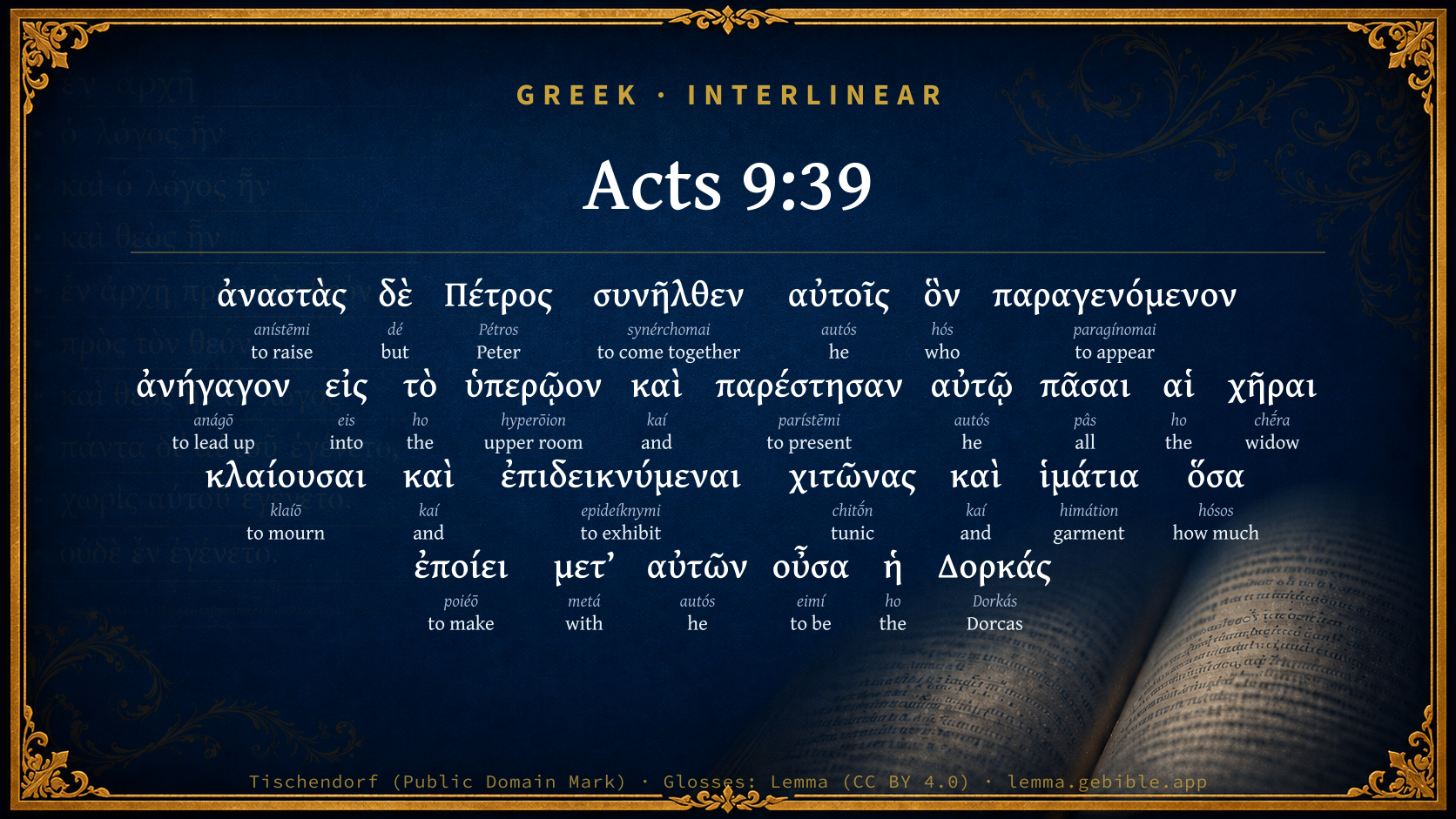
Peter got up and went with them. When he had come, they brought him into the upper chamber. All the widows stood by him weeping, and showing the coats and garments which Dorcas had made while she was with them.
Download a study sheet
One document with this verse’s original text, its word-by-word gloss line, the meaning frame, cross-references with their text, attributed commentary, and full source and license credits — printable, and it pastes into notes with its structure intact.
This verse Autodidact and up
A passage Seminary Student
Up to 50 verses in one chapter. A passage sheet keeps up to 6 commentary sources and 12 cross-references per verse, in the order this page ranks them, and says so on the sheet whenever that leaves anything out. Ask for a single verse and you get the Autodidact verse sheet above.
Everything on this page stays free to read, with no account — the sheet is a download of what is already on screen, not access to it.
Compare translations 3
The same verse in 3 English versions, stacked beneath the original-language interlinear above. Click any original word for its lexicon entry.
Each is an independent rendering of the whole verse — the interlinear is not word-aligned to these translations.
Highlighted words mark where these versions differ — a whole-verse word diff, not a word-by-word alignment.
-
World English Bible Public Domain
Peter got up and went with them. When he had come, they brought him into the upper chamber. All the widows stood by him weeping, and showing the coats and garments which Dorcas had made while she was with them.
-
King James Version Public Domain
Then Peter arose and went with them. When he was come, they brought him into the upper chamber: and all the widows stood by him weeping, and shewing the coats and garments which Dorcas made, while she was with them.
-
unfoldingWord Literal Text CC BY-SA 4.0
So, arising, Peter went with them, whom, having arrived, they brought up to the upper room, and all the widows stood by him, weeping and showing him coats and garments, as many as Dorcas used to make, being with them.
unfoldingWord Literal Text — © unfoldingWord, licensed CC BY-SA 4.0. Word-aligned USFM3 via Door43 (git.door43.org/unfoldingWord/en_ult).
Show all 19 translations
Every available English version of this verse, each an independent rendering of the whole verse.
-
World English Bible Public Domain
Peter got up and went with them. When he had come, they brought him into the upper chamber. All the widows stood by him weeping, and showing the coats and garments which Dorcas had made while she was with them.
-
Berean Standard Bible Public Domain
So Peter got up and went with them. On his arrival, they took him to the upper room. All the widows stood around him, weeping and showing him the tunics and other clothing that Dorcas had made while she was still with them.
-
Majority Standard Bible Public Domain
So Peter got up and went with them. On his arrival, they took him to the upper room. All the widows stood around him, weeping and showing him the tunics and other clothing that Dorcas had made while she was still with them.
-
King James Version Public Domain
Then Peter arose and went with them. When he was come, they brought him into the upper chamber: and all the widows stood by him weeping, and shewing the coats and garments which Dorcas made, while she was with them.
-
American Standard Version (1901) Public Domain
And Peter arose and went with them. And when he was come, they brought him into the upper chamber: and all the widows stood by him weeping, and showing the coats and garments which Dorcas made, while she was with them.
-
Revised Version (1885) Public Domain
And Peter arose and went with them. And when he was come, they brought him into the upper chamber: and all the widows stood by him weeping, and shewing the coats and garments which Dorcas made, while she was with them.
-
Geneva Bible (1599) Public Domain
Then Peter arose and came with them: and when hee was come, they brought him into the vpper chamber, where all the widowes stoode by him weeping, and shewing the coates and garments, which Dorcas made, while she was with them.
-
Douay-Rheims (1899) Public Domain
And Peter rising up, went with them. And when he was come, they brought him into the upper chamber. And all the widows stood about him weeping, and shewing him the coats and garments which Dorcas made them.
-
Young's Literal Translation Public Domain
And Peter having risen, went with them, whom having come, they brought into the upper chamber, and all the widows stood by him weeping, and shewing coats and garments, as many as Dorcas was making while she was with them.
-
Literal Standard Version CC BY-SA 4.0
And Peter having risen, went with them, whom having come, they brought into the upper chamber, and all the widows stood by him weeping, and showing coats and garments, as many as Dorcas was making while she was with them.
-
Unlocked Literal Bible CC BY-SA 4.0
Peter arose and went with them. When he had arrived, they brought him to the upper room, and all the widows stood by him weeping, showing him the coats and garments that Dorcas had made while she had been with them.
-
unfoldingWord Literal Text CC BY-SA 4.0
So, arising, Peter went with them, whom, having arrived, they brought up to the upper room, and all the widows stood by him, weeping and showing him coats and garments, as many as Dorcas used to make, being with them.
-
Darby Bible Public Domain
And Peter rising up went with them, whom, when arrived, they brought up into the upper chamber; and all the widows stood by him weeping and shewing him the body-coats and garments which Dorcas had made while she was with them.
-
World Messianic Bible Public Domain
Peter got up and went with them. When he had come, they brought him into the upper room. All the widows stood by him weeping, and showing the tunics and other garments which Dorcas had made while she was with them.
-
Webster's Bible Public Domain
Then Peter arose, and went with them. When he had come, they brought him into the upper chamber: and all the widows stood by him weeping, and showing the coats and garments which Dorcas made, while she was with them.
-
Free Bible Version CC BY-SA 4.0
So Peter got ready and left with them. When he arrived they took him upstairs. All the widows were there crying, and they showed him the coats and clothes that Dorcas had made while she was with them.
-
Bible in Basic English Public Domain
And Peter went with them. And when he had come, they took him into the room: and all the widows were there, weeping and putting before him the coats and clothing which Dorcas had made while she was with them.
-
Text-Critical English NT CC BY 4.0
So Peter rose and went with them. When he arrived, they brought him to the upper room, and all the widows stood before him, weeping and showing him all the tunics and cloaks that Dorcas had made while she was still with them.
-
Tyndale New Testament (1534) Public Domain
Peter arose and came with them and when he was come they brought him in to the chamber. And all the wydowes stode roude aboute hym wepynge and shewynge the cotes and garmentes which Dorcas made whill she was with them.
Literal Standard Version (2020), Covenant Press — licensed CC BY-SA 4.0. Text via the HelloAO Bible API (eBible.org). Unlocked Literal Bible (unfoldingWord) — licensed CC BY-SA 4.0. Text via the HelloAO Bible API (eBible.org). unfoldingWord Literal Text — © unfoldingWord, licensed CC BY-SA 4.0. Word-aligned USFM3 via Door43 (git.door43.org/unfoldingWord/en_ult). Free Bible Version, Dr. Jonathan Gallagher — licensed CC BY-SA 4.0. Text via the HelloAO Bible API (eBible.org).
Word by word
More ways to search: Search by grammar → Find every occurrence → Compare this word →
Practice this passage: Drill this verse → Learn its vocabulary →
- Appears 2× in the Greek New Testament
- First appears at Acts 9:36
- Part of Speech
- Noun
- Case
- Nominative
- Number
- Singular
- Gender
- Feminine
Full Thayer's Definition
- ἀναστὰς anístēmi G450 “to raise” Verb, Aorist, Active, Participle, Nominative, Singular, Masculine
- δὲ dé G1161 “but” Conjunction
- Πέτρος Pétros G4074 “Peter” Noun, Nominative, Singular, Masculine
- συνῆλθεν synérchomai G4905 “to come together” Verb, Aorist, Active, Indicative, 3rd person, Singular
- αὐτοῖς autós G846 “he” Personal pronoun, Dative, Plural, Masculine
- ὃν hós G3739 “who” Relative pronoun, Accusative, Singular, Masculine
- παραγενόμενον paragínomai G3854 “to appear” Verb, Aorist, Middle deponent, Participle, Accusative, Singular, Masculine
- ἀνήγαγον anágō G321 “to lead up” Verb, Aorist, Active, Indicative, 3rd person, Plural, Attic form
- εἰς eis G1519 “into” Preposition
- τὸ ho G3588 “the” Article, Accusative, Singular, Neuter
- ὑπερῷον hyperōion G5253 “upper room” Noun, Accusative, Singular, Neuter
- καὶ kaí G2532 “and” Conjunction
- παρέστησαν parístēmi G3936 “to present” Verb, Aorist, Active, Indicative, 3rd person, Plural
- αὐτῷ autós G846 “he” Personal pronoun, Dative, Singular, Masculine
- πᾶσαι pâs G3956 “all” Adjective, Nominative, Plural, Feminine
- αἱ ho G3588 “the” Article, Nominative, Plural, Feminine
- χῆραι chḗra G5503 “widow” Noun, Nominative, Plural, Feminine
- κλαίουσαι klaíō G2799 “to mourn” Verb, Present, Active, Participle, Nominative, Plural, Feminine
- καὶ kaí G2532 “and” Conjunction
- ἐπιδεικνύμεναι epideíknymi G1925 “to exhibit” Verb, Present, Middle, Participle, Nominative, Plural, Feminine
- χιτῶνας chitṓn G5509 “tunic” Noun, Accusative, Plural, Masculine
- καὶ kaí G2532 “and” Conjunction
- ἱμάτια himátion G2440 “garment” Noun, Accusative, Plural, Neuter
- ὅσα hósos G3745 “how much” Correlative pronoun, Accusative, Plural, Neuter
- ἐποίει poiéō G4160 “to make” Verb, Imperfect, Active, Indicative, 3rd person, Singular
- μετ’ metá G3326 “with” Preposition
- αὐτῶν autós G846 “he” Personal pronoun, Genitive, Plural, Feminine
- οὖσα eimí G1510 “to be” Verb, Present, Active, Participle, Nominative, Singular, Feminine
- ἡ ho G3588 “the” Article, Nominative, Singular, Feminine
- Δορκάς Dorkás G1393 “Dorcas” Noun, Nominative, Singular, Feminine
About this verse
These counts appear in no published source. They are computed here, from the morphology-tagged text and Lemma’s own curated glosses. What Lemma adds →
- 30
- words
- 24
- distinct lemmas
- Acts
- section
Cross-references
23Topical passages linked to Acts 9:39 in the Treasury of Scripture Knowledge — connected by theme and wording, ordered by reader-vote popularity; previews shown in the World English Bible.
- Proverbs 10:7 The memory of the righteous is blessed, But the name of the wicked will rot.
- Proverbs 31:30–31 Charm is deceitful, and beauty is vain; But a woman who fears Yahweh, she shall be praised.
- Ephesians 4:28 Let him who stole steal no more; but rather let him labor, working with his hands the thing that is good, that he may have something to give to him who has need.
- 1 Thessalonians 1:3 remembering without ceasing your work of faith and labor of love and patience of hope in our Lord Jesus Christ, before our God and Father.
- 2 Samuel 1:24 You daughters of Israel, weep over Saul, Who clothed you in scarlet delicately, Who put ornaments of gold on your clothing.
- Job 31:19–20 If I have seen any perish for want of clothing, Or that the needy had no covering;
- Ecclesiastes 9:10 Whatever your hand finds to do, do it with your might; for there is no work, nor device, nor knowledge, nor wisdom, in Sheol, where you are going.
- Matthew 17:17 Jesus answered, "Faithless and perverse generation! How long will I be with you? How long will I bear with you? Bring him here to me."
- Matthew 25:36–39 naked, and you clothed me; I was sick, and you visited me; I was in prison, and you came to me.'
- Matthew 26:11 For you always have the poor with you; but you don't always have me.
- Mark 14:8 She has done what she could. She has anointed my body beforehand for the burying.
- Luke 24:44 He said to them, "This is what I told you, while I was still with you, that all things which are written in the law of Moses, the prophets, and the psalms, concerning me must be fulfilled."
- John 12:8 For you always have the poor with you, but you don't always have me."
- John 17:12 While I was with them in the world, I kept them in your name. Those whom you have given me I have kept. None of them is lost, except the son of destruction, that the Scripture might be fulfilled.
- Acts 6:1 Now in those days, when the number of the disciples was multiplying, a complaint arose from the Grecian Jews against the Hebrews because their widows were neglected in the daily service.
- Acts 8:2 Devout men buried Stephen, and lamented greatly over him.
- Acts 9:36–37 Now there was at Joppa a certain disciple named Tabitha, which when translated, means Dorcas. This woman was full of good works and acts of mercy which she did.
- Acts 9:41 He gave her his hand, and raised her up. Calling the saints and widows, he presented her alive.
- Acts 20:35 In all things I gave you an example, that so laboring you ought to help the weak, and to remember the words of the Lord Jesus, that he himself said, 'It is more blessed to give than to receive.'"
- 2 Corinthians 8:12 For if the readiness is there, it is acceptable according to what you have, not according to what you don't have.
- 1 Thessalonians 4:13 But we don't want you to be ignorant, brothers, concerning those who have fallen asleep, so that you don't grieve like the rest, who have no hope.
- James 2:15–17 And if a brother or sister is naked and in lack of daily food,
- 1 John 3:18 My little children, let's not love in word only, neither with the tongue only, but in deed and truth.
Cross-references courtesy of OpenBible.info (CC BY 4.0).
Lesson kit
Teaching starters — assembled from the data on this page, not authored interpretation. Every prompt links to the verse data it draws on. Edit before teaching.
Acts, in the Acts, opens this verse with 30 words (24 distinct Greek lemmas). Its most distinctive word is Dorkás (“Dorcas”). A historical commentator’s framing appears above. Read the whole chapter for the surrounding context.
Discussion questions
- What does “Dorcas” (Dorkás) contribute to the verse as a whole?
- Acts 9:36 shares the word «Dorcas» with this verse. How do the two illuminate each other?
- “he” occurs 3× in this one verse. What is the effect of the repetition?
- These translations render this verse differently. What is at stake in choosing one wording over another?
- Reading how Joseph Benson's Commentary and Bengel's Gnomon read this verse, where do the two commentators agree and where do they part?
Things to notice
- These translations choose different wording for 22 words in this verse.
- “he” occurs 3× in this single verse.
- 24 distinct Greek lemmas span 30 words in this verse.
Commentary
Notes on Acts 9:39 from classic Christian and Jewish commentators (each source and its license shown beneath its notes). The classic Christian expositions comment on the surrounding passage and are grouped to its opening verse, so a note may address several verses; the Jewish commentaries on the Tanakh (Rashi and others) are per-verse, so they appear only where the commentator wrote on this verse.
Lemma curates 59 commentaries, every one of them public domain or Creative Commons licensed, each selected and text-cleaned for this edition rather than reprinted as found. About our sources →
Joseph Benson's Commentary
Joseph Benson's Commentary on the Old and New Testaments (1811–1818) — public domain. Text from a community e-Sword module.
Bengel's Gnomon
Johann Albrecht Bengel
Bengel's Gnomon of the New Testament — English translation (T&T Clark, Edinburgh, 1860) — public domain. Text from a community e-Sword module.
Meyer's Critical & Exegetical Commentary
Heinrich August Wilhelm Meyer
Meyer — Critical and Exegetical Commentary on the New Testament — English translation by Peter Christie, edited by Frederick Crombie (T&T Clark, 1880) — public domain. Text from a community e-Sword module.
Expositor's Greek Testament
ed. W. Robertson Nicoll
The Expositor's Greek Testament, edited by W. Robertson Nicoll (1897–1910) — public domain. Text from a community e-Sword module.
Jamieson, Fausset & Brown
Robert Jamieson, A. R. Fausset & David Brown
Jamieson, Fausset & Brown — Commentary Critical and Explanatory on the Whole Bible (1871) — public domain (CC PDM 1.0). Text via the HelloAO Bible API.
Adam Clarke's Commentary
Adam Clarke's Commentary on the Bible (1810–1826) — public domain. Text from a community e-Sword/MySword module.
John Calvin's Commentaries
John Calvin's Commentaries (1540-1563) — public domain. Text from the Calvin Translation Society English edition (1840s-50s) via the Christian Classics Ethereal Library (ccel.org). Calvin's coverage is partial (roughly two-thirds of the Bible); uncommented books and verses are honest gaps, never fabricated. The 19th-century editor's footnotes and remarks are omitted so the notes are faithfully Calvin's own voice.
Ellicott's Commentary for English Readers
A Bible Commentary for English Readers, edited by Charles John Ellicott (1878–1897) — public domain. Text from a community e-Sword module.
The Cambridge Bible for Schools and Colleges
gen. ed. J. J. S. Perowne
The Cambridge Bible for Schools and Colleges (gen. ed. J. J. S. Perowne; Cambridge University Press, 1878–1918) — public domain. Text from a community e-Sword module.
John Gill's Exposition
John Gill's Exposition of the Whole Bible (1746–1763) — public domain (CC PDM 1.0). Text via the HelloAO Bible API.
Trapp's Complete Commentary
John Trapp
John Trapp, A Commentary or Exposition upon All the Books of the Old and New Testament (1647–1656) — public domain. Text from a community e-Sword module.
Albert Barnes' Notes on the Bible
Albert Barnes' Notes on the Bible (1834–1885) — public domain. Text from a community e-Sword/MySword module.
Haydock's Catholic Bible Commentary
George Leo Haydock (1774–1849), Haydock's Catholic Family Bible and Commentary, 1859 edition — public domain. Excludes Psalms (Douay-Rheims chapter numbering differs from Protestant) and Deuterocanonical books (Catholic canon only).
Matthew Poole's English Annotations
Matthew Poole's English Annotations on the Holy Bible (1683–1685) — public domain. Text from a community e-Sword/MySword module.
Whedon's Commentary on the Bible
Daniel D. Whedon
Daniel D. Whedon (gen. ed.), Commentary on the Old and New Testaments (1874–1909) — public domain. Text from a community e-Sword module.
The Pulpit Commentary
The Pulpit Commentary (1880–1919), ed. H.D.M. Spence-Jones & Joseph S. Exell — public domain. Text from a community e-Sword module.
John Wesley's Explanatory Notes
John Wesley, Explanatory Notes Upon the Whole Bible (1754–1765) — public domain. Text via the GEBible commentary corpus.
Scofield Reference Notes
C. I. Scofield
The Scofield Reference Bible (1917 edition), notes by C. I. Scofield — public domain. Text from a community e-Sword module.
McGarvey & Pendleton's Commentaries
J. W. McGarvey
J. W. McGarvey (with Philip Y. Pendleton), Commentaries on the New Testament (The Fourfold Gospel, 1914; Acts; and the epistles) — public domain. Text from a community e-Sword/MySword module.
Cambridge Greek Testament for Schools and Colleges
Cambridge Greek Testament for Schools and Colleges (Cambridge University Press, 1896; 21 vols, various authors incl. Carr, Maclear, Plummer, Farrar, Lumby, Moule, M. R. James, Simcox) — public domain. Text from a community e-Sword module.
Alford’s Greek Testament
Henry Alford
Henry Alford, The Greek Testament (1849–1861) — public domain. Text from a community e-Sword module.
Vincent's Word Studies in the New Testament
Marvin R. Vincent
Marvin R. Vincent, Word Studies in the New Testament (1887–1900) — public domain. Text from a community e-Sword/MySword module.