
John 13:27

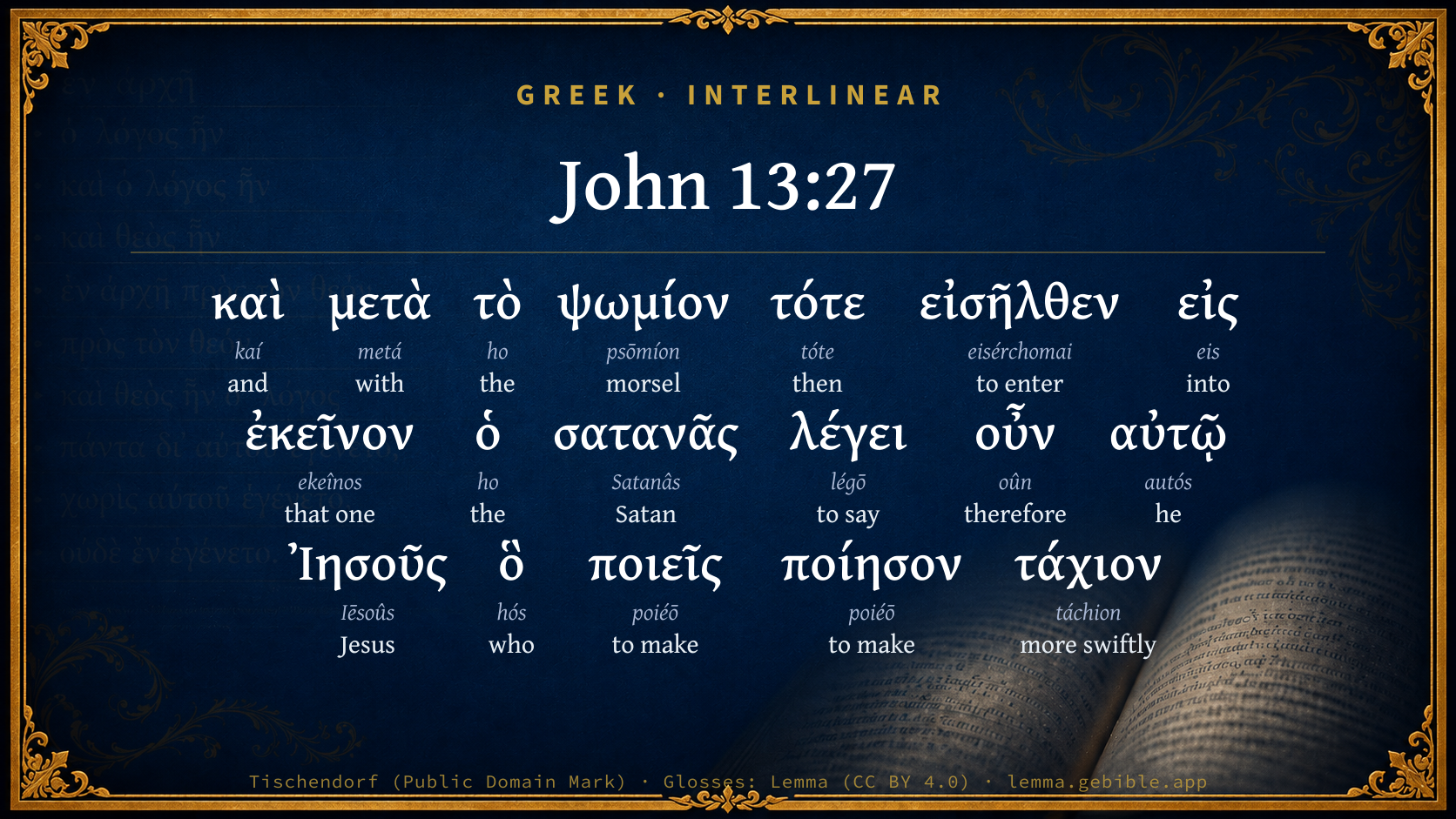
Greek (Tischendorf 8th ed.) John 13:27 appears in the Greek New Testament. The text above is from the Tischendorf 8th edition. Each word links to its Strong’s number and a concise gloss. Click any word for its full Thayer’s Greek Lexicon entry.
Download image
Cite this verse

John 13:27 (World English Bible). Public Domain. Lemma interlinear Bible study tool, https://lemma.gebible.app/v/john/13/27.

Show BibTeX & RIS
BibTeX
RIS
English Translation
After the piece of bread, then Satan entered into him. Then Jesus said to him, "What you do, do quickly."
World English Bible · Public Domain
Highlights
  • 1 first appearance in the Greek New Testament
Full analysis ↓
Download a study sheet

One document with this verse’s original text, its word-by-word gloss line, the meaning frame, cross-references with their text, attributed commentary, and full source and license credits — printable, and it pastes into notes with its structure intact.

This verse Autodidact and up

Study sheet (.html) Plain text (.txt)

A passage Seminary Student

Up to 50 verses in one chapter. A passage sheet keeps up to 6 commentary sources and 12 cross-references per verse, in the order this page ranks them, and says so on the sheet whenever that leaves anything out. Ask for a single verse and you get the Autodidact verse sheet above.

Everything on this page stays free to read, with no account — the sheet is a download of what is already on screen, not access to it.

Want to remove ads? Support Godless Engineer
Compare translations 3

The same verse in 3 English versions, stacked beneath the original-language interlinear above. Click any original word for its lexicon entry.

Each is an independent rendering of the whole verse — the interlinear is not word-aligned to these translations.

Highlighted words mark where these versions differ — a whole-verse word diff, not a word-by-word alignment.

  • World English Bible Public Domain
    After the piece of bread, then Satan entered into him. Then Jesus said to him, "What you do, do quickly."
  • King James Version Public Domain
    And after the sop Satan entered into him. Then said Jesus unto him, That thou doest, do quickly.
  • unfoldingWord Literal Text CC BY-SA 4.0
    And after the bread, Satan then entered into him. Therefore, Jesus says to him, “What you are doing, do quickly.”

unfoldingWord Literal Text — © unfoldingWord, licensed CC BY-SA 4.0. Word-aligned USFM3 via Door43 (git.door43.org/unfoldingWord/en_ult).

Versions to compare (up to 4)

3 of 4 selected

Show all 19 translations

Every available English version of this verse, each an independent rendering of the whole verse.

  • World English Bible Public Domain
    After the piece of bread, then Satan entered into him. Then Jesus said to him, "What you do, do quickly."
  • Berean Standard Bible Public Domain
    And when Judas had taken the morsel, Satan entered into him. Then Jesus said to Judas, “What you are about to do, do quickly.”
  • Majority Standard Bible Public Domain
    And when Judas had taken the morsel, Satan entered into him. Then Jesus said to Judas, “What you are about to do, do quickly.”
  • King James Version Public Domain
    And after the sop Satan entered into him. Then said Jesus unto him, That thou doest, do quickly.
  • American Standard Version (1901) Public Domain
    And after the sop, then entered Satan into him. Jesus therefore saith unto him, What thou doest, do quickly.
  • Revised Version (1885) Public Domain
    And after the sop, then entered Satan into him. Jesus therefore saith unto him, That thou doest, do quickly.
  • Geneva Bible (1599) Public Domain
    And after the soppe, Satan entred into him. Then sayd Iesus vnto him, That thou doest, doe quickly.
  • Douay-Rheims (1899) Public Domain
    And after the morsel, Satan entered into him. And Jesus said to him: That which thou dost, do quickly.
  • Young's Literal Translation Public Domain
    And after the morsel, then the Adversary entered into that one, Jesus, therefore, saith to him, `What thou dost -- do quickly;'
  • Literal Standard Version CC BY-SA 4.0
    And after the morsel, then Satan entered into that one. Jesus, therefore, says to him, “What you do—do quickly”;
  • Unlocked Literal Bible CC BY-SA 4.0
    Then after the bread, Satan entered into him, so Jesus said to him, “What you are doing, do it quickly.”
  • unfoldingWord Literal Text CC BY-SA 4.0
    And after the bread, Satan then entered into him. Therefore, Jesus says to him, “What you are doing, do quickly.”
  • Darby Bible Public Domain
    And, after the morsel, then entered Satan into him. Jesus therefore says to him, What thou doest, do quickly.
  • World Messianic Bible Public Domain
    After the piece of bread, then Satan entered into him. Then Yeshua said to him, “What you do, do quickly.”
  • Webster's Bible Public Domain
    And after the sop Satan entered into him. Then said Jesus to him, What thou doest, do quickly.
  • Free Bible Version CC BY-SA 4.0
    After dipping the piece of bread, he gave it to Judas, son of Simon Iscariot. Once Judas had taken the bread, Satan entered him. “What you're going to do, do it quickly,” Jesus told him.
  • Bible in Basic English Public Domain
    And when Judas took the bread Satan went into him. Then Jesus said to him, Do quickly what you have to do.
  • Text-Critical English NT CC BY 4.0
    After Judas took the morsel, Satan entered into him. Then Jesus said to him, “What yoʋ are about to do, do quickly.”
  • Tyndale New Testament (1534) Public Domain
    And after the soppe Satan entred into him. Then sayd Iesus vnto him: that thou dost do quickly.

Literal Standard Version (2020), Covenant Press — licensed CC BY-SA 4.0. Text via the HelloAO Bible API (eBible.org). Unlocked Literal Bible (unfoldingWord) — licensed CC BY-SA 4.0. Text via the HelloAO Bible API (eBible.org). unfoldingWord Literal Text — © unfoldingWord, licensed CC BY-SA 4.0. Word-aligned USFM3 via Door43 (git.door43.org/unfoldingWord/en_ult). Free Bible Version, Dr. Jonathan Gallagher — licensed CC BY-SA 4.0. Text via the HelloAO Bible API (eBible.org).

Word by word

More ways to search: Search by grammar → Find every occurrence → Compare this word →

Practice this passage: Drill this verse → Learn its vocabulary →

ψωμίον
psōmíon
G5596
“morsel”
Noun, Accusative, Singular, Neuter
Part of Speech
Noun
Case
Accusative
Number
Singular
Gender
Neuter
Full Thayer's Definition

Origin: diminutive from a derivative of the base of G5597

TDNT: None

1. a fragment, bit, morsel
  1. καὶ kaí G2532 “and” Conjunction
  2. μετὰ metá G3326 “with” Preposition
  3. τὸ ho G3588 “the” Article, Accusative, Singular, Neuter
  4. τότε tóte G5119 “then” Adverb
  5. εἰσῆλθεν eisérchomai G1525 “to enter” Verb, Aorist, Active, Indicative, 3rd person, Singular
  6. εἰς eis G1519 “into” Preposition
  7. ἐκεῖνον ekeînos G1565 “that one” Demonstrative pronoun, Accusative, Singular, Masculine
  8. ὁ ho G3588 “the” Article, Nominative, Singular, Masculine
  9. σατανᾶς Satanâs G4567 “Satan” Noun, Nominative, Singular, Masculine
  10. λέγει légō G3004 “to say” Verb, Present, Active, Indicative, 3rd person, Singular
  11. οὖν oûn G3767 “therefore” Conjunction
  12. αὐτῷ autós G846 “he” Personal pronoun, Dative, Singular, Masculine
  13. Ἰησοῦς Iēsoûs G2424 “Jesus” Noun, Nominative, Singular, Masculine
  14. ὃ hós G3739 “who” Relative pronoun, Accusative, Singular, Neuter
  15. ποιεῖς poiéō G4160 “to make” Verb, Present, Active, Indicative, 2nd person, Singular
  16. ποίησον poiéō G4160 “to make” Verb, Aorist, Active, Imperative, 2nd person, Singular
  17. τάχιον táchion G5032 “more swiftly” Adverb, Comparative

About this verse

These counts appear in no published source. They are computed here, from the morphology-tagged text and Lemma’s own curated glosses. What Lemma adds →

18
words
16
distinct lemmas
Gospels
section

Notable vocabulary

The rarest word here is ψωμίον morsel G5596 — appearing just 4 times in the whole Greek New Testament.

First appearance in Scripture

This word makes its first canonical appearance in the Greek New Testament here:

  • τάχιον more swiftly G5032

Shared distinctive vocabulary

ψωμίον morsel G5596 occurs in 3 verses of the Greek New Testament. Also found in:
Repetition

Words recur within this verse:

  • ποιεῖς to make G4160 ×2
  • τὸ the G3588 ×2

Cross-references

12

Topical passages linked to John 13:27 in the Treasury of Scripture Knowledge — connected by theme and wording, ordered by reader-vote popularity; previews shown in the World English Bible.

  • Luke 22:3 Satan entered into Judas, who was surnamed Iscariot, who was numbered with the twelve.
  • John 13:2 After supper, the devil having already put into the heart of Judas Iscariot, Simon's son, to betray him,
  • Proverbs 1:16 For their feet run to evil. They hurry to shed blood.
  • Ecclesiastes 9:3 This is an evil in all that is done under the sun, that there is one event to all: yes also, the heart of the sons of men is full of evil, and madness is in their heart while they live, and after that they go to the dead.
  • Matthew 12:45 Then he goes, and takes with himself seven other spirits more evil than he is, and they enter in and dwell there. The last state of that man becomes worse than the first. Even so will it be also to this evil generation."
  • Acts 5:3 But Peter said, "Ananias, why has Satan filled your heart to lie to the Holy Spirit, and to keep back part of the price of the land?
  • James 1:13–15 Let no man say when he is tempted, "I am tempted by God," for God can't be tempted by evil, and he himself tempts no one.
  • Jeremiah 2:24–25 a wild donkey used to the wilderness, that snuffs up the wind in her desire; in her occasion who can turn her away? all those who seek her will not weary themselves; in her month they shall find her.
  • Daniel 2:15 he answered Arioch the king's captain, Why is the decree so urgent from the king? Then Arioch made the thing known to Daniel.
  • 1 Kings 18:27 It happened at noon, that Elijah mocked them, and said, Cry aloud; for he is a god: either he is musing, or he is gone aside, or he is on a journey, or peradventure he sleeps and must be awakened.
  • Psalms 109:6 Set a wicked man over him. Let an adversary stand at his right hand.
  • Mark 6:25 She came in immediately with haste to the king, and asked, "I want you to give me right now the head of John the Baptizer on a platter."

Cross-references courtesy of OpenBible.info (CC BY 4.0).

Commentary

Notes on John 13:27 from classic Christian and Jewish commentators (each source and its license shown beneath its notes). The classic Christian expositions comment on the surrounding passage and are grouped to its opening verse, so a note may address several verses; the Jewish commentaries on the Tanakh (Rashi and others) are per-verse, so they appear only where the commentator wrote on this verse.

Lemma curates 59 commentaries, every one of them public domain or Creative Commons licensed, each selected and text-cleaned for this edition rather than reprinted as found. About our sources →

Joseph Benson's Commentary

Joh 13:27-30. And after the sop Satan entered into him — More fully; “non secundum substantiam,” says Jerome, “sed secundum operationem,” not as to his substance, but as to his operation; as he is said to do when man’s will is fully inclined to obey his motions. Then said Jesus, That thou doest, do quickly — This is not a permission, much less a command. It is only as if he had said, If thou art determined to do it, why dost thou delay? Hereby showing Judas that he could not be hid, and expressing his own readiness to suffer. No man at the table knew why he said this — That is, none except John and Judas, for John does not here include himself, but speaks of the other disciples; for though they could know nothing of the matter, in all probability he must have comprehended the meaning of Christ’s words to the traitor. Some thought because Judas had the bag — Had the keeping of the common purse, on which they were to subsist during their stay at Jerusalem; that Jesus had said, Buy that which we have need of against the feast — That is, the seven ensuing days of the feast; or that he should give something to the poor — These meanings were what first occurred to the disciples. But being in great perplexity on account of his declaration concerning the treachery of one of their number, they did not think much upon what he now said to Judas. The declaration which engrossed their attention had not pointed at any of them in particular, and the discovery of the person was made to John only. They were therefore swallowed up in grief, and each of them would fain have cleared himself, inquiring of Jesus, one by one, Lord, is it I? Mat 26:22; Mar 14:19. Judas himself even, conscious as he was of his guilty purpose, also inquiring, with unparalleled impudence, Master, is it I? He then, having received the sop — With the awful words of his Master (giving him to know that his intentions were not concealed) sounding, as it were, in his ears; went immediately out — To the chief priests, or, went out soon, without any further reply, as ευθεως, here rendered immediately, sometimes signifies: for it seems he stayed till the Lord’s supper was instituted: being so utterly abandoned as to be capable of committing his intended horrible crime, even with this aggravation; and it was night — Which was the time he had appointed to meet those who were consulting how to execute their purpose against the life of Jesus, and under the cover of it he went to them, and fulfilled his engagement in a little time, by delivering his Master into their hands.

Joseph Benson's Commentary on the Old and New Testaments (1811–1818) — public domain. Text from a community e-Sword module.

MacLaren's Expositions of Holy Scripture

Alexander MacLaren

John

THE DISMISSAL OF JUDAS

Joh 13:27.

When our Lord gave the morsel, dipped in the dish, to Judas, only John knew the significance of the act. But if we supplement the narrative here with that given by Matthew, we shall find that, accompanying the gift of the sop, was a brief dialogue in which the betrayer, with unabashed front, hypocritically said, ‘Lord! Is it I?’ and heard the solemn, sad answer, ‘Thou sayest!’ Two things, then, appealed to him at the moment: one, the conviction that he was discovered; the other, the wonderful assurance that he was still loved, for the gift of the morsel was a token of friendliness. He shut his heart against them both; and as he shut his heart against Christ he opened it to the devil. So ‘after the sop Satan entered into him.’ At that moment a soul committed suicide; and none of those that sat by, with the exception of Christ and the ‘disciple whom He loved,’ so much as dreamed of the tragedy going on before their eyes.

I know not that there are anywhere words more weighty and wonderful than those of our text. And I desire to try if I can at all make you feel as I feel, their solemn signification and force. ‘That thou doest, do quickly.’

I. I hear in them, first, the voice of despairing love abandoning the conflict.

If I have rightly construed the meaning of the incident, this is the plain meaning of it. And you will observe that the Revised Version, more accurately and closely rendering the words of our text, begins with a ‘Therefore.’ ‘Therefore said Jesus unto him,’ because the die was cast; because the will of Judas had conclusively welcomed Satan, and conclusively rejected Christ; therefore, knowing that remonstrance was vain, knowing that the deed was, in effect, done, Jesus Christ, that Incarnate Charity which ‘believeth all things, and hopeth all things,’ abandoned the man to himself, and said, ‘There, then, if thou wilt thou must. I have done all I can; my last arrow is shot, and it has missed the target. That then doest, do quickly.’

There is a world of solemn meaning in that one little word ‘doest.’ It teaches us the old lesson, which sense is so apt to forget, that the true actor in man’s deeds is ‘the hidden man of the heart,’ and that when it has acted, it matters comparatively little whether the mere tool and instrument of the hands or of the other organs have carried out the behest. The thing is done before it is done when the man has resolved, with a fixed will, to do it. The betrayal was as good as in process, though no step beyond the introductory ones, which could easily have been cancelled, had yet been accomplished. Because there was a fixed purpose which could not be altered by anything now, therefore Jesus Christ regards the act as completed. It is what we think in our hearts that we are; and our fixed determinations, our inclinations of will, are far more truly our doings than the mere consequences of these, embodied in actuality. It is but a poor estimate of a man that judges him by the test of what he has done. What he has wanted to do is the true man; what he has attempted to do. ‘It was well that it was in thine heart!’ saith God to the king who thought of building the Temple which he was never allowed to rear. ‘It is ill that is in thine heart,’ says He by whom actions are weighed, to the sinner in purpose, though his clean hands lie idly in his lap. These hidden movements of desire and will that never come to the surface are our true selves. Look after them, and the deeds will take care of themselves. Serpent’s eggs have serpents in them. And he that has determined upon a sin has done the sin, whether his hands have been put to it or no.

But, then, turn for a moment to the other thought that is suggested here-that solemn picture of a soul left to do as it will, because divine love has no other restraints which it can impose, and is bankrupt of motives that it can adduce to prevent it from its madness. Now I do not believe, for my part, that any man in this world is so all-round ‘sold unto sin’ as that the seeking love of God gives him up as irreclaimable. I do not believe that there are any people concerning whom it is true that it is impossible for the grace of God to find some chink and cranny in their souls through which it can enter and change them. There are no hopeless cases as long as men are here. But, then, though there may not be so, in regard to the whole sweep of the man’s nature, yet every one of us, over and over again, has known what it is to come exactly into that position in regard to some single evil or other, concerning which we have so set our teeth and planted our feet at such an angle of resistance as that God gives up dealing with us and leaves us, as He did with Balaam when He opposed his covetous inclinations to all the remonstrances of Heaven. God said at last to him ‘Go!’ because it was the best way to teach him what a fool he had been in wanting to go. Thus, when we determine to set ourselves against the pleadings and the beseechings of divine love, the truest kindness is to fling the reins upon our necks, and let us gallop ourselves into a sweat and weariness, and then we shall be more amenable to the touch of the rein thereafter.

Are there any people whom God is teaching obedience to His light touch, by letting them run their course after some one specific sin? Perhaps there are. At all events, let us remember that that position of being allowed to do as we like is one to which we all tend, in the measure in which we indulge our inclinations, and shut our hearts against God’s pleadings. There is such a thing as a conscience seared as with a hot iron. They used to say that there were witches’ marks on the body, places where, if you stuck a pin in, there was no feeling. Men cover themselves all over with marks of that sort, which are not sensitive even to the prick of a divine remonstrance, rebuke, or retribution. They ‘wipe their mouths and say I have done no harm.’ You can tie up the clapper of the bell that swings on the black rock, on which, if you drift, you go to pieces. You can silence the Voice by the simple process of neglecting it. Judas set his teeth against two things, the solemn conviction that Jesus Christ knew his sin, and the saving assurance that Jesus Christ loved him still. And whosoever resists either of these two is getting perilously near to the point where, not in petulance but in pity, God will say, ‘Very well, I have called and ye have refused. Now go, and do what you want to do, and see how you like it when it is done. What thou doest, do quickly.’ Do you remember the other word, ‘If ‘twere done when ‘tis done, then ‘twere well it were done quickly’? But since consequences last when deeds are past, perhaps you had better halt before you determine to do them.

II. Now, secondly, I hear in these words the voice of strangely blended majesty and humiliation.

‘What thou doest, do!’ Judas thought he had got possession of Christ’s person, and was His master in a very real sense. When lo! all at once the victim assumes the position of the Lord and commands, showing the traitor that instead of thwarting and counterworking, he was but carrying out the designs of his fancied victim; and that he was an instrument in Christ’s hands for the execution of His will. And these two thoughts, how, in effect, all antagonism, all malicious hatred, all violent opposition of every sort but work in with Christ’s purpose, and carry out His intention; and how, at the moments of deepest apparent degradation, He towers, in manifest Majesty and Masterhood, seem to me to be plainly taught in the word before us.

He uses his foes for the furtherance of His purpose. That has been the history of the world ever since. ‘The floods, O Lord, have lifted up their voice.’ And what have they done? Smashing against the breakwater, they but consolidate its mighty blocks, and prove that ‘the Lord on high is mightier than the noise of many waters.’ It has been so in the past, it is so to-day; it will be so till the end. Every Judas is unconsciously the servant of Him whom he seeks to betray; and finds out to his bewilderment that what he meant for a death-blow is fulfilling the very purpose and will of the Lord against whom he has turned.

Again, the combination here, in such remarkable juxtaposition, of the two things, a willing submission to the utmost extremity of shame, which the treasonous heart can froth out in its malice and, at the same time, a rising up in conscious majesty and lordship, are suggested to us by the words before us. That combination of utter lowliness and transcendent loftiness runs through the whole life and history of our Lord. Did you ever think how strong an argument that strange combination, brought out so inartificially throughout the whole of the Gospels, is for their historical veracity? Suppose the problem had been given to poets to create and to set in a series of appropriate scenes a character with these two opposites stamped equally upon it, neither of them impinging upon the domain of the other-viz., utter humility and humiliation in circumstance, and majestic sovereignty and elevation above all circumstances-do you think that any of them could have solved the problem, though- Aeschylus and Shakespeare had been amongst them, as these four men that wrote these four little tracts that we call Gospels have done? How comes it that this most difficult of literary problems has been so triumphantly solved by these men? I think there is only one answer, ‘Because they were reporters, and imagined nothing, but observed everything, and repeated what had happened.’ He reconciled these opposites who was the Man of Sorrows and acquainted with grief, and yet the Eternal Son of the Father; and the Gospels have solved the problem only because they are simple records of its solution by Him.

Wherever in His history there is some trait of lowliness there is by the side of it a flash of majesty. Wherever in His history there is some gleaming out from the veil of flesh of the hidden glory of divinity, there is immediately some drawing of the veil across the glory. And the two things do not contradict nor confuse, but we stand before that double picture of a Christ betrayed and of a Christ commanding His betrayer, and using his treason, and we say, ‘The Word was made flesh, and dwelt among us.’

III. Again, I hear the voice of instinctive human weakness.

‘That thou doest, do quickly.’ It may be doubtful, and some of you perhaps may not be disposed to follow me in my remark, but to my ear that sounds just like the utterance of that instinctive dislike of suspense and of the long hanging over us of the sword by a hair, which we all know so well. Better to suffer than to wait for suffering. The loudest thunder-crash is not so awe-inspiring as the dread silence of nature when the sky is black before the peal rolls through the clouds. Many a martyr has prayed for a swift ending of his troubles. Many a sorrowing heart, that has been sitting cowering under the anticipation of coming evils, has wished that the string could be pulled, as it were, and they could all come down in one cold flood, and be done with, rather than trickle drop by drop. They tell us that the bravest soldiers dislike the five minutes when they stand in rank before the first shot is fired. And with all reverence I venture to think that He who knew all our weaknesses in so far as weakness was not sin, is here letting us see how He, too, desired that the evil which was coming might come quickly, and that the painful tension of expectation might be as brief as possible. That may be doubtful; I do not dwell upon it, but I suggest it for your consideration.

IV. And then I pass on to the last of the tones that I hear in these utterances-the voice of the willing Sacrifice for the sins of the world.

‘That thou doest, do quickly.’ There is nothing more obvious throughout the whole of the latter portion of the Gospel narrative than the way in which, increasingly towards its close, Jesus seemed to hasten to the Cross. You remember His own sayings: ‘I have a baptism to be baptized with, and how am I straitened till it be accomplished. I am come to cast fire on the earth; would it were already kindled!’ You remember with what a strange air-I was going to use an inappropriate word, and say, of alacrity; but, at all events, of fixed resolve-He journeyed from Galilee, in that last solemn march to Jerusalem, and how the disciples followed, astonished at the unwonted look of decision and absorption that was printed upon His countenance. If we consider His doings in that last week in Jerusalem, how he courted publicity, how He avoided no encounter with His official enemies, how He sharpened His tones, not exactly so as to provoke, but certainly so as by no means to conciliate, we shall see, I think, in it all, His consciousness that the hour had come, and His absolute readiness and willingness to be offered for the world’s sin. He stretches out His hands, as it were, to draw the Cross nearer to Himself, not with any share in the weakness of a fanatical aspiration after martyrdom, but under a far deeper and more wonderful impulse.

Why was Christ so willing, so eager, if I may use the word, that His death should be accomplished? Two reasons, which at the bottom are one, answer the question. He thus hastened to His Cross because He would obey the Father’s will, and because He loved the whole world-you and me and all our fellows. We were each in His heart. It was because He wanted to save thee that He said to Judas, ‘Do it quickly, that the world’s salvation and that man’s salvation may be accomplished.’ These were the cords that bound Him to the altar. Let us never forget that Judas with his treachery, and rulers with their hostility, and Pilate with his authority, and the soldiers with their nails, and centurions with their lances, and the grim figure of Death itself with its shaft, would have been all equally powerless against Christ if it had not been his loving will to die on the Cross for each of us.

Therefore, brethren, as we hear this voice, let us discern in it the tones which warn us of the danger of yielding to inclination and stifling His rebukes, till He abandons us for the moment in despair; let us hear in it the pathetic voice of a Brother, who knows all our weaknesses and has felt our emotions; let us hear the voice of Sovereign Authority which uses its enemies for its purposes, and is never loftier than when it is most lowly, whose Cross is His throne of glory, whose exaltation is His deepest humiliation, and let us hear a love which, discerning each of us through all the ages and the crowds, went willingly to the Cross because He willed that He should be our Saviour.

And seeing that time is short, and the future precarious, and delay may darken into loss and rejection, let us take these words as spoken to us in another sense, and hear in them the warning that ‘to-day, if we will hear His voice, we harden not our hearts,’ and when He says to us, in regard to repentance and faith, and Christian consecration and service, ‘That thou doest, do quickly,’ let us answer, ‘I made haste and delayed not, but made haste to keep Thy commandments.’

Alexander MacLaren, Expositions of Holy Scripture (1904–1910) — public domain. Text from a community e-Sword module.

Tyndale Open Study Notes

Tyndale Open Resources

13:27 When Satan entered into Judas (see Luke 22:3), Judas became an example of what happens to those who are consumed by the darkness. Satan uses such people as pawns in a wider struggle against the light. • Hurry and do what you’re going to do: In issuing this command, Jesus once again showed that he was in control, not human beings or Satan (see study note on John 7:30).

Tyndale Open Study Notes — © Tyndale Open Resources, licensed CC BY-SA 4.0. Text via the HelloAO Bible API.

Bengel's Gnomon

Johann Albrecht Bengel

Joh 13:27. Μετὰ τὸ ψώμιον, after the giving of the morsel) not at the time of giving the morsel.—τότε, then) The time is accurately marked, and may be compared with the similar notation of time, Luk 22:3; Luk 22:7, “Then (δέ) entered Satan into Judas;—then (δέ) came the day of unleavened bread,” etc.—εἰσῆλθεν, entered) Previously he may have only suggested [“put into his heart”] the thought, Joh 13:2 [ch. Joh 12:4 (his objection to the waste of the ointment on the person of Jesus); Joh 6:70-71, “Jesus answered,—One of you is a devil: He spake of Judas”]. As the economy of evil and that of good may, from opposite sides, be compared with one another in all respects: so also the degrees of satanic operation and possession may be compared with those of the Divine operation and indwelling.—ἐκεῖνον, that man) He already marks Judas by a pronoun that removes him to a distance.—ὃ ποιεῖς, what thou doest) He does not desire him to do it, but, if he must persist in doing it, to do it quickly; and thereby He intimates, that He is ready for suffering. Judas might have perceived from this ray of the Lord’s omniscience, that he is known.—τάχιον, more quickly) So εὐθέως, Joh 13:30, “He then, having received the sop, went immediately out.” In Joh 13:31, “Therefore, when he was gone out, Jesus said, Now is the Son of man glorified,” the cause is shown why Jesus thus hastened to the passion.

Bengel's Gnomon of the New Testament — English translation (T&T Clark, Edinburgh, 1860) — public domain. Text from a community e-Sword module.

Meyer's Critical & Exegetical Commentary

Heinrich August Wilhelm Meyer

Joh_13:27-28. Καὶ μετὰ τὸ ψωμ.] and after the morsel, i.e. after Jesus had given him the morsel, Joh_13:26. So frequently also in the classics a single word only is used with μετά, which, according to the context, represents an entire sentence. See Ast, ad Plat. Leg. p. 273 f., Lex. Plat. II. p. 311; Jacobs, ad Anthol. XIII. p. 82.

τότε] then, at that moment, intentionally bringing into relief the horribly tragic moment.

εἰσῆλθεν, κ.τ.λ.] so that he was therefore from henceforward a man possessed by the devil, Mar_5:12-13; Mar_9:25; Luk_8:30; Mat_12:45. The expression (comp. Luk_22:3) forbids a figurative interpretation (that Judas completely hardened himself after this discovery was understood by him to have been made), which is already to be found in Theodore of Mopsuestia. The complete hardening, in consequence of which he could no more retrace his steps, was simply the immediate consequence of this possession by the devil. But against a magical causal connection, as it were, of the entrance of the devil along with the morsel, Cyril already justly declared himself. The representation rather is, that now, just when Judas had taken the morsel without inward compunction, he was given up by Christ, and therewith is laid open to the unhindered entrance of the devil (καθάπερ τινὰ πύλην τὴν τοῦ φυλάττοντος ἐρήμην, Cyril), and experiences this entrance. John did not see this (in the external bearing of Judas, as Godet supposes); but it is with him a psychological certainty.

ὅ ποιεῖς, ποίησον τάχιον] What thou purposest to do (comp. Joh_13:6; Winer, p. 249 [E. T. p. 304]), do more quickly. In the comparative lies the notion: hasten it. So very frequently in Homer θᾶσσον. See Duncan, Lex. ed. Rost, p. 524, and generally Nägelsbach, Anm. z. Ilias, p. 21, 314, ed. 3; on the graecism of τάχιον, Lobeck, ad Phryn. p. 77. The imperative, however, is not permissive (Grotius, Kuinoel, and several others); but Jesus actually wishes to surmount as soon as possible the last crisis (His ὥρα), now determined for Him in the connection of the divine destiny. The resigned, characteristic decision of mind brooks no delay. To suggest the intention, on the part of Jesus, that He wished to be rid of the oppressive proximity of the traitor (Ambrose: ut a consortio suo recederet, comp. Lücke, B. Crusius, Tholuck), is to anticipate what follows.

Meyer — Critical and Exegetical Commentary on the New Testament — English translation by Peter Christie, edited by Frederick Crombie (T&T Clark, 1880) — public domain. Text from a community e-Sword module.

Expositor's Greek Testament

ed. W. Robertson Nicoll

Joh 13:27 . But instead of moving Judas to compunction μετὰ τὸ ψωμίον , τότε εἰσῆλθεν εἰς ἐκεῖνον ὁ Σατανᾶς . μετὰ “after,” not “with,” “non cum offula,” Bengel and Cyril, who also says, οὐ γὰρ ἔτι σύμβουλον ἔχει τὸν σατανᾶν , ἀλλʼ ὅλης ἤδη τῆς καρδίας δεσπότην . On ἐκεῖνον Bengel also has: “Jam remote notat Judam”. Morally he is already far removed from that company. But what was it that thus finally determined Judas? Perhaps the very revulsion of feeling caused by taking the sop from Jesus: perhaps the accompanying words, Ὃ ποιεῖς , ποίησον τάχιον , “what thou doest, do quickly”. τάχιον : “to Attic writers θάσσων ( θάττων ) was the only comparative, and τάχιστος the only superlative”. Rutherford, New Phryn. , p. 150. The idea in the comparative is “with augmented speed,” see Donaldson’s Greek Gram. , p. 390.

The Expositor's Greek Testament, edited by W. Robertson Nicoll (1897–1910) — public domain. Text from a community e-Sword module.

Godet's Commentaries

Frédéric Louis Godet

Vv. 27b-30. “Jesus therefore said to him: What thou doest, do quickly. 28. But no one of those who were at table knew why he said this to him. 29. For some thought that, as Judas had the bag, Jesus meant to say to him, Buy the things which we have need of for the feast, or that he bade him give something to the poor. 30. He therefore, having taken the morsel, went out immediately. Now it was night.”

The words of Jesus to Judas are not a permission (Grotius); they are a command. But, it is said, Jesus pushed Judas into the abyss by speaking to him thus. Jesus had no longer any ground to spare him, since from this decisive moment no return was possible for Judas. The evening was already far advanced (Joh 13:30), and Jesus had need of the little time which remained to Him to finish His work with His own. Judas in his pride imagined that he held the person of his Master in his hands. Jesus makes him understand that he, as well as the new master whom he obeys, is only an instrument. The word τάχιον signifies: more quickly; the meaning is therefore: “hasten thy begun work.” John says: no one of those who were at table (Joh 13:28). Perhaps he tacitly excepts himself. Weiss thinks not. He believes also that John did not understand the import of the injunction of Jesus. From the words: for the feast, some infer that this evening could not be that on which the people celebrated the Paschal supper. For how could purchases be made on a Sabbatical day, such as that was? And if the Paschal supper, the essential act of the feast, was already finished, there were no more purchases to be made for the feast. But, on the other side, it may be said that if this evening had been that of the 13th-14th of Nisan, the entire day of the 14th would still remain for making purchases. And how could the disciples have supposed that Jesus sent Judas out for this purpose in the darkness of the night (Luthardt, Keil)? This passage, therefore, does not seem to us fitted to solve the difficult question which is in hand. Nevertheless it appears to me that the for the feast is more naturally understood if it was yet on the evening which preceded the day of the 14th, the first of the feast of the Passover (see on Joh 13:1). We are amazed at the skill with which Judas had been able to disguise his character and his plans. Even at this last moment, his fellow-disciples were entirely blinded with regard to him. On His part, Jesus could not without danger unmask him more openly than He does here; with the impetuosity of a Peter, what might have occurred between him and the traitor? This whole scene, described in Joh 13:27-29, was an affair of a moment. For this reason the words: having taken the morsel, Joh 13:30, are directly connected by οὖν with Joh 13:27 : and after having taken the morsel. It is between the participle having taken and the verb he went out, that Hengstenberg wishes to place the institution of the Lord’s Supper. But the εὐθέως, immediately, too closely connects the second of these two acts with the first. The last words: it was night, make us think of Jesus’ words in Luk 22:53 : “This is your hour and the power of darkness.” They complete the picture of a situa tion which had left on the heart of John ineffaceable recollections. The Johannean narrative is studded throughout with similar incidents, which are explicable only by the vividness of personal recollection. Comp. Joh 1:40, Joh 6:59, Joh 8:20, Joh 10:23, etc. Augustine (see Westcott) adds to these words: Erat autem nox, this gloss: Et ipse qui exivit erat nox.

At what time in the meal is the institution of the Lord’s Supper to be placed? We adopt the view, as we propose this question, that this meal is in fact the one in which, according to the Synoptics, Jesus instituted this ceremony. Bengel, Wichelhaus and others, it is true, have tried to distinguish two suppers: the first, that of John 13, took place at Bethany; Joh 14:31 indicates the moment when Jesus departed from that place to repair to Jerusalem; the second, that of the Synoptics, took place on the next day at evening, at the time of the Israelite Paschal supper. But the prediction of the denial of Peter, with the words: Even this night, in both passages, renders this supposition inadmissible. We hold, moreover, that, if the author of the fourth Gospel does not mention the institution of the Lord’s Supper, it is not because he is ignorant of it or that he would deny it, but because this fact was sufficiently well known in the Church, and because there was nothing to lead him specially to recall it to mind in his narrative (see on Joh 13:20). If the case stands thus, where is the institution of the Lord’s Supper to be inserted in our narrative?

According to Kern, after Joh 14:31, as the foundation of the discourse in Joh 15:1 ff.: “I am the true vine,” etc. But, at this time, Jesus rises and gives the order to depart: is this a suitable situation for such a ceremony? According toOlshausen, Luthardt, after Joh 13:38 (prediction of Peter’s denial) and before the words: Let not your heart be troubled.This opinion would be admissible, if the Synoptics did not agree in placing the prediction of the denial after the institution, and even (two of them) on the way to Gethsemane. Lucke, Lange, Maier and others: in the interval between Joh 13:33 and Joh 13:34, because of the connection between the idea of the new commandment and that of thenew covenant in the institution of the Supper. But the direct connection between the question of Peter: Lord, whither goest thou? (Joh 13:36) and the words of Jesus: Whither I go, ye cannot come (Joh 13:33), make it difficult to insert so considerable a ceremony between these two verses. Neander, Ebrard: in the interval between Joh 13:32 and Joh 13:33. There is, indeed, between Joh 13:31-32 and Joh 13:33-34 a certain break of continuity.

The idea of the glory of Jesus (Joh 13:31-32) may have preceded the institution of the Supper, and the latter have been followed no less naturally by the idea of the approaching departure of Jesus (Joh 13:33-34). In itself, there is nothing to oppose this solution. Paulus, Kahnis and others decide for the interval between Joh 13:30 and Joh 13:31, immediately after the departure of Judas. The words: When therefore he was gone out, Jesus said (see at Joh 13:31) are not favorable to this opinion, and the words of Joh 13:31-32 have the character of an exclamation called forth by the departure of Judas. Meyer, Weiss, Keil (the last two, because of the first two Synoptics, who place the institution of the Supper immediately after the revelation concerning the traitor) content themselves with saying: after Joh 13:30, without attempting to make a more precise statement. But what, in this case, are we to do with the narrative of Luke who, on the contrary, places the revelation of the traitor immediately after the institution of the Supper. If he works on the foundation of Mark’s narrative, how does he modify it in so perceptible and arbitrary a manner?

And if he has a source which is peculiar to himself, why should it not have its own value by the side of that of the two other Synoptics? His account of the institution of the Supper is fully confirmed by Paul. The opinion of these critics is, therefore, precarious. The idea ofHengstenberg (at the moment of Joh 13:30 and before the departure of Judas) is not compatible with the expression: he went out immediately. Stier has decided for the interval between Joh 13:22 and Joh 13:23; but the question of Peter in Joh 13:24 is so closely connected with that of the disciples in Joh 13:22! Baumlein suggests the interval between Joh 13:19 and Joh 13:21, where the quite isolated words of Joh 13:20 are placed. The idea of receiving Jesus in the person of His messengers, and of receiving in Him God Himself, is indeed in harmony with that of the dwelling of the Lord in His own; thus with that of the Supper. In my first edition, the authority of Luke’s narrative and certain indications in that of John led me to place the washing of the feet quite at the end of the meal. The institution of the Lord’s Supper must consequently have preceded it, and thus I went back, with Seiffert, even to the beginning of the meal, Joh 13:1-3, for the locating of the Supper, while seeking an allusion to this last pledge of the divine love in the expression: He ended by testifying to them all his love. I have abandoned this idea altogether: 1. Because there is an improbability in placing the washing of the feet at the end of the meal; 2. Because Joh 13:26 (the morsel given to Judas) proves that they were still in the midst of the meal, after that Acts 3. Because the indication, Luk 23:24, is very vague: “There was also a dispute among the disciples.” It is impossible to draw from this a conclusion with relation to the moment when the dispute occurred.

Beyschlag has brought out an important circumstance; it is that according to the Synoptics the institution of the Supper did not take place at one single time, but that it was divided into two very distinct acts; the one during, the other after the meal (Luk 22:20 and 1Co 11:25). The first may, therefore, be placed before Joh 13:18, and the second after Joh 13:30. Westcott arrives at nearly the same result. He places the act relating to the bread between Joh 13:19-20 and that relating to the cup between Joh 13:32-33. If we study the Synoptic narratives, we find in all the three these three elements:

1. The farewell word (I will no more drink of this fruit of the vine); 2. The institution of the Supper; 3. The revelation of the traitor. In the three accounts, the second is placed in the middle; but the first is placed as the third in Luke, at the beginning in the other two, from which it follows that the question of the participation of Judas in the Supper is not so simple as it appears to be at the first glance, and may be resolved at once affirmatively (with relation to the bread) and negatively (with relation to the cup). A second observation which goes to support the preceding is that, according to John, Jesus spoke of Judas not once, but three times, at different moments in the repast. The Synoptics have concentrated these three revelations in a single one, which they have placed, either before, or after, the institution of the Supper. It is very possible, therefore, that the two forms of the Synoptic story respecting this point are not exclusive of each other, and that we may be led to represent the matter to ourselves in this way: First, the word of farewell: This is my last meal (Luke); then, a word relating to the betrayal (Matthew and Mark); then, the institution of the Supper, so far as the bread was concerned (the three); a new word relating to Judas (Luke); finally, his going out and the institution of the cup.

With reference to the conduct of Judas, I will add some considerations to those which were presented at the end of chap. 6. This man had attached himself to Jesus, not for the satisfaction of his moral needs, as one drawn, taught and given by God (Joh 6:39; Joh 6:44-45), but by political ambition and gross cupidity. For he hoped for a brilliant career in following Him whom so many miracles proved to be the Christ. But when he perceived that the path followed by Jesus was the opposite of that which he had hoped, he was continually more and more irritated and embittered from day to day. He saw himself at once deceived on the side of Jesus and compromised by his character as a disciple before the rulers of the hierarchy. His treachery was therefore the result at once of his resentment against Jesus, by whom he believed himself to be deceived, and of his desire to restore himself to favor with the great men of the nation. As soon as he realized that this last purpose failed, despair took possession of him. Judas is the example of a faith and repentance which do not have as their origin moral needs.

It is important to notice finally the relation between the narrative of John and that of the Synoptics to the subject of this whole scene. What strikes us is that in the Synoptics the relation between Jesus and Judas in this meal is presented as a particular story, forming in itself a whole, while in John the setting forth of the matter is gradual, varied and in a manner blended with the narrative of the whole of the repast in a life-like way. How can we fail to understand the historical superiority of this second form? Does not Beyschlag rightly say: “By the dramatic clearness of John’s narrative the obscurities of the Synoptic story are scattered”?

Frédéric Louis Godet — Commentaries on Luke, John, Romans, and 1 Corinthians — English translation (T&T Clark, Edinburgh, 1870s–1890s) — public domain. Text from a community e-Sword module.

Jamieson, Fausset & Brown

Robert Jamieson, A. R. Fausset & David Brown

after the sop Satan entered into him--Very solemn are these brief hints of the successive steps by which Judas reached the climax of his guilt. "The devil had already put it into his heart to betray his Lord." Yet who can tell what struggles he went through ere he brought himself to carry that suggestion into effect? Even after this, however, his compunctions were not at an end. With the thirty pieces of silver already in his possession, he seems still to have quailed--and can we wonder? When Jesus stooped to wash his feet, it may be the last struggle was reaching its crisis. But that word of the Psalm, about "one that ate of his bread who would lift up his heel against Him" (Psa 41:9) probably all but turned the dread scale, and the still more explicit announcement, that one of those sitting with Him at the table should betray Him, would beget the thought, "I am detected; it is now too late to draw back." At that moment the sop is given; offer of friendship is once more made--and how affectingly! But already "Satan has entered into him," and though the Saviour's act might seem enough to recall him even yet, hell is now in his bosom, and he says within himself, "The die is cast; now let me go through with it"; fear, begone!" (See on Mat 12:43).

Then said Jesus unto him, That thou doest, do quickly--that is, Why linger here? Thy presence is a restraint, and thy work stands still; thou hast the wages of iniquity, go work for it!

Jamieson, Fausset & Brown — Commentary Critical and Explanatory on the Whole Bible (1871) — public domain (CC PDM 1.0). Text via the HelloAO Bible API.

Adam Clarke's Commentary

Verse 27. Satan entered into him.] He had entered into him before, and now he enters again, to strengthen him in his purpose of delivering up his Master. But the morsel was not the cause of this entering in; the giving of it only marks the time in which the devil confirmed Judas in his traitorous purpose. Some have thought that this morsel was the sacrament of the Lord's Supper: but this is an utter mistake.

That thou doest, do quickly.] As if he had said: "Thou art past all counsel; thou hast filled up the measure of thy iniquity, and hast wholly abandoned thyself to Satan; I will not force thee to turn from thy purpose, and without this thou wilt not. Thy designs are all known to me; what thou art determined to do, and I to permit, do directly; delay not, I am ready."

Adam Clarke's Commentary on the Bible (1810–1826) — public domain. Text from a community e-Sword/MySword module.

John Calvin's Commentaries

27. Satan entered into him. As it is certain that it was only at the instigation of Satan that Judas formed the design of committing so heinous a crime, why is it now said, for the first time, that Satan entered into him, who had already held the throne in his heart? But as they who are more fully confirmed in the faith which they formerly possessed are often said to believe, and thus an increase of their faith is called faith, so now that Judas is utterly given up to Satan, so as to be hurried on, by vehement impetuosity, to every extremity of evil, Satan is said to have entered into him. For as the saints make gradual progress, and in proportion to the new gifts by which they are continually enlarged, they are said to be filled with the Holy Spirit; so, in proportion as wicked men provoke the anger of God against themselves by their ingratitude, The Lord deprives them of his Spirit, of all light of reason, and, indeed, of all human feeling, and delivers them unreservedly to Satan. This is a dreadful vengeance of God, when men are given up to a reprobate mind, (Romans 1:28,) so that they scarcely differ at all from the brutes, and — what is worse — fall into horrid crimes from which the brutes themselves would shrink. We ought, therefore, to walk diligently in the fear of the Lord, lest, if we overpower his goodness by our wickedness, he at length give us up to the rage of, Satan.

By giving the sop, Christ did not give an opportunity to Satan, but rather Judas, having received the sop, gave himself up entirely to Satan. It was, indeed, the occasion, but not the cause. His heart, which was harder than iron, ought to have been softened by so great kindness showed to him by Christ; and now his desperate and incurable obstinacy deserves that God, by his just judgment, should harden his heart still more by Satan. Thus, when, by acts of kindness to enemies, we heap coals of fire on their heads, (Romans 12:20,) if they are utterly incurable, they are the more enraged and inflamed to their destruction. And yet no blame is due, on this account, to our kindness, by which their hearts ought to have been inflamed to love us.

Augustine was wrong in thinking that this sop was an emblem of the body of Christ, since it was not during the Lord’s Supper that it was given to Judas. It is also a very foolish dream to imagine that the devil entered essentially — as the phrase is — into Judas; for the Evangelist speaks only of the power and efficacy of Satan. This example reminds us what a dreadful punishment awaits all those who profane the gifts of the Lord by abusing them.

What thou doest, do quickly. The exhortation addressed by Christ to Judas is not of such a nature that he can be regarded as exciting him to do the action: it is rather the language of one who views the crime with horror and detestation. Hitherto he had endeavored, by various methods, to bring him back, but to no purpose. Now he addresses him as a desperate man, “Go to destruction, since you have resolved to go to destruction;” and, in doing so, he performs the office of a, judge, who condemns to death not those whom he, of his own accord, desires to ruin, but those who have already ruined themselves by their own fault. In short, Christ does not lay Judas under the necessity of perishing, but declares him to be what he had formerly been.

John Calvin's Commentaries (1540-1563) — public domain. Text from the Calvin Translation Society English edition (1840s-50s) via the Christian Classics Ethereal Library (ccel.org). Calvin's coverage is partial (roughly two-thirds of the Bible); uncommented books and verses are honest gaps, never fabricated. The 19th-century editor's footnotes and remarks are omitted so the notes are faithfully Calvin's own voice.

Ellicott's Commentary for English Readers

(27) And after the sop Satan entered into him.—The Greek expresses more vividly the very moment when the mind finally cast out love, and left itself as a possession for Satan. “And after the sop, then Satan entered into him.” It was at that moment, when the last effort had been tried, and tried in vain, when the heart hardened itself to receive from Jesus the sacred pledge of love, while it was plotting in black hatred how to betray Him; it was then that hope took her flight from a realm of gloom where she could no longer dwell, and light ceased to shine in a darkness that would not comprehend it.

Then said Jesus unto him.—Better, Jesus therefore said unto him. It was because He read the secrets of the heart, and saw that it was wholly given up to evil that He said it.

That thou doest, do quickly.—The Greek is exactly, more quickly. “Carry out your plans even more quickly than you have proposed. Do the fatal deed at once. It is resolved, and every effort to win thee has failed. A fixed resolve is nothing less than the deed itself.”

A Bible Commentary for English Readers, edited by Charles John Ellicott (1878–1897) — public domain. Text from a community e-Sword module.

The Cambridge Bible for Schools and Colleges

gen. ed. J. J. S. Perowne

27. Satan entered into him] Literally, at that moment Satan entered into him. At first Satan made suggestions to him (Joh_13:2) and Judas listened to them; now Satan takes full possession of him. Desire had conceived and brought forth sin, and the sin full grown had engendered death (Jas_1:15). Satan is mentioned here only in S. John.

Then said] Once more we must substitute therefore for ‘then.’ Jesus knew that Satan had claimed his own, and therefore bad him do his work.

do quickly] Literally, do more quickly; carry it out at once, even sooner than has been planned. Now that the winning back of Judas has become hopeless, delay was worse than useless: it merely kept Him from His hour of victory. Comp. Mat_23:32.

The Cambridge Bible for Schools and Colleges (gen. ed. J. J. S. Perowne; Cambridge University Press, 1878–1918) — public domain. Text from a community e-Sword module.

John Gill's Exposition

And after the sop, Satan entered into him,.... After he had taken and eaten the sop, or crust of bread, by which he was pointed out to be the betrayer, "Satan entered into him"; possessed his body, and filled his mind, and stirred him up more eagerly to pursue with rigour his wicked design. The Jews have a saying (l), that

"no man commits a transgression, until , "a spirit of madness enters into him".''

Such an evil spirit entered into Judas, which pushed him on to commit this horrid iniquity:

then said Jesus to him, that thou doest, do quickly; this he said, not as approving his wicked design, and exhorting him to it as a laudable action, but rather as deriding him, having nothing to care about, or fear from him; or as upbraiding him with his perfidy and wickedness, and signifying that he should take no methods to prevent him, though he fully knew what was in his heart to do; and it seems also to express the willingness of Christ, and his eager and hearty desire to suffer and die for his people, in order to obtain salvation for them.

(l) T. Bab. Sota, fol. 3. 1. Tzeror Hammor, fol. 112. 1. & 117. 3.

John Gill's Exposition of the Whole Bible (1746–1763) — public domain (CC PDM 1.0). Text via the HelloAO Bible API.

Trapp's Complete Commentary

John Trapp

27 And after the sop Satan entered into him. Then said Jesus unto him, That thou doest, do quickly.

Ver. 27. Satan entered into him] Had gotten more full possession of him. Let them that depart the public assemblies ere all be done, as Judas did, take heed they meet not the devil at the door. The fourth Council of Carthage excommunicated such, and so delivered them up to Satan, which is a grievous punishment; for then they lie open to all wickedness, as Ananias, whose heart Satan had filled from corner to corner. Luther when he had read certain letters sent to him from Vitus Theodorus, fetched a deep sigh, and said, Heu quam furit Satan, et impellit securos homines ad horrenda flagitia, quae corpus et animum perdunt! Oh how the devil rageth and driveth on secure persons to horrible and damnable wickedness! That which moved Luther to say so, was a sad relation made in that letter, of a certain widow, who being with child by a young scholar, could not have her child baptized unless she would tell the priest who was the child’s father; whereat she being grievously vexed, first killed her child and then hanged herself. Which when the scholar heard of, he likewise stabbed himself to death. The priest understanding what tragedies had followed upon his refusing to baptize the child, hanged himself also. Now, who can doubt but all this was done by the instigation of the devil? Men usually defy him and spit at his name; but they spit not low enough, they spit him out of their mouths, but not out of their hearts; there he plays Rex, and so long cares no more for their cursing of him than he doth for holy water.

That thou doest, do quickly] This is no command, but a prediction by way of detestation; like as when God said to Balaam, Go, for I know thou wilt go after the wages of wickedness. Some note here that, even to Judas, Christ saith, "That thou doest, do quickly," so odious is dulness unto him. (Ward’s Serm.)

John Trapp, A Commentary or Exposition upon All the Books of the Old and New Testament (1647–1656) — public domain. Text from a community e-Sword module.

Albert Barnes' Notes on the Bible

After the sop - After he had taken and probably eaten it. By this Judas saw that Jesus knew his design, and that he could not conceal his plan. He saw, also, that the other disciples would be acquainted with it; and, aroused by sudden anger, or with the apprehension that he should lose his reward, or that Jesus might escape, he resolved on executing his plan at once.

Satan entered into him - The devil had before this put it into his heart to betray Jesus Joh 13:2, but he now excited him to a more decided purpose. See Luk 22:3; also Act 5:3; “Why hath Satan filled thine heart,” etc.

What thou doest, do quickly - This showed to Judas that Jesus was acquainted with his design. He did not command him to betray him, but he left him to his own purpose. He had used means enough to reclaim him and lead him to a holy life, and now he brought him to a decision. He gave him to understand that he was acquainted with his plan, and submitted it to the conscience of Judas to do quickly what he would do. If he relented, he called on him to do it at once. If he could still pursue his wicked plan, could go forward when he was conscious that the Saviour knew his design, he was to do it at once. God adopts all means to bring men to a decision. He calls upon them to act decisively, firmly, immediately. He does not allow them the privilege to deliberate about wicked deeds, but calls on them to act at once, and to show whether they will obey or disobey him; whether they will serve him, or whether they will betray fits cause. He knows all their plans, as Jesus did that of Judas, and he calls on men to act under the full conviction that he knows all their soul. Sin thus is a vast evil. When men can sin knowing that God sees it all, it shows that the heart is fully set in them to do evil, and that there is nothing that will restrain them.

Albert Barnes' Notes on the Bible (1834–1885) — public domain. Text from a community e-Sword/MySword module.

Haydock's Catholic Bible Commentary

Satan entered into him, who presently went out with great anger and indignation. It was then night, likely about nine o’clock. (Witham) --- That which thou dost, do quickly. It is not a license, much less a command, to go about his treason: but a signification to him, that Christ would not hinder or resist what he was about, do it as soon as he pleased: but was both ready, and desirous to suffer for our redemption. (Challoner) --- Christ does not by these words exhort the traitor, much less command him, to perform his wicked deed; but he means to reprobate it, and at the same time testify that he would not hinder his being betrayed. (St. John Chrysostom, hom. lxxi. in Joan.) --- It is the voice not of command, but of permission, not of a person in fear, but of one prepared for death. (St. Leo)

George Leo Haydock (1774–1849), Haydock's Catholic Family Bible and Commentary, 1859 edition — public domain. Excludes Psalms (Douay-Rheims chapter numbering differs from Protestant) and Deuterocanonical books (Catholic canon only).

Matthew Poole's English Annotations

That the devil did ever so enter into Judas as to possess him, as we read of many who were possessed, and violently acted by the devil, is more than we read and, where in holy writ: the entrance into him, signifies Judas’s free and willing giving up of himself to the devil’s suggestions and conduct; and in this sense the devil also before this time was entered into Judas, Luk 22:3. But as holy men are said to be filled with the Spirit of God, who had before received the Spirit, because the Holy Spirit came after upon them with fuller and stronger impulses and motions; so though the devil had formerly been moving Judas to this vile act, and had had his consent to it, yet after he had taken this mouthful, the devil plied him with stronger motions, impulses, and suggestions: and now he had mastered his conscience, and hardened his heart, so as he was more prepared for the villany about which he had some thoughts before. He had now, with an unbelieving and unthankful heart, been eating the passover, which was a type of Christ; and had so mastered his conscience, as to come and do this, with a vile heart, reeking before with treacherous and bloody designs against his Lord and Master. See what is the effect. His heart is more vile, more treacherous, and bloody; he is twice more the servant of the devil than he was before. The sop given him by Christ was but an accidental occasion of it; as the devil took more advantage from his now hardened and further emboldened heart, and he is twice more the child of the devil than he was before. Christ, knowing this, doth not command, advise, or exhort him; but, in a detestation, bids him go and do what he was resolved to do, and which he knew would be quickly; letting him know both that he knew what was in his heart, and that he was now ready to receive the effects of his malice.

Matthew Poole's English Annotations on the Holy Bible (1683–1685) — public domain. Text from a community e-Sword/MySword module.

Whedon's Commentary on the Bible

Daniel D. Whedon

27. Do quickly—This is properly no original command to do, and no permission of the act. It only requires that the act, wicked and forbidden though it be, should be rapid and brief. This both required his instant departure, which was a desirable result, and indicated that there was but a short time for the accomplishment of a stupendous destiny.

Daniel D. Whedon (gen. ed.), Commentary on the Old and New Testaments (1874–1909) — public domain. Text from a community e-Sword module.

The Pulpit Commentary

And after the sop; not with it. By no magical or demoniacal rite was the man rendered the slave of Satan; post hoc is not propter hoc. After the sop, after this last final proof of the unutterable friendship and love of the Divine Lord tote , then, "at that moment," as though goodness was turned into wrath, and the conflict with evil closed, the incarnated fiend resolved that he would wait no longer. Then Satan (the only place in the Fourth Gospel where Satan is mentioned) entered into him. How could this be known? The evangelist clearly saw what he thus described he saw the malign and unrelenting expression on Judas"s face; he suspected that some devilish plot was hatched, some hideous purpose finally formed. It is the evangelist"s way of saying what he personally saw and afterwards concluded. Up to that moment of supreme forbearance, the character was not irretrievably damned, but now he had sinned against knowledge and love, and even Jesus gives him up. "It were better for him that he had never been born." There is no more awful or tragic touch in the whole narrative, nor any more symbolic of the curse which the corrupt heart can make and bring down upon itself out of the greatest blessing. There is no advantage in trying to determine the amount of figurative sense conveyed by the expression, "Satan entered." The ethical state consequent either upon the sop or the devil is clear enough. The moment when it was induced is signalized in this tragedy. The vehement effort which the traitor must have made to resist all gracious influences opened the way for the powers of hell and darkness to take possession of him. He strengthened himself to do evil. Jesus therefore said to him, That thou doest, do quickly. Questions have been raised as to the sentence whether it was a solemn command or a permission at once to carry out the purpose that was in his heart (as Grotius, Kuinoel, and others suppose); but Meyer here is more penetrative (so Moulton): "Jesus (as a man) actually wishes to surmount as soon as possible the last crisis of his fate now determined for him." Jameson ("Profound Problems in Theology and Philosophy") urges that it was the prolongation of the struggle which was the bitterest element in Christ"s sufferings. The decision at which he had arrived brooked no longer delay. As if he had said, "If you have any manhood in you, and you are not altogether incarnate daemon, make haste, let me remain no longer in suspense; carry out the purpose now and at once." Ambrose, Lucke, Tholuck, suggest that he meant to separate Judas from the eleven, and be rid of his presence. His removal from the group is undoubtedly the condition of our Lord"s highest revelations of himself.

The Pulpit Commentary (1880–1919), ed. H.D.M. Spence-Jones & Joseph S. Exell — public domain. Text from a community e-Sword module.

John Wesley's Explanatory Notes

What thou doest, do quickly - This is not a permission, much less a command. It is only as if he had said, If thou art determined to do it, why dost thou delay? Hereby showing Judas, that he could not be hid, and expressing his own readiness to suffer.

John Wesley, Explanatory Notes Upon the Whole Bible (1754–1765) — public domain. Text via the GEBible commentary corpus.

Kretzmann's Popular Commentary

Paul E. Kretzmann

The betrayal definitely decided upon:

v. 27. And after the sop Satan entered into him. Then said Jesus unto him, That thou doest, do quickly.

v. 28. Now no man at the table knew for what intent He spake this unto him.

v. 29. For some of them thought, because Judas had the bag, that Jesus had said unto him, Buy those things that we have need of against the feast, or that he should give something to the poor.

v. 30. He, then, having received the sop, went immediately out; and it was night.

In all His dealings with Judas, in all the warnings which the Lord sounded, He still had the object of winning him from his way of sin and damnation, if possible. But in this crisis Judas decided the wrong way, he rejected the admonition of the Lord. After he had received the sop, the devil entered into him, took complete possession of his heart and mind, hardened both against the influence of Jesus, and forced Judas to do his will. That is the final result of yielding to evil influence in the first place; the ability to turn to good is lost. and in the crisis the devil steps in and takes hold of such a person as his own property. Now Jesus distinctly, so that all the disciples could hear it, told Judas to do as quickly as possible what he had in mind, what he intended to do. The traitor was not directing the turn of events, for this was altogether in the hands of Jesus; he was the devil’s tool, but his devilish work resulted in the serving of God’s plans. The fate of Judas was hereby decided; his heart was hardened; he was deserted by God forever: forever given into the will and submission of the devil. That is the terrible judgment which finally strikes the backslider, the apostate that denies the accepted truth: he is the tool and instrument of the devil to work his will, to commit one sin after the other, and finally to end in everlasting damnation. Though the disciples heard the order of Jesus to Judas, there was none of them in the table round, not even John himself, that understood to what Jesus had reference. Since Judas was the treasurer of the disciples, some thought that he was to buy provisions for the Passover and the Feast of Unleavened Bread, which was connected with the Passover, or for the chagigah, or meal of thanksgiving, which was celebrated on the 15th

of Nisan, or that he was to take care of some poor people. Note: It seems that Jesus, in the midst of His great poverty, still took occasion to do good to the poor. Ways and means may always be found to make the mammon of unrighteousness work for the Lord. Immediately after Judas had received the sop at the hand of Jesus and had heard the remark which accompanied the action, he left the room. It was now about the time of the evening when twilight gave way to complete darkness, when night fell, about seven o’clock or somewhat later at that time of the year. Judas belonged to those that hate the light, that prefer the cover of darkness for their deeds. For that purpose he had left the upper room. There was night in him, and there was night about him; he was a child of darkness and damnation.

Paul E. Kretzmann, Popular Commentary of the Bible (1921–1924) — public domain. Text from a community e-Sword module.

Cambridge Greek Testament for Schools and Colleges

27. τότε εἰσηλθεν κ.τ.λ. At that moment Satan entered into him. At first Satan made suggestions to him (Joh 13:2; Luk 22:3) and Judas listened to them; now Satan takes full possession of him. Desire had conceived and brought forth sin, and the sin full grown had engendered death (Jas 1:15). Jesus knew that Satan had claimed his own, and therefore saith to him, That thou doest, do more quickly; carry it out at once, even sooner than was planned (1Ti 3:14), Winer, p. 304. Now that the case of Judas was hopeless, delay merely kept Jesus from His hour of victory (Mat 23:32; Luk 12:50). He longs to be alone with the faithful Eleven. For τάχιον see on Joh 20:4.

Cambridge Greek Testament for Schools and Colleges (Cambridge University Press, 1896; 21 vols, various authors incl. Carr, Maclear, Plummer, Farrar, Lumby, Moule, M. R. James, Simcox) — public domain. Text from a community e-Sword module.

Alford’s Greek Testament

Henry Alford

27.] “Post offulam, non cum offula.” Bengel. Observe the ψωμίον stands for the act in which it played a principal part. This giving the sop was one of the closest testimonies of friendly affection.

τότε carries a graphic power and pathos with it: at that moment.

εἰσῆλθ. εἰς ἐκ. ὁ σ.] See ver. 2 and note. Satan entered fully into him, took full possession of him,—so that his will was not only bent upon doing the deed of treachery, but fixed and determined to do it then and there. The words must be understood literally, not as , as merely betokening τὴν κύρωσιν τῶν καταθυμίων τῷ διαβόλῳ λογισμῶν.

ὃ ποιεῖς …] These words are not to be evaded, as being permissive (Grot.) or dismissive (οὐδὲ προστάττοντος οὐδὲ συμβουλεύοντος, ἀλλʼ ὀνειδίζοντος καὶ δεικνύοντος ὅτι αὐτὸς μὲν ἐβούλετο διορθώσασθαι, ἐπειδὴ δὲ ἀδιορθώτως εἶχεν, ἀφίησιν αὐτόν. Chrys. Hom, in Joan. lxx. 1. 2). They are like the saying of God to Balaam, Num 22:20,—and of our Lord to the Pharisees, Mat 23:32. The course of sinful action is presupposed, and the command to go on is but the echo of that mysterious appointment by which the sinner in the exercise of his own corrupted will becomes the instrument of the purposes of God. Thus it is not ὅ, or εἴ τι, ποιήσεις, but ὃ ποιεῖς:—that which thou art doing, hast just now fully determined to put in present action, do more quickly—‘than thou seemest willing:’—or perhaps better ‘than thou wouldst otherwise have done,’ which seems the account to be ordinarily given of this use of the comparative:—reproving his lingering, and his pretending (Matt. ver. 25) to share in the general doubt.

Henry Alford, The Greek Testament (1849–1861) — public domain. Text from a community e-Sword module.

International Critical Commentary

27. μετὰ τὸ ψωμίον, sc. after the whole incident of the giving of the sop, a classical use of μετά with a substantive following.

τότε, “then,” a graphic word, calling attention to the moment of final decision.

εἰσῆλθεν εἰς ἐκ. κτλ., “Satan entered into that one,” ἐκεῖνος being used as indicating the alien mind of Judas, and not merely for emphasis (see on 1:8). Lk. (22:3) has the same phrase εἰσῆλθεν ὁ Σατανᾶς εἰς Ἰούδαν, but he uses it of him at an earlier stage. See v. 2; and cf. 6:70. It was a natural way of explaining a course of treachery, so abhorrent to the evangelists, by whom the direct agency of Satan was firmly believed in. εἰσέρχομαι is the verb used by the Synoptists to describe the “entering in” of evil spirits (cf. Mar 5:12, Luk 8:30, Luk 11:26). The evangelist can no otherwise explain to himself the devilish treachery that followed.

ὁ Ἰησοῦς. BL om. ὁ. (See on 1:29; and cf. v. 26.)

ποίησον is imperative. “What thou doest, do more quickly” (see on 2:5).

τάχιον (or τάχειον) is the comparative, occurring again in the N. T. only at Joh 20:4, Heb 13:19, Heb 13:23; cf. Wisd. 13:9. Possibly Judas had not intended to consummate his treachery so soon, and was waiting until the Passover was past. But, whether this be so or not, the stern word “Do it more quickly” is human, indeed, in its context. “How am I straitened until it be finished!” is an earlier saying which Lk. (12:50) ascribes to Jesus. The looking forward to the inevitable Passion was torture; that there should be no longer delay was the natural wish of His heart. Attention has been called above (1:14) to the emphasis laid by Jn. on the true humanity of Jesus, as indicated by the human emotions of which Jn. tells.

International Critical Commentary — older volumes (1896–1929), various authors — public domain. Text from a community e-Sword module.

Vincent's Word Studies in the New Testament

Marvin R. Vincent

Then [τοτε] . With a peculiar emphasis, marking the decisive point at which Judas was finally committed to his dark deed. The token of goodwill which Jesus had offered, if it did not soften his heart would harden it; and Judas appears to have so interpreted it as to confirm him in his purpose.

Satan. The only occurrence of the word in this Gospel.

Into him [εις εκεινον] . The pronoun of remote reference sets Judas apart from the company of the disciples.

Quickly [ταχιον] . Literally, more quickly. The comparative implies a command to hasten his work, which was already begun.

Marvin R. Vincent, Word Studies in the New Testament (1887–1900) — public domain. Text from a community e-Sword/MySword module.

Lesson kit

Teaching starters — assembled from the data on this page, not authored interpretation. Every prompt links to the verse data it draws on. Edit before teaching.

John, in the Gospels, opens this verse with 18 words (16 distinct Greek lemmas). Its most distinctive word is psōmíon (“morsel”). A historical commentator’s framing appears above. Read the whole chapter for the surrounding context.

Discussion questions

  1. The word psōmíon carries the sense “morsel.” How does it shape the verse?
  2. The word “more swiftly” first appears here in Scripture. What is being introduced at this debut?
  3. John 13:26 shares the word «morsel» with this verse. How do the two illuminate each other?
  4. “to make” occurs 2× in this one verse. What is the effect of the repetition?
  5. These translations render this verse differently. What is at stake in choosing one wording over another?
  6. Reading how Joseph Benson's Commentary and MacLaren's Expositions of Holy Scripture read this verse, where do the two commentators agree and where do they part?

Things to notice

  • 1 word makes its first canonical appearance in Scripture here.
  • These translations choose different wording for 10 words in this verse.
  • “to make” occurs 2× in this single verse.
  • 16 distinct Greek lemmas span 18 words in this verse.

Reading settings

Reading text

Shown beneath each verse's original-language words.

Old Testament
Old Testament edition

Read the OT as the Masoretic Hebrew (MT) or the Greek Septuagint (LXX).

English shown for the Greek Septuagint (in the Hebrew ↔ Greek comparison).

Comparing translations? Open the Compare panel on any verse page to stack up to four side by side.