

Acts 1:2
Greek (Tischendorf 8th ed.) Acts 1:2 appears in the Greek New Testament. The text above is from the Tischendorf 8th edition. Each word links to its Strong’s number and a concise gloss. Click any word for its full Thayer’s Greek Lexicon entry.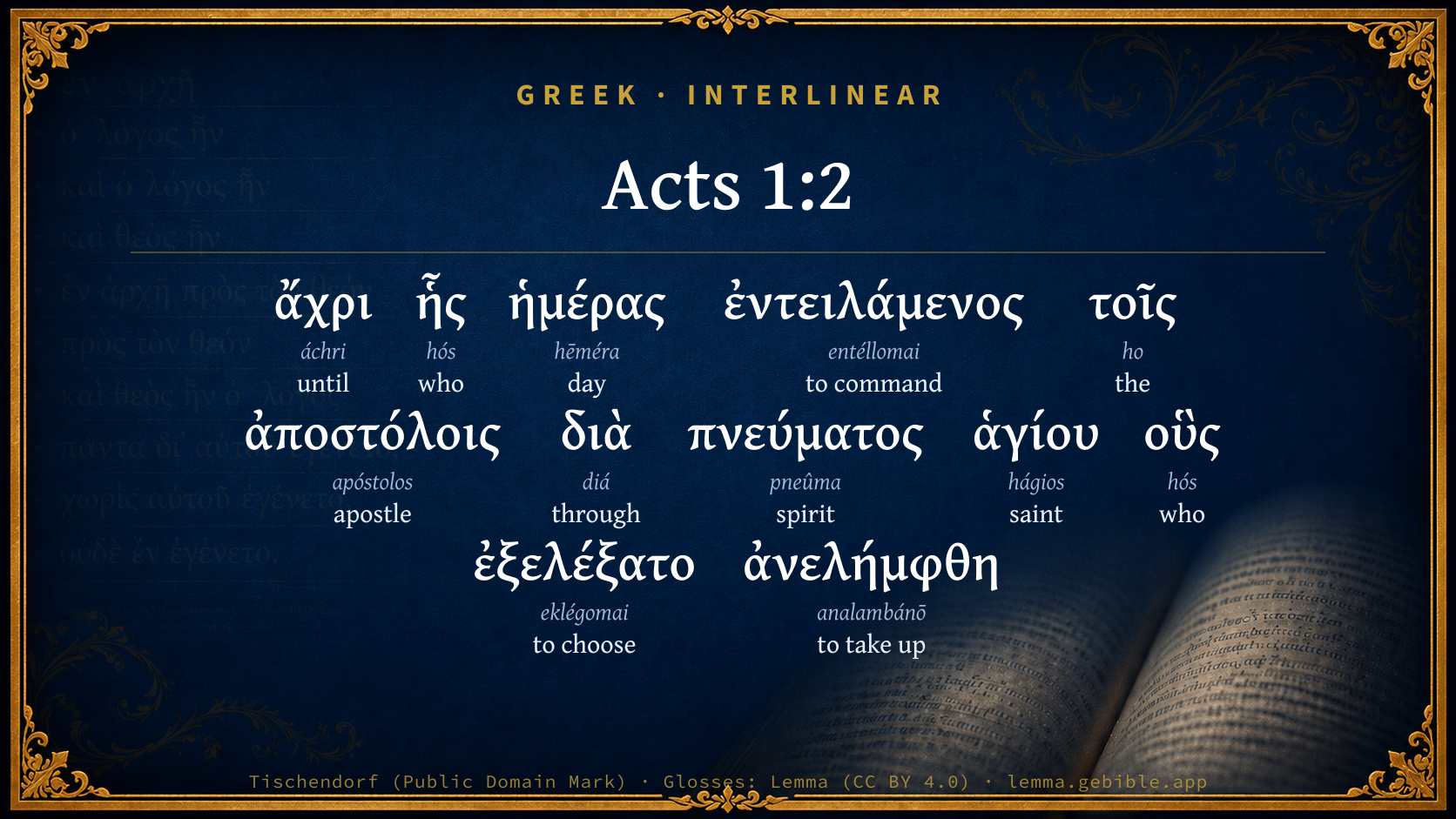
until the day in which he was received up, after he had given commandment through the Holy Spirit to the apostles whom he had chosen.
Download a study sheet
One document with this verse’s original text, its word-by-word gloss line, the meaning frame, cross-references with their text, attributed commentary, and full source and license credits — printable, and it pastes into notes with its structure intact.
This verse Autodidact and up
A passage Seminary Student
Up to 50 verses in one chapter. A passage sheet keeps up to 6 commentary sources and 12 cross-references per verse, in the order this page ranks them, and says so on the sheet whenever that leaves anything out. Ask for a single verse and you get the Autodidact verse sheet above.
Everything on this page stays free to read, with no account — the sheet is a download of what is already on screen, not access to it.
Compare translations 3
The same verse in 3 English versions, stacked beneath the original-language interlinear above. Click any original word for its lexicon entry.
Each is an independent rendering of the whole verse — the interlinear is not word-aligned to these translations.
Highlighted words mark where these versions differ — a whole-verse word diff, not a word-by-word alignment.
-
World English Bible Public Domain
until the day in which he was received up, after he had given commandment through the Holy Spirit to the apostles whom he had chosen.
-
King James Version Public Domain
Until the day in which he was taken up, after that he through the Holy Ghost had given commandments unto the apostles whom he had chosen:
-
unfoldingWord Literal Text CC BY-SA 4.0
until that day when he was taken up, having given commands through the Holy Spirit to the apostles whom he had chosen,
unfoldingWord Literal Text — © unfoldingWord, licensed CC BY-SA 4.0. Word-aligned USFM3 via Door43 (git.door43.org/unfoldingWord/en_ult).
Show all 19 translations
Every available English version of this verse, each an independent rendering of the whole verse.
-
World English Bible Public Domain
until the day in which he was received up, after he had given commandment through the Holy Spirit to the apostles whom he had chosen.
-
Berean Standard Bible Public Domain
until the day He was taken up to heaven, after giving instructions through the Holy Spirit to the apostles He had chosen.
-
Majority Standard Bible Public Domain
until the day He was taken up to heaven, after giving instructions through the Holy Spirit to the apostles He had chosen.
-
King James Version Public Domain
Until the day in which he was taken up, after that he through the Holy Ghost had given commandments unto the apostles whom he had chosen:
-
American Standard Version (1901) Public Domain
until the day in which he was received up, after that he had given commandment through the Holy Spirit unto the apostles whom he had chosen:
-
Revised Version (1885) Public Domain
until the day in which he was received up, after that he had given commandment through the Holy Ghost unto the apostles whom he had chosen:
-
Geneva Bible (1599) Public Domain
Vntill the day that hee was taken vp, after that hee through the holy Ghost, had giuen commandements vnto the Apostles, whome hee had chosen:
-
Douay-Rheims (1899) Public Domain
Until the day on which, giving commandments by the Holy Ghost to the apostles whom he had chosen, he was taken up.
-
Young's Literal Translation Public Domain
till the day in which, having given command, through the Holy Spirit, to the apostles whom he did choose out, he was taken up,
-
Literal Standard Version CC BY-SA 4.0
until the day in which, having given command through the Holy Spirit to the apostles whom He chose out, He was taken up,
-
Unlocked Literal Bible CC BY-SA 4.0
until the day that he was taken up, after he had given commands through the Holy Spirit to the apostles he had chosen.
-
unfoldingWord Literal Text CC BY-SA 4.0
until that day when he was taken up, having given commands through the Holy Spirit to the apostles whom he had chosen,
-
Darby Bible Public Domain
until that day in which, having by the Holy Spirit charged the apostles whom he had chosen, he was taken up;
-
World Messianic Bible Public Domain
until the day in which he was received up, after he had given commandment through the Holy Spirit to the emissaries whom he had chosen.
-
Webster's Bible Public Domain
Until the day in which he was taken up, after that he through the Holy Spirit had given commandments to the apostles whom he had chosen:
-
Free Bible Version CC BY-SA 4.0
until the day he was taken up to heaven. This was after he'd given instructions through the Holy Spirit to his chosen apostles.
-
Bible in Basic English Public Domain
Till the day when he was taken up to heaven after he had given his orders, through the Holy Spirit, to the Apostles of whom he had made selection:
-
Text-Critical English NT CC BY 4.0
until the day he was taken up, after he had given commands through the Holy Spirit to the apostles he had chosen.
-
Tyndale New Testament (1534) Public Domain
vntyll the daye in the which he was taken vp after that he thorowe the holy goost had geven commaundementes vnto the Apostles which he had chosen:
Literal Standard Version (2020), Covenant Press — licensed CC BY-SA 4.0. Text via the HelloAO Bible API (eBible.org). Unlocked Literal Bible (unfoldingWord) — licensed CC BY-SA 4.0. Text via the HelloAO Bible API (eBible.org). unfoldingWord Literal Text — © unfoldingWord, licensed CC BY-SA 4.0. Word-aligned USFM3 via Door43 (git.door43.org/unfoldingWord/en_ult). Free Bible Version, Dr. Jonathan Gallagher — licensed CC BY-SA 4.0. Text via the HelloAO Bible API (eBible.org).
Word by word
More ways to search: Search by grammar → Find every occurrence → Compare this word →
Practice this passage: Drill this verse → Learn its vocabulary →
- Appears 13× in the Greek New Testament
- First appears at Mark 16:19
- Part of Speech
- Verb
- Tense
- Aorist
- Voice
- Passive
- Mood
- Indicative
- Person
- 3rd person
- Number
- Singular
Full Thayer's Definition
- ἄχρι áchri G891 “until” Adverb
- ἧς hós G3739 “who” Relative pronoun, Genitive, Singular, Feminine
- ἡμέρας hēméra G2250 “day” Noun, Genitive, Singular, Feminine
- ἐντειλάμενος entéllomai G1781 “to command” Verb, Aorist, Middle or Passive deponent, Participle, Nominative, Singular, Masculine
- τοῖς ho G3588 “the” Article, Dative, Plural, Masculine
- ἀποστόλοις apóstolos G652 “apostle” Noun, Dative, Plural, Masculine
- διὰ diá G1223 “through” Preposition
- πνεύματος pneûma G4151 “spirit” Noun, Genitive, Singular, Neuter
- ἁγίου hágios G40 “saint” Adjective, Genitive, Singular, Neuter
- οὓς hós G3739 “who” Relative pronoun, Accusative, Plural, Masculine
- ἐξελέξατο eklégomai G1586 “to choose” Verb, Aorist, Middle, Indicative, 3rd person, Singular
- ἀνελήμφθη analambánō G353 “to take up” Verb, Aorist, Passive, Indicative, 3rd person, Singular
About this verse
These counts appear in no published source. They are computed here, from the morphology-tagged text and Lemma’s own curated glosses. What Lemma adds →
- 12
- words
- 11
- distinct lemmas
- Acts
- section
Notable vocabulary
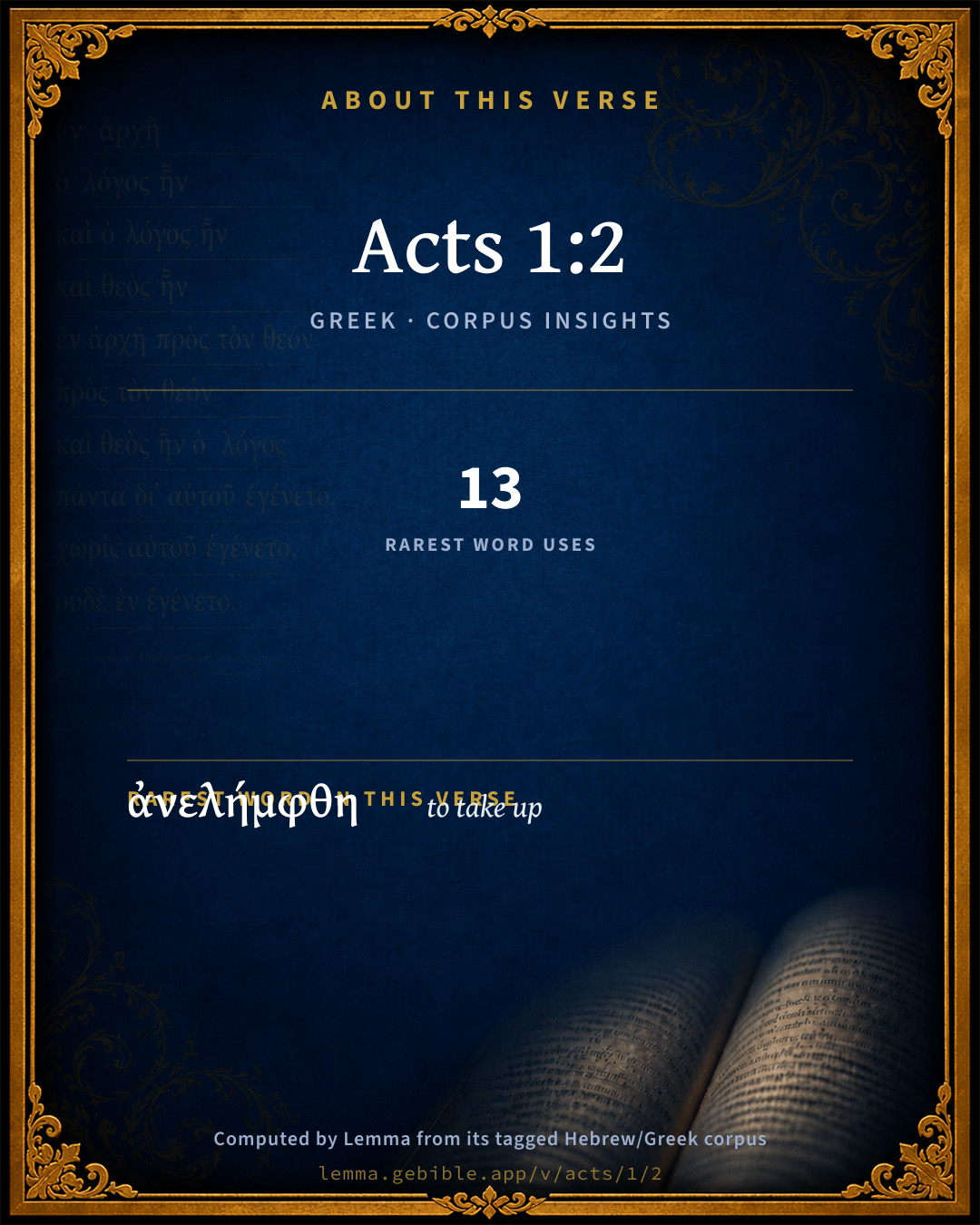
The rarest word here is ἀνελήμφθη to take up G353 — appearing just 13 times in the whole Greek New Testament.
Shared distinctive vocabulary
ἀνελήμφθη to take up G353 occurs in 13 verses of the Greek New Testament. Also found in:
Repetition
A word recurs within this verse:
- ἧς who G3739 ×2
Cross-references
49Topical passages linked to Acts 1:2 in the Treasury of Scripture Knowledge — connected by theme and wording, ordered by reader-vote popularity; previews shown in the World English Bible.
- Acts 1:9 When he had said these things, as they were looking, he was taken up, and a cloud received him out of their sight.
- Isaiah 59:20–21 A Redeemer will come to Zion, and to those who turn from disobedience in Jacob, says Yahweh.
- John 20:21 Jesus therefore said to them again, "Peace be to you. As the Father has sent me, even so I send you."
- Acts 10:38 even Jesus of Nazareth, how God anointed him with the Holy Spirit and with power, who went about doing good and healing all who were oppressed by the devil, for God was with him.
- Hebrews 9:24 For Christ hasn't entered into holy places made with hands, which are representations of the true, but into heaven itself, now to appear in the presence of God for us;
- John 13:18 I don't speak concerning all of you. I know whom I have chosen. But that the Scripture may be fulfilled, 'He who eats bread with me has lifted up his heel against me.'
- Matthew 28:19–20 Therefore go, and make disciples of all nations, baptizing them in the name of the Father and of the Son and of the Holy Spirit,
- Ephesians 4:8–10 Therefore he says, "When he ascended on high, he led captivity captive, and gave gifts to men."
- Isaiah 48:16 Come you near to me, hear you this; from the beginning I have not spoken in secret; from the time that it was, there am I: and now the Lord Yahweh has sent me, and his Spirit.
- Luke 24:45–49 Then he opened their minds, that they might understand the Scriptures.
- John 13:3 Jesus, knowing that the Father had given all things into his hands, and that he came forth from God, and was going to God,
- Isaiah 11:2–3 The Spirit of Yahweh shall rest on him, the spirit of wisdom and understanding, the spirit of counsel and might, the spirit of knowledge and of the fear of Yahweh.
- Isaiah 42:1 Behold, my servant, whom I uphold; my chosen, in whom my soul delights: I have put my Spirit on him; he will bring forth justice to the Gentiles.
- Isaiah 61:1 The Spirit of the Lord Yahweh is on me; because Yahweh has anointed me to preach good news to the humble; he has sent me to bind up the broken-hearted, to proclaim liberty to the captives, and the opening [of the prison] to those who are bound;
- Matthew 3:16 Jesus, when he was baptized, went up directly from the water: and behold, the heavens were opened to him. He saw the Spirit of God descending as a dove, and coming on him.
- Matthew 10:1–4 He called to himself his twelve disciples, and gave them authority over unclean spirits, to cast them out, and to heal every disease and every sickness.
- Matthew 12:28 But if I by the Spirit of God cast out demons, then the Kingdom of God has come upon you.
- Mark 3:14–19 He appointed twelve, that they might be with him, and that he might send them out to preach,
- Mark 6:30 The apostles gathered themselves together to Jesus, and they told him all things, whatever they had done, and whatever they had taught.
- Mark 16:15–19 He said to them, "Go into all the world, and preach the Gospel to the whole creation.
- Luke 6:13–16 When it was day, he called his disciples, and from them he chose twelve, whom he also named apostles:
- Luke 9:51 It came to pass, when the days were near that he should be taken up, he intently set his face to go to Jerusalem,
- Luke 24:51 It happened, while he blessed them, that he withdrew from them, and was carried up into heaven.
- John 1:16 From his fullness we all received grace upon grace.
- John 3:34 For he whom God has sent speaks the words of God; for God gives the Spirit without measure.
- John 6:62 Then what if you would see the Son of Man ascending to where he was before?
- John 6:70 Jesus answered them, "Didn't I choose you, the twelve, and one of you is a devil?"
- John 13:1 Now before the feast of the Passover, Jesus knowing that his time had come that he would depart from this world to the Father, having loved his own who were in the world, he loved them to the end.
- John 16:28 I came out from the Father, and have come into the world. Again, I leave the world, and go to the Father."
- John 17:13 But now I come to you, and I say these things in the world, that they may have my joy made full in themselves.
- John 20:17 Jesus said to her, "Don't touch me, for I haven't yet ascended to my Father; but go to my brothers, and tell them, 'I am ascending to my Father and your Father, to my God and your God.'"
- Acts 1:11 who also said, "You men of Galilee, why do you stand looking into the sky? This Jesus, who was received up from you into the sky will come back in the same way as you saw him going into the sky."
- Acts 1:13 When they had come in, they went up into the upper room, where they were staying; that is Peter, John, James, Andrew, Philip, Thomas, Bartholomew, Matthew, James the son of Alphaeus, Simon the Zealot, and Judas the son of James.
- Acts 10:40–42 God raised him up the third day, and gave him to be revealed,
- Galatians 1:1 Paul, an apostle (not from men, neither through man, but through Jesus Christ, and God the Father, who raised him from the dead),
- Ephesians 2:20 being built on the foundation of the apostles and prophets, Christ Jesus himself being the chief cornerstone;
- 1 Timothy 3:16 Without controversy, the mystery of godliness is great: God was revealed in the flesh, Justified in the spirit, Seen by angels, Preached among the nations, Believed on in the world, And received up in glory.
- Hebrews 6:19–20 This hope we have as an anchor of the soul, a hope both sure and steadfast and entering into that which is within the veil;
- 1 Peter 3:22 who is at the right hand of God, having gone into heaven, angels and authorities and powers being made subject to him.
- 2 Peter 3:2 that you should remember the words which were spoken before by the holy prophets, and the commandments of us, the apostles of the Lord and Savior:
- Revelation 1:1 This is the Revelation of Jesus Christ, which God gave him to show to his servants the things which must happen soon, which he sent and made known by his angel to his servant, John,
- Revelation 2:7 He who has an ear, let him hear what the Spirit says to the assemblies. To him who overcomes I will give to eat of the tree of life, which is in the Paradise of my God.
- Revelation 2:11 He who has an ear, let him hear what the Spirit says to the assemblies. He who overcomes won't be harmed by the second death.
- Revelation 2:29 He who has an ear, let him hear what the Spirit says to the assemblies.
- Revelation 3:13 He who has an ear, let him hear what the Spirit says to the assemblies.
- Revelation 3:16 So, because you are lukewarm, and neither hot nor cold, I will vomit you out of my mouth.
- Revelation 3:22 He who has an ear, let him hear what the Spirit says to the assemblies."
- Revelation 21:14 The wall of the city had twelve foundations, and on them twelve names of the twelve Apostles of the Lamb.
- Revelation 2:17 He who has an ear, let him hear what the Spirit says to the assemblies. To him who overcomes, to him I will give of the hidden manna, and I will give him a white stone, and on the stone a new name written, which no one knows but he who receives it.
Cross-references courtesy of OpenBible.info (CC BY 4.0).
Lesson kit
Teaching starters — assembled from the data on this page, not authored interpretation. Every prompt links to the verse data it draws on. Edit before teaching.
Acts, in the Acts, opens this verse with 12 words (11 distinct Greek lemmas). Its most distinctive word is analambánō (“to take up”). A historical commentator’s framing appears above. Read the whole chapter for the surrounding context.
Discussion questions
- What does “to take up” (analambánō) contribute to the verse as a whole?
- Mark 16:19 shares the word «to take up» with this verse. How do the two illuminate each other?
- “who” occurs 2× in this one verse. What is the effect of the repetition?
- These translations render this verse differently; the difference is in the English rendering, not the original. What questions does that raise?
- Reading how The Preacher's Complete Homiletical Commentary and Bengel's Gnomon read this verse, where do the two commentators agree and where do they part?
Things to notice
- These translations choose different wording for 11 words in this verse.
- “who” occurs 2× in this single verse.
- 11 distinct Greek lemmas span 12 words in this verse.
Commentary
Notes on Acts 1:2 from classic Christian and Jewish commentators (each source and its license shown beneath its notes). The classic Christian expositions comment on the surrounding passage and are grouped to its opening verse, so a note may address several verses; the Jewish commentaries on the Tanakh (Rashi and others) are per-verse, so they appear only where the commentator wrote on this verse.
Lemma curates 59 commentaries, every one of them public domain or Creative Commons licensed, each selected and text-cleaned for this edition rather than reprinted as found. About our sources →
The Preacher's Complete Homiletical Commentary
Joseph S. Exell (gen. ed.)
The Preacher's Complete Homiletical Commentary (gen. ed. Joseph S. Exell; Funk & Wagnalls, c. 1892) — public domain (pre-1929). A full-Bible homiletical/sermon-outline anthology covering 65 of 66 books (2 John is absent from the source module). Text from a community e-Sword module.
Bengel's Gnomon
Johann Albrecht Bengel
Bengel's Gnomon of the New Testament — English translation (T&T Clark, Edinburgh, 1860) — public domain. Text from a community e-Sword module.
Meyer's Critical & Exegetical Commentary
Heinrich August Wilhelm Meyer
Meyer — Critical and Exegetical Commentary on the New Testament — English translation by Peter Christie, edited by Frederick Crombie (T&T Clark, 1880) — public domain. Text from a community e-Sword module.
Expositor's Greek Testament
ed. W. Robertson Nicoll
The Expositor's Greek Testament, edited by W. Robertson Nicoll (1897–1910) — public domain. Text from a community e-Sword module.
Jamieson, Fausset & Brown
Robert Jamieson, A. R. Fausset & David Brown
Jamieson, Fausset & Brown — Commentary Critical and Explanatory on the Whole Bible (1871) — public domain (CC PDM 1.0). Text via the HelloAO Bible API.
Adam Clarke's Commentary
Adam Clarke's Commentary on the Bible (1810–1826) — public domain. Text from a community e-Sword/MySword module.
John Calvin's Commentaries
John Calvin's Commentaries (1540-1563) — public domain. Text from the Calvin Translation Society English edition (1840s-50s) via the Christian Classics Ethereal Library (ccel.org). Calvin's coverage is partial (roughly two-thirds of the Bible); uncommented books and verses are honest gaps, never fabricated. The 19th-century editor's footnotes and remarks are omitted so the notes are faithfully Calvin's own voice.
Ellicott's Commentary for English Readers
A Bible Commentary for English Readers, edited by Charles John Ellicott (1878–1897) — public domain. Text from a community e-Sword module.
The Cambridge Bible for Schools and Colleges
gen. ed. J. J. S. Perowne
The Cambridge Bible for Schools and Colleges (gen. ed. J. J. S. Perowne; Cambridge University Press, 1878–1918) — public domain. Text from a community e-Sword module.
John Gill's Exposition
John Gill's Exposition of the Whole Bible (1746–1763) — public domain (CC PDM 1.0). Text via the HelloAO Bible API.
Trapp's Complete Commentary
John Trapp
John Trapp, A Commentary or Exposition upon All the Books of the Old and New Testament (1647–1656) — public domain. Text from a community e-Sword module.
Albert Barnes' Notes on the Bible
Albert Barnes' Notes on the Bible (1834–1885) — public domain. Text from a community e-Sword/MySword module.
Haydock's Catholic Bible Commentary
George Leo Haydock (1774–1849), Haydock's Catholic Family Bible and Commentary, 1859 edition — public domain. Excludes Psalms (Douay-Rheims chapter numbering differs from Protestant) and Deuterocanonical books (Catholic canon only).
Matthew Poole's English Annotations
Matthew Poole's English Annotations on the Holy Bible (1683–1685) — public domain. Text from a community e-Sword/MySword module.
Whedon's Commentary on the Bible
Daniel D. Whedon
Daniel D. Whedon (gen. ed.), Commentary on the Old and New Testaments (1874–1909) — public domain. Text from a community e-Sword module.
The Pulpit Commentary
The Pulpit Commentary (1880–1919), ed. H.D.M. Spence-Jones & Joseph S. Exell — public domain. Text from a community e-Sword module.
John Wesley's Explanatory Notes
John Wesley, Explanatory Notes Upon the Whole Bible (1754–1765) — public domain. Text via the GEBible commentary corpus.
Burkitt's Expository Notes on the New Testament
William Burkitt
William Burkitt's Expository Notes on the New Testament (1700–1703) — public domain. Text from a community e-Sword module.
McGarvey & Pendleton's Commentaries
J. W. McGarvey
J. W. McGarvey (with Philip Y. Pendleton), Commentaries on the New Testament (The Fourfold Gospel, 1914; Acts; and the epistles) — public domain. Text from a community e-Sword/MySword module.
The People's New Testament
B. W. Johnson
B. W. Johnson's The People's New Testament with Notes (1889–1891) — public domain. Electronic text from the Christian Classics Ethereal Library (CCEL) ThML edition.
Cambridge Greek Testament for Schools and Colleges
Cambridge Greek Testament for Schools and Colleges (Cambridge University Press, 1896; 21 vols, various authors incl. Carr, Maclear, Plummer, Farrar, Lumby, Moule, M. R. James, Simcox) — public domain. Text from a community e-Sword module.
Alford’s Greek Testament
Henry Alford
Henry Alford, The Greek Testament (1849–1861) — public domain. Text from a community e-Sword module.
Vincent's Word Studies in the New Testament
Marvin R. Vincent
Marvin R. Vincent, Word Studies in the New Testament (1887–1900) — public domain. Text from a community e-Sword/MySword module.