
1 Peter 2:10

Greek (Tischendorf 8th ed.) 1 Peter 2:10 appears in the Greek New Testament. The text above is from the Tischendorf 8th edition. Each word links to its Strong’s number and a concise gloss. Click any word for its full Thayer’s Greek Lexicon entry.
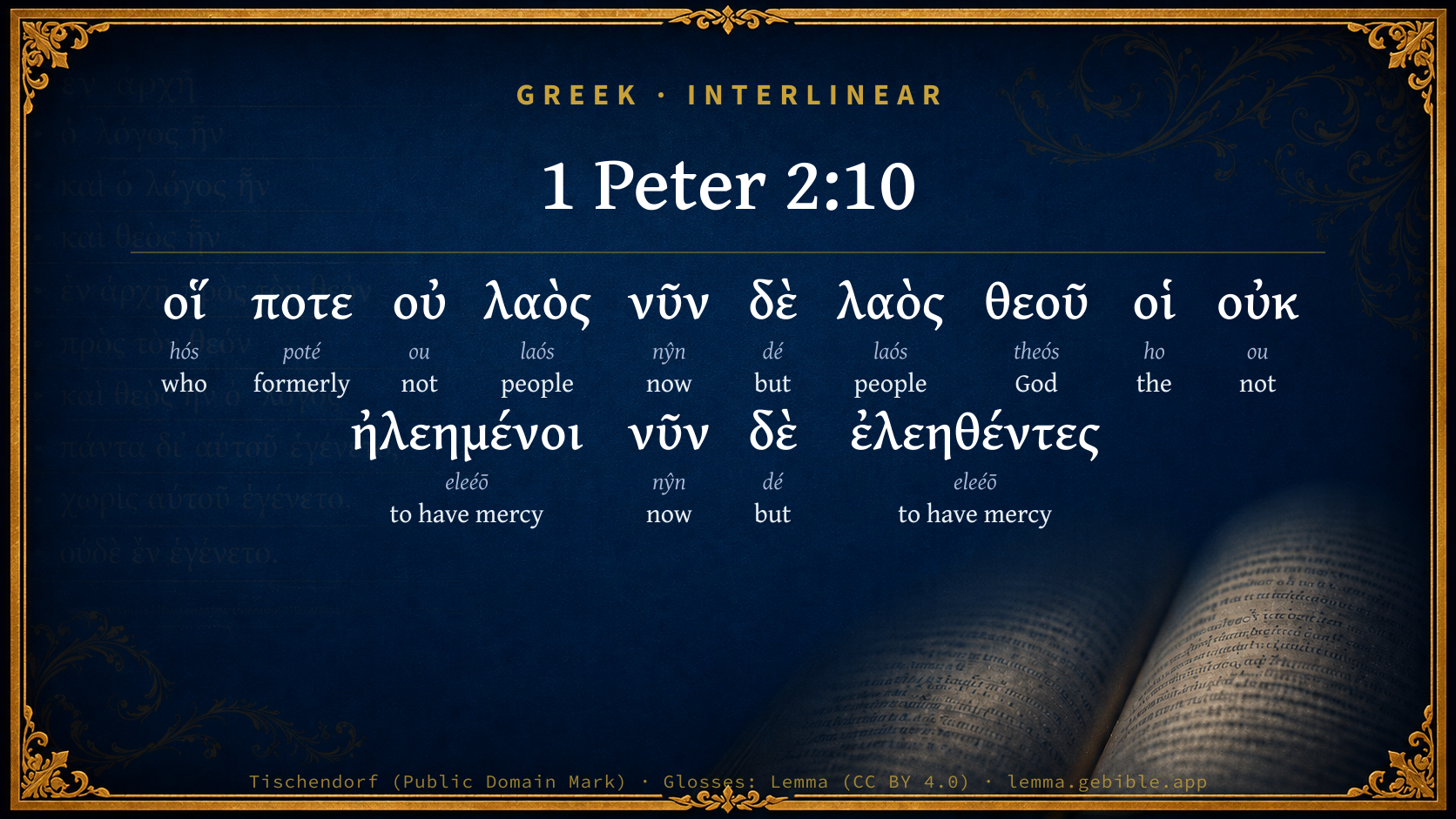
Download image
Cite this verse

1 Peter 2:10 (World English Bible). Public Domain. Lemma interlinear Bible study tool, https://lemma.gebible.app/v/1-peter/2/10.

Show BibTeX & RIS
BibTeX
RIS
English Translation
who in time past were no people, but now are God's people, who had not obtained mercy, but now have obtained mercy.
World English Bible · Public Domain
Download a study sheet

One document with this verse’s original text, its word-by-word gloss line, the meaning frame, cross-references with their text, attributed commentary, and full source and license credits — printable, and it pastes into notes with its structure intact.

This verse Autodidact and up

Study sheet (.html) Plain text (.txt)

A passage Seminary Student

Up to 50 verses in one chapter. A passage sheet keeps up to 6 commentary sources and 12 cross-references per verse, in the order this page ranks them, and says so on the sheet whenever that leaves anything out. Ask for a single verse and you get the Autodidact verse sheet above.

Everything on this page stays free to read, with no account — the sheet is a download of what is already on screen, not access to it.

Want to remove ads? Support Godless Engineer
Compare translations 3

The same verse in 3 English versions, stacked beneath the original-language interlinear above. Click any original word for its lexicon entry.

Each is an independent rendering of the whole verse — the interlinear is not word-aligned to these translations.

Highlighted words mark where these versions differ — a whole-verse word diff, not a word-by-word alignment.

  • World English Bible Public Domain
    who in time past were no people, but now are God's people, who had not obtained mercy, but now have obtained mercy.
  • King James Version Public Domain
    Which in time past were not a people, but are now the people of God: which had not obtained mercy, but now have obtained mercy.
  • unfoldingWord Literal Text CC BY-SA 4.0
    who once “not a people,” but now “a people of God;” the ones “not having received mercy,” but now “having received mercy.”

unfoldingWord Literal Text — © unfoldingWord, licensed CC BY-SA 4.0. Word-aligned USFM3 via Door43 (git.door43.org/unfoldingWord/en_ult).

Versions to compare (up to 4)

3 of 4 selected

Show all 19 translations

Every available English version of this verse, each an independent rendering of the whole verse.

  • World English Bible Public Domain
    who in time past were no people, but now are God's people, who had not obtained mercy, but now have obtained mercy.
  • Berean Standard Bible Public Domain
    Once you were not a people, but now you are the people of God; once you had not received mercy, but now you have received mercy.
  • Majority Standard Bible Public Domain
    Once you were not a people, but now you are the people of God; once you had not received mercy, but now you have received mercy.
  • King James Version Public Domain
    Which in time past were not a people, but are now the people of God: which had not obtained mercy, but now have obtained mercy.
  • American Standard Version (1901) Public Domain
    who in time past were no people, but now are the people of God: who had not obtained mercy, but now have obtained mercy.
  • Revised Version (1885) Public Domain
    which in time past were no people, but now are the people of God: which had not obtained mercy, but now have obtained mercy.
  • Geneva Bible (1599) Public Domain
    Which in time past were not a people, yet are nowe the people of God: which in time past were not vnder mercie, but nowe haue obteined mercie.
  • Douay-Rheims (1899) Public Domain
    Who in time past were not a people: but are now the people of God. Who had not obtained mercy; but now have obtained mercy.
  • Young's Literal Translation Public Domain
    who `were' once not a people, and `are' now the people of God; who had not found kindness, and now have found kindness.
  • Literal Standard Version CC BY-SA 4.0
    who [were] once not a people, but [are] now the people of God; who had not found mercy, but now have found mercy.
  • Unlocked Literal Bible CC BY-SA 4.0
    Once you were not a people, but now you are the people of God. You did not receive mercy, but now you have received mercy.
  • unfoldingWord Literal Text CC BY-SA 4.0
    who once “not a people,” but now “a people of God;” the ones “not having received mercy,” but now “having received mercy.”
  • Darby Bible Public Domain
    who once [were] not a people, but now God's people; who were not enjoying mercy, but now have found mercy.
  • World Messianic Bible Public Domain
    In the past, you were not a people, but now are God’s people, who had not obtained mercy, but now have obtained mercy.
  • Webster's Bible Public Domain
    Who in time past were not a people, but are now the people of God: who had not obtained mercy, but now have obtained mercy.
  • Free Bible Version CC BY-SA 4.0
    In the past you were nobodies, but now you are God's people. In the past you hadn't received mercy, but now you have received mercy.
  • Bible in Basic English Public Domain
    In the past you were not a people, but now you are the people of God; then there was no mercy for you, but now mercy has been given to you.
  • Text-Critical English NT CC BY 4.0
    Once you were not a people, but now you are the people of God. Once you had not received mercy, but now you have received mercy.
  • Tyndale New Testament (1534) Public Domain
    which in tyme past were not a people yet are now the people of God: which were not vnder mercye but now have obteyned mercye.

Literal Standard Version (2020), Covenant Press — licensed CC BY-SA 4.0. Text via the HelloAO Bible API (eBible.org). Unlocked Literal Bible (unfoldingWord) — licensed CC BY-SA 4.0. Text via the HelloAO Bible API (eBible.org). unfoldingWord Literal Text — © unfoldingWord, licensed CC BY-SA 4.0. Word-aligned USFM3 via Door43 (git.door43.org/unfoldingWord/en_ult). Free Bible Version, Dr. Jonathan Gallagher — licensed CC BY-SA 4.0. Text via the HelloAO Bible API (eBible.org).

Word by word

More ways to search: Search by grammar → Find every occurrence → Compare this word →

Practice this passage: Drill this verse → Learn its vocabulary →

About this verse

These counts appear in no published source. They are computed here, from the morphology-tagged text and Lemma’s own curated glosses. What Lemma adds →

14
words
9
distinct lemmas
General Epistles
section

Shared distinctive vocabulary

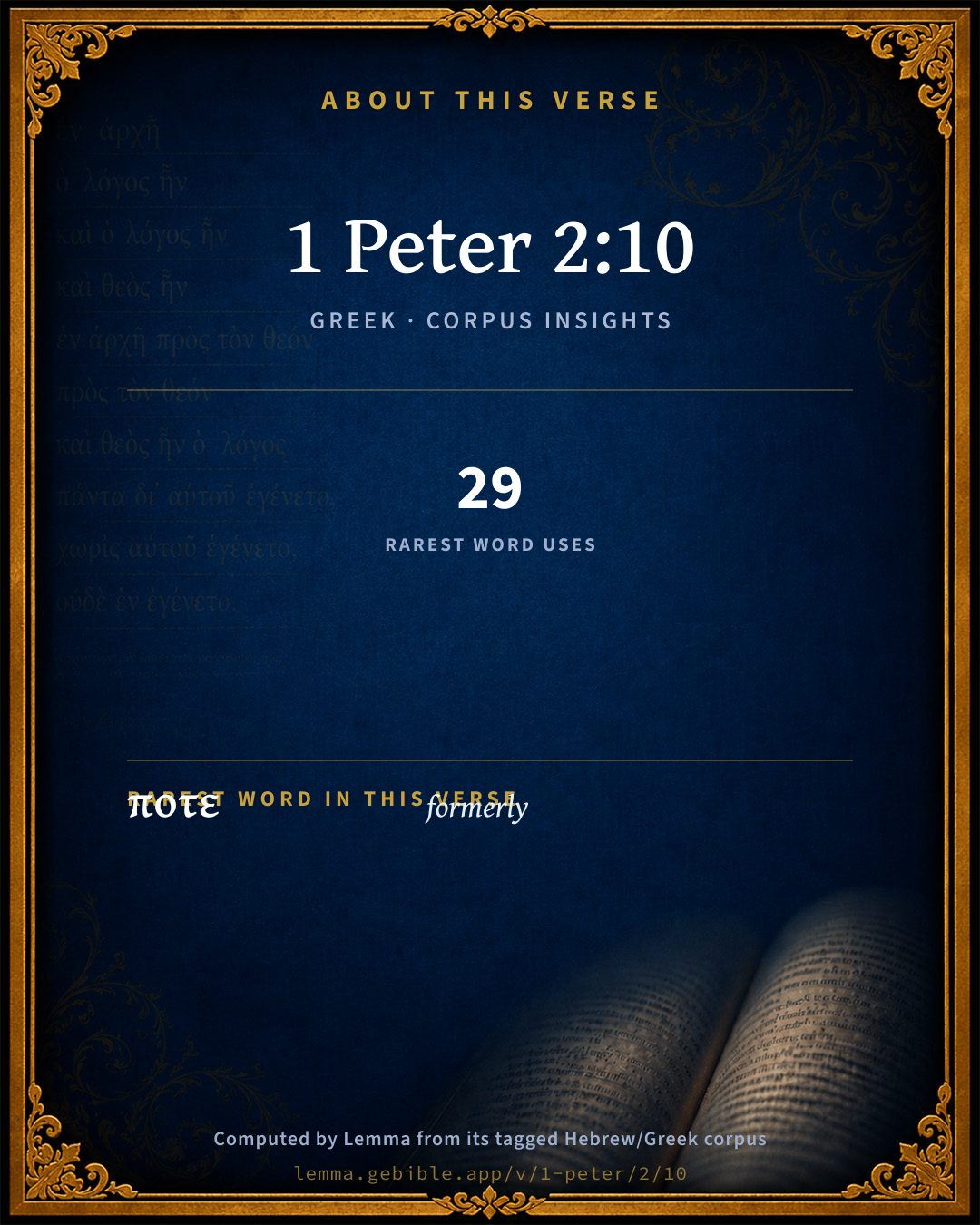
ποτε formerly G4218 occurs in 28 verses of the Greek New Testament. Also found in:
Repetition

Words recur within this verse:

  • λαὸς people G2992 ×2
  • νῦν now G3568 ×2
  • ἠλεημένοι to have mercy G1653 ×2
  • οὐ not G3756 ×2
  • δὲ but G1161 ×2

Cross-references

9

Topical passages linked to 1 Peter 2:10 in the Treasury of Scripture Knowledge — connected by theme and wording, ordered by reader-vote popularity; previews shown in the World English Bible.

  • Hosea 2:23 I will sow her to me in the earth; And I will have mercy on her who had not obtained mercy; And I will tell those who were not my people, 'You are my people;' And they will say, 'My God!'"
  • Hosea 1:9–10 He said, "Call his name Lo-Ammi; for you are not my people, and I will not be yours.
  • Romans 9:25–26 As he says also in Hosea, "I will call them 'my people,' which were not my people; And her 'beloved,' who was not beloved."
  • Hebrews 4:16 Let us therefore draw near with boldness to the throne of grace, that we may receive mercy, and may find grace for help in time of need.
  • Romans 11:6–7 And if by grace, then it is no longer of works; otherwise grace is no longer grace. But if it is of works, it is no longer grace; otherwise work is no longer work.
  • Romans 10:19 But I ask, didn't Israel know? First Moses says, "I will provoke you to jealousy with that which is no nation, With a nation void of understanding I will make you angry."
  • 1 Timothy 1:13 although I was before a blasphemer, a persecutor, and insolent. However, I obtained mercy, because I did it ignorantly in unbelief.
  • Romans 11:30 For as you in time past were disobedient to God, but now have obtained mercy by their disobedience,
  • 1 Corinthians 7:25 Now concerning virgins, I have no commandment from the Lord, but I give my judgment as one who has obtained mercy from the Lord to be trustworthy.

Cross-references courtesy of OpenBible.info (CC BY 4.0).

Commentary

Notes on 1 Peter 2:10 from classic Christian and Jewish commentators (each source and its license shown beneath its notes). The classic Christian expositions comment on the surrounding passage and are grouped to its opening verse, so a note may address several verses; the Jewish commentaries on the Tanakh (Rashi and others) are per-verse, so they appear only where the commentator wrote on this verse.

Lemma curates 59 commentaries, every one of them public domain or Creative Commons licensed, each selected and text-cleaned for this edition rather than reprinted as found. About our sources →

Bengel's Gnomon

Johann Albrecht Bengel

1Pe 2:10. Οἱ ποτὲ, who in time past) See Rom 9:25, note; and with “in time past,” comp. presently after, “ye were,” 1Pe 2:25. The quotation from Hosea is a kind of enigma. In Hosea, if taken literally, it has reference to the Jews; for, according to the context, as an axiom it is only applied to a particular subject (hypothesis[16]); but there may be a more general question (thesis) in the mind of the speaker, and then it may be applied to other subjects. I will call them My people, who were not (My) people, is applicable to Jews and Gentiles. Thus care is taken that the sense of the text may not necessarily appear to be twofold.—οὐ λαὸς, not a people) Rom 10:19, note: not even a people, much less the people of God. The former half of the verse has special reference to the Gentiles; the latter to the Jews. Concerning the latter, see Tit 3:4, and the context: concerning the former, Act 15:14.

[16] Hypothesis is a particular definite question: thesis, where the subject of inquiry is general and unlimited. Cic. in Top.: Quæstionum duo sunt genera, alterum infinitum, alterum definitum; definitum est, quod ὑπόθεσιν Græci, nos causam; infinitum, quod θέσιν illi appellant, nos propositum possumus nominare.—T.

Bengel's Gnomon of the New Testament — English translation (T&T Clark, Edinburgh, 1860) — public domain. Text from a community e-Sword module.

Meyer's Critical & Exegetical Commentary

Heinrich August Wilhelm Meyer

1Pe_2:10. A reference to Hos_2:23, linking itself on to the end of the preceding verse, in which the former and present conditions of the readers are contrasted. This difference the verse emphasizes by means of a simple antithesis. The passage in Hosea runs: וְרִחַמְתִּי אֶת־לֹא רֻחָמָה וְאָמַרְתִּי לְלֹא־עַמִּי עַמִּי־אַתָּה, LXX.: ἀγαπήσω τὴν οὐκ ἠγαπημένην καὶ ἐρῶ τῷ οὐ λαῷ μου· λαός μου εἶ σύ (the Cod. Alex. and the Ed. Aldina have at the commencement the additional words: ἐλεήσω τὴν οὐκ ἠλεημένην).

οἱ ποτὲ οὐ λαός] Grotius, Steiger, Weiss incorrectly supply: Θεοῦ. λαός is here used absolutely (Bengel: ne populus quidem, nedum Dei populus). οὐ belongs not to ἦτε to be supplied, but is closely connected with λαός, equivalent to no-people. In like manner οὐκ ἠλεημένοι as equal to not-obtained mercy. The meaning is not that they once were not what they now are, but that they were the opposite of it (Wiesinger). But οὐ … λαός is a people who, in their separation from God, are without that unity of life in which alone they can be considered by Him as a people; or, more simply, who do not serve God who is the true King of every people; cf. Deu_32:21, and Keil in loc. De Wette is hardly satisfactory: they were not a people, inasmuch as they were without the principle of all true nationality, the real knowledge of God, etc.; now they are a people, even a people of God, inasmuch as they not only serve God, but are received also by God into community of life with Himself.

οἱ οὐκ ἠλεημένοι, νῦν δὲ ἐλεηθέντες] The part. perf. denotes their former and ended condition. Standing as it does here not as a verb, but as a substantive, like οὐ … λαός, it cannot be taken as a plusquam-perf. part. (in opposition to Hofmann). The aorist part. points, on the other hand, to the fact of pardon having been extended: once not in possession of mercy, but now having become partakers of it (Winer, p. 322[130] [E. T. 431]).

[130] In the original passage these words apply to Israel; but from this it does not follow that Peter writes to Jewish-Christians. For if Paulas he clearly doesapplies the passage (Rom_9:25) to the calling of the heathen, then Peter surely, with equal right, could use it with reference to the heathen converts. They had been, in its full sense, that which God says to Israel: לֹא־עַמִּי; and they had become that to which He would again make Israel, His people. It must be observed, however, that God in that passage addresses Israel as לֹא־עַמִּי only because it had forsaken Him and given itself up to the worship of Baal, and consequently incurred punishment. Apart from this, Israel had always remained the people of God.If only Jewish converts were meant here, then Peter would assume that they in their Judaism had been idolaters, which is absolutely impossible, or at least Peter must then have said why they, who as Israelites were the people of God, could not in their former state be regarded as such. Accordingly, οὐ λαός is here in no way applicable to Israel, but only to the heathen; and it is not (as Weiss maintains, p. 119) purely arbitrary to apply the passage, in opposition to its original sense, to heathen Christians. Whilst Brückner says only that the words cannot serve to prove the readers to have been Jews formerly, Wiesinger rightly and most decidedly denies the possibility of applying them to Jewish converts; so, too, Schott.Weisss assertion is by no means justified by his insisting (die Petr. Frage, p. 626) that nothing tenable has been brought forward against it.

Meyer — Critical and Exegetical Commentary on the New Testament — English translation by Peter Christie, edited by Frederick Crombie (T&T Clark, 1880) — public domain. Text from a community e-Sword module.

Expositor's Greek Testament

ed. W. Robertson Nicoll

1Pe 2:10 , from Hos 1:6 ; Hos 2:1 (3); cf. Rom 9:25 (has καλέσω κάλεσον of Hos.); the terms are so familiar that μου is omitted by Peter as unnecessary ( cf. γένος ἐκ . for τὸ γ . μου ἐ .).

The Expositor's Greek Testament, edited by W. Robertson Nicoll (1897–1910) — public domain. Text from a community e-Sword module.

Geneva Bible (1599)

Geneva Bible translators

Hos. 2:23; Rom. 9:25

Geneva Bible (1599) marginal notes — public domain. Text via Bolls.life.

Jamieson, Fausset & Brown

Robert Jamieson, A. R. Fausset & David Brown

Adapted from Hos 1:9-10; Hos 2:23. Peter plainly confirms Paul, who quotes the passage as implying the call of the Gentiles to become spiritually that which Israel had been literally, "the people of God." Primarily, the prophecy refers to literal Israel, hereafter to be fully that which in their best days they were only partially, God's people.

not obtained mercy--literally, "who were men not compassionated." Implying that it was God's pure mercy, not their merits, which made the blessed change in their state; a thought which ought to kindle their lively gratitude, to be shown with their life, as well as their lips.

Jamieson, Fausset & Brown — Commentary Critical and Explanatory on the Whole Bible (1871) — public domain (CC PDM 1.0). Text via the HelloAO Bible API.

Adam Clarke's Commentary

Verse 10. Which in time past were not a people] This is a quotation from Ho 1:9-10; Ho 2:23, where the calling of the Gentiles, by the preaching of the Gospel, is foretold. From this it is evident, that the people to whom the apostle now addresses himself had been Gentiles, covered with ignorance and superstition, and now had obtained mercy by the preaching of the Gospel of Christ.

Adam Clarke's Commentary on the Bible (1810–1826) — public domain. Text from a community e-Sword/MySword module.

John Calvin's Commentaries

10 Which in time past were not a people He brings for confirmation a passage from Hosea, and well accommodates it to his own purpose. For Hosea, after having in God’s name declared that the Jews were repudiated, gives them a hope of a future restoration. Peter reminds us that this was fulfilled in his own age; for the Jews were scattered here and there, as the torn members of a body; nay, they seemed to be no longer God’s people, no worship remained among them, they were become entangled in the corruptions of the heathens; it could not then be said otherwise of them, but that they were repudiated by the Lord. But when they are gathered in Christ, from no people they really become the people of God. Paul, in Romans 9:26, applies also this prophecy to the Gentiles, and not without reason; for from the time the Lord’s covenant was broken, from which alone the Jews derived their superiority, they were put on a level with the Gentiles. It hence follows, that what God had promised, to make a people of no people, belongs in common to both.

Which had not obtained mercy This was added by the Prophet, in order that the gratuitous covenant of God, by which he takes them to be his people, might be more clearly set forth; as though he had said, “There is no other reason why the Lord counts us his people, except that he, having mercy on us, graciously adopts us.” It is then God’s gratuitous goodness, which makes of no people a people to God, and reconciles the alienated.

John Calvin's Commentaries (1540-1563) — public domain. Text from the Calvin Translation Society English edition (1840s-50s) via the Christian Classics Ethereal Library (ccel.org). Calvin's coverage is partial (roughly two-thirds of the Bible); uncommented books and verses are honest gaps, never fabricated. The 19th-century editor's footnotes and remarks are omitted so the notes are faithfully Calvin's own voice.

Ellicott's Commentary for English Readers

(10) Which in time past were not a people.—Here at last, say some, we have a distinct proof that the Epistle was written to the Gentiles only, or, at least, to churches which contained a very small proportion of Jews. Such, however, is by no means the case; in fact, the opposite. We have here an emphasised adaptation of Hos_2:23, “And I will have mercy upon Lo-ruhamah, and I will say to Lo-ammi, ‘Thou art Animi,’ i.e., My people.” Now who were Lo-ruhamah and Lo-ammi? Types of Israel left unpitied, and rejected from their covenant with God. And this unpitied and rejected Israel, after being “scattered,” or sown, all over the earth, was to be restored again to favour, together with the increment of the Gentiles who joined, it as the result of the “sowing.” St. Peter means, then, that in his Hebrew readers and the brethren from among the Gentiles, who by the gospel of St. Paul had adhered to them, this promise given by Hosea had found its fulfilment. But, as usual, the quotation demands a more searching scrutiny of the context from which it is taken. The name Diaspora, or Dispersion, by which St. Peter, in 1Pe_1:1, designates those to whom he writes, was applied to themselves by the Jews in direct allusion (as seems probable) to the name Jezreel, or God will scatter, in Hos_1:4. Now mark that St. Peter does not say “which in time past were not God’s people,” but “were not a people.” This was the effect of the dispersion, or “scattering.” Though each Jew of the dispersion retained, and still retains, in isolation, his national characteristics and aspirations, yet their unity—that which made them a “people”—was, and is, for the time broken. The Hebrews had not only ceased to be in covenant as “God’s people,” but had ceased to be “a people” at all. But in Christ, that very “scattering” becomes a “sowing” (Hos_2:23), for the name Jezreel means both equally; their very dispersion becomes the means of their multiplication by union with the Gentiles in Christ, and thus spiritually they recover the lost unity, and become once more a solid and well-governed confederation, i.e., “a people,” and that “the people of God.” (See Joh_11:52, and Dr. Pusey’s notes on Hosea.) It is a mistake to take St. Paul’s quotation of this passage in Rom_9:26, as if it referred solely to the Gentiles; for he expressly affirms that the title “My people” belongs to neither section exclusively, but to both in reunion—“us whom He called, not only of the Jews, but also of the Gentiles.”

A Bible Commentary for English Readers, edited by Charles John Ellicott (1878–1897) — public domain. Text from a community e-Sword module.

The Cambridge Bible for Schools and Colleges

gen. ed. J. J. S. Perowne

10. Which in time past were not a people] The reference is to the children of Gomer, with their strange ill-omened names, Lo-Ammi and Lo-Ruhamah (Hos_1:2.): but it may be a question whether the citation is made directly from the prophet, or is traceable to St Paul’s use of it in Rom_9:25. In favour of the former view is the fact that St Peter quotes it (1) in a different form from St Paul’s, giving “had not obtained mercy” for “not beloved,” following in this the text of the Alexandrian MS. of the LXX., and (2) in a different application, St Paul referring it to the calling of the Gentiles, while he applies it to that of Israel. Some interpreters, indeed, have seen in this passage also a proof that St Peter was writing to Gentile converts or thinking of them chiefly, but it may well be urged against this view that if the history of the prophet’s adulterous wife had been to him a parable of the sin and repentance of Israel, it might well be so to the Apostle also. Had not his Master spoken of the people as “an evil and adulterous generation” (Mat_12:39)? Had not his friend St James addressed them as “adulterers and adulteresses” (Jas_4:4)?

The Cambridge Bible for Schools and Colleges (gen. ed. J. J. S. Perowne; Cambridge University Press, 1878–1918) — public domain. Text from a community e-Sword module.

John Gill's Exposition

Dearly beloved, I beseech you,.... The apostle, from characters of the saints, and which express their blessings and privileges, with great beauty, propriety, and pertinency, passes to exhortations to duties; he addresses the saints under this affectionate appellation, "dearly beloved", to express his great love to them, and to show that what he was about to exhort them to sprung from sincere and hearty affection for them, and was with a view to their real good; nor does he in an authoritative way command, as he might have done, as an apostle, but, as a friend, he entreats and beseeches them:

as strangers and pilgrims; not in a literal sense, though they were in a foreign country, in a strange land, and sojourners there, but in a spiritual and mystical sense; they were "strangers", not to God and Christ, and to the Spirit, to themselves, to the saints, and to all that is good, as they had formerly been, but to the world, the men of it, and the things in it; and therefore it became them to separate from it, and not conform to it; to abstain from all appearance of evil, to have no fellowship with the unfruitful works of darkness, but to deny ungodliness and worldly lusts: and they were "pilgrims"; whose habit is Christ and his righteousness; whose food is Christ and his fulness; whose staff is Christ and the promises; whose guide is the blessed Spirit; the place for which they are bound is heaven, the better country, where is their Father's house, their friends, and their inheritance; this world not being their country, nor their resting place, it became them to have their conversation in heaven, and to

abstain from fleshly lusts; which spring from the flesh, and are concerned about fleshly things, and are exercised in and by the members of the flesh, or body; hence, in the Syriac version, they are called, "the lusts of the body": these are to be abstained from; not that the apostle thought that they could be without them; for while the saints are in the body, flesh, or corrupt nature will be in them, and the lusts thereof; but then these are not to be indulged, or provision to be made for them, to fulfil them; they are not to be obeyed and served, or lived unto, but to be denied and crucified, being unsuitable to the character of strangers and pilgrims, and also because of their hurtful and pernicious nature:

which war against the soul; see Rom 7:23, these are enemies to the spiritual peace, comfort, and welfare of the soul; and being of a man's household, and in his heart, are the worst enemies he has; and are to be treated as such, to be shunned and avoided, watched and guarded against; for though they cannot destroy the souls of true believers, they may bring much leanness upon them, and greatly distress them, and spoil them of their inward joy, and spiritual pleasure.

John Gill's Exposition of the Whole Bible (1746–1763) — public domain (CC PDM 1.0). Text via the HelloAO Bible API.

Trapp's Complete Commentary

John Trapp

10 Which in time past were not a people, but are now the people of God: which had not obtained mercy, but now have obtained mercy.

Ver. 10. Which in time past were not] If Plato thought it such a mercy to him that he was a man and not a woman, a Grecian and not a barbarian, a scholar to Socrates and not to any other philosopher, what exceeding great cause have we to praise God that we are born Christians, not Pagans, Protestants, not Papists, in these blessed days of reformation, &c.

John Trapp, A Commentary or Exposition upon All the Books of the Old and New Testament (1647–1656) — public domain. Text from a community e-Sword module.

Albert Barnes' Notes on the Bible

Which in time past were not a people - That is, who formerly were not regarded as the people of God. There is an allusion here to the passage in Hos 2:23, “And I will have mercy upon her that had not obtained mercy; and I will say to them which were not my people, Thou art my people; and they shall say, Thou art my God.” It is, however, a mere allusion, such as one makes who uses the language of another to express his ideas, without meaning to say that both refer to the same subject. In Hosea, the passage refers evidently to the reception of one portion of the Israelites into favor after their rejection; in Peter, it refers mainly to those who had been Gentiles, and who had never been recognized as the people of God. The language of the prophet would exactly express his idea, and he therefore uses it without intending to say that this was its original application. See it explained in the notes at Rom 9:25. Compare the notes at Eph 2:11-12.

Which had not obtained mercy - That is, who had been living unpardoned, having no knowledge of the way by which sinners might be forgiven, and no evidence that your sins were forgiven. They were then in the condition of the whole pagan world, and they had not then been acquainted with the glorious method by which God forgives iniquity.

Albert Barnes' Notes on the Bible (1834–1885) — public domain. Text from a community e-Sword/MySword module.

Matthew Poole's English Annotations

Which in time past were not a people; either, were not a people, i.e. a formed state, or commonwealth, being dispersed in several countries, among other people, and not worth the name of a people: or, were not the people of God, (supplying God out of the opposite clause), since he had given them a bill of divorce, and said Lo-ammi and Lo-ruhamah to them, Hos 1:1-11. These were the Jews of the dispersion, and such as had not returned out of the Babylonish captivity, together with many of other tribes mixed with them, who, before their conversion to Christ, seemed cut off from the body of that people, had no solemn worship of God among them, and were tainted with the corruptions of the heathen, with whom they conversed.

But are now the people of God; really God’s people, restored to their old covenant state and church privileges, by their believing in Christ.

Which had not obtained mercy, but now have obtained mercy; the mercy of being God’s people, and enjoying their privileges, being justified, at peace with God, &c. Lest they might any way abuse what he had said in the former verse concerning their great dignity and privileges, so as to ascribe any thing to themselves, the apostle intimates here, that all they enjoyed was merely out of God’s mercy.

Matthew Poole's English Annotations on the Holy Bible (1683–1685) — public domain. Text from a community e-Sword/MySword module.

Whedon's Commentary on the Bible

Daniel D. Whedon

10. This citation of Hos_2:23, slightly changed, is applicable alike to the recovery of apostate Jews in the prophet’s time, and the conversion to Christ of Jews and Gentiles.

Daniel D. Whedon (gen. ed.), Commentary on the Old and New Testaments (1874–1909) — public domain. Text from a community e-Sword module.

The Pulpit Commentary

Which in time past were not a people, but are now the people of God. St. Peter quotes the prophecy of Hosea, (Hos_2:23) as St. Paul also does in Rom_9:25, Rom_9:26. And as St. Paul applies the prophet"s words (said originally of the Jews) to the Christian Church, to those called "not of the Jews only, but also of the Gentiles," so apparently does St. Peter here. They were not a people; "Ne populus quidem," says Bengel, "nedum Dei populus." It is the calling of God which gives a unity to the Church gathered out of all races and all lands, and makes it the people of God. Which had not obtained mercy, but now have obtained mercy. The aorist participle, ejelhqentev, implies that that mercy had been obtained at a definite time, at their conversion.

The Pulpit Commentary (1880–1919), ed. H.D.M. Spence-Jones & Joseph S. Exell — public domain. Text from a community e-Sword module.

John Wesley's Explanatory Notes

Who in time past were not a people - Much less the people of God; but scattered individuals of many nations. The former part of the verse particularly respects the gentiles; the latter, the Jews.

John Wesley, Explanatory Notes Upon the Whole Bible (1754–1765) — public domain. Text via the GEBible commentary corpus.

The People's New Testament

B. W. Johnson

10. Which in time past were not a people. Not the people of God. See Hosea 2:23, which Peter quotes. The prophets in many places foretold the call of the Gentiles. See Rom. 9:25, 26.

B. W. Johnson's The People's New Testament with Notes (1889–1891) — public domain. Electronic text from the Christian Classics Ethereal Library (CCEL) ThML edition.

Cambridge Greek Testament for Schools and Colleges

10. οὐ λαὸς … οὐκ ἠλεημένοι. In Hos 1:6-7; Hos 2:23, the faithlessness of Israel to Jehovah her true bridegroom is described under the figure of the prophet’s faithless wife who deserts him for false paramours. The children are therefore called by symbolical names, Lo-ammi = “not my people” and Lo-ruhamah = “not having obtained mercy.” But when their mother is at last restored their names are changed to Ammi and Ruhamah. In Hosea the words refer to Israelites but in Rom 9:25 St Paul applies the passage to the admission of the Gentiles. So here St Peter, probably borrowing from St Paul, is almost certainly referring to the admission of Gentiles to be the new “Israel of God.”

οὐκ ἠλεημένοι … ἐλεηθέντες. The perfect participle denotes the long-continued state in which they had lived as heathen, while the aorist refers to the crisis of their conversion, though of course the effects of that mercy are still continuous. Neither St Peter nor St Paul mean that the heathen or the unconverted Jew had no share in God’s mercy. The reference is to the special mercy of the gift of the Gospel.

The Second Section of the Epistle, 1Pe 2:11 to 1Pe 4:11, contains an exhortation to renounce heathen principles of conduct and adopt Christian principles, which will necessarily transform the various social relationships and duties of life.

Cambridge Greek Testament for Schools and Colleges (Cambridge University Press, 1896; 21 vols, various authors incl. Carr, Maclear, Plummer, Farrar, Lumby, Moule, M. R. James, Simcox) — public domain. Text from a community e-Sword module.

Alford’s Greek Testament

Henry Alford

10.] Contrast, in a glorious description of the office, privilege, and function, of the enlightened and adopted people of God.

10.] who (contrast between their former and present states) were once no people (the Apostle is again citing, or rather clothing that which he has to write in, O. T. words. In Hos 2:23 A, we read ἐλεήσω τὴν οὐκ ἠλεημένην, καὶ ἐρῶ τῷ οὐ λαῷ μου λαός μου εἶ σύ), but (are) now the people of God (these words, as Wies. maintains, apply most properly to Gentile Christians, although spoken in the prophecy of Jews, St. Paul thus uses them, Rom 9:25; and it is not impossible that that passage may have been in St. Peter’s mind), who were unpitied (of God: the οὑκ here and above, not merely negatives, but contraries: not “who had not obtained mercy, but now have obtained mercy,” as E. V., indicating a mere change of time in order of progress, but who were unpitied, objects of aversion and wrath), but now compassionated (the aor. part. has a fine and delicate force which cannot be given in a version: q. d. who were men who (have received no pity), but now men who (received pity), viz. when God called you by Christ).

Henry Alford, The Greek Testament (1849–1861) — public domain. Text from a community e-Sword module.

Vincent's Word Studies in the New Testament

Marvin R. Vincent

People [λαος] . See on ver. 9, and note the choice of the term here. A people of God. Compare Rom 9:25, 26.

Marvin R. Vincent, Word Studies in the New Testament (1887–1900) — public domain. Text from a community e-Sword/MySword module.

Lesson kit

Teaching starters — assembled from the data on this page, not authored interpretation. Every prompt links to the verse data it draws on. Edit before teaching.

1 Peter, in the General Epistles, opens this verse with 14 words (9 distinct Greek lemmas). Its most distinctive word is poté (“formerly”). A historical commentator’s framing appears above. Read the whole chapter for the surrounding context.

Discussion questions

  1. How does “formerly” (poté) shape what this verse is saying?
  2. Luke 22:32 shares the word «formerly» with this verse. How do the two illuminate each other?
  3. “people” occurs 2× in this one verse. What is the effect of the repetition?
  4. These translations render this verse differently. What is at stake in choosing one wording over another?
  5. Reading how Bengel's Gnomon and Meyer's Critical & Exegetical Commentary read this verse, where do the two commentators agree and where do they part?

Things to notice

  • These translations choose different wording for 13 words in this verse.
  • “people” occurs 2× in this single verse.
  • 9 distinct Greek lemmas span 14 words in this verse.

Reading settings

Reading text

Shown beneath each verse's original-language words.

Old Testament
Old Testament edition

Read the OT as the Masoretic Hebrew (MT) or the Greek Septuagint (LXX).

English shown for the Greek Septuagint (in the Hebrew ↔ Greek comparison).

Comparing translations? Open the Compare panel on any verse page to stack up to four side by side.