John 17:4

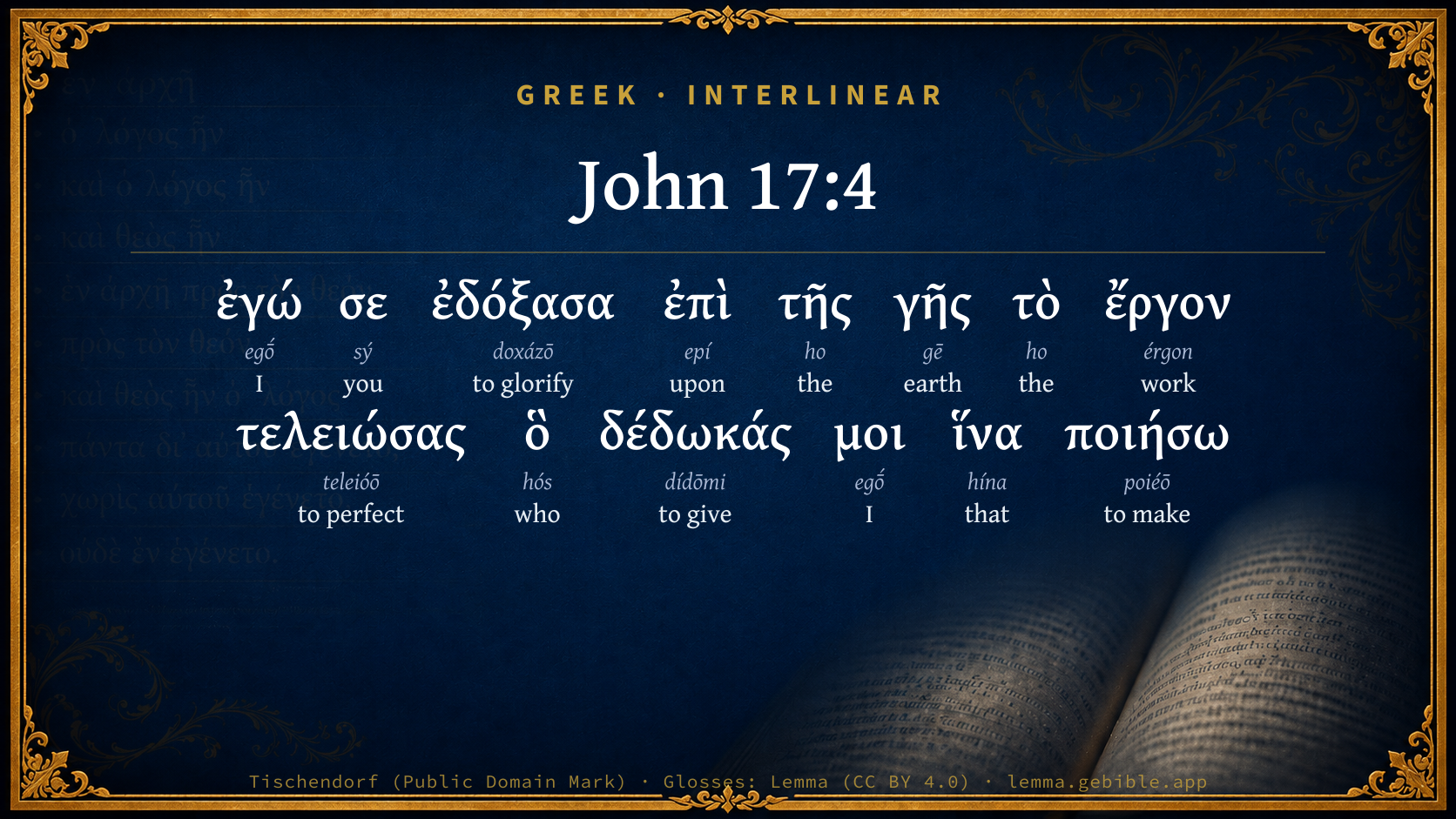
Greek (Tischendorf 8th ed.) John 17:4 appears in the Greek New Testament. The text above is from the Tischendorf 8th edition. Each word links to its Strong’s number and a concise gloss. Click any word for its full Thayer’s Greek Lexicon entry.
Download image
Cite this verse

John 17:4 (World English Bible). Public Domain. Lemma interlinear Bible study tool, https://lemma.gebible.app/v/john/17/4.

Show BibTeX & RIS
BibTeX
RIS
English Translation
I glorified you on the earth. I have accomplished the work which you have given me to do.
World English Bible · Public Domain
Download a study sheet

One document with this verse’s original text, its word-by-word gloss line, the meaning frame, cross-references with their text, attributed commentary, and full source and license credits — printable, and it pastes into notes with its structure intact.

This verse Autodidact and up

Study sheet (.html) Plain text (.txt)

A passage Seminary Student

Up to 50 verses in one chapter. A passage sheet keeps up to 6 commentary sources and 12 cross-references per verse, in the order this page ranks them, and says so on the sheet whenever that leaves anything out. Ask for a single verse and you get the Autodidact verse sheet above.

Everything on this page stays free to read, with no account — the sheet is a download of what is already on screen, not access to it.

Want to remove ads? Support Godless Engineer
Compare translations 3

The same verse in 3 English versions, stacked beneath the original-language interlinear above. Click any original word for its lexicon entry.

Each is an independent rendering of the whole verse — the interlinear is not word-aligned to these translations.

Highlighted words mark where these versions differ — a whole-verse word diff, not a word-by-word alignment.

  • World English Bible Public Domain
    I glorified you on the earth. I have accomplished the work which you have given me to do.
  • King James Version Public Domain
    I have glorified thee on the earth: I have finished the work which thou gavest me to do.
  • unfoldingWord Literal Text CC BY-SA 4.0
    I glorified you on the earth, having completed the work that you have given me so that I might do it.

unfoldingWord Literal Text — © unfoldingWord, licensed CC BY-SA 4.0. Word-aligned USFM3 via Door43 (git.door43.org/unfoldingWord/en_ult).

Versions to compare (up to 4)

3 of 4 selected

Show all 19 translations

Every available English version of this verse, each an independent rendering of the whole verse.

  • World English Bible Public Domain
    I glorified you on the earth. I have accomplished the work which you have given me to do.
  • Berean Standard Bible Public Domain
    I have glorified You on earth by accomplishing the work You gave Me to do.
  • Majority Standard Bible Public Domain
    I have glorified You on earth. I have accomplished the work You gave Me to do.
  • King James Version Public Domain
    I have glorified thee on the earth: I have finished the work which thou gavest me to do.
  • American Standard Version (1901) Public Domain
    I glorified thee on the earth, having accomplished the work which thou hast given me to do.
  • Revised Version (1885) Public Domain
    I glorified thee on the earth, having accomplished the work which thou hast given me to do.
  • Geneva Bible (1599) Public Domain
    I haue glorified thee on the earth: I haue finished the worke which thou gauest me to doe.
  • Douay-Rheims (1899) Public Domain
    I have glorified thee on the earth; I have finished the work which thou gavest me to do.
  • Young's Literal Translation Public Domain
    I did glorify Thee on the earth, the work I did finish that Thou hast given me, that I may do `it'.
  • Literal Standard Version CC BY-SA 4.0
    I glorified You on the earth, having completed the work that You have given Me, that I should do.
  • Unlocked Literal Bible CC BY-SA 4.0
    I glorified you on the earth. I have finished the work that you have given me to do.
  • unfoldingWord Literal Text CC BY-SA 4.0
    I glorified you on the earth, having completed the work that you have given me so that I might do it.
  • Darby Bible Public Domain
    I have glorified *thee* on the earth, I have completed the work which thou gavest me that I should do it;
  • World Messianic Bible Public Domain
    I glorified you on the earth. I have accomplished the work which you have given me to do.
  • Webster's Bible Public Domain
    I have glorified thee on the earth: I have finished the work which thou gavest me to do.
  • Free Bible Version CC BY-SA 4.0
    I have brought glory to you here on earth by completing the work you gave me to do.
  • Bible in Basic English Public Domain
    I have given you glory on the earth, having done all the work which you gave me to do.
  • Text-Critical English NT CC BY 4.0
    I have glorified yoʋ on earth. I have completed the work yoʋ have given me to do.
  • Tyndale New Testament (1534) Public Domain
    I have glorified the on the erth. I have fynysshed the worke which thou gavest me to do.

Literal Standard Version (2020), Covenant Press — licensed CC BY-SA 4.0. Text via the HelloAO Bible API (eBible.org). Unlocked Literal Bible (unfoldingWord) — licensed CC BY-SA 4.0. Text via the HelloAO Bible API (eBible.org). unfoldingWord Literal Text — © unfoldingWord, licensed CC BY-SA 4.0. Word-aligned USFM3 via Door43 (git.door43.org/unfoldingWord/en_ult). Free Bible Version, Dr. Jonathan Gallagher — licensed CC BY-SA 4.0. Text via the HelloAO Bible API (eBible.org).

Word by word

More ways to search: Search by grammar → Find every occurrence → Compare this word →

Practice this passage: Drill this verse → Learn its vocabulary →

τελειώσας
teleióō
G5048
“to perfect”
Verb, Aorist, Active, Participle, Nominative, Singular, Masculine
Part of Speech
Verb
Tense
Aorist
Voice
Active
Mood
Participle
Case
Nominative
Number
Singular
Gender
Masculine
Full Thayer's Definition

Origin: from G5046

TDNT: 09:19,1

1. to make perfect, complete a. to carry through completely, to accomplish, finish, bring to an end 2. to complete (perfect) a. add what is yet wanting in order to render a thing full b. to be found perfect 3. to bring to the end (goal) proposed 4. to accomplish a. bring to a close or fulfilment by event 1. of the prophecies of the scriptures
  1. ἐγώ egṓ G1473 “I” Personal pronoun, 1st person, Nominative, Singular
  2. σε sý G4771 “you” Personal pronoun, 2nd person, Accusative, Singular
  3. ἐδόξασα doxázō G1392 “to glorify” Verb, Aorist, Active, Indicative, 1st person, Singular
  4. ἐπὶ epí G1909 “upon” Preposition
  5. τῆς ho G3588 “the” Article, Genitive, Singular, Feminine
  6. γῆς gē G1093 “earth” Noun, Genitive, Singular, Feminine
  7. τὸ ho G3588 “the” Article, Accusative, Singular, Neuter
  8. ἔργον érgon G2041 “work” Noun, Accusative, Singular, Neuter
  9. ὃ hós G3739 “who” Relative pronoun, Accusative, Singular, Neuter
  10. δέδωκάς dídōmi G1325 “to give” Verb, Perfect, Active, Indicative, 2nd person, Singular
  11. μοι egṓ G1473 “I” Personal pronoun, 1st person, Dative, Singular
  12. ἵνα hína G2443 “that” Conjunction
  13. ποιήσω poiéō G4160 “to make” Verb, Aorist, Active, Subjunctive, 1st person, Singular

About this verse

These counts appear in no published source. They are computed here, from the morphology-tagged text and Lemma’s own curated glosses. What Lemma adds →

14
words
12
distinct lemmas
Gospels
section

Notable vocabulary

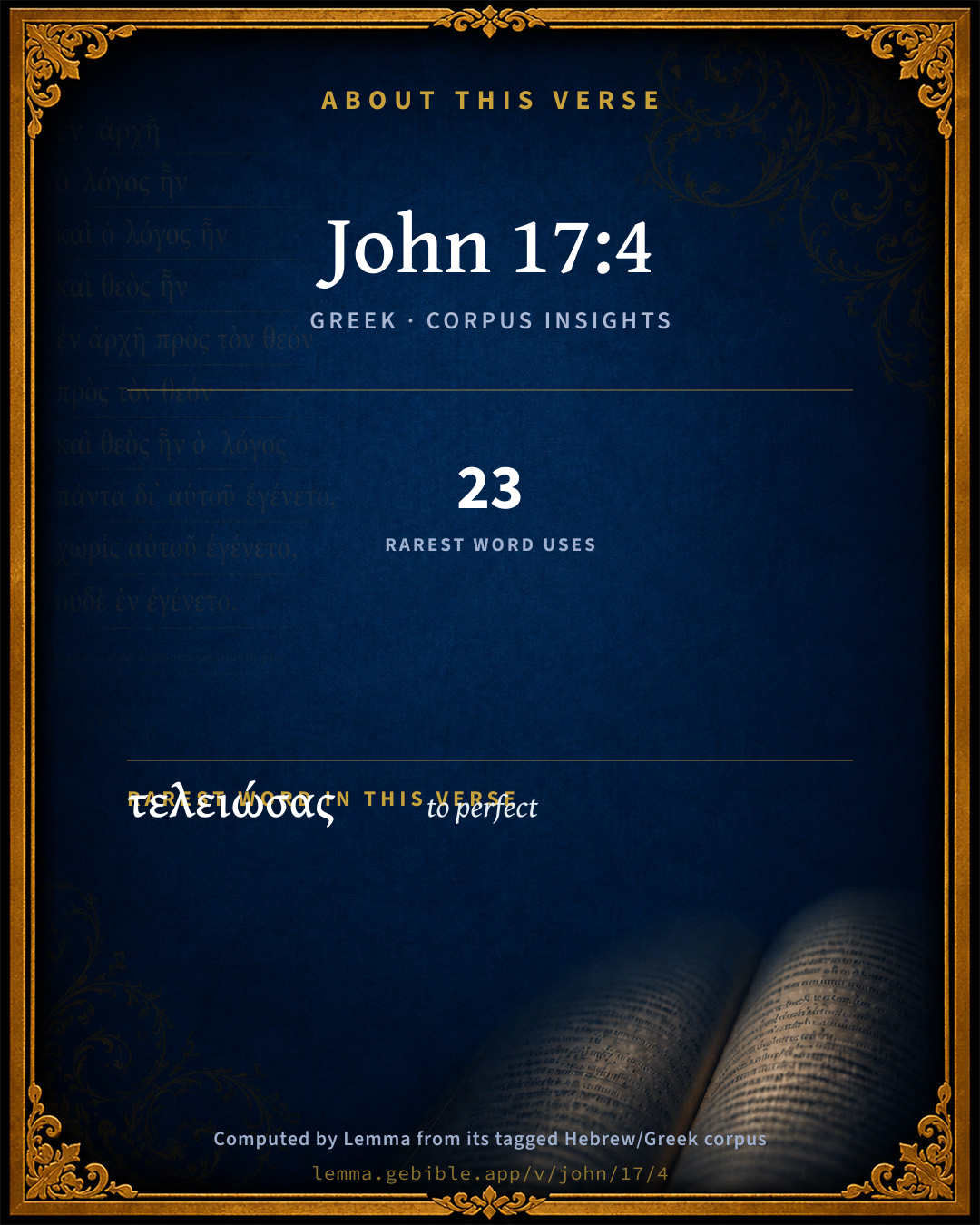
The rarest word here is τελειώσας to perfect G5048 — appearing just 23 times in the whole Greek New Testament.

Shared distinctive vocabulary

τελειώσας to perfect G5048 occurs in 23 verses of the Greek New Testament. Also found in:

Repetition

Words recur within this verse:

Cross-references

12

Topical passages linked to John 17:4 in the Treasury of Scripture Knowledge — connected by theme and wording, ordered by reader-vote popularity; previews shown in the World English Bible.

  • John 4:34 Jesus said to them, "My food is to do the will of him who sent me, and to accomplish his work.
  • Acts 20:24 But these things don't count; nor do I hold my life dear to myself, so that I may finish my race with joy, and the ministry which I received from the Lord Jesus, to fully testify to the Gospel of the grace of God.
  • 2 Timothy 4:7 I have fought the good fight. I have finished the course. I have kept the faith.
  • John 14:31 But that the world may know that I love the Father, and as the Father commanded me, even so I do. Arise, let us go from here.
  • John 19:30 When Jesus therefore had received the vinegar, he said, "It is finished." He bowed his head, and gave up his spirit.
  • John 13:31–32 When he had gone out, Jesus said, "Now the Son of Man has been glorified, and God has been glorified in him.
  • John 15:10 If you keep my commandments, you will remain in my love; even as I have kept my Father's commandments, and remain in his love.
  • John 12:28 Father, glorify your name!" Then there came a voice out of the sky, saying, "I have both glorified it, and will glorify it again."
  • Luke 22:37 For I tell you that this which is written must still be fulfilled in me: 'He was counted with the lawless.' For that which concerns me has an end."
  • John 9:3 Jesus answered, "Neither did this man sin, nor his parents; but, that the works of God might be revealed in him.
  • John 14:13 Whatever you will ask in my name, that will I do, that the Father may be glorified in the Son.
  • John 5:36 But the testimony which I have is greater than that of John, for the works which the Father gave me to accomplish, the very works that I do, testify about me, that the Father has sent me.

Cross-references courtesy of OpenBible.info (CC BY 4.0).

Commentary

Notes on John 17:4 from classic Christian and Jewish commentators (each source and its license shown beneath its notes). The classic Christian expositions comment on the surrounding passage and are grouped to its opening verse, so a note may address several verses; the Jewish commentaries on the Tanakh (Rashi and others) are per-verse, so they appear only where the commentator wrote on this verse.

Lemma curates 59 commentaries, every one of them public domain or Creative Commons licensed, each selected and text-cleaned for this edition rather than reprinted as found. About our sources →

The Biblical Illustrator

Joseph S. Exell

Joh_17:4-5

I have glorified Thee on the earth

The glorification of God

The words may be considered

I.

IN A MEDIATORY SENSE; so they are proper to Christ;

1. I have glorified Thee. Christ glorified God

(1) By His person (Heb_1:3).

(2) By His life and perfect obedience (Joh_8:46; Joh_8:49).

(3) By discovering Gods mercy (Joh_1:14).

(4) By His miracles (Mat_9:8; Mar_15:31).

(5) By His passion.

(6) In His doctrine.

God was much glorified in the Creation (Psa_19:1), in His providences; but mostly in Christ, redemption being the most noble work with which He was ever acquainted. In creation, the wisdom, goodness, and power of God appeared; in providence, the justice, mercy, and truth of God; but these in Christ in a more raised degree.

2. I have finished the work, &c., implies

(1) The submission, faithfulness, and diligence of Christ Php_2:7; Joh_13:1).

(2) The completeness of our redemption (Heb_10:14; Rom_8:1).

(3) The Divine appointment of His work (Psa_40:7-8).

II. IN A MORAL SENSE in which they apply to us.

1. What it is to glorify God upon earth, &c.

(1) What? God is glorified passively. So all things shall at length glorify Psa_76:10; Rom_3:5; Rom_3:7). This is no thanks to them, but to Gods wise and powerful government. We glorify God actively when we set ourselves to this work, and make it our end and scope. Thus actively to glorify God is

(a) To acknowledge His excellency upon all occasions (Psa_50:23; Psa_145:10).

(b) To resign our wills to His. Verbal praises merely are but an empty prattle (2Th_1:11-12). God is most glorified in the creatures obedience. First, to His laws, when we study to please Him in all things (Col_1:10). Second, to His providence. It is an honour to Him when we are contented to be what God will have us to be, and can prefer His glory before our own ease, His honour before our plenty Php_1:20).

(c) To entertain the impressions of His glory upon us, i.e., when we grow most like Him, and show forth His virtues (1Pe_2:9; Eph_1:12). A Christians life is a hymn to God; his circumspect walking proclaims Gods wisdom; His awfulness and watchfulness against sin, His Majesty; His cheerful and ready obedience, His goodness; His purity, Gods holiness.

(d) To do those things which tend to the honour of Gods name, and to bring Him into request in the world (1Pe_2:12; Mat_5:16; chap. 15:8).

(e) To promote His interests in the world. This is the method of the Lords prayer, Hallowed be Thy name; and then, Thy kingdom come.

(f) To do the work which He hath given us to do. First, the duty of our particular relations. If poor, I glorify God by my diligence, patience, innocence, contentedness; if rich, I glorify God by a humble mind; if well, I glorify God by my health; if sick, by meekness under His hand; if a magistrate, by my zeal (Neh_1:11); if a minister, by my watchfulness; if a tradesman, by my righteousness. From the king to the scullion, all are to work for God. Second, the duty of our vocation and calling. Every Christian hath his way and place, some work which God gave him.

(g) To make God the great scope and end of our lives and actions. In our ordinary actions (1Co_10:31). So in acts of grace.

(2) Where? On earth.

(a) Where so few mind Gods glory, but seek their own things Php_3:20).

(b) Which is the place of our trial? Many expect to glorify God in heaven, but take no care to glorify God on earth. But here where the danger is there is the duty and trial (Mat_10:32).

(3) How? I have finished, &c.

(a) It is work that glorifieth God; not empty praises, but a holy conversation (Mat_5:16; Psa_50:23; Joh_15:8).

(b) Every man has his work. Life was given to us for somewhat; not merely that we might fill up the number of things in the world, as stones and rubbish: not to grow in stature, like the plants; nor merely to taste pleasures, like the beasts. God gave man faculties of reason and conscience to manage some work and business for the glory of God and his own eternal happiness. The world was never made to be a hive for drones and idle ones.

(c) This work is given us by God. By His word. There is no course of service good but what is agreeable to the word of God (Psa_119:105; Tit_2:12). By His providence, which ruleth in everything that falleth out. But how should a man glorify God in his place and station wherein God hath set him? Be content with it; God is the Master of the scenes, and appoints which part to act. With patience digest the inconveniences of your calling.

(d) This work must be finished and perfected (Rev_2:10; 2Ti_4:7-8).

2. Why this should be our great care?

(1) This is the end why all creatures were made (Rom_11:36; Pro_16:4).

(2) God has a right and interest in us (Rom_14:7-8; 1Co_6:19-20).

(3) We shall be called to an account (Luk_19:23).

(4) Great benefit will come to us by it. God noteth it (chap. 17:10), and rewards it (Mat_19:28).

(5) This ennobles a man.

(6) God will have His glory upon you, if not from you, for He is resolved not to be a loser (Pro_16:4; Lev_10:3).

(7) When we come to die this will be our comfort, Christ hath left us a pattern here; and Hezekiah (Isa_38:3), and Paul (2Ti_4:7-8). (T. Manton, D. D.)

The heavenly glorification

1. Our Lord presents as a plea that He might be glorified--the fidelity and completeness with which He had discharged His trust. This petition rises beyond that in the first. In the first He prayed for glorification on earth, that He might be borne triumphantly, as the Divine testimony to His success. Here He prays for glorification in heaven, that He might be raised to that position of honour which by Divine right belonged to Him from eternity.

2. It is wonderful and encouraging that the Son of God should not only pray, but should use arguments for His requests. Thus, as in all things, He was made like unto His brethren. Notice

I. CHRISTS DECLARATION CONCERNING HIS COURSE ON EARTH--I have glorified Thee, &c.

1. His mission was a work; not a course of influence, or teaching only, but of glorious action, viz., the redemption of mankind from the power and consequences of sin.

2. This work was the result of Divine arrangement. Long before His advent He had declared, Lo, I come, &c. (Psa_40:7-8; cf. Heb_10:7). So that Father, Son, and Spirit, were alike interested in the accomplishment of redemption. Yet the work was specially personal to Christ. Great undertakings require great qualifications. Hence this work was laid on the strong Son of God, who alone could accomplish it.

3. This world was the scene or sphere of the Saviours work. In heaven God is ever glorified. How fitting, then, and necessary, that God should be glorified where He had been dishonoured. And mark what emphasis is laid on the personal element. Adam fell from his original innocence, and thus failed in glorifying God, and all his posterity have followed in his downward course. Jesus, the second Adam alone, could say, I have finished the work of God, I have glorified the Father.

4. It is not difficult to see that the bearing of the Saviours course on earth was for the glorification of the Father, although at the same time it had its relation and design in regard to man. His course was a constant acknowledgment of God. The thought of the Father was always first. He connected all that He said and all that He did with the Father. Mens minds were always directed by Him up to God. For the first time in history the Divine law, in all its extent and spirituality, found complete illustration and fulfilment. In Him we behold the personal revelation of God. In Him the brightness of the Fathers glory, and the express image of His person. Men beheld the glory as of the only begotten of the Father, full of grace and truth.

5. Christ, however, speaks of the completion of His course before it was actually closed--I have finished. But it was virtually ended. Having asked to be glorified, He had no doubt of the issue. His active life of ceaseless beneficence and spotless innocence had run its course, and His work was accomplished. His words combine the profoundest humility with the loftiest dignity.

II. THE SAVIOURS REQUEST FOR HIS MEDIATORIAL CROWN IN HEAVEN (Joh_17:5). These words assume that Christ had an existence before His appearance on earth; and that in His pre-existence He had Divine glory; and that His true and eternal glory, when He became incarnate, was necessarily veiled. Now He prays that, having accomplished His enterprise, He may resume His majesty, and rise again to His glory in heaven. This glorification involved

1. The enthronement of His person, with the new element of humanity added to His Divine nature. As relating to our nature, this was a marvellous request, and what a stimulus it is for us! With what a dignity does it invest our nature! Christs love to humanity was so strong that He would not return to heaven without our nature.

2. The exhibition of His perfection. It was necessary that all the principalities and powers of heaven subject unto Him should see that His assumption of humanity brought no flaw to His infinite perfection; that His personal glory suffered no abatement from its new association. Hence, in the visions of the Apocalypse, we find angels and saints uniting in the new song of adoration to the Redeemer (Rev_5:13).

3. The establishment and triumph of His kingdom. If the end for which He took our nature were not realized, how could He be glorified? The complete success of His mission was essential to His glory with the Father. Hence, as this kingdom advances, and this principle triumphs, He is glorified on His throne. (J. Spence, D.D.)

Christs retrospect of life

Jesus brought honour to God

I. BECAUSE HE SO LIVED AS TO MAKE OTHER MEN THINK MORE ABOUT GOD. Out of sight, out of mind is the old adage; and because God is always invisible, therefore He is often forgotten. Whatever makes men think about God with reverence and gratitude thereby promotes His glory. In this sense, the heavens declare His glory. They suggest to mens minds thoughts of His wisdom, power, and greatness. For service of this kind was there ever anything in the world like the words and deeds of Jesus? Jesus might not have mentioned the name of God, but do you think that you could have been in His presence one hour and not have bad your thoughts elevated Godward? Men saw Him heal the sick, raise the dead, &c.; was it possible for them to see and hear these things, and not recognize the power and love of God? The morality of Jesus teaching must have been a great power to startle men who had buried themselves in unmindfulness of the Most High. There was something in Jesus Himself that made men think of God. It is not possible for us to imitate the miracles of Christ; but it is possible for a man to manifest such a temper, that wherever he goes he will suggest thoughts of God.

II. BY HELPING MEN TO THINK OF GOD MORE CORRECTLY. We ofttimes make mistakes about each others character, and sometimes to their advantage. We give men credit for what they are not and have not. Bat no thought of ours ever goes beyond the truth about God. His character is nobler and greater than my best conception can be; therefore whatever helps me to see Him more perfectly, and corrects my mistakes about Him, promotes His glory. Was there ever anything in the world that had such power to clear the darkness that hid the glory of God, as the life and labour, the words and works of Jesus? Could men see and hear these things and help thinking better of God? Could they go on and not think of Him whose care is over all creation?

III. BY A CONSTANT RECOGNITION OF HIS AUTHORITY AND HELP. How careful He was to make men understand that He was not in the world to pursue His own plans, or to follow His own purpose! He called His miracles the works of the Father. The habit of thanking God for all things became a conspicuous feature in His character, as we learn from this fact--that by means of it two of His disciples recognized Him after He camefrom the dead. When men see in us this constant recognition of Divine authority, help, and mercy, then in our way we can say with Jesus, I have glorified Thee on the earth. Then, again, by His obedience to the Divine laws, His cheerful contentment with Gods dispensations, His unfaltering trust in God, Jesus glorified God. Conclusion:

1. It is easy to think of glorifying God in heaven, where every heart is pure; but Jesus said, I have glorified Thee on the earth--in lifes difficulties, trials, temptations--where sin abounds.

2. It is a simple contradiction for a man to call himself a Christian and not to have an increasing anxiety to regard Gods authority, submit to His will, give Him thanks for His kindness, and live to His praise and glory. (C. Vince.)

Christs a great work on earth

The Son glorified the Father on the earth by finishing the work which He had given Him to do. It was a great work. None but the Eternal Son could have finished it. The dignity of the eternal law, which man had broken, had to be vindicated and upheld; the full weight of an infinite curse had to be endured. Each of the sins of all His people, which cleaved to them as a leprosy, had to be borne and carried away. The prince of this world had to be met and conquered on his own ground, the battle-field of this world. All this work had to be done in the face of the full strength and opposition of hell and all the powers thereof; in face, and in spite of the apathy and indifference, the ignorance and folly of His own, and the rage and antagonism of the powers of this world. The work had to be done, moreover, in mans nature. The nature that sinned behoved also to be the nature that suffered. (T. Alexander, M. A.)

The Messianic purpose

I. IT WAS CHRISTS END IN EXECUTING HIS MEDIATORY OFFICE TO GLORIFY GOD.

1. What is it to glorify God? (Psa_86:11; Rev_4:11).

(1) Not to add glory to Him (Psa_8:1; Psa_106:2).

(2) But to declare the glory that is in Him (Mat_5:16; Mat_15:31; Joh_12:28; Joh_16:14).

2. This was Christs end (Joh_7:18).

(1) Not His own glory (Joh_8:50; Heb_12:2).

(2) Not ultimately mans happiness (Php_1:11; Php_2:11), for

(a) God does all things for His own glory (Psa_46:10; Pro_16:14).

(b) All creatures are bound to glorify Him (Lev_10:3; 1Co_10:31; 1Pe_4:11).

(c) His glory is the best end (Rom_11:36).

3. How did Christ glorify His Father? (Joh_14:13)

(1) By declaring His holiness (verse 11).

(2) By showing forth His praise (Mat_11:25).

(3) By the works He did in His name (Joh_10:25; Joh_11:40).

(4) By the occasions He gave others to bless and praise God (Luk_17:18; Luk_18:43; Php_1:11).

(5) By teaching His disciples to ascribe all glory to Him (Mat_6:13).

(6) By the holiness of His life (Mat_5:16).

(7) By the manner of His death (Joh_21:19; Php_2:8; Php_2:11).

(8) By the conquest thereby obtained over the devil (Heb_2:14).

(9) By His glorious resurrection and ascension (Rom_1:4; Luk_24:51-53).

4. Uses

(1) Comfort to believers, that their salvation is for Gods glory (1Ti_2:4).

(2) Exhortation to follow Christ in glorifying God (1Co_10:31).

(a) In your thoughts (Pro_12:5; Isa_55:7).

(b) In your affections (Gal_5:24; Col_3:2-3).

(c) In your words (Jam_3:6-9).

(d) In your actions (1Pe_2:12).

II. CHRIST HAS FINISHED THE WORK WHICH GOD GAVE HIM TO DO Joh_4:34).

1. What was this work? The recovery of fallen man (1Ti_2:6).

(1) To this end the Father accepted Him as our ransom (Joh_3:16;2Co_5:19-21).

(2) He, to capacitate Himself for this great work, assumed our nature and became man (Joh_1:14; 1Ti_1:15).

(3) Being thus made man, the Father exacted of Him (Isa_61:1-3; 1Ti_2:6)

(a) An entire obedience to His laws (Heb_7:26).

(b) To undergo suffering for sin (Isa_53:6; 2Co Heb_2:9).

(4) By complying with such terms Christ ejected our redemption Heb_4:15; Rom_1:16; 1Co_1:30-31).

2. How did Christ finish it?

(1) As to all sorts and kinds, He died and suffered (Php_2:8).

(2) As to all parts, everything required.

(3) As to all degrees, His obedience was perfect (1Pe_2:22); and His sufferings were infinitely meritorious (1Jn_2:2; Act_20:28).

(4) As to all the times of obedience, He continued in all things Gal_3:10).

3. What benefits accrue to us hereby?

(1) We are redeemed from all evil (Isa_33:22; 1Pe_3:13).

(a) From the wrath of God (Rom_5:9).

(b) From the power of Satan (Joh_16:11; 1Jn_3:8).

(c) From the prevalency of sin (Act_3:26).

(d) From the curse of the law (Gal_3:13).

(e) From eternal torments (Rom_8:1; 1Th_1:10).

(2) Instatement in all good (Rom_8:32; 1Co_3:22).

(a) In the love of God (Rom_5:1).

(b) In a justified estate (Rom_3:24).

(c) In the power of holiness (1Pe_1:18).

(d) In a title to eternal happiness (Joh_14:2).

III. WE, IN IMITATION OF CHRIST, OUGHT TO FINISH THE WORK WHICH GOD HAS GIVEN US TO DO (1Pe_2:21; 1Co_11:1).

1. To glorify God.

(1) By acknowledging our dependence on Him, and honouring Him accordingly (Psa_86:9).

(2) By discovering His glory and perfections one to another (Psa_9:11).

(3) By blessing and praising Him (Psa_86:12; Luk_5:25; 2Co_9:13).

(4) By confession of sins (1Jn_1:9; Jer_13:16).

(5) By a dedication of the whole man to Him (1Co_6:20).

(6) By being fruitful in holiness (Joh_15:8).

2. Why should we finish this work? This is the end

(1) Of our coming into the world (Psa_149:2; Pro_16:4; Rev_4:11).

(2) Of our being endowed with rational souls capable of this work (Job_35:10-11; Act_17:26-27).

(3) Of our preservation, and all the blessings we receive from Him Act_17:28; Heb_1:3; Psa_107:8).

(4) Of all other works He enables us to do (Mat_5:16; 1Co_10:31).

(5) Of the gracious manifestations of His will to us (1Pe_2:9).

(6) Of the glorious hope set before us (Col_1:27-28; Heb_7:19).

3. How may we finish this work? We must celebrate

(1) His omnipresence and omniscience by acknowledgement (Psa_139:7-8), by suitable behaviour (Psa_16:8), by sincerity in all our ways (Job_11:11; 2Co_1:12).

(2) His omnipotence, by praying to Him (Eph_6:18), by depending on Him (Rom_4:20-21), by fearing Him (Joh_4:24; Isa_8:13), and humbling ourselves before Him (Isa_2:10-12).

(3) His wisdom, by admiring it (Rom_11:33).

(4) His sovereignty by submitting to it (1Sa_3:18).

(5) His goodness, by loving Him (Deu_6:5), longing for Him Psa_42:1-2), rejoicing in Him (Php_4:4).

(6) His veracity, by believing Him (1Jn_5:10), and so with His other perfections, mercy, justice, spirituality, &c. Conclusion: Glorify God because

1. He made you.

2. What you have He gave you.

3. He gave it for His glory.

4. The angels glorify Him.

5. He is highly offended in those who will not give Him glory Mal_2:2; Act_12:23).

6. Glorify Him, and He will glorify you (1Sa_2:30).

(Bp. Beveridge.)

I have finished the work which Thou gavest Me to do. Work

1. It is work that glorifies God.

2. Each one has his proper work assigned Him of God.

3. This work must be finished on earth.

4. To have finished this work is the most consolatory death-bed reflection. (W. H. Van Doren, D. D.)

Christs finished work

I. A WORK GIVEN TO CHRIST, AND UNDERTAKEN BY HIM-salvation work. It was a prescribed work, a definite work, a complete work. We have a summary of it in Dan_9:24.

1. He was to finish the transgression. He did that by fulfilling the law, which demanded two things--obedience, and, failing obedience, satisfaction. Christ met the law in both ways.

2. He was to make an end of sin. To seal it up (Rev_20:3).

3. He was to make reconciliation for iniquity; by giving up Himself, the just for the unjust.

4. He was to bring in an everlasting righteousness Himself, the righteousness of God (Rom_3:21; 2Co_5:21).

5. He was to seal up the vision and prophecy; that is, to consummate, ratify, and fulfil them; to secure all their precious promises, and to preserve them for His people--because a seal protects and preserves.

II. THIS WORK CHRIST FINISHED. Redemption is finished, the types and the shadows finished, forgiveness sealed and finished, the separation which sin had made between the sinner and God, and between the members in the body of Christ, finished, the distance annihilated, those who were afar off are made nigh by the blood of Christ.

III. THIS WAS NO LIGHT WORK. All the angels in heaven could not have accomplished it (Isa_59:16).

1. It was no insufficient work; the Lord Jesus left nothing for any to do.

2. It was no disappointing work; it did not disappoint the Father, nor the Son, nor the Holy Ghost, and it will not disappoint you (Rom_10:11).

3. It was no uncertain work; some people seem to think as if its completion depended upon whether they consented or not.

4. It is no unsatisfying work; try it!

5. It was no unnecessary work; without it no sinner could be saved; you cannot get to heaven by any other way, you cannot approach God in any other name; do not talk about your works, prayers, intentions, charity: I am the Way, the Truth, and the Life, &c. (M. Rainsford.)

Lifes work should be completed

If any of you should die to-day, could you say to God, Lord, here is my life work. Thou didst send me into life with a handful of seeds, and here is my heart, like a garden, full of flowers? (H. W. Beecher.)

Christs reward His finished work

I. CHRISTS FINISHED WORK.

1. It is true of all men in a sense that they must finish the work given them to do. It may be well done or ill done, but we must each of us weave into the web of human story that bit of the pattern, be it dark or bright, which has been allotted to us. But though we have to finish our task, it may be anything but a finished piece of work for all that. The true soul looking back on its past cannot think but its life has been a poor thing after all. It is a thing of patches and broken ends, of wasted powers, opportunities lost, and the result is a lame and blemished offering that I am ashamed of, as I well might be.

2. But consider how entirely different the attitude of Christ is here. Though like us, having the same burden, and the same life of faith by which to direct His steps, and coming so near to us, yet what a gulf lies between Him and us in virtue of this one fact, that He was wholly without sin. Hence, when He comes to the brink of life, He can look back without one regret, and say, I have finished the work, &c., so finished it that it needs no supplement, that it will tolerate no amendment. It had been given Him to reveal the Father, and He had discovered to us the brightness of His glory, &c. It had been given to Him to show us the path of life, and through the worlds thorns and briers. He had walked on straight and undefiled in the way everlasting. It had been given to Him to bear our griefs and carry our sorrows, and with every human sympathy He had reached out and laid hold on all the ills of men, and made them all His own. It had been given Him to make His soul an offering for sin, and He was waiting, ready to be offered up. There was nothing which He undertook which He had not fulfilled, no opportunity given Him which He had failed to use. It looks, indeed, a broken life, when we think how brief it was, yet it was the only whole life ever lived on earth.

3. What encouragement lies for us in this, and how it helps to assure our heart before God. The glory which He claimed as His due is to be paid to Him in His people; it was for them that He finished His work, it is for them that He asks His reward. And as He had no misgivings about His right, no more should we when we are pleading in His name.

II. THE PRAYER (Joh_17:5). It must have been a strange thing, even to those who had accompanied Him so long, to listen to those words. No saying of Christ contains a suggestion of stronger and grander importance than this.

1. Jesus in the solemn simplicity of prayer takes it on Him to speak to the Eternal Father about a time when as yet there was neither heaven nor earth, and as it were reminds His Father that even then He was not companionless, neither did Divine love shrivel into mere self-love. And the strange thing is to think of Him who called Himself the Son of Man calmly recalling these mysterious communings as part of His personal experience.

2. And now, as to the nature of that glory whose restoration He prays for.

(1) We are apt, in a somewhat carnal way, to picture for the risen Lord that kind of regal magnificence which has always been the ideal of Eastern monarchs. Their notion of glory is to absorb to themselves all power and praise, and then to withdraw into privacies of undisturbed delight where toil and trouble may not enter, nor the cry of the afflicted or the groan of the oppressed. Christ never wore, nor wished to wear, such a crown, and was more glorious even in His crown of thorns than He would be with such honours. It was a true song the angels sang at Bethlehem, glory to God in the highest when God was lying there in the stable; and to exchange the grandeur of that humility for any kind of state and magnificence would be to fall away from the reality of greatness and to get mere empty show and display.

(2) What, then, was that glory? We read of the Lamb slain from the foundation of the world, and the Lamb foreordained from the foundation of the world. Words like these remind us that, far back in a past eternity, the spirit of the Son was the same as now. His was an eternal spirit of obedience, sacrifice, and love. Because of this the Father loved Him and delighted in Him; this was His honour, to be the symbol and the revelation of Divine love.

3. That is the one side of the medal, and the other presents exactly the same picture. The heavens have now received Him, but heaven is partly opened to show us what He now is; the Lamb slain from the foundation of the world is exalted still as a slain Lamb. There is change of place and circumstances, but no change of spirit. There are songs of praise sung to Him, there are crowns put upon His head, there are crowns east at His feet, but He is still the slain Lamb to whom honours and dignities are nothing except as giving Him power to work out the purpose of His life. His new power is only the means of new services, and His glory is to give us repentance and remission of our sins. It is as if the Cross were planted between the two eternities, whether we look backward or forward, it is the same glorious vision we behold.

III. WHATEVER GLORY CHRIST ASKS IS FOR HIS PEOPLES SAKE (Joh_17:10). He desires to realize it in them. The holy angels, and all the saints who have washed their robes, &c., cannot help singing, Worthy is the Lamb that was slain, &c. But He turns from them all to His Church, and the thought of His heart is, Father, let Me be glorified in them. The reward He sought and still seeks is that we should obtain His spirit; that we should be able to finish our work as He finished His, that He may be able to say of us one day, Well done good and faithful servant. In a measure, it depends upon us whether the longing of Christs soul is to be satisfied or not; He would be glorified in us, but if we are full of envy and malice and hatred, He is not glorified, He is dishonoured in us; He would be glorified in us, but if we are carnally-minded and selfish, caring only for the treasures that corrupt and perish, we do not glorify, we bring reproach upon Jesus. He would be glorified in us, but if we are slack in His work, counting His service a burden, He is not glorified in us, and He may well be ashamed to call Himself our God. But we are His glory, and crown, and rejoicing when in meekness, love, patience, righteousness, &c., we are doing in this world as He did; dead to it and laying up for ourselves the treasures which are unseen and eternal. See to it that you are going to be a crown of rejoicing to Him, and not a fresh crown of thorns. (W. C. Smith, D. D.)

The complete work

These are words which no other man who has ever left this world has dared to say, or could say. Even the best men say, when they realise their approaching death, I would that I might have lived to complete this work. Or, more often, I feel as if my whole work were just beginning! Or, oftener yet, I have done nothing! The only perfect work is Christs. Has anything in nature fulfilled all its purpose? Is any rose without a blemish? Is any pleasure--is any affection--all it could be? Does He not charge His angels with folly? and are not the heavens unclean in His sight? The ancient artists, in a true sense of the incompleteness of all which a human hand could ever do, were wont to inscribe on their highest works not he painted it; or he sculptured it; but he was painting it. To Christ only, of all that ever trod this earth, it belongs to say, I have finished. What then was this work?

I. TO BE A MODEL MAN. Therefore, as His great type and forerunner, David, went through almost all the vicissitudes of human life that he might write the Psalms, that keystone to every heart--so Christ passed through so many chapters of life, and filled so many relations, that He might be a Pattern to every one.

II. TO BE A TEACHER. Therefore He is called The Word, for as a word conveys mind to mind, so Christ conveys the mind of God to the mind of man. With this end in view, He was always changing the letter of law into its spirit; making the obedience at once far more strict, and infinitely more free.

III. TO BE A SACRIFICE FOR SIN. This vast work Christ finished on the cross, so finished that it does not require or admit one iota of addition on your part. The worst thing you can do in the world is to treat that as unfinished! The unbelief in the finished work--giving God the lie, disparaging the work of Christ, and limiting the Holy One of Israel--is a greater sin than all the guilt for which you may be now wishing and doubting whether you are forgiven.

IV. TO BE THE MYSTICAL HEAD OF A MYSTICAL BODY. As such He died, rose, ascended. And every believer is a member in that mystical body. Therefore, believer, your death is past, and your resurrection and ascension are sure.

V. TO GLORIFY GOD. The two in His mind stand as one. And nothing has ever reached its resting-place till it rests there. This only is final--and the final is the test of everything--Does it glorify God. (J. Vaughan, M. A.)

Lifes work well done

1. We naturally link with these words Christs last words (Joh_19:30). When men come to die, the mind naturally reviews the past and forecasts the future. As Paul lay awaiting death, he looked over the past and his mind rested with satisfaction on the fact that he had fought a good fight, &c. Then he looked forward, and the outlook was bright. There is laid up for me a crown. As Jesus was brought face to face with death He looked back to see what He had done, and forward to see the final outcome of His life-work, He cried, It is finished.

2. Those granite columns in our cemeteries are parables of human life. Over some graves the pillar rises furl and high, signifying a completed life. Over other graves the column is broken off abruptly, half way or near the top. Many a mans career in this world is like those broken columns. Men are naturally anxious to bring their undertakings to a successful, completion before they die. But how many fail! The field is left halt ploughed The author is called away when his book is only partially written. The mother dies before the children are grown. Die when man may, he generally leaves something unfinished. But it was not so with our Lord. He had been sent of God to do a certain work, and He early apprehended it. I must be about My Fathers business. In this work He never faltered.

I. EVERY MAN HAS A WORK TO DO FOR GOD IN THIS WORLD, and should find it out and do it. The latest gospel, says Carlyle, is, know thy work and do it. Fill the place God has ordained you to fill. Alas! many never consider the meaning and purpose of their life. Suppose you should see an angel flying through space and you should haft him, Whither bound? and he should answer back, Nowhere. Suppose you should signal a ship on the sea and say, Whither bound? and the answer came back, Nowhere. How many in life are like that.

II. THE SECRET OF EVERY GREAT AND TRUE LIFE LIES IN GRASPING THIS TRUTH--e.g., Moses and Paul. William, Prince of Orange, laboured in the conviction that God had called him to his special work, and that he must finish it before be died. Oliver Cromwell realized the same truth. To those who were convened to judge the king he said, If any one had voluntarily proposed to me to judge and punish the king I should have looked upon him as a prodigy of treason, but since Providence and necessity have imposed this upon me, I pray heaven to bless your deliberations. On his death-bed he prayed, saying, Lord, Thou art my witness, that if I still desire to live, it is to glorify Thy name and to complete Thy work. Columbus was inspired to heroic endurance by the same conviction. Man, he said, is an instrument that must work until it breaks in the hand of Providence, who uses it for His own purposes. General Gordons magnificent life was inspired by the same conviction. Nothing was created in vain. Every created object in the wide universe, from the mote that floats in the sunbeam to the archangel that serves next the throne, has a place and a work in the plan of the Creator. It is mans highest privilege and first duty to discover what Gods plan or purpose of life for him is. To find that out and do it is to live to some purpose. He always wins who sides with God. Some say, This is all true of the great ones of the earth, but my life is so insignificant that I cannot believe that God has any special work for me to do. No life is insignificant or worthless. The smallest cog in the smallest wheel of the great manufactory has its place to fill and work to do.

III. DO NOT UNDER-ESTIMATE YOUR LIFES WORTH AND WORK. Your life is worth something to God. Multitudes of men and women fail in duty because they under-estimate their worth. What is one star among the myriads above? What is one leaf or blade of grass to the million forms of vegetable life that mantle the earth with beauty? But let us not be oppressed with the thought of our littleness. A human soul is the highest of all created things. Man has a mind that, in some measure, can comprehend the vastness of creation. To man God has given dominion over all works. So that there is nothing great in the world but man, and nothing great in man but mind or soul. Do not think little of your place and work in Gods vast universe. It makes little difference what work is assigned us of God so long as we do that work faithfully and well.

IV. A MANS BEST WORK IS OFTEN THAT WHICH GROWS OUT OF WHAT HE BEGAN. Look at the engine that George Stephenson used in 1825. What a poor affair it is alongside of those magnificent engines of modern make. And yet that old crippled engine was the mother of them all. What you do may be insignificant in itself, but out of that may grow a work that will bless a world. The seed you plant may grow a mighty tree, whose wide branches may shelter the weary and whose rich fruit may feed the hungry long after you have passed away. Here is a merchant prince. He is forward in every good work. You inquire into his life, and this is the story: In early days I was brought up among the poor and profane of a great city. I was induced to enter a mission school. My teacher was a gentle Christian woman. What she was and did and said touched my heart and waked up my better nature. I would give thousands to-day to know where she is, that I might thank her. The mission teacher went home many a night with a sore discouraged heart. What surprise of joy there will be in heaven when the faithful workers meet there, for the first time, the results of their work on earth.

V. THERE IS A DIVISION OF LABOUR. This is of Gods ordaining. To one man God has given the talent of invention, to another he has given the skill of the artizan, to others musical faculties, eloquence, aptness for commercial life, or medicine. Each should cultivate and develop his special faculty, feeling that his work is God-given. If God should send His angels to this world and commission the one to rule a kingdom and the other to plough a field or sweep a room, and if each did the work assigned them, they would each be equally rewarded and commended by Him who sent them. Robert Browning teaches this truth in that little poem, The Boy and the Angel. This view dignifies labour of every kind. Here is a blacksmith welding together links of a great chain. He does his work faithfully and well. His work is a part of his religion. Years go by. The old blacksmith is dead and forgotten. A ship is on the sea and a wild storm is raging. The anchor is dropped. The safety of the whole ships crew and passengers depend on the chain that holds the anchor. All through the dark night and the wild storm the ship is held fast and sure. At last, when the storm is ended all gather on deck and with glad and reverent heart join in hymns of thanksgiving to God for deliverance. Yes, praise God for safety and praise God because that old God-fearing blacksmith put his conscience in the chain he made for the cable. Heaven will disclose heroes and heroines whom this world never dreamed of. Multitudes of them will come from humble homes and obscure corners.

VI. LET US SEE TO IT THAT WE FULFIL THE PURPOSE OF OUR EXISTENCE. They tell us that it is a serious thing to die; it is a more serious thing to live. Sad beyond expression will it be, to pass from this earth, so crammed with opportunity of usefulness, to the judgment-seat of Christ with our God-given work unfinished, and at last compelled to face the terrible fact that life is done and lifes great work undone. It were better never to have had an existence than having it, fail in fulfilling the Divine purpose of our being. (J. B.Silcox.)

The Biblical Illustrator, edited by Joseph S. Exell (c. 1880s–1900s) — public domain. Text from a community e-Sword module.

Joseph Benson's Commentary

Joh 17:4-5. I have glorified thee on earth — My doctrine, example, and miracles have manifested thy glory here on earth. I have finished the work thou gavest me to do — I have almost finished the work which I undertook for man’s redemption. And now, O Father, glorify thou me with thyself — Or, in thine own presence, as Dr. Campbell translates παρα σεαυτω, observing, that the force of the Greek preposition, παρα, is not rightly expressed by the English with, which, as applied here, is exceedingly vague and indeterminate. With the glory which I had with thee — He does not say received. He always had it till he emptied himself of it in the days of his flesh; before the world was — “The Socinians, who deny, not only our Lord’s divinity, but his existence before he appeared in the world, are at a loss how to explain this passage, in consistency with their opinion. They imagine, that as in the prophetical writings, things to come are spoken of as already existing, to denote the divine decree concerning them, and the certainty of their happening; so, Jesus is here said to possess glory with the Father before the foundation of the world, not because he then existed, but because that glory was appointed him in the divine decree from eternity, and was certainly to be bestowed upon him in the fulness of time. Withal, in confirmation of this observation, they cite Rev 13:8, where Christ is called a lamb slain from the foundation of the world; and 2Ti 1:9, where the apostle, speaking of the favours conferred on Christians, says, Hath saved us, and called us according to his own purpose and grace, which was given us in Christ Jesus before the world began. But here, without laying the whole stress of the matter on the answer given by Whitby, namely, that these passages are mistranslated, I observe, that though, for the reasons mentioned, the sacred writers, when warmed with the grandeur of their subject, might, in their discourses, represent the great events which were to befall the church under the gospel dispensation, as existing from eternity; yet, no fire of imagination could authorize the figure in the present instance. For it were absurd to fancy that Jesus, in this his last solemn prayer with his disciples, gravely spake of himself as existing from eternity, and as enjoying with God blessings which were to be bestowed upon him only in time. Such figures, how ever proper they may be in prophecy, are not of the style of prayer, far less of our Lord’s prayers, which are remarkable for their simplicity. Besides, it should be remembered that this is not the only passage which speaks of Christ’s pre-existence, for the Evangelist John (Joh 1:1) represents him as existing from eternity, and making all things. And (Joh 8:58) Jesus himself tells us that he existed before Abraham. And Paul affirms, (Php 2:6,) that before Jesus took the form of a servant, he was in the form of God.” — Macknight.

Joseph Benson's Commentary on the Old and New Testaments (1811–1818) — public domain. Text from a community e-Sword module.

Tyndale Open Study Notes

Tyndale Open Resources

17:4 Jesus’ miracles displayed God’s glory for the world to see (1:14). This task was finished; Jesus’ life and obedience had glorified God.

Tyndale Open Study Notes — © Tyndale Open Resources, licensed CC BY-SA 4.0. Text via the HelloAO Bible API.

Bengel's Gnomon

Johann Albrecht Bengel

Joh 17:4. Ἐπὶ τῆς γῆς, upon earth) In antithesis to παρὰ σεαυτῷ, with Thine own self, viz., in heaven, Joh 17:5. The earth had revolted from God.—ἐτελείωσα, I have consummated [finished]) Hereby is explained the expression, I have glorified Thee.

Bengel's Gnomon of the New Testament — English translation (T&T Clark, Edinburgh, 1860) — public domain. Text from a community e-Sword module.

Meyer's Critical & Exegetical Commentary

Heinrich August Wilhelm Meyer

Joh_17:4-5. Once more the prayer of Joh_17:1, δόξασόν σου τὸν υἱόν, but stating a different reason for it (ostendit, non iniquum se petere, Grotius), and setting forth the δόξα more definitely.

ἐγώ σε ἐδοξ. ἐπὶ τ. γ.] By what, is expressed by the following parallel proposition, which is subjoined with asyndetic liveliness. The Messianic work glorified God, to whose highest revelation, and therewith to His knowledge, praise, and honour it bore reference. Comp. Joh_17:6.

The aorists ἐδόξ. and ἐτελεί. are employed, because Jesus stands at the goal of His earthly activity, where He already includes in this account the fact which puts a close to His earthly work, the fact of His death, as already accomplished. Christ is not passive in His sufferings; His obedientia passiva is active, the highest point of His activity.

καὶ νῦν] And now, when I take leave of this my earthly ministry.

In what follows note the correlation of με σύ with ἐγώ σε, in which the thought of recompense (comp. διό, Php_2:9) is expressed. The emphasis lies on ἐγώ and σύ, hence after με no comma should stand.

παρὰ σεαυτῷ] so that I may be united with Thyself in heavenly fellowship (Col_3:3), corresponding to ἐπὶ τ. γῆς. Comp. on Joh_13:32.

The δόξα, which Jesus possessed before the creation of the world, and thus in eternity before time was (εἶχον, which is to be understood realiter, not with the Socinians, Grotius, Wetstein, Nösselt, Löffler, Eckermann, Stolz, Gabler, comp. B. Crusius, Schleiermacher, L. J. p. 286 f., Scholten, ideally of the destinatio divina), was the divine glory, i.e. the essentially glorious manifestation of the entire divine perfection and blessedness, the μορφὴ θεοῦ (Php_2:6) in His pre-existent state (Joh_1:1), of which He divested Himself when He became man, and the resumption of which, in the consciousness of its once enjoyed possession,[189]He now asks in prayer from God. Had Christ contemplated Himself as the eternal archetype of humanity in His pre-historical unity with the proper personal life of God, and attributed to Himself in this sense the premundane δόξα (Beyschlag, p. 87 f.), His expression ΕἾΧΟΝ ΠΑΡᾺ ΣΟΊ would stand in contradiction therewith, because this latter separates the subject that had been in possession from the divine subject in such a manner that the former was with the latter, and possessed the glory, as then also the glory again prayed for would not be adequate to that already formerly possessed; for the essence of the former is the σύνθρονον εἶναι θεοῦ, which consequently that of the latter must also have been. Comp. on Joh_6:62.

For the fulfilment of this prayer: Php_2:9; 1Ti_3:16; Heb_1:8; Heb_1:13; Act_2:34; 1Pe_3:22, et al. The δόξα, however, which His believing ones beheld in Him in His earthly working (Joh_1:14), was not the heavenly majesty in its Godlike, absolute existence and manifestation,that He had as λόγος ἄσαρκος, and obtained it again in divine-human completeness after His ascension,but His temporally divine-human glory, the glory of God present in earthly and bodily limitation, which He had in the state of ΚΈΝΩΣΙς, and made known through grace and truth, as well as through His entire activity. Comp. on Joh_1:14; see also Liebner, Christol. I. p. 323 f.

[189] Not merely in a momentary anticipation, in which it appeared before the eye of His spirit (Weizsäcker). Comp. on Joh_8:58. It is a perversion of the exegetically clear and certain relation when Weizsäcker finds in such passages, instead of the self-consciousness of Jesus reaching back into His pre-human state, only the culminating point of an advancing self-knowledge. That here, however, and in ver. 25, different modes of apprehending the person of Christ are intimated (Weizsäcker in the Jahrb. f. D. Th. 1862, p. 645 ff.), cannot be established on exegetical grounds. See on ver. 25.

Meyer — Critical and Exegetical Commentary on the New Testament — English translation by Peter Christie, edited by Frederick Crombie (T&T Clark, 1880) — public domain. Text from a community e-Sword module.

Expositor's Greek Testament

ed. W. Robertson Nicoll

Joh 17:4 . ἐγώ σε … ποιήσω . This is a fresh ground for the petition of Joh 17:1 renewed in Joh 17:5 : “glorify Thou me”. The ground is “I have glorified Thee on the earth; having finished perfectly accomplished, cf. τετέλεσται of the cross] the work which Thou gavest me to do”. But it is not the idea of reward that is prominent here, although that idea is found in Phi 2:6-11 ; Heb 2:9-11 ; Heb 5:4-10 ; the immediate thought here is of the necessary progress which the hour demanded. There remained no longer any reason for His continuance on earth. He did not desire, and did not need, any prolongation of life below. Beyschlag’s objection ( N.T. Theol. , i. 254) is therefore baseless, as also is Grotius’ “ostendit, non iniquum se petere”.

The Expositor's Greek Testament, edited by W. Robertson Nicoll (1897–1910) — public domain. Text from a community e-Sword module.

Godet's Commentaries

Frédéric Louis Godet

Vv. 4, 5. “I have glorified thee on the earth; I have accomplished the work which thou hast given me to do. 5.And now, Father, glorify thou me, with thyself, with the glory which I had with thee before the world was.”

After having thus described the life which He desires to communicate to the world, Jesus returns to His request: Glorify me, in Joh 17:1. He has founded this request on what He is to do in the future; He now justifies it by what He has already done hitherto. As far as He has been able to do it here below, in His earthly condition, He has glorified God, He has caused His holy and good character to shine in the hearts of men. But to do more than this, He must have a new position, with new means of activity. It is thus that in Joh 17:4 the way is prepared for the repetition of His petition in Joh 17:5.

The Alexandrian reading τελειώσας, having accomplished, seems to me much more after the Greek than the Hebrew style,—in other terms, much more Alexandrian than apostolic. The juxtaposition of the two verbs in the T. R. is therefore, in my view, preferable to their syntactic fitting to each other in the other text.

The words: “I have accomplished the work,” express with a sublime candor the feeling of a perfectly pure conscience. He does not perceive in His life, at this supreme moment, either any evil committed or even any good omitted. The duty of every hour has been perfectly fulfilled. There has been in this human life which He has now behind Him, not only no spot, but no deficiency with reference to the task of making the divine perfection shine forth resplendently.

Frédéric Louis Godet — Commentaries on Luke, John, Romans, and 1 Corinthians — English translation (T&T Clark, Edinburgh, 1870s–1890s) — public domain. Text from a community e-Sword module.

Jamieson, Fausset & Brown

Robert Jamieson, A. R. Fausset & David Brown

I have glorified thee on the earth--rather, "I glorified" (for the thing is conceived as now past).

I have finished--I finished.

the work which thou gavest me to do--It is very important to preserve in the translation the past tense, used in the original, otherwise it might be thought that the work already "finished" was only what He had done before uttering that prayer; whereas it will be observed that our Lord speaks throughout as already beyond this present scene (Joh 17:12, &c.), and so must be supposed to include in His "finished work" the "decease which He was to accomplish at Jerusalem."

Jamieson, Fausset & Brown — Commentary Critical and Explanatory on the Whole Bible (1871) — public domain (CC PDM 1.0). Text via the HelloAO Bible API.

Adam Clarke's Commentary

Verse 4. I have glorified thee] Our Lord, considering himself as already sacrificed for the sin of the world, speaks of having completed the work which God had given him to do: and he looks forward to that time when, through the preaching of his Gospel, his sacrifice should be acknowledged, and the true God should be known and worshipped by the whole world.

Adam Clarke's Commentary on the Bible (1810–1826) — public domain. Text from a community e-Sword/MySword module.

John Calvin's Commentaries

4. I have glorified thee. His reason for saying this is, that God had been made known to the world both by the doctrine of Christ, and by his miracles; and the glory of God is, when we know what he is. When he adds, I have finished the work which thou gavest me to do, he means that he has completed the whole course of his calling; for the full time was come when he ought to be received into the heavenly glory Nor does he speak only of the office of teaching, but includes also the other parts of his ministry; for, though the chief part of it still remained to be accomplished, namely, the sacrifice of death, by which he was to take away the iniquities of us all, yet, as the hour of his death was already at hand, he speaks as if he had already endured it. The amount of his request, therefore, is that the Father would put him in possession of the kingdom; since, having completed his course, nothing more remained for him to do, than to display, by the power of the Spirit, the fruit and efficacy of all that he had done on earth by the command of his Father, according to the saying of Paul,

He humbled and annihilated himself, by taking the form of a servant. Therefore God hath highly exalted him, and given him a name which is above every name, (Philippians 2:7, 10.)

John Calvin's Commentaries (1540-1563) — public domain. Text from the Calvin Translation Society English edition (1840s-50s) via the Christian Classics Ethereal Library (ccel.org). Calvin's coverage is partial (roughly two-thirds of the Bible); uncommented books and verses are honest gaps, never fabricated. The 19th-century editor's footnotes and remarks are omitted so the notes are faithfully Calvin's own voice.

Ellicott's Commentary for English Readers

(4) I have glorified thee on the earth: I have finished the work . . .—Better, I glorified Thee on earth: I finished the work . . . The former sentence is .explained by the latter. God was glorified in the completion of the Messianic work of Christ. For this conception of the work of life, which includes the whole life as manifesting God to man, comp. Notes on Joh_5:36; Joh_9:4; Joh_10:25 et al.

A Bible Commentary for English Readers, edited by Charles John Ellicott (1878–1897) — public domain. Text from a community e-Sword module.

The Cambridge Bible for Schools and Colleges

gen. ed. J. J. S. Perowne

4. I have glorified] Better, I glorified. In confident anticipation Christ looks backs from the point when all shall be accomplished, and speaks of the whole work of redemption as one act. Our translators have been very capricious throughout this chapter, rendering aorists as perfects and perfects as aorists. Comp. Joh_17:6; Joh_17:8; Joh_17:18; Joh_17:21-23; Joh_17:25-26.

I have finished] According to the right reading, having finished or perfected. This is the way in which God is glorified, the completion of the work of revelation.

gavest me] Better, hast given Me. Christ did not choose for Himself.

to do] Literally, in order that I may do it: this was God’s purpose in giving it. It is S. John’s favourite particle; comp. Joh_5:36 and see on Joh_17:3.

The Cambridge Bible for Schools and Colleges (gen. ed. J. J. S. Perowne; Cambridge University Press, 1878–1918) — public domain. Text from a community e-Sword module.

John Gill's Exposition

I have glorified thee on the earth,.... This is made use of as a reason and argument, why the Father should glorify him: Christ glorified his Father personally, as he held forth and expressed the glory of his person; and verbally, by ascribing, on all occasions, praise and glory to him; and really, or by deeds, and that by various ways: as in and by his ministry; by asserting he had his mission, qualifications, and doctrine, from him as a prophet; his principal work was to declare his Father's mind and will, his love and grace; nor did he seek his own, but his Father's glory: and by his miracles: for though these were proofs of his deity and Messiahship, and displays of his own glory; yet the glory of his Father, especially of his power, was eminently seen in them, for he referred them to him; and these were often the means of men's glorifying the God of Israel: and by his whole life and conversation, which was entirely according to the will of God; and every action of it was directed to his glory; particularly he glorified him by his early regard to his will, and the business he sent him about; by his zeal for his Father's house; and by the exercise of the various graces of faith, hope, and love upon him: and as by his life, so at his death, even all the while he was "on the earth"; where God had been dishonoured by the sin of men; where Christ now was debased in human nature, and even that was for the glory of God; and this is said in distinction from heaven, where God is glorified by the angels, and where Christ would shortly be glorified in his human nature:

I have finished the work which thou gavest me to do; by "the work" is meant obedience to the will of God; the destruction of all spiritual enemies, as sin, Satan, the world, and death; and the redemption and salvation of his people, which was "given" him to do: he did not take it upon himself, but being called to it he readily accepted of it; it was appointed, and cut out for him, in the council and covenant of grace; he was thoroughly acquainted with it; and though it was difficult, it was pleasant and delightful to him; nor did he leave it till he could say it is "finished"; as it was by himself alone, without the help of man; and is so complete that nothing can be added to it; and so firmly done, that it cannot be unravelled by men and devils: he speaks of it as done, because the time was come to finish it, and he was sure of the accomplishment of it.

John Gill's Exposition of the Whole Bible (1746–1763) — public domain (CC PDM 1.0). Text via the HelloAO Bible API.

Trapp's Complete Commentary

John Trapp

4 I have glorified thee on the earth: I have finished the work which thou gavest me to do.

Ver. 4. That thou gavest me to do] Our Saviour counts his work a gift; so should we take it for a favour, that he employs us, that we may have any office about him, that we may magnify him with our bodies, "whether by life or death," Php 1:19. As a heretic I am condemned, said Mr Bradford, and shall be burned, whereof I ask God heartily mercy that I do no more rejoice than I do, having so great cause as to be an instrument, wherein it may please my dear Lord God and Saviour to suffer. And the greatest promotion, said Latimer, that God giveth in this world, is, to be such Philippians to whom it is given, not only to believe, but also to suffer. Ignatius professed he would rather be a martyr than a monarch. John Noyes took up a fagot at the fire, and kissed it, saying, Blessed be the time that ever I was born to come to this. The apostles rejoiced that they were graced so as to be disgraced for Christ, Act 5:41.

John Trapp, A Commentary or Exposition upon All the Books of the Old and New Testament (1647–1656) — public domain. Text from a community e-Sword module.

Albert Barnes' Notes on the Bible

Have glorified thee - In my instructions and life. See his discourses everywhere, the whole tendency of which is to put honor on God.

I have finished the work - Compare Joh 19:30. When he says “I have finished,” he probably means to include also his death. All the preparations for that death were made. He had preached to the Jews; he had given them full proof that he was the Messiah; he had collected his disciples; he had taught them the nature of his religion; he had given them his parting counsel, and there was nothing remaining to be done but to return to God. We see here that Jesus was careful that his great and important work should be done before his dying hour. He did not postpone it to be performed just as he was leaving the world. So completely had he done his work, that even before his death he could I say, “I have finished the work.” How happy would it be if men would imitate his example, and not leave their great work of life to be done on a dying bed? Christians should have their work accomplished, and when that hour approaches, have nothing to do but to die, and return to their Father in heaven.

Albert Barnes' Notes on the Bible (1834–1885) — public domain. Text from a community e-Sword/MySword module.

Matthew Poole's English Annotations

I have glorified thee on the earth; by preaching the gospel, by living up to the rule of thy law, by the miracles which I have wrought. God could not be glorified by Christ, by the addition of any thing to his essential glory; only by manifesting to the world his Father’s goodness, justice, mercy, truth, wisdom, and other of his attributes. One way by which he had glorified his Father, is expressed, viz. by finishing the work which he had given him in commission. But how could Christ say this, who had not yet died for the sins of men, which was the principal piece of his work?

Answer. It was so nigh, that he speaks of it as already done: so, Joh 17:11, he saith, I am no more in the world, because he was to be so little a time in the world. Again, he speaks of what he was fully resolved to do, as if it were already done.

Matthew Poole's English Annotations on the Holy Bible (1683–1685) — public domain. Text from a community e-Sword/MySword module.

Whedon's Commentary on the Bible

Daniel D. Whedon

4. Glorified thee on the earth—On the earth in antithesis with in heaven. In the former he had glorified God; in the latter God will glorify him. He had glorified God on earth by exhibiting to mankind the perfect ideal of God in man; miraculously showing forth the wisdom and power of God, but especially revealing God’s mercy for the salvation of the world.

Have finished the work—The great mission for divine manifestation and human redemption. By this great work he had purchased the right to save all who by faith should accept his mission.

Daniel D. Whedon (gen. ed.), Commentary on the Old and New Testaments (1874–1909) — public domain. Text from a community e-Sword module.

The Pulpit Commentary

He continues the prayer which he is offering for himself: I glorified thee on the earth, having finished the work which thou hast given me to do. Many expositors urge a proleptical or anticipatory assertion of the completion of his earthly work, as though the Passion were already over, and he were now uttering the consummatum est of the cross. This is, however, included in the next clause. The night has come when the earthly ministry is at an end. The Jesus Christ, whom the Father has sent, has completed his task. The whole work of the earthly manifestation of the Word was at an. end. Suffering remains, the issues of the conflict with evil have to be encountered; but the die is cast the thing is done. The godly life, as well as the atoning death, are correlative parts of the merits and work of Christ, and have glorified the Father. But what a self-consciousness beams forth in these simple words! St. Paul, on the verge of his martyrdom, in the midst of the horrors of the Neronian persecution, exclaimed, "I have fought a good fight, I have finished my course." But our Lord is unconscious of any coming short of the glory of God; and he even counts on higher power to glorify God by returning to a position which he had for a while vacated.

The perfect work.

Even good men, when they approach the close of life and take a retrospect of the past, are constrained in candour to admit that they have failed to realize their own ideal, to satisfy their own conscience, to approve themselves to their God. They have to lament and confess infirmities and negligences. Christ alone could look hack upon life without discovering any cause for reproach. Addressing the Father himself, he claimed to have accomplished the work which had been given him to do.

I CHRIST"S CONCEPTION OF HIS MINISTRY.

1. In his view this was a work to be done. The serious and sacred nature of this earthly life was never realized by any as by him. "I work," said Jesus, with a sublime simplicity; and the record of his labors proves the truth of his assertion.

2. In his view Christ"s ministry was a trust from his Father. Every true servant of God can speak of the work which Divine authority has assigned to him as his vocation. Of this the Son of God, who became the Servant of God, has given us the most glorious example. Obedience and subjection were characteristic of the Savior"s earthly ministry.

II CHRIST"S CONSCIOUS COMPLETION OF HIS MINISTRY.

1. From the beginning our Lord had possessed a clear conception of the nature of the work to which he had been designated and commissioned by the Father.

2. Our Lord had been conscious of the possession of all the qualifications necessary for the fulfillment of his work. He was well aware that his mission would not fail through any deficiency on his part.

3. Amidst all his labors and sufferings Jesus had been sustained by the conviction that his work was advancing to its completion. The very circumstances which to another mind might have seemed fatal to his great enterprise, were to his clear knowledge the conditions of its prosperous issue.

4. The approaching sacrifice was regarded by the Redeemer as if already offered; it was so in intention and resolve.

5. The results of the Savior"s work were present to his holy and benevolent mind. By anticipation the results were already reaped a glorious harvest from the seed sown and seemingly perished in the earth.

APPLICATION. The example of Christ is a rebuke to all desultory views of life. Those who regard this existence as an opportunity for personal pleasure, enrichment, or aggrandizement may well ponder the spirit displayed by the Lord Jesus, who looked upon his life here as sacred, as allowing of a consecrated service to the Father. Christ"s spirit can animate his followers so that they may both undertake and complete some good work for the Divine glory. T.

The Pulpit Commentary (1880–1919), ed. H.D.M. Spence-Jones & Joseph S. Exell — public domain. Text from a community e-Sword module.

John Wesley's Explanatory Notes

I have finished the work - Thus have I glorified thee, laying the foundation of thy kingdom on earth.

John Wesley, Explanatory Notes Upon the Whole Bible (1754–1765) — public domain. Text via the GEBible commentary corpus.

Burkitt's Expository Notes on the New Testament

William Burkitt

Learn hence, that the whole life of Christ, while here on earth, was a glorifying of his Father; he glorified his Father by the doctrine which he preached; he glorified his Father by the miracles which he wrought; he glorified his Father by the unspotted purity and innocency of his life, and by his unparalleled sufferings at his death.

That is, I am now about to finish it: he speaks of what he was resolved to do as already done.

Here note, 1. That it is work that glorifies God.

2. That every man has his work, his proper work, assigned him by God.

3. This work must be finished here upon earth.

4. That, when we have done our proportion of work, we may expect our proportion of wages.

5. That it is a blessed thing at the hour of death to be able to say in sincerity and uprightness, that we have glorified God in the world, and have finished the work which he appointed us to do; Father, I have glorified thee on earth; and have finished the work which thou gavest me to do.

William Burkitt's Expository Notes on the New Testament (1700–1703) — public domain. Text from a community e-Sword module.

The People's New Testament

B. W. Johnson

4. I have glorified thee on the earth. He had done this because he could say, “I have finished the work that thou gavest me to do.”

B. W. Johnson's The People's New Testament with Notes (1889–1891) — public domain. Electronic text from the Christian Classics Ethereal Library (CCEL) ThML edition.

Cambridge Greek Testament for Schools and Colleges

4. τελειώσας (אABCL) for ἐτελείωσα (D).

4. ἐδόξασα. I glorified Thee on the earth, having perfected. In confident anticipation Christ looks back from the point when all shall be accomplished, and speaks of the whole work of redemption as one act. The A.V. is very capricious throughout this chapter, rendering aorists as perfects and perfects as aorists. Comp. Joh 17:6; Joh 17:8; Joh 17:18; Joh 17:21-23; Joh 17:25-26. For δέδωκας see on Joh 3:35: Christ did not choose His work for Himself. The ἵνα indicates God’s purpose in giving it.

Cambridge Greek Testament for Schools and Colleges (Cambridge University Press, 1896; 21 vols, various authors incl. Carr, Maclear, Plummer, Farrar, Lumby, Moule, M. R. James, Simcox) — public domain. Text from a community e-Sword module.

Alford’s Greek Testament

Henry Alford

4.] The past tenses are proleptical. In the rendering of this whole chapter they should be kept indefinite, not made into perfects as in E. V., which destroys this proleptical character. I glorified Thee … I finished … What view of the aorist has led to Bp. Wordsworth’s explanation here,—“the aorist is used, not the perfect, masmuch as the work of glorification was still going on, and not to be completed before His Passion, when He would say τετέλεσται,”—I am quite unable to imagine. That the aorist implies present continuance, is at least a startling doctrine. The force of it here surely is, that our Lord stands by anticipation at the end of His accomplished course, and looks back on it all as past, as historically gathered up in one act: which is the very sense and propriety of the aorist.

τὸ ἔργον is not only the ministerial life of our Lord, but the whole Life, with all its appointed manifestations of humility and purity,—the perfect righteousness which by that life He has planted in our nature,—and His prophetic and declarative office, terminated by His Passion and Death.

Henry Alford, The Greek Testament (1849–1861) — public domain. Text from a community e-Sword module.

International Critical Commentary

4. ἐγώ σε ἐδόξασα ἐπὶ τῆς γῆς. This is in direct sequence with v. 2 (v. 3 being parenthetical). He had spoken of the “glorification” of the Father by Him, which was to be consummated in the gift of eternal life through His ministry to those whom the Father had given Him. This “glorification” had been His aim throughout His earthly sojourn. “I glorified Thee on earth” (the aorist ἐδόξασα being the aorist of historical retrospect) by making known as never before the nature of God.

τὸ ἔργον τελειώσας ὃ δέδωκάς μοι ἵνα ποιήσω. This had been His purpose throughout (see on 4:34), from the day when He asked οὐκ ᾔδειτε ὅτι ἐν τοῖς τοῦ πατρός μου δεῖ εἶναί με; (Luk 2:49). His “works” had been “given” Him by the Father to accomplish (3:35, 5:36). They had now been accomplished, and presently He would say τετέλεσται (19:30).

For τελειώσας (אABCLNW) the rec. (with Θ) has ἐτελείωσα, and for δέδωκας (אABLNΘ) CDW have ἔδωκας. The variants δέδωκα, ἔδωκα frequently occur (cf. vv. 6, 8, 24, etc.) in similar contexts throughout the Gospel. Abbott (Diat. 2454) holds that “the aorist usually describes gifts regarded as given by the Father to the Son on His coming into the world to proclaim the Gospel; the perfect describes gifts regarded as having been given to the Son and as now belonging to Him.” But we cannot always press this distinction.

International Critical Commentary — older volumes (1896–1929), various authors — public domain. Text from a community e-Sword module.

Vincent's Word Studies in the New Testament

Marvin R. Vincent

I have glorified - I have finished [εδοξασα - ετελειωσα] . The best texts read, teleiwsav, having finished; the participle defining the manner in which He had glorified the Father upon earth. So Rev.

To do [ινα ποιησω] . Literally, in order that I should do (it).

Marvin R. Vincent, Word Studies in the New Testament (1887–1900) — public domain. Text from a community e-Sword/MySword module.

Lesson kit

Teaching starters — assembled from the data on this page, not authored interpretation. Every prompt links to the verse data it draws on. Edit before teaching.

John, in the Gospels, opens this verse with 14 words (12 distinct Greek lemmas). Its most distinctive word is teleióō (“to perfect”). A historical commentator’s framing appears above. Read the whole chapter for the surrounding context.

Discussion questions

  1. What does “to perfect” (teleióō) contribute to the verse as a whole?
  2. How does Luke 2:43, which shares the word «to perfect», read alongside this verse?
  3. What does the repetition of “I” (2× in this one verse) do in this verse?
  4. These translations render this verse differently; the difference is in the English rendering, not the original. What questions does that raise?
  5. Compare how The Biblical Illustrator and Joseph Benson's Commentary read this verse. Where do they agree or differ?

Things to notice

Reading settings

Reading text

Shown beneath each verse's original-language words.

Old Testament
Old Testament edition

Read the OT as the Masoretic Hebrew (MT) or the Greek Septuagint (LXX).

English shown for the Greek Septuagint (in the Hebrew ↔ Greek comparison).

Comparing translations? Open the Compare panel on any verse page to stack up to four side by side.