Acts 5:32

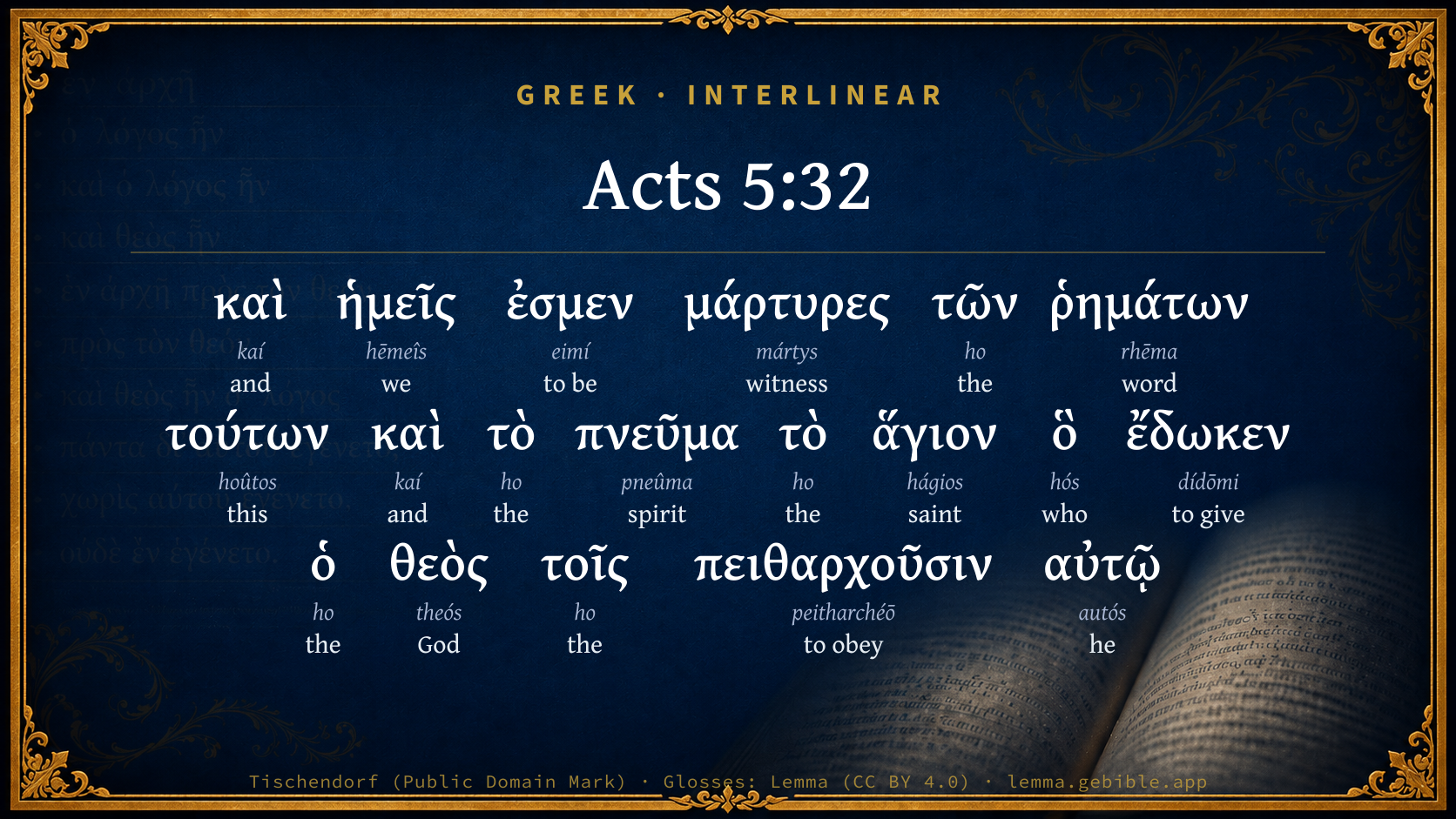
Greek (Tischendorf 8th ed.) Acts 5:32 appears in the Greek New Testament. The text above is from the Tischendorf 8th edition. Each word links to its Strong’s number and a concise gloss. Click any word for its full Thayer’s Greek Lexicon entry.
Download image
Cite this verse

Acts 5:32 (World English Bible). Public Domain. Lemma interlinear Bible study tool, https://lemma.gebible.app/v/acts/5/32.

Show BibTeX & RIS
BibTeX
RIS
English Translation
We are His witnesses of these things; and so also is the Holy Spirit, whom God has given to those who obey him."
World English Bible · Public Domain
Download a study sheet

One document with this verse’s original text, its word-by-word gloss line, the meaning frame, cross-references with their text, attributed commentary, and full source and license credits — printable, and it pastes into notes with its structure intact.

This verse Autodidact and up

Study sheet (.html) Plain text (.txt)

A passage Seminary Student

Up to 50 verses in one chapter. A passage sheet keeps up to 6 commentary sources and 12 cross-references per verse, in the order this page ranks them, and says so on the sheet whenever that leaves anything out. Ask for a single verse and you get the Autodidact verse sheet above.

Everything on this page stays free to read, with no account — the sheet is a download of what is already on screen, not access to it.

Want to remove ads? Support Godless Engineer
Compare translations 3

The same verse in 3 English versions, stacked beneath the original-language interlinear above. Click any original word for its lexicon entry.

Each is an independent rendering of the whole verse — the interlinear is not word-aligned to these translations.

Highlighted words mark where these versions differ — a whole-verse word diff, not a word-by-word alignment.

  • World English Bible Public Domain
    We are His witnesses of these things; and so also is the Holy Spirit, whom God has given to those who obey him."
  • King James Version Public Domain
    And we are his witnesses of these things; and so is also the Holy Ghost, whom God hath given to them that obey him.
  • unfoldingWord Literal Text CC BY-SA 4.0
    And we are witnesses of these things, and the Holy Spirit, whom God has given to those obeying him.”

unfoldingWord Literal Text — © unfoldingWord, licensed CC BY-SA 4.0. Word-aligned USFM3 via Door43 (git.door43.org/unfoldingWord/en_ult).

Versions to compare (up to 4)

3 of 4 selected

Show all 19 translations

Every available English version of this verse, each an independent rendering of the whole verse.

  • World English Bible Public Domain
    We are His witnesses of these things; and so also is the Holy Spirit, whom God has given to those who obey him."
  • Berean Standard Bible Public Domain
    We are witnesses of these things, and so is the Holy Spirit, whom God has given to those who obey Him.”
  • Majority Standard Bible Public Domain
    We are His witnesses of these things, and so is the Holy Spirit, whom God has given to those who obey Him.”
  • King James Version Public Domain
    And we are his witnesses of these things; and so is also the Holy Ghost, whom God hath given to them that obey him.
  • American Standard Version (1901) Public Domain
    And we are witnesses of these things; and `so is' the Holy Spirit, whom God hath given to them that obey him.
  • Revised Version (1885) Public Domain
    And we are witnesses of these things; and so is the Holy Ghost, whom God hath given to them that obey him.
  • Geneva Bible (1599) Public Domain
    And we are his witnesses concerning these things which we say: yea, and the holy Ghost, whome God hath giuen to them that obey him.
  • Douay-Rheims (1899) Public Domain
    And we are witnesses of these things and the Holy Ghost, whom God hath given to all that obey him.
  • Young's Literal Translation Public Domain
    and we are His witnesses of these sayings, and the Holy Spirit also, whom God gave to those obeying him.'
  • Literal Standard Version CC BY-SA 4.0
    and we are His witnesses of these sayings, and the Holy Spirit also, whom God gave to those obeying Him.”
  • Unlocked Literal Bible CC BY-SA 4.0
    We are witnesses of these things, and so is the Holy Spirit, whom God has given to those who obey him.”
  • unfoldingWord Literal Text CC BY-SA 4.0
    And we are witnesses of these things, and the Holy Spirit, whom God has given to those obeying him.”
  • Darby Bible Public Domain
    And *we* are [his] witnesses of these things, and the Holy Spirit also, which God has given to those that obey him.
  • World Messianic Bible Public Domain
    We are his witnesses of these things; and so also is the Holy Spirit, whom God has given to those who obey him.”
  • Webster's Bible Public Domain
    And we are his witnesses of these things; and so is also the Holy Spirit, whom God hath given to them that obey him.
  • Free Bible Version CC BY-SA 4.0
    We are witnesses of what happened, and so is the Holy Spirit, whom God has given to those who obey him.”
  • Bible in Basic English Public Domain
    And we are witnesses of these things, and so is the Holy Spirit, whom God has given to those who keep his laws.
  • Text-Critical English NT CC BY 4.0
    Concerning these things we are his witnesses, and so is the Holy Spirit, whom God has given to those who obey him.”
  • Tyndale New Testament (1534) Public Domain
    And we are his recordes concernynge these thinges and also the holy goost whom God hath geve to them that obey him.

Literal Standard Version (2020), Covenant Press — licensed CC BY-SA 4.0. Text via the HelloAO Bible API (eBible.org). Unlocked Literal Bible (unfoldingWord) — licensed CC BY-SA 4.0. Text via the HelloAO Bible API (eBible.org). unfoldingWord Literal Text — © unfoldingWord, licensed CC BY-SA 4.0. Word-aligned USFM3 via Door43 (git.door43.org/unfoldingWord/en_ult). Free Bible Version, Dr. Jonathan Gallagher — licensed CC BY-SA 4.0. Text via the HelloAO Bible API (eBible.org).

Word by word

More ways to search: Search by grammar → Find every occurrence → Compare this word →

Practice this passage: Drill this verse → Learn its vocabulary →

πειθαρχοῦσιν
peitharchéō
G3980
“to obey”
Verb, Present, Active, Participle, Dative, Plural, Masculine
Part of Speech
Verb
Tense
Present
Voice
Active
Mood
Participle
Case
Dative
Number
Plural
Gender
Masculine
Full Thayer's Definition

Origin: from a compound of G3982 and G757

TDNT: 06:09,8

1. to obey (a ruler or a superior)
  1. καὶ kaí G2532 “and” Conjunction
  2. ἡμεῖς hēmeîs G2249 “we” Personal pronoun, 1st person, Nominative, Plural
  3. ἐσμεν eimí G1510 “to be” Verb, Present, Active, Indicative, 1st person, Plural
  4. μάρτυρες mártys G3144 “witness” Noun, Nominative, Plural, Masculine
  5. τῶν ho G3588 “the” Article, Genitive, Plural, Neuter
  6. ῥημάτων rhēma G4487 “word” Noun, Genitive, Plural, Neuter
  7. τούτων hoûtos G3778 “this” Demonstrative pronoun, Genitive, Plural, Neuter
  8. καὶ kaí G2532 “and” Conjunction
  9. τὸ ho G3588 “the” Article, Accusative, Singular, Neuter
  10. πνεῦμα pneûma G4151 “spirit” Noun, Accusative, Singular, Neuter
  11. τὸ ho G3588 “the” Article, Accusative, Singular, Neuter
  12. ἅγιον hágios G40 “saint” Adjective, Accusative, Singular, Neuter
  13. ὃ hós G3739 “who” Relative pronoun, Accusative, Singular, Neuter
  14. ἔδωκεν dídōmi G1325 “to give” Verb, Aorist, Active, Indicative, 3rd person, Singular
  15. ὁ ho G3588 “the” Article, Nominative, Singular, Masculine
  16. θεὸς theós G2316 “God” Noun, Nominative, Singular, Masculine
  17. τοῖς ho G3588 “the” Article, Dative, Plural, Masculine
  18. αὐτῷ autós G846 “he” Personal pronoun, Dative, Singular, Masculine

About this verse

These counts appear in no published source. They are computed here, from the morphology-tagged text and Lemma’s own curated glosses. What Lemma adds →

19
words
14
distinct lemmas
Acts
section

Notable vocabulary

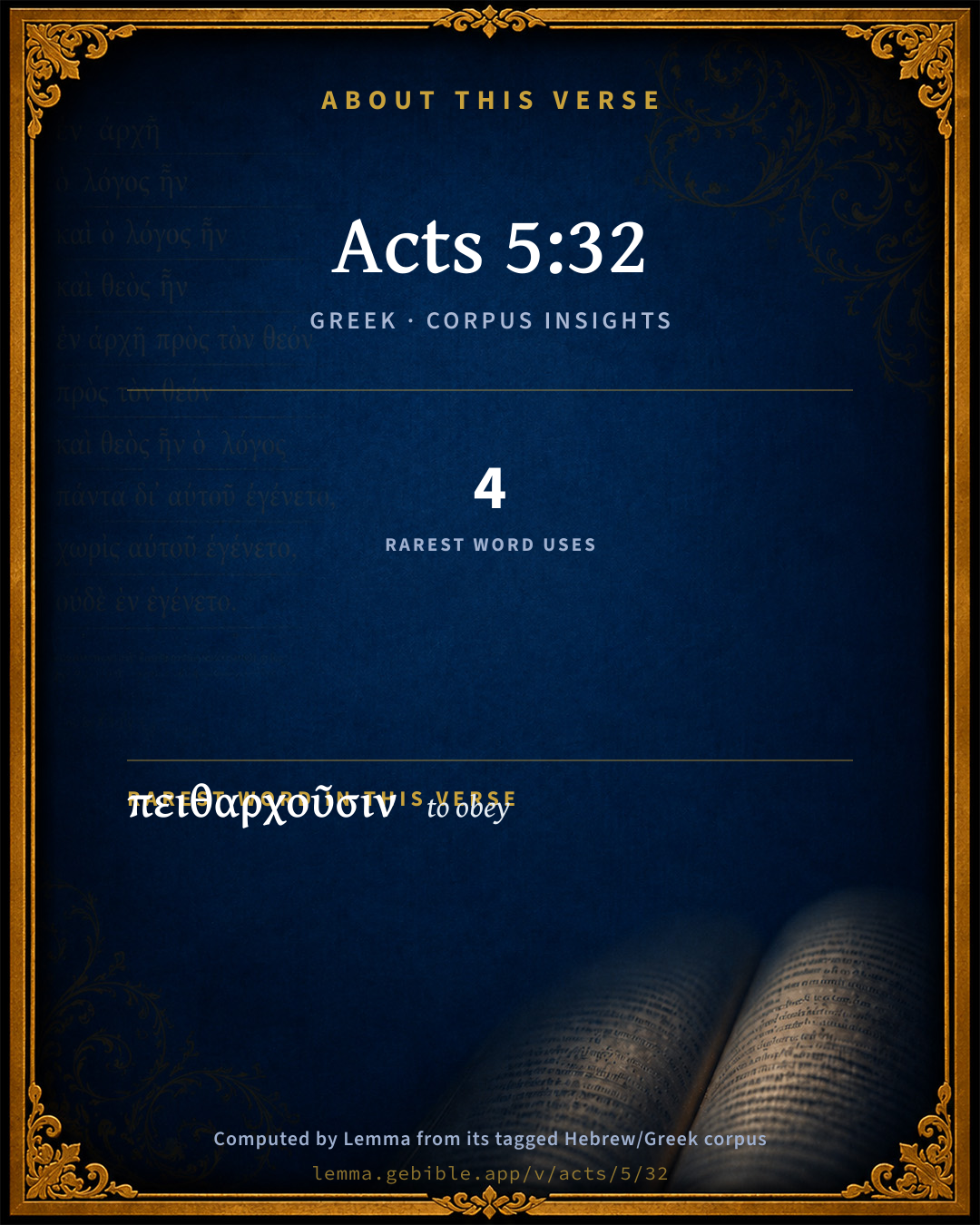
The rarest word here is πειθαρχοῦσιν to obey G3980 — appearing just 4 times in the whole Greek New Testament.

Shared distinctive vocabulary

πειθαρχοῦσιν to obey G3980 occurs in 4 verses of the Greek New Testament. Also found in:

Repetition

Words recur within this verse:

Cross-references

16

Topical passages linked to Acts 5:32 in the Treasury of Scripture Knowledge — connected by theme and wording, ordered by reader-vote popularity; previews shown in the World English Bible.

  • John 15:26–27 "When the Counselor has come, whom I will send to you from the Father, the Spirit of truth, who proceeds from the Father, he will testify about me.
  • Hebrews 2:3–4 how will we escape if we neglect so great a salvation-- which at the first having been spoken through the Lord, was confirmed to us by those who heard;
  • Acts 1:8 But you will receive power when the Holy Spirit has come upon you. You will be witnesses to me in Jerusalem, in all Judea and Samaria, and to the uttermost parts of the earth."
  • Luke 24:47–48 and that repentance and remission of sins should be preached in his name to all the nations, beginning at Jerusalem.
  • John 16:7–14 Nevertheless I tell you the truth: It is to your advantage that I go away, for if I don't go away, the Counselor won't come to you. But if I go, I will send him to you.
  • Acts 5:29 But Peter and the apostles answered, "We must obey God rather than men.
  • Acts 10:39–41 We are witnesses of everything he did both in the country of the Jews, and in Jerusalem; whom they also killed, hanging him on a tree.
  • Acts 13:31 and he was seen for many days by those who came up with him from Galilee to Jerusalem, who are his witnesses to the people.
  • 1 Peter 1:12 To them it was revealed, that not to themselves, but to you, did they minister these things, which now have been announced to you through those who preached the Gospel to you by the Holy Spirit sent out from heaven; which things angels desire to look into.
  • John 7:39 But he said this about the Spirit, which those believing in him were to receive. For the Holy Spirit was not yet given, because Jesus wasn't yet glorified.
  • Acts 2:4 They were all filled with the Holy Spirit, and began to speak with other languages, as the Spirit gave them the ability to speak.
  • Acts 2:38–39 Peter said to them, "Repent, and be baptized, everyone of you, in the name of Jesus Christ for the forgiveness of sins, and you will receive the gift of the Holy Spirit.
  • Acts 10:44 While Peter was still speaking these words, the Holy Spirit fell on all those who heard the word.
  • Acts 15:28 For it seemed good to the Holy Spirit, and to us, to lay no greater burden on you than these necessary things:
  • Acts 2:32 This Jesus God raised up, to which we all are witnesses.
  • 2 Corinthians 13:1 This is the third time I am coming to you. "At the mouth of two or three witnesses shall every word established."

Cross-references courtesy of OpenBible.info (CC BY 4.0).

Commentary

Notes on Acts 5:32 from classic Christian and Jewish commentators (each source and its license shown beneath its notes). The classic Christian expositions comment on the surrounding passage and are grouped to its opening verse, so a note may address several verses; the Jewish commentaries on the Tanakh (Rashi and others) are per-verse, so they appear only where the commentator wrote on this verse.

Lemma curates 59 commentaries, every one of them public domain or Creative Commons licensed, each selected and text-cleaned for this edition rather than reprinted as found. About our sources →

The Biblical Illustrator

Joseph S. Exell

Act_5:32

And we are witnesses of these things; and so also is the Holy Ghost.

The witness of the Word and of the Spirit

The book of Acts is one continuous testimony to the Ascension. As the Gospels contain the record of what Jesus began, so the Acts contain the record of what He continued to do and teach (Act_1:1). Our Lord prolongs His days, and some of the earliest of the new days of the Son of Man are recorded here. This word of St. Peter sums up the witness to the Ascension in a more compendious form than any other. It unites the two testimonies--of God and man--as they are not elsewhere--united. Let us consider these as--

I. The sum of the historical testimony to the facts of the gospel. That which the evangelists afterwards wrote the apostles now preach under the inspiration of the same Spirit, viz.

1. The Divine mission of Christ. The God of our fathers raised up His Son Jesus. Peter is here, and as long as we follow him in this book, a minister of the circumcision. Jesus in His preaching is the promise given to the fathers of the Jewish covenant. Beginning at Jerusalem He testifies to the council, who, however, could only receive the first principles of the doctrine of the dignity of Christ. Hence the reserve with which the holy name is always introduced. It is not Gods only begotten Son, but His Servant Son, whom He raised up of the seed of David, a prophet approved of God as the other prophets were. But St. Peter did not preach only for Jews. His words are so ordered as to bear the higher and broader meaning. The Servant was not only a descendant of Abraham and a prophet like unto Moses; God raised Him up in a sense that has no parallel. As Divine, Christs goings forth were from everlasting; as human, He was raised up by a peculiar and heavenly generation. St. Paul at Antioch takes up Peters words, and gives them the wider application.

2. The death of Christ. Here also we mark the specific application to Jewish hearers. St. Peter proclaimed Christs death as it could only have been proclaimed to the actual crucifiers. The same message that offered them pardon painted their crime in its most awful colours. The death of Christ is the central theme of New Testament testimony as declared by human witnesses under the direction of the Holy Ghost. As a fact, it has the largest place in the record. Here only all the evangelists unite, and wherever we turn in the later scriptures the Crucifixion is always near at hand. This, however, is a light thing compared with the meaning of the event. The tree becomes the Cross, and it is placed in the centre of New Testament theology. While the work of Christs mission is the whole sum of truth, the Cross is the whole sum of Christs work, and it is at the foot of the Cross that the apostles survey the whole truth as it is in Jesus.

3. The exaltation of Christ. Once more we mark the influence of Peters hearers. Every word is chosen to mark the contrast between the act of men and the act of God. They raised Him up to the tree; God raised Him up to a glory that was the measure of His humiliation. This is the testimony of the Holy Ghost to all mankind, and in a special sense. The apostles could only witness to Christs life, death, resurrection, and ascension, but the Spirit throughout the entire New Testament proclaims through the apostles that Jesus sat down at the right hand of the Majesty on high.

II. The saving supremacy of Christ as our Prince and Saviour at the right hand of the Father. It was declared by our Lord that the Spirit should glorify Him after His departure, and one part of that office He discharged by giving Him the new names acquired by His death.

1. Christ became, by His ascension, the Prince of His people. He was not that in the deepest and widest sense until He was received into the heavens. Then God highly exalted Him because of the suffering of death.

2. So also He became our Saviour, in the most comprehensive sense only, when, all His offices complete, He began His mediatorial reign. His name shall be called Jesus, said the angel; and by that name He was always known. Unto you is born a Saviour, said the angels; but we never hear that name given Him till now.

3. But the full significance of the new name is found only in the combination.

(1) He is the Saviour of the subjects of His kingdom, and none are His true subjects who are not delivered by His power from their guilt, their subjection to sin and the empire of Satan. The whole tenor of His instructions is faithful to the one idea of the gathering out of the world a people who are saved from their sins. As He began, so He ended with the kingdom of heaven. This also was the burden of apostolic testimony. St. Peter (chap. 2.) proclaims a saving grace that rescues souls from an untoward generation and adds them to the Church as saved. And the Holy Ghost everywhere bears the same testimony. The kingdom is still not of this world.

(2) And He is the Ruler over those whom He saves. Absolute submission to His authority is the law of His Church--a law to which the Spirit everywhere bears testimony. Our salvation is made perfect by holy obedience. This testimony, added to the former, completes the witness to the Redeemers lordship in heaven. Those who would make Him a king over all men alike are rebuked by the declaration that He is a prince only as He is a Saviour. Those who would make Him only a Saviour are rebuked by the declaration that He is a Saviour only as He is a prince.

III. The salvation which our Prince in heaven bestows on man upon earth. And here St. Peter preaches, as the organ of the Holy Ghost, the common salvation, to use his own phrase, in a manner that is by no means common.

1. Jesus in heaven is the Giver of repentance and pardon. These two words express the whole sum of salvation provided in Christ and proclaimed in His gospel. The former comprises all that is to be wrought in man as preparation; the latter comprises all that man, thus prepared, receives from Christs mercy. The two together comprise all the words of this life.

2. To these things bear the apostles witness, and so does also the Holy Ghost--

(1) As the vindicator of Christs claims to all who hear the gospel, but more specifically to those who obey.

(2) As the revealer of Christs mercy. (WB. Pope, D. D.)

Christian witnesses

I. The respective witnesses--the apostles in the first case, and the Holy Ghost in the second. With regard to the apostles: we may remark, that their evidence, as it will bear the strictest scrutiny, so it is worthy of universal credit.

1. These witnesses must have had the strongest reasons for what they affirmed, concerning the Saviours resurrection--or they would not have espoused a cause so extremely unpopular and hazardous.

2. Next to their peculiar situation--the nature of the evidence which these persons gave affords the strongest grounds of confidence. They were eye-witnesses of the fact.

3. And this is further strengthened by the number of witnesses herein concerned.

4. The place where they declared the fact strongly confirms it. They chose the spot where the event happened--the city where dwelt the very murderers of the Son of God--as the first place in which to spread their report.

5. The time which they chose also is another evidence of their integrity. While the transactions of Calvary were yet fresh in the memory of all, and while the enemies of the Saviour were still in transports of joy on account of their supposed victory, His disciples boldly declared that He was raised from the dead, and ascended into heaven.

II. But there is a higher kind of evidence: The Holy Ghost also (Mar_16:20; Act_4:33).

1. This He did by enabling them to work miracles in confirmation of the truth.

2. The transforming effects of the gospel on the hearts and lives of men afford us another proof.

3. Consolation and peace afforded to the mourner are also in proof. His smile makes the poor, the needy, the trembling rejoice.

Conclusion:

1. The evidence of an ascended Saviour gives us encouragement for faith and prayer, and love, and praise.

2. How dangerous for sinners to disobey and dishonour Him! (American National Preacher.)

Gods chosen witnesses

(text, and Isa_43:10):--Men bear for God two kinds of testimony--in-voluntary and voluntary.

I. The Jews were involuntary witnesses. They had the law and the prophets. They glorified in this. But their formalism and worldliness prevented them from seeing the meaning of these oracles of God. They were called into court, as it were, by God. Bring forth the blind that have eyes, and the deaf that have ears; Let all nations be gathered and confronted with these Hebrews. Who among the heathen can announce coming and far-distant events, or even show former things? But the Jews can. The law and prophets in their hands--books seven centuries old--declare the history of man from the Creation and announce the coming One--My servant whom I have chosen--seven centuries in advance. You Hebrews, God said by Isaiah (Isa_43:8), with eyes but seeing not, hold these books in your hands. Ye are My unconscious, involuntary witnesses. So He may say still. These Hebrews nave, most tenaciously, and often at the hazard of their lives, held fast these sacred volumes through all these centuries. Peeled and scattered over the earth, they have guarded these documents while they have misread them; a blind people that have eyes--shrewd, far-seeing, and intelligent in all other matters, but perverse and ignorant in this, they have remained involuntary witness-bearers to the veracity and supremacy of God.

II. Christians are voluntary witnesses in a twofold capacity--as a Church and as individuals.

1. Against atheism asserting there is no God, the Church proclaims: There is, and we know, worship and obey Him.

2. Against paganism, with its many gods, the Church testifies: The Lord our God is one Lord.

3. Against many-faced infidelity denying that there is any revelation from God, if there is a God at all, the Church avers: We have. God spake at sundry times and in various ways to the fathers by the prophets. In these last days He has spoken unto us by His Son.

4. Against those who deny the manifestation of God in three persons, the Church keeps uttering its benediction: The grace of our Lord Jesus Christ, and the love of God, and the communion of the Holy Ghost, be with you all.

5. Those who deny the necessity for any atonement may hear the Church declare: The wages of sin is death, but we have redemption through the blood of Christ, even the forgiveness of sins, and see her showing forth His death till He come in her holy communion.

6. To sceptics who scornfully ask: Where is the promise of His coming? the Church testifies: We wait for the Son of God from heaven. He will appear, and then all mysteries will be solved.

7. To Romanists who assert that there are other mediators than Jesus, the Church proclaims one God and one Mediator between God and man, the Man Christ Jesus.

8. False liberalism may say to the sinner: Be sincere and you need no more; the Church echoes her Founders words: Except a man be born from above he cannot see the kingdom of heaven, and those of His beloved disciple: Without holiness no man shall see the Lord. (J. Hall, D. D.)

The evidence from experience

Does the religion of Christ stand the test of the Baconian philosophy?

I. We shall probably find Christianity a religion that will submit to the test of experience, because--

1. It is a religion for all men. There is nothing in Christianity narrow, exclusive, sectarian. Now how can this be unless it be put to the test of fact? The masses cannot reason closely.

2. Only by commending itself to his experience will this religion do for any man all the time. There are times when philosophy and theology cannot sustain a man. In trouble and death mere reason will not sustain him. He must then know his support.

3. The method of experience has been found to be better fitted to give an understanding of things. The world knew little of the sciences till Bacons time. One pound of fact is worth a ton of argument. It is probable, therefore, that God designing a religion for all men would so arrange that it could be subjected to the most convincing test.

II. Does Christianity submit itself to tests that man can try? Yes; let us observe them--

1. A verification of the promises of the Bible as touching

(1) charity. Ask any man who has tried charity for twenty or thirty years if it pays.

(2) Prayer.

2. Let us come to the heart of Scripture. We are told that he who believes will be saved. Can we know we are saved? If there is a fact in the universe of which we may be certain, it is that Christ reveals Himself to the believer as his Saviour.

III. A few questions to those who still object.

1. Is mystery confined to Christianity? I will undertake to explain the mystery of the Trinity to any man who will unfold the mystery of a single seed.

2. On the testimony of a few competent witnesses we believe in the wonderful revelation of the spectroscope. Millions of competent witnesses declare that they know by experience Christianity to be true.

3. Owen finds a fossil five hundred feet down. He says that animal lived on the surface because there are sockets for eyes. Nature makes nothing in vain. It must have lived where light was. Now in man we find yearnings, hopes that nothing but immortality can satisfy. Can you believe that God made light for the eyes, but nothing for the soul? Conclusion: Many doubt the possibility of knowing the forgiveness of sins. I say to a man, Saturn has three rings and eight satellites. Says he, That cannot be, for I have conversed with many men who have looked at Saturn, but they never saw any rings or moons. I apply the telescope to his eye; he looks, but sees nothing. Why? He is blind. (C. D. Foss, D. D.)

The test of experience

There are two methods by which conclusions are reached--the method of argument and that of experience. These have their representatives in Aristotle and Bacon. By the first we are led by reason; by the second fact. Which is the better method? A farmer ploughing his field turns to the light a bit of yellow substance. He examines it. It seems to be gold. He reasons; gold has been found in the neighbourhood; the geological conditions are all favourable, and it, has the appearance and gravity of gold. This is the first method. But suppose he takes that substance to the metallurgist, and an acid is applied that will take hold of nothing else but gold. He now knows through experience that it is gold. Take the case of character: you wish to know if a man is honest. You say he looks honest, has honest associates, comes of an honest stock. Now that is all argument. But suppose his partner says, I know he is honest; he has been with me for twenty years. That is the method of Bacon--experience. Is it not the most conclusive? (C. D. Foss, D. D.)

The Biblical Illustrator, edited by Joseph S. Exell (c. 1880s–1900s) — public domain. Text from a community e-Sword module.

MacLaren's Expositions of Holy Scripture

Alexander MacLaren

Acts

WHOM TO OBEY,-ANNAS OR ANGEL?

Act 5:17 - Act 5:32.

The Jewish ecclesiastics had been beaten in the first round of the fight, and their attempt to put out the fire had only stirred the blaze. Popular sympathy is fickle, and if the crowd does not shout with the persecutors, it will make heroes and idols of the persecuted. So the Apostles had gained favour by the attempt to silence them, and that led to the second round, part of which is described in this passage.

The first point to note is the mean motives which influenced the high-priest and his adherents. As before, the Sadducees were at the bottom of the assault; for talk about a resurrection was gall and wormwood to them. But Luke alleges a much more contemptible emotion than zeal for supposed truth as the motive for action. The word rendered in the Authorised Version ‘indignation,’ is indeed literally ‘zeal,’ but it here means, as the Revised Version has it, nothing nobler than ‘jealousy.’ ‘Who are those ignorant Galileans that they should encroach on the office of us dignified teachers? and what fools the populace must be to listen to them! Our prestige is threatened. If we don’t bestir ourselves, our authority will be gone.’ A lofty spirit in which to deal with grave movements of opinion, and likely to lead its possessors to discern truth!

The Sanhedrin, no doubt, talked solemnly about the progress of error, and the duty of firmly putting it down, and, like Jehu, said, ‘Come, and see our zeal for the Lord’; but it was zeal for greetings in the marketplace, and the chief seats in the synagogues, and the other advantages of their position. So it has often been since. The instruments which zeal for truth uses are argument, Scripture, and persuasion. That zeal which betakes itself to threats and force is, at the best, much mingled with the wrath and jealousy of man.

The arrest of the Apostles and their committal to prison was simply for detention, not punishment. The rulers cast their net wider this time, and secured all the Apostles, and, having them safe under lock and key, they went home triumphant, and expecting to deal a decisive blow to-morrow. Then comes one of the great ‘buts’ of Scripture. Annas and Caiaphas thought that they had scored a success, but an angel upset their calculations. To try to explain the miracle away is hopeless. It is wiser to try to understand it.

The very fact that it did not lead to the Apostles’ deliverance, but that the trial and scourging followed next day, just as if it had not happened, which has been alleged as a proof of its uselessness, and inferentially of its falsehood, puts us on the right track. It was not meant for their deliverance, but for their heartening, and for the bracing of all generations of Christians, by showing, at the first conflict with the civil power, that the Lord was with His Church. His strengthening power is operative when no miracle is wrought. If His servants are not delivered, it is not that He lacks angels, but that it is better for them and the Church that they should lie in prison or die at the stake.

The miracle was a transient revelation of a perpetual truth, and has shed light on many a dark dungeon where God’s servants have lain rotting. It breathed heroic constancy into the Twelve. How striking and noble was their prompt obedience to the command to resume the perilous work of preaching! As soon as the dawn began to glimmer over Olivet, and the priests were preparing for the morning sacrifice, there were these irrepressible disturbers, whom the officials thought they had shut up safely last night, lifting up their voices again as if nothing had happened. What a picture of dauntless persistence, and what a lesson for us! The moment the pressure is off, we should spring back to our work of witnessing for Christ.

The bewilderment of the Council comes in strong contrast with the unhesitating action of the Apostles. There is a half ludicrous side to it, which Luke does not try to hide. There was the pompous assembling of all the great men at early morning, and their dignified waiting till their underlings brought in the culprits. No doubt, Annas put on his severest air of majesty, and all were prepared to look their sternest for the confusion of the prisoners. The prison, the Temple, and the judgment hall, were all near each other. So there was not long to wait. But, behold! the officers come back alone, and their report shakes the assembly out of its dignity. One sees the astonished underlings coming up to the prison, and finding all in order, the sentries patrolling, the doors fast {so the angel had shut them as well as opened them}, and then entering ready to drag out the prisoners, and-finding all silent. Such elaborate guard kept over an empty cage!

It was not the officers’ business to offer explanations, and it does not seem that any were asked. One would have thought that the sentries would have been questioned. Herod went the natural way to work, when he had Peter’s guards examined and put to death. But Annas and his fellows do not seem to have cared to inquire how the escape had been made. Possibly they suspected a miracle, or perhaps feared that inquiry might reveal sympathisers with the prisoners among their own officials. At any rate, they were bewildered, and lost their heads, wondering what was to come next, and how this thing was to end.

The further news that these obstinate fanatics were at their old work in the Temple again, must have greatly added to the rulers’ perplexity, and they must have waited the return of the officers sent off for the second time to fetch the prisoners, with somewhat less dignity than before. The officers felt the pulse of the crowd, and did not venture on force, from wholesome fear for their own skins. An excited mob in the Temple court was not to be trifled with, so persuasion was adopted. The brave Twelve went willingly, for the Sanhedrin had no terrors for them, and by going they secured another opportunity of ringing out their Lord’s salvation. Wherever a Christian can witness for Christ, he should be ready to go.

The high-priest discreetly said nothing about the escape. Possibly he had no suspicion of a miracle, but, even if he had, Act 4:16 shows that that would not have led to any modification of his hostility. Persecutors, clothed with a little brief authority, are strangely blind to the plainest indications of the truth spoken by their victims. Annas did not know what a question about the escape might bring out, so he took the safer course of charging the Twelve with disobedience to the Sanhedrin’s prohibition. How characteristic of all his kind that is! Never mind whether what the martyr says is true or not. He has broken our law, and defied our authority; that is enough. Are we to be chopping logic, and arguing with every ignorant upstart who chooses to vent his heresies? Gag him,-that is easier and more dignified.

A world of self-consequence peeps out in that ‘we straitly charged you,’ and a world of contempt peeps out in the avoidance of naming Jesus. ‘This name’ and ‘this man’ is the nearest that the proud priest will come to soiling his lips by mentioning Him. He bears unconscious testimony to the Apostles’ diligence, and to the popular inclination to them, by charging them with having filled the city with what he contemptuously calls ‘your teaching,’ as if it had no other source than their own ignorant notions.

Then the deepest reason for the Sanhedrin’s bitterness leaks out in the charge of inciting the mob to take vengeance on them for the death of Jesus. It was true that the Apostles had charged that guilt home on them, but not on them only, but on the whole nation, so that no incitement to revenge lay in the charge. It was true that they had brought ‘this man’s blood’ on the rulers, but only to draw them to repentance, not to hound at them their sharers in the guilt. Had Annas forgot ‘His blood be on us, and on our children’? But, when an evil deed is complete, the doers try to shuffle off the responsibility which they were ready to take in the excitement of hurrying to do it. Annas did not trouble himself about divine vengeance; it was the populace whom he feared.

So, in its attempt to browbeat the accused, in its empty airs of authority, in its utter indifference to the truth involved, in its contempt for the preachers and their message, in its brazen denial of responsibility, its dread of the mob, and its disregard of the far-off divine judgment, his bullying speech is a type of how persecutors, from Roman governors down, have hectored their victims.

And Peter’s brave answer is, thank God! the type of what thousands of trembling women and meek men have answered. His tone is severer now than on his former appearance. Now he has no courteous recognition of the court’s authority. Now he brushes aside all Annas’s attempts to impose on him the sanctity of its decrees, and flatly denies that the Council has any more right to command than any other ‘men.’ They claimed to be depositaries of God’s judgments. This revolutionary fisherman sees nothing in them but ‘men,’ whose commands point one way, while God’s point the other. The angel bade them ‘speak’; the Council had bid them be dumb. To state the opposition was to determine their duty. Formerly Peter had said ‘judge ye’ which command it is right to obey. Now, he wraps his refusal in no folds of courtesy, but thrusts the naked ‘We must obey God’ in the Council’s face. That was a great moment in the history of the world and the Church. How much lay in it, as in a seed,-Luther’s ‘Here I stand, I can do none other. God help me! Amen’; Plymouth Rock, and many a glorious and blood-stained page in the records of martyrdom.

Peter goes on to vindicate his assumption that in disobeying Annas they are obeying God, by reiterating the facts which since Pentecost he had pressed on the national conscience. Israel had slain, and God had exalted, Jesus to His right hand. That was God’s verdict on Israel’s action. But it was also the ground of hope for Israel; for the exaltatior of Jesus was that He might be ‘Prince [or Leader] and Saviour,’ and from His exalted hand were shed the gifts of ‘repentance and remission of sins,’ even of the great sin of slaying Him. These things being so, how could the Apostles be silent? Had not God bid them speak, by their very knowledge of these? They were Christ’s witnesses, constituted as such by their personal acquaintance with Him and their having seen Him raised and ascending, and appointed to be such by His own lips, and inspired for their witnessing by the Holy Spirit shed on them at Pentecost. Peter all but reproduces the never-to-be-forgotten words heard by them all in the upper room, ‘He shall bear witness of Me: and ye also shall bear witness, because ye have been with Me from the beginning.’ Silence would be treason. So it is still. What were Annas and his bluster to men whom Christ had bidden to speak, and to whom He had given the Spirit of the Father to speak in them?

Alexander MacLaren, Expositions of Holy Scripture (1904–1910) — public domain. Text from a community e-Sword module.

Bengel's Gnomon

Johann Albrecht Bengel

Act 5:32. Καὶ, and) and in consequence.—δὲ, indeed) This particle amplifies. The testimony of the Holy Spirit is weightier than that of the apostles.—τοῖς πειθαρχοῦσιν, who obey) God, saith Peter, hath given us the Holy Spirit: it is He who impels us to give testimony; and we obey; Act 5:29. We should note the difference between the two words, comparing Act 5:36-37; Act 5:40, where πείθεσθαι occurs: it is this, according to Ammonius; πείθεσθαι is said of one who voluntarily assents to another (τὸ ἑκουσίως συγκατατίθεσθαι: so also ὑποτάσσεσθαι), but πειθαρχεῖν of one who obeys the command of another (τὸ κελεύοντι πεισθῆναι).[42] Comp. Act 27:11; Act 27:21, “The centurion believed (ἘΠΕΊΘΕΤΟ) the master of the ship:” “Ye should have hearkened (complied with my counsel, ΠΕΙΘΑΡΧΉΣΑΝΤΆς) unto me.”

[42] Πειθαρχεῖν, from ἀρχὴ, implies some degree of constraint or obedience to authority and command. Πείθεσθαι and ὑποτάσσεσθαι are more spontaneous. See Tittm. Syn. N. T.—E. and T.

Bengel's Gnomon of the New Testament — English translation (T&T Clark, Edinburgh, 1860) — public domain. Text from a community e-Sword module.

Expositor's Greek Testament

ed. W. Robertson Nicoll

Act 5:32 . “And we are witnesses of these things,” R.V. (W.H [183] ), but in margin, “witnesses in Him,” ἐν αὐτῷ ( cf. Luk 24:47 ); “nos in eo testes sumus,” Iren., see also above critical notes. For an explanation of the reading in T.R. and the two genitives, see Simcox, Language of the N. T. , p. 84, note, and compare 2Co 5:1 , Phi 2:30 , 1Th 1:3 . ῥημάτων : here=Hebrew דָּבַר , cf. Act 10:37 (Grotius, Blass), the words standing for their contents, i.e. , the things, the facts. Meyer understood the facts to be the Resurrection and Ascension of Jesus, but Wendt understands them to be the gifts of the Messianic salvation mentioned in Act 5:31 , and compares Act 5:20 . But the use of the word in Act 5:20 need not limit its use here: the Apostles were called above all things to witness to the facts of Christ’s life, Act 10:37 , and the ζωή in Act 5:20 depended upon the Resurrection. In Luk 1:37 R.V. has “no word,” ῥῆμα , where A.V. has “no thing,” cf. Luk 1:65 , where A. V. has “things” in the margin ( ῥήματα ), and R.V. reads “sayings” in text: Luk 2:15 , where R.V. has “this thing” ( ῥῆμα ) in the text, and “saying” in margin; in Luk 2:19 ; Luk 2:51 , R.V. has “sayings” in the text, “things” in the margin so in LXX, the same uncertainty, cf. Gen 15:1 ; Gen 18:14 , Exo 2:14-15 . ῥῆμα is used frequently by St. Luke in his writings, and much more so than by the other Evangelists; although it is found in all parts of the Acts, it is noticeable that it is employed more frequently in the earlier chapters, as in the first two chapters of the Gospel. καὶ τὸ πνεῦμα τὸ ἅγιον δὲ : on the expression see Act 4:8 . The Holy Ghost συμμαρτυρεῖ with the Apostles, Rom 8:16 ( cf. Act 15:28 ). We may well compare with these words of St. Luke our Lord’s parting words in Joh 15:26-27 . Here we have also the twofold witness the historical witness borne to the facts and the internal witness of the Holy Ghost in bringing home to men’s hearts the meaning of the facts (see Westcott on St. John, in loco ). τοῖς πειθαρχοῦσιν αὐτῷ : not to be limited to the Apostles, although by repeating this verb used at the opening of the speech St. Peter intimates that the ὑπακοὴ τῆς πίστεως (Rom 1:5 ) was the first requisite for the reception of the divine gift. In their own case the witness of the Spirit had been clearly shown, not only in the miracles which the Apostles had done, but also in the results of their preaching, in the enthusiasm of their charity, and we need not limit with Nösgen the thought of the gift of the Holy Spirit to the events of Pentecost. If this short speech of St. Peter, 29 32, reads like a summary of much which he is represented as saying on former occasions, we have no warrant for dismissing it as unhistorical, or even for supposing that St. Luke has only given us a summary of the address. It is rather “a perfect model of concise and ready eloquence,” and a striking fulfilment of the Lord’s promise, Mat 11:19 . Nothing was more natural than that St. Peter and his fellow-Apostles, like men whose minds were finally made up, should thus content themselves with an emphatic reassertion of the main issues involved in teaching which was already widely known, and with a justification of their disobedience to man by an appeal to the results which accompanied their obedience to God.

[183] Westcott and Hort’s The New Testament in Greek: Critical Text and Notes.

The Expositor's Greek Testament, edited by W. Robertson Nicoll (1897–1910) — public domain. Text from a community e-Sword module.

Geneva Bible (1599)

Geneva Bible translators

It is not sufficient for us that there is a right end, but we must also according to our vocation go on forward till we come unto it.

Geneva Bible (1599) marginal notes — public domain. Text via Bolls.life.

Jamieson, Fausset & Brown

Robert Jamieson, A. R. Fausset & David Brown

we are his witnesses . . . and the Holy Ghost--They as competent human witnesses to facts, and the Holy Ghost as attesting them by undeniable miracles.

Jamieson, Fausset & Brown — Commentary Critical and Explanatory on the Whole Bible (1871) — public domain (CC PDM 1.0). Text via the HelloAO Bible API.

Adam Clarke's Commentary

Verse 32. We are his witnesses] The word αυτου, his, is omitted by AD, and several others of good note; the Syriac, all the Arabic, AEthiopic, and Vulgate. It does not seem to be necessary.

Of these things] των πηματων τουτων, Of these transactions: i.e. of Christ's life and miracles, and of your murderous proceedings against him.

And so is also the Holy Ghost] In the gift of tongues lately communicated; and by his power and influence on our souls, by which we are enabled to give irresistible witness of our Lord's resurrection.

To them that obey him.] We obey GOD, not you; and therefore God gives us this Spirit, which is in us a fountain of light, life, love, and power. The Spirit of God is given to the obedient: in proportion as a man who has received the first influences of it (for without this he cannot move in the spiritual life) is obedient to those influences, in the same proportion the gifts and graces, the light, life, and power, of the Holy Spirit, are increased in his soul.

Adam Clarke's Commentary on the Bible (1810–1826) — public domain. Text from a community e-Sword/MySword module.

John Calvin's Commentaries

32. And we are his witnesses. After that they have declared that their doctrine came from God, they descend now unto the other part that they speak as they were commanded by God, lest they seem to attempt anything unadvisedly. For this also was a necessary defense, as it is for all the ministers of the gospel, to wit, that they make this openly known to all men that they teach nothing but that which they have received of God. Secondly, that they are called hereunto, so that they cannot avoid the necessity of teaching, unless they will resist God. Luke putteth words in this place, instead of things, according to the Hebrew phrase. Although if any man had rather understand it of the speech itself, I do not deny but that it may be so. The sum is, seeing they are brought forth by God to be witnesses, they may not give back, but they must publish things which he hath commanded.

And also the Spirit. They confirm their calling by the effect; for this was a seal to approve their doctrine, seeing that God gave the Holy Spirit to those which believed. Forasmuch, as it appeared manifestly by this, that he allowed the faith of the gospel, and it was acceptable to him. In that they say to those which obey him, I refer it unto Christ, as if they should have said, those which believe in Christ are plentifully rewarded for their obedience. Therefore God will have Christ obeyed. Wherefore even our ministry doth please him in that thing. Yet here may a question be moved, Seeing that we have saith by the revelation of the Spirit, how is it said in this place, that the same is given after faith? I answer, that the gift of tongues, of prophecy, of interpretation, of healing, and such like, are spoken of in this place, wherewith God did beautiful his Church. As Paul saith, where he asketh the Galatians, whether they received the Spirit by the law, or by the hearing of faith, (Galatians 3:2.) Therefore the illumin-ation of the Spirit goeth before faith, because it is the cause thereof; but there follow other graces afterward, that we may go forward, according to that, “To him that hath shall be given,” (Matthew 13:12.) And if we will be enriched every now and then with new gifts of the Spirit, let us hold out unto God the lap of faith. But the reward wherewith our want of faith is rewarded at this day is far unlike; for the most part being destitute of the Spirit of God doth neither see nor understand anything.

John Calvin's Commentaries (1540-1563) — public domain. Text from the Calvin Translation Society English edition (1840s-50s) via the Christian Classics Ethereal Library (ccel.org). Calvin's coverage is partial (roughly two-thirds of the Bible); uncommented books and verses are honest gaps, never fabricated. The 19th-century editor's footnotes and remarks are omitted so the notes are faithfully Calvin's own voice.

Ellicott's Commentary for English Readers

(32) And so is also the Holy Ghost.—The signs and wonders, the tongues and the prophecies, the new power and the new love, were all thought of by the Apostles as coming from their Lord; and therefore as an evidence that He had triumphed over death and had ascended into heaven. (Comp. Act_2:33.)

A Bible Commentary for English Readers, edited by Charles John Ellicott (1878–1897) — public domain. Text from a community e-Sword module.

The Cambridge Bible for Schools and Colleges

gen. ed. J. J. S. Perowne

32. And we are his witnesses of these things] The best texts omit his, while some ancient authorities add in him in place of his.

these things] i.e. the Crucifixion and the Resurrection and Ascension.

and so is also the Holy Ghost] Also is not found in the best MSS. Christ had said, while alive, concerning the Holy Ghost, “He shall testify of me” (Joh_15:26). This He did in the minds of the Apostles by “bringing all things to their remembrance,” and enlightening them to see how Christ’s life had fulfilled the prophecies, and also in the mighty powers which through the outpouring of the Spirit they now possessed.

whom God hath given to them that obey him] Thus the disciples declare that the obedience to God, which at the outset (Act_5:29) they had proclaimed as their bounden duty, was also the reason why the Holy Ghost had been bestowed upon them, and leaving it to be gathered that what God has done He will do again, and bestow His gifts of grace on those who are willing to obey Him.

The Cambridge Bible for Schools and Colleges (gen. ed. J. J. S. Perowne; Cambridge University Press, 1878–1918) — public domain. Text from a community e-Sword module.

John Gill's Exposition

When they heard that,.... This defence of the apostles, in which they still insisted upon it, that they had been the crucifiers of Christ, and yet that he was raised from the dead, and exalted in heaven, and was a spiritual Saviour of men:

they were cut; to the heart, as if they had been cut asunder with a saw; the Ethiopic version renders it, "they were angry", and "gnashed with their teeth", as if a saw was drawn to and fro; they were filled with rage and madness:

and took counsel to slay them; not in a legal and judicial way, but in a private manner, or by force; stirring up the zealots to rise up against them, and dispatch them at once, as blasphemers and heretics.

John Gill's Exposition of the Whole Bible (1746–1763) — public domain (CC PDM 1.0). Text via the HelloAO Bible API.

Trapp's Complete Commentary

John Trapp

32 And we are his witnesses of these things; and so is also the Holy Ghost, whom God hath given to them that obey him.

Ver. 32. To them that obey him] πειθαρχουσιν. The Syriac and Arabic have it, To them that believe in him, πιστευουσιν. It comes all to one pass; for neither is faith without obedience, nor obedience without faith; and both are from the Spirit.

John Trapp, A Commentary or Exposition upon All the Books of the Old and New Testament (1647–1656) — public domain. Text from a community e-Sword module.

Albert Barnes' Notes on the Bible

And we are his witnesses - For this purpose they had been appointed, Act 1:8, Act 1:21-22; Act 2:32; Act 3:15; Luk 24:48.

Of these things - Particularly of the resurrection of the Lord Jesus, and of the events which had followed it. Perhaps, however, he meant to include everything pertaining to the life, teachings, and death of the Lord Jesus.

And so is also ... - The descent of the Holy Spirit to endow them with remarkable gifts Act 2:1-4, to awaken and convert such a multitude Act 2:41; Act 4:4; Act 5:14, was an unanswerable attestation of the truth of these doctrines and of the Christian religion. So manifest and decided was the presence of God attending them, that “they” could have no doubt that what they said was true; and so open and public was this attestation, that it was an evidence to all the people of the truth of their doctrine.

Albert Barnes' Notes on the Bible (1834–1885) — public domain. Text from a community e-Sword/MySword module.

Matthew Poole's English Annotations

We are his witnesses; they refuse not to bear their testimony for Christ, who witnessed a good profession for us.

So is also the Holy Ghost; the Holy Ghost does witness,

1. By the apostles; through his grace and strength they bear their record.

2. By all the miracles that were wrought, for they were only done by his power.

3. By enabling any to believe these things; which belief is his work.

4. Not to say that the Holy Ghost was a witness of the things concerning Christ at his baptism, and the several attestations he gave, saying, This is my beloved Son, Mat 3:17.

Obey him; some read, believe in him, which is to the same purpose; for there is no true repentance where there is no faith; nor no saving faith where there is no repentance and amendment.

Matthew Poole's English Annotations on the Holy Bible (1683–1685) — public domain. Text from a community e-Sword/MySword module.

The Pulpit Commentary

Witnesses for his witnesses, A.V. and T.R.; so is the Holy Ghost for so is also the Holy Ghost, A.V. and T.R. We are witnesses. The direct reference is to the command recorded in Act_1:8, which they felt imperatively bound to obey. So is the Holy Ghost. The Holy Ghost bare witness to the gospel preached by the apostles by the powers which he gave them to heal and work miracles, and by the conversion of many who heard the word: "the gospel preached with the Holy Ghost sent down from heaven". (1Pe_1:12) Mark the solemnity and authority which Peter claimed for the gospel by thus asserting that the Holy Ghost was the witness with the apostles to the truth of their testimony concerning Jesus Christ.

The Pulpit Commentary (1880–1919), ed. H.D.M. Spence-Jones & Joseph S. Exell — public domain. Text from a community e-Sword module.

John Wesley's Explanatory Notes

And also the Holy Ghost - A much greater witness.

John Wesley, Explanatory Notes Upon the Whole Bible (1754–1765) — public domain. Text via the GEBible commentary corpus.

Godbey's Commentary on the New Testament

William B. Godbey

THE GIFT OF THE HOLY GHOST

32. Here we find that the Holy Ghost is given to them that obey God. The Greek for obedience and faith is the same word, which is also true of unbelief and disobedience, illustrating the fact that they are one and inseparable. A true faith always obeys, while disobedience is demonstrative evidence of unbelief. The Holy Ghost will not abide where He is not scrupulously obeyed. He is keenly susceptible of the slightest disobedience, evanescing unconsciously. So you wake to find the heavenly dove flown away out of your heart, leaving an aching void the world can never fill. It is a wonderfully delicate matter to obey God. It is easy, if you pursue the right method, but impossible on any other line. What is the right method? The Bible is the guide-book. If you are truly interested in the Guide, you will be thrillingly interested in the guide-book. With thorough abandonment to God, perfect commitment of your creeds, opinions, theories, notions and enterprises to Him, bereft of every care, sit meekly and lowly at the feet of Jesus, while the Holy Ghost teaches His blessed Word. If you say yes to God, and no to Satan, all the time, you will have no trouble to obey God, and in that case He gives you His Holy Spirit to dwell in your heart, giving you a sweet heaven in which to go to heaven. “My yoke is easy and my burden is light” — this you will always find true if you will let God have His way in all things. Your life will become a cloudless sunshine.

William B. Godbey, Commentary on the New Testament (1896–1900) — public domain. Text from a community e-Sword module.

McGarvey & Pendleton's Commentaries

J. W. McGarvey

See notes on verse 29

J. W. McGarvey (with Philip Y. Pendleton), Commentaries on the New Testament (The Fourfold Gospel, 1914; Acts; and the epistles) — public domain. Text from a community e-Sword/MySword module.

Cambridge Greek Testament for Schools and Colleges

32. αὐτοῦ omitted with אAD. Vulg. ‘et nos sumus testes horum verborum.’

32. καὶ ἡμεῖς ἐσμὲν μάρτυρες τῶν ῥ. τ., and we are witnesses of these things, i.e. of the Crucifixion, Resurrection and Ascension.

καὶ τὸ πνεῦμα τὸ ἄγιον, and so is the Holy Ghost. Christ had said, while alive, concerning the Holy Ghost, ‘He shall testify of Me’ (Joh 15:26). And this He now did in the minds of the Apostles by ‘bringing all things to their remembrance,’ and by enlightening them to see how Christ’s life had fulfilled the prophecies, and also in the mighty powers which through the outpouring of the Spirit they now possessed.

τοῖς πειθαρχοῦσιν, to them that obey Him. Thus the disciples declare that the obedience to God, which at the outset (Act 5:29) they had proclaimed as their bounden duty, was also the reason why the Holy Ghost had been bestowed upon them. They leave it to be gathered that what God has done He will do again, and bestow like gifts of grace on others who are willing to obey Him.

Cambridge Greek Testament for Schools and Colleges (Cambridge University Press, 1896; 21 vols, various authors incl. Carr, Maclear, Plummer, Farrar, Lumby, Moule, M. R. James, Simcox) — public domain. Text from a community e-Sword module.

Alford’s Greek Testament

Henry Alford

32.] ἀρχηγ. κ. σωτ., not, ‘to be a Prince and a Saviour:’ but the words are the predicate of τοῦτον—as a P. and a S.

ἀρχηγόν, as ch. 3:15, which see. κ. σωτ. not = τῆς σωτηρίας. Jesus was to be King and Captain of Israel, and also their Saviour. The two offices, though inseparably connected in fact, had each its separate meaning in Peter’s speech: a Prince, to whom you owe obedience—a Saviour, by whom you must be saved from your sins.

τῇ δεξιᾷ, by (not to) His right hand, as in ch. 2:33, where see note. The great aim here, as there, is to set forth God as the Doer of all this.

δοῦναι, in his Kingly prerogative; μετ. κ. ἄφ. ἁμ., to lead to salvation (εἰς σωτηρίαν, as 2Co 7:10: εἰς ζωήν, as ch. 11:18) by him as a Saviour. Somewhat similarly Bengel: ‘μετ., qua Jesus accipitur ut Princeps: ἄφες. qua accipitur ut Salvator.’

The key to this part of the speech is Luk 24:47-49, where we have, in our Lord’s command to them, the same conjunction of μετ. κ. ἄφες. ἁμ.—and immediately follows, as here, ὑμεῖς μάρτυρες τούτων, appointing them to that office which they were now discharging,—and, corresponding to τὸ πνεῦμα τὸ ἅγ. of our text, ἰδοὺ ἐγὼ ἐξαποστέλλω τὴν ἐπαγγελίαν τοῦ πατρός μου ἐφʼ ὑμᾶς. By conjoining the Holy Ghost, as a witness, with themselves,—they claim and assert the promise of Joh 15:26, Joh 15:27: see also the apostolic letter of ch. 15:28. When we remember, how much of the apostolic testimony was given in writing, as well as by word of mouth, this declaration of Peter becomes an important datum for judging of the nature of that testimony also. See a very similar conjunction, 1Jn 5:9.

They were God’s witnesses, in the things which they had seen and heard as men: the Holy Ghost in them was God’s Witness, in purifying and enlarging by His inspiration that their testimony to facts, and in unfolding, from (and as inseparable from) these witnessed facts,—the things which eye hath not seen, nor ear heard. And in the Scripture these same testimonies are conjoined; that of the Apostles, holy men under the guidance and reminding of the Holy Spirit, faithfully and honestly reporting those things which fall under human observation: and that of God the Spirit Himself, testifying, through them, those loftier things which no human experience can assure, nor human imagination compass.

ῥημάτων] histories, things expressed in words: see note on Luk 1:4.

τοῖς πειθ.] Not ἡμῖν, which might make an unreal distinction between the Apostles and the then believers, and an implied exclusion of the hearers from this gift,—but generally, to all the πειθαρχοῦσιν αὐτῷ, by this word recalling the opening of the speech and binding all together. So that the sense of the whole is, ‘We are acting in obedience to God, and for the everlasting good of our common Israel: and otherwise we cannot do.’ And a solemn invitation is implied. ‘Be ye obedient likewise.’ It is remarkable that a similar word, ὑπήκουον τῇ πίστει, is used of the multitude of converted priests, ch. 6:7.

Henry Alford, The Greek Testament (1849–1861) — public domain. Text from a community e-Sword module.

Vincent's Word Studies in the New Testament

Marvin R. Vincent

Witnesses. See on Act 1:22.

Obey. See on ver. 29.

Marvin R. Vincent, Word Studies in the New Testament (1887–1900) — public domain. Text from a community e-Sword/MySword module.

Lesson kit

Teaching starters — assembled from the data on this page, not authored interpretation. Every prompt links to the verse data it draws on. Edit before teaching.

Acts, in the Acts, opens this verse with 19 words (14 distinct Greek lemmas). Its most distinctive word is peitharchéō (“to obey”). A historical commentator’s framing appears above. Read the whole chapter for the surrounding context.

Discussion questions

  1. The word peitharchéō carries the sense “to obey.” How does it shape the verse?
  2. How does Acts 5:29, which shares the word «to obey», read alongside this verse?
  3. What does the repetition of “the” (5× in this one verse) do in this verse?
  4. These translations render this verse differently; the difference is in the English rendering, not the original. What questions does that raise?
  5. Compare how The Biblical Illustrator and MacLaren's Expositions of Holy Scripture read this verse. Where do they agree or differ?

Things to notice

Reading settings

Reading text

Shown beneath each verse's original-language words.

Old Testament
Old Testament edition

Read the OT as the Masoretic Hebrew (MT) or the Greek Septuagint (LXX).

English shown for the Greek Septuagint (in the Hebrew ↔ Greek comparison).

Comparing translations? Open the Compare panel on any verse page to stack up to four side by side.