John 18:9

Greek (Tischendorf 8th ed.) John 18:9 appears in the Greek New Testament. The text above is from the Tischendorf 8th edition. Each word links to its Strong’s number and a concise gloss. Click any word for its full Thayer’s Greek Lexicon entry.
Download image
Cite this verse

John 18:9 (World English Bible). Public Domain. Lemma interlinear Bible study tool, https://lemma.gebible.app/v/john/18/9.

Show BibTeX & RIS
BibTeX
RIS
English Translation
that the word might be fulfilled which he spoke, "Of those whom you have given me, I have lost none."
World English Bible · Public Domain
Download a study sheet

One document with this verse’s original text, its word-by-word gloss line, the meaning frame, cross-references with their text, attributed commentary, and full source and license credits — printable, and it pastes into notes with its structure intact.

This verse Autodidact and up

Study sheet (.html) Plain text (.txt)

A passage Seminary Student

Up to 50 verses in one chapter. A passage sheet keeps up to 6 commentary sources and 12 cross-references per verse, in the order this page ranks them, and says so on the sheet whenever that leaves anything out. Ask for a single verse and you get the Autodidact verse sheet above.

Everything on this page stays free to read, with no account — the sheet is a download of what is already on screen, not access to it.

Want to remove ads? Support Godless Engineer
Compare translations 3

The same verse in 3 English versions, stacked beneath the original-language interlinear above. Click any original word for its lexicon entry.

Each is an independent rendering of the whole verse — the interlinear is not word-aligned to these translations.

Highlighted words mark where these versions differ — a whole-verse word diff, not a word-by-word alignment.

  • World English Bible Public Domain
    that the word might be fulfilled which he spoke, "Of those whom you have given me, I have lost none."
  • King James Version Public Domain
    That the saying might be fulfilled, which he spake, Of them which thou gavest me have I lost none.
  • unfoldingWord Literal Text CC BY-SA 4.0
    ( so that would be fulfilled the word that he said: “Of those you have given me, I lost none from among them.”)

unfoldingWord Literal Text — © unfoldingWord, licensed CC BY-SA 4.0. Word-aligned USFM3 via Door43 (git.door43.org/unfoldingWord/en_ult).

Versions to compare (up to 4)

3 of 4 selected

Show all 19 translations

Every available English version of this verse, each an independent rendering of the whole verse.

  • World English Bible Public Domain
    that the word might be fulfilled which he spoke, "Of those whom you have given me, I have lost none."
  • Berean Standard Bible Public Domain
    This was to fulfill the word He had spoken: “I have not lost one of those You have given Me.”
  • Majority Standard Bible Public Domain
    This was to fulfill the word He had spoken: “I have not lost one of those You have given Me.”
  • King James Version Public Domain
    That the saying might be fulfilled, which he spake, Of them which thou gavest me have I lost none.
  • American Standard Version (1901) Public Domain
    that the word might be fulfilled which he spake, Of those whom thou hast given me I lost not one.
  • Revised Version (1885) Public Domain
    that the word might be fulfilled which he spake, Of those whom thou hast given me I lost not one.
  • Geneva Bible (1599) Public Domain
    This was that the worde might be fulfilled which hee spake, Of them which thou gauest me, haue I lost none.
  • Douay-Rheims (1899) Public Domain
    That the word might be fulfilled which he said: Of them whom thou hast given me, I have not lost any one.
  • Young's Literal Translation Public Domain
    that the word might be fulfilled that he said -- `Those whom Thou hast given to me, I did not lose of them even one.'
  • Literal Standard Version CC BY-SA 4.0
    that the word might be fulfilled that He said, “Those whom You have given to Me, I did not lose even one of them.”
  • Unlocked Literal Bible CC BY-SA 4.0
    This was in order to fulfill the word that he said: “Of those whom you have given me, I lost no one.”
  • unfoldingWord Literal Text CC BY-SA 4.0
    ( so that would be fulfilled the word that he said: “Of those you have given me, I lost none from among them.”)
  • Darby Bible Public Domain
    that the word might be fulfilled which he spoke, [As to] those whom thou hast given me, I have not lost one of them.
  • World Messianic Bible Public Domain
    that the word might be fulfilled which he spoke, “Of those whom you have given me, I have lost none.”
  • Webster's Bible Public Domain
    That the saying might be fulfilled which he spoke, Of them whom thou gavest to me, I have lost none.
  • Free Bible Version CC BY-SA 4.0
    These words fulfilled what he had previously said: “I have not lost any of those you gave me.”
  • Bible in Basic English Public Domain
    (He said this so that his words might come true, I have kept safe all those whom you gave to me.)
  • Text-Critical English NT CC BY 4.0
    He said this to fulfill the word he had spoken: “I have not lost a single one of those yoʋ have given me.”
  • Tyndale New Testament (1534) Public Domain
    Iesus answered I sayde vnto you I am he. If ye seke me let these goo their waye.

Literal Standard Version (2020), Covenant Press — licensed CC BY-SA 4.0. Text via the HelloAO Bible API (eBible.org). Unlocked Literal Bible (unfoldingWord) — licensed CC BY-SA 4.0. Text via the HelloAO Bible API (eBible.org). unfoldingWord Literal Text — © unfoldingWord, licensed CC BY-SA 4.0. Word-aligned USFM3 via Door43 (git.door43.org/unfoldingWord/en_ult). Free Bible Version, Dr. Jonathan Gallagher — licensed CC BY-SA 4.0. Text via the HelloAO Bible API (eBible.org).

Word by word

More ways to search: Search by grammar → Find every occurrence → Compare this word →

Practice this passage: Drill this verse → Learn its vocabulary →

πληρωθῇ
plēróō
G4137
“to fulfill”
Verb, Aorist, Passive, Subjunctive, 3rd person, Singular
Part of Speech
Verb
Tense
Aorist
Voice
Passive
Mood
Subjunctive
Person
3rd person
Number
Singular
Full Thayer's Definition

Origin: from G4134

TDNT: 10:46,9

1. to make full, to fill up, i.e. to fill to the full a. to cause to abound, to furnish or supply liberally 1. I abound, I am liberally supplied 2. to render full, i.e. to complete a. to fill to the top: so that nothing shall be wanting to full measure, fill to the brim b. to consummate: a number 1. to make complete in every particular, to render perfect 2. to carry through to the end, to accomplish, carry out, (some undertaking) c. to carry into effect, bring to realisation, realise 1. of matters of duty: to perform, execute 2. of sayings, promises, prophecies, to bring to pass, ratify, accomplish 3. to fulfil, i.e. to cause God's will (as made known in the law) to be obeyed as it should be, and God's promises (given through the prophets) to receive fulfilment
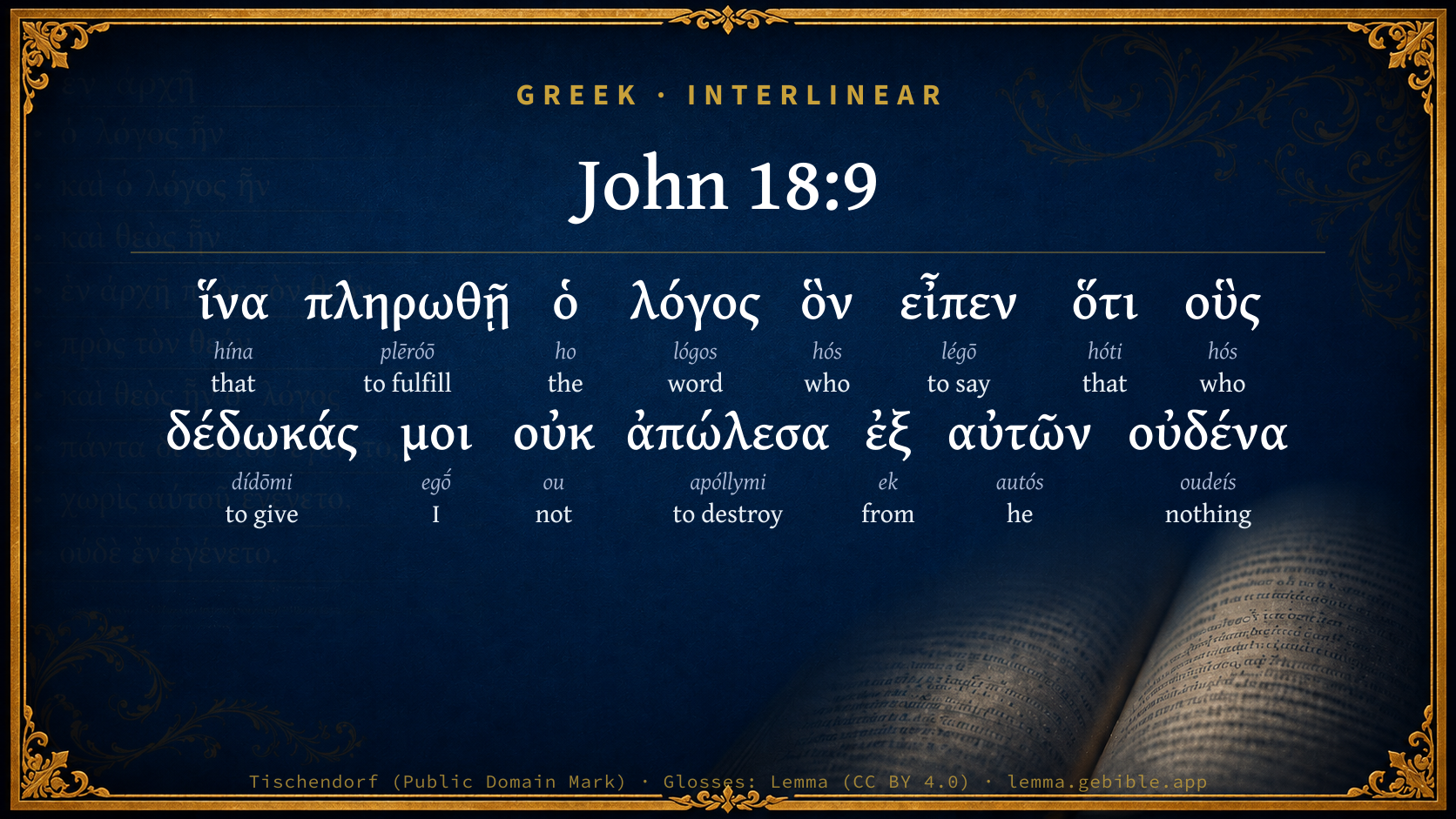
  1. ἵνα hína G2443 “that” Conjunction
  2. ὁ ho G3588 “the” Article, Nominative, Singular, Masculine
  3. λόγος lógos G3056 “word” Noun, Nominative, Singular, Masculine
  4. ὃν hós G3739 “who” Relative pronoun, Accusative, Singular, Masculine
  5. εἶπεν légō G3004 “to say” Verb, Aorist, Active, Indicative, 3rd person, Singular
  6. ὅτι hóti G3754 “that” Conjunction
  7. οὓς hós G3739 “who” Relative pronoun, Accusative, Plural, Masculine
  8. δέδωκάς dídōmi G1325 “to give” Verb, Perfect, Active, Indicative, 2nd person, Singular
  9. μοι egṓ G1473 “I” Personal pronoun, 1st person, Dative, Singular
  10. οὐκ ou G3756 “not” Particle, Negative
  11. ἀπώλεσα apóllymi G622 “to destroy” Verb, Aorist, Active, Indicative, 1st person, Singular
  12. ἐξ ek G1537 “from” Preposition
  13. αὐτῶν autós G846 “he” Personal pronoun, Genitive, Plural, Masculine
  14. οὐδένα oudeís G3762 “nothing” Adjective, Accusative, Singular, Masculine, Negative

About this verse

These counts appear in no published source. They are computed here, from the morphology-tagged text and Lemma’s own curated glosses. What Lemma adds →

15
words
14
distinct lemmas
Gospels
section

Repetition

A word recurs within this verse:

Cross-references

1

Topical passages linked to John 18:9 in the Treasury of Scripture Knowledge — connected by theme and wording, ordered by reader-vote popularity; previews shown in the World English Bible.

  • John 17:12 While I was with them in the world, I kept them in your name. Those whom you have given me I have kept. None of them is lost, except the son of destruction, that the Scripture might be fulfilled.

Cross-references courtesy of OpenBible.info (CC BY 4.0).

Commentary

Notes on John 18:9 from classic Christian and Jewish commentators (each source and its license shown beneath its notes). The classic Christian expositions comment on the surrounding passage and are grouped to its opening verse, so a note may address several verses; the Jewish commentaries on the Tanakh (Rashi and others) are per-verse, so they appear only where the commentator wrote on this verse.

Lemma curates 59 commentaries, every one of them public domain or Creative Commons licensed, each selected and text-cleaned for this edition rather than reprinted as found. About our sources →

Tyndale Open Study Notes

Tyndale Open Resources

18:9 I did not lose a single one: Jesus continued to be a good shepherd, offering his life for the sheep and protecting them from the wolves (10:11-15). From the beginning, however, Judas Iscariot had not been a true disciple of Jesus (17:12).

Tyndale Open Study Notes — © Tyndale Open Resources, licensed CC BY-SA 4.0. Text via the HelloAO Bible API.

Bengel's Gnomon

Johann Albrecht Bengel

Joh 18:9. Πληρωθῇ, might be fulfilled) Jesus therefore was a Prophet: so in Joh 18:32.—οὐκ ἀπώλεσα, I have not lost) not even in this their greatest occasion of danger.

Bengel's Gnomon of the New Testament — English translation (T&T Clark, Edinburgh, 1860) — public domain. Text from a community e-Sword module.

Jamieson, Fausset & Brown

Robert Jamieson, A. R. Fausset & David Brown

That the saying might be fulfilled which he spake, Of them which thou gavest me have I lost none--The reference is to such sayings as Joh 6:39; Joh 17:12; showing how conscious the Evangelist was, that in reporting his Lord's former sayings, he was giving them not in substance merely, but in form also. Observe, also, how the preservation of the disciples on this occasion is viewed as part that deeper preservation undoubtedly intended in the saying quoted.

Jamieson, Fausset & Brown — Commentary Critical and Explanatory on the Whole Bible (1871) — public domain (CC PDM 1.0). Text via the HelloAO Bible API.

John Calvin's Commentaries

9. I have lost none. This passage appears to be inappropriately quoted, as it relates to their souls rather than to their bodies; for Christ did not keep the apostles safe to the last, but this he accomplished, that, amidst incessant dangers, and even in the midst of death, still their eternal salvation was secured. I reply, the Evangelist does not speak merely of their bodily life, but rather means that Christ, sparing them for a time, made provision for their eternal salvation. Let us consider how great their weakness was; what do we think they would have done, if they had been brought to the test? While, therefore, Christ did not choose that they should be tried beyond the strength which he had given to them, he rescued them from eternal destruction. And hence we may draw a general doctrine, that, though he try our faith by many temptations, still he will never allow us to come into extreme danger without supplying us also with strength to overcome. And, indeed, we see how he continually bears with our weakness, when he puts himself forward to repel so many attacks of Satan and wicked men, because he sees that we are not yet able or prepared for them. In short, he never brings his people into the field of battle till they have been fully trained, so that even in perishing they do not perish, because there is gain provided for them both in death and in life.

John Calvin's Commentaries (1540-1563) — public domain. Text from the Calvin Translation Society English edition (1840s-50s) via the Christian Classics Ethereal Library (ccel.org). Calvin's coverage is partial (roughly two-thirds of the Bible); uncommented books and verses are honest gaps, never fabricated. The 19th-century editor's footnotes and remarks are omitted so the notes are faithfully Calvin's own voice.

Ellicott's Commentary for English Readers

(9) That the saying might be fulfilled, which he spake.—Comp. Joh_17:12. The quotation is in many ways suggestive. (1) It is not verbally accurate, i.e., St. John, quoting the words of Christ, which he has himself recorded a few verses before, is at no pains to reproduce it word for word, but is satisfied in giving the substance of it. This throws light on the general literary habits and feelings of this age and race, and it is in full harmony with the usual practice of quotation in the New Testament. (2) St. John quotes with an application to temporal persecution that which had been spoken of spiritual persecution. This illustrates the kind of way in which words are said to be “fulfilled” in more than one sense. Striking words fix themselves in the mind, and an event occurs which illustrates their meaning, and it is said therefore to fulfil them, though of each fulfilment it can be only part. (Comp. especially Notes on Joh_2:17; Joh_12:38 et seq.) (3) The quotation shows that in the thought of St. John himself, the prayer recorded in John 17 is no résumé of the words of our Lord, but an actual record of His prayer: he quotes the “saying” as fulfilled, just as he would have quoted a passage from the Old Testament Scriptures.

A Bible Commentary for English Readers, edited by Charles John Ellicott (1878–1897) — public domain. Text from a community e-Sword module.

The Cambridge Bible for Schools and Colleges

gen. ed. J. J. S. Perowne

9. thou gavest me have I lost] Better, Thou hast given me I lost (see on Joh_17:4). The reference is to Joh_17:12, and is a strong, confirmation of the historical truth of chap. 17. If the prayer were the composition of the Evangelist to set forth in an ideal form Christ’s mental condition at the time, this reference to a definite portion of it would be most unnatural. The change from ‘not one of them perished’ to ‘I lost of them not one’ brings out more clearly the protective intervention of Christ.

It does not follow, because S. John gives this interpretation of Christ’s words, that therefore they have no other. This was a first fulfilment, within an hour or two of their utterance, an earnest of a larger fulfilment in the future. The meaning here must not be limited to bodily preservation. Had they been captured, apostasy (at least for a time) might have been the result, as was actually the case with S. Peter.

The Cambridge Bible for Schools and Colleges (gen. ed. J. J. S. Perowne; Cambridge University Press, 1878–1918) — public domain. Text from a community e-Sword module.

John Gill's Exposition

That the saying might be fulfilled which he spake,.... Joh 17:12;

of them which thou gavest me have I lost none; which though it has a peculiar respect to the apostles, is true of all the elect of God; who are given to Christ, and shall none of them be lost, neither their souls nor bodies; for Christ's charge of them reaches to both: both were given to him, both are redeemed by him, and both shall be saved in him with an everlasting salvation: he saves their souls from an eternal death, and will raise their bodies from a corporeal one; wherefore that his care of his disciples, with respect to their bodies as well as souls, with respect to their temporal lives as well as eternal happiness, might be seen; he made this agreement with the Jews that came to take him, or rather laid this injunction on them, to dismiss them; and which it is very remarkable they did; they laid hands on none of them, even though Peter drew his sword and struck off the ear of one of them: and which is a very considerable instance of the power which Christ had over the spirits of these men, to restrain them; and so a proof of his proper deity, as well as of the care of Christ for the preservation of his apostles, whilst he was here on earth; for to that time only the words cited have a respect; in which Christ speaks of his keeping them whilst he was with them, and uses this as an argument with his Father to keep them, now he was removing from them: wherefore their losing their lives afterwards for his sake, as they all did excepting the Apostle John, is no contradiction to this expression of his; and besides, they were preserved by the power of God so long, until they had done the work which was appointed them to do, and for which they were given him, and chosen by him to be his apostles, and for which they were better furnished after his resurrection and ascension; for had they been, apprehended by the Jews at this time, in all probability, according to an human view of things, such was their weakness, they would have fallen most foully and shamefully, as the instance of Peter, the strongest of them, shows; and therefore to prevent such a temptation and to preserve them, our Lord took this method to deliver them out of the hands of the Jews; the saving clause, "but the son of perdition", is here left out, because Judas, who is designed by that character, was now openly declared to be what he was; he was no longer among the disciples; he was separated from them, and had betrayed his master, and was not of the number of those Christ insisted upon might be let go.

John Gill's Exposition of the Whole Bible (1746–1763) — public domain (CC PDM 1.0). Text via the HelloAO Bible API.

Trapp's Complete Commentary

John Trapp

9 That the saying might be fulfilled, which he spake, Of them which thou gavest me have I lost none.

Ver. 9. That the saying might be fulfilled, &c.] Christ spake it of their souls, it is here applied to their bodies. God hath a fatherly care of both, and will not lay more upon the outward man than the inward shall be enabled to undergo. Hence that of the prophet, "Behold, I have tried thee, but not as silver," Isa 48:10. Why so? because God’s weak children having far more dross in them than good ore, would never be able to abide a strict trial.

John Trapp, A Commentary or Exposition upon All the Books of the Old and New Testament (1647–1656) — public domain. Text from a community e-Sword module.

Albert Barnes' Notes on the Bible

The saying - Joh 17:12. As he had kept them for more than three years, so he still sought their welfare, even when his death was near.

Albert Barnes' Notes on the Bible (1834–1885) — public domain. Text from a community e-Sword/MySword module.

Matthew Poole's English Annotations

But were those words of our Saviour, Of them which thou gavest me have I lost none, to be understood as to a temporary losing, or of an eternal destruction? Some of the ancients were of opinion, that they were to be understood of a losing with reference to a spiritual and eternal state; but that they were applicable also to a losing as to this life. I think that they are applicable to both, and that in this text they are primarily to be understood of a losing as to a temporal death and destruction. It was Christ’s purpose, that eleven of his twelve apostles should outlive him, receive the promise of the Father in the pouring out of the Spirit, and be his instruments to carry the gospel over a great part of the world: this they could not have done had they been put to death at this time; he therefore resolved not to lose them in this sense, but to uphold and preserve their lives, for these ends to which he had designed them; and therefore he said to these officers, You have the person whom ye seek for; for these my disciples, you have nothing against them, let them go away: and by his power upon their hearts he effected it, so that they had a liberty to forsake him, and to flee and to shift for themselves.

Matthew Poole's English Annotations on the Holy Bible (1683–1685) — public domain. Text from a community e-Sword/MySword module.

Whedon's Commentary on the Bible

Daniel D. Whedon

9. The saying—See Joh_18:12. Rationalistic commentators have pronounced this a very mistaken pretence of a fulfilment of Christ’s words. Christ spoke, say they, of preservation from final perdition, but this was preservation from bodily harm. It is a poor reply to these objectors to say, “but the bodily was typical of the spiritual.” The true reply is this: Christ was bound on his part to keep his disciples, both in body and in soul, for their future ministry. They were to be immortal until their work was done. He had preserved them not only from apostacy but from temporal death, for the future mission before them. Judas, on the other hand, perished in body and soul, and so was completely “the son of perdition.” And so now Jesus provides for their present safety, in literal fulfilment of his claim, that he had kept all and lost none—save one.

Daniel D. Whedon (gen. ed.), Commentary on the Old and New Testaments (1874–1909) — public domain. Text from a community e-Sword module.

The Pulpit Commentary

But John found

(4) a deeper reason still. He said this in order that the word which he spake an hour or two before might be fulfilled, not finally exhausted in its unfathomable depth, but gloriously illustrated, Concerning those whom thou hast given me, not one of them I lost. This is a proof, as recognized by De Wette and others, that the evangelist was quoting exact words of the Master, not words which he had theologically attributed to him. The temporal safety of the disciples was a means on that dread night of saving their souls from death, as well as their bodies from torture or destruction. "Christ," says Calvin, "continually bears with our weakness when he puts himself forward to repel so many attacks of Satan and wicked men, because he sees that we are not yet able or prepared for them. In short, he never brings his people into the field of battle till they have been fully trained, so that in perishing they do not perish, because there is gain provided for them both in death and in life." The reference of the apostle to Joh_17:12 is, moreover, also one of the numerous proofs which the Gospel itself supplies, that great, Heaven-taught as the apostle was, he stands, with all his inspiration, far below, at least on a different plane, from that occupied by the Lord. His occasional interjections and explanations of his Master"s words calmer be put on the same level with the words themselves. Even Reuss finds here a reason for holding the authenticity of many at least of the sayings themselves, while refusing to accept the genuineness of the Gospel as a whole ("Theologic Johannique," in loco).

The Pulpit Commentary (1880–1919), ed. H.D.M. Spence-Jones & Joseph S. Exell — public domain. Text from a community e-Sword module.

John Wesley's Explanatory Notes

John xvii, 12.

John Wesley, Explanatory Notes Upon the Whole Bible (1754–1765) — public domain. Text via the GEBible commentary corpus.

Cambridge Greek Testament for Schools and Colleges

9. οὓς δεδ. μ., οὐκ ἀπ. Of those whom Thou hast given Me, I lost not one. The reference is to Joh 17:12, and is a strong confirmation of the historical truth of chap. 17. If the prayer were the composition of the Evangelist to set forth in an ideal form Christ’s mental condition at the time, this reference to a definite portion of it would be most unnatural. The change from ‘not one of them perished’ to ‘I lost of them not one’ brings out the protective intervention of Christ.

It does not follow, because S. John gives this interpretation of Christ’s words, that therefore they have no other. This was a first fulfilment, within an hour or two of their utterance, an earnest of a larger fulfilment in the future. The meaning here must not be limited to bodily preservation. Had they been captured, apostasy might have been the result, as was actually the case with S. Peter.

Cambridge Greek Testament for Schools and Colleges (Cambridge University Press, 1896; 21 vols, various authors incl. Carr, Maclear, Plummer, Farrar, Lumby, Moule, M. R. James, Simcox) — public domain. Text from a community e-Sword module.

Alford’s Greek Testament

Henry Alford

9.] See ch. 17:12. An unquestionable proof, if any were wanted, that the words of ch. 17 are no mere description of the mind of our Lord at the time, nor free arrangement of His words, but his very words themselves. This is recognized even by De Wette.

On the application of the saying, we may remark that the words unquestionably had a much deeper meaning than any belonging to this occasion; but that the remarks so often made in this commentary on the fulfilment of prophecies must be borne in mind;—that to ‘fulfil’ a prophecy is not to exhaust its capability of being again and again fulfilled:—that the words of the Lord have many stages of unfolding;—and that the temporal deliverance of the Apostles now, doubtless was but a part in the great spiritual safe-keeping which the Lord asserted by anticipation in these words.

Henry Alford, The Greek Testament (1849–1861) — public domain. Text from a community e-Sword module.

International Critical Commentary

9. ἵνα πληρωθῇ ὁ λόγος κτλ. For the phrase ἵνα πληρ., introducing a saying of Jesus, see Introd., p. cxliii f. Another example is in v. 32. For Jn., the words of Jesus were possessed of authority, and inspired, like the language of the O.T., by foreknowledge of future events. The λόγος, or “saying” (see on 2:22), to which reference is here made is that of 17:12 loosely quoted. ὅτι is recitantis, but it does not introduce the exact words previously ascribed to Jesus.

The comment of Jn. (ἵνα πλ. ὁ λόγος κτλ.) would seem to limit the application of “I lost none of those whom thou gavest me” to the fact that the disciples were let go free when Jesus was arrested. Some at least of Jn.’s explanations of the words of Jesus are of doubtful accuracy (see on 2:19, 21); but it is hard to believe that he could have missed here the larger and more spiritual meaning of 17:12, which is already indicated at 6:39, 10:28.

οὓς δέδωκάς μοι, οὐκ ἀπώλεσα ἐξ αὐτῶν οὐδένα. The close verbal parallel in 2 Ezr 2:26 is interesting: “servos quos tibi dedi, nemo ex eis interiet, ego enim eos requiram de numero tuo,” words which are addressed by God to the personified nation. Chapters 1. and 2. of 2 Esdras are Christian, and probably belong to the second century. The passage quoted above may be a reminiscence of Joh 18:3 or Joh 17:12 or Joh 6:37. See on 3:31 above for other parallels between 2 Esdras and Jn.

International Critical Commentary — older volumes (1896–1929), various authors — public domain. Text from a community e-Sword module.

Lesson kit

Teaching starters — assembled from the data on this page, not authored interpretation. Every prompt links to the verse data it draws on. Edit before teaching.

John, in the Gospels, opens this verse with 15 words (14 distinct Greek lemmas). Its most distinctive word is plēróō (“to fulfill”). A historical commentator’s framing appears above. Read the whole chapter for the surrounding context.

Discussion questions

  1. How does “to fulfill” (plēróō) shape what this verse is saying?
  2. How does John 17:12, which shares this passage’s theme, read alongside this verse?
  3. What does the repetition of “who” (2× in this one verse) do in this verse?
  4. These translations render this verse differently; the difference is in the English rendering, not the original. What questions does that raise?
  5. Compare how Tyndale Open Study Notes and Bengel's Gnomon read this verse. Where do they agree or differ?

Things to notice

Reading settings

Reading text

Shown beneath each verse's original-language words.

Old Testament
Old Testament edition

Read the OT as the Masoretic Hebrew (MT) or the Greek Septuagint (LXX).

English shown for the Greek Septuagint (in the Hebrew ↔ Greek comparison).

Comparing translations? Open the Compare panel on any verse page to stack up to four side by side.