
Genesis 8:6

Hebrew (Westminster Leningrad Codex) Genesis 8:6 appears in the Hebrew Old Testament. The text above is from the Westminster Leningrad Codex. Each word links to its Strong’s number, a concise gloss, and parsing drawn from the Open Scriptures Hebrew Bible morphology. Click any word for its full Brown-Driver-Briggs (BDB) entry.
Download image
Cite this verse

Genesis 8:6 (World English Bible). Public Domain. Lemma interlinear Bible study tool, https://lemma.gebible.app/v/genesis/8/6.

Show BibTeX & RIS
BibTeX
RIS
English Translation
It happened at the end of forty days, that Noah opened the window of the ark which he had made,
World English Bible · Public Domain
Highlights
  • 1 first appearance in the Hebrew Bible
Full analysis ↓
Download a study sheet

One document with this verse’s original text, its word-by-word gloss line, the meaning frame, cross-references with their text, attributed commentary, and full source and license credits — printable, and it pastes into notes with its structure intact.

This verse Autodidact and up

Study sheet (.html) Plain text (.txt)

A passage Seminary Student

Up to 50 verses in one chapter. A passage sheet keeps up to 6 commentary sources and 12 cross-references per verse, in the order this page ranks them, and says so on the sheet whenever that leaves anything out. Ask for a single verse and you get the Autodidact verse sheet above.

Everything on this page stays free to read, with no account — the sheet is a download of what is already on screen, not access to it.

Want to remove ads? Support Godless Engineer
Compare translations 3

The same verse in 3 English versions, stacked beneath the original-language interlinear above. Click any original word for its lexicon entry.

Each is an independent rendering of the whole verse — the interlinear is not word-aligned to these translations.

Highlighted words mark where these versions differ — a whole-verse word diff, not a word-by-word alignment.

  • World English Bible Public Domain
    It happened at the end of forty days, that Noah opened the window of the ark which he had made,
  • King James Version Public Domain
    And it came to pass at the end of forty days, that Noah opened the window of the ark which he had made:
  • unfoldingWord Literal Text CC BY-SA 4.0
    And it happened the end of forty days that Noah opened the window of the ark that he had made,

unfoldingWord Literal Text — © unfoldingWord, licensed CC BY-SA 4.0. Word-aligned USFM3 via Door43 (git.door43.org/unfoldingWord/en_ult).

Versions to compare (up to 4)

3 of 4 selected

Show all 18 translations

Every available English version of this verse, each an independent rendering of the whole verse.

  • World English Bible Public Domain
    It happened at the end of forty days, that Noah opened the window of the ark which he had made,
  • Berean Standard Bible Public Domain
    After forty days Noah opened the window he had made in the ark
  • Majority Standard Bible Public Domain
    After forty days Noah opened the window he had made in the ark
  • King James Version Public Domain
    And it came to pass at the end of forty days, that Noah opened the window of the ark which he had made:
  • American Standard Version (1901) Public Domain
    And it came to pass at the end of forty days, that Noah opened the window of the ark which he had made:
  • Revised Version (1885) Public Domain
    And it came to pass at the end of forty days, that Noah opened the window of the ark which he had made:
  • Geneva Bible (1599) Public Domain
    So after fourtie dayes, Noah opened the windowe of the Arke, which he had made,
  • Douay-Rheims (1899) Public Domain
    And after that forty days were passed, Noe, opening the window of the ark which he had made, sent forth a raven:
  • Young's Literal Translation Public Domain
    And it cometh to pass, at the end of forty days, that Noah openeth the window of the ark which he made,
  • Literal Standard Version CC BY-SA 4.0
    And it comes to pass, at the end of forty days, that Noah opens the window of the Ark which he made,
  • Unlocked Literal Bible CC BY-SA 4.0
    It came about after forty days that Noah opened the window of the ark which he had made.
  • unfoldingWord Literal Text CC BY-SA 4.0
    And it happened the end of forty days that Noah opened the window of the ark that he had made,
  • Darby Bible Public Domain
    And it came to pass at the end of forty days that Noah opened the window of the ark which he had made.
  • World Messianic Bible Public Domain
    At the end of forty days, Noah opened the window of the ship which he had made,
  • Webster's Bible Public Domain
    And it came to pass at the end of forty days, that Noah opened the window of the ark which he had made:
  • Free Bible Version CC BY-SA 4.0
    Forty days later Noah opened the window he'd made in the ark,
  • Bible in Basic English Public Domain
    Then, after forty days, through the open window of the ark which he had made,
  • JPS Tanakh (1917) Public Domain
    And it came to pass at the end of forty days, that Noah opened the window of the ark which he had made.

Literal Standard Version (2020), Covenant Press — licensed CC BY-SA 4.0. Text via the HelloAO Bible API (eBible.org). Unlocked Literal Bible (unfoldingWord) — licensed CC BY-SA 4.0. Text via the HelloAO Bible API (eBible.org). unfoldingWord Literal Text — © unfoldingWord, licensed CC BY-SA 4.0. Word-aligned USFM3 via Door43 (git.door43.org/unfoldingWord/en_ult). Free Bible Version, Dr. Jonathan Gallagher — licensed CC BY-SA 4.0. Text via the HelloAO Bible API (eBible.org).

Word by word

More ways to search: Search by grammar → Find every occurrence → Compare this word →

Practice this passage: Drill this verse → Learn its vocabulary →

הַתֵּבָ֖ה
têbâh
H8392
“the · ark”
Particle, Definite Article + Noun, Common, Feminine, Singular, Absolute
Part of Speech
Particle + Noun
Type
Common
Gender
Feminine
Number
Singular
State
Absolute
Full BDB Definition

Origin: perhaps of foreign derivation

TWOT: 2492

ark - vessel which Noah built - basket vessel in which Moses was placed
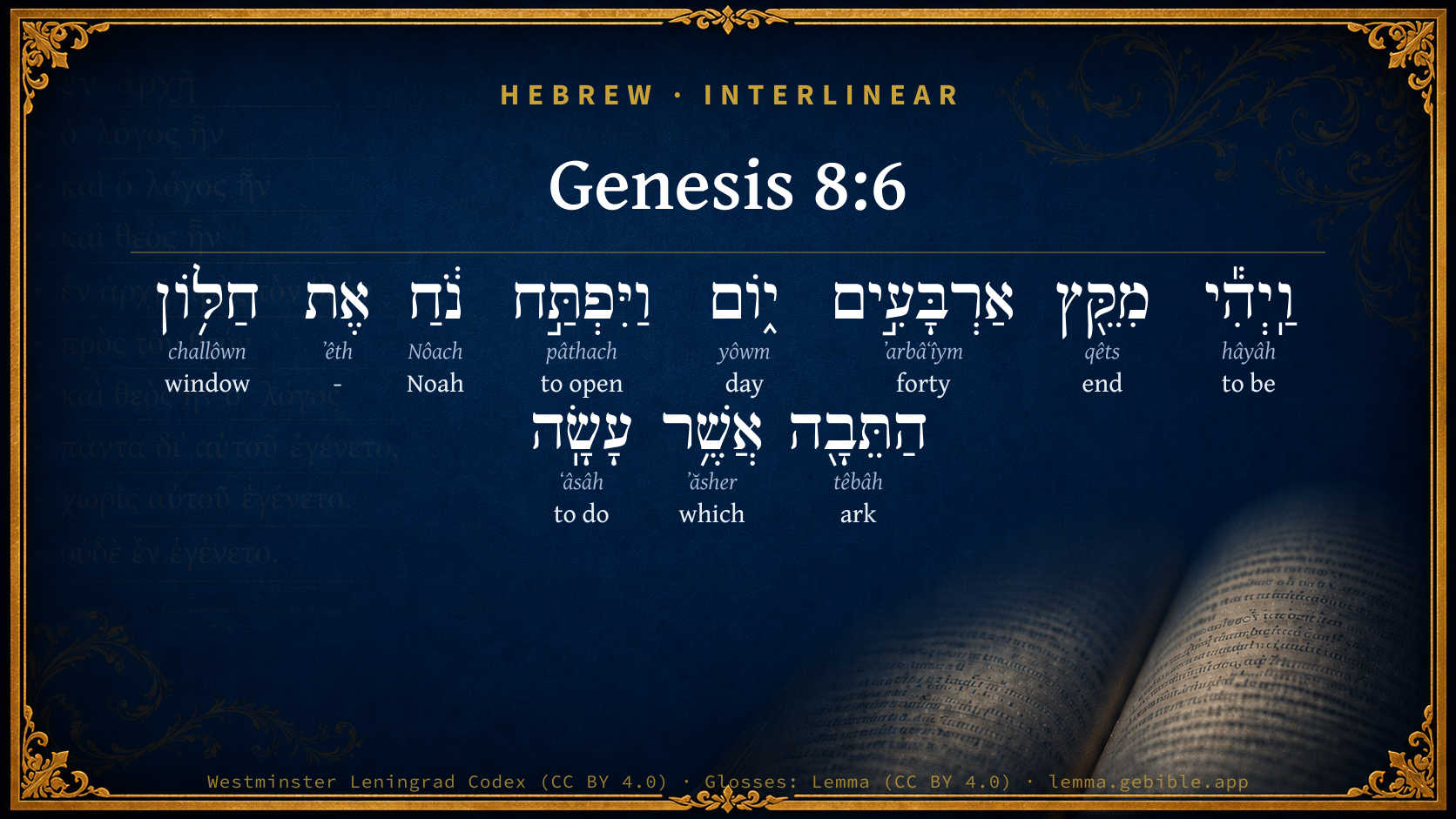
  1. וַֽיְהִ֕י hâyâh H1961 “and · to be” Conjunction + Verb, Qal, Sequential Imperfect, 3rd Person, Masculine, Singular
  2. מִקֵּ֖ץ qêts H7093 “from · end of” Preposition + Noun, Common, Masculine, Singular, Construct
  3. אַרְבָּעִ֣ים ʼarbâʻîym H705 “forty” Adjective, Cardinal number, Both, Plural, Absolute
  4. י֑וֹם yôwm H3117 “day” Noun, Common, Masculine, Singular, Absolute
  5. וַיִּפְתַּ֣ח pâthach H6605 “and · to open” Conjunction + Verb, Qal, Sequential Imperfect, 3rd Person, Masculine, Singular
  6. נֹ֔חַ Nôach H5146 “Noah” Noun, Proper
  7. אֶת ʼêth H853 “-” Particle, Direct Object
  8. חַלּ֥וֹן challôwn H2474 “window of” Noun, Common, Both, Singular, Construct
  9. אֲשֶׁ֥ר ʼăsher H834 “which” Particle, Relative
  10. עָשָֽׂה ʻâsâh H6213 “to do” Verb, Qal, Perfect, 3rd Person, Masculine, Singular

About this verse

These counts appear in no published source. They are computed here, from the morphology-tagged text and Lemma’s own curated glosses. What Lemma adds →

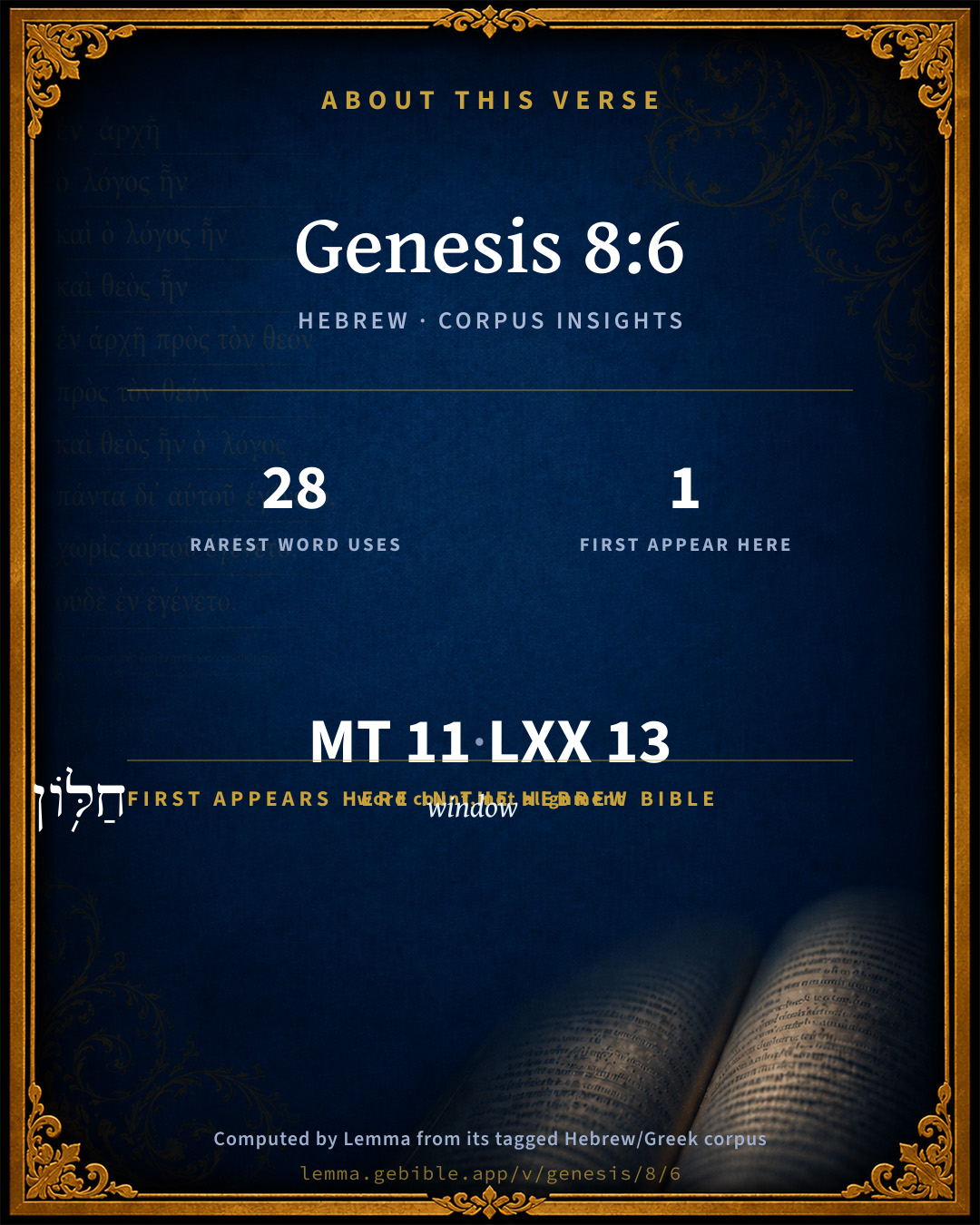
11
words
11
distinct lemmas
Pentateuch
section

First appearance in Scripture

This word makes its first canonical appearance in the Hebrew Bible here:

  • חַלּ֥וֹן window H2474

Shared distinctive vocabulary

הַתֵּבָ֖ה ark H8392 occurs in 25 verses of the Hebrew Bible. Also found in:

Grammatical profile

  • 3 verbs
  • 5 nouns
  • 1 adjective
  • 2 particles

Verb forms

  • וַֽיְהִ֕י Qal · Sequential Imperfect
  • וַיִּפְתַּ֣ח Qal · Sequential Imperfect
  • עָשָֽׂה Qal · Perfect

Hebrew & Septuagint length

In English translation the verse runs 20 words from the Hebrew and 19 from the Septuagint (LXX English) — closely comparable.

A rough comparison of the two English renderings, which tokenize alike — not a word-level alignment.

Word counts can differ between the Hebrew and the Greek without any difference in meaning — e.g. the Hebrew direct-object marker אֵת has no separate Greek word, and Greek often adds the article ὁ.

In the original languages it is 11 Hebrew tokens and 13 Greek tokens — but the two are counted differently (Hebrew bundles its prefixes and suffixes into one token; the Greek is in lemma form), so that isn’t a like-for-like length.

Cross-references

2

Topical passages linked to Genesis 8:6 in the Treasury of Scripture Knowledge — connected by theme and wording, ordered by reader-vote popularity; previews shown in the World English Bible.

  • Genesis 6:16 You shall make a roof in the ark, and to a cubit shall you finish it upward. You shall set the door of the ark in the side of it. You shall make it with lower, second, and third levels.
  • Daniel 6:10 When Daniel knew that the writing was signed, he went into his house (now his windows were open in his chamber toward Jerusalem) and he kneeled on his knees three times a day, and prayed, and gave thanks before his God, as he did before.

Cross-references courtesy of OpenBible.info (CC BY 4.0).

Hebrew and Greek witnesses Masoretic Hebrew ↔ Greek Septuagint

The same verse in the two great witnesses to the Old Testament, shown verse-for-verse.

These are two independent witnesses, not word-aligned to each other, and the Septuagint is shown in lemma (dictionary) form.

Hebrew Genesis 8:6 Masoretic · Westminster Leningrad Codex

וַֽיְהִ֕י מִקֵּ֖ץ אַרְבָּעִ֣ים י֑וֹם וַיִּפְתַּ֣ח נֹ֔חַ אֶת חַלּ֥וֹן הַתֵּבָ֖ה אֲשֶׁ֥ר עָשָֽׂה

It happened at the end of forty days, that Noah opened the window of the ark which he had made,

World English Bible · Public Domain

Greek LXX Genesis 8:6 Septuagint · lemma form

καί γίγνομαι μετά τεσσαράκοντα ἡμέρα ἀναοἴγω νωε ὁ θυρίς ὁ κιβωτός ὅς ποιέω

And it came to pass after forty days Noe opened the window of the ark which he had made.

LXX2012 (modern English Septuagint) · Public Domain

On this verse, The Cambridge Bible for Schools and Colleges discusses the Septuagint’s reading. Read the note in Commentary ↓

Hebrew: Westminster Leningrad Codex (CC BY 4.0). Greek: Septuagint (public domain); English from LXX2012 (modern English Septuagint) (Public Domain). How the Septuagint differs from the Hebrew →

Targum (Aramaic paraphrase)

2

The Targum is the ancient Jewish Aramaic paraphrase of the Hebrew Scriptures — an interpretive translation, not the Hebrew text itself. Onkelos (literal) and Pseudo-Jonathan (expansive) render the Torah, and Jonathan the Prophets. Coverage is partial: where no permissively-licensed English translation exists for a verse, only the Aramaic is shown. This is verse-level text, not a word-by-word alignment to the Hebrew.

  1. Targum Onkelos Torah (Genesis–Deuteronomy)
    וַהֲוָה מִסּוֹף אַרְבְּעִין יוֹמִין וּפְתַח נֹחַ יָת כַּוַּת תֵּבוֹתָא דִּי עֲבָד

    And it was at the end of forty days, and Noach opened the windows of the ark which he had made.

    Targum Onkelos — Aramaic: “Onkelos Genesis” (public domain); “Onkelos Exodus” (public domain); “Onkelos Leviticus” (public domain); “Onkelos Numbers” (public domain); “Onkelos Deuteronomy” (public domain). English: “Sefaria Community Translation” (CC0 1.0 (public-domain dedication)); “J.W. Etheridge. The Targums of Onkelos and Jonathan Ben Uzziel on the Pentateuch. London: Longmans, Green, 1862” (public domain). Text via Sefaria.

  2. Targum Pseudo-Jonathan Torah (Genesis–Deuteronomy)
    וַהֲוָה מִסוֹף אַרְבְּעִין יוֹמִין וּפְתַח נחַ יַת כַּוַות תֵּיבוּתָא דְעָבַד

    And it was at the end of forty days, and Noah opened the aperture of the ark which he had made.

    Targum Pseudo-Jonathan — Aramaic: “Targum Jonathan on Genesis” (public domain); “Targum Jonathan on Exodus” (public domain); “Targum Jonathan on Leviticus” (public domain); “Targum Jonathan on Numbers” (public domain); “Targum Jonathan on Deuteronomy” (public domain). English: “The Targum of Jonathan ben Uzziel, trans. J. W. Etheridge, London, 1862” (public domain). Text via Sefaria.

Commentary

Notes on Genesis 8:6 from classic Christian and Jewish commentators (each source and its license shown beneath its notes). The classic Christian expositions comment on the surrounding passage and are grouped to its opening verse, so a note may address several verses; the Jewish commentaries on the Tanakh (Rashi and others) are per-verse, so they appear only where the commentator wrote on this verse.

Lemma curates 59 commentaries, every one of them public domain or Creative Commons licensed, each selected and text-cleaned for this edition rather than reprinted as found. About our sources →

Trapp's Complete Commentary

John Trapp

Gen 8:6 And it came to pass at the end of forty days, that Noah opened the window of the ark which he had made:

Ver. 6. At the end of forty days.] Viz., After that the tops of the mountains were discovered.

The window of the ark,] i.e., That in the upper loft of the ark, where the fowls were.

John Trapp, A Commentary or Exposition upon All the Books of the Old and New Testament (1647–1656) — public domain. Text from a community e-Sword module.

The Biblical Illustrator

Joseph S. Exell

Gen_8:6-8

Noah opened the window of the ark

The judicious conduct of a good man in seeking to ascertain the facts of life and his relation thereto

We observe:

I.

THAT NOAH DID NOT EXHIBIT AN IMPETUOUS HASTE TO GET OUT OF THE CIRCUMSTANCES IN WHICH GOD HAD PLACED HIM.

1. We see that God does sometimes place men in unwelcome positions.

2. That when God does place men in unwelcome positions, it is that their own moral welfare may be enhanced.

3. That when men are placed in unwelcome positions they should not remove from them without a Divine intimation.

II. THAT NOAH WAS THOUGHTFUL AND JUDICIOUS IN ENDEAVOURING TO ASCERTAIN THE WILL OF GOD IN REFERENCE TO HIS POSITION IN ITS RELATION TO THE CHANGING CONDITION OF THINGS.

1. Noah felt that the time was advancing for a change in his position, and that it would be necessitated by the new facts of life.

2. Noah recognized the fact that the change in his position should be preceded by devout thought and precaution.

III. THAT NOAH EMPLOYED VARIED AND CONTINUOUS METHODS OF ASCERTAINING THE FACTS OF HIS POSITION AND HIS DUTY IN RELATION THERETO.

1. These methods were varied.

2. Continuous.

3. Appropriate.

IV. THAT NOAH YIELDED A PATIENT OBEDIENCE TO THE TEST OF CIRCUMSTANCES WHICH HE HAD EMPLOYED.

V. THAT INDICATIONS OF DUTY ARE ALWAYS GIVEN TO THOSE WHO SEEK THEM DEVOUTLY. The dove returned to Noah with the olive leaf. Men who seek prayerfully to know their duty in the events of life, will surely have given to them the plain indications of Providence. Lessons:--

1. That men should not trust their own reason alone to guide them in the events of life.

2. That men who wish to know the right path of life should employ the best talents God has given them.

3. That honest souls are divinely led. (J. S. Exell, M. A.)

Lessons

1. God in wisdom sometimes lengthens trials to the proof of the faith and patience of His saints.

2. Believing saints though God appear not, will stay contentedly forty days, that is, the time fit for His salvation.

3. Lawful means believers may use for their comfort, when there is no immediate appearance of God. Noah opens the window which God forbids not (Gen_8:6).

4. Visible experiments of the ceasing of Gods wrath may be desired and used by His people where the Lord sets no bars.

5. Unclean, or the worst of creatures, may be of use sometimes to comfort the Church. As the ravens fed Elijah.

6. Instinct of creatures from God teach His people of His providences to them. (Gen_8:7). (G. Hughes, B. D.)

Noahs messengers

I. MESSENGERS SELECTED. After long floating, during which time Noah would know little of what was passing in the outer world, save that he heard the rain and tempest, the ark grounded. Doubtless he would often look forth on the waste of waters. The rapid evaporation, etc., would very much intercept a distant view. Fogs and mists, etc. Hence to know the state of things beyond the reach of his vision he would send forth messengers. Birds. Birds of swift and strong wing, and clear vision. Land birds. Aquatic birds would not have returned. Birds that may be domesticated and having local attachments. Hence they would return to the ark.

II. MESSENGERS SENT FORTH.

III. MESSENGERS RETURNING. Though Noah might not follow their far flight, they could see the huge ark, to which also their unerring instinct--perhaps supernaturally--would guide them. The joy of Noah on looking once more upon a branch of olive. One of the most beautiful and useful of trees also. Learn--

1. Gratitude for that reason which adapts means to ends.

2. Gods creatures thus employed in the service of man.

3. The ark a type of Christ; and the dove and olive branch, of the soul hastening with peaceful feelings and first fruits to Jesus. (J. C. Gray.)

Raven and dove

Noah sent out the raven first, probably because it had been the most companionable bird and seemed the wisest, preferable to the silly dove; but it never came back with Gods message. And so has one often found that an inquiry into Gods will, the examination, for example, of some portion of Scripture, undertaken with a prospect of success and with good human helps, has failed, and has failed in this peculiar raven like way; the inquiry has settled down on some worthless point, on some rotting carcase, on some subject of passing interest or worldly learning, and brings back no message of God to us. On the other hand, the continued use, Sabbath after Sabbath, of Gods appointed means, and the patient waiting for some message of God to come to us through what seems a most unlikely messenger, will often be rewarded. It may be but a single leaf plucked off that we get, but enough to convince us that God has been mindful of our need, and is preparing for us a habitable, world. Many a man is like the raven, feeding himself on the destruction of others, satisfied with knowing how God has dealt with others. He thinks he has done his part when he has found out who has been sinning and what been the result. But the dove will not settle on any such resting place, and is dissatisfied until for herself she can pluck off some token that Gods anger is turned away and that now there is peace on earth. And if only you wait Gods time and renew your endeavours to find such tokens, some assurance will be given you, some green and growing thing, some living part, however small, of the new creation which will certify you of your hope. (M. Dods, D. D.)

The bird on the mast

A sailing vessel was driven before the hurricane--a white bird suddenly descended on the mast: the hearts of the crewwere cheered; hope dawned . . . Such consolation may be always mine! One bright, holy, faithful thought is my dove upon the mast. However sadly I toss over the waves of this troublesome, weary world, that gentle bird of paradise revives and strengthens me. It tells me that the storm will soon be over and gone, and the green land, with the singing of birds, is come. (Wilmott.)

The Biblical Illustrator, edited by Joseph S. Exell (c. 1880s–1900s) — public domain. Text from a community e-Sword module.

Whedon's Commentary on the Bible

Daniel D. Whedon

6. Forty days — It is a question whether these forty days are to be reckoned from the landing of the ark on Ararat, (as Calvin,) or from the time that the mountain summits became visible. If the first view be taken, then the raven and the dove were sent forth after the ark grounded and before any land was seen. This seems to be the most reasonable view, for it does not appear likely that Noah would send forth the raven and the dove “to see whether the waters had abated” after the mountain tops had become visible. We understand, then, that Gen_8:6-12 detail events which transpired while the waters were decreasing, and before the mountain tops were seen, as described in Gen_8:5.

The window — Not the window mentioned in Gen_6:16, which was an aperture for light. See the note at that place.

Daniel D. Whedon (gen. ed.), Commentary on the Old and New Testaments (1874–1909) — public domain. Text from a community e-Sword module.

The Preacher's Complete Homiletical Commentary

Joseph S. Exell (gen. ed.)

CRITICAL NOTES.—

Gen_8:6. Window.] Properly, “hole:” not the same word as in ch. Gen_6:16.—

Gen_8:7. Raven.] Probably so called from its blackness (Gesenius, Fürst): from its cry or croaking (Davies).—

Gen_8:8. Dove.] A tender, mild bird; emblem of purity, Sol. Son_1:15; Son_4:1; Son_5:12; love, ibid Gen_5:2, Gen_6:9; simplicity, Hos_7:11, Mat_10:16; with melancholy note, Isa_38:14, Nah_2:7, Eze_7:16; and quick homeward, flight, Isa_60:8; Psa_55:6; Hos_11:11.

Gen_8:21. For the imagination.]—The “For” is apparently an unhappy rendering. Better, with Leeser, “although,” or with Young, “though:” better still, with Murphy, “because.” God will not again make man’s wickedness a “cause” or reason for bringing in a flood of waters.

MAIN HOMILETICS OF THE PARAGRAPH.—Gen_8:6-12

THE JUDICIOUS CONDUCT OF A GOOD MAN IN SEEKING TO ASCERTAIN THE FACTS OF LIFE, AND HIS RELATION THERETO

We observe:—

I. That Noah did not exhibit an impetuous haste to get out of the circumstances in which God had placed him. Noah had now been shut up in the ark for a long time, and yet he does not give way to complaining language, but calmly waits the day of his deliverance. That day advanced in definite stages; the fountains of the deep and the windows of heaven were closed, the waters returned from off the earth; then the ark rested on the mountain, and the waters gradually decreased until the tops of the mountains were seen, and Noah was permitted to step out on dry land. And this is the ordinary way of life; men are gradually released from their troubles, and given, step by step, to see the purpose of God concerning them. They do not see the dry land all at once, upon the first outlook from the ark; they have to wait for it many days. The waiting is a sacred discipline, and the effort to ascertain the facts of the case and the Divine providence in reference thereto, is strengthening to the soul. It is very important that our conduct should be wise and calm during the last days of trial, as indiscretion then may have a most calamitous effect upon our after life, and may mar the effect of former patience. Some men are very impetuous; they are always seeking a change of condition and circumstance; and consequently they often get out of the ark in which they are located before the waters have wholly subsided, and thus injury befals them. Men should never be in a hurry to betake themselves from positions in which God has placed them, even though they may be uncomfortable; the proper time of release will come, and then they will be safe in availing themselves of it.

1. We see that God does sometimes place men in unwelcome positions. The ark would not be a very welcome habitation to Noah. He would very likely, had he been consulted, have preferred another method of safety from the deluge. But there are times when God selects a man’s circumstances for him, often uncomfortable, but always full of rich mercy. There are multitudes of good men to-day living and toiling in unfavourable spheres, which they would fain leave, but which they retain under a consciousness of duty. They are remaining in the ark till God shall give them permission to leave it.

2. That when God does place men in unwelcome positions, it is that their own moral welfare may be enhanced. Noah was placed in the ark for his own safety, and also that he might be an instrument in the hand of Divine providence in the new condition of things after the flood. And so when good men are in circumstances somewhat unfavourable, it is that God’s love may be manifested to them, that they receive a holy discipline, and that they may accomplish a ministry of good to those by whom they are surrounded. Men who go into the ark are safe, but they have hard work awaiting them.

3. That when men are placed in unwelcome positions they should not remove from them without a Divine intimation. Had some men been in Noah’s position they would have got out of the ark when it struck upon the mountain, they would have made no effort to ascertain the Divine will in reference to their lot. God never intends good men to get out of their arks until there is something better for them to step into. They must wait for the dry land.

II. That Noah was thoughtful and judicious in endeavouring to ascertain the will of God in reference to his position in its relation to the changing condition of things.

1. Noah felt that the time was advancing for a change in his position, and that it would be necessitated by the new facts of life. Noah was not always to remain in the ark. Good men are not always to continue in their trying and unfavourable circumstances, they have presentiments of better things, and are justified in seeking to realize them in harmony with the Divine will. Some men never dream of bettering their circumstances, they are lethargic spirits, and are content to remain in the ark all their days; they care not to inherit the new world before them. Mere ambition or restlessness should not lead men to alter their method of life or station, but only the providence of God as shown in daily events. When the earth is dry it is folly for a man to remain in the ark. The dry earth is God’s call to Noah to come and possess it. Some men never have eyes to behold the opportunity of their lives.

2. Noah recognised the fact that the change in his position should be preceded by devout thought and precaution. Before he left the refuge of the ark he made every possible calculation as to the likelihood of the future; he did not irreverently trust himself to the care of a Providence whose blessing he had never sought. He moved in his more welcome sphere of life guided by the will of God. A worthy pattern for all who may be about to change their mode of life.

III. That Noah employed varied and continuous methods of ascertaining the facts of his position and his duty in relation thereto. “And he sent forth a raven, which went forth to and fro, until the waters were dried up from the earth. And he sent forth a dove from him, to see if the waters were abated from off the face of the ground.”

1. These methods were varied. First he sent forth a raven, “which went forth to and fro, until the waters were dried up from off the earth.” Now the raven, being a bird which feeds upon flesh and carrion, must have found plenty of food floating on the waters; and it could have sufficient rest on the bodies of the dead animals: for anyone may have seen a carrion crow standing on a dead animal carried down a mountain stream. Then Noah sent forth the dove, which feeds upon seeds and vegetable matter, it was obliged to return. But the second time it returned with the olive leaf in its mouth, which shewed that the waters had very materially subsided, and were within a few feet of the ground. And so men who are seeking a change in their condition of life should employ the best and most varied agencies to ascertain the propriety and opportunity of so doing. One effort may not be reliable. The raven may not return, even if the flood has not subsided. Then try the second, a dove. And if you are honest in the sending forth of these messengers, and in the interpretation of the olive leaf on their return, you need not miss your providential way in life.

2. These methods were continuous. “And he stayed yet another seven days, and again he sent forth the dove out of the ark.” You will notice here the interesting fact that Noah waited seven days. This is perhaps an indirect indication of the observance of the Sabbath. The Sabbath is a time when men may test the facts of daily life and circumstance.

3. These methods were appropriate. Noah employed agencies that were ready to his use, that would be impartial in the service, and whose natural instinct would be an infallible guide. And so when men are testing the important issues of life and circumstance, they should be careful to select the most fitting agencies for so doing. They should not risk so great a result upon an inappropriate or uncertain omen.

IV. That Noah yielded a patient obedience to the test of circumstances which he had employed.—He was patiently obedient to the tests he employed; he did not wantonly reject them or foolishly disobey them. Some men pretend to seek the Divine guidance in the transactions of their lives, and yet they never follow it when opposed to their own inclinations or foregone conclusions. They send out the raven and the dove, and yet get out of the ark upon the dictate of their own impulse. This conduct is profane and perilous.

V. That indications of duty are always given to those who seek them devoutly. The dove returned to Noah with the olive leaf. It is stated by some natural historians, that the olive grew under water in the Red Sea, and bore berries there. Whether this be so or not, it is probable that the olive may live more healthily under a flood than most other trees. It is eminently hardy, and will grow in a favourable soil without care or culture. It is generally a plant of the Mediterranean. Men who seek prayerfully to know their duty in the events of life, will surely have given to them the plain indications of Providence. LESSONS:—

1. That men should not trust their own reason alone to guide them in the events of life.

2. That men who wish to know the right path of life should employ the best talents God has given them.

3. That honest souls are Divinely led.

SUGGESTIVE COMMENTS ON THE VERSES

Gen_8:6-7. God in wisdom sometimes lengthens trials to test the faith and patience of His saints.

Believing saints, though God appears not, will stay contentedly forty days, that is, the time for their salvation. Lawful means believers may use for their comfort, when there is no immediate appearance of God.

Visible experiments of the ceasing of God’s wrath may be desired, and used by His people, where the Lord sets no prohibition.

Unclean or the worst of creatures may be of use sometimes to comfort the Church.

Instinct of creatures from God teaches His people of His providence to them.

Gen_8:8. The dove emblematical of the Holy Ghost.

1. As the dove rested not on the flooded ground so the Holy Spirit will not dwell in an impure heart.

2. As the dove returned in the evening into the ark, so the Spirit in the time of the gospel, which is the evening of the world.

3. As the dove brought an olive leaf whereby Noah knew that the waters were dried, so the Spirit brings comfort and peace to the soul, assuring it that God’s judgments are past, their sins being pardoned.

The raven sets forth the wicked in the church who go and come but never effectually dwell there.

Noah sent forth a raven and a dove to bring him intelligence; observe here, that though God had told Noah particularly when the flood would come, even to a day (Ch. Gen_7:4), yet he did not give him a particular account by revelation at what times and by what steps it should go away. The knowledge of the former was necessary to his preparing the ark; but the knowledge of the latter would serve only to gratify his curiosity, and the concealing it from him would be the needful exercise of his faith and patience. He could not forsee the flood by revelation; but he might by ordinary means discover its decrease, and God was pleased to leave him to use them [Henry and Scott].

Believing souls, when means answer not, will wait a longer time.

God’s gracious ones in faith use other lawful means if one do fail.

Clean as well as unclean, that which is chosen by God may be used by His Church for its good.

Faith in God’s salvation may put souls upon a desire to see it, or to have evidence of it.

God’s gracious ones desire the abating of the tokens of the Divine displeasure.

Gen_8:9. The best means that believers use may not always give them rest.

God’s providence in continual tokens of displeasure, may obstruct means of comfort.

It is in such case the work of the saints to take up the means again, in due time to use them.

The dove is an emblem of a gracious soul, that, finding no rest for its foot, no solid peace or satisfaction in this world—this deluged, defiling world—returns to Christ as to its ark, as to its Noah, its rest. The carnal heart, like the raven, takes up with the world, and feeds on the carrion it finds there; but return thou to thy rest, O my soul (Psa_116:7). O that I had wings like a dove (Psa_55:6). And as Noah put forth his hand and took the dove, and pulled her in to him, into the ark, so Christ will graciously preserve, and help, and welcome those that fly to Him for rest [Henry and Scott].

Gen_8:10-11, God’s way of answer, and the waiting of His saints are fitly coupled.

God’s gracious ones are of a contented, waiting and hoping frame.

Faith will expect from seven to seven, from week to week, to receive answers of peace from God.

After waiting, faith will make trial of lawful means again and again. It will add messenger to messenger.

Waiting believers shall receive some sweet return by use of means in God’s time.

He that sends out for God is most likely to have return from him.

Visible tokens of God’s wrath ceasing He is pleased to vouchsafe to His own.

It concerns God’s saints to consider His signal discoveries of grace to know them, and gather hope and comfort from them.

The olive branch, which was an emblem of peace, was brought, not by the raven, a bird of prey, nor by a gay and proud peacock, but by a mild, patient, humble dove. It is a dove-like disposition that brings into the soul earnests of rest and joy [Henry and Scott].

This olive leaf in the mouth of the dove may set forth:—

1. The grace and peace by Jesus Christ which are brought in the mouth of His ministers.

2. The dove returned at first without her errand; but sent again she brought better tidings. The man of God must not only be “apt to teach,” but “patient, in meekness, instructing those that oppose themselves; proving, if at any time, God will give them repentance” [Trapp].

The fresh olive leaf was the first sign of the resurrection of the earth to new life after the flood, and the dove with the olive leaf a herald of salvation.

Gen_8:12. The giving of one step of mercy makes God’s saints wait for more.

The saint’s disposition is to get mercy by trying means, as well as to wait for it.

In the withholding of return of means may be the return of mercy. Though the dove stay, yet mercy cometh.

Providence promotes the comforts of saints when he seems to stop them.

ILLUSTRATIONS

BY THE

REV. WM. ADAMSON

Security! Gen_8:6. When Alexander the Great was asked how he could sleep so soundly and securely in the midst of surrounding danger, he replied that he might well repose when Parmenis watched. Noah might well be in peace, since God had him in charge. A gentleman, crossing a dreary moor, came upon a cottage. When about to leave, he said to its occupant, “Are you not afraid to live in this lonely place?” To this the man at once responded, “oh! no, for faith closes the door at night, and mercy opens it in the morning.” Thus was Noah kept during the long night of the deluge; and mercy opened the door for him.

“Heaven closed its windows, and the deep Restrained its fountains, while the arid winds Swept o’er the floods.”—Bickersteth.

Teachers! Gen_8:6. Each of God’s saints, writes a model minister, is sent into the world to prove some part of the Divine character. One is sent to live in the valley of ease—having much rest, and hearing sweet birds of promise singing in his ears—to prove the love of God in sweet communings. Another is called to stand where the thunder clouds brew—where the lightnings play, and where the tempestuous winds are howling on the mountain tops—to prove the power and majesty of God to keep from all harm, and preserve amid all peril. Thus:—

“God sends His teachers into every age,

To every clime, and every race of men,

With revelations fitted to their growth.”—Lowell.

Raven! Gen_8:7.

1. Some have likened this bird to the law, which can tell no tale of comfort—which leaves the soul in the deepest cells of uttermost despair, and which pays no soothing visit.

2. Others have compared this bird with the worldling, to whom the Gospel ark is not a welcome home—who is carried away by the wild desires and raging lusts—who wanders to and fro, and never settles, and who feed upon the putrid remnants of sin, the carrion of loathsome pleasures.

3. Others again have regarded this gloomy bird and its instincts as a type of the old nature in the Christian, for of the impure a remnant still exists in the saintly heart. Thus the raven, finding its food in carrion, figures those inclinations, writes Jukes, which feed of dead things. The ark does not change the raven; so the Cross may restrain, but does not alter impure desires.

Dove! Gen_8:8. The Mandan Indians have an annual ceremony held round a “big canoe” which is of singular interest. The ceremony is called “the settling of the waters;” and it is held always on the day in which the willow trees of their country come into blossom. The reason why they select this tree is that the bird flew to their ancestors in the “big canoe” when the waters were settling, with a branch of it in its mouth. This bird is the dove, which is held so sacred among them that neither man, woman, nor child would injure it. Indeed, the Mandans declare that even their dogs instinctively respect the dove.

“Sweet dove! the softest, steadiest plume

In all the sunbright sky,

Bright’ning in ever-changeful bloom,

As breezes change on high.”

Olive Tree! Gen_8:11. This may justly be considered one of the most valuable gifts which the beneficent Creator has bestowed upon the human family—and in its various and important uses, we may discover the true reason why the dove was directed by God to select the olive leaf from the countless variety which bestrewed the shiny tops and declivities of Ararat—as the chosen symbol of returning health and life, vigour and strength, fertility and fruitfulness.

“For in a kindly soil it strikes its root,

And flourisheth, and bringeth forth abundant fruit.”—Southey.

Ark-rest! Gen_8:8. Noah’s dove found no rest for the sole of her foot, though the raven did. But his foothold—decay and death—would not suit her; so, whirling round and round, at last she returned to the ark. The needle in the compass never stands still, but quivers and trembles and flutters until it comes right against the north. The wise men of the East never found rest until they were right beneath where the star gleamed. So the soul can enjoy no true and fixed repose till it enters into Christ, the true ark; and all its tossings and agitations are but so many wings to carry it hither and thither, that it may find rest. As Augustine says: “Thou, O God, hast created us for Thyself, and our hearts are restless until they rest in Thee.” Therefore the soul that seeks rest elsewhere,

“Oh! but it walks a weary round,

And follows a sad dance.”—Manson.

Dove-voices! Gen_8:8. A young man who had been piously brought up, but who had given himself up to every kind of vice and folly, at last joined himself to a company of pirates. A voice—soft and gentle as a mother’s—seemed to be always pleading with him. It was the plaintive, appealing “coo-oo” of the dove. Wherever he went, there he heard the “home-call.” One night, when the crew had landed amid the lovely forest scenery of a West Indian island, he heard the “dove-voices” amid the tropical vegetation. The tender, reproachful murmer seemed to pierce him through his very heart. He fell on his knees in deep contrition of soul; and the same dove who had called him to penitence, called him to peace.

“For back He came from heaven’s gate,

And brought—that Dove so mild—

From the Father in heaven, who hears Him speak,

A blessing for His child.”—Bremer.

Olive Leaf! Gen_8:11. There is one still for the family of God in the ark of His Church floating on the troublous waters of the world. For ages the weary cry of the people of God, waiting and watching for the final deliverance, has gone up: How long, O Lord? The Dove—the Holy Spirit—bears to us the olive-leaf: I will come again, and receive you to myself. The raven—i.e., human reason—does not bring this emblem of hope;but the Heavenly Comforter—

“Oh! who could bear life’s stormy doom,

Did not Thy Heavenly Dove

Come brightly bearing through the gloom,

A peace-branch from above!”—Moore.

Dove-lessons! Gen_8:9. Doves have been trained to fly from place to place, carrying letters in a basket, fastened to their necks or feet. They are swift of flight; but our prayers and sighs are swifter, for they take but a moment to pass from earth to heaven, and bear the troubles of our heart to the heart of God. As Gotthold says, these messengers wing their way, and in defiance of all obstacles they report to the Omniscient the affliction of the victim, and bring back to him the Divine consolation. And yet not always at once; for Noah sent his messenger out more than once ere the message of peace and prosperity was brought back. The dove—

“A second time returning to her rest,

Brought in her mouth a tender olive-leaf—

Emblem of peace.”

Olive-Symbol! Gen_8:11. The celebrated Captain Cook found that green branches—carried in the hands, or stuck in the ground—were the emblems of peace universally employed and understood by the numerous and untutored inhabitants of the South Sea Islands. Turner mentions that one day, when he and others were backing out into deep water to get clear of some shallow coral-patches, and to look for a better passage for their boat, the natives on the shore—thinking they were afraid—ran and broke off branches from the trees, and waved them above their heads in token of peace and friendship. The cruel natives of Melanesia used this as a means of decoying the missionary Bishop Pattison ashore to be murdered. And hence the people of Israel were commanded to construct their booths at the Feast of Tabernacles partly with branches of olive. All the civilized nations of the world were secretly directed by the overruling Providence of Heaven, writes Paxton to bear them in their hands as emblems of peace and amity.

Dove-Symbol! Gen_8:11. Bishop Lake says that the early fathers observed the allegory which Peter makes in comparing Noah’s ark unto the Church. They considered that as the dove brought the olive branch into the ark, in token that the deluge had ceased, even so the dove, which lighted upon Christ, brought the glad tidings of the Gospel, that other ark—

“Like Noah’s, cast upon the stormy floods,

But sheltering One who gave His life for man.”

The Preacher's Complete Homiletical Commentary (gen. ed. Joseph S. Exell; Funk & Wagnalls, c. 1892) — public domain (pre-1929). A full-Bible homiletical/sermon-outline anthology covering 65 of 66 books (2 John is absent from the source module). Text from a community e-Sword module.

Geneva Bible (1599)

Geneva Bible translators

Hebrew, at the end of forty days.

Geneva Bible (1599) marginal notes — public domain. Text via Bolls.life.

Matthew Henry's Commentary

We have here an account of the spies which Noah sent forth to bring him intelligence from abroad, a raven and a dove. Observe here,

I. That though God had told Noah particularly when the flood would come, even to a day (Gen 7:4), yet he did not give him a particular account by revelation at what times, and by what steps, it should go away, 1. Because the knowledge of the former was necessary to his preparing the ark, and settling himself in it; but the knowledge of the latter would serve only to gratify his curiosity, and the concealing of it from him would be the needful exercise of his faith and patience. And, 2. He could not foresee the flood, but by revelation; but he might, by ordinary means, discover the decrease of it, and therefore God was pleased to leave him to the use of them.

II. That though Noah by faith expected his enlargement, and by patience waited for it, yet he was inquisitive concerning it, as one that thought it long to be thus confined. Note, Desires of release out of trouble, earnest expectations of it, and enquiries concerning its advances towards us, will very well consist with the sincerity of faith and patience. He that believes does not make haste to run before God, but he does make haste to go forth to meet him, Isa 28:16. Particularly, 1. Noah sent forth a raven through the window of the ark, which went forth, as the Hebrew phrase is, going forth and returning, that is, flying about, and feeding on the carcases that floated, but returning to the ark for rest; probably not in it, but upon it. This gave Noah little satisfaction; therefore, 2. He sent forth a dove, which returned the first time with no good news, but probably wet and dirty; but, the second time, she brought an olive-leaf in her bill, which appeared to be first plucked off, a plain indication that now the trees, the fruit-trees, began to appear above water. Note here, (1.) That Noah sent forth the dove the second time seven days after the first time, and the third time was after seven days too; and probably the first sending of her out was seven days after the sending forth of the raven. This intimates that it was done on the sabbath day, which, it should seem, Noah religiously observed in the ark. Having kept the sabbath in a solemn assembly of his little church, he then expected special blessings from heaven, and enquired concerning them. Having directed his prayer, he looked up, Psa 5:3. (2.) The dove is an emblem of a gracious soul, which finding no rest for its foot, no solid peace or satisfaction in this world, this deluged defiling world, returns to Christ as to its ark, as to its Noah. The carnal heart, like the raven, takes up with the world, and feeds on the carrions it finds there; but return thou to thy rest, O my soul, to thy Noah, so the word is, Psa 116:7. O that I had wings like a dove, to flee to him! Psa 55:6. And as Noah put forth his hand, and took the dove, and pulled her in to him, into the ark, so Christ will graciously preserve, and help, and welcome, those that fly to him for rest. (3.) The olive-branch, which was an emblem of peace, was brought, not by the raven, a bird of prey, nor by a gay and proud peacock, but by a mild, patient, humble dove. It is a dove-like disposition that brings into the world earnests of rest and joy. (4.) Some make these things an allegory. The law was first sent forth like the raven, but brought no tidings of the assuaging of the waters of God's wrath, with which the world of mankind was deluged; therefore, in the fulness of time, God sent forth his gospel, as the dove, in the likeness of which the Holy Spirit descended, and this presents us with an olive-branch and brings in a better hope.

Matthew Henry's Commentary on the Whole Bible (1708–1710) — public domain (CC PDM 1.0). Text via the HelloAO Bible API.

Jamieson, Fausset & Brown

Robert Jamieson, A. R. Fausset & David Brown

at the end of forty days--It is easy to imagine the ardent longing Noah and his family must have felt to enjoy again the sight of land as well as breathe the fresh air; and it was perfectly consistent with faith and patience to make inquiries whether the earth was yet ready.

Jamieson, Fausset & Brown — Commentary Critical and Explanatory on the Whole Bible (1871) — public domain (CC PDM 1.0). Text via the HelloAO Bible API.

John Calvin's Commentaries

6. At the end of forty days. We may hence conjecture with what great anxiety the breast of the holy man was oppressed. After he had perceived the ark to be resting on solid ground, he yet did not dare to open the window till the fortieth day; not because he was stunned and torpid, but because an example, thus formidable, of the vengeance of God, had affected him with such fear and sorrow combined, that being deprived of all judgment, he silently remained in the chamber of his ark. At length he sends forth a raven, from which he might receive a more certain indication of the dryness of the earth. But the raven perceiving nothing but muddy marshes, hovers around, and immediately seeks to be readmitted. I have no doubt that Noah purposely selected the ravens which he knew might be allured by the odour of carcasses, to take a further flight, if the earth, with the animals upon it, were already exposed to view; but the raven, flying around did not depart far. I wonder whence a negation, which Moses has not in the Hebrew text, has crept into the Greek and Latin version, since it entirely changes the sense. Hence the fable has originated, that the raven, having found carcasses, was kept away from the arks and forsook its protector. Afterwards, futile allegories followed, just as the curiosity of men is ever desirous of trifling. But the dove, in its first egress, imitated the raven, because it flew back to the ark; afterwards it brought a branch of olive in its bill; and at the third time, as if emancipated, it enjoyed the free air, and the free earth. Some writers exercise their ingenuity on the olive branch; because among the ancients it was the emblem of peace, as the laurel was of victory. But I rather think, that as the olive tree does not grow upon the mountains, and is not a very lofty tree, the Lord had given his servant some token whence he might infer, that pleasant regions, and productive of good fruits, were now freed from the waters. Because the version of Jerome says, that it was a branch with green leaves; they who have thought, that the deluge began in the month of September, take this as a confirmation of their opinion. But the words of Moses have no such meaning. And it might be that the Lord, willing to revive the spirit of Noah, offered some branch to the dove, which had not yet altogether withered under the waters.

John Calvin's Commentaries (1540-1563) — public domain. Text from the Calvin Translation Society English edition (1840s-50s) via the Christian Classics Ethereal Library (ccel.org). Calvin's coverage is partial (roughly two-thirds of the Bible); uncommented books and verses are honest gaps, never fabricated. The 19th-century editor's footnotes and remarks are omitted so the notes are faithfully Calvin's own voice.

Ellicott's Commentary for English Readers

(6) Noah opened the window.—Not the zohar of Gen_6:16, but an aperture. He had waited forty days after seeing the heights around him rising clearly into the air, and then, impatient of the slow subsidence of the waters, Noah at last sent forth a raven to bring him some news of the state of the earth. This bird was chosen as one strong of flight, and also, perhaps, because anciently regarded as prophetic of the weather; besides this, it is easily tamed, and as Noah retained its mate he had security for its return. And so it seems to have done, for it is described as going “forth to and fro.” Each night it returned to the ark, and probably to its old perch near the female. The Chaldean Genesis agrees with many commentators and the ancient versions in supposing that the raven did not return, finding abundant food in the floating dead bodies (Chaldean Genesis, p. 286); but this is contrary to the Hebrew. The versions must have had a negative in their copies, and have read, “which went forth, going, and not returning.” The present Hebrew text is, however, consistent with itself; for it adds, “until the waters,” &c. This must mean that as soon as the earth was dry this going to and fro ceased.

A Bible Commentary for English Readers, edited by Charles John Ellicott (1878–1897) — public domain. Text from a community e-Sword module.

The Cambridge Bible for Schools and Colleges

gen. ed. J. J. S. Perowne

6–12. The Story of the Raven and the Dove. (J.)

6. at the end of forty days] The forty days mentioned in Gen_7:4; Gen_7:12. the window] LXX θυρίδα, Lat. fenestram. This was not mentioned by P in the description of the ark in chap. 6. The word used here is the ordinary equivalent for a window (ḥallôn), and is different from the “light” (ṣohar) mentioned in Gen_6:16.

The Cambridge Bible for Schools and Colleges (gen. ed. J. J. S. Perowne; Cambridge University Press, 1878–1918) — public domain. Text from a community e-Sword module.

John Gill's Exposition

And it came to pass at the end of forty days,.... From the appearance of the mountains, that is, from the first day of the tenth month, to forty days after; and being ended, this must be the eleventh day of the eleventh month, the month Ab, which answers to July and August; and according to Bishop Usher (k) it was Friday the twenty eighth of August:

that Noah opened the window of the ark which he had made; of which See Gill on Gen 6:16.

(k) Ut supra. (Annales Vet. Test. p. 4.)

John Gill's Exposition of the Whole Bible (1746–1763) — public domain (CC PDM 1.0). Text via the HelloAO Bible API.

The Pulpit Commentary

Vers. 6, 7. And it came to pass, literally, it wasat the end of forty days. Delaying through combined fear and sorrow on account of the Divine judgment (Calvin); to allow sufficient space to undo the effect of the forty days" rain (Murphy); probably just to be assured that the Deluge would not return. That Noah opened the windowchalon, a window, "so called from being perforated, from chalal, to bore or pierce" (Gesenius); used of the window of Rahab"s house; (Jos_2:18) not the window (tsohar) of Gen_6:16, q.v. of the ark which he had made: and he sent forth a raven. Literally, the orev, so called from its black color" (Gesenius; cf. Son_5:11), Latin, corvus, a raven or crow; the article being used either

(1) because the species of bird is intended to be indicated (Kalisch), or

(2) because there was only one male raven in the ark, the raven being among the unclean birds (Lev_11:15; Deu_14:14; Lunge) but against this is "the dove" (per. 8); or

(3) because it had come to be well known from this particular circumstance (Keil). Its peculiar fitness for the mission imposed on it lay in its being a bird of prey, and therefore able to sustain itself by feeding on carrion. (Pro_30:17) To the incident here recorded is doubtless to be traced the prophetic character which in the ancient heathen world, and among the Arabians in particular, was supposed to attach to this ominous bird. Which went to and fro. Literally, and it went forth going and returning, i.e. flying backwards and forwards, from the ark and to the ark, perhaps resting on it, but not entering into it (Calvin, Willet, Ainsworth, Keil, Kalisch, Lunge, Bush, "Speaker"s Commentary"); though some have conceived that it no more returned to the ark, but kept flying to and fro throughout the earth (LXX, "kai ejxelqwstreyen;" Vulgate, "qui egrediebatur et non revertebatur;" Alford, "it is hardly probable that it returned;" Murphy, "it did not need to return"). Until the waters were dried up from off the earth. When of course its return was unnecessary. Cf. for a similar form of expression 2Sa_6:23. Whether it entirely disappeared at the first, or continued hovering round the ark, Noah was unable from its movements to arrive at any certain conclusion as to the condition of the earth, and accordingly required to adopt another expedient, which he did in the mission of the dove.

Vers. 6-12.

The dispensations of righteousness and love.

The raven and the dove. While this passage has its natural, historical fitness, we cannot overlook its symbolical significance. It seems to set forth the two administrations of God, both of them going forth from the same center of his righteousness in which his people are kept safe. The one represented by the carrion bird, the raven, is THE ADMINISTRATION OF JUDGMENT, which goes forth to and fro until the waters are dried up from off the earth finding a resting-place in the waters of destruction, though not a permanent rest; returning to the ark, as the beginning and the end of judgment is the righteousness of God. The dove is the emblem of DIVINE GRACE, spiritual life and peace. It cannot find rest in the waters of judgment until another seven days, another period of gracious manifestation, has prepared the world for it; then it brings with it the plucked-off olive leaf, emblem of retiring judgment and revealed mercy; and when yet another period of gracious manifestation has passed by, the dove shall return no more to the ark, for the ark itself is no more needed the waters are abated from off the face of the earth. So we may say the raven dispensation was that which preceded Noah. Then followed the first sending forth of the dove unto the time of Moses, leading to a seven days" period of the ark life, waiting for another mission of grace. The dove brought back the olive leaf when the prophetic period of the old dispensation gave fuller promise of Divine mercy. But yet another period of seven days must transpire before the dove is sent forth and returns no more to the ark, but abides in the earth. After the two sacred intervals, the period of the law and the period of the prophets, which were both immediately connected with a special limited covenant such as is represented in the ark, there followed the world-wide mission of the Comforter. The waters were abated. The Grace and Truth" took possession of man"s world, cursed by sin, redeemed by grace. R.

The Pulpit Commentary (1880–1919), ed. H.D.M. Spence-Jones & Joseph S. Exell — public domain. Text from a community e-Sword module.

Keil & Delitzsch

C. F. Keil & F. Delitzsch

Forty days after the appearance of the mountain tops, Noah opened the window of the ark and let a raven fly out (lit., the raven, i.e., the particular raven known from that circumstance), for the purpose of ascertaining the drying up of the waters. The raven went out and returned until the earth was dry, but without being taken back into the ark, as the mountain tops and the carcases floating upon the water afforded both resting-places and food. After that, Noah let a dove fly out three times, at intervals of seven days. It is not distinctly stated that he sent it out the first time seven days after the raven, but this is implied in the statement that he stayed yet other seven days before sending it out the second time, and the same again before sending it the third time (Gen 8:10 and Gen 8:12). The dove, when first sent out, "found no rest for the sole of its foot;" for a dove will only settle upon such places and objects as are dry and clean. It returned to the ark and let Noah take it in again (Gen 8:8, Gen 8:9). The second time it returned in the evening, having remained out longer than before, and brought a fresh (טרף freshly plucked) olive-leaf in its mouth. Noah perceived from this that the water must be almost gone, had "abated from off the earth," though the ground might not be perfectly dry, as the olive-tree will put out leaves even under water. The fresh olive-leaf was the first sign of the resurrection of the earth to new life after the flood, and the dove with the olive-leaf a herald of salvation. The third time it did not return; a sign that the waters had completely receded from the earth. The fact that Noah waited 40 days before sending the raven, and after that always left an interval of seven days, is not to be accounted for on the supposition that these numbers were already regarded as significant. The 40 days correspond to the 40 days during which the rain fell and the waters rose; and Noah might assume that they would require the same time to recede as to rise. The seven days constituted the week established at the creation, and God had already conformed to it in arranging their entrance into the ark (Gen 7:4, Gen 7:10). The selection which Noah made of the birds may also be explained quite simply from the difference in their nature, with which Noah must have been acquainted; that is to say, from the fact that the raven in seeking its food settles upon every carcase that it sees, whereas the dove will only settle upon what is dry and clean.

Keil & Delitzsch — Biblical Commentary on the Old Testament (1861–1891) — public domain (CC PDM 1.0). Text via the HelloAO Bible API. (Old Testament only.)

Kretzmann's Popular Commentary

Paul E. Kretzmann

The Sending of the Raven and the Dove

v. 6. And it came to pass at the end of forty days that Noah opened the window of the ark which he had made;

v. 7. and he sent forth a raven, which went forth to and fro until the waters were dried up from off the earth. Forty days after the summits of the highlands had become visible, Noah opened the window of the ark, that is, he took away the screen from the light-opening and let a raven fly out, his intention being to find out whether it were possible for birds to find the necessary food on the earth by this time. But this experiment was not satisfactory, since the raven went forth and returned, probably feeding on the carrion which he found and then returning for his mate, without, however, becoming an inmate of the ark again.

v. 8. Also he sent forth a dove from him to see if the waters were abated from off the face of the ground;

v. 9. but the dove found no rest for the sole of her foot, and she returned unto him into the ark, for the waters were on the face of the whole earth. Then he put forth his hand, and took her, and pulled her in unto him into the ark. For his second attempt at finding out how much the waters had decreased on the earth Noah chose a bird of more domestic habits, a dove. For the dove the bleak cliffs were no acceptable roosting-places; so she returned to the shelter of the ark. Noah concluded from this that the waters were still covering the entire lowlands, so he put forth his hand for the dove to alight upon, thus causing her to return into the ark.

v. 10. And he stayed yet other seven days; and again he sent forth the dove out of the ark;

v. 11. and the dove came in to him in the evening; and, lo, in her mouth was an olive leaf, plucked off. So Noah knew that the waters were abated from off the earth. Noah continued to give evidence of the patience of faith by once more waiting a full week before he sent out another dove. This dove made a wide flight in search of the plains and did not return until the evening. But the token which she brought was a fair sign of deliverance soon to be expected, for in her bill she carried a leaf, or small twig, of an olive-tree, a species which is found only in the lowlands, has green leaves throughout the year, and is able to endure the action of water for a long time. Thus Noah had proof that the waters had fallen to the level of the olive-trees in the valleys.

v. 12. And he stayed yet other seven days and sent forth the dove, which returned not again unto him any more. The dove, finding both roosting-places and food in abundance, no longer felt the need of returning to the shelter of the ark. The attraction of freedom, under the circumstances, and the new life outweighed the desire to return. The great Flood was a thing of the past.

Paul E. Kretzmann, Popular Commentary of the Bible (1921–1924) — public domain. Text from a community e-Sword module.

unfoldingWord translationNotes

Door43 World Missions Community

It came about

This phrase is used here to mark the beginning of a new part of the story. If your language has a way for doing this, you could consider using it here. AT: "It happened that"

It came about ... the window of the ark which he had made

The phrase "which he had made" tells about the window. Some languages may need to make this phrase a separate sentence: "Noah had made a window in the boat. It came about after forty days that he opened the window" (See: Distinguishing versus Informing or Reminding)

raven

a black bird that eats mainly the flesh of dead animals

it flew back and forth

This means that the raven kept leaving the boat and returning.

until the waters were dried up

This can be stated in active form. AT: "until the wind dried up the waters" or "until the waters dried up" (See: Active or Passive)

unfoldingWord translationNotes — © Distant Shores Media and the Door43 World Missions Community, licensed CC BY-SA 4.0. Source: git.door43.org/Door43/en_tn.

Rashi

Rabbi Shlomo Yitzchaki (Rashi)

מקץ ארבעים יום AT THE END OF FORTY DAYS from when the tops of the mountains were seen.

את חלון התבה אשר עשה THE WINDOW OF THE ARK WHICH HE HAD MADE — for the light; it does not mean the door of the Ark intended for entry and exit.

Rashi on the Tanakh — English translations: “The Judaica Press complete Tanach with Rashi, translated by A. J. Rosenberg” (CC BY 4.0); “Pentateuch with Rashi's commentary by M. Rosenbaum and A.M. Silbermann, 1929-1934” (public domain); “The Metsudah Tanach series, Lakewood, N.J” (CC BY 4.0); and “The Book of Joshua, Metsudah Publications, 1997” (CC BY 4.0). Text via Sefaria.

Radak

Rabbi David Kimhi (Radak)

ויהי מקץ ארבעים יום, these words refer to the end of forty days after the waters had begun to recede; personally, I feel that the period described dates back to the day when the ark had come to rest on Mount Ararat. How else would Noach have been able to determine that the waters had begun to recede, seeing that all around him there was only water? Once the ark had come to rest on Mount Ararat Noach could measure how much more of the mountain was becoming visible beneath the ark. Noach knew that the ark had come to rest on something solid. He then waited another 40 days to give the waters a chance to recede still further, before he saw any point in sending out a bird (raven) to determine if that bird could locate a tree which was exposed above the water.

את חלון התבה, the window of the ark which he had made before departure. The window described here as חלון is identical with what had been described by G’d as צוהר in 6,16. He sent the raven out from this widow. We may legitimately ask that if Noach knew the day on which the rains had stopped as we stated earlier, why did he not open the window of the ark immediately, seeing that no more rain was falling? We may answer that Noach was still worried that the turbulent waves surrounding the ark would come crashing through such an open window. This is why he waited another 40 days until such waves were much below the lower decks of the ark and posed no threat.

Radak on the Tanakh — English translations: “Sefaria Community Translation” (CC0 1.0 (public-domain dedication)); “Eliyahu Munk, HaChut Hameshulash” (CC BY 4.0); “Rabbi Mike Feuer, Jerusalem Anthology” (CC BY 4.0); and “R. David Kimhi on the first book of Psalms, Translated by R.G. Finch, London, 1919” (public domain). Text via Sefaria.

Lesson kit

Teaching starters — assembled from the data on this page, not authored interpretation. Every prompt links to the verse data it draws on. Edit before teaching.

Genesis, in the Pentateuch, opens this verse with 11 words (11 distinct Hebrew lemmas). Its most distinctive word is têbâh (“ark”). A historical commentator’s framing appears above. Read the whole chapter for the surrounding context.

Discussion questions

  1. What does “ark” (têbâh) contribute to the verse as a whole?
  2. The word “window” first appears here in Scripture. What is being introduced at this debut?
  3. Genesis 6:14 shares the word «ark» with this verse. How do the two illuminate each other?
  4. The translations on this page render this verse differently — a whole-verse word diff, not a word-by-word alignment. What might account for the different wordings?
  5. The verb «וַֽיְהִ֕י» is Qal Sequential Imperfect. How does its form color the action?
  6. Reading how Trapp's Complete Commentary and The Biblical Illustrator read this verse, where do the two commentators agree and where do they part?

Things to notice

Reading settings

Reading text

Shown beneath each verse's original-language words.

Old Testament
Old Testament edition

Read the OT as the Masoretic Hebrew (MT) or the Greek Septuagint (LXX).

English shown for the Greek Septuagint (in the Hebrew ↔ Greek comparison).

Comparing translations? Open the Compare panel on any verse page to stack up to four side by side.