John 13:23

Greek (Tischendorf 8th ed.) John 13:23 appears in the Greek New Testament. The text above is from the Tischendorf 8th edition. Each word links to its Strong’s number and a concise gloss. Click any word for its full Thayer’s Greek Lexicon entry.
Download image
Cite this verse

John 13:23 (World English Bible). Public Domain. Lemma interlinear Bible study tool, https://lemma.gebible.app/v/john/13/23.

Show BibTeX & RIS
BibTeX
RIS
English Translation
One of his disciples, whom Jesus loved, was at the table, leaning against Jesus' breast.
World English Bible · Public Domain
Download a study sheet

One document with this verse’s original text, its word-by-word gloss line, the meaning frame, cross-references with their text, attributed commentary, and full source and license credits — printable, and it pastes into notes with its structure intact.

This verse Autodidact and up

Study sheet (.html) Plain text (.txt)

A passage Seminary Student

Up to 50 verses in one chapter. A passage sheet keeps up to 6 commentary sources and 12 cross-references per verse, in the order this page ranks them, and says so on the sheet whenever that leaves anything out. Ask for a single verse and you get the Autodidact verse sheet above.

Everything on this page stays free to read, with no account — the sheet is a download of what is already on screen, not access to it.

Want to remove ads? Support Godless Engineer
Compare translations 3

The same verse in 3 English versions, stacked beneath the original-language interlinear above. Click any original word for its lexicon entry.

Each is an independent rendering of the whole verse — the interlinear is not word-aligned to these translations.

Highlighted words mark where these versions differ — a whole-verse word diff, not a word-by-word alignment.

  • World English Bible Public Domain
    One of his disciples, whom Jesus loved, was at the table, leaning against Jesus' breast.
  • King James Version Public Domain
    Now there was leaning on Jesus' bosom one of his disciples, whom Jesus loved.
  • unfoldingWord Literal Text CC BY-SA 4.0
    Now one of his disciples, whom Jesus loved, was reclining to eat against the chest of Jesus.

unfoldingWord Literal Text — © unfoldingWord, licensed CC BY-SA 4.0. Word-aligned USFM3 via Door43 (git.door43.org/unfoldingWord/en_ult).

Versions to compare (up to 4)

3 of 4 selected

Show all 19 translations

Every available English version of this verse, each an independent rendering of the whole verse.

  • World English Bible Public Domain
    One of his disciples, whom Jesus loved, was at the table, leaning against Jesus' breast.
  • Berean Standard Bible Public Domain
    One of His disciples, the one whom Jesus loved, was reclining at His side.
  • Majority Standard Bible Public Domain
    One of His disciples, the one whom Jesus loved, was reclining at His side.
  • King James Version Public Domain
    Now there was leaning on Jesus' bosom one of his disciples, whom Jesus loved.
  • American Standard Version (1901) Public Domain
    There was at the table reclining in Jesus' bosom one of his disciples, whom Jesus loved.
  • Revised Version (1885) Public Domain
    There was at the table reclining in Jesus’ bosom one of his disciples, whom Jesus loved.
  • Geneva Bible (1599) Public Domain
    Nowe there was one of his disciples, which leaned on Iesus bosome, whom Iesus loued.
  • Douay-Rheims (1899) Public Domain
    Now there was leaning on Jesus' bosom one of his disciples, whom Jesus loved.
  • Young's Literal Translation Public Domain
    And there was one of his disciples reclining (at meat) in the bosom of Jesus, whom Jesus was loving;
  • Literal Standard Version CC BY-SA 4.0
    And there was one of His disciples reclining in the bosom of Jesus, whom Jesus was loving;
  • Unlocked Literal Bible CC BY-SA 4.0
    One of his disciples, whom Jesus loved, was lying down at the table against Jesus' side.
  • unfoldingWord Literal Text CC BY-SA 4.0
    Now one of his disciples, whom Jesus loved, was reclining to eat against the chest of Jesus.
  • Darby Bible Public Domain
    Now there was at table one of his disciples in the bosom of Jesus, whom Jesus loved.
  • World Messianic Bible Public Domain
    One of his disciples, whom Yeshua loved, was at the table, leaning against Yeshua’s chest.
  • Webster's Bible Public Domain
    Now there was leaning on Jesus' bosom, one of his disciples, whom Jesus loved.
  • Free Bible Version CC BY-SA 4.0
    The disciple whom Jesus loved was sitting next to Jesus at the table, leaning close to him.
  • Bible in Basic English Public Domain
    There was at table one of his disciples, the one dear to Jesus, resting his head on Jesus' breast.
  • Text-Critical English NT CC BY 4.0
    One of his disciples, the one whom Jesus loved, was reclining on Jesus' chest.
  • Tyndale New Testament (1534) Public Domain
    Ther was one of his disciples which leaned on Iesus bosome whom Iesus loved.

Literal Standard Version (2020), Covenant Press — licensed CC BY-SA 4.0. Text via the HelloAO Bible API (eBible.org). Unlocked Literal Bible (unfoldingWord) — licensed CC BY-SA 4.0. Text via the HelloAO Bible API (eBible.org). unfoldingWord Literal Text — © unfoldingWord, licensed CC BY-SA 4.0. Word-aligned USFM3 via Door43 (git.door43.org/unfoldingWord/en_ult). Free Bible Version, Dr. Jonathan Gallagher — licensed CC BY-SA 4.0. Text via the HelloAO Bible API (eBible.org).

Word by word

More ways to search: Search by grammar → Find every occurrence → Compare this word →

Practice this passage: Drill this verse → Learn its vocabulary →

κόλπῳ
kólpos
G2859
“bosom”
Noun, Dative, Singular, Masculine
Part of Speech
Noun
Case
Dative
Number
Singular
Gender
Masculine
Full Thayer's Definition

Origin: apparently a primary word

TDNT: 16:44,5

1. the front of the body between the arms 2. the bosom of a garment, i.e. the hollow formed by the upper forepart of a rather loose garment bound by a girdle or sash, used for keeping and carrying things (the fold or pocket) 3. a bay of the sea
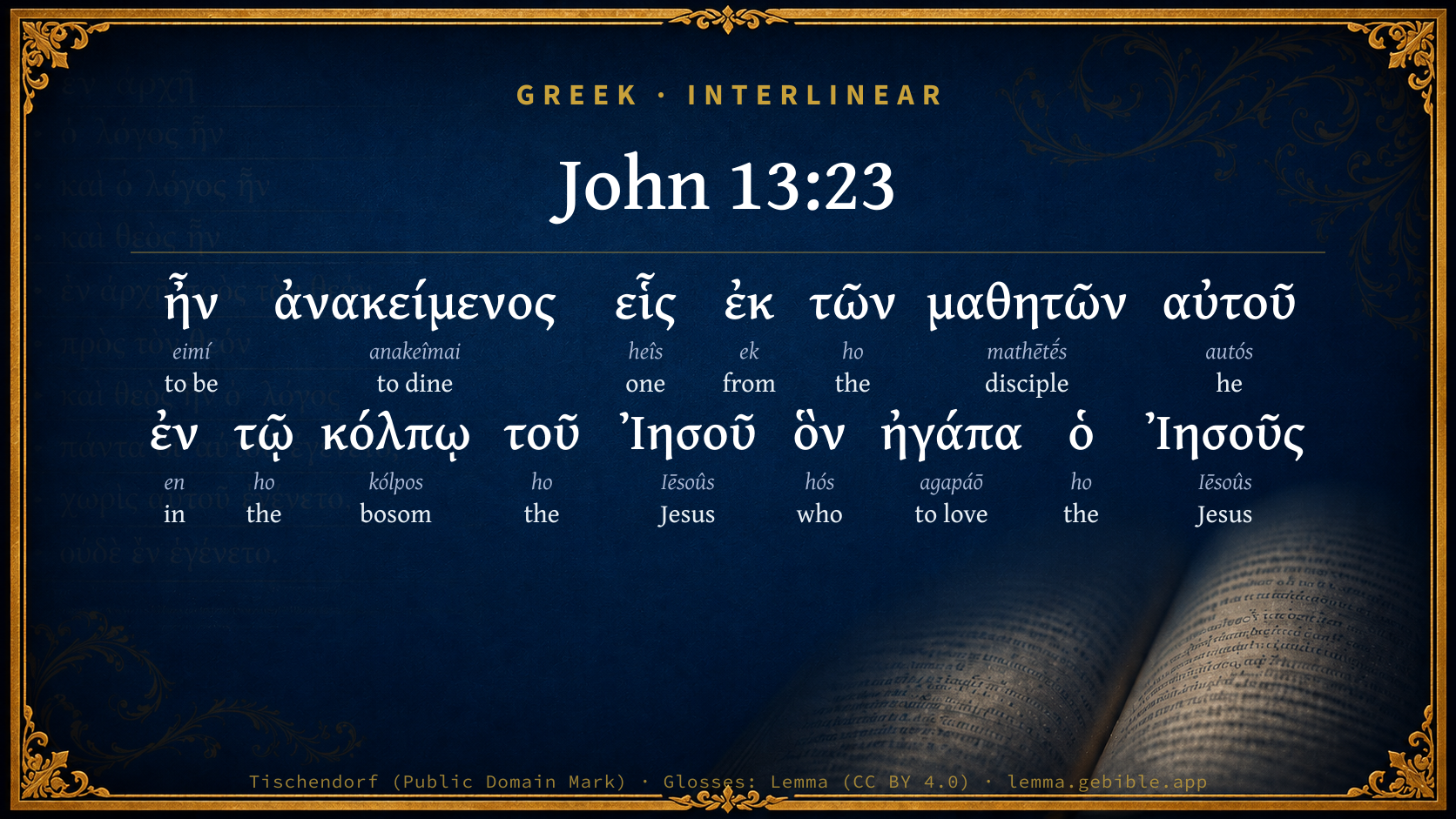
  1. ἦν eimí G1510 “to be” Verb, Imperfect, Active, Indicative, 3rd person, Singular
  2. ἀνακείμενος anakeîmai G345 “to dine” Verb, Present, Middle or Passive deponent, Participle, Nominative, Singular, Masculine
  3. εἷς heîs G1520 “one” Adjective, Nominative, Singular, Masculine
  4. ἐκ ek G1537 “from” Preposition
  5. τῶν ho G3588 “the” Article, Genitive, Plural, Masculine
  6. μαθητῶν mathētḗs G3101 “disciple” Noun, Genitive, Plural, Masculine
  7. αὐτοῦ autós G846 “he” Personal pronoun, Genitive, Singular, Masculine
  8. ἐν en G1722 “in” Preposition
  9. τῷ ho G3588 “the” Article, Dative, Singular, Masculine
  10. τοῦ ho G3588 “the” Article, Genitive, Singular, Masculine
  11. Ἰησοῦ Iēsoûs G2424 “Jesus” Noun, Genitive, Singular, Masculine
  12. ὃν hós G3739 “who” Relative pronoun, Accusative, Singular, Masculine
  13. ἠγάπα agapáō G25 “to love” Verb, Imperfect, Active, Indicative, 3rd person, Singular
  14. ὁ ho G3588 “the” Article, Nominative, Singular, Masculine
  15. Ἰησοῦς Iēsoûs G2424 “Jesus” Noun, Nominative, Singular, Masculine

About this verse

These counts appear in no published source. They are computed here, from the morphology-tagged text and Lemma’s own curated glosses. What Lemma adds →

16
words
12
distinct lemmas
Gospels
section

Notable vocabulary

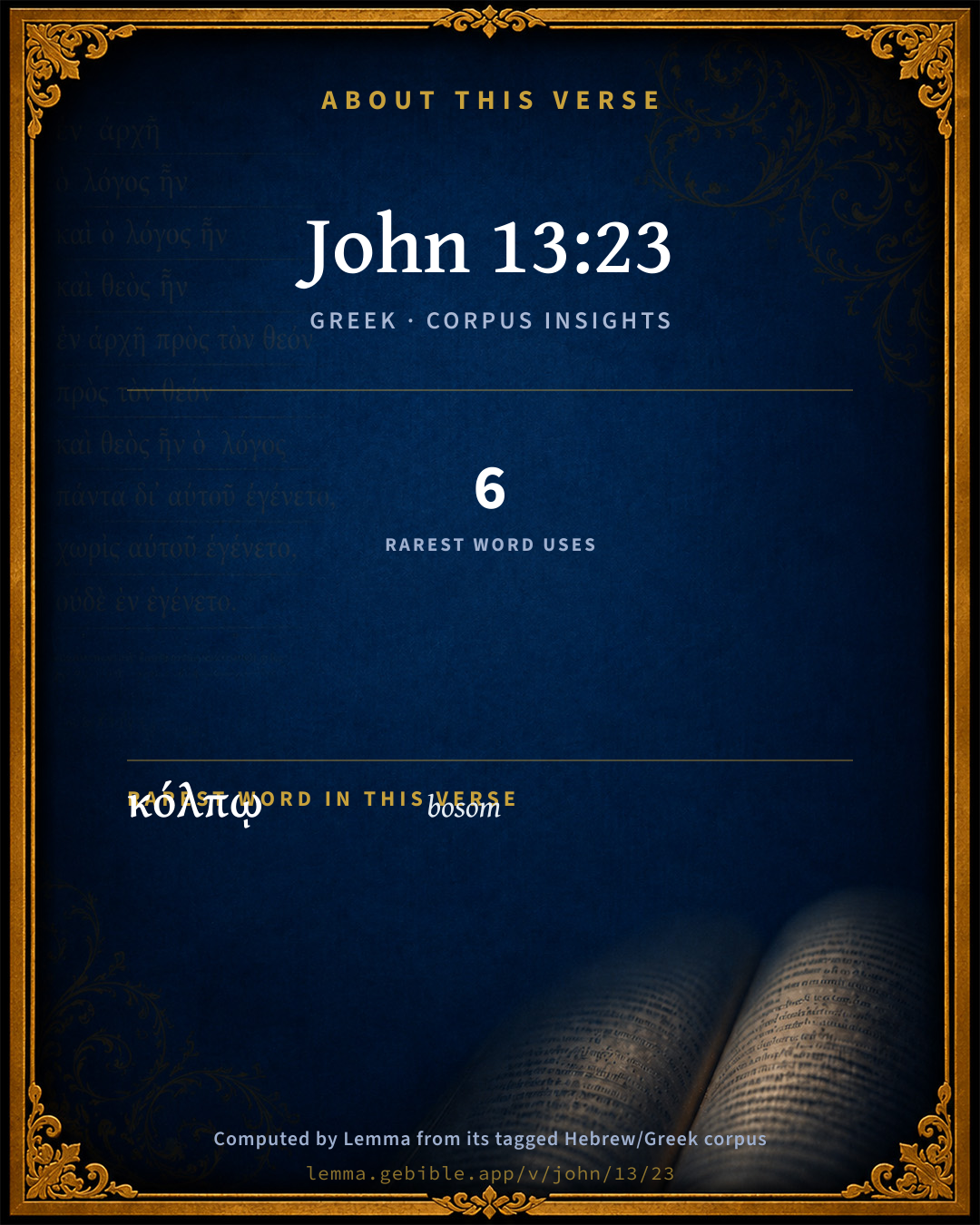
The rarest word here is κόλπῳ bosom G2859 — appearing just 6 times in the whole Greek New Testament.

Shared distinctive vocabulary

κόλπῳ bosom G2859 occurs in 6 verses of the Greek New Testament. Also found in:

Repetition

Words recur within this verse:

  • Ἰησοῦ Jesus G2424 ×2
  • τῶν the G3588 ×4

Cross-references

12

Topical passages linked to John 13:23 in the Treasury of Scripture Knowledge — connected by theme and wording, ordered by reader-vote popularity; previews shown in the World English Bible.

  • John 19:26 Therefore when Jesus saw his mother, and the disciple whom he loved standing there, he said to his mother, "Woman, behold your son!"
  • John 20:2 Therefore she ran and came to Simon Peter, and to the other disciple whom Jesus loved, and said to them, "They have taken away the Lord out of the tomb, and we don't know where they have laid him!"
  • John 21:7 That disciple therefore whom Jesus loved said to Peter, "It's the Lord!" So when Simon Peter heard that it was the Lord, he wrapped his coat around him (for he was naked), and threw himself into the sea.
  • John 21:20 Then Peter, turning around, saw a disciple following. This was the disciple whom Jesus sincerely loved, the one who had also leaned on Jesus' breast at the supper and asked, "Lord, who is going to betray You?"
  • Revelation 1:16–18 He had seven stars in his right hand. Out of his mouth proceeded a sharp two-edged sword. His face was like the sun shining at its brightest.
  • 2 Samuel 12:3 but the poor man had nothing, except one little ewe lamb, which he had bought and raised. It grew up together with him, and with his children. It ate of his own food, drank of his own cup, and lay in his bosom, and was to him like a daughter.
  • John 13:25 He, leaning back, as he was, on Jesus' breast, asked him, "Lord, who is it?"
  • John 21:24 This is the disciple who testifies about these things, and wrote these things. We know that his witness is true.
  • John 1:18 No one has seen God at any time. The one and only Son, who is in the bosom of the Father, he has declared him.
  • John 11:3 The sisters therefore sent to him, saying, "Lord, behold, he for whom you have great affection is sick."
  • John 11:5 Now Jesus loved Martha, and her sister, and Lazarus.
  • John 11:36 The Jews therefore said, "See how much affection he had for him!"

Cross-references courtesy of OpenBible.info (CC BY 4.0).

Commentary

Notes on John 13:23 from classic Christian and Jewish commentators (each source and its license shown beneath its notes). The classic Christian expositions comment on the surrounding passage and are grouped to its opening verse, so a note may address several verses; the Jewish commentaries on the Tanakh (Rashi and others) are per-verse, so they appear only where the commentator wrote on this verse.

Lemma curates 59 commentaries, every one of them public domain or Creative Commons licensed, each selected and text-cleaned for this edition rather than reprinted as found. About our sources →

Joseph Benson's Commentary

Joh 13:23-26. There was leaning on Jesus’s bosom — That is, sitting next to him at table. This phrase only expresses the then customary posture at meals, where the guests all leaned sideways on couches, and each was said to lie in the bosom of him who was placed next above him; one of the disciples whom Jesus loved — This was John, the memory of whose sweet disposition, and other amiable qualities, is perpetuated in the peculiar love which Jesus bare to him. He always avoids with great care the expressly naming himself. Perhaps our Lord now gave him the first proof of his peculiar love, by disclosing this secret to him. Simon Peter, therefore — Not daring to ask Jesus himself; beckoned to him — The word νευει, thus rendered, might be more exactly translated, nodded, namely, he intimated his desire by a motion of his head; that he should ask him privately who it should be — Peter was probably desirous to know, not only that he might be sure it was not himself, but that, knowing who it was, he and the other disciples might withdraw from him, and guard against him, as also, if possible, prevent his design. It may appear to us a desirable thing to know who, in the church, will deceive us, yet let this suffice: Christ knows, though we do not. He then, lying on Jesus’s breast — That is, leaning backward, and secretly whispering; saith, Lord, who is it? Jesus answered — In his ear: so careful was he not to offend (if it had been possible) even Judas himself; He it is to whom I shall give a sop — Το ψωμιον, the sop, which he took up while he was speaking; and when he had dipped the sop — In a thick kind of sauce made of dates, raisins, and other ingredients beaten together and properly diluted; he gave it to Judas Iscariot — Who took it readily enough, not suspecting the design of Christ’s giving it to him. See note on Mat 26:20-25. The Jews still retain the use of such a sauce, which they call haroseth, made of such kind of ingredients, about the consistence of mortar, to represent the clay in which their forefathers wrought while they were under bondage to the Egyptians.

Joseph Benson's Commentary on the Old and New Testaments (1811–1818) — public domain. Text from a community e-Sword module.

Tyndale Open Study Notes

Tyndale Open Resources

13:23 The disciple Jesus loved appears at the cross (19:26-27), at the tomb (20:2-9), and at the resurrection (21:1, 20-23). He is the author of this Gospel (21:24-25). Some scholars believe that Lazarus was in fact the disciple whom Jesus loved (see 11:3, 5, 36), but the person referred to here was among the twelve apostles and is usually identified as the apostle John. • was sitting next to Jesus at the table: Literally was reclining on Jesus’ bosom. They were probably reclining at a triclinium, a U-shaped table with couches. Guests reclined on the couches, while the center provided access to servers. The diners supported their bodies by their left elbows while using their right hands for eating. Feet were extended away from the table (cp. Luke 7:38).

Tyndale Open Study Notes — © Tyndale Open Resources, licensed CC BY-SA 4.0. Text via the HelloAO Bible API.

Bengel's Gnomon

Johann Albrecht Bengel

Joh 13:23. Ὃν ἠγάπα, whom He loved) [So also ch. Joh 19:26, Joh 21:7; Joh 21:20.—V. g.] John avoids with great care express mention of himself It is more an object to be desired, to be loved by Jesus, than to be distinguished by a proper name. There is, however, in this passage, a designation [intimation by description] of the proper name itself (as in Luk 2:11, notes; the name Jesus not being given, but its equivalent force being represented by the term Saviour; Rev 1:4, “Him which is, and which was, and which is to come,” a periphrasis for the Tetragram of Jehovah, יהוה; add, if you please, the observations I have made in Paneg. Gregorii Thaum. p. 181); for John is designated as the one especially favoured by the grace of the Lord.[333] Accordingly this appellation is put, even where the accompanying context did not much require it: for instance, in ch. Joh 20:2, in connection with Peter, whose name is given. Moreover here, when Jesus’ passion was at hand, the first remarkable intimation of His love was given to John, through the revelation to him of the secret [Joh 13:20]; previously he seems not to have known that he was so dear to Him.

[333] This is the meaning of the Hebrew name John.—E. and T.

Bengel's Gnomon of the New Testament — English translation (T&T Clark, Edinburgh, 1860) — public domain. Text from a community e-Sword module.

Meyer's Critical & Exegetical Commentary

Heinrich August Wilhelm Meyer

Joh_13:23-24. There was, however, reclining at table, one of the disciples, etc., so that ἦν belongs to ἐν τῷ κόλπῳ (Luk_16:23). The custom was to lie with the left arm supported on the cushion, and the feet stretched out behind, so that the right hand remained free for eating. The one who lay next reached, with the back of his head, to the sinus of the girdle (κόλπος, Luk_6:38; Plin. ep. iv. 22) of the first, and had the feet of the first at his back; in like manner, the third in the κόλπος of the second. See Lightfoot, p. 1095 f.

ὃν ἠγαπ. ὁ Ἰ.] κατʼ ἐξοχήν. Comp. Joh_19:26, Joh_20:2, Joh_21:7; Joh_21:20. It serves to explain the fact that he was Jesus nearest table-companion. And here, out of the recollection of that sacred, and by him never to be forgotten moment, there first breaks from his lips this nameless, and yet so expressive designation of himself. It is very arbitrary, however, to take this as a circumlocution for his name (Gotthold, Bengel, Hengstenberg, Godet); such a view should have been precluded already by the circumstance that ὃν ἠγ. ὁ κύριος is never employed (but always ὁ Ἰησοῦς).

According to the reading κ. λέγει αὐτῷ· εἰπὲ τίς ἐστιν (see critical notes), Peter supposes, with the hasty temperament which marked him, that John, as the confidant of Jesus, would know whom the latter meant.[130] The λέγει is to be imagined as spoken in a whisper, to which also the νεύει, depicting the occurrence in a lively manner, points. Should εἰπέ be taken as: say to Jesus (Ewald), either περὶ οὗ λέγει would be omitted, or instead of λέγει, λέγεις would be expressed.

[130] In this and other individual traits (Joh_18:15-16, Joh_19:26-27, Joh_20:2-3, Joh_21:3-4, Joh_18:10, Joh_13:8, Joh_21:15-16) the design has been discovered to make Peter appear in a less advantageous light than John, or to make him appear so generally,which would be in keeping with the anti-Judaic tendency of the author. See especially Baur, p. 320 ff. Comp. Hilgenfeld, Evang. p. 335; Spaeth in Hilgenf. ZeitsChr. 1868, p. 182 f. But if the author had actually entertained this design, it would have been an easy thing for himsince he is said to have disposed of the historical material in so altogether free a mannerto have satisfied it in dogmatic points (which would be principally concerned), and yet more easy, at least in Joh_1:43, and Joh_6:68-69, to have remained silent. Comp. on vv. 10, 11.

Meyer — Critical and Exegetical Commentary on the New Testament — English translation by Peter Christie, edited by Frederick Crombie (T&T Clark, 1880) — public domain. Text from a community e-Sword module.

Expositor's Greek Testament

ed. W. Robertson Nicoll

Joh 13:23 . ἦν … Ἰησοῦς , the disciple whom Jesus loved lay next Him, ἐν τῷ κόλπῳ . Two arrangements of guests at a table were in vogue. They either lay at right angles to the table and parallel to one another, each resting on his left elbow and having his right hand free (see Rich’s Dict. , s. v. Trielinium, Lectus, Accubo ); or they lay obliquely, the second reaching with his head to “the sinus of the girdle ( κόλπος )” of the first, and with the feet of the first at his back; while the third occupied the same posture relatively to the second (see the engraving in Becker’s Charicles , 327, and Lightfoot, p. 1095, who says that this second arrangement prevailed in Palestine in the time of Christ). John was lying, then, next to Jesus, his position being inside that of Jesus. To him Peter νεύει , “beckons” ( cf. νεύσω μέν τοι ἐγὼ κεφαλῇ , Od., xvi. 283), taking the initiative as usual, but not himself asking, perhaps because he had made so many mistakes that evening already, perhaps because a private matter might better be transacted in a whisper from John.

The Expositor's Greek Testament, edited by W. Robertson Nicoll (1897–1910) — public domain. Text from a community e-Sword module.

Godet's Commentaries

Frédéric Louis Godet

Vv. 23, 24. Now one of the disciples, he whom Jesus loved, was reclining on his bosom; 24 Simon Peter beckoned to him to ask who this one might be.”

Among the ancients, persons reclined rather than sat at table, each guest having the left arm supported on a cushion, so as to support the head, and the right arm free, for eating; the feet were extended behind. Each guest thus had his head near the breast of the one whose place was at his left hand; this was John’s place as related to Jesus, at this last meal.

The unanimous tradition of the primitive Church designates John as the disciple to whom Joh 13:23 applies. Our Gospel itself allows no doubt of this; as we have shown in the Introduction (Vol. I., p. 32f.). This appears from Joh 21:2, compared with Joh 13:7; Joh 13:20-23 of the same chapter. Among the seven disciples who are named in Joh 13:2, Peter, Thomas, and Nathanael are of course excluded, since the disciple whom Jesus loved is nowhere designated by his name in the Gospel, while these three are thus designated several times. The last two disciples, who are not named, do not seem to have belonged to the circle of the apostles; there remain, therefore, only the two sons of Zebedee. As James is excluded by the fact of his early death (comp. what is said of the disciple whom Jesus loved, Joh 13:22 : “If I will that he tarry till I come, what is it to thee?”), John only remains.

The Synoptic narrative leads to the same result: The disciple whom Jesus loved being necessarily one of the three privileged apostles, and Peter and James being excluded for the reasons indicated, John alone remains. If he designates himself by this periphrase, it is certainly not through vanity as has been asserted—it is precisely from humility that he avoids declaring his name, but with the feeling of the infinite condescension of Him who had deigned to treat him, during His earthly existence, as His friend. The reading of the T. R., agreeing with 14 MSS., among which are the Alexandrian and Cambridge MSS., and with the Peschito, is very simple: “Simon Peter beckons to him to ask who it is of whom he speaks.” But the Alexandrian authorities, theVatican and Ephrem MSS., etc., and the Itala read: “Simon Peter beckons to him and says to him: Tell who it is of whom he speaks.” The Sinaitic MS. unites the two readings and puts them in juxtaposition, a fact which, in any case, proves the high antiquity of both. Against the first is alleged its great clearness and simplicity; this can be a reason for rejecting it only if the second presents a really admissible meaning. Otherwise the latter must be regarded as the result of an accidental error or of a faulty correction.

The attempt has been made to give it two meanings.Ewald: “He makes a sign and says: Tell (to Jesus) who is the one of whom he speaks.” But, in this case, either: of whom thou speakest, or: ask him, instead of tell would be necessary. The majority (Weiss, Keil, Luthardt) think that Peter, supposing that John already knows from Jesus who is the traitor, simply says to John: “Tell me who it is of whom he (Jesus) speaks.” But the: he beckons, implies that Peter and John were not seated near one another, while the: he says to him, would imply proximity. To solve this contradiction, these last words must, in this case, be explained: “he says to him by a sign” (νεύων λέγει). Is this use of λέγειν natural? But, above all, how could Peter have supposed so positively and mistakenly (Joh 13:25) that John already knew this secret? For myself, I persist in believing that in this case, as in so many others, it is an error to bind oneself to the Alexandrian text. The reading of this text seems to me to result from a gloss, sometimes added to (Sinait.), sometimes substituted for (Vatican), the primitive text which has been preserved in the other documents. It follows from Joh 13:24 that Peter was not seated at Jesus’ side; otherwise he might have himself put the question to Him.

Frédéric Louis Godet — Commentaries on Luke, John, Romans, and 1 Corinthians — English translation (T&T Clark, Edinburgh, 1870s–1890s) — public domain. Text from a community e-Sword module.

Geneva Bible (1599)

Geneva Bible translators

John’s leaning was such, that sitting down in his bed, his head was toward Jesus’ head: so that it was an easy matter for him to touch Jesus’ bosom: for it is certain that in old time men used not to sit at the table, but to lie down: on the one side.

Geneva Bible (1599) marginal notes — public domain. Text via Bolls.life.

Jamieson, Fausset & Brown

Robert Jamieson, A. R. Fausset & David Brown

there was leaning on Jesus' bosom one of his disciples, whom Jesus loved--Thus modestly does our Evangelist denote himself, as reclining next to Jesus at the table.

Peter . . . beckoned to him to ask who it should be of whom he spake--reclining probably at the corresponding place on the other side of Jesus.

Jamieson, Fausset & Brown — Commentary Critical and Explanatory on the Whole Bible (1871) — public domain (CC PDM 1.0). Text via the HelloAO Bible API.

Adam Clarke's Commentary

Verse 23. Now there was leaning on Jesus' bosom] The Jews of those days, at their suppers, reclined, supported by their left arm, on couches placed round the table, as the Greeks and Romans did. On each couch there were two or three persons; and the head of one of them came near to the bosom of him who reclined above him on the same couch. The person here mentioned was John, the writer of this history, who, being more tenderly loved by Christ than the rest, had always that place at table which was nearest to his Lord.

Adam Clarke's Commentary on the Bible (1810–1826) — public domain. Text from a community e-Sword/MySword module.

John Calvin's Commentaries

23. Whom Jesus loved. The peculiar love with which Christ loved John plainly testifies that, if we love some more than others, this is not always inconsistent with brotherly love; but all lies in this, that our love shall be directed towards God, and that every man, in proportion as he excels in the gifts of God, shall share in it the more largely. From this end Christ never turned aside in the smallest degree; but with us the case is widely different, for such is the vanity of our mind, that there are few who, in loving men, approach more nearly to God. And yet the love of men towards each other will never be properly regulated, unless it be directed to God.

Lay at table in Jesus’ bosom. What is here related by John might be regarded in the present day as indecorous; but such was, at that time, the manner of being placed at table; for they did not sit, as we do, at table, but, after having put off their shoes, lay half-stretched out, reclining on small cushions.

John Calvin's Commentaries (1540-1563) — public domain. Text from the Calvin Translation Society English edition (1840s-50s) via the Christian Classics Ethereal Library (ccel.org). Calvin's coverage is partial (roughly two-thirds of the Bible); uncommented books and verses are honest gaps, never fabricated. The 19th-century editor's footnotes and remarks are omitted so the notes are faithfully Calvin's own voice.

Ellicott's Commentary for English Readers

(23) Now there was leaning on Jesus’ bosom.—Leonardo’s picture is in one respect misleading, and, like most paintings of the Lord’s Supper, has not represented the method in which the guests reclined rather than sat at table. Each leaned on his left arm, leaving the right arm free. The feet were stretched out behind the guest on his right hand, and the back of the head reached near to the bosom of the guest on the left. (Comp. Note on Joh_13:25.) The Jews followed this Persian method of reclining on couches at meals from the time of the Captivity, and this method of eating the Passover had the special significance of security and possession of the Promised Land, as opposed to the attitude of one undertaking a journey, which was part of the original institution (Exo_12:11).

One of his disciples, whom Jesus loved—i.e., John himself. (Comp. Joh_21:2; Joh_21:7; Joh_21:20-23, and Introduction, p. 375.) The same designation occurs also in Joh_19:26.

A Bible Commentary for English Readers, edited by Charles John Ellicott (1878–1897) — public domain. Text from a community e-Sword module.

The Cambridge Bible for Schools and Colleges

gen. ed. J. J. S. Perowne

23. there was leaning on Jesus’ bosom] Better, there was reclining on Jesus’ lap. It is important to mark the distinction between this and the words rendered ‘lying on Jesus’ breast’ in Joh_13:25. The Jews had adopted the Persian, Greek, and Roman custom of reclining at meals, and had long since exchanged the original practice of standing at the Passover first for sitting and then for reclining. They reclined on the left arm and ate with the right. This is the posture of the beloved disciple indicated here, which continued throughout the meal: in Joh_13:25 we have a momentary change of posture.

whom Jesus loved] This explains how S. John came to be nearest (see Introduction ii. iii. 3 b), and “out of the recollection of that sacred, never-to-be-forgotten moment, there breaks from him for the first time this nameless, yet so expressive designation of himself” (Meyer). Comp. Joh_19:26, Joh_21:7; Joh_21:20; not Joh_20:2. S. John was on our Lord’s right. Who was next to Him on the left? Some think Judas, who must have been very close for Christ to answer him without the others hearing.

The Cambridge Bible for Schools and Colleges (gen. ed. J. J. S. Perowne; Cambridge University Press, 1878–1918) — public domain. Text from a community e-Sword module.

John Gill's Exposition

Now there was leaning on Jesus' bosom,.... Not pressing upon that part of Christ's body, which would have been irreverent in John, and troublesome to Christ; but leaning at table upon his bed or couch, on which he lay; and which was next to, and just before Christ; so that he was very near unto, and seemed to lie in the bosom of Christ; as such are said to do, who sit next at table to another. The posture of the Jews at table, was either "sitting" or "lying", and a difference they make between these two;

"if, say they (d), , "they sat" to eat everyone asked a blessing for himself; but if "they lay down", one asked a blessing for them all.''

This lying down was not on their backs, nor on their right side, but on their left; for they say (e), that

"lying down on the back, is not called "lying down"; and lying on the right side, is not called lying down.''

And the reason given is (f), because they have need of the right hand to eat with; but as they elsewhere (g) observe,

"they used to eat lying along, leaning on the left side, their feet to the ground, and every man on a single couch.''

Would you know the order in which they, lay, take the account as they have given it (h);

"when there were but two couches, the principal person lay first, and the second to him above him; and when there were three, the principal person lay in the middle, the second to him above him, and the third below him; and if he would talk with him, he raised himself upright, and sitting upright he talked with him; that is, as the gloss explains it, if the principal person was desirous to talk with him that was second to him, he must raise himself up from his lying down, and sit upright; for all the white he is leaning, he cannot talk with him, because he that is second to him, is behind the head of the principal person, and the face of the principal person is turned to the other side; and it is better for the second to sit below him, that he may hear his words, whilst he is leaning.''

The form in which Christ and his disciples sat or lay at table, we may conceive was this (i); a table was placed in the middle and as many beds or couches round it, as there were persons; Christ the principal and most worthy person lay first, with his head toward the table, his face somewhat turned from it, leaning on his left elbow upon the couch; in this posture lay Jesus, upon the first couch; in the same posture lay John, in the next to him, and just before him; the hinder part of his head being towards, and near the breast and bosom of Jesus; whence he is said to lean upon it: now to lie next to the principal person, was a very great honour, as well as a mark of great affection; and for John to lie next to Jesus, and as it were to lean on his bosom, showed how much he was respected and honoured by him; and therefore John modestly conceals his name, and only says,

one of his disciples whom Jesus loved; Christ, as the Son of God, and surety of his people, loved his true disciples, as he does all his elect, alike; not one more than the other; but as man, he had a particular affection for this disciple, and therefore admitted him near his person, and was very familiar with him.

(d) Misn. Beracot, c. 6. sect. 6. (e) T. Bab. Pesachim, fol. 108. 1. (f) Gloss in ib. (g) Gloss in T. Bab. Beracot, fol. 46. 2. & Bartenora in Misn. Beracot, c. 6. sect. 6. (h) T. Bab. Beracot, fol. 46. 2. (i) Vid. Alstorphium delectis veterum, p. 109, 110.

John Gill's Exposition of the Whole Bible (1746–1763) — public domain (CC PDM 1.0). Text via the HelloAO Bible API.

Trapp's Complete Commentary

John Trapp

23 Now there was leaning on Jesus’ bosom one of his disciples, whom Jesus loved.

Ver. 23. Now there was leaning on Jesus’ bosom] So must we do at the sacrament, by the actuation of our faith, ascending up into heaven, and fetching down Christ into the heart, that we may have intimate and entire communion with him. {a} By the force of our faith at the Lord’s table, cruci haeremus, sanguinem fugimus, et intra ipsa redemptoris nostri vulnera figimus linguam, saith St Cyprian (de Coena Dom.). We adhere to the cross, we flee to the blood.

{a} Calceis exuti, et pulvinis innixi, in lectulis semisupini iacebant. Calvin. in loc.

John Trapp, A Commentary or Exposition upon All the Books of the Old and New Testament (1647–1656) — public domain. Text from a community e-Sword module.

Albert Barnes' Notes on the Bible

Leaning on Jesus’ bosom - This does not mean that he was at that time actually lying on his bosom, but that he occupied a situation next to him at the table, so that his head naturally fell back on his bosom when he spoke to him. See the notes at Mat 23:6.

Whom Jesus loved - This was doubtless John himself. The evangelists are not accustomed to mention their own names when any mark of favor or any good deed is recorded. They did not seek publicity or notoriety. In this case the appellation is more tender and honorable than any mere name. John was admitted to special friendship, perhaps, because the natural disposition of our Saviour was more nearly like the amiableness and mildness of John than any of the other disciples (Robert Hall). The highest honor that can be conferred on any man is to say that Jesus loved him. Yet this is an honor which all may possess, but which none can inherit without his spirit and without loving him. It is an honor which cannot be won by wealth or learning, by beauty or accomplishments, by rank or earthly honors, but only by the possession of a meek and quiet spirit, which is in the sight of God of great price, 1Pe 3:4; compare Rom 8:9.

Albert Barnes' Notes on the Bible (1834–1885) — public domain. Text from a community e-Sword/MySword module.

Haydock's Catholic Bible Commentary

One of his disciples. St. John himself was lying at table in (or towards) the bosom of Jesus.[1] These words seem to express the manner that the Jews were place at table. They had couches about a table, to lean or lie upon; and three for example upon each couch. The master, or head of the company, was placed in the midst; so that we may suppose, that Christ was placed on one of these couches in the midst, St. Peter on one side of him, and St. John on the other; and that St. John, in that resting and leaning posture, had his head all the time turned, and inclined towards Christ’s bosom: yet it can scarce be imagined, that his head laid continually upon our Saviour’s breast or bosom; for this posture would have been very uneasy to Jesus, or to any one. St. John then leaned all supper time towards Jesus’s bosom or breast, but not upon it. (Witham) --- Whilst all were fearing for themselves, and Peter, the very head of the apostles, was trembling, St. John rests; reposing on the bosom of Jesus. (St. John Chrysostom, hom. lxxi. in Joan.)

===============================

[BIBLIOGRAPHY]

Erat recumbens in sinu Jesu, ver. 23. And cum recubuisset super pectus Jesu, ver. 25. In the Greek, ver. 23, Greek: anakeimenos epi to kolpo tou Iesou; and ver. 25, Greek: epipeson epi to stethos tou Iesou. The word Greek: anakeimenos from Greek: anakeisthai, seems to express no more than the manner in those days of leaning, or lying at table: as in the Latin, accumbere, or discumbere; but Greek: epipeson, from Greek: epipiptein epi to stethos, signifies a bowing or falling down on Christ’s breast, as it were in a fit of trouble or grief. See the author of the Analysis, diss. xxxvi. St. John Chrysostom, (hom. xllii. p. 423, tom. 8, Nov. Ed. Ben.) seems to make a difference betwixt these two expressions, when he says: Joannes ... in sinu Jesu recubat, nec recubat solum, sed in pectus incidit: neque hoc solum quæsitu dignum est, &c. Greek: o Ioannes anakeitai eis ton kolpon tou Iesou, kai ouk anakeitai monon, alla kai to stethei epipiptei, kai ou touto monon axion zeteseos, &c.

====================

George Leo Haydock (1774–1849), Haydock's Catholic Family Bible and Commentary, 1859 edition — public domain. Excludes Psalms (Douay-Rheims chapter numbering differs from Protestant) and Deuterocanonical books (Catholic canon only).

Matthew Poole's English Annotations

This leaning on Jesus’ bosom, and the laying on Jesus’ breast, mentioned Joh 13:25, cannot be understood without the understanding of the usual posture the Jews used at their meals, and particularly at the paschal supper; of which we have spoken largely; See Poole on "Mat 26:20": see the annotations there. Their posture seemeth to have been kneeling, and resting their bodies back upon their legs, with a leaning upon their left elbow; and this seemeth not to have been so close, but that he that so sat might use his other hand to take his meat; hence he who sat before any, sat with his back towards him, but leaning towards the bosom of the other, which is here called a leaning on (that is, towards) his bosom, and laying on his breast; for it cannot be understood of such a sitting, or leaning, as to touch the other’s breast or bosom, for that would have hindered him upon whom the person so leaned from any use of his right hand to take his meat or drink. It is apparent from hence, first, that at this supper there was none but Christ and his disciples. Secondly, that they sat in this posture of leaning. These two things make it very probable, if not certain, that the supper here mentioned was either the paschal supper, or a common supper, which immediately went before, or followed after, the passover supper. For,

1. We have no record of any other supper, at which were only Christ and the twelve disciples; and:

2. If we may believe the Jewish writers, though their ordinary posture at their common meals was discumbency, that is a kneeling on their knees, with a resting their bodies backward upon their legs; yet this posture of leaning was constantly added only upon the passover night, as a further testimony of their liberty, that they were not now servants, as in the land of Egypt. The person who sat next to our Saviour, with his back next our Saviour’s bosom, was John, often in Scripture dignified with the title of the beloved disciple, and him whom Jesus loved, Joh 19:26; Joh 20:2; 21:7,20.

Matthew Poole's English Annotations on the Holy Bible (1683–1685) — public domain. Text from a community e-Sword/MySword module.

Whedon's Commentary on the Bible

Daniel D. Whedon

23. Leaning on Jesus’s bosom—Reclining next to him on the couch at table, whereby he could in a low voice address Jesus by turning back his head.

Whom Jesus loved—By this expression, used by John some five times, he doubtless designates himself, (Joh_19:26; Joh_20:2; Joh_21:7; Joh_21:20.) Twice he also mentions that he reclined on Jesus’s bosom, (Joh_21:20.) John was the youngest of the disciples; and without claiming any proud pre-eminence, or setting up for rival to Peter for the primacy, he tenderly remembers that Jesus had for him a peculiar love. He was the youngest, tenderest, feeblest lamb of the flock.

Daniel D. Whedon (gen. ed.), Commentary on the Old and New Testaments (1874–1909) — public domain. Text from a community e-Sword module.

John Wesley's Explanatory Notes

There was lying in the bosom of Jesus -- that is, sitting next to him at table. This phrase only expresses the then customary posture at meals, where the guests all leaned sidewise on couches. And each was said to lie in the bosom of him who was placed next above him. One of the disciples whom Jesus loved - St. John avoids with great care the expressly naming himself. Perhaps our Lord now gave him the first proof of his peculiar love, by disclosing this secret to him.

John Wesley, Explanatory Notes Upon the Whole Bible (1754–1765) — public domain. Text via the GEBible commentary corpus.

Burkitt's Expository Notes on the New Testament

William Burkitt

Observe here, 1. The character given of St. John the beloved disciple: he leaned on Christ’s bosom; that is, he had most intimate converse with Christ, one whom Christ treated with greater freedom and familiarity than the rest, and one that knew more of his heart than most of his disciples. We commonly call a very near friend a bosom friend.

Learn, That although Christ had an endeared love for all his disciples and followers, yet there were degrees in Christ’s own love, and he had a familiarity with some disciples beyond others, whilst he was here upon earth, even as now in heaven, though his heart be towards all his children here on earth, yet he is pleased to let out more kind manifestations of himself, and more sensible evidences of his love towards some than towards others. John was the disciple that lay in Jesus’s bosom.

Observe, 2. The way which our Saviour took to discover Judas to the rest of his disciples, not by naming him, but by giving him a sop; partly because he would not give Judas any provocation by mentioning his name, and partly because the sign of eating the sop was most agreeable to the prophetical prediction, My own familiar friend, who did eat of my bread, hath lifted up his heel against me Psa 41:9.

Observe, 3. The time when Judas received the sop, and the consequence that followed upon his receiving of it; it was at that time when he had, with an unbelieving heart, and an unthankful spirit, been eating the passover, which was a type of Christ. Now Satan enters into him; that is, takes fuller possession of him, and he gives himself up more freely and fully to the devil’s conduct and suggestion. Satan gets possession of wicked men gradually and by degrees; not all at once; the only way to be safe is to resist the beginnings of sin; for, when Satan once gets footing, it is hard to prevent a more full possession.

Observe, 4. The place where Judas now was, namely, at Bethany, some miles form Jerusalem, and it was now night; yet so intent he was upon the devil’s work, that away he trudges to Jerusalem, and at that time of night repairs to the high priests, and sells his Saviour into their hands. O what a warmth and zeal was here in the devil’s cause! Men given over by God, and possessed by Satan, are so restless and unwearied in sin, that neither by day nor by night can they cease from the contrivance and execution of it.

William Burkitt's Expository Notes on the New Testament (1700–1703) — public domain. Text from a community e-Sword module.

unfoldingWord translationNotes

Door43 World Missions Community

One of his disciples, whom Jesus loved

This refers to John.

lying down at the table

During the time of Christ, Jews would often dine together in the Greek style, in which they lay on their sides on low couches. (See: Assumed Knowledge and Implicit Information)

Jesus' side

Lying with one's head against the side of another diner in the Greek style was considered to be the place of greatest friendship with him.

loved

This kind of love comes from God and focuses on the good of others, even when it does not benefit oneself. This kind of love cares for others, no matter what they do.

translationWords

disciple

love

Peter

lord

unfoldingWord translationNotes — © Distant Shores Media and the Door43 World Missions Community, licensed CC BY-SA 4.0. Source: git.door43.org/Door43/en_tn.

Cambridge Greek Testament for Schools and Colleges

23. ἦν ἀνακείμενος … ἐν τ. κόλπῳ. It is important to distinguish between this reclining on Jesus’ lap and ἀναπέσων ἐπὶ τὸ στῆθος in Joh 13:25. The Jews had adopted the Persian, Greek, and Roman custom of reclining at meals, and had long since exchanged the original practice of standing at the Passover first for sitting and then for reclining. They reclined on the left arm and ate with the right. This is the posture of the beloved disciple indicated here, which continued throughout the meal: in Joh 13:25 we have a momentary change of posture.

ὃν ἠγάπα ὁ Ἰ. This explains how S. John came to be nearest and to be told who was the traitor (Introduction, p. xxxiv.) Comp. Joh 19:26, Joh 21:7; Joh 21:20; not Joh 20:2. S. John was on the Lord’s right. Who was next to Him on the left? Possibly Judas, who most have been very close for Christ to answer him without the others hearing.

Cambridge Greek Testament for Schools and Colleges (Cambridge University Press, 1896; 21 vols, various authors incl. Carr, Maclear, Plummer, Farrar, Lumby, Moule, M. R. James, Simcox) — public domain. Text from a community e-Sword module.

Alford’s Greek Testament

Henry Alford

23.] Since the captivity, the Jews lay at table in the Persian manner, on divans or couches, each on his left side, with his face towards the table, his left elbow resting on a pillow and supporting his head. Thus the second guest to the right hand lay with his head near the breast of the first, and so on (Lücke ii. 565).

ὃν ἠγάπα ὁ Ἰησ.] The disciple meant is John himself, see ch. 21:20; also designated thus, ch. 19:26; 21:7 (see Prolegomena to John, § i. 6).

Henry Alford, The Greek Testament (1849–1861) — public domain. Text from a community e-Sword module.

International Critical Commentary

23. After ἦν the rec., with אAC2DWΘ, ins. δέ, but om. BC*L.

For the constr. ἦν ἀνακείμενος, where we should expect the impf., see on 1:28.

εἷς ἐκ τῶν μαθ. Θ om. ἐκ, but ins. אABCDW; see on 1:40.

ὃν ἠγάπα ὁ Ἰησοῦς. Cf. 19:26, 20:2, 21:7, 20. We have argued in the Introduction (p. xxxv f.) that this disciple was John the son of Zebedee. The question has been raised, indeed, whether we may not suppose others, outside the circle of the Twelve, to have been present at the Last Supper, of whom “the beloved disciple” may have been one. But the language of Mar 14:17, “He cometh with the Twelve,” is explicit; so too Luk 22:14, “He sat down, and the apostles with Him.” There is no hint anywhere of the presence of any except the twelve chosen companions of the Lord (cf. v. 18), of whom therefore the beloved disciple must be one. Sanday’s suggestion1 that the beloved disciple may have been present as a young and favoured follower, a “supernumerary apostle,” lacks evidence. It is highly unlikely that Jesus would have bestowed special marks of His love and favour on one whom He did not include within the circle of the Twelve, and of whom, besides, the Synoptists know absolutely nothing.1

The posture at table of guests at a feast seems to have been that of reclining sideways on couches or divans, the left arm on a cushion which was on the table, the right hand being thus free for taking food; the feet were stretched out behind. The host or principal person was in the centre, and the place of honour was above him, that is, to his left; the next highest place being below him, or to his right.2 Thus the person on the right of the host would be so placed that his head would be close to the host’s breast, and that it would be easy therefore to say a word to him confidentially. The host would occupy a similar position in relation to the chief guest on his left, and would readily be able to address him privately.

It is plain that, at the Supper, the beloved disciple (i.e., as we take it, John the son of Zebedee) lay on the right of Jesus, ἀνακείμενος ἐν τῷ κόλπῳ τοῦ Ἰησοῦ. There is no certain indication as to the disciple on His left (which was the place of honour). Some have thought it was Peter, but, if that were so, he would have addressed his question (v. 24) to Jesus directly, without the intervention of John. And the fact that he made signs to John would suggest that he was not very near him at table. It is more probable that the chief place (on the left of Jesus) was occupied by Judas, for Jesus was able to speak to him privately without the conversation being overheard (see v. 27 and cf. Mat 26:25). That Judas was the treasurer of the little company (see on 12:6) may point to his enjoyment of some kind of precedence; and if this were so, he would naturally occupy the chief place at table, next to Jesus. See also on 6:71.

That John the son of Zebedee was given a place of honour at the supper is reminiscent of the request of Mar 10:37 that he and his brother should be given the two highest seats in the Messianic kingdom; and it is possible that it was their custom to occupy the places of honour at the common meals of the Lord and His disciples. This would suggest that James was on the left of Jesus, as John was on His right, at the Last Supper; but more probably on this occasion Judas was next his Master.

International Critical Commentary — older volumes (1896–1929), various authors — public domain. Text from a community e-Sword module.

Vincent's Word Studies in the New Testament

Marvin R. Vincent

Was leaning on Jesus ' bosom [ην ανακειμενος εν τω κολπω του ιησου] . The Rev. renders, "there was at the table reclining," etc. At the table is added because the verb is the general term equivalent to sitting at table. "In Jesus ' bosom," defines John's position relatively to the other guests. As the guests reclined upon the left arm, the feet being stretched out behind, the head of each would be near the breast of his companion on the left. Supposing that Jesus, Peter, and John were together, Jesus would occupy the central place, the place of honor, and John, being in front of Him, could readily lean back and speak to Him. Peter would be behind him.

Bosom. See on Luk 6:38. The Synoptists do not give this incident.

Marvin R. Vincent, Word Studies in the New Testament (1887–1900) — public domain. Text from a community e-Sword/MySword module.

Lesson kit

Teaching starters — assembled from the data on this page, not authored interpretation. Every prompt links to the verse data it draws on. Edit before teaching.

John, in the Gospels, opens this verse with 16 words (12 distinct Greek lemmas). Its most distinctive word is kólpos (“bosom”). A historical commentator’s framing appears above. Read the whole chapter for the surrounding context.

Discussion questions

  1. The word kólpos carries the sense “bosom.” How does it shape the verse?
  2. Luke 6:38 shares the word «bosom» with this verse. How do the two illuminate each other?
  3. “Jesus” occurs 2× in this one verse. What is the effect of the repetition?
  4. These translations render this verse differently. What is at stake in choosing one wording over another?
  5. Reading how Joseph Benson's Commentary and Tyndale Open Study Notes read this verse, where do the two commentators agree and where do they part?

Things to notice

Reading settings

Reading text

Shown beneath each verse's original-language words.

Old Testament
Old Testament edition

Read the OT as the Masoretic Hebrew (MT) or the Greek Septuagint (LXX).

English shown for the Greek Septuagint (in the Hebrew ↔ Greek comparison).

Comparing translations? Open the Compare panel on any verse page to stack up to four side by side.