
Acts 7:43

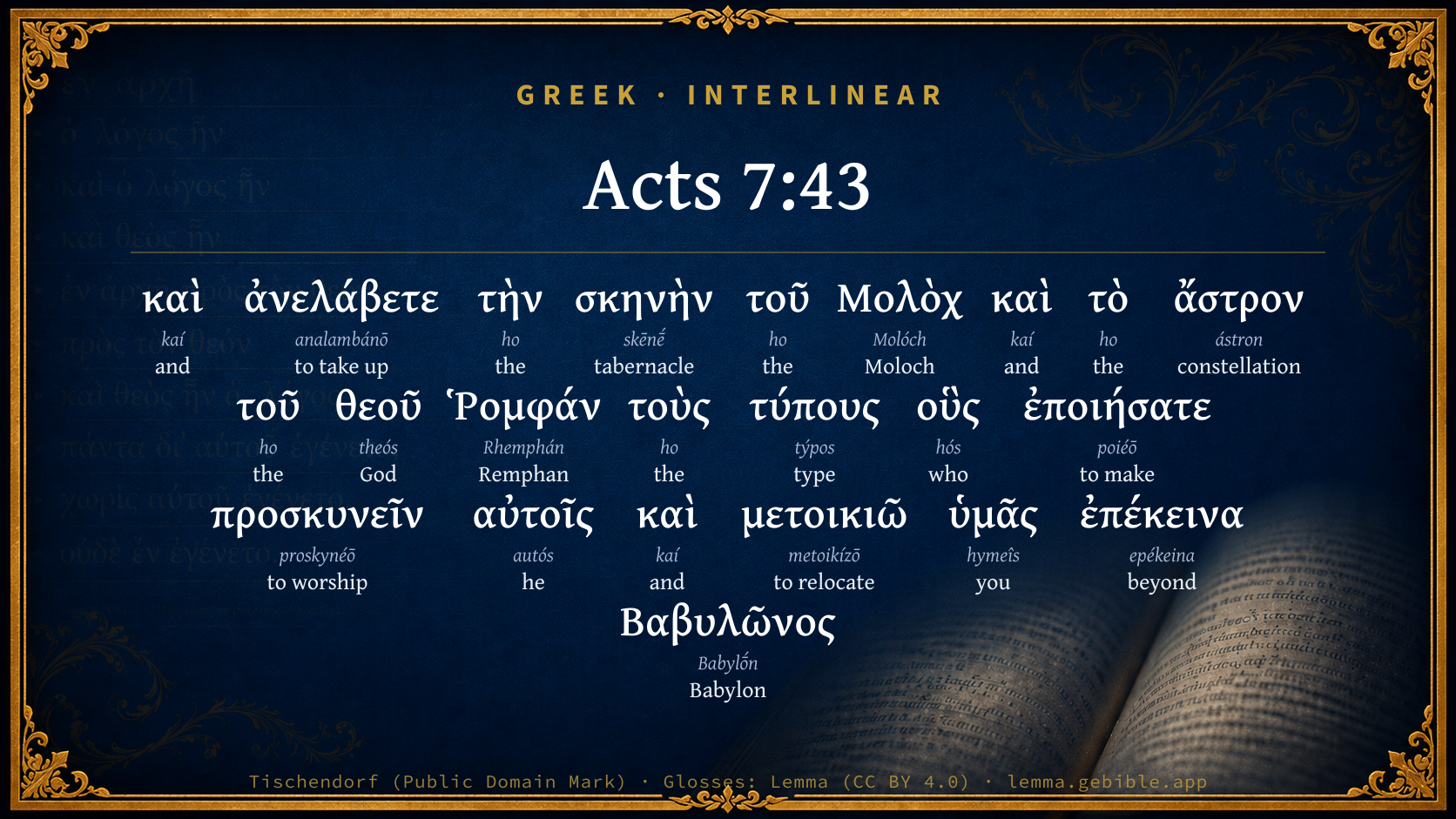
Greek (Tischendorf 8th ed.) Acts 7:43 appears in the Greek New Testament. The text above is from the Tischendorf 8th edition. Each word links to its Strong’s number and a concise gloss. Click any word for its full Thayer’s Greek Lexicon entry.
Download image
Cite this verse

Acts 7:43 (World English Bible). Public Domain. Lemma interlinear Bible study tool, https://lemma.gebible.app/v/acts/7/43.

Show BibTeX & RIS
BibTeX
RIS
English Translation
You took up the tent of Moloch, The star of your god Rephan, The figures which you made to worship. I will carry you away beyond Babylon.'
World English Bible · Public Domain
Highlights
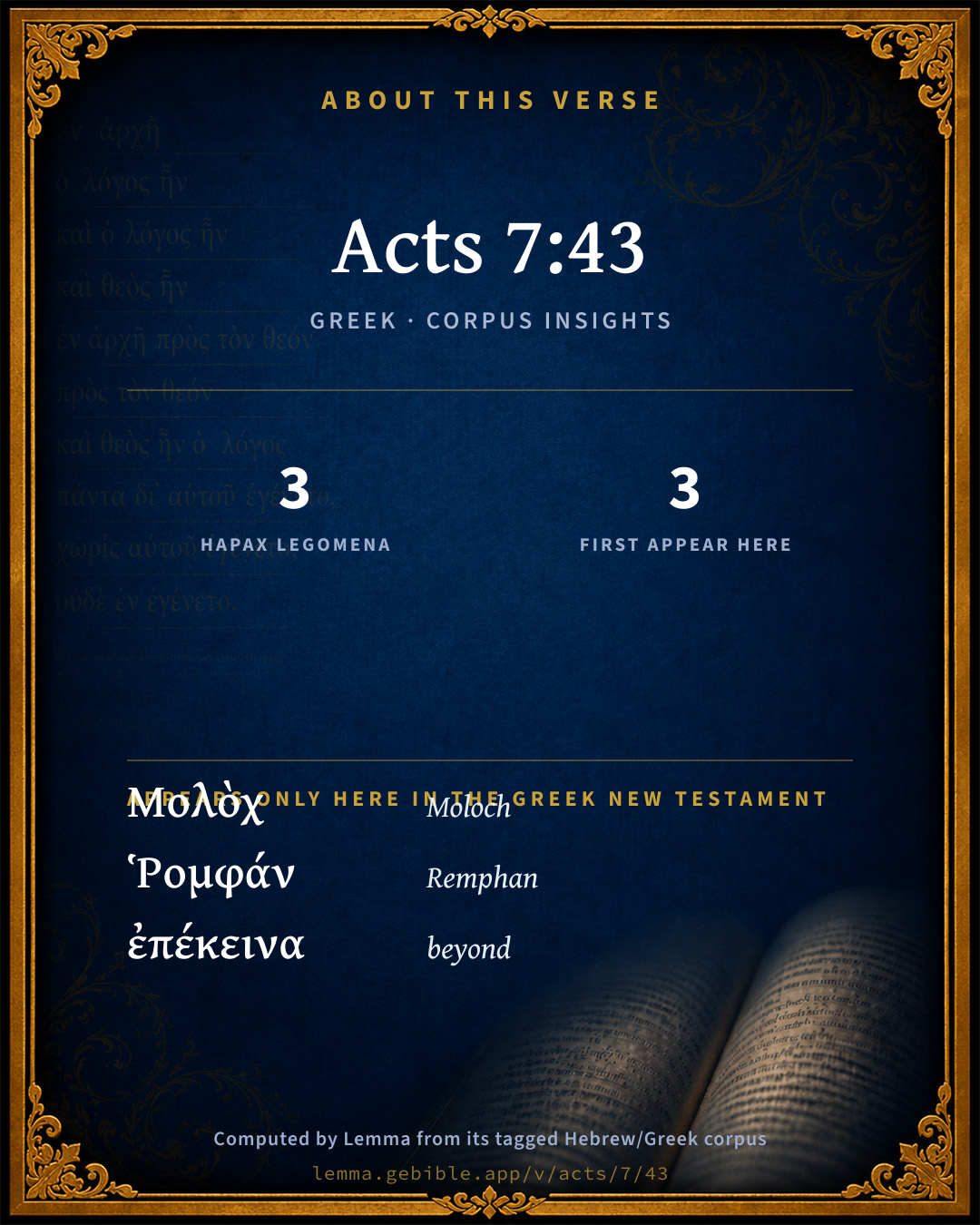
  • 3 hapax legomena — only here in the Greek New Testament
  • 3 first appearances in the Greek New Testament
Full analysis ↓
Download a study sheet

One document with this verse’s original text, its word-by-word gloss line, the meaning frame, cross-references with their text, attributed commentary, and full source and license credits — printable, and it pastes into notes with its structure intact.

This verse Autodidact and up

Study sheet (.html) Plain text (.txt)

A passage Seminary Student

Up to 50 verses in one chapter. A passage sheet keeps up to 6 commentary sources and 12 cross-references per verse, in the order this page ranks them, and says so on the sheet whenever that leaves anything out. Ask for a single verse and you get the Autodidact verse sheet above.

Everything on this page stays free to read, with no account — the sheet is a download of what is already on screen, not access to it.

Want to remove ads? Support Godless Engineer
Compare translations 3

The same verse in 3 English versions, stacked beneath the original-language interlinear above. Click any original word for its lexicon entry.

Each is an independent rendering of the whole verse — the interlinear is not word-aligned to these translations.

Highlighted words mark where these versions differ — a whole-verse word diff, not a word-by-word alignment.

  • World English Bible Public Domain
    You took up the tent of Moloch, The star of your god Rephan, The figures which you made to worship. I will carry you away beyond Babylon.'
  • King James Version Public Domain
    Yea, ye took up the tabernacle of Moloch, and the star of your god Remphan, figures which ye made to worship them: and I will carry you away beyond Babylon.
  • unfoldingWord Literal Text CC BY-SA 4.0
    And you took up the tabernacle of Molech and the star of your god Rephan— the images that you made to worship them— and I will remove you beyond Babylon.’

unfoldingWord Literal Text — © unfoldingWord, licensed CC BY-SA 4.0. Word-aligned USFM3 via Door43 (git.door43.org/unfoldingWord/en_ult).

Versions to compare (up to 4)

3 of 4 selected

Show all 19 translations

Every available English version of this verse, each an independent rendering of the whole verse.

  • World English Bible Public Domain
    You took up the tent of Moloch, The star of your god Rephan, The figures which you made to worship. I will carry you away beyond Babylon.'
  • Berean Standard Bible Public Domain
    You have taken along the tabernacle of Molech and the star of your god Rephan, the idols you made to worship. Therefore I will send you into exile beyond Babylon.’
  • Majority Standard Bible Public Domain
    You have taken along the tabernacle of Molech and the star of your god Remphan, the idols you made to worship. Therefore I will send you into exile beyond Babylon.’
  • King James Version Public Domain
    Yea, ye took up the tabernacle of Moloch, and the star of your god Remphan, figures which ye made to worship them: and I will carry you away beyond Babylon.
  • American Standard Version (1901) Public Domain
    And ye took up the tabernacle of Moloch, And the star of the god Rephan, The figures which ye made to worship them: And I will carry you away beyond Babylon.
  • Revised Version (1885) Public Domain
    And ye took up the tabernacle of Moloch, And the star of the god Rephan, The figures which ye made to worship them: And I will carry you away beyond Babylon.
  • Geneva Bible (1599) Public Domain
    And ye tooke vp the tabernacle of Moloch, and the starre of your god Remphan, figures, which ye made to worship them: therefore I will carie you away beyond Babylon.
  • Douay-Rheims (1899) Public Domain
    And you took unto you the tabernacle of Moloch, and the star of your god Rempham, figures which you made to adore them. And I will carry you away beyond Babylon.
  • Young's Literal Translation Public Domain
    and ye took up the tabernacle of Moloch, and the star of your god Remphan -- the figures that ye made to bow before them, and I will remove your dwelling beyond Babylon.
  • Literal Standard Version CC BY-SA 4.0
    And you took up the dwelling place of Moloch, and the star of your god Remphan—the figures that you made to worship them, and I will remove your dwelling beyond Babylon.
  • Unlocked Literal Bible CC BY-SA 4.0
    You accepted the tabernacle of Molech and the star of the god Rephan, and the images that you made to worship them: and I will carry you away beyond Babylon.'
  • unfoldingWord Literal Text CC BY-SA 4.0
    And you took up the tabernacle of Molech and the star of your god Rephan— the images that you made to worship them— and I will remove you beyond Babylon.’
  • Darby Bible Public Domain
    Yea, ye took up the tent of Moloch, and the star of [your] god Remphan, the forms which ye made to do homage to them; and I will transport you beyond Babylon.
  • World Messianic Bible Public Domain
    You took up the tabernacle of Moloch, the star of your god Rephan, the figures which you made to worship, so I will carry you away beyond Babylon.’
  • Webster's Bible Public Domain
    Yes, ye took up the tabernacle of Moloch, and the star of your God Remphan, figures which ye made to worship them: and I will carry you away beyond Babylon.
  • Free Bible Version CC BY-SA 4.0
    No, you carried the Tabernacle of the god Moloch and the image of the god Rephan's star, images that you made so you could worship them. So I will banish you in exile beyond Babylon.’
  • Bible in Basic English Public Domain
    And you took up the tent of Moloch and the star of the god Rephan, images which you made to give worship to them: and I will take you away, farther than Babylon.
  • Text-Critical English NT CC BY 4.0
    No! You took up the tabernacle of Molech and the star of your god Remphan, the images you made so that you could worship them, so I will send you into exile beyond Babylon.’
  • Tyndale New Testament (1534) Public Domain
    And ye toke vnto you the tabernacle of Moloch and the starre of youre god Remphan figures which ye made to worshippe them. And I will translate you beyonde Babylon.

Literal Standard Version (2020), Covenant Press — licensed CC BY-SA 4.0. Text via the HelloAO Bible API (eBible.org). Unlocked Literal Bible (unfoldingWord) — licensed CC BY-SA 4.0. Text via the HelloAO Bible API (eBible.org). unfoldingWord Literal Text — © unfoldingWord, licensed CC BY-SA 4.0. Word-aligned USFM3 via Door43 (git.door43.org/unfoldingWord/en_ult). Free Bible Version, Dr. Jonathan Gallagher — licensed CC BY-SA 4.0. Text via the HelloAO Bible API (eBible.org).

Word by word

More ways to search: Search by grammar → Find every occurrence → Compare this word →

Practice this passage: Drill this verse → Learn its vocabulary →

Μολὸχ
Molóch
G3434
“Moloch”
Noun, Proper, indeclinable
Part of Speech
Noun · Proper, indeclinable
Full Thayer's Definition

Origin: of hebrew origin H4432

TDNT: None

Molech = "king" 1. the name of the idol god of the Ammonites, to which human victims, particularly young children were offered in sacrifice. Its image was a hollow brazen figure, with the head of an ox, and outstretched human arms. It was heated red hot by a fire from within, and the little ones placed in its arms to be slowly burned, while to prevent the parents from hearing the dying cries, the sacrificing priests beat drums
  1. καὶ kaí G2532 “and” Conjunction
  2. ἀνελάβετε analambánō G353 “to take up” Verb, Aorist, Active, Indicative, 2nd person, Plural
  3. τὴν ho G3588 “the” Article, Accusative, Singular, Feminine
  4. σκηνὴν skēnḗ G4633 “tabernacle” Noun, Accusative, Singular, Feminine
  5. τοῦ ho G3588 “the” Article, Genitive, Singular, Masculine
  6. καὶ kaí G2532 “and” Conjunction
  7. τὸ ho G3588 “the” Article, Accusative, Singular, Neuter
  8. ἄστρον ástron G798 “constellation” Noun, Accusative, Singular, Neuter
  9. τοῦ ho G3588 “the” Article, Genitive, Singular, Masculine
  10. θεοῦ theós G2316 “God” Noun, Genitive, Singular, Masculine
  11. Ῥομφάν Rhemphán G4481 “Remphan” Noun, Proper, indeclinable
  12. τοὺς ho G3588 “the” Article, Accusative, Plural, Masculine
  13. τύπους týpos G5179 “type” Noun, Accusative, Plural, Masculine
  14. οὓς hós G3739 “who” Relative pronoun, Accusative, Plural, Masculine
  15. ἐποιήσατε poiéō G4160 “to make” Verb, Aorist, Active, Indicative, 2nd person, Plural
  16. προσκυνεῖν proskynéō G4352 “to worship” Verb, Present, Active, Infinitive
  17. αὐτοῖς autós G846 “he” Personal pronoun, Dative, Plural, Masculine
  18. καὶ kaí G2532 “and” Conjunction
  19. μετοικιῶ metoikízō G3351 “to relocate” Verb, Future, Active, Indicative, 1st person, Singular, Attic form
  20. ὑμᾶς hymeîs G5210 “you” Personal pronoun, 2nd person, Accusative, Plural
  21. ἐπέκεινα epékeina G1900 “beyond” Adverb
  22. Βαβυλῶνος Babylṓn G897 “Babylon” Noun, Genitive, Singular, Feminine

About this verse

These counts appear in no published source. They are computed here, from the morphology-tagged text and Lemma’s own curated glosses. What Lemma adds →

23
words
17
distinct lemmas
Acts
section

Notable vocabulary

3 hapax legomena — words that appear only here in the entire Greek New Testament:

  • Μολὸχ Moloch G3434
  • Ῥομφάν Remphan G4481
  • ἐπέκεινα beyond G1900

First appearance in Scripture

These words make their first canonical appearance in the Greek New Testament here:

  • Μολὸχ Moloch G3434
  • Ῥομφάν Remphan G4481
  • ἐπέκεινα beyond G1900

Shared distinctive vocabulary

μετοικιῶ to relocate G3351 occurs in 2 verses of the Greek New Testament. Also found in:
Repetition

Words recur within this verse:

Cross-references

10

Topical passages linked to Acts 7:43 in the Treasury of Scripture Knowledge — connected by theme and wording, ordered by reader-vote popularity; previews shown in the World English Bible.

  • Amos 5:26–27 Yes, you have borne the tent of your king and the shrine of your images, the star of your god, which you made for yourselves.
  • Exodus 20:4–5 "You shall not make for yourselves an idol, nor any image of anything that is in the heavens above, or that is in the earth beneath, or that is in the water under the earth:
  • Deuteronomy 5:8–9 "You shall not make an engraved image for yourself, [nor] any likeness [of anything] that is in heaven above, or that is in the earth beneath, or that is in the water under the earth:
  • Leviticus 20:2–5 "Moreover, you shall tell the children of Israel, 'Anyone of the children of Israel, or of the strangers who live as foreigners in Israel, who gives any of his seed to Molech; he shall surely be put to death. The people of the land shall stone him with stones.
  • Deuteronomy 4:16–18 Lest you corrupt yourselves, and make yourself an engraved image in the form of any figure, the likeness of male or female,
  • 2 Kings 17:16–18 They forsook all the commandments of Yahweh their God, and made them molten images, even two calves, and made an Asherah, and worshiped all the host of the sky, and served Baal.
  • 2 Kings 18:11 The king of Assyria carried Israel away to Assyria, and put them in Halah, and on the Habor, the river of Gozan, and in the cities of the Medes,
  • 2 Kings 21:6 He made his son to pass through the fire, and practiced sorcery, and used enchantments, and dealt with those who had familiar spirits, and with wizards: he worked much evil in the sight of Yahweh, to provoke him to anger.
  • Leviticus 18:21 "'You shall not give any of your children to sacrifice to Molech; neither shall you profane the name of your God: I am Yahweh.
  • 2 Kings 17:6 In the ninth year of Hoshea the king of Assyria took Samaria, and carried Israel away to Assyria, and placed them in Halah, and on the Habor, the river of Gozan, and in the cities of the Medes.

Cross-references courtesy of OpenBible.info (CC BY 4.0).

Commentary

Notes on Acts 7:43 from classic Christian and Jewish commentators (each source and its license shown beneath its notes). The classic Christian expositions comment on the surrounding passage and are grouped to its opening verse, so a note may address several verses; the Jewish commentaries on the Tanakh (Rashi and others) are per-verse, so they appear only where the commentator wrote on this verse.

Lemma curates 59 commentaries, every one of them public domain or Creative Commons licensed, each selected and text-cleaned for this edition rather than reprinted as found. About our sources →

Bengel's Gnomon

Johann Albrecht Bengel

Act 7:43. Καὶ) and therefore.—καὶ ἀνελάβετε, and ye took up) Hebr. ונשאתם, and ye bore, as litters or biers (for carrying images on), not without pageant. That this was perpetrated in the wilderness not long after the calf was made, is evident from the preceding verse. This idolatry was clandestine (for otherwise Moses would not have concealed or omitted to notice it), but yet it was gross and frequent. τὴν σκηνὴν, the tabernacle) A portable shrine.—καὶ τὸ) The four clauses in Amos are read in this order: And ye bore the tabernacle (Malcechem) of your king [Engl. Vers. of your Moloch], and—(Cijun) the support or prop [Engl. Vers. Chiun, the god] of your images; the star of your god, which ye have made for yourselves: wherein the third clause is subjoined to the second by apposition, there being now (in this case) no ואת prefixed; which is the reason why the LXX. translators (whom Stephen follows) have been able, without injury to the sense, to transpose these two clauses [the star—images, in LXX.: but images—the star, in the Hebr.], and why the fourth clause [which ye made to yourselves] has reference to the one of these in the Hebrew [the star], but to the other in the Greek [the figures or images], Moloch and Cijun, from being appellative became proper names; and these in Amos are construed with reference to their signification as appellatives, so that that weighty suffix, כם, your, should not be excluded [your Moloch or else King], in such a way, however, as to allude to the proper names: whence the LXX. expressly have translated them as proper names. That what Cijun (Chiun) denotes in Amos, is denoted by the Remphan of the LXX. translators, is evident from the same transposition of the clauses: namely, Saturn, as Moloch denotes Mars. See the Specimen Glossarii Sacri of A. Mller, p. 13; Selden, de diisSyr[50], and on him Andr. Beyerus; Buddei, H. E. V. T. Per. ii. p. 768, etc. Humphr. Hodius, lib. ii. de Bibl. c. 4, fol. 115, 116, plausibly infers that the translator of Amos was an Egyptian, from this Egyptian appellation of Saturn. Joh. Christoph. Harenbergius, in a remarkable disquisition, thinks that Chijun or Remphan was the Nile, which the Egyptians represented by the star Saturn. P. E. Jablonski interprets both of the Sun: Sam. Petitus, both of Saturn.—ΤῸ ἌΣΤΡΟΝ, the star) So Saturn is called, the star of whom was represented by the image: as contrasted with Mars, whom they worshipped under the form of a human figure.—τοῦ θεοῦ ὑμῶν, your god) R. Isaac Caro terms the planet Saturn the Star of Israel, appealing to the unanimous opinion of all astrologers. See Lud. de Dieu on this passage. For the purpose of upbraiding them, he thrice introduces the word your.—Ῥεμφὰν, Remphan) The stop, judging from the Hebrew accents and the order of the words, ought to have been placed before this word, which is variously written; which, however, the LXX. translators have superseded or rendered unnecessary [by the different order of the words which they give]. But whereas the notion of the word Cijun had in it a notion suited for bringing conviction home to the Jews, a notion which is not fully given in the proper name, Ρεμφὰν, of the same LXX., Stephen supplied it by introducing the verb ΠΡΟΣΚΥΝΕῖΝ, to worship; whether you derive כיון from כהן (as איוב from אהב, and היה for ההה) or from כון, with which comp. the conjugate, להכין, Isa 40:20. The word, ῬΕΦᾺΝ, and by inserting as the Greeks do an Μ before the second labial, ῬΕΜΦᾺΝ, seems to have the same origin as תרפים (as to which others have treated); and hence has arisen the name Remphis, a king of Egypt. Moloch is a name plain enough.—τοὺς τύπους, figures) [types]. Subtilty [in describing images as mere symbols, or types, representing different attributes of the true God] does not excuse idolatry.—ἘΠΈΚΕΙΝΑ ΒΑΒΥΛῶΝΟς, beyond Babylon) i.e. beyond Damascus and Babylon: for Amos in the Hebrew, and the LXX., read ἘΠΈΚΕΙΝΑ ΔΑΜΑΣΚΟῦ. At the time of Amos they were in dread of Damascus on account of the Syrian wars: Babel (Babylon), the place of their captivity, was not as yet named; Stephen therefore supplied it: and in fact they were carried away beyond the city of Babylon: 2Ki 17:6, “The king of Assyria took Samaria (in the ninth year of Hoshea), and carried Israel away into Assyria, and placed them in Halah and Habor, by the river of Gozan, and in the cities of the Medes.” They were carried away, as a punishment, to that quarter from which they had brought their idols. Their thoughts were dwelling on Egypt: they therefore had to depart to another region far removed from it. A similar case of Ampliatio[51] of a quotation in ch Act 15:17 (where see the note) should be compared. The Wecheliana editio observes, that there is read somewhere Δαμασκοῦ instead of ΒΑΒΥΛῶΝΟς: and Prideaux, in his Connection of Sacred History with Profane, Part i. p. 14, 15, ed. Germ., thinks this to be derived from old copies, and almost approves of it. The Wechelian readings, when they are supported by no other MSS., owe their origin to the annotations of Beza. ΔΑΜΑΣΚΟῦ has been plainly derived from the LXX. in (into) Justin, whom Beza quotes.

[50] yr. the Peschito Syriac Version: second cent.: publ. and corrected by Cureton, from MS. of fifth cent.

[51] The designation of a thing from the future event: as here the applying the future carrying away to Babylon to the immediate subject of Amos’ prophecy, the carrying away to Damascus.—E. and T.

Bengel's Gnomon of the New Testament — English translation (T&T Clark, Edinburgh, 1860) — public domain. Text from a community e-Sword module.

Meyer's Critical & Exegetical Commentary

Heinrich August Wilhelm Meyer

Act_7:43. Καὶ … προσκυνεῖν αὐτοῖς] is the answer which God Himself gives to His question, and in which καί joins on to the negation implied in the preceding clause: No, this ye have not done, and instead of it ye have taken up (from the earth, in order to carry it in procession from one encampment to another) the tent (סִכּוּת, the portable tent-temple) of Moloch.

τοῦ Μολόχ] so according to the LXX. The Hebrew has מַלְכְּכֶם (of your king, i.e. your idol). The LXX. puts instead of this the name of the idol, either as explanatory or more probably as following another reading (מִלְכֹּם, comp. LXX. 2Ki_23:13). ὁ Μολόχ, Hebrew הַמֹּלֶךְ (Rex), called also מִלְכֹּם and מַלְכָּם, was an idol of the Ammonites, to whom children were offered, and to whom afterwards even the Israelites[208] sacrificed children (Lev_18:21; Lev_20:2; 1Ki_11:7; 2Ki_23:10; Jer_7:31). His brazen image was, according to Rabbinical tradition (comp. the description, agreeing in the main, of the image of Kronos in Diod. Sic. xx. 14), especially according to Jarchi on Jer_7:31, hollow, heated from below, with the head of an ox and outstretched arms, into which the children were laid, whose cries were stifled by the sacrificing priests with the beating of drums. The question whether Moloch corresponds to Kronos or Saturn, or is to be regarded as the god of the sun (Theophylact, Spencer, Deyling, and others, including Heinrichs, Kuinoel, Olshausen, Münter, Creuzer), is settled for our passage to this extent, that, as here by Moloch and Rephan two different divinities from the host of heaven must be meant, and Rephan corresponds to Kronos, the view of Moloch as god of the sun receives thereby a confirmation, however closely the mythological idea of Kronos was originally related to the notion of a solar deity (comp. Preller, Griech. Mythol. I. p. 42 f.), and consequently also to that of Moloch. See, moreover, for Moloch as god of the sun, Müller in Herzogs Encykl. IX. p. 716 f.

καὶ τὸ ἄστρον τοῦ θεοῦ ὑμ. Ῥεφάν] and the star (star-image) of your (alleged) god Rephan, i.e. the star made the symbol of your god Rephan. Ῥεφάν is the Coptic name of Saturn, as Kircher (Lingua Aeg. restituta, p. 49, 527) has proved from the great Egyptian Scala. The ancient Arabs, Phoenicians, and Egyptians gave divine honours to the planet Saturn; and in particular the Arabic name of this star, םזַה, corresponds entirely to the Hebrew form כִּיּוּן (see Winer, Realw. II. p. 387, and generally Müller in Herzogs Encykl. xii. p. 738), which the LXX. translators[209] have expressed by Rephan, the Coptic name of Saturn known to them. See Movers, Phönicier, I. p. 289 f., Müller, l.c.

We may add, that there is no account in the Pentateuch of the worship of Moloch and Rephan in the desert; yet the former is forbidden in Lev_18:21; Lev_20:2; Deu_18:10. It is probable, however, that from this very fact arose a tradition, which the LXX. followed in Amos, l.c.

τοὺς τύπους] apposition to τὴν σκην. τ. Μολ. κ. τ. ἄστρ. τ. θεοῦ ὑμ. Ῥεφ. It includes a reference to the tent of Moloch, in so far as the image of the idol was to be found in it and was carried along with it. For examples in which the context gives to τύπος the definite sense of idol, see Kypke, ii. p. 38, and from Philo, Loesner, p. 192.

ἘΠΈΚΕΙΝΑ] beyond Babylon. Only here in the N. T., but often in classic writers.

Βαβυλ.] LXX.: Δαμασκοῦ (so also the Hebrew). An extension in accordance with history, as similar modifications were indulged in by the Rabbins; see Lightfoot, p. 75.

[208] Whether the children were burned alive, or first put to death, might seem doubtful from such passages as Eze_20:26; Eze_20:31. But the burning alive must be assumed according to the notices preserved concerning the Carthaginian procedure at such sacrifices of children (see Knobel on Lev_18:21).The extravagant assertion that the worship of Moloch was the orthodox primitive worship of the Hebrews (Vatke, Daumer, Ghillany), was a folly of 183542.

[209] In general, the LXX. has dealt very freely with this passage. The original text runs according to the customary rendering: and ye carried the tent of your king and the frame (כִּיּוּן) of your images, the star of your divinity, which ye made for yourselves. See Hitzig in loc.; Gesenius, Thes. II. p. 669. The LXX. took כִּיּוּן, which is to be derived from כוּן, as a proper name (Ῥεφάν), and transposed the words as if there stood in the Hebrew כּוֹכַב כִּיּוּן אֱלֹהֵיכֶם צַלְמֵיכֶם. Moreover, it is to be observed that the words of the original may be taken also as future, as a threat of punishment (E. Meier, Ewald): so shall ye take up the tent (Ewald: the pole) of your king and the platform of your images, etc. According to this, the fugitives are conceived as taking on their backs the furniture of their gods, and carrying them from one place of refuge to another. This view corresponds best with the connection in the prophet; and in the threat is implied at the same time the accusation, which Düsterdieck in the Stud. u. Krit. 1849, p. 910, feels the want of, on which account he takes it as present (but ye carry, etc.).The speech of Stephen, as we have it, simply follows the LXX.

Meyer — Critical and Exegetical Commentary on the New Testament — English translation by Peter Christie, edited by Frederick Crombie (T&T Clark, 1880) — public domain. Text from a community e-Sword module.

Expositor's Greek Testament

ed. W. Robertson Nicoll

Act 7:43 . The answer of God to His own question: καί should be explained “ye actually took up” (“yea,” R.V., in Amo 5:26 ); ἀνελάβετε , “ye took up,” i.e. , to carry in procession from one halting place to another. τὴν σκηνὴν , properly σκηνή = סִכּוּת , which has sometimes been explained as the tent or tabernacle made by the idolatrous Israelites in honour of an idol, like the tabernacle of the covenant in honour of Jehovah, but R.V. renders “Siccuth your king” (margin, “the tabernacle of your king”), Amo 5:26 , see below. τοῦ Μολόχ : s in LXX, but in Hebrew, מַלְכְּכֶם , i.e. , your king (as A.V. in margin, Amo 5:26 ). The LXX, either as explanatory, or perhaps through another reading מִלְכֹּם , 2Ki 23:13 , here render by the name of the idol. Sayce also ( Patriarchal Palestine , p. 258) renders “Sikkuth your Malik,” i.e. , the Babylonian god Sikkuth also represents “Malik,” the king, another Babylonian deity (= Moloch of the O.T.). Most commentators maintain that Act 7:26 (Amo 5 ) is not in the original connected with Act 7:25 as the LXX render, referring the latter verse back to Mosaic times. The LXX may have followed some tradition, but not only does the fact that the worship of Moloch was forbidden in the wilderness seem to indicate that its practice was a possibility, but there is also evidence that long before the Exodus Babylonian influence had made itself felt in the West, and the statement of Amos may therefore mean that the Babylonian god was actually worshipped by the Israelites in the wilderness (Sayce, u. s. , p. 259). In margin of R.V. we have “shall take up,” i.e. , carry away with you into exile (as a threat), while others take the verb not in a future but in a perfect sense, as referring to the practice of the contemporaries of the prophet: “de suo tempore hæc dicit Amos” (Blass). Siccuth or rather Saccuth is probably a proper name (a name given to Nin-ip, the warlike sun-god of Babylonia (Sayce)), and both it and Kewan ( Kaivan ), כִּיּוּן , represent Babylono-Assyrian deities (or a deity), see Schrader, Cun. Inscript. and the O. T. , ii., 141, 142, E.T.; Sayce, u. s. , Art [209] “Chiun” in Hastings’ B.D., and Felten and Wendt, in loco . For the thought expressed here that their gods should go into captivity with the people, cf. Isa 46:2 . καὶ τὸ ἄστρον … Ῥεμφάν , T.R. but R.V. Ῥεφάν , on the reading see critical notes, and Wendt, p. 177. For the Hebrew (Amo 5:26 ) כִּיּוּן Chiun , the LXX has Ῥαιφάν . How can we account for this? Probably LXX read the word not Chiun but Kewan כֵּיוָן (so in Syr. Pesh., Kewan = Saturn your idol), of which Ῥαιφάν is a corruption through Καιφάν ( cf. similar change of כ into ר in Nah 1:6 , כאש in LXX ἀρχάς as if ראש , Robinson’s Gesenius , p. 463). Kewan = Ka-ai-va-nu, an Assyrian name for the planet Saturn, called by the same name in Arabic and Persian (Hamburger, Real-Encyclopädie des Judentums , i., 2, 216, and Art [210] “Chiun,” u. s. ); and this falls in perfectly with the Hebrew, “the star of your god” (your star-god) אֱלֹהֵיכֶם כּוֹכַב , the previous word, צַלְמֵיכֶם , “your images,” being placed after the two Hebrew words just quoted, cf. LXX (but see also Sayce, u. s. , who renders “Chiun, your Zelem,” Zelem denoting another Babylonian deity = the image or disc of the sun). It seems plain at all events that both in the Hebrew and in the LXX reference is made to the divine honours paid to the god Saturn. In the words “ye took up the star,” etc., the meaning is that they took up the star or image which represented the god Saturn your god with some authorities (so in LXX, see Blass, in loco ). ὑμῶν , i.e. , the deity whom these Israelites thus placed on a level with Jehovah. If we take כִּיּוּן Chiun = the litter, or pedestal, of your gods, i.e. , on which they were carried in procession, as if from כּוּן (a meaning advocated by Dr. Robertson Smith), and not as a proper name at all: “the shrines of your images, the star of your God,” R.V. margin, Amo 5:26 , we may still infer from the mention of a star that the reference is to the debasement of planet worship (so Jerome conjectured Venus or Lucifer). It is to be noted that the vocalisation of Siccuth and Chiun is the same, and it has been recently suggested that for the form of these two names in our present text we are indebted to the misplaced zeal of the Massoretes, by the familiar trick of fitting the pointing of one word to the consonant skeleton of another here the pointing is taken from the word שִׁקּוּצ , “abomination,” see Art [211] , “Chiun,” u. s. τοὺς τύπους , simulacra : in LXX, in opposition to σκηνή and ἄστρον . If the σκηνή is to be taken as meaning the tent or tabernacle containing the image of the god, it might be so described. τύποι is used, Jos., Ant. , i., 19, 11; xv. 9, 5, of the images of Laban stolen by Rachel. προσκυνεῖν αὐτοῖς : not in LXX, where we read τοὺς τύπους αὐτῶν οὓς ἐποιήσατε ἑαυτοῖς . ἐπέκεινα βαβυλῶνος : in LXX and Hebrew “Damascus” ἐπέκ . only here in N.T., but in classical authors, and in LXX, Gen 35:16 (21), Jer 22:19 (and Aquila on passage in Genesis). “Babylon” may have been due to a slip, but more probably spoken designedly: “interpretatur vaticinium Stephanus ex eventu” (as the Rabbis often interpreted passages), see Wendt, in loco , and Light-foot. It may be that St. Stephen thus closes one part of his speech, that which shows how Israel, all through their history, had been rebellious, and how punishment had followed. If this conjecture is correct, we pass now to the way in which Stephen deals with the charge of blasphemy against the temple.

[209] grammatical article.

[210] grammatical article.

[211] grammatical article.

The Expositor's Greek Testament, edited by W. Robertson Nicoll (1897–1910) — public domain. Text from a community e-Sword module.

Geneva Bible (1599)

Geneva Bible translators

You took it upon your shoulders and carried it.

Geneva Bible (1599) marginal notes — public domain. Text via Bolls.life.

Jamieson, Fausset & Brown

Robert Jamieson, A. R. Fausset & David Brown

Yea, ye took up the tabernacle of Molech, &c.--Two kinds of idolatry are charged upon the Israelites: that of the golden calf and that of the heavenly bodies; Molech and Remphan being deities, representing apparently the divine powers ascribed to nature, under different aspects.

carry you beyond Babylon--the well-known region of the captivity of Judah; while "Damascus" is used by the prophet (Amo 5:27), whither the ten tribes were carried.

Jamieson, Fausset & Brown — Commentary Critical and Explanatory on the Whole Bible (1871) — public domain (CC PDM 1.0). Text via the HelloAO Bible API.

Adam Clarke's Commentary

Verse 43. Ye took up the tabernacle of Moloch, and the star of your god Remphan, figures which ye made to worship them.] This is a literal translation of the place, as it stands in the Septuagint; but in the Hebrew text it stands thus: But ye have borne the tabernacle of your Molech, and Chiun, your images, the star of your god which ye made to yourselves. This is the simple version of the place, unless we should translate ונסאתם את סכות מלככם venasatem eth Siccuth malkekem, ye took SIKUTH your king, (instead of ye took up the tabernacle of your MOLEK,) as some have done. The place is indeed very obscure, and the two texts do not tend to cast light on each other. The rabbins say siccuth, which we translate tabernacle, is the name of an idol. Molech is generally understood to mean the sun; and several persons of good judgment think that by Remphan or Raiphan is meant the planet Saturn, which the Copts call ρηφαν, Rephan. It will be seen above that instead of Remphan, or, as some of the best MSS. have it, Rephan, the Hebrew text has כיון Chiun, which might possibly be a corruption of ריפן Reiphan, as it would be very easy to mistake the כ caph for ר resh, and the vau shurek ו for פ pe. This emendation would bring the Hebrew, Septuagint, and the text of Luke, nearer together; but there is no authority either from MSS. or versions for this correction: however, as Chiun is mentioned in no other place, though Molech often occurs, it is the more likely that there might have been some very early mistake in the text, and that the Septuagint has preserved the true reading.

It was customary for the idolaters of all nations to carry images of their gods about them in their journeys, military expeditions, c. and these, being very small, were enclosed in little boxes, perhaps some of them in the shape of temples, called tabernacles; or, as we have it, Ac 19:24, shrines. These little gods were the penates and lares among the Romans, and the tselems or talismans among the ancient eastern idolaters. The Hebrew text seems to refer to these when it says, the tabernacle of your Molech, and Chiun, your images, צלמיכם tsalmeycem, your tselems, τους τυπους, the types or simulachres of your gods. See Clarke on Ge 31:19. Many of those small portable images are now in my own collection, all of copper or brass; some of them the identical penates of the ancient Romans, and others the offspring of the Hindoo idolatry; they are from an ounce weight to half a pound. Such images as these I suppose the idolatrous Israelites, in imitation of their neighbours, the Moabites, Ammonites, c., to have carried about with them and to such the prophet appears to me unquestionably to allude.

I will carry you away beyond Babylon.] You have carried your idolatrous images about; and I will carry you into captivity, and see if the gods in whom ye have trusted can deliver you from my hands. Instead of beyond Babylon, Amos, from whom the quotation is made, says, I will carry you beyond Damascus. Where they were carried was into Assyria and Media, see 2Kg 17:6: now, this was not only beyond Damascus, but beyond Babylon itself; and, as Stephen knew this to be the fact, he states it here, and thus more precisely fixes the place of their captivity. The Holy Spirit, in his farther revelations, has undoubted right to extend or illustrate those which he had given before. This case frequently occurs when a former prophecy is quoted in later times.

Adam Clarke's Commentary on the Bible (1810–1826) — public domain. Text from a community e-Sword/MySword module.

John Calvin's Commentaries

43. You took to you the tabernacle of Moloch. Some take the copulative for the adversative [particle,] as if he should say, Yea, rather, ye worshipped the idol. It may be resolved also into the conjunction causal, thus, You did not offer sacrifices to me, because ye erected a tabernacle to Moloch. But I expound it somewhat otherwise, to wit, that God doth first accuse the fathers for the more vehemency; and then afterwards he addeth, that their posterity did increase the superstitions, because they gat to themselves new and diverse idols; as if the prophet had spoken thus in the person of God, If I shall rip up from the beginning, (O house of Jacob,) how your kindred hath behaved itself toward me; your fathers began to overthrow and corrupt, even in the wilderness, that worship which I had commanded; but you have far passed their ungodliness, for you have brought in an infinite company of gods. And this order is fitter for Stephen’s purpose; for he intendeth to prove, (as we have already said,) that after the Israelites felt away unto strange and bastardly rites, they never made an end of sinning, but being stricken with blindness, they polluted themselves every now and then with new idolatries, until they were come even unto the last end of impiety. Therefore, Stephen confirmeth this sentence fitly with the testimony of the prophet, that the Jews, descending of wicked and rebellious fathers, had never ceased to wax worse and worse. And although the prophet’s words be somewhat unlike to these, yet is the sense all one. It is to be thought that Stephen, who had to deal with the Jews, did repeat word for word in their tongue that which is in the prophet; Luke, who wrote in Greek, did follow the Greek interpreter. The prophet saith, Ye honored Succoth your king, and Chiun your image, the star of your gods. The Greek interpreter made a noun common of a noun proper, because of the alliance of the word Succoth, which signifieth a tabernacle. Furthermore, I cannot tell whence he fetcheth that his Remphan, unless it were because that word was more used in that time.

And figures which ye made. The word image, which is in the prophet, doth of itself signify no evil thing. Moreover, the word [τυπος]; is taken amongst the Grecians in good part. For the ceremonies which God appointed are called [τυποι]; notwithstanding the prophet condemneth expressly the figures [types] which the Jews had made. Why so? Because God will not be worshipped under a visible and external form. If any man object that he speaketh in this place of stars; that is true, I confess; but I stand only upon this, that although the prophet doth give their idols some honest name, yet doth he sharply condemn their corrupt worship; whereby the foolish and childish caviling of the Papists is refuted. Because they deny that those images which they worship are idols, they say, that that mad worship of theirs is, [εικονοδουλεια], or serving of images, and not [ειδολοδουλεια], or worshipping of idols. Seeing they mock God sophistically, there is no man that is endued even but with common understanding, which doth not see that they are more than ridiculous even in such toys. For although I move no question about the word, it is certain that the word [τυπος]; is more honorable than [εικων]. But those same [τυποι], or figures, are simply condemned in this place, which men make to themselves, not only [προς την λατρειαν], or that they may worship them, but [προς την προσκυνησιν], that is, that they may give them even any reverence at all. Therefore that filthy distinction falleth flat to the ground, wherein the Papists think they have a crafty starting-hole.

Beyond Babylon. The prophet nameth Damascus; neither doth the Greek interpretation dissent from the same. Wherefore it may be that the word Babylon cropt [crept] in here through error; though in the sum of the thing there be no great difference. The Israelites were to be carried away to Babylon; but because they thought that they had a sure and strong fortress in the kingdom of Syria, whose head Damascus was, therefore the prophet saith that Damascus shall not help them, but that God shall drive them farther; as if he should say, So long as you have Damascus set against your enemies, you think that you are well fenced; but God shall carry you away beyond it; even into Assyria and Chaldea.

John Calvin's Commentaries (1540-1563) — public domain. Text from the Calvin Translation Society English edition (1840s-50s) via the Christian Classics Ethereal Library (ccel.org). Calvin's coverage is partial (roughly two-thirds of the Bible); uncommented books and verses are honest gaps, never fabricated. The 19th-century editor's footnotes and remarks are omitted so the notes are faithfully Calvin's own voice.

Ellicott's Commentary for English Readers

(43) Ye took up the tabernacle of Moloch.—The verb implies the up-lifting of the tabernacle of Moloch, in the same manner as the ark was borne (Exo_25:14; 1Ki_2:26), as a sacred ensign in the march of the Israelites. The Hebrew word for “tabernacle” (Siccuth) is an unusual one, and may have been used as a proper name; the word rendered “Moloch,” being descriptive, Siccuth your king. The prohibition of the distinctive rite of Moloch worship in Lev_18:21; Lev_20:2, is, perhaps, in favour of the common rendering. In spite of this prohibition, however, it reappeared continually under the kings, both of Judah (2Ki_16:3; 2Ki_23:10; Jer_7:31; Jer_32:35) and Israel (2Ki_17:17; Eze_23:37).

And the star of your god Remphan.—Remphan appears to have been understood by the LXX. translators as an equivalent for the Hebrew “Chiun,” which is supposed by many scholars to be identified with the planet Saturn, of which “Ræphan” (the LXX. form of the name) was the Coptic or Egyptian name. There is no adequate proof, however, that the planet was so known, and the Hebrew may bear the meaning of the pedestal of your images. As to “star,” however, there is no question, and this was enough for Stephen’s purpose, as proving the worship of the host of heaven.

I will carry you away beyond Babylon.—Both the Hebrew and the LXX. give “Damascus”; and we are left to choose between an intentional variation, to emphasise the actual fulfilment of the words as surpassing what the prophet had foretold, or an inaccuracy naturally incident to a quotation from memory. One section of the speech, that which accumulates proof that Israel, had been all along a rebellious people. seems to end here. The next deals with the charge that Stephen had spoken blasphemous words against the Temple.

A Bible Commentary for English Readers, edited by Charles John Ellicott (1878–1897) — public domain. Text from a community e-Sword module.

The Cambridge Bible for Schools and Colleges

gen. ed. J. J. S. Perowne

43. Yea, ye took up, &c.] Read, And ye took up. The conjunction is the ordinary copulative, and the thought is continuous, “Your hearts were after your idols, and ye took up their images,” more truly than my ark. In the Hebrew the word for “took up” is that regularly employed for the “bearing” the ark of the covenant.

the tabernacle of Moloch] The Hebrew word which the LXX. have rendered tabernacle is not the usual form for that word. There is little doubt that it is intended for a proper name, Siccuth.

and the star of your god Remphan [Rephan, the] figures which ye made to worship them] This clause differs widely from the Hebrew, which gives, “And Chiun your images, the star of your god which ye made to yourselves.” The LXX. seem to have read the words in a different order. Rephan, which is by them substituted for Chiun, is said to be the Egyptian name for Saturn (see Spencer, de Leg. Heb. p. 667), and may have been used by them as an equivalent for the other name which is found nowhere else but in Amos. The whole idea of the passage seems to be that the stars were being worshipped, and so it is an illustration suited for Stephen’s argument. “To worship them” is an addition not in the LXX.

and I will carry you away beyond Babylon] The Hebrew of Amos and the LXX. say beyond Damascus. But as Babylon was the place most connected in the mind of the Jew with captivity, the alteration in the quotation may be due either to the prominence of such connection in Stephen’s mind, or in the thoughts of the reporter of the speech, who thus inadvertently wrote Babylon. At this point Stephen closes the digression which began at the 37th verse, and which is meant to point out that the Jews are doing towards Jesus just what their fathers did to Moses and against God. He now resumes the argument that God’s worship was not meant to be always fixed to one place.

The Cambridge Bible for Schools and Colleges (gen. ed. J. J. S. Perowne; Cambridge University Press, 1878–1918) — public domain. Text from a community e-Sword module.

John Gill's Exposition

Yea, ye took up the tabernacle of Mo,.... Sometimes called Molech, and sometimes Milcorn; it was the god of the Ammonites, and the same with Baal: the one signifies king, and the other lord; and was, no doubt, the same with the Apis or Serapis of the Egyptians, and the calf of the Israelites. Frequent mention is made of giving seed to Molech, and causing the children to pass through fire to him. The account the Jews give of this image, and of the barbarous worship of it, is this (f):

"though all idolatrous places were in Jerusalem, Molech was without Jerusalem; and it was made an hollow image, placed within seven chancels or chapels; and whoever offered fine flour, they opened to him the first; if turtle doves or two young pigeons, they opened the second; if a lamb, they opened the third; if a ram, they opened the fourth; if a calf, they opened the fifth; if an ox, they opened the sixth; but whoever offered his son, they opened the seventh: his face was a calf's, and his hands were stretched out, as a man opens his hands to receive any thing from his friend; and they make him hot with fire, and the priests take the infant and put it into the hands of Molech, and the infant expires: and wherefore is it called Topher and Hinnom? Tophet, because they make a noise with drums, that its father may not hear the voice of the child, and have compassion on it, and return to it; and Hinnom, because the child roars, and the voice of its roaring ascends.''

Others give a milder account of this matter, and say, that the service was after this manner (g); that

"the father delivered his son to the priests, who made two large fires, and caused the son to pass on his feet between the two fires,''

so that it was only a sort of a lustration or purification by fire; but the former account, which makes the child to be sacrificed, and put to death, seems best to agree with the scriptural one. Now this idol was included in chancels or chapels, as in the account given, or in shrines, in tabernacles, or portable temples, which might be taken up and carried; and such an one is here mentioned: by which is meant, not the tabernacle of the Lord made by Bezaleel; as if the sense was, that the idolatrous Israelites, though not openly, yet secretly, and in their hearts worshipped Mo, as if he was included in the tabernacle; so that to take it up means no other, than in the heart to worship, and to consider him as if he had been shut up and carried in that tabernacle; nor is it to be thought that they publicly took up, and carried a tabernacle, in which was the image of Mo, during their forty years' travels in the wilderness; for whatever they might do the few days they worshipped the golden calf, which is possible, it cannot be received, that Moses, who was so severe against idolatry, would ever have connived at such a practice: this therefore must have reference to after times, when they sacrificed their children to him, and took up and carried his image in little shrines and tabernacles.

And the star of your god Remphan. The Alexandrian copy reads "Raiphan"; some copies read "Raphan"; and so the Arabic version; others "Rephan"; the Syriac version reads "Rephon"; and the Ethiopic version "Rephom". Giants, with the Hebrews, were called "Rephaim"; and so Mo, who is here meant, is called "Rephan", and with an epenthesis "Remphan", because of his gigantic form; which some have concluded from the massy crown on his head, which, with the precious stones, weighed a talent of gold, which David took from thence, Sa2 12:30 for not the then reigning king of the Ammonites, but Molech, or Milchom, their idol, is meant: this is generally thought to be the same with Chiun in Amos; but it does not stand in a place to answer to that; besides, that should not be left untranslated, it not being a proper name of an idol, but signifies a type or form; and the whole may be rendered thus, "but ye have borne the tabernacle of your king, and the type, or form of your images, the star of your god"; which version agrees with Stephens's, who, from the Septuagint, adds the name of this their king, and their god Rephan, or Remphan. Drusius conjectures, that this is a fault of the Scribes writing Rephan for Cephan, or that the Septuagint interpreters mistook the letter for and instead of Cevan read Revan; and Chiun is indeed, by Kimchi and Aben Ezra (h), said to be the same with Chevan, which, in the Ishmaelitish and Persian languages, signifies Saturn; and so does Rephan in the Egyptian language: and it is further to be observed, that the Egyptians had a king called Remphis, the same with Apis; and this may be the reason why the Septuagint interpreters, who interpreted for Ptolomy, king of Egypt, put Rephan, which Stephen calls Remphan, instead of Chiun, which they were better acquainted with, since they both signify the same deity, and the same star; and which also was the star of the Israelites, called by them because supposed to have the government of the sabbath day, and therefore fitly called the "star of your god". Upon the whole, Mo, Chiun, Rephan, or Remphan, and Remphis, all are the same with the Serapis of the Egyptians, and the calf of the Israelites; and which idolatry was introduced on account of Joseph, who interpreted the dream of Pharaoh's kine, and provided for the Egyptians in the years of plenty against the years of famine, and was worshipped under the ox with a bushel on his head;

figures which ye made to worship them; in Amos it is said, "which you made for yourselves": meaning both the image and the tabernacle in which it was, which they made for their own use, to worship their deity in and by:

and I will carry you beyond Babylon; in Amos it is beyond Damascus, and so some copies read here, which was in Babylon; and explains the sense of the prophet more fully, that they should not only be carried for their idolatry beyond Damascus, and into the furthermost parts of Babylon, but beyond it, even into the cities of the Medea, Halah, and Habor, by the river Gozan; and here is no contradiction: how far beyond Damascus, the prophet does not say; and if they were carried beyond Babylon, they must be carried beyond Damascus, and so the words of the prophet were fulfilled; and Stephen living after the fulfilment of the prophecy, by which it appeared that they were carried into Media, could say how far they were carried; wherefore the Jew (i) has no reason to cavil at Stephen, as if he misrepresented the words of the prophet, and related things otherwise than they were; and so Kimchi interprets it, far beyond Damascus; and particularly mentions Halah and Habor, cities in Media, where the ten tribes were carried.

(f) R. David Kimchi in 2 Kings xxiii. 10. (g) Jarchi & Ben Melech in Lev. xviii. 23. Kimchi in Sepher Shorash. rad. (h) In Amos v. 25. (i) R. Isaac Chizzuk Emuna, par. 2. c. 64. p. 451.

John Gill's Exposition of the Whole Bible (1746–1763) — public domain (CC PDM 1.0). Text via the HelloAO Bible API.

Trapp's Complete Commentary

John Trapp

43 Yea, ye took up the tabernacle of Moloch, and the star of your god Remphan, figures which ye made to worship them: and I will carry you away beyond Babylon.

Ver. 43. Of your god Remphan] Amo 5:26, called Chiun. These are but various names of the same idol; the Hebrews calling it by one name, the Egyptians by another. See Selden de Diis Syris.

John Trapp, A Commentary or Exposition upon All the Books of the Old and New Testament (1647–1656) — public domain. Text from a community e-Sword module.

Albert Barnes' Notes on the Bible

Yea, ye took up - That is, you bore, or you carried with you, for purposes of idolatrous worship.

The tabernacle - This word properly means a “tent”; but it is also applied to the small tent or house in which was contained the image of the god; the shrine, box, or tent in which the idol was placed. It is customary for idolatrous nations to bear their idols about with them, enclosed in cases or boxes of various sizes, usually very small, as their idols are commonly small. Probably they were made in the shape of small “temples” or tabernacles; and such appear to have been the “silver shrines” for Diana, made at Ephesus, Act 19:24. These shrines, or images, were borne with them as a species of amulet, charm, or talisman to defend them from evil. Such images the Jews seem to have carried with them.

Moloch - This word comes from the Hebrew word signifying “king.” This was a god of the Ammonites, to whom human sacrifices were offered. Moses in several places forbids the Israelites, under penalty of death, to dedicate their children to Moloch, by making them pass through the fire, Lev 18:21; Lev 20:2-5. There is great probability that the Hebrews were addicted to the worship of this deity after they entered the land of Canaan. Solomon built a temple to Moloch on the Mount of Olives 1Ki 11:7; and Manasseh made his son pass through the fire in honor of this idol, 2Ki 21:3, 2Ki 21:6. The image of this idol was made of brass, and his arms extended so as to embrace anyone; and when they offered children to him, they heated the statue, and when it was burning hot, they placed the child in his arms, where it was soon destroyed by heat. It is not certain what this god was supposed to represent. Some suppose it was in honor of the planet Saturn; others, the sun; others, Mercury, Venus, etc. What particular god it was is not material. It was the most cutting reproof that could be made to the Jews, that their fathers had been guilty of worshipping this idol.

And the star - The Hebrew in this place is, “Chiun your images, the star of your god.” The expression used here leads us to suppose that this was a star which was worshipped, but what star it is not easy to ascertain; nor is it easy to determine why it is called both “Chiun” and “Remphan.” Stephen quotes from the Septuagint translation. In that translation the word “Chiun” is rendered by the word “Raiphan,” or “Rephan,” easily changed into “Remphan.” Why the authors of that version adopted this is not known. It was probably, however, from one of two causes:

(1) Either because the word “Chiun” in Hebrew meant the same as “Remphan” in the language of Egypt, where the translation was made; or,

(2) Because the “object” of worship called “Chiun” in Hebrew was called “Remphan” in the language of Egypt. It is generally agreed that the object of their worship was the planet “Saturn,” or “Mars,” both of which planets were worshipped as gods of evil influence. In Arabic, the word “Chevan” denotes the planet Saturn. Probably “Rephan,” or “Remphan,” is the Coptic name for the same planet, and the Septuagint adopted this because that translation was made in Egypt, where the Coptic language was spoken.

Figures which ye made - Images of the god which they made. See the article “Chiun” in Robinson’s Calmet.

And I will carry you away ... - This is simply expressing in few words what is stated at greater length in Amo 5:27. In Hebrew it is “Damascus”; but this evidently denotes the Eastern region, in which also Babylon was situated.

Albert Barnes' Notes on the Bible (1834–1885) — public domain. Text from a community e-Sword/MySword module.

Haydock's Catholic Bible Commentary

And you, that is, your forefathers, took unto you the tabernacle of Moloch. He reproaches the Jews with their idolatry and worship of different false gods, from time to time, notwithstanding God’s comminations by the prophets, of which he puts them in mind by these words, and I will translate you beyond Babylon. The prophet Amos, chap. v, ver. 27. out of whom St. Stephen takes this citation, says, beyond Damascus, but the sense is the same, being a prediction, that the ten tribes of Israel should be carried away captives beyond Damascus by the Assyrians, and even beyond Babylon into Media, Persia, &c. (Witham)

George Leo Haydock (1774–1849), Haydock's Catholic Family Bible and Commentary, 1859 edition — public domain. Excludes Psalms (Douay-Rheims chapter numbering differs from Protestant) and Deuterocanonical books (Catholic canon only).

Matthew Poole's English Annotations

Took up the tabernacle, on their shoulders, as they did the ark.

Of Moloch; the idol of the children of Ammon, which the Israelites were especially forbidden to worship, Lev 18:21; 20:2 yet they did ordinarily worship him, 2Ch 28:3; Jer 7:31 and there was a high place built by Solomon for him, 1Ki 11:7.

The tabernacle of Moloch was either a chest or press in which that idol was put, or the chapels into which the worshippers of Moloch were admitted, according to the quality of the offering which they brought. Which of the planets they intended to honour hereby, whether the sun, or Mars, or Saturn, it matters not so much; any of these, or any other of their gods, might be called Moloch, taking the word appellatively.

Remphan, in the place here cited, is called by the prophet, Chiun; which is one and the same idol in both places, the prophet calling it by its name then in use; and St. Stephen, like unto the name the Septuagint had called it by: whether Saturn was intended by this, as some think, or Hercules, as others, it is not our present business to inquire.

Figures; images and representatives of the hosts of heaven, or of the planets.

Beyond Babylon; the prophet Amos saith, beyond Damascus, Amo 5:27; here St. Stephen does not contradict the prophet, for they who were carried away beyond Babylon must needs be carried away beyond Damascus, as the ten captive tribes were, unto whom this was threatened.

Matthew Poole's English Annotations on the Holy Bible (1683–1685) — public domain. Text from a community e-Sword/MySword module.

Whedon's Commentary on the Bible

Daniel D. Whedon

43. Took up the tabernacle—Have borne the tabernacle of Moloch. That is, you have carried it, according to idolatrous custom, in the public processions of idol-worship. These tabernacles were what were called shrines: that is, they were small model temples which could be carried in the hands, containing the image of the god. These shrines containing the idolatrous image could be kept in the family or about the person in concealment, so that even while Jehovah alone was publicly worshipped a private idolatry could be perpetually maintained.

Moloch—The name Moloch in the Hebrew, and other dialects of the posterity of Shem, signified king. It is clear that terrible rites were performed of sacrifice to the hideous image of this idol-god. He is described as a hollow figure with the face of a calf and his arms extended. By fire kindled within his brazen frame was heated, and children were placed in his arms and burnt.

Remphan—This is the Greek term by which the Septuagint translators have rendered the word Chiun, found in Amo_5:26. It is the Coptic, or old Egyptian word, for the name of the star Saturn.

Beyond Babylon—In the Hebrew it is beyond Damascus, by which the same captivity is designated. The present phrase is suggested by the historical fulfilment.

Daniel D. Whedon (gen. ed.), Commentary on the Old and New Testaments (1874–1909) — public domain. Text from a community e-Sword module.

The Pulpit Commentary

And for yea, A.V.; the god Rephan for your god Remphan, A.V. and T.R.; the figures for figures, A.V. The god Rephan. Rephan, or Raiphan, or Remphan, as it is variously written, is the LXX translation of the Hebrew Chiun in Amo_5:26. The best explanation of this is that Rephan is the Coptic name of the planet Saturn, well-known of course to the LXX, and that Chiun is the Hebrew and Arabic name of the same star, which they therefore translated by Rephan. With regard to the difficulty which has been felt by many that there is no mention of any such worship of Moloch and Chiun in the wilderness, and that sacrifices were continually offered to the Lord, it seems to arise from an entire misconception of the passage in Amos. What Amos means to say is that because of the treacherous, unfaithful heart of Israel, as shown in the worship of the golden calf and all their rebellions in the wilderness, all their sacrifices were worthless. Just as he had said in Amo_5:22, "Though ye offer me burnt offerings and your meat offerings, I will not accept them: neither will I regard the peace offerings of your fat beasts;" "I hate, I despise your feast days; Take away from me the noise of thy songs; for I will not hear the melody of thy viols": (Amo_5:21, Amo_5:23) just as Isaiah also says, "To what purpose is the multitude of your sacrifices unto me?... I am full of the burnt offerings of rams, and the fat of fed beasts ... Bring no more vain oblations; ... it is iniquity, even the solemn meeting"; (Isa_1:11-13, etc) and again, "He that killeth an ox is as if he slew a man; he that sacrificeth a lamb, as if he cut off a dog"s neck; he that offereth an oblation, as if he offered swine"s blood": (Isa_66:3) so all the sacrifices offered up during forty years in the wilderness were no sacrifices at all, and their hypocrisy was clearly seen when they reached the land of Canaan, and, according to Moses" prophetic declaration, "forsook God which made them aria sacrificed unto devils, not to God; to gods whom they knew, (Deu_32:15-18) such as Chiun and Moloch, Baalim and Ashtoreth. This later idolatry was the fruit and the judicial punishment of their first declension and apostasy in the wilderness, and led to the Captivity in Babylon. It was on seeing their unfaithfulness in the wilderness that" God turned and gave them up to serve the host of heaven."

The Pulpit Commentary (1880–1919), ed. H.D.M. Spence-Jones & Joseph S. Exell — public domain. Text from a community e-Sword module.

John Wesley's Explanatory Notes

Ye took up - Probably not long after the golden calf: but secretly; else Moses would have mentioned it. The shrine - A small, portable chapel, in which was the image of their god. Moloch was the planet Mars, which they worshipped under a human shape. Remphan, that is, Saturn, they represented by a star. And I will carry you beyond Babylon - That is, beyond Damascus (which is the word in Amos) and Babylon. This was fulfilled by the king of Assyria, 2 Kings xvii, 6.

John Wesley, Explanatory Notes Upon the Whole Bible (1754–1765) — public domain. Text via the GEBible commentary corpus.

Godbey's Commentary on the New Testament

William B. Godbey

43. “You took up the statue of Moloch and the star of your god Remphan, images which you made, to worship them; and I will carry you away beyond Babylon.” Moloch is the Tyrian word and Remphan the Coptic for the Hebrew word Baal, all meaning the sun-god, which was so extensively and extravagantly worshipped by the polytheistic idolaters of that day. They would heat the hollow brazen image of Moloch and lay an infant in his arms, thus offering human sacrifices, which continued till the days of Josiah, during the periods of apostasy and idolatry in Israel. Here Stephen certifies that Israel practiced these idolatries, carrying with them the little images throughout all of their peregrinations in the wilderness. When they crossed the Jordan, Joshua required an abandonment of all this idolatry, administering to them the rite of circumcision, symbolical of their right to sanctification, during their great holiness campmeeting held at Gilgal, immediately after crossing and before they set upon the conquest of the land. Unfortunately, after arriving in Canaan they never did utterly expurgate the land of idolatry, hence the surviving Canaanites proved a snare to them, leading them into idolatry and superinducing the sad and mournful downward trend of four hundred and fifty years of backsliding, recorded in the book of Judges, developing long-established alienation from Jehovah and culminating in their awful Babylonian captivity. Nothing but entire sanctification saves people from idolatry. That is the distressing trouble in the churches of the present day; they are full of idolatry. They worship water-gods, day-gods, creed-gods, sect-gods, money-gods, gods of wood and stone in the form of a fine edifice, and gods of flesh and blood in the form of big preachers and other phases of human leadership. The Holiness Movement is God’s call to the people to forsake idolatry. Oh, how perniciously the popular clergy fight for their sectarian gods! As we see here in Israel the awful ultimatum of persistent idolatry was Babylonian captivity, even so this day the masses of Christendom are captured and enslaved in spiritual Babylon.

William B. Godbey, Commentary on the New Testament (1896–1900) — public domain. Text from a community e-Sword module.

McGarvey & Pendleton's Commentaries

J. W. McGarvey

See notes on verse 41

J. W. McGarvey (with Philip Y. Pendleton), Commentaries on the New Testament (The Fourfold Gospel, 1914; Acts; and the epistles) — public domain. Text from a community e-Sword/MySword module.

The People's New Testament

B. W. Johnson

43. Ye took up the tabernacle of Moloch. Israel turned to the abominable worship of Moloch and other false gods, and hence shall be carried into Captivity. Moloch, a god of the Amorites, worshiped by human sacrifices. Remphan. Some planet worshiped as a god. Beyond Babylon. A punishment brought on all Israel for its sins, predicted by Amos. Observe still his point of showing their national sinfulness.

B. W. Johnson's The People's New Testament with Notes (1889–1891) — public domain. Electronic text from the Christian Classics Ethereal Library (CCEL) ThML edition.

unfoldingWord translationNotes

Door43 World Missions Community

Connecting Statement:

Stephen continues his response to the high priest and the council which he began in Acts 7:2.

General Information:

The quotation from the prophet Amos continues here.

You accepted

It is implied that they took these idols with them as they traveled in the wilderness. AT: "you carried with you from place to place" (See: Assumed Knowledge and Implicit Information)

tabernacle of Molech

the tent that housed the false god Molech

the star of the god Rephan

the star that is identified with the false god Rephan

the images that you made

They made statues or images of the gods Molech and Rephan in order to worship them.

I will carry you away beyond Babylon

"I will remove you to places even farther than Babylon." This would be God's act of judgment.

translationWords

tabernacle

Molech

false god

image

worship

Babylon

unfoldingWord translationNotes — © Distant Shores Media and the Door43 World Missions Community, licensed CC BY-SA 4.0. Source: git.door43.org/Door43/en_tn.

Cambridge Greek Testament for Schools and Colleges

43. Omit ὑμῶν before Ῥεφάν with BD. Vulg. has vestri.’

43. καὶ ἀνελάβετε. Render, and ye took up. The conjunction is the ordinary copulative, and the thought is continuous, ‘your hearts were after your idols, and ye took up their images,’ more truly than my ark. In the Hebrew the word for ‘took up’ is that regularly employed for the ‘bearing’ the ark of the covenant. So the prophet reproaches them with paying to Moloch honour which they had been taught to render to Jehovah.

τὴν σκηνήν, the tabernacle. The Hebrew word which the LXX. have rendered σκηνή is not the usual form for that word. It seems probable that it is intended for a proper name, Siccuth.

καὶ τὸ ἄστρον … αὐτοῖς, the star of your god Rephan, the figures which ye made to worship them. This clause differs widely from the Hebrew, which gives, ‘and Chiun your images, the star of your god which ye made to yourselves.’ The LXX. seem to have read the words in a different order. Rephan, which is by them substituted for Chiun, is said to be the Egyptian name for Saturn (see Spencer de Leg. Heb. p. 667), and may have been used by them as an equivalent for the other name which is found nowhere else but in Amos. The whole idea of the passage seems to be that the stars were being worshipped, and so it is an illustration suited for Stephen’s argument. προσκυνεῖν αὐτοῖς is an addition not in the LXX.

ἐπέκεινα Βαβυλῶνος, beyond Babylon. The Hebrew of Amos and the LXX. say beyond Damascus. But as Babylon was the place most connected in the mind of the Jew with captivity, the alteration in the quotation may be due either to the prominence of such connexion in Stephen’s mind, or in the thoughts of the reporter of the speech, who thus inadvertently wrote Babylon. At this point Stephen closes the digression which began at the 37th verse, and which is meant to point out that the Jews are doing towards Jesus just what their fathers did to Moses and against God. He now resumes the argument that God’s worship was not meant to be always fixed to one place.

Cambridge Greek Testament for Schools and Colleges (Cambridge University Press, 1896; 21 vols, various authors incl. Carr, Maclear, Plummer, Farrar, Lumby, Moule, M. R. James, Simcox) — public domain. Text from a community e-Sword module.

Alford’s Greek Testament

Henry Alford

43.] The answer, by God Himself: Yea, ἀνελάβετε, ye [took up, i.e.] carried about with you, (not My tabernacle as your sole or chief holy place, but) the tabernacle (סִכּוּת, the portable tent for the image: Diod. Sic. xx. 65, mentions the ἱερὰ σκηνή] in the Carthaginian camp) of M., &c.

Stephen was not the sole dishonourer, if a dishonourer, of the holy place—their fathers had done it before.

Μολόχ] So the LXX: the Heb. has מַלְכְּכֶם, ‘of your king;’—the LXX probably followed another reading (מלכם is actually found in 577 Kennicot and 4401 De Rossi), or perhaps explained the expression by the cognate name of this god. Moloch (Winer, Realw.) was the Phœnician Saturn: his image was of brass with the head of an ox, and outstretched arms of a man, hollow; and human sacrifices (of children) were offered, by laying them in these arms and heating the image by a fire kindled within. The rigid prohibitions of the worship of Moloch (Lev 18:21; Lev 20:2-5) were openly transgressed by Ahaz, 2Ki 16:3; by Manasseh, ib. 21:6; see also 23:10; Jer 7:31; Jer 32:35. In the kingdom of Israel this abomination had been long practised, see 2Ki 17:17; Eze 23:37. We find traces of it at Carthage (Diod. Sic. xx. 14), among the Phœnicians (Q. Curt. iv. 3. 23. Euseb. laud. xiii. 4. Porpbyr. de Abstin. ii. 56),—among the Cretans and Rhodians (Porphyr. ibid.), and the Assyrian colonists at Sepharvaim, 2Ki 17:31.

τὸ ἄστρον τοῦ θ. Ῥεφάν] Heb. כִּיּוּן, Chiún; but what the meaning of either this or Ῥαιφάν (LXX) is, we have nothing but conjecture to inform us. The principal opinions have been (1) that of Kircher, who maintains Ῥεφάν (Ῥηφάν) to be a Coptic word, signifying the planet Saturn, and answering to the Arabic ‘Kewan:’ (2) that of Hengstenberg, Authentie des Pentat. 110 ff., who entirely repudiates Kircher’s interpretation, and supposes Ῥηφάν to have arisen from a misreading of ריון for כיון. But Winer (Realw.) prefers the former opinion, and supports it by the authority of eminent modern Coptic and Arabic scholars.

De Wette and Hengstenberg believe כִּיּוּן to be an appellative noun, and would render it, Gestell, the carriage or frame, on which the star or image was carried: ‘imaginem idolorum vestrorum,’ Vulg. Amos. l. c. Wordsw. after alex. in Catena, supposes ῥεφάν to signify σκότισμα, or blindness, and suggests that the name may have been one given by the Jews in contempt, like Beelzebub, to the god of the Ekronites. See Smith, Bibl. Dict., art. Remphan.

Βαβυλῶνος] Δαμασκοῦ, LXX and Heb. The fulfilment of the prophecy would make it very natural to substitute that name which had become inseparably associated with the captivity.

Henry Alford, The Greek Testament (1849–1861) — public domain. Text from a community e-Sword module.

Vincent's Word Studies in the New Testament

Marvin R. Vincent

Tabernacle of Moloch. The portable tent - temple of the God, to be carried in procession. Moloch was an Ammonite idol to whom children were sacrificed. According to Rabbinical tradition, his image was hollow, heated from below, with the head of an ox and outstretched arms, into which children were laid, their cries being stifled by the beating of drums. Remphan. The texts vary between Remphan, Rephan, and Romphan. It is supposed to be the Coptic name for Saturn, to which the Arabs, Egyptians, and Phoenicians paid divine honors.

Marvin R. Vincent, Word Studies in the New Testament (1887–1900) — public domain. Text from a community e-Sword/MySword module.

Lesson kit

Teaching starters — assembled from the data on this page, not authored interpretation. Every prompt links to the verse data it draws on. Edit before teaching.

Acts, in the Acts, opens this verse with 23 words (17 distinct Greek lemmas). Its most distinctive word is Molóch (“Moloch”). A historical commentator’s framing appears above. Read the whole chapter for the surrounding context.

Discussion questions

  1. The word Molóch carries the sense “Moloch.” How does it shape the verse?
  2. 3 words here appear nowhere else in the Greek New Testament. Why might the author reach for such rare wording?
  3. 3 words make their first appearance in Scripture here. What does this debut establish?
  4. How does Acts 7:4, which shares the word «to relocate», read alongside this verse?
  5. What does the repetition of “the” (5× in this one verse) do in this verse?
  6. The translations on this page render this verse differently — a whole-verse word diff, not a word-by-word alignment. What might account for the different wordings?
  7. Compare how Bengel's Gnomon and Meyer's Critical & Exegetical Commentary read this verse. Where do they agree or differ?

Things to notice

  • 3 words in this verse appear nowhere else in the Greek New Testament.
  • 3 words make their first canonical appearance in Scripture here.
  • These translations choose different wording for 13 words in this verse.
  • “the” occurs 5× in this single verse.
  • 17 distinct Greek lemmas span 23 words in this verse.

Reading settings

Reading text

Shown beneath each verse's original-language words.

Old Testament
Old Testament edition

Read the OT as the Masoretic Hebrew (MT) or the Greek Septuagint (LXX).

English shown for the Greek Septuagint (in the Hebrew ↔ Greek comparison).

Comparing translations? Open the Compare panel on any verse page to stack up to four side by side.