Luke 2:37

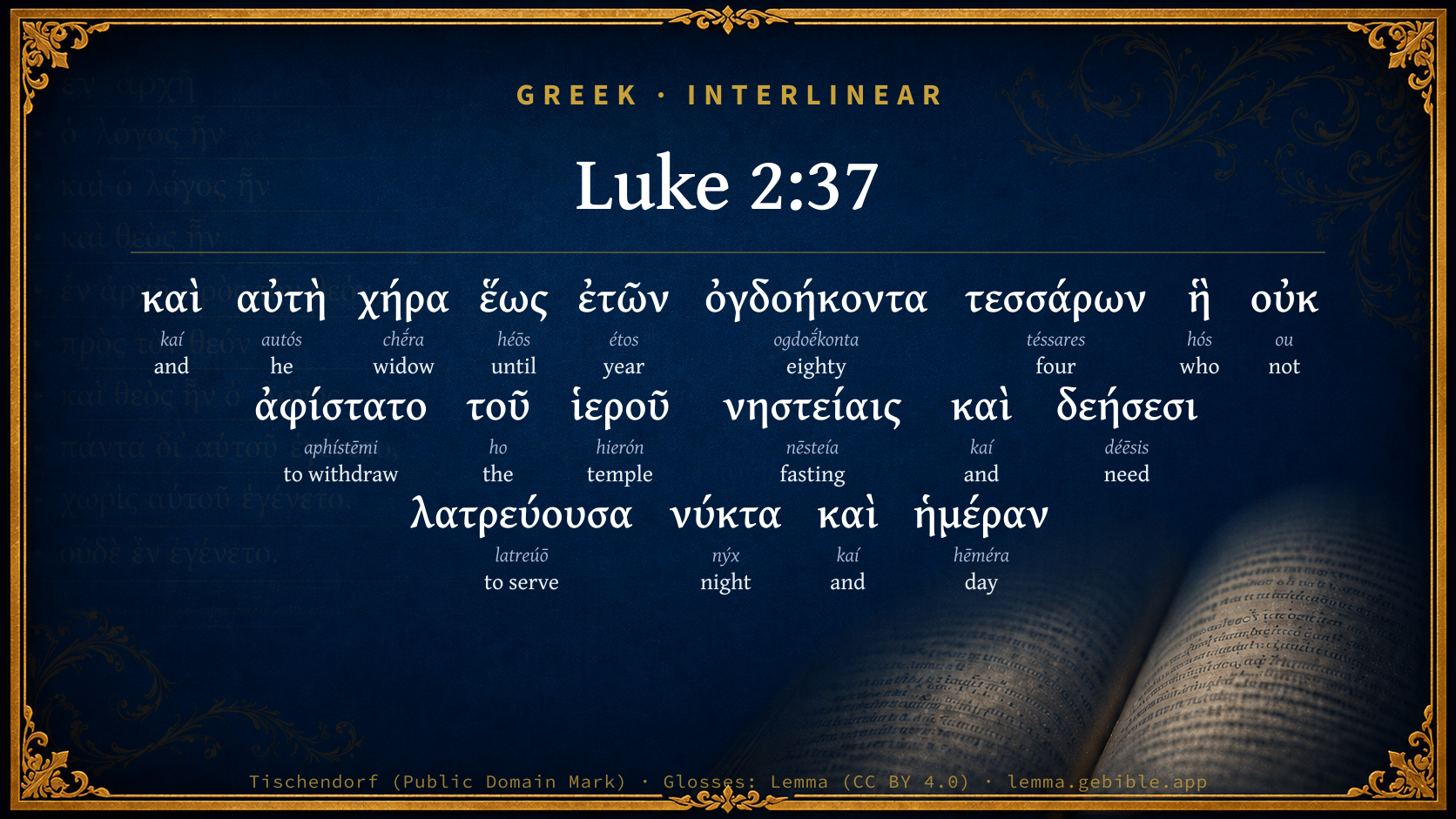
Greek (Tischendorf 8th ed.) Luke 2:37 appears in the Greek New Testament. The text above is from the Tischendorf 8th edition. Each word links to its Strong’s number and a concise gloss. Click any word for its full Thayer’s Greek Lexicon entry.
Download image
Cite this verse

Luke 2:37 (World English Bible). Public Domain. Lemma interlinear Bible study tool, https://lemma.gebible.app/v/luke/2/37.

Show BibTeX & RIS
BibTeX
RIS
English Translation
and she had been a widow for about eighty-four years), who didn't depart from the temple, worshipping with fastings and petitions night and day.
World English Bible · Public Domain
Highlights
  • 3 first appearances in the Greek New Testament
Full analysis ↓
Download a study sheet

One document with this verse’s original text, its word-by-word gloss line, the meaning frame, cross-references with their text, attributed commentary, and full source and license credits — printable, and it pastes into notes with its structure intact.

This verse Autodidact and up

Study sheet (.html) Plain text (.txt)

A passage Seminary Student

Up to 50 verses in one chapter. A passage sheet keeps up to 6 commentary sources and 12 cross-references per verse, in the order this page ranks them, and says so on the sheet whenever that leaves anything out. Ask for a single verse and you get the Autodidact verse sheet above.

Everything on this page stays free to read, with no account — the sheet is a download of what is already on screen, not access to it.

Want to remove ads? Support Godless Engineer
Compare translations 3

The same verse in 3 English versions, stacked beneath the original-language interlinear above. Click any original word for its lexicon entry.

Each is an independent rendering of the whole verse — the interlinear is not word-aligned to these translations.

Highlighted words mark where these versions differ — a whole-verse word diff, not a word-by-word alignment.

  • World English Bible Public Domain
    and she had been a widow for about eighty-four years), who didn't depart from the temple, worshipping with fastings and petitions night and day.
  • King James Version Public Domain
    And she was a widow of about fourscore and four years, which departed not from the temple, but served God with fastings and prayers night and day.
  • unfoldingWord Literal Text CC BY-SA 4.0
    and she a widow for 84 years who never left the temple, serving with fastings and prayers night and day.

unfoldingWord Literal Text — © unfoldingWord, licensed CC BY-SA 4.0. Word-aligned USFM3 via Door43 (git.door43.org/unfoldingWord/en_ult).

Versions to compare (up to 4)

3 of 4 selected

Show all 19 translations

Every available English version of this verse, each an independent rendering of the whole verse.

  • World English Bible Public Domain
    and she had been a widow for about eighty-four years), who didn't depart from the temple, worshipping with fastings and petitions night and day.
  • Berean Standard Bible Public Domain
    and then was a widow to the age of eighty-four. She never left the temple, but worshiped night and day, fasting and praying.
  • Majority Standard Bible Public Domain
    and then was a widow to the age of eighty-four. She never left the temple, but worshiped night and day, fasting and praying.
  • King James Version Public Domain
    And she was a widow of about fourscore and four years, which departed not from the temple, but served God with fastings and prayers night and day.
  • American Standard Version (1901) Public Domain
    and she had been a widow even unto fourscore and four years), who departed not from the temple, worshipping with fastings and supplications night and day.
  • Revised Version (1885) Public Domain
    and she had been a widow even for fourscore and four years), which departed not from the temple, worshipping with fastings and supplications night and day.
  • Geneva Bible (1599) Public Domain
    And she was widowe about foure score and foure yeeres, and went not out of the Temple, but serued God with fastings and prayers, night and day.
  • Douay-Rheims (1899) Public Domain
    And she was a widow until fourscore and four years; who departed not from the temple, by fastings and prayers serving night and day.
  • Young's Literal Translation Public Domain
    and she `is' a widow of about eighty-four years, who did depart not from the temple, with fasts and supplications serving, night and day,
  • Literal Standard Version CC BY-SA 4.0
    and she [is] a widow of about eighty-four years, who did not depart from the temple, serving with fasts and supplications, night and day,
  • Unlocked Literal Bible CC BY-SA 4.0
    and was a widow for eighty-four years. She never left the temple but was serving with fastings and prayers, night and day.
  • unfoldingWord Literal Text CC BY-SA 4.0
    and she a widow for 84 years who never left the temple, serving with fastings and prayers night and day.
  • Darby Bible Public Domain
    and herself a widow up to eighty-four years; who did not depart from the temple, serving night and day with fastings and prayers;
  • World Messianic Bible Public Domain
    and she had been a widow for about eighty-four years), who didn’t depart from the temple, worshiping with fastings and petitions night and day.
  • Webster's Bible Public Domain
    And she was a widow of about eighty four years, who departed not from the temple, but served God with fastings and prayers night and day.
  • Free Bible Version CC BY-SA 4.0
    and then she had been widowed. She was eighty-four years old. She spent her time at the Temple in worship, fasting and praying.
  • Bible in Basic English Public Domain
    She had been a widow for eighty-four years); she was in the Temple at all times, worshipping with prayers and going without food, night and day.
  • Text-Critical English NT CC BY 4.0
    and she was a widow of about eighty-four years of age. She did not depart from the temple, but served night and day with fasting and prayer.
  • Tyndale New Testament (1534) Public Domain
    And she had bene a wedowe aboute.iiii. scoore and.iiii. yere which went never oute of the temple but served God with fastinge and prayer nyght and daye.

Literal Standard Version (2020), Covenant Press — licensed CC BY-SA 4.0. Text via the HelloAO Bible API (eBible.org). Unlocked Literal Bible (unfoldingWord) — licensed CC BY-SA 4.0. Text via the HelloAO Bible API (eBible.org). unfoldingWord Literal Text — © unfoldingWord, licensed CC BY-SA 4.0. Word-aligned USFM3 via Door43 (git.door43.org/unfoldingWord/en_ult). Free Bible Version, Dr. Jonathan Gallagher — licensed CC BY-SA 4.0. Text via the HelloAO Bible API (eBible.org).

Word by word

More ways to search: Search by grammar → Find every occurrence → Compare this word →

Practice this passage: Drill this verse → Learn its vocabulary →

ὀγδοήκοντα
ogdoḗkonta
G3589
“eighty”
Adjective, Numeral (indeclinable)
Part of Speech
Adjective · Numeral (indeclinable)
Full Thayer's Definition

Origin: from G3590

TDNT: None

1. eighty
  1. καὶ kaí G2532 “and” Conjunction
  2. αὐτὴ autós G846 “he” Personal pronoun, Nominative, Singular, Feminine
  3. χήρα chḗra G5503 “widow” Noun, Nominative, Singular, Feminine
  4. ἕως héōs G2193 “until” Adverb
  5. ἐτῶν étos G2094 “year” Noun, Genitive, Plural, Neuter
  6. τεσσάρων téssares G5064 “four” Adjective, Genitive, Plural, Neuter
  7. ἣ hós G3739 “who” Relative pronoun, Nominative, Singular, Feminine
  8. οὐκ ou G3756 “not” Particle, Negative
  9. ἀφίστατο aphístēmi G868 “to withdraw” Verb, Imperfect, Middle or Passive deponent, Indicative, 3rd person, Singular
  10. τοῦ ho G3588 “the” Article, Genitive, Singular, Neuter
  11. ἱεροῦ hierón G2411 “temple” Noun, Genitive, Singular, Neuter
  12. νηστείαις nēsteía G3521 “fasting” Noun, Dative, Plural, Feminine
  13. καὶ kaí G2532 “and” Conjunction
  14. δεήσεσι déēsis G1162 “need” Noun, Dative, Plural, Feminine
  15. λατρεύουσα latreúō G3000 “to serve” Verb, Present, Active, Participle, Nominative, Singular, Feminine
  16. νύκτα nýx G3571 “night” Noun, Accusative, Singular, Feminine
  17. καὶ kaí G2532 “and” Conjunction
  18. ἡμέραν hēméra G2250 “day” Noun, Accusative, Singular, Feminine

About this verse

These counts appear in no published source. They are computed here, from the morphology-tagged text and Lemma’s own curated glosses. What Lemma adds →

19
words
17
distinct lemmas
Gospels
section

Notable vocabulary

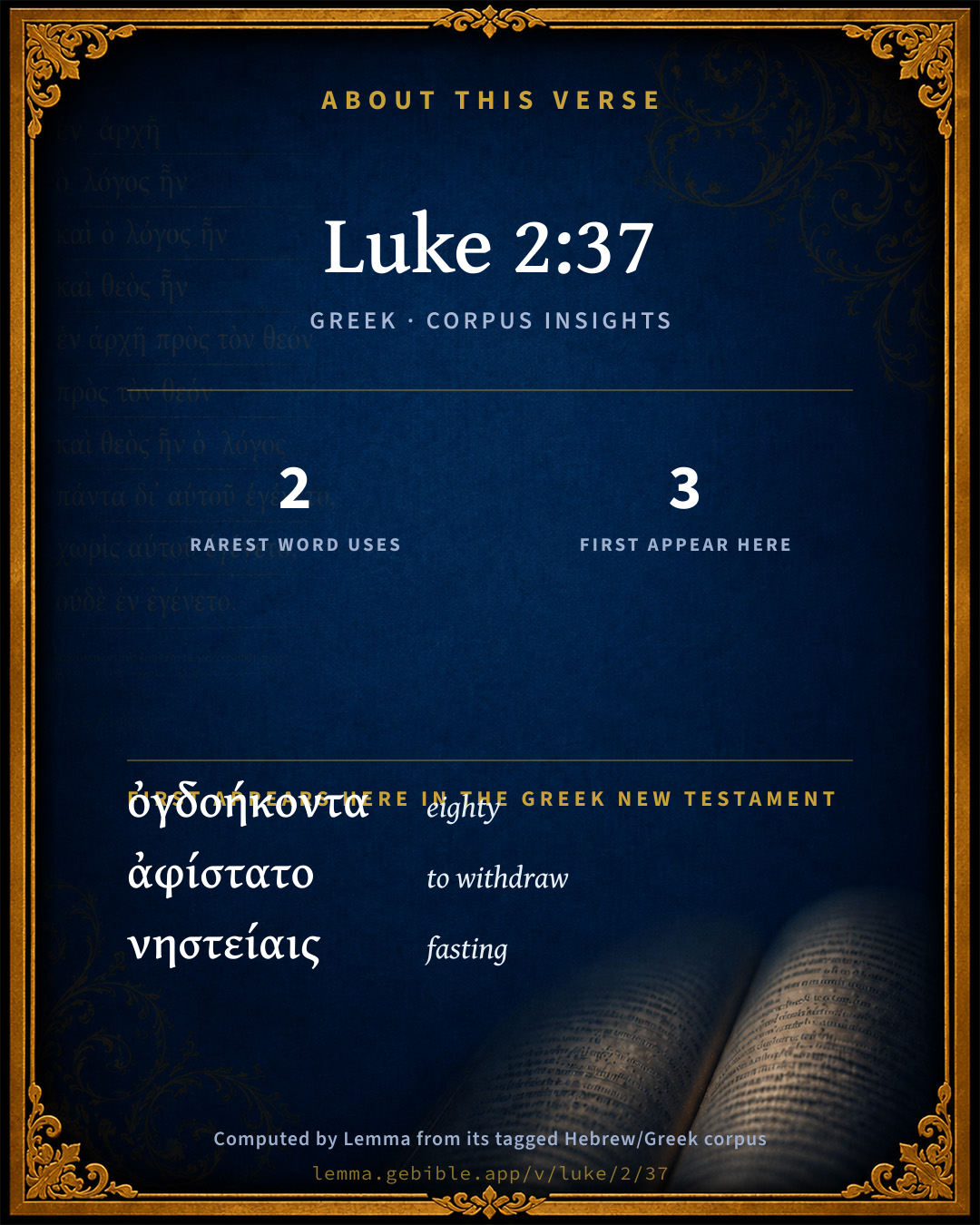
The rarest word here is ὀγδοήκοντα eighty G3589 — appearing just 2 times in the whole Greek New Testament.

First appearance in Scripture

These words make their first canonical appearance in the Greek New Testament here:

  • ὀγδοήκοντα eighty G3589
  • ἀφίστατο to withdraw G868
  • νηστείαις fasting G3521

Shared distinctive vocabulary

ὀγδοήκοντα eighty G3589 occurs in 2 verses of the Greek New Testament. Also found in:

Repetition

A word recurs within this verse:

Cross-references

14

Topical passages linked to Luke 2:37 in the Treasury of Scripture Knowledge — connected by theme and wording, ordered by reader-vote popularity; previews shown in the World English Bible.

  • 1 Timothy 5:5 Now she who is a widow indeed, and desolate, has her hope set on God, and continues in petitions and prayers night and day.
  • Psalms 23:6 Surely goodness and loving kindness shall follow me all the days of my life, And I shall dwell in Yahweh's house forever.
  • Acts 14:23 When they had appointed elders for them in every assembly, and had prayed with fasting, they commended them to the Lord, on whom they had believed.
  • Psalms 27:4 One thing I have asked of Yahweh, that I will seek after, That I may dwell in the house of Yahweh all the days of my life, To see Yahweh's beauty, And to inquire in his temple.
  • Acts 13:3 Then, when they had fasted and prayed and laid their hands on them, they sent them away.
  • Acts 26:7 which our twelve tribes, earnestly serving night and day, hope to attain. Concerning this hope I am accused by the Jews, King Agrippa!
  • Exodus 38:8 He made the basin of brass, and its base of brass, out of the mirrors of the ministering women who ministered at the door of the tent of meeting.
  • Psalms 22:2 My God, I cry in the daytime, but you don't answer; In the night season, and am not silent.
  • Psalms 84:4 Blessed are those who dwell in your house. They are always praising you. Selah.
  • Psalms 84:10 For a day in your courts is better than a thousand. I would rather be a doorkeeper in the house of my God, Than to dwell in the tents of wickedness.
  • Psalms 135:1–2 Praise Yah! Praise the name of Yahweh! Praise him, you servants of Yahweh,
  • Luke 5:33 They said to him, "Why do John's disciples often fast and pray, likewise also the disciples of the Pharisees, but yours eat and drink?"
  • Revelation 3:12 He who overcomes, I will make him a pillar in the temple of my God, and he will go out from there no more. I will write on him the name of my God, and the name of the city of my God, the new Jerusalem, which comes down out of heaven from my God, and my own new name.
  • Revelation 7:15 Therefore they are before the throne of God, they serve him day and night in his temple. He who sits on the throne will spread his tent over them.

Cross-references courtesy of OpenBible.info (CC BY 4.0).

Commentary

Notes on Luke 2:37 from classic Christian and Jewish commentators (each source and its license shown beneath its notes). The classic Christian expositions comment on the surrounding passage and are grouped to its opening verse, so a note may address several verses; the Jewish commentaries on the Tanakh (Rashi and others) are per-verse, so they appear only where the commentator wrote on this verse.

Lemma curates 59 commentaries, every one of them public domain or Creative Commons licensed, each selected and text-cleaned for this edition rather than reprinted as found. About our sources →

The Biblical Illustrator

Joseph S. Exell

Luk_2:37

Which departed not from the Temple

Neglectors of public worship

I know that there are not a few who say that they can edify as well or better at home.

Hence these eat their morsel alone. But, so far as I have ever known them, they are neither to be envied nor imitated. They have always been feeble, sickly, useless, spiritual dyspeptics; while as certainly all observation has shown me, and all experience has proved to me, that they who neglect the house of prayer, or come to it reluctantly and rarely, are invariably dull in their spiritual conceptions, cold in their affections, wavering in their convictions, and useless in Christian work, while they are easily led away by the force of temptation. (J. Aldis.)

Blessedness of public worship

On the other hand, quite as certainly all who through long years have been early and constant in their attendance on the means of grace, who have planned carefully and toiled hard that they might be so, who have brought to the exercises of religion an attentive mind and a living heart, have, so far as my observation has extended, been distinguished for the cheerful trustfulness of Christian hope, for the consistent devotedness of Christian life, for diligence and success in Christian work; while they have been to all their brotherhood an example, an inspiration, and a joy. (J. Aldis.)

Delight in being in Gods house

A minister had noted among the most regular attendants at his church an aged woman. On all occasions she was in her place--always in time--always attentive. He sought her out and visited her, and great was his astonishment to find this poor woman so deaf as to be unable to hear a single word. By means of a slate he entered into conversation with her, and his first inquiry was, Why, being too deaf to hear one word of the service, are you so regular in your attendance at the house of God? Oh, sir, she replied, with warm tears swelling up from her eyes, it is my Fathers house, and I love to be there. He meets me in His own sanctuary, and I can, in spirit, join in the prayer and praise, though the words of others may not reach me; and as Jesus speaks to my soul, I hear the whispers of His love, though my outer ears are dead to all the sounds of earth. I love to be in the assembly of Gods people, because they are the people of God, the children of my Father, and and it is very pleasant to be in such good company, though I can no longer converse with them. There is now very little left that I can do for the cause and the kingdom of my Redeemer, besides trying to set a right example. My day for active effort is past, and all I can now do is to seek to influence others by the power of a humble and earnest life. Even this will soon be over, and while the opportunity remains I would improve it for my Masters glory. He did not in His last hour of deepest agony forget us poor sinners; and shall we weary of our lightest yoke, and throw it off before our last hour has come? What a powerful reproof was this aged womans example to those who, with faculties still unimpaired, and strength unabated by the infirmities of age, yet wilfully absent themselves from Gods house! Served God with fastings and prayers.

Fastings and prayers

It has been said that her form of piety was Jewish rather than Christian; but must not St. Paul have had her in his eye when he speaks of the true type of the Christian widow as trusting in God and continuing in supplications and prayers night and day? (1Ti_5:5.) Her piety was certainly not of that stamp which finds most favour amongst us now-active, bustling, energetic, and so assumed to be the most useful; but have we not gone much too far in despising the contemplative, ascetic, prayerful life? Who knows what may not have been the use of Annas lastings and prayers, in preparing hearts to receive the Lord? God, we doubt not, answered her many supplications in ways which could not be traced out, but which will assuredly be known at the last. Her life of fasting and devotion was evidently her calling of God, known and approved by Him. And may not, in this very day, the life of religion amongst ourselves be owing not only to sermons, and visitings, and meetings, but to the prayers of the few scattered handfuls of worshippers who here and there are constant at daily service? It has been rightly said, that the abuses which have attended often on the practice of a monastic life, should not render us insensible to the duty of spending large portions of our time in meditation, and prayer, and fasting. (M. F. Sadler.)

The Biblical Illustrator, edited by Joseph S. Exell (c. 1880s–1900s) — public domain. Text from a community e-Sword module.

Tyndale Open Study Notes

Tyndale Open Resources

2:37 she lived as a widow to the age of eighty-four: In the ancient world, great age was associated with wisdom and honor. • She never left the Temple: This is probably hyperbole; we might say, “She was there all the time,” reflecting her total dedication to God.

Tyndale Open Study Notes — © Tyndale Open Resources, licensed CC BY-SA 4.0. Text via the HelloAO Bible API.

Bengel's Gnomon

Johann Albrecht Bengel

Luk 2:37. Ἐτῶν, of years) These were the years of her whole life, not of her widowhood only. It was persons advanced in age who were the first after the angels in doing honour to the birth of the Christ: so that it might hereby be made evident that the salvation brought in by Him relates to the better life.[29]—ὁγδοήκοντα τεσσάρων, eighty-four) Therefore Anna had been about twenty-four years old when Jerusalem had come under the power of the Romans, led by Pompey as their general.—νηστεἰαις, fastings) even in her old age.

[29] Which succeeds this life. For old people could have derived no good from the salvation, if it affected merely the life which they were so soon about to leave.—ED.

Bengel's Gnomon of the New Testament — English translation (T&T Clark, Edinburgh, 1860) — public domain. Text from a community e-Sword module.

Meyer's Critical & Exegetical Commentary

Heinrich August Wilhelm Meyer

Luk_2:37. Ἕως (see the critical remarks) ἐτ. ὀγδοήκ.: even to eighty-four years, she had come even to this age of life in her widowhood. Comp. Mat_18:21 f. Rettig is mistaken in his judgment upon ἕως in the Stud. u. Krit. 1838, p. 221. Comp. Dem. 262, 5.

οὐκ ἀφίστατο κ.τ.λ.] a popular description of unremitting zeal (comp. Hom. Od. ii. 345, Il. xxiv. 72) in the public worship of God. Comp. xxiv. 53.

νύκτα κ. ἡμέρ.] Thus also at Act_26:7; Mar_4:28; 1Ti_5:5. Elsewhere the order is inverted. Instances of both arrangements may be seen in Bornemann, Schol. p. 27; Lobeck, Paralip. p. 62 f., and from the Latin: Heindorf on Horat. Sat. i. 1. 77. In this place νύκτα, is prefixed in order, as in Acts, l.c., and 1Ti_5:5, to make the fervency of the pious temple-service the more prominent. The case is otherwise, where it is simply a question of definition of time, at Est_4:15.

Meyer — Critical and Exegetical Commentary on the New Testament — English translation by Peter Christie, edited by Frederick Crombie (T&T Clark, 1880) — public domain. Text from a community e-Sword module.

Expositor's Greek Testament

ed. W. Robertson Nicoll

Luk 2:37 . ἕως : either a widow for eighty-four years (Godet), or, as most think, a widow till the eighty-fourth year of her life. The former rendering would make her very old: married, say, at sixteen, seven years a wife, eighty-four years a widow = 107; not impossible, and borne out by the πολλαῖς after ἡμέραις (Luk 2:36 , advanced in days many ). νηστείαις : the fasting might be due to poverty, or on system, which would suggest a Judaistic type of piety. νύκτα κ . ἡ .: did she sleep within the temple precincts?

The Expositor's Greek Testament, edited by W. Robertson Nicoll (1897–1910) — public domain. Text from a community e-Sword module.

Jamieson, Fausset & Brown

Robert Jamieson, A. R. Fausset & David Brown

departed not from the temple--was found there at all stated hours of the day, and even during the night services of the temple watchmen (Psa 134:1-2), "serving God with fastings and prayer." (See Ti1 5:5, suggested by this.)

Jamieson, Fausset & Brown — Commentary Critical and Explanatory on the Whole Bible (1871) — public domain (CC PDM 1.0). Text via the HelloAO Bible API.

Adam Clarke's Commentary

Verse 37. Departed not from the temple] Attended constantly at the hours of prayer, which were nine in the morning and three in the afternoon. See Ac 2:15; Ac 3:1. It does not appear that women had any other functions to perform in that holy place.

With fastings] She accompanied her devotion with frequent fastings, probably not oftener than twice in the week; for this was the custom of the most rigid Pharisees: see Lu 18:12.

Adam Clarke's Commentary on the Bible (1810–1826) — public domain. Text from a community e-Sword/MySword module.

Ellicott's Commentary for English Readers

(37) A widow of about fourscore and four years.—The better MSS. read, “up to the point of fourscore and four years,” pointing to the fact that this was the duration of her widowhood. Assuming her to have been married at fifteen, this places her actual age at 106. She had lived through the whole century that preceded the birth of Christ, from the death of John Hyrcanus, and had witnessed, therefore, the conquest of Judæa by Pompeius, and the rise of the Herodian house.

Which departed not from the temple.—Probably some chamber within the precincts was assigned to her, as a reputed prophetess, as seems to have been the case with Huldah (2Ch_34:22). Her form, bent and worn, we may believe, with age and fastings, had become familiar to all worshippers at the Temple. She, too, was one of the devout circle who cherished expectations of the coming of the Christ.

A Bible Commentary for English Readers, edited by Charles John Ellicott (1878–1897) — public domain. Text from a community e-Sword module.

The Cambridge Bible for Schools and Colleges

gen. ed. J. J. S. Perowne

37. departed not] She was present (that is) at all the stated hours of prayer; unless we suppose that her position as a Prophetess had secured her the right of living in one of the Temple chambers, and perhaps of doing some work for it like trimming the lamps (as is the Rabbinic notion about Deborah, derived from the word Lapidoth ‘splendours’).

fastings] The Law of Moses had only appointed one yearly fast, on the Great Day of Atonement. But the Pharisees had adopted the practice of ‘fasting twice in the week,’ viz. on Monday and Thursday, when Moses is supposed to have ascended, and descended from, Sinai (see on Luk_18:12), and had otherwise multiplied and extended the simple original injunction (v. 33).

prayers] Rather, supplications (a more special word).

night and day] ‘Night’ is put first by the ordinary Hebrew idiom (as in the Greek word νυχθήμερον) which arose from their notion that ‘God made the world in six days and seven nights.’ Comp. Act_26:7, “unto which promise our twelve tribes, instantly serving God night and day (Greek), hope to come.” 1Ti_5:5, “she that is a widow indeed, and desolate, trusteth in God, and continueth in supplications and prayers night and day.”

The Cambridge Bible for Schools and Colleges (gen. ed. J. J. S. Perowne; Cambridge University Press, 1878–1918) — public domain. Text from a community e-Sword module.

John Gill's Exposition

And she coming in that instant,.... That the parents of Christ brought him into the temple; just as Simeon was embracing him in his arms, and blessing God for him, and saying the things concerning him he had done; and who also came at that juncture, as he did, under the impulse, and by the direction of the Spirit of God,

gave thanks likewise unto the Lord: praised him, as he had done, that he had sent the promised, and long looked for Messiah and Saviour; and that she had lived to see his blessed face, and this happy day; and that she should be directed to come in at this instant, and be favoured with this singular mercy of seeing the new born Saviour, and his honoured parents:

and spake of him to all them that looked for redemption in Jerusalem; this she either did at this time; they in Jerusalem that looked, and diligently waited for, and earnestly desired the Messiah, and spiritual redemption and salvation by him, being now assembled together in the temple; or afterwards, as she had opportunity of conversing with them, when she acquainted them with what she had heard and seen. By "the redemption" they were looking for, is meant, the Redeemer; as by salvation, the Saviour, in Luk 2:30. Some versions, as the Syriac, Arabic, and Ethiopic read, "the redemption of Jerusalem"; not literally, but spiritually, understood, even the redemption of the church of Christ, which is often so called: and others, as the Persic version, "the redemption of Israel"; that is, of spiritual Israel: some read "in Israel"; so one copy of Stephens's.

John Gill's Exposition of the Whole Bible (1746–1763) — public domain (CC PDM 1.0). Text via the HelloAO Bible API.

Trapp's Complete Commentary

John Trapp

37 And she was a widow of about fourscore and four years, which departed not from the temple, but served God with fastings and prayers night and day.

Ver. 37. A widow of about eighty-four years] She was now ripe, and ready, even of her own accord, to fall into God’s hand, as ripe fruits do into the hand of the gatherer. And the thoughts of death had long since forbade the banns of a second marriage. Cogita te quotidie moriturum, et de secundis nuptiis nunquam cogitabis. Think of death, and the thoughts of marrying again will die within thee.

John Trapp, A Commentary or Exposition upon All the Books of the Old and New Testament (1647–1656) — public domain. Text from a community e-Sword module.

Albert Barnes' Notes on the Bible

And she was a widow of about fourscore and four years - That is, she was about 84 years of age. It does not mean that she had been a widow for that long time.

Fastings and prayers - Constant religious service. pending her time in prayer, and in all the ordinances of religion.

Night and day - Continually - that is, at the usual times of public worship and in private. When it is said that she departed not from the temple, it is meant that she was “constant” and “regular” in all the public services at the temple, or was never absent from those services. God blesses those who wait at his temple gates.

Albert Barnes' Notes on the Bible (1834–1885) — public domain. Text from a community e-Sword/MySword module.

Whedon's Commentary on the Bible

Daniel D. Whedon

37. A widow of fourscore years—It is honorable to Israel that the true widow was honored. If Anna were married, as is often the case with girls in the East, at thirteen, was seven years a wife, and eighty-four years a widow, she was now one hundred and four years old. But more probably this eighty-four years was her entire age. Though second marriages were not forbidden, yet among both Jews and Romans, a reverence was paid to the pure widow who retained unbroken and unrepeated her first wedding vows. So long had been Anna’s spotless widow-hood, and so profound was her piety, that whether she really uttered inspired predictions or not, she received the sacred epithet of prophetess. She departed not from the temple; for probably reverence for her piety secured for her the privilege of residing in some one of the chambers of the women’s court.

Daniel D. Whedon (gen. ed.), Commentary on the Old and New Testaments (1874–1909) — public domain. Text from a community e-Sword module.

The Pulpit Commentary

Which departed not from the temple, but served God with fastings and prayers night and day. Probably, in virtue of her reputation as a prophetess, some small chamber in the temple was assigned to her. This seems to have been the case with Huldah. (2Ch_34:22) It has also been suggested that she lovingly performed some work in or about the sacred building. Farrar suggests such as trimming the lamps (as is the rabbinic notion about Deborah), derived from the word lapidoth, splendor. Such sacred functions were regarded among all nations as a high honor.

The great city of Ephesus boasted her name of newkorov , temple-sweeper, as her proudest title to honor.

The Pulpit Commentary (1880–1919), ed. H.D.M. Spence-Jones & Joseph S. Exell — public domain. Text from a community e-Sword module.

John Wesley's Explanatory Notes

Fourscore and four years - These were the years of her life, not her widowhood only. Who departed not from the temple - Who attended there at all the stated hours of prayer. But served God with fastings and prayers - Even at that age. Night and day - That is, spending therein a considerable part of the night, as well as of the day.

John Wesley, Explanatory Notes Upon the Whole Bible (1754–1765) — public domain. Text via the GEBible commentary corpus.

The People's New Testament

B. W. Johnson

37. A widow even for fourscore and four years. She had passed seven years with a husband when young and then remained a widow until, at this time, she was eighty-four years old, devoting herself to a religious life. Departed not from the temple. Probably assigned, on account of her saintly character, a chamber in the temple.

B. W. Johnson's The People's New Testament with Notes (1889–1891) — public domain. Electronic text from the Christian Classics Ethereal Library (CCEL) ThML edition.

Cambridge Greek Testament for Schools and Colleges

37. ἕως. אABL, Copt. Sah[52] &c.

[52] Sah. Sahidic Version.

37. οὐκ ἀφίστατο. She was present (that is) at all the stated hours of prayer; unless we suppose that her position as a prophetess had secured her the right of living in one of the Temple chambers, and perhaps of doing some work for it like trimming the lamps (as is the Rabbinic notion about Deborah, derived from the word Lapidoth ‘splendours’).

νηστείαις. The Law of Moses had only appointed one yearly fast, on the Great Day of Atonement. But the Pharisees had adopted the practice of ‘fasting twice in the week,’ viz. on Monday and Thursday, when Moses is supposed to have ascended, and descended from, Sinai (see on Luk 18:12). In other respects also they had multiplied and extended the simple original injunction (Luk 5:33).

δεήσεσι. Supplications (a more special word than προσευχαῖς).

λατρεύουσα νύκτα καὶ ἡμέραν. Worshipping night and day. ‘Night’ is put first by the ordinary Hebrew idiom (as in the Greek word νυχθήμερον) which arose from their notion that ‘God made the world in six days and seven nights.’ Comp. Act 26:7, “unto which promise our twelve tribes, instantly serving God night and day (Greek), hope to come.” 1Ti 5:5, “she that is a widow indeed, and desolate, trusteth in God, and continueth in supplications and prayers night and day.” Meyer thinks that this order of the words implies more fervency of service.

Cambridge Greek Testament for Schools and Colleges (Cambridge University Press, 1896; 21 vols, various authors incl. Carr, Maclear, Plummer, Farrar, Lumby, Moule, M. R. James, Simcox) — public domain. Text from a community e-Sword module.

Alford’s Greek Testament

Henry Alford

37. νηστ. καὶ δεήσ.] Not merely in the ordinary hours of prayer, at nine, and three, or the ordinary fasts on Monday and Thursday, but in an ascetic-devotional method of life.

νύκτα is put first, because fasts were reckoned from one evening to another. Meyer. Is it not rather because the greater solemnity and emphasis rests on the religious exercise by night?

Henry Alford, The Greek Testament (1849–1861) — public domain. Text from a community e-Sword module.

International Critical Commentary

37. οὐκ ἀφίστατο τοῦ ἱεροῦ. See on 8:13. This is to be understood, like 24:53, of constant attendance, rather than of actual residence within the temple precincts, although the latter may have been possible. She never missed a service, and between the services she spent most of her time in the temple. In spite of her age she kept more than the customary fasts (comp. 5:33), perhaps more than the Mondays and Thursdays (see on 18:12), and spent an unusual amount of time in prayer.

λατρεύουσα. Freq. in Lk., Paul, and Heb. See on 4:8. Not in Mk. or In. Mat 4:10 from Deu 6:13.—νύκτα κ. ἡμέραν. Comp. Act 26:7. This is the usual order: Mar 4:27, Mar 4:5:5 ; Act 20:31; 1Th 2:9, 1Th 2:3:10; 2Th 3:8; 1Ti 5:5 ; 2Ti 1:3. But the other is also common: 18:7 ; Act 9:24; Rev 4:8, etc.; and in O.T. is more common. It may be doubted whether the order makes any difference of meaning: see Ellicott on 1Ti 5:5, and comp. Hom. Od. ii.345; Il xxiv. 73, v. 490; Plat. Theaet. 151 A.

International Critical Commentary — older volumes (1896–1929), various authors — public domain. Text from a community e-Sword module.

Vincent's Word Studies in the New Testament

Marvin R. Vincent

Of about fourscore and four years [ως ετων ογδοηκοντα τεσσαρων] . The A. V. might be supposed to be stating her age; but the best texts read ewv, until, instead of wv, about; and the statement refers to the time of her widowhood; a widow even for (or up to) fourscore and four years. So Rev.

Served [λατρευουσα] . The present participle, serving. Rev., worshipping. See on chapter Luk 1:74.

Marvin R. Vincent, Word Studies in the New Testament (1887–1900) — public domain. Text from a community e-Sword/MySword module.

Lesson kit

Teaching starters — assembled from the data on this page, not authored interpretation. Every prompt links to the verse data it draws on. Edit before teaching.

Luke, in the Gospels, opens this verse with 19 words (17 distinct Greek lemmas). Its most distinctive word is ogdoḗkonta (“eighty”). A historical commentator’s framing appears above. Read the whole chapter for the surrounding context.

Discussion questions

  1. What does “eighty” (ogdoḗkonta) contribute to the verse as a whole?
  2. 3 words make their first appearance in Scripture here. What does this debut establish?
  3. How does Luke 16:7, which shares the word «eighty», read alongside this verse?
  4. What does the repetition of “and” (3× in this one verse) do in this verse?
  5. These translations render this verse differently; the difference is in the English rendering, not the original. What questions does that raise?
  6. Compare how The Biblical Illustrator and Tyndale Open Study Notes read this verse. Where do they agree or differ?

Things to notice

  • 3 words make their first canonical appearance in Scripture here.
  • These translations choose different wording for 20 words in this verse.
  • “and” occurs 3× in this single verse.
  • 17 distinct Greek lemmas span 19 words in this verse.

Reading settings

Reading text

Shown beneath each verse's original-language words.

Old Testament
Old Testament edition

Read the OT as the Masoretic Hebrew (MT) or the Greek Septuagint (LXX).

English shown for the Greek Septuagint (in the Hebrew ↔ Greek comparison).

Comparing translations? Open the Compare panel on any verse page to stack up to four side by side.