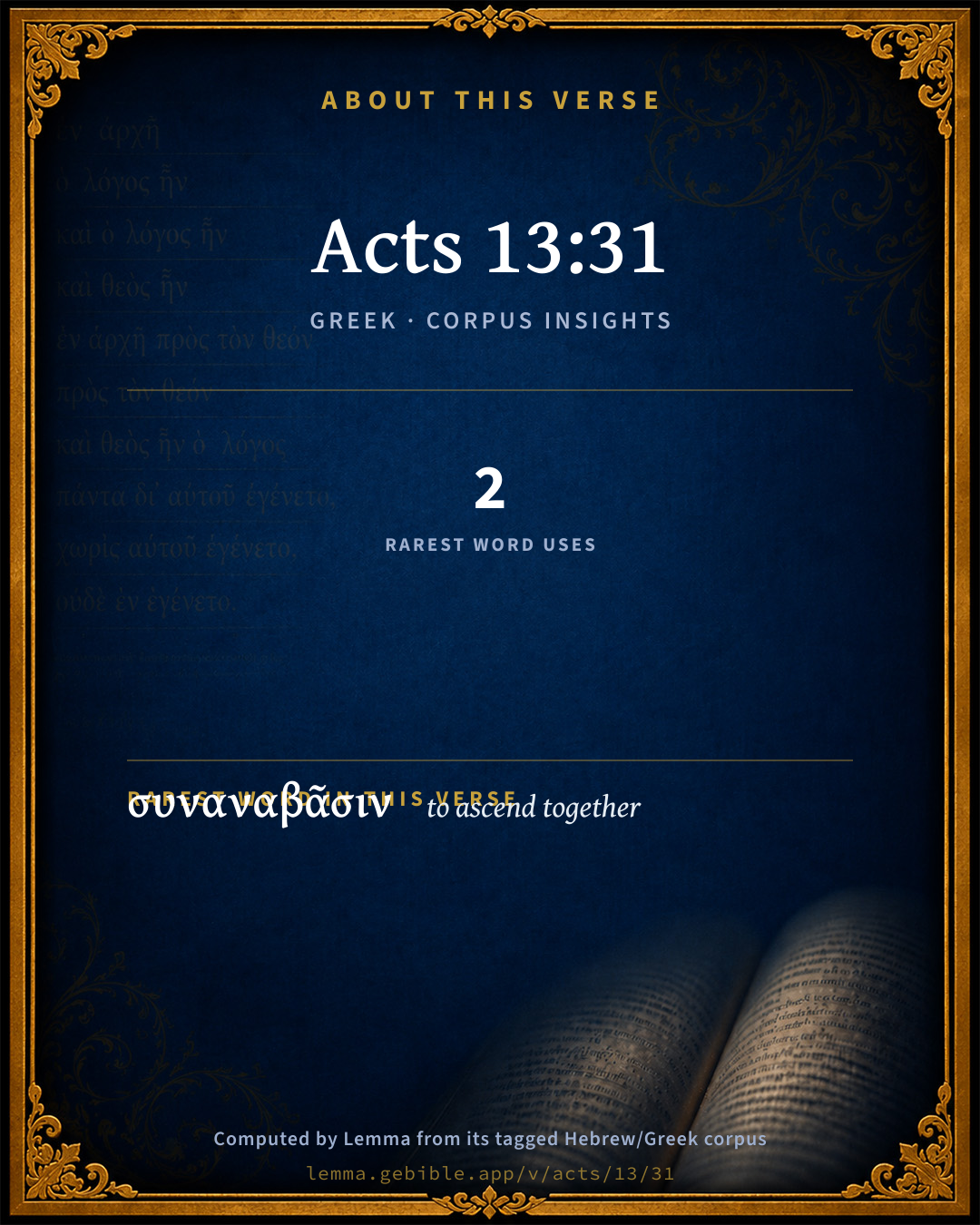
Acts 13:31

Greek (Tischendorf 8th ed.) Acts 13:31 appears in the Greek New Testament. The text above is from the Tischendorf 8th edition. Each word links to its Strong’s number and a concise gloss. Click any word for its full Thayer’s Greek Lexicon entry.

Download image
Cite this verse

Acts 13:31 (World English Bible). Public Domain. Lemma interlinear Bible study tool, https://lemma.gebible.app/v/acts/13/31.

Show BibTeX & RIS
BibTeX
RIS
English Translation
and he was seen for many days by those who came up with him from Galilee to Jerusalem, who are his witnesses to the people.
World English Bible · Public Domain
Download a study sheet

One document with this verse’s original text, its word-by-word gloss line, the meaning frame, cross-references with their text, attributed commentary, and full source and license credits — printable, and it pastes into notes with its structure intact.

This verse Autodidact and up

Study sheet (.html) Plain text (.txt)

A passage Seminary Student

Up to 50 verses in one chapter. A passage sheet keeps up to 6 commentary sources and 12 cross-references per verse, in the order this page ranks them, and says so on the sheet whenever that leaves anything out. Ask for a single verse and you get the Autodidact verse sheet above.

Everything on this page stays free to read, with no account — the sheet is a download of what is already on screen, not access to it.

Want to remove ads? Support Godless Engineer
Compare translations 3

The same verse in 3 English versions, stacked beneath the original-language interlinear above. Click any original word for its lexicon entry.

Each is an independent rendering of the whole verse — the interlinear is not word-aligned to these translations.

Highlighted words mark where these versions differ — a whole-verse word diff, not a word-by-word alignment.

  • World English Bible Public Domain
    and he was seen for many days by those who came up with him from Galilee to Jerusalem, who are his witnesses to the people.
  • King James Version Public Domain
    And he was seen many days of them which came up with him from Galilee to Jerusalem, who are his witnesses unto the people.
  • unfoldingWord Literal Text CC BY-SA 4.0
    who was seen for many days by the ones having come up with him from Galilee to Jerusalem, who now are his witnesses to the people.

unfoldingWord Literal Text — © unfoldingWord, licensed CC BY-SA 4.0. Word-aligned USFM3 via Door43 (git.door43.org/unfoldingWord/en_ult).

Versions to compare (up to 4)

3 of 4 selected

Show all 19 translations

Every available English version of this verse, each an independent rendering of the whole verse.

  • World English Bible Public Domain
    and he was seen for many days by those who came up with him from Galilee to Jerusalem, who are his witnesses to the people.
  • Berean Standard Bible Public Domain
    and for many days He was seen by those who had accompanied Him from Galilee to Jerusalem. They are now His witnesses to our people.
  • Majority Standard Bible Public Domain
    and for many days He was seen by those who had accompanied Him from Galilee to Jerusalem. They are His witnesses to our people.
  • King James Version Public Domain
    And he was seen many days of them which came up with him from Galilee to Jerusalem, who are his witnesses unto the people.
  • American Standard Version (1901) Public Domain
    and he was seen for many days of them that came up with him from Galilee to Jerusalem, who are now his witnesses unto the people.
  • Revised Version (1885) Public Domain
    and he was seen for many days of them that came up with him from Galilee to Jerusalem, who are now his witnesses unto the people.
  • Geneva Bible (1599) Public Domain
    And hee was seene many dayes of them, which came vp with him from Galile to Hierusalem, which are his witnesses vnto the people.
  • Douay-Rheims (1899) Public Domain
    Who was seen for many days, by them who came up with him from Galilee to Jerusalem, who to this present are his witnesses to the people.
  • Young's Literal Translation Public Domain
    and he was seen for many days of those who did come up with him from Galilee to Jerusalem, who are his witnesses unto the people.
  • Literal Standard Version CC BY-SA 4.0
    and He was seen for many days of those who came up with Him from Galilee to Jerusalem, who are His witnesses to the people.
  • Unlocked Literal Bible CC BY-SA 4.0
    He was seen for many days by those who had come up with him from Galilee to Jerusalem. These people are now his witnesses to the people.
  • unfoldingWord Literal Text CC BY-SA 4.0
    who was seen for many days by the ones having come up with him from Galilee to Jerusalem, who now are his witnesses to the people.
  • Darby Bible Public Domain
    who appeared for many days to those who had come up with him from Galilee to Jerusalem, who are now his witnesses to the people.
  • World Messianic Bible Public Domain
    and he was seen for many days by those who came up with him from Galilee to Jerusalem, who are his witnesses to the people.
  • Webster's Bible Public Domain
    And he was seen many days by them who came up with him from Galilee to Jerusalem, who are his witnesses to the people.
  • Free Bible Version CC BY-SA 4.0
    and he appeared over the course of many days to those who had followed him from Galilee to Jerusalem. They are now his witnesses to the people.
  • Bible in Basic English Public Domain
    And for a number of days he was seen by those who came with him from Galilee to Jerusalem, who are now his witnesses before the people.
  • Text-Critical English NT CC BY 4.0
    and for many days he was seen by those who had come up with him from Galilee to Jerusalem, who are his witnesses to the people.
  • Tyndale New Testament (1534) Public Domain
    and he was sene many dayes of them which came with him from Galile to Ierusalem. Which are his witnesses vnto the people.

Literal Standard Version (2020), Covenant Press — licensed CC BY-SA 4.0. Text via the HelloAO Bible API (eBible.org). Unlocked Literal Bible (unfoldingWord) — licensed CC BY-SA 4.0. Text via the HelloAO Bible API (eBible.org). unfoldingWord Literal Text — © unfoldingWord, licensed CC BY-SA 4.0. Word-aligned USFM3 via Door43 (git.door43.org/unfoldingWord/en_ult). Free Bible Version, Dr. Jonathan Gallagher — licensed CC BY-SA 4.0. Text via the HelloAO Bible API (eBible.org).

Word by word

More ways to search: Search by grammar → Find every occurrence → Compare this word →

Practice this passage: Drill this verse → Learn its vocabulary →

συναναβᾶσιν
synanabaínō
G4872
“to ascend together”
Verb, Aorist, Active, Participle, Dative, Plural, Masculine
Part of Speech
Verb
Tense
Aorist
Voice
Active
Mood
Participle
Case
Dative
Number
Plural
Gender
Masculine
Full Thayer's Definition

Origin: from G4862 and G305

TDNT: None

1. to ascend at the same time, come up together with to a higher place a. with one
  1. ὃς hós G3739 “who” Relative pronoun, Nominative, Singular, Masculine
  2. ὤφθη horáō G3708 “to see” Verb, Aorist, Passive, Indicative, 3rd person, Singular
  3. ἐπὶ epí G1909 “upon” Preposition
  4. ἡμέρας hēméra G2250 “day” Noun, Accusative, Plural, Feminine
  5. πλείους pleíōn G4119 “greater” Adjective, Accusative, Plural, Feminine, Comparative
  6. τοῖς ho G3588 “the” Article, Dative, Plural, Masculine
  7. αὐτῷ autós G846 “he” Personal pronoun, Dative, Singular, Masculine
  8. ἀπὸ apó G575 “from” Preposition
  9. τῆς ho G3588 “the” Article, Genitive, Singular, Feminine
  10. Γαλιλαίας Galilaía G1056 “Galilee” Noun, Genitive, Singular, Feminine
  11. εἰς eis G1519 “into” Preposition
  12. Ἱερουσαλήμ Hierousalḗm G2419 “Jerusalem” Noun, Proper, indeclinable
  13. οἵτινες hóstis G3748 “whoever” Relative pronoun, Nominative, Plural, Masculine
  14. νῦν nŷn G3568 “now” Adverb
  15. εἰσιν eimí G1510 “to be” Verb, Present, Active, Indicative, 3rd person, Plural
  16. μάρτυρες mártys G3144 “witness” Noun, Nominative, Plural, Masculine
  17. αὐτοῦ autós G846 “he” Personal pronoun, Genitive, Singular, Masculine
  18. πρὸς prós G4314 “to” Preposition
  19. τὸν ho G3588 “the” Article, Accusative, Singular, Masculine
  20. λαόν laós G2992 “people” Noun, Accusative, Singular, Masculine

About this verse

These counts appear in no published source. They are computed here, from the morphology-tagged text and Lemma’s own curated glosses. What Lemma adds →

21
words
18
distinct lemmas
Acts
section

Notable vocabulary

The rarest word here is συναναβᾶσιν to ascend together G4872 — appearing just 2 times in the whole Greek New Testament.

Shared distinctive vocabulary

συναναβᾶσιν to ascend together G4872 occurs in 2 verses of the Greek New Testament. Also found in:

Repetition

Words recur within this verse:

  • τοῖς the G3588 ×3
  • αὐτῷ he G846 ×2

Cross-references

18

Topical passages linked to Acts 13:31 in the Treasury of Scripture Knowledge — connected by theme and wording, ordered by reader-vote popularity; previews shown in the World English Bible.

  • Luke 24:48 You are witnesses of these things.
  • Acts 1:3 To these he also showed himself alive after he suffered, by many proofs, appearing to them over a period of forty days, and speaking about God's Kingdom.
  • Matthew 28:16 But the eleven disciples went into Galilee, to the mountain where Jesus had sent them.
  • Acts 1:8 But you will receive power when the Holy Spirit has come upon you. You will be witnesses to me in Jerusalem, in all Judea and Samaria, and to the uttermost parts of the earth."
  • Acts 1:11 who also said, "You men of Galilee, why do you stand looking into the sky? This Jesus, who was received up from you into the sky will come back in the same way as you saw him going into the sky."
  • 1 Corinthians 15:5–7 and that he appeared to Cephas, then to the twelve.
  • Mark 16:12–14 After these things he was revealed in another form to two of them, as they walked, on their way into the country.
  • Luke 24:36–42 As they said these things, Jesus himself stood among them, and said to them, "Peace be to you."
  • John 15:27 You will also testify, because you have been with me from the beginning.
  • John 20:19–29 When therefore it was evening, on that day, the first day of the week, and when the doors were locked where the disciples were assembled, for fear of the Jews, Jesus came and stood in the midst, and said to them, "Peace be to you."
  • John 21:1–14 After these things, Jesus revealed himself again to the disciples at the sea of Tiberias. He revealed himself this way.
  • Acts 1:22 beginning from the baptism of John, to the day that he was received up from us, of these one must become a witness with us of his resurrection."
  • Acts 2:32 This Jesus God raised up, to which we all are witnesses.
  • Acts 3:15 and killed the Prince of life, whom God raised from the dead, to which we are witnesses.
  • Acts 5:32 We are His witnesses of these things; and so also is the Holy Spirit, whom God has given to those who obey him."
  • Acts 10:39 We are witnesses of everything he did both in the country of the Jews, and in Jerusalem; whom they also killed, hanging him on a tree.
  • Acts 10:41 not to all the people, but to witnesses who were chosen before by God, to us, who ate and drank with him after he rose from the dead.
  • Hebrews 2:3–4 how will we escape if we neglect so great a salvation-- which at the first having been spoken through the Lord, was confirmed to us by those who heard;

Cross-references courtesy of OpenBible.info (CC BY 4.0).

Where the printed editions differ

1 variant

Places in this verse where the major printed Greek editions disagree on the wording in a way that affects the translation — a comparison of editions, not a manuscript-by-manuscript collation. The editions are the modern critical texts (Nestlé-Aland 28/27, SBL, Westcott-Hort, Tregelles, Tyndale House) and the traditional texts behind the KJV (the Textus Receptus and the Byzantine/Majority text). It is not a claim about which reading is original.

  1. Extra text
    νῦν

    “now”

    In NA28NA27SBLWHTreg Not in TynTRByz

    νῦν (nun) 'now' is only in older manuscripts (NA28+NA27+SBL+WH+Treg)

Textual data: Translators Amalgamated Greek New Testament (STEPBible TAGNT) · CC BY 4.0.

Commentary

Notes on Acts 13:31 from classic Christian and Jewish commentators (each source and its license shown beneath its notes). The classic Christian expositions comment on the surrounding passage and are grouped to its opening verse, so a note may address several verses; the Jewish commentaries on the Tanakh (Rashi and others) are per-verse, so they appear only where the commentator wrote on this verse.

Lemma curates 59 commentaries, every one of them public domain or Creative Commons licensed, each selected and text-cleaned for this edition rather than reprinted as found. About our sources →

Tyndale Open Study Notes

Tyndale Open Resources

13:31 The fact that Jesus was raised from the dead was well documented by witnesses.

Tyndale Open Study Notes — © Tyndale Open Resources, licensed CC BY-SA 4.0. Text via the HelloAO Bible API.

Bengel's Gnomon

Johann Albrecht Bengel

Act 13:31. Τοῖς συναναβᾶσιν, by them that came up with Him) That last journey both presupposes all the rest, and is in itself the most momentous one.—οἴτινες νο͂ν εἰσι, who now are) Paul mentions nothing as to his own vision of Him; for there was no need to descend into this detail in the beginning: nor does he say anything of himself as distinguished from Barnabas: wherefore, in Act 13:32, he speaks more generally.—αὐτοῦ, His) Christ’s: ch. Act 5:32; comp. note, ch. Act 2:32, “This Jesus hath God raised up, whose (God’s) witnesses we all are;” ch. Act 10:41; 1Co 15:15.—λαὸν, the people) Answering to ὑμᾶς in the following ver.

Bengel's Gnomon of the New Testament — English translation (T&T Clark, Edinburgh, 1860) — public domain. Text from a community e-Sword module.

Meyer's Critical & Exegetical Commentary

Heinrich August Wilhelm Meyer

Act_13:31-33. Ἐπὶ ἡμέρ. πλείους] for several days, as in Luk_4:25; Nägelsbach on the Iliad, p. 284, ed. 3. Instead of the argumentative ὅς, ὅσγε would be still more significant.

τοῖς συναναβᾶσιν κ.τ.λ.] Thus Paul according to this narrative, like Luke in the Gospel, follows the tradition which knows only Jewish appearances of the Risen One (see on Mat_28:10). Comp. Act_1:4.

οἵτινες] quippe qui.

καὶ ἡμεῖς κ.τ.λ.] we also, on our part, engaged in the same work of preaching as those eye-witnesses, announce unto you the promise made to the fathers, that (namely) God has completely fulfilled this, etc.

ὃτι ταύτην κ.τ.λ.] contains the particular part of the ἐπαγγελία (the promise of the Messiah generally) which is announced. Entirely arbitrarily, Heumann, Heinrichs, Kuinoel, and others hold that it should be connected: εὐαγγελιζόμεθα, ὅτι τὴν πρὸς τοὺς πατέρας γενομ. ἐπαγγ. ὁ Θεὸς ἐκπεπλ., and that ταύτην is without significance. This very repetition of ταύτην has rhetorical emphasis; comp. Act_9:20; see Dissen, ad Dem. de cor. p. 225; Bernhardy, p. 283.

ἐκπεπλήρωκε] stronger than the simple verb, Act_13:27; comp. the passages from Xenoph. in Sturz, Herod, v. 35: τὴν ὑπόσχεσιν ἐκπληρῶσαι, Plat. Legg. p. 958 B: ἐκπληρώσῃ τὸ χρέος ἅπαν, Polyb. i. 67. 1 : τὰς ἐλπίδας κ. τὰς ἐπαγγελίας ἐκπληροῦν, 3Ma_1:2; 3Ma_1:22. Elsewhere not in the N.T., but comp. ἐκπλήρωσις, Act_21:26.

τοῖς τέκνοις αὐτ. ἡμῖν] for the benefit of their children (descendants), us. The prefixing of τ. τέκν. αὐτ. has a peculiar emphasis.

ἀναστήσας Ἰησοῦν] by this, that He raised up Jesus (from the dead). This interpretation (Erasmus, Luther, Hammond, Clericus, Heumann, Morus, de Wette, Baumgarten, Lange, and others) is necessarily required by the connection, which is as follows: (1) The Jews have put to death Jesus, though innocent, and buried Him (Act_13:28-29). (2) But God has raised Him from the dead, as is certain from His appearance among His followers and their testimony (Act_13:30-31). (3) By this resurrection of Jesus, God has completely fulfilled to us the promise, etc. (Act_13:32-33). (4) But the Raised One will, according to Gods assurance, never again die (Act_13:34-38). This, the only explanation accordant with the context, is confirmed by the purposely chosen ἐκπεπλήρωκε, as, indeed, the fulfilment of the promise begun from the very appearance of Jesus has, although secured already essentially (as Hofmann interprets the compound verb), only become complete by His resurrection. It has been objected that ἐκ νεκρῶν would have to be added to ἀναστήσας, as in Act_13:34; but incorrectly, as the context makes this addition very superfluous, which yet is purposely added in Act_13:34, in order that the contrast of μηκέτι μέλλοντα ὑποστρέφειν εἰς διαφθοράν might more strongly appear. The textual necessity of our interpretation excludes, accordingly, of itself the other explanation (Castalio, Calvin, Beza, Grotius, Calovius, Wolf, Bengel, Michaelis, Rosenmüller, Heinrichs, Kuinoel, Olshausen, Hofmann, Weissag. u. Erf. II. p. 173, Schriftbew. I. p. 123, and others), according to which ἀναστήσας is rendered like הֵקִים, prodire jubens, exhibens (Act_3:22, Act_7:37). This rendering would hardly have been adopted and defended, had it not been thought necessary to understand Psa_2:7 of the appearance of Jesus upon earth.

ὡς … γέγραπται] denotes the ἀναστήσας Ἰησοῦν as the event which took place according to (besides other scriptural passages) the saying in Psa_2:7.

τῷ πρώτῳ] Formerly (see Wetstein)though not universally, yet frequentlythe first Psalm was wont not to be separately numbered, but, as an introduction to the Psalter and certainly composed for this object, to be written along with the second Psalm, as it is even now found in MSS. As, however, such a local citation of a passage is found neither in Pauls writings nor elsewhere in the N.T., it must be assumed that Paul did not himself utter the πρώτῳ, and that it was not even added by Luke; but that he took it over from his documentary sourceinto which it had doubtless come, because it was esteemed particularly noteworthy that this prophecy should be found written on the very front of the Psalter.

υἱός μου εἶ σὺ κ.τ.λ.] in the historical sense of the Psalm composed by Solomon on his anointing: My son (as the theocratic king) thou art; I (no other) have this day begotten thee (made thee by thine anointing and installation to be this my son). But, according to the Messianic fulfilment of this divine saying, so far as it has been historically fulfilled (it is otherwise in Heb_1:5) especially by the resurrection of the Messiah: My Son (as the Messiah) thou art; I am He who has this day (on the day of the resurrection) begotten Thee, installed Thee into this divine Sonship by the resurrection (Rom_1:4),inasmuch, namely, as the resurrection was the actual guarantee, excluding all doubt, of that Sonship of Christ. Thus has God by the resurrection, after His humiliation, although He was from eternity Gods Son, constituted Him the Son of God (He has begotten Him). Comp. Act_2:36. The expression is not to be illustrated from πρωτότοκος ἐκ. τ. νεκρῶν, Col_1:18 (against Baumgarten); because for denoting the installation into the divine Sonship the figure begotten suits admirably; but, as a new beginner of life (as Baumgarten explains it), Christ would by the resurrection not be begotten, but born. Comp. also Rom_8:29. The σήμερον, moreover, which to those interpreters, who explain the ἀναστήσας generally of the bringing forward Jesus, must appear without significance and included in the quotation only for the sake of completeness (as is, however, not the case even in Heb_1:5), forms an essential element of the prophecy in its relation to the connection.

Meyer — Critical and Exegetical Commentary on the New Testament — English translation by Peter Christie, edited by Frederick Crombie (T&T Clark, 1880) — public domain. Text from a community e-Sword module.

Expositor's Greek Testament

ed. W. Robertson Nicoll

Act 13:31 . ὤφθη , see Milligan’s note on the word, Resurrection of our Lord , p. 265; Witness of the Epistles (1892), pp. 369, 377, 386; and Beyschlag, Leben Jesu , i., p. 434 (second edition), cf. Luk 24:34 , 1Co 15:5 ff. ἐπὶ : with accusative of duration of time, cf. Act 16:18 , Act 18:20 , Act 19:8 ; Act 19:10 ; Act 19:34 , Act 27:20 , cf. Luk 4:25 ; Luk 18:4 ; in classical writers, but only in St. Luke in N.T., except Heb 11:30 , Vindiciæ Lucanæ , p. 53. οἵτινες : if we add νῦν , see critical notes, the word intimates that this announcement of Jesus as the Messiah was not first made by Paul, as some new thing, but that His Apostles were still bearing the same witness to the Jews ( λαόν ) as a living message in the same city in which Jesus had been crucified.

The Expositor's Greek Testament, edited by W. Robertson Nicoll (1897–1910) — public domain. Text from a community e-Sword module.

Jamieson, Fausset & Brown

Robert Jamieson, A. R. Fausset & David Brown

he was seen many days of them which came up with him from Galilee to Jerusalem, &c.--that is, by those who, having gone out and in with Him in closest intimacy during all His public ministry, which lay chiefly in Galilee, and having accompanied Him on His last journey to Jerusalem, could not possibly be mistaken as to the identity of the risen One, and were therefore unexceptionable and sufficient witnesses.

Jamieson, Fausset & Brown — Commentary Critical and Explanatory on the Whole Bible (1871) — public domain (CC PDM 1.0). Text via the HelloAO Bible API.

Adam Clarke's Commentary

Verse 31. He was seen many days, c.] The thing was done but a very short time since and many of the witnesses are still alive, and ready to attest the fact of this resurrection in the most unequivocal manner.

Adam Clarke's Commentary on the Bible (1810–1826) — public domain. Text from a community e-Sword/MySword module.

John Calvin's Commentaries

31. After that he hath said that Christ came out of the grave, which was beset with the hired ministers of the adversaries, he addeth now that he appeared to many of the disciples, which bare faithful witness to the people. And he calleth them witnesses, either in respect of their office; because they were chosen for this purpose, as we have already said in the first chapter, (Acts 1:8;) or else declaring simply that they professed openly and freely that which they knew concerning Christ. Whereupon it followeth that the matter was made known openly at Jerusalem. And the proof was not so light; because, in the fearful power of the enemies, who were ready and bent to resist, and did omit nothing, there were, notwithstanding, such as did openly affirm that Christ rose again, and were also such as saw that thing with their eyes; for if there had been any refutation in readiness, the scribes would not have neglected it.

John Calvin's Commentaries (1540-1563) — public domain. Text from the Calvin Translation Society English edition (1840s-50s) via the Christian Classics Ethereal Library (ccel.org). Calvin's coverage is partial (roughly two-thirds of the Bible); uncommented books and verses are honest gaps, never fabricated. The 19th-century editor's footnotes and remarks are omitted so the notes are faithfully Calvin's own voice.

Ellicott's Commentary for English Readers

(31) And he was seen many days.—The language is that of one who had conversed with the witnesses, and had convinced himself of the truth of their testimony. We find what the Apostle had in his thoughts in a more expanded form in 1Co_15:3-8.

Who are his witnesses.—More accurately, who are now his witnesses.

Unto the people.—The word is used in its distinctive sense as applied to those who were the people of God. (Comp. Act_26:17; Act_26:23.)

A Bible Commentary for English Readers, edited by Charles John Ellicott (1878–1897) — public domain. Text from a community e-Sword module.

The Cambridge Bible for Schools and Colleges

gen. ed. J. J. S. Perowne

31. them which came up with him from Galilee to Jerusalem] The Apostles, and the body of Christ’s followers, were drawn from Galilee, insomuch that, before the Crucifixion, Galilæans was a name by which they were known (Mar_14:70).

who are his witnesses unto the people] The oldest MSS. read “who now are, &c.” St Paul has not mentioned the ascension of Jesus, but the addition of this word implies that He was no longer on earth that men might see Him. The Apostle also thus marks out what was the especial work of those who had been with Christ during His life.

The Cambridge Bible for Schools and Colleges (gen. ed. J. J. S. Perowne; Cambridge University Press, 1878–1918) — public domain. Text from a community e-Sword module.

John Gill's Exposition

And as concerning that he raised him up from the dead,.... This, as it is differently expressed from the raising him up, spoken of in the preceding verse, so seems to be a distinct article from it, and is supported by other passages of Scripture: the apostle having shown that God had fulfilled his promise to the fathers, concerning the raising up, or sending the Messiah into the world, who is no other than the eternal Son of God, proceeds to prove his resurrection from the dead, as man, which was in such sort, as

now no more to return to corruption; so as not to die any more, and be laid in the grave, and there corrupted; as was the case of those who were raised from the dead by the prophets, under the Old Testament, or by Christ himself, before his death and resurrection; for these were raised to a mortal life, and died again, and were buried, and saw corruption; but Christ was raised up from the dead, never to die more, but to live forever, having in his hands the keys of hell and death, and being the triumphant conqueror over death and the grave; in proof of which some passages are produced out of the Old Testament, as follow: "he said on this wise"; that is, God said so, or after this manner, Isa 55:3 "I will give you the sure mercies of David"; that is, of the Messiah; by which are meant the blessings of the sure and well ordered covenant of grace, which the Messiah by his sufferings and death was to ratify and secure for all his people: now had he only died, and not been raised from the dead, these blessings had not been ratified and made sure unto them; therefore, when God promises his people, that he will give them the sure mercies of David, or the Messiah, he promises that the Messiah shall not only die to procure mercies and blessings for them, but that he shall rise again from the dead, to make them sure unto them; so that these words are pertinently produced in proof of Christ's resurrection. David is a name frequently given to the Messiah, as in Jer 30:9 David being an eminent type of Christ, and the Messiah being a son of his; and who must be meant here; and which is owned by several Jewish commentators (o) of the best note; and which appears from his being called a witness to the people, a leader and a commander of them, in the next verse: the blessings of the covenant are fitly called "mercies", because they spring from the grace and mercy of God, and wonderfully display it, and are in mercy to his people; and these are the mercies of David, or of Christ, because the covenant being made with him, these blessings were put into his hands for them, and come through his blood to them; and hence they are said to be "sure" ones; they are in safe hands; Christ, who is intrusted with them, faithfully distributes them: but then, as by his death he has made way for the communication of them, consistent with the justice of God; so he must rise again, and live for ever, to distribute them, or see that there is an application of them made to the persons for whom they are designed: besides, it is one of the sure mercies promised to David, to the Messiah himself, that though he died, and was laid in the grave, he should not continue there, but rise again, as the next testimony most clearly shows.

(o) Aben Ezra & Kimchi in Isa. lv. 3. Abarbinel. Mashmia Jeshua, fol. 26. 1.

John Gill's Exposition of the Whole Bible (1746–1763) — public domain (CC PDM 1.0). Text via the HelloAO Bible API.

Trapp's Complete Commentary

John Trapp

31 And he was seen many days of them which came up with him from Galilee to Jerusalem, who are his witnesses unto the people.

Ver. 31. Who are his witnesses to the people] Of our Saviour’s resurrection there were many witnesses, both living (as the angels, the women, the soldiers, the apostles, those 500 brethren at once, 1Co 15:6) and dead (such as were the earthquake, the empty grave, the stone rolled away, the clothes wrapt up together, &c.), and all little enough. But "why should it be thought a thing incredible that God should raise the dead?" Act 26:8. {See Trapp on "Act 26:8"}

John Trapp, A Commentary or Exposition upon All the Books of the Old and New Testament (1647–1656) — public domain. Text from a community e-Sword module.

Albert Barnes' Notes on the Bible

And he was seen - See the notes at the end of Matthew.

Many days - Forty days, Act 1:3.

Of them which came up - By the apostles particularly. He was seen by others; but they are especially mentioned as having been chosen for this object, to bear witness to him, and as having been particularly qualified for it.

Albert Barnes' Notes on the Bible (1834–1885) — public domain. Text from a community e-Sword/MySword module.

Matthew Poole's English Annotations

Seen many days; forty days between his resurrection and ascension, Act 1:3. Christ was seen, not only by the apostles, but of the Galilean women which came up with him unto Jerusalem, Mat 28:1, and by above five hundred at once, 1Co 15:6; so plentifully would God have this great article of our faith and object of our hope to be confirmed unto us.

Matthew Poole's English Annotations on the Holy Bible (1683–1685) — public domain. Text from a community e-Sword/MySword module.

Whedon's Commentary on the Bible

Daniel D. Whedon

31. From Galilee… witnesses—The predictions are proved by the record, their fulfilment by living testimony.

Daniel D. Whedon (gen. ed.), Commentary on the Old and New Testaments (1874–1909) — public domain. Text from a community e-Sword module.

The Pulpit Commentary

For many days for many days, A.V.; that for which, A.V.; who are now for who are, A.V. and T.R. St. Paul thus confirms the statement in Act_1:3. (see note to Act_1:11) From Galilee to Jerusalem. Who are meant? and what ascent from Galilee to Jerusalem is here intended? The answer to the first question is, the eleven apostles, whose special office it was to bear witness to the resurrection of the Lord Jesus. (Act_1:22, note) The answer to the second is, that the ascent from Galilee, where most of our Lord"s appearances took place, to Jerusalem, shortly before the Ascension, is here intended, and that this passage is a distinct recognition by St. Luke of the Galilaean appearances. There is, as is well known, great obscurity, and apparent discrepancies in the accounts of our Lord"s appearances after the Resurrection. St. Matthew seems to place them exclusively in Galilee. (Mat_28:7, Mat_28:10, Mat_28:16) St. Mark likewise; (Mar_16:7) but in the section 9-20 he mentions the appearance to MaryMagdalene and to the two disciples on the way to Emmaus, but gives no clue as to where the appearance to the eleven took place. St. Luke seems to place them exclusively in Judaea, but very curiously puts a mention of Galilee in the angel"s mouth in the very place where, according to St. Matthew, he announced the Lord"s appearance in Galilee. St. John, again places the three first appearances in Jerusalem, (Joh 20) but describes at length a third as having taken place in Galilee. (Joh_21:2, Joh_21:14) St. Paul (1Co_15:6) speaks of an appearance to five hundred brethren at once, which in all probability took place in Galilee, as only a hundred and twenty names were numbered at Jerusalem. (Act_1:15) It is, therefore, satisfactory to have this confirmation of the residence of the apostles in Galilee between the Resurrection and the Ascension in St. Luke"s report of St. Paul"s speech. Observe that St. Paul distinctly separates himself from these witnesses by the emphatic hJmeiv in ver. 32.

The Pulpit Commentary (1880–1919), ed. H.D.M. Spence-Jones & Joseph S. Exell — public domain. Text from a community e-Sword module.

John Wesley's Explanatory Notes

He was seen many days by them who came up with him from Galilee to Jerusalem - This last journey both presupposes all the rest, and was the most important of all.

John Wesley, Explanatory Notes Upon the Whole Bible (1754–1765) — public domain. Text via the GEBible commentary corpus.

McGarvey & Pendleton's Commentaries

J. W. McGarvey

See notes one verse 30

J. W. McGarvey (with Philip Y. Pendleton), Commentaries on the New Testament (The Fourfold Gospel, 1914; Acts; and the epistles) — public domain. Text from a community e-Sword/MySword module.

Cambridge Greek Testament for Schools and Colleges

31. ἀπὸ τῆς Γαλιλαίας, from Galilee. The Apostles, and the main body of Christ’s followers, were drawn from Galilee, in so much that, before the Crucifixion, Galilæans was a name by which they were known (Mar 14:70).

οἵτινες νῦν εἰσὶν μάρτυρες αὐτοῦ, who now are His witnesses. St Paul has not mentioned the Ascension of Jesus, but when he says that now men are His witnesses, it is implied that Christ was no longer on earth for men to see Him. The Apostle also thus marks out what was the especial work of those who had companied with Jesus during His life.

Cambridge Greek Testament for Schools and Colleges (Cambridge University Press, 1896; 21 vols, various authors incl. Carr, Maclear, Plummer, Farrar, Lumby, Moule, M. R. James, Simcox) — public domain. Text from a community e-Sword module.

Alford’s Greek Testament

Henry Alford

31.] The νῦν gives peculiar force to the sentence. Who are at this moment witnesses,—living witnesses; q. d. ‘I am not telling you a matter of the past merely, but one made present to the people of the Jews (τῷ λαῷ) by living and autoptic testimony.’

Henry Alford, The Greek Testament (1849–1861) — public domain. Text from a community e-Sword module.

Lesson kit

Teaching starters — assembled from the data on this page, not authored interpretation. Every prompt links to the verse data it draws on. Edit before teaching.

Acts, in the Acts, opens this verse with 21 words (18 distinct Greek lemmas). Its most distinctive word is synanabaínō (“to ascend together”). A historical commentator’s framing appears above. Read the whole chapter for the surrounding context.

Discussion questions

  1. How does “to ascend together” (synanabaínō) shape what this verse is saying?
  2. How does Mark 15:41, which shares the word «to ascend together», read alongside this verse?
  3. What does the repetition of “the” (3× in this one verse) do in this verse?
  4. These translations render this verse differently. What is at stake in choosing one wording over another?
  5. Compare how Tyndale Open Study Notes and Bengel's Gnomon read this verse. Where do they agree or differ?

Things to notice

Reading settings

Reading text

Shown beneath each verse's original-language words.

Old Testament
Old Testament edition

Read the OT as the Masoretic Hebrew (MT) or the Greek Septuagint (LXX).

English shown for the Greek Septuagint (in the Hebrew ↔ Greek comparison).

Comparing translations? Open the Compare panel on any verse page to stack up to four side by side.