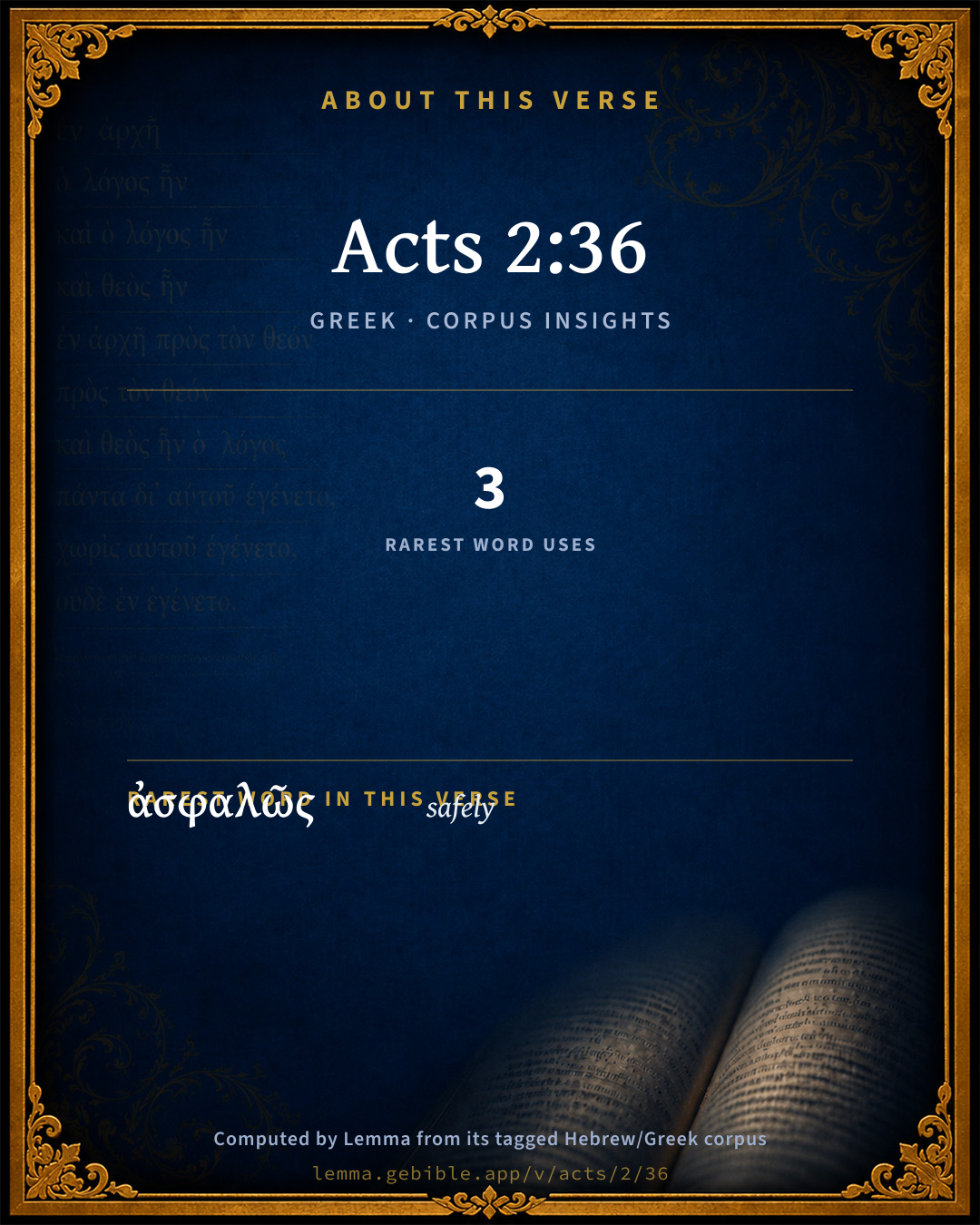
Acts 2:36

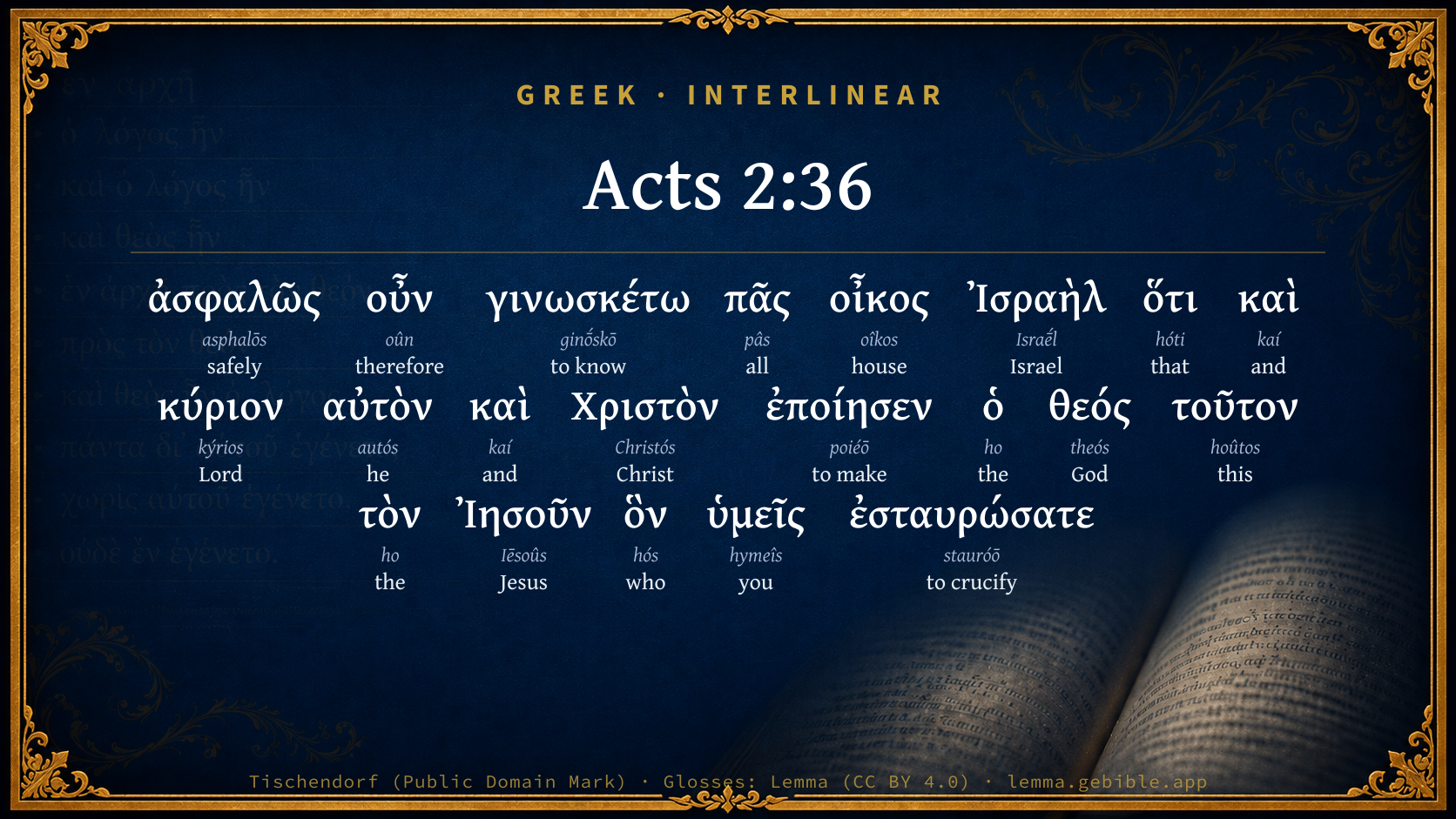
Greek (Tischendorf 8th ed.) Acts 2:36 appears in the Greek New Testament. The text above is from the Tischendorf 8th edition. Each word links to its Strong’s number and a concise gloss. Click any word for its full Thayer’s Greek Lexicon entry.
Download image
Cite this verse

Acts 2:36 (World English Bible). Public Domain. Lemma interlinear Bible study tool, https://lemma.gebible.app/v/acts/2/36.

Show BibTeX & RIS
BibTeX
RIS
English Translation
"Let all the house of Israel therefore know assuredly that God has made him both Lord and Christ, this Jesus whom you crucified."
World English Bible · Public Domain
Download a study sheet

One document with this verse’s original text, its word-by-word gloss line, the meaning frame, cross-references with their text, attributed commentary, and full source and license credits — printable, and it pastes into notes with its structure intact.

This verse Autodidact and up

Study sheet (.html) Plain text (.txt)

A passage Seminary Student

Up to 50 verses in one chapter. A passage sheet keeps up to 6 commentary sources and 12 cross-references per verse, in the order this page ranks them, and says so on the sheet whenever that leaves anything out. Ask for a single verse and you get the Autodidact verse sheet above.

Everything on this page stays free to read, with no account — the sheet is a download of what is already on screen, not access to it.

Want to remove ads? Support Godless Engineer
Compare translations 3

The same verse in 3 English versions, stacked beneath the original-language interlinear above. Click any original word for its lexicon entry.

Each is an independent rendering of the whole verse — the interlinear is not word-aligned to these translations.

Highlighted words mark where these versions differ — a whole-verse word diff, not a word-by-word alignment.

  • World English Bible Public Domain
    "Let all the house of Israel therefore know assuredly that God has made him both Lord and Christ, this Jesus whom you crucified."
  • King James Version Public Domain
    Therefore let all the house of Israel know assuredly, that God hath made the same Jesus, whom ye have crucified, both Lord and Christ.
  • unfoldingWord Literal Text CC BY-SA 4.0
    Therefore, let all the house of Israel know certainly that God has made him both Lord and Christ, this Jesus whom you crucified.”

unfoldingWord Literal Text — © unfoldingWord, licensed CC BY-SA 4.0. Word-aligned USFM3 via Door43 (git.door43.org/unfoldingWord/en_ult).

Versions to compare (up to 4)

3 of 4 selected

Show all 19 translations

Every available English version of this verse, each an independent rendering of the whole verse.

  • World English Bible Public Domain
    "Let all the house of Israel therefore know assuredly that God has made him both Lord and Christ, this Jesus whom you crucified."
  • Berean Standard Bible Public Domain
    Therefore let all Israel know with certainty that God has made this Jesus, whom you crucified, both Lord and Christ!”
  • Majority Standard Bible Public Domain
    Therefore let all Israel know with certainty that God has made this Jesus, whom you crucified, both Lord and Christ!”
  • King James Version Public Domain
    Therefore let all the house of Israel know assuredly, that God hath made the same Jesus, whom ye have crucified, both Lord and Christ.
  • American Standard Version (1901) Public Domain
    Let all the house of Israel therefore know assuredly, that God hath made him both Lord and Christ, this Jesus whom ye crucified.
  • Revised Version (1885) Public Domain
    Let all the house of Israel therefore know assuredly, that God hath made him both Lord and Christ, this Jesus whom ye crucified.
  • Geneva Bible (1599) Public Domain
    Therefore, let all the house of Israel know for a suretie, that God hath made him both Lord, and Christ, this Iesus, I say, whome yee haue crucified.
  • Douay-Rheims (1899) Public Domain
    Therefore let all the house of Israel know most certainly, that God hath made both Lord and Christ, this same Jesus, whom you have crucified.
  • Young's Literal Translation Public Domain
    assuredly, therefore, let all the house of Israel know, that both Lord and Christ did God make him -- this Jesus whom ye did crucify.'
  • Literal Standard Version CC BY-SA 4.0
    assuredly, therefore, let all the house of Israel know that God made Him both Lord and Christ—this Jesus whom you crucified.”
  • Unlocked Literal Bible CC BY-SA 4.0
    Therefore, let all the house of Israel certainly know that God has made him both Lord and Christ, this Jesus whom you crucified.”
  • unfoldingWord Literal Text CC BY-SA 4.0
    Therefore, let all the house of Israel know certainly that God has made him both Lord and Christ, this Jesus whom you crucified.”
  • Darby Bible Public Domain
    Let the whole house of Israel therefore know assuredly that God has made him, this Jesus whom *ye* have crucified, both Lord and Christ.
  • World Messianic Bible Public Domain
    “Let all the house of Israel therefore know certainly that God has made him both Lord and Messiah, this Yeshua whom you crucified.”
  • Webster's Bible Public Domain
    Therefore let all the house of Israel know assuredly, that God hath made that same Jesus whom ye have crucified, both Lord and Christ.
  • Free Bible Version CC BY-SA 4.0
    Now let everyone in Israel be totally convinced of this: God has made this Jesus, whom you killed on a cross, both Lord and Messiah!”
  • Bible in Basic English Public Domain
    For this reason, let all Israel be certain that this Jesus, whom you put to death on the cross, God has made Lord and Christ.
  • Text-Critical English NT CC BY 4.0
    Therefore, let all the house of Israel know with certainty that God has made him both Lord and Christ, this Jesus whom you crucified.”
  • Tyndale New Testament (1534) Public Domain
    So therfore let all the housse of Israel knowe for a suerty that God hath made the same Iesus whom ye have crucified lorde and Christ.

Literal Standard Version (2020), Covenant Press — licensed CC BY-SA 4.0. Text via the HelloAO Bible API (eBible.org). Unlocked Literal Bible (unfoldingWord) — licensed CC BY-SA 4.0. Text via the HelloAO Bible API (eBible.org). unfoldingWord Literal Text — © unfoldingWord, licensed CC BY-SA 4.0. Word-aligned USFM3 via Door43 (git.door43.org/unfoldingWord/en_ult). Free Bible Version, Dr. Jonathan Gallagher — licensed CC BY-SA 4.0. Text via the HelloAO Bible API (eBible.org).

Word by word

More ways to search: Search by grammar → Find every occurrence → Compare this word →

Practice this passage: Drill this verse → Learn its vocabulary →

ἀσφαλῶς
asphalōs
G806
“safely”
Adverb
Part of Speech
Adverb
Full Thayer's Definition

Origin: from G804

TDNT: 09:26,9

1. safety (so as to prevent escape), assuredly
  1. οὖν oûn G3767 “therefore” Conjunction
  2. γινωσκέτω ginṓskō G1097 “to know” Verb, Present, Active, Imperative, 3rd person, Singular
  3. πᾶς pâs G3956 “all” Adjective, Nominative, Singular, Masculine
  4. οἶκος oîkos G3624 “house” Noun, Nominative, Singular, Masculine
  5. Ἰσραὴλ Israḗl G2474 “Israel” Noun, Proper, indeclinable
  6. ὅτι hóti G3754 “that” Conjunction
  7. καὶ kaí G2532 “and” Conjunction
  8. κύριον kýrios G2962 “Lord” Noun, Accusative, Singular, Masculine
  9. αὐτὸν autós G846 “he” Personal pronoun, Accusative, Singular, Masculine
  10. καὶ kaí G2532 “and” Conjunction
  11. Χριστὸν Christós G5547 “Christ” Noun, Accusative, Singular, Masculine
  12. ἐποίησεν poiéō G4160 “to make” Verb, Aorist, Active, Indicative, 3rd person, Singular
  13. ὁ ho G3588 “the” Article, Nominative, Singular, Masculine
  14. θεός theós G2316 “God” Noun, Nominative, Singular, Masculine
  15. τοῦτον hoûtos G3778 “this” Demonstrative pronoun, Accusative, Singular, Masculine
  16. τὸν ho G3588 “the” Article, Accusative, Singular, Masculine
  17. Ἰησοῦν Iēsoûs G2424 “Jesus” Noun, Accusative, Singular, Masculine
  18. ὃν hós G3739 “who” Relative pronoun, Accusative, Singular, Masculine
  19. ὑμεῖς hymeîs G5210 “you” Personal pronoun, 2nd person, Nominative, Plural
  20. ἐσταυρώσατε stauróō G4717 “to crucify” Verb, Aorist, Active, Indicative, 2nd person, Plural

About this verse

These counts appear in no published source. They are computed here, from the morphology-tagged text and Lemma’s own curated glosses. What Lemma adds →

21
words
19
distinct lemmas
Acts
section

Notable vocabulary

The rarest word here is ἀσφαλῶς safely G806 — appearing just 3 times in the whole Greek New Testament.

Shared distinctive vocabulary

ἀσφαλῶς safely G806 occurs in 3 verses of the Greek New Testament. Also found in:

Repetition

Words recur within this verse:

Cross-references

20

Topical passages linked to Acts 2:36 in the Treasury of Scripture Knowledge — connected by theme and wording, ordered by reader-vote popularity; previews shown in the World English Bible.

  • Acts 5:30–31 The God of our fathers raised up Jesus, whom you killed, hanging him on a tree.
  • Romans 14:8–12 For if we live, we live to the Lord. Or if we die, we die to the Lord. If therefore we live or die, we are the Lord's.
  • 2 Corinthians 5:10 For we must all be revealed before the judgment seat of Christ; that each one may receive the things in the body, according to what he has done, whether good or bad.
  • Acts 4:11–12 He is 'the stone which was regarded as worthless by you, the builders, which has become the head of the corner.'
  • Ezekiel 34:30 They shall know that I, Yahweh, their God am with them, and that they, the house of Israel, are my people, says the Lord Yahweh.
  • Zechariah 13:1 "In that day there will be a spring opened to the house of David and to the inhabitants of Jerusalem, for sin and for uncleanness.
  • 2 Thessalonians 1:7–10 and to give relief to you that are afflicted with us, when the Lord Jesus is revealed from heaven with his mighty angels in flaming fire,
  • Acts 2:22–23 "Men of Israel, hear these words! Jesus of Nazareth, a man approved by God to you by mighty works and wonders and signs which God did by him in the midst of you, even as you yourselves know,
  • Acts 10:36–42 The word which he sent to the children of Israel, preaching good news of peace by Jesus Christ--he is Lord of all--
  • Psalms 2:1–8 Why do the nations rage, And the peoples plot a vain thing?
  • Jeremiah 9:26 Egypt, and Judah, and Edom, and the children of Ammon, and Moab, and all that have the corners [of their hair] cut off, who dwell in the wilderness; for all the nations are uncircumcised, and all the house of Israel are uncircumcised in heart.
  • Jeremiah 31:31 Behold, the days come, says Yahweh, that I will make a new covenant with the house of Israel, and with the house of Judah:
  • Jeremiah 33:14 Behold, the days come, says Yahweh, that I will perform that good word which I have spoken concerning the house of Israel and concerning the house of Judah.
  • Luke 2:11 For there is born to you, this day, in the city of David, a Savior, who is Christ the Lord.
  • John 5:22–29 For the Father judges no one, but he has given all judgment to the Son,
  • Romans 9:3–6 For I could wish that I myself were accursed from Christ for my brothers' sake, my relatives according to the flesh,
  • Ezekiel 39:25–29 Therefore thus says the Lord Yahweh: Now will I bring back the captivity of Jacob, and have mercy on the whole house of Israel; and I will be jealous for my holy name.
  • Matthew 28:18–20 Jesus came to them and spoke to them, saying, "All authority has been given to me in heaven and on earth.
  • John 3:35–36 The Father loves the Son, and has given all things into his hand.
  • Jeremiah 2:4 Hear you the word of Yahweh, O house of Jacob, and all the families of the house of Israel:

Cross-references courtesy of OpenBible.info (CC BY 4.0).

Commentary

Notes on Acts 2:36 from classic Christian and Jewish commentators (each source and its license shown beneath its notes). The classic Christian expositions comment on the surrounding passage and are grouped to its opening verse, so a note may address several verses; the Jewish commentaries on the Tanakh (Rashi and others) are per-verse, so they appear only where the commentator wrote on this verse.

Lemma curates 59 commentaries, every one of them public domain or Creative Commons licensed, each selected and text-cleaned for this edition rather than reprinted as found. About our sources →

MacLaren's Expositions of Holy Scripture

Alexander MacLaren

Acts

PETER’S FIRST SERMON

THE NAME ABOVE EVERY NAME

Act 2:36.

It is no part of my purpose at this time to consider the special circumstances under which these words were spoken, nor even to enter upon an exposition of their whole scope. I select them for one reason, the occurrence in them of the three names by which we designate our Saviour-Jesus, Lord, Christ. To us they are very little more than three proper names; they were very different to these men who listened to the characteristically vehement discourse of the Apostle Peter. It wanted some courage to stand up at Pentecost and proclaim on the housetop what he had spoken in the ear long ago, ‘Thou art the Christ, the Son of the living God!’ To most of his listeners to say ‘Jesus is the Christ’ was folly, and to say ‘Jesus is the Lord’ was blasphemy.

The three names are names of the same Person, but they proclaim altogether different aspects of His work and His character. The name ‘Jesus’ is the name of the Man, and brings to us a Brother; the name ‘Christ’ is the name of office, and brings to us a Redeemer; the name ‘Lord’ is the name of dignity, and brings to us a King.

I. First, then, the name Jesus is the name of the Man, and tells us of a Brother.

There were many men in Palestine who bore the name of ‘Jesus’ when He bore it. We find that one of the early Christians had it; and it comes upon us with almost a shock when we read that ‘Jesus, called Justus,’ was the name of one of the friends of the Apostle Paul {Col 4:11}. But, through reverence on the part of Christians, and through horror on the part of Jews, the name ceased to be a common one; and its disappearance from familiar use has hid from us the fact of its common employment at the time when our Lord bore it. Though it was given to Him as indicative of His office of saving His people from their sins, yet none of all the crowds who knew Him as Jesus of Nazareth supposed that in His name there was any greater significance than in those of the ‘Simons,’ ‘Johns,’ and ‘Judahs’ in the circle of His disciples.

Now the use of Jesus as the proper name of our Lord is very noticeable. In the Gospels, as a rule, it stands alone hundreds of times, whilst in combination with any other of the titles it is rare. ‘Jesus Christ,’ for instance, only occurs, if I count aright, twice in Matthew, once in Mark, twice in John. But if you turn to the Epistles and the latter books of the Scriptures, the proportions are reversed. There you have a number of instances of the occurrence of such combinations as ‘Jesus Christ,’ ‘Christ Jesus,’ ‘The Lord Jesus,’ ‘Christ the Lord,’ and more rarely the full solemn title, ‘The Lord Jesus Christ,’ but the occurrence of the proper name ‘Jesus’ alone is the exception. So far as I know, there are only some thirty or forty instances of its use singly in the whole of the books of the New Testament outside of the four Evangelists. The occasions where it is used are all of them occasions in which one may see that the writer’s intention is to put strong emphasis, for some reason or other, on the Manhood of our Lord Jesus, and to assert, as broadly as may be, His entire participation with us in the common conditions of our human nature, corporeal and mental.

And I think I shall best bring out the meaning and worth of the name by putting a few of these instances before you.

For example, more than once we find phrases like these: ‘we believe that Jesus died,’ ‘having therefore boldness to enter into the holiest by the blood of Jesus,’ and the like-which emphasise His death as the death of a man like ourselves, and bring us close to the historical reality of His human pains and agonies for us. ‘Christ died’ is a statement which makes the purpose and efficacy of His death more plain, but ‘Jesus died’ shows us His death as not only the work of the appointed Messiah, but as the act of our brother man, the outcome of His human love, and never rightly to be understood if His work be thought of apart from His personality.

There is brought into view, too, prominently, the side of Christ’s sufferings which we are all apt to forget-the common human side of His agonies and His pains. I know that a certain school of preachers, and some unctuous religious hymns, and other forms of composition, dwell, a great deal too much for reverence, upon the mere physical aspect of Christ’s sufferings. But the temptation, I believe, with most of us is to dwell too little upon that,-to argue about the death of Christ, to think about it as a matter of speculation, to regard it as a mysterious power, to look upon it as an official act of the Messiah who was sent into the world for us; and to forget that He bore a manhood like our own, a body that was impatient of pains and wounds and sufferings, and a human life which, like all human lives, naturally recoiled and shrank from the agony of death.

And whilst, therefore, the great message, ‘It is Christ that died,’ is ever to be pondered, we have also to think with sympathy and gratitude on the homelier representation coming nearer to our hearts, which proclaims that ‘Jesus died.’ Let us not forget the Brother’s manhood that had to agonise and to suffer and to die as the price of our salvation.

Again, when the Scripture would set our Lord before us, as in His humanity, our pattern and example, it sometimes uses this name, in order to give emphasis to the thought of His Manhood-as, for example, in the words of the Epistle to the Hebrews, ‘looking unto Jesus, the Author and Perfecter of faith.’ That is to say-a mighty stimulus to all brave perseverance in our efforts after higher Christian nobleness lies in the vivid and constant realisation of the true manhood of our Lord, as the type of all goodness, as having Himself lived by faith, and that in a perfect degree and manner. We are to turn away our eyes from contemplating all other lives and motives, and to ‘look off’ from them to Him. In all our struggles let us think of Him. Do not take poor human creatures for your ideal of excellence, nor tune your harps to their keynotes. To imitate men is degradation, and is sure to lead to deformity. None of them, is a safe guide. Black veins are in the purest marble, and flaws in the most lustrous diamonds. But to imitate Jesus is freedom, and to be like Him is perfection. Our code of morals is His life. He is the Ideal incarnate. The secret of all progress is, ‘Run-looking unto Jesus.’

Then, again, we have His manhood emphasised when His sympathy is to be commended to our hearts. ‘The great High Priest, who is passed into the heavens’ is ‘Jesus’ . . . ‘who was in all points tempted like as we are.’ To every sorrowing soul, to all men burdened with heavy tasks, unwelcome duties, pains and sorrows of the imagination, or of the heart, or of memory, or of physical life, or of circumstances-to all there comes the thought, ‘Every ill that flesh is heir to’ He knows by experience, and in the Man Jesus we find not only the pity of a God, but the sympathy of a Brother.

When one of our princes goes for an afternoon into the slums in East London, everybody says, and says deservedly, ‘right!’ and ‘princely!’ This prince has learned pity in ‘the huts where poor men lie,’ and knows by experience all their squalor and misery. The Man Jesus is the sympathetic Priest. The Rabbis, who did not usually see very far into the depth of things, yet caught a wonderful glimpse when they said: ‘Messias will be found sitting outside the gate of the city amongst the lepers.’ That is where He sits; and the perfectness of His sympathy, and the completeness of His identification of Himself with all our tears and our sorrows, are taught us when we read that our High Priest is not merely Christ the Official, but Jesus the Man.

And then we find such words as these: ‘If we believe that Jesus died and rose again, even so them also which sleep in Jesus will God bring with Him’: I think any one that reads with sympathy must feel how very much closer to our hearts that consolation comes, ‘Jesus rose again,’ than even the mighty word which the Apostle uses on another occasion, ‘Christ is risen from the dead.’ The one tells us of the risen Redeemer, the other tells us of the risen Brother. And wherever there are sorrowing souls, enduring loss and following their dear ones into the darkness with yearning hearts, they are comforted when they feel that the beloved dead lie down beside their Brother, and with their Brother they shall rise again.

So, again, most strikingly, and yet somewhat singularly, in the words of Scripture which paint most loftily the exaltation of the risen Saviour to the right hand of God, and His wielding of absolute power and authority, it is the old human name that is used; as if the writers would bind together the humiliation and the exaltation, and were holding up hands of wonder at the thought that a Man had risen thus to the Throne of the Universe. What an emphasis and glow of hope there is in such words as these: ‘We see not yet all things put under Him, but we see Jesus’-the very Man that was here with us- ‘crowned with glory and honour.’ So in the Book of the Revelation the chosen name for Him who sits amidst the glories of the heavens, and settles the destinies of the universe, and orders the course of history, is Jesus. As if the Apostle would assure us that the face which looked down upon him from amidst the blaze of the glory was indeed the face that he knew long ago upon earth, and the breast that ‘was girded with a golden girdle’ was the breast upon which he so often had leaned his happy head.

So the ties that bind us to the Man Jesus should be the human bonds that knit us to one another, transferred to Him and purified and strengthened. All that we have failed to find in men we can find in Him. Human wisdom has its limits, but here is a Man whose word is truth, who is Himself the truth. Human love is sometimes hollow, often impotent; it looks down upon us, as a great thinker has said, like the Venus of Milo, that lovely statue, smiling in pity, but it has no arms. But here is a love that is mighty to help, and on which we can rely without disappointment or loss. Human excellence is always limited and imperfect, but here is One whom we may imitate and be pure. So let us do like that poor woman in the Gospel story-bring our precious alabaster box of ointment-the love of these hearts of ours, which is the most precious thing we have to give. The box of ointment that we have so often squandered upon unworthy heads-let us come and pour it upon His, not unmingled with our tears, and anoint Him, our beloved and our King. This Man has loved each of us with a brother’s heart; let us love Him with all our hearts.

II. So much for the first name. The second-’Christ’-is the name of office, and brings to us a Redeemer.

I need not dwell at any length upon the original significance and force of the name; it is familiar, of course, to us all. It stands as a transference into Greek of the Hebrew Messias; the one and the other meaning, as we all know, the ‘Anointed.’ But what is the meaning of claiming for Jesus that He is anointed? A sentence will answer the question. It means that He fulfils all which the inspired imagination of the great ones of the past had seen in that dim Figure that rose before prophet and psalmist. It means that He is anointed or inspired by the divine indwelling to be Prophet, Priest, and King all over the world. It means that He is-though the belief had faded away from the minds of His generation-a sufferer whilst a Prince, and appointed to ‘turn away unrighteousness’ from the world, and not from ‘Jacob’ only, by a sacrifice and a death.

I cannot see less in the contents of the Jewish idea, the prophetic idea, of the Messias, than these points: divine inspiration or anointing; a sufferer who is to redeem; the fulfiller of all the rapturous visions of psalmist and of prophet in the past.

And so, when Peter stood up amongst that congregation of wondering strangers and scowling Pharisees, and said, ‘The Man that died on the Cross, the Rabbi-peasant from half-heathen Galilee, is the Person to whom Law and Prophets have been pointing,’-no wonder that no one believed him except those whose hearts were touched, for it is never possible for the common mind, at any epoch, to believe that a man who stands beside them is very much bigger than themselves. Great men have always to die, and get a halo of distance around them, before their true stature can be seen.

And now two remarks are all I can afford myself upon this point, and one is this: the hearty recognition of His Messiahship is the centre of all discipleship. The earliest and the simplest Christian creed, which yet-like the little brown roll in which the infant beec-leaves lie folded up-contains in itself all the rest, was this: ‘Jesus is Christ.’ Although it is no part of my business to say how much imperfection and confusion of head comprehension may co-exist with a heart acceptance of Jesus that saves a soul from sin, yet I cannot in faithfulness to my own convictions conceal my belief that he who contents himself with ‘Jesus’ and does not grasp ‘Christ’ has cast away the most valuable and characteristic part of the Christianity which he professes. Surely a most simple inference is that a Christian is at least a man who recognises the Christship of Jesus. And I press that upon you, my friends. It is not enough for the sustenance of your own souls and for the cultivation of a vigorous religious life that men should admire, howsoever profoundly and deeply, the humanity of the Lord unless that humanity leads them on to see the office of the Messiah to whom their whole hearts cleave. ‘Jesus is the Christ’ is the minimum Christian creed.

And then, still further, let me remind you how the recognition of Jesus as Christ is essential to giving its full value to the facts of the manhood. ‘Jesus died!’ Yes. What then? What is that to me? Is that all that I have to say? If His is simply a human death, like all others, I want to know what makes the story of it a Gospel. I want to know what more interest I have in it than I have in the death of Socrates, or in the death of any man or woman whose name was in the obituary column of yesterday’s newspaper. ‘Jesus died.’ That is a fact. What is wanted to turn the fact into a gospel? That I shall know who it was that died, and why He died. ‘I declare unto you the gospel which I preach,’ Paul says, ‘how that Christ died for our sins, according to the Scriptures.’ The belief that the death of Jesus was the death of the Christ is needful in order that it shall be the means of my deliverance from the burden of sin. If it be only the death of Jesus, it is beautiful, pathetic, as many another martyr’s has been, but if it be the death of Christ, then ‘my faith can lay her hand’ on that great Sacrifice ‘and know her guilt was there.’

So in regard to His perfect example. If we only see His manhood when we are ‘looking unto Jesus,’ the contemplation of His perfection would be as paralysing as spectacles of supreme excellence usually are. But when we can say, ‘Christ also suffered for us, leaving us an example,’ and so can deepen the thought of His Manhood into that of His Messiahship, and the conception of His work as example into that of His work as sacrifice, we can hope that His divine power will dwell in us to mould our lives to the likeness of His human life of perfect obedience.

So in regard to His Resurrection and glorious Ascension to the right hand of God. We have not only to think of the solitary man raised from the grave and caught up to the throne. If it were only ‘Jesus’ who rose and ascended, His Resurrection and Ascension might be as much to us as the raising of Lazarus, or the rapture of Elijah- namely, a demonstration that death did not destroy conscious being, and that a man could rise to heaven; but they would be no more. But if ‘Christ is risen from the dead,’ He is ‘become the first-fruits of them that slept.’ If Jesus has gone up on high, others may or may not follow in His train. He may show that manhood is not incapable of elevation to heaven, but has no power to draw others up after Him. But if Christ is gone up, He is gone to prepare a place for us, not to fill a solitary throne, and His Ascension is the assurance that He will lift us too to dwell with Him and share His triumph over death and sin.

Most of the blessedness and beauty of His Example, all the mystery and meaning of His Death, and all the power of His Resurrection, depend on the fact that ‘it is Christ that died, yea rather, that is risen again, who is even at the right hand of God.’

III. ‘The Lord’ is the name of dignity and brings before us the King.

There are three grades, so to speak, of dignity expressed by this one word ‘Lord’ in the New Testament. The lowest is that in which it is almost the equivalent of our own English title of respectful courtesy, ‘Sir,’ in which sense it is often used in the Gospels, and applied to our Lord as to many other of the persons there. The second is that in which it expresses dignity and authority-and in that sense it is frequently applied to Christ. The third and highest is that in which it is the equivalent of the Old Testament ‘Lord,’ as a divine name; in which sense also it is applied to Christ in the New Testament.

The first and last of these may be left out of consideration now: the central one is the meaning of the word here. I have only time to touch upon two thoughts-to connect this name of dignity first with one and then with the other of the two names that we have already considered.

Jesus is Lord, that is to say, wonderful as it is, His manhood is exalted to supreme dignity. It is the teaching of the New Testament, that in Jesus, the Child of Mary, our nature sits on the throne of the universe and rules over all things. Those rude herdsmen, brothers of Joseph, who came into Pharaoh’s palace-strange contrast to their tents!-there found their brother ruling over that ancient and highly civilised land! We have the Man Jesus for the Lord over all. Trust His dominion and rejoice in His rule, and bow before His authority. Jesus is Lord.

Christ is Lord. That is to say: His sovereign authority and dominion are built upon the fact of His being Deliverer, Redeemer, Sacrifice. His Kingdom is a Kingdom that rests upon His suffering. ‘Wherefore God also hath exalted Him, and given Him a Name that is above every name.’

It is because He wears a vesture dipped in blood, that ‘on the vesture is the name written “King of kings, and Lord of lords.”‘ It is ‘because He shall deliver the needy when he crieth,’ as the prophetic psalm has it, that ‘all kings shall fall down before Him and all nations shall serve Him.’ Because He has given His life for the world He is the Master of the World. His humanity is raised to the throne because His humanity stooped to the cross. As long as men’s hearts can be touched by absolute unselfish surrender, and as long as they can know the blessedness of responsive surrender, so long will He who gave Himself for the world be the Sovereign of the world, and the First-born from the dead be the Prince of all the kings of the earth.

And so, dear friends, our thoughts to-day all point to this lesson- do not you content yourselves with a maimed Christ. Do not tarry in the Manhood; do not think it enough to cherish reverence for the nobility of His soul, the gentle wisdom of His words, the beauty of His character, the tenderness of His compassion. All these will be insufficient for your needs. There is more in His mission than these -even His death for you and for all men. Take Him for your Christ, but do not lose the Person in the Work, any more than you lose the work in the Person. And be not content with an intellectual recognition of Him, but bring Him the faith which cleaves to Him and His work as its only hope and peace, and the love which, because of His work as Christ, flows out to the beloved Person who has done it all. Thus loving Jesus and trusting Christ, you will bring obedience to your Lord and homage to your King, and learn the sweetness and power of ‘the name that is above every name’-the name of the Lord Jesus Christ.

May we all be able, with clear and unfaltering conviction of our understandings and loving affiance of our whole souls, to repeat as our own the grand words in which so many centuries have proclaimed their faith-words which shed a spell of peacefulness over stormy lives, and fling a great light of hope into the black jaws of the grave: ‘I believe in Jesus Christ, His only Son, our Lord!’

Alexander MacLaren, Expositions of Holy Scripture (1904–1910) — public domain. Text from a community e-Sword module.

Bengel's Gnomon

Johann Albrecht Bengel

Act 2:36. Ἀσφαλῶς, assuredly) Peter proclaimed this aloud with great force. Comp. ch. Act 4:10, Act 13:38. Γνωστὸν, known.—καὶ Κύριον[19] καὶ Χριστόν, both Lord and Christ) Peter had quoted the promise given to David concerning the Christ, and the Psalm, in which David had called Him Lord. Now therefore he infers the title, Lord, from Act 2:34, and from Psalms 110, and repeats the title, Christ, from Act 2:30, and from the promise given to David, conjoining both strong points (sinews) of his argument in this recapitulation. The particle καὶ, both, though omitted by some in the former place, makes the language very vivid.[20] Henceforward continually, in the New Testament, Jesus in His exaltation is meant by the appellation, Lord; Act 2:47, etc.; except where there is reference to the Hebrew יהוה, which requires to be explained according to the sense of the passages in the Old Testament.—αὐτὸν, Him) viz. this Jesus. It is altogether demonstrative.—ἐποίησε, hath made) and that too in such away, as that JESUS[21] was even previously Lord and Christ: Act 2:34.—ὑμεῖς ἐσταυρώσατε, ye have crucified) The sting of his speech is put at the end.

[19] καὶ Κύριον αὐτὸν καὶ Χριστὸν is pronounced the better reading by the margin of Ed. 2.—E. B.

[20] And this has been in some measure expressed in the Vers. Germ. by the repetition of the words Zu einem.—E. B.

[21] As the name JESUS means God-Saviour.—E. and T.

ABCDEde Vulg. have καὶ before Κύριον. But the Elzevir Rec. Text (not Stephens’) omit it.—E. and T.

So ABC Vulg. Iren.; but Ee and Rec. Text, καὶ Χριστὸν αὐτον. D corrected d omits αὐτόν.—E. and T.

Bengel's Gnomon of the New Testament — English translation (T&T Clark, Edinburgh, 1860) — public domain. Text from a community e-Sword module.

Meyer's Critical & Exegetical Commentary

Heinrich August Wilhelm Meyer

Act_2:36. The Christological aim of the whole discourse, which, as undoubtedly proved after what has been hitherto said (οὖν), is emphatically at the close set down for recognition as the summary of the faith now requisite. In this case ἀσφαλῶς (unchangeably) is marked with strong emphasis.

πᾶς οἶκος ʼΙσρ.] without the article, because οἶκ. ʼΙσρ. has assumed the nature of a proper name. Comp. LXX. 1Ki_12:23; Eze_45:6, al. Winer, p. 105 [E. T. 137]. The. whole people is regarded as the family of their ancestor Israel (בֵּית יְשְׂרָאֵל).

καὶ κύριον αὐτὸν κ. Χριστόν] him Lord (ruler generally, comp. Act_10:36) as well as also Messiah. The former general expression, according to which He is ὁ ὢν ἐπὶ πάντων, Rom_9:5, and κεφαλὴ ὑπὲρ πάντα, Eph_1:22, the latter special, according to which He is the σωτὴρ τοῦ κόσμου, v. 31, Joh_4:42, and κεφαλὴ τῆς ἐκκλησίας, Eph_1:22, Col_1:18, together characterize the Messianic possessor of the kingdom, which God has made Christ to be by His exaltation, seeing that He had in His state of humiliation emptied Himself of the power and glory, and was only reinstated into them by His exaltation. Previously He was indeed likewise Lord and Messiah, but in the form of a servant; and it was after laying aside that form that He became such in complete reality.[135] It is not to be inferred from such passages as this and Act_4:27; Act_10:38; Act_17:31 (de Wette), that the Book of Acts represents the Messianic dignity of Jesus as an acquisition in time; against which view even παρὰ τοῦ πατρός in our passage (Act_2:33), compared with the confession in Mat_16:16, Joh_16:30, is decisive, to say nothing of the Pauline training of Luke himself. Comp. also Act_2:34.

αὐτόν is not superfluous, but τοῦτον τὸν ʼΙησοῦν is a weighty epexegesis, which is purposely chosen in order to annex the strongly contrasting ὃν ὑμεῖς ἐσταυρώσατε (comp. Act_3:13, Act_7:52), and thus to impart to the whole address a deeply impressive conclusion. Aculeus in fine, Bengel.

[135] Comp. Weiss, bibl. Theol. p. 134 f.

Meyer — Critical and Exegetical Commentary on the New Testament — English translation by Peter Christie, edited by Frederick Crombie (T&T Clark, 1880) — public domain. Text from a community e-Sword module.

Expositor's Greek Testament

ed. W. Robertson Nicoll

Act 2:36 . ἀσφαλῶς : used here emphatically; the Apostle would emphasise the conclusion which he is about to draw from his three texts; cf. Act 21:34 , Act 22:30 , and Wis 18:6 (so in classical Greek). πᾶς οἶκος Ἰσρ ., without the article, for οἶκος Ἰ . is regarded as a proper name, cf. LXX, 1Sa 7:2 , 1Ki 12:23 , Neh 4:16 , Eze 45:6 , or it may be reckoned as Hebraistic, Blass, Grammatik des N. G. , pp. 147, 158. καὶ Κύριον καὶ Χριστόν : the Κύριος plainly refers to the prophetic utterance just cited. Although in the first verse of Psa 110 the words τῷ Κυρίῳ μου are not to be taken as a name of God, for the expression is Adoni not Adonai (“the LORD saith unto my Lord,” R.V.), and is simply a title of honour and respect, which was used of earthly superiors, e.g. , of Abraham, Moses, Elijah, Sisera, Naaman, yet St. Peter had called David a Prophet, and only in the Person of the Risen and Ascended Christ Who had sat down with His Father on His Throne could the Apostle see an adequate fulfilment of David’s prophecy, or an adequate realisation of the anticipations of the Christ. So in the early Church, Justin Martyr, Apol. , i., 60, appeals to the words of “the prophet David” in this same Psalm as foretelling the Ascension of Christ and His reign over His spiritual enemies. On the remarkable expression Χριστὸς Κύριος in connection with Psa 110:1 , see Ryle and James, Psalms of Solomon , pp. 141 143, cf. with the passage here Act 10:36 ; Act 10:42 . In 1Pe 3:15 we have the phrase Κύριον δὲ Χριστὸν ἁγιάσατε κ . τ . λ . (R.V. and W.H [128] ), “sanctify in your hearts Christ as Lord” (R.V.), where St. Peter does not hesitate to command that Christ be sanctified in our hearts as Lord, in words which are used in the O.T. of the LORD of hosts, Isa 8:13 , and His sanctification by Israel. If it is said that it has been already shown that in Psa 110:1 Christ is referred to not as the Lord but as “my lord,” it must not be forgotten that an exact parallel to 1Pe 3:15 and its high Christology may be found in this first sermon of St. Peter, cf. note on Act 2:18-21 ; Act 2:33 . τοῦτον τὸν Ι . ὃν ὑμεῖς ἐσταυρώσατε , “hath made Him both Lord and Christ, this Jesus whom ye crucified,” R.V., so Vulgate. The A.V., following Tyndale and Cranmer, inverts the clauses, but fails to mark what Bengel so well calls aculeus in fine , the stinging effect with which St. Peter’s words would fall on the ears of his audience, many of whom may have joined in the cry, Crucify Him! (Chrysostom). Holtzmann describes this last clause of the speech as “ein schwerer Schlusstein zur Krönung des Gebäudes”.

[128] Westcott and Hort’s The New Testament in Greek: Critical Text and Notes.

The Expositor's Greek Testament, edited by W. Robertson Nicoll (1897–1910) — public domain. Text from a community e-Sword module.

Geneva Bible (1599)

Geneva Bible translators

Christ is said to be made, because he was advanced to that dignity: and therefore it is not spoken of his nature, but of his state and dignity.

Geneva Bible (1599) marginal notes — public domain. Text via Bolls.life.

Jamieson, Fausset & Brown

Robert Jamieson, A. R. Fausset & David Brown

Therefore--that is, to sum up all.

let all the house of Israel--for in this first discourse the appeal is formally made to the whole house of Israel, as the then existing Kingdom of God.

know assuredly--by indisputable facts, fulfilled predictions, and the seal of the Holy Ghost set upon all.

that God hath made--for Peter's object was to show them that, instead of interfering with the arrangements of the God of Israel, these events were His own high movements.

this same Jesus, whom ye have crucified--"The sting is at the close" [BENGEL]. To prove to them merely that Jesus was the Messiah might have left them all unchanged in heart. But to convince them that He whom they had crucified had been by the right hand of God exalted, and constituted the "LORD" whom David in spirit adored, to whom every knee shall bow, and the CHRIST of God, was to bring them to "look on Him whom they had pierced and mourn for Him."

Jamieson, Fausset & Brown — Commentary Critical and Explanatory on the Whole Bible (1871) — public domain (CC PDM 1.0). Text via the HelloAO Bible API.

Adam Clarke's Commentary

Verse 36. Both Lord and Christ.] Not only the Messiah, but the supreme Governor of all things and all persons, Jews and Gentiles, angels and men. In the preceding discourse, Peter assumes a fact which none would attempt to deny, viz. that Jesus had been lately crucified by them. He then,

1. Proves his resurrection.

2. His ascension.

3. His exaltation to the right hand of God.

4. The effusion of the Holy Spirit, which was the fruit of his glorification, and which had not only been promised by himself, but foretold by their own prophets: in consequence of which,

5. It was indisputably proved that this same Jesus, whom they had crucified, was the promised Messiah; and if so,

6. The Governor of the universe, from whose power and justice they had every thing to dread, as they refused to receive his proffered mercy and kindness.

Adam Clarke's Commentary on the Bible (1810–1826) — public domain. Text from a community e-Sword/MySword module.

John Calvin's Commentaries

36. Therefore, let all the house of Israel know The house of Israel did confess that that Christ should come which was promised; yet did they not know Who it was. Therefore, Peter concludeth, that Jesus: whom they had so spitefully handled, yea, whose name they did so greatly detest: is he whom they ought to acknowledge to be their Lord, and whom they ought to reverence. For, (saith he,) God hath made him Lord and Christ; that is, you must look for none other than him whom God hath made and given. Furthermore, he saith, That he was made, because God the Father gave him this honor. He joineth the title Lord with the word Christ, because it was a common thing among the Jews, that the Redeemer should be anointed upon this condition, that he might be the Head of the Church, and that the chiefest power over all things might be given him. He speaketh unto the whole house of Israel; as if he should say, Whosoever will be reckoned among the sons of Jacob, and do also look for the promise, let them know for a surety, that this is he and none other. He useth the word house, because God had separated that name and family from all other people. And he saith ασφαλως, or for a surety, not only that they may repose their sure confidence and trust in Christ, but that he may take away all occasion of doubting from those which do oftentimes willingly doubt even of matters which are certain and sure. In the end of his oration he upbraideth unto them again, that they did crucify him, that being touched with greater grief of conscience, they may desire remedy.

And now, forasmuch as they know that Jesus is the Anointed of the Lord, the governor of the Church, and the giver of the Holy Ghost, the accusation hath so much the more force. For the putting of him to death was not only full of cruelty and wickedness, but also a testimony of outrageous disloyalty against God, of sacrilege and unthankfulness, and, finally, of apostasy. But it was requisite that they should be so wounded, lest they should have been slow to seek for medicine. And yet, notwithstanding, they did not crucify him with their own hands; but this is more than sufficient to make them guilty, in that they desired to have him put to death. And we also are accused by this same voice, if we crucify him in ourselves, being already glorified in heaven, making a mock of him, as saith the Apostle, (Hebrews 6:6.)

John Calvin's Commentaries (1540-1563) — public domain. Text from the Calvin Translation Society English edition (1840s-50s) via the Christian Classics Ethereal Library (ccel.org). Calvin's coverage is partial (roughly two-thirds of the Bible); uncommented books and verses are honest gaps, never fabricated. The 19th-century editor's footnotes and remarks are omitted so the notes are faithfully Calvin's own voice.

Ellicott's Commentary for English Readers

(36) That same Jesus. . . .—Better, this Jesus.

Both Lord and Christ.—Some MSS. omit “both.” The word “Lord” is used with special reference to the prophetic utterance of the Psalm thus cited. There is a rhetorical force in the very order of the words which the English can scarcely give: “that both Lord and Christ hath God made this Jesus whom ye crucified.” The pronoun of the last verb is emphatic, as pointing the contrast between the way in which the Jews of Jerusalem had dealt with Jesus and the recognition which he had received from the Father. The utterance of the word “crucified” at the close, pressing home the guilt of the people on their consciences, may be thought of as, in a special manner, working the result described in the next verse.

A Bible Commentary for English Readers, edited by Charles John Ellicott (1878–1897) — public domain. Text from a community e-Sword module.

The Cambridge Bible for Schools and Colleges

gen. ed. J. J. S. Perowne

36. let all the house of Israel know] Of course such an appeal can only be made to Israel, for they only had known the prophecies, and received the promises.

that God hath made, &c.] The Greek has more force than the A. V. gives. Render, God hath made him both Lord and Christ, even this Jesus whom ye crucified. This is the close of the reasoning. Jesus, who had been crucified, God has raised from the grave, God has exalted to heaven and set Him on His own right hand, and thus shewn that He is the Lord and the Anointed One.

The Cambridge Bible for Schools and Colleges (gen. ed. J. J. S. Perowne; Cambridge University Press, 1878–1918) — public domain. Text from a community e-Sword module.

John Gill's Exposition

Now when they heard this,.... Or "him", as the Arabic version; that is, Peter speaking these things, describing the character of Jesus of Nazareth; opening the prophecies concerning him; asserting his resurrection from the dead, and exaltation at the right hand of God; ascribing this wonderful affair, of speaking with divers tongues, to his effusion of the Spirit; and charging them home with the iniquity of crucifying him:

they were pricked in their hearts; the word of God entered into them, and was as a sharp sword in them, which cut and laid open their hearts, and the sin and wickedness of them; they saw themselves guilty of the crime laid to their charge, and were filled with remorse of conscience for it; they felt pain at their hearts, and much uneasiness, and were seized with horror and trembling; they were wounded in their spirits, being hewn and cut down by the prophets and apostles of the Lord, and slain by the words of his mouth; they were as dead men in their own apprehension; and indeed, a prick, a cut, or wound in the heart is mortal:

and said unto Peter, and to the rest of the apostles, men and brethren, what shall we do? the persons they before mocked at, they are glad to advise with, what should be done in this their sad and wretched case; what they should do to obtain the favour of God, the forgiveness of their sins, and everlasting salvation. Convinced, awakened sinners, are generally at first upon a covenant of works; are for doing something to atone for their past crimes, to set themselves right in the sight of God, to ingratiate themselves into his favour, and procure the pardon of their sins, and the inheritance of eternal life. And they seem also to be at a loss about the way of salvation, what is to be done to attain it, or how, and by what means it is to be come at; and are almost ready to despair of it, their sin appearing in so dreadful a light, and attended with such aggravating circumstances. Beza's ancient copy reads, "some of them said to Peter", &c. not all that heard, but those that were pricked to the heart.

John Gill's Exposition of the Whole Bible (1746–1763) — public domain (CC PDM 1.0). Text via the HelloAO Bible API.

Trapp's Complete Commentary

John Trapp

36 Therefore let all the house of Israel know assuredly, that God hath made that same Jesus, whom ye have crucified, both Lord and Christ.

Ver. 36. Lord and Christ] Messiah the Prince, Dan 9:25.

John Trapp, A Commentary or Exposition upon All the Books of the Old and New Testament (1647–1656) — public domain. Text from a community e-Sword module.

Albert Barnes' Notes on the Bible

Therefore let all ... - “Convinced by the prophecies, by our testimony, and by the remarkable scenes exhibited on the day of Pentecost, let all be convinced that the true Messiah has come and has been exalted to heaven.”

House of Israel - The word “house” often means “family”: “let all the family of Israel, that is, all the nation of the Jews, know this.”

Know assuredly - Be assured, or know without any hesitation or possibility of mistake. This is the sum of his argument or his discourse. He had established the points which he purposed to prove, and he now applies it to his hearers.

God hath made - God hath appointed or constituted. See Act 5:31.

That same Jesus - The very person who had suffered. He was raised with the same body, and had the same soul; he was the same being, as distinguished from all others. So Christians, in the resurrection, will be the same beings that they were before they died.

Whom ye have crucified - See Act 2:23. There was nothing better suited to show them the guilt of having done this than the argument which Peter used. He showed them that God had sent him as the Messiah, and that he had showed his love for him in raising him from the dead. The Son of God, and the hope of their nation, they had put to death. He was not an impostor, nor a man sowing sedition, nor a blasphemer, but the Messiah of God; and they had imbrued their hands in his blood. There is nothing better suited to make sinners fear and tremble than to show them that, in rejecting Christ, they have rejected God; in refusing to serve him they have refused to serve God. The crime of sinners has a double malignity, as committed against a kind and lovely Saviour, and against the God who loved him, and appointed him to save people. Compare Act 3:14-15.

Both Lord - The word “lord” properly denotes “proprietor, master, or sovereign.” Here it means clearly that God had exalted him to be the king so long expected; and that he had given him dominion in the heavens, or, as we should say, made him ruler of all things. The extent of this dominion may be seen in Joh 17:2; Eph 1:21, etc. In the exercise of this orifice, he now rules in heaven and on earth, and will yet come to judge the world. This truth was particularly suited to excite their fear. They had murdered their sovereign, now shown to be raised from the dead, and entrusted with infinite power. They had reason, therefore, to fear that he would come forth in vengeance, and punish them for their crimes. Sinners, in opposing the Saviour, are at war with their living and mighty sovereign and Lord. He has all power, and it is not safe to contend against the judge of the living and the dead.

And Christ - Messiah. They had thus crucified the hope of their nation; imbrued their hands in the blood of him to whom the prophets had looked; and put to death that Holy One, the prospect of whose coming had sustained the most holy men of the world in affliction, and cheered them when they looked on to future years. He who was the hope of their fathers had come, and they had put him to death; and it is no wonder that the consciousness of this - that a sense of guilt, and shame, and confusion should overwhelm their minds, and lead them to ask, in deep distress, what they should do.

Albert Barnes' Notes on the Bible (1834–1885) — public domain. Text from a community e-Sword/MySword module.

Matthew Poole's English Annotations

This is the conclusion which the apostle infers from the premises, applying what he had said very close and home, or it would not in all likelihood have had so good an effect.

Ye have crucified; ye are the men.

Lord over all the creatures, beyond what the first Adam was; and Christ, King over all the people of God, to rule in them, and reign for them; for to this purpose he was the Christ, or the Anointed of God, declared by God to be so, and owned for such by all that believed in him.

Matthew Poole's English Annotations on the Holy Bible (1683–1685) — public domain. Text from a community e-Sword/MySword module.

Whedon's Commentary on the Bible

Daniel D. Whedon

36. Therefore—And now comes the inference in conclusion. The crucified and ascended Jesus, from whom this Pentecostal effusion has come, is Lord and Messiah; and well it is that the house of Israel should note the assured fact.

Whom ye have crucified—Your crucified victim is your triumphant Lord.

Daniel D. Whedon (gen. ed.), Commentary on the Old and New Testaments (1874–1909) — public domain. Text from a community e-Sword module.

The Pulpit Commentary

Let all the house of Israel therefore for therefore let all the house of Israel, A.V.; him both Lord and Christ, this Jesus whom ye crucified for that same Jesus whom ye have crucified, both Lord and Christ, A.V., a change very much for the worse, inasmuch as the R.V is not an English phrase, and adds nothing to the sense.

The Pulpit Commentary (1880–1919), ed. H.D.M. Spence-Jones & Joseph S. Exell — public domain. Text from a community e-Sword module.

John Wesley's Explanatory Notes

Lord - Jesus, after his exaltation, is constantly meant by this word in the New Testament, unless sometimes where it occurs, in a text quoted from the Old Testament.

John Wesley, Explanatory Notes Upon the Whole Bible (1754–1765) — public domain. Text via the GEBible commentary corpus.

Burkitt's Expository Notes on the New Testament

William Burkitt

That is, God the Father hath ordained and appointed this Jesus whom we have crucified, to be the head and Saviour of his church, he being the true and promised Messiah.

Learn hence, That the Lord Jesus Christ was constituted and appointed by his Father, to be the supreme Governor and only Saviour of his church. God had made Jesus both Lord, and Christ, both a prince and a Saviour.

Note farther, How very close and home the apostle is in applying what he had said to his auditors; he doth not rest in generals; but says plainly, Ye are the men; This is the same Jesus whom ye have crucified, whom ye with wicked hands have slain: Had not the application been so close, it is probable the success of the sermon had not been so considerable.

Thence learn, That the success and efficacy of the word preached, depends upon a particular and warm application of it to every man’s conscience: generals will not affect. See an instance of it in what follows.

William Burkitt's Expository Notes on the New Testament (1700–1703) — public domain. Text from a community e-Sword module.

Godbey's Commentary on the New Testament

William B. Godbey

36. Peter with the boldness of an archangel certifies and proves by David and Jacob that God has received, crowned and sceptered that same Jesus whom they had crucified both Lord and Christ. Thus he charges the mighty men of church and state with the blackest crime that ever cursed humanity. Nothing but the supernatural presence of the Holy Ghost in Peter kept them from killing him on the spot. See an illiterate fisherman prove more than a match for all the power of earth and hell.

CONVICTION

The supernatural presence of the Holy Ghost, indisputably manifest in Peter and the one hundred and twenty, despite the combined powers of church and state, earth and hell, settled down on that multitude a superhuman conviction like a nightmare from the eternal world, paralyzing resistance, confounding contradiction, demolishing the impregnable citadels of deep- seated prejudice, smashing the mighty bulwarks of tradition and priestcraft, undermining and demolishing mountains of church-pride and ploughing the very foundation of the hierarchy, flooding the multitude with a Niagara of consternation, uncoping hell and unveiling the devil, revealing the Gorgon horrors of the bottomless pit, the matchless altitudes of glorified humanity and the transcendent possibilities of the glorified Christ and the incarnate Holy Ghost. The flashed lightnings of conviction sweep away all decorum, annihilate all sense of propriety and dumfound all the courtesies inspired by an audience of one hundred thousand delegates from all the Jewish synagogues beneath the skies.

William B. Godbey, Commentary on the New Testament (1896–1900) — public domain. Text from a community e-Sword module.

McGarvey & Pendleton's Commentaries

J. W. McGarvey

36. The progressive advances of his argument being now complete, those of them which needed proof being sustained by conclusive evidence, and the remainder consisting in facts well known to his audience, he announces his final conclusion in these bold and confident terms: (36) " Therefore, let all the house of Israel know assuredly, that God has made that same Jesus whom you have crucified both Lord and Christ. "

J. W. McGarvey (with Philip Y. Pendleton), Commentaries on the New Testament (The Fourfold Gospel, 1914; Acts; and the epistles) — public domain. Text from a community e-Sword/MySword module.

The People's New Testament

B. W. Johnson

36. Therefore let all the house of Israel know, etc. This is the grand climax, the conclusion to which the whole discourse had been directed.

B. W. Johnson's The People's New Testament with Notes (1889–1891) — public domain. Electronic text from the Christian Classics Ethereal Library (CCEL) ThML edition.

Cambridge Greek Testament for Schools and Colleges

36. αὐτὸν placed after κύριον with אABC. The Vulg. has ‘dominum eum et Christum.’

36. γινωσκέτω. This appeal could only be made to Israel, for they alone knew of the promises and prophecies in which the Christ had been foretold.

ὅτι καὶ κ.τ.λ. Render, that God hath made Him both Lord and Christ, even this Jesus whom ye crucified. Thus closes the argument. Its steps are: Jesus, who has been crucified, has been by God raised from the grave, by God exalted to heaven, and set at His right hand, and thus proved to be the Lord and the Anointed One.

Cambridge Greek Testament for Schools and Colleges (Cambridge University Press, 1896; 21 vols, various authors incl. Carr, Maclear, Plummer, Farrar, Lumby, Moule, M. R. James, Simcox) — public domain. Text from a community e-Sword module.

Alford’s Greek Testament

Henry Alford

36.] The conclusion from all that has been said.

πᾶς οἶκος Ἰσρ. = πᾶς ὁ οἶκ. Ἰσρ., οἶκος being a familiar noun used anarthrously: see Eph 2:21, note, and Winer, edn. 6, § 19, who however does not give οἶκος in his list: the whole house of Israel—for all hitherto said has gone upon proofs and sayings belonging to Israel, and to all Israel.

ὁ θεὸς ἐποίησεν, as before, is the ground-tone of the discourse.

κύριον, from ver. 34.

χριστόν, in the full and glorious sense in which that term was prophetically known. The same is expressed ch. 5:31 by ἀρχηγὸν κ. σωτῆρα ὕψωσεν.

The final clause sets in the strongest and plainest light the fact to which the discourse testifies—ending with ὃν ὑμεῖς ἐσταυρώσατε,—the remembrance most likely to carry compunction to their hearts. ‘In clausula orationis iterum illis exprobrat quod Eum crucifixerint, ut majori conscientiæ dolore tacti ad remedium aspirent.’ Calvin in loc. ‘Aculeus in fine.’ Bengel.

Henry Alford, The Greek Testament (1849–1861) — public domain. Text from a community e-Sword module.

Vincent's Word Studies in the New Testament

Marvin R. Vincent

Assuredly [ασφαλως] . From aj, not, and sfallw, to cause to fall. Hence, firmly, steadfastly.

Marvin R. Vincent, Word Studies in the New Testament (1887–1900) — public domain. Text from a community e-Sword/MySword module.

Lesson kit

Teaching starters — assembled from the data on this page, not authored interpretation. Every prompt links to the verse data it draws on. Edit before teaching.

Acts, in the Acts, opens this verse with 21 words (19 distinct Greek lemmas). Its most distinctive word is asphalōs (“safely”). A historical commentator’s framing appears above. Read the whole chapter for the surrounding context.

Discussion questions

  1. How does “safely” (asphalōs) shape what this verse is saying?
  2. Mark 14:44 shares the word «safely» with this verse. How do the two illuminate each other?
  3. “and” occurs 2× in this one verse. What is the effect of the repetition?
  4. These translations render this verse differently; the difference is in the English rendering, not the original. What questions does that raise?
  5. Reading how MacLaren's Expositions of Holy Scripture and Bengel's Gnomon read this verse, where do the two commentators agree and where do they part?

Things to notice

Reading settings

Reading text

Shown beneath each verse's original-language words.

Old Testament
Old Testament edition

Read the OT as the Masoretic Hebrew (MT) or the Greek Septuagint (LXX).

English shown for the Greek Septuagint (in the Hebrew ↔ Greek comparison).

Comparing translations? Open the Compare panel on any verse page to stack up to four side by side.