Acts 2:24

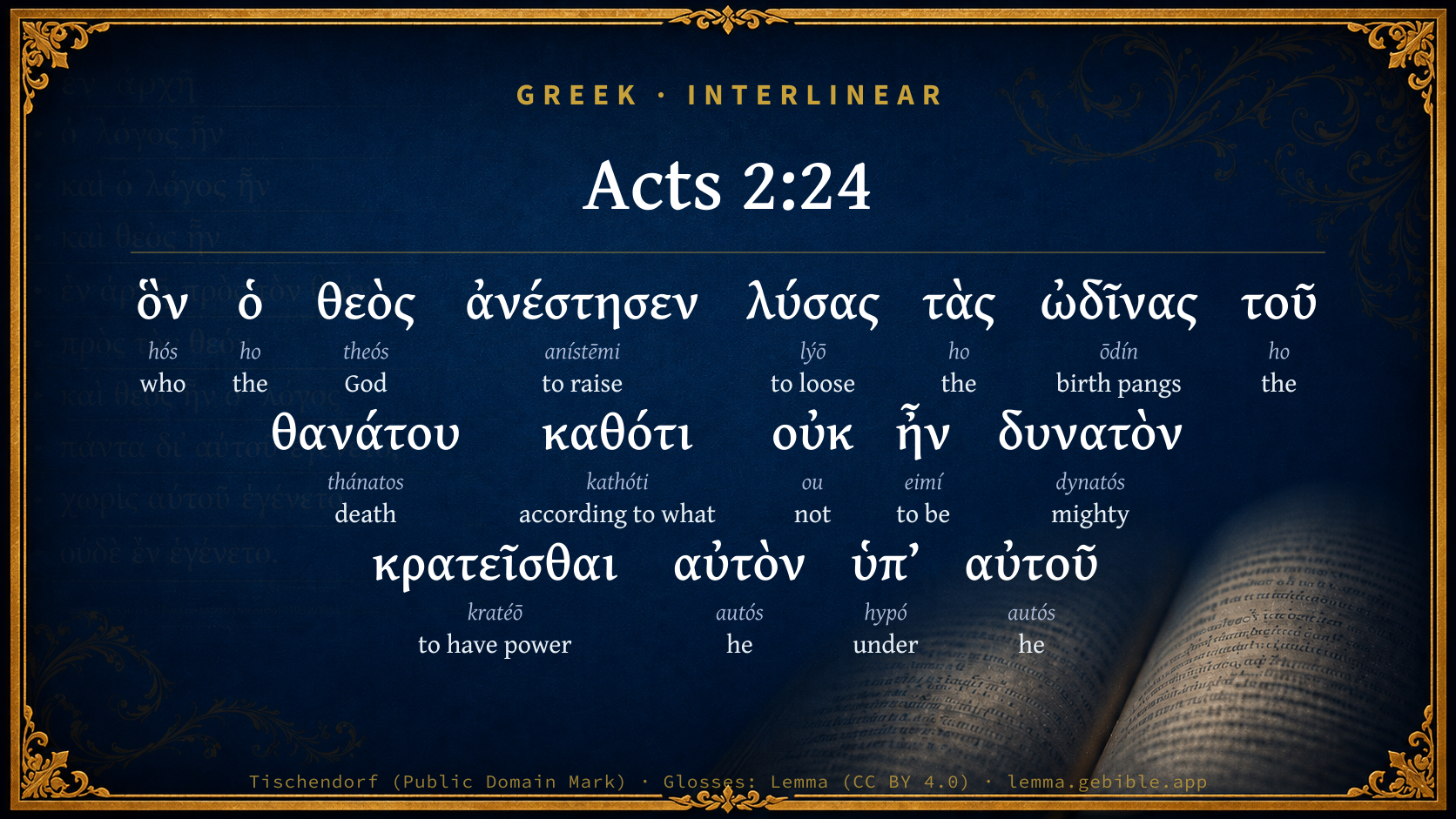
Greek (Tischendorf 8th ed.) Acts 2:24 appears in the Greek New Testament. The text above is from the Tischendorf 8th edition. Each word links to its Strong’s number and a concise gloss. Click any word for its full Thayer’s Greek Lexicon entry.
Download image
Cite this verse

Acts 2:24 (World English Bible). Public Domain. Lemma interlinear Bible study tool, https://lemma.gebible.app/v/acts/2/24.

Show BibTeX & RIS
BibTeX
RIS
English Translation
whom God raised up, having freed him from the agony of death, because it was not possible that he should be held by it.
World English Bible · Public Domain
Download a study sheet

One document with this verse’s original text, its word-by-word gloss line, the meaning frame, cross-references with their text, attributed commentary, and full source and license credits — printable, and it pastes into notes with its structure intact.

This verse Autodidact and up

Study sheet (.html) Plain text (.txt)

A passage Seminary Student

Up to 50 verses in one chapter. A passage sheet keeps up to 6 commentary sources and 12 cross-references per verse, in the order this page ranks them, and says so on the sheet whenever that leaves anything out. Ask for a single verse and you get the Autodidact verse sheet above.

Everything on this page stays free to read, with no account — the sheet is a download of what is already on screen, not access to it.

Want to remove ads? Support Godless Engineer
Compare translations 3

The same verse in 3 English versions, stacked beneath the original-language interlinear above. Click any original word for its lexicon entry.

Each is an independent rendering of the whole verse — the interlinear is not word-aligned to these translations.

Highlighted words mark where these versions differ — a whole-verse word diff, not a word-by-word alignment.

  • World English Bible Public Domain
    whom God raised up, having freed him from the agony of death, because it was not possible that he should be held by it.
  • King James Version Public Domain
    Whom God hath raised up, having loosed the pains of death: because it was not possible that he should be holden of it.
  • unfoldingWord Literal Text CC BY-SA 4.0
    whom God raised up, having loosed the agonies of death, because it was not possible for him to be held by it.

unfoldingWord Literal Text — © unfoldingWord, licensed CC BY-SA 4.0. Word-aligned USFM3 via Door43 (git.door43.org/unfoldingWord/en_ult).

Versions to compare (up to 4)

3 of 4 selected

Show all 19 translations

Every available English version of this verse, each an independent rendering of the whole verse.

  • World English Bible Public Domain
    whom God raised up, having freed him from the agony of death, because it was not possible that he should be held by it.
  • Berean Standard Bible Public Domain
    But God raised Him from the dead, releasing Him from the agony of death, because it was impossible for Him to be held in its clutches.
  • Majority Standard Bible Public Domain
    But God raised Him from the dead, releasing Him from the agony of death, because it was impossible for death to keep Him in its grip.
  • King James Version Public Domain
    Whom God hath raised up, having loosed the pains of death: because it was not possible that he should be holden of it.
  • American Standard Version (1901) Public Domain
    whom God raised up, having loosed the pangs of death: because it was not possible that he should be holden of it.
  • Revised Version (1885) Public Domain
    whom God raised up, having loosed the pangs of death: because it was not possible that he should be holden of it.
  • Geneva Bible (1599) Public Domain
    Whome God hath raised vp, and loosed the sorrowes of death, because it was vnpossible that he should be holden of it.
  • Douay-Rheims (1899) Public Domain
    Whom God hath raised up, having loosed the sorrows of hell, as it was impossible that he should be holden by it.
  • Young's Literal Translation Public Domain
    whom God did raise up, having loosed the pains of the death, because it was not possible for him to be held by it,
  • Literal Standard Version CC BY-SA 4.0
    whom God raised up, having loosed the travails of death, because it was not possible for Him to be held by it;
  • Unlocked Literal Bible CC BY-SA 4.0
    But God raised him up, freeing him from the pains of death, because it was impossible for him to be held by it.
  • unfoldingWord Literal Text CC BY-SA 4.0
    whom God raised up, having loosed the agonies of death, because it was not possible for him to be held by it.
  • Darby Bible Public Domain
    Whom God has raised up, having loosed the pains of death, inasmuch as it was not possible that he should be held by its power;
  • World Messianic Bible Public Domain
    whom God raised up, having freed him from the agony of death, because it was not possible that he should be held by it.
  • Webster's Bible Public Domain
    Whom God hath raised up, having loosed the pains of death: because it was not possible that he should be held by it.
  • Free Bible Version CC BY-SA 4.0
    But God raised him back to life, freeing him from the burden of death, because death did not have the power to keep him a prisoner.
  • Bible in Basic English Public Domain
    But God gave him back to life, having made him free from the pains of death because it was not possible for him to be overcome by it.
  • Text-Critical English NT CC BY 4.0
    But God raised him up, releasing him from the pangs of death, because it was impossible for death to keep its hold on him.
  • Tyndale New Testament (1534) Public Domain
    whom God hath raysed vp and lowsed the sorowes of deeth because it was vnpossible that he shuld be holden of it.

Literal Standard Version (2020), Covenant Press — licensed CC BY-SA 4.0. Text via the HelloAO Bible API (eBible.org). Unlocked Literal Bible (unfoldingWord) — licensed CC BY-SA 4.0. Text via the HelloAO Bible API (eBible.org). unfoldingWord Literal Text — © unfoldingWord, licensed CC BY-SA 4.0. Word-aligned USFM3 via Door43 (git.door43.org/unfoldingWord/en_ult). Free Bible Version, Dr. Jonathan Gallagher — licensed CC BY-SA 4.0. Text via the HelloAO Bible API (eBible.org).

Word by word

More ways to search: Search by grammar → Find every occurrence → Compare this word →

Practice this passage: Drill this verse → Learn its vocabulary →

ὠδῖνας
ōdín
G5604
“birth pangs”
Noun, Accusative, Plural, Feminine
Part of Speech
Noun
Case
Accusative
Number
Plural
Gender
Feminine
Full Thayer's Definition

Origin: akin to G3601

TDNT: 20:07,1

1. the pain of childbirth, travail pain, birth pangs 2. intolerable anguish, in reference to the dire calamities precede the advent of the Messiah
  1. ὃν hós G3739 “who” Relative pronoun, Accusative, Singular, Masculine
  2. ὁ ho G3588 “the” Article, Nominative, Singular, Masculine
  3. θεὸς theós G2316 “God” Noun, Nominative, Singular, Masculine
  4. ἀνέστησεν anístēmi G450 “to raise” Verb, Aorist, Active, Indicative, 3rd person, Singular
  5. λύσας lýō G3089 “to loose” Verb, Aorist, Active, Participle, Nominative, Singular, Masculine
  6. τὰς ho G3588 “the” Article, Accusative, Plural, Feminine
  7. τοῦ ho G3588 “the” Article, Genitive, Singular, Masculine
  8. θανάτου thánatos G2288 “death” Noun, Genitive, Singular, Masculine
  9. καθότι kathóti G2530 “according to what” Adverb
  10. οὐκ ou G3756 “not” Particle, Negative
  11. ἦν eimí G1510 “to be” Verb, Imperfect, Active, Indicative, 3rd person, Singular
  12. δυνατὸν dynatós G1415 “mighty” Adjective, Nominative, Singular, Neuter
  13. κρατεῖσθαι kratéō G2902 “to have power” Verb, Present, Passive, Infinitive
  14. αὐτὸν autós G846 “he” Personal pronoun, Accusative, Singular, Masculine
  15. ὑπ’ hypó G5259 “under” Preposition
  16. αὐτοῦ autós G846 “he” Personal pronoun, Genitive, Singular, Masculine

About this verse

These counts appear in no published source. They are computed here, from the morphology-tagged text and Lemma’s own curated glosses. What Lemma adds →

17
words
14
distinct lemmas
Acts
section

Notable vocabulary

The rarest word here is ὠδῖνας birth pangs G5604 — appearing just 4 times in the whole Greek New Testament.

Shared distinctive vocabulary

ὠδῖνας birth pangs G5604 occurs in 4 verses of the Greek New Testament. Also found in:

Repetition

Words recur within this verse:

Cross-references

41

Topical passages linked to Acts 2:24 in the Treasury of Scripture Knowledge — connected by theme and wording, ordered by reader-vote popularity; previews shown in the World English Bible.

  • 1 Corinthians 6:14 Now God raised up the Lord, and will also raise us up by his power.
  • Acts 2:32 This Jesus God raised up, to which we all are witnesses.
  • 1 Peter 1:21 who through him are believers in God, who raised him from the dead, and gave him glory; so that your faith and hope might be in God.
  • Romans 8:11 But if the Spirit of him who raised up Jesus from the dead dwells in you, he who raised up Christ Jesus from the dead will also give life to your mortal bodies through his Spirit who dwells in you.
  • Colossians 2:12 having been buried with him in baptism, in which you were also raised with him through faith in the working of God, who raised him from the dead.
  • Romans 6:4 We were buried therefore with him through baptism to death, that just like Christ was raised from the dead through the glory of the Father, so we also might walk in newness of life.
  • John 10:18 No one takes it away from me, but I lay it down by myself. I have power to lay it down, and I have power to take it again. I received this commandment from my Father."
  • 2 Corinthians 4:14 knowing that he who raised the Lord Jesus will raise us also with Jesus, and will present us with you.
  • Ephesians 1:20 which he worked in Christ, when he raised him from the dead, and made him to sit at his right hand in the heavenly places,
  • Hebrews 13:20 Now may the God of peace, who brought again from the dead the great shepherd of the sheep with the blood of an eternal covenant, our Lord Jesus,
  • 1 Thessalonians 1:10 and to wait for his Son from heaven, whom he raised from the dead-- Jesus, who delivers us from the wrath to come.
  • John 2:19–21 Jesus answered them, "Destroy this temple, and in three days I will raise it up."
  • Acts 3:15 and killed the Prince of life, whom God raised from the dead, to which we are witnesses.
  • Acts 13:30 But God raised him from the dead,
  • Acts 17:31 because he has appointed a day in which he will judge the world in righteousness by the man whom he has ordained; of which he has given assurance to all men, in that he has raised him from the dead."
  • Romans 4:24 but for our sake also, to whom it will be accounted, who believe in him who raised Jesus, our Lord, from the dead,
  • Romans 10:9 that if you will confess with your mouth the Lord Jesus, and believe in your heart that God raised him from the dead, you will be saved.
  • Luke 24:1–53 But on the first day of the week, at early dawn, they and some others came to the tomb, bringing the spices which they had prepared.
  • Acts 3:26 God, having raised up his servant, Jesus, sent him to you first, to bless you, in turning away everyone of you from your wickedness."
  • Galatians 1:1 Paul, an apostle (not from men, neither through man, but through Jesus Christ, and God the Father, who raised him from the dead),
  • Psalms 116:3–4 The cords of death surrounded me, The pains of Sheol got a hold of me. I found trouble and sorrow.
  • Psalms 116:16 Yahweh, truly I am your servant. I am your servant, the son of your handmaid. You have freed me from my chains.
  • John 20:9 For as yet they didn't know the Scripture, that he must rise from the dead.
  • Acts 4:10 be it known to you all, and to all the people of Israel, that in the name of Jesus Christ of Nazareth, whom you crucified, whom God raised from the dead, in him does this man stand here before you whole.
  • Acts 10:40–41 God raised him up the third day, and gave him to be revealed,
  • Acts 13:33–34 that God has fulfilled the same to us, their children, in that he raised up Jesus. As it is also written in the second psalm, 'You are my Son. Today I have become your father.'
  • Acts 13:37 But he whom God raised up saw no decay.
  • 1 Corinthians 15:15 Yes, we are found false witnesses of God, because we testified about God that he raised up Christ, whom he didn't raise up, if it is so that the dead are not raised.
  • Revelation 1:18 and the Living one. I was dead, and behold, I am alive forevermore. Amen. I have the keys of Death and of Hades.
  • Isaiah 26:19 Your dead shall live; my dead bodies shall arise. Awake and sing, you who dwell in the dust; for your dew is [as] the dew of herbs, and the earth shall cast forth the dead.
  • Romans 8:34 Who is he who condemns? It is Christ who died, yes rather, who was raised from the dead, who is at the right hand of God, who also makes intercession for us.
  • Romans 14:9 For to this end Christ died, rose, and lived again, that he might be Lord of both the dead and the living.
  • 1 Corinthians 15:12 Now if Christ is preached, that he has been raised from the dead, how do some among you say that there is no resurrection of the dead?
  • Isaiah 25:8 He has swallowed up death forever; and the Lord Yahweh will wipe away tears from off all faces; and the reproach of his people will he take away from off all the earth: for Yahweh has spoken it.
  • Matthew 27:63 saying, "Sir, we remember what that deceiver said while he was still alive: 'After three days I will rise again.'
  • John 12:39 For this cause they couldn't believe, for Isaiah said again,
  • Isaiah 53:10 Yet it pleased Yahweh to bruise him; he has put him to grief: when you shall make his soul an offering for sin, he shall see [his] seed, he shall prolong his days, and the pleasure of Yahweh shall prosper in his hand.
  • Hosea 13:14 I will ransom them from the power of Sheol. I will redeem them from death! Death, where are your plagues? Sheol, where is your destruction? Compassion will be hidden from my eyes.
  • Hebrews 2:14 Since then the children have shared in flesh and blood, he also himself in like manner partook of the same, that through death he might bring to nothing him who had the power of death, that is, the devil,
  • John 10:35 If he called them gods, to whom the word of God came (and the Scripture can't be broken),
  • Acts 1:16 "Brothers, it was necessary that this Scripture should be fulfilled, which the Holy Spirit spoke before by the mouth of David concerning Judas, who was guide to those who took Jesus.

Cross-references courtesy of OpenBible.info (CC BY 4.0).

Commentary

Notes on Acts 2:24 from classic Christian and Jewish commentators (each source and its license shown beneath its notes). The classic Christian expositions comment on the surrounding passage and are grouped to its opening verse, so a note may address several verses; the Jewish commentaries on the Tanakh (Rashi and others) are per-verse, so they appear only where the commentator wrote on this verse.

Lemma curates 59 commentaries, every one of them public domain or Creative Commons licensed, each selected and text-cleaned for this edition rather than reprinted as found. About our sources →

Bengel's Gnomon

Johann Albrecht Bengel

Act 2:24. Λύσας, having loosed) This verb accords with the term חבלים, which is denoted by the Latin Vulg. funes, “the cords” or ‘bands;’ but it is also used of the pains of one in parturition.—τὰς ὠδῖνας, the pains) out of which new life arose. Jesus experienced the pains of death whilst He died. In death, τετέλεσται, He was consummated, all was finished; and therefore after death there were no more pains: a little after, in His resurrection there was made a loosing, not of pains, but of the bonds or bands, which had brought with them the pain, whilst He was in the act of dying.—ᾅδου) Ὠδῖνες θανάτου and ὠδῖνες ᾅδου are expressions used in Psalms 18 (17):5, 6, “The sorrows (in margin, cords) of hell compassed me about; the snares of death prevented me.” In Luke most have written θανάτου, perhaps with a view to soften the mode of expression; but the old reading, ᾅδου, is more in accordance with Act 2:27; Act 2:31.[13]—ΟὐΚ ἮΝ ΔΎΝΑΤΟΝ, it was not possible) on account of the predictions mentioned in Act 2:25, and the reasons mentioned in those predictions. To this the must (δεῖ) in ch. Act 3:21 corresponds. Hence we find so often the expression, once, once for all, so often used as to the death of Christ: Rom 6:10, note: “In that He died, He died unto sin once” (ἐφάπαξ, not merely ἍΠΑΞ).—ὙΠʼ ΑὐΤΟῦ, by it) by Hades or Hell, although a powerful enemy.

[13] The larger Ed. had preferred the reading θανάτου; but the 2d Ed. prefers ᾅδου, with the Gnomon and Vers. Germ.—E. B.

ABCE Theb. read θανάτου. De Vulg. Memph. Syr. read ᾅδου: Iren. 193, ‘inferorum.’—E. and T.

Bengel's Gnomon of the New Testament — English translation (T&T Clark, Edinburgh, 1860) — public domain. Text from a community e-Sword module.

Meyer's Critical & Exegetical Commentary

Heinrich August Wilhelm Meyer

Act_2:24. Τὰς ὠδῖνας] Peter most probably used the common expression from the O. T.: חֶבְלֵי מָוֶת, snares of death, in which the θάνατος personified is conceived as a huntsman laying a snare. Psa_18:5 f., Psa_116:3. See Gesen. Thes. I. p. 440. The LXX. erroneously translates this expression as ὠδῖνες θανάτου, misled by חֵבֶל, dolor (Isa_66:7), in the plural חֲבָלִים, used particularly of birth-pangs. See the LXX. Psa_18:5; 2Sa_22:6. But Lukeand this betrays the use of a Hebrew source directly or indirectlyhas followed the LXX., and has thus changed the Petrine expression vincula mortis into dolores mortis. The expression of Luke, who with ὠδῖνες could think of nothing else than the only meaning which it has in Greek, gives the latter, and not the former sense. In the sense of Peter, therefore, the words are to be explained: after he has loosed the snares of death (with which death held him captive); but in the sense of Luke: after he has loosed the pangs of death. According to Luke (comp. on πρωτότοκος ἐκ τῶν νεκρῶν, Col_1:18), the resurrection of Jesus is conceived as birth from the dead. Death travailed (ὁ θάνατος ὤδινε κατέχων αὐτόν, Chrys.) in birth-throes even until the dead was raised again. With this event these pangs ceased, they were loosed; and because God has made Christ alive, God has loosed the pangs of death. On λύσας, see LXX. Job_39:3; Soph. O. C. 1612, El. 927; Aelian. H. A. xii. 5. Comp. Plat. Pol. ix. p. 574 A: μεγάλαις ὠδῖσί τε καὶ ὀδύναις συνέχεσθαι. The aorist participle is synchronous with ἀνέστησε. To understand the death-pangs of Christ, from which God freed Him resuscitando eum ad vitam nullis doloribus obnoxiam (Grotius), is incorrect, because the liberation from the pains of death has already taken place through the death itself, with which the earthly work of Christ, even of His suffering, was finished (Joh_19:30). Quite groundless is the assertion of Olshausen, that in Hellenistic Greek ὠδῖνες has not only the meaning of pains, but also that of bonds, which is not at all to be vouched by the passages in Schleusn. Thes. V. p. 571.

καθότι: according to the fact, that; see on Luk_1:7.

οὐκ ἦν δύνατον which is afterwards proved from David. It was thus impossible in virtue of the divine destination attested by David. Other reasons (Calovius: on account of the unio personalis, etc.) are here far-fetched.

κρατεῖσθαι ὑπʼ αὐτοῦ] The θάνατος could not but give Him up; Christ could not be retained by death in its power, which would have happened, if He, like other dead, had not become alive again and risen to eternal life (Rom_6:9). On κρατεῖσθαι ὑπό, to be ruled by, comp.4Ma_2:9; Dem. 1010. 17. By His resurrection Christ has done away death as a power (2Ti_1:10; 1Co_15:25 f.).

Meyer — Critical and Exegetical Commentary on the New Testament — English translation by Peter Christie, edited by Frederick Crombie (T&T Clark, 1880) — public domain. Text from a community e-Sword module.

Geneva Bible (1599)

Geneva Bible translators

Christ (as David foretold) did not only rise again, but also was in the grave void of all corruption.

The dead that was full of sorrow both of body and mind: therefore when death appeared conqueror and victor over those sorrows, Christ is rightly said to have overcome those sorrows of death, when as being dead, he overcame death, to live forever with his Father.

Geneva Bible (1599) marginal notes — public domain. Text via Bolls.life.

Jamieson, Fausset & Brown

Robert Jamieson, A. R. Fausset & David Brown

was not possible he should be holden of it--Glorious saying! It was indeed impossible that "the Living One" should remain "among the dead" (Luk 24:5); but here, the impossibility seems to refer to the prophetic assurance that He should not see corruption.

Jamieson, Fausset & Brown — Commentary Critical and Explanatory on the Whole Bible (1871) — public domain (CC PDM 1.0). Text via the HelloAO Bible API.

Adam Clarke's Commentary

Verse 24. Whom God hath raised up] For, as God alone gave him up to death, so God alone raised him up from death.

Having loosed the pains of death] It is generally supposed that this expression means, the dissolving of those bonds or obligations by which those who enter into the region of the dead are detained there till the day of the resurrection; and this is supposed to be the meaning of חבלי מות chebley maveth, in Ps 116:3, or חבלי שאול chebley sheol, in Ps 18:5, and in 2Sa 22:6, to which, as a parallel, this place has been referred. But Kypke has sufficiently proved that λυειν τας ωδινας θανατου, signifies rather to REMOVE the pains or sufferings of death. So Lucian, De Conscr. Hist., says, "a copious sweat to some, ελυσε τον πυρετον, REMOVES or carries off the fever." So STRABO, speaking of the balm of Jericho, says, λυει δε κεφαλαλγιας θαυμαστως-it wonderfully REMOVES the headache, c. That Christ did suffer the pains and sorrows of death in his passion is sufficiently evident but that these were all removed, previously to his crucifixion, is fully seen in that calm manner in which he met it, with all its attendant terrors. If we take the words as commonly understood, they mean that it was impossible for the Prince of Life to be left in the empire of death: his resurrection, therefore, was a necessary consequence of his own Divine power.

Instead of θανατου, of death, the Codex Bezae, Syriac, Coptic, and Vulgate, have αιδου, of hell, or the place of separate spirits; and perhaps it was on no better authority than this various reading, supported but by slender evidence, that, He descended into hell, became an article in what is called the apostles' creed. And on this article many a popish legend has been builded, to the discredit of sober sense and true religion.

Adam Clarke's Commentary on the Bible (1810–1826) — public domain. Text from a community e-Sword/MySword module.

John Calvin's Commentaries

24. Having loosed the sorrows of death. By the sorrows of death I understand some farther thing than the bodily sense or feeling. For those which duly consider the nature of death, because they hear that it is the curse of God, must needs conceive that God is angry in death. Hence cometh marvelous horror, wherein there is greater misery than in death itself. Furthermore, Christ died upon this occasion that he might take upon him our guiltiness. That inward fear of conscience, which made him so afraid that he sweat blood when he presented himself before the throne and tribunal seat of God, did more vex him, and brought upon him greater horror, than all the torments of the flesh. And whereas Peter saith, that Christ did wrestle with such sorrows, and doth also declare that he had the victory, by this it cometh to pass that the faithful ought not now to be afraid of death; for death hath not the like quality now which was in Adam; because by the victory of Christ the curse is swallowed up, (1 Corinthians 15:54.) We feel, indeed, yet the pricking of sorrows, but such as do not wholly wound us, whilst that we hold up the buckler of faith against them. He added a reason, because it was impossible that Christ should be oppressed by death, who is the author of life.

John Calvin's Commentaries (1540-1563) — public domain. Text from the Calvin Translation Society English edition (1840s-50s) via the Christian Classics Ethereal Library (ccel.org). Calvin's coverage is partial (roughly two-thirds of the Bible); uncommented books and verses are honest gaps, never fabricated. The 19th-century editor's footnotes and remarks are omitted so the notes are faithfully Calvin's own voice.

Ellicott's Commentary for English Readers

(24) Whom God hath raised up.—It is probable enough that some rumours of the Resurrection had found their way among the people, and had been met by the counter-statement of which we read in Mat_28:11-15; but this was the first public witness, borne by one who was ready to seal his testimony with his blood, to the stupendous fact.

Having loosed the pains of death.—The word for “pains” is the same as that for “sorrows” in Mat_24:8 : literally, travail-pangs. The phrase was not uncommon in the LXX. version, but was apparently a mistranslation of the Hebrew for “cords,” or “bands,” of death. If we take the Greek word in its full meaning, the Resurrection is thought of as a new birth as from the womb of the grave.

Because it was not possible. . . .—The moral impossibility was, we may say, two-fold. The work of the Son of Man could not have ended in a failure and death which would have given the lie to all that He had asserted of Himself. Its issue could not run counter to the prophecies which had implied with more or less clearness a victory over death. The latter, as the sequel shows, was the thought prominent in St. Peter’s mind.

A Bible Commentary for English Readers, edited by Charles John Ellicott (1878–1897) — public domain. Text from a community e-Sword module.

John Gill's Exposition

Whom God raised up,.... From the dead; for though his life was taken away by men, he was raised to life again by God the Father, to whom the resurrection of Christ is generally ascribed, though not to the exclusion of Christ himself, and the blessed Spirit; and this being what the apostles were witnesses of, and the Jews endeavoured to stifle as much as they could, it being the sign Christ gave them of the truth of his Messiahship; and this being also a fundamental article of the Christian religion, the apostle enlarges upon it:

having loosed the pains of death; this may be understood either of what Christ had done for his people by dying for them; he had abolished death; he had took away its sting, and delivered them from the curse of it, having fulfilled the law, satisfied justice, and made full atonement for their sin; so that though they die, death is not a penal evil to them, nor shall they always continue under the power of it: or of what God did in raising Christ from the dead; he delivered him from the power of death, by which he was held in the grave, and which is expressed by a word which signifies pains and sorrows, even those of a woman in travail; which though he felt not now, he had gone through them; his low state in the grave was the effect of them; and these are said to be loosed when he was raised up, he being so entirely delivered from them, as that they should never come upon him more: and it is to be observed, that the same word in the Hebrew language, and so in the Chaldee and Syriac, in which Peter might speak, signifies both cords and sorrows; and we often read in Talmudic and Rabbinic (w) writings, of , "the sorrows", or "pains" of the Messiah. The death which Christ died, being the death of the cross, was a very painful one: he endured great pains in his body, smote with rods, and buffeted with the hands of men; by being scourged and whipped, and having a crown of thorns platted on his head; but the pains of the cross were still greater, his body being stretched out upon it, and fastened to it by nails drove through his hands and feet, and then reared up, and jogged in the earth, where he hung upon it in extreme agony, till he expired: and these pains he endured, not through want of love to him in his Father, who, as he does not willingly grieve and afflict the children of men, so neither would he his own Son; nor was it on account of any sin of his, for he knew none, nor did he commit any; but he was wounded, and bruised, and endured these sorrows and pains for the sins of his people: as he was their surety, it was necessary he should die, because the wages of sin is death, and the justice and veracity of God required it; and it was proper he should die the painful death of the cross, because of the types and prophecies of it, and chiefly that he might appear to be made a curse for his people: though more must be meant here than the pains he endured in the moment and article of death, since they ceased at death, and he was then freed from them; whereas the text speaks of a loosing him from them at his resurrection, which supposes that they continued on him until that time; wherefore these pains of death also signify the power and dominion death had over him, and continued to have over him in the grave; with the cords of which he was bound and held, till he was loosed by raising him from the dead. Dr. Goodwin is of opinion, that these words are to be understood, not of the resurrection of Christ's body from the pains and power of death, but at least chiefly of the recovery and revival of his soul from those spiritual agonies which attended him, and from which he was loosed and delivered before his death; and the rather, because as before observed, at death the pains of it are gone, the bitterness of it is over, and nothing is felt in the grave; besides, the word here used signifies the pains of a woman in travail, Th1 5:3 and seems best to agree with those inward sufferings of Christ, which are called "the travail of his soul", Isa 53:11 and which, like the pangs of a woman in labour, came upon him gradually: four or five days before his death he said, "now is my soul troubled", Joh 12:27. The night in which he was betrayed, when he came into the garden, he began to be sorrowful, and heavy, and sore amazed; and at length he breaks out, and says, "my soul is exceeding sorrowful, even unto death", Mat 26:37 and after some time his pains increase, and being in agony, he prayed more earnestly, and his sweat was, as it were, great drops of blood, Luk 22:44 but the sharpest pains were yet to come, and which he endured when on the cross, being forsaken by his God and Father, Mat 27:46 and which arose partly from the sins of his people, the filth and guilt of them laid upon him, which must be very distressing to his pure and holy mind; and from the wrath of God, and curse of the law, which he sustained as the punishment for them; and it was necessary he should bear the whole punishment due to sin, the punishment of sense, or feel the wrath of God, and the strokes of divine justice, and the punishment of loss, or be deprived of the divine presence; and these sorrows of soul may be well called the pains or sorrows of death, because they were unto death, and issued in it; a corporeal death followed upon them; and when he was in the garden, and on the cross, it might be truly said, "the sorrows of death compassed him about", Psa 18:4 but from these he was loosed just before his death, when he said, "it is finished"; the darkness was over; the light of God's countenance broke out upon him; he heard his cry, and helped him in the acceptable time, in the day of salvation; his anger, as a judge, was turned away from him, justice being entirely satisfied; and therefore it was not possible he should be held any longer with these cords and sorrows of death; for he being an infinite person, was able to bear all the wrath of God at once, which was due to sin, and therefore did not bring on him an eternal death as on the wicked, he sustaining and satisfying for all at once; and, like another Samson, broke asunder these cords like threads, and was loosed from them. But after all, though these are very great truths; yet, according to the order in which these words lie, being placed after the account of the crucifixion and death of Christ, they seem rather to respect the resurrection of his body, and the loosing it from the power and dominion of death; and in such sense as never to return to it, or any more feel the pains of it. One of Stephen's copies reads, "the pains of Hades", or the invisible state; and the Vulgate Latin version, "the pains of hell"; as in Psa 18:5 where the grave is meant; and the Syriac version, , "the pains", or "cords of the grave": the word "cords", or "bands", best agrees with the word "loosing"; and the Ethiopic version renders it, "the bands of death",

Because it was not possible he should be holden of it: of death, and under the power of it; partly, because of the power and dignity of his person, as the Son of God, he being still the Prince of life, and who by dying abolished death, and him that had the power of it; and partly, because as the surety of his people, he had made full satisfaction for sin, and had brought in an everlasting righteousness, and therefore ought in justice to be discharged, and detained a prisoner no longer; as also because of the prophecies of the Old Testament concerning his resurrection, which must be fulfilled, as follows,

(w) T. Bab. Sabbat, fol. 118. 2. & Sanhedrin, fol. 98. 2. Alkath Rocel, l. 1. p. 1. & passim.

John Gill's Exposition of the Whole Bible (1746–1763) — public domain (CC PDM 1.0). Text via the HelloAO Bible API.

Trapp's Complete Commentary

John Trapp

24 Whom God hath raised up, having loosed the pains of death: because it was not possible that he should be holden of it.

Ver. 24. It was not possible] For he was life essential, and therefore "swallowed up death in victory," 1Co 15:54.

Him being delivered by the determinate counsel of God] Quod dum devitatur impletur, saith Gregory. The wicked’s intense rage carries on God’s decree against their wills; for while they sit backward to his command, they row forward to his decree; dum sun cuique Deus fit dira libido.

John Trapp, A Commentary or Exposition upon All the Books of the Old and New Testament (1647–1656) — public domain. Text from a community e-Sword module.

Albert Barnes' Notes on the Bible

Whom God hath raised up - This was the main point, in this part of his argument, which Peter wished to establish. He could not but admit that the Messiah had been in an ignominious manner put to death. But he now shows them that God had also raised him up; had thus given his attestation to his doctrine; and had sent down his Spirit according to the promise which the Lord Jesus made before his death.

Having loosed the pains of death - The word “loosed,” λύσας lusas, is opposed to bind, and is properly applied to a cord, or to anything which is bound. See Mat 21:2; Mar 1:7. Hence, it means to free or to liberate, Luk 13:16; 1Co 7:27. It is used in this sense here; though the idea of untying or loosing a band is retained, because the word translated “pains” often means “a cord or band.”

The pains of death - ὠδῖνας τοῦ θάνατου ōdinas tou thanatou. The word translated “pains” denotes properly “the extreme sufferings of parturition, and then any severe or excruciating pangs.” Hence, it is applied also to death, as being a state of extreme suffering. A very frequent meaning of the Hebrew word of which this is the translation is cord or band. This, perhaps, was the original idea of the word; and the Hebrews expressed any extreme agony under the idea of bands or cords closely drawn, binding and constricting the limbs, and producing severe pain. Thus, death was represented under this image of a band that confined people, that pressed closely on them, that prevented escape, and produced severe suffering. For this use of the word חבל chebel, see Psa 119:61; Isa 66:7; Jer 22:23; Hos 13:13. It is applied to death, Psa 18:5, “The snares of death prevented me”; corresponding to the word “sorrows” in the previous part of the verse; Psa 116:3, “The sorrows of death compassed me, and the pains of hell (Hades or Sheol, the cords or pains that were binding me down to the grave) gat held on me.”

We are not to infer from this that our Lord suffered anything after death. It means simply that he could not be held by the grave, but that God loosed the bonds which had held him there; that he now set him free who had been encompassed by these pains or bonds until they had brought him down to the grave. Pain, mighty pain, will encompass us all like the constrictions and bindings of a cord which we cannot loose, and will fasten our limbs and bodies in the grave. Those bands begin to be thrown around us in early life, and they are drawn closer and closer, until we lie panting under the stricture on a bed of pain, and then are still and immovable in the grave - subdued in a manner not a little resembling the mortal agonies of the tiger in the convolutions of the boa constrictor, or like Laocoon and his sons in the folds of the serpents from the Island of Tenedos.

It was not possible - This does not refer to any natural impossibility, or to any inherent efficacy or power in the body of Jesus itself, but simply means that “in the circumstances of the case such an event could not be.” Why it could not be he proceeds at once to show. It could not be consistently with the promises of the Scriptures. Jesus was the “Prince of life” Act 3:15; he had life in himself Joh 1:4; Joh 5:26; he had power to lay down his life and to take it again Jdg 10:18; and it was indispensable that he should rise. He came, also, that through death he might destroy him that had the power of death that is, the devil Heb 2:14; and as it was his purpose to gain this victory, he could not be defeated in it by being confined to the grave.

Albert Barnes' Notes on the Bible (1834–1885) — public domain. Text from a community e-Sword/MySword module.

Haydock's Catholic Bible Commentary

Having loosed the sorrows[2] of hell, &c. In the ordinary Greek copies, of death. As to the sense of this place, 1. It is certain Christ suffered the pains and pangs of a violent death. 2. That his soul suffered no pains after death, nor in any place called hell. 3. We believe, as in the Apostles’ Creed, that his blessed soul descended into hell, that is, to that place in the inferior parts of the earth, (Ephesians iv. 9.) which we commonly call Limbus Patrum [Limbo of the Fathers], not to suffer, but to free the souls of the just from thence. --- As it was impossible he should be held there, either by death, or hell, his soul being always united to the divine person: and his rising again being foretold in the Psalms, in the words here cited. (Witham) --- Having overcome the grievous pains of death, and all the power of hell. (Challoner) --- Not that Jesus suffered any thing after his death; that was impossible. But these pains were loosed in his regard, because he was preserved from them, as the bird is preserved from the nets of the fowlers, which are broken before it is taken in them. (St. Augustine, ep. ad. Olimp. xcv.) --- Moreover he loosed others of those pains. (St. Augustine, lib. xii, chap. 13. de Gen. ad lit.)

===============================

[BIBLIOGRAPHY]

Solutis doloribus Inferni. Greek: lusas tas odinas adou, though in the common Greek copies, Greek: thanatou. See St. John Chrysostom, hom vi.

George Leo Haydock (1774–1849), Haydock's Catholic Family Bible and Commentary, 1859 edition — public domain. Excludes Psalms (Douay-Rheims chapter numbering differs from Protestant) and Deuterocanonical books (Catholic canon only).

Matthew Poole's English Annotations

Whom God hath raised up: Christ rose by his own power as God: it being, perhaps, too strong meat to be given at first to such who were under so great prejudices against our Saviour; but by consequence in the following discourse he sufficiently shows it.

Loosed; the same word לבח variously pointed, signifying either a cord or pain, the metaphor of loosing agrees with it.

The pains of death: though our Lord endured no more pain after he had said, It is finished, and had yielded up the ghost; yet whilst he was in the grave, being under the power of death, the pains of death are said to be loosed at his resurrection.

It was not possible that he should be holden of it long, much less for ever; being such a one as David spake of.

Matthew Poole's English Annotations on the Holy Bible (1683–1685) — public domain. Text from a community e-Sword/MySword module.

Whedon's Commentary on the Bible

Daniel D. Whedon

24. Whom God hath raised—Now comes the great sequel to this crucifixion—the resurrection. The listeners knew the crucifixion; the apostles, as Peter will assure them, (Act_2:32,) knew the resurrection. But first he will prove it by testimony infallible, namely, testimony before the fact, being Divine prophecy.

Loosed the pains of death—In his resurrection Jesus was not released from the “pains of death,” for they had ceased when he expired. In Psa_18:5, the Hebrew word for “snares” or “bonds of death” may signify either snares, or birth-pains, or agonies in general. The Septuagint Greek has ωδινες, a word of this last signification. Luke, in translating Peter’s speech from the Hebrew, in which it was spoken, into Greek, uses the Septuagint word. Probably in the Hebraized Greek of the day the word had the same double meaning; so that an English translator might suitably render it snares or “bonds of death;” a meaning suggested by the terms loosed and holden.

Not possible—The impossibility that Christ should fail of a resurrection was not because it was prophetically predicted, but it was predicted because it was an impossibility. The Prince of Life could die in order to be the author of life to dying men; but the conquest of death must give way to a resurrection. His death was voluntary, his resurrection a necessity. The impossibility is additional, in Peter’s own view, to the prophecy. He knew it to lie in the very nature of Christ, who was able not only to lay down his life but to take it again. Hence in a true sense his resurrection was a natural event, being the legitimate effect of a sufficient cause. Hence, there is a fine truth in a striking reply of Goldwin Smith to those who object to a religion’s depending on human testimony. The resurrection of Christ is a necessary result of the high perfection of his character. If his life is a true life, and his death a transcendent death, then his resurrection is a necessary sequence, whether proved by human testimony or not. Not only does the testimony prove the fact, but the fact proves the testimony.

Holden of it—Holden of death. We have a mighty Saviour who submitted to death, conquered death, and finally holds the keys of death and of Hades. His resurrection, surely, is a very natural event.

Daniel D. Whedon (gen. ed.), Commentary on the Old and New Testaments (1874–1909) — public domain. Text from a community e-Sword module.

The Pulpit Commentary

Raised for hath raised, A.V.; pangs for pains, A.V. Pangs. St. Luke follows the LXX, who render the tw,m; or ylebj, oftou, Psa_18:5, 6 116:3, by wjdinev qana as if the Hebrew word were lb,je, the pains or pangs of a woman in childbirth, whereas it really is lb,j, a cord, as it is rendered in the margin of Psa_18:5, meaning the snare of the fowler. The variation is very similar to that of the fruit of our lips" in Heb_13:15, compared with the calves of our lips" of Hos_14:2. It is manifest that "loosed" applies better to cords than to pangs. It was not possible. Why, not possible?

1. Because of the union of the Godhead and manhood in the one Person of Christ.

2. Because of God"s character, which makes it impossible that one who trusts in him should be forsaken, or that God"s Holy One should see corruption.

3. Because the Scripture, which cannot be broken, declared the resurrection of Christ.

The Pulpit Commentary (1880–1919), ed. H.D.M. Spence-Jones & Joseph S. Exell — public domain. Text from a community e-Sword module.

John Wesley's Explanatory Notes

Having loosed the pains of death - The word properly means, the pains of a woman in travail. As it was not possible that he should be held under it - Because the Scripture must needs be fulfilled.

John Wesley, Explanatory Notes Upon the Whole Bible (1754–1765) — public domain. Text via the GEBible commentary corpus.

McGarvey & Pendleton's Commentaries

J. W. McGarvey

See notes on verse 22

J. W. McGarvey (with Philip Y. Pendleton), Commentaries on the New Testament (The Fourfold Gospel, 1914; Acts; and the epistles) — public domain. Text from a community e-Sword/MySword module.

The People's New Testament

B. W. Johnson

24. Because it was not possible that he should be holden. It was not possible that Jesus be held by death, because he had life in himself, and, besides, it was the Father's will that he should arise. This verse epitomizes the four Gospels.

B. W. Johnson's The People's New Testament with Notes (1889–1891) — public domain. Electronic text from the Christian Classics Ethereal Library (CCEL) ThML edition.

Cambridge Greek Testament for Schools and Colleges

24. τὰς ὠδῖνας τοῦ θανάτου. The expression occurs in LXX. Psa 17:5, &c.

Cambridge Greek Testament for Schools and Colleges (Cambridge University Press, 1896; 21 vols, various authors incl. Carr, Maclear, Plummer, Farrar, Lumby, Moule, M. R. James, Simcox) — public domain. Text from a community e-Sword module.

Alford’s Greek Testament

Henry Alford

24.] There is some difficulty in explaining the expression ὠδῖνας in the connexion in which it is here found. The difficulty lies, not in the connexion of λύειν with ὠδῖνας, which is amply justified, see reff., but in the interpretation of ὠδῖνας here. For ὠδῖνας θαν. must mean the pains of death, i.e. the pains which precede and end in death; a meaning here inapplicable. (The explanation of Chrys., Theophyl., Œc., ὁ θάνατος ὤδινε κατέχων αὐτόν, κ. τὰ δεινὰ ἔπασχε, will not be generally maintained at the present day. Stier does maintain it, Reden der Apostel, vol. i. p. 43 ff., but to me not convincingly: and, characteristically, Wordsw. also.) The fact may be, that Peter used the Hebrew word חֶבְלֵי, ref. Psa. ‘nets, or bands,’ i.e. the nets in which death held the Lord captive; and that, in rendering the words into Greek, the LXX rendering of the word in that place and Psa 114:3, viz. ὠδῖνες, has been adopted. (But see Prolegg. to Vol. I. ch. ii. § ii. pp. 28, 29.) It has been attempted in vain by Olshausen and others to shew that ὠδῖνες sometimes in Hellenistic Greek signifies bands. No one instance cited by Schleusner (Lex. V. T.) of that meaning is to the point. See Simonis Lex., חבל.

οὐκ ἦν δυν. depends for its proof on the γάρ which follows.

Henry Alford, The Greek Testament (1849–1861) — public domain. Text from a community e-Sword module.

Vincent's Word Studies in the New Testament

Marvin R. Vincent

Pains [ωδινας] . The meaning is disputed. Some claim that Peter followed the Septuagint mistranslation of Psa 18:5, where the Hebrew word for snares is rendered by the word used here, pains; and that, therefore, it should be rendered snares of death; the figure being that of escape from the snare of a huntsman. Others suppose that death is represented in travail, the birth - pangs ceasing with the delivery; i e., the resurrection. This seems to be far - fetched, though it is true that in classical Greek the word is used commonly of birth - throes. It is better, perhaps, on the whole, to take the expression in the sense of the A. V., and to make the pains of death stand for death generally.

Marvin R. Vincent, Word Studies in the New Testament (1887–1900) — public domain. Text from a community e-Sword/MySword module.

Lesson kit

Teaching starters — assembled from the data on this page, not authored interpretation. Every prompt links to the verse data it draws on. Edit before teaching.

Acts, in the Acts, opens this verse with 17 words (14 distinct Greek lemmas). Its most distinctive word is ōdín (“birth pangs”). A historical commentator’s framing appears above. Read the whole chapter for the surrounding context.

Discussion questions

  1. What does “birth pangs” (ōdín) contribute to the verse as a whole?
  2. How does Matthew 24:8, which shares the word «birth pangs», read alongside this verse?
  3. What does the repetition of “the” (3× in this one verse) do in this verse?
  4. These translations render this verse differently. What is at stake in choosing one wording over another?
  5. Compare how Bengel's Gnomon and Meyer's Critical & Exegetical Commentary read this verse. Where do they agree or differ?

Things to notice

Reading settings

Reading text

Shown beneath each verse's original-language words.

Old Testament
Old Testament edition

Read the OT as the Masoretic Hebrew (MT) or the Greek Septuagint (LXX).

English shown for the Greek Septuagint (in the Hebrew ↔ Greek comparison).

Comparing translations? Open the Compare panel on any verse page to stack up to four side by side.