
Acts 7:45

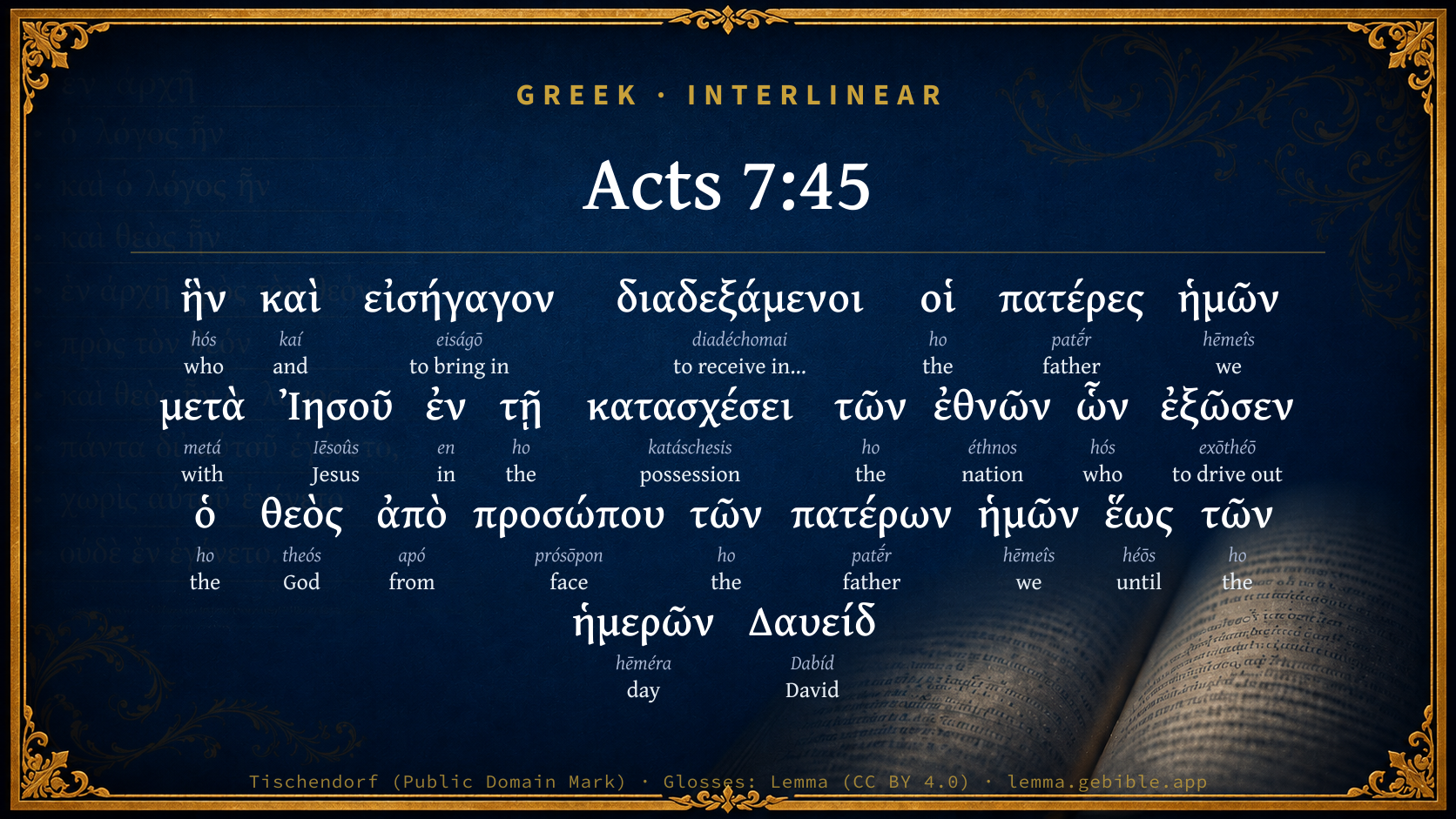
Greek (Tischendorf 8th ed.) Acts 7:45 appears in the Greek New Testament. The text above is from the Tischendorf 8th edition. Each word links to its Strong’s number and a concise gloss. Click any word for its full Thayer’s Greek Lexicon entry.
Download image
Cite this verse

Acts 7:45 (World English Bible). Public Domain. Lemma interlinear Bible study tool, https://lemma.gebible.app/v/acts/7/45.

Show BibTeX & RIS
BibTeX
RIS
English Translation
which also our fathers, in their turn, brought in with Joshua when they entered into the possession of the nations, whom God drove out before the face of our fathers, to the days of David,
World English Bible · Public Domain
Highlights
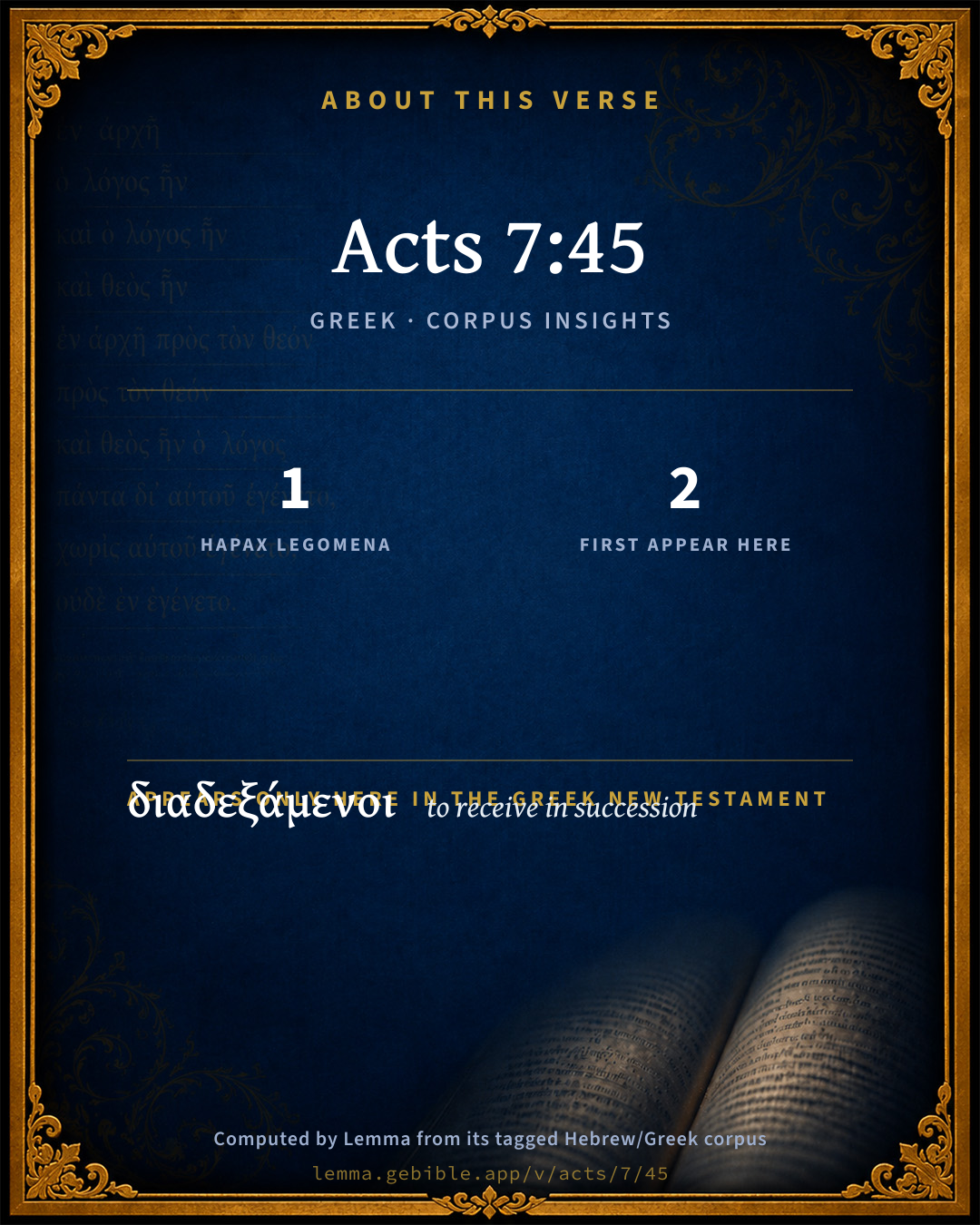
  • 1 hapax legomenon — only here in the Greek New Testament
  • 2 first appearances in the Greek New Testament
Full analysis ↓
Download a study sheet

One document with this verse’s original text, its word-by-word gloss line, the meaning frame, cross-references with their text, attributed commentary, and full source and license credits — printable, and it pastes into notes with its structure intact.

This verse Autodidact and up

Study sheet (.html) Plain text (.txt)

A passage Seminary Student

Up to 50 verses in one chapter. A passage sheet keeps up to 6 commentary sources and 12 cross-references per verse, in the order this page ranks them, and says so on the sheet whenever that leaves anything out. Ask for a single verse and you get the Autodidact verse sheet above.

Everything on this page stays free to read, with no account — the sheet is a download of what is already on screen, not access to it.

Want to remove ads? Support Godless Engineer
Compare translations 3

The same verse in 3 English versions, stacked beneath the original-language interlinear above. Click any original word for its lexicon entry.

Each is an independent rendering of the whole verse — the interlinear is not word-aligned to these translations.

Highlighted words mark where these versions differ — a whole-verse word diff, not a word-by-word alignment.

  • World English Bible Public Domain
    which also our fathers, in their turn, brought in with Joshua when they entered into the possession of the nations, whom God drove out before the face of our fathers, to the days of David,
  • King James Version Public Domain
    Which also our fathers that came after brought in with Jesus into the possession of the Gentiles, whom God drave out before the face of our fathers, unto the days of David;
  • unfoldingWord Literal Text CC BY-SA 4.0
    which also our fathers, having received it in turn, brought in with Joshua in the possessing of the nations that God drove out from the face of our fathers, until the days of David,

unfoldingWord Literal Text — © unfoldingWord, licensed CC BY-SA 4.0. Word-aligned USFM3 via Door43 (git.door43.org/unfoldingWord/en_ult).

Versions to compare (up to 4)

3 of 4 selected

Show all 19 translations

Every available English version of this verse, each an independent rendering of the whole verse.

  • World English Bible Public Domain
    which also our fathers, in their turn, brought in with Joshua when they entered into the possession of the nations, whom God drove out before the face of our fathers, to the days of David,
  • Berean Standard Bible Public Domain
    And our fathers who received it brought it in with Joshua when they dispossessed the nations God drove out before them. It remained until the time of David,
  • Majority Standard Bible Public Domain
    And our fathers who received it brought it in with Joshua when they dispossessed the nations God drove out before them. It remained until the time of David,
  • King James Version Public Domain
    Which also our fathers that came after brought in with Jesus into the possession of the Gentiles, whom God drave out before the face of our fathers, unto the days of David;
  • American Standard Version (1901) Public Domain
    Which also our fathers, in their turn, brought in with Joshua when they entered on the possession of the nations, that God thrust out before the face of our fathers, unto the days of David;
  • Revised Version (1885) Public Domain
    Which also our fathers, in their turn, brought in with Joshua when they entered on the possession of the nations, which God thrust out before the face of our fathers, unto the days of David;
  • Geneva Bible (1599) Public Domain
    Which tabernacle also our fathers receiued, and brought in with Iesus into the possession of the Gentiles, which God draue out before our fathers, vnto the dayes of Dauid:
  • Douay-Rheims (1899) Public Domain
    Which also our fathers receiving, brought in with Jesus, into the possession of the Gentiles, whom God drove out before the face of our fathers, unto the days of David.
  • Young's Literal Translation Public Domain
    which also our fathers having in succession received, did bring in with Joshua, into the possession of the nations whom God did drive out from the presence of our fathers, till the days of David,
  • Literal Standard Version CC BY-SA 4.0
    which also our fathers having in succession received, brought in with Joshua, into the possession of the nations whom God drove out from the presence of our fathers, until the days of David,
  • Unlocked Literal Bible CC BY-SA 4.0
    Later, our fathers, under Joshua, received the tabernacle and brought it with them when they took possession of the land. God took the land from the nations and drove them out before the face of our fathers. The tabernacle remained in the land until the time of David,
  • unfoldingWord Literal Text CC BY-SA 4.0
    which also our fathers, having received it in turn, brought in with Joshua in the possessing of the nations that God drove out from the face of our fathers, until the days of David,
  • Darby Bible Public Domain
    which also our fathers, receiving from their predecessors, brought in with Joshua when they entered into possession of [the lands of] the nations, whom God drove out from [the] face of our fathers, until the days of David;
  • World Messianic Bible Public Domain
    which also our fathers, in their turn, brought in with Joshua when they entered into the possession of the nations whom God drove out before the face of our fathers to the days of David,
  • Webster's Bible Public Domain
    Which also our fathers, that came after, brought in with Jesus into the possession of the Gentiles, whom God drove out before the face of our fathers, to the days of David;
  • Free Bible Version CC BY-SA 4.0
    Later on, our forefathers carried it with them when they went in with Joshua to occupy the land taken from the nations the Lord drove out before them. It stayed there until the time of David.
  • Bible in Basic English Public Domain
    Which our fathers, in their turn, took with them when, with Joshua, they came into the heritage of the nations whom God was driving out before the face of our fathers, till the time of David,
  • Text-Critical English NT CC BY 4.0
    Receiving it in turn, our fathers brought it in with Joshua when they dispossessed the nations whom God drove out from their presence. It remained there until the days of David,
  • Tyndale New Testament (1534) Public Domain
    Which tabernacle oure fathers receaved and brought it in with Iosue into the possession of the gentyls which God drave out before the face of oure fathers vnto the tyme of David

Literal Standard Version (2020), Covenant Press — licensed CC BY-SA 4.0. Text via the HelloAO Bible API (eBible.org). Unlocked Literal Bible (unfoldingWord) — licensed CC BY-SA 4.0. Text via the HelloAO Bible API (eBible.org). unfoldingWord Literal Text — © unfoldingWord, licensed CC BY-SA 4.0. Word-aligned USFM3 via Door43 (git.door43.org/unfoldingWord/en_ult). Free Bible Version, Dr. Jonathan Gallagher — licensed CC BY-SA 4.0. Text via the HelloAO Bible API (eBible.org).

Word by word

More ways to search: Search by grammar → Find every occurrence → Compare this word →

Practice this passage: Drill this verse → Learn its vocabulary →

διαδεξάμενοι
diadéchomai
G1237
“to receive in succession”
Verb, Aorist, Middle deponent, Participle, Nominative, Plural, Masculine
Part of Speech
Verb
Tense
Aorist
Voice
Middle deponent
Mood
Participle
Case
Nominative
Number
Plural
Gender
Masculine
Full Thayer's Definition

Origin: from G1223 and G1209

TDNT: None

1. to receive through another, anything left or bequeathed by him, to receive in succession, receive in turn, succeed to
  1. ἣν hós G3739 “who” Relative pronoun, Accusative, Singular, Feminine
  2. καὶ kaí G2532 “and” Conjunction
  3. εἰσήγαγον eiságō G1521 “to bring in” Verb, Aorist, Active, Indicative, 3rd person, Plural
  4. οἱ ho G3588 “the” Article, Nominative, Plural, Masculine
  5. πατέρες patḗr G3962 “father” Noun, Nominative, Plural, Masculine
  6. ἡμῶν hēmeîs G2249 “we” Personal pronoun, 1st person, Genitive, Plural
  7. μετὰ metá G3326 “with” Preposition
  8. Ἰησοῦ Iēsoûs G2424 “Jesus” Noun, Genitive, Singular, Masculine
  9. ἐν en G1722 “in” Preposition
  10. τῇ ho G3588 “the” Article, Dative, Singular, Feminine
  11. κατασχέσει katáschesis G2697 “possession” Noun, Dative, Singular, Feminine
  12. τῶν ho G3588 “the” Article, Genitive, Plural, Neuter
  13. ἐθνῶν éthnos G1484 “nation” Noun, Genitive, Plural, Neuter
  14. ὧν hós G3739 “who” Relative pronoun, Genitive, Plural, Neuter
  15. ἐξῶσεν exōthéō G1856 “to drive out” Verb, Aorist, Active, Indicative, 3rd person, Singular
  16. ὁ ho G3588 “the” Article, Nominative, Singular, Masculine
  17. θεὸς theós G2316 “God” Noun, Nominative, Singular, Masculine
  18. ἀπὸ apó G575 “from” Preposition
  19. προσώπου prósōpon G4383 “face” Noun, Genitive, Singular, Neuter
  20. τῶν ho G3588 “the” Article, Genitive, Plural, Masculine
  21. πατέρων patḗr G3962 “father” Noun, Genitive, Plural, Masculine
  22. ἡμῶν hēmeîs G2249 “we” Personal pronoun, 1st person, Genitive, Plural
  23. ἕως héōs G2193 “until” Adverb
  24. τῶν ho G3588 “the” Article, Genitive, Plural, Feminine
  25. ἡμερῶν hēméra G2250 “day” Noun, Genitive, Plural, Feminine
  26. Δαυείδ Dabíd G1138 “David” Noun, Proper, indeclinable

About this verse

These counts appear in no published source. They are computed here, from the morphology-tagged text and Lemma’s own curated glosses. What Lemma adds →

27
words
19
distinct lemmas
Acts
section

Notable vocabulary

1 hapax legomenon — a word that appears only here in the entire Greek New Testament:

  • διαδεξάμενοι to receive in succession G1237

First appearance in Scripture

These words make their first canonical appearance in the Greek New Testament here:

  • διαδεξάμενοι to receive in succession G1237
  • ἐξῶσεν to drive out G1856

Shared distinctive vocabulary

κατασχέσει possession G2697 occurs in 2 verses of the Greek New Testament. Also found in:
Repetition

Words recur within this verse:

Cross-references

18

Topical passages linked to Acts 7:45 in the Treasury of Scripture Knowledge — connected by theme and wording, ordered by reader-vote popularity; previews shown in the World English Bible.

  • Psalms 44:2 You drove out the nations with your hand, But you planted them. You afflicted the peoples, But you spread them abroad.
  • Joshua 18:1 The whole congregation of the children of Israel assembled themselves together at Shiloh, and set up the tent of meeting there: and the land was subdued before them.
  • Joshua 23:9 For Yahweh has driven out from before you great nations and strong: but as for you, no man has stood before you to this day.
  • Joshua 24:18 and Yahweh drove out from before us all the peoples, even the Amorites who lived in the land: therefore we also will serve Yahweh; for he is our God.
  • Deuteronomy 32:49 Go up into this mountain of Abarim, to Mount Nebo, which is in the land of Moab, that is over against Jericho; and see the land of Canaan, which I give to the children of Israel for a possession;
  • Joshua 3:6–7 Joshua spoke to the priests, saying, Take up the ark of the covenant, and pass over before the people. They took up the ark of the covenant, and went before the people.
  • Joshua 3:11–17 Behold, the ark of the covenant of the Lord of all the earth passes over before you into the Jordan.
  • Judges 18:31 So they set them up Micah's engraved image which he made, all the time that the house of God was in Shiloh.
  • 1 Samuel 4:4 So the people sent to Shiloh; and they brought from there the ark of the covenant of Yahweh of Hosts, who sits [above] the cherubim: and the two sons of Eli, Hophni and Phinehas, were there with the ark of the covenant of God.
  • 2 Samuel 6:1–23 David again gathered together all the chosen men of Israel, thirty thousand.
  • 1 Kings 8:4 They brought up the ark of Yahweh, and the tent of meeting, and all the holy vessels that were in the Tent; even these did the priests and the Levites bring up.
  • 1 Chronicles 15:1–17 [David] made him houses in the city of David; and he prepared a place for the ark of God, and pitched for it a tent.
  • 1 Chronicles 16:39 and Zadok the priest, and his brothers the priests, before the tent of Yahweh in the high place that was at Gibeon,
  • 1 Chronicles 21:29 For the tent of Yahweh, which Moses made in the wilderness, and the altar of burnt offering, were at that time in the high place at Gibeon.
  • Nehemiah 9:24 So the children went in and possessed the land, and you subdued before them the inhabitants of the land, the Canaanites, and gave them into their hands, with their kings, and the peoples of the land, that they might do with them as they would.
  • Psalms 78:55 He also drove out the nations before them, Allotted them for an inheritance by line, And made the tribes of Israel to dwell in their tents.
  • Acts 13:19 When he had destroyed seven nations in the land of Canaan, he gave them their land for an inheritance, for about four hundred fifty years.
  • Hebrews 4:8 For if Joshua had given them rest, he would not have spoken afterward of another day.

Cross-references courtesy of OpenBible.info (CC BY 4.0).

Commentary

Notes on Acts 7:45 from classic Christian and Jewish commentators (each source and its license shown beneath its notes). The classic Christian expositions comment on the surrounding passage and are grouped to its opening verse, so a note may address several verses; the Jewish commentaries on the Tanakh (Rashi and others) are per-verse, so they appear only where the commentator wrote on this verse.

Lemma curates 59 commentaries, every one of them public domain or Creative Commons licensed, each selected and text-cleaned for this edition rather than reprinted as found. About our sources →

The Preacher's Complete Homiletical Commentary

Joseph S. Exell (gen. ed.)

CRITICAL REMARKS

Act_7:45. Our fathers that came after should be simply our fathers. Jesus is Joshua, as in Heb_4:8. Into (lit. in) the possession of the Gentiles.—Meaning that the Ark was brought in to remain in the possession of the nations—i.e., in their land. The R.V. reads, “When they entered on the possession of the nations”; lit. “at” or “in” their taking possession of (the land of) the nations.

Act_7:46. Tabernacle should be “habitation,” permanent abode, like “house” in Act_7:47.

Act_7:48. The prophet was Isaiah (Isa_66:1-2).

Act_7:52. Which of the prophets, etc., echoed the words of Christ (Mat_5:12; Mat_23:31; Luk_13:34).

Act_7:53. By the disposition of the angels is better rendered in the R.V., as it was ordained by angels, or as ordinances of angels; lit. unto ordinances of angels. Compare Gal_3:19 and Heb_2:2.

HOMILETICAL ANALYSIS.—Act_7:45-53

From Joshua to Jesus; or, the Downward Course of Israel

I. Joshua and the conquest.—

1. The clearing out of the nations from Canaan.

(1) Effected instrumentally by the swords of Joshua and his warriors. Stephen does not hint that the extermination of the Canaanites was a horrible impiety; this is mostly done by tender-hearted “moderns” who see nothing wrong in shooting down “inferior races” when they happen to be possessed of desirable lands.

(2) Sanctioned providentially and even commanded verbally by God Himself (Deu_7:1-2; Deu_32:49), so that Stephen represents the nations as having been thrust out by God before the face of the fathers of Israel. That God had a perfect right to eject the degraded Canaanites from their land, and to do so in whatever way He chose, no one can dispute. That He selected Joshua and his warriors for this purpose could not render the action wrong on God’s part, and was ample justification for Joshua 2. The entering in of Israel into their possession. This took place under the leadership of Joshua, who in conducting Israel to Canaan served as an eminent type of Christ. In taking over the soil the Israelites did nothing different from what has been going on ever since in the providence of God. Degenerate nations retire, go down, and become extinct before or are absorbed in superior peoples who are better able to occupy the land.

3. The establishment in Canaan of Jehovah’s worship. Stephen clearly believed that Moses had made a tabernacle in the wilderness, and that Joshua had fetched it into Canaan, setting it up first at Gilgal (Jos_4:18-19), and latterly at Shiloh (Jos_18:1; Jos_19:51). In so doing Israel under Joshua began her national history well. Had she adhered to Jehovah and His tabernacle her subsequent fortunes, and perhaps the history of the world, would have been different.

II. David and the monarchy.—Two things noted.

1. Concerning David’s character. That he found favour in the sight of God, and was a man after God’s own heart (Act_13:22; 1Sa_13:14), who delighted to do Jehovah’s will (Psa_40:8). This does not imply that David never fell into sin.

2. Concerning David’s request. To be allowed to find a habitation for the God of Jacob. This request, though denied him, was pronounced good and accepted as an evidence of his piety (1Ch_22:7-8). In David’s days Israel’s national glory reached its zenith. In the next reign it began to decline.

III. Solomon and the temple.—

1. The honour conferred upon David’s son. He was permitted to carry out his father’s project and erect a house for the worship of Jehovah (1 Kings 6, 8). A signal honour of which in his latter days he became unmindful (1Ki_11:1-13). Eminent service in and to the Church is no certain guarantee against apostasy. For the notion that Stephen intended “to declare that Solomon built the temple without warrant, in place of the tabernacle” (Weizsäcker), there is not the shadow of foundation.

2. The silence preserved about his reign. It is significant that Stephen adds nothing more about David’s son; as if he desired to convey the impression that nothing more to Solomon’s advantage or Israel’s could be said. Possibly this was so. Nevertheless, Nihil nisi bonum de mortuis is an excellent maxim.

IV. Isaiah and Jehovah.—

1. The decline in religion after Solomon. Notwithstanding the magnificence of the temple worship, and perhaps partly because of its magnificence, it began to degenerate—drifting first into mere external ritual, and latterly terminating in shameful and shameless idolatry (see Isa_1:11-15; Isa_2:8).

2. The lofty doctrine of the prophets. That Jehovah was not a local divinity, but the sovereign of the universe; that He could not be confined to any material edifice, however imposing, since heaven was His throne and the earth His footstool; and that He could not be served by any mere bodily performance or visible ceremonial, but only by the true homage of the heart.

3. The evil fortunes of the prophets. The people, stiff-necked and uncircumcised in heart, resisted the Holy Ghost who spake in them (2Sa_23:2; 2Pe_1:21), and persecuted them, sometimes even unto death (Mat_23:29-35).

V. Jesus and His contemporaries.—

1. Their exalted privileges.

(1) They had received the law, as it was ordained by angels, or as the ordinance of angels (Psa_68:17).

(2) They had been honoured by the coming to them of the righteous One (Joh_1:11).

2. Their heinous sins.

(1) They had not kept the law (Joh_7:19).

(2) They had betrayed and murdered the righteous One (Act_2:23).

Learn.—

1. The powerlessness of mere external privilege to save.

2. The heredity that shows itself in sin as well as in piety.

3. The criminality of those who know the truth, and do not walk in accordance therewith.

HINTS AND SUGGESTIONS

Act_7:44-47. Four Old Testament Typical Persons.

I. Moses.—As

1. Deliverer.

2. Mediator.

3. Lawgiver.

II. Joshua.—As

1. Captain.

2. Conqueror.

3. Consolidator.

III. David.—As

1. Shepherd.

2. King.

IV. Solomon.—As

1. Builder of the Temple.

2. As Prince of Peace.

Act_7:47. The House and its Dwellers.

I. The house.—There was on earth once a house which Jehovah called His own. Though the Most High dwelleth not in temples made with hands, yet He chose for Himself a local habitation, and built for Himself a place of special abode. For many an age it was simply a tent, of stakes, and boards, and curtains; in after ages it was a palace, of marble, and gold, and cedar, and brass; but whether it was named Jehovah’s tent or Jehovah’s temple, it was still the place of His habitation.

II. The dwellers.—They of old were Israel. To them pertained the house, and the altar, and the mercy seat, and the glory.

III. The blessedness.—“Blessed are they that dwell in Thy house.” This blessedness is both negative and positive. It arises out of that which we are freed from, and that which we gain.

1. The negative. On entering the house of God, we are delivered from the dangers which beset all who remain outside.

2. The positive.

(1) Love. Jehovah’s house is specially the abode of love. It was love that thought of such a house for us; it was love that planned it, and love that built it. It is love too that fills it, and provides all its excellences.

(2) Companionship. It is not into a cell we enter—a prison, a desert, a place of isolation. It is into a home, a well-replenished habitation, a well-peopled city. Israel’s temple was such, to which the tribes went up. Much of life’s happiness is derived from the fellowship of heart with heart, and the communion of saints is no small portion of our joy, even here. Here, on earth, companionship is imperfect, and is sometimes a hindrance, a vexation. Not so hereafter, in the “house not made with hands,” the city of habitation, the eternal tabernacle.

(3) Service. “They serve Him day and night in His temple.” “His servants shall serve Him.” It is to serve, as well as to reign, that we are called. Such service is, in all its parts, blessedness. David knew the blessedness of service in his day.

(4) Glory. At present it is not glory, save in anticipation.—H. Bonar, D.D.

Act_7:48-50. The Greatness and Majesty of God.

I. The throne of His glory.—Heaven. A throne.

1. Resplendent.—Filled with His presence.

2. Exalted.—High above this world (Psa_103:19).

3. Powerful.—Wielding authority over all created things.

II. The footstool of His feet.—The earth. As such:

1. The work of His hands (Isa_48:13).

2. Under His rule (Psa_110:1).

3. Destined to share His glory (Isa_60:13).

III. The place of His rest.—

1. The temple which Solomon built, symbolically (Psa_132:14).

2. The universe, which He himself built, really.

Learn.—

1. The reverence due to God (Ecc_5:2).

2. The hopefulness of earth’s future (Isa_60:13).

3. The spirituality of divine worship (Joh_4:21-24).

Act_7:51-53. A Terrible Indictment.

I. Jehovah’s law broken.—And that by men who had received it at the hands of angels.

II. Jehovah’s prophets murdered.—And that by the men they had come to instruct.

III. Jehovah’s Son slain.—And that by those who should have been His protectors.

IV. Jehovah’s Spirit resisted.—And that by the men who had been pledged to obey.

The Preacher's Complete Homiletical Commentary (gen. ed. Joseph S. Exell; Funk & Wagnalls, c. 1892) — public domain (pre-1929). A full-Bible homiletical/sermon-outline anthology covering 65 of 66 books (2 John is absent from the source module). Text from a community e-Sword module.

Bengel's Gnomon

Johann Albrecht Bengel

Act 7:45. Διαδεξάμενοι, having received) in a long succession.—ἐν, in [or into]) when they subdued the peoples (in Canaan).—τῇ κατασχέσει, the occupation [‘possession’]) מורשה, LXX. κατάσχεσις· ירש, κατέσχε.

Bengel's Gnomon of the New Testament — English translation (T&T Clark, Edinburgh, 1860) — public domain. Text from a community e-Sword module.

Meyer's Critical & Exegetical Commentary

Heinrich August Wilhelm Meyer

Act_7:45. Which also our fathers with Joshua (in connection with Joshua, under whose guidance they stood), after having received it (from Moses), brought in (to Canaan). διαδέχεσθαι (only here in the N. T.) denotes the taking over from a former possessor, 4Ma_4:15; Dem. 1218, 23. 1045, 10; Polyb. ii. 4. 7; xxxi. 12. 7; Lucian. Dial. M. xi. 3.

ἐν τῇ κατασχέσει τῶν ἐθνῶν] κατάσχεσις, as in Act_7:5, possessio (LXX., Apocr., Joseph.). But ἐν is not to be explained as put for εἰς (Vulgate, Calvin, Grotius, Kuinoel, and others), nor is κατάσχεσις τῶν ἐθνῶν taking possession of the land of the Gentiles (as is generally held), which is not expressed. Rather: the fathers brought in the tabernacle of the covenant during the possession of the Gentiles, i.e. while the Gentiles were in the state of possession. To this, then, significantly corresponds what further follows: ὧν ἔξωσεν ὁ Θεὸς κ.τ.λ. But of what the Gentiles were at that time possessors, is self-evident from εἰσήγαγονnamely, of the Holy Land, to which the εἰς in εἰσήγαγ. refers according to the history well known to the hearers.

ἀπὸ προσώπου τ. π. ἡμ.] away from the face of our fathers, so that they withdrew themselves by flight from their view. Comp. LXX. Exo_34:24; Deu_11:23. On the aorist form ἔξωσα, from ἐξωθεῖν, see Winer, p. 86 [E. T. 111].

ἕως τῶν ἡμ. Δ.] is to be separated from the parenthetic clause ὧν ἔξωσεν … ἡμῶν, and to be joined to the preceding: which our fathers brought in … until the days of David, so that it remained in Canaan until the time of David (inclusively). Kuinoel attaches it to ὧν ἔξωσεν κ.τ.λ.; for until the time of David the struggle with the inhabitants of Canaan lasted. This is in opposition to the connection, in which the important point was the duration of the tabernacle-service, as the sequel, paving the way for the transition to the real temple, shows; with David the new epoch of worship begins to dawn.

Meyer — Critical and Exegetical Commentary on the New Testament — English translation by Peter Christie, edited by Frederick Crombie (T&T Clark, 1880) — public domain. Text from a community e-Sword module.

Expositor's Greek Testament

ed. W. Robertson Nicoll

Act 7:45 . διαδεξάμενοι : having received in their turn, i.e. , from Moses, only here in N.T., cf. 4Ma 4:15 ; so also in classical Greek, in Dem. and in Polyb., cf. διαδοχῆς , “in their turn,” Herod., viii., 142: (on the technical meaning of διάδοχος , to which in the LXX διαδεχόμενος is akin to the term of a deputy, or of one next to the king, see Deissmann, Bibelstudien , pp. 111, 112). μετὰ Ἰησοῦ , cf. Heb 4:8 , where Syr. Pesh. has “Jesus the son of Nun” (but not here). ἐν τῇ κατασχέσει τῶν ἐθνῶν : “when they entered on the possession of the nations,” R.V., lit [212] , in the taking possession of the nations, i.e. , of the land inhabited by the nations (Wendt). A.V. follows Vulgate; frequent in LXX, cf. Jos., Ant. , ix., 1, 2, and Test. xii. Patr. , x., used by Philo in the sense of a portion given to keep (Grimm-Thayer). ὧν : Attic attraction, cf. Act 1:1 . ἀπὸ προσώπου : for a similar phrase cf. Deu 11:23 ; Deu 12:29-30 , etc., and frequently in LXX, Hebrew מִפְּנֵי . ἕως τῶν ἡμ . Δ .: to be connected with the first part of the verse, “which also our fathers brought in … unto the days of David” (inclusively), see Wendt, in loco, i.e. , “et mansit tabernaculum usque ad tempora Davidis” (Blass). Rendall takes the words as closely joined to ὧν ἐξῶσεν , but the clause ὧν ἐξῶσεν … ἡμῶν is rather subordinate.

[212] literal, literally.

The Expositor's Greek Testament, edited by W. Robertson Nicoll (1897–1910) — public domain. Text from a community e-Sword module.

Geneva Bible (1599)

Geneva Bible translators

Delivered from hand to hand.

God drove them out, that they should yield up the possession of those countries to our fathers, when they entered into the land.

By the figure Metonymy, for the countries which the Gentiles possessed.

Geneva Bible (1599) marginal notes — public domain. Text via Bolls.life.

Jamieson, Fausset & Brown

Robert Jamieson, A. R. Fausset & David Brown

which . . . our fathers that came after--rather, "having received it by succession" (Margin), that is, the custody of the tabernacle from their ancestors.

brought in with Jesus--or Joshua.

into the possession--rather, "at the taking possession of [the territory of] the Gentiles."

unto the days of David--for till then Jerusalem continued in the hands of the Jebusites. But Stephen's object in mentioning David is to hasten from the tabernacle which he set up, to the temple which his son built, in Jerusalem; and this only to show, from their own Scripture (Isa 66:1-2), that even that temple, magnificent though it was, was not the proper resting-place of Jehovah upon earth; as his audience and the nations had all along been prone to imagine. (What that resting-place was, even "the contrite heart, that trembleth at God's word," he leaves to be gathered from the prophet referred to).

Jamieson, Fausset & Brown — Commentary Critical and Explanatory on the Whole Bible (1871) — public domain (CC PDM 1.0). Text via the HelloAO Bible API.

Adam Clarke's Commentary

Verse 45. Brought in with Jesus] That is, with JOSHUA, whom the Greek version, quoted by St. Stephen, always writes ιησους, JESUS, but which should constantly be written Joshua in such cases as the present, in order to avoid ambiguity and confusion.

Possession of the Gentiles] των εθνων, of the heathens, whom Joshua conquered, and gave their land to the children of Israel.

Adam Clarke's Commentary on the Bible (1810–1826) — public domain. Text from a community e-Sword/MySword module.

John Calvin's Commentaries

45. Which they brought in. This serveth to increase the frowardness of the nation, that whereas the tabernacle did continue with them, and they carried the same whithersoever they went, yet could they not be kept within the bounds of God’s covenant, but they would have strange and profane rites; to wit, declaring that God dwelt amidst them, from whom they were so far distant, and whom they did drive out of that inheritance which he had given them. To this purpose serveth that also, that God did beautify the tabernacle with divers miracles; for the worthiness thereof was established by those victories which the Jews had gotten, as it appeareth by divers places of the holy history; therefore, it must needs be that they were very disobedient, which did not cease oftentimes to start aside from that worship which was so many ways approved.

Until the days of David. Although the ark of the Lord continued long in Shiloh, yet it had no certain place until the reign of David, (1 Samuel 1:3;) for it was unlawful for men to erect a place for the same, but it was to be placed in that place which the Lord had showed, as Moses saith oftentimes. Neither durst David himself, after he had taken it from the enemies, bring it into the thrashing-floor of Araunah until the Lord had declared, by an angel from heaven, that that was the place which he had chosen, (2 Samuel 24:16.) And Stephen counteth this a singular benefit of God, not without great cause, that the place was showed to David wherein the Israelites should hereafter worship God; as in the Psalm he rejoiceth as over some notable thing: “I was glad when they said unto me, We will go into the house of the Lord; our feet shall be stable in thy courts, O Jerusalem,” (Psalm 132:3) The priesthood was coupled with the kingdom; therefore, the stability of the kingdom is showed in the resting of the ark; therefore it is said that he desired this so earnestly that he bound himself with a solemn vow, that he would not come within his house, that his eyes should enjoy no sleep, nor his temples any rest, until he should know a place for the Lord, and a tabernacle for the God of Jacob. Furthermore, the place was showed to David, but it was granted to Solomon to build the temple, (1 Kings 5:7.)

John Calvin's Commentaries (1540-1563) — public domain. Text from the Calvin Translation Society English edition (1840s-50s) via the Christian Classics Ethereal Library (ccel.org). Calvin's coverage is partial (roughly two-thirds of the Bible); uncommented books and verses are honest gaps, never fabricated. The 19th-century editor's footnotes and remarks are omitted so the notes are faithfully Calvin's own voice.

Ellicott's Commentary for English Readers

(45) Brought in with Jesus.—This is, of course, as in Heb_4:8, the “Joshua” of the Old Testament. It would, perhaps, have been better, as a general rule, to have reproduced the Hebrew rather than the Greek form of Old Testament names in the English version of the New. On the other hand, there is, in this instance, something gained in our attention being called to the identity of the two names. It is noticeable that though Stephen was on his trial as a disciple of Jesus of Nazareth, that name does not pass his lips as he speaks in his defence, except in this reference to the great captain of Israel. It is possible that under this reticence, there may have been a half-veiled reference to Him who, also bearing the name that marked Him out as a Saviour, had come, after another fashion, “into the possession of the Gentiles.” The word for “possession” is found in Act_7:5, but not elsewhere in the New Testament. In the LXX. it is common enough, as in Gen_47:11; Lev_25:24; Deu_32:51.

A Bible Commentary for English Readers, edited by Charles John Ellicott (1878–1897) — public domain. Text from a community e-Sword module.

The Cambridge Bible for Schools and Colleges

gen. ed. J. J. S. Perowne

45. Which also our fathers that came after] Better, having received it after. For all the generation that came out of Egypt was dead at the entry into Canaan except Caleb and Joshua.

brought in with Jesus [i.e. Joshua] It is better here and in Heb_4:8 to let the Greek orthography give place to the form of the word used in the Old Testament.

into the possession of the Gentiles] The preposition is not into but in, and the noun does not mean the land possessed by the nations, but the act of the Israelites in taking possession of it for themselves. Read, when they took possession of the nations, (lit. in their taking possession,) whom God drove [thrust] out before the face of our fathers, unto the days of David. Till this time the Tabernacle existed, and as the history tells was not always in one place in the land of Canaan, and at the time when the first proposal for a permanent Temple is made by David (2Sa_7:2) and approved by Nathan, God forbids the building of it by David. All which goes to strengthen Stephen’s argument that the worship should not be fettered to one place.

The Cambridge Bible for Schools and Colleges (gen. ed. J. J. S. Perowne; Cambridge University Press, 1878–1918) — public domain. Text from a community e-Sword module.

John Gill's Exposition

Which also our fathers that came after,.... Who came after those that died in the wilderness, and never saw nor entered into the land of Canaan; the children of that generation whose carcasses fell in the wilderness, who sprung from them, came up in their room, and succeeded them:

brought in with Jesus into the possession of the Gentiles; that is, they having received the tabernacle from their fathers, brought it into the land of Canaan, which was possessed by the Gentiles, when they entered into it with Joshua their leader, and captain, at the head of them; who is here called Jesus, as he is in Heb 4:8 for Joshua and Jesus are the same name, and signify a saviour; for such an one Joshua was to the people of Israel; and was an eminent type of Jesus Christ, the captain of our salvation, in his bringing many sons to glory:

whom God drove out before the face of our fathers; the Gentiles, who before possessed the land of Canaan, were drove out by God before the Israelites, to make way for their settlement there; for to whom can the success of those victories over the Canaanites be ascribed, which the Israelites under Joshua obtained, but to God? The language on the "Tingitane", or Hercules's pillars, said to be set up by some of these Canaanites, agrees with this, on which they inscribed these words;

"we are they who fled from the face of Joshua the robber, the son of Nave,''

or Nun:

unto the days of David; this clause must not be read in connection with the words immediately preceding, as if the sense was, that the inhabitants of Canaan were drove out of their land unto the times of David, and then returned and resettled, as in the Ethiopic version; but with the beginning of the verse, and the meaning is, that the tabernacle which the Israelites received from their fathers, and brought into the land of Canaan with them, was there unto the times of David.

John Gill's Exposition of the Whole Bible (1746–1763) — public domain (CC PDM 1.0). Text via the HelloAO Bible API.

Trapp's Complete Commentary

John Trapp

45 Which also our fathers that came after brought in with Jesus into the possession of the Gentiles, whom God drave out before the face of our fathers, unto the days of David;

Ver. 45. Brought in] This argued and aggravated their levitatem plus quam desultoriam, monstrous giddiness in running after strange gods, having the true God so near them as never any people had. (Beza.) It might be said of them as it was once of Baldwin the apostate, that he had religionem Ephemeram, for each day a new religion: or as Lactantius writeth of some idolaters in his time, that they feigned what they pleased, and then feared what they feigned.

John Trapp, A Commentary or Exposition upon All the Books of the Old and New Testament (1647–1656) — public domain. Text from a community e-Sword module.

Albert Barnes' Notes on the Bible

Our fathers that came after - None of the generation that came out of Egypt were permitted to enter into the and of Canaan except Caleb and Joshua, Num 14:22-24; Num 32:11-12. Hence, it is said that their fathers who “came after,” that is, after the generation when the tabernacle was built. The Greek, however, here means, properly, “which also our fathers, having “received,” brought,” etc. The sense is not materially different. Stephen means that it was not brought in by that generation, but by the next.

With Jesus - This should have been rendered “with Joshua.” Jesus is the Greek mode of writing the name “Joshua.” But the Hebrew name should by all means have been retained here, as also in Heb 4:8.

Into the possession of the Gentiles - Into the land possessed by the Gentiles, that is, into the promised land then occupied by the Canaanites, etc.

Whom God ... - That is, he continued to drive them out until the time of David, when they were completely expelled. Or it may mean that the tabernacle was in the possession of the Jews, and was the appointed place of worship, until the time of David, who desired to build him a temple. The Greek is ambiguous. The “connection” favors the latter interpretation.

Albert Barnes' Notes on the Bible (1834–1885) — public domain. Text from a community e-Sword/MySword module.

Matthew Poole's English Annotations

Jesus, or Joshua, it being the same name, as appears also, Heb 4:8, only Jesus is more according to the Greek use: Joshua was a type of Jesus, and agreed with him in his name, and in the reason of his name; he having also saved the people, and brought them into the promised rest; yet the difference is as great between them as betwixt the heavenly Canaan and the earthly.

Before the face of our fathers; they were not able to look upon an Israelite, whilst God was for them.

Matthew Poole's English Annotations on the Holy Bible (1683–1685) — public domain. Text from a community e-Sword/MySword module.

Whedon's Commentary on the Bible

Daniel D. Whedon

45. Fathers that came after—That is, the second generation; the first having died in the wilderness.

With Jesus—Very capriciously, our translators here have put the Greek form of the name Jesus for its Hebrew, Joshua. (See note on Mat_1:1.)

The possession of the Gentiles— The landed possession; that is, the territory

Unto the days of David— This depends upon brought. The meaning is that our fathers of the second generation under Joshua brought the tabernacle into the land of the expelled Canaanites, retaining it until the time of David.

Daniel D. Whedon (gen. ed.), Commentary on the Old and New Testaments (1874–1909) — public domain. Text from a community e-Sword module.

The Pulpit Commentary

In their turn for that come after, (diadexamenoi), A.V.; Joshua (the Hebrew form) for Jesus (the Greek form of the name), A.V.; when they entered on the possession of the nations for into the possession of the Gentiles, A.V.; which God thrust for whom God drave, A.V. In their turn; more literally, having received it in succession. It only occurs here in the New Testament. Meyer quotes RAPC 4Ma 4:15, "On the death of Seleucus, his son Antiochus received the kingdom in succession;" and classical writers. When they entered, etc. There are three ways of construing the words ejn th katascesei twn ejqnwn

(1) as the A.V., taking ejn in the sense of eijv, and making the phrase synonymous with the laud of Canaan, the land which the Gentiles then possessed;

(2) in (their) taking possession (of the land) of the Gentiles, i.e. when they took, taking katascesiv in a transitive sense, which seems to be the sense of the R.V.:

(3) with Meyer, during the holdings or possession by the Gentiles of the land, that, viz. into which their fathers brought the tabernacle. The first seems the most simple and in accordance with the Greek of the New Testament, and with what follows of the expulsion of the nations before the Israelites.

The Pulpit Commentary (1880–1919), ed. H.D.M. Spence-Jones & Joseph S. Exell — public domain. Text from a community e-Sword module.

John Wesley's Explanatory Notes

Which our fathers having received - From their ancestors; brought into the possession of the Gentiles - Into the land which the Gentiles possessed before. So that God's favour is not a necessary consequence of inhabiting this land. All along St. Stephen intimates two things:

1. That God always loved good men in every land:

2. That he never loved bad men even in this. Josh iii, 14.

John Wesley, Explanatory Notes Upon the Whole Bible (1754–1765) — public domain. Text via the GEBible commentary corpus.

Scofield Reference Notes

C. I. Scofield

Jesus

i.e. Joshua.

The Scofield Reference Bible (1917 edition), notes by C. I. Scofield — public domain. Text from a community e-Sword module.

Godbey's Commentary on the New Testament

William B. Godbey

45. Jesus, E. V., in this verse, should read Joshua, as in R. V. The solution consists in the fact that Joshua is a Hebrew word, which means Jesus in Greek. The great general reason why Moses could not lead Israel into the promised land was because of his symbolic character as the law-giver of Israel. [To be sure, he blurred his experience of sanctification by impatience at the waters of Meribah, but soon regained lost ground.] If Moses had led Israel into Canaan, it would typically involve the conclusion that we can be sanctified by good works, i. e., through the law, which is utterly impossible; hence it would not do for Moses to lead them in. As Aaron, the high priest stood at the head of the officiating clergy, he could not enter the land lest the dogma of sanctification by church rites, loyalty and obedience to the ruling ministers could not sanctify you. Miriam, the prophetess, represents the fire-baptized holiness evangelists. If she had entered the land, it would have involved the conclusion that red-hot holiness preachers can sanctify you, which is utterly untrue. As none but Joshua, which means Jesus, could lead them in, it settles the matter in the symbolic theology of the Old Testament, that none but Jesus can sanctify a soul.

William B. Godbey, Commentary on the New Testament (1896–1900) — public domain. Text from a community e-Sword module.

McGarvey & Pendleton's Commentaries

J. W. McGarvey

See notes on verse 44

J. W. McGarvey (with Philip Y. Pendleton), Commentaries on the New Testament (The Fourfold Gospel, 1914; Acts; and the epistles) — public domain. Text from a community e-Sword/MySword module.

Cambridge Greek Testament for Schools and Colleges

45. ἣν καὶ εἰσήγαγον διαδεξάμενοι κ.τ.λ., which also our fathers having received it after, &c. All the generation that came out of Egypt was dead at the entry into Canaan except Caleb and Joshua.

μετὰ Ἰησοῦ, with Joshua. See above on Act 7:29-30.

ἐν τῇ κατασχέσει κ.τ.λ., when they took possession [lit. in their taking possession] of the nations whom God thrust out before the face of our fathers, unto the days of David. Till this time the tabernacle existed, and, as the history tells us, was not always in one place in the land of Canaan, and at the time when the first proposal for a permanent temple is made by David (2Sa 7:2) and approved by Nathan, God forbids the building of it by David. All which goes to strengthen Stephen’s argument that the worship should not be fettered to one place.

Cambridge Greek Testament for Schools and Colleges (Cambridge University Press, 1896; 21 vols, various authors incl. Carr, Maclear, Plummer, Farrar, Lumby, Moule, M. R. James, Simcox) — public domain. Text from a community e-Sword module.

Alford’s Greek Testament

Henry Alford

45. εἰσήγ.] absolute: introduced, viz. εἰς τὴν γῆν:—not connected with ἐν τῇ κατασχ.,—see below.

διαδεξ.] Having inherited it, i.e. succeeded to its custody and privileges. The sense of ‘successores,’ ‘qui majores exceperunt,’ is ungrammatical; as also is that of ‘postea,’ ‘deinceps.’

ἐν τῇ κατασχέσει] at (or ‘in’) their taking possession. The Vulg. rendering, ‘in possessionem gentium,’ is philologically inadmissible; ‘in terram a gentibus occupatam’ (Calvin, De Dieu, Grot., Kuin.) is still worse. The passage of the LXX, Num 32:5, δοθήτω ἡ γῆ αὕτη τοῖς οἰκέταις σου ἐν κατασχέσει, brought forward to justify these renderings, is directly against them. The word is one of those examples of verbal nouns in -σις where the meaning hovers uncertainly between the act of doing and the thing done. Such is often the case with καύχησις in St. Paul. Cf. for a very near approach to the concrete meaning of this word, Num 27:4, Num 27:7. But, abstract or concrete, it always, as might be expected from the very composition of the word, is used of that final and settled possession which Israel took of the land, not of that transitory possession from which the gentes were driven out. So that Wordsw.’s rendering, “the portion, or possession of the Gentiles,” is out of the question.

The martyr combines rapidly a considerable period, during which this κατάσχεσις and this expulsion was taking place (for it was not complete till the time of David) in order to arrive at the next great event of his history, the substitution of the temple of Solomon for the tabernacle.

Henry Alford, The Greek Testament (1849–1861) — public domain. Text from a community e-Sword module.

Vincent's Word Studies in the New Testament

Marvin R. Vincent

That came after [διαδεξαμενοι] . Only here in New Testament. The verb originally means to receive from one another, in succession; and that appears to be the more simple and natural rendering here : having received it (from Moses). Rev., very neatly, in their turn.

Jesus. Joshua. The names are the same, both signifying Savior. See on Mt 1:21.

Into the possession [εν τη κατασχεσει] . Rev., when they entered on the possession. 15 Before the face [απο προσωπου] . More strictly, "away from the face." The same expression occurs in the Septuagint, Deu 11:23.

Marvin R. Vincent, Word Studies in the New Testament (1887–1900) — public domain. Text from a community e-Sword/MySword module.

Lesson kit

Teaching starters — assembled from the data on this page, not authored interpretation. Every prompt links to the verse data it draws on. Edit before teaching.

Acts, in the Acts, opens this verse with 27 words (19 distinct Greek lemmas). Its most distinctive word is diadéchomai (“to receive in succession”). A historical commentator’s framing appears above. Read the whole chapter for the surrounding context.

Discussion questions

  1. The word diadéchomai carries the sense “to receive in succession.” How does it shape the verse?
  2. 1 word here appears nowhere else in the Greek New Testament. Why might the author reach for such rare wording?
  3. 2 words make their first appearance in Scripture here. What does this debut establish?
  4. How does Acts 7:5, which shares the word «possession», read alongside this verse?
  5. What does the repetition of “father” (2× in this one verse) do in this verse?
  6. The translations on this page render this verse differently — a whole-verse word diff, not a word-by-word alignment. What might account for the different wordings?
  7. Compare how The Preacher's Complete Homiletical Commentary and Bengel's Gnomon read this verse. Where do they agree or differ?

Things to notice

  • 1 word in this verse appears nowhere else in the Greek New Testament.
  • 2 words make their first canonical appearance in Scripture here.
  • These translations choose different wording for 19 words in this verse.
  • “father” occurs 2× in this single verse.
  • 19 distinct Greek lemmas span 27 words in this verse.

Reading settings

Reading text

Shown beneath each verse's original-language words.

Old Testament
Old Testament edition

Read the OT as the Masoretic Hebrew (MT) or the Greek Septuagint (LXX).

English shown for the Greek Septuagint (in the Hebrew ↔ Greek comparison).

Comparing translations? Open the Compare panel on any verse page to stack up to four side by side.