Acts 7:3

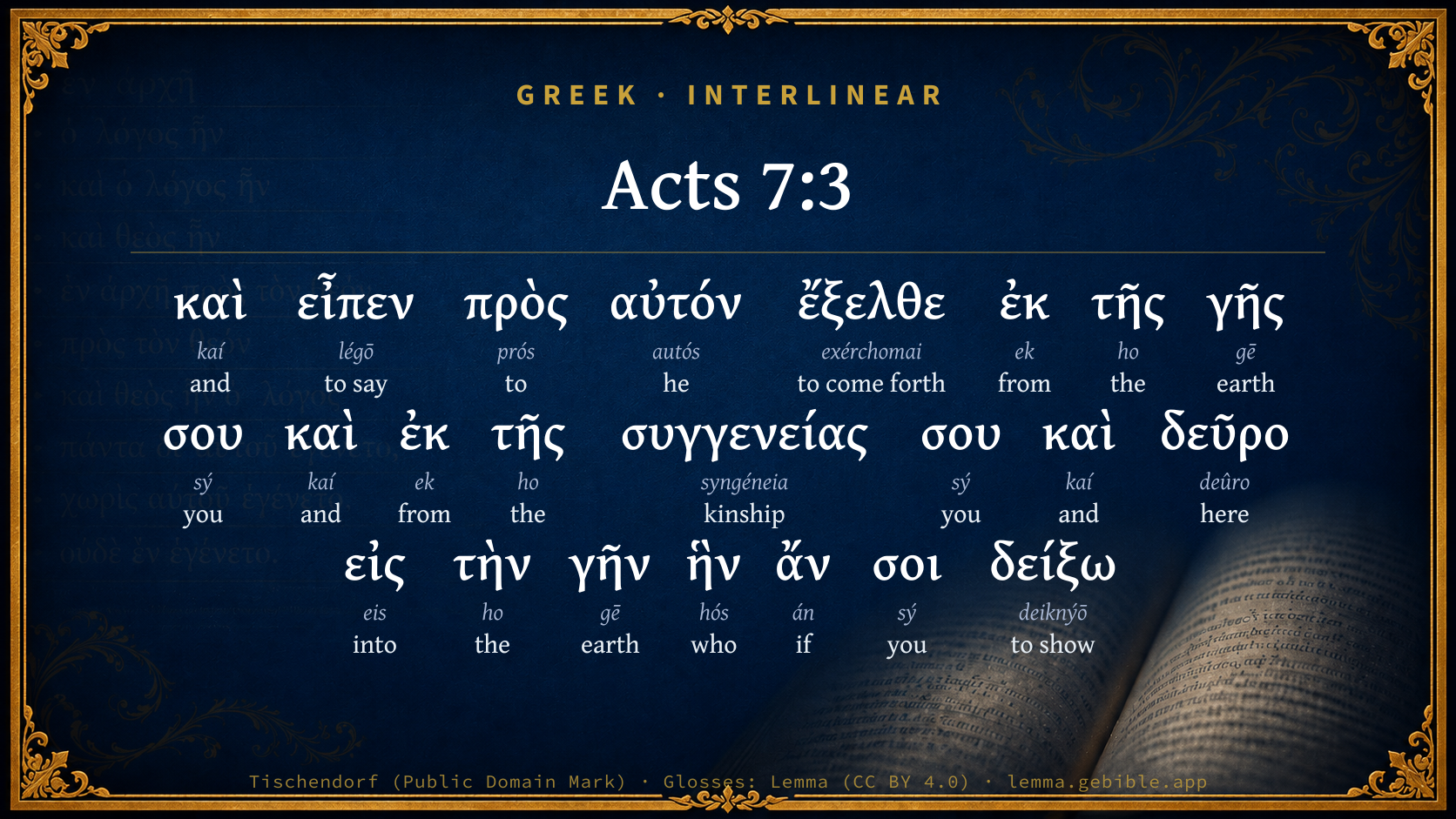
Greek (Tischendorf 8th ed.) Acts 7:3 appears in the Greek New Testament. The text above is from the Tischendorf 8th edition. Each word links to its Strong’s number and a concise gloss. Click any word for its full Thayer’s Greek Lexicon entry.
Download image
Cite this verse

Acts 7:3 (World English Bible). Public Domain. Lemma interlinear Bible study tool, https://lemma.gebible.app/v/acts/7/3.

Show BibTeX & RIS
BibTeX
RIS
English Translation
and said to him, 'Get out of your land, and from your relatives, and come into a land which I will show you.'
World English Bible · Public Domain
Download a study sheet

One document with this verse’s original text, its word-by-word gloss line, the meaning frame, cross-references with their text, attributed commentary, and full source and license credits — printable, and it pastes into notes with its structure intact.

This verse Autodidact and up

Study sheet (.html) Plain text (.txt)

A passage Seminary Student

Up to 50 verses in one chapter. A passage sheet keeps up to 6 commentary sources and 12 cross-references per verse, in the order this page ranks them, and says so on the sheet whenever that leaves anything out. Ask for a single verse and you get the Autodidact verse sheet above.

Everything on this page stays free to read, with no account — the sheet is a download of what is already on screen, not access to it.

Want to remove ads? Support Godless Engineer
Compare translations 3

The same verse in 3 English versions, stacked beneath the original-language interlinear above. Click any original word for its lexicon entry.

Each is an independent rendering of the whole verse — the interlinear is not word-aligned to these translations.

Highlighted words mark where these versions differ — a whole-verse word diff, not a word-by-word alignment.

  • World English Bible Public Domain
    and said to him, 'Get out of your land, and from your relatives, and come into a land which I will show you.'
  • King James Version Public Domain
    And said unto him, Get thee out of thy country, and from thy kindred, and come into the land which I shall shew thee.
  • unfoldingWord Literal Text CC BY-SA 4.0
    and he said to him, ‘Go out from your land and from your relatives, and come into the land that I will show you.’

unfoldingWord Literal Text — © unfoldingWord, licensed CC BY-SA 4.0. Word-aligned USFM3 via Door43 (git.door43.org/unfoldingWord/en_ult).

Versions to compare (up to 4)

3 of 4 selected

Show all 19 translations

Every available English version of this verse, each an independent rendering of the whole verse.

  • World English Bible Public Domain
    and said to him, 'Get out of your land, and from your relatives, and come into a land which I will show you.'
  • Berean Standard Bible Public Domain
    and told him, ‘Leave your country and your kindred and go to the land I will show you.’
  • Majority Standard Bible Public Domain
    and told him, ‘Leave your country and your kindred and go to the land I will show you.’
  • King James Version Public Domain
    And said unto him, Get thee out of thy country, and from thy kindred, and come into the land which I shall shew thee.
  • American Standard Version (1901) Public Domain
    and said unto him, Get thee out of thy land, and from thy kindred, and come into the land which I shall show thee.
  • Revised Version (1885) Public Domain
    and said unto him, Get thee out of thy land, and from thy kindred, and come into the land which I shall shew thee.
  • Geneva Bible (1599) Public Domain
    And said vnto him, Come out of thy countrey, and from thy kindred, and come into the land, which I shall shewe thee.
  • Douay-Rheims (1899) Public Domain
    And said to him: Go forth out of thy country, and from thy kindred, and come into the land which I shall shew thee.
  • Young's Literal Translation Public Domain
    and He said to him, Go forth out of thy land, and out of thy kindred, and come to a land that I shall shew thee.
  • Literal Standard Version CC BY-SA 4.0
    and He said to him, Go forth out of your land, and out of your relatives, and come to a land that I will show you.
  • Unlocked Literal Bible CC BY-SA 4.0
    he said to him, 'Leave your land and your relatives, and go into the land that I will show you.'
  • unfoldingWord Literal Text CC BY-SA 4.0
    and he said to him, ‘Go out from your land and from your relatives, and come into the land that I will show you.’
  • Darby Bible Public Domain
    and said to him, Go out of thy land and out of thy kindred, and come into the land which I will shew thee.
  • World Messianic Bible Public Domain
    and said to him, ‘Get out of your land and away from your relatives, and come into a land which I will show you.’
  • Webster's Bible Public Domain
    And said to him, Depart from thy country, and from thy kindred, and come into the land which I shall show thee.
  • Free Bible Version CC BY-SA 4.0
    God told him, ‘Leave your country and your relatives, and go to the country that I'm going to show you.’
  • Bible in Basic English Public Domain
    And said to him, Go out of your land, and away from your family, and come into the land to which I will be your guide.
  • Text-Critical English NT CC BY 4.0
    and said to him, ‘Leave yoʋr land and yoʋr relatives, and go to a land I will show yoʋ.’
  • Tyndale New Testament (1534) Public Domain
    and sayd vnto him: come out of thy contre and from thy kynred and come into the londe which I shall shewe the.

Literal Standard Version (2020), Covenant Press — licensed CC BY-SA 4.0. Text via the HelloAO Bible API (eBible.org). Unlocked Literal Bible (unfoldingWord) — licensed CC BY-SA 4.0. Text via the HelloAO Bible API (eBible.org). unfoldingWord Literal Text — © unfoldingWord, licensed CC BY-SA 4.0. Word-aligned USFM3 via Door43 (git.door43.org/unfoldingWord/en_ult). Free Bible Version, Dr. Jonathan Gallagher — licensed CC BY-SA 4.0. Text via the HelloAO Bible API (eBible.org).

Word by word

More ways to search: Search by grammar → Find every occurrence → Compare this word →

Practice this passage: Drill this verse → Learn its vocabulary →

συγγενείας
syngéneia
G4772
“kinship”
Noun, Genitive, Singular, Feminine
Part of Speech
Noun
Case
Genitive
Number
Singular
Gender
Feminine
Full Thayer's Definition

Origin: from G4773

TDNT: 19:16,1

1. a kinship, relationship 2. kindred, relations collectively, family
  1. καὶ kaí G2532 “and” Conjunction
  2. εἶπεν légō G3004 “to say” Verb, Aorist, Active, Indicative, 3rd person, Singular
  3. πρὸς prós G4314 “to” Preposition
  4. αὐτόν autós G846 “he” Personal pronoun, Accusative, Singular, Masculine
  5. ἔξελθε exérchomai G1831 “to come forth” Verb, Aorist, Active, Imperative, 2nd person, Singular
  6. ἐκ ek G1537 “from” Preposition
  7. τῆς ho G3588 “the” Article, Genitive, Singular, Feminine
  8. γῆς gē G1093 “earth” Noun, Genitive, Singular, Feminine
  9. σου sý G4771 “you” Personal pronoun, 2nd person, Genitive, Singular
  10. καὶ kaí G2532 “and” Conjunction
  11. ἐκ ek G1537 “from” Preposition
  12. τῆς ho G3588 “the” Article, Genitive, Singular, Feminine
  13. σου sý G4771 “you” Personal pronoun, 2nd person, Genitive, Singular
  14. καὶ kaí G2532 “and” Conjunction
  15. δεῦρο deûro G1204 “here” Verb, Present, Active, Imperative, 2nd person, Singular
  16. εἰς eis G1519 “into” Preposition
  17. τὴν ho G3588 “the” Article, Accusative, Singular, Feminine
  18. γῆν gē G1093 “earth” Noun, Accusative, Singular, Feminine
  19. ἣν hós G3739 “who” Relative pronoun, Accusative, Singular, Feminine
  20. ἄν án G302 “if” Particle
  21. σοι sý G4771 “you” Personal pronoun, 2nd person, Dative, Singular
  22. δείξω deiknýō G1166 “to show” Verb, Future, Active, Indicative, 1st person, Singular

About this verse

These counts appear in no published source. They are computed here, from the morphology-tagged text and Lemma’s own curated glosses. What Lemma adds →

23
words
15
distinct lemmas
Acts
section

Notable vocabulary

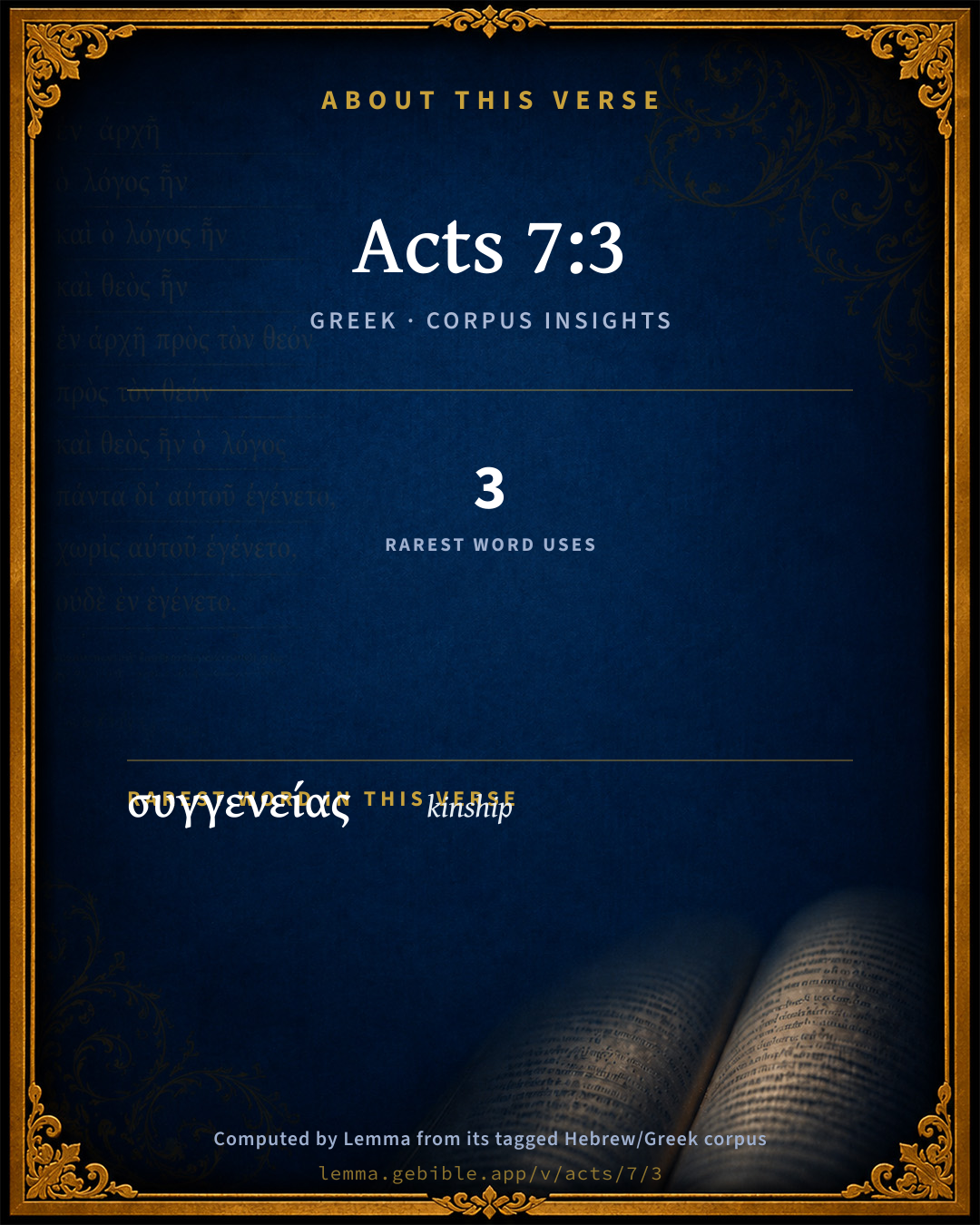
The rarest word here is συγγενείας kinship G4772 — appearing just 3 times in the whole Greek New Testament.

Shared distinctive vocabulary

συγγενείας kinship G4772 occurs in 3 verses of the Greek New Testament. Also found in:

Repetition

Words recur within this verse:

Cross-references

9

Topical passages linked to Acts 7:3 in the Treasury of Scripture Knowledge — connected by theme and wording, ordered by reader-vote popularity; previews shown in the World English Bible.

  • Genesis 12:1 Now Yahweh said to Abram, "Get out of your country, and from your relatives, and from your father's house, to the land that I will show you.
  • Hebrews 11:8 By faith, Abraham, when he was called, obeyed to go out to the place which he was to receive for an inheritance. He went out, not knowing where he went.
  • Genesis 15:7 He said to him, "I am Yahweh who brought you out of Ur of the Chaldees, to give you this land to inherit it."
  • Joshua 24:3 I took your father Abraham from beyond the River, and led him throughout all the land of Canaan, and multiplied his seed, and gave him Isaac.
  • Nehemiah 9:8 and found his heart faithful before you, and made a covenant with him to give the land of the Canaanite, the Hittite, the Amorite, and the Perizzite, and the Jebusite, and the Girgashite, to give it to his seed, and have performed your words; for you are righteous.
  • Matthew 10:37 He who loves father or mother more than me is not worthy of me; and he who loves son or daughter more than me isn't worthy of me.
  • Luke 14:33 So therefore whoever of you who doesn't renounce all that he has, he can't be my disciple.
  • 2 Corinthians 6:17 Therefore, "'Come out from among them, And be separate,' says the Lord, 'Touch no unclean thing. I will receive you.
  • Genesis 13:14–17 Yahweh said to Abram, after Lot was separated from him, "Now, lift up your eyes, and look from the place where you are, northward and southward and eastward and westward,

Cross-references courtesy of OpenBible.info (CC BY 4.0).

Commentary

Notes on Acts 7:3 from classic Christian and Jewish commentators (each source and its license shown beneath its notes). The classic Christian expositions comment on the surrounding passage and are grouped to its opening verse, so a note may address several verses; the Jewish commentaries on the Tanakh (Rashi and others) are per-verse, so they appear only where the commentator wrote on this verse.

Lemma curates 59 commentaries, every one of them public domain or Creative Commons licensed, each selected and text-cleaned for this edition rather than reprinted as found. About our sources →

Bengel's Gnomon

Johann Albrecht Bengel

Act 7:3. Ἔξελθε—δείξω) So Gen 12:1, LXX., except that they (the LXX.) introduce καὶ ἐκ τοῦ οἴκου τοῦ πατρός σου.—γῆς, from thy country) This brought with it (caused) his departure from Chaldea.—συγγενείας, from thy kindred) This caused subsequently his departure from Haran or Charran, to which the family of Abraham had come, Act 7:4. The more adult part of the family remained in Mesopotamia, the younger portion in Haran; for it is not to be supposed that Terah remained altogether alone there. They who also followed Abraham out of Haran, followed him of their own accord. Abraham was not ordered to bring them with him: and if they had not followed, he still would have gone forth out of Haran: comp. Gen 11:31; Gen 24:4 (where Abraham directs his servant to go to his country (Mesopotamia) and his kindred, implying that the adults of the family had remained in Mesopotamia).—ἣν ἂν, whichsoever) Abraham did not know which would be the land: Heb 11:8.

Bengel's Gnomon of the New Testament — English translation (T&T Clark, Edinburgh, 1860) — public domain. Text from a community e-Sword module.

John Calvin's Commentaries

3. Come out of thy country. God useth many words, to the end he may the more wound the mind of Abraham, as if it were not a thing sharp enough of itself to be banished out of his own country. And that served to try his faith; even as that other thing also, that God assigneth him no land wherein he may dwell, but maketh him stand in doubt, and wait for a time. Wherefore the obedience of Abraham was so much the more to be commended, because the sweetness of his native soil keepeth him not back from going willingly, as it were, into exile; and in that he doubteth not to follow God, although there appear no certain resting-place, but is commanded to wander to and fro for a time. Whereas, the showing of the land is deferred, it differeth not much from deceiving of him.

Furthermore, we learn continually by our own experience how profitable it was for Abraham thus to be exercised, and, as it were, trained by little and little. Many men are carried with a godly affection to attempt great things, but by and by, so soon as their heat is waxen cold, it repenteth them of their purpose, and they would gladly slip their necks out of the collar. Therefore, lest Abraham should faint when he was in the midst of his course, through the remembrance of those things which he had left behind him, God sifteth and trieth his mind thoroughly, immediately after he had begun, lest he take anything in hand lightly and unadvisedly. To this purpose serveth the parable which Christ setteth before us concerning the building of the tower, (Luke 14:28.) For he teacheth that we must first cast the charges, lest with shame we be enforced to leave off building after we have begun. And though this were a particular thing in Abraham in that he was commanded to go out of his own country, and to go into a far country, in that God carried him from place to place, yet, notwithstanding, there is in these words some figure of the calling of us all. We are not all simply commanded to forsake our country, but we are commanded to deny ourselves; we are not commanded to come out of our father’s house, but to bid adieu to our own will, and to the desires of our own flesh. Again, if father and mother, wife and children, hinder us from following God, we must forsake them all. The commandment is given simply to Abraham to flit; but we are commanded to do the stone upon condition. For if in any place we cannot serve God, we must rather make choice of exile than to stay in our nest, being slothful and sluggish. Therefore, let us have the example of Abraham always before our eyes. He is the father of the faithful, he was tried all manner of ways. Doth he forget his country, his friends, and himself, that he may give over himself unto God? (Romans 4:16,17.) If we will be counted the children of God, we must not degenerate from him.

Which I shall show thee. We must note that which I touched a little before, that Abraham is kept in doubt, to the end his patience may be tried. And this must we also apply to our own use, that we may learn to depend wholly upon God. And surely this is a principal exercise of our faith to put our trust in God, even when we see nothing. God, indeed, will oftentimes show us a land wherein he granteth us an abiding-place; yet, notwithstanding, because we are strangers in the world, we have no certain and continual place of abode anywhere. Again, our life, as Paul saith, is hid, (Colossians 3:3;) and being like unto dead men, we hope for salvation, which is hid in heaven. Therefore, as touching our perpetual habitation, God doth cause us to depend upon his providence alone, when he commandeth us, as it were, to wander in a strange country. Lest such deferring discourage us, we must hold this general rule of faith, that we must go whither God calleth us, howsoever he do not show that which he promiseth.

John Calvin's Commentaries (1540-1563) — public domain. Text from the Calvin Translation Society English edition (1840s-50s) via the Christian Classics Ethereal Library (ccel.org). Calvin's coverage is partial (roughly two-thirds of the Bible); uncommented books and verses are honest gaps, never fabricated. The 19th-century editor's footnotes and remarks are omitted so the notes are faithfully Calvin's own voice.

The Cambridge Bible for Schools and Colleges

gen. ed. J. J. S. Perowne

3. and said unto him] It does not appear from the narrative in Genesis whether there had been some Divine communication which caused the first removal from Ur to Haran. We are only told (Gen_11:31) that Terah took his family and removed, but as it is there added “to go into the land of Canaan,” and as in the following chapter, where God’s order to remove is expressly given (Gen_12:1), it is also said that “they went forth to go into the land of Canaan,” we may conclude that the first removal had been enjoined by God, and that it was only on account of Terah’s age that the country for which they set forth was not reached at once. In Gen_15:7 God says “I am the Lord that brought thee out of Ur of the Chaldees,” language which implies a command given for the first removal. Cp. Neh_9:7. Gen_12:1 should be rendered “Now the Lord said unto Abram,” not “had said,” as A. V.

Get thee out of thy country [land], and from thy kindred, and come into the land which I shall shew thee] The word for land is the same in both clauses. In Gen_12:1 the words “and from thy father’s house” are added after “kindred.” The destination of the emigrants was known before they started from Ur.

The Cambridge Bible for Schools and Colleges (gen. ed. J. J. S. Perowne; Cambridge University Press, 1878–1918) — public domain. Text from a community e-Sword module.

John Gill's Exposition

And said unto him,.... Not the words in Gen 12:1 for they were said in Haran, these in Mesopotamia, before he dwelt there, and besides, these are different from them; no mention is here made of getting out from his father's house, as there; because his father's house sent along with him, or rather he with them from Mesopotamia to Haran:

get thee out of thy country; from Ur of the Chaldees, where he was born:

and from thy kindred; his relations that lived in the same place, who did not go along with him:

and come into the land which I shall show thee; not telling him the place whither he was to go; wherefore when he had his first call, and first set out, he knew not whither he went; see Heb 11:8. This was an emblem of the calling of the saints out of the world, from their former course of life, and from among their old companions and friends, to follow Christ whithersoever he is pleased to lead them; and who at last will bring them safe to the land afar off, the better and heavenly country.

John Gill's Exposition of the Whole Bible (1746–1763) — public domain (CC PDM 1.0). Text via the HelloAO Bible API.

Trapp's Complete Commentary

John Trapp

3 And said unto him, Get thee out of thy country, and from thy kindred, and come into the land which I shall shew thee.

Ver. 3. Get thee out, &c.] Both Abraham’s great temptations began thus. {See Trapp on "Gen 12:1"} {See Trapp on "Gen 12:2"} {See Trapp on "Gen 12:3"} &c.

John Trapp, A Commentary or Exposition upon All the Books of the Old and New Testament (1647–1656) — public domain. Text from a community e-Sword module.

Albert Barnes' Notes on the Bible

And said unto him - How long this was said before he went is not recorded. Moses simply says that God had commanded him to go, Gen 12:1.

Thy kindred - Thy relatives, or family connections. It seems that “Terah” went with him as far as to Haran; but Abraham was apprised that he was to leave his family and to go almost alone.

Into the land ... - The country was yet unknown. The place was to be shown him. This is presented in the New Testament as a strong instance of faith, Heb 11:8-9. It was an act of “simple confidence” in God. And to leave his country and home; to go into a land of strangers, not knowing whither he went, required strong confidence in God. It is a simple illustration of what man is always required to do at the command of God. Thus, the gospel requires him to commit all to God; to yield body and soul to his disposal; to be ready at his command to forsake father, and mother, and friends, and houses, and lands, for the sake of the Lord Jesus, Luk 14:33; Mat 19:27, Mat 19:29. The trials which Abraham might have anticipated may be readily conceived. He was going, in a rude and barbarous age of the world, into a land of strangers. He was without arms or armies, and almost alone. He did not even know the nature or situation of the land, or the character of its inhabitants.

He had no title to it; no claim to urge; and he went depending on the simple promise of God that he would give it to him. He went, therefore, trusting simply to the promise of God. Thus, his conduct illustrated precisely what we are to do in reference to all our coming life, and to the eternity before us: We are to trust simply to the promise of God, and do what he requires. This is faith. In Abraham it was as simple and intelligible an operation of mind as ever occurs in any instance. Nor is faith in the Scriptures regarded as more mysterious than any other mental operation. If Abraham had seen all that was to result from his going into that land, it would have been a sufficient reason to induce him to do as he did. But God saw it; and Abraham was required to act just as if he had seen it all, and all the reasons why he was called. Upon the strength of God’s promises, Abraham was called to act. This was faith. It did not require him to act where there was “no reason” for his so acting, but where he did not see the reason. So in all cases of faith. If man could see all that God sees, he would perceive reasons for acting as God requires. But the reasons of things are often concealed, and man is required to act on the belief that God sees reasons why he should so act. To act under the proper impression of that truth which God presents is faith; as simple and intelligible as any other act or operation of the mind. See the notes on Mar 16:16.

Albert Barnes' Notes on the Bible (1834–1885) — public domain. Text from a community e-Sword/MySword module.

Matthew Poole's English Annotations

This command given unto Abraham we read of, Gen 12:1,5,6; and it is here the rather spoken of by St. Stephen, to prove that Abraham was in the favour of God, and did truly serve him, before he ever saw the land of Canaan, and before the ceremonial law was given by Moses, and, much more, before the temple was built; and therefore it could not be blasphemy in him to hold that God might be served without those ceremonies, and worshipped elsewhere than in Jerusalem.

The land which I shall show thee; this was the glory of Abraham’s faith, that it submitted absolutely to God, and enabled Abraham to go he knew not whither, Heb 11:8, for God did not so much as name the place he would have him go unto.

Matthew Poole's English Annotations on the Holy Bible (1683–1685) — public domain. Text from a community e-Sword/MySword module.

Whedon's Commentary on the Bible

Daniel D. Whedon

3. Saul… made havoc—The fierce cruelty of this Sauline persecution appears in every clause. Havoc, in the Greek, is a term that designates ravage done by a beast of prey; every house indicates that no single Christian was permitted to escape; haling (old English for hauling) describes the brutal violence done to persons in apprehending; women implies the disregard not only of the tender sex, but of any respected character; prison implies probably the inquisitorial prison belonging to the temple for religious heretics. Paul in many passages refers with deep contrition to these cruelties, (Act_26:9-11; Act_22:3-4.)

But while the detail of cruelty is so severe, and the dispersion so total, there is one most interesting feature of forbearance in the statement. Besides the martyrdom of Stephen, Luke intimates no other murder. A later martyrologist would have pictured a score of bloody executions. But in fact the Jewish authorities had no power for capital punishment. A single murder like that of Stephen might be overlooked by the Roman government; but persistence in a series of executions on their own authority would have brought the Roman procurator from Cesarea to exact an account, or even have roused Vitellius, the Roman prefect of all Syria, at Antioch, to appear with his army at Jerusalem.

Daniel D. Whedon (gen. ed.), Commentary on the Old and New Testaments (1874–1909) — public domain. Text from a community e-Sword module.

The Pulpit Commentary

Thy land for thy country, A.V.

The Pulpit Commentary (1880–1919), ed. H.D.M. Spence-Jones & Joseph S. Exell — public domain. Text from a community e-Sword module.

John Wesley's Explanatory Notes

Which I will show thee - Abraham knew not where he went.

John Wesley, Explanatory Notes Upon the Whole Bible (1754–1765) — public domain. Text via the GEBible commentary corpus.

McGarvey & Pendleton's Commentaries

J. W. McGarvey

See notes on verse 2

J. W. McGarvey (with Philip Y. Pendleton), Commentaries on the New Testament (The Fourfold Gospel, 1914; Acts; and the epistles) — public domain. Text from a community e-Sword/MySword module.

Cambridge Greek Testament for Schools and Colleges

3. καὶ εἶπεν πρὸς αὐτόν, and said unto him. It does not appear from the narrative in Genesis whether there had been some divine communication which caused the first removal from Ur to Haran. We are only told (Gen 11:31) that Terah took his family and removed, but as it is there added ‘to go into the land of Canaan,’ and as in the following chapter, where God’s order to remove is expressly given (Gen 12:1), it is also said that ‘they went forth to go into the land of Canaan,’ we may reasonably conclude that the first removal had been enjoined by God, and that it was only on account of Terah’s age that the country for which they set forth was not reached at once. In Gen 15:7 God says ‘I am the Lord that brought thee out of Ur of the Chaldees,’ language which implies a command given for the first removal. Cp. Neh 9:7. Gen 12:1 should be rendered ‘Now the Lord said unto Abram,’ not ‘had said,’ as A.V.

ἔξελθε ἐκ τῆς γῆς σου, Get thee out of thy land. Let γῆ be translated alike in both clauses of the verse. In Gen 12:1 the words καὶ ἐκ τοῦ οἴκου τοῦ πατρός σου are added after συγγενείας σου. Although the emigrants halted at Haran, their destination was known to be Canaan before they started from Ur. (See Gen 11:31.)

Cambridge Greek Testament for Schools and Colleges (Cambridge University Press, 1896; 21 vols, various authors incl. Carr, Maclear, Plummer, Farrar, Lumby, Moule, M. R. James, Simcox) — public domain. Text from a community e-Sword module.

Lesson kit

Teaching starters — assembled from the data on this page, not authored interpretation. Every prompt links to the verse data it draws on. Edit before teaching.

Acts, in the Acts, opens this verse with 23 words (15 distinct Greek lemmas). Its most distinctive word is syngéneia (“kinship”). A historical commentator’s framing appears above. Read the whole chapter for the surrounding context.

Discussion questions

  1. What does “kinship” (syngéneia) contribute to the verse as a whole?
  2. How does Luke 1:61, which shares the word «kinship», read alongside this verse?
  3. What does the repetition of “earth” (2× in this one verse) do in this verse?
  4. These translations render this verse differently; the difference is in the English rendering, not the original. What questions does that raise?
  5. Compare how Bengel's Gnomon and John Calvin's Commentaries read this verse. Where do they agree or differ?

Things to notice

Reading settings

Reading text

Shown beneath each verse's original-language words.

Old Testament
Old Testament edition

Read the OT as the Masoretic Hebrew (MT) or the Greek Septuagint (LXX).

English shown for the Greek Septuagint (in the Hebrew ↔ Greek comparison).

Comparing translations? Open the Compare panel on any verse page to stack up to four side by side.