
2 Samuel 2:10

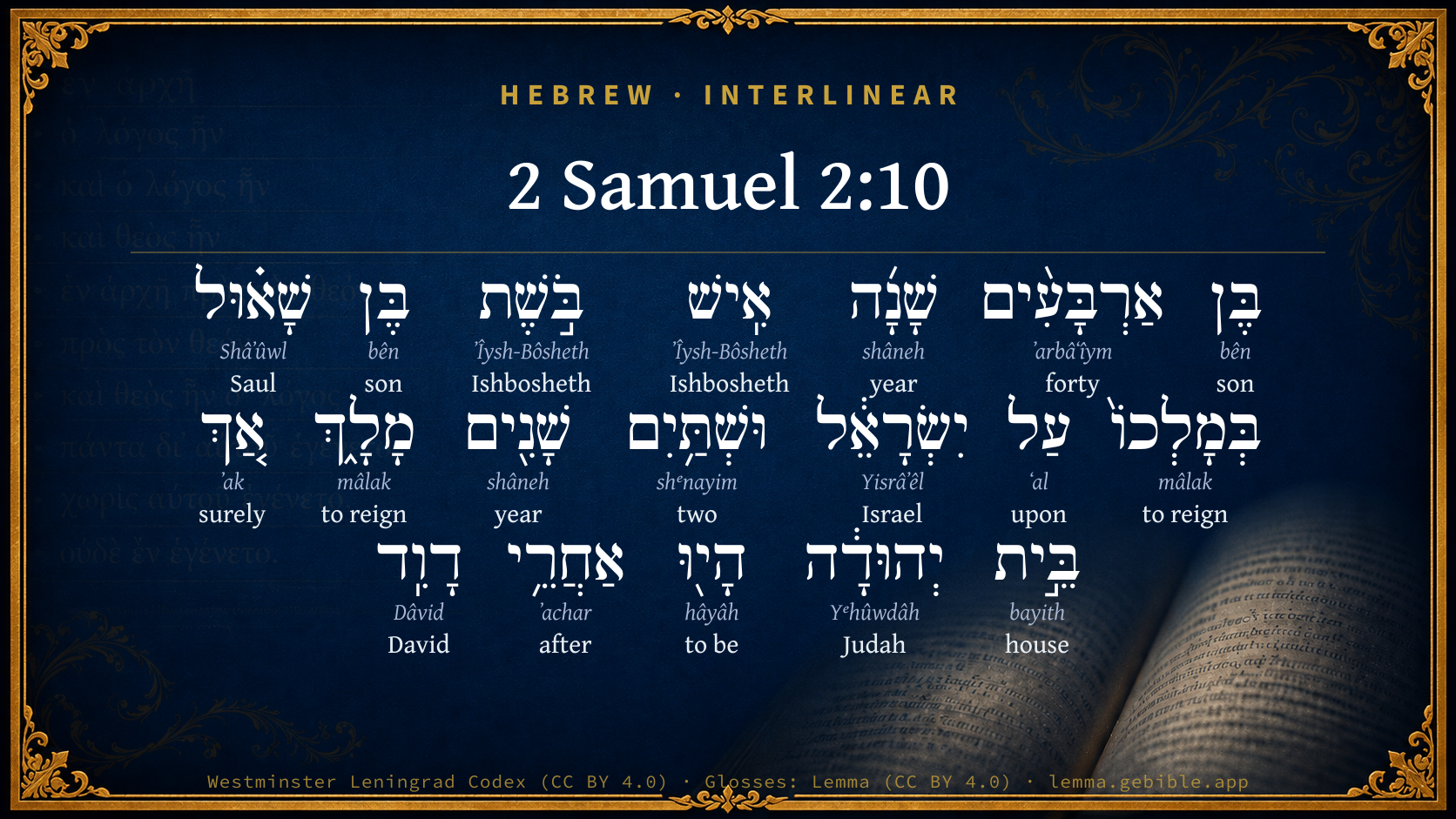
Hebrew (Westminster Leningrad Codex) 2 Samuel 2:10 appears in the Hebrew Old Testament. The text above is from the Westminster Leningrad Codex. Each word links to its Strong’s number, a concise gloss, and parsing drawn from the Open Scriptures Hebrew Bible morphology. Click any word for its full Brown-Driver-Briggs (BDB) entry.
Download image
Cite this verse

2 Samuel 2:10 (World English Bible). Public Domain. Lemma interlinear Bible study tool, https://lemma.gebible.app/v/2-samuel/2/10.

Show BibTeX & RIS
BibTeX
RIS
English Translation
Ish-bosheth, Saul's son, was forty years old when he began to reign over Israel, and he reigned two years. But the house of Judah followed David.
World English Bible · Public Domain
Download a study sheet

One document with this verse’s original text, its word-by-word gloss line, the meaning frame, cross-references with their text, attributed commentary, and full source and license credits — printable, and it pastes into notes with its structure intact.

This verse Autodidact and up

Study sheet (.html) Plain text (.txt)

A passage Seminary Student

Up to 50 verses in one chapter. A passage sheet keeps up to 6 commentary sources and 12 cross-references per verse, in the order this page ranks them, and says so on the sheet whenever that leaves anything out. Ask for a single verse and you get the Autodidact verse sheet above.

Everything on this page stays free to read, with no account — the sheet is a download of what is already on screen, not access to it.

Want to remove ads? Support Godless Engineer
Compare translations 3

The same verse in 3 English versions, stacked beneath the original-language interlinear above. Click any original word for its lexicon entry.

Each is an independent rendering of the whole verse — the interlinear is not word-aligned to these translations.

Highlighted words mark where these versions differ — a whole-verse word diff, not a word-by-word alignment.

  • World English Bible Public Domain
    Ish-bosheth, Saul's son, was forty years old when he began to reign over Israel, and he reigned two years. But the house of Judah followed David.
  • King James Version Public Domain
    Ishbosheth Saul's son was forty years old when he began to reign over Israel, and reigned two years. But the house of Judah followed David.
  • unfoldingWord Literal Text CC BY-SA 4.0
    Ish Bosheth, the son of Saul, a son of 40 years when he became king over Israel, and he reigned two years. Nevertheless, the house of Judah were behind David.

unfoldingWord Literal Text — © unfoldingWord, licensed CC BY-SA 4.0. Word-aligned USFM3 via Door43 (git.door43.org/unfoldingWord/en_ult).

Versions to compare (up to 4)

3 of 4 selected

Show all 18 translations

Every available English version of this verse, each an independent rendering of the whole verse.

  • World English Bible Public Domain
    Ish-bosheth, Saul's son, was forty years old when he began to reign over Israel, and he reigned two years. But the house of Judah followed David.
  • Berean Standard Bible Public Domain
    Saul’s son Ish-bosheth was forty years old when he began to reign over Israel, and he reigned for two years. The house of Judah, however, followed David.
  • Majority Standard Bible Public Domain
    Saul’s son Ish-bosheth was forty years old when he began to reign over Israel, and he reigned for two years. The house of Judah, however, followed David.
  • King James Version Public Domain
    Ishbosheth Saul's son was forty years old when he began to reign over Israel, and reigned two years. But the house of Judah followed David.
  • American Standard Version (1901) Public Domain
    Ish-bosheth, Saul's son, was forty years old when he began to reign over Israel, and he reigned two years. But the house of Judah followed David.
  • Revised Version (1885) Public Domain
    (Ish-bosheth Saul’s son was forty years old when he began to reign over Israel, and he reigned two years.) But the house of Judah followed David.
  • Geneva Bible (1599) Public Domain
    Ish-bosheth Sauls sonne was fourtie yeere olde when he began to reigne ouer Israel, and reigned two yeere: but the house of Iudah followed Dauid.
  • Douay-Rheims (1899) Public Domain
    Isboseth the son of Saul was forty years old when he began to reign over, Israel, and he reigned two years: and only the house of Juda followed David.
  • Young's Literal Translation Public Domain
    A son of forty years, `is' Ish-Bosheth son of Saul, in his reigning over Israel, and two years he hath reigned, only the house of Judah have been after David.
  • Literal Standard Version CC BY-SA 4.0
    Ish-Bosheth son of Saul [is] a son of forty years in his reigning over Israel, and he has reigned [for] two years; only the house of Judah has been after David.
  • Unlocked Literal Bible CC BY-SA 4.0
    Ishbosheth son of Saul, was forty years old when he began to reign over Israel, and he reigned two years. But the house of Judah followed David.
  • unfoldingWord Literal Text CC BY-SA 4.0
    Ish Bosheth, the son of Saul, a son of 40 years when he became king over Israel, and he reigned two years. Nevertheless, the house of Judah were behind David.
  • Darby Bible Public Domain
    Ishbosheth Saul's son was forty years old when he began to reign over Israel, and he reigned two years. However, the house of Judah followed David.
  • World Messianic Bible Public Domain
    Ishbosheth, Saul’s son, was forty years old when he began to reign over Israel, and he reigned two years. But the house of Judah followed David.
  • Webster's Bible Public Domain
    Ish-bosheth, Saul's son, was forty years old when he began to reign over Israel, and he reigned two years: but the house of Judah followed David.
  • Free Bible Version CC BY-SA 4.0
    Ishbosheth, son of Saul, was forty when he became king over Israel, and he reigned for two years. However, the people of Judah were on David's side.
  • Bible in Basic English Public Domain
    (Saul's son Ish-bosheth was forty years old when he became king over Israel, and he was ruler for two years.) But Judah was on the side of David.
  • JPS Tanakh (1917) Public Domain
    Ish-bosheth Saul's son was forty years old when he began to reign over Israel, and he reigned two years. But the house of Judah followed David.

Literal Standard Version (2020), Covenant Press — licensed CC BY-SA 4.0. Text via the HelloAO Bible API (eBible.org). Unlocked Literal Bible (unfoldingWord) — licensed CC BY-SA 4.0. Text via the HelloAO Bible API (eBible.org). unfoldingWord Literal Text — © unfoldingWord, licensed CC BY-SA 4.0. Word-aligned USFM3 via Door43 (git.door43.org/unfoldingWord/en_ult). Free Bible Version, Dr. Jonathan Gallagher — licensed CC BY-SA 4.0. Text via the HelloAO Bible API (eBible.org).

Word by word

More ways to search: Search by grammar → Find every occurrence → Compare this word →

Practice this passage: Drill this verse → Learn its vocabulary →

אִֽישׁ
ʼÎysh-Bôsheth
H378
“Ishbosheth”
Noun, Proper
Part of Speech
Noun
Type
Proper
Full BDB Definition

Origin: from H376 and H1322

TWOT: None

Ishbosheth = "man of shame" - surviving son of Saul, king of Israel for 7 years while David was king over Judah; succeeded by David who united the kingdom
  1. בֶּן bên H1121 “son of” Noun, Common, Masculine, Singular, Construct
  2. אַרְבָּעִ֨ים ʼarbâʻîym H705 “forty” Adjective, Cardinal number, Both, Plural, Absolute
  3. שָׁנָ֜ה shâneh H8141 “year” Noun, Common, Feminine, Singular, Absolute
  4. בֹּ֣שֶׁת ʼÎysh-Bôsheth H378 “Ishbosheth” Noun, Proper
  5. בֶּן bên H1121 “son of” Noun, Common, Masculine, Singular, Construct
  6. שָׁא֗וּל Shâʼûwl H7586 “Saul” Noun, Proper
  7. בְּמָלְכוֹ֙ mâlak H4427 “in/at · to reign · him” Preposition + Verb, Qal, Infinitive Construct + Suffix, Personal, 3rd Person, Masculine, Singular
  8. עַל ʻal H5921 “upon” Preposition
  9. יִשְׂרָאֵ֔ל Yisrâʼêl H3478 “Israel” Noun, Proper
  10. וּשְׁתַּ֥יִם shᵉnayim H8147 “and · two” Conjunction + Adjective, Cardinal number, Feminine, Dual, Absolute
  11. שָׁנִ֖ים shâneh H8141 “years” Noun, Common, Feminine, Plural, Absolute
  12. מָלָ֑ךְ mâlak H4427 “to reign” Verb, Qal, Perfect, 3rd Person, Masculine, Singular
  13. אַ֚ךְ ʼak H389 “surely” Particle, Accusative
  14. בֵּ֣ית bayith H1004 “house of” Noun, Common, Masculine, Singular, Construct
  15. יְהוּדָ֔ה Yᵉhûwdâh H3063 “Judah” Noun, Proper
  16. הָי֖וּ hâyâh H1961 “to be” Verb, Qal, Perfect, 3rd Person, Common, Plural
  17. אַחֲרֵ֥י ʼachar H310 “after” Preposition
  18. דָוִֽד Dâvid H1732 “David” Noun, Proper

About this verse

These counts appear in no published source. They are computed here, from the morphology-tagged text and Lemma’s own curated glosses. What Lemma adds →

19
words
15
distinct lemmas
Historical
section

Notable vocabulary

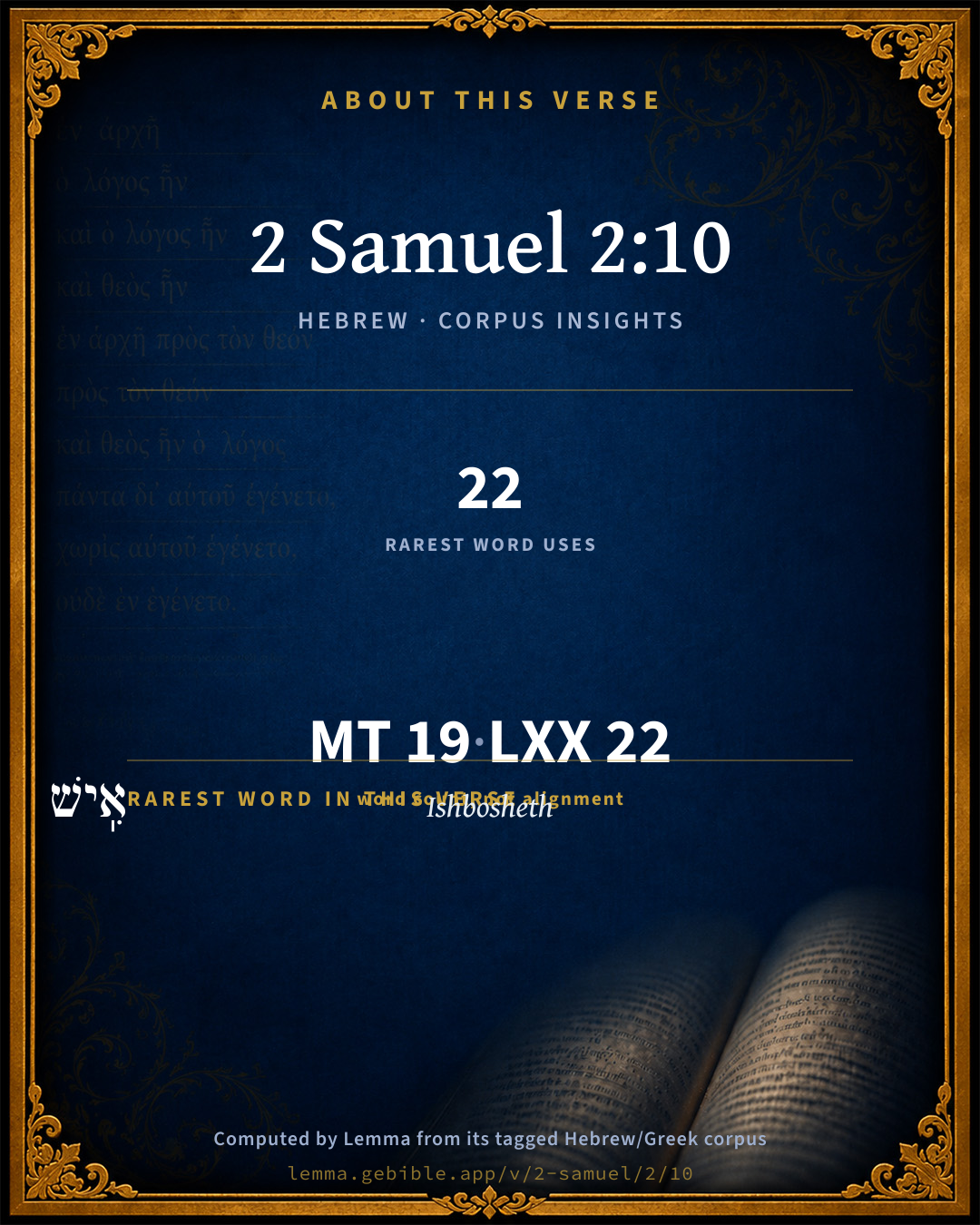
The rarest word here is אִֽישׁ Ishbosheth H378 — appearing just 22 times in the whole Hebrew Bible.

Shared distinctive vocabulary

אִֽישׁ Ishbosheth H378 occurs in 10 verses of the Hebrew Bible. Also found in:

Grammatical profile

  • 3 verbs
  • 11 nouns
  • 2 adjectives
  • 2 prepositions
  • 1 particle

Verb forms

  • בְּמָלְכוֹ֙ Qal · Infinitive Construct
  • מָלָ֑ךְ Qal · Perfect
  • הָי֖וּ Qal · Perfect

Repetition

Words recur within this verse — often emphatic in Hebrew:

  • בֶּן son H1121 ×2
  • שָׁנָ֜ה year H8141 ×2
  • אִֽישׁ Ishbosheth H378 ×2
  • בְּמָלְכוֹ֙ to reign H4427 ×2

Hebrew & Septuagint length

In English translation the verse runs 26 words from the Hebrew and 27 from the Septuagint (LXX English) — closely comparable.

A rough comparison of the two English renderings, which tokenize alike — not a word-level alignment.

Word counts can differ between the Hebrew and the Greek without any difference in meaning — e.g. the Hebrew direct-object marker אֵת has no separate Greek word, and Greek often adds the article ὁ.

In the original languages it is 19 Hebrew tokens and 22 Greek tokens — but the two are counted differently (Hebrew bundles its prefixes and suffixes into one token; the Greek is in lemma form), so that isn’t a like-for-like length.

Hebrew and Greek witnesses Masoretic Hebrew ↔ Greek Septuagint

The same verse in the two great witnesses to the Old Testament, shown verse-for-verse.

These are two independent witnesses, not word-aligned to each other, and the Septuagint is shown in lemma (dictionary) form.

Hebrew 2 Samuel 2:10 Masoretic · Westminster Leningrad Codex

בֶּן אַרְבָּעִ֨ים שָׁנָ֜ה אִֽישׁ בֹּ֣שֶׁת בֶּן שָׁא֗וּל בְּמָלְכוֹ֙ עַל יִשְׂרָאֵ֔ל וּשְׁתַּ֥יִם שָׁנִ֖ים מָלָ֑ךְ אַ֚ךְ בֵּ֣ית יְהוּדָ֔ה הָי֖וּ אַחֲרֵ֥י דָוִֽד

Ish-bosheth, Saul's son, was forty years old when he began to reign over Israel, and he reigned two years. But the house of Judah followed David.

World English Bible · Public Domain

Greek LXX 2 Samuel 2:10 Septuagint · lemma form

τεσσαράκοντα ἔτος ιεβοσθε υἱός σαούλ ὅτε βασιλεύω ἐπί ὁ ἰσραήλ καί δύο ἔτος βασιλεύω πλήν ὁ οἶκος ιουδα ὅς εἰμί ὀπίσω δαυίδ

Jebosthe, Saul's son was forty years old, when he reigned over Israel; and he reigned two years, but not over the house of Juda, who followed David.

LXX2012 (modern English Septuagint) · Public Domain

Hebrew: Westminster Leningrad Codex (CC BY 4.0). Greek: Septuagint (public domain); English from LXX2012 (modern English Septuagint) (Public Domain). How the Septuagint differs from the Hebrew →

Targum (Aramaic paraphrase)

1

The Targum is the ancient Jewish Aramaic paraphrase of the Hebrew Scriptures — an interpretive translation, not the Hebrew text itself. Onkelos (literal) and Pseudo-Jonathan (expansive) render the Torah, and Jonathan the Prophets. Coverage is partial: where no permissively-licensed English translation exists for a verse, only the Aramaic is shown. This is verse-level text, not a word-by-word alignment to the Hebrew.

  1. Targum Jonathan Prophets (Joshua–Malachi)
    בַּר אַרְבְּעִין שְׁנִין אִישׁ בֹּשֶׁת בַּר שָׁאוּל כַּד מְלַךְ עַל יִשְׂרָאֵל וְתַרְתֵּין שְׁנִין מְלַךְ בְּרַם דְבֵית יְהוּדָה הֲווֹ בָּתַר דָוִד:

    (no public-domain English translation for this verse)

    Targum Jonathan — Aramaic: “Mikraot Gedolot” (public domain). English: “Sefaria Community Translation” (CC0 1.0 (public-domain dedication)); “London "Chaldee Paraphrase," 1871” (public domain). Text via Sefaria.

Commentary

Notes on 2 Samuel 2:10 from classic Christian and Jewish commentators (each source and its license shown beneath its notes). The classic Christian expositions comment on the surrounding passage and are grouped to its opening verse, so a note may address several verses; the Jewish commentaries on the Tanakh (Rashi and others) are per-verse, so they appear only where the commentator wrote on this verse.

Lemma curates 59 commentaries, every one of them public domain or Creative Commons licensed, each selected and text-cleaned for this edition rather than reprinted as found. About our sources →

Trapp's Complete Commentary

John Trapp

2Sa 2:10 Ishbosheth Saul’s son [was] forty years old when he began to reign over Israel, and reigned two years. But the house of Judah followed David.

Ver. 10. And reigned two years,] sc., Peaceably and quietly, before war fell out betwixt him and David. So Saul is said to have reigned two years, {1Sa 13:1} that is, free from foreign enemies, and unmolested by the Philistines. After this, there was five years’ war betwixt the house of Saul and the house of David, till Ishbosheth’s death. {2Sa 3:1}

But the house of Judah followed David.] Yet were they not guilty of the sin of schism: no more are the Reformed Churches, for forsaking of Antichrist, to follow the Lamb wheresoever he goeth, to set the crown upon the Lord Christ’s head.

John Trapp, A Commentary or Exposition upon All the Books of the Old and New Testament (1647–1656) — public domain. Text from a community e-Sword module.

Keil & Delitzsch

C. F. Keil & F. Delitzsch

Length of the reigns of Ishbosheth over Israel, and David at Hebron. The age of Ishbosheth is given, as is generally the case at the commencement of a reign. He was forty years old when he began to reign, and reigned two years; whereas David was king at Hebron over the house of Judah seven years and a half. We are struck with this difference in the length of the two reigns; and it cannot be explained, as Seb. Schmidt, Clericus, and others suppose, on the simple assumption that David reigned two years at Hebron over Judah, namely up to the time of the murder of Ishbosheth, and then five years and a half over Israel, namely up to the time of the conquest of Jerusalem: for this is at variance with the plain statement in the text, that "David was king in Hebron over the house of Judah seven years and a half." The opinion that the two years of Ishbosheth's reign are to be reckoned up to the time of the war with David, because Abner played the principal part during the other five years and a half that David continued to reign at Hebron, is equally untenable. We may see very clearly from 2 Samuel 3-5 not only that Ishbosheth was king to the time of his death, which took place after that of Abner, but also that after both these events David was anointed king over Israel in Hebron by all the tribes, and that he then went directly to attack Jerusalem, and after conquering the citadel of Zion, chose that city as his own capital. The short duration of Ishbosheth's reign can only be explained, therefore, on the supposition that he was not made king, as David was, immediately after the death of Saul, but after the recovery by Abner of the land which the Philistines had taken on this side the Jordan, which may have occupied five years.

(Note: From the fact that in Sa2 2:10, Sa2 2:11, Ishbosheth's ascending the throne is mentioned before that of David, and is also accompanied with a statement of his age, whereas the age of David is not given till Sa2 5:4-5, when he became king over all Israel, Ewald draws the erroneous conclusion that the earlier (?) historian regarded Ishbosheth as the true king, and David as a pretender. But the very opposite of this is stated as distinctly as possible in Sa2 2:4. (compared with Sa2 2:8). The fact that Ishbosheth is mentioned before David in Sa2 2:10 may be explained simply enough from the custom so constantly observed in the book of Genesis, of mentioning subordinate lines or subordinate persons first, and stating whatever seemed worth recording with regard to them, in order that the ground might be perfectly clear for relating the history of the principal characters without any interruption.)

Keil & Delitzsch — Biblical Commentary on the Old Testament (1861–1891) — public domain (CC PDM 1.0). Text via the HelloAO Bible API. (Old Testament only.)

Tyndale Open Study Notes

Tyndale Open Resources

2:10-11 Ishbosheth . . . ruled from Mahanaim for two years at some point during David’s 7½-year reign from Hebron. Apparently a gap of five years occurred in which the northern tribes were without a king.

Tyndale Open Study Notes — © Tyndale Open Resources, licensed CC BY-SA 4.0. Text via the HelloAO Bible API.

Adam Clarke's Commentary

Verse 10. Ish-bosheth - reigned two years.] It is well observed that Ish-bosheth reigned all the time that David reigned in Hebron, which was seven years and six months. Perhaps the meaning of the writer is this: Ish-bosheth reigned two years before any but the tribe of Judah had attached themselves to the interest of David. Some think that Abner in effect reigned the last five years of Ish-bosheth, who had only the name of king after the first two years. Or the text may be understood thus: When Ish-bosheth had reigned two years over Israel, he was forty years of age.

Houbigant, dissatisfied with all the common modes of solution, proposes to read ששית שנה shishshith shanah, six years, for the שתים שנים shetayim shanim, two years, of the text, which he contends is a solecism; for in pure Hebrew the words would be שתים שנה as they are everywhere read in the first book; and שנה is the reading of eleven of Kennicott's MSS., and nine of De Rossi's; but the number two is acknowledged by all the ancient versions, and by all the MSS. yet collated. The critical reader may examine Houbigant on the place. After all, probably the expedition mentioned in the succeeding verses is that to which the writer refers, and from which he dates. Ish-bosheth had reigned two years without any rupture with David or his men, till under the direction of Abner, captain of his host, the Israelites passed over Jordan, from Mahanaim to Gibeon, and being opposed by Joab, captain of David's host, that battle took place which is described in the following verses.

Adam Clarke's Commentary on the Bible (1810–1826) — public domain. Text from a community e-Sword/MySword module.

The Cambridge Bible for Schools and Colleges

gen. ed. J. J. S. Perowne

10. forty years old] This statement is surprising, even if we reduce Ish-bosheth’s age at Saul’s death to 34½, by supposing that his accession is dated 5½ years after that event; and it is possible that the numeral has been corrupted in transcription. As it stands, it involves a double difficulty. (a) About 32 years is the most that can be assigned to Saul’s reign (see note on 1Sa_13:1, and Introd. to 1 Sam. p. 23, so that it represents his youngest son as born before his accession, which is improbable. (b) Ish-bosheth’s eldest brother Jonathan seems to have been about the same age as David, and therefore not much more than thirty at the time of his death.

two years] The duration of Ish-bosheth’s reign is probably reckoned from the time when Abner succeeded in establishing his authority over all Israel. Five years and a half were occupied with the reconquest of the land from the Philistines, and these two years synchronize with the last two of David’s reign at Hebron. No great interval seems to have elapsed between the deaths of Abner and Ish-bosheth, and David’s recognition as king of Israel.

The Cambridge Bible for Schools and Colleges (gen. ed. J. J. S. Perowne; Cambridge University Press, 1878–1918) — public domain. Text from a community e-Sword module.

John Gill's Exposition

Ishbosheth, Saul's son, was forty years old when he began to reign over Israel,.... Being born the same year his father began to reign. See Gill on Sa1 31:6,

and reigned two years; which some understand of these, and no more; and whereas David reigned seven years and a half over Judah, before he reigned over all Israel, it is thought by the Jewish chronologer (c) that there was a vacancy in the throne of Israel for the space of five years, and so says Kimchi; which vacancy was either before the reign of Ishbosheth, it being a matter in dispute whether he or Mephibosheth should be set up, or after his death; the tribes of Israel being so long before they acknowledged David their king; or Ishbosheth's reign of two years must be in the middle of David's reign over Judah; but there is no need to suppose either of these, for the text says not that Ishbosheth reigned only two years; but the meaning is, as Ben Gersom observes, that he had reigned two years when the following things happened, and a war began, and not by him but by Abner, and carried on by him; and he being an inactive prince, the rest of his reign was reckoned as no reign, whereas he lived and reigned the same length of time David did over Judah; see Sa2 3:1,

but the house of Judah followed David; kept close to him as their king, yielding a cheerful obedience to him.

(c) Seder Olam Rabba, c. 13. p. 37.

John Gill's Exposition of the Whole Bible (1746–1763) — public domain (CC PDM 1.0). Text via the HelloAO Bible API.

Albert Barnes' Notes on the Bible

Forty ... two - The numerals are somewhat strange. First, as regards the 40 years. Even assuming that Ish-bosheth’s reign did not commence until five and a half years after Saul’s death, which must have been the case if the two years in the text gives the true length of his reign, it is startling to hear of Saul’s younger son being 35 years old at his father’s death, born consequently some three years before his father’s accession, and five years older than David, the bosom friend of his older brother Jonathan. The age, too, of Jonathan’s child, Mephibosheth, who was five years old at his father’s death, would lead one to expect rather a less age for his uncle. Next, as regards the two years. Since David (compare 2Sa 2:11; and marginal references) reigned seven years in Hebron over Judah only, it follows, if the two years in the text are correct, either that an interval of five years elapsed between Ish-bosheth’s death and David’s being anointed “king over all Israel,” or that a like interval elapsed between Saul’s death and the commencement of Ish-bosheth’s reign. Of the two the latter is the more probable, and has the advantage of diminishing Ish-bosheth’s age by between five and six years. But the narrative in 2 Sam. 3; 2Sa 4:1-12 of the “long war,” of the birth of David’s six sons, and of Abner’s conspiracy and death, seems to imply a longer time than two years, in which case both the numerals would have to be corrected.

Albert Barnes' Notes on the Bible (1834–1885) — public domain. Text from a community e-Sword/MySword module.

Haydock's Catholic Bible Commentary

He reigned two years, viz., before he began visibly to decline: but in all he reigned seven years and six months: for so long David reigned in Hebron. (Challoner) (Worthington) --- The Jews admit of an interregnum in Israel of above five years, which is by no means probable. Two years elapsed before the two houses came to an open war; (Salien) soon after which, the power of Isboseth was greatly weakened by the defeat, and afterwards by the defection, of Abner. (Haydock) --- Hence the sacred historian refers to the commencement of hostilities, and not to the end of Isboseth’s dominion. (Estius; Tirinus; Calmet)

George Leo Haydock (1774–1849), Haydock's Catholic Family Bible and Commentary, 1859 edition — public domain. Excludes Psalms (Douay-Rheims chapter numbering differs from Protestant) and Deuterocanonical books (Catholic canon only).

Matthew Poole's English Annotations

Reigned two years, to wit, before the following war broke forth; compare 1Sa 13:1; for that he reigned longer, may appear both from the following verse and from 2Sa 3:1, and from the following history; though some think he reigned only two years, and that the rest of David’s seven years the Israelites by Abner’s instigation stuck to the house of Saul, but were in suspense whether they should confer the crown upon Mephibosheth the right heir, but a child; or upon Ish-bosheth, a grown man, whom with some difficulty, and after long debates amongst themselves, they preferred.

Matthew Poole's English Annotations on the Holy Bible (1683–1685) — public domain. Text from a community e-Sword/MySword module.

Whedon's Commentary on the Bible

Daniel D. Whedon

10. Ishbosheth… reigned two years — The next verse informs us that David reigned in Hebron ever Judah seven years and six months, and therefore we must naturally conclude that for five years and six months the other tribes of Israel were without an acknowledged king. It is altogether gratuitous to assume, as some critics have done, that Ishbosheth reigned all the time that David reigned in Hebron. It is probable, however, that David was king in Hebron some time before Ishbosheth began to reign. David seems to have been anointed very soon after Saul’s death, but it must have taken Abner some time to gather up the scattered army and recover from the defeat and losses of Gilboa sufficiently to attend to the inauguration of Ishbosheth. So it is likely that David reigned in Hebron a year or more before the son of Saul was anointed at Mahanaim. Then followed two years of strife and bickering between the two governments, which was of sufficient length to be called “long war.” 2Sa_3:1. And after both Abner and Ishbosheth had been vilely assassinated, it is but natural to suppose that the northern tribes would wait some years to observe the manner of David’s government before they all came together to acknowledge and anoint him king. See on 2Sa_5:1.

Daniel D. Whedon (gen. ed.), Commentary on the Old and New Testaments (1874–1909) — public domain. Text from a community e-Sword module.

The Pulpit Commentary

Vers. 10, 11. Ishbosheth two years ... David... seven years and six months. Where are we to place the five years and a half of difference? The usual assumption is that David was made King of Israel immediately upon Ishbosheth"s murder; but this is wrong. We cannot believe that Abner would allow so long a period as five years to elapse before asserting the claims of Saul"s family, especially as David was already made King of Judah at Hebron. Still, as the war with the Philistines was the first object of his care, and as some form of popular ratification was necessary, some months may have passed before Ishbosheth was publicly installed as king, though Abner must have acted in his name from the first. The main interval of five years before David"s accession must have been after Ishbosheth"s death. That murder, and still more so the murder of Abner, must have made David an object of great suspicion to all Israel. Shimei, when he called him "a bloody man", (2Sa_16:8) was but uttering a slander commonly current among the people. Gradually most of them would become convinced of his innocence; and all, as they contrasted the anarchy which prevailed in their country with the peace and security won by David for Judah, would regard his election as the best course under the circumstances. As the Philistines immediately resented their action, and endeavoured to crush the king before he could concentrate his power, it is probable that during these five years they had again obtained practical command of the more fertile districts of Palestine. Ishbosheth... was forty years old. In the previous narrative Jonathan always appears as the most important of Saul"s sons, and naturally it is assumed that he was the firstborn; yet his child was but five years old at his father"s death, while Ishbosheth, his uncle, a younger brother of Jonathan, is described as a man of forty. Some think that Ishbosheth was the eldest son, but in 1Ch_8:33 he is placed last, and, though a weak man, was not so feeble as to have been set aside from the succession. But confessedly the chronology of Saul"s reign is so full of difficulties, that it is impossible altogether to explain it. (see note on 1Sa_13:1)

The Pulpit Commentary (1880–1919), ed. H.D.M. Spence-Jones & Joseph S. Exell — public domain. Text from a community e-Sword module.

John Wesley's Explanatory Notes

Two years - Namely, before the following war broke out, which continued five years.

John Wesley, Explanatory Notes Upon the Whole Bible (1754–1765) — public domain. Text via the GEBible commentary corpus.

unfoldingWord translationNotes

Door43 World Missions Community

the house of Judah followed David

Obeying David's rule is spoken of as "following" him. AT: "the tribe of Judah obeyed David as their king" (See: Idiom)

house of Judah

Here "house" is used to mean "tribe."

translationWords

son

Saul (OT)

reign

house

Judah

Hebron

unfoldingWord translationNotes — © Distant Shores Media and the Door43 World Missions Community, licensed CC BY-SA 4.0. Source: git.door43.org/Door43/en_tn.

Lesson kit

Teaching starters — assembled from the data on this page, not authored interpretation. Every prompt links to the verse data it draws on. Edit before teaching.

2 Samuel, in the Historical, opens this verse with 19 words (15 distinct Hebrew lemmas). Its most distinctive word is ʼÎysh-Bôsheth (“Ishbosheth”). A historical commentator’s framing appears above. Read the whole chapter for the surrounding context.

Discussion questions

  1. The word ʼÎysh-Bôsheth carries the sense “Ishbosheth.” How does it shape the verse?
  2. 2 Samuel 2:8 shares the word «Ishbosheth» with this verse. How do the two illuminate each other?
  3. “son” occurs 2× in this one verse. What is the effect of the repetition?
  4. These translations render this verse differently. What is at stake in choosing one wording over another?
  5. The verb «בְּמָלְכוֹ֙» is Qal Infinitive Construct. How does its form color the action?
  6. Reading how Trapp's Complete Commentary and Keil & Delitzsch read this verse, where do the two commentators agree and where do they part?

Things to notice

Reading settings

Reading text

Shown beneath each verse's original-language words.

Old Testament
Old Testament edition

Read the OT as the Masoretic Hebrew (MT) or the Greek Septuagint (LXX).

English shown for the Greek Septuagint (in the Hebrew ↔ Greek comparison).

Comparing translations? Open the Compare panel on any verse page to stack up to four side by side.