Genesis 6:21

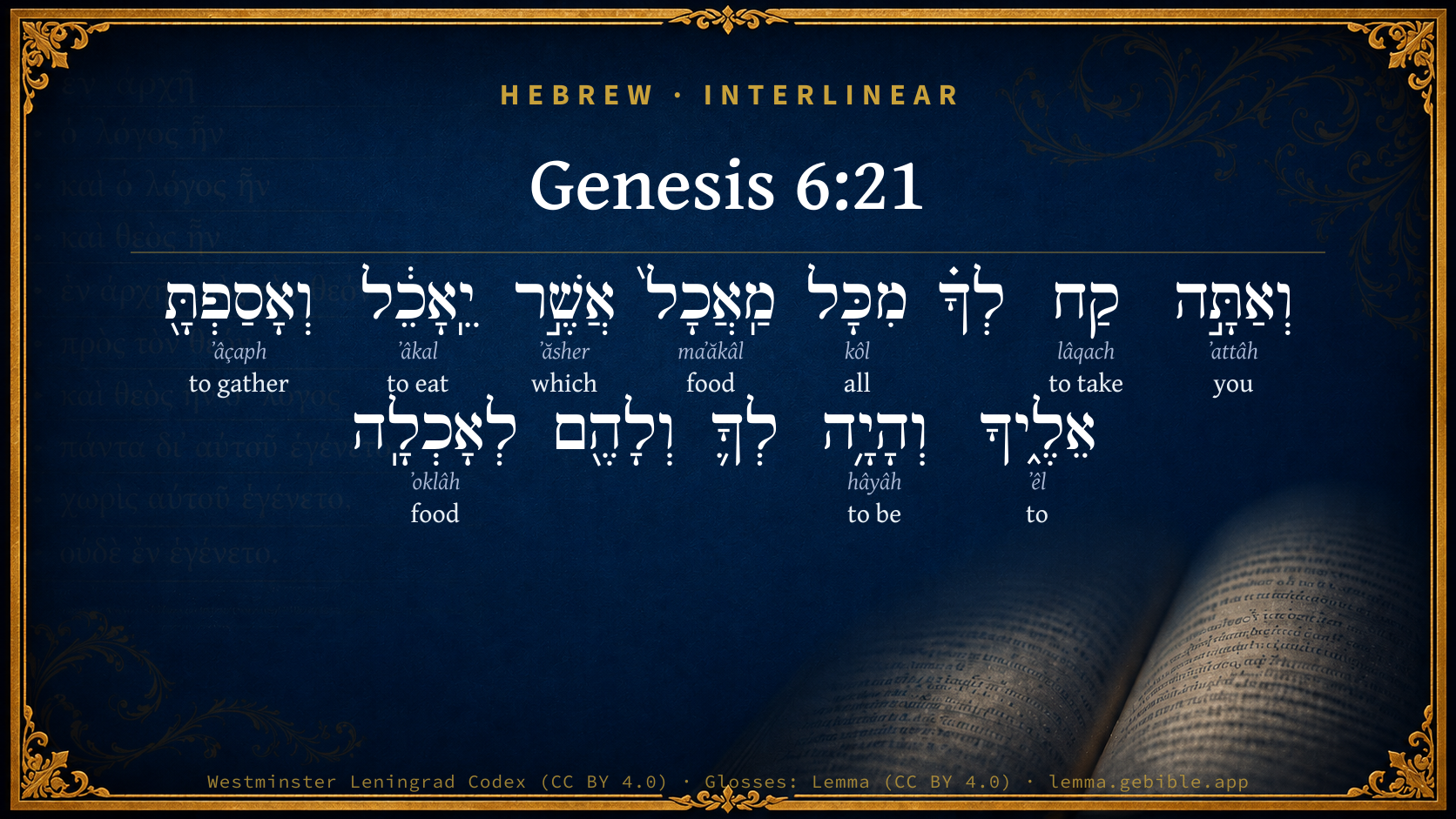
Hebrew (Westminster Leningrad Codex) Genesis 6:21 appears in the Hebrew Old Testament. The text above is from the Westminster Leningrad Codex. Each word links to its Strong’s number, a concise gloss, and parsing drawn from the Open Scriptures Hebrew Bible morphology. Click any word for its full Brown-Driver-Briggs (BDB) entry.
Download image
Cite this verse

Genesis 6:21 (World English Bible). Public Domain. Lemma interlinear Bible study tool, https://lemma.gebible.app/v/genesis/6/21.

Show BibTeX & RIS
BibTeX
RIS
English Translation
Take with you of all food that is eaten, and gather it to you; and it will be for food for you, and for them."
World English Bible · Public Domain
Highlights
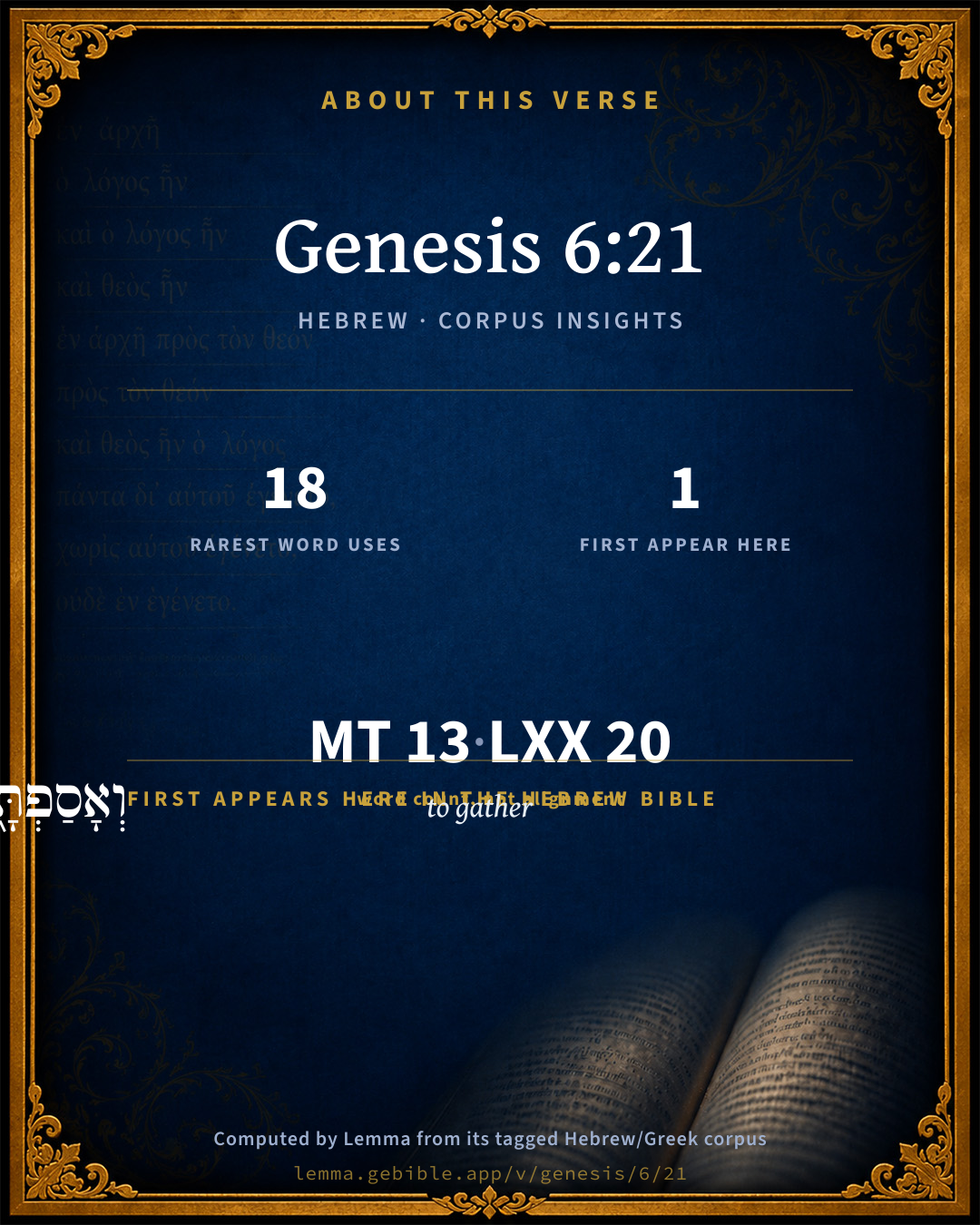
  • 1 first appearance in the Hebrew Bible
Full analysis ↓
Download a study sheet

One document with this verse’s original text, its word-by-word gloss line, the meaning frame, cross-references with their text, attributed commentary, and full source and license credits — printable, and it pastes into notes with its structure intact.

This verse Autodidact and up

Study sheet (.html) Plain text (.txt)

A passage Seminary Student

Up to 50 verses in one chapter. A passage sheet keeps up to 6 commentary sources and 12 cross-references per verse, in the order this page ranks them, and says so on the sheet whenever that leaves anything out. Ask for a single verse and you get the Autodidact verse sheet above.

Everything on this page stays free to read, with no account — the sheet is a download of what is already on screen, not access to it.

Want to remove ads? Support Godless Engineer
Compare translations 3

The same verse in 3 English versions, stacked beneath the original-language interlinear above. Click any original word for its lexicon entry.

Each is an independent rendering of the whole verse — the interlinear is not word-aligned to these translations.

Highlighted words mark where these versions differ — a whole-verse word diff, not a word-by-word alignment.

  • World English Bible Public Domain
    Take with you of all food that is eaten, and gather it to you; and it will be for food for you, and for them."
  • King James Version Public Domain
    And take thou unto thee of all food that is eaten, and thou shalt gather it to thee; and it shall be for food for thee, and for them.
  • unfoldingWord Literal Text CC BY-SA 4.0
    And you must take with you some of every food that is eaten and store it with you, and it will be food for you and for them.”

unfoldingWord Literal Text — © unfoldingWord, licensed CC BY-SA 4.0. Word-aligned USFM3 via Door43 (git.door43.org/unfoldingWord/en_ult).

Versions to compare (up to 4)

3 of 4 selected

Show all 18 translations

Every available English version of this verse, each an independent rendering of the whole verse.

  • World English Bible Public Domain
    Take with you of all food that is eaten, and gather it to you; and it will be for food for you, and for them."
  • Berean Standard Bible Public Domain
    You are also to take for yourself every kind of food that is eaten and gather it as food for yourselves and for the animals.”
  • Majority Standard Bible Public Domain
    You are also to take for yourself every kind of food that is eaten and gather it as food for yourselves and for the animals.”
  • King James Version Public Domain
    And take thou unto thee of all food that is eaten, and thou shalt gather it to thee; and it shall be for food for thee, and for them.
  • American Standard Version (1901) Public Domain
    And take thou unto thee of all food that is eaten, and gather it to thee; and it shall be for food for thee, and for them.
  • Revised Version (1885) Public Domain
    And take thou unto thee of all food that is eaten, and gather it to thee; and it shall be for food for thee, and for them.
  • Geneva Bible (1599) Public Domain
    And take thou with thee of all meate that is eaten: and thou shalt gather it to thee, that it may be meate for thee and for them.
  • Douay-Rheims (1899) Public Domain
    Thou shalt take unto thee of all food that may be eaten, and thou shalt lay it up with thee: and it shall be food for thee and them.
  • Young's Literal Translation Public Domain
    `And thou, take to thyself of all food that is eaten; and thou hast gathered unto thyself, and it hath been to thee and to them for food.'
  • Literal Standard Version CC BY-SA 4.0
    And you, take for yourself from all food that is eaten; and you have gathered [it] to yourself, and it has been for you and for them for food.”
  • Unlocked Literal Bible CC BY-SA 4.0
    Gather for yourself every kind of food that is eaten and store it, so that it will be food for you and for them.”
  • unfoldingWord Literal Text CC BY-SA 4.0
    And you must take with you some of every food that is eaten and store it with you, and it will be food for you and for them.”
  • Darby Bible Public Domain
    And take thou of all food that is eaten, and gather [it] to thee, that it may be for food for thee and for them.
  • World Messianic Bible Public Domain
    Take with you some of all food that is eaten, and gather it to yourself; and it will be for food for you, and for them.”
  • Webster's Bible Public Domain
    And take thou to thee of all food that is eaten, and thou shalt gather it to thee; and it shall be for food for thee, and for them.
  • Free Bible Version CC BY-SA 4.0
    Take all kinds of food with you too. Store it so you and the animals will have enough to eat.”
  • Bible in Basic English Public Domain
    And make a store of every sort of food for yourself and them.
  • JPS Tanakh (1917) Public Domain
    And take thou unto thee of all food that is eaten, and gather it to thee; and it shall be for food for thee, and for them.'

Literal Standard Version (2020), Covenant Press — licensed CC BY-SA 4.0. Text via the HelloAO Bible API (eBible.org). Unlocked Literal Bible (unfoldingWord) — licensed CC BY-SA 4.0. Text via the HelloAO Bible API (eBible.org). unfoldingWord Literal Text — © unfoldingWord, licensed CC BY-SA 4.0. Word-aligned USFM3 via Door43 (git.door43.org/unfoldingWord/en_ult). Free Bible Version, Dr. Jonathan Gallagher — licensed CC BY-SA 4.0. Text via the HelloAO Bible API (eBible.org).

Word by word

More ways to search: Search by grammar → Find every occurrence → Compare this word →

Practice this passage: Drill this verse → Learn its vocabulary →

לְאָכְלָֽה
ʼoklâh
H402
“to/for · food”
Preposition + Noun, Common, Feminine, Singular, Absolute
Part of Speech
Preposition + Noun
Type
Common
Gender
Feminine
Number
Singular
State
Absolute
Full BDB Definition

Origin: from H401

TWOT: 85b

food - food, eating - object of devouring, consuming - by wild beasts (figurative) - in fire - of judgment (figurative)
  1. וְאַתָּ֣ה ʼattâh H859 “and · you” Conjunction + Pronoun, Personal, 2nd Person, Masculine, Singular
  2. קַח lâqach H3947 “take” Verb, Qal, Imperative, 2nd Person, Masculine, Singular
  3. מִכָּל kôl H3605 “from · all of” Preposition + Noun, Common, Masculine, Singular, Construct
  4. מַֽאֲכָל֙ maʼăkâl H3978 “food” Noun, Common, Masculine, Singular, Absolute
  5. אֲשֶׁ֣ר ʼăsher H834 “which” Particle, Relative
  6. יֵֽאָכֵ֔ל ʼâkal H398 “to eat” Verb, Niphal, Imperfect, 3rd Person, Masculine, Singular
  7. וְאָסַפְתָּ֖ ʼâçaph H622 “and · to gather” Conjunction + Verb, Qal, Perfect, 2nd Person, Masculine, Singular
  8. אֵלֶ֑יךָ ʼêl H413 “to · you” Preposition + Suffix, Personal, 2nd Person, Masculine, Singular
  9. וְהָיָ֥ה hâyâh H1961 “and · to be” Conjunction + Verb, Qal, Perfect, 3rd Person, Masculine, Singular

About this verse

These counts appear in no published source. They are computed here, from the morphology-tagged text and Lemma’s own curated glosses. What Lemma adds →

13
words
10
distinct lemmas
Pentateuch
section

Notable vocabulary

The rarest word here is לְאָכְלָֽה food H402 — appearing just 18 times in the whole Hebrew Bible.

First appearance in Scripture

This word makes its first canonical appearance in the Hebrew Bible here:

  • וְאָסַפְתָּ֖ to gather H622

Shared distinctive vocabulary

לְאָכְלָֽה food H402 occurs in 18 verses of the Hebrew Bible. Also found in:

Grammatical profile

  • 4 verbs
  • 3 nouns
  • 1 pronoun
  • 4 prepositions
  • 1 particle

Verb forms

  • קַח Qal · Imperative
  • יֵֽאָכֵ֔ל Niphal · Imperfect
  • וְאָסַפְתָּ֖ Qal · Perfect
  • וְהָיָ֥ה Qal · Perfect

Hebrew & Septuagint length

In English translation the verse runs 25 words from the Hebrew and 31 from the Septuagint (LXX English) — closely comparable.

A rough comparison of the two English renderings, which tokenize alike — not a word-level alignment.

Word counts can differ between the Hebrew and the Greek without any difference in meaning — e.g. the Hebrew direct-object marker אֵת has no separate Greek word, and Greek often adds the article ὁ.

In the original languages it is 13 Hebrew tokens and 20 Greek tokens — but the two are counted differently (Hebrew bundles its prefixes and suffixes into one token; the Greek is in lemma form), so that isn’t a like-for-like length.

Cross-references

9

Topical passages linked to Genesis 6:21 in the Treasury of Scripture Knowledge — connected by theme and wording, ordered by reader-vote popularity; previews shown in the World English Bible.

  • Genesis 1:29–30 God said, "Behold, I have given you every herb yielding seed, which is on the surface of all the earth, and every tree, which bears fruit yielding seed. It will be your food.
  • Psalms 136:25 Who gives food to every creature; For his loving kindness endures forever.
  • Psalms 145:16 You open your hand, And satisfy the desire of every living thing.
  • Job 38:41 Who provides for the raven his prey, When his young ones cry to God, And wander for lack of food?
  • Job 40:20 Surely the mountains bring him forth food, Where all the animals of the field do play.
  • Psalms 35:6 Let their way be dark and slippery, Yahweh's angel pursuing them.
  • Psalms 104:27–28 These all wait for you, That you may give them their food in due season.
  • Psalms 147:9 He provides food for the cattle, And for the young ravens when they call.
  • Matthew 6:26 See the birds of the sky, that they don't sow, neither do they reap, nor gather into barns. Your heavenly Father feeds them. Aren't you of much more value than they?

Cross-references courtesy of OpenBible.info (CC BY 4.0).

Hebrew and Greek witnesses Masoretic Hebrew ↔ Greek Septuagint

The same verse in the two great witnesses to the Old Testament, shown verse-for-verse.

These are two independent witnesses, not word-aligned to each other, and the Septuagint is shown in lemma (dictionary) form.

Hebrew Genesis 6:21 Masoretic · Westminster Leningrad Codex

וְאַתָּ֣ה קַח לְךָ֗ מִכָּל מַֽאֲכָל֙ אֲשֶׁ֣ר יֵֽאָכֵ֔ל וְאָסַפְתָּ֖ אֵלֶ֑יךָ וְהָיָ֥ה לְךָ֛ וְלָהֶ֖ם לְאָכְלָֽה

Take with you of all food that is eaten, and gather it to you; and it will be for food for you, and for them."

World English Bible · Public Domain

Greek LXX Genesis 6:21 Septuagint · lemma form

σύ δέ λαμβάνω σεαυτοῦ ἀπό πᾶς ὁ βρῶμα ὅς ἐσθίω καί συνἄγω πρός σεαυτοῦ καί εἰμί σύ καί ἐκεῖνος ἐσθίω

And you shall take to yourself of all kinds of food which you⌃ eat, and you shall gather them to yourself, and it shall be for you and them to eat.

LXX2012 (modern English Septuagint) · Public Domain

Hebrew: Westminster Leningrad Codex (CC BY 4.0). Greek: Septuagint (public domain); English from LXX2012 (modern English Septuagint) (Public Domain). How the Septuagint differs from the Hebrew →

Targum (Aramaic paraphrase)

2

The Targum is the ancient Jewish Aramaic paraphrase of the Hebrew Scriptures — an interpretive translation, not the Hebrew text itself. Onkelos (literal) and Pseudo-Jonathan (expansive) render the Torah, and Jonathan the Prophets. Coverage is partial: where no permissively-licensed English translation exists for a verse, only the Aramaic is shown. This is verse-level text, not a word-by-word alignment to the Hebrew.

  1. Targum Onkelos Torah (Genesis–Deuteronomy)
    וְאַתְּ סַב לָךְ מִכָּל מֵיכַל דְּמִתְאֲכֵל וְתִכְנוֹשׁ לְוָתָךְ וִיהֵי לָךְ וּלְהוֹן לְמֵיכָל

    And thou, take with thee of all food which is eaten, and gather to be with thee; and it shall be for thee and for them to eat.

    Targum Onkelos — Aramaic: “Onkelos Genesis” (public domain); “Onkelos Exodus” (public domain); “Onkelos Leviticus” (public domain); “Onkelos Numbers” (public domain); “Onkelos Deuteronomy” (public domain). English: “Sefaria Community Translation” (CC0 1.0 (public-domain dedication)); “J.W. Etheridge. The Targums of Onkelos and Jonathan Ben Uzziel on the Pentateuch. London: Longmans, Green, 1862” (public domain). Text via Sefaria.

  2. Targum Pseudo-Jonathan Torah (Genesis–Deuteronomy)
    וְאַתְּ סַב לָךְ מִכָּל מֵיכַל דְמִיתְאָכִיל וִיהֵי לָךְ וּלְהוֹן לְמֵיכָל

    And thou, take to thee of all food that is eaten, and let it be to thee and to them for food.

    Targum Pseudo-Jonathan — Aramaic: “Targum Jonathan on Genesis” (public domain); “Targum Jonathan on Exodus” (public domain); “Targum Jonathan on Leviticus” (public domain); “Targum Jonathan on Numbers” (public domain); “Targum Jonathan on Deuteronomy” (public domain). English: “The Targum of Jonathan ben Uzziel, trans. J. W. Etheridge, London, 1862” (public domain). Text via Sefaria.

Commentary

Notes on Genesis 6:21 from classic Christian and Jewish commentators (each source and its license shown beneath its notes). The classic Christian expositions comment on the surrounding passage and are grouped to its opening verse, so a note may address several verses; the Jewish commentaries on the Tanakh (Rashi and others) are per-verse, so they appear only where the commentator wrote on this verse.

Lemma curates 59 commentaries, every one of them public domain or Creative Commons licensed, each selected and text-cleaned for this edition rather than reprinted as found. About our sources →

Trapp's Complete Commentary

John Trapp

Gen 6:21 And take thou unto thee of all food that is eaten, and thou shalt gather [it] to thee; and it shall be for food for thee, and for them.

Ver. 21. Take thou unto thee of all food.] God could have kept them alive without either food or ark. But he will have us serve his providence, in use of lawful means; and so to trust him, as that we do not tempt him.

John Trapp, A Commentary or Exposition upon All the Books of the Old and New Testament (1647–1656) — public domain. Text from a community e-Sword module.

Adam Clarke's Commentary

Verse 21. Of all food that is eaten] That is, of the food proper for every species of animals.

Adam Clarke's Commentary on the Bible (1810–1826) — public domain. Text from a community e-Sword/MySword module.

The Cambridge Bible for Schools and Colleges

gen. ed. J. J. S. Perowne

21. of all food that is eaten] Presumably vegetables, cereals, and fruit. Cf. Gen_1:29.

The Cambridge Bible for Schools and Colleges (gen. ed. J. J. S. Perowne; Cambridge University Press, 1878–1918) — public domain. Text from a community e-Sword module.

Matthew Poole's English Annotations

See Gen 1:29-30.

Matthew Poole's English Annotations on the Holy Bible (1683–1685) — public domain. Text from a community e-Sword/MySword module.

Whedon's Commentary on the Bible

Daniel D. Whedon

21. All food — Noah had had abundant opportunity to lay in provisions for the animals before the signs of the catastrophe appeared. It was not till the last seven days that they began to enter the ark. Gen_7:4; Gen_7:10.

Daniel D. Whedon (gen. ed.), Commentary on the Old and New Testaments (1874–1909) — public domain. Text from a community e-Sword module.

Radak

Rabbi David Kimhi (Radak)

ואתה קח לך, seeing that they will come to you in order to survive, you will have to prepare food for them, each species according to the type of diet it is used to. Even the predators will not be allowed to eat flesh while in the ark but would have to subsist on a vegetarian diet. They had, after all, been used to such a diet immediately after they had been created, as we have already explained on Genesis 1,25.

Radak on the Tanakh — English translations: “Sefaria Community Translation” (CC0 1.0 (public-domain dedication)); “Eliyahu Munk, HaChut Hameshulash” (CC BY 4.0); “Rabbi Mike Feuer, Jerusalem Anthology” (CC BY 4.0); and “R. David Kimhi on the first book of Psalms, Translated by R.G. Finch, London, 1919” (public domain). Text via Sefaria.

Lesson kit

Teaching starters — assembled from the data on this page, not authored interpretation. Every prompt links to the verse data it draws on. Edit before teaching.

Genesis, in the Pentateuch, opens this verse with 13 words (10 distinct Hebrew lemmas). Its most distinctive word is ʼoklâh (“food”). A historical commentator’s framing appears above. Read the whole chapter for the surrounding context.

Discussion questions

  1. How does “food” (ʼoklâh) shape what this verse is saying?
  2. This is the first place “to gather” appears in Scripture (first appears here). What does its debut here establish?
  3. How does Genesis 1:29, which shares the word «food», read alongside this verse?
  4. The translations on this page render this verse differently — a whole-verse word diff, not a word-by-word alignment. What might account for the different wordings?
  5. «קַח» is a Qal Imperative verb. How does that grammatical form shape the action described?
  6. Compare how Trapp's Complete Commentary and Adam Clarke's Commentary read this verse. Where do they agree or differ?

Things to notice

Reading settings

Reading text

Shown beneath each verse's original-language words.

Old Testament
Old Testament edition

Read the OT as the Masoretic Hebrew (MT) or the Greek Septuagint (LXX).

English shown for the Greek Septuagint (in the Hebrew ↔ Greek comparison).

Comparing translations? Open the Compare panel on any verse page to stack up to four side by side.