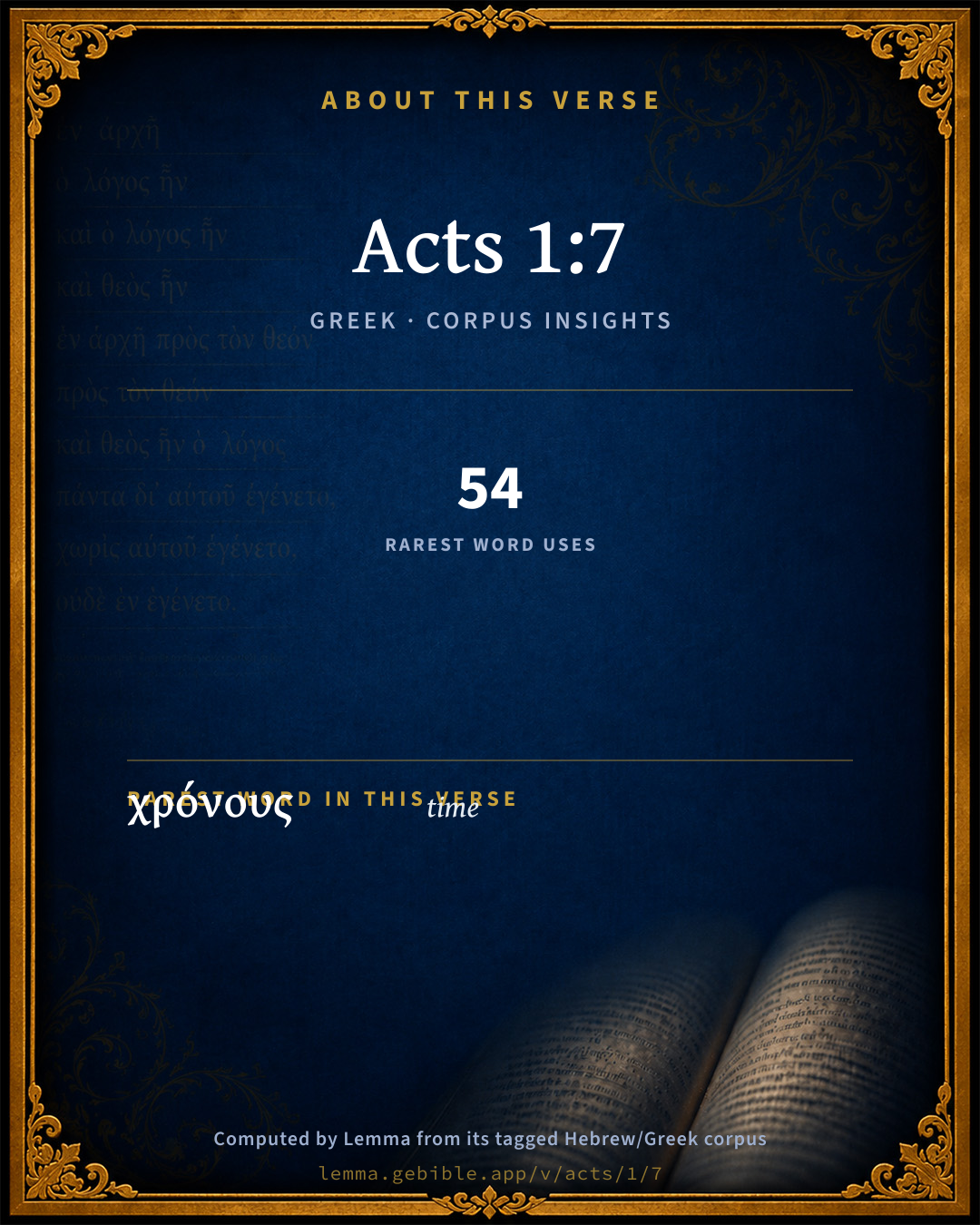
Acts 1:7

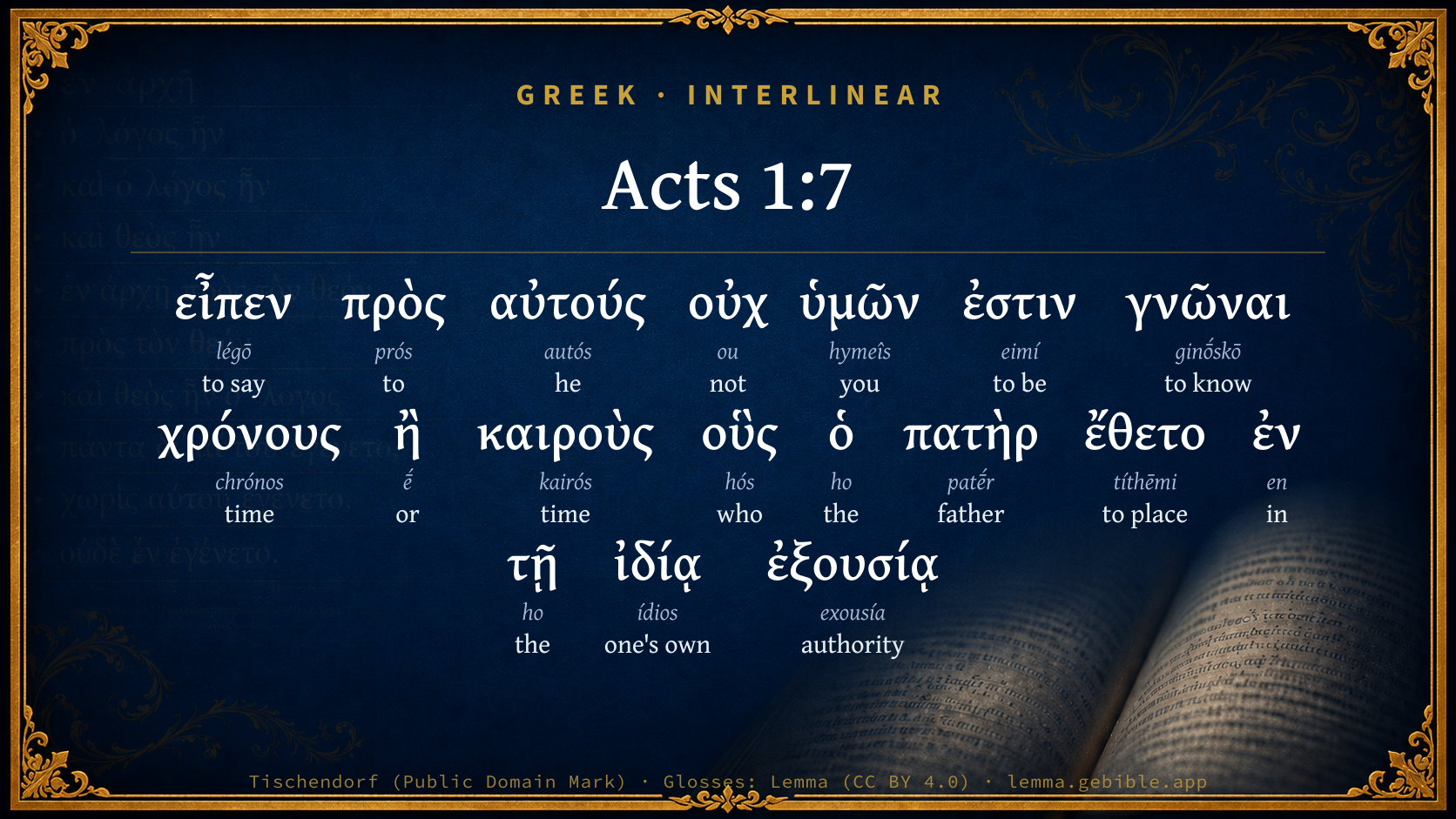
Greek (Tischendorf 8th ed.) Acts 1:7 appears in the Greek New Testament. The text above is from the Tischendorf 8th edition. Each word links to its Strong’s number and a concise gloss. Click any word for its full Thayer’s Greek Lexicon entry.
Download image
Cite this verse

Acts 1:7 (World English Bible). Public Domain. Lemma interlinear Bible study tool, https://lemma.gebible.app/v/acts/1/7.

Show BibTeX & RIS
BibTeX
RIS
English Translation
He said to them, "It isn't for you to know times or seasons which the Father has set within His own authority.
World English Bible · Public Domain
Download a study sheet

One document with this verse’s original text, its word-by-word gloss line, the meaning frame, cross-references with their text, attributed commentary, and full source and license credits — printable, and it pastes into notes with its structure intact.

This verse Autodidact and up

Study sheet (.html) Plain text (.txt)

A passage Seminary Student

Up to 50 verses in one chapter. A passage sheet keeps up to 6 commentary sources and 12 cross-references per verse, in the order this page ranks them, and says so on the sheet whenever that leaves anything out. Ask for a single verse and you get the Autodidact verse sheet above.

Everything on this page stays free to read, with no account — the sheet is a download of what is already on screen, not access to it.

Want to remove ads? Support Godless Engineer
Compare translations 3

The same verse in 3 English versions, stacked beneath the original-language interlinear above. Click any original word for its lexicon entry.

Each is an independent rendering of the whole verse — the interlinear is not word-aligned to these translations.

Highlighted words mark where these versions differ — a whole-verse word diff, not a word-by-word alignment.

  • World English Bible Public Domain
    He said to them, "It isn't for you to know times or seasons which the Father has set within His own authority.
  • King James Version Public Domain
    And he said unto them, It is not for you to know the times or the seasons, which the Father hath put in his own power.
  • unfoldingWord Literal Text CC BY-SA 4.0
    But he said to them, “It is not for you to know the times or the seasons that the Father has set by his own authority.

unfoldingWord Literal Text — © unfoldingWord, licensed CC BY-SA 4.0. Word-aligned USFM3 via Door43 (git.door43.org/unfoldingWord/en_ult).

Versions to compare (up to 4)

3 of 4 selected

Show all 19 translations

Every available English version of this verse, each an independent rendering of the whole verse.

  • World English Bible Public Domain
    He said to them, "It isn't for you to know times or seasons which the Father has set within His own authority.
  • Berean Standard Bible Public Domain
    Jesus replied, “It is not for you to know times or seasons that the Father has fixed by His own authority.
  • Majority Standard Bible Public Domain
    Jesus replied, “It is not for you to know times or seasons that the Father has fixed by His own authority.
  • King James Version Public Domain
    And he said unto them, It is not for you to know the times or the seasons, which the Father hath put in his own power.
  • American Standard Version (1901) Public Domain
    And he said unto them, It is not for you to know times or seasons, which the Father hath set within His own authority.
  • Revised Version (1885) Public Domain
    And he said unto them, It is not for you to know times or seasons, which the Father hath set within his own authority.
  • Geneva Bible (1599) Public Domain
    And hee saide vnto them, It is not for you to know the times, or the seasons, which the Father hath put in his owne power,
  • Douay-Rheims (1899) Public Domain
    But he said to them: It is not for you to know the times or moments, which the Father hath put in his own power:
  • Young's Literal Translation Public Domain
    and he said unto them, `It is not yours to know times or seasons that the Father did appoint in His own authority;
  • Literal Standard Version CC BY-SA 4.0
    And He said to them, “It is not yours to know times or seasons that the Father appointed in His own authority;
  • Unlocked Literal Bible CC BY-SA 4.0
    He said to them, “It is not for you to know the times or the seasons which the Father has determined by his own authority.
  • unfoldingWord Literal Text CC BY-SA 4.0
    But he said to them, “It is not for you to know the times or the seasons that the Father has set by his own authority.
  • Darby Bible Public Domain
    And he said to them, It is not yours to know times or seasons, which the Father has placed in his own authority;
  • World Messianic Bible Public Domain
    He said to them, “It isn’t for you to know times or seasons which the Father has set within his own authority.
  • Webster's Bible Public Domain
    And he said to them, It is not for you to know the times or the seasons, which the Father hath put in his own power.
  • Free Bible Version CC BY-SA 4.0
    “You don't need to know about the dates and times that are set by the Father's authority,” he told them.
  • Bible in Basic English Public Domain
    And he said to them, It is not for you to have knowledge of the time and the order of events which the Father has kept in his control.
  • Text-Critical English NT CC BY 4.0
    He said to them, “It is not for you to know the times or seasons that the Father has set by his own authority,
  • Tyndale New Testament (1534) Public Domain
    And he sayde vnto them: It is not for you to knowe the tymes or the seasons which the father hath put in his awne power:

Literal Standard Version (2020), Covenant Press — licensed CC BY-SA 4.0. Text via the HelloAO Bible API (eBible.org). Unlocked Literal Bible (unfoldingWord) — licensed CC BY-SA 4.0. Text via the HelloAO Bible API (eBible.org). unfoldingWord Literal Text — © unfoldingWord, licensed CC BY-SA 4.0. Word-aligned USFM3 via Door43 (git.door43.org/unfoldingWord/en_ult). Free Bible Version, Dr. Jonathan Gallagher — licensed CC BY-SA 4.0. Text via the HelloAO Bible API (eBible.org).

Word by word

More ways to search: Search by grammar → Find every occurrence → Compare this word →

Practice this passage: Drill this verse → Learn its vocabulary →

χρόνους
chrónos
G5550
“time”
Noun, Accusative, Plural, Masculine
Part of Speech
Noun
Case
Accusative
Number
Plural
Gender
Masculine
Full Thayer's Definition

Origin: of uncertain derivation

TDNT: 18:41,1

1. time either long or short
  1. εἶπεν légō G3004 “to say” Verb, Aorist, Active, Indicative, 3rd person, Singular
  2. πρὸς prós G4314 “to” Preposition
  3. αὐτούς autós G846 “he” Personal pronoun, Accusative, Plural, Masculine
  4. οὐχ ou G3756 “not” Particle, Negative
  5. ὑμῶν hymeîs G5210 “you” Personal pronoun, 2nd person, Genitive, Plural
  6. ἐστιν eimí G1510 “to be” Verb, Present, Active, Indicative, 3rd person, Singular
  7. γνῶναι ginṓskō G1097 “to know” Verb, Aorist, Active, Infinitive
  8. ἢ ḗ G2228 “or” Particle
  9. καιροὺς kairós G2540 “time” Noun, Accusative, Plural, Masculine
  10. οὓς hós G3739 “who” Relative pronoun, Accusative, Plural, Masculine
  11. ὁ ho G3588 “the” Article, Nominative, Singular, Masculine
  12. πατὴρ patḗr G3962 “father” Noun, Nominative, Singular, Masculine
  13. ἔθετο títhēmi G5087 “to place” Verb, Aorist, Middle, Indicative, 3rd person, Singular
  14. ἐν en G1722 “in” Preposition
  15. τῇ ho G3588 “the” Article, Dative, Singular, Feminine
  16. ἰδίᾳ ídios G2398 “one's own” Adjective, Dative, Singular, Feminine
  17. ἐξουσίᾳ exousía G1849 “authority” Noun, Dative, Singular, Feminine

About this verse

These counts appear in no published source. They are computed here, from the morphology-tagged text and Lemma’s own curated glosses. What Lemma adds →

18
words
17
distinct lemmas
Acts
section

Shared distinctive vocabulary

χρόνους time G5550 occurs in 54 verses of the Greek New Testament. Also found in:

Repetition

A word recurs within this verse:

Cross-references

12

Topical passages linked to Acts 1:7 in the Treasury of Scripture Knowledge — connected by theme and wording, ordered by reader-vote popularity; previews shown in the World English Bible.

  • Matthew 24:36 But no one knows of that day and hour, not even the angels of heaven, but my Father only.
  • 1 Thessalonians 5:1–2 But concerning the times and the seasons, brothers, you have no need that anything be written to you.
  • Mark 13:32 But of that day or that hour no one knows, not even the angels in heaven, nor the Son, but only the Father.
  • Deuteronomy 29:29 The secret things belong to Yahweh our God; but the things that are revealed belong to us and to our children forever, that we may do all the words of this law.
  • Mark 10:40 but to sit at my right hand and at my left hand is not mine to give, but for whom it has been prepared."
  • Daniel 2:21 He changes the times and the seasons; he removes kings, and sets up kings; he gives wisdom to the wise, and knowledge to those who have understanding;
  • Ephesians 1:10 to an administration of the fullness of the times, to sum up all things in Christ, the things in the heavens, and the things on the earth, in him;
  • Luke 21:24 They will fall by the edge of the sword, and will be led captive into all the nations. Jerusalem will be trampled down by the Gentiles, until the times of the Gentiles are fulfilled.
  • Matthew 20:23 He said to them, "You will indeed drink my cup, and be baptized with the baptism that I am baptized with, but to sit on my right hand and on my left hand is not mine to give; but it is for whom it has been prepared by my Father."
  • Acts 17:26 He made from one blood every nation of men to dwell on all the surface of the earth, having determined appointed seasons, and the boundaries of their dwellings,
  • 1 Timothy 6:15 which in its own times he will show, who is the blessed and only Ruler, the King of kings, and Lord of lords;
  • 2 Timothy 3:1 But know this, that in the last days, grievous times will come.

Cross-references courtesy of OpenBible.info (CC BY 4.0).

Commentary

Notes on Acts 1:7 from classic Christian and Jewish commentators (each source and its license shown beneath its notes). The classic Christian expositions comment on the surrounding passage and are grouped to its opening verse, so a note may address several verses; the Jewish commentaries on the Tanakh (Rashi and others) are per-verse, so they appear only where the commentator wrote on this verse.

Lemma curates 59 commentaries, every one of them public domain or Creative Commons licensed, each selected and text-cleaned for this edition rather than reprinted as found. About our sources →

MacLaren's Expositions of Holy Scripture

Alexander MacLaren

Acts

THE ASCENSION

THE UNKNOWN TO-MORROW

A New Year’s Sermon

Act 1:7.

The New Testament gives little encouragement to a sentimental view of life. Its writers had too much to do, and too much besides to think about, for undue occupation with pensive remembrances or imaginative forecastings. They bid us remember as a stimulus to thanksgiving and a ground of hope. They bid us look forward, but not along the low levels of earth and its changes. One great future is to draw all our longings and to fix our eyes, as the tender hues of the dawn kindle infinite yearnings in the soul of the gazer. What may come is all hidden; we can make vague guesses, but reach nothing more certain. Mist and cloud conceal the path in front of the portion which we are actually traversing, but when it climbs, it comes out clear from the fogs that hang about the flats. We can track it winding up to the throne of Christ. Nothing is certain, but the coming of the Lord and ‘our gathering together to Him.’

The words of this text in their original meaning point only to the ignorance of the time of the end which Christ had been foretelling. But they may allow of a much wider application, and their lessons are in entire consonance with the whole tone of Scripture in regard to the future. We are standing now at the beginning of a New Year, and the influence of the season is felt in some degree by us all. Not for the sake of repressing any wise forecasting which has for its object our preparation for probable duties and exigencies; not for the purpose of repressing that trustful anticipation which, building on our past time and on God’s eternity, fronts the future with calm confidence; not for the sake of discouraging that pensive and softened mood which if it does nothing more, at least delivers us for a moment from the tyrannous power of the present, do we turn to these words now; but that we may together consider how much they contain of cheer and encouragement, of stimulus to our duty, and of calming for our hearts in the prospect of a New Year. They teach us the limits of our care for the future, as they give us the limits of our knowledge of it. They teach us the best remedies for all anxiety, the great thoughts that tranquillise us in our ignorance, viz. that all is in God’s merciful hand, and that whatever may come, we have a divine power which will fit us for it; and they bid us anticipate our work and do it, as the best counterpoise for all vain curiosity about what may be coming on the earth.

I. The narrow limits of our knowledge of the future.

We are quite sure that we shall die. We are sure that a mingled web of joy and sorrow, light shot with dark, will be unrolled before us- but of anything more we are really ignorant. We know that certainly the great majority of us will be alive at the close of this New Year; but who will be the exceptions? A great many of us, especially those of us who are in the monotonous stretch of middle life, will go on substantially as we have been going on for years past, with our ordinary duties, joys, sorrows, cares; but to some of us, in all probability, this year holds some great change which may darken all our days or brighten them. In all our forward-looking there ever remains an element of uncertainty. The future fronts us like some statue beneath its canvas covering. Rolling mists hide it all, except here and there a peak.

I need not remind you how merciful and good it is that it is so. Therefore coming sorrows do not diffuse anticipatory bitterness as of tainted water percolating through gravel, and coming joys are not discounted, and the present has a reality of its own, and is not coloured by what is to come.

Then this being so-what is the wise course of conduct? Not a confident reckoning on to-morrow. There is nothing elevating in anticipation which paints the blank surface of the future with the same earthly colours as dye the present. There is no more complete waste of time than that. Nor is proud self-confidence any wiser, which jauntily takes for granted that ‘tomorrow will be as this day.’ The conceit that things are to go on as they have been fools men into a dream of permanence which has no basis. Nor is the fearful apprehension of evil any wiser. How many people spoil the present gladness with thoughts of future sorrow, and cannot enjoy the blessedness of united love for thinking of separation!

In brief, it is wise to be but little concerned with the future, except-

1. In the way of taking reasonable precautions to prepare for its probabilities.

2. To fit ourselves for its duties.

One future we may contemplate. Our fault is not that we look forward, but that we do not look far enough forward. Why trouble with the world when we have heaven? Why look along the low level among the mists of earth and forests and swamps, when we can see the road climbing to the heights? Why be anxious about what three hundred and sixty-five days may bring, when we know what Eternity will bring? Why divert our God-given faculty of hope from its true object? Why torment ourselves with casting the fashion of uncertain evils, when we can enter into the great peace of looking for ‘that blessed Hope’?

II. The safe Hands which keep the future.

‘The Father hath put in His own power.’ We have not to depend upon an impersonal Fate; nor upon a wild whirl of Chance; nor upon ‘laws of averages,’ ‘natural laws,’ ‘tendencies’ and ‘spirit of the age’; nor even on a theistic Providence, but upon a Father who holds all things ‘in His own power,’ and wields all for us. So will not our way be made right?

Whatever the future may bring, it will be loving, paternal discipline. He shapes it all and keeps it in His hands. Why should we be anxious? That great name of ‘Father’ binds Him to tender, wise, disciplinary dealing, and should move us to calm and happy trust.

III. The sufficient strength to face the future.

‘The power of the Holy Ghost coming upon you’ is promised here to the disciples for a specific purpose; but it is promised and given to us all through Christ, if we will only take it. And in Him we shall be ready for all the future.

The Spirit of God is the true Interpreter of Providence. He calms our nature, and enlightens our understanding to grasp the meaning of all our experiences. The Spirit makes joy more blessed, by keeping us from undue absorption in it. The Spirit is the Comforter. The Spirit fits us for duty.

So be quite sure that nothing will come to you in your earthly future, which He does not Himself accompany to interpret it, and to make it pure blessing.

IV. The practical duty in view of the future.

{a} The great thing we ought to look to in the future is our work,- not what we shall enjoy or what we shall endure, but what we shall do. This is healthful and calming.

{b} The great remedy for morbid anticipation lies in regarding life as the opportunity for service. Never mind about the future, let it take care of itself. Work! That clears away cobwebs from our brains, as when a man wakes from troubled dreams, to hear ‘the sweep of scythe in morning dew,’ and the shout of the peasant as he trudges to his task, and the lowing of the cattle, and the clink of the hammer.

{c} The great work we have to do in the future is to be witnesses for Christ. This is the meaning of all life; we can do it in joy and in sorrow, and we shall bear a charmed life till it be done. So the words of the text are a promise of preservation.

Then, dear brethren, how do you stand fronting that Unknown? How can you face it without going mad, unless you know God and trust Him as your Father through Christ? If you do, you need have no fear. To-morrow lies all dim and strange before you, but His gentle and strong hand is working in the darkness and He will shape it right. He will fit you to bear it all. If you regard it as your supreme duty and highest honour to be Christ’s witness, you will be kept safe, ‘delivered out of the mouth of the lion,’ that by you ‘the preaching may be fully known.’

If not, how dreary is that future to you, ‘all dim and cheerless, like a rainy sea,’ from which wild shapes may come up and devour you! Love and friendship will pass, honour and strength will fail, life will ebb away, and of all that once stretched before you, nothing will be left but one little strip of sand, fast jellying with the tide beneath your feet, and before you a wild unlighted ocean!

Alexander MacLaren, Expositions of Holy Scripture (1904–1910) — public domain. Text from a community e-Sword module.

Bengel's Gnomon

Johann Albrecht Bengel

Act 1:7. Οὐκ ὑμῶν ἐστιν, not for you is it) He does not say, “It is not for you;” but “not for you (not your part) is it;” in order that the emphasis may be on the ὑμῶν [Engl. Vers. loses this point]. Comp. by all means Joh 4:38, οὐχ ὑμεῖς,—ἄλλοι, not ye—others have; and “not unto thee (it appertained), but to the priests,” 2Ch 26:18; and οὐχ ἡμῖν καὶ ὑμῖν, “Not to us and to you belongeth the office of building,” etc., Ezr 4:3. It is a kindly repulse, and an impressive description of the Divine Reserve; and yet its aim is not to censure but to teach. He does not say, It is not part of your right and office to ask; but He says, Not yours is it to know. The Father has not ordered that this should he in your power, but has reserved it to His own power, that He should Himself know and do. Comp. Mat 24:36, “Of that day and hour knoweth no man; no, not the angels of heaven, but My Father only.” Not yours is it, saith He; from which it is not a legitimate inference, that it will not be the privilege even of others hereafter. The Revelation of the Divine economy has its successive steps: 1Pe 1:12, “Unto whom it was revealed that not unto themselves, but unto us, they did minister the things which are now reported,” etc.; Mat 11:11; Rev 1:1.—χρόνους ἢ καιροὺς, the intervals (periods) or times [“the times or the seasons”]) The question of the disciples is corrected, and the general term, χρόνῳ, “at this interval” (period), is determined by another term being added, χρόνους ἢ καιροὺς, the intervals (periods) or times, as we have elsewhere shown. Let it be generally observed in this place, that something longer is meant by χρόνον than by καιρόν: ch. Act 7:17; Act 7:20, “As the time (ὁ χρόνος) of the promise drew nigh,” “In which season (καιρῷ) Moses was born.” Justus Jonas writes, “It is enough that you know from the Scriptures that it is about to come to pass that all things shall be restored; but when this is about to be, belongs to GOD.”—οὓς, which) To pry into the times reserved to GOD, is the part of mere curiosity: not to concern one’s self about what has been revealed, is the part of a petty or a drowsy mind: Dan 9:2; 1Pe 1:11, “Searching what, or what manner of time, the Spirit of Christ which was in them did signify;” Rev 13:18. The things which did not as yet belong to the apostles to know, were afterwards signified by the Apocalypse. The more general enunciation of truths does not derogate from the special revelation which follows subsequently. Peter also has it said to him in this place, Thine it is not, altogether as in Joh 21:22-23, What is that to thee?—ὁ Πατὴρ, the Father) Mat 20:23, “To sit on My right hand is not Mine to give, but—to them for whom it is prepared of My Father;” Mat 24:36.—ἔθετο, hath put) Therefore the thing itself is sure: otherwise there would be no time of the thing.—ἐν τῇ ἰδίᾳ ἐξουσίᾳ, in His own power) At the time of the farther revelation, and especially of the actual fulfilment, even those things which heretofore had rested in the Father’s power, are known.

Bengel's Gnomon of the New Testament — English translation (T&T Clark, Edinburgh, 1860) — public domain. Text from a community e-Sword module.

Meyer's Critical & Exegetical Commentary

Heinrich August Wilhelm Meyer

f

Act_1:7 f. Jesus refuses to answer the question of the disciples; not indeed in respect of the matter itself involved, but in respect of the time inquired after, as not beseeming them (observe the emphatic οὐχ ὑμῶν); and on the contrary (ἀλλά) He turns their thoughts, and guides their interest to their future official equipment and destination, which alone they were now to lay to heart. Chrysostom aptly says: διδασκάλου τοῦτό ἐστι μὴ ἃ βούλεται ὁ μαθητὴς, ἀλλʼ ἃ συμΦέρει μαθεῖν, διδάσκειν.

χρόνους ἣ καιρούς] times or, in order to denote the idea still more definitely, seasons. καιρός is not equivalent to χρόνος, but denotes a definite marked off portion of time with the idea of fitness. See Thom. Mag. p. 489 f.; Tittm. Synon. N. T. p. 41. On ἤ, which is not equivalent to καί, comp. here Dem. Ol. 3 : τίνα γὰρ χρόνον ἢ τίνα καιρὸν τοῦ παρόντος βελτίω ζητεῖτε;

ἔθετο ἐν τῇ ἰδίᾳ ἐξουσίᾳ] has established by means of His own plenitude of power. On ἐν, comp. Mat_21:23.

The whole declaration (Act_1:7) is a general proposition, the application of which to the question put by the disciples is left to them; therefore only in respect of this application is an ad hanc rem perficiendam to be mentally supplied with ἔθετο. Bengel, however, well observes: gravis descriptio reservati divini; and ergo res ipsa firma est, alias nullum ejus rei tempus esset. But this res ipsa was, in the view of Jesus (which, however, we have no right to put into the question of the disciples, in opposition to Hofmann, Schriftbew. II. 2, p. 647), the restoration of the kingdom, not for the natural, but for the spiritual Israel, comprehending also the believing Gentiles (Rom_4:9), for the Ἰσραὴλ τοῦ Θεοῦ (Gal_6:16); see Mat_8:11; Joh_10:16; Joh_10:26; Joh_8:42 ff. al.; and already Mat_3:9.

δύναμιν ἐπελθ. τοῦ ἁγ. πν. ἐφ ̓ ὑμᾶς] power, when the Holy Spirit has (shall have) come upon you, Winer, p. 119 [E. T. 156].

μάρτυρες] namely, of my teaching, actions, and life, what ye all have yourselves heard and seen, Act_5:21 f., Act_10:39 ff.; Luk_24:48; Joh_15:27.

ἔν τε Ἱερουσαλ.… τῆς γῆς] denotes the sphere of the apostles work in its commencement and progress, up to its most general diffusion; therefore τῆς γῆς is not to be explained of the land, but of the earth; and, indeed, it is to be observed that Jesus delineates for the apostles their sphere ideally. Comp. Act_13:47; Isa_8:9; Rom_10:18; Col_1:23; Mar_16:15.

Meyer — Critical and Exegetical Commentary on the New Testament — English translation by Peter Christie, edited by Frederick Crombie (T&T Clark, 1880) — public domain. Text from a community e-Sword module.

Expositor's Greek Testament

ed. W. Robertson Nicoll

Act 1:7 . χρόνους ἢ καιρούς : Blass regards the two as synonymous, and no doubt it is difficult always to maintain a distinction. But here χρόνους may well be taken to mean space of time as such, the duration of the Church’s history, and καιρούς the critical periods in that history. ὁ μὲν καιρὸς δηλοῖ ποιότητα χρόνου , χρόνος δὲ ποσότητα (Ammonius). A good instance of the distinction may be found in LXX Neh 10:34 : εἰς καιροὺς ἀπὸ χρόνων , “at times appointed”; cf. 1Th 5:1 . So here Weiss renders: “zu kennen Zeiten und geeignete Zeitpunkte”. In modern Greek, whilst καιρός means weather , χρόνος means year , so that “in both words the kernel of meaning has remained unaltered; this in the case of καιρούς is changeableness, of χρόνων duration” (Curtius, Etym. , p. 110 sq. ); cf. also Trench, N. T. Synonyms , ii., p. 27 ff.; Kennedy, Sources of N. T. Greek , p. 153; and Grimm-Thayer, sub v. καιρός . ἐξουσία , authority , R.V. either as delegated or unrestrained, the liberty of doing as one pleases ( ἔξεστι ); δύναμις , power , natural ability, inherent power, residing in a thing by virtue of its nature, or , which a person or thing exerts or puts forth so δύναμις is ascribed to Christ, now in one sense, now in another, so also to the Holy Spirit as in Act 1:8 ; cf. Act 10:38 , Luk 4:14 , Rom 15:13 ; Bengel, Luk 4:36 , and Grimm-Thayer, Synonyms. Sub v. δύναμις .

The Expositor's Greek Testament, edited by W. Robertson Nicoll (1897–1910) — public domain. Text from a community e-Sword module.

Geneva Bible (1599)

Geneva Bible translators

That is, the fit occasions that serve to doing of matters which the Lord hath appointed to bring things to pass in.

Geneva Bible (1599) marginal notes — public domain. Text via Bolls.life.

Jamieson, Fausset & Brown

Robert Jamieson, A. R. Fausset & David Brown

It is not for you to know the times, &c.--implying not only that this was not the time, but that the question was irrelevant to their present business and future work.

Jamieson, Fausset & Brown — Commentary Critical and Explanatory on the Whole Bible (1871) — public domain (CC PDM 1.0). Text via the HelloAO Bible API.

Adam Clarke's Commentary

Verse 7. The times or the seasons] χρονουςηκαιρους. Times here may signify any large portion of a period, aera, or century-such as an Olympiad, lustrum or year; and seasons, the particular part, season, or opportunity in that period, c., in which it might be proper to do any particular work. God has not only fixed the great periods in which he will bring about those great revolutions which his wisdom, justice, and mercy have designed, but he leaves himself at full liberty to choose those particular portions of such periods as may be best for the accomplishment of those purposes. Thus God is no necessary agent-every thing is put in his own power, εν τη ιδια εξουσια, under his control and authority nor will he form decrees of which he must become the necessary executor. The infinite liberty of acting or not acting, as wisdom, justice, and goodness shall see best, is essential to God, nor can there be a point in the whole of his eternity in which he must be the necessary agent of a fixed and unalterable fate. Infinite, eternal liberty to act or not to act, to create or not create, to destroy or not destroy, belongs to God alone, and we must take care how we imagine decrees, formed even by his own prescience, in reference to futurity, which his power is from the moment of their conception laid under the necessity of performing. In every point of time and eternity, God must be free to act or not to act, as may seem best to his godly wisdom.

Adam Clarke's Commentary on the Bible (1810–1826) — public domain. Text from a community e-Sword/MySword module.

John Calvin's Commentaries

7. It is not for you to know, etc. This is a general reprehension of the whole question. For it was too curious for them to desire to know that whereof their Master would have them ignorant; but this is the true means to become wise, namely, to go as far forward in learning as our Master Christ goeth in teaching, and willingly to be ignorant of those things which he doth conceal from us. But forasmuch as there is naturally engendered in us a certain foolish and vain curiosity, and also a certain rash kind of boldness, we must diligently observe this admonition of Christ, whereby he correcteth both these vices. But to the end we may know what his meaning is hereby, we must mark the two members which he joineth together. “It is not for you” (saith he) “to know those things which the Father hath placed in his own power.” He speaketh, indeed, of the times and seasons; but seeing there is the like reason in other things, we must think this to be a universal precept, That being contented with the revelation of God, we think it an heinous crime to inquire any further. This is the true mean between the two extremes. The Papists, that they may have somewhat wherewith to cloak their gross ignorance, say for themselves, that they omit the hidden mysteries of God, as though our whole faith and religion did consist upon any thing else than upon the hidden mysteries of God; then may we take our leave of Christ and his gospel, if we must abstain utterly from the hidden mysteries of God. But we must keep, as I said before a mean herein; for we must be desirous to learn so far as our heavenly Master doth teach us; but as for such things as he will have us ignorant of, let mine be so bold as to inquire after them that we may be wise with sobriety. Therefore, so often as we are vexed with this foolish desire of knowing more than we ought, let us call to mind this saying of Christ, “It is not for you to know.” For unless we will burst in against his will and commandment, this shall have force and strength enough to restrain the outrageousness of our wits.

Now, as touching the foreknowledge of times, Christ condemneth only the searching out thereof which reacheth beyond the measure of God’s revelation; and that is to be noted out of the second member, as before I have said, “which the Father hath placed in his own power.” Truth it is, that God hath in his own power winter and summer, and the rest of the seasons of the year, cold and heat, fair weather and foul. But because he hath testified that the course of the years shall be perpetual, (Genesis 1:14,) he is said not to have placed that in his own power which he hath revealed unto men. What thing soever the philosophers or husbandmen do comprehend or understand by art, by learning, by judgment, or experience, all that doth God not retain unto himself, because he hath after a certain sort revealed it unto them, (Genesis 8:22.) The same opinion must we have of the prophets; for it was their office to know those things which God did reveal. But we must be ignorant of the secret events of things, as touching the time to come; for there is nothing which may make us more slack in doing our duties, than too careful an inquisition herein, for we will always take counsel according to the future event of things; but the Lord, by hiding the same from us, doth prescribe unto us what we ought to do. Here ariseth a conflict, because we will not willingly suffer God to have that which is his own, namely, the sole government and direction of things which are to come; but we cast ourselves into a strange and inordinate carefulness. To conclude, Christ forbiddeth us to apply those things unto ourselves, which God doth challenge as proper to himself alone. Of this sort is the foreknowledge of those things which God hath taken to himself to govern and direct, according to his own pleasure, far contrary to our opinion, and otherwise than we could invent.

John Calvin's Commentaries (1540-1563) — public domain. Text from the Calvin Translation Society English edition (1840s-50s) via the Christian Classics Ethereal Library (ccel.org). Calvin's coverage is partial (roughly two-thirds of the Bible); uncommented books and verses are honest gaps, never fabricated. The 19th-century editor's footnotes and remarks are omitted so the notes are faithfully Calvin's own voice.

Ellicott's Commentary for English Readers

(7) It is not for you to know the times or the seasons.—The combination of the two words is characteristic of St. Luke and St. Paul (1Th_5:1). The answer to the eager question touches the season rather than the nature of the fulfilment of their hopes. They are left to the teaching of the Spirit and of Time to remould and purify their expectations of the restoration of Israel. What was needed now was the patience that waits for and accepts that teaching.

Which the Father hath put in his own power.—Better, as free from the ambiguity which attaches to the present version, which the Father appointed by His own authority.

A Bible Commentary for English Readers, edited by Charles John Ellicott (1878–1897) — public domain. Text from a community e-Sword module.

The Cambridge Bible for Schools and Colleges

gen. ed. J. J. S. Perowne

7. It is not for you, &c.] During the tutelage, as it may be called, of His disciples, our Lord constantly avoided giving a direct answer to enquiries which they addressed to Him. He checked in this way their tendency to speculate on the future, and drew their minds to their duty in the present. Cp. Joh_21:21-22.

in his own power] The word here rendered power is not the same as that so rendered in the following verse. The sense of this first word is “absolute disposal,” and we might well render it authority.

The Cambridge Bible for Schools and Colleges (gen. ed. J. J. S. Perowne; Cambridge University Press, 1878–1918) — public domain. Text from a community e-Sword module.

John Gill's Exposition

And he said unto them,.... To his disciples,

it is not for you to know the times or the seasons; meaning, not the times that are past from Adam to Christ; as how long the world stood; when the flood came; when Sodom and Gomorrha were burned to ashes; when the children of Israel came out of Egypt, and the law was given to them; when the kingdom of Israel began, and when the Jews were carried captive, and when they returned; when the sceptre departed from Judah, and Daniel's weeks had an end: or the particular seasons of the year, and the times for planting, ploughing, sowing, reaping, &c. but when should be the time, the day, and hour of the coming of the son of man, when he shall set up his kingdom in a more glorious manner, and the kingdoms of this world shall become his; or when the kingdom shall be restored to Israel. This, by the Jews, is said to be one of the seven things hid from men (k):

"seven things are hid from the children of men, and these are they; the day of death, and the day of consolation, and the depth of judgment, and a man knows not what is in the heart of his neighbour, nor with what he shall be rewarded, and "when the kingdom of the house of David shall return", and when the kingdom of Persia shall fall.

Which the Father hath put in his own power; and not in the power of a creature, no, not of the angels; see Mat 24:36 wherefore it is vain and sinful, as well as fruitless, to indulge a curious inquiry into these things, or into the times and seasons of what is future; as of the time of a man's death, of the end of the world, of the second coming of Christ; only those things should be looked into which God has revealed, and put into the power of man to know by diligent search and inquiry. Says R. Simeon (l),

"flesh and blood, (i.e. man), which knows not , "its times and its moments", (and so the Vulgate Latin renders the words here), ought to add a void space to the blessed God, who knows the times and moments.

(k) T. Bab. Pesachim, fol. 54. 2. Vid. Bereshit Rabba, sect. 65. fol. 57. 4. (l) Apud R. Sol. Jarchi in Gen. ii. 2.

John Gill's Exposition of the Whole Bible (1746–1763) — public domain (CC PDM 1.0). Text via the HelloAO Bible API.

Trapp's Complete Commentary

John Trapp

7 And he said unto them, It is not for you to know the times or the seasons, which the Father hath put in his own power.

Ver. 7. It is not for you] This key God carries under his own girdle.

John Trapp, A Commentary or Exposition upon All the Books of the Old and New Testament (1647–1656) — public domain. Text from a community e-Sword module.

Albert Barnes' Notes on the Bible

It is not for you to know - The question of the apostles respected the time of the restoration; it was not whether he would do it. Accordingly, his answer meets precisely their inquiry; and he tells them in general that the time of the great events of God’s kingdom was not to be understood by them. They had asked a similar question on a former occasion, Mat 24:3, “Tell us when shall these things be?” Jesus had answered them then by showing them that certain signs would precede his coming, and then by saying Mat 24:36, “But of that day and that hour knoweth no man, no, not the angels of heaven, but my Father only.” God has uniformly reproved a vain curiosity on such points, 1Th 5:1-2; 2Pe 3:10; Luk 12:39-40.

The times or the seasons - The difference between these words is, that the former denotes any time or period that is indefinite or uncertain; the later denotes a fixed, definite, or appropriate time. They seem to be used here to denote the periods that would mark or determine all future events.

The Father hath put ... - So entirely had the Father reserved the knowledge of these to himself, that it is said that even the Son did not know them. See Mar 3:32, and the notes on that place.

In his own power - That is, he has fixed them by his own authority, he will bring them about in his own time and way; and therefore it is not proper for people anxiously to inquire into them. All prophecy is remarkably obscure in regard to the time of its fulfillment. The reasons why it is so are such as the following:

To excite people to watch for the events that are to come, as the time is uncertain, and they will come “like a thief in the night.”

(2)As they are to be brought about by human agency, they are so arranged as to call forth that agency. If people knew just when an event was to come to pass, they might be remiss, and feel that their own efforts were not needed.

(3)The knowledge of future scenes of the exact time, might alarm people, and absorb their thoughts so entirely as to prevent a proper attention to the present duties of life. Duty is ours now; God will provide for future scenes.

(4)Promises sufficiently clear and full are therefore given us to encourage us, but not so full as to excite a vain and idle curiosity. All this is eminently true of our own death, one of the most important future scenes through which we are to pass. It is certainly before us; it is near; it cannot be long delayed; it may come at any moment. God has fixed the time, but will not inform us when it shall be. He does not gratify a vain curiosity; nor does he terrify us by announcing to us the day or the hour when we are to die, as we do a man that is to be executed. This would be to make our lives like that of a criminal sentenced to die, and we should through all our life, through fear of death, be subject to bondage, Heb 2:15. He has made enough known to excite us to make preparation, and to be always ready, having our loins girt about and our lamps trimmed and burning, Luk 12:35.

Albert Barnes' Notes on the Bible (1834–1885) — public domain. Text from a community e-Sword/MySword module.

Matthew Poole's English Annotations

Our Saviour blames their curiosity about such things as are not necessary to be known; and yet though our Saviour does not in his answer tell them what they desired to know, he tells them what is more expedient for them to know. The petition of wicked men, nay, of devils, (as when they crave to go into the swine), is sometimes granted according to their will. But the prayer of the disciples of Christ is answered to their best advantage, though it does not seem to agree to the matter of their desire.

It is not for you to know the times or the seasons; how long any mercy shall be deferred; when it shall be given.

The Father; who is fons et origo Deitatis; to whom Christ, especially as Mediator, and in our stead, refers all things.

Matthew Poole's English Annotations on the Holy Bible (1683–1685) — public domain. Text from a community e-Sword/MySword module.

Whedon's Commentary on the Bible

Daniel D. Whedon

7. The times or the seasons—Without confirming, denying, or correcting their notion, postponing the right informing of their views to the Pentecost, Jesus gently reproves their impatience in regard to the time. He gives an admonition which Christians of all ages would do well to note. The attempting by prophetic calculations to fix the precise date of any future event reduces the Scripture to a mere fortune-teller’s manual. Few errors within the limits of Christianity have been more dangerous or disgraceful in effect either upon the credit of the Bible, or upon the mind of the individuals.—The word times here signifies the great current, and seasons the particular points or epochs of time.

Put in his own power—A very striking expression, indicating that the Omnipotent reserves for his own decision the great events of the world, and especially the world’s “last things.” God is his own counsellor, and, like a wise sovereign, keeps his own secrets of state. Nay, more, the free actions of men being undecreed are intrinsically alternative, and able to proceed in either of diverse ways. See note on Mat_11:23; Mat_11:25, and Rom_2:1-10; Rom_8:29-30. Israel was able to accept Messiah-Jesus. And had all Israel been thus true to her national mission, the Pentecostal outpouring would not have been confined to the precincts of an upper room. The latter glory would have forthwith filled the temple and the nation, and such would have been its wondrous manifestation of splendour and of power that Rome would have bowed the knee, and the fulness of the Gentiles would have been gathered in. Christ would have even seen the travail of his soul and been satisfied. The consummation and the advent might have been hastened by centuries, perhaps by millenniums. The Father thus reserves the times and seasons in his own power, in view of the contingencies of the world’s future events and courses. (See note Act_2:1.) This reservation by the Father is in striking harmony with our Lord’s declaration in Mar_13:32, where not only men and angels, but even the Son, is excluded from a knowledge of the day and the hour. (See our note.) This declaration of our Lord furnishes the key-note for St. Paul’s times and seasons, 1Th_5:1, and other similar passages.

Bengel remarks, however, “The thing itself is true, otherwise there would be no time for the thing.” True, it may be replied; but what the true nature of the thing is—that is, of the restoration of the kingdom or nationality to Israel—our Lord stops not to explain. It may be that the true kingdom— the Church of God—is to be restored to the natural Israel only by his becoming a part of the true Israel. And this is implied by the universal spread of the Gospel, described in Act_1:8. Thus much is certain, that the New Testament contains not one explicit literal declaration that the Jewish nation is to be so restored to the land of Palestine, or that Jerusalem is to be again the local head of the theocracy or kingdom of God. Neither Jerusalem nor the Jew is recognised as a distinct department or element in the new dispensation.

Daniel D. Whedon (gen. ed.), Commentary on the Old and New Testaments (1874–1909) — public domain. Text from a community e-Sword module.

The Pulpit Commentary

Times or seasons for the times or the seasons, A.V.; set within his own authority for put in his own power, A.V. It is not for you to know, etc. The time of the end is always spoken of as hidden (so Mat_24:36; Mar_13:32; 1Th_5:1, 1Th_5:2; 2Pe_3:10, etc.) Times or season. Times with reference to duration, seasons with reference to fitness or opportunity. Which the Father. The distinctive use of the word "Father" here agrees with our Lord"s saying in Mar_13:32, "Neither the Son, but the Father." Hath set within his own authority (ejxousi) Hath reserved under his own authority ("Speaker"s Commentary"); "Has established by means of his own plenitude of power" (Meyer); "Hath put or kept in his own power (A.V., and so Afford). This last seems the best.

The Pulpit Commentary (1880–1919), ed. H.D.M. Spence-Jones & Joseph S. Exell — public domain. Text from a community e-Sword module.

John Wesley's Explanatory Notes

The times or the seasons - Times, in the language of the Scriptures, denote a longer; seasons, a shorter space. Which the Father hath put in his own power - To be revealed when and to whom it pleaseth him.

John Wesley, Explanatory Notes Upon the Whole Bible (1754–1765) — public domain. Text via the GEBible commentary corpus.

Godbey's Commentary on the New Testament

William B. Godbey

TIMES AND SEASONS

7. Probably a better translation of these Greek words would be “periods and epochs.” You plant out a peach orchard. Then follows a period running over a number of years during which the trees flourish and yield their fruits. Eventually they get old and diseased, and the fruit is not only imperfect in quality but much reduced in quantity, so that it no longer pays to perpetuate the enterprise. The fruit bearing period is past and a revolutionary epoch supervenes. You dig the trees up by the roots, make fuel of trunks, roots and branches, plough and harrow the ground as virgin soil and proceed to pitch another crop on an entirely different agricultural line. So, in the Divine administration, we see these periods occupying rolling centuries and wound up by miraculous Divine interventions, developing memorable epochs and superinducing a new order of things. The Eden period terminated in the sad calamity of the Fall; the antediluvian, with the Flood; the patriarchal, with Egyptian slavery, plagues, and destruction in the Red Sea. The Mosaic dispensation, launched amid the thunders and earthquakes of Sinai, adorned with many prophets, saints and martyrs, finally degenerated, like its predecessors, into dead formality and hollow hypocrisy, rushing madly into the bloody scene of Calvary, fast ripening for destruction by the invasion of the Roman armies. The Gospel dispensation, the last of all in the grand preparatory for the coming kingdom, though inaugurated amid the unprecedented glories of Pentecost, pursuant to prophecies has already degenerated into worldly ecclesiasticisms, fast ripening for destruction. “It is not your prerogative to know the periods and epochs, which the Father placed in his own authority.” The appointment of the day of His coming is fanatical, as this is known to the Father only. However, it is our privilege to know the time of the end, the precise time being known only to the Father, from the simple fact that it is probably impossible for any human being to know the exact chronology. Professors Totton and Dimbleby, evidently the greatest chronologists of the present age, define the expiration of the “Gentile times” in the last vernal equinox (1898). The lunar chronology finishes the “Gentile times” seven years ago; the calendar chronology, thirty-five years hence, and the solar chronology, in seventy years. If we take Daniel’s tribulation period, forty five years, to intervene between the rapture of the Bride and the coming of the King, we may certainly be on the constant lookout, because by the majority of chronologists the coming of the Lord to steal away His Bride is over-due. That we are living in the time of the end of the Gentile dispensation and in the Millennial dawn, is certainly indubitable.

William B. Godbey, Commentary on the New Testament (1896–1900) — public domain. Text from a community e-Sword module.

McGarvey & Pendleton's Commentaries

J. W. McGarvey

See notes on verse 6

J. W. McGarvey (with Philip Y. Pendleton), Commentaries on the New Testament (The Fourfold Gospel, 1914; Acts; and the epistles) — public domain. Text from a community e-Sword/MySword module.

The People's New Testament

B. W. Johnson

7. It is not for you to know. This was a reproof, not only to them, but to those in all ages who seek to know “the times or the seasons, which the Father hath put in his own power.”

B. W. Johnson's The People's New Testament with Notes (1889–1891) — public domain. Electronic text from the Christian Classics Ethereal Library (CCEL) ThML edition.

Cambridge Greek Testament for Schools and Colleges

7. οὐχ ὑμῶν ἐστίν, it does not belong to you, it is not your business. This sense of the genitive, implying property or propriety, is not uncommon in classical Greek. During the tutelage, as it may be called, of His disciples, Jesus constantly avoided giving a direct answer to the inquiries which they addressed to Him. He checked in this way their tendency to speculate on the future and drew their minds to their duty in the present. Cf. Joh 21:21-22. Of this conduct Chrysostom writes: διδασκάλου γὰρ τοῦτό ἐστι, μὴ ἃ βούλεται ὁ μαθητὴς ἀλλ’ ἃ συμφέρει μαθεῖν, διδάσκειν.

καιρούς. Vulg. ‘momenta.’ This word differs from χρόνος in being restricted to some well-defined point of time, while χρόνος embraces a more extended period. Cf. LXX. Neh 10:34, where the wood for the altar is to be brought εἰς ἀπὸ χρόνων ἐνιαυτὸν κατ’ ἐνιαυτόν, = at fixed points of time chosen out of larger periods, year by year. The A.V. has ‘at times appointed year by year.’ Cf. also for the idea of the words LXX. 2Sa 20:5, καὶ ἐχρόνησεν ἀπὸ τοῦ καιροῦ οὗ ἐτάξατο αὐτῷ, ‘he tarried longer than the set time which he had appointed him’ (A.V.). The two nouns are found in conjunction LXX. Dan 2:21; Dan 7:12. Also in 1Th 5:1.

ἐξουσίᾳ = authority, absolute disposal. ‘Which the Father appointed by His own authority.’ It is not the same word as that in the next verse, δύναμις, though the A.V. renders both by ‘power.’

Cambridge Greek Testament for Schools and Colleges (Cambridge University Press, 1896; 21 vols, various authors incl. Carr, Maclear, Plummer, Farrar, Lumby, Moule, M. R. James, Simcox) — public domain. Text from a community e-Sword module.

Alford’s Greek Testament

Henry Alford

7.] This is a general reproof and assertion, spoken with reference to men, as forbidden to search curiously into a point which Omniscience has reserved—the times and seasons of the future divine dealings. But it is remarkable that not θεός, but ὁ πατήρ, is here used; and this cannot fail to remind us of that saying (Mar 13:32), περὶ δὲ τῆς ἡμέρας ἐκείνης ἢ τῆς ὥρας οὐδεὶς οἶδεν, οὐδὲ ἄγγελος ἐν οὐρανῷ, οὐδὲ ὁ υἱός, εἰ μὴ ὁ πατήρ. It may be observed however, that the same assertion is not made here: only the times and seasons said to be in the power of the Almighty Father, Who ordereth all things κατὰ τὴν βουλὴν τοῦ θελήματος αὐτοῦ. The Knowledge of the Son is not here in question, only that of the disciples. It is an enquiry intimately connected with the interpretation of the two passages, but one beyond our power to resolve, how far, among the things not yet put under His feet, may be this very thing, the knowledge of that day and hour. Bengel attempts to evade the generality of the οὐχ ὑμῶν ἐστιν:—‘quæ apostolorum nondum erat nosse, per Apocalypsin postea sunt significata.’ But signified to whom? What individual, or portion of the Church, has ever read plainly these χρόνους ἢ καιρούς in that mysterious book? There is truth in Olsh.’s remark, that the Apostles were to be less prophets of the future, than witnesses of the past; but we must not so limit the ὑμῶν, nor forget that the γνῶναι χρόνους ἢ καιρ. has very seldom been imparted by prophecy, which generally has formed a testimony to this very fact, that God has them in His foreknowledge, and, while He announces the events, conceals for the most part in obscurity the times.

χρ. ἢ καιρ.] not synonymous; as Meyer observes, καιρός is always a definite limited space of time, and involves the idea of transitoriness. See also Tittmann, N. T. Synonymes, pp. 39-45.

ἔθ. ἐν τῇ ἰδ. ἐξ.] Some (De Wette, al.) render ‘hath appointed by His own power;’ I should rather take ἐν ἐξ. as in ch. 5:4, in His own power, and understand by ἔθετο kept, ‘(hath) placed,’ as E. V. But the aor. sense should be preserved: the period referred to being that of the arrangement of the divine counsels of Redemption.

Henry Alford, The Greek Testament (1849–1861) — public domain. Text from a community e-Sword module.

Vincent's Word Studies in the New Testament

Marvin R. Vincent

The times - the seasons [χρονους - καιρους] . Rev. properly omits the article. The former of these words, time absolutely, without regard to circumstances; the latter, definite periods, with the idea of fitness. His own [τη ιδια] . Stronger than the simple possessive pronoun. The adjective means private, personal. Often used adverbially in the phrase kat' ijdian, apart, privately. See Mt 17:1; Mt 24:3.

Marvin R. Vincent, Word Studies in the New Testament (1887–1900) — public domain. Text from a community e-Sword/MySword module.

Lesson kit

Teaching starters — assembled from the data on this page, not authored interpretation. Every prompt links to the verse data it draws on. Edit before teaching.

Acts, in the Acts, opens this verse with 18 words (17 distinct Greek lemmas). Its most distinctive word is chrónos (“time”). A historical commentator’s framing appears above. Read the whole chapter for the surrounding context.

Discussion questions

  1. How does “time” (chrónos) shape what this verse is saying?
  2. How does Matthew 2:7, which shares the word «time», read alongside this verse?
  3. What does the repetition of “the” (2× in this one verse) do in this verse?
  4. The translations on this page render this verse differently — a whole-verse word diff, not a word-by-word alignment. What might account for the different wordings?
  5. Compare how MacLaren's Expositions of Holy Scripture and Bengel's Gnomon read this verse. Where do they agree or differ?

Things to notice

Reading settings

Reading text

Shown beneath each verse's original-language words.

Old Testament
Old Testament edition

Read the OT as the Masoretic Hebrew (MT) or the Greek Septuagint (LXX).

English shown for the Greek Septuagint (in the Hebrew ↔ Greek comparison).

Comparing translations? Open the Compare panel on any verse page to stack up to four side by side.