

Acts 4:27
Greek (Tischendorf 8th ed.) Acts 4:27 appears in the Greek New Testament. The text above is from the Tischendorf 8th edition. Each word links to its Strong’s number and a concise gloss. Click any word for its full Thayer’s Greek Lexicon entry.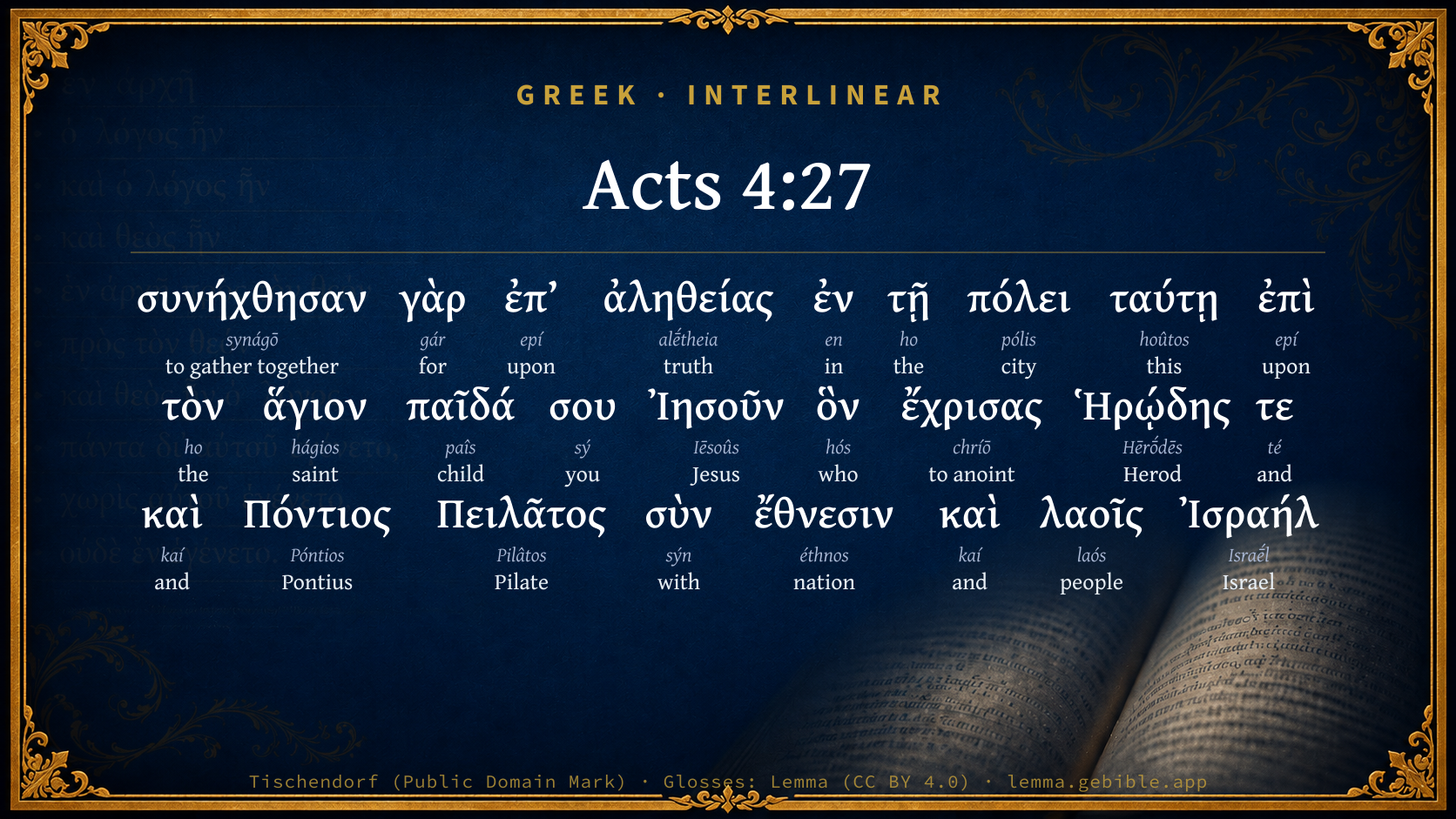
For truly, in this city against your holy servant, Jesus, whom you anointed, both Herod and Pontius Pilate, with the Gentiles and the people of Israel, were gathered together
Download a study sheet
One document with this verse’s original text, its word-by-word gloss line, the meaning frame, cross-references with their text, attributed commentary, and full source and license credits — printable, and it pastes into notes with its structure intact.
This verse Autodidact and up
A passage Seminary Student
Up to 50 verses in one chapter. A passage sheet keeps up to 6 commentary sources and 12 cross-references per verse, in the order this page ranks them, and says so on the sheet whenever that leaves anything out. Ask for a single verse and you get the Autodidact verse sheet above.
Everything on this page stays free to read, with no account — the sheet is a download of what is already on screen, not access to it.
Compare translations 3
The same verse in 3 English versions, stacked beneath the original-language interlinear above. Click any original word for its lexicon entry.
Each is an independent rendering of the whole verse — the interlinear is not word-aligned to these translations.
Highlighted words mark where these versions differ — a whole-verse word diff, not a word-by-word alignment.
-
World English Bible Public Domain
For truly, in this city against your holy servant, Jesus, whom you anointed, both Herod and Pontius Pilate, with the Gentiles and the people of Israel, were gathered together
-
King James Version Public Domain
For of a truth against thy holy child Jesus, whom thou hast anointed, both Herod, and Pontius Pilate, with the Gentiles, and the people of Israel, were gathered together,
-
unfoldingWord Literal Text CC BY-SA 4.0
For in truth both Herod and Pontius Pilate, with the nations and the people of Israel, were gathered together in this city against your holy Servant Jesus, whom you anointed,
unfoldingWord Literal Text — © unfoldingWord, licensed CC BY-SA 4.0. Word-aligned USFM3 via Door43 (git.door43.org/unfoldingWord/en_ult).
Show all 19 translations
Every available English version of this verse, each an independent rendering of the whole verse.
-
World English Bible Public Domain
For truly, in this city against your holy servant, Jesus, whom you anointed, both Herod and Pontius Pilate, with the Gentiles and the people of Israel, were gathered together
-
Berean Standard Bible Public Domain
In fact, this is the very city where Herod and Pontius Pilate conspired with the Gentiles and the people of Israel against Your holy servant Jesus, whom You anointed.
-
Majority Standard Bible Public Domain
In fact, Herod and Pontius Pilate conspired with the Gentiles and the people of Israel against Your holy servant Jesus, whom You anointed.
-
King James Version Public Domain
For of a truth against thy holy child Jesus, whom thou hast anointed, both Herod, and Pontius Pilate, with the Gentiles, and the people of Israel, were gathered together,
-
American Standard Version (1901) Public Domain
for of a truth in this city against thy holy Servant Jesus, whom thou didst anoint, both Herod and Pontius Pilate, with the Gentiles and the peoples of Israel, were gathered together,
-
Revised Version (1885) Public Domain
for of a truth in this city against thy holy Servant Jesus, whom thou didst anoint, both Herod and Pontius Pilate, with the Gentiles and the peoples of Israel, were gathered together,
-
Geneva Bible (1599) Public Domain
For doutlesse, against thine holy Sonne Iesus, whome thou haddest anoynted, both Herod and Pontius Pilate, with the Gentiles and the people of Israel gathered themselues together,
-
Douay-Rheims (1899) Public Domain
For of a truth there assembled together in this city against thy holy child Jesus, whom thou hast anointed, Herod, and Pontius Pilate, with the Gentiles and the people of Israel,
-
Young's Literal Translation Public Domain
for gathered together of a truth against Thy holy child Jesus, whom Thou didst anoint, were both Herod and Pontius Pilate, with nations and peoples of Israel,
-
Literal Standard Version CC BY-SA 4.0
for gathered together of a truth against Your holy child Jesus, whom You anointed, were both Herod and Pontius Pilate, with nations and peoples of Israel,
-
Unlocked Literal Bible CC BY-SA 4.0
Indeed, both Herod and Pontius Pilate, together with the Gentiles and the people of Israel, gathered together in this city against your holy servant Jesus, whom you anointed.
-
unfoldingWord Literal Text CC BY-SA 4.0
For in truth both Herod and Pontius Pilate, with the nations and the people of Israel, were gathered together in this city against your holy Servant Jesus, whom you anointed,
-
Darby Bible Public Domain
For in truth against thy holy servant Jesus, whom thou hadst anointed, both Herod and Pontius Pilate, with [the] nations, and peoples of Israel, have been gathered together in this city
-
World Messianic Bible Public Domain
“For truly, both Herod and Pontius Pilate, with the Gentiles and the people of Israel, were gathered together against your holy servant Yeshua, whom you anointed,
-
Webster's Bible Public Domain
For in truth against thy holy child Jesus, whom thou hast anointed, both Herod, and Pontius Pilate, with the Gentiles, and the people of Israel, were assembled,
-
Free Bible Version CC BY-SA 4.0
Now this has really happened right here in this city! Both Herod and Pontius Pilate, together with the foreigners and the people of Israel, united together against your holy servant Jesus, whom you anointed as Messiah.
-
Bible in Basic English Public Domain
For, truly, in this town, against your holy servant, Jesus, who was marked out by you as Christ, Herod, and Pontius Pilate, with the Gentiles and the people of Israel, came together,
-
Text-Critical English NT CC BY 4.0
For indeed both Herod and Pontius Pilate, along with the Gentiles and the people of Israel, were gathered together against yoʋr holy servant Jesus, whom yoʋ anointed,
-
Tyndale New Testament (1534) Public Domain
For of a trueth agaynst thy holy chylde Iesus whom thou hast annoynted bothe Herode and also Poncius Pylate with the Gentils and the people of Israel gaddered them selves to gedder
Literal Standard Version (2020), Covenant Press — licensed CC BY-SA 4.0. Text via the HelloAO Bible API (eBible.org). Unlocked Literal Bible (unfoldingWord) — licensed CC BY-SA 4.0. Text via the HelloAO Bible API (eBible.org). unfoldingWord Literal Text — © unfoldingWord, licensed CC BY-SA 4.0. Word-aligned USFM3 via Door43 (git.door43.org/unfoldingWord/en_ult). Free Bible Version, Dr. Jonathan Gallagher — licensed CC BY-SA 4.0. Text via the HelloAO Bible API (eBible.org).
Word by word
More ways to search: Search by grammar → Find every occurrence → Compare this word →
Practice this passage: Drill this verse → Learn its vocabulary →
- Appears 3× in the Greek New Testament
- First appears at Luke 3:1
- Part of Speech
- Noun
- Case
- Nominative
- Number
- Singular
- Gender
- Masculine
Full Thayer's Definition
- συνήχθησαν synágō G4863 “to gather together” Verb, Aorist, Passive, Indicative, 3rd person, Plural
- γὰρ gár G1063 “for” Conjunction
- ἐπ’ epí G1909 “upon” Preposition
- ἀληθείας alḗtheia G225 “truth” Noun, Genitive, Singular, Feminine
- ἐν en G1722 “in” Preposition
- τῇ ho G3588 “the” Article, Dative, Singular, Feminine
- πόλει pólis G4172 “city” Noun, Dative, Singular, Feminine
- ταύτῃ hoûtos G3778 “this” Demonstrative pronoun, Dative, Singular, Feminine
- ἐπὶ epí G1909 “upon” Preposition
- τὸν ho G3588 “the” Article, Accusative, Singular, Masculine
- ἅγιον hágios G40 “saint” Adjective, Accusative, Singular, Masculine
- παῖδά paîs G3816 “child” Noun, Accusative, Singular, Masculine
- σου sý G4771 “you” Personal pronoun, 2nd person, Genitive, Singular
- Ἰησοῦν Iēsoûs G2424 “Jesus” Noun, Accusative, Singular, Masculine
- ὃν hós G3739 “who” Relative pronoun, Accusative, Singular, Masculine
- ἔχρισας chríō G5548 “to anoint” Verb, Aorist, Active, Indicative, 2nd person, Singular
- Ἡρῴδης Hērṓdēs G2264 “Herod” Noun, Nominative, Singular, Masculine
- τε té G5037 “and” Particle
- καὶ kaí G2532 “and” Conjunction
- Πόντιος Póntios G4194 “Pontius” Noun, Nominative, Singular, Masculine
- Πειλᾶτος Pilâtos G4091 “Pilate” Noun, Nominative, Singular, Masculine
- σὺν sýn G4862 “with” Preposition
- ἔθνεσιν éthnos G1484 “nation” Noun, Dative, Plural, Neuter
- καὶ kaí G2532 “and” Conjunction
- λαοῖς laós G2992 “people” Noun, Dative, Plural, Masculine
- Ἰσραήλ Israḗl G2474 “Israel” Noun, Proper, indeclinable
About this verse
These counts appear in no published source. They are computed here, from the morphology-tagged text and Lemma’s own curated glosses. What Lemma adds →
- 26
- words
- 23
- distinct lemmas
- Acts
- section
Cross-references
46Topical passages linked to Acts 4:27 in the Treasury of Scripture Knowledge — connected by theme and wording, ordered by reader-vote popularity; previews shown in the World English Bible.
- Matthew 27:2 and they bound him, and led him away, and delivered him up to Pontius Pilate, the governor.
- Acts 4:30 while you stretch out your hand to heal; and that signs and wonders may be done through the name of your holy Servant Jesus."
- Luke 9:22 saying, "The Son of Man must suffer many things, and be rejected by the elders, chief priests, and scribes, and be killed, and the third day be raised up."
- Job 14:4 Who can bring a clean thing out of an unclean? Not one.
- Job 15:14 What is man, that he should be clean? He who is born of a woman, that he should be righteous?
- Job 25:4 How then can man be just with God? Or how can he who is born of a woman be clean?
- Psalms 2:2 The kings of the earth take a stand, And the rulers take counsel together, Against Yahweh, and against his anointed, saying,
- Psalms 2:6 "Yet I have set my king on my holy hill of Zion."
- Psalms 45:7 You have loved righteousness, and hated wickedness. Therefore God, your God, has anointed you with the oil of gladness above your fellows.
- Isaiah 49:7 Thus says Yahweh, the Redeemer of Israel, [and] his Holy One, to him whom man despises, to him whom the nation abhors, to a servant of rulers: Kings shall see and arise; princes, and they shall worship; because of Yahweh who is faithful, [even] the Holy One of Israel, who has chosen you.
- Isaiah 53:3 He was despised, and rejected by men; a man of suffering, and acquainted with disease: and as one from whom men hide their face he was despised; and we didn't respect him.
- Isaiah 61:1 The Spirit of the Lord Yahweh is on me; because Yahweh has anointed me to preach good news to the humble; he has sent me to bind up the broken-hearted, to proclaim liberty to the captives, and the opening [of the prison] to those who are bound;
- Zechariah 11:7–8 So I fed the flock of slaughter, especially the oppressed of the flock. I took for myself two staffs. The one I called "Favor," and the other I called "Union," and I fed the flock.
- Matthew 2:13–16 Now when they had departed, behold, an angel of the Lord appeared to Joseph in a dream, saying, "Arise and take the young child and his mother, and flee into Egypt, and stay there until I tell you, for Herod will seek the young child to destroy him."
- Matthew 14:1 At that time, Herod the tetrarch heard the report concerning Jesus,
- Matthew 20:18–19 "Behold, we are going up to Jerusalem, and the Son of Man will be delivered to the chief priests and scribes, and they will condemn him to death,
- Matthew 21:28 But what do you think? A man had two sons, and he came to the first, and said, 'Son, go work today in my vineyard.'
- Matthew 23:37 "Jerusalem, Jerusalem, who kills the prophets, and stones those who are sent to her! How often would I have gathered your children together, even as a hen gathers her chickens under her wings, and you would not!
- Matthew 26:3–4 Then the chief priests, the scribes, and the elders of the people were gathered together in the court of the high priest, who was called Caiaphas.
- Matthew 26:59–68 Now the chief priests, the elders, and the whole council sought false testimony against Jesus, that they might put him to death;
- Matthew 27:11–36 Now Jesus stood before the governor: and the governor asked him, saying, "Are you the King of the Jews?" Jesus said to him, "So you say."
- Matthew 27:40–43 and saying, "You who destroy the temple, and build it in three days, save yourself! If you are the Son of God, come down from the cross!"
- Mark 10:33 "Behold, we are going up to Jerusalem. The Son of Man will be delivered to the chief priests and the scribes. They will condemn him to death, and will deliver him to the Gentiles.
- Mark 14:1–2 It was now two days before the feast of the Passover and the unleavened bread, and the chief priests and the scribes sought how they might sieze him by deception, and kill him.
- Mark 14:43–65 Immediately, while he was still speaking, Judas, one of the twelve, came--and with him a multitude with swords and clubs, from the chief priests, the scribes, and the elders.
- Mark 15:1–27 Immediately in the morning the chief priests, with the elders and scribes, and the whole council, held a consultation, and bound Jesus, and carried him away, and delivered him up to Pilate.
- Mark 15:31 Likewise, also the chief priests mocking among themselves with the scribes said, "He saved others. He can't save himself.
- Luke 1:35 The angel answered her, "The Holy Spirit will come on you, and the power of the Most High will overshadow you. Therefore also the holy one who is born from you will be called the Son of God.
- Luke 4:18 "The Spirit of the Lord is on me, Because he has anointed me to preach good news to the poor. He has sent me to heal the brokenhearted, To proclaim release to the captives, Recovering of sight to the blind, To deliver those who are crushed,
- Luke 13:31–33 On that same day, some Pharisees came, saying to him, "Get out of here, and go away, for Herod wants to kill you."
- Luke 18:31–33 He took the twelve aside, and said to them, "Behold, we are going up to Jerusalem, and all the things that are written through the prophets concerning the Son of Man will be completed.
- Luke 20:13–19 The lord of the vineyard said, 'What shall I do? I will send my beloved son. It may be that seeing him, they will respect him.'
- Luke 22:1–6 Now the feast of unleavened bread, which is called the Passover, drew near.
- Luke 22:47–52 While he was still speaking, behold, a multitude, and he who was called Judas, one of the twelve, was leading them. He came near to Jesus to kiss him.
- Luke 22:63–23:5 The men who held Jesus mocked him and beat him.
- Luke 23:7–38 When he found out that he was in Herod's jurisdiction, he sent him to Herod, who was also in Jerusalem during those days.
- John 1:11 He came to his own, and those who were his own didn't receive him.
- John 10:36 Do you say of him whom the Father sanctified and sent into the world, 'You blaspheme,' because I said, 'I am the Son of God?'
- John 18:19–24 The high priest therefore asked Jesus about his disciples, and about his teaching.
- John 18:28–19:24 They led Jesus therefore from Caiaphas into the Praetorium. It was early, and they themselves didn't enter into the Praetorium, that they might not be defiled, but might eat the Passover.
- John 19:34 However one of the soldiers pierced his side with a spear, and immediately blood and water came out.
- Acts 2:27 Because you will not leave my soul in Hades, Neither will you allow your Holy One to see decay.
- Acts 3:13–14 The God of Abraham, Isaac, and Jacob, the God of our fathers, has glorified his Servant Jesus, whom you delivered up, and denied in the presence of Pilate, when he had determined to release him.
- Acts 10:38 even Jesus of Nazareth, how God anointed him with the Holy Spirit and with power, who went about doing good and healing all who were oppressed by the devil, for God was with him.
- Hebrews 7:26 For such a high priest was fitting for us: holy, guiltless, undefiled, separated from sinners, and made higher than the heavens;
- John 18:1–14 When Jesus had spoken these words, he went out with his disciples over the brook Kidron, where was a garden, into which he and his disciples entered.
Cross-references courtesy of OpenBible.info (CC BY 4.0).
Where the printed editions differ
1 variantPlaces in this verse where the major printed Greek editions disagree on the wording in a way that affects the translation — a comparison of editions, not a manuscript-by-manuscript collation. The editions are the modern critical texts (Nestlé-Aland 28/27, SBL, Westcott-Hort, Tregelles, Tyndale House) and the traditional texts behind the KJV (the Textus Receptus and the Byzantine/Majority text). It is not a claim about which reading is original.
-
Extra text
ἐν τῇ πόλει ταύτῃ
“in the city this”
In NA28NA27TynSBLWHTreg Not in TRByzἐν τῇ πόλει ταύτῃ (en tēa polei tautē) 'in the city this' is only in older manuscripts (NA28+NA27+Tyn+SBL+WH+Treg)
Textual data: Translators Amalgamated Greek New Testament (STEPBible TAGNT) · CC BY 4.0.
Lesson kit
Teaching starters — assembled from the data on this page, not authored interpretation. Every prompt links to the verse data it draws on. Edit before teaching.
Acts, in the Acts, opens this verse with 26 words (23 distinct Greek lemmas). Its most distinctive word is Póntios (“Pontius”). A historical commentator’s framing appears above. Read the whole chapter for the surrounding context.
Discussion questions
- The word Póntios carries the sense “Pontius.” How does it shape the verse?
- Luke 3:1 shares the word «Pontius» with this verse. How do the two illuminate each other?
- “upon” occurs 2× in this one verse. What is the effect of the repetition?
- These translations render this verse differently. What is at stake in choosing one wording over another?
- Reading how MacLaren's Expositions of Holy Scripture and Bengel's Gnomon read this verse, where do the two commentators agree and where do they part?
Things to notice
- These translations choose different wording for 8 words in this verse.
- “upon” occurs 2× in this single verse.
- 23 distinct Greek lemmas span 26 words in this verse.
Commentary
Notes on Acts 4:27 from classic Christian and Jewish commentators (each source and its license shown beneath its notes). The classic Christian expositions comment on the surrounding passage and are grouped to its opening verse, so a note may address several verses; the Jewish commentaries on the Tanakh (Rashi and others) are per-verse, so they appear only where the commentator wrote on this verse.
Lemma curates 59 commentaries, every one of them public domain or Creative Commons licensed, each selected and text-cleaned for this edition rather than reprinted as found. About our sources →
MacLaren's Expositions of Holy Scripture
Alexander MacLaren
Alexander MacLaren, Expositions of Holy Scripture (1904–1910) — public domain. Text from a community e-Sword module.
Bengel's Gnomon
Johann Albrecht Bengel
Bengel's Gnomon of the New Testament — English translation (T&T Clark, Edinburgh, 1860) — public domain. Text from a community e-Sword module.
Meyer's Critical & Exegetical Commentary
Heinrich August Wilhelm Meyer
Meyer — Critical and Exegetical Commentary on the New Testament — English translation by Peter Christie, edited by Frederick Crombie (T&T Clark, 1880) — public domain. Text from a community e-Sword module.
Expositor's Greek Testament
ed. W. Robertson Nicoll
The Expositor's Greek Testament, edited by W. Robertson Nicoll (1897–1910) — public domain. Text from a community e-Sword module.
Geneva Bible (1599)
Geneva Bible translators
Geneva Bible (1599) marginal notes — public domain. Text via Bolls.life.
Adam Clarke's Commentary
Adam Clarke's Commentary on the Bible (1810–1826) — public domain. Text from a community e-Sword/MySword module.
John Calvin's Commentaries
John Calvin's Commentaries (1540-1563) — public domain. Text from the Calvin Translation Society English edition (1840s-50s) via the Christian Classics Ethereal Library (ccel.org). Calvin's coverage is partial (roughly two-thirds of the Bible); uncommented books and verses are honest gaps, never fabricated. The 19th-century editor's footnotes and remarks are omitted so the notes are faithfully Calvin's own voice.
Ellicott's Commentary for English Readers
A Bible Commentary for English Readers, edited by Charles John Ellicott (1878–1897) — public domain. Text from a community e-Sword module.
The Cambridge Bible for Schools and Colleges
gen. ed. J. J. S. Perowne
The Cambridge Bible for Schools and Colleges (gen. ed. J. J. S. Perowne; Cambridge University Press, 1878–1918) — public domain. Text from a community e-Sword module.
John Gill's Exposition
John Gill's Exposition of the Whole Bible (1746–1763) — public domain (CC PDM 1.0). Text via the HelloAO Bible API.
Trapp's Complete Commentary
John Trapp
John Trapp, A Commentary or Exposition upon All the Books of the Old and New Testament (1647–1656) — public domain. Text from a community e-Sword module.
Albert Barnes' Notes on the Bible
Albert Barnes' Notes on the Bible (1834–1885) — public domain. Text from a community e-Sword/MySword module.
Matthew Poole's English Annotations
Matthew Poole's English Annotations on the Holy Bible (1683–1685) — public domain. Text from a community e-Sword/MySword module.
Whedon's Commentary on the Bible
Daniel D. Whedon
Daniel D. Whedon (gen. ed.), Commentary on the Old and New Testaments (1874–1909) — public domain. Text from a community e-Sword module.
The Pulpit Commentary
The Pulpit Commentary (1880–1919), ed. H.D.M. Spence-Jones & Joseph S. Exell — public domain. Text from a community e-Sword module.
John Wesley's Explanatory Notes
John Wesley, Explanatory Notes Upon the Whole Bible (1754–1765) — public domain. Text via the GEBible commentary corpus.
Scofield Reference Notes
C. I. Scofield
The Scofield Reference Bible (1917 edition), notes by C. I. Scofield — public domain. Text from a community e-Sword module.
McGarvey & Pendleton's Commentaries
J. W. McGarvey
J. W. McGarvey (with Philip Y. Pendleton), Commentaries on the New Testament (The Fourfold Gospel, 1914; Acts; and the epistles) — public domain. Text from a community e-Sword/MySword module.
unfoldingWord translationNotes
Door43 World Missions Community
unfoldingWord translationNotes — © Distant Shores Media and the Door43 World Missions Community, licensed CC BY-SA 4.0. Source: git.door43.org/Door43/en_tn.
Cambridge Greek Testament for Schools and Colleges
Cambridge Greek Testament for Schools and Colleges (Cambridge University Press, 1896; 21 vols, various authors incl. Carr, Maclear, Plummer, Farrar, Lumby, Moule, M. R. James, Simcox) — public domain. Text from a community e-Sword module.
Alford’s Greek Testament
Henry Alford
Henry Alford, The Greek Testament (1849–1861) — public domain. Text from a community e-Sword module.
Vincent's Word Studies in the New Testament
Marvin R. Vincent
Marvin R. Vincent, Word Studies in the New Testament (1887–1900) — public domain. Text from a community e-Sword/MySword module.