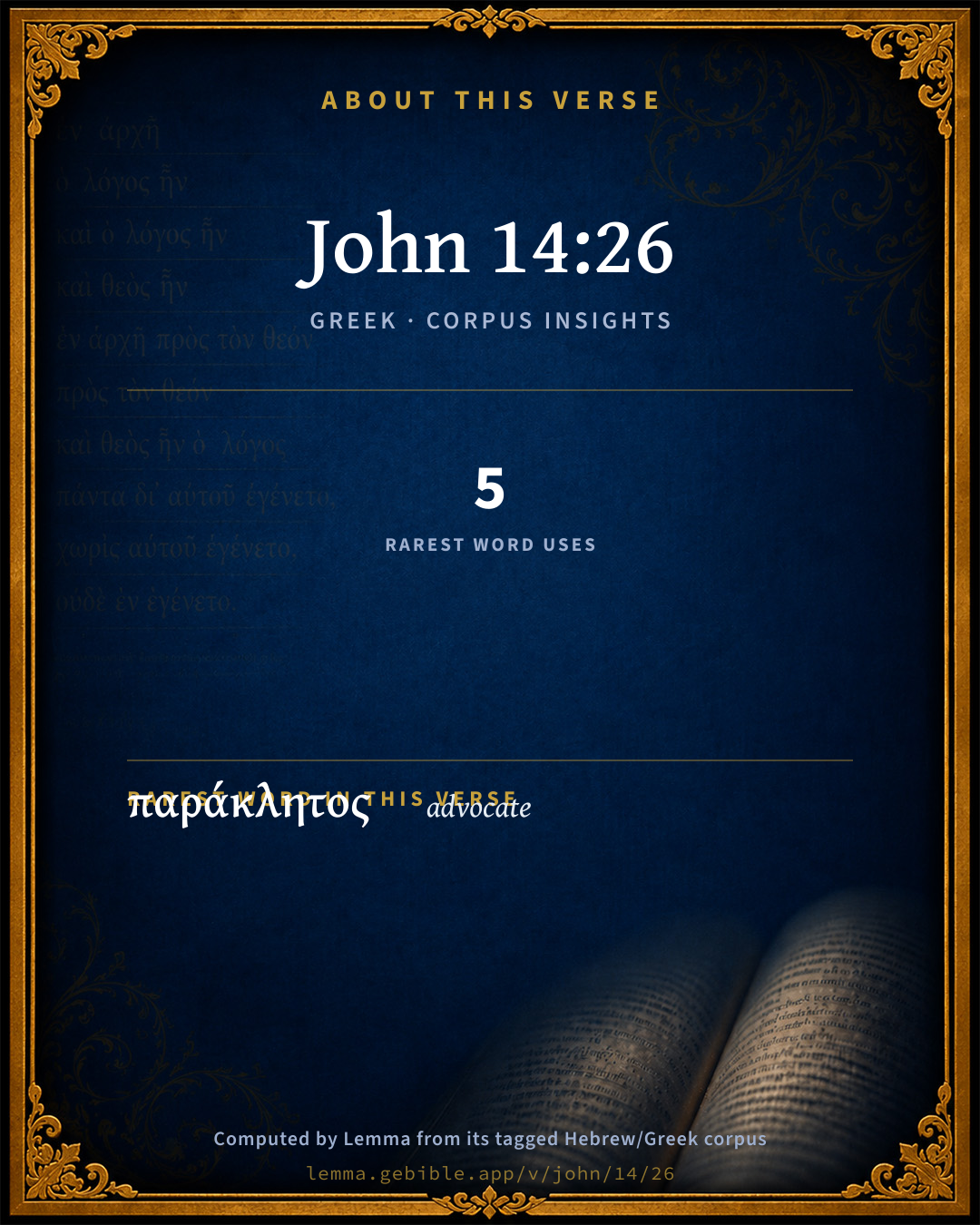
John 14:26

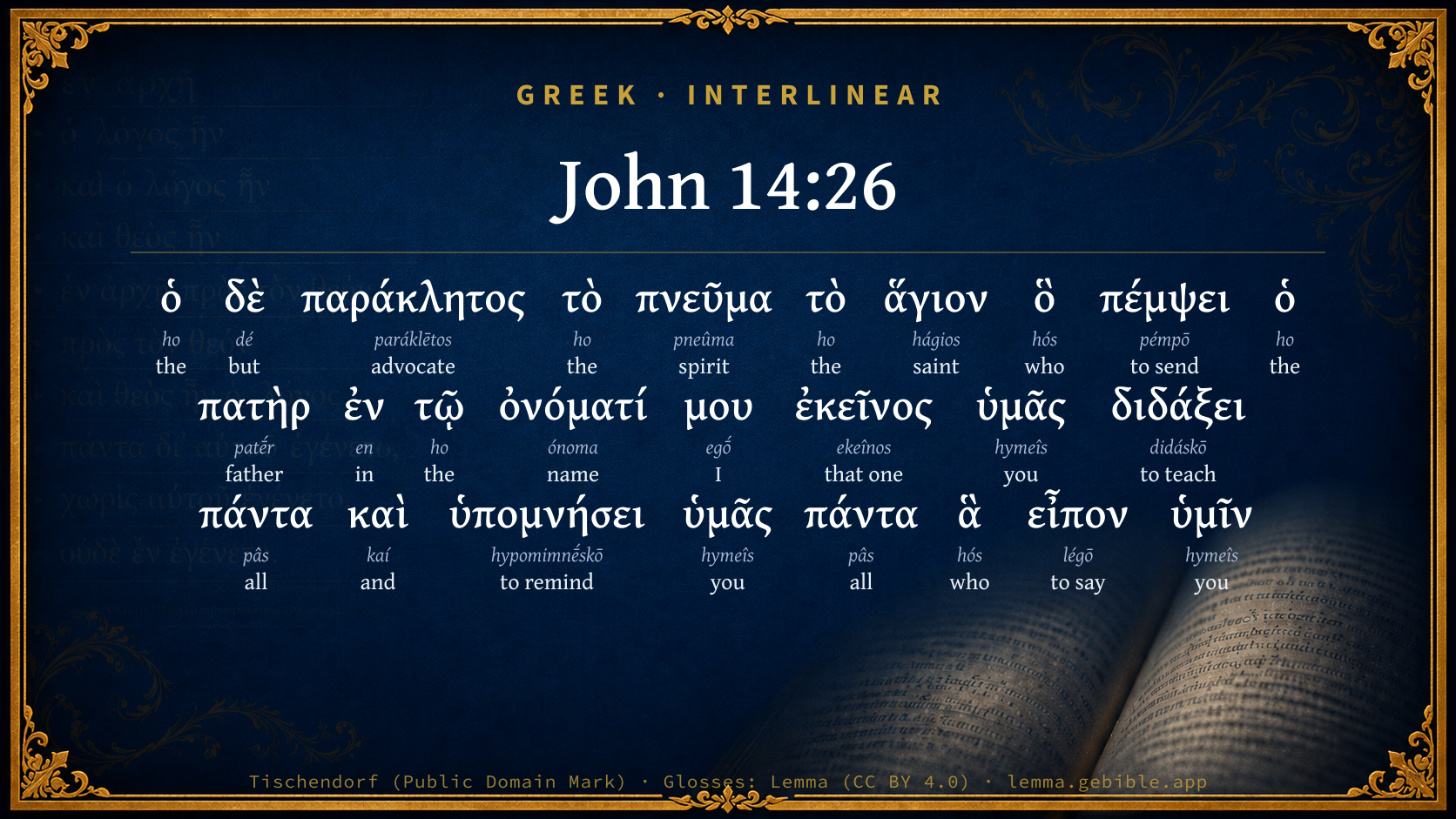
Greek (Tischendorf 8th ed.) John 14:26 appears in the Greek New Testament. The text above is from the Tischendorf 8th edition. Each word links to its Strong’s number and a concise gloss. Click any word for its full Thayer’s Greek Lexicon entry.
Download image
Cite this verse

John 14:26 (World English Bible). Public Domain. Lemma interlinear Bible study tool, https://lemma.gebible.app/v/john/14/26.

Show BibTeX & RIS
BibTeX
RIS
English Translation
But the Counselor, the Holy Spirit, whom the Father will send in my name, he will teach you all things, and will remind you of all that I said to you.
World English Bible · Public Domain
Download a study sheet

One document with this verse’s original text, its word-by-word gloss line, the meaning frame, cross-references with their text, attributed commentary, and full source and license credits — printable, and it pastes into notes with its structure intact.

This verse Autodidact and up

Study sheet (.html) Plain text (.txt)

A passage Seminary Student

Up to 50 verses in one chapter. A passage sheet keeps up to 6 commentary sources and 12 cross-references per verse, in the order this page ranks them, and says so on the sheet whenever that leaves anything out. Ask for a single verse and you get the Autodidact verse sheet above.

Everything on this page stays free to read, with no account — the sheet is a download of what is already on screen, not access to it.

Want to remove ads? Support Godless Engineer
Compare translations 3

The same verse in 3 English versions, stacked beneath the original-language interlinear above. Click any original word for its lexicon entry.

Each is an independent rendering of the whole verse — the interlinear is not word-aligned to these translations.

Highlighted words mark where these versions differ — a whole-verse word diff, not a word-by-word alignment.

  • World English Bible Public Domain
    But the Counselor, the Holy Spirit, whom the Father will send in my name, he will teach you all things, and will remind you of all that I said to you.
  • King James Version Public Domain
    But the Comforter, which is the Holy Ghost, whom the Father will send in my name, he shall teach you all things, and bring all things to your remembrance, whatsoever I have said unto you.
  • unfoldingWord Literal Text CC BY-SA 4.0
    Now the Helper—the Holy Spirit whom the Father will send in my name—he will teach you everything, and he will remind you of everything that I said to you.

unfoldingWord Literal Text — © unfoldingWord, licensed CC BY-SA 4.0. Word-aligned USFM3 via Door43 (git.door43.org/unfoldingWord/en_ult).

Versions to compare (up to 4)

3 of 4 selected

Show all 19 translations

Every available English version of this verse, each an independent rendering of the whole verse.

  • World English Bible Public Domain
    But the Counselor, the Holy Spirit, whom the Father will send in my name, he will teach you all things, and will remind you of all that I said to you.
  • Berean Standard Bible Public Domain
    But the Advocate, the Holy Spirit, whom the Father will send in My name, will teach you all things and will remind you of everything I have told you.
  • Majority Standard Bible Public Domain
    But the Advocate, the Holy Spirit, whom the Father will send in My name, will teach you all things and will remind you of everything I have told you.
  • King James Version Public Domain
    But the Comforter, which is the Holy Ghost, whom the Father will send in my name, he shall teach you all things, and bring all things to your remembrance, whatsoever I have said unto you.
  • American Standard Version (1901) Public Domain
    But the Comforter, `even' the Holy Spirit, whom the Father will send in my name, he shall teach you all things, and bring to your remembrance all that I said unto you.
  • Revised Version (1885) Public Domain
    But the Comforter, even the Holy Spirit, whom the Father will send in my name, he shall teach you all things, and bring to your remembrance all that I said unto you.
  • Geneva Bible (1599) Public Domain
    But the Comforter, which is the holy Ghost, whom the Father wil send in my Name, he shall teach you all things, and bring all things to your remembrance, which I haue tolde you.
  • Douay-Rheims (1899) Public Domain
    But the Paraclete, the Holy Ghost, whom the Father will send in my name, he will teach you all things, and bring all things to your mind, whatsoever I shall have said to you.
  • Young's Literal Translation Public Domain
    and the Comforter, the Holy Spirit, whom the Father will send in my name, he will teach you all things, and remind you of all things that I said to you.
  • Literal Standard Version CC BY-SA 4.0
    and the Comforter, the Holy Spirit, whom the Father will send in My Name, He will teach you all things, and remind you of all things that I said to you.
  • Unlocked Literal Bible CC BY-SA 4.0
    However, the Comforter—the Holy Spirit whom the Father will send in my name—he will teach you everything and he will remind you of everything that I said to you.
  • unfoldingWord Literal Text CC BY-SA 4.0
    Now the Helper—the Holy Spirit whom the Father will send in my name—he will teach you everything, and he will remind you of everything that I said to you.
  • Darby Bible Public Domain
    but the Comforter, the Holy Spirit, whom the Father will send in my name, *he* shall teach you all things, and will bring to your remembrance all the things which I have said to you.
  • World Messianic Bible Public Domain
    But the Counselor, the Holy Spirit, whom the Father will send in my name, will teach you all things, and will remind you of all that I said to you.
  • Webster's Bible Public Domain
    But the Comforter, who is the Holy Spirit, whom the Father will send in my name, he will teach you all things, and bring all things to your remembrance, whatever I have said to you.
  • Free Bible Version CC BY-SA 4.0
    But when the Father sends the Comforter, the Holy Spirit, in my place, he will teach you everything and remind you of all that I told you.
  • Bible in Basic English Public Domain
    But the Helper, the Holy Spirit, whom the Father will send in my name, will be your teacher in all things and will put you in mind of everything I have said to you.
  • Text-Critical English NT CC BY 4.0
    But the Helper, the Holy Spirit, whom the Father will send in my name, will teach you everything and remind you of everything I have told you.
  • Tyndale New Testament (1534) Public Domain
    But that comforter which is the holy gost (whom my father will sende in my name) he shall teache you all thinges and bringe all thinges to youre remembraunce whatsoever I have tolde you.

Literal Standard Version (2020), Covenant Press — licensed CC BY-SA 4.0. Text via the HelloAO Bible API (eBible.org). Unlocked Literal Bible (unfoldingWord) — licensed CC BY-SA 4.0. Text via the HelloAO Bible API (eBible.org). unfoldingWord Literal Text — © unfoldingWord, licensed CC BY-SA 4.0. Word-aligned USFM3 via Door43 (git.door43.org/unfoldingWord/en_ult). Free Bible Version, Dr. Jonathan Gallagher — licensed CC BY-SA 4.0. Text via the HelloAO Bible API (eBible.org).

Word by word

More ways to search: Search by grammar → Find every occurrence → Compare this word →

Practice this passage: Drill this verse → Learn its vocabulary →

παράκλητος
paráklētos
G3875
“advocate”
Noun, Nominative, Singular, Masculine
Part of Speech
Noun
Case
Nominative
Number
Singular
Gender
Masculine
Full Thayer's Definition

Origin: a root word

TDNT: 18:20,8

1. summoned, called to one's side, esp. called to one's aid a. one who pleads another's cause before a judge, a pleader, counsel for defense, legal assistant, an advocate b. one who pleads another's cause with one, an intercessor 1. of Christ in his exaltation at God's right hand, pleading with God the Father for the pardon of our sins c. in the widest sense, a helper, succourer, aider, assistant 1. of the Holy Spirit destined to take the place of Christ with the apostles (after his ascension to the Father), to lead them to a deeper knowledge of the gospel truth, and give them divine strength needed to enable them to undergo trials and persecutions on behalf of the divine kingdom
  1. ὁ ho G3588 “the” Article, Nominative, Singular, Masculine
  2. δὲ dé G1161 “but” Conjunction
  3. τὸ ho G3588 “the” Article, Nominative, Singular, Neuter
  4. πνεῦμα pneûma G4151 “spirit” Noun, Nominative, Singular, Neuter
  5. τὸ ho G3588 “the” Article, Nominative, Singular, Neuter
  6. ἅγιον hágios G40 “saint” Adjective, Nominative, Singular, Neuter
  7. ὃ hós G3739 “who” Relative pronoun, Accusative, Singular, Neuter
  8. πέμψει pémpō G3992 “to send” Verb, Future, Active, Indicative, 3rd person, Singular
  9. ὁ ho G3588 “the” Article, Nominative, Singular, Masculine
  10. πατὴρ patḗr G3962 “father” Noun, Nominative, Singular, Masculine
  11. ἐν en G1722 “in” Preposition
  12. τῷ ho G3588 “the” Article, Dative, Singular, Neuter
  13. ὀνόματί ónoma G3686 “name” Noun, Dative, Singular, Neuter
  14. μου egṓ G1473 “I” Personal pronoun, 1st person, Genitive, Singular
  15. ἐκεῖνος ekeînos G1565 “that one” Demonstrative pronoun, Nominative, Singular, Masculine
  16. ὑμᾶς hymeîs G5210 “you” Personal pronoun, 2nd person, Accusative, Plural
  17. διδάξει didáskō G1321 “to teach” Verb, Future, Active, Indicative, 3rd person, Singular
  18. πάντα pâs G3956 “all” Adjective, Accusative, Plural, Neuter
  19. καὶ kaí G2532 “and” Conjunction
  20. ὑπομνήσει hypomimnḗskō G5279 “to remind” Verb, Future, Active, Indicative, 3rd person, Singular
  21. ὑμᾶς hymeîs G5210 “you” Personal pronoun, 2nd person, Accusative, Plural
  22. πάντα pâs G3956 “all” Adjective, Accusative, Plural, Neuter
  23. ἃ hós G3739 “who” Relative pronoun, Accusative, Plural, Neuter
  24. εἶπον légō G3004 “to say” Verb, Aorist, Active, Indicative, 1st person, Singular
  25. ὑμῖν hymeîs G5210 “you” Personal pronoun, 2nd person, Dative, Plural

About this verse

These counts appear in no published source. They are computed here, from the morphology-tagged text and Lemma’s own curated glosses. What Lemma adds →

26
words
18
distinct lemmas
Gospels
section

Notable vocabulary

The rarest word here is παράκλητος advocate G3875 — appearing just 5 times in the whole Greek New Testament.

Shared distinctive vocabulary

παράκλητος advocate G3875 occurs in 5 verses of the Greek New Testament. Also found in:

Repetition

Words recur within this verse:

Cross-references

73

Topical passages linked to John 14:26 in the Treasury of Scripture Knowledge — connected by theme and wording, ordered by reader-vote popularity; previews shown in the World English Bible.

  • John 15:26 "When the Counselor has come, whom I will send to you from the Father, the Spirit of truth, who proceeds from the Father, he will testify about me.
  • John 14:16 I will pray to the Father, and he will give you another Counselor, that he may be with you forever,--
  • 1 Corinthians 2:10–13 But to us, God revealed them through the Spirit. For the Spirit searches all things, yes, the deep things of God.
  • 1 John 2:27 As for you, the anointing which you received from him remains in you, and you don't need for anyone to teach you. But as his anointing teaches you concerning all things, and is true, and is no lie, and even as it taught you, you will remain in him.
  • John 16:7 Nevertheless I tell you the truth: It is to your advantage that I go away, for if I don't go away, the Counselor won't come to you. But if I go, I will send him to you.
  • 1 John 2:20 You have an anointing from the Holy One, and you know the truth.
  • Romans 15:13 Now may the God of hope fill you with all joy and peace in believing, that you may abound in hope, in the power of the Holy Spirit.
  • Ephesians 1:17 that the God of our Lord Jesus Christ, the Father of glory, may give to you a spirit of wisdom and revelation in the knowledge of him;
  • Acts 2:4 They were all filled with the Holy Spirit, and began to speak with other languages, as the Spirit gave them the ability to speak.
  • Acts 2:33 Being therefore exalted by the right hand of God, and having received from the Father the promise of the Holy Spirit, he has poured out this, which you now see and hear.
  • 1 Corinthians 6:19 Or don't you know that your body is a temple of the Holy Spirit which is in you, which you have from God? You are not your own,
  • John 2:22 When therefore he was raised from the dead, his disciples remembered that he said this, and they believed the Scripture, and the word which Jesus had said.
  • Acts 13:2 As they served the Lord and fasted, the Holy Spirit said, "Separate Barnabas and Saul for me, for the work to which I have called them."
  • Isaiah 54:13 All your children shall be taught of Yahweh; and great shall be the peace of your children.
  • Luke 24:49 Behold, I send forth the promise of my Father on you. But wait in the city of Jerusalem until you are clothed with power from on high."
  • Titus 3:5 not by works of righteousness, which we did ourselves, but according to his mercy, he saved us, through the washing of regeneration and renewing by the Holy Spirit,
  • 1 Peter 1:12 To them it was revealed, that not to themselves, but to you, did they minister these things, which now have been announced to you through those who preached the Gospel to you by the Holy Spirit sent out from heaven; which things angels desire to look into.
  • 1 John 5:7 For there are three who testify:
  • John 16:13–14 However when he, the Spirit of truth, has come, he will guide you into all truth, for he will not speak from himself; but whatever he hears, he will speak. He will declare to you things that are coming.
  • 1 Thessalonians 1:5–6 and that our Gospel came to you not in word only, but also in power, and in the Holy Spirit, and with much assurance. You know what kind of men we showed ourselves to be among you for your sake.
  • Jude 1:20 But you, beloved, keep building up yourselves on your most holy faith, praying in the Holy Spirit.
  • 2 Corinthians 13:14 The grace of the Lord Jesus Christ, the love of God, and the communion of the Holy Spirit, be with you all. Amen.
  • Hebrews 3:7 Therefore, even as the Holy Spirit says, "Today if you will hear his voice,
  • Hebrews 9:8 The Holy Spirit is indicating this, that the way into the Holy Place wasn't yet revealed while the first tabernacle was still standing;
  • 1 Thessalonians 4:8 Therefore he who rejects doesn't reject man, but God, who has also given his Holy Spirit to you.
  • Matthew 3:11 I indeed baptize you in water for repentance, but he who comes after me is mightier than I, whose shoes I am not worthy to carry. He will baptize you in the Holy Spirit.
  • Luke 11:13 If you then, being evil, know how to give good gifts to your children, how much more will your heavenly Father give the Holy Spirit to those who ask him?"
  • 1 Corinthians 12:3 Therefore I make known to you that no man speaking by God's Spirit says, "Jesus is accursed." No one can say, "Jesus is Lord," but by the Holy Spirit.
  • Psalms 51:11 Don't throw me from your presence, And don't take your holy Spirit from me.
  • 2 Peter 1:21 For no prophecy ever came by the will of man: but holy men of God spoke, being moved by the Holy Spirit.
  • Luke 1:41 It happened, when Elizabeth heard Mary's greeting, that the baby leaped in her womb, and Elizabeth was filled with the Holy Spirit.
  • Romans 15:16 that I should be a servant of Christ Jesus to the Gentiles, ministering as a priest the Gospel of God, that the offering up of the Gentiles might be made acceptable, sanctified by the Holy Spirit.
  • John 20:22 When he had said this, he breathed on them, and said to them, "Receive the Holy Spirit!
  • Romans 14:17 for the Kingdom of God is not eating and drinking, but righteousness, peace, and joy in the Holy Spirit.
  • Ephesians 4:30 Don't grieve the Holy Spirit of God, in whom you were sealed for the day of redemption.
  • 2 Timothy 1:14 That good thing which was committed to you, guard through the Holy Spirit who dwells in us.
  • Hebrews 2:4 God also bearing witness with them, both by signs and wonders, and by various works of power, and by gifts of the Holy Spirit, according to his own will?
  • Acts 1:8 But you will receive power when the Holy Spirit has come upon you. You will be witnesses to me in Jerusalem, in all Judea and Samaria, and to the uttermost parts of the earth."
  • Acts 11:16 I remembered the word of the Lord, how he said, 'John indeed baptized in water, but you will be baptized in the Holy Spirit.'
  • Acts 20:28 Take heed, therefore, to yourselves, and to all the flock, in which the Holy Spirit has made you overseers, to shepherd the assembly of the Lord and God which he purchased with his own blood.
  • Romans 5:5 and hope doesn't disappoint us, because God's love has been poured out into our hearts through the Holy Spirit who was given to us.
  • Matthew 1:20 But when he thought about these things, behold, an angel of the Lord appeared to him in a dream, saying, "Joseph, son of David, don't be afraid to take to yourself Mary, your wife, for that which is conceived in her is of the Holy Spirit.
  • Mark 13:11 When they lead you away and deliver you up, don't be anxious beforehand, or premeditate what you will say, but say whatever will be given you in that hour. For it is not you who speak, but the Holy Spirit.
  • John 6:45 It is written in the prophets, 'They will all be taught by God.' Therefore everyone who hears from the Father, and has learned, comes to me.
  • Psalms 25:8–9 Good and upright is Yahweh, Therefore he will instruct sinners in the way.
  • Psalms 25:12–14 What man is he who fears Yahweh? He shall instruct him in the way that he shall choose.
  • Isaiah 63:10 But they rebelled, and grieved his holy Spirit: therefore he was turned to be their enemy, [and] himself fought against them.
  • Mark 12:36 For David himself said in the Holy Spirit, 'The Lord said to my Lord, Sit at my right hand, Until I make your enemies the footstool of your feet.'
  • John 12:16 His disciples didn't understand these things at first, but when Jesus was glorified, then they remembered that these things were written about him, and that they had done these things to him.
  • Hebrews 10:15 The Holy Spirit also testifies to us, for after saying,
  • Matthew 28:19 Therefore go, and make disciples of all nations, baptizing them in the name of the Father and of the Son and of the Holy Spirit,
  • Luke 1:15 For he will be great in the sight of the Lord, and he will drink no wine nor strong drink. He will be filled with the Holy Spirit, even from his mother's womb.
  • Luke 1:35 The angel answered her, "The Holy Spirit will come on you, and the power of the Most High will overshadow you. Therefore also the holy one who is born from you will be called the Son of God.
  • Luke 3:22 and the Holy Spirit descended in a bodily form as a dove on him; and a voice came out of the sky, saying "You are my beloved Son. In you I am well pleased."
  • John 7:39 But he said this about the Spirit, which those believing in him were to receive. For the Holy Spirit was not yet given, because Jesus wasn't yet glorified.
  • Acts 1:2 until the day in which he was received up, after he had given commandment through the Holy Spirit to the apostles whom he had chosen.
  • Acts 1:4 Being assembled together with them, he charged them, "Don't depart from Jerusalem, but wait for the promise of the Father, which you heard from me.
  • Acts 7:51 "You stiff-necked and uncircumcised in heart and ears, you always resist the Holy Spirit! As your fathers did, so you do.
  • Acts 15:8 God, who knows the heart, testified about them, giving them the Holy Spirit, just like he did to us.
  • Acts 20:35 In all things I gave you an example, that so laboring you ought to help the weak, and to remember the words of the Lord Jesus, that he himself said, 'It is more blessed to give than to receive.'"
  • 2 Corinthians 6:6 in pureness, in knowledge, in patience, in kindness, in the Holy Spirit, in sincere love,
  • Ephesians 1:13 in whom you also, having heard the word of the truth, the Gospel of your salvation,--in whom, having also believed, you were sealed with the Holy Spirit of promise,
  • Revelation 2:11 He who has an ear, let him hear what the Spirit says to the assemblies. He who overcomes won't be harmed by the second death.
  • Jeremiah 31:33–34 But this is the covenant that I will make with the house of Israel after those days, says Yahweh: I will put my law in their inward parts, and in their heart will I write it; and I will be their God, and they shall be my people:
  • Luke 1:67 His father, Zacharias, was filled with the Holy Spirit, and prophesied, saying,
  • Acts 5:3 But Peter said, "Ananias, why has Satan filled your heart to lie to the Holy Spirit, and to keep back part of the price of the land?
  • Acts 7:55 But he, being full of the Holy Spirit, looked up steadfastly into heaven, and saw the glory of God, and Jesus standing on the right hand of God,
  • Acts 13:4 So, being sent out by the Holy Spirit, they went down to Seleucia. From there they sailed to Cyprus.
  • Acts 15:28 For it seemed good to the Holy Spirit, and to us, to lay no greater burden on you than these necessary things:
  • Acts 16:6 When they had gone through the region of Phrygia and Galatia, they were forbidden by the Holy Spirit to speak the word in Asia.
  • Acts 28:25 When they didn't agree among themselves, they departed after Paul had spoken one word, "The Holy Spirit spoke rightly through Isaiah, the prophet, to our fathers,
  • Luke 2:25 Behold, there was a man in Jerusalem whose name was Simeon. This man was righteous and devout, looking for the consolation of Israel, and the Holy Spirit was on him.
  • Matthew 1:18 Now the birth of Jesus Christ was like this; for after his mother, Mary, was engaged to Joseph, before they came together, she was found pregnant by the Holy Spirit.

Cross-references courtesy of OpenBible.info (CC BY 4.0).

Commentary

Notes on John 14:26 from classic Christian and Jewish commentators (each source and its license shown beneath its notes). The classic Christian expositions comment on the surrounding passage and are grouped to its opening verse, so a note may address several verses; the Jewish commentaries on the Tanakh (Rashi and others) are per-verse, so they appear only where the commentator wrote on this verse.

Lemma curates 59 commentaries, every one of them public domain or Creative Commons licensed, each selected and text-cleaned for this edition rather than reprinted as found. About our sources →

Tyndale Open Study Notes

Tyndale Open Resources

14:26 Jesus promised to send the Holy Spirit (see also 14:16; 15:26; 16:7, 12-14). • The Spirit will teach . . . everything, recalling Jesus’ words and clarifying their meaning. John experienced this power as he wrote his Gospel (2:22); Christians experience this work of the Spirit as they read the Scriptures.

Tyndale Open Study Notes — © Tyndale Open Resources, licensed CC BY-SA 4.0. Text via the HelloAO Bible API.

Bengel's Gnomon

Johann Albrecht Bengel

Joh 14:26. Ἐκεῖνος, [That Person], He) So ch. Joh 15:26 [ἐκεῖνος], “He shall testify of Me;” Joh 16:8, “And when He is come, He (ἐκεῖνος) will reprove the world of sin,” etc.; 13, 14, “When He (ἐκεῖνος), the Spirit of truth, is come, He will guide you, etc.: He (ἐκεῖνος) shall glorify Me.”—διδάξει πάντα. He shall teach you all things) There is not added here the clause, which I said unto you. For that Paraclete taught other things also: ch. Joh 16:12-13, “I have yet many things to say unto you, but ye cannot bear them now. Howbeit, when He, the Spirit of truth, is come, He will guide you into all truth.” Nor, however, even subsequently, were the whole of the dogmas of Christian truth infused into the apostles in one condensed mass; but as often as they needed them, and as the occasion suggested, the Paraclete instructed them in all the parts of the Apostolic office.—ὑπομνήσει, shall bring to your remembrance) This very discourse (homily) furnishes an instance, as having been a long time afterwards so accurately written out by John. Add Act 11:16, [Peter says] “Then remembered I the word of the Lord, how that He said, John indeed baptized with water, but ye shall be baptized with the Holy Ghost.”

Bengel's Gnomon of the New Testament — English translation (T&T Clark, Edinburgh, 1860) — public domain. Text from a community e-Sword module.

Expositor's Greek Testament

ed. W. Robertson Nicoll

Joh 14:26 . But His teaching would be continued and completed by the Paraclete: ὁ δὲ παράκλητος … ὑμῖν . The Paraclete is now identified with τὸ πνεῦμα τὸ ἅγιον , and His connection with Christ is further guaranteed by the clause ὃ πέμψει ὁ πατὴρ ἐν τῷ ὀνόματί μου , “which the Father will send in my name,” that is, as representing me and promoting my interests. And this He will accomplish by teaching: ἐκεῖνος “He,” and no longer the visible Christ, “will teach you all things,” πάντα in contrast to the ταῦτα (Joh 14:25 ) with which Christ had to be satisfied; but πάντα must itself be limited by the needs and capacities of the disciples. καὶ ὑπομνήσει … “and will bring to your remembrance all that I said to you,” that is, the teaching of the Spirit should so connect itself with the teaching of Christ as to revive the memory of forgotten words of His, and give them a new meaning. Cf. especially Joh 16:12-14 .

The Expositor's Greek Testament, edited by W. Robertson Nicoll (1897–1910) — public domain. Text from a community e-Sword module.

Adam Clarke's Commentary

Verse 26. He shall teach you all things] If in the things which I have already spoken to you, there appear to you any obscurity, the Holy Spirit, the Advocate, Counsellor, and Instructer, will take away all your doubts, free you from all embarrassment, and give you a perfect understanding in all things: and this Spirit ye shall shortly receive.

And bring all things to your remembrance] Here Christ promises them that inspiration of the Holy Spirit which enabled them not only to give a true history of his life and death, but also gave them the most perfect recollection of all the words which he had spoken to them, so that they have been able to transmit to posterity the identical words which Jesus uttered in his sermons, and in his different discourses with them, the Jews, and others.

Adam Clarke's Commentary on the Bible (1810–1826) — public domain. Text from a community e-Sword/MySword module.

Ellicott's Commentary for English Readers

(26) But the Comforter, which is the Holy Ghost.—Better, as before, but the Advocate . . . (Comp. Excursus G: The Meaning of the word Paraclete.) For the words “Holy Ghost” comp. Joh_7:39; Joh_20:22, which are the only passages where we find them in this Gospel. They are frequent in the earlier Gospels. (See Note on Mat_12:31.) In four passages in the New Testament (Luk_11:13; Eph_1:13; Eph_4:30; 1Th_4:8) our translators have preferred the rendering “Holy Spirit.” The identification here with the Advocate brings out the contrast between the practical obedience and holiness (Joh_14:23) of those to whom the Holy Spirit should be sent, and the disobedience (Joh_14:24) of those who rejected the revelation by the Son.

Whom the Father will send in my name—i.e., as My representative. (Comp. Joh_14:13.) Their Master will depart from them, but the Father will send them another Teacher who will make clear to them the lessons they have already heard, and teach them things which they cannot bear now.

He shall teach you all things.—Comp. Joh_16:13. The words are here without an expressed limitation, but the “all things” here is equal to the “all truth” in the later passage.

And bring all things to your remembrance, whatsoever I have said unto you.—The limitation, “whatsoever I have said unto you,” is to be taken with this clause only, and is not to be extended to the words, “He shall teach you all things.” For instances of the recurrence of words spoken by our Lord with a fulness of new meaning revealed in them by the Holy Spirit, comp. Joh_2:22; Joh_12:16. The Gospel according to St. John, with its full records of the words spoken by our Lord, is itself a commentary on this text.

A Bible Commentary for English Readers, edited by Charles John Ellicott (1878–1897) — public domain. Text from a community e-Sword module.

The Cambridge Bible for Schools and Colleges

gen. ed. J. J. S. Perowne

26. But the Comforter] Better, But the Advocate (see on Joh_14:16).

which is the Holy Ghost] Even the Holy Spirit. The epithet ‘holy’ is given to the Spirit thrice in this Gospel; Joh_1:33, Joh_20:22, and here (in Joh_7:39 the ‘holy’ is very doubtful). It is not frequent in any Gospel but the third; five times in S. Matthew, four in S. Mark, twelve in S. Luke. S. Luke seems fond of the expression, which he uses about forty times in the Acts; and he rarely speaks of the Spirit without prefixing the ‘holy.’ Here only does S. John give the full phrase, both substantive and epithet having the article: in Joh_1:33 and Joh_20:22 there is no article.

in my name] As My representative, taking My place and continuing My work (see on Joh_14:13). ‘He shall not speak of Himself … He shall receive of Mine and shew it unto you’ (Joh_16:13-14). The mission of the Paraclete in reference to the glorified Redeemer, is analogous to the mission of the Messiah in reference to the Father.

shall teach you all things] i.e. ‘guide you into all the truth’ (Joh_16:13). He shall teach them the Divine truth in its fulness; all those things which they ‘cannot bear now,’ and also ‘things to come.’

bring all things to your remembrance] Not merely the words of Christ, a particular in which this Gospel is a striking fulfilment of this promise, but also the meaning of them, which the Apostles often failed to see at the time: comp. Joh_2:22, Joh_12:16; Luk_9:45; Luk_18:34; Luk_24:8. “It is on the fulfilment of this promise to the Apostles, that their sufficiency as Witnesses of all that the Lord did and taught, and consequently the authenticity of the Gospel narrative, is grounded” (Alford).

The Cambridge Bible for Schools and Colleges (gen. ed. J. J. S. Perowne; Cambridge University Press, 1878–1918) — public domain. Text from a community e-Sword module.

John Gill's Exposition

But the Comforter, which is the Holy Ghost,.... Before spoken of, Joh 14:16, for whom Christ promised to pray the Father that he might be given to them. The word used there, as here, signifies an "advocate", and is so rendered, Jo1 2:1, a patron, one that pleads and defends, the cause of another, before kings and princes; so the Jewish writers (z) use the word the same with here, and give this as the sense of it: and which agrees well enough with the work and office of the Spirit of God, who has promised to the apostles to speak in them and for them, when they should be brought before kings and governors for Christ's sake; and would so thoroughly plead his cause and theirs, as to convince the world of sin, righteousness and judgment; and who acts the part of an intercessor, or advocate, for private believers, in prayer to the King of kings: but inasmuch as it also signifies a "comforter", and this being agreeably to the present condition of the apostles, as before observed; it may be most proper to retain that sense of it here, who is explained to be the Holy Ghost; which is a more clear and explicit account of him than before, and very distinctly points out the third person in the Trinity, who is in his nature holy, equally with the Father and Son, and the author of holiness in all the saints:

whom the Father will send in my name. The mission of the Spirit is here ascribed to the Father, but not to the exclusion of the Son, who is also said to send him, Joh 15:26, which was not so proper to be mentioned here, because he speaks of his being sent, "in his name"; that is, at his request, through his mediation and intercession, in his room and stead, acting, the same part, and bearing the same flame of an advocate or comforter, and for the glory and honour of his name: which act of sending does not suppose any local motion, which cannot agree with an infinite and immense spirit; nor inferiority in him to the other two persons, since he who is sent by Christ, and in his name, is also the sender of Christ; but it denotes the joint consent and agreement of Father, Son, and Spirit, in this affair:

he shall teach you all things: this is the proper work and business of the Spirit, to teach, interpret, and explain all things which Christ had said to them; to make them more plain and easy to their understandings; to instruct them in all things necessary to salvation, and to be known by them, that they might teach them others:

and bring all things to your remembrance, whatsoever I have said to you; which through inattention, or want of understanding in them, had slipped their minds, and were forgotten by them. This accounts for it, how the evangelists some years after the death of Christ; at different times and places, and without consulting each other, could commit to writing the life, actions, sayings, and sermons of Christ, with all the minute circumstances attending them.

(z) Maimon. & Bartenora in Pirke Abot, c. 4. sect. 11.

John Gill's Exposition of the Whole Bible (1746–1763) — public domain (CC PDM 1.0). Text via the HelloAO Bible API.

Trapp's Complete Commentary

John Trapp

26 But the Comforter, which is the Holy Ghost, whom the Father will send in my name, he shall teach you all things, and bring all things to your remembrance, whatsoever I have said unto you.

Ver. 26. But the Comforter, &c.] The Spirit teacheth only things consonant to Scripture, and is thereby discerned from a spirit of delusion. He is not novarum revelationum architectus, author of new revelations, as Papists, Mahometans, Anabaptists, and Libertines would make him. The Jews also had many traditions and unwritten verities (as they called them) wherewith they believed their scribes and doctors were inspired, for the people’s better direction in observing the law. These they called Mashlamnuthoth, Completiones, Perfectiones, because they thought that the written law was perfected and completed by them. (Buxtorff.) These were those our Saviour cried down, Mat 15:5. And the prophet tells us, that in vain shall we look to hear the voice behind us, where our "eyes see not our teachers," Isa 30:20-21.

John Trapp, A Commentary or Exposition upon All the Books of the Old and New Testament (1647–1656) — public domain. Text from a community e-Sword module.

Albert Barnes' Notes on the Bible

Will send in my name - On my account. To perfect my work. To execute it as I would in applying it to the hearts of men. See Joh 14:13.

Shall teach you all things - All things which it was needful for them to understand in the apostolic office, and particularly those things which they were not prepared then to hear or could not then understand. See Joh 16:12. Compare the notes at Mat 10:19-20. This was a full promise that they would be inspired, and that in organizing the church, and in recording the truths necessary for its edification, they would be under the infallible guidance of the Holy Spirit.

Bring all things to your remembrance - This probably refers to two things:

1. He would seasonably remind them of the sayings of Jesus, which they might otherwise have forgotten. In the organization of the church, and in composing the sacred history, he would preside over their memories, and recall such truths and doctrines as were necessary either for their comfort or the edification of his people. Amid the multitude of things which Jesus spake during a ministry of more than three years, it was to be expected that many things which he had uttered, that would be important for the edification of the church, would be forgotten. We see, hence, the nature of their inspiration. The Holy Spirit made use of their memories, and doubtless of all their natural faculties. He so presided over their memories as to recall what they had forgotten, and then it was recorded as a thing which they distinctly remembered, in the same way as we remember a thing which would have been forgotten had not some friend recalled it to our recollection.

2. The Holy Spirit would teach them the meaning of those things which the Saviour had spoken. Thus they did not understand that he ought to be put to death until after his resurrection, though he had repeatedly told them of it, Luk 24:21, Luk 24:25-26. So they did not until then understand that the gospel was to be preached to the Gentiles, though this was also declared before. Compare Mat 4:15-16; Mat 12:21, with Act 10:44-48.

Albert Barnes' Notes on the Bible (1834–1885) — public domain. Text from a community e-Sword/MySword module.

Haydock's Catholic Bible Commentary

The Paraclete, the Holy Ghost, whom the Father will send in my name, as proceeding also from me: and therefore Christ saith, in the next chapter, (ver. 26) that he himself will send him from the Father. He will teach you all things, &c. He will give you a more perfect knowledge of all those truths, which I have taught you. (Witham) --- Teach you all things. Here the Holy Ghost is promised to the apostles, and their successors, particularly, in order to teach them all truth, and to preserve them from error. (Challoner) --- The Scripture, in different places, remarks, that the apostles did not understand the accomplishment of prophecies, as soon as they were fulfilled. (Luke xxiv. 27.) They could not draw the comparison between the actions of our Saviour, and the figures of the old law: but no sooner had the Holy Ghost descended upon them, than they explained the Scriptures, their hearts and eyes being opened and enlightened by the light of the Holy Spirit. (Calmet) --- See chap. xvi. ver. 12. and 13.

George Leo Haydock (1774–1849), Haydock's Catholic Family Bible and Commentary, 1859 edition — public domain. Excludes Psalms (Douay-Rheims chapter numbering differs from Protestant) and Deuterocanonical books (Catholic canon only).

Matthew Poole's English Annotations

The word is the same which was so translated before; (see the import of it, Joh 14:16,17) he is there called the

Comforter, and the Spirit of truth; here, the Holy Spirit. The Father here is said to send in the name, that is, with the authority and upon the mediation, of the Lord Jesus Christ: and two pieces of the Spirit’s work, besides comforting, are here expressed.

He shall teach you all things; he shall more fully explain to you all things. Three of the apostles themselves had already in this chapter discovered great degrees of ignorance as to the doctrine of the Trinity, Christ’s union or oneness with his Father, &c. You shall not be left (saith our Saviour) in this ignorance; for when the Holy Spirit shall come, he shall more fully and perfectly instruct you in all things, in which I have already instructed you, and which are necessary for you to know in order to your eternal happiness.

And bring all things to your remembrance; whatsoever I have said unto you; and shall bring to your remembrance the things I have taught you, so as you shall more fully and clearly understand them; and though you may have forgotten them, yet they shall by the Holy Spirit be revived in your memories; so as they shall not be like water spilt on the ground, which cannot again be gathered up, but like seed sown in the earth; which, though it may at present rot, and die under the clods, or at least not spring up, yet it shall spring up, and bring forth desired fruit. It is one great work of the Holy Spirit, to bring the revelations of holy writ to our remembrance, and withal to clear to us the sense of them, and confirm our faith in them, and chiefly quicken us to practise what is our duty: but it is to be observed, that the Spirit doth not make revelations of new notions; it only brings to our remembrance what Christ hath said, and further revealeth what was before in the word revealed, though possibly particular persons were ignorant of such revelations of the word: so things may be new, and newly revealed to us, which in themselves are not so. There are no new truths, but particular persons may have new discoveries of old truth, which they had before misapprehensions of.

Matthew Poole's English Annotations on the Holy Bible (1683–1685) — public domain. Text from a community e-Sword/MySword module.

Whedon's Commentary on the Bible

Daniel D. Whedon

26. Teach you all things… bring… to your remembrance, whatsoever I have said—The Paraclete should teach and remind; and the subject both of this teaching and reminding should be all things whatsoever I have said. That is, it should make clear all that they did not understand, and remind them of all they had forgotten, in the words of Jesus. Within their apostolic prerogative they should be enabled, by the Spirit impregnating the words of Jesus, fully and truly to expound his doctrine. They should be able, respectively, to preach, to record, and to transmit to posterity the true system of his religion without any deficiency or error.

We now suppose a pause in the discourse of Jesus. Still his intense thoughts rest upon his departure, and upon the loved ones he leaves on earth. He resumes in words of pathos and yet of consolation.

Daniel D. Whedon (gen. ed.), Commentary on the Old and New Testaments (1874–1909) — public domain. Text from a community e-Sword module.

John Wesley's Explanatory Notes

In my name - For my sake, in my room, and as my agent. He will teach you all things - Necessary for you to know. Here is a clear promise to the apostles, and their successors in the faith, that the Holy Ghost will teach them all that truth which is needful for their salvation.

John Wesley, Explanatory Notes Upon the Whole Bible (1754–1765) — public domain. Text via the GEBible commentary corpus.

The People's New Testament

B. W. Johnson

26. The Comforter, which is the Holy Ghost. More correctly, Holy Spirit. He shall teach you all things. A special promise to the apostles, which fitted them to preach the Gospel authoritatively and leave behind them the records of the New Testament.

B. W. Johnson's The People's New Testament with Notes (1889–1891) — public domain. Electronic text from the Christian Classics Ethereal Library (CCEL) ThML edition.

Cambridge Greek Testament for Schools and Colleges

26. ἅγιον. This epithet is given to the Spirit thrice in this Gospel; Joh 1:33, Joh 20:22, and here: in Joh 7:39 ἅγιον is an insertion. It is not frequent in any Gospel but the third; 5 times in S. Matthew , 4 in S. Mark , 12 in S. Luke. S. Luke seems fond of the expression, which he uses some 40 times in the Acts; rarely using Πνεῦμα without ἅγιον. Here only does S. John give the full phrase: in Joh 1:33 and Joh 20:22 there is no article.

ἐν τ. ὀν. μ. As My representative, taking My place and continuing My work: see on Joh 14:13 and comp. Joh 16:13-14. The mission of the Paraclete in reference to the glorified Redeemer is analogous to that of the Messiah in reference to the Father. And His two functions are connected: He teaches new truths, ‘things to come,’ things which they ‘cannot bear now,’ in recalling the old; and He brings the old to their remembrance in teaching the new. He recalls not merely the words of Christ, a particular in which this Gospel is a striking fulfilment of the promise, but also the meaning of them, which the Apostles often failed to see at the time: comp. Joh 2:22, Joh 12:16; Luk 9:45; Luk 18:34; Luk 24:8. “It is on the fulfilment of this promise to the Apostles, that their sufficiency as Witnesses of all that the Lord did and taught, and consequently the authenticity of the Gospel narrative, is grounded” (Alford).

Cambridge Greek Testament for Schools and Colleges (Cambridge University Press, 1896; 21 vols, various authors incl. Carr, Maclear, Plummer, Farrar, Lumby, Moule, M. R. James, Simcox) — public domain. Text from a community e-Sword module.

Alford’s Greek Testament

Henry Alford

26.] q. d. ‘I know that ye do not understand them yet: but’ &c.

τὸ πν. τὸ ἅγ.] The Paraclete is now more closely defined by this well-known Name,—and, by ὃ πέμψει ὁ πατήρ, and ἐκεῖνος …, designated personally, as One sent, and One acting on them.

ἐν τῷ ὀν. μου, not, ‘in My stead,’ but in regard of Me—‘in answer to My prayer, and prayers in My name,—to those who bear My name,—and as a means of manifesting Me.’

διδάξ. πάντα stands by itself, not with ἃ εἶπον:—shall teach you all things;—‘all that can and may be learnt by you, all that belongs to your work and life in Me.’

ὑπομνήσει] What is not understood is liable to be forgotten;—and therefore in this word is implied the giving them a right understanding of, as well as recalling, what Jesus had said to them: see ch. 2:22; 12:16.

It is on the fulfilment of this promise to the Apostles, that their sufficiency as Witnesses of all that the Lord did and taught, and consequently the authenticity of the gospel narrative, is grounded.

Henry Alford, The Greek Testament (1849–1861) — public domain. Text from a community e-Sword module.

International Critical Commentary

26. This is the fifth (and last) time that the Paraclete is mentioned (see on 15:26 for the meaning of the word). Here ὁ παράκλητος is for the first time identified with τὸ πνεῦμα τὸ ἅγιον, an august title familiar to every Jew (cf. Psa 51:11, Isa 63:10). The complete title does not occur again in Jn. (but cf. 20:22). We have it, however, in Mar 3:29, Mar 13:11, Mat 12:32; cf. Luk 12:10, Luk 12:12.

ὃ πέμψει. For ὅ, אcL have ὅν. The Old Syriac treats the Spirit as feminine, but the Peshitta does not follow this Semitic doctrine.

ὃ πέμψει ὁ πατήρ. This is the Lucan doctrine, that the Father sends the Spirit (Luk 24:49, Act 2:33), and we have had it already at v. 16; but at 15:26, 16:7 the Spirit is sent by the Son (see also 20:22). This is only an additional illustration of the Johannine doctrine that what the Father does, the Son does (see note on v. 13 above).

ἐν τῷ ὀνόματί μου. “In my stead” does not convey the meaning adequately. At 5:43 Jesus said that He had come “in the Name” of the Father, and at 10:25 that He wrought His works in the same Name; the meaning in both cases (see notes in loc.) being not only that He came as the Father’s representative, but as One to whom “the Name,” i.e. the providential power of the Father, had been given, and who was to reveal the Father’s character and purpose. So here it is said that the Spirit will be sent “in the Name” of Christ, to explain His mission and to reveal its consequences. As the Son was sent in the Name of the Father (5:43), so the Holy Spirit will be sent in future “in the Name” of the Son. This does not imply that the Holy Spirit was not operative before the Incarnation, but rather that after the Passion and Resurrection (see on 16:23; and cf. 7:39) He will come with the more effective quickening power of the new revelation of God in Christ.

ἐκεῖνος. It is He, the Spirit, whose twofold work is now described in relation primarily to the listening apostles, but probably what is said may apply in some measure to all Christian disciples of succeeding generations.

ὑμᾶς διδάξει πάντα. This has already been said at 16:13 ὁδηγήσει ὑμᾶς εἰς πᾶσαν τὴν ἀλήθειαν. The two phrases are treated as identical at Psa 25:5: ὁδήγησόν με ἐπὶ τὴν ἀλήθειάν σου, καὶ δίδαξόν με. Cf. also Psa 25:9:

ὁδηγήσει πρᾳεῖς ἐν κρίσει,

διδάξει πρᾳεῖς ὁδοὺς αὐτοῦ.

See, for other apparent reminiscences of the Psalter, on 16:13.

πάντα in this verse corresponds to εἰς πᾶσαν τὴν ἀλήθειαν of 16:13, and stands in contrast to ταῦτα of v. 25, sc. the things that have already been taught by Jesus. For πάντα, cf. 1Jn 2:27 τὸ αὐτοῦ χρίσμα διδάσκει ὑμᾶς περὶ πάντων. The reference is only (see again on 16:13) to religious doctrines (cf. 1Co 2:10 πνεῦμα πάντα ἐρευνᾷ, καὶ τὰ βάθη τοῦ θεοῦ), but of these Divine truths the Spirit is to teach new things as time goes on.

καὶ ὑπομνήσει ὑμᾶς πάντα ἃ εἶπον ὑμῖν. BL add ἐγώ after ὑμῖν, and this would bring out the emphasis well; but it is omitted by most authorities. “And He will bring to your remembrance all that I said to you,” the aor. εἶπον indicating that the personal oral teaching of Jesus was ended. This is the second side of the work of the Spirit, who not only was to reveal what was new, but was to recall to the memory of the apostles the old truths that Jesus had taught. Cf. 2:22, 12:16, Act 11:16, for illustrations of the fact that after His Resurrection the apostles entered more fully into the meaning of His words than they had done at the time they were spoken. Here, however, the promise is that their memory of them shall be stimulated. Bengel says pregnantly, “Exemplum praebet haec ipsa homilia.”

ὑπομνήσει ὑμᾶς πάντα. ὑπομιμνήσκειν does not occur again in Jn.; but cf. Luk 22:61, where Peter “remembered” the words of Jesus. There is a literary parallel (but no more) in Jubilees xxxii. 25, where God says to Jacob after his vision, “I will bring all things to thy remembrance.”

International Critical Commentary — older volumes (1896–1929), various authors — public domain. Text from a community e-Sword module.

Vincent's Word Studies in the New Testament

Marvin R. Vincent

In my name. See on ver. 13.

He [εκεινος] . Setting the Advocate distinctly and sharply before the hearers. The pronoun is used in John's First Epistle, distinctively of our Lord. See 1Jo 2:6; 1Jo 3:3, 5, 7, 16; 1Jo 4:17.

I have said [ειπον] . The aorist tense, I said.

Marvin R. Vincent, Word Studies in the New Testament (1887–1900) — public domain. Text from a community e-Sword/MySword module.

Lesson kit

Teaching starters — assembled from the data on this page, not authored interpretation. Every prompt links to the verse data it draws on. Edit before teaching.

John, in the Gospels, opens this verse with 26 words (18 distinct Greek lemmas). Its most distinctive word is paráklētos (“advocate”). A historical commentator’s framing appears above. Read the whole chapter for the surrounding context.

Discussion questions

  1. The word paráklētos carries the sense “advocate.” How does it shape the verse?
  2. John 14:16 shares the word «advocate» with this verse. How do the two illuminate each other?
  3. “all” occurs 2× in this one verse. What is the effect of the repetition?
  4. The translations on this page render this verse differently — a whole-verse word diff, not a word-by-word alignment. What might account for the different wordings?
  5. Reading how Tyndale Open Study Notes and Bengel's Gnomon read this verse, where do the two commentators agree and where do they part?

Things to notice

Reading settings

Reading text

Shown beneath each verse's original-language words.

Old Testament
Old Testament edition

Read the OT as the Masoretic Hebrew (MT) or the Greek Septuagint (LXX).

English shown for the Greek Septuagint (in the Hebrew ↔ Greek comparison).

Comparing translations? Open the Compare panel on any verse page to stack up to four side by side.