John 11:46

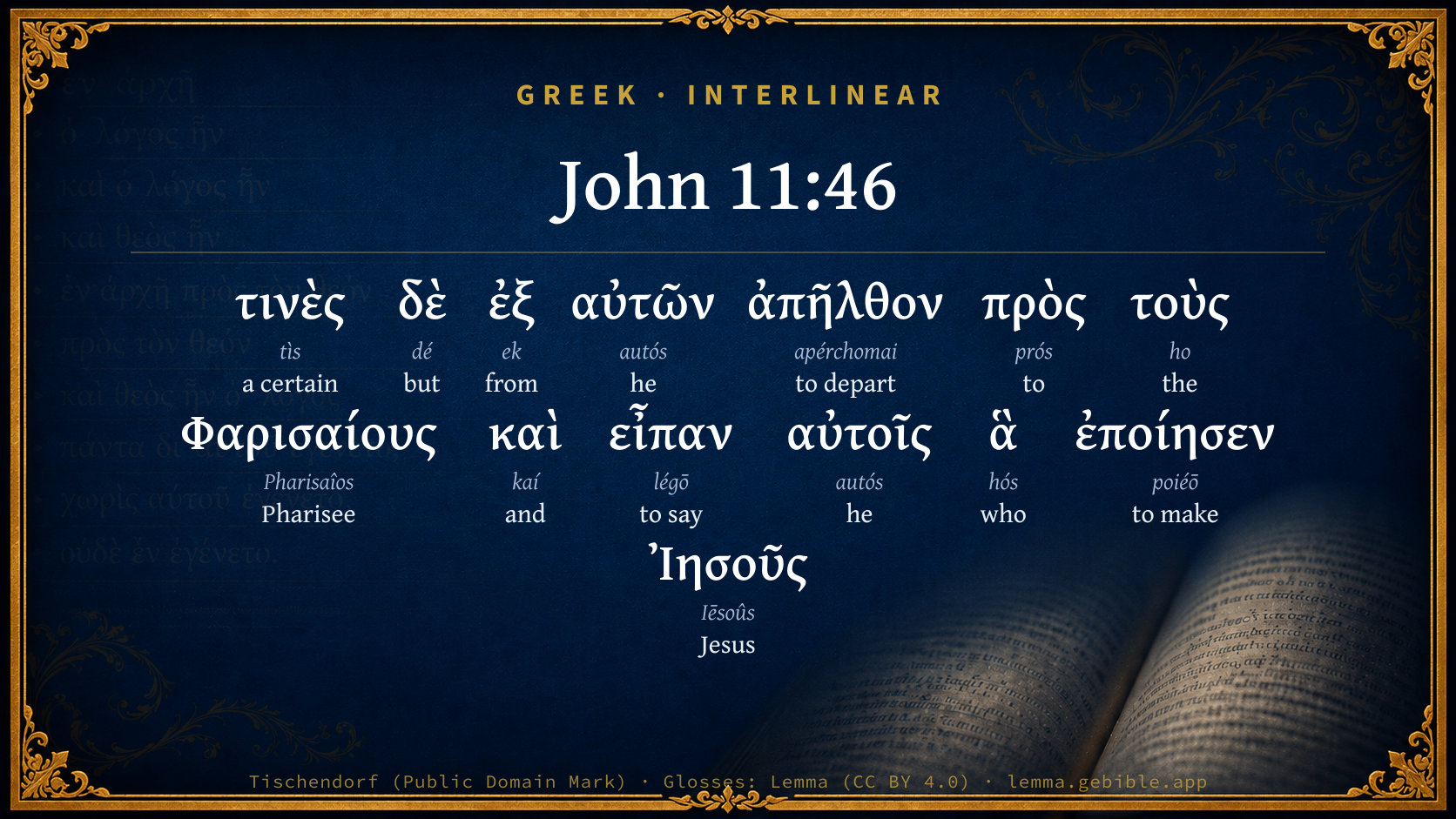
Greek (Tischendorf 8th ed.) John 11:46 appears in the Greek New Testament. The text above is from the Tischendorf 8th edition. Each word links to its Strong’s number and a concise gloss. Click any word for its full Thayer’s Greek Lexicon entry.
Download image
Cite this verse

John 11:46 (World English Bible). Public Domain. Lemma interlinear Bible study tool, https://lemma.gebible.app/v/john/11/46.

Show BibTeX & RIS
BibTeX
RIS
English Translation
But some of them went away to the Pharisees, and told them the things which Jesus had done.
World English Bible · Public Domain
Download a study sheet

One document with this verse’s original text, its word-by-word gloss line, the meaning frame, cross-references with their text, attributed commentary, and full source and license credits — printable, and it pastes into notes with its structure intact.

This verse Autodidact and up

Study sheet (.html) Plain text (.txt)

A passage Seminary Student

Up to 50 verses in one chapter. A passage sheet keeps up to 6 commentary sources and 12 cross-references per verse, in the order this page ranks them, and says so on the sheet whenever that leaves anything out. Ask for a single verse and you get the Autodidact verse sheet above.

Everything on this page stays free to read, with no account — the sheet is a download of what is already on screen, not access to it.

Want to remove ads? Support Godless Engineer
Compare translations 3

The same verse in 3 English versions, stacked beneath the original-language interlinear above. Click any original word for its lexicon entry.

Each is an independent rendering of the whole verse — the interlinear is not word-aligned to these translations.

Highlighted words mark where these versions differ — a whole-verse word diff, not a word-by-word alignment.

  • World English Bible Public Domain
    But some of them went away to the Pharisees, and told them the things which Jesus had done.
  • King James Version Public Domain
    But some of them went their ways to the Pharisees, and told them what things Jesus had done.
  • unfoldingWord Literal Text CC BY-SA 4.0
    But some of them went away to the Pharisees and told them what Jesus had done.

unfoldingWord Literal Text — © unfoldingWord, licensed CC BY-SA 4.0. Word-aligned USFM3 via Door43 (git.door43.org/unfoldingWord/en_ult).

Versions to compare (up to 4)

3 of 4 selected

Show all 19 translations

Every available English version of this verse, each an independent rendering of the whole verse.

  • World English Bible Public Domain
    But some of them went away to the Pharisees, and told them the things which Jesus had done.
  • Berean Standard Bible Public Domain
    But some of them went to the Pharisees and told them what Jesus had done.
  • Majority Standard Bible Public Domain
    But some of them went to the Pharisees and told them what Jesus had done.
  • King James Version Public Domain
    But some of them went their ways to the Pharisees, and told them what things Jesus had done.
  • American Standard Version (1901) Public Domain
    But some of them went away to the Pharisees, and told them the things which Jesus had done.
  • Revised Version (1885) Public Domain
    But some of them went away to the Pharisees, and told them the things which Jesus had done.
  • Geneva Bible (1599) Public Domain
    But some of them went their way to the Pharises, and told them what things Iesus had done.
  • Douay-Rheims (1899) Public Domain
    But some of them went to the Pharisees, and told them the things that Jesus had done.
  • Young's Literal Translation Public Domain
    but certain of them went away unto the Pharisees, and told them what Jesus did;
  • Literal Standard Version CC BY-SA 4.0
    but certain of them went away to the Pharisees, and told them what Jesus did;
  • Unlocked Literal Bible CC BY-SA 4.0
    But some of them went away to the Pharisees and told them the things that Jesus had done.
  • unfoldingWord Literal Text CC BY-SA 4.0
    But some of them went away to the Pharisees and told them what Jesus had done.
  • Darby Bible Public Domain
    but some of them went to the Pharisees and told them what Jesus had done.
  • World Messianic Bible Public Domain
    But some of them went away to the Pharisees and told them the things which Yeshua had done.
  • Webster's Bible Public Domain
    But some of them went to the Pharisees, and told them what things Jesus had done.
  • Free Bible Version CC BY-SA 4.0
    But others went to the Pharisees and told them what Jesus had done.
  • Bible in Basic English Public Domain
    But some of them went to the Pharisees with the news of what Jesus had done.
  • Text-Critical English NT CC BY 4.0
    But some of them went to the Pharisees and told them what Jesus had done.
  • Tyndale New Testament (1534) Public Domain
    But some of them went their wayes to the Pharises and tolde them what Iesus had done.

Literal Standard Version (2020), Covenant Press — licensed CC BY-SA 4.0. Text via the HelloAO Bible API (eBible.org). Unlocked Literal Bible (unfoldingWord) — licensed CC BY-SA 4.0. Text via the HelloAO Bible API (eBible.org). unfoldingWord Literal Text — © unfoldingWord, licensed CC BY-SA 4.0. Word-aligned USFM3 via Door43 (git.door43.org/unfoldingWord/en_ult). Free Bible Version, Dr. Jonathan Gallagher — licensed CC BY-SA 4.0. Text via the HelloAO Bible API (eBible.org).

Word by word

More ways to search: Search by grammar → Find every occurrence → Compare this word →

Practice this passage: Drill this verse → Learn its vocabulary →

Φαρισαίους
Pharisaîos
G5330
“Pharisee”
Noun, Accusative, Plural, Masculine
Part of Speech
Noun
Case
Accusative
Number
Plural
Gender
Masculine
Full Thayer's Definition

Origin: of hebrew origin cf G6567

TDNT: 09:11,1

1. A sect that seems to have started after the Jewish exile. In addition to OT books the Pharisees recognised in oral tradition a standard of belief and life. They sought for distinction and praise by outward observance of external rites and by outward forms of piety, and such as ceremonial washings, fastings, prayers, and alms giving; and, comparatively negligent of genuine piety, they prided themselves on their fancied good works. They held strenuously to a belief in the existence of good and evil angels, and to the expectation of a Messiah; and they cherished the hope that the dead, after a preliminary experience either of reward or of penalty in Hades, would be recalled to life by him, and be requited each according to his individual deeds. In opposition to the usurped dominion of the Herods and the rule of the Romans, they stoutly upheld the theocracy and their country's cause, and possessed great influence with the common people. According to Josephus they numbered more than 6000. They were bitter enemies of Jesus and his cause; and were in turn severely rebuked by him for their avarice, ambition, hollow reliance on outward works, and affection of piety in order to gain popularity.
  1. τινὲς tìs G5100 “a certain” Indefinite pronoun, Nominative, Plural, Masculine
  2. δὲ dé G1161 “but” Conjunction
  3. ἐξ ek G1537 “from” Preposition
  4. αὐτῶν autós G846 “he” Personal pronoun, Genitive, Plural, Masculine
  5. ἀπῆλθον apérchomai G565 “to depart” Verb, Aorist, Active, Indicative, 3rd person, Plural
  6. πρὸς prós G4314 “to” Preposition
  7. τοὺς ho G3588 “the” Article, Accusative, Plural, Masculine
  8. καὶ kaí G2532 “and” Conjunction
  9. εἶπαν légō G3004 “to say” Verb, Aorist, Active, Indicative, 3rd person, Plural
  10. αὐτοῖς autós G846 “he” Personal pronoun, Dative, Plural, Masculine
  11. ἃ hós G3739 “who” Relative pronoun, Accusative, Plural, Neuter
  12. ἐποίησεν poiéō G4160 “to make” Verb, Aorist, Active, Indicative, 3rd person, Singular
  13. Ἰησοῦς Iēsoûs G2424 “Jesus” Noun, Nominative, Singular, Masculine

About this verse

These counts appear in no published source. They are computed here, from the morphology-tagged text and Lemma’s own curated glosses. What Lemma adds →

14
words
13
distinct lemmas
Gospels
section

Repetition

A word recurs within this verse:

  • αὐτῶν he G846 ×2

Cross-references

5

Topical passages linked to John 11:46 in the Treasury of Scripture Knowledge — connected by theme and wording, ordered by reader-vote popularity; previews shown in the World English Bible.

  • Luke 16:30–31 "He said, 'No, father Abraham, but if one goes to them from the dead, they will repent.'
  • John 9:13 They brought him who had been blind to the Pharisees.
  • John 5:15–16 The man went away, and told the Jews that it was Jesus who had made him well.
  • John 12:37 But though he had done so many signs before them, yet they didn't believe in him,
  • Acts 5:25 One came and told them, "Behold, the men whom you put in prison are in the temple, standing and teaching the people."

Cross-references courtesy of OpenBible.info (CC BY 4.0).

Commentary

Notes on John 11:46 from classic Christian and Jewish commentators (each source and its license shown beneath its notes). The classic Christian expositions comment on the surrounding passage and are grouped to its opening verse, so a note may address several verses; the Jewish commentaries on the Tanakh (Rashi and others) are per-verse, so they appear only where the commentator wrote on this verse.

Lemma curates 59 commentaries, every one of them public domain or Creative Commons licensed, each selected and text-cleaned for this edition rather than reprinted as found. About our sources →

The Preacher's Complete Homiletical Commentary

Joseph S. Exell (gen. ed.)

EXPLANATORY AND CRITICAL NOTES

Joh_11:46. But some of them, etc.—It is possible to misjudge their motives; but in view of Joh_19:22 and Joh_10:31 their action can hardly be viewed as friendly.

Joh_11:48. The Romans, etc.—If Christ were to be raised to the position of leader of the people the jealous Roman government might take away the last vestige of their power. “They feared temporal loss and incurred eternal, and did not even escape the temporal” (Augustine). Place.—Their position probably as ecclesiastical rulers of the Jewish people. Thus both such political and religious privileges as they possessed might be endangered, they thought.

Joh_11:49. Caiaphas.—Joseph Caiaphas, son-in-law of Annas, who had been deprived of the priesthood by Valerius Gratus (Josephus, Ant., 18). To conciliate him the members of his family were elected in turn to the office. That same year.—I.e. that memorable year.

Joh_11:50. Caiaphas was politically an opportunist, and an unscrupulous one to boot. Justice, human life, he little regarded where his interests and those of his class were concerned. Expediency must rule.

Joh_11:51. Prophesied.—Like Balaam (Numbers 24).

Joh_11:53. Then from that day, etc.—The Pharisees had now overcome their last scruples, and united for evil with the sceptical Sadducees.

Joh_11:54. Jesus therefore, etc.—Ephraim is said by Robinson to be near Bethel; and he identifies it with Ephron (2Ch_13:19), and this Ephron with Ophrah (Jdg_18:23).

Joh_11:55. Purify.—2Ch_30:16-20; Act_21:24.

Joh_11:56-57. Then sought they.—The simple country folk would have heard Jesus gladly; and the commandment of the chief priests and Pharisees was no doubt given with the intention of making our Lord appear to be one unworthy of their regard.

MAIN HOMILETICS OF THE PARAGRAPH.—Joh_11:47-57

The unconscious prophecy of Caiaphas.—The wonderful miracle at Bethany could not remain hid. Many of those who had seen it believed. Some of them, however, although they could not doubt the evidence of their senses in the matter of the miracle, appear not to have been drawn more closely to Christ. These went to the Pharisees with the news of the miracle and of the fact that many had believed on the Saviour. It does not seem necessary to seek for either a good or a bad motive in their action. They went with that eagerness to bear news, especially to such as will welcome it, which seems characteristic of some people. The tidings those men brought threw the dominant party into a state of perturbation. A crisis had arrived; and Pharisee and Sadducee were joined in an unholy league against God’s holy child, Jesus.

I. The perplexity of the Jewish leaders in council.—

1. The opening scene in the council of Christ’s enemies reveals the unholy conspirators in a state of pitiful perplexity. They cannot deny Christ’s miracles. They see that if He continues His course a large following will gather around Him, which by ordinary methods they will be unable to control.

2. And then, in spite of all their proud boasts about their freedom (Joh_8:33), they have to acknowledge the dominant power of Rome. They fear that power—fear that, if Jesus attracts a large band of followers, the Roman governor may step in to disperse it, and may tell them, the present religious rulers of the people, that, being incapable, apparently, of exerting any proper authority, they must in every department give up the reins of power.

3. This, no doubt, influenced some. But many of them must have known that the kingdom Christ spoke of setting up was no earthly dominion. There was another influence at the bottom of all this bitter enmity against Jesus. He had put the Sadducees more than once to silence. And this last miracle struck at one of the fundamental tenets of their sect, “that the spirit of man is an emanation of the Deity, and after death returns to Him, so that there can be no resurrection of the body.” Our Lord’s rebuke of this sect made them especially bitter, and indeed the leaders in the plot against Jesus.

4. While the council was in perplexity, and the more law-abiding no doubt shrinking from extreme measures, a man unscrupulous and able brought all to a speedy decision. Caiaphas, the high priest, owed his position to the intervention of the Roman governor, Valerius Gratus, and thus was interested in preventing anything which would arouse the jealousy of Rome. He evidently had sat silent in the council whilst the members were blindly and confusedly dubitating, with cynical scorn expressed in his look. At last he intervened, rating the council for their indecision and weakness, and impressing on them his idea as to what their line of action should be.

II. The counsel of Caiaphas.—

1. He interpreted the desires of the majority of his colleagues which they themselves were afraid to give expression to, far less to carry into execution. His counsel was one of expediency pure and simple. Justice, righteousness, truth, were nothing to him.

2. The present danger must be averted by some means or other, if the position of the Jewish rulers, both toward the people and in relation to the Roman power, was to be maintained. If this Jesus continued to work and gain adherents as He had been doing, then farewell to their authority over the people as teachers and administrators of their law—farewell also, perhaps, to the limited power they still possessed under Rome. Therefore said this bold and evil man, “Ye know nothing at all, nor consider that it is expedient for us,” etc. (Joh_11:50). That was his decision: Remove this man by death, and your difficulties vanish.

3. A simple cutting of the knot, Caiaphas! No question as to the antecedents of this Jesus, as to the manner and substance of His teaching, as to the truth of His mighty works, as to whether He has encouraged any feeling of disloyalty among His followers toward the reigning powers. No! simply: This man stands in our way; remove Him, and we shall be able to advance: He seems to endanger our authority; let Him die, and we shall stand secure. It is a counsel which some would count worldly-wise, but its inspiration is from beneath, not from above. “What is necessary is right”; “Necessity knows no law”; “The end justifies the means”: such are Caiaphas’ counsels.

4. Swayed by this dominant mind, even those who had qualms of conscience seem to have yielded to this evil counsel (Joh_11:53). How far had these formal adherents to the law of Moses fallen below its standard of justice between man and man! how far below those Roman conquerors whom they hated, and who prided themselves justly on the protection which their laws afforded to the citizens of the Roman State in all quarters of the world! Caiaphas must bow before the heathen who wrote, “Fiat justitia, ruat cœlum.”

5. And let thy counsel, Caiaphas, appear successful for the time: will it prove so in the end? Has ever true good come from unrighteousness? God, it is true, may and does bring good out of evil,—

“From seeming evil still educing good,

And better thence again.”

Thomson.

But will it be for good to those who do the unrighteous deed, carry out the unrighteous plan? Never!

III. The unconscious prophecy of Caiaphas.—

1. He was high priest. And even though one who was unworthy occupied the office, the office itself had a theocratic dignity, and served a divine purpose. And here God made use of the office. The high priest, who year by year entered into the Holiest of all, “not without blood, which he offered for himself and the errors of the people” (Heb_9:7), is here led unwittingly to prophesy concerning the one offering which was to be made not only for the Jewish “nation,” but for all the children of God scattered abroad, who were thus to be brought into unity (Joh_10:16).

2. “Man proposes, but God disposes.” Caiaphas and his fellow-councillors thought that by getting rid of Jesus they might preserve the small remnant of authority they possessed, and through it might yet regain their national power. In this view he appealed to the better part of the council and the national party, who may even yet have dreamed that Jesus might have some Messianic message for them, and many of whom believed Him to be a prophet. But the appeal of Caiaphas prevailed over their better feelings.

3. And yet by the divine guidance this evil counsel resulted in the true good of the spiritual Israel, in a wider blessing than any mere restitution of the Jewish “nation,” in the state in which it then was, would have been. It would result in the blessed unity of all peoples, which later Judaism had failed to pray and labour for (Joh_12:32; Psalms 67; 1Jn_2:2).

4. But although God could and did bring blessing to all men by the carrying out of the evil counsel of Caiaphas, no blessing, rather the reverse, would come on those who planned and carried it out. These men ostensibly based their action on the danger of the Romans interfering or taking away what power remained to them, etc. (Joh_11:48). They thought to avert this danger by an unrighteous action. But from the moment they carried out their designs that which they feared began to come upon them.

5. The Sadducees sought to crush One who had brought their errors home to them, and had thus given opportunity for triumph to their opponents (Mat_22:34). But lo! when He had been crucified, in place of One who taught the resurrection of the dead there arose multitudes who proclaimed the resurrection of that same Jesus whom they had crucified, and preached the Resurrection with amazing power and results (Act_4:2; Act_23:9).

6. And in the end the power of the Jewish rulers, their temple, their city, and the “nation” itself, passed away amid blood and fire. Unrighteousness may triumph for a time, yet in the end it shall not prevail.

Lessons.—

1. Righteousness is the only safe principle to guide the activity both of governments and individuals. Such merely worldly-wise, unjust, and tyrannical modes of action as that of Caiaphas and all his kind will result only in disaster to those who adopt them. Unrighteousness carries within it the elements of its own punishment and final ruin here and hereafter. The Christian rule of action is:—

“Perish policy and cunning!

Perish all that fears the light!

Whether losing, whether winning,

Trust in God and do the right.”

MacLeod.

2. What has been planned by evil men can in God’s hand be turned to good. He that sits in heaven laughs at their designs; and whilst they go on and often perish in their wickedness, He bends their actions to subserve His own eternal purposes.

ILLUSTRATION

Joh_11:50. Hypocritical excuses for crime.—The real ground of opposition was hatred of the light; the ostensible ground was patriotism, public zeal, loyalty, far-sighted policy. And such is life. The motive in which a deed of sin is done is not the motive which a man allows to others or whispers to himself. Listen to the criminal receiving sentence, and the cause of condemnation is not the enormity of the crime, but the injustice of the country’s law. Hear the man of disorderly life, whom society has expelled from her bosom, and the cause of the expulsion is not his profligacy, but the false slander which has misrepresented him. Take his own account of the matter, and he is innocent, injured, pure. For there are names so tender, and so full of fond endearment, with which this world sugars over its dark guilt towards God with a crust of superficial whiteness, that the sin, on which eighteen centuries have looked back appalled, was, to the doers of that sin, nothing atrocious, but respectable, defensible, nay even, under the circumstances, necessary.—F. W. Robertson.

The Preacher's Complete Homiletical Commentary (gen. ed. Joseph S. Exell; Funk & Wagnalls, c. 1892) — public domain (pre-1929). A full-Bible homiletical/sermon-outline anthology covering 65 of 66 books (2 John is absent from the source module). Text from a community e-Sword module.

Bengel's Gnomon

Johann Albrecht Bengel

Joh 11:46. Ἀπῆλθον, departed [went their ways]) as aliens to Him.

Bengel's Gnomon of the New Testament — English translation (T&T Clark, Edinburgh, 1860) — public domain. Text from a community e-Sword module.

Expositor's Greek Testament

ed. W. Robertson Nicoll

Joh 11:46 . But of this number [it may be “of the Jews” generally, and not of those who had been at Bethany] some went away to the Pharisees and told them, His recognised enemies, what He had done. Whether they did this in good faith or not does not appear.

The Expositor's Greek Testament, edited by W. Robertson Nicoll (1897–1910) — public domain. Text from a community e-Sword module.

Geneva Bible (1599)

Geneva Bible translators

The last point of hard and iron-like stubbornness is this, to proclaim open war against God, and yet ceaseth not to make a presence both of godliness and of the profit of the commonwealth.

Geneva Bible (1599) marginal notes — public domain. Text via Bolls.life.

Adam Clarke's Commentary

Verse 46. But some of them went their ways] Astonishing! Some that had seen even this miracle steeled their hearts against it; and not only so, but conspired the destruction of this most humane, amiable, and glorious Saviour! Those who obstinately resist the truth of God are capable of every thing that is base, perfidious, and cruel.

Adam Clarke's Commentary on the Bible (1810–1826) — public domain. Text from a community e-Sword/MySword module.

John Calvin's Commentaries

46. But some of them went away to the Pharisees. In those who accuse Christ we behold detestable ingratitude, or rather horrible rage, from which we infer how blind and mad is their impiety. The resurrection of Lazarus ought undoubtedly to have softened even hearts of stone; but there is no work of God which impiety will not infect and corrupt by the bitterness of its poison. So then, before men can profit by miracles, their hearts must be purified; for they who have no fear of God, and no reverence for him, though they saw heaven and earth mingled, will never cease to reject sound doctrine through obstinate ingratitude. Thus you will see in the present day many enemies of the Gospel, like fanatics, fighting with the open and visible hand of God. And yet they demand miracles from us, but it is for no other purpose than to show that, in stubborn resistance, they are monsters of men. As to the report being carried to the Pharisees rather than to any others, it is because, in proportion to their hypocrisy, they were more fierce in opposing the Gospel. For the same reason he soon afterwards makes express mention of them, when he relates that the council was assembled. They were indeed a part of the priests, but are specially named by the Evangelist, because they served the purpose of bellows to kindle the rage of the whole council

John Calvin's Commentaries (1540-1563) — public domain. Text from the Calvin Translation Society English edition (1840s-50s) via the Christian Classics Ethereal Library (ccel.org). Calvin's coverage is partial (roughly two-thirds of the Bible); uncommented books and verses are honest gaps, never fabricated. The 19th-century editor's footnotes and remarks are omitted so the notes are faithfully Calvin's own voice.

Ellicott's Commentary for English Readers

(46) But some of them went their ways to the Pharisees—i.e., necessarily, some of those who had been with Mary, and had seen the things which Jesus did, and had believed. But why did they then go and tell the Pharisees? It is contrary to their position as believers to think that they did this as informers against Jesus. What they have seen has carried conviction to their own minds, and they report it to the Pharisees, either as a proof that He really was the Messiah, or in any case to demand from them a judgment on the facts which they report.

A Bible Commentary for English Readers, edited by Charles John Ellicott (1878–1897) — public domain. Text from a community e-Sword module.

John Gill's Exposition

But some of them went their way to the Pharisees,.... At Jerusalem, who were members of the sanhedrim; so far were some of them from receiving any advantage by this miracle, that they were the more hardened, and filled with malice and envy to Christ, and made the best of their way to acquaint his most inveterate enemies:

and told them what things Jesus had done; at Bethany; not to soften their minds, and bring them to entertain a good opinion of him, but to irritate them, and put them upon schemes to destroy him; thus even miracles, as well as the doctrines of the Gospel, are to some the savour of death unto death, whilst to others the savour of life unto life.

John Gill's Exposition of the Whole Bible (1746–1763) — public domain (CC PDM 1.0). Text via the HelloAO Bible API.

Trapp's Complete Commentary

John Trapp

46 But some of them went their ways to the Pharisees, and told them what things Jesus had done.

Ver. 46. But some of them, &c.] Lo, reprobates will not believe, though one rose from the dead to them.

John Trapp, A Commentary or Exposition upon All the Books of the Old and New Testament (1647–1656) — public domain. Text from a community e-Sword module.

Albert Barnes' Notes on the Bible

Some of them ... - We see here the different effect which the word and works of God will have on different individuals. Some are converted and others are hardened; yet the evidence of this miracle was as clear to the one as the other. But they would not be convinced.

Albert Barnes' Notes on the Bible (1834–1885) — public domain. Text from a community e-Sword/MySword module.

Matthew Poole's English Annotations

These Jews had the same means for believing the others had; they had heard the same words from Christ, they had seen the same miracle wrought by Christ. Whence is it that any of the other Jews believed? These, instead of believing, run to the Pharisees to accuse him. Can any account be given of this, unless from the freedom of Divine grace, showing mercy where God will show mercy? Though possibly the former wickedness, of these Jews was the cause of God’s not giving that grace to them which he gave to others.

Matthew Poole's English Annotations on the Holy Bible (1683–1685) — public domain. Text from a community e-Sword/MySword module.

John Wesley's Explanatory Notes

But some of them went to the Pharisees - What a dreadful confirmation of that weighty truth, If they hear not Moses and the prophets, neither will they be persuaded though one rose from the dead!

John Wesley, Explanatory Notes Upon the Whole Bible (1754–1765) — public domain. Text via the GEBible commentary corpus.

Cambridge Greek Testament for Schools and Colleges

46. τινὲς δὲ ἐξ αὐτῶν. Again, of the Jews generally, rather than of those who saw and believed. With what intention they went away to the Pharisees, is not clear: possibly to convince them, or to seek an authoritative solution of their own perplexity, or as feeling that the recognised leaders of the people ought to know the whole case. Comp. Joh 5:15, Joh 9:13. The bad result of their mission has made some too hastily conclude that their intention was bad.

Cambridge Greek Testament for Schools and Colleges (Cambridge University Press, 1896; 21 vols, various authors incl. Carr, Maclear, Plummer, Farrar, Lumby, Moule, M. R. James, Simcox) — public domain. Text from a community e-Sword module.

Alford’s Greek Testament

Henry Alford

46.] Meyer, with his usual philological acumen, takes pains to set right the understanding of this. In the last verse, it is not πολλοὶ … τῶν ἐλθόντων, but πολλοὶ … οἱ ἐλθόντες: thus identifying the πολλοί with those that came: ‘many … to wit, those that came.’ All these ἐπίστευσαν εἰς αὐτόν (see a similar case in ch. 8:30 ff.). Then, τινὲς ἐξ αὐτῶν, viz. the ἐλθόντων, and πιστευόντων, went, &c. The δέ (see on ver. 37) certainly shews that this was done with a hostile intent: not in doubt as to the miracle, any more than in the case of the blind man, ch. 9, but with a view to stir up the rulers yet more against Him. This Evangelist is very simple, and at the same time very consistent, in his use of particles: almost throughout his Gospel the great subject, the manifestation of the Glory of Christ, is carried onward by οὖν, whereas δέ as generally prefaces the development of the antagonist manifestation of hatred and rejection of Him. If it seem strange that this hostile step should be taken by πιστεύοντες εἰς αὐτόν, we at least find a parallel in the passage above cited, ch. 8:30 ff.

Henry Alford, The Greek Testament (1849–1861) — public domain. Text from a community e-Sword module.

International Critical Commentary

46. τινὲς δὲ ἐξ αὐτῶν κτλ. There is nothing to prove that this action of some of the citizens who had come to Bethany and had been convinced of the claims of Jesus by the raising of Lazarus was malevolent. δέ means no more here than “however.”

ἀπῆλθον πρὸς τοὺς φαρισαίους, “went off to the Pharisees,” i.e. to the religious leaders who formed the most zealous and orthodox party in the Sanhedrim (see on 7:32). An event of such religious significance as the miracle at Bethany seemed to be would naturally be brought before them, and those who reported it probably did so without meaning to injure Jesus. See on 5:15 for a similar case.

If the plural ἅ before ἐποίησεν is to be pressed, it means that not only the raising of Lazarus, but other actions of Jesus which they had observed or of which they had heard, were included in their report (cf. πολλὰ σημεῖα, v. 47).

Counsel of Caiaphas to the Sanhedrim, and Their Resolve (vv. 47-53)

International Critical Commentary — older volumes (1896–1929), various authors — public domain. Text from a community e-Sword module.

Vincent's Word Studies in the New Testament

Marvin R. Vincent

Some of them. Not of the Jews who had come to Mary, but some of the Jews, some perhaps who had joined the crowd from curiosity.

Marvin R. Vincent, Word Studies in the New Testament (1887–1900) — public domain. Text from a community e-Sword/MySword module.

Lesson kit

Teaching starters — assembled from the data on this page, not authored interpretation. Every prompt links to the verse data it draws on. Edit before teaching.

John, in the Gospels, opens this verse with 14 words (13 distinct Greek lemmas). Its most distinctive word is Pharisaîos (“Pharisee”). A historical commentator’s framing appears above. Read the whole chapter for the surrounding context.

Discussion questions

  1. The word Pharisaîos carries the sense “Pharisee.” How does it shape the verse?
  2. How does Luke 16:30–31, which shares this passage’s theme, read alongside this verse?
  3. What does the repetition of “he” (2× in this one verse) do in this verse?
  4. The translations on this page render this verse differently — a whole-verse word diff, not a word-by-word alignment. What might account for the different wordings?
  5. Compare how The Preacher's Complete Homiletical Commentary and Bengel's Gnomon read this verse. Where do they agree or differ?

Things to notice

Reading settings

Reading text

Shown beneath each verse's original-language words.

Old Testament
Old Testament edition

Read the OT as the Masoretic Hebrew (MT) or the Greek Septuagint (LXX).

English shown for the Greek Septuagint (in the Hebrew ↔ Greek comparison).

Comparing translations? Open the Compare panel on any verse page to stack up to four side by side.