

John 17:8
Greek (Tischendorf 8th ed.) John 17:8 appears in the Greek New Testament. The text above is from the Tischendorf 8th edition. Each word links to its Strong’s number and a concise gloss. Click any word for its full Thayer’s Greek Lexicon entry.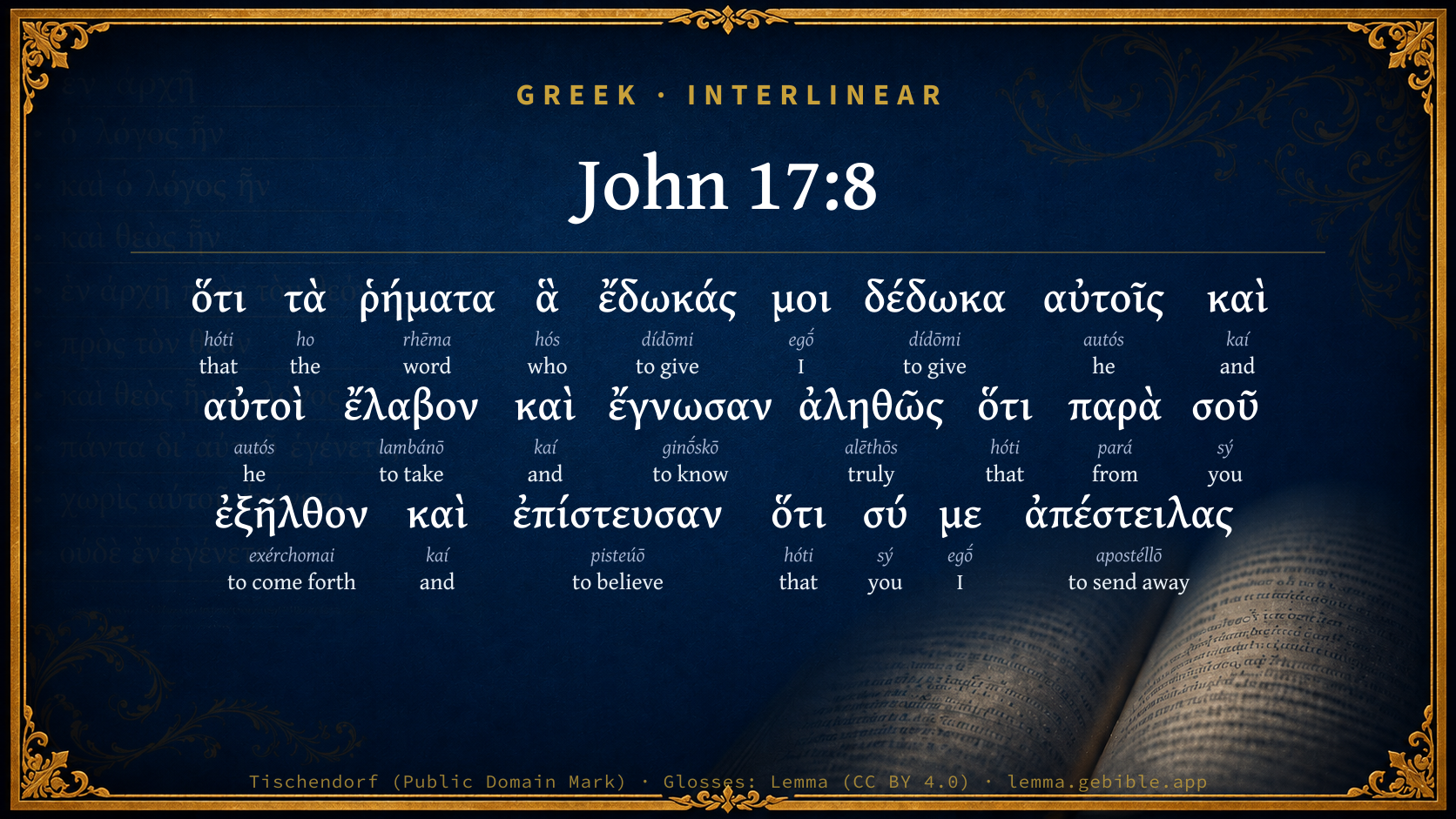
for the words which you have given me I have given to them, and they received them, and knew for sure that I came forth from you, and they have believed that you sent me.
Download a study sheet
One document with this verse’s original text, its word-by-word gloss line, the meaning frame, cross-references with their text, attributed commentary, and full source and license credits — printable, and it pastes into notes with its structure intact.
This verse Autodidact and up
A passage Seminary Student
Up to 50 verses in one chapter. A passage sheet keeps up to 6 commentary sources and 12 cross-references per verse, in the order this page ranks them, and says so on the sheet whenever that leaves anything out. Ask for a single verse and you get the Autodidact verse sheet above.
Everything on this page stays free to read, with no account — the sheet is a download of what is already on screen, not access to it.
Compare translations 3
The same verse in 3 English versions, stacked beneath the original-language interlinear above. Click any original word for its lexicon entry.
Each is an independent rendering of the whole verse — the interlinear is not word-aligned to these translations.
Highlighted words mark where these versions differ — a whole-verse word diff, not a word-by-word alignment.
-
World English Bible Public Domain
for the words which you have given me I have given to them, and they received them, and knew for sure that I came forth from you, and they have believed that you sent me.
-
King James Version Public Domain
For I have given unto them the words which thou gavest me; and they have received them, and have known surely that I came out from thee, and they have believed that thou didst send me.
-
unfoldingWord Literal Text CC BY-SA 4.0
for I have given them the words that you gave me, and they received and truly knew that I came from you, and they believed that you sent me.
unfoldingWord Literal Text — © unfoldingWord, licensed CC BY-SA 4.0. Word-aligned USFM3 via Door43 (git.door43.org/unfoldingWord/en_ult).
Show all 19 translations
Every available English version of this verse, each an independent rendering of the whole verse.
-
World English Bible Public Domain
for the words which you have given me I have given to them, and they received them, and knew for sure that I came forth from you, and they have believed that you sent me.
-
Berean Standard Bible Public Domain
For I have given them the words You gave Me, and they have received them. They knew with certainty that I came from You, and they believed that You sent Me.
-
Majority Standard Bible Public Domain
For I have given them the words You gave Me, and they have received them. They knew with certainty that I came from You, and they believed that You sent Me.
-
King James Version Public Domain
For I have given unto them the words which thou gavest me; and they have received them, and have known surely that I came out from thee, and they have believed that thou didst send me.
-
American Standard Version (1901) Public Domain
for the words which thou gavest me I have given unto them; and they received `them', and knew of a truth that I came forth from thee, and they believed that thou didst send me.
-
Revised Version (1885) Public Domain
for the words which thou gavest me I have given unto them; and they received them, and knew of a truth that I came forth from thee, and they believed that thou didst send me.
-
Geneva Bible (1599) Public Domain
For I haue giuen vnto them the wordes which thou gauest me, and they haue receiued them, and haue knowen surely that I came out from thee, and haue beleeued that thou hast sent me.
-
Douay-Rheims (1899) Public Domain
Because the words which thou gavest me, I have given to them; and they have received them, and have known in very deed that I came out from thee, and they have believed that thou didst send me.
-
Young's Literal Translation Public Domain
because the sayings that Thou hast given to me, I have given to them, and they themselves received, and have known truly, that from Thee I came forth, and they did believe that Thou didst send me.
-
Literal Standard Version CC BY-SA 4.0
because the sayings that You have given to Me, I have given to them, and they themselves received, and have known truly, that I came forth from You, and they believed that You sent Me.
-
Unlocked Literal Bible CC BY-SA 4.0
for I have given them all the words that you gave me. They received them and truly knew that I came from you, and they believed that you sent me.
-
unfoldingWord Literal Text CC BY-SA 4.0
for I have given them the words that you gave me, and they received and truly knew that I came from you, and they believed that you sent me.
-
Darby Bible Public Domain
for the words which thou hast given me I have given them, and they have received [them], and have known truly that I came out from thee, and have believed that thou sentest me.
-
World Messianic Bible Public Domain
for the words which you have given me I have given to them; and they received them, and knew for sure that I came from you. They have believed that you sent me.
-
Webster's Bible Public Domain
For I have given to them the words which thou gavest me; and they have received them, and have known surely that I came from thee, and they have believed that thou didst send me.
-
Free Bible Version CC BY-SA 4.0
I have given them the message that you gave me. They accepted it, completely convinced that I came from you, and they believed that you sent me.
-
Bible in Basic English Public Domain
Because I have given them the words which you gave to me; and they have taken them to heart, and have certain knowledge that I came from you, and they have faith that you sent me.
-
Text-Critical English NT CC BY 4.0
For I have given them the words that yoʋ gave me, and they have received them and truly know that I came from yoʋ. They have also come to believe that yoʋ sent me.
-
Tyndale New Testament (1534) Public Domain
For I have geven vnto them the wordes which thou gavest me and they have receaved them and knowe surely that I came out from the: and doo beleve that thou dyddest send me.
Literal Standard Version (2020), Covenant Press — licensed CC BY-SA 4.0. Text via the HelloAO Bible API (eBible.org). Unlocked Literal Bible (unfoldingWord) — licensed CC BY-SA 4.0. Text via the HelloAO Bible API (eBible.org). unfoldingWord Literal Text — © unfoldingWord, licensed CC BY-SA 4.0. Word-aligned USFM3 via Door43 (git.door43.org/unfoldingWord/en_ult). Free Bible Version, Dr. Jonathan Gallagher — licensed CC BY-SA 4.0. Text via the HelloAO Bible API (eBible.org).
Word by word
More ways to search: Search by grammar → Find every occurrence → Compare this word →
Practice this passage: Drill this verse → Learn its vocabulary →
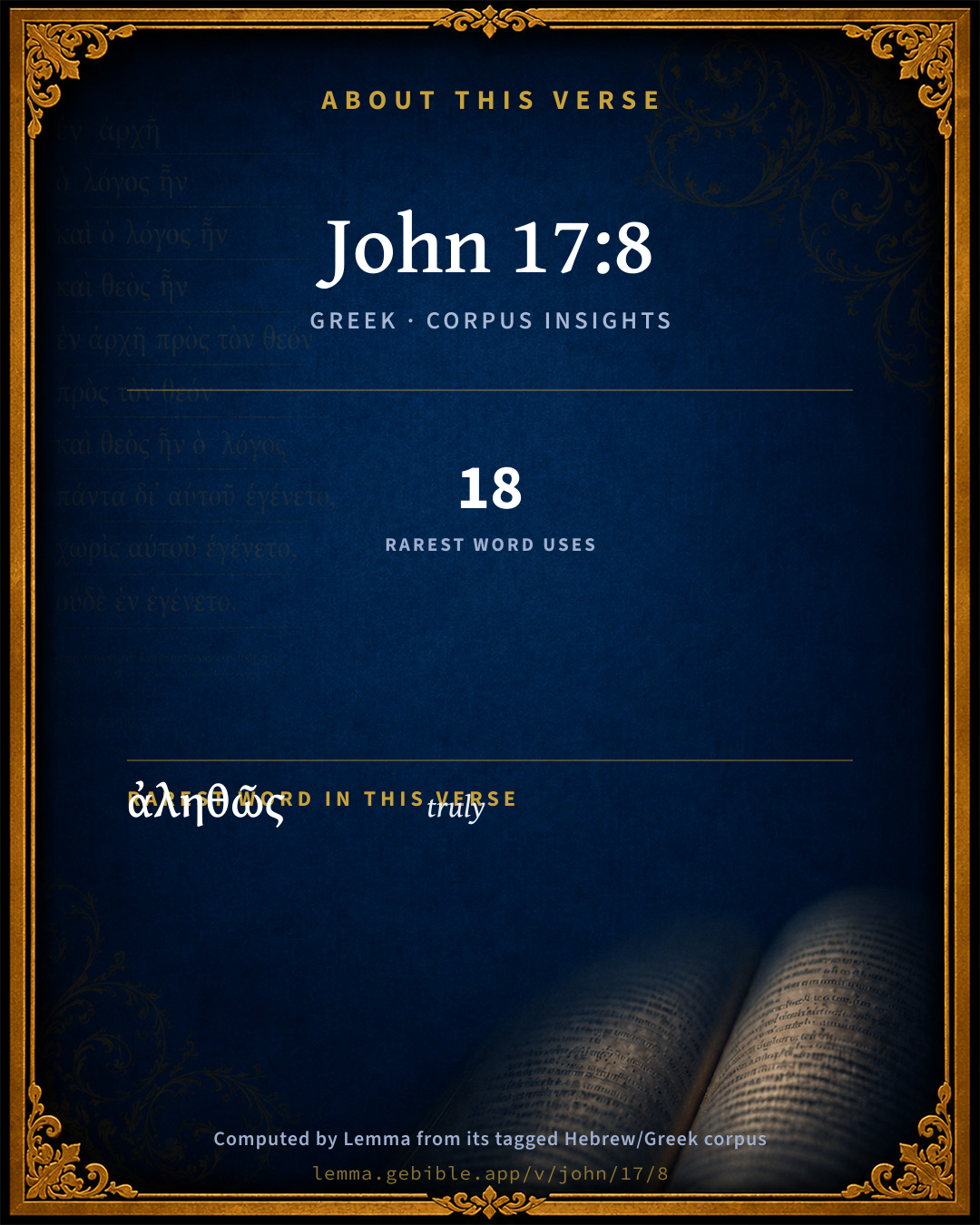
- Appears 18× in the Greek New Testament
- First appears at Matthew 14:33
- Part of Speech
- Adverb
Full Thayer's Definition
- ὅτι hóti G3754 “that” Conjunction
- τὰ ho G3588 “the” Article, Accusative, Plural, Neuter
- ῥήματα rhēma G4487 “word” Noun, Accusative, Plural, Neuter
- ἃ hós G3739 “who” Relative pronoun, Accusative, Plural, Neuter
- ἔδωκάς dídōmi G1325 “to give” Verb, Aorist, Active, Indicative, 2nd person, Singular
- μοι egṓ G1473 “I” Personal pronoun, 1st person, Dative, Singular
- δέδωκα dídōmi G1325 “to give” Verb, Perfect, Active, Indicative, 1st person, Singular
- αὐτοῖς autós G846 “he” Personal pronoun, Dative, Plural, Masculine
- καὶ kaí G2532 “and” Conjunction
- αὐτοὶ autós G846 “he” Personal pronoun, Nominative, Plural, Masculine
- ἔλαβον lambánō G2983 “to take” Verb, Aorist, Active, Indicative, 3rd person, Plural
- καὶ kaí G2532 “and” Conjunction
- ἔγνωσαν ginṓskō G1097 “to know” Verb, Aorist, Active, Indicative, 3rd person, Plural
- ἀληθῶς alēthōs G230 “truly” Adverb
- ὅτι hóti G3754 “that” Conjunction
- παρὰ pará G3844 “from” Preposition
- σοῦ sý G4771 “you” Personal pronoun, 2nd person, Genitive, Singular
- ἐξῆλθον exérchomai G1831 “to come forth” Verb, Aorist, Active, Indicative, 1st person, Singular
- καὶ kaí G2532 “and” Conjunction
- ἐπίστευσαν pisteúō G4100 “to believe” Verb, Aorist, Active, Indicative, 3rd person, Plural
- ὅτι hóti G3754 “that” Conjunction
- σύ sý G4771 “you” Personal pronoun, 2nd person, Nominative, Singular
- με egṓ G1473 “I” Personal pronoun, 1st person, Accusative, Singular
- ἀπέστειλας apostéllō G649 “to send away” Verb, Aorist, Active, Indicative, 2nd person, Singular
About this verse
These counts appear in no published source. They are computed here, from the morphology-tagged text and Lemma’s own curated glosses. What Lemma adds →
- 24
- words
- 16
- distinct lemmas
- Gospels
- section
Cross-references
28Topical passages linked to John 17:8 in the Treasury of Scripture Knowledge — connected by theme and wording, ordered by reader-vote popularity; previews shown in the World English Bible.
- John 17:14 I have given them your word. The world hated them, because they are not of the world, even as I am not of the world.
- John 15:15 No longer do I call you servants, for the servant doesn't know what his lord does. But I have called you friends, for everything that I heard from my Father, I have made known to you.
- John 16:30 Now we know that you know all things, and don't need for anyone to question you. By this we believe that you came forth from God."
- 1 Thessalonians 2:13 For this cause we also thank God without ceasing, that, when you received from us the word of the message of God, you accepted it not as the word of men, but, as it is in truth, the word of God, which also works in you who believe.
- John 16:27 for the Father himself loves you, because you have loved me, and have believed that I came forth from God.
- John 8:42 Therefore Jesus said to them, "If God were your Father, you would love me, for I came out and have come from God. For I haven't come of myself, but he sent me.
- John 12:49 For I spoke not from myself, but the Father who sent me, he gave me a commandment, what I should say, and what I should speak.
- John 17:21 that they may all be one; even as you, Father, are in me, and I in you, that they also may be one in us; that the world may believe that you sent me.
- 1 John 4:14 We have seen and testify that the Father has sent the Son as the Savior of the world.
- Proverbs 1:3 To receive instruction in wise dealing, In righteousness, justice, and equity;
- John 6:68 Simon Peter answered him, "Lord, to whom would we go? You have the words of eternal life.
- John 14:10 Don't you believe that I am in the Father, and the Father in me? The words that I tell you, I speak not from myself; but the Father who lives in me does his works.
- John 17:23 I in them, and you in me, that they may be perfected into one; that the world may know that you sent me, and loved them, even as you loved me.
- John 17:25–26 Righteous Father, the world hasn't known you, but I knew you; and these knew that you sent me.
- Proverbs 8:10 Receive my instruction rather than silver; Knowledge rather than choice gold.
- Matthew 13:11 He answered them, "To you it is given to know the mysteries of the Kingdom of Heaven, but it is not given to them.
- John 17:6–7 I revealed your name to the people whom you have given me out of the world. They were yours, and you have given them to me. They have kept your word.
- John 17:18 As you sent me into the world, even so I have sent them into the world.
- 1 Corinthians 15:1 Now I declare to you, brothers, the Gospel which I preached to you, which also you received, in which you also stand,
- Ephesians 3:2–8 if it is so that you have heard of the administration of that grace of God which was given me toward you;
- 1 Thessalonians 4:1 Finally then, brothers, we beg and exhort you in the Lord Jesus, that as you received from us how you ought to walk and to please God, that you abound more and more.
- Proverbs 1:23 Turn at my reproof. Behold, I will pour out my spirit on you. I will make known my words to you.
- John 3:17 For God didn't send his Son into the world to judge the world, but that the world should be saved through him.
- John 3:33 He who has received his witness has set his seal to this, that God is true.
- 1 Corinthians 11:23 For I received from the Lord that which also I delivered to you, that the Lord Jesus on the night in which he was betrayed took bread.
- Proverbs 4:10 Listen, my son, and receive my sayings. The years of your life will be many.
- Ephesians 4:11–12 He gave some to be apostles; and some, prophets; and some, evangelists; and some, shepherds and teachers;
- Proverbs 2:1 My son, if you will receive my words, And store up my commandments within you;
Cross-references courtesy of OpenBible.info (CC BY 4.0).
Lesson kit
Teaching starters — assembled from the data on this page, not authored interpretation. Every prompt links to the verse data it draws on. Edit before teaching.
John, in the Gospels, opens this verse with 24 words (16 distinct Greek lemmas). Its most distinctive word is alēthōs (“truly”). A historical commentator’s framing appears above. Read the whole chapter for the surrounding context.
Discussion questions
- The word alēthōs carries the sense “truly.” How does it shape the verse?
- How does Matthew 14:33, which shares the word «truly», read alongside this verse?
- What does the repetition of “to give” (2× in this one verse) do in this verse?
- These translations render this verse differently; the difference is in the English rendering, not the original. What questions does that raise?
- Compare how Tyndale Open Study Notes and Bengel's Gnomon read this verse. Where do they agree or differ?
Things to notice
- These translations choose different wording for 14 words in this verse.
- “to give” occurs 2× in this single verse.
- 16 distinct Greek lemmas span 24 words in this verse.
Commentary
Notes on John 17:8 from classic Christian and Jewish commentators (each source and its license shown beneath its notes). The classic Christian expositions comment on the surrounding passage and are grouped to its opening verse, so a note may address several verses; the Jewish commentaries on the Tanakh (Rashi and others) are per-verse, so they appear only where the commentator wrote on this verse.
Lemma curates 59 commentaries, every one of them public domain or Creative Commons licensed, each selected and text-cleaned for this edition rather than reprinted as found. About our sources →
Tyndale Open Study Notes
Tyndale Open Resources
Tyndale Open Study Notes — © Tyndale Open Resources, licensed CC BY-SA 4.0. Text via the HelloAO Bible API.
Bengel's Gnomon
Johann Albrecht Bengel
Bengel's Gnomon of the New Testament — English translation (T&T Clark, Edinburgh, 1860) — public domain. Text from a community e-Sword module.
Expositor's Greek Testament
ed. W. Robertson Nicoll
The Expositor's Greek Testament, edited by W. Robertson Nicoll (1897–1910) — public domain. Text from a community e-Sword module.
Jamieson, Fausset & Brown
Robert Jamieson, A. R. Fausset & David Brown
Jamieson, Fausset & Brown — Commentary Critical and Explanatory on the Whole Bible (1871) — public domain (CC PDM 1.0). Text via the HelloAO Bible API.
Adam Clarke's Commentary
Adam Clarke's Commentary on the Bible (1810–1826) — public domain. Text from a community e-Sword/MySword module.
John Calvin's Commentaries
John Calvin's Commentaries (1540-1563) — public domain. Text from the Calvin Translation Society English edition (1840s-50s) via the Christian Classics Ethereal Library (ccel.org). Calvin's coverage is partial (roughly two-thirds of the Bible); uncommented books and verses are honest gaps, never fabricated. The 19th-century editor's footnotes and remarks are omitted so the notes are faithfully Calvin's own voice.
Ellicott's Commentary for English Readers
A Bible Commentary for English Readers, edited by Charles John Ellicott (1878–1897) — public domain. Text from a community e-Sword module.
The Cambridge Bible for Schools and Colleges
gen. ed. J. J. S. Perowne
The Cambridge Bible for Schools and Colleges (gen. ed. J. J. S. Perowne; Cambridge University Press, 1878–1918) — public domain. Text from a community e-Sword module.
John Gill's Exposition
John Gill's Exposition of the Whole Bible (1746–1763) — public domain (CC PDM 1.0). Text via the HelloAO Bible API.
Trapp's Complete Commentary
John Trapp
John Trapp, A Commentary or Exposition upon All the Books of the Old and New Testament (1647–1656) — public domain. Text from a community e-Sword module.
Albert Barnes' Notes on the Bible
Albert Barnes' Notes on the Bible (1834–1885) — public domain. Text from a community e-Sword/MySword module.
Matthew Poole's English Annotations
Matthew Poole's English Annotations on the Holy Bible (1683–1685) — public domain. Text from a community e-Sword/MySword module.
Whedon's Commentary on the Bible
Daniel D. Whedon
Daniel D. Whedon (gen. ed.), Commentary on the Old and New Testaments (1874–1909) — public domain. Text from a community e-Sword module.
John Wesley's Explanatory Notes
John Wesley, Explanatory Notes Upon the Whole Bible (1754–1765) — public domain. Text via the GEBible commentary corpus.
Burkitt's Expository Notes on the New Testament
William Burkitt
William Burkitt's Expository Notes on the New Testament (1700–1703) — public domain. Text from a community e-Sword module.
Cambridge Greek Testament for Schools and Colleges
Cambridge Greek Testament for Schools and Colleges (Cambridge University Press, 1896; 21 vols, various authors incl. Carr, Maclear, Plummer, Farrar, Lumby, Moule, M. R. James, Simcox) — public domain. Text from a community e-Sword module.
Alford’s Greek Testament
Henry Alford
Henry Alford, The Greek Testament (1849–1861) — public domain. Text from a community e-Sword module.
International Critical Commentary
International Critical Commentary — older volumes (1896–1929), various authors — public domain. Text from a community e-Sword module.
Vincent's Word Studies in the New Testament
Marvin R. Vincent
Marvin R. Vincent, Word Studies in the New Testament (1887–1900) — public domain. Text from a community e-Sword/MySword module.